



Aluminum Casting Market
Aluminum Casting Market Size, Share, Insights, Competitive Landscape, and Forecast 2026 to 2033
Aluminum Casting Market Size and Trend Analysis
How Fast Is the Aluminum Casting Market Growing?
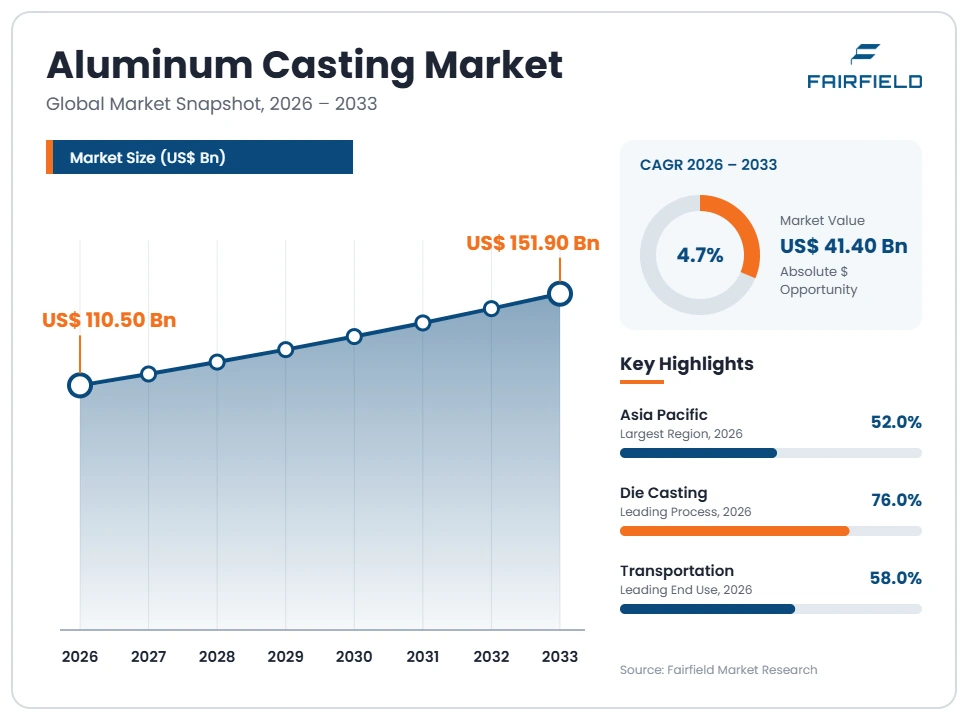
The global aluminum casting market size is expected to be valued at US$ 110.50 billion in 2026 and projected to reach US$ 151.90 billion by 2033, growing at a CAGR of 4.7% between 2026 and 2033.
Between 2020 and 2025, the market grew at a CAGR of about 4.2%, as vehicle production fell during the pandemic and then recovered, electric vehicle makers increased use of aluminum parts, and aluminum prices swung sharply. Aluminum casting pours or injects molten aluminum into molds to make parts such as engine blocks, transmission housings, wheels, battery housings, structural body parts, and industrial components. Three factors now drive growth: vehicle lightweighting to improve fuel efficiency and electric vehicle range, the rise of gigacasting that replaces dozens of stamped steel parts with one large casting, and demand from aerospace, construction, and industrial machinery. The market is shifting toward high-pressure die casting of large structural parts, recycled aluminum alloys that cut carbon emissions, and automation in foundries. In February 2026, Nemak completed its US$ 336 million acquisition of the automotive business of GF Casting Solutions, expanding its structural and e-mobility casting capacity in Europe, China, and the United States.
Key Report Takeaways
- By Process: Die Casting held 76.0% share in 2026, and is also projected to expand fastest at a 5.0% CAGR through 2033, driven by high-pressure die casting of large structural and battery parts for electric vehicles.
- By End Use: Transportation held 58.0% share in 2026, and is also projected to expand fastest at a 5.1% CAGR through 2033, driven by lightweighting in passenger cars, commercial vehicles, and aircraft.
- By Application: Engine & Powertrain held 38.0% share in 2026, while Structural & Body Parts are projected to expand at a 9.0% CAGR through 2033, driven by gigacasting of underbodies and battery enclosures.
- By Region: Asia Pacific held 52.0% share in 2026, while India is projected to expand at a 6.3% CAGR through 2033, driven by vehicle production growth, two-wheeler demand, and new foundry investments.
Global Aluminum Casting Market Trends and Insights
Drivers Impact Analysis
Two drivers carry the strongest influence on aluminum casting demand during the forecast period.
| Driver | Impact on CAGR Forecast | Geographic Relevance | Impact Timeline |
| Vehicle lightweighting and electric vehicle growth | High | Global | Long term (≥4 years) |
| Aerospace, defense, and industrial demand | Medium | North America, Europe | Medium term (2–4 years) |
Lightweighting Is Driving the Aluminum Casting Market
Vehicle lightweighting and electric vehicle growth are the strongest driver of the aluminum casting market. Lighter vehicles use less energy.
The mechanism is the push for efficiency and lower emissions. Aluminum weighs about one third as much as steel, so replacing steel parts with aluminum castings cuts vehicle weight, improves fuel economy, and extends electric vehicle range. Electric vehicles use aluminum castings for battery housings, motor housings, inverter cases, and structural parts. Global electric vehicle sales exceeded 4 million units in the first quarter of 2025, up 35% from a year earlier. Carmakers such as Tesla, Volvo, Toyota, and Chinese brands are adopting gigacasting to make large underbody sections in one piece, cutting parts, welding, and assembly time. Emission rules in Europe, China, and the United States keep pressure on weight reduction. These trends increase aluminum content per vehicle.
Industrial and Aerospace Demand Is Expanding the Aluminum Casting Market
Aerospace, defense, and industrial demand is expanding the aluminum casting market. Many sectors need strong, light, and complex parts.
The cause is rising production in high-value industries. Airbus plans to raise A320 Family production to 75 aircraft per month by 2027, increasing demand for aerospace castings. Defense agencies are funding domestic casting capacity, and the U.S. Department of Defense awarded Constellium US$ 23 million in July 2024 to expand casting capacity at Muscle Shoals. Industrial machinery, pumps, compressors, electrical equipment, and renewable energy systems use aluminum castings. Construction uses cast aluminum in windows, facades, and fittings. Consumer electronics use die-cast housings. These diverse uses support steady demand and help foundries balance the ups and downs of the automotive cycle. Data center and power grid investments are also increasing demand for cast enclosures and heat sinks.
Restraints Impact Analysis
Two restraints limit how quickly the aluminum casting market grows.
| Restraint | Impact on CAGR Forecast | Geographic Relevance | Impact Timeline |
| Aluminum price volatility and energy costs | High | Global | Medium term (2–4 years) |
| High capital costs and skilled labor shortages | Medium | North America, Europe | Long term (≥4 years) |
Price Volatility Slows the Aluminum Casting Market
Aluminum price volatility and energy costs slow the aluminum casting market. Raw materials and energy make up a large share of foundry costs.
The specific causes are commodity markets and trade policy. Aluminum prices move with global supply, energy prices, and demand from China. Tariffs on imported aluminum in the United States pushed domestic costs up sharply, with US aluminum prices rising nearly 40% to more than US$ 5,200 per metric ton by January 2026. Melting aluminum uses large amounts of energy, so high electricity and gas prices in Europe hurt foundry margins. Foundries often struggle to pass full cost increases to automotive customers under long-term contracts. These factors squeeze profits and can delay investment. Some foundries use price pass-through clauses linked to aluminum indexes, but these often lag cost increases by several months.
Capital Costs Restrict the Aluminum Casting Market
High capital costs and skilled labor shortages restrict the aluminum casting market. Modern foundries need expensive equipment and skilled staff.
The underlying causes are technology demands and workforce gaps. Large high-pressure die casting machines used for gigacasting can cost tens of millions of dollars each and need new buildings and cooling systems. Smaller foundries may not afford upgrades. Experienced die makers, metallurgists, and maintenance technicians are retiring faster than they are replaced. Porosity and defects in large castings require advanced quality control. Slower electric vehicle growth in some markets has made some investments riskier. These factors slow capacity expansion. Some carmakers have also paused or scaled back gigacasting plans after finding that repairs to large single-piece castings can be costly, which adds uncertainty to investment decisions. Automation, simulation software, and training programs are helping foundries address skills gaps.
Market Opportunities
Gigacasting and EV Structures Open a Fast-Growth Revenue Pool
Gigacasting and electric vehicle structures open a fast-growth revenue pool in the aluminum casting market. Large castings are changing how cars are built.
Die casters and machine makers can capture this opportunity. Giant casting machines from IDRA, LK Group, and Bühler make front and rear underbodies in one piece, reducing parts from dozens to a few. Battery enclosures and motor housings need precise, leak-tight castings. Nemak is starting a megacasting plant in Augusta, Georgia, in the second half of 2026, with production ramping through 2028. Ryobi has adopted gigacasting in Japan for large automotive parts. Suppliers with large-machine expertise can win long programs with carmakers. Chinese die casters have moved fastest in adopting very large machines, giving them early experience and cost advantages.
Recycled and Low-Carbon Aluminum Create a Sustainability Revenue Pool
Recycled aluminum and low-carbon alloys create a sustainability revenue pool in the aluminum casting market. Carmakers want to cut emissions across their supply chains.
Foundries and alloy producers can capture this opportunity. Recycled aluminum needs only about 5% of the energy used to make primary aluminum. New alloys that tolerate more scrap and need no heat treatment suit large castings. Carmakers in Europe set targets for recycled content and low-carbon materials. Carbon reporting rules push suppliers to measure and lower emissions. Closed-loop recycling of foundry scrap reduces costs. Companies that offer certified low-carbon castings can win premium contracts. Aluminum producers are launching low-carbon brands made with renewable power and high recycled content, and foundries that use them can help carmakers meet emissions targets for their supply chains.
Segment Analysis
- By Process: Die Casting Leads and Grows Fastest
Die Casting held 76.0% share in 2026 and is also the fastest-growing process, expanding at a 5.0% CAGR through 2033. Die casting, especially high-pressure die casting, produces thin-walled, precise parts at high volume and suits automotive, electronics, and industrial uses. Nemak, Ryobi, Dynacast, Gibbs Die Casting, and Martinrea International are leading die casters.
Permanent mold casting is used for wheels, cylinder heads, and pistons, while sand casting serves large, complex, and low-volume parts such as engine blocks and industrial housings. Investment casting serves aerospace, defense, and medical parts that need fine detail and tight tolerances. For the market, die casting growth follows electric vehicle production and the move to larger, more integrated parts.
- By End Use: Transportation Leads and Grows Fastest
Transportation held 58.0% share in 2026 and is also the fastest-growing end use, expanding at a 5.1% CAGR through 2033. Passenger cars, trucks, buses, two-wheelers, rail, and aircraft use aluminum castings for engines, transmissions, wheels, structures, and battery systems.
Industrial machinery, building and construction, consumer goods, and electrical equipment are other end uses. Construction uses castings in windows, curtain walls, and fittings. For the market, transportation growth drives volume. Industrial uses include pump and valve bodies, gearbox housings, compressors, and electrical enclosures, which need strength and corrosion resistance. Consumer goods such as cookware, power tools, and appliances use die-cast parts. Telecom and electronics use cast housings and heat sinks that manage heat from processors and power devices.
- By Application: Engine & Powertrain Leads While Structural & Body Parts Grow Fastest
Engine & Powertrain held 38.0% share in 2026. Cylinder heads, engine blocks, transmission cases, and motor housings are long-established, high-volume uses of aluminum castings.
Structural & Body Parts are the fastest-growing application, expanding at a 9.0% CAGR through 2033. Gigacasting of underbodies, shock towers, and battery enclosures is replacing stamped steel. Wheels, chassis, and suspension parts are other important applications for cast aluminum. For the market, structural growth offsets slower engine demand. As electric vehicles replace combustion cars, demand for cylinder heads and engine blocks will gradually decline, while demand for motor housings, inverter cases, and battery trays rises. Aluminum wheels remain a large, steady segment, and lightweight chassis and suspension parts help offset heavy batteries.
Geography Analysis
- Why Is North America Important to the Aluminum Casting Market?
North America is an important aluminum casting market. The United States, Mexico, and Canada have large vehicle production, aerospace, and defense industries. Nemak in Mexico, Martinrea International and Linamar in Canada, and Alcoa in the United States are key players. Wisconsin Aluminum Foundry acquired ATEK Metal Technologies in August 2024, and defense programs are funding new domestic casting capacity. Mexico is a major hub for automotive castings that serve US and Canadian assembly plants. Key barriers include high aluminum costs after tariffs and labor shortages. One opportunity is megacasting for electric vehicle and truck programs.
- Europe Builds the Aluminum Casting Market Through Premium Vehicles
Europe is the second-largest aluminum casting market. Germany, Italy, France, Spain, and Austria have premium car makers and suppliers. Constellium and many specialist foundries are based in the region. Germany has many die casters supplying Volkswagen, BMW, and Mercedes-Benz, and Italy is home to leading casting machine makers such as IDRA. Austria and Romania have growing foundry clusters. Carmakers in the region are shifting castings toward electric vehicle parts. Key barriers include high energy costs and weak vehicle demand in some markets. One opportunity is low-carbon castings using recycled aluminum.
- Which Region Is Leading the Aluminum Casting Market?
Asia Pacific is leading the aluminum casting market with a 52.0% share in 2026. China is the largest country market, with huge vehicle, electric vehicle, and electronics production. India is the fastest-growing country at a 6.3% CAGR through 2033. Japan hosts Ryobi. South Korea and Thailand have large automotive supply chains. Chinese electric vehicle makers such as BYD and Xiaomi use large castings in their vehicles. India benefits from rapid growth in cars, two-wheelers, and production-linked incentive schemes. Key barriers include overcapacity and price pressure in China. One change shaping the region is gigacasting adoption by local carmakers.
- Latin America Grows the Aluminum Casting Market Through Vehicle Production
Latin America is a growing aluminum casting market. Brazil and Argentina produce vehicles and agricultural machinery, and Nemak has plants in Brazil. Vehicle makers in Brazil are investing in hybrid and flex-fuel models that still use aluminum engine and transmission castings, and Chinese carmakers are building plants in the country. Chile, Peru, and Colombia use aluminum castings in mining equipment, pumps, valves, and construction products. Agricultural machinery and truck makers in Argentina use cast parts from local foundries. Key barriers include economic swings, currency volatility, and high interest rates. One opportunity is local supply for new vehicle plants.
- Middle East & Africa Expands the Aluminum Casting Market Through Industrial Growth
Middle East & Africa is an emerging aluminum casting market. The United Arab Emirates, Saudi Arabia, and Bahrain produce primary aluminum, and South Africa and Morocco make vehicles. Primary aluminum smelters in the region, including Emirates Global Aluminium and Ma’aden, supply metal to foundries worldwide and are looking to add downstream products. Morocco has become a major car exporter with growing supplier parks, and Saudi Arabia plans local vehicle production. Key barriers include limited foundries, technical skills, and local engineering capacity. Egypt and South Africa also have small foundry sectors serving local industry. One opportunity is automotive supply for new plants.
Competitive Landscape
The aluminum casting market is fragmented. Nemak, Ryobi, Martinrea International, Dynacast, and Linamar are leading automotive casters, while Gibbs Die Casting, Endurance Technologies, and Consolidated Metco serve specific segments. Alcoa and Constellium supply aluminum and castings, and thousands of small foundries serve local markets.
Companies compete on casting size and quality, cost, alloy expertise, global footprint, and relationships with carmakers. Large vehicle programs favor big suppliers that can invest in machines and serve customers on several continents. Smaller foundries compete mainly through specialization, flexibility, and short lead times. Carmakers such as Tesla have brought some casting in-house, which changes the supplier landscape. Chinese die casters are expanding abroad to follow their customers. Machine makers such as IDRA, Bühler, and LK Group shape the technology.
Strategic moves show how competition is changing. In August 2024, Wisconsin Aluminum Foundry acquired ATEK Metal Technologies. In February 2026, Nemak completed its acquisition of GF Casting Solutions’ automotive business. In July 2026, Nemak said its Georgia megacasting plant would start production. These moves show competition shifting toward scale, consolidation, and new megacasting capacity close to electric vehicle assembly plants, as suppliers prepare for larger structural castings and higher defense and aerospace demand.
Three themes shape vendor strategy. First, companies are consolidating. Second, they are adding megacasting capacity. Third, they are using more recycled aluminum. Vendors that combine large-casting capability, global footprints, and low-carbon materials are best placed to win share.
Recent Industry Developments
- July 2026: Nemak said its megacasting plant in Augusta, Georgia, would start production in the second half of 2026, ramping through 2028 – expands gigacasting capacity in North America.
- February 2026: Nemak completed its US$ 336 million acquisition of the automotive business of GF Casting Solutions, adding nine plants in Europe, China, and the United States – strengthens high-pressure die casting for e-mobility.
- August 2024: Wisconsin Aluminum Foundry acquired ATEK Metal Technologies – consolidates US foundry capacity.
- July 2024: The U.S. Department of Defense awarded Constellium US$ 23 million to expand casting capacity at Muscle Shoals – supports domestic defense supply.
Companies Covered in the Report
- Nemak
- Ryobi
- Martinrea International
- Dynacast
- Linamar
- Gibbs Die Casting
- Endurance Technologies
- Consolidated Metco
- Alcoa
- Constellium
- Wisconsin Aluminum Foundry
- Rheinmetall
Aluminum Casting Market Report Scope
| Metric | Value |
| Study Period | 2020–2033 |
| Market Size 2026 | US$ 110.50 Billion |
| Market Size 2033 | US$ 151.90 Billion |
| CAGR 2026–2033 | 4.7% |
| Absolute Dollar Opportunity | US$ 41.40 Billion |
| Largest Market | Asia Pacific |
| Fastest-Growing Market | India (Asia Pacific) |
| Market Concentration | Fragmented |
| Major Players | Nemak, Ryobi, Martinrea International, Dynacast, Linamar |
Aluminum Casting Market Segmentation
Process
- Die Casting
- Permanent Mold Casting
- Sand Casting
- Others
End Use
- Transportation
- Industrial
- Building & Construction
- Consumer Goods
- Others
Application
- Engine & Powertrain
- Structural & Body Parts
- Wheels
- Chassis & Suspension
- Others
Regions
- North America
- Europe
- Asia Pacific
- Latin America
- Middle East & Africa
- Executive Summary
- Global Aluminum Casting Market Snapshot
- Future Projections
- Key Report Takeaways
- Regional Snapshot
- Market Overview
- Market Definition and Report Scope
- Historical Trends 2020–2025
- Market Dynamics
- Drivers
- Lightweighting Is Driving the Aluminum Casting Market
- Industrial and Aerospace Demand Is Expanding the Aluminum Casting Market
- Restraints
- Price Volatility Slows the Aluminum Casting Market
- Capital Costs Restrict the Aluminum Casting Market
- Market Opportunities
- Gigacasting and EV Structures Open a Fast-Growth Revenue Pool
- Recycled and Low-Carbon Aluminum Create a Sustainability Revenue Pool
- Drivers
- Global Aluminum Casting Market Outlook, 2020-2033
- Global Aluminum Casting Market Outlook, by Process, Value (US$ Billion), 2020-2033
- Die Casting
- Permanent Mold Casting
- Sand Casting
- Others
- Global Aluminum Casting Market Outlook, by End Use, Value (US$ Billion), 2020-2033
- Transportation
- Industrial
- Building & Construction
- Consumer Goods
- Others
- Global Aluminum Casting Market Outlook, by Application, Value (US$ Billion), 2020-2033
- Engine & Powertrain
- Structural & Body Parts
- Wheels
- Chassis & Suspension
- Others
- Global Aluminum Casting Market Outlook, by Region, Value (US$ Billion), 2020-2033
- North America
- Europe
- Asia Pacific
- Latin America
- Middle East & Africa
- Global Aluminum Casting Market Outlook, by Process, Value (US$ Billion), 2020-2033
- North America Aluminum Casting Market Outlook, 2020-2033
- North America Aluminum Casting Market Outlook, by Process, Value (US$ Billion), 2020-2033
- Die Casting
- Permanent Mold Casting
- Sand Casting
- Others
- North America Aluminum Casting Market Outlook, by End Use, Value (US$ Billion), 2020-2033
- Transportation
- Industrial
- Building & Construction
- Consumer Goods
- Others
- North America Aluminum Casting Market Outlook, by Application, Value (US$ Billion), 2020-2033
- Engine & Powertrain
- Structural & Body Parts
- Wheels
- Chassis & Suspension
- Others
- North America Aluminum Casting Market Outlook, by Country, Value (US$ Billion), 2020-2033
- United States Aluminum Casting Market Outlook, by Process, 2020-2033
- United States Aluminum Casting Market Outlook, by End Use, 2020-2033
- United States Aluminum Casting Market Outlook, by Application, 2020-2033
- Mexico Aluminum Casting Market Outlook, by Process, 2020-2033
- Mexico Aluminum Casting Market Outlook, by End Use, 2020-2033
- Mexico Aluminum Casting Market Outlook, by Application, 2020-2033
- Canada Aluminum Casting Market Outlook, by Process, 2020-2033
- Canada Aluminum Casting Market Outlook, by End Use, 2020-2033
- Canada Aluminum Casting Market Outlook, by Application, 2020-2033
- North America Aluminum Casting Market Outlook, by Process, Value (US$ Billion), 2020-2033
- Europe Aluminum Casting Market Outlook, 2020-2033
- Europe Aluminum Casting Market Outlook, by Process, Value (US$ Billion), 2020-2033
- Die Casting
- Permanent Mold Casting
- Sand Casting
- Others
- Europe Aluminum Casting Market Outlook, by End Use, Value (US$ Billion), 2020-2033
- Transportation
- Industrial
- Building & Construction
- Consumer Goods
- Others
- Europe Aluminum Casting Market Outlook, by Application, Value (US$ Billion), 2020-2033
- Engine & Powertrain
- Structural & Body Parts
- Wheels
- Chassis & Suspension
- Others
- Europe Aluminum Casting Market Outlook, by Country, Value (US$ Billion), 2020-2033
- Germany Aluminum Casting Market Outlook, by Process, 2020-2033
- Germany Aluminum Casting Market Outlook, by End Use, 2020-2033
- Germany Aluminum Casting Market Outlook, by Application, 2020-2033
- Italy Aluminum Casting Market Outlook, by Process, 2020-2033
- Italy Aluminum Casting Market Outlook, by End Use, 2020-2033
- Italy Aluminum Casting Market Outlook, by Application, 2020-2033
- France Aluminum Casting Market Outlook, by Process, 2020-2033
- France Aluminum Casting Market Outlook, by End Use, 2020-2033
- France Aluminum Casting Market Outlook, by Application, 2020-2033
- Spain Aluminum Casting Market Outlook, by Process, 2020-2033
- Spain Aluminum Casting Market Outlook, by End Use, 2020-2033
- Spain Aluminum Casting Market Outlook, by Application, 2020-2033
- Austria Aluminum Casting Market Outlook, by Process, 2020-2033
- Austria Aluminum Casting Market Outlook, by End Use, 2020-2033
- Austria Aluminum Casting Market Outlook, by Application, 2020-2033
- Romania Aluminum Casting Market Outlook, by Process, 2020-2033
- Romania Aluminum Casting Market Outlook, by End Use, 2020-2033
- Romania Aluminum Casting Market Outlook, by Application, 2020-2033
- Europe Aluminum Casting Market Outlook, by Process, Value (US$ Billion), 2020-2033
- Asia Pacific Aluminum Casting Market Outlook, 2020-2033
- Asia Pacific Aluminum Casting Market Outlook, by Process, Value (US$ Billion), 2020-2033
- Die Casting
- Permanent Mold Casting
- Sand Casting
- Others
- Asia Pacific Aluminum Casting Market Outlook, by End Use, Value (US$ Billion), 2020-2033
- Transportation
- Industrial
- Building & Construction
- Consumer Goods
- Others
- Asia Pacific Aluminum Casting Market Outlook, by Application, Value (US$ Billion), 2020-2033
- Engine & Powertrain
- Structural & Body Parts
- Wheels
- Chassis & Suspension
- Others
- Asia Pacific Aluminum Casting Market Outlook, by Country, Value (US$ Billion), 2020-2033
- China Aluminum Casting Market Outlook, by Process, 2020-2033
- China Aluminum Casting Market Outlook, by End Use, 2020-2033
- China Aluminum Casting Market Outlook, by Application, 2020-2033
- India Aluminum Casting Market Outlook, by Process, 2020-2033
- India Aluminum Casting Market Outlook, by End Use, 2020-2033
- India Aluminum Casting Market Outlook, by Application, 2020-2033
- Japan Aluminum Casting Market Outlook, by Process, 2020-2033
- Japan Aluminum Casting Market Outlook, by End Use, 2020-2033
- Japan Aluminum Casting Market Outlook, by Application, 2020-2033
- South Korea Aluminum Casting Market Outlook, by Process, 2020-2033
- South Korea Aluminum Casting Market Outlook, by End Use, 2020-2033
- South Korea Aluminum Casting Market Outlook, by Application, 2020-2033
- Thailand Aluminum Casting Market Outlook, by Process, 2020-2033
- Thailand Aluminum Casting Market Outlook, by End Use, 2020-2033
- Thailand Aluminum Casting Market Outlook, by Application, 2020-2033
- Asia Pacific Aluminum Casting Market Outlook, by Process, Value (US$ Billion), 2020-2033
- Latin America Aluminum Casting Market Outlook, 2020-2033
- Latin America Aluminum Casting Market Outlook, by Process, Value (US$ Billion), 2020-2033
- Die Casting
- Permanent Mold Casting
- Sand Casting
- Others
- Latin America Aluminum Casting Market Outlook, by End Use, Value (US$ Billion), 2020-2033
- Transportation
- Industrial
- Building & Construction
- Consumer Goods
- Others
- Latin America Aluminum Casting Market Outlook, by Application, Value (US$ Billion), 2020-2033
- Engine & Powertrain
- Structural & Body Parts
- Wheels
- Chassis & Suspension
- Others
- Latin America Aluminum Casting Market Outlook, by Country, Value (US$ Billion), 2020-2033
- Brazil Aluminum Casting Market Outlook, by Process, 2020-2033
- Brazil Aluminum Casting Market Outlook, by End Use, 2020-2033
- Brazil Aluminum Casting Market Outlook, by Application, 2020-2033
- Argentina Aluminum Casting Market Outlook, by Process, 2020-2033
- Argentina Aluminum Casting Market Outlook, by End Use, 2020-2033
- Argentina Aluminum Casting Market Outlook, by Application, 2020-2033
- Chile Aluminum Casting Market Outlook, by Process, 2020-2033
- Chile Aluminum Casting Market Outlook, by End Use, 2020-2033
- Chile Aluminum Casting Market Outlook, by Application, 2020-2033
- Peru Aluminum Casting Market Outlook, by Process, 2020-2033
- Peru Aluminum Casting Market Outlook, by End Use, 2020-2033
- Peru Aluminum Casting Market Outlook, by Application, 2020-2033
- Colombia Aluminum Casting Market Outlook, by Process, 2020-2033
- Colombia Aluminum Casting Market Outlook, by End Use, 2020-2033
- Colombia Aluminum Casting Market Outlook, by Application, 2020-2033
- Latin America Aluminum Casting Market Outlook, by Process, Value (US$ Billion), 2020-2033
- Middle East & Africa Aluminum Casting Market Outlook, 2020-2033
- Middle East & Africa Aluminum Casting Market Outlook, by Process, Value (US$ Billion), 2020-2033
- Die Casting
- Permanent Mold Casting
- Sand Casting
- Others
- Middle East & Africa Aluminum Casting Market Outlook, by End Use, Value (US$ Billion), 2020-2033
- Transportation
- Industrial
- Building & Construction
- Consumer Goods
- Others
- Middle East & Africa Aluminum Casting Market Outlook, by Application, Value (US$ Billion), 2020-2033
- Engine & Powertrain
- Structural & Body Parts
- Wheels
- Chassis & Suspension
- Others
- Middle East & Africa Aluminum Casting Market Outlook, by Country, Value (US$ Billion), 2020-2033
- United Arab Emirates Aluminum Casting Market Outlook, by Process, 2020-2033
- United Arab Emirates Aluminum Casting Market Outlook, by End Use, 2020-2033
- United Arab Emirates Aluminum Casting Market Outlook, by Application, 2020-2033
- Saudi Arabia Aluminum Casting Market Outlook, by Process, 2020-2033
- Saudi Arabia Aluminum Casting Market Outlook, by End Use, 2020-2033
- Saudi Arabia Aluminum Casting Market Outlook, by Application, 2020-2033
- Bahrain Aluminum Casting Market Outlook, by Process, 2020-2033
- Bahrain Aluminum Casting Market Outlook, by End Use, 2020-2033
- Bahrain Aluminum Casting Market Outlook, by Application, 2020-2033
- South Africa Aluminum Casting Market Outlook, by Process, 2020-2033
- South Africa Aluminum Casting Market Outlook, by End Use, 2020-2033
- South Africa Aluminum Casting Market Outlook, by Application, 2020-2033
- Morocco Aluminum Casting Market Outlook, by Process, 2020-2033
- Morocco Aluminum Casting Market Outlook, by End Use, 2020-2033
- Morocco Aluminum Casting Market Outlook, by Application, 2020-2033
- Egypt Aluminum Casting Market Outlook, by Process, 2020-2033
- Egypt Aluminum Casting Market Outlook, by End Use, 2020-2033
- Egypt Aluminum Casting Market Outlook, by Application, 2020-2033
- Middle East & Africa Aluminum Casting Market Outlook, by Process, Value (US$ Billion), 2020-2033
- Competitive Landscape
- Market Concentration and Industry Leaders
- Competitive Differentiation
- Strategic Moves and Market Direction
- Recent Industry Developments
- Company Profiles
- Nemak
- Ryobi
- Martinrea International
- Dynacast
- Linamar
- Gibbs Die Casting
- Endurance Technologies
- Consolidated Metco
- Alcoa
- Constellium
- Wisconsin Aluminum Foundry
- Rheinmetall
- Appendix
- Research Methodology
- Report Assumptions
- Acronyms and Abbreviations
Process
- Die Casting
- Permanent Mold Casting
- Sand Casting
- Others
End Use
- Transportation
- Industrial
- Building & Construction
- Consumer Goods
- Others
Application
- Engine & Powertrain
- Structural & Body Parts
- Wheels
- Chassis & Suspension
- Others
Regions
- North America
- Europe
- Asia Pacific
- Latin America
- Middle East & Africa
Our Research Methodology
Considering the volatility of business today, traditional approaches to strategizing a game plan can be unfruitful if not detrimental. True ambiguity is no way to determine a forecast. A myriad of predetermined factors must be accounted for such as the degree of risk involved, the magnitude of circumstances, as well as conditions or consequences that are not known or unpredictable. To circumvent binary views that cast uncertainty, the application of market research intelligence to strategically posture, move, and enable actionable outcomes is necessary.
View Methodology
Quality Assured
Rigorous Validation Process

Confidentiality Assured
End-to-end Data Security

Custom Research Services
Tailored To Your Objectives
FAQs
The aluminum casting market is valued at US$ 110.50 billion in 2026, led by die casting and Asia Pacific.
The market is projected to reach US$ 151.90 billion by 2033, growing at a 4.7% CAGR and adding US$ 41.40 billion.
Structural and body parts are growing fastest at a 9.0% CAGR through 2033, driven by gigacasting of underbodies and battery enclosures.
India is growing fastest at a 6.3% CAGR through 2033, driven by vehicle production, two-wheeler demand, and new foundry investments.
Asia Pacific holds the largest share at 52.0% in 2026, supported by huge vehicle and electronics production in China.
Related Reports
Copper Wire & Cable Market Size, Share, Insights, Competitive Landscape, and Forecast 2026 to 2033
Copper wire and cable market to reach US$ 352.62 billion by 2033 at an 8.6% CAGR. Explore voltage, installation and regional trends.
Ni-based Superalloys Market Size, Share, Insights, Competitive Landscape, and Forecast 2026 to 2033
Ni-based superalloys market rises from US$10.35Bn in 2026 to US$18.92Bn by 2033 at 9.0% CAGR. Explore trends, segments and key companies.
Expanded Metal Foils Market Size, Share, Insights, Competitive Landscape, and Forecast 2026 to 2033
The global expanded metal foils market is valued at US$0.5 billion in 2026, reaching US$0.9 billion by 2033, growing at an 8.8% CAGR
Zirconium Market Size, Share, Insights, Competitive Landscape, and Forecast 2026 to 2033
The global zirconium market is valued at US$4.5 billion in 2026, reaching US$6.5 billion by 2033, growing at a 5.4% CAGR
Precision Stainless Steel Market Size, Share, Insights, Competitive Landscape, and Forecast 2026 to 2033
The global precision stainless steel market is valued at US$9.8 billion in 2026, reaching US$15.7 billion by 2033, growing at a 6.96% CAGR
Multi-mode Receiver Market Insights, Competitive Landscape, and Market Forecast 2033
Multi-Mode Receiver Market is projected to reach US$2.18 billion by 2033, driven by aircraft modernization, navigation mandates and fleet expansion