



Synchronous Condenser Market
Synchronous Condenser Market Size, Share, Insights, Competitive Landscape, and Forecast 2026 to 2033
Synchronous Condenser Market Size and Trend Analysis
How Fast Is the Synchronous Condenser Market Growing?
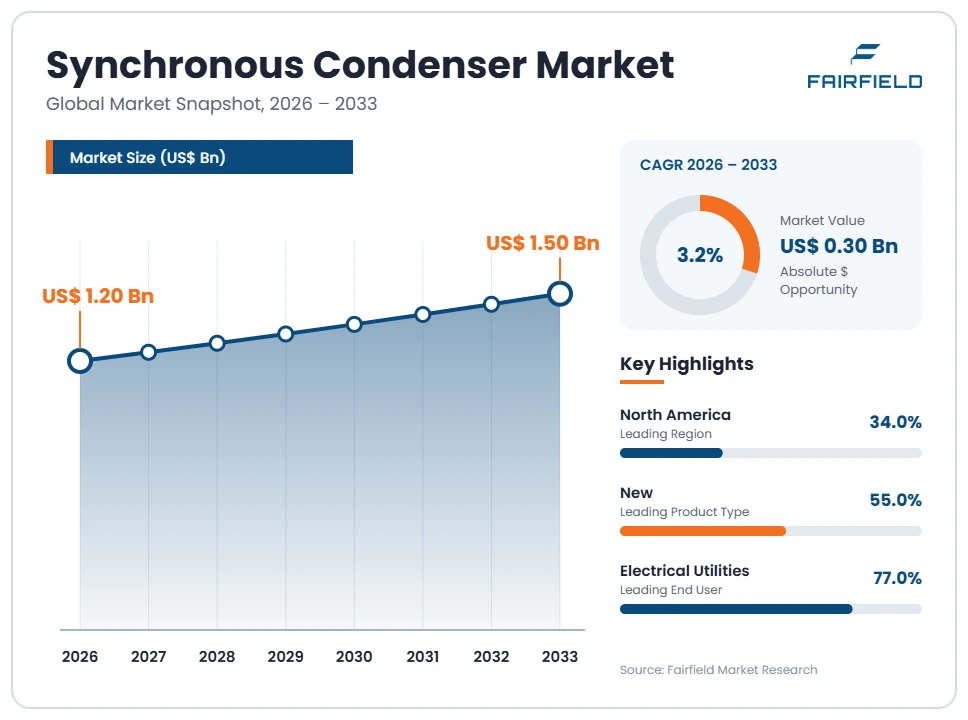
The global synchronous condenser market size is expected to be valued at US$ 1.20 billion in 2026 and projected to reach US$ 1.50 billion by 2033, growing at a CAGR of 3.2% between 2026 and 2033.
Between 2020 and 2025, the market grew at a CAGR of about 3.2%, as grid operators in Europe, Australia, and North America began installing new machines to support networks with high shares of wind and solar power. A synchronous condenser is a large rotating machine, similar to a generator without a prime mover, that connects to the grid to provide reactive power, voltage control, short-circuit strength, and system inertia. These services were once supplied by coal, gas, and nuclear plants, which are now retiring. Three factors now drive growth: the closure of fossil power plants, rapid renewable integration that relies on inverter-based generation, and new high-voltage transmission links. The market is shifting toward high-inertia designs with flywheels, conversion of retired generators into condensers, and hybrid solutions that combine condensers with grid-forming batteries. In February 2025, Ansaldo Energia won a US$ 300 million order for five 250 MVAR units to strengthen grid stability on Terna’s Italian network.
Key Report Takeaways
- By Cooling Type: Air-Cooled held 45.0% share in 2026, while Hydrogen-Cooled is projected to expand at a 4.0% CAGR through 2033, driven by large, high-rating machines that need efficient cooling in transmission-scale projects.
- By Product Type: New held 55.0% share in 2026, while Refurbished is projected to expand at a 4.1% CAGR through 2033, driven by low-cost conversion of retiring coal and gas generators into condensers.
- By End User: Electrical Utilities held 77.0% share in 2026, while Industrial is projected to expand at a 4.8% CAGR through 2033, driven by steel, mining, and data center sites needing stable voltage.
- By Region: North America held 34.0% share in 2026, while Asia Pacific is projected to expand at a 4.4% CAGR through 2033, driven by renewable zones in Australia and grid upgrades in India and China.
Global Synchronous Condenser Market Trends and Insights
Drivers Impact Analysis
Two drivers carry the strongest influence on synchronous condenser demand during the forecast period.
| Driver | Impact on CAGR Forecast | Geographic Relevance | Impact Timeline |
| Renewable integration and fossil plant retirements | High | Europe, North America, Asia Pacific | Long term (≥4 years) |
| Transmission expansion and HVDC links | Medium | Global | Medium term (2–4 years) |
Renewable Integration Is Driving the Synchronous Condenser Market
Renewable integration and the retirement of fossil power plants are the strongest driver of the synchronous condenser market. Grids need new sources of stability.
The mechanism is the loss of spinning machines from the grid. Coal, gas, and nuclear plants use large synchronous generators that naturally provide system inertia, short-circuit strength, and reactive power, which keep frequency and voltage stable after faults. Wind turbines and solar panels connect through power electronics and do not provide these services in the same way. As fossil plants close, grid operators in Germany, the United Kingdom, Italy, Australia, and Texas have identified stability gaps. Synchronous condensers fill these gaps reliably. The United Kingdom’s National Grid ran stability pathfinder tenders, and Australia’s Renewable Energy Zones include condensers. These programs create steady demand.
Transmission Expansion Is Expanding the Synchronous Condenser Market
Transmission expansion and high-voltage direct current links are expanding the synchronous condenser market. New lines need strong connection points.
The cause is massive investment in power grids. Countries are building long transmission lines to move power from remote wind and solar sites to cities. High-voltage direct current converter stations, especially older line-commutated designs, need strong alternating current grids, which condensers provide. Weak grid areas at the end of long lines need voltage support. Grid operators in India, China, Brazil, and the United States are planning large transmission programs. Interconnectors between countries in Europe also require stability support. These projects create new installation opportunities. Offshore wind connections in the North Sea and the Baltic Sea also need strong onshore connection points, and data center clusters add large new loads that weaken some local grids.
Restraints Impact Analysis
Two restraints limit how quickly the synchronous condenser market grows.
| Restraint | Impact on CAGR Forecast | Geographic Relevance | Impact Timeline |
| Competition from grid-forming batteries and power electronics | Medium | Global | Long term (≥4 years) |
| High capital costs and long lead times | Medium | Global | Medium term (2–4 years) |
Competing Technologies Slow the Synchronous Condenser Market
Competition from grid-forming batteries and power electronics slows the synchronous condenser market. Other technologies can provide some of the same services.
The specific causes are fast progress in inverter technology. Static VAR compensators and STATCOMs provide fast reactive power control at lower cost in some cases. Grid-forming battery inverters can provide synthetic inertia and voltage support, and they also store energy for market trading. Several grid operators in Australia and Europe are testing batteries for stability services. Battery costs have fallen sharply. However, batteries provide less fault current than rotating machines. These alternatives may reduce the number of condensers needed. Many grid planners now compare condensers, STATCOMs, and batteries for each location, choosing the cheapest mix that meets technical needs. In practice, condensers often win where high fault current is essential.
High Costs Restrict the Synchronous Condenser Market
High capital costs and long lead times restrict the synchronous condenser market. Condensers are large, complex machines.
The underlying causes are heavy equipment and supply chain limits. Each unit requires a large rotating machine, transformer, cooling system, building, and grid connection, costing tens of millions of dollars. Manufacturing capacity for large rotating machines and transformers is tight, causing lead times of several years. Projects require detailed grid studies and regulatory approval. Maintenance of rotating equipment adds operating costs. Utilities with limited budgets may delay orders. These factors slow project timelines. Suppliers are expanding factories and offering standardized designs to shorten delivery, while grid operators are placing framework orders for several units at once to secure manufacturing slots. Long-term service agreements help reduce operating risk for owners and give suppliers recurring revenue over the life of each machine.
Market Opportunities
Generator Conversions Open a Fast-Growth Revenue Pool
Converting retired generators into synchronous condensers opens a fast-growth revenue pool in the synchronous condenser market. Existing machines can be reused.
Engineering firms and original equipment makers can capture this opportunity. When coal or gas plants close, their generators can be decoupled from turbines and run as condensers using existing grid connections, buildings, and transformers. Conversion costs much less than new units and takes far less time to complete. Plant owners earn valuable new revenue from stability services. GE Vernova, Siemens Energy, and ANDRITZ offer conversion services. Many plants scheduled to close in North America, Europe, and Asia Pacific are candidates. Companies with conversion experience can win repeat projects. Regulators in some markets now pay for stability services through long-term contracts, which supports financing.
High-Inertia and Hybrid Solutions Create a Technology Revenue Pool
High-inertia condensers and hybrid solutions create a technology revenue pool in the synchronous condenser market. Grid operators want more stability per unit.
Equipment makers can capture this opportunity. Adding heavy flywheels to condensers increases stored rotating energy, giving more system inertia per machine. Combining condensers with STATCOMs or grid-forming batteries delivers both inertia and fast control. Digital monitoring and predictive maintenance improve availability and uptime. Siemens Energy won a condenser contract for Australia’s Central-West Orana Renewable Energy Zone in May 2025. Companies that offer integrated stability packages can earn higher margins. Grid operators in Ireland and the United Kingdom are paying for stability through competitive tenders, giving suppliers visibility. Combining condensers with energy storage at the same site shares grid connections and land, lowering total costs for developers.
Segment Analysis
- By Cooling Type: Air-Cooled Leads While Hydrogen-Cooled Grows Fastest
Air-Cooled held 45.0% share in 2026. Air-cooled condensers are simpler to install and maintain and suit small and medium ratings used by many utilities and industrial sites. ABB, WEG, and BRUSH supply air-cooled machines.
Hydrogen-Cooled is the fastest-growing cooling type, expanding at a 4.0% CAGR through 2033. Hydrogen cooling allows very large machines with high ratings, which suit transmission-scale projects. Water-cooled designs serve some large units. For the market, hydrogen cooling growth follows larger projects. Air-cooled machines remain popular for ratings up to about 200 MVAR because they avoid the safety systems needed for hydrogen. Larger transmission projects increasingly specify units of 250 MVAR or more, often with flywheels.
- By Product Type: New Leads While Refurbished Grows Fastest
New held 55.0% share in 2026. Purpose-built condensers from leading suppliers offer optimized designs, high inertia options, and long service lives for grid operators.
Refurbished is clearly the fastest-growing product type, expanding at a 4.1% CAGR through 2033. Conversion of retiring generators provides lower-cost stability. For the market, refurbishment growth supports faster grid support. Converting a generator can take one to two years, compared with several years for a new unit, and it reuses existing grid connections that are hard to obtain. However, not every old generator is suitable, and some need major repairs or new starting systems. Plant owners in the United States, Germany, and the United Kingdom have converted several units.
- By End User: Electrical Utilities Lead While Industrial Grows Fastest
Electrical Utilities held 77.0% share in 2026. Transmission system operators and utilities install condensers to maintain grid stability as renewable shares rise and fossil plants retire across their networks.
Industrial is the fastest-growing end user, expanding at a 4.8% CAGR through 2033. Steel mills, mines, and large data centers use condensers to stabilize voltage and protect sensitive equipment. For the market, industrial growth broadens demand beyond utilities. Electric arc furnaces in steel plants cause voltage swings that affect nearby users, and condensers help smooth them. Remote mines powered by renewable energy and batteries need condensers to keep their small grids stable. Large data center campuses connecting to weak grids are also studying condensers to meet grid code requirements.
Geography Analysis
- Which Region Is Leading the Synchronous Condenser Market?
North America is leading the synchronous condenser market with a 34.0% share in 2026. The United States is retiring coal plants and adding large amounts of wind and solar, especially in Texas, where ANDRITZ and GE Vernova are installing units at a substation. GE Vernova and Eaton are key players. Canada adds demand from new transmission and wind projects. Grid operators such as ERCOT and regional transmission organizations are studying stability needs as inverter-based generation grows. Key barriers include long equipment lead times and regulatory approvals. One change shaping the region is generator conversion at retiring coal plants.
- Europe Builds the Synchronous Condenser Market Through Grid Stability Programs
Europe is a major synchronous condenser market. Germany, the United Kingdom, Italy, Denmark, and Ireland have high renewable shares and stability programs. Siemens Energy in Germany, Ansaldo Energia in Italy, and ABB are key players in the region. Grid operators in Germany plan many condensers along new north-south transmission corridors. Ireland has one of the world’s highest shares of wind power and has procured stability services. Denmark installed condensers early to support its wind-heavy national grid. Key barriers include high costs and long permitting. One opportunity is interconnectors and offshore wind connections.
- Which Region Is Growing Fastest in the Synchronous Condenser Market?
Asia Pacific is growing fastest in the synchronous condenser market at a 4.4% CAGR through 2033. Australia is installing condensers in renewable energy zones, while India and China expand transmission. Japan has Mitsubishi Electric and Fuji Electric, which supply domestic and export projects. Australia’s grid operator has identified system strength gaps across several states, prompting large condenser orders. India is building green energy transmission corridors for large solar and wind parks in Rajasthan and Gujarat. Key barriers include competition from grid-forming batteries. One change shaping the region is renewable energy zones that bundle generation and stability.
- Latin America Grows the Synchronous Condenser Market Through Transmission Lines
Latin America is a growing synchronous condenser market. Brazil and Chile are expanding transmission and renewables. Brazil is building long transmission lines, including high-voltage direct current links, to carry power from the north and northeast to major cities in the south. Chile has large solar resources in the Atacama Desert and weak grid sections that need voltage support. Mexico and Colombia are adding wind and solar renewables, and Argentina and Peru are planning new transmission links that may need stability support. Key barriers include limited budgets and regulatory delays. One opportunity is HVDC converter stations that need strong alternating current grids.
- Middle East & Africa Expands the Synchronous Condenser Market Through Renewables
Middle East & Africa is an emerging synchronous condenser market. Saudi Arabia and the United Arab Emirates are adding solar power. Large solar parks in Saudi Arabia and the United Arab Emirates and planned high-voltage links in the region are increasing the need for reactive power and system inertia. Egypt and Morocco have growing wind and solar capacity and plan interconnections with Europe. South Africa is retiring coal plants and adding renewables, creating new stability gaps in its grid. Key barriers include high costs and grid funding limits. One opportunity is grids being built for new renewable zones.
Competitive Landscape
The synchronous condenser market is moderately concentrated. Siemens Energy, GE Vernova, ABB, Ansaldo Energia, and Hitachi Energy lead in large projects, while ANDRITZ, Voith, WEG, BRUSH, Fuji Electric, Mitsubishi Electric Power Products, Doosan Skoda Power, and BHEL serve specific markets.
Companies compete on machine size, inertia, efficiency, delivery time, grid studies, and service. References matter, because grid operators prefer suppliers with proven units in service. Large suppliers offer complete packages including grid studies, transformers, buildings, and long-term maintenance. Regional suppliers compete mainly on price, local presence, and service. Manufacturing capacity is a key constraint, and suppliers with available factory slots can win orders quickly. Partnerships help firms bid on large, complex projects.
Strategic moves show how competition is changing. In February 2025, Ansaldo Energia won a US$ 300 million order from Terna. In May 2025, Siemens Energy won an Australian contract. In May 2025, ANDRITZ and GE Vernova partnered on a Texas project. These moves show competition shifting toward large, multi-unit orders tied to renewable energy zones and national grid programs, with suppliers partnering to share engineering work and secure scarce manufacturing slots for large rotating machines.
Three themes shape vendor strategy. First, companies are adding factory capacity for large machines. Second, they are offering generator conversions. Third, they are combining technologies such as flywheels, STATCOMs, and batteries. Vendors that combine proven machines, fast delivery, and full lifecycle service are best placed to win share.
Recent Industry Developments
- May 2025: Siemens Energy was awarded a contract to supply synchronous condensers for Australia’s Central-West Orana Renewable Energy Zone – supports renewable integration.
- May 2025: ANDRITZ and GE Vernova partnered to install two synchronous condensers at a substation in Texas – strengthens grid stability in the United States.
- February 2025: Ansaldo Energia won a US$ 300 million order for five 250 MVAR synchronous condensers for Terna’s grid in Italy – adds system inertia and voltage support.
Companies Covered in the Report
- Siemens Energy
- GE Vernova
- ABB
- Ansaldo Energia
- Hitachi Energy
- ANDRITZ
- Voith
- WEG
- BRUSH
- Fuji Electric
- Mitsubishi Electric Power Products
- Doosan Skoda Power
Synchronous Condenser Market Report Scope
| Metric | Value |
| Study Period | 2020–2033 |
| Market Size 2026 | US$ 1.20 Billion |
| Market Size 2033 | US$ 1.50 Billion |
| CAGR 2026–2033 | 3.2% |
| Absolute Dollar Opportunity | US$ 0.30 Billion |
| Largest Market | North America |
| Fastest-Growing Market | Asia Pacific |
| Market Concentration | Moderately Concentrated |
| Major Players | Siemens Energy, GE Vernova, ABB, Ansaldo Energia, Hitachi Energy |
Synchronous Condenser Market Segmentation
Cooling Type
- Air-Cooled
- Hydrogen-Cooled
- Water-Cooled
Product Type
- New
- Refurbished
End User
- Electrical Utilities
- Industrial
Regions
- North America
- Europe
- Asia Pacific
- Latin America
- Middle East & Africa
- Executive Summary
- Global Synchronous Condenser Market Snapshot
- Future Projections
- Key Report Takeaways
- Regional Snapshot
- Market Overview
- Market Definition and Report Scope
- Historical Trends 2020–2025
- Market Dynamics
- Drivers
- Renewable Integration Is Driving the Synchronous Condenser Market
- Transmission Expansion Is Expanding the Synchronous Condenser Market
- Restraints
- Competing Technologies Slow the Synchronous Condenser Market
- High Costs Restrict the Synchronous Condenser Market
- Market Opportunities
- Generator Conversions Open a Fast-Growth Revenue Pool
- High-Inertia and Hybrid Solutions Create a Technology Revenue Pool
- Drivers
- Global Synchronous Condenser Market Outlook, 2020-2033
- Global Synchronous Condenser Market Outlook, by Cooling Type, Value (US$ Billion), 2020-2033
- Air-Cooled
- Hydrogen-Cooled
- Water-Cooled
- Global Synchronous Condenser Market Outlook, by Product Type, Value (US$ Billion), 2020-2033
- New
- Refurbished
- Global Synchronous Condenser Market Outlook, by End User, Value (US$ Billion), 2020-2033
- Electrical Utilities
- Industrial
- Global Synchronous Condenser Market Outlook, by Region, Value (US$ Billion), 2020-2033
- North America
- Europe
- Asia Pacific
- Latin America
- Middle East & Africa
- Global Synchronous Condenser Market Outlook, by Cooling Type, Value (US$ Billion), 2020-2033
- North America Synchronous Condenser Market Outlook, 2020-2033
- North America Synchronous Condenser Market Outlook, by Cooling Type, Value (US$ Billion), 2020-2033
- Air-Cooled
- Hydrogen-Cooled
- Water-Cooled
- North America Synchronous Condenser Market Outlook, by Product Type, Value (US$ Billion), 2020-2033
- New
- Refurbished
- North America Synchronous Condenser Market Outlook, by End User, Value (US$ Billion), 2020-2033
- Electrical Utilities
- Industrial
- North America Synchronous Condenser Market Outlook, by Country, Value (US$ Billion), 2020-2033
- United States Synchronous Condenser Market Outlook, by Cooling Type, 2020-2033
- United States Synchronous Condenser Market Outlook, by Product Type, 2020-2033
- United States Synchronous Condenser Market Outlook, by End User, 2020-2033
- Canada Synchronous Condenser Market Outlook, by Cooling Type, 2020-2033
- Canada Synchronous Condenser Market Outlook, by Product Type, 2020-2033
- Canada Synchronous Condenser Market Outlook, by End User, 2020-2033
- North America Synchronous Condenser Market Outlook, by Cooling Type, Value (US$ Billion), 2020-2033
- Europe Synchronous Condenser Market Outlook, 2020-2033
- Europe Synchronous Condenser Market Outlook, by Cooling Type, Value (US$ Billion), 2020-2033
- Air-Cooled
- Hydrogen-Cooled
- Water-Cooled
- Europe Synchronous Condenser Market Outlook, by Product Type, Value (US$ Billion), 2020-2033
- New
- Refurbished
- Europe Synchronous Condenser Market Outlook, by End User, Value (US$ Billion), 2020-2033
- Electrical Utilities
- Industrial
- Europe Synchronous Condenser Market Outlook, by Country, Value (US$ Billion), 2020-2033
- Germany Synchronous Condenser Market Outlook, by Cooling Type, 2020-2033
- Germany Synchronous Condenser Market Outlook, by Product Type, 2020-2033
- Germany Synchronous Condenser Market Outlook, by End User, 2020-2033
- United Kingdom Synchronous Condenser Market Outlook, by Cooling Type, 2020-2033
- United Kingdom Synchronous Condenser Market Outlook, by Product Type, 2020-2033
- United Kingdom Synchronous Condenser Market Outlook, by End User, 2020-2033
- Italy Synchronous Condenser Market Outlook, by Cooling Type, 2020-2033
- Italy Synchronous Condenser Market Outlook, by Product Type, 2020-2033
- Italy Synchronous Condenser Market Outlook, by End User, 2020-2033
- Denmark Synchronous Condenser Market Outlook, by Cooling Type, 2020-2033
- Denmark Synchronous Condenser Market Outlook, by Product Type, 2020-2033
- Denmark Synchronous Condenser Market Outlook, by End User, 2020-2033
- Ireland Synchronous Condenser Market Outlook, by Cooling Type, 2020-2033
- Ireland Synchronous Condenser Market Outlook, by Product Type, 2020-2033
- Ireland Synchronous Condenser Market Outlook, by End User, 2020-2033
- Europe Synchronous Condenser Market Outlook, by Cooling Type, Value (US$ Billion), 2020-2033
- Asia Pacific Synchronous Condenser Market Outlook, 2020-2033
- Asia Pacific Synchronous Condenser Market Outlook, by Cooling Type, Value (US$ Billion), 2020-2033
- Air-Cooled
- Hydrogen-Cooled
- Water-Cooled
- Asia Pacific Synchronous Condenser Market Outlook, by Product Type, Value (US$ Billion), 2020-2033
- New
- Refurbished
- Asia Pacific Synchronous Condenser Market Outlook, by End User, Value (US$ Billion), 2020-2033
- Electrical Utilities
- Industrial
- Asia Pacific Synchronous Condenser Market Outlook, by Country, Value (US$ Billion), 2020-2033
- Australia Synchronous Condenser Market Outlook, by Cooling Type, 2020-2033
- Australia Synchronous Condenser Market Outlook, by Product Type, 2020-2033
- Australia Synchronous Condenser Market Outlook, by End User, 2020-2033
- India Synchronous Condenser Market Outlook, by Cooling Type, 2020-2033
- India Synchronous Condenser Market Outlook, by Product Type, 2020-2033
- India Synchronous Condenser Market Outlook, by End User, 2020-2033
- China Synchronous Condenser Market Outlook, by Cooling Type, 2020-2033
- China Synchronous Condenser Market Outlook, by Product Type, 2020-2033
- China Synchronous Condenser Market Outlook, by End User, 2020-2033
- Japan Synchronous Condenser Market Outlook, by Cooling Type, 2020-2033
- Japan Synchronous Condenser Market Outlook, by Product Type, 2020-2033
- Japan Synchronous Condenser Market Outlook, by End User, 2020-2033
- Asia Pacific Synchronous Condenser Market Outlook, by Cooling Type, Value (US$ Billion), 2020-2033
- Latin America Synchronous Condenser Market Outlook, 2020-2033
- Latin America Synchronous Condenser Market Outlook, by Cooling Type, Value (US$ Billion), 2020-2033
- Air-Cooled
- Hydrogen-Cooled
- Water-Cooled
- Latin America Synchronous Condenser Market Outlook, by Product Type, Value (US$ Billion), 2020-2033
- New
- Refurbished
- Latin America Synchronous Condenser Market Outlook, by End User, Value (US$ Billion), 2020-2033
- Electrical Utilities
- Industrial
- Latin America Synchronous Condenser Market Outlook, by Country, Value (US$ Billion), 2020-2033
- Brazil Synchronous Condenser Market Outlook, by Cooling Type, 2020-2033
- Brazil Synchronous Condenser Market Outlook, by Product Type, 2020-2033
- Brazil Synchronous Condenser Market Outlook, by End User, 2020-2033
- Chile Synchronous Condenser Market Outlook, by Cooling Type, 2020-2033
- Chile Synchronous Condenser Market Outlook, by Product Type, 2020-2033
- Chile Synchronous Condenser Market Outlook, by End User, 2020-2033
- Mexico Synchronous Condenser Market Outlook, by Cooling Type, 2020-2033
- Mexico Synchronous Condenser Market Outlook, by Product Type, 2020-2033
- Mexico Synchronous Condenser Market Outlook, by End User, 2020-2033
- Colombia Synchronous Condenser Market Outlook, by Cooling Type, 2020-2033
- Colombia Synchronous Condenser Market Outlook, by Product Type, 2020-2033
- Colombia Synchronous Condenser Market Outlook, by End User, 2020-2033
- Argentina Synchronous Condenser Market Outlook, by Cooling Type, 2020-2033
- Argentina Synchronous Condenser Market Outlook, by Product Type, 2020-2033
- Argentina Synchronous Condenser Market Outlook, by End User, 2020-2033
- Peru Synchronous Condenser Market Outlook, by Cooling Type, 2020-2033
- Peru Synchronous Condenser Market Outlook, by Product Type, 2020-2033
- Peru Synchronous Condenser Market Outlook, by End User, 2020-2033
- Latin America Synchronous Condenser Market Outlook, by Cooling Type, Value (US$ Billion), 2020-2033
- Middle East & Africa Synchronous Condenser Market Outlook, 2020-2033
- Middle East & Africa Synchronous Condenser Market Outlook, by Cooling Type, Value (US$ Billion), 2020-2033
- Air-Cooled
- Hydrogen-Cooled
- Water-Cooled
- Middle East & Africa Synchronous Condenser Market Outlook, by Product Type, Value (US$ Billion), 2020-2033
- New
- Refurbished
- Middle East & Africa Synchronous Condenser Market Outlook, by End User, Value (US$ Billion), 2020-2033
- Electrical Utilities
- Industrial
- Middle East & Africa Synchronous Condenser Market Outlook, by Country, Value (US$ Billion), 2020-2033
- Saudi Arabia Synchronous Condenser Market Outlook, by Cooling Type, 2020-2033
- Saudi Arabia Synchronous Condenser Market Outlook, by Product Type, 2020-2033
- Saudi Arabia Synchronous Condenser Market Outlook, by End User, 2020-2033
- United Arab Emirates Synchronous Condenser Market Outlook, by Cooling Type, 2020-2033
- United Arab Emirates Synchronous Condenser Market Outlook, by Product Type, 2020-2033
- United Arab Emirates Synchronous Condenser Market Outlook, by End User, 2020-2033
- Egypt Synchronous Condenser Market Outlook, by Cooling Type, 2020-2033
- Egypt Synchronous Condenser Market Outlook, by Product Type, 2020-2033
- Egypt Synchronous Condenser Market Outlook, by End User, 2020-2033
- Morocco Synchronous Condenser Market Outlook, by Cooling Type, 2020-2033
- Morocco Synchronous Condenser Market Outlook, by Product Type, 2020-2033
- Morocco Synchronous Condenser Market Outlook, by End User, 2020-2033
- South Africa Synchronous Condenser Market Outlook, by Cooling Type, 2020-2033
- South Africa Synchronous Condenser Market Outlook, by Product Type, 2020-2033
- South Africa Synchronous Condenser Market Outlook, by End User, 2020-2033
- Middle East & Africa Synchronous Condenser Market Outlook, by Cooling Type, Value (US$ Billion), 2020-2033
- Competitive Landscape
- Market Concentration and Industry Leaders
- Competitive Differentiation
- Strategic Moves and Market Direction
- Recent Industry Developments
- Company Profiles
- Siemens Energy
- GE Vernova
- ABB
- Ansaldo Energia
- Hitachi Energy
- ANDRITZ
- Voith
- WEG
- BRUSH
- Fuji Electric
- Mitsubishi Electric Power Products
- Doosan Skoda Power
- Appendix
- Research Methodology
- Report Assumptions
- Acronyms and Abbreviations
Cooling Type
- Air-Cooled
- Hydrogen-Cooled
- Water-Cooled
Product Type
- New
- Refurbished
End User
- Electrical Utilities
- Industrial
Regions
- North America
- Europe
- Asia Pacific
- Latin America
- Middle East & Africa
Our Research Methodology
Considering the volatility of business today, traditional approaches to strategizing a game plan can be unfruitful if not detrimental. True ambiguity is no way to determine a forecast. A myriad of predetermined factors must be accounted for such as the degree of risk involved, the magnitude of circumstances, as well as conditions or consequences that are not known or unpredictable. To circumvent binary views that cast uncertainty, the application of market research intelligence to strategically posture, move, and enable actionable outcomes is necessary.
View Methodology
Quality Assured
Rigorous Validation Process

Confidentiality Assured
End-to-end Data Security

Custom Research Services
Tailored To Your Objectives
FAQs
The synchronous condenser market is valued at US$ 1.20 billion in 2026, led by air-cooled units and North America.
The market is projected to reach US$ 1.50 billion by 2033, growing at a 3.2% CAGR and adding US$ 0.30 billion.
Industrial is growing fastest at a 4.8% CAGR through 2033, driven by steel, mining, and data center sites needing stable voltage.
Asia Pacific is growing fastest at a 4.4% CAGR through 2033, driven by renewable zones in Australia and grid upgrades in India.
North America holds the largest share at 34.0% in 2026, supported by coal retirements and rapid wind and solar growth.
Related Reports
Water and Wastewater Treatment Market Size, Share, Insights, Competitive Landscape, and Forecast 2026 to 2033
Water and wastewater treatment market to reach US$ 508.0 billion by 2033 from US$ 345.0 billion in 2026 at a 5.7% CAGR. Explore trends, segments and regions.
Vehicle-to-Grid Technology Market Size, Share, Insights, Competitive Landscape, and Forecast 2026 to 2033
Explore the vehicle-to-grid technology market, forecast to reach US$6.9 billion by 2033 at 28.4% CAGR, with component, application and regional insights.
Offshore Oil and Gas Equipment Market Size, Share, Insights, Competitive Landscape, and Forecast 2026 to 2033
The offshore oil and gas equipment market is projected to grow from US$94.0 billion in 2026 to US$138.0 billion by 2033, at a 5.6% CAGR. Explore trends.
Floating Storage and Regasification Unit Market Size, Share, Insights, Competitive Landscape, and Forecast 2026 to 2033
Floating storage and regasification unit market to grow from US$8.96 Bn in 2026 to US$13.92 Bn by 2033 at 6.5% CAGR. Explore types, mooring and regions.
Floating Solar Market Size, Share, Insights, Competitive Landscape, and Forecast 2026 to 2033
Floating solar market to grow from US$1.60 Bn in 2026 to US$4.02 Bn by 2033 at 14.1% CAGR. Explore capacities, products, locations and regional trends.
Offshore Grid Connection Solutions Market Size, Share, Insights, Competitive Landscape, and Forecast 2026 to 2033
Offshore grid connection solutions market to reach US$ 5.71 billion by 2033 at a 6.7% CAGR. Explore HVDC, subsea cables, applications and regional trends.