



Offshore Grid Connection Solutions Market
Offshore Grid Connection Solutions Market Size, Share, Insights, Competitive Landscape, and Forecast 2026 to 2033
Offshore Grid Connection Solutions Market Analysis, 2026–2033
Offshore Grid Connection Solutions Market
Offshore Grid Connection Solutions Market Size, Share, Insights, Competitive Landscape, and Forecast 2026 to 2033
Offshore Grid Connection Solutions Market Size and Trend Analysis
How Fast Is the Offshore Grid Connection Solutions Market Growing?
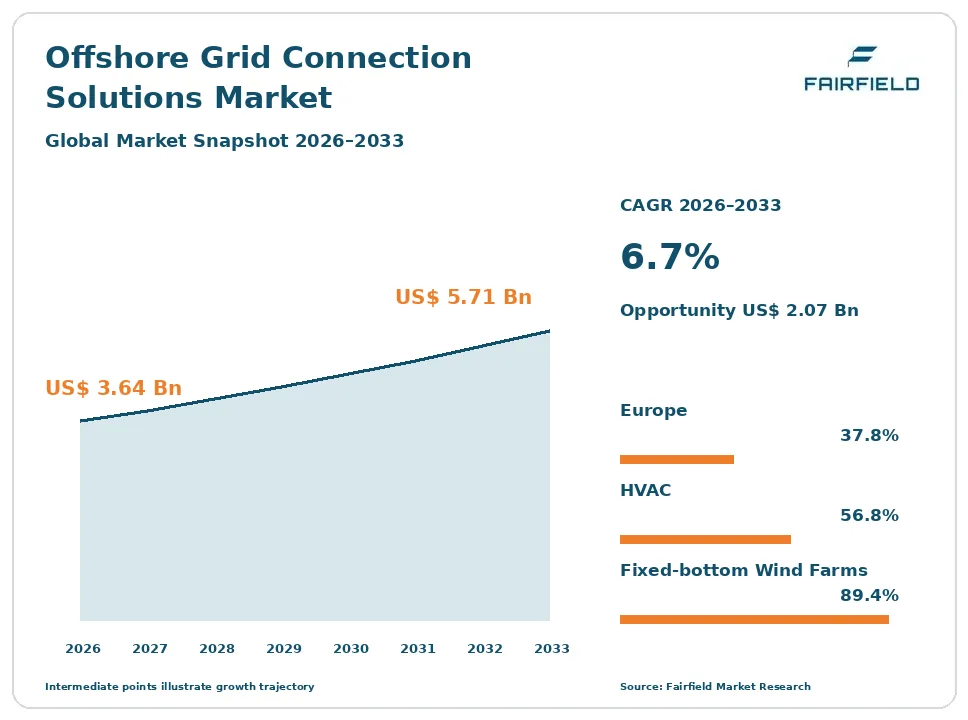
The global offshore grid connection solutions market size is expected to be valued at US$ 3.64 billion in 2026 and projected to reach US$ 5.71 billion by 2033, growing at a CAGR of 6.7% between 2026 and 2033.
Between 2020 and 2025, the market grew at a CAGR of about 5.6%, as offshore wind expanded in Europe and China, although high interest rates, supply chain costs, and project cancellations in the United States and the United Kingdom slowed some projects in 2023 and 2024. Three factors now drive growth: national offshore wind targets, the shift to larger wind farms located far from shore that need HVDC transmission, and plans for meshed offshore grids linking countries. The market is moving toward standardized 2 GW systems at 525 kV, longer subsea export cables, larger offshore substations, and new connection designs for floating offshore wind.
Key Report Takeaways
- By Transmission Type: HVAC held 56.8% share in 2026, while HVDC is projected to expand at a 9.2% CAGR through 2033, driven by large wind farms located far from shore that need efficient long-distance transmission.
- By Component: Offshore Substations & Converter Platforms held 47.6% share in 2026, while Subsea Cable Systems are projected to expand at a 7.9% CAGR through 2033, driven by longer cable routes and higher voltages.
- By Application: Fixed-bottom Wind Farms held 89.4% share in 2026, while Floating Wind Farms are projected to expand at a 18.6% CAGR through 2033, driven by deep-water projects in Europe and Asia Pacific.
- By Region: Europe held 37.8% share in 2026, while Asia Pacific is projected to expand at a 8.4% CAGR through 2033, driven by offshore wind programs in China, South Korea, Japan, and Taiwan.
Global Offshore Grid Connection Solutions Market Trends and Insights
Drivers Impact Analysis
Two drivers carry the strongest influence on offshore grid connection demand during the forecast period.
| Driver | Impact on CAGR Forecast | Geographic Relevance | Impact Timeline |
| National offshore wind targets and auctions | High | Europe, Asia Pacific | Long term (≥4 years) |
| Larger, more distant wind farms requiring HVDC | High | Europe, Asia Pacific, North America | Medium term (2-4 years) |
Offshore Wind Targets Are Driving the Offshore Grid Connection Solutions Market
National offshore wind targets and auctions are the strongest driver of the offshore grid connection solutions market. Every offshore wind farm needs cables and substations to bring power to shore.
The mechanism is government policy and energy security goals. Germany aims for 30 GW of offshore wind by 2030 and 70 GW by 2045, and the Netherlands, Denmark, Belgium, and the United Kingdom have similar large targets. North Sea countries agreed in the Ostend Declaration to reach 300 GW of offshore wind by 2050. China adds several gigawatts of offshore wind every year, and South Korea, Japan, Taiwan, and Australia are launching programs. Transmission system operators such as TenneT, 50Hertz, and Amprion plan and own many offshore connections. These long-term programs create a steady pipeline of grid connection orders.
Larger and More Distant Wind Farms Are Expanding the Offshore Grid Connection Solutions Market
Larger and more distant wind farms requiring HVDC are expanding the offshore grid connection solutions market. As projects move farther offshore, they need more advanced and valuable connection systems.
The cause is the physics of power transmission. Alternating current cables lose efficiency over long distances, so wind farms more than about 80 to 100 kilometers from shore use HVDC transmission. Each HVDC link needs offshore and onshore converter stations, platforms, and long subsea export cables, making them much more valuable than shorter HVAC links. TenneT’s 2 GW program standardizes 525 kV HVDC systems for the Dutch and German North Sea. In December 2025, GE Vernova and Seatrium won the BalWin5 project, a 2.2 GW HVDC link. Larger turbines and wind farm sizes increase the power each connection carries, raising contract values.
Restraints Impact Analysis
Two restraints limit how quickly the offshore grid connection solutions market grows.
| Restraint | Impact on CAGR Forecast | Geographic Relevance | Impact Timeline |
| Supply chain bottlenecks and long lead times | High | Europe, North America, Asia Pacific | Medium term (2-4 years) |
| High costs, project cancellations, and permitting delays | High | North America, Europe | Short term (≤2 years) |
Supply Chain Bottlenecks Slow the Offshore Grid Connection Solutions Market
Supply chain bottlenecks and long lead times slow the offshore grid connection solutions market. Only a few companies can build HVDC converters, subsea cables, and offshore platforms.
The specific causes are limited factory and vessel capacity. HVDC converter suppliers such as Siemens Energy, Hitachi Energy, and GE Vernova have full order books, and new orders may wait years for delivery. Subsea cable factories and cable-laying vessels are booked years ahead. Platform fabrication yards in Europe and Asia Pacific are also busy. Skilled engineers and offshore workers are in short supply. Developers increasingly sign framework and capacity reservation agreements to secure slots, such as RWE’s agreements with Hitachi Energy and Aibel in 2024. Commissioning dates for new projects often extend into the 2030s. These factors limit how quickly new connections can be delivered.
High Costs and Cancellations Restrict the Offshore Grid Connection Solutions Market
High costs, project cancellations, and permitting delays restrict the offshore grid connection solutions market. Offshore wind projects face financial and political challenges.
The underlying causes are inflation, interest rates, and policy changes. Steel, copper, and installation costs rose sharply after 2021, and higher interest rates increased financing costs. Several projects in the United States and the United Kingdom were cancelled or delayed when developers could not make them profitable. Policy changes in the United States have stopped or slowed offshore wind permits and leases. Permitting for cable routes and onshore substations can take years due to environmental and local concerns. Failed auctions in some countries have reduced planned capacity. Grid operators also face rising costs that may be passed to electricity consumers, raising political pressure. These factors create uncertainty and slow orders for new connections.
Market Opportunities
Meshed and Multi-terminal Offshore Grids Open a Large Revenue Pool
Meshed offshore grids and multi-terminal HVDC systems open a large revenue pool in the offshore grid connection solutions market. Countries plan to link offshore wind farms with each other and with neighboring countries.
HVDC suppliers and grid operators can capture this opportunity. Hybrid interconnectors connect wind farms to more than one country, improving power trading and grid reliability. Belgium’s Princess Elisabeth Island is planned as the world’s first artificial energy island, linking wind farms and interconnectors. TenneT and 50Hertz plan offshore hubs that connect multiple platforms. Multi-terminal systems need new technology, such as DC circuit breakers and advanced controls. Standardized designs allow suppliers to build many similar systems efficiently. Long-term framework agreements give suppliers steady work. Suppliers with proven multi-terminal technology can win premium contracts.
Floating Wind and Asia Pacific Expansion Create a Growth Revenue Pool
Floating offshore wind and Asia Pacific expansion create a growth revenue pool in the offshore grid connection solutions market. New markets and technologies need new connection solutions.
Cable makers and system integrators can capture this opportunity. Floating wind farms in deep water need dynamic cables that move with platforms and floating or subsea substations. Projects are planned off Norway, Scotland, France, South Korea, Japan, and the United States West Coast. China continues to build large offshore wind farms with domestic suppliers. Taiwan, South Korea, Japan, Vietnam, the Philippines, and Australia are launching offshore wind programs that need connection systems. LS Cable & System and Taihan in South Korea are expanding subsea cable capacity. Local production partnerships help win projects in these markets.
Segment Analysis
By Transmission Type: HVAC Leads While HVDC Grows Fastest
HVAC held 56.8% share in 2026. High-voltage alternating current connections are used for wind farms closer to shore, typically within about 80 kilometers. They are simpler and cheaper for shorter distances and are widely used in China, the United Kingdom, and Taiwan. HVAC systems use offshore transformer substations and three-core subsea export cables.
HVDC is the fastest-growing transmission type, expanding at a 9.2% CAGR through 2033. HVDC transmission reduces losses over long distances and allows large amounts of power to flow through fewer cables. Germany, the Netherlands, and the United Kingdom are building many 2 GW HVDC links. Voltage source converter technology from Siemens Energy, Hitachi Energy, and GE Vernova dominates. For the market, HVDC growth raises project values.
By Component: Offshore Substations & Converter Platforms Lead While Subsea Cable Systems Grow Fastest
Offshore Substations & Converter Platforms held 47.6% share in 2026. Offshore substations collect power from turbines and raise its voltage, while converter platforms change alternating current to direct current for HVDC links. These large structures need complex electrical equipment and heavy steel topsides and foundations. Yards such as Seatrium, Aibel, and Smulders build platforms.
Subsea Cable Systems are the fastest-growing component, expanding at a 7.9% CAGR through 2033. Longer routes, higher voltages, and more projects increase demand for export and inter-array cables. Prysmian, NKT, Nexans, Sumitomo Electric, and LS Cable & System are major suppliers and are investing in new factories and vessels. Onshore converter stations and cables form other components. For the market, cable growth reflects longer distances.
By Application: Fixed-bottom Wind Farms Lead While Floating Wind Farms Grow Fastest
Fixed-bottom Wind Farms held 89.4% share in 2026. Most offshore wind farms use monopile or jacket foundations in water up to about 60 meters deep, in the North Sea, Baltic Sea, and Chinese coastal waters. These projects require standard grid connection systems.
Floating Wind Farms are the fastest-growing application, expanding at a 18.6% CAGR through 2033. Floating offshore wind allows turbines in deep water, opening new areas off Norway, Scotland, France, Japan, South Korea, and California. These projects need dynamic cables and new substation designs, such as floating substations. Oil and gas platform electrification forms another application. Several pilot floating farms are already operating in Scotland, Norway, and France. For the market, floating growth creates demand for innovative products.
Geography Analysis
North America Develops the Offshore Grid Connection Solutions Market Amid Policy Uncertainty
North America is a developing offshore grid connection solutions market. The United States had planned large offshore wind growth on the East Coast, with projects such as Vineyard Wind and Revolution Wind, but policy changes since 2025 have paused permits and slowed new projects. Some states, including New York and New Jersey, still support offshore wind and transmission planning. Canada is developing offshore wind off Nova Scotia. New cable factories in the United States face uncertain demand. Key barriers include permitting, federal policy, and high costs. One opportunity is state-led transmission planning for future projects and shared offshore transmission backbones.
Which Region Is Leading the Offshore Grid Connection Solutions Market?
Europe is leading the offshore grid connection solutions market with a 37.8% share in 2026. Germany, the Netherlands, the United Kingdom, Denmark, and Belgium have large offshore wind programs and grid operators such as TenneT, 50Hertz, Amprion, Elia, and National Grid that plan offshore connections. In June 2026, Siemens Energy and NSORe won the 2 GW NSC2 converter station contract from 50Hertz. Major suppliers Siemens Energy, Hitachi Energy, Prysmian, NKT, and Nexans are based in the region. One change shaping the region is the move to meshed grids.
Which Region Is Growing Fastest in the Offshore Grid Connection Solutions Market?
Asia Pacific is growing fastest in the offshore grid connection solutions market at a 8.4% CAGR through 2033. China has the world’s largest offshore wind capacity and continues to add projects with domestic cable and converter suppliers such as Orient Cable and ZTT. Taiwan and South Korea are building large offshore wind farms, and Japan is launching floating and fixed projects. Australia, Vietnam, and the Philippines are developing programs. China’s large domestic market lets local suppliers build experience and lower costs. One challenge is local content rules that favor domestic suppliers in Taiwan and South Korea. One opportunity is cable and substation supply for new markets such as Australia and Vietnam.
Latin America Explores the Offshore Grid Connection Solutions Market
Latin America is an early-stage offshore grid connection solutions market. Brazil has strong offshore wind potential and passed a law in 2025 setting rules for offshore wind development, with many projects proposed off its northeastern and southern coasts. Colombia has launched its first offshore wind round off its Caribbean coast. Offshore oil and gas platforms in Brazil could use power from shore. Key barriers include limited grid capacity, lack of supply chains, and early-stage regulation. Global developers and grid companies have signed early agreements with Brazilian states and ports. One opportunity is the first commercial offshore wind connections in Brazil.
Middle East & Africa Explores the Offshore Grid Connection Solutions Market
Middle East & Africa is an emerging offshore grid connection solutions market. Offshore oil and gas fields in Saudi Arabia, the United Arab Emirates, and Qatar are being electrified with power from shore to cut emissions, using subsea cables and offshore substations. South Africa and Morocco have studied offshore wind potential. Key barriers include limited offshore wind policy and strong competition from cheap onshore solar. Oman and Egypt are exploring offshore wind for green hydrogen production, which would need grid connections. One opportunity is platform electrification projects in Saudi Arabia and the United Arab Emirates, where national oil companies have awarded large contracts.
Competitive Landscape
The offshore grid connection solutions market is highly concentrated. Siemens Energy, Hitachi Energy, and GE Vernova lead HVDC converter technology, while Prysmian, NKT, Nexans, Sumitomo Electric, and LS Cable & System lead subsea cables. Platform builders such as Seatrium, Aibel, and Smulders and installers such as DEME and Van Oord complete the supply chain.
Companies compete on technology, delivery capacity, track record, project execution, and price. Few suppliers can deliver complete 2 GW HVDC systems, so grid operators sign long-term framework agreements to secure capacity. Consortia combining converter, platform, and cable suppliers are common and help share large project risks. Suppliers are investing in new factories, cable-laying vessels, and fabrication yards to meet demand. Chinese suppliers are competitive in their home market and starting to bid abroad. Execution risk is high, so buyers value suppliers with a record of on-time delivery.
Strategic moves show how competition is changing. In May 2024, Hitachi Energy and Aibel signed framework agreements with RWE for multiple HVDC systems. In December 2025, GE Vernova and Seatrium won TenneT’s BalWin5 project. In June 2026, Siemens Energy and NSORe won the NSC2 converter station from 50Hertz. These moves show competition shifting toward long-term frameworks and consortia.
Three themes shape vendor strategy. First, companies are expanding factory and vessel capacity. Second, they are standardizing 2 GW designs to speed delivery. Third, they are developing technology for meshed, multi-terminal, and floating grids.
Offshore Grid Connection Solutions Market Industry Leaders
Siemens Energy Hitachi Energy GE Vernova Prysmian NKT
Recent Industry Developments
- June 2026: Siemens Energy and NSORe won a contract from 50Hertz for the 2 GW NSC2 offshore converter station - commissioning is planned for 2034.
- December 2025: GE Vernova and Seatrium won TenneT’s 2.2 GW BalWin5 HVDC grid connection - their first German 2 GW project award.
- May 2024: Hitachi Energy and Aibel signed framework agreements with RWE for multiple HVDC offshore wind connections - secures supply capacity for future projects.
Companies Covered in the Report
- Siemens Energy
- Hitachi Energy
- GE Vernova
- Prysmian
- NKT
- Nexans
- Sumitomo Electric
- LS Cable & System
- Seatrium
- Aibel
- Smulders
- Mitsubishi Electric
Offshore Grid Connection Solutions Market Report Scope
This report covers offshore grid connection solutions, including HVAC and HVDC transmission systems, offshore substations and converter platforms, subsea export and inter-array cables, and onshore converter stations, for fixed-bottom and floating offshore wind farms, interconnectors, and platform electrification. It excludes wind turbines and foundations. The base year is 2025, and the forecast period runs from 2026 to 2033. All values are expressed in US$ Billion.
Transmission Type
- HVAC
- HVDC
Component
- Offshore Substations & Converter Platforms
- Subsea Cable Systems
- Onshore Converter Stations
Application
- Fixed-bottom Wind Farms
- Floating Wind Farms
- Interconnectors & Platform Electrification
Regions
- North America
- Europe
- Asia Pacific
- Latin America
- Middle East & Africa
Key Questions Answered in the Report
How big is the offshore grid connection solutions market in 2026?
The offshore grid connection solutions market is valued at US$ 3.64 billion in 2026, led by HVAC connections and offshore substations.
What is the offshore grid connection solutions market forecast to 2033?
The market is projected to reach US$ 5.71 billion by 2033, growing at a 6.7% CAGR and adding US$ 2.07 billion.
Which transmission type is growing fastest in offshore grid connections?
HVDC is growing fastest at a 9.2% CAGR through 2033, driven by large wind farms located far from shore.
Which region is growing fastest in the offshore grid connection solutions market?
Asia Pacific is growing fastest at a 8.4% CAGR through 2033, driven by offshore wind programs in China and Japan.
Which region holds the largest offshore grid connection solutions market share?
Europe holds the largest share at 37.8% in 2026, supported by large North Sea programs in Germany and the Netherlands.
1. Executive Summary
1.1. Global Offshore Grid Connection Solutions Market Snapshot
1.2. Future Projections
1.3. Key Report Takeaways
1.4. Regional Snapshot
2. Market Overview
2.1. Market Definition and Report Scope
2.2. Historical Trends 2020–2025
2.3. Market Dynamics
2.3.1. Drivers
2.3.1.1. Offshore Wind Targets Are Driving the Offshore Grid Connection Solutions Market
2.3.1.2. Larger and More Distant Wind Farms Are Expanding the Offshore Grid Connection Solutions Market
2.3.2. Restraints
2.3.2.1. Supply Chain Bottlenecks Slow the Offshore Grid Connection Solutions Market
2.3.2.2. High Costs and Cancellations Restrict the Offshore Grid Connection Solutions Market
2.3.3. Market Opportunities
2.3.3.1. Meshed and Multi-terminal Offshore Grids Open a Large Revenue Pool
2.3.3.2. Floating Wind and Asia Pacific Expansion Create a Growth Revenue Pool
3. Global Offshore Grid Connection Solutions Market Outlook, 2020-2033
3.1. Global Offshore Grid Connection Solutions Market Outlook, by Transmission Type, Value (US$ Billion), 2020-2033
3.1.1. HVAC
3.1.2. HVDC
3.2. Global Offshore Grid Connection Solutions Market Outlook, by Component, Value (US$ Billion), 2020-2033
3.2.1. Offshore Substations & Converter Platforms
3.2.2. Subsea Cable Systems
3.2.3. Onshore Converter Stations
3.3. Global Offshore Grid Connection Solutions Market Outlook, by Application, Value (US$ Billion), 2020-2033
3.3.1. Fixed-bottom Wind Farms
3.3.2. Floating Wind Farms
3.3.3. Interconnectors & Platform Electrification
3.4. Global Offshore Grid Connection Solutions Market Outlook, by Region, Value (US$ Billion), 2020-2033
3.4.1. North America
3.4.2. Europe
3.4.3. Asia Pacific
3.4.4. Latin America
3.4.5. Middle East & Africa
4. North America Offshore Grid Connection Solutions Market Outlook, 2020-2033
4.1. North America Offshore Grid Connection Solutions Market Outlook, by Transmission Type, Value (US$ Billion), 2020-2033
4.1.1. HVAC
4.1.2. HVDC
4.2. North America Offshore Grid Connection Solutions Market Outlook, by Component, Value (US$ Billion), 2020-2033
4.2.1. Offshore Substations & Converter Platforms
4.2.2. Subsea Cable Systems
4.2.3. Onshore Converter Stations
4.3. North America Offshore Grid Connection Solutions Market Outlook, by Application, Value (US$ Billion), 2020-2033
4.3.1. Fixed-bottom Wind Farms
4.3.2. Floating Wind Farms
4.3.3. Interconnectors & Platform Electrification
4.4. North America Offshore Grid Connection Solutions Market Outlook, by Country, Value (US$ Billion), 2020-2033
4.4.1. United States Offshore Grid Connection Solutions Market Outlook, by Transmission Type, 2020-2033
4.4.2. United States Offshore Grid Connection Solutions Market Outlook, by Component, 2020-2033
4.4.3. United States Offshore Grid Connection Solutions Market Outlook, by Application, 2020-2033
4.4.4. Canada Offshore Grid Connection Solutions Market Outlook, by Transmission Type, 2020-2033
4.4.5. Canada Offshore Grid Connection Solutions Market Outlook, by Component, 2020-2033
4.4.6. Canada Offshore Grid Connection Solutions Market Outlook, by Application, 2020-2033
5. Europe Offshore Grid Connection Solutions Market Outlook, 2020-2033
5.1. Europe Offshore Grid Connection Solutions Market Outlook, by Transmission Type, Value (US$ Billion), 2020-2033
5.1.1. HVAC
5.1.2. HVDC
5.2. Europe Offshore Grid Connection Solutions Market Outlook, by Component, Value (US$ Billion), 2020-2033
5.2.1. Offshore Substations & Converter Platforms
5.2.2. Subsea Cable Systems
5.2.3. Onshore Converter Stations
5.3. Europe Offshore Grid Connection Solutions Market Outlook, by Application, Value (US$ Billion), 2020-2033
5.3.1. Fixed-bottom Wind Farms
5.3.2. Floating Wind Farms
5.3.3. Interconnectors & Platform Electrification
5.4. Europe Offshore Grid Connection Solutions Market Outlook, by Country, Value (US$ Billion), 2020-2033
5.4.1. Germany Offshore Grid Connection Solutions Market Outlook, by Transmission Type, 2020-2033
5.4.2. Germany Offshore Grid Connection Solutions Market Outlook, by Component, 2020-2033
5.4.3. Germany Offshore Grid Connection Solutions Market Outlook, by Application, 2020-2033
5.4.4. Netherlands Offshore Grid Connection Solutions Market Outlook, by Transmission Type, 2020-2033
5.4.5. Netherlands Offshore Grid Connection Solutions Market Outlook, by Component, 2020-2033
5.4.6. Netherlands Offshore Grid Connection Solutions Market Outlook, by Application, 2020-2033
5.4.7. United Kingdom Offshore Grid Connection Solutions Market Outlook, by Transmission Type, 2020-2033
5.4.8. United Kingdom Offshore Grid Connection Solutions Market Outlook, by Component, 2020-2033
5.4.9. United Kingdom Offshore Grid Connection Solutions Market Outlook, by Application, 2020-2033
5.4.10. Denmark Offshore Grid Connection Solutions Market Outlook, by Transmission Type, 2020-2033
5.4.11. Denmark Offshore Grid Connection Solutions Market Outlook, by Component, 2020-2033
5.4.12. Denmark Offshore Grid Connection Solutions Market Outlook, by Application, 2020-2033
5.4.13. Belgium Offshore Grid Connection Solutions Market Outlook, by Transmission Type, 2020-2033
5.4.14. Belgium Offshore Grid Connection Solutions Market Outlook, by Component, 2020-2033
5.4.15. Belgium Offshore Grid Connection Solutions Market Outlook, by Application, 2020-2033
6. Asia Pacific Offshore Grid Connection Solutions Market Outlook, 2020-2033
6.1. Asia Pacific Offshore Grid Connection Solutions Market Outlook, by Transmission Type, Value (US$ Billion), 2020-2033
6.1.1. HVAC
6.1.2. HVDC
6.2. Asia Pacific Offshore Grid Connection Solutions Market Outlook, by Component, Value (US$ Billion), 2020-2033
6.2.1. Offshore Substations & Converter Platforms
6.2.2. Subsea Cable Systems
6.2.3. Onshore Converter Stations
6.3. Asia Pacific Offshore Grid Connection Solutions Market Outlook, by Application, Value (US$ Billion), 2020-2033
6.3.1. Fixed-bottom Wind Farms
6.3.2. Floating Wind Farms
6.3.3. Interconnectors & Platform Electrification
6.4. Asia Pacific Offshore Grid Connection Solutions Market Outlook, by Country, Value (US$ Billion), 2020-2033
6.4.1. China Offshore Grid Connection Solutions Market Outlook, by Transmission Type, 2020-2033
6.4.2. China Offshore Grid Connection Solutions Market Outlook, by Component, 2020-2033
6.4.3. China Offshore Grid Connection Solutions Market Outlook, by Application, 2020-2033
6.4.4. Taiwan Offshore Grid Connection Solutions Market Outlook, by Transmission Type, 2020-2033
6.4.5. Taiwan Offshore Grid Connection Solutions Market Outlook, by Component, 2020-2033
6.4.6. Taiwan Offshore Grid Connection Solutions Market Outlook, by Application, 2020-2033
6.4.7. South Korea Offshore Grid Connection Solutions Market Outlook, by Transmission Type, 2020-2033
6.4.8. South Korea Offshore Grid Connection Solutions Market Outlook, by Component, 2020-2033
6.4.9. South Korea Offshore Grid Connection Solutions Market Outlook, by Application, 2020-2033
6.4.10. Japan Offshore Grid Connection Solutions Market Outlook, by Transmission Type, 2020-2033
6.4.11. Japan Offshore Grid Connection Solutions Market Outlook, by Component, 2020-2033
6.4.12. Japan Offshore Grid Connection Solutions Market Outlook, by Application, 2020-2033
6.4.13. Australia Offshore Grid Connection Solutions Market Outlook, by Transmission Type, 2020-2033
6.4.14. Australia Offshore Grid Connection Solutions Market Outlook, by Component, 2020-2033
6.4.15. Australia Offshore Grid Connection Solutions Market Outlook, by Application, 2020-2033
6.4.16. Vietnam Offshore Grid Connection Solutions Market Outlook, by Transmission Type, 2020-2033
6.4.17. Vietnam Offshore Grid Connection Solutions Market Outlook, by Component, 2020-2033
6.4.18. Vietnam Offshore Grid Connection Solutions Market Outlook, by Application, 2020-2033
6.4.19. Philippines Offshore Grid Connection Solutions Market Outlook, by Transmission Type, 2020-2033
6.4.20. Philippines Offshore Grid Connection Solutions Market Outlook, by Component, 2020-2033
6.4.21. Philippines Offshore Grid Connection Solutions Market Outlook, by Application, 2020-2033
7. Latin America Offshore Grid Connection Solutions Market Outlook, 2020-2033
7.1. Latin America Offshore Grid Connection Solutions Market Outlook, by Transmission Type, Value (US$ Billion), 2020-2033
7.1.1. HVAC
7.1.2. HVDC
7.2. Latin America Offshore Grid Connection Solutions Market Outlook, by Component, Value (US$ Billion), 2020-2033
7.2.1. Offshore Substations & Converter Platforms
7.2.2. Subsea Cable Systems
7.2.3. Onshore Converter Stations
7.3. Latin America Offshore Grid Connection Solutions Market Outlook, by Application, Value (US$ Billion), 2020-2033
7.3.1. Fixed-bottom Wind Farms
7.3.2. Floating Wind Farms
7.3.3. Interconnectors & Platform Electrification
7.4. Latin America Offshore Grid Connection Solutions Market Outlook, by Country, Value (US$ Billion), 2020-2033
7.4.1. Brazil Offshore Grid Connection Solutions Market Outlook, by Transmission Type, 2020-2033
7.4.2. Brazil Offshore Grid Connection Solutions Market Outlook, by Component, 2020-2033
7.4.3. Brazil Offshore Grid Connection Solutions Market Outlook, by Application, 2020-2033
7.4.4. Colombia Offshore Grid Connection Solutions Market Outlook, by Transmission Type, 2020-2033
7.4.5. Colombia Offshore Grid Connection Solutions Market Outlook, by Component, 2020-2033
7.4.6. Colombia Offshore Grid Connection Solutions Market Outlook, by Application, 2020-2033
8. Middle East & Africa Offshore Grid Connection Solutions Market Outlook, 2020-2033
8.1. Middle East & Africa Offshore Grid Connection Solutions Market Outlook, by Transmission Type, Value (US$ Billion), 2020-2033
8.1.1. HVAC
8.1.2. HVDC
8.2. Middle East & Africa Offshore Grid Connection Solutions Market Outlook, by Component, Value (US$ Billion), 2020-2033
8.2.1. Offshore Substations & Converter Platforms
8.2.2. Subsea Cable Systems
8.2.3. Onshore Converter Stations
8.3. Middle East & Africa Offshore Grid Connection Solutions Market Outlook, by Application, Value (US$ Billion), 2020-2033
8.3.1. Fixed-bottom Wind Farms
8.3.2. Floating Wind Farms
8.3.3. Interconnectors & Platform Electrification
8.4. Middle East & Africa Offshore Grid Connection Solutions Market Outlook, by Country, Value (US$ Billion), 2020-2033
8.4.1. Saudi Arabia Offshore Grid Connection Solutions Market Outlook, by Transmission Type, 2020-2033
8.4.2. Saudi Arabia Offshore Grid Connection Solutions Market Outlook, by Component, 2020-2033
8.4.3. Saudi Arabia Offshore Grid Connection Solutions Market Outlook, by Application, 2020-2033
8.4.4. United Arab Emirates Offshore Grid Connection Solutions Market Outlook, by Transmission Type, 2020-2033
8.4.5. United Arab Emirates Offshore Grid Connection Solutions Market Outlook, by Component, 2020-2033
8.4.6. United Arab Emirates Offshore Grid Connection Solutions Market Outlook, by Application, 2020-2033
8.4.7. Qatar Offshore Grid Connection Solutions Market Outlook, by Transmission Type, 2020-2033
8.4.8. Qatar Offshore Grid Connection Solutions Market Outlook, by Component, 2020-2033
8.4.9. Qatar Offshore Grid Connection Solutions Market Outlook, by Application, 2020-2033
8.4.10. South Africa Offshore Grid Connection Solutions Market Outlook, by Transmission Type, 2020-2033
8.4.11. South Africa Offshore Grid Connection Solutions Market Outlook, by Component, 2020-2033
8.4.12. South Africa Offshore Grid Connection Solutions Market Outlook, by Application, 2020-2033
8.4.13. Morocco Offshore Grid Connection Solutions Market Outlook, by Transmission Type, 2020-2033
8.4.14. Morocco Offshore Grid Connection Solutions Market Outlook, by Component, 2020-2033
8.4.15. Morocco Offshore Grid Connection Solutions Market Outlook, by Application, 2020-2033
8.4.16. Oman Offshore Grid Connection Solutions Market Outlook, by Transmission Type, 2020-2033
8.4.17. Oman Offshore Grid Connection Solutions Market Outlook, by Component, 2020-2033
8.4.18. Oman Offshore Grid Connection Solutions Market Outlook, by Application, 2020-2033
8.4.19. Egypt Offshore Grid Connection Solutions Market Outlook, by Transmission Type, 2020-2033
8.4.20. Egypt Offshore Grid Connection Solutions Market Outlook, by Component, 2020-2033
8.4.21. Egypt Offshore Grid Connection Solutions Market Outlook, by Application, 2020-2033
9. Competitive Landscape
9.1. Market Concentration and Industry Leaders
9.2. Competitive Differentiation
9.3. Strategic Moves and Market Direction
9.4. Recent Industry Developments
9.5. Company Profiles
9.5.1. Siemens Energy
9.5.2. Hitachi Energy
9.5.3. GE Vernova
9.5.4. Prysmian
9.5.5. NKT
9.5.6. Nexans
9.5.7. Sumitomo Electric
9.5.8. LS Cable & System
9.5.9. Seatrium
9.5.10. Aibel
9.5.11. Smulders
9.5.12. Mitsubishi Electric
10. Appendix
10.1. Research Methodology
10.2. Report Assumptions
10.3. Acronyms and Abbreviations
| Transmission Type | HVAC, HVDC |
| Component | Offshore Substations & Converter Platforms, Subsea Cable Systems, Onshore Converter Stations |
| Application | Fixed-bottom Wind Farms, Floating Wind Farms, Interconnectors & Platform Electrification |
| Regions | North America, Europe, Asia Pacific, Latin America, Middle East & Africa |
Our Research Methodology
Considering the volatility of business today, traditional approaches to strategizing a game plan can be unfruitful if not detrimental. True ambiguity is no way to determine a forecast. A myriad of predetermined factors must be accounted for such as the degree of risk involved, the magnitude of circumstances, as well as conditions or consequences that are not known or unpredictable. To circumvent binary views that cast uncertainty, the application of market research intelligence to strategically posture, move, and enable actionable outcomes is necessary.
View Methodology
Quality Assured
Rigorous Validation Process

Confidentiality Assured
End-to-end Data Security

Custom Research Services
Tailored To Your Objectives
FAQs
The offshore grid connection solutions market is valued at US$ 3.64 billion in 2026, led by HVAC connections and offshore substations.
The market is projected to reach US$ 5.71 billion by 2033, growing at a 6.7% CAGR and adding US$ 2.07 billion.
HVDC is growing fastest at a 9.2% CAGR through 2033, driven by large wind farms located far from shore.
Asia Pacific is growing fastest at a 8.4% CAGR through 2033, driven by offshore wind programs in China and Japan.
Europe holds the largest share at 37.8% in 2026, supported by large North Sea programs in Germany and the Netherlands.
Related Reports
Floating Storage and Regasification Unit Market Size, Share, Insights, Competitive Landscape, and Forecast 2026 to 2033
Floating storage and regasification unit market to grow from US$8.96 Bn in 2026 to US$13.92 Bn by 2033 at 6.5% CAGR. Explore types, mooring and regions.
Floating Solar Market Size, Share, Insights, Competitive Landscape, and Forecast 2026 to 2033
Floating solar market to grow from US$1.60 Bn in 2026 to US$4.02 Bn by 2033 at 14.1% CAGR. Explore capacities, products, locations and regional trends.
Nickel Hydrogen Batteries Market Size, Share, Insights, Competitive Landscape, and Forecast 2026 to 2033
Nickel hydrogen batteries market to reach US$11.85 billion by 2033 at 13.7% CAGR, driven by hybrid vehicles and stationary energy storage.
Landing String Equipment Market Size, Share, Insights, Competitive Landscape, and Forecast 2026 to 2033
Explore the landing string equipment market, reaching US$ 0.80 billion by 2033 at 6.6% CAGR, with component, technology and regional insights.
Fuel Cell Market Size, Share, Insights, Competitive Landscape, and Forecast 2026 to 2033
Fuel cell market to reach US$ 21.6 billion by 2033 at 17.0% CAGR. Explore technologies, applications, regions and key companies.
Solid-state Battery Market Size, Share, Insights, Competitive Landscape, and Forecast 2026 to 2033
Solid-state battery market to reach US$ 11.7 billion by 2033 at 36.9% CAGR. Explore technologies, applications, regions and key companies.