



Toilet Paper Market
Toilet Paper Market Size, Share, Insights, Competitive Landscape, and Forecast 2026 to 2033
Toilet Paper Market Size and Trend Analysis
How Fast Is the Toilet Paper Market Growing?
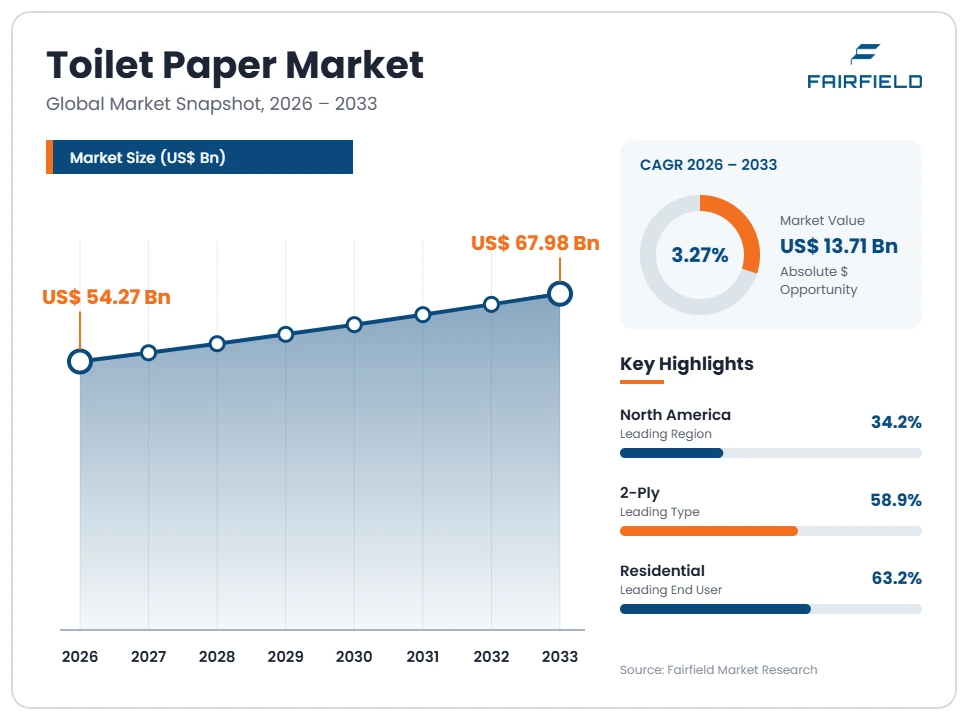
The global toilet paper market size is expected to be valued at US$ 54.27 billion in 2026 and projected to reach US$ 67.98 billion by 2033, growing at a CAGR of 3.27% between 2026 and 2033.
Between 2020 and 2025, the market grew at a CAGR of about 3.0%, after a sharp spike in 2020 when households stockpiled bathroom tissue during pandemic lockdowns, followed by a period of normalization and price increases as pulp, energy, and freight costs rose. Toilet paper is an essential tissue paper product used daily in homes, offices, hotels, schools, and public facilities, which keeps demand stable through economic cycles. Growth now comes from population growth, urbanization, and rising hygiene standards in Asia Pacific, Latin America, and Middle East & Africa, where per-capita use remains far below North America and Europe. In mature markets, value growth depends on premium toilet paper, such as softer, thicker, and quilted rolls, along with sustainable tissue made from recycled fiber, bamboo, or certified pulp. Online subscriptions and private-label products are also reshaping how consumers buy.
Key Report Takeaways
- By Type: 2-Ply held 58.9% share in 2026, while 1-Ply is projected to expand at a 4.7% CAGR through 2033, driven by cost-conscious buyers in developing markets and high-volume commercial washrooms that favor economical rolls.
- By Distribution Channel: Supermarkets & Hypermarkets held 44.0% share in 2026, while Online is projected to expand at a 6.0% CAGR through 2033, driven by bulk subscription services, home delivery, and growing e-commerce use for household essentials.
- By End User: Residential held 63.2% share in 2026, while Commercial is projected to expand at a 4.0% CAGR through 2033, driven by recovering office occupancy, tourism, hospitality growth, and stricter washroom hygiene standards in public facilities.
- By Region: North America held 34.2% share in 2026, while Asia Pacific is projected to expand at a 4.8% CAGR through 2033, driven by urbanization, rising incomes, and expanding modern retail in China, India, and Indonesia.
Global Toilet Paper Market Trends and Insights
Drivers Impact Analysis
Two drivers carry the strongest influence on toilet paper demand during the forecast period.
| Driver | Impact on CAGR Forecast | Geographic Relevance | Impact Timeline |
| Rising hygiene awareness, urbanization, and population growth | High | Asia Pacific, Middle East & Africa, Latin America | Long term (≥4 years) |
| Premiumization and product innovation | Medium | North America, Europe | Medium term (2–4 years) |
Rising Hygiene Awareness Is Driving the Toilet Paper Market
Rising hygiene awareness, urbanization, and population growth are the strongest driver of the toilet paper market. More people are adopting toilet paper as a daily habit.
The mechanism is changing living conditions and habits in developing countries. As people move to cities, they live in homes with modern bathrooms and shop in supermarkets that stock bathroom tissue. Rising incomes allow households to spend more on personal hygiene products. Per-capita toilet paper use in India, Indonesia, Vietnam, and many countries across Middle East & Africa is still a small fraction of use in the United States, leaving large room for growth. Sanitation programs and tourism raise expectations for clean washrooms in hotels, airports, and offices. Producers such as Kimberly-Clark, Essity, and Asia Pulp & Paper are expanding capacity and distribution in these markets. These trends add steady volume growth every year.
Premiumization Is Expanding the Toilet Paper Market
Premiumization and product innovation are expanding the toilet paper market in value terms. Consumers in mature markets are trading up.
The cause is consumer demand for comfort, strength, and better experiences. Brands such as Charmin, Cottonelle, Quilted Northern, and Cushelle offer ultra-soft, ultra-strong, and quilted rolls at higher prices. Mega rolls and compact packs that last longer and save storage space have become popular. Scented, lotion-infused, and moist toilet tissue products add further choice. Procter & Gamble expanded its Charmin line in February 2026. Sustainable products made from bamboo, recycled fiber, or certified pulp attract environmentally aware shoppers and often sell at a premium. These innovations raise average selling prices and support revenue growth even where volumes are flat, while building stronger brand loyalty among shoppers.
Restraints Impact Analysis
Two restraints limit how quickly the toilet paper market grows.
| Restraint | Impact on CAGR Forecast | Geographic Relevance | Impact Timeline |
| Volatile pulp, energy, and freight costs | High | Global | Medium term (2–4 years) |
| Mature demand and alternatives such as bidets | Medium | North America, Europe, Asia Pacific | Long term (≥4 years) |
Raw Material Volatility Slows the Toilet Paper Market
Volatile pulp, energy, and freight costs slow the toilet paper market. Tissue production is costly and resource-intensive.
The specific causes are input price swings. Market pulp, especially northern bleached softwood kraft and eucalyptus hardwood pulp, makes up a large share of production cost, and its price moves with global supply, mill outages, and demand from China. Tissue machines use large amounts of energy to dry paper, so natural gas and electricity price spikes in Europe sharply raised costs in recent years. Toilet paper is bulky and light, making freight a large cost relative to product value. Producers often struggle to pass costs to retailers quickly, which squeezes margins. Price increases can push consumers toward cheaper private-label brands. These cost pressures limit investment in new machines and slow market growth.
Mature Demand and Alternatives Restrict the Toilet Paper Market
Mature demand and alternatives such as bidets restrict the toilet paper market. Growth is slow in established regions.
The underlying causes are saturation and changing habits. In North America and Europe, almost every household already uses toilet paper, and population growth is low, so volume growth is limited. Bidets, bidet seats, and handheld sprayers are common in Japan, South Korea, Italy, and much of Middle East & Africa, and sales of bidet attachments rose in the United States after 2020. Water-based cleansing reduces paper use per person. Environmental concerns about deforestation also lead some consumers to use less paper. Strong private-label competition limits pricing power for brand owners. These factors keep volume growth in mature markets low over the entire forecast period.
Market Opportunities
Sustainable Tissue Opens a Premium Revenue Pool
Sustainable tissue opens a premium revenue pool in the toilet paper market. Consumers and retailers want greener products.
Producers and challenger brands can capture this opportunity. Bamboo toilet paper, recycled-fiber rolls, and products with forest certification attract younger shoppers who are willing to pay more. Plastic-free packaging, such as paper wrappers and cardboard boxes, reduces waste. Large retailers set sustainability targets for their suppliers, favoring products with lower carbon footprints. Producers are investing in alternative fibers, such as wheat straw, to reduce reliance on wood pulp. Water-saving and energy-efficient tissue machines cut environmental impact. Essity, Sofidel, and Kimberly-Clark have published targets to reduce emissions and use more sustainable fiber. Companies that build credible sustainability claims can win shelf space, loyal customers, and retailer contracts.
Emerging Markets and E-Commerce Create a Volume Revenue Pool
Emerging markets and e-commerce create a volume revenue pool in the toilet paper market. Many consumers are still adopting the product.
Global and regional producers can capture this opportunity. Asia Pacific, Latin America, and Middle East & Africa have large populations with low per-capita use. Affordable small packs and 1-ply rolls help first-time buyers. Local production reduces freight costs and import duties. Online channels, including Amazon, quick-commerce apps, and direct-to-consumer subscription brands, make bulk buying easier and attract younger households. The Suzano and Kimberly-Clark joint venture will combine international tissue operations to serve these growth markets. Partnerships with local distributors and modern retailers widen reach in smaller cities. Companies that build local capacity, affordable formats, and digital sales can capture fast growth.
Segment Analysis
- By Type: 2-Ply Leads While 1-Ply Grows Fastest
2-Ply held 58.9% share in 2026. Two-ply toilet paper offers a good balance of softness, strength, and absorbency, making it the standard choice for most households in North America and Europe. Most leading brands, including Charmin, Cottonelle, and Quilted Northern, focus on 2-ply and 3-ply products. Premium toilet paper in 3-ply and quilted formats is a smaller, higher-value niche.
1-Ply is the fastest-growing type, expanding at a 4.7% CAGR through 2033. One-ply rolls are cheaper, last longer, and are easier on septic systems, making them popular with budget-conscious consumers in Asia Pacific, Latin America, and Middle East & Africa. Commercial washrooms in offices, schools, and public facilities also use 1-ply jumbo rolls to control costs. For the market, 1-ply growth reflects expanding adoption in developing regions.
- By Distribution Channel: Supermarkets & Hypermarkets Lead While Online Grows Fastest
Supermarkets & Hypermarkets held 44.0% share in 2026. Large stores such as Walmart, Costco, Carrefour, and Tesco offer wide choice, bulk packs, and promotions. Toilet paper is often used as a traffic driver, and private-label products are strongest in this channel.
Online is the fastest-growing channel, expanding at a 6.0% CAGR through 2033. Consumers buy bulky packs online for home delivery to avoid carrying them. Subscription services from Amazon and direct-to-consumer brands deliver toilet paper automatically. Quick-commerce apps in India and China add speed. Retailers also use online data to promote private-label packs. Convenience stores and pharmacies are other channels, serving urgent and small-pack purchases. For the market, online growth changes how brands reach consumers and price products.
- By End User: Residential Leads While Commercial Grows Fastest
Residential held 63.2% share in 2026. Households are the largest consumers of toilet paper, buying regularly for daily use. Larger families, remote and hybrid work, and more time at home after 2020 supported household demand. Households buy mostly through supermarkets and online, and brand loyalty is strong among premium buyers.
Commercial is the fastest-growing end user, expanding at a 4.0% CAGR through 2033. Offices, hotels, restaurants, airports, hospitals, schools, and shopping malls need large volumes of tissue paper for washrooms. Essity, through its Tork brand, and Kimberly-Clark Professional lead this segment with jumbo rolls, dispensers, and hygiene services. Tourism recovery and stricter hygiene standards support growth. For the market, commercial growth adds steady institutional demand.
Geography Analysis
- Which Region Is Leading the Toilet Paper Market?
North America is leading the toilet paper market with a 34.2% share in 2026. The United States has one of the highest per-capita toilet paper consumption rates in the world, with consumers preferring soft, thick, premium rolls. Procter & Gamble, Kimberly-Clark, and Georgia-Pacific dominate branded sales, while private-label products from Costco, Walmart, and other retailers hold a large share. Canada adds demand, with Kruger as a leading producer of Cashmere and Purex brands. Strong online sales and subscription services support growth. Key barriers include market maturity and rising bidet use. One change shaping the region is capacity expansion, as Sofidel and others build new tissue mills closer to consumers.
- Europe Expands the Toilet Paper Market Through Sustainability
Europe is a major toilet paper market. Germany, the United Kingdom, France, Italy, and Spain are the largest country markets, with high per-capita use. Essity, Sofidel, WEPA, and Metsä Tissue are leading producers, and private-label products hold a very high share in many countries. Consumers favor recycled and certified products, and the European Union packaging rules push producers to reduce plastic wrapping. High energy costs after 2022 raised production costs and led to price increases. Key barriers include energy prices and strong private-label competition. One opportunity is sustainable tissue, including recycled-fiber and plastic-free products.
- Which Region Is Growing Fastest in the Toilet Paper Market?
Asia Pacific is growing fastest in the toilet paper market at a 4.8% CAGR through 2033. China is the largest country market in the region, with producers such as Hengan, Vinda, and Asia Pulp & Paper expanding capacity. India and Indonesia have low per-capita use but rising incomes and urban populations. Japan and South Korea are mature markets where bidets are common, limiting paper use. Australia is a stable market with strong recycled-paper brands. Modern retail and e-commerce make products easier to buy. Key barriers include low adoption in rural areas. One change shaping the region is local production growth.
- Latin America Grows the Toilet Paper Market Through Rising Consumption
Latin America is a growing toilet paper market. Brazil and Mexico are the largest markets, with strong producers such as Suzano, CMPC, through its Softys unit, and Kimberly-Clark de México. Chile, Colombia, Argentina, and Peru add demand. Local eucalyptus pulp gives producers a cost advantage. Consumers are shifting from 1-ply to 2-ply and larger pack sizes as incomes rise, and private-label products are growing in large retail chains. Key barriers include currency swings and price sensitivity. One opportunity is premiumization, as urban consumers trade up to softer brands and online shopping grows.
- Middle East & Africa Develops the Toilet Paper Market Through Urbanization
Middle East & Africa is a developing toilet paper market. Saudi Arabia, the United Arab Emirates, Egypt, South Africa, and Nigeria are key markets. Hotels, airports, malls, and offices drive commercial demand, while urbanization and growing modern retail support household use. Bidets and water-based cleansing are common in many countries, which limits paper use per person. Hotel growth in Saudi Arabia adds demand. Local producers and imports from Asia Pacific and Europe serve demand. Key barriers include low per-capita use and limited purchasing power in some countries. One change shaping the region is new local tissue capacity.
Competitive Landscape
The toilet paper market is moderately consolidated. Kimberly-Clark, Procter & Gamble, Georgia-Pacific, Essity, and Sofidel are leading global producers, while Kruger, WEPA, Suzano, CMPC, Asia Pulp & Paper, Hengan, Vinda, and ABC Tissue hold strong regional positions. Private-label products made by contract manufacturers compete with brands in most markets, often winning price-sensitive shoppers through large retail chains such as Walmart and Costco.
Companies compete on softness, strength, price, brand loyalty, sustainability, and distribution. Scale matters because tissue is a capital-intensive, low-margin business where large machines and efficient logistics lower costs. Integrated producers that make their own pulp, such as Suzano and CMPC, have a cost advantage. Branded leaders such as Charmin owner Procter & Gamble invest heavily in advertising and product innovation to justify premium prices against private label.
Strategic moves show how competition is changing. In 2025, Suzano and Kimberly-Clark agreed to form a US$ 3.4 billion international tissue joint venture, with Suzano holding 51%. In October 2025, Sofidel expanded tissue capacity in North America. In February 2026, Procter & Gamble expanded its Charmin product line. These moves show competition shifting toward scale, local capacity, and premium products.
Three themes shape vendor strategy. First, companies are building capacity close to consumers to cut freight costs. Second, they are investing in sustainable fibers and plastic-free packaging. Third, they are expanding in emerging markets and online channels where growth is fastest.
Recent Industry Developments
- February 2026: Procter & Gamble expanded its Charmin toilet paper line with new product formats – strengthens premium toilet paper competition in North America.
- October 2025: Sofidel expanded tissue production capacity in North America – brings more bathroom tissue supply closer to consumers and retailers.
- June 2025: Suzano and Kimberly-Clark agreed to form a US$ 3.4 billion international tissue joint venture, with Suzano holding 51% and 22 plants, expected to close in mid-2026 – reshapes global tissue paper competition.
Companies Covered in the Report
- Kimberly-Clark
- Procter & Gamble
- Georgia-Pacific
- Essity
- Sofidel
- Kruger
- WEPA
- Suzano
- CMPC
- ABC Tissue
- Asia Pulp & Paper
- Vinda
Toilet Paper Market Report Scope
| Metric | Value |
| Study Period | 2020–2033 |
| Market Size 2026 | US$ 54.27 Billion |
| Market Size 2033 | US$ 67.98 Billion |
| CAGR 2026–2033 | 3.27% |
| Absolute Dollar Opportunity | US$ 13.71 Billion |
| Largest Market | North America |
| Fastest-Growing Market | Asia Pacific |
| Market Concentration | Moderately Consolidated |
| Major Players | Kimberly-Clark, Procter & Gamble, Georgia-Pacific, Essity, Sofidel |
Toilet Paper Market Segmentation
Type
- 1-Ply
- 2-Ply
- 3-Ply and Above
Distribution Channel
- Supermarkets & Hypermarkets
- Convenience Stores
- Online
- Others
End User
- Residential
- Commercial
Regions
- North America
- Europe
- Asia Pacific
- Latin America
- Middle East & Africa
- Executive Summary
- Global Toilet Paper Market Snapshot
- Future Projections
- Key Report Takeaways
- Regional Snapshot
- Market Overview
- Market Definition and Report Scope
- Historical Trends 2020–2025
- Market Dynamics
- Drivers
- Rising Hygiene Awareness Is Driving the Toilet Paper Market
- Premiumization Is Expanding the Toilet Paper Market
- Restraints
- Raw Material Volatility Slows the Toilet Paper Market
- Mature Demand and Alternatives Restrict the Toilet Paper Market
- Market Opportunities
- Sustainable Tissue Opens a Premium Revenue Pool
- Emerging Markets and E-Commerce Create a Volume Revenue Pool
- Drivers
- Global Toilet Paper Market Outlook, 2020-2033
- Global Toilet Paper Market Outlook, by Type, Value (US$ Billion), 2020-2033
- 1-Ply
- 2-Ply
- 3-Ply and Above
- Global Toilet Paper Market Outlook, by Distribution Channel, Value (US$ Billion), 2020-2033
- Supermarkets & Hypermarkets
- Convenience Stores
- Online
- Others
- Global Toilet Paper Market Outlook, by End User, Value (US$ Billion), 2020-2033
- Residential
- Commercial
- Global Toilet Paper Market Outlook, by Region, Value (US$ Billion), 2020-2033
- North America
- Europe
- Asia Pacific
- Latin America
- Middle East & Africa
- Global Toilet Paper Market Outlook, by Type, Value (US$ Billion), 2020-2033
- North America Toilet Paper Market Outlook, 2020-2033
- North America Toilet Paper Market Outlook, by Type, Value (US$ Billion), 2020-2033
- 1-Ply
- 2-Ply
- 3-Ply and Above
- North America Toilet Paper Market Outlook, by Distribution Channel, Value (US$ Billion), 2020-2033
- Supermarkets & Hypermarkets
- Convenience Stores
- Online
- Others
- North America Toilet Paper Market Outlook, by End User, Value (US$ Billion), 2020-2033
- Residential
- Commercial
- North America Toilet Paper Market Outlook, by Country, Value (US$ Billion), 2020-2033
- United States Toilet Paper Market Outlook, by Type, 2020-2033
- United States Toilet Paper Market Outlook, by Distribution Channel, 2020-2033
- United States Toilet Paper Market Outlook, by End User, 2020-2033
- Canada Toilet Paper Market Outlook, by Type, 2020-2033
- Canada Toilet Paper Market Outlook, by Distribution Channel, 2020-2033
- Canada Toilet Paper Market Outlook, by End User, 2020-2033
- North America Toilet Paper Market Outlook, by Type, Value (US$ Billion), 2020-2033
- Europe Toilet Paper Market Outlook, 2020-2033
- Europe Toilet Paper Market Outlook, by Type, Value (US$ Billion), 2020-2033
- 1-Ply
- 2-Ply
- 3-Ply and Above
- Europe Toilet Paper Market Outlook, by Distribution Channel, Value (US$ Billion), 2020-2033
- Supermarkets & Hypermarkets
- Convenience Stores
- Online
- Others
- Europe Toilet Paper Market Outlook, by End User, Value (US$ Billion), 2020-2033
- Residential
- Commercial
- Europe Toilet Paper Market Outlook, by Country, Value (US$ Billion), 2020-2033
- Germany Toilet Paper Market Outlook, by Type, 2020-2033
- Germany Toilet Paper Market Outlook, by Distribution Channel, 2020-2033
- Germany Toilet Paper Market Outlook, by End User, 2020-2033
- United Kingdom Toilet Paper Market Outlook, by Type, 2020-2033
- United Kingdom Toilet Paper Market Outlook, by Distribution Channel, 2020-2033
- United Kingdom Toilet Paper Market Outlook, by End User, 2020-2033
- France Toilet Paper Market Outlook, by Type, 2020-2033
- France Toilet Paper Market Outlook, by Distribution Channel, 2020-2033
- France Toilet Paper Market Outlook, by End User, 2020-2033
- Italy Toilet Paper Market Outlook, by Type, 2020-2033
- Italy Toilet Paper Market Outlook, by Distribution Channel, 2020-2033
- Italy Toilet Paper Market Outlook, by End User, 2020-2033
- Spain Toilet Paper Market Outlook, by Type, 2020-2033
- Spain Toilet Paper Market Outlook, by Distribution Channel, 2020-2033
- Spain Toilet Paper Market Outlook, by End User, 2020-2033
- Europe Toilet Paper Market Outlook, by Type, Value (US$ Billion), 2020-2033
- Asia Pacific Toilet Paper Market Outlook, 2020-2033
- Asia Pacific Toilet Paper Market Outlook, by Type, Value (US$ Billion), 2020-2033
- 1-Ply
- 2-Ply
- 3-Ply and Above
- Asia Pacific Toilet Paper Market Outlook, by Distribution Channel, Value (US$ Billion), 2020-2033
- Supermarkets & Hypermarkets
- Convenience Stores
- Online
- Others
- Asia Pacific Toilet Paper Market Outlook, by End User, Value (US$ Billion), 2020-2033
- Residential
- Commercial
- Asia Pacific Toilet Paper Market Outlook, by Country, Value (US$ Billion), 2020-2033
- China Toilet Paper Market Outlook, by Type, 2020-2033
- China Toilet Paper Market Outlook, by Distribution Channel, 2020-2033
- China Toilet Paper Market Outlook, by End User, 2020-2033
- India Toilet Paper Market Outlook, by Type, 2020-2033
- India Toilet Paper Market Outlook, by Distribution Channel, 2020-2033
- India Toilet Paper Market Outlook, by End User, 2020-2033
- Indonesia Toilet Paper Market Outlook, by Type, 2020-2033
- Indonesia Toilet Paper Market Outlook, by Distribution Channel, 2020-2033
- Indonesia Toilet Paper Market Outlook, by End User, 2020-2033
- Japan Toilet Paper Market Outlook, by Type, 2020-2033
- Japan Toilet Paper Market Outlook, by Distribution Channel, 2020-2033
- Japan Toilet Paper Market Outlook, by End User, 2020-2033
- South Korea Toilet Paper Market Outlook, by Type, 2020-2033
- South Korea Toilet Paper Market Outlook, by Distribution Channel, 2020-2033
- South Korea Toilet Paper Market Outlook, by End User, 2020-2033
- Australia Toilet Paper Market Outlook, by Type, 2020-2033
- Australia Toilet Paper Market Outlook, by Distribution Channel, 2020-2033
- Australia Toilet Paper Market Outlook, by End User, 2020-2033
- Asia Pacific Toilet Paper Market Outlook, by Type, Value (US$ Billion), 2020-2033
- Latin America Toilet Paper Market Outlook, 2020-2033
- Latin America Toilet Paper Market Outlook, by Type, Value (US$ Billion), 2020-2033
- 1-Ply
- 2-Ply
- 3-Ply and Above
- Latin America Toilet Paper Market Outlook, by Distribution Channel, Value (US$ Billion), 2020-2033
- Supermarkets & Hypermarkets
- Convenience Stores
- Online
- Others
- Latin America Toilet Paper Market Outlook, by End User, Value (US$ Billion), 2020-2033
- Residential
- Commercial
- Latin America Toilet Paper Market Outlook, by Country, Value (US$ Billion), 2020-2033
- Brazil Toilet Paper Market Outlook, by Type, 2020-2033
- Brazil Toilet Paper Market Outlook, by Distribution Channel, 2020-2033
- Brazil Toilet Paper Market Outlook, by End User, 2020-2033
- Mexico Toilet Paper Market Outlook, by Type, 2020-2033
- Mexico Toilet Paper Market Outlook, by Distribution Channel, 2020-2033
- Mexico Toilet Paper Market Outlook, by End User, 2020-2033
- Chile Toilet Paper Market Outlook, by Type, 2020-2033
- Chile Toilet Paper Market Outlook, by Distribution Channel, 2020-2033
- Chile Toilet Paper Market Outlook, by End User, 2020-2033
- Colombia Toilet Paper Market Outlook, by Type, 2020-2033
- Colombia Toilet Paper Market Outlook, by Distribution Channel, 2020-2033
- Colombia Toilet Paper Market Outlook, by End User, 2020-2033
- Argentina Toilet Paper Market Outlook, by Type, 2020-2033
- Argentina Toilet Paper Market Outlook, by Distribution Channel, 2020-2033
- Argentina Toilet Paper Market Outlook, by End User, 2020-2033
- Peru Toilet Paper Market Outlook, by Type, 2020-2033
- Peru Toilet Paper Market Outlook, by Distribution Channel, 2020-2033
- Peru Toilet Paper Market Outlook, by End User, 2020-2033
- Latin America Toilet Paper Market Outlook, by Type, Value (US$ Billion), 2020-2033
- Middle East & Africa Toilet Paper Market Outlook, 2020-2033
- Middle East & Africa Toilet Paper Market Outlook, by Type, Value (US$ Billion), 2020-2033
- 1-Ply
- 2-Ply
- 3-Ply and Above
- Middle East & Africa Toilet Paper Market Outlook, by Distribution Channel, Value (US$ Billion), 2020-2033
- Supermarkets & Hypermarkets
- Convenience Stores
- Online
- Others
- Middle East & Africa Toilet Paper Market Outlook, by End User, Value (US$ Billion), 2020-2033
- Residential
- Commercial
- Middle East & Africa Toilet Paper Market Outlook, by Country, Value (US$ Billion), 2020-2033
- Saudi Arabia Toilet Paper Market Outlook, by Type, 2020-2033
- Saudi Arabia Toilet Paper Market Outlook, by Distribution Channel, 2020-2033
- Saudi Arabia Toilet Paper Market Outlook, by End User, 2020-2033
- United Arab Emirates Toilet Paper Market Outlook, by Type, 2020-2033
- United Arab Emirates Toilet Paper Market Outlook, by Distribution Channel, 2020-2033
- United Arab Emirates Toilet Paper Market Outlook, by End User, 2020-2033
- Egypt Toilet Paper Market Outlook, by Type, 2020-2033
- Egypt Toilet Paper Market Outlook, by Distribution Channel, 2020-2033
- Egypt Toilet Paper Market Outlook, by End User, 2020-2033
- South Africa Toilet Paper Market Outlook, by Type, 2020-2033
- South Africa Toilet Paper Market Outlook, by Distribution Channel, 2020-2033
- South Africa Toilet Paper Market Outlook, by End User, 2020-2033
- Nigeria Toilet Paper Market Outlook, by Type, 2020-2033
- Nigeria Toilet Paper Market Outlook, by Distribution Channel, 2020-2033
- Nigeria Toilet Paper Market Outlook, by End User, 2020-2033
- Middle East & Africa Toilet Paper Market Outlook, by Type, Value (US$ Billion), 2020-2033
- Competitive Landscape
- Market Concentration and Industry Leaders
- Competitive Differentiation
- Strategic Moves and Market Direction
- Recent Industry Developments
- Company Profiles
- Kimberly-Clark
- Procter & Gamble
- Georgia-Pacific
- Essity
- Sofidel
- Kruger
- WEPA
- Suzano
- CMPC
- ABC Tissue
- Asia Pulp & Paper
- Vinda
- Appendix
- Research Methodology
- Report Assumptions
- Acronyms and Abbreviations
Type
- 1-Ply
- 2-Ply
- 3-Ply and Above
Distribution Channel
- Supermarkets & Hypermarkets
- Convenience Stores
- Online
- Others
End User
- Residential
- Commercial
Regions
- North America
- Europe
- Asia Pacific
- Latin America
- Middle East & Africa
Our Research Methodology
Considering the volatility of business today, traditional approaches to strategizing a game plan can be unfruitful if not detrimental. True ambiguity is no way to determine a forecast. A myriad of predetermined factors must be accounted for such as the degree of risk involved, the magnitude of circumstances, as well as conditions or consequences that are not known or unpredictable. To circumvent binary views that cast uncertainty, the application of market research intelligence to strategically posture, move, and enable actionable outcomes is necessary.
View Methodology
Quality Assured
Rigorous Validation Process

Confidentiality Assured
End-to-end Data Security

Custom Research Services
Tailored To Your Objectives
FAQs
The toilet paper market is valued at US$ 54.27 billion in 2026, led by 2-ply products and North America.
The market is projected to reach US$ 67.98 billion by 2033, growing at a 3.27% CAGR and adding US$ 13.71 billion.
Online is growing fastest at a 6.0% CAGR through 2033, driven by bulk subscriptions, home delivery, and growing e-commerce use.
Asia Pacific is growing fastest at a 4.8% CAGR through 2033, driven by urbanization, rising incomes, and modern retail growth.
North America holds the largest share at 34.2% in 2026, supported by high per-capita use and strong premium brands.
Related Reports
Vertical Garden Construction Market Size, Share, Insights, Competitive Landscape, and Forecast 2026 to 2033
The global vertical garden construction market is valued at US$1.28 billion in 2026, reaching US$2.26 billion by 2033, growing at an 8.5% CAGR
Zero Gravity Entertainment Market Size, Share, Insights, Competitive Landscape, and Forecast 2026 to 2033
Zero gravity entertainment market to grow from US$ 0.3 billion in 2026 to US$ 0.8 billion by 2033 at a 15.0% CAGR. Explore experiences, channels and regions.
Veterinary Wearable Devices Market Size, Share, Insights, Competitive Landscape, and Forecast 2026 to 2033
The veterinary wearable devices market is projected to grow from US$3.10 billion in 2026 to US$7.69 billion by 2033, at a 13.9% CAGR, led by pet and herd monitoring.
Expansion Joints Market Size, Share, Insights, Competitive Landscape, and Forecast 2026 to 2033
The expansion joints market is projected to grow from US$1,285.1 million in 2026 to US$1,691.1 million by 2033, at a CAGR of 4.0%, led by energy investment.
Tankless Water Heater Market Size, Share, Insights, Competitive Landscape, and Forecast 2026 to 2033
The tankless water heater market is projected to grow from US$5.60 billion in 2026 to US$10.37 billion by 2033, at a 9.2% CAGR, driven by efficient heating.
Plus Size Womens Clothing Market Size, Share, Insights, Competitive Landscape, and Forecast 2026 to 2033
Plus size womens clothing market to reach US$344.91 Bn by 2033 from US$219.06 Bn in 2026 at 6.7% CAGR. Explore products, price ranges, age groups and regions.