



Tankless Water Heater Market
Tankless Water Heater Market Size, Share, Insights, Competitive Landscape, and Forecast 2026 to 2033
How Fast Is the Tankless Water Heater Market Growing?
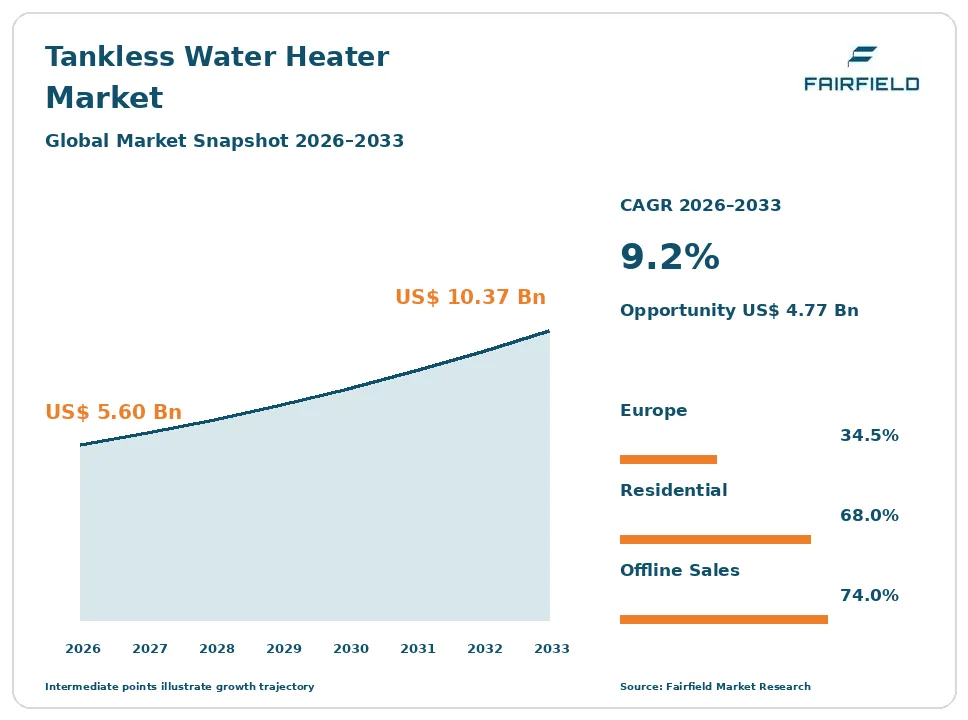
The global tankless water heater market size is expected to be valued at US$ 5.60 billion in 2026 and projected to reach US$ 10.37 billion by 2033, growing at a CAGR of 9.2% between 2026 and 2033.
Between 2020 and 2025, the market grew at a CAGR of about 8.1%, as homeowners and builders looked for ways to cut energy bills and save space. Three factors now drive growth: stricter energy efficiency rules for water heaters, consumer demand for on-demand hot water without storage tanks, and the steady replacement of older tank heaters in homes and businesses. Tankless units heat water only when a tap opens, avoiding the standby heat losses of tank models. The market is shifting toward condensing tankless gas models with efficiency above 95%, compact electric tankless units for apartments and point-of-use needs, and smart, Wi-Fi-connected heaters with built-in recirculation. New efficiency standards in the United States and climate targets in Europe continue to shape product design. Competition from heat pump water heaters is rising where governments push to replace gas.
Key Report Takeaways
- By Technology: Non-Condensing held 58.0% share in 2026, while Condensing is projected to expand at a 10.6% CAGR through 2033, driven by stricter efficiency standards and rebates for high-efficiency gas units.
- By Application: Residential held 68.0% share in 2026, while Commercial is projected to expand at a 9.8% CAGR through 2033, driven by restaurants, hotels, and offices adopting rack-mounted tankless systems.
- By Distribution Channel: Offline held 74.0% share in 2026, while Online is projected to expand at an 11.3% CAGR through 2033, driven by direct-to-consumer sales of electric tankless models.
- By Region: Europe held 34.5% share in 2026, while North America is projected to expand at a 10.2% CAGR through 2033, driven by replacement demand and efficiency rebates in the United States.
Global Tankless Water Heater Market Trends and Insights
Drivers Impact Analysis
| Driver | Impact on CAGR Forecast | Geographic Relevance | Impact Timeline |
| Energy efficiency rules and incentives | High | North America, Europe | Medium term (2-4 years) |
| Demand for on-demand hot water and compact design | High | Global | Long term (≥4 years) |
Two drivers carry the strongest influence on tankless water heater demand during the forecast period.
Energy Efficiency Rules Are Driving the Tankless Water Heater Market
Energy efficiency rules and incentives are the strongest driver of the tankless water heater market. Governments want to cut energy use in buildings.
The mechanism is regulation and rebates. Water heating accounts for a large share of home energy use, and tank heaters lose heat while water sits unused. In December 2024, the U.S. Department of Energy finalized standards that would require condensing tankless technology for most gas-fired instantaneous heaters from 2029, although the rule has faced challenges since. ENERGY STAR labels and utility rebates in the United States and Canada reward high-efficiency models. The European Union’s ecodesign and energy label rules push builders toward efficient heaters. Japan has long promoted high-efficiency gas units. These factors steer buyers away from old tank models and toward efficient tankless designs.
Consumer Demand Is Expanding the Tankless Water Heater Market
Demand for on-demand hot water and compact design is expanding the tankless water heater market. Homeowners want endless hot water and more space.
The cause is changing living patterns and housing. Tankless units supply hot water as long as needed, which suits larger families and homes with several bathrooms. They are small and wall-mounted, freeing space in apartments and small homes, which are growing in cities. Tankless heaters also last about 20 years, compared with 10 to 15 years for tank heaters. Smart features, such as app control and leak detection, appeal to tech-minded buyers. Rinnai showcased its SENSEI RX model with intelligent recirculation at the 2025 AHR Expo. These trends support steady replacement and new-build demand.
Restraints Impact Analysis
| Restraint | Impact on CAGR Forecast | Geographic Relevance | Impact Timeline |
| High upfront and installation costs | High | Global | Short term (≤2 years) |
| Shift away from gas and competition from heat pumps | Medium | Europe, North America | Long term (≥4 years) |
Two restraints limit how quickly the tankless water heater market grows.
High Upfront Costs Slow the Tankless Water Heater Market
High upfront and installation costs slow the tankless water heater market. Tankless units cost more to buy and install than standard tank heaters.
The specific causes are equipment and installation needs. A gas tankless heater often needs a larger gas line, new venting, and sometimes an upgraded electrical supply. Electric tankless models for whole homes may need major electrical panel upgrades. Installation can cost as much as the heater itself. Most buyers replace water heaters in an emergency when the old unit fails, so they often choose the cheapest, fastest option, usually another tank heater. Tankless units also need regular descaling in hard-water areas. Some users complain of a short “cold water sandwich” between uses. These factors limit adoption among cost-sensitive buyers.
Gas Phase-Outs Restrict the Tankless Water Heater Market
The shift away from gas and competition from heat pump water heaters restrict the tankless water heater market. Many governments want to cut fossil fuel use in homes.
The underlying causes are climate policy and building rules. Some cities in the United States and countries in Europe limit or ban gas connections in new buildings. Heat pump water heaters are often more efficient than gas tankless models and receive larger subsidies, such as tax credits in the United States. Gas tankless makers face uncertainty about future demand. Electric tankless models can benefit, but they need high power, which can strain home and grid capacity. These factors cap growth for gas models in mature markets.
Market Opportunities
Commercial Rack Systems Open a High-Value Revenue Pool
Commercial tankless systems open a high-value revenue pool in the tankless water heater market. Businesses need large volumes of hot water at peak times.
Manufacturers with commercial product lines can capture this opportunity. Restaurants, hotels, gyms, hospitals, and laundries use multiple tankless units linked together in racks, which provide backup if one unit fails. In March 2025, Rheem launched its IKONIC commercial tankless line with up to 98% thermal efficiency and rack options. Modular systems are easier to install and service than large boilers, and they can grow as a business expands by adding more units to the rack. Reduced energy bills help businesses recover costs. Service contracts and remote monitoring add recurring revenue. Commercial buyers also value lower carbon emissions to meet corporate climate goals.
Smart and Connected Heaters Create a Premium Revenue Pool
Smart and connected heaters create a premium revenue pool in the tankless water heater market. Buyers want control, efficiency data, and early warnings.
Manufacturers with strong software and connectivity can capture this opportunity. Wi-Fi models let users set temperatures, track energy use, and get maintenance alerts through apps. Built-in recirculation pumps deliver hot water faster and reduce wasted water. A. O. Smith launched its Adapt premium condensing tankless line with recirculation and Wi-Fi in 2024. Leak detection features reduce water damage and can lower insurance claims for homeowners. Premium models carry higher margins and support brand loyalty. Data from connected heaters also helps manufacturers improve products and offer predictive maintenance. Integration with home energy systems and solar power adds further value for buyers.
Segment Analysis
By Technology: Non-Condensing Leads While Condensing Grows Fastest
Non-Condensing held 58.0% share in 2026. Non-condensing units, including most electric tankless heaters and many lower-cost gas models, are simpler and cheaper to buy. Electric models dominate in Europe and in apartments, where gas lines are not available. Stiebel Eltron, Bosch Home Comfort, and Vaillant Group lead in electric units, while many budget gas models in China also use non-condensing designs.
Condensing is the fastest-growing technology, expanding at a 10.6% CAGR through 2033. Condensing tankless gas heaters capture heat from exhaust gases, reaching efficiencies of 95% or more. They also allow cheaper plastic venting. New efficiency rules in the United States and rebates favor condensing units. For the market, this growth raises average selling prices.
By Application: Residential Leads While Commercial Grows Fastest
Residential held 68.0% share in 2026. Homeowners buy tankless heaters for energy efficiency, endless hot water, and space savings. Replacement of old tank heaters forms most sales, while new homes in the United States, Japan, and Europe increasingly include tankless units as standard. Point-of-use electric units serve kitchens and bathrooms, often far from the main heater.
Commercial is the fastest-growing application, expanding at a 9.8% CAGR through 2033. Restaurants, hotels, schools, and healthcare facilities use multiple linked units to meet peak demand. Rack systems save floor space and provide backup. Rheem, Rinnai, and Navien offer pre-built rack systems that shorten installation time. For the market, commercial growth adds high-value orders.
By Distribution Channel: Offline Leads While Online Grows Fastest
Offline held 74.0% share in 2026. Plumbing wholesalers, contractors, and home improvement stores sell most tankless heaters, because installation usually requires a licensed professional. Contractors often recommend brands, giving them strong influence over buyer choice. Manufacturers run training and loyalty programs to win contractor support.
Online is the fastest-growing channel, expanding at an 11.3% CAGR through 2033. Buyers increasingly research and buy electric tankless and point-of-use units online, where prices are easy to compare. Manufacturers and retailers offer installation services with online orders. Customer reviews, comparison tools, and video guides help buyers choose models. For the market, online growth widens reach to do-it-yourself buyers and smaller brands.
Geography Analysis
Which Region Is Growing Fastest in the Tankless Water Heater Market?
North America is growing fastest in the tankless water heater market at a 10.2% CAGR through 2033. The United States has a large stock of aging tank heaters that need replacement, and builders increasingly install tankless units in new homes. Rinnai, Navien, Rheem, A. O. Smith, Noritz, and Bradford White compete strongly. Utility rebates and ENERGY STAR programs support high-efficiency models, and Canada offers similar incentives. Key barriers include high installation costs and competition from heat pump water heaters. Warm southern states favor outdoor installation, which lowers venting costs. One change shaping the region is the move to condensing units under new federal standards.
Which Region Is Leading the Tankless Water Heater Market?
Europe is leading the tankless water heater market with a 34.5% share in 2026. Germany, France, Italy, the United Kingdom, and Spain have long used instantaneous heaters, especially electric models in apartments and gas combination units in homes. Stiebel Eltron, Vaillant Group, Bosch Home Comfort, and Ariston are based here. European Union energy labels push buyers toward efficient models, and small apartments in cities favor compact wall-mounted units. Electric instantaneous heaters are common in Germany and Austria, while gas combination units are popular in the United Kingdom and Italy. Key barriers include gas phase-outs in new buildings. One change shaping the region is growth in electric units paired with rooftop solar.
Asia Pacific Grows the Tankless Water Heater Market Through Urban Housing
Asia Pacific is a large and growing tankless water heater market. Japan has one of the highest tankless adoption rates in the world, with Rinnai, Noritz, and Paloma based there. China has a huge market for gas instantaneous heaters in city apartments, and South Korea has strong demand led by KD Navien. India and Indonesia are adopting electric tankless units for bathrooms. Australia uses gas tankless widely, though some states now favor electric options. Rapid urban housing growth in China, India, and Vietnam adds new buyers each year. Key barriers include intense price competition. One change shaping the region is smart heaters with app control.
Latin America Develops the Tankless Water Heater Market Through Electric Showers
Latin America is a developing tankless water heater market. Brazil uses many electric shower heaters, a form of point-of-use tankless heating, and Mexico and Argentina use gas instantaneous heaters. Chile, Colombia, and Peru are seeing growth in apartment construction, where compact heaters save space. Global brands sell through local distributors and home improvement chains, while local makers compete on price. Rising middle-class incomes in Brazil and Mexico support upgrades to safer, more efficient units. Key barriers include low incomes and unreliable power in some areas. One opportunity is efficient electric models for new homes and apartments.
Middle East & Africa Adopts the Tankless Water Heater Market Through New Construction
Middle East & Africa is an emerging tankless water heater market. Saudi Arabia, the United Arab Emirates, and Qatar are building many new homes, hotels, and offices, where compact heaters save space. Israel uses solar and electric heating. South Africa and Egypt have growing demand for electric tankless units, though power cuts limit use in some areas. Large tourism projects in Saudi Arabia create demand for commercial hot water systems. Morocco and Kenya are adopting compact electric units in cities. Key barriers include low awareness and high import costs. One opportunity is hotels and commercial buildings that need reliable, efficient hot water.
Competitive Landscape
The tankless water heater market is moderately concentrated. Rinnai, Noritz, Paloma (which owns Rheem), A. O. Smith (which owns Takagi), KD Navien, Bosch Home Comfort, Vaillant Group, Stiebel Eltron, Ariston, and Bradford White hold most of the market. Chinese makers such as Haier, Midea, and Vanward lead in China’s gas heater segment.
Companies compete on efficiency, reliability, flow rate, smart features, price, and contractor relationships. Strong installer networks and training programs help brands win sales, since contractors often choose the brand. Warranty length, service support, and spare parts availability are also important. Price competition is strongest in electric tankless units, where many brands offer similar products. Online reviews increasingly shape buyer choice. Japanese and Korean makers have deep expertise in condensing gas technology, while European brands lead in electric units. Large firms also use acquisitions and partnerships to enter new regions and add product lines, and Chinese brands are expanding exports with lower prices.
Strategic moves show how competition is changing. In January 2024, A. O. Smith launched its Adapt premium condensing line. In December 2024, the U.S. Department of Energy finalized condensing-level standards for gas tankless heaters. In February 2025, Rinnai showcased its SENSEI RX. In March 2025, Rheem launched its IKONIC commercial tankless line. These moves show competition shifting toward condensing and connected products.
Three themes shape vendor strategy. First, companies are expanding condensing lines. Second, they are adding smart features. Third, they are targeting commercial buyers.
Tankless Water Heater Market Industry Leaders
- Rinnai
- A. O. Smith
- Bosch Home Comfort
- Noritz
- Vaillant Group
Recent Industry Developments
- March 2025: Rheem launched its IKONIC commercial tankless gas water heaters with up to 98% thermal efficiency and rack-system options - targets high-volume commercial hot water needs.
- February 2025: Rinnai showcased its SENSEI RX tankless heater with Smart-Circ intelligent recirculation at the AHR Expo - strengthens its premium residential range.
- December 2024: The U.S. Department of Energy finalized efficiency standards requiring condensing tankless technology for most gas instantaneous heaters from 2029 - pushes the market toward high-efficiency units.
- January 2024: A. O. Smith launched its Adapt premium condensing gas tankless heaters with built-in recirculation and Wi-Fi - expands its in-house tankless portfolio.
Companies Covered in the Report
- Rinnai
- A. O. Smith
- Bosch Home Comfort
- Noritz
- Vaillant Group
- Rheem
- KD Navien
- Stiebel Eltron
- Ariston
- Bradford White
- Paloma
- Haier
Tankless Water Heater Market Report Scope
This report covers tankless water heaters, including gas-fired and electric models with condensing and non-condensing technology, for residential and commercial use, sold through offline and online channels. It includes whole-home and point-of-use units but excludes storage tank and heat pump water heaters. The base year is 2025, and the forecast period runs from 2026 to 2033. All values are expressed in US$ Billion.
Technology
- Condensing
- Non-Condensing
Application
- Residential
- Commercial
Distribution Channel
- Offline
- Online
Regions
- North America
- Europe
- Asia Pacific
- Latin America
- Middle East & Africa
Key Questions Answered in the Report
How big is the tankless water heater market in 2026?
The tankless water heater market is valued at US$ 5.60 billion in 2026, led by residential use and Europe.
What is the tankless water heater market forecast to 2033?
The market is projected to reach US$ 10.37 billion by 2033, growing at a 9.2% CAGR and adding US$ 4.77 billion.
Which technology is growing fastest in the tankless water heater market?
Condensing tankless heaters are growing fastest at a 10.6% CAGR through 2033, driven by stricter efficiency rules and rebates.
Which region is growing fastest in the tankless water heater market?
North America is growing fastest at a 10.2% CAGR through 2033, driven by replacement demand and efficiency incentives in the United States.
Which region holds the largest tankless water heater market share?
Europe holds the largest share at 34.5% in 2026, supported by widespread electric and gas instantaneous heaters in apartments.
1. Executive Summary
1.1. Global Tankless Water Heater Market Snapshot
1.2. Future Projections
1.3. Key Report Takeaways
1.4. Regional Snapshot
2. Market Overview
2.1. Market Definition and Report Scope
2.2. Historical Trends 2020–2025
2.3. Market Dynamics
2.3.1. Drivers
2.3.1.1. Energy Efficiency Rules Are Driving the Tankless Water Heater Market
2.3.1.2. Consumer Demand Is Expanding the Tankless Water Heater Market
2.3.2. Restraints
2.3.2.1. High Upfront Costs Slow the Tankless Water Heater Market
2.3.2.2. Gas Phase-Outs Restrict the Tankless Water Heater Market
2.3.3. Market Opportunities
2.3.3.1. Commercial Rack Systems Open a High-Value Revenue Pool
2.3.3.2. Smart and Connected Heaters Create a Premium Revenue Pool
3. Global Tankless Water Heater Market Outlook, 2020-2033
3.1. Global Tankless Water Heater Market Outlook, by Technology, Value (US$ Billion), 2020-2033
3.1.1. Condensing
3.1.2. Non-Condensing
3.2. Global Tankless Water Heater Market Outlook, by Application, Value (US$ Billion), 2020-2033
3.2.1. Residential
3.2.2. Commercial
3.3. Global Tankless Water Heater Market Outlook, by Distribution Channel, Value (US$ Billion), 2020-2033
3.3.1. Offline
3.3.2. Online
3.4. Global Tankless Water Heater Market Outlook, by Region, Value (US$ Billion), 2020-2033
3.4.1. North America
3.4.2. Europe
3.4.3. Asia Pacific
3.4.4. Latin America
3.4.5. Middle East & Africa
4. North America Tankless Water Heater Market Outlook, 2020-2033
4.1. North America Tankless Water Heater Market Outlook, by Technology, Value (US$ Billion), 2020-2033
4.1.1. Condensing
4.1.2. Non-Condensing
4.2. North America Tankless Water Heater Market Outlook, by Application, Value (US$ Billion), 2020-2033
4.2.1. Residential
4.2.2. Commercial
4.3. North America Tankless Water Heater Market Outlook, by Distribution Channel, Value (US$ Billion), 2020-2033
4.3.1. Offline
4.3.2. Online
4.4. North America Tankless Water Heater Market Outlook, by Country, Value (US$ Billion), 2020-2033
4.4.1. United States Tankless Water Heater Market Outlook, by Technology, 2020-2033
4.4.2. United States Tankless Water Heater Market Outlook, by Application, 2020-2033
4.4.3. United States Tankless Water Heater Market Outlook, by Distribution Channel, 2020-2033
4.4.4. Canada Tankless Water Heater Market Outlook, by Technology, 2020-2033
4.4.5. Canada Tankless Water Heater Market Outlook, by Application, 2020-2033
4.4.6. Canada Tankless Water Heater Market Outlook, by Distribution Channel, 2020-2033
5. Europe Tankless Water Heater Market Outlook, 2020-2033
5.1. Europe Tankless Water Heater Market Outlook, by Technology, Value (US$ Billion), 2020-2033
5.1.1. Condensing
5.1.2. Non-Condensing
5.2. Europe Tankless Water Heater Market Outlook, by Application, Value (US$ Billion), 2020-2033
5.2.1. Residential
5.2.2. Commercial
5.3. Europe Tankless Water Heater Market Outlook, by Distribution Channel, Value (US$ Billion), 2020-2033
5.3.1. Offline
5.3.2. Online
5.4. Europe Tankless Water Heater Market Outlook, by Country, Value (US$ Billion), 2020-2033
5.4.1. Germany Tankless Water Heater Market Outlook, by Technology, 2020-2033
5.4.2. Germany Tankless Water Heater Market Outlook, by Application, 2020-2033
5.4.3. Germany Tankless Water Heater Market Outlook, by Distribution Channel, 2020-2033
5.4.4. France Tankless Water Heater Market Outlook, by Technology, 2020-2033
5.4.5. France Tankless Water Heater Market Outlook, by Application, 2020-2033
5.4.6. France Tankless Water Heater Market Outlook, by Distribution Channel, 2020-2033
5.4.7. Italy Tankless Water Heater Market Outlook, by Technology, 2020-2033
5.4.8. Italy Tankless Water Heater Market Outlook, by Application, 2020-2033
5.4.9. Italy Tankless Water Heater Market Outlook, by Distribution Channel, 2020-2033
5.4.10. United Kingdom Tankless Water Heater Market Outlook, by Technology, 2020-2033
5.4.11. United Kingdom Tankless Water Heater Market Outlook, by Application, 2020-2033
5.4.12. United Kingdom Tankless Water Heater Market Outlook, by Distribution Channel, 2020-2033
5.4.13. Spain Tankless Water Heater Market Outlook, by Technology, 2020-2033
5.4.14. Spain Tankless Water Heater Market Outlook, by Application, 2020-2033
5.4.15. Spain Tankless Water Heater Market Outlook, by Distribution Channel, 2020-2033
5.4.16. Austria Tankless Water Heater Market Outlook, by Technology, 2020-2033
5.4.17. Austria Tankless Water Heater Market Outlook, by Application, 2020-2033
5.4.18. Austria Tankless Water Heater Market Outlook, by Distribution Channel, 2020-2033
6. Asia Pacific Tankless Water Heater Market Outlook, 2020-2033
6.1. Asia Pacific Tankless Water Heater Market Outlook, by Technology, Value (US$ Billion), 2020-2033
6.1.1. Condensing
6.1.2. Non-Condensing
6.2. Asia Pacific Tankless Water Heater Market Outlook, by Application, Value (US$ Billion), 2020-2033
6.2.1. Residential
6.2.2. Commercial
6.3. Asia Pacific Tankless Water Heater Market Outlook, by Distribution Channel, Value (US$ Billion), 2020-2033
6.3.1. Offline
6.3.2. Online
6.4. Asia Pacific Tankless Water Heater Market Outlook, by Country, Value (US$ Billion), 2020-2033
6.4.1. Japan Tankless Water Heater Market Outlook, by Technology, 2020-2033
6.4.2. Japan Tankless Water Heater Market Outlook, by Application, 2020-2033
6.4.3. Japan Tankless Water Heater Market Outlook, by Distribution Channel, 2020-2033
6.4.4. China Tankless Water Heater Market Outlook, by Technology, 2020-2033
6.4.5. China Tankless Water Heater Market Outlook, by Application, 2020-2033
6.4.6. China Tankless Water Heater Market Outlook, by Distribution Channel, 2020-2033
6.4.7. South Korea Tankless Water Heater Market Outlook, by Technology, 2020-2033
6.4.8. South Korea Tankless Water Heater Market Outlook, by Application, 2020-2033
6.4.9. South Korea Tankless Water Heater Market Outlook, by Distribution Channel, 2020-2033
6.4.10. India Tankless Water Heater Market Outlook, by Technology, 2020-2033
6.4.11. India Tankless Water Heater Market Outlook, by Application, 2020-2033
6.4.12. India Tankless Water Heater Market Outlook, by Distribution Channel, 2020-2033
6.4.13. Indonesia Tankless Water Heater Market Outlook, by Technology, 2020-2033
6.4.14. Indonesia Tankless Water Heater Market Outlook, by Application, 2020-2033
6.4.15. Indonesia Tankless Water Heater Market Outlook, by Distribution Channel, 2020-2033
6.4.16. Australia Tankless Water Heater Market Outlook, by Technology, 2020-2033
6.4.17. Australia Tankless Water Heater Market Outlook, by Application, 2020-2033
6.4.18. Australia Tankless Water Heater Market Outlook, by Distribution Channel, 2020-2033
6.4.19. Vietnam Tankless Water Heater Market Outlook, by Technology, 2020-2033
6.4.20. Vietnam Tankless Water Heater Market Outlook, by Application, 2020-2033
6.4.21. Vietnam Tankless Water Heater Market Outlook, by Distribution Channel, 2020-2033
7. Latin America Tankless Water Heater Market Outlook, 2020-2033
7.1. Latin America Tankless Water Heater Market Outlook, by Technology, Value (US$ Billion), 2020-2033
7.1.1. Condensing
7.1.2. Non-Condensing
7.2. Latin America Tankless Water Heater Market Outlook, by Application, Value (US$ Billion), 2020-2033
7.2.1. Residential
7.2.2. Commercial
7.3. Latin America Tankless Water Heater Market Outlook, by Distribution Channel, Value (US$ Billion), 2020-2033
7.3.1. Offline
7.3.2. Online
7.4. Latin America Tankless Water Heater Market Outlook, by Country, Value (US$ Billion), 2020-2033
7.4.1. Brazil Tankless Water Heater Market Outlook, by Technology, 2020-2033
7.4.2. Brazil Tankless Water Heater Market Outlook, by Application, 2020-2033
7.4.3. Brazil Tankless Water Heater Market Outlook, by Distribution Channel, 2020-2033
7.4.4. Mexico Tankless Water Heater Market Outlook, by Technology, 2020-2033
7.4.5. Mexico Tankless Water Heater Market Outlook, by Application, 2020-2033
7.4.6. Mexico Tankless Water Heater Market Outlook, by Distribution Channel, 2020-2033
7.4.7. Argentina Tankless Water Heater Market Outlook, by Technology, 2020-2033
7.4.8. Argentina Tankless Water Heater Market Outlook, by Application, 2020-2033
7.4.9. Argentina Tankless Water Heater Market Outlook, by Distribution Channel, 2020-2033
7.4.10. Chile Tankless Water Heater Market Outlook, by Technology, 2020-2033
7.4.11. Chile Tankless Water Heater Market Outlook, by Application, 2020-2033
7.4.12. Chile Tankless Water Heater Market Outlook, by Distribution Channel, 2020-2033
7.4.13. Colombia Tankless Water Heater Market Outlook, by Technology, 2020-2033
7.4.14. Colombia Tankless Water Heater Market Outlook, by Application, 2020-2033
7.4.15. Colombia Tankless Water Heater Market Outlook, by Distribution Channel, 2020-2033
7.4.16. Peru Tankless Water Heater Market Outlook, by Technology, 2020-2033
7.4.17. Peru Tankless Water Heater Market Outlook, by Application, 2020-2033
7.4.18. Peru Tankless Water Heater Market Outlook, by Distribution Channel, 2020-2033
8. Middle East & Africa Tankless Water Heater Market Outlook, 2020-2033
8.1. Middle East & Africa Tankless Water Heater Market Outlook, by Technology, Value (US$ Billion), 2020-2033
8.1.1. Condensing
8.1.2. Non-Condensing
8.2. Middle East & Africa Tankless Water Heater Market Outlook, by Application, Value (US$ Billion), 2020-2033
8.2.1. Residential
8.2.2. Commercial
8.3. Middle East & Africa Tankless Water Heater Market Outlook, by Distribution Channel, Value (US$ Billion), 2020-2033
8.3.1. Offline
8.3.2. Online
8.4. Middle East & Africa Tankless Water Heater Market Outlook, by Country, Value (US$ Billion), 2020-2033
8.4.1. Saudi Arabia Tankless Water Heater Market Outlook, by Technology, 2020-2033
8.4.2. Saudi Arabia Tankless Water Heater Market Outlook, by Application, 2020-2033
8.4.3. Saudi Arabia Tankless Water Heater Market Outlook, by Distribution Channel, 2020-2033
8.4.4. United Arab Emirates Tankless Water Heater Market Outlook, by Technology, 2020-2033
8.4.5. United Arab Emirates Tankless Water Heater Market Outlook, by Application, 2020-2033
8.4.6. United Arab Emirates Tankless Water Heater Market Outlook, by Distribution Channel, 2020-2033
8.4.7. Qatar Tankless Water Heater Market Outlook, by Technology, 2020-2033
8.4.8. Qatar Tankless Water Heater Market Outlook, by Application, 2020-2033
8.4.9. Qatar Tankless Water Heater Market Outlook, by Distribution Channel, 2020-2033
8.4.10. Israel Tankless Water Heater Market Outlook, by Technology, 2020-2033
8.4.11. Israel Tankless Water Heater Market Outlook, by Application, 2020-2033
8.4.12. Israel Tankless Water Heater Market Outlook, by Distribution Channel, 2020-2033
8.4.13. South Africa Tankless Water Heater Market Outlook, by Technology, 2020-2033
8.4.14. South Africa Tankless Water Heater Market Outlook, by Application, 2020-2033
8.4.15. South Africa Tankless Water Heater Market Outlook, by Distribution Channel, 2020-2033
8.4.16. Egypt Tankless Water Heater Market Outlook, by Technology, 2020-2033
8.4.17. Egypt Tankless Water Heater Market Outlook, by Application, 2020-2033
8.4.18. Egypt Tankless Water Heater Market Outlook, by Distribution Channel, 2020-2033
8.4.19. Morocco Tankless Water Heater Market Outlook, by Technology, 2020-2033
8.4.20. Morocco Tankless Water Heater Market Outlook, by Application, 2020-2033
8.4.21. Morocco Tankless Water Heater Market Outlook, by Distribution Channel, 2020-2033
8.4.22. Kenya Tankless Water Heater Market Outlook, by Technology, 2020-2033
8.4.23. Kenya Tankless Water Heater Market Outlook, by Application, 2020-2033
8.4.24. Kenya Tankless Water Heater Market Outlook, by Distribution Channel, 2020-2033
9. Competitive Landscape
9.1. Market Concentration and Industry Leaders
9.2. Competitive Differentiation
9.3. Strategic Moves and Market Direction
9.4. Recent Industry Developments
9.5. Company Profiles
9.5.1. Rinnai
9.5.2. A. O. Smith
9.5.3. Bosch Home Comfort
9.5.4. Noritz
9.5.5. Vaillant Group
9.5.6. Rheem
9.5.7. KD Navien
9.5.8. Stiebel Eltron
9.5.9. Ariston
9.5.10. Bradford White
9.5.11. Paloma
9.5.12. Haier
10. Appendix
10.1. Research Methodology
10.2. Report Assumptions
10.3. Acronyms and Abbreviations
| Technology | Condensing, Non-Condensing |
| Application | Residential, Commercial |
| Distribution Channel | Offline, Online |
| Regions | North America, Europe, Asia Pacific, Latin America, Middle East & Africa |
Our Research Methodology
Considering the volatility of business today, traditional approaches to strategizing a game plan can be unfruitful if not detrimental. True ambiguity is no way to determine a forecast. A myriad of predetermined factors must be accounted for such as the degree of risk involved, the magnitude of circumstances, as well as conditions or consequences that are not known or unpredictable. To circumvent binary views that cast uncertainty, the application of market research intelligence to strategically posture, move, and enable actionable outcomes is necessary.
View Methodology
Quality Assured
Rigorous Validation Process

Confidentiality Assured
End-to-end Data Security

Custom Research Services
Tailored To Your Objectives
FAQs
The tankless water heater market is valued at US$ 5.60 billion in 2026, led by residential use and Europe.
The market is projected to reach US$ 10.37 billion by 2033, growing at a 9.2% CAGR and adding US$ 4.77 billion.
Condensing tankless heaters are growing fastest at a 10.6% CAGR through 2033, driven by stricter efficiency rules and rebates.
North America is growing fastest at a 10.2% CAGR through 2033, driven by replacement demand and efficiency incentives in the United States.
Europe holds the largest share at 34.5% in 2026, supported by widespread electric and gas instantaneous heaters in apartments.
Related Reports
Household Cooking Appliance Market Size, Share, Insights, Competitive Landscape, and Forecast 2026 to 2033
Household cooking appliance market to reach US$ 580.24 billion by 2033 from US$ 366.11 billion in 2026 at a 6.8% CAGR. Explore products and regional trends.
Toilet Paper Market Size, Share, Insights, Competitive Landscape, and Forecast 2026 to 2033
The global toilet paper market is valued at US$54.27 billion in 2026, reaching US$67.98 billion by 2033, growing at a 3.27% CAGR
Vertical Garden Construction Market Size, Share, Insights, Competitive Landscape, and Forecast 2026 to 2033
The global vertical garden construction market is valued at US$1.28 billion in 2026, reaching US$2.26 billion by 2033, growing at an 8.5% CAGR
Zero Gravity Entertainment Market Size, Share, Insights, Competitive Landscape, and Forecast 2026 to 2033
Zero gravity entertainment market to grow from US$ 0.3 billion in 2026 to US$ 0.8 billion by 2033 at a 15.0% CAGR. Explore experiences, channels and regions.
Veterinary Wearable Devices Market Size, Share, Insights, Competitive Landscape, and Forecast 2026 to 2033
The veterinary wearable devices market is projected to grow from US$3.10 billion in 2026 to US$7.69 billion by 2033, at a 13.9% CAGR, led by pet and herd monitoring.
Expansion Joints Market Size, Share, Insights, Competitive Landscape, and Forecast 2026 to 2033
The expansion joints market is projected to grow from US$1,285.1 million in 2026 to US$1,691.1 million by 2033, at a CAGR of 4.0%, led by energy investment.