



Vertical Garden Construction Market
Vertical Garden Construction Market Size, Share, Insights, Competitive Landscape, and Forecast 2026 to 2033
Vertical Garden Construction Market Size and Trend Analysis
How Fast Is the Vertical Garden Construction Market Growing?
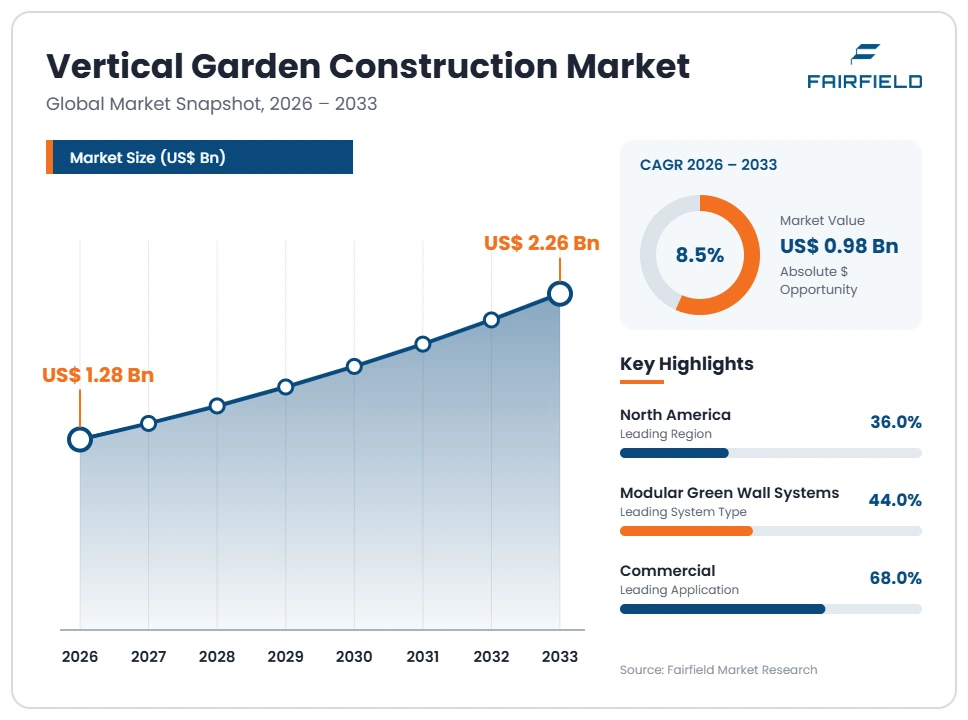
The global vertical garden construction market size is expected to be valued at US$ 1.28 billion in 2026 and projected to reach US$ 2.26 billion by 2033, growing at a CAGR of 8.5% between 2026 and 2033.
Between 2020 and 2025, the market grew at a CAGR of about 7.4%, slowing briefly in 2020 as construction sites closed, then accelerating as developers, employers, and cities invested in healthier and greener buildings. Vertical garden construction covers the design, supply, installation, and maintenance of living walls, green walls, and green facades on building exteriors and interiors. Systems include modular panels, felt pockets, trays, and climbing-plant structures, supported by irrigation, drainage, and lighting. Growth comes from green building certifications, urban heat island concerns, biophilic office design, and city rules that require greenery on new buildings. The market is shifting toward modular, sensor-controlled systems that cut maintenance and water use. In April 2026, The 13 Palace hotel in Macau set a Guinness World Records title for the tallest semi-indoor vertical garden at 50.863 m.
Key Report Takeaways
- By System Type: Modular Green Wall Systems held 44.0% share in 2026 and are projected to expand at the fastest 9.3% CAGR through 2033, driven by fast installation, easy plant replacement, and integrated irrigation that lowers lifetime maintenance costs.
- By Location: Outdoor held 57.0% share in 2026, while Indoor is projected to expand at a 9.4% CAGR through 2033, driven by biophilic office design, hospitality projects, and growing awareness of indoor air quality and employee wellbeing.
- By Application: Commercial held 68.0% share in 2026, while Residential is projected to expand at a 9.6% CAGR through 2033, driven by premium apartment developments, balcony gardens, and rising consumer interest in urban greenery at home.
- By Region: North America held 36.0% share in 2026, while Asia Pacific is projected to expand at a 10.2% CAGR through 2033, driven by dense cities, green building rules, and large commercial projects in China, India, and Singapore.
Global Vertical Garden Construction Market Trends and Insights
Drivers Impact Analysis
Two drivers carry the strongest influence on vertical garden construction demand during the forecast period.
| Driver | Impact on CAGR Forecast | Geographic Relevance | Impact Timeline |
| Green building standards and urban climate policy | High | Global | Long term (≥4 years) |
| Biophilic design and occupant wellbeing | Medium | North America, Europe, Asia Pacific | Medium term (2–4 years) |
Green Building Standards Are Driving the Vertical Garden Construction Market
Green building standards and urban climate policy are the strongest driver of the vertical garden construction market. Cities want buildings that cool streets and clean air.
The mechanism is regulation and certification credits. Rating systems such as LEED, BREEAM, and Green Mark award points for vegetation, stormwater control, and habitat creation, which encourages developers to add living walls. Cities including Singapore, Paris, London, Toronto, and Melbourne use greening rules, incentives, or green-area ratios for new projects. Green walls shade facades, reduce surface temperatures, and lower air-conditioning loads. A 500 m² living wall on a London office tower reportedly cut summer HVAC energy use by 12%. Plants also capture particulate pollution and absorb noise along busy roads. These benefits help cities fight the urban heat island effect and meet climate targets, creating steady demand.
Biophilic Design Is Expanding the Vertical Garden Construction Market
Biophilic design and occupant wellbeing are expanding the vertical garden construction market. Employers and hotels want spaces that feel natural.
The cause is competition for tenants, workers, and guests. Research links indoor plants with lower stress, better focus, and improved perceived air quality. Office owners install interior green walls in lobbies and workspaces to attract tenants and encourage staff to return to the office. Hotels, airports, malls, hospitals, and restaurants use vertical gardens as signature features that strengthen their brands and appear widely on social media. Interior landscaping firms such as Ambius offer green walls and moss walls as part of plant-care contracts. Preserved moss walls give a low-maintenance option for spaces with poor light. Retailers and co-working operators also use green walls to create memorable spaces. These trends add steady interior demand and recurring service revenue.
Restraints Impact Analysis
Two restraints limit how quickly the vertical garden construction market grows.
| Restraint | Impact on CAGR Forecast | Geographic Relevance | Impact Timeline |
| High installation and maintenance costs | High | Global | Long term (≥4 years) |
| Water use, structural, and fire safety concerns | Medium | Global | Medium term (2–4 years) |
High Costs Slow the Vertical Garden Construction Market
High installation and maintenance costs slow the vertical garden construction market. Living walls are expensive compared with conventional cladding.
The specific causes are complex systems and ongoing care. A professional living wall needs structural support, waterproofing, irrigation pumps, sensors, drainage, and sometimes grow lights, all installed by skilled teams. Plants must be inspected, pruned, fed, and replaced, and maintenance contracts can cost a large share of the initial price each year. Access equipment for tall exterior walls adds expense. Poorly maintained walls can fail visibly, damaging owner confidence. Many cost-sensitive developers therefore choose cheaper green facades with climbing plants or skip greenery altogether. Owners also struggle to measure returns on energy savings and wellbeing, which makes budget approval harder. These cost barriers limit adoption, especially in residential and smaller commercial projects.
Safety and Resource Concerns Restrict the Vertical Garden Construction Market
Water use, structural, and fire safety concerns restrict the vertical garden construction market. Owners and insurers weigh risks carefully.
The underlying causes are added load, moisture, and combustible materials. Saturated growing media make walls heavy, so older buildings may need structural upgrades. Leaks can damage facades and interiors. Irrigation uses water, which is a concern in dry cities. Fire regulations for exterior cladding have tightened in several countries, and dry plants or felt systems can raise questions from fire engineers. Manufacturers such as Sempergreen now certify systems for fire safety, but approvals add time and cost. Pests and plant diseases can spread quickly across dense plantings, and some building owners worry about insects near windows. These concerns slow approvals and push buyers toward lower-risk solutions such as potted plants or simple green facades.
Market Opportunities
Smart and Modular Systems Open a Fast-Growth Revenue Pool
Smart and modular systems open a fast-growth revenue pool in the vertical garden construction market. Technology can cut costs and failure risk.
System makers and installers can capture this opportunity. Pre-grown modular panels allow walls to look mature on day one and make plant replacement simple. Sensors measure moisture, nutrients, and light, while automated irrigation adjusts watering remotely and alerts maintenance teams to problems. Recycled-water and rainwater systems reduce water use. Lightweight substrates lower structural loads. Remote monitoring lets firms manage many sites efficiently, reduce site visits, and sell long-term service contracts to building owners. Standardized panels, developed with property developers, can lower unit costs and support larger projects. Companies that combine reliable hardware with data-driven maintenance and clear energy reporting can win repeat business.
Retrofits and Infrastructure Create a Large Revenue Pool
Retrofits and public infrastructure create a large revenue pool in the vertical garden construction market. Existing buildings and cities need greening.
Contractors and landscape firms can capture this opportunity. Most buildings that will exist in 2050 are already built, and owners are retrofitting facades to meet energy and climate goals. Parking structures, rail stations, highway sound barriers, bridges, and hoardings around construction sites can host green facades and living walls. Cities fund greening projects to reduce heat and flooding and improve public health. Schools and hospitals install green walls for wellbeing. Green walls can also be paired with solar panels and rainwater harvesting in integrated facade upgrades. Companies that offer affordable, lightweight retrofit systems and clear performance data on cooling, air quality, and biodiversity can capture public and private budgets.
Segment Analysis
- By System Type: Modular Green Wall Systems Lead and Grow Fastest
Modular Green Wall Systems held 44.0% share in 2026 and are also the fastest-growing system type, expanding at a 9.3% CAGR through 2033. Modular panels, trays, and cassettes are pre-planted in nurseries and clipped onto frames on site, which speeds installation and reduces on-site labor. Individual modules can be removed and replaced without disturbing the whole wall. LiveWall, ANS Global, Sempergreen, and GSky Plant Systems offer leading modular systems with integrated irrigation.
Felt-layer systems, used in many hydroponic designs, offer thin and lightweight walls favored by architects for dramatic indoor features. Foam-based and mineral wool-based systems are used for specific climates and fire requirements. Green facades with climbing plants on cables or trellises offer the lowest-cost option for large exterior areas. For the market, modular growth reflects demand for reliable, maintainable systems.
- By Location: Outdoor Leads While Indoor Grows Fastest
Outdoor held 57.0% share in 2026. Exterior living walls and green facades cover large surfaces on offices, malls, hotels, and public buildings, delivering cooling, noise reduction, and stormwater benefits. Exterior projects are larger and more valuable but need stronger structures and weather-resistant plants.
Indoor is the fastest-growing location, expanding at a 9.4% CAGR through 2033. Office lobbies, atriums, hotels, restaurants, airports, and healthcare facilities use interior green walls to improve wellbeing and brand image. Grow lights allow plants to thrive away from windows, and preserved moss walls offer a no-water alternative. Hybrid work has pushed employers to make offices more attractive, which supports interior greenery spending. For the market, indoor growth adds recurring maintenance revenue.
- By Application: Commercial Leads While Residential Grows Fastest
Commercial held 68.0% share in 2026. Offices, hotels, retail centers, airports, hospitals, and public buildings account for most vertical garden construction spending, because they have larger budgets, green certification goals, and visible public spaces. Interior landscaping contracts often bundle installation with ongoing care.
Residential is the fastest-growing application, expanding at a 9.6% CAGR through 2033. Developers of premium apartments and condominiums use green facades and balcony planting as selling points. Homeowners buy smaller DIY and modular kits for balconies, patios, and kitchens, including herb and vegetable walls. Online retailers make these kits easy to buy, and self-watering designs reduce care needs for busy households. For the market, residential growth widens the customer base beyond large commercial projects.
Geography Analysis
- Which Region Is Leading the Vertical Garden Construction Market?
North America is leading the vertical garden construction market with a 36.0% share in 2026. The United States has strong demand from offices, hotels, retail, healthcare, and university campuses, supported by LEED certification and corporate sustainability goals. LiveWall, GSky Plant Systems, Sage Vertical Garden Systems, and Ambius are active suppliers and service providers. Interior plant-care firms are consolidating, with Ambius acquiring two Austin plantscape businesses in September 2025. Canada adds demand through Toronto’s green building rules. Key barriers include high labor costs and cold winters that limit exterior plant choices. One change shaping the region is the growth of interior biophilic design in offices.
- Europe Expands the Vertical Garden Construction Market Through Climate Adaptation
Europe is a major vertical garden construction market. The United Kingdom, France, Germany, the Netherlands, Spain, and Italy are key markets, with London and Paris home to many landmark living walls. Sempergreen, Biotecture, ANS Global, Treebox, and Paisajismo Urbano are leading suppliers. European Union climate adaptation and biodiversity policies encourage urban greening, and many cities use green-area rules for new developments. Stricter fire safety rules for facades affect system choice and favor certified systems. Key barriers include fire regulations and high maintenance costs. One opportunity is retrofitting older buildings to reduce summer overheating.
- Which Region Is Growing Fastest in the Vertical Garden Construction Market?
Asia Pacific is growing fastest in the vertical garden construction market at a 10.2% CAGR through 2033. Singapore is a global leader in sky-rise greenery, supported by Green Mark certification and government incentives. China is adding vertical gardens to commercial and hospitality projects, and The 13 Palace in Macau set a world record for the tallest semi-indoor green wall in April 2026. India is adopting green walls in offices, airports, and metro stations, with ZTC International among local suppliers. Australia hosts Fytogreen and The Greenwall Company. Key barriers include cost sensitivity. One change shaping the region is rapid urbanization.
- Latin America Grows the Vertical Garden Construction Market Through Urban Greening
Latin America is a growing vertical garden construction market. Mexico, Brazil, Colombia, and Chile are leading markets, with Mexico City known for its highway pillar gardens and Medellín for green corridors that reduce urban heat. Warm climates allow year-round plant growth in many cities. Hotels, offices, and malls use green walls to stand out. Local landscaping firms install most systems, often using regional plants suited to local climates. Hospitality projects in tourist destinations add demand. Key barriers include limited budgets and economic volatility. One opportunity is public greening programs that combine climate adaptation with community wellbeing.
- Middle East & Africa Develops the Vertical Garden Construction Market Through Landmark Projects
Middle East & Africa is a developing vertical garden construction market. The United Arab Emirates, Saudi Arabia, and Qatar use green walls in hotels, malls, airports, and mega-projects to improve comfort and create landmark designs. Hot climates make shading and cooling valuable, but water scarcity requires efficient drip irrigation and drought-tolerant plants. South Africa and Egypt show growing interest in commercial projects, especially offices and shopping centers. Large tourism and hospitality developments add new demand. Key barriers include high water costs and extreme heat. One change shaping the region is smart irrigation that cuts water use.
Competitive Landscape
The vertical garden construction market is fragmented. Ambius, Sempergreen, LiveWall, Biotecture, and ANS Global are leading players, while Fytogreen, GSky Plant Systems, ZTC International, Paisajismo Urbano, Treebox, Sage Vertical Garden Systems, and The Greenwall Company compete strongly. Many local landscape contractors install and maintain systems in their home markets.
Companies compete on system reliability, plant survival rates, design quality, fire certification, water efficiency, price, and maintenance service. System makers often sell through networks of certified installers, while interior landscaping firms bundle green walls with plant-care contracts. Track records on landmark projects help win new work from architects and developers. Larger facility management and pest control groups, such as Mitie and Rentokil Initial, have entered the market through acquisitions, bringing national service networks and strong client relationships.
Strategic moves show how competition is changing. In September 2025, Ambius acquired two Austin plantscape firms, adding green wall and moss wall services. In April 2026, The 13 Palace in Macau set a record for the tallest semi-indoor green wall. In May 2026, Viritopia highlighted a 500 m² London living wall that cut summer HVAC use by 12%. These moves show competition shifting toward service scale and proven performance.
Three themes shape vendor strategy. First, companies are building modular, pre-grown systems to simplify installation. Second, they are adding sensors and remote monitoring to cut maintenance costs. Third, they are consolidating service networks to offer long-term care contracts.
Recent Industry Developments
- May 2026: Viritopia reported that its 500 m² living wall on a London office tower cut summer HVAC energy use by 12% – shows measurable energy value of living walls.
- April 2026: The 13 Palace in Macau set a Guinness World Records title for the tallest semi-indoor vertical garden at 50.863 m – showcases large-scale green walls in hospitality.
- September 2025: Ambius, part of Rentokil Terminix, acquired Creative Plant Designs and Plant Management Associates in Austin – expands green wall and moss wall services in North America.
Companies Covered in the Report
- Ambius
- Sempergreen
- LiveWall
- Biotecture
- ANS Global
- Fytogreen
- GSky Plant Systems
- ZTC International
- Paisajismo Urbano
- Treebox
- Sage Vertical Garden Systems
- The Greenwall Company
Vertical Garden Construction Market Report Scope
| Metric | Value |
| Study Period | 2020–2033 |
| Market Size 2026 | US$ 1.28 Billion |
| Market Size 2033 | US$ 2.26 Billion |
| CAGR 2026–2033 | 8.5% |
| Absolute Dollar Opportunity | US$ 0.98 Billion |
| Largest Market | North America |
| Fastest-Growing Market | Asia Pacific |
| Market Concentration | Fragmented |
| Major Players | Ambius, Sempergreen, LiveWall, Biotecture, ANS Global |
Vertical Garden Construction Market Segmentation
System Type
- Modular Green Wall Systems
- Felt Layer-Based Systems
- Foam-Based Systems
- Mineral Wool-Based Systems
- Green Facades
Location
- Outdoor
- Indoor
Application
- Commercial
- Residential
Regions
- North America
- Europe
- Asia Pacific
- Latin America
- Middle East & Africa
- Executive Summary
- Global Vertical Garden Construction Market Snapshot
- Future Projections
- Key Report Takeaways
- Regional Snapshot
- Market Overview
- Market Definition and Report Scope
- Historical Trends 2020–2025
- Market Dynamics
- Drivers
- Green Building Standards Are Driving the Vertical Garden Construction Market
- Biophilic Design Is Expanding the Vertical Garden Construction Market
- Restraints
- High Costs Slow the Vertical Garden Construction Market
- Safety and Resource Concerns Restrict the Vertical Garden Construction Market
- Market Opportunities
- Smart and Modular Systems Open a Fast-Growth Revenue Pool
- Retrofits and Infrastructure Create a Large Revenue Pool
- Drivers
- Global Vertical Garden Construction Market Outlook, 2020-2033
- Global Vertical Garden Construction Market Outlook, by System Type, Value (US$ Billion), 2020-2033
- Modular Green Wall Systems
- Felt Layer-Based Systems
- Foam-Based Systems
- Mineral Wool-Based Systems
- Green Facades
- Global Vertical Garden Construction Market Outlook, by Location, Value (US$ Billion), 2020-2033
- Outdoor
- Indoor
- Global Vertical Garden Construction Market Outlook, by Application, Value (US$ Billion), 2020-2033
- Commercial
- Residential
- Global Vertical Garden Construction Market Outlook, by Region, Value (US$ Billion), 2020-2033
- North America
- Europe
- Asia Pacific
- Latin America
- Middle East & Africa
- Global Vertical Garden Construction Market Outlook, by System Type, Value (US$ Billion), 2020-2033
- North America Vertical Garden Construction Market Outlook, 2020-2033
- North America Vertical Garden Construction Market Outlook, by System Type, Value (US$ Billion), 2020-2033
- Modular Green Wall Systems
- Felt Layer-Based Systems
- Foam-Based Systems
- Mineral Wool-Based Systems
- Green Facades
- North America Vertical Garden Construction Market Outlook, by Location, Value (US$ Billion), 2020-2033
- Outdoor
- Indoor
- North America Vertical Garden Construction Market Outlook, by Application, Value (US$ Billion), 2020-2033
- Commercial
- Residential
- North America Vertical Garden Construction Market Outlook, by Country, Value (US$ Billion), 2020-2033
- United States Vertical Garden Construction Market Outlook, by System Type, 2020-2033
- United States Vertical Garden Construction Market Outlook, by Location, 2020-2033
- United States Vertical Garden Construction Market Outlook, by Application, 2020-2033
- Canada Vertical Garden Construction Market Outlook, by System Type, 2020-2033
- Canada Vertical Garden Construction Market Outlook, by Location, 2020-2033
- Canada Vertical Garden Construction Market Outlook, by Application, 2020-2033
- North America Vertical Garden Construction Market Outlook, by System Type, Value (US$ Billion), 2020-2033
- Europe Vertical Garden Construction Market Outlook, 2020-2033
- Europe Vertical Garden Construction Market Outlook, by System Type, Value (US$ Billion), 2020-2033
- Modular Green Wall Systems
- Felt Layer-Based Systems
- Foam-Based Systems
- Mineral Wool-Based Systems
- Green Facades
- Europe Vertical Garden Construction Market Outlook, by Location, Value (US$ Billion), 2020-2033
- Outdoor
- Indoor
- Europe Vertical Garden Construction Market Outlook, by Application, Value (US$ Billion), 2020-2033
- Commercial
- Residential
- Europe Vertical Garden Construction Market Outlook, by Country, Value (US$ Billion), 2020-2033
- United Kingdom Vertical Garden Construction Market Outlook, by System Type, 2020-2033
- United Kingdom Vertical Garden Construction Market Outlook, by Location, 2020-2033
- United Kingdom Vertical Garden Construction Market Outlook, by Application, 2020-2033
- France Vertical Garden Construction Market Outlook, by System Type, 2020-2033
- France Vertical Garden Construction Market Outlook, by Location, 2020-2033
- France Vertical Garden Construction Market Outlook, by Application, 2020-2033
- Germany Vertical Garden Construction Market Outlook, by System Type, 2020-2033
- Germany Vertical Garden Construction Market Outlook, by Location, 2020-2033
- Germany Vertical Garden Construction Market Outlook, by Application, 2020-2033
- Netherlands Vertical Garden Construction Market Outlook, by System Type, 2020-2033
- Netherlands Vertical Garden Construction Market Outlook, by Location, 2020-2033
- Netherlands Vertical Garden Construction Market Outlook, by Application, 2020-2033
- Spain Vertical Garden Construction Market Outlook, by System Type, 2020-2033
- Spain Vertical Garden Construction Market Outlook, by Location, 2020-2033
- Spain Vertical Garden Construction Market Outlook, by Application, 2020-2033
- Italy Vertical Garden Construction Market Outlook, by System Type, 2020-2033
- Italy Vertical Garden Construction Market Outlook, by Location, 2020-2033
- Italy Vertical Garden Construction Market Outlook, by Application, 2020-2033
- Europe Vertical Garden Construction Market Outlook, by System Type, Value (US$ Billion), 2020-2033
- Asia Pacific Vertical Garden Construction Market Outlook, 2020-2033
- Asia Pacific Vertical Garden Construction Market Outlook, by System Type, Value (US$ Billion), 2020-2033
- Modular Green Wall Systems
- Felt Layer-Based Systems
- Foam-Based Systems
- Mineral Wool-Based Systems
- Green Facades
- Asia Pacific Vertical Garden Construction Market Outlook, by Location, Value (US$ Billion), 2020-2033
- Outdoor
- Indoor
- Asia Pacific Vertical Garden Construction Market Outlook, by Application, Value (US$ Billion), 2020-2033
- Commercial
- Residential
- Asia Pacific Vertical Garden Construction Market Outlook, by Country, Value (US$ Billion), 2020-2033
- Singapore Vertical Garden Construction Market Outlook, by System Type, 2020-2033
- Singapore Vertical Garden Construction Market Outlook, by Location, 2020-2033
- Singapore Vertical Garden Construction Market Outlook, by Application, 2020-2033
- China Vertical Garden Construction Market Outlook, by System Type, 2020-2033
- China Vertical Garden Construction Market Outlook, by Location, 2020-2033
- China Vertical Garden Construction Market Outlook, by Application, 2020-2033
- Macau Vertical Garden Construction Market Outlook, by System Type, 2020-2033
- Macau Vertical Garden Construction Market Outlook, by Location, 2020-2033
- Macau Vertical Garden Construction Market Outlook, by Application, 2020-2033
- India Vertical Garden Construction Market Outlook, by System Type, 2020-2033
- India Vertical Garden Construction Market Outlook, by Location, 2020-2033
- India Vertical Garden Construction Market Outlook, by Application, 2020-2033
- Australia Vertical Garden Construction Market Outlook, by System Type, 2020-2033
- Australia Vertical Garden Construction Market Outlook, by Location, 2020-2033
- Australia Vertical Garden Construction Market Outlook, by Application, 2020-2033
- Asia Pacific Vertical Garden Construction Market Outlook, by System Type, Value (US$ Billion), 2020-2033
- Latin America Vertical Garden Construction Market Outlook, 2020-2033
- Latin America Vertical Garden Construction Market Outlook, by System Type, Value (US$ Billion), 2020-2033
- Modular Green Wall Systems
- Felt Layer-Based Systems
- Foam-Based Systems
- Mineral Wool-Based Systems
- Green Facades
- Latin America Vertical Garden Construction Market Outlook, by Location, Value (US$ Billion), 2020-2033
- Outdoor
- Indoor
- Latin America Vertical Garden Construction Market Outlook, by Application, Value (US$ Billion), 2020-2033
- Commercial
- Residential
- Latin America Vertical Garden Construction Market Outlook, by Country, Value (US$ Billion), 2020-2033
- Mexico Vertical Garden Construction Market Outlook, by System Type, 2020-2033
- Mexico Vertical Garden Construction Market Outlook, by Location, 2020-2033
- Mexico Vertical Garden Construction Market Outlook, by Application, 2020-2033
- Brazil Vertical Garden Construction Market Outlook, by System Type, 2020-2033
- Brazil Vertical Garden Construction Market Outlook, by Location, 2020-2033
- Brazil Vertical Garden Construction Market Outlook, by Application, 2020-2033
- Colombia Vertical Garden Construction Market Outlook, by System Type, 2020-2033
- Colombia Vertical Garden Construction Market Outlook, by Location, 2020-2033
- Colombia Vertical Garden Construction Market Outlook, by Application, 2020-2033
- Chile Vertical Garden Construction Market Outlook, by System Type, 2020-2033
- Chile Vertical Garden Construction Market Outlook, by Location, 2020-2033
- Chile Vertical Garden Construction Market Outlook, by Application, 2020-2033
- Latin America Vertical Garden Construction Market Outlook, by System Type, Value (US$ Billion), 2020-2033
- Middle East & Africa Vertical Garden Construction Market Outlook, 2020-2033
- Middle East & Africa Vertical Garden Construction Market Outlook, by System Type, Value (US$ Billion), 2020-2033
- Modular Green Wall Systems
- Felt Layer-Based Systems
- Foam-Based Systems
- Mineral Wool-Based Systems
- Green Facades
- Middle East & Africa Vertical Garden Construction Market Outlook, by Location, Value (US$ Billion), 2020-2033
- Outdoor
- Indoor
- Middle East & Africa Vertical Garden Construction Market Outlook, by Application, Value (US$ Billion), 2020-2033
- Commercial
- Residential
- Middle East & Africa Vertical Garden Construction Market Outlook, by Country, Value (US$ Billion), 2020-2033
- United Arab Emirates Vertical Garden Construction Market Outlook, by System Type, 2020-2033
- United Arab Emirates Vertical Garden Construction Market Outlook, by Location, 2020-2033
- United Arab Emirates Vertical Garden Construction Market Outlook, by Application, 2020-2033
- Saudi Arabia Vertical Garden Construction Market Outlook, by System Type, 2020-2033
- Saudi Arabia Vertical Garden Construction Market Outlook, by Location, 2020-2033
- Saudi Arabia Vertical Garden Construction Market Outlook, by Application, 2020-2033
- Qatar Vertical Garden Construction Market Outlook, by System Type, 2020-2033
- Qatar Vertical Garden Construction Market Outlook, by Location, 2020-2033
- Qatar Vertical Garden Construction Market Outlook, by Application, 2020-2033
- South Africa Vertical Garden Construction Market Outlook, by System Type, 2020-2033
- South Africa Vertical Garden Construction Market Outlook, by Location, 2020-2033
- South Africa Vertical Garden Construction Market Outlook, by Application, 2020-2033
- Egypt Vertical Garden Construction Market Outlook, by System Type, 2020-2033
- Egypt Vertical Garden Construction Market Outlook, by Location, 2020-2033
- Egypt Vertical Garden Construction Market Outlook, by Application, 2020-2033
- Middle East & Africa Vertical Garden Construction Market Outlook, by System Type, Value (US$ Billion), 2020-2033
- Competitive Landscape
- Market Concentration and Industry Leaders
- Competitive Differentiation
- Strategic Moves and Market Direction
- Recent Industry Developments
- Company Profiles
- Ambius
- Sempergreen
- LiveWall
- Biotecture
- ANS Global
- Fytogreen
- GSky Plant Systems
- ZTC International
- Paisajismo Urbano
- Treebox
- Sage Vertical Garden Systems
- The Greenwall Company
- Appendix
- Research Methodology
- Report Assumptions
- Acronyms and Abbreviations
System Type
- Modular Green Wall Systems
- Felt Layer-Based Systems
- Foam-Based Systems
- Mineral Wool-Based Systems
- Green Facades
Location
- Outdoor
- Indoor
Application
- Commercial
- Residential
Regions
- North America
- Europe
- Asia Pacific
- Latin America
- Middle East & Africa
Our Research Methodology
Considering the volatility of business today, traditional approaches to strategizing a game plan can be unfruitful if not detrimental. True ambiguity is no way to determine a forecast. A myriad of predetermined factors must be accounted for such as the degree of risk involved, the magnitude of circumstances, as well as conditions or consequences that are not known or unpredictable. To circumvent binary views that cast uncertainty, the application of market research intelligence to strategically posture, move, and enable actionable outcomes is necessary.
View Methodology
Quality Assured
Rigorous Validation Process

Confidentiality Assured
End-to-end Data Security

Custom Research Services
Tailored To Your Objectives
FAQs
The vertical garden construction market is valued at US$ 1.28 billion in 2026, led by modular systems and North America.
The market is projected to reach US$ 2.26 billion by 2033, growing at an 8.5% CAGR and adding US$ 0.98 billion.
Residential is growing fastest at a 9.6% CAGR through 2033, driven by premium apartments, balcony gardens, and home greenery kits.
Asia Pacific is growing fastest at a 10.2% CAGR through 2033, driven by dense cities and green building rules in Singapore and China.
North America holds the largest share at 36.0% in 2026, supported by commercial demand, LEED certification, and strong interior landscaping firms.
Related Reports
Toilet Paper Market Size, Share, Insights, Competitive Landscape, and Forecast 2026 to 2033
The global toilet paper market is valued at US$54.27 billion in 2026, reaching US$67.98 billion by 2033, growing at a 3.27% CAGR
Zero Gravity Entertainment Market Size, Share, Insights, Competitive Landscape, and Forecast 2026 to 2033
Zero gravity entertainment market to grow from US$ 0.3 billion in 2026 to US$ 0.8 billion by 2033 at a 15.0% CAGR. Explore experiences, channels and regions.
Veterinary Wearable Devices Market Size, Share, Insights, Competitive Landscape, and Forecast 2026 to 2033
The veterinary wearable devices market is projected to grow from US$3.10 billion in 2026 to US$7.69 billion by 2033, at a 13.9% CAGR, led by pet and herd monitoring.
Expansion Joints Market Size, Share, Insights, Competitive Landscape, and Forecast 2026 to 2033
The expansion joints market is projected to grow from US$1,285.1 million in 2026 to US$1,691.1 million by 2033, at a CAGR of 4.0%, led by energy investment.
Tankless Water Heater Market Size, Share, Insights, Competitive Landscape, and Forecast 2026 to 2033
The tankless water heater market is projected to grow from US$5.60 billion in 2026 to US$10.37 billion by 2033, at a 9.2% CAGR, driven by efficient heating.
Plus Size Womens Clothing Market Size, Share, Insights, Competitive Landscape, and Forecast 2026 to 2033
Plus size womens clothing market to reach US$344.91 Bn by 2033 from US$219.06 Bn in 2026 at 6.7% CAGR. Explore products, price ranges, age groups and regions.