



Household Cooking Appliance Market
Household Cooking Appliance Market Size, Share, Insights, Competitive Landscape, and Forecast 2026 to 2033
Household Cooking Appliance Market Size and Trend Analysis
How Fast Is the Household Cooking Appliance Market Growing?
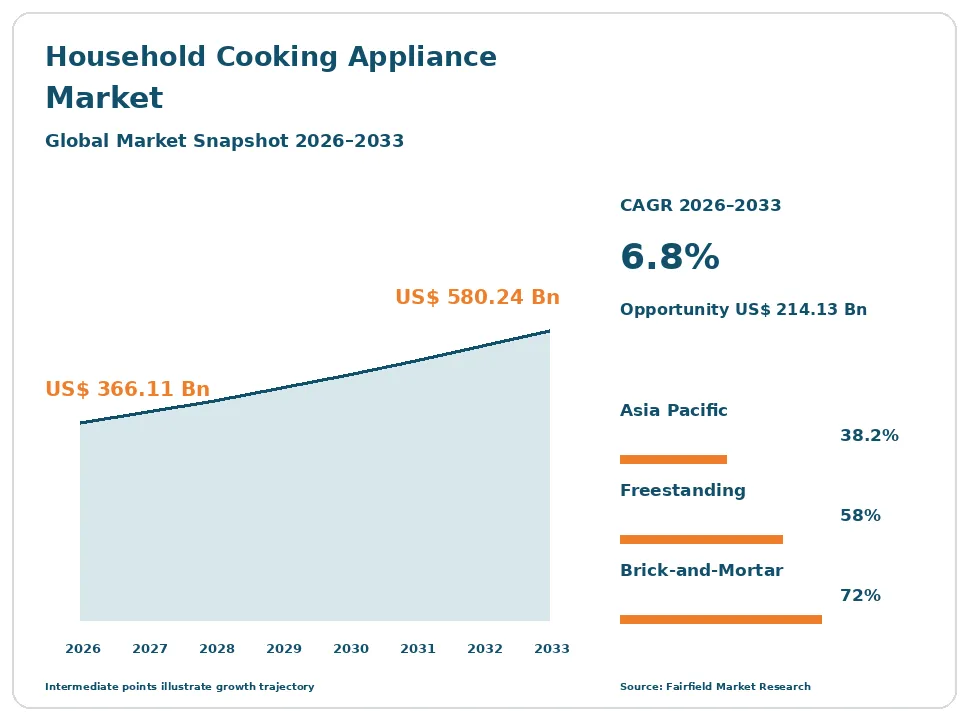
The global household cooking appliance market size is expected to be valued at US$ 366.11 billion in 2026 and projected to reach US$ 580.24 billion by 2033, growing at a CAGR of 6.8% between 2026 and 2033.
Between 2020 and 2025, the market grew at a CAGR of about 5.9%, lifted in the early years by more home cooking during lockdowns, then supported by housing activity, kitchen renovations, and rising incomes in emerging economies. Household cooking appliances include cooktops and cooking ranges, ovens, microwaves, and specialized countertop products such as air fryers, multi-cookers, and induction hobs. Kitchen appliances for cooking are essential purchases, but buyers increasingly choose models that save energy, cook faster, and connect to apps. Growth comes from urbanization, smaller households, premium kitchen design, and the shift from gas to electric and induction cooking. The market is shifting toward smart cooking appliances with AI recipe guidance, built-in designs, and multifunction countertop units. In May 2026, Samsung expanded its Bespoke AI kitchen line with AI-assisted cooking and energy optimization features.
Key Report Takeaways
- By Product: Cooktops & Cooking Ranges held 45.0% share in 2026, while Specialized Appliances are projected to expand at a 7.9% CAGR through 2033, driven by strong demand for air fryers, multi-cookers, and compact countertop ovens in smaller urban homes.
- By Structure: Freestanding held 58.0% share in 2026, while Built-in is projected to expand at a 7.6% CAGR through 2033, driven by premium kitchen renovations, modular kitchens, and integrated designs in new apartments.
- By Distribution Channel: Brick-and-Mortar held 72.0% share in 2026, while E-commerce is projected to expand at a 9.4% CAGR through 2033, driven by online comparison shopping, flexible financing, and fast delivery of countertop and connected appliances.
- By Region: Asia Pacific held 38.2% share in 2026, while India is projected to expand at a 8.9% CAGR through 2033, driven by rising incomes, modular kitchens, urban housing, and manufacturing incentives for domestic appliances.
Global Household Cooking Appliance Market Trends and Insights
Drivers Impact Analysis
| Driver | Impact on CAGR Forecast | Geographic Relevance | Impact Timeline |
| Urbanization, rising incomes, and new housing | High | Asia Pacific, Latin America, Middle East & Africa | Long term (≥4 years) |
| Smart, energy-efficient, and electric cooking adoption | High | North America, Europe, Asia Pacific | Medium term (2-4 years) |
Two drivers carry the strongest influence on household cooking appliance demand during the forecast period.
Urbanization and Rising Incomes Are Driving the Household Cooking Appliance Market
Urbanization, rising incomes, and new housing are the strongest driver of the household cooking appliance market. More households are buying modern kitchens.
The mechanism is household formation and lifestyle change. Millions of people move to cities each year in India, China, Indonesia, Vietnam, and many countries across Middle East & Africa, forming new households that need stoves, ovens, and microwaves. Rising middle-class incomes allow families to upgrade from basic burners to branded gas hobs, induction cooktops, and built-in ovens. New apartments often include modular kitchens with integrated appliances. Smaller households and busy work schedules increase demand for quick, convenient cooking with microwaves and air fryers. Government programs that provide clean cooking fuel and appliance manufacturing incentives in India also support adoption. These trends create steady volume growth in emerging markets.
Smart and Electric Cooking Is Expanding the Household Cooking Appliance Market
Smart, energy-efficient, and electric cooking adoption is expanding the household cooking appliance market. Consumers are replacing older appliances with better ones.
The cause is technology improvements and policy pressure. Induction cooktops heat faster, use less energy, and avoid indoor air pollution from gas, and several cities in North America and Europe restrict gas in new buildings. Smart cooking appliances connect to apps for remote preheating, recipe guidance, and automatic temperature control, and AI cameras inside ovens can recognize food and adjust settings. Samsung, LG, Whirlpool, and Haier have all expanded connected cooking ranges since 2025. Energy-labeling rules encourage efficient models. Replacement cycles in mature markets shorten as consumers upgrade to premium features. These shifts raise average selling prices and support value growth even where unit sales are flat.
Restraints Impact Analysis
| Restraint | Impact on CAGR Forecast | Geographic Relevance | Impact Timeline |
| Raw material costs, tariffs, and price competition | High | Global | Medium term (2-4 years) |
| Housing slowdowns and long replacement cycles | Medium | North America, Europe, China | Long term (≥4 years) |
Two restraints limit how quickly the household cooking appliance market grows.
Cost Pressures Slow the Household Cooking Appliance Market
Raw material costs, tariffs, and price competition slow the household cooking appliance market. Margins are under pressure.
The specific causes are input costs and intense rivalry. Steel, aluminum, copper, glass, and electronic components make up a large share of appliance costs, and their prices have been volatile since 2021. Tariffs on imported appliances and parts in the United States and other countries raise prices and disrupt supply chains. Chinese manufacturers compete aggressively on price in global markets, and retailers push private-label products. Promotions and discounting are common, especially online. Producers must invest in automation, lean factories, and regional manufacturing to stay competitive. Logistics costs for bulky ranges and ovens add further pressure, especially for exports. These pressures limit profitability and slow investment in some markets.
Housing Slowdowns Restrict the Household Cooking Appliance Market
Housing slowdowns and long replacement cycles restrict the household cooking appliance market. Many sales depend on moves and renovations.
The underlying causes are interest rates and product durability. Higher mortgage rates have slowed home sales and new construction in North America and Europe, and the property downturn in China has cut demand for new kitchen fittings. Cooking ranges and ovens often last ten to fifteen years, so replacement demand is slow and steady rather than fast. Consumers delay purchases during economic uncertainty. Saturation in mature markets limits unit growth. Some consumers also repair rather than replace appliances, supported by right-to-repair rules in Europe. Rental housing limits purchases, because landlords choose basic models and tenants rarely buy built-in units. These factors keep growth moderate in developed regions.
Market Opportunities
Countertop and Multifunction Appliances Open a Fast-Growth Revenue Pool
Countertop and multifunction appliances open a fast-growth revenue pool in the household cooking appliance market. Consumers want speed and versatility.
Appliance makers can capture this opportunity. Air fryers have become mainstream in North America, Europe, and Asia Pacific, and multi-cookers combine pressure cooking, slow cooking, steaming, and baking in one unit. Compact countertop ovens with air-fry and steam functions suit apartments and dormitories. These products have shorter replacement cycles and sell well online and through social media marketing. Panasonic launched a connected four-in-one countertop multi-oven in March 2025. Retailers give these products prominent space, and gifting seasons boost sales. Companies that innovate quickly with healthy cooking features, easy cleaning, and app connectivity can capture fast-growing demand.
Premium Built-in and Connected Kitchens Create a High-Value Revenue Pool
Premium built-in and connected kitchens create a high-value revenue pool in the household cooking appliance market. Homeowners are investing in kitchen design.
Premium brands can capture this opportunity. Built-in ovens, induction cooktops, steam ovens, and integrated ventilation are popular in new apartments and luxury renovations. Connected ecosystems link cooking appliances with refrigerators, recipe apps, voice assistants, and grocery services, which creates opportunities for recurring software and content revenue as well as stronger brand loyalty. LG introduced AI-powered built-in cooking appliances in February 2026. Developers in India, China, and Middle East & Africa increasingly fit branded appliances in new homes. Kitchen designers and builders influence brand choice, so partnerships with developers and showrooms matter. Companies with strong design, installation service, and connected ecosystems can capture higher margins.
Segment Analysis
By Product: Cooktops & Cooking Ranges Lead While Specialized Appliances Grow Fastest
Cooktops & Cooking Ranges held 45.0% share in 2026. Gas hobs, electric coil and ceramic cooktops, induction cooktops, and freestanding ranges are the core cooking equipment in nearly every home. Induction is gaining share in Europe, China, and India because of energy efficiency and safety. Whirlpool, Haier, BSH, and Electrolux are leading suppliers.
Specialized Appliances are the fastest-growing product, expanding at a 7.9% CAGR through 2033. Air fryers, multi-cookers, rice cookers, countertop ovens, grills, and steam ovens address demand for healthy, convenient cooking. Ovens and microwaves form another large segment, with microwaves widely used for reheating and quick meals in offices and homes. For the market, specialized appliance growth adds frequent, impulse-driven purchases.
By Structure: Freestanding Leads While Built-in Grows Fastest
Freestanding held 58.0% share in 2026. Freestanding ranges, cooktops, and microwaves are affordable, easy to install, and portable when people move, making them popular in rented homes and emerging markets.
Built-in is the fastest-growing structure, expanding at a 7.6% CAGR through 2033. Built-in ovens, hobs, and microwaves fit modular kitchens and create a seamless look. Premium brands such as Miele, BSH’s Bosch and Siemens, Smeg, and Fisher & Paykel focus on built-in ranges. Built-in units also suit new apartments in China, India, and the United Arab Emirates, where developers fit complete kitchens before sale. For the market, built-in growth raises average prices and supports premium positioning.
By Distribution Channel: Brick-and-Mortar Leads While E-commerce Grows Fastest
Brick-and-Mortar held 72.0% share in 2026. Appliance stores, electronics chains, home improvement retailers, and kitchen showrooms let buyers see products, compare finishes, and arrange installation. Large items such as ranges and built-in ovens are still mostly bought in stores, often with professional delivery, installation, and removal of old units. Retail promotions during holidays drive large volumes.
E-commerce is the fastest-growing channel, expanding at a 9.4% CAGR through 2033. Online marketplaces and brand websites offer wide choice, reviews, financing, and fast delivery. Countertop appliances, small ovens, and induction plates sell especially well online, often supported by video reviews and influencer marketing. Brands are building direct-to-consumer stores and subscription services for accessories. For the market, e-commerce growth increases price transparency and direct brand sales.
Geography Analysis
Why Is North America Important to the Household Cooking Appliance Market?
North America is important because it is a large, high-value market with strong demand for premium ranges, built-in ovens, and connected appliances. The United States has high household appliance ownership, large kitchens, and frequent remodeling, and Whirlpool, GE Appliances, owned by Haier, and Samsung compete strongly. Air fryers and countertop ovens have become very popular. Some cities restrict gas in new buildings, encouraging induction. Canada adds demand, and Mexico is a major appliance manufacturing hub. Key barriers include tariffs and slow housing activity. One change shaping the region is the shift toward electric and induction cooking.
Europe Advances the Household Cooking Appliance Market Through Energy Efficiency
Europe is a major household cooking appliance market. Germany, France, the United Kingdom, Italy, and Spain lead, with strong demand for built-in ovens and induction hobs. BSH, Electrolux, Miele, Smeg, and Arçelik are leading producers. European Union energy-labeling and ecodesign rules push efficient models, and many households are replacing gas hobs with induction to cut emissions. Kitchen renovation is a major and steady source of demand. Key barriers include weak housing activity, high energy prices, and strong price competition from Asian brands. One opportunity is induction and connected kitchens in renovations.
Which Region Is Leading the Household Cooking Appliance Market?
Asia Pacific is leading the household cooking appliance market with a 38.2% share in 2026. China is the largest producer and consumer, with Haier, Midea, and Gree among major brands. India is the fastest-growing country, expanding at a 8.9% CAGR through 2033, as urban households adopt gas hobs, induction cooktops, microwaves, and air fryers, supported by production-linked incentives. Japan and South Korea have advanced connected kitchens, with Panasonic, Samsung, and LG leading. Key barriers include intense price competition and thin margins for mass-market products. One change shaping the region is the rise of modular kitchens.
Latin America Grows the Household Cooking Appliance Market Through Urban Housing
Latin America is a growing household cooking appliance market. Brazil and Mexico are the largest markets, with strong demand for gas ranges and microwaves, and Whirlpool and Electrolux have large operations in the region. Colombia, Chile, Argentina, and Peru add demand as urban housing and consumer credit grow. Online sales are expanding quickly through regional marketplaces such as Mercado Libre. Installment payments make premium appliances affordable for many more families. Key barriers include currency swings, inflation, high interest rates on consumer credit, and import costs. One opportunity is affordable induction and countertop appliances for smaller homes.
Middle East & Africa Develops the Household Cooking Appliance Market Through Population Growth
Middle East & Africa is a developing household cooking appliance market. Saudi Arabia, the United Arab Emirates, Egypt, Nigeria, and South Africa have young, growing populations and expanding housing projects. Premium built-in kitchens from European and Asian brands are popular in Saudi Arabia and the United Arab Emirates, while affordable gas cookers dominate many African markets. Clean cooking programs support adoption of modern stoves, and liquefied petroleum gas cookers are replacing wood and charcoal in many homes. Key barriers include low incomes in some countries and unreliable electricity. One change shaping the region is large residential development programs.
Competitive Landscape
The household cooking appliance market is moderately consolidated. Haier, Whirlpool, Electrolux, BSH, and Samsung are leading players, while LG Electronics, Midea, Panasonic, Miele, Arçelik, Smeg, and Fisher & Paykel compete strongly. Many regional and private-label brands serve price-sensitive buyers, especially in Asia Pacific, Latin America, and Middle East & Africa, where local manufacturers sell affordable gas stoves and microwaves through traditional retailers. Large online marketplaces also sell their own branded countertop appliances.
Companies compete on design, reliability, energy efficiency, smart features, price, brand strength, retail presence, and after-sales service. Global groups own multiple brands across price points, from mass-market to luxury. Chinese manufacturers have expanded abroad through acquisitions and their own brands, raising competition in Europe and North America. Countertop appliance makers, including specialist brands, compete on fast innovation, low prices, and social media marketing.
Strategic moves show how competition is changing. In September 2025, Whirlpool launched an expanded range of connected ovens and cooktops with voice control. In February 2026, LG introduced AI-powered built-in cooking appliances. In May 2026, Samsung expanded its Bespoke AI kitchen line. These moves show competition shifting toward AI-enabled and connected cooking.
Three themes shape vendor strategy. First, companies are adding AI and app connectivity to cooking appliances. Second, they are expanding induction and built-in ranges for premium kitchens. Third, they are building regional manufacturing to manage tariffs and costs.
Household Cooking Appliance Market Industry Leaders
- Haier
- Whirlpool
- Electrolux
- BSH
- Samsung
Recent Industry Developments
- May 2026: Samsung expanded its Bespoke AI kitchen appliance line with AI-assisted cooking, energy optimization, and SmartThings connectivity - strengthens smart cooking appliances competition.
- February 2026: LG Electronics introduced AI-powered built-in cooking appliances with steam cooking, remote control, and personalized recipes - expands premium built-in kitchen appliances.
- September 2025: Whirlpool launched an expanded range of connected ovens and cooktops with voice control and energy-efficient features - supports connected household cooking appliances in North America.
Companies Covered in the Report
- Haier
- Whirlpool
- Electrolux
- BSH
- Samsung
- LG Electronics
- Midea
- Panasonic
- Miele
- Arçelik
- Smeg
- Fisher & Paykel
Household Cooking Appliance Market Report Scope
This report covers household cooking appliances, including cooktops and cooking ranges, ovens, microwaves, and specialized appliances, in freestanding and built-in structures, powered by gas and electricity, sold through brick-and-mortar and e-commerce channels. The base year is 2025, and the forecast period runs from 2026 to 2033. All values are expressed in US$ Billion.
Product
- Cooktops & Cooking Ranges
- Ovens & Microwaves
- Specialized Appliances
Structure
- Freestanding
- Built-in
Distribution Channel
- Brick-and-Mortar
- E-commerce
Regions
- North America
- Europe
- Asia Pacific
- Latin America
- Middle East & Africa
Key Questions Answered in the Report
How big is the household cooking appliance market in 2026?
The household cooking appliance market is valued at US$ 366.11 billion in 2026, led by cooktops and ranges and Asia Pacific.
What is the household cooking appliance market forecast to 2033?
The market is projected to reach US$ 580.24 billion by 2033, growing at a 6.8% CAGR and adding US$ 214.13 billion.
Which product is growing fastest in the household cooking appliance market?
Specialized appliances are growing fastest at a 7.9% CAGR through 2033, driven by air fryers, multi-cookers, and countertop ovens.
Which country is growing fastest in the household cooking appliance market?
India is growing fastest at an 8.9% CAGR through 2033, driven by rising incomes, urban housing, and modular kitchen adoption.
Which region holds the largest household cooking appliance market share?
Asia Pacific holds the largest share at 38.2% in 2026, supported by large production and consumption in China and India.
1. Executive Summary
1.1. Global Household Cooking Appliance Market Snapshot
1.2. Future Projections
1.3. Key Report Takeaways
1.4. Regional Snapshot
2. Market Overview
2.1. Market Definition and Report Scope
2.2. Historical Trends 2020–2025
2.3. Market Dynamics
2.3.1. Drivers
2.3.1.1. Urbanization and Rising Incomes Are Driving the Household Cooking Appliance Market
2.3.1.2. Smart and Electric Cooking Is Expanding the Household Cooking Appliance Market
2.3.2. Restraints
2.3.2.1. Cost Pressures Slow the Household Cooking Appliance Market
2.3.2.2. Housing Slowdowns Restrict the Household Cooking Appliance Market
2.3.3. Market Opportunities
2.3.3.1. Countertop and Multifunction Appliances Open a Fast-Growth Revenue Pool
2.3.3.2. Premium Built-in and Connected Kitchens Create a High-Value Revenue Pool
3. Global Household Cooking Appliance Market Outlook, 2020-2033
3.1. Global Household Cooking Appliance Market Outlook, by Product, Value (US$ Billion), 2020-2033
3.1.1. Cooktops & Cooking Ranges
3.1.2. Ovens & Microwaves
3.1.3. Specialized Appliances
3.2. Global Household Cooking Appliance Market Outlook, by Structure, Value (US$ Billion), 2020-2033
3.2.1. Freestanding
3.2.2. Built-in
3.3. Global Household Cooking Appliance Market Outlook, by Distribution Channel, Value (US$ Billion), 2020-2033
3.3.1. Brick-and-Mortar
3.3.2. E-commerce
3.4. Global Household Cooking Appliance Market Outlook, by Region, Value (US$ Billion), 2020-2033
3.4.1. North America
3.4.2. Europe
3.4.3. Asia Pacific
3.4.4. Latin America
3.4.5. Middle East & Africa
4. North America Household Cooking Appliance Market Outlook, 2020-2033
4.1. North America Household Cooking Appliance Market Outlook, by Product, Value (US$ Billion), 2020-2033
4.1.1. Cooktops & Cooking Ranges
4.1.2. Ovens & Microwaves
4.1.3. Specialized Appliances
4.2. North America Household Cooking Appliance Market Outlook, by Structure, Value (US$ Billion), 2020-2033
4.2.1. Freestanding
4.2.2. Built-in
4.3. North America Household Cooking Appliance Market Outlook, by Distribution Channel, Value (US$ Billion), 2020-2033
4.3.1. Brick-and-Mortar
4.3.2. E-commerce
4.4. North America Household Cooking Appliance Market Outlook, by Country, Value (US$ Billion), 2020-2033
4.4.1. United States Household Cooking Appliance Market Outlook, by Product, 2020-2033
4.4.2. United States Household Cooking Appliance Market Outlook, by Structure, 2020-2033
4.4.3. United States Household Cooking Appliance Market Outlook, by Distribution Channel, 2020-2033
4.4.4. Canada Household Cooking Appliance Market Outlook, by Product, 2020-2033
4.4.5. Canada Household Cooking Appliance Market Outlook, by Structure, 2020-2033
4.4.6. Canada Household Cooking Appliance Market Outlook, by Distribution Channel, 2020-2033
4.4.7. Mexico Household Cooking Appliance Market Outlook, by Product, 2020-2033
4.4.8. Mexico Household Cooking Appliance Market Outlook, by Structure, 2020-2033
4.4.9. Mexico Household Cooking Appliance Market Outlook, by Distribution Channel, 2020-2033
5. Europe Household Cooking Appliance Market Outlook, 2020-2033
5.1. Europe Household Cooking Appliance Market Outlook, by Product, Value (US$ Billion), 2020-2033
5.1.1. Cooktops & Cooking Ranges
5.1.2. Ovens & Microwaves
5.1.3. Specialized Appliances
5.2. Europe Household Cooking Appliance Market Outlook, by Structure, Value (US$ Billion), 2020-2033
5.2.1. Freestanding
5.2.2. Built-in
5.3. Europe Household Cooking Appliance Market Outlook, by Distribution Channel, Value (US$ Billion), 2020-2033
5.3.1. Brick-and-Mortar
5.3.2. E-commerce
5.4. Europe Household Cooking Appliance Market Outlook, by Country, Value (US$ Billion), 2020-2033
5.4.1. Germany Household Cooking Appliance Market Outlook, by Product, 2020-2033
5.4.2. Germany Household Cooking Appliance Market Outlook, by Structure, 2020-2033
5.4.3. Germany Household Cooking Appliance Market Outlook, by Distribution Channel, 2020-2033
5.4.4. France Household Cooking Appliance Market Outlook, by Product, 2020-2033
5.4.5. France Household Cooking Appliance Market Outlook, by Structure, 2020-2033
5.4.6. France Household Cooking Appliance Market Outlook, by Distribution Channel, 2020-2033
5.4.7. United Kingdom Household Cooking Appliance Market Outlook, by Product, 2020-2033
5.4.8. United Kingdom Household Cooking Appliance Market Outlook, by Structure, 2020-2033
5.4.9. United Kingdom Household Cooking Appliance Market Outlook, by Distribution Channel, 2020-2033
5.4.10. Italy Household Cooking Appliance Market Outlook, by Product, 2020-2033
5.4.11. Italy Household Cooking Appliance Market Outlook, by Structure, 2020-2033
5.4.12. Italy Household Cooking Appliance Market Outlook, by Distribution Channel, 2020-2033
5.4.13. Spain Household Cooking Appliance Market Outlook, by Product, 2020-2033
5.4.14. Spain Household Cooking Appliance Market Outlook, by Structure, 2020-2033
5.4.15. Spain Household Cooking Appliance Market Outlook, by Distribution Channel, 2020-2033
6. Asia Pacific Household Cooking Appliance Market Outlook, 2020-2033
6.1. Asia Pacific Household Cooking Appliance Market Outlook, by Product, Value (US$ Billion), 2020-2033
6.1.1. Cooktops & Cooking Ranges
6.1.2. Ovens & Microwaves
6.1.3. Specialized Appliances
6.2. Asia Pacific Household Cooking Appliance Market Outlook, by Structure, Value (US$ Billion), 2020-2033
6.2.1. Freestanding
6.2.2. Built-in
6.3. Asia Pacific Household Cooking Appliance Market Outlook, by Distribution Channel, Value (US$ Billion), 2020-2033
6.3.1. Brick-and-Mortar
6.3.2. E-commerce
6.4. Asia Pacific Household Cooking Appliance Market Outlook, by Country, Value (US$ Billion), 2020-2033
6.4.1. China Household Cooking Appliance Market Outlook, by Product, 2020-2033
6.4.2. China Household Cooking Appliance Market Outlook, by Structure, 2020-2033
6.4.3. China Household Cooking Appliance Market Outlook, by Distribution Channel, 2020-2033
6.4.4. India Household Cooking Appliance Market Outlook, by Product, 2020-2033
6.4.5. India Household Cooking Appliance Market Outlook, by Structure, 2020-2033
6.4.6. India Household Cooking Appliance Market Outlook, by Distribution Channel, 2020-2033
6.4.7. Japan Household Cooking Appliance Market Outlook, by Product, 2020-2033
6.4.8. Japan Household Cooking Appliance Market Outlook, by Structure, 2020-2033
6.4.9. Japan Household Cooking Appliance Market Outlook, by Distribution Channel, 2020-2033
6.4.10. South Korea Household Cooking Appliance Market Outlook, by Product, 2020-2033
6.4.11. South Korea Household Cooking Appliance Market Outlook, by Structure, 2020-2033
6.4.12. South Korea Household Cooking Appliance Market Outlook, by Distribution Channel, 2020-2033
7. Latin America Household Cooking Appliance Market Outlook, 2020-2033
7.1. Latin America Household Cooking Appliance Market Outlook, by Product, Value (US$ Billion), 2020-2033
7.1.1. Cooktops & Cooking Ranges
7.1.2. Ovens & Microwaves
7.1.3. Specialized Appliances
7.2. Latin America Household Cooking Appliance Market Outlook, by Structure, Value (US$ Billion), 2020-2033
7.2.1. Freestanding
7.2.2. Built-in
7.3. Latin America Household Cooking Appliance Market Outlook, by Distribution Channel, Value (US$ Billion), 2020-2033
7.3.1. Brick-and-Mortar
7.3.2. E-commerce
7.4. Latin America Household Cooking Appliance Market Outlook, by Country, Value (US$ Billion), 2020-2033
7.4.1. Brazil Household Cooking Appliance Market Outlook, by Product, 2020-2033
7.4.2. Brazil Household Cooking Appliance Market Outlook, by Structure, 2020-2033
7.4.3. Brazil Household Cooking Appliance Market Outlook, by Distribution Channel, 2020-2033
7.4.4. Mexico Household Cooking Appliance Market Outlook, by Product, 2020-2033
7.4.5. Mexico Household Cooking Appliance Market Outlook, by Structure, 2020-2033
7.4.6. Mexico Household Cooking Appliance Market Outlook, by Distribution Channel, 2020-2033
7.4.7. Colombia Household Cooking Appliance Market Outlook, by Product, 2020-2033
7.4.8. Colombia Household Cooking Appliance Market Outlook, by Structure, 2020-2033
7.4.9. Colombia Household Cooking Appliance Market Outlook, by Distribution Channel, 2020-2033
7.4.10. Chile Household Cooking Appliance Market Outlook, by Product, 2020-2033
7.4.11. Chile Household Cooking Appliance Market Outlook, by Structure, 2020-2033
7.4.12. Chile Household Cooking Appliance Market Outlook, by Distribution Channel, 2020-2033
7.4.13. Argentina Household Cooking Appliance Market Outlook, by Product, 2020-2033
7.4.14. Argentina Household Cooking Appliance Market Outlook, by Structure, 2020-2033
7.4.15. Argentina Household Cooking Appliance Market Outlook, by Distribution Channel, 2020-2033
7.4.16. Peru Household Cooking Appliance Market Outlook, by Product, 2020-2033
7.4.17. Peru Household Cooking Appliance Market Outlook, by Structure, 2020-2033
7.4.18. Peru Household Cooking Appliance Market Outlook, by Distribution Channel, 2020-2033
8. Middle East & Africa Household Cooking Appliance Market Outlook, 2020-2033
8.1. Middle East & Africa Household Cooking Appliance Market Outlook, by Product, Value (US$ Billion), 2020-2033
8.1.1. Cooktops & Cooking Ranges
8.1.2. Ovens & Microwaves
8.1.3. Specialized Appliances
8.2. Middle East & Africa Household Cooking Appliance Market Outlook, by Structure, Value (US$ Billion), 2020-2033
8.2.1. Freestanding
8.2.2. Built-in
8.3. Middle East & Africa Household Cooking Appliance Market Outlook, by Distribution Channel, Value (US$ Billion), 2020-2033
8.3.1. Brick-and-Mortar
8.3.2. E-commerce
8.4. Middle East & Africa Household Cooking Appliance Market Outlook, by Country, Value (US$ Billion), 2020-2033
8.4.1. Saudi Arabia Household Cooking Appliance Market Outlook, by Product, 2020-2033
8.4.2. Saudi Arabia Household Cooking Appliance Market Outlook, by Structure, 2020-2033
8.4.3. Saudi Arabia Household Cooking Appliance Market Outlook, by Distribution Channel, 2020-2033
8.4.4. United Arab Emirates Household Cooking Appliance Market Outlook, by Product, 2020-2033
8.4.5. United Arab Emirates Household Cooking Appliance Market Outlook, by Structure, 2020-2033
8.4.6. United Arab Emirates Household Cooking Appliance Market Outlook, by Distribution Channel, 2020-2033
8.4.7. Egypt Household Cooking Appliance Market Outlook, by Product, 2020-2033
8.4.8. Egypt Household Cooking Appliance Market Outlook, by Structure, 2020-2033
8.4.9. Egypt Household Cooking Appliance Market Outlook, by Distribution Channel, 2020-2033
8.4.10. Nigeria Household Cooking Appliance Market Outlook, by Product, 2020-2033
8.4.11. Nigeria Household Cooking Appliance Market Outlook, by Structure, 2020-2033
8.4.12. Nigeria Household Cooking Appliance Market Outlook, by Distribution Channel, 2020-2033
8.4.13. South Africa Household Cooking Appliance Market Outlook, by Product, 2020-2033
8.4.14. South Africa Household Cooking Appliance Market Outlook, by Structure, 2020-2033
8.4.15. South Africa Household Cooking Appliance Market Outlook, by Distribution Channel, 2020-2033
9. Competitive Landscape
9.1. Market Concentration and Industry Leaders
9.2. Competitive Differentiation
9.3. Strategic Moves and Market Direction
9.4. Recent Industry Developments
9.5. Company Profiles
9.5.1. Haier
9.5.2. Whirlpool
9.5.3. Electrolux
9.5.4. BSH
9.5.5. Samsung
9.5.6. LG Electronics
9.5.7. Midea
9.5.8. Panasonic
9.5.9. Miele
9.5.10. Arçelik
9.5.11. Smeg
9.5.12. Fisher & Paykel
10. Appendix
10.1. Research Methodology
10.2. Report Assumptions
10.3. Acronyms and Abbreviations
| Product | Cooktops & Cooking Ranges, Ovens & Microwaves, Specialized Appliances |
| Structure | Freestanding, Built-in |
| Distribution Channel | Brick-and-Mortar, E-commerce |
| Regions | North America, Europe, Asia Pacific, Latin America, Middle East & Africa |
Our Research Methodology
Considering the volatility of business today, traditional approaches to strategizing a game plan can be unfruitful if not detrimental. True ambiguity is no way to determine a forecast. A myriad of predetermined factors must be accounted for such as the degree of risk involved, the magnitude of circumstances, as well as conditions or consequences that are not known or unpredictable. To circumvent binary views that cast uncertainty, the application of market research intelligence to strategically posture, move, and enable actionable outcomes is necessary.
View Methodology
Quality Assured
Rigorous Validation Process

Confidentiality Assured
End-to-end Data Security

Custom Research Services
Tailored To Your Objectives
FAQs
The household cooking appliance market is valued at US$ 366.11 billion in 2026, led by cooktops and ranges and Asia Pacific.
The market is projected to reach US$ 580.24 billion by 2033, growing at a 6.8% CAGR and adding US$ 214.13 billion.
Specialized appliances are growing fastest at a 7.9% CAGR through 2033, driven by air fryers, multi-cookers, and countertop ovens.
India is growing fastest at an 8.9% CAGR through 2033, driven by rising incomes, urban housing, and modular kitchen adoption.
Asia Pacific holds the largest share at 38.2% in 2026, supported by large production and consumption in China and India.
Related Reports
Toilet Paper Market Size, Share, Insights, Competitive Landscape, and Forecast 2026 to 2033
The global toilet paper market is valued at US$54.27 billion in 2026, reaching US$67.98 billion by 2033, growing at a 3.27% CAGR
Vertical Garden Construction Market Size, Share, Insights, Competitive Landscape, and Forecast 2026 to 2033
The global vertical garden construction market is valued at US$1.28 billion in 2026, reaching US$2.26 billion by 2033, growing at an 8.5% CAGR
Zero Gravity Entertainment Market Size, Share, Insights, Competitive Landscape, and Forecast 2026 to 2033
Zero gravity entertainment market to grow from US$ 0.3 billion in 2026 to US$ 0.8 billion by 2033 at a 15.0% CAGR. Explore experiences, channels and regions.
Veterinary Wearable Devices Market Size, Share, Insights, Competitive Landscape, and Forecast 2026 to 2033
The veterinary wearable devices market is projected to grow from US$3.10 billion in 2026 to US$7.69 billion by 2033, at a 13.9% CAGR, led by pet and herd monitoring.
Expansion Joints Market Size, Share, Insights, Competitive Landscape, and Forecast 2026 to 2033
The expansion joints market is projected to grow from US$1,285.1 million in 2026 to US$1,691.1 million by 2033, at a CAGR of 4.0%, led by energy investment.
Tankless Water Heater Market Size, Share, Insights, Competitive Landscape, and Forecast 2026 to 2033
The tankless water heater market is projected to grow from US$5.60 billion in 2026 to US$10.37 billion by 2033, at a 9.2% CAGR, driven by efficient heating.