



3D Cell Culture Market
3D Cell Culture Market Size, Share, Insights, Competitive Landscape, and Forecast 2026 to 2033
3D Cell Culture Market Size and Trend Analysis
How Fast Is the 3D Cell Culture Market Growing?
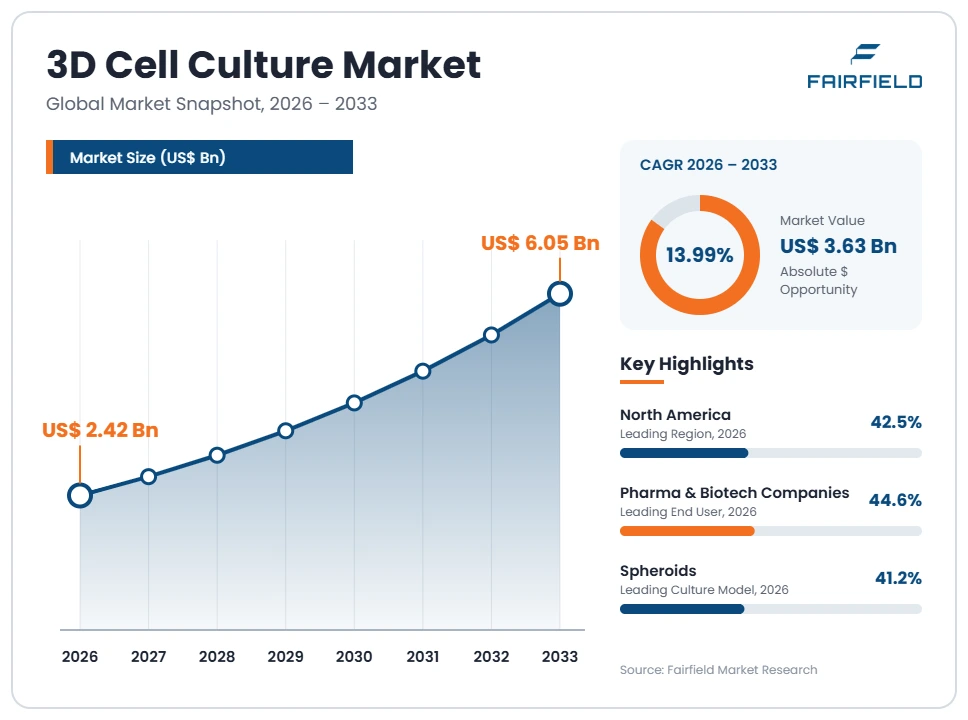
The global 3D Cell Culture market size is expected to be valued at US$ 2.42 billion in 2026 and projected to reach US$ 6.05 billion by 2033, growing at a CAGR of 13.99% between 2026 and 2033.
The market grew at a 12.6% CAGR from 2020 to 2025, reaching US$ 2.14 billion in 2025. Three factors explain the sustained pace. Legislative change, led by the FDA Modernization Act 2.0 signed in December 2022, removed the statutory requirement for animal testing before human trials and legitimised non-animal models. Patient-derived organoid screening moved from academic laboratories into oncology discovery programmes. Consumable formats such as ultra-low attachment plates and defined hydrogels became cheap enough for routine use. The direction is steady: three-dimensional cell culture is becoming a standard laboratory format rather than a specialist technique, with growth weighted toward reagents and consumables rather than instruments.
Key Report Takeaways
- By Product Type: Consumables and Reagents held 38.5% share in 2026, while Microfluidic and Organ-on-Chip Systems are projected to expand at an 18.9% CAGR through 2033, as barrier-tissue models enter formal toxicology evaluation programmes.
- By Culture Model: Spheroids held 41.2% share in 2026, while Organoids are projected to expand at a 17.4% CAGR through 2033, because patient-derived tissue models predict treatment response better than cell lines.
- By Application: Drug Discovery and Screening held 36.8% share in 2026, while Toxicology and Safety Testing is projected to expand at a 16.5% CAGR through 2033, following regulatory interest in validated in vitro methods.
- By End User: Pharmaceutical and Biotechnology Companies held 44.6% share in 2026, while Contract Research Organizations are projected to expand at a 15.8% CAGR through 2033, as sponsors outsource complex model work to specialist benches.
- By Geography: North America held 42.5% share in 2026, while Asia Pacific is projected to expand at a 16.8% CAGR through 2033, supported by biologics research capacity in China, Japan, and South Korea.
Global 3D Cell Culture Market Trends and Insights
Drivers Impact Analysis
Two forces account for most of the incremental spending on three-dimensional cell culture products through 2033.
| Driver | Impact on CAGR Forecast | Geographic Relevance | Impact Timeline |
| Policy shift toward non-animal methods in preclinical testing | High | North America, Europe | Medium term 2–4 years |
| Patient-derived organoid screening in oncology discovery | High | North America, Europe, Asia Pacific | Long term ≥4 years |
Policy Shift Away From Animal Testing Widens 3D Cell Culture Use in Preclinical Work
Legislative and regulatory change is the strongest demand signal in this market. Sponsors that once ran only animal studies now budget for human-relevant in vitro models alongside them, which adds plates, matrices, media, and analysis instruments to every discovery programme. Laboratories buy the format once and then consume reagents continuously.
The mechanism is statutory permission combined with structured evaluation routes. The FDA Modernization Act 2.0, signed in December 2022, removed the legal requirement for animal testing before human trials, and the FDA ISTAND pilot programme gives developers a defined path to submit novel drug development tools for qualification. In Europe, Directive 2010/63/EU applies the Three Rs principle of replacement, reduction, and refinement to every authorised project. Together these instruments make spending on spheroid and organoid culture defensible to research finance committees.
Patient-Derived Organoid Screening Expands Oncology Demand for 3D Culture Consumables
Oncology discovery is now the largest single pull on three-dimensional culture consumables. Tumour organoids grown from patient biopsies retain the genetic and architectural features of the original tissue, so screening results translate more reliably than flat monolayer assays. Each programme consumes extracellular matrix, defined media, and specialised plates in volume.
The causal chain runs from biology to purchasing. Flat cultures lose tumour heterogeneity and drug gradients within days, which produced costly late-stage attrition and pushed discovery teams toward architecture-preserving formats. Biobanks of patient-derived organoids now exist for colorectal, pancreatic, lung, and breast tumours, giving screening groups ready panels. Imaging and high-content analysis vendors have adapted readers for thick samples, removing the analysis bottleneck. Because organoid lines must be expanded and passaged repeatedly, demand is recurring rather than one-off, which suits reagent suppliers well.
Restraints Impact Analysis
Two constraints keep three-dimensional models from displacing established methods at scale.
| Restraint | Impact on CAGR Forecast | Geographic Relevance | Impact Timeline |
| Incomplete regulatory qualification of in vitro models as study replacements | High | North America, Europe, Asia Pacific | Long term ≥4 years |
| Biological matrix batch variability and high cost per assay well | Medium | Global | Medium term 2–4 years |
Missing Regulatory Qualification Keeps 3D Cell Culture Out of Pivotal Safety Packages
Permission to use a model is not the same as acceptance of its data. Regulators have not broadly qualified three-dimensional systems as replacements for animal studies in pivotal nonclinical packages, so most sponsors run them as supporting evidence in addition to, rather than instead of, traditional work. That keeps spending incremental and caps the budget any single platform can win.
The cause is the evidence burden attached to method validation. ICH M3 and ICH S5 still frame nonclinical safety expectations around established study designs, and replacing one requires reproducibility data across laboratories. The OECD route through test guidelines and the GIVIMP guidance on good in vitro method practices demands documented method transfer, reference compounds, and defined prediction models. Assembling that package takes years and funding that few individual platform developers can carry alone.
Matrix Batch Variability and Per-Well Cost Limit 3D Culture Screening Throughput
Reproducibility problems and unit economics together restrict how far laboratories scale three-dimensional assays. Screening groups that can run a two-dimensional campaign across hundreds of plates typically restrict organoid work to focused panels, because results drift between experiments and the cost per well does not justify broad coverage.
Two specific cost sources drive this. Animal-derived basement membrane extracts carry lot-to-lot differences in growth factor and protein composition, which forces re-qualification of every new lot and occasionally invalidates ongoing studies. Synthetic and chemically defined hydrogels solve consistency but sell at a clear premium per millilitre. Culture duration is the second charge: spheroid and organoid assays run for days or weeks rather than overnight, occupying incubator space, consuming specialised media, and requiring skilled operators. Automation helps, but liquid handlers configured for viscous matrices cost more than standard screening decks.
Market Opportunities
Contract Research Organisations Building Organoid Benches Open a Recurring Service Revenue Pool
Outsourced complex-model services represent the clearest new revenue pool in three-dimensional cell culture. Sponsors want organoid and spheroid data without hiring specialist staff or validating matrices internally, so they buy the assay as a service. That shifts spending from one-off instrument purchases to repeat study fees and the consumables behind them.
Contract research organisations with established screening infrastructure are best placed to capture it, and demand comes from mid-size biotechnology firms running lean discovery teams. Reagent suppliers benefit indirectly, because a service bench consumes matrices and media continuously across many client programmes. Qualification frameworks support the shift: a service provider can amortise the cost of validating a model across dozens of customers, which no single sponsor can justify. Standardised, catalogued assay panels are becoming the commercial unit that this part of the market sells.
Organ-on-Chip Platforms Open a Disease-Modelling Pool Beyond Conventional Toxicology Plates
Microfluidic organ-on-chip systems address a revenue pool that static plates cannot reach. Perfused liver, kidney, intestine, and blood-brain barrier models reproduce flow, shear, and tissue interfaces, which matters for questions about absorption, clearance, and barrier permeability. Each chip run consumes dedicated cartridges, pumps, and media kits at a far higher value per experiment.
Platform developers with instrument and consumable businesses are positioned to capture this, while demand originates from safety pharmacology groups and rare disease programmes rather than from high-throughput screening teams. The FDA ISTAND pilot programme provides a route for such systems to be considered as qualified drug development tools, and OECD validation work gives a longer path toward formal test guidelines. Multi-organ linked systems extend the pool further, since they answer questions about metabolite transfer that no single-tissue model can.
Segment Analysis
- By Product Type: Consumables Carry the Revenue While Organ-on-Chip Systems Scale Quickest
Consumables and Reagents led with 38.5% share in 2026, because every experiment consumes plates, matrices, and defined media regardless of platform choice. Laboratories replace them weekly, which makes this the most predictable revenue line in three-dimensional cell culture. Microfluidic and Organ-on-Chip Systems grow fastest at an 18.9% CAGR to 2033, driven by perfused barrier and liver models that static formats cannot reproduce.
Scaffold-Based Platforms supply hydrogels, polymeric scaffolds, and extracellular matrix products for tissue-engineering work, while Scaffold-Free Platforms cover ultra-low attachment plates, hanging-drop systems, and magnetic levitation. Bioreactors and Instruments serve scale-up and perfusion culture. For suppliers, the implication is that platform placement matters mainly as a route to consumable pull-through, and vendors increasingly price instruments to secure that recurring stream.
- By Culture Model: Spheroid Culture Dominates While Organoids Add Share Faster
Spheroids held 41.2% share in 2026, reflecting their simplicity, low cost, and compatibility with existing plate readers and liquid handlers. A spheroid assay needs no specialist matrix and fits standard screening timelines. Organoids expand fastest at a 17.4% CAGR through 2033, because patient-derived tissue models reproduce epithelial architecture and genetic background, which improves translation into clinical response.
Hydrogel-Embedded Cultures support matrix-dependent work in invasion, differentiation, and stem cell biology, while Tissue Explants and Organotypic Slices preserve native stroma and immune cells for immuno-oncology questions. Biobanked organoid panels for colorectal, pancreatic, and lung tumours have made the model accessible to groups without derivation expertise. The business implication is that suppliers of chemically defined, organoid-qualified media now compete on consistency rather than price alone.
- By Application: Drug Discovery Leads While Toxicology Testing Grows at the Fastest Rate
Drug Discovery and Screening was the largest application at 36.8% share in 2026, since hit identification and lead optimisation consume the greatest volume of assay plates across the industry. Discovery budgets are also the least constrained by validation requirements. Toxicology and Safety Testing grows fastest at a 16.5% CAGR to 2033, because regulators have opened structured routes for in vitro methods to be evaluated.
Cancer Research remains a deep application for tumour spheroid and organoid work, Regenerative Medicine and Tissue Engineering draws on scaffolds and bioreactors, and Stem Cell Research underpins induced pluripotent stem cell differentiation protocols. OECD test guidelines and GIVIMP guidance on in vitro method practices set the documentation standard. Suppliers that can demonstrate method transferability are winning the safety-testing accounts.
- By End User: Pharmaceutical Companies Buy Most While Contract Research Organizations Expand Quickest
Pharmaceutical and Biotechnology Companies accounted for 44.6% of spending in 2026, because they run the largest discovery portfolios and can fund the staff, incubator space, and automation that three-dimensional work requires. Their purchases span instruments, matrices, and media together. Contract Research Organizations grow fastest at a 15.8% CAGR through 2033, as sponsors outsource organoid and spheroid assays rather than build internal capability.
Academic and Research Institutes remain the source of most new protocols and organoid derivation methods, and they buy in smaller, grant-funded quantities. Hospitals and Diagnostic Laboratories are beginning to use tumour organoids in translational studies of treatment response. For vendors, the shift toward service providers concentrates purchasing into fewer, larger, more price-sensitive accounts that demand documented lot consistency.
Geography Analysis
- Which Region Is Leading the 3D Cell Culture Market?
North America leads with 42.5% share in 2026, because the United States combines the largest pharmaceutical research base, dense academic funding, and the clearest statutory opening for non-animal methods. Canada contributes through stem cell and organoid research centres in Toronto, Vancouver, and Montreal.
Three causes sustain that position. The FDA Modernization Act 2.0, signed in December 2022, removed the statutory animal testing requirement and gave sponsors cover to invest in human-relevant models. The FDA ISTAND pilot programme offers a qualification route for novel drug development tools. National Institutes of Health funding supports organoid biobanking and tissue chip programmes that seed commercial demand.
The regional change underway is industrialisation: screening groups are moving organoid assays from bespoke protocols onto automated, catalogued platforms, which raises consumable volumes per laboratory.
- Europe Converts Three Rs Policy Into Routine Demand for Non-Animal Culture Models
Europe held 28.0% share in 2026, with Germany, the United Kingdom, the Netherlands, Switzerland, and France the main contributors. The region’s position rests on policy rather than on raw research volume, since replacement of animal procedures is written directly into law.
Directive 2010/63/EU on the protection of animals used for scientific purposes requires project authorisation under the Three Rs principle, and a European Parliament resolution called for a coordinated plan to phase out animal testing in research. The European Commission Joint Research Centre maintains validation work through EURL ECVAM, which shapes how methods are documented.
Dutch and Swiss institutes lead organoid derivation and tissue chip research. The main regional opportunity is in standardised, animal-free matrices, which align with both procurement policy and reproducibility requirements.
- Which Region Is Growing Fastest in the 3D Cell Culture Market?
Asia Pacific is growing fastest at a 16.8% CAGR between 2026 and 2033, from 22.0% share in 2026, because biologics and oncology research capacity is expanding rapidly in China, Japan, South Korea, India, and Singapore.
The causes are investment and capability. Chinese biotechnology firms have built large discovery operations that now run organoid panels in-house, and domestic suppliers of plates, matrices, and media have reduced local prices substantially. Japan’s strength in induced pluripotent stem cell science feeds directly into organoid and tissue construct work. South Korea and Singapore fund translational research institutes that buy instruments and consumables together.
The change shaping the region is local manufacturing of defined hydrogels and culture media, which shortens supply chains and removes the import premium that previously limited routine use.
- Latin America Builds Three-Dimensional Culture Capacity Around Academic Oncology Centres
Latin America held 4.3% share in 2026, with Brazil, Mexico, Argentina, Chile, and Colombia supplying most demand. Adoption is concentrated in public university hospitals and federal research institutes rather than in commercial discovery operations, which keeps average order sizes small.
São Paulo, Mexico City, and Buenos Aires host groups working on tumour spheroids and patient-derived models in gastric, cervical, and breast cancer, often in international collaborations that supply protocols and reference materials.
Barriers are practical. Import duties and customs delays raise the delivered cost of temperature-sensitive matrices, cold chain reliability varies, and grant cycles make multi-year consumable commitments difficult. Local distributor stocking programmes for frozen reagents are the clearest opportunity, since they remove the shipping risk that currently deters routine use.
- Middle East & Africa Adds Research Capacity Through National Science Investment Programmes
Middle East & Africa represented 3.2% share in 2026, the smallest regional position, concentrated in Saudi Arabia, the United Arab Emirates, Israel, Egypt, and South Africa. Israel contributes disproportionately through its biotechnology sector and university spin-outs working on tissue models.
Gulf state science funding programmes have built new research universities and precision medicine centres with current-generation laboratory equipment, including imaging systems suited to thick three-dimensional samples. South African institutes apply organoid methods to infectious disease and cancer research.
Constraints are structural. Trained personnel for organoid derivation are scarce, service engineer coverage for microfluidic instruments is thin outside a few cities, and reagent lead times are long. The opportunity lies in training-linked supply agreements, where vendors bundle protocol transfer and staff education with the first platform installation.
Competitive Landscape
The market is moderately concentrated, with a clear split between broad life-science suppliers and focused platform specialists. Thermo Fisher Scientific, Corning Incorporated, Merck KGaA, Lonza Group, and Danaher Corporation hold strong positions because they already supply plates, media, and reagents to the same laboratories through established catalogue channels. Specialists such as Emulate, CN Bio Innovations, InSphero, and Molecular Devices compete on model fidelity in organ-on-chip and organoid screening rather than on breadth. Acquisition has been the usual route for large suppliers to add three-dimensional capability, since organic development of matrices and microfluidic hardware is slow.
Competition turns on reproducibility evidence more than on headline performance. Buyers ask for lot-to-lot consistency data, documented protocol transfer between sites, compatibility with existing liquid handlers and high-content imagers, and a defined position on animal-derived components. Chemically defined, animal-free matrices have become a competitive requirement in European procurement. New entrants arrive from bioprinting, hydrogel chemistry, and semiconductor-adjacent microfluidics, and most reach customers through distribution partnerships with incumbent catalogue suppliers rather than by building their own field organisations.
Strategic activity concentrates on three fronts. Large suppliers are assembling end-to-end workflows that pair culture consumables with automation and imaging analysis, so a laboratory can buy one validated chain. Platform specialists are pursuing formal qualification evidence, because regulatory acceptance is the gate that converts supporting assays into budgeted replacements. Several vendors are localising reagent manufacturing in Asia Pacific to shorten cold chain routes.
The prevailing strategic direction is standardisation. Vendors are moving away from bespoke protocols toward catalogued, documented assay systems that any trained laboratory can reproduce, because that is what regulators, service providers, and procurement teams now require.
Recent Industry Developments
- September 2010: The European Union adopted Directive 2010/63/EU on the protection of animals used for scientific purposes – embedded the Three Rs principle in project authorisation and created durable policy demand for replacement methods.
- September 2021: The European Parliament adopted a resolution calling for a coordinated plan to phase out the use of animals in research, testing and education – signalled long-term procurement direction across member states.
- December 2022: The FDA Modernization Act 2.0 was signed into law in the United States, removing the statutory requirement for animal testing before human trials – allowed sponsors to budget for human-relevant in vitro models.
- April 2025: The FDA published a roadmap to reduce and replace animal testing requirements for monoclonal antibodies and other drugs using New Approach Methodologies – gave organoid and organ-on-chip developers a stated agency direction to design evidence against.
Companies Covered in the Report
- Thermo Fisher Scientific Inc.
- Corning Incorporated
- Merck KGaA
- Lonza Group AG
- Danaher Corporation
- Sartorius AG
- Tecan Group Ltd.
- Emulate, Inc.
- CN Bio Innovations Ltd.
- InSphero AG
- Greiner Bio-One International GmbH
- Molecular Devices, LLC
3D Cell Culture Market Report Scope
| Metric | Value |
| Study Period | 2020–2033 |
| Market Size 2026 | US$ 2.42 Billion |
| Market Size 2033 | US$ 6.05 Billion |
| CAGR 2026–2033 | 13.99% |
| Absolute Dollar Opportunity | US$ 3.63 Billion |
| Largest Market | North America |
| Fastest-Growing Market | Asia Pacific |
| Market Concentration | Medium |
| Major Players | Thermo Fisher Scientific, Corning Incorporated, Merck KGaA, Lonza Group, Danaher Corporation |
3D Cell Culture Market Segmentation
Product Type
- Consumables and Reagents
- Scaffold-Based Platforms
- Scaffold-Free Platforms
- Microfluidic and Organ-on-Chip Systems
- Bioreactors and Instruments
Culture Model
- Spheroids
- Organoids
- Hydrogel-Embedded Cultures
- Tissue Explants and Organotypic Slices
Application
- Drug Discovery and Screening
- Toxicology and Safety Testing
- Cancer Research
- Regenerative Medicine and Tissue Engineering
- Stem Cell Research
End User
- Pharmaceutical and Biotechnology Companies
- Academic and Research Institutes
- Contract Research Organizations
- Hospitals and Diagnostic Laboratories
Regions
- North America
- Europe
- Asia Pacific
- Latin America
- Middle East & Africa
- Executive Summary
- Global 3D Cell Culture Market Snapshot
- Future Projections
- Key Report Takeaways
- Regional Snapshot
- Market Overview
- Market Definition and Report Scope
- Historical Trends 2020–2025
- Market Dynamics
- Drivers
- Policy Shift Away From Animal Testing Widens 3D Cell Culture Use in Preclinical Work
- Patient-Derived Organoid Screening Expands Oncology Demand for 3D Culture Consumables
- Restraints
- Missing Regulatory Qualification Keeps 3D Cell Culture Out of Pivotal Safety Packages
- Matrix Batch Variability and Per-Well Cost Limit 3D Culture Screening Throughput
- Market Opportunities
- Contract Research Organisations Building Organoid Benches Open a Recurring Service Revenue Pool
- Organ-on-Chip Platforms Open a Disease-Modelling Pool Beyond Conventional Toxicology Plates
- Drivers
- Global 3D Cell Culture Market Outlook, 2020–2033
- Global 3D Cell Culture Market Outlook, by Product Type, Value (US$ Billion), 2020–2033
- Consumables and Reagents
- Scaffold-Based Platforms
- Scaffold-Free Platforms
- Microfluidic and Organ-on-Chip Systems
- Bioreactors and Instruments
- Global 3D Cell Culture Market Outlook, by Culture Model, Value (US$ Billion), 2020–2033
- Spheroids
- Organoids
- Hydrogel-Embedded Cultures
- Tissue Explants and Organotypic Slices
- Global 3D Cell Culture Market Outlook, by Application, Value (US$ Billion), 2020–2033
- Drug Discovery and Screening
- Toxicology and Safety Testing
- Cancer Research
- Regenerative Medicine and Tissue Engineering
- Stem Cell Research
- Global 3D Cell Culture Market Outlook, by End User, Value (US$ Billion), 2020–2033
- Pharmaceutical and Biotechnology Companies
- Academic and Research Institutes
- Contract Research Organizations
- Hospitals and Diagnostic Laboratories
- Global 3D Cell Culture Market Outlook, by Region, Value (US$ Billion), 2020–2033
- North America
- Europe
- Asia Pacific
- Latin America
- Middle East & Africa
- Global 3D Cell Culture Market Outlook, by Product Type, Value (US$ Billion), 2020–2033
- North America 3D Cell Culture Market Outlook, 2020–2033
- North America 3D Cell Culture Market Outlook, by Product Type, Value (US$ Billion), 2020–2033
- Consumables and Reagents
- Scaffold-Based Platforms
- Scaffold-Free Platforms
- Microfluidic and Organ-on-Chip Systems
- Bioreactors and Instruments
- North America 3D Cell Culture Market Outlook, by Culture Model, Value (US$ Billion), 2020–2033
- Spheroids
- Organoids
- Hydrogel-Embedded Cultures
- Tissue Explants and Organotypic Slices
- North America 3D Cell Culture Market Outlook, by Application, Value (US$ Billion), 2020–2033
- Drug Discovery and Screening
- Toxicology and Safety Testing
- Cancer Research
- Regenerative Medicine and Tissue Engineering
- Stem Cell Research
- North America 3D Cell Culture Market Outlook, by End User, Value (US$ Billion), 2020–2033
- Pharmaceutical and Biotechnology Companies
- Academic and Research Institutes
- Contract Research Organizations
- Hospitals and Diagnostic Laboratories
- North America 3D Cell Culture Market Outlook, by Country, Value (US$ Billion), 2020–2033
- United States 3D Cell Culture Market Outlook, by Product Type, 2020–2033
- United States 3D Cell Culture Market Outlook, by Culture Model, 2020–2033
- United States 3D Cell Culture Market Outlook, by Application, 2020–2033
- United States 3D Cell Culture Market Outlook, by End User, 2020–2033
- Canada 3D Cell Culture Market Outlook, by Product Type, 2020–2033
- Canada 3D Cell Culture Market Outlook, by Culture Model, 2020–2033
- Canada 3D Cell Culture Market Outlook, by Application, 2020–2033
- Canada 3D Cell Culture Market Outlook, by End User, 2020–2033
- North America 3D Cell Culture Market Outlook, by Product Type, Value (US$ Billion), 2020–2033
- Europe 3D Cell Culture Market Outlook, 2020–2033
- Europe 3D Cell Culture Market Outlook, by Product Type, Value (US$ Billion), 2020–2033
- Consumables and Reagents
- Scaffold-Based Platforms
- Scaffold-Free Platforms
- Microfluidic and Organ-on-Chip Systems
- Bioreactors and Instruments
- Europe 3D Cell Culture Market Outlook, by Culture Model, Value (US$ Billion), 2020–2033
- Spheroids
- Organoids
- Hydrogel-Embedded Cultures
- Tissue Explants and Organotypic Slices
- Europe 3D Cell Culture Market Outlook, by Application, Value (US$ Billion), 2020–2033
- Drug Discovery and Screening
- Toxicology and Safety Testing
- Cancer Research
- Regenerative Medicine and Tissue Engineering
- Stem Cell Research
- Europe 3D Cell Culture Market Outlook, by End User, Value (US$ Billion), 2020–2033
- Pharmaceutical and Biotechnology Companies
- Academic and Research Institutes
- Contract Research Organizations
- Hospitals and Diagnostic Laboratories
- Europe 3D Cell Culture Market Outlook, by Country, Value (US$ Billion), 2020–2033
- Germany 3D Cell Culture Market Outlook, by Product Type, 2020–2033
- Germany 3D Cell Culture Market Outlook, by Culture Model, 2020–2033
- Germany 3D Cell Culture Market Outlook, by Application, 2020–2033
- Germany 3D Cell Culture Market Outlook, by End User, 2020–2033
- United Kingdom 3D Cell Culture Market Outlook, by Product Type, 2020–2033
- United Kingdom 3D Cell Culture Market Outlook, by Culture Model, 2020–2033
- United Kingdom 3D Cell Culture Market Outlook, by Application, 2020–2033
- United Kingdom 3D Cell Culture Market Outlook, by End User, 2020–2033
- Netherlands 3D Cell Culture Market Outlook, by Product Type, 2020–2033
- Netherlands 3D Cell Culture Market Outlook, by Culture Model, 2020–2033
- Netherlands 3D Cell Culture Market Outlook, by Application, 2020–2033
- Netherlands 3D Cell Culture Market Outlook, by End User, 2020–2033
- Switzerland 3D Cell Culture Market Outlook, by Product Type, 2020–2033
- Switzerland 3D Cell Culture Market Outlook, by Culture Model, 2020–2033
- Switzerland 3D Cell Culture Market Outlook, by Application, 2020–2033
- Switzerland 3D Cell Culture Market Outlook, by End User, 2020–2033
- France 3D Cell Culture Market Outlook, by Product Type, 2020–2033
- France 3D Cell Culture Market Outlook, by Culture Model, 2020–2033
- France 3D Cell Culture Market Outlook, by Application, 2020–2033
- France 3D Cell Culture Market Outlook, by End User, 2020–2033
- Europe 3D Cell Culture Market Outlook, by Product Type, Value (US$ Billion), 2020–2033
- Asia Pacific 3D Cell Culture Market Outlook, 2020–2033
- Asia Pacific 3D Cell Culture Market Outlook, by Product Type, Value (US$ Billion), 2020–2033
- Consumables and Reagents
- Scaffold-Based Platforms
- Scaffold-Free Platforms
- Microfluidic and Organ-on-Chip Systems
- Bioreactors and Instruments
- Asia Pacific 3D Cell Culture Market Outlook, by Culture Model, Value (US$ Billion), 2020–2033
- Spheroids
- Organoids
- Hydrogel-Embedded Cultures
- Tissue Explants and Organotypic Slices
- Asia Pacific 3D Cell Culture Market Outlook, by Application, Value (US$ Billion), 2020–2033
- Drug Discovery and Screening
- Toxicology and Safety Testing
- Cancer Research
- Regenerative Medicine and Tissue Engineering
- Stem Cell Research
- Asia Pacific 3D Cell Culture Market Outlook, by End User, Value (US$ Billion), 2020–2033
- Pharmaceutical and Biotechnology Companies
- Academic and Research Institutes
- Contract Research Organizations
- Hospitals and Diagnostic Laboratories
- Asia Pacific 3D Cell Culture Market Outlook, by Country, Value (US$ Billion), 2020–2033
- China 3D Cell Culture Market Outlook, by Product Type, 2020–2033
- China 3D Cell Culture Market Outlook, by Culture Model, 2020–2033
- China 3D Cell Culture Market Outlook, by Application, 2020–2033
- China 3D Cell Culture Market Outlook, by End User, 2020–2033
- Japan 3D Cell Culture Market Outlook, by Product Type, 2020–2033
- Japan 3D Cell Culture Market Outlook, by Culture Model, 2020–2033
- Japan 3D Cell Culture Market Outlook, by Application, 2020–2033
- Japan 3D Cell Culture Market Outlook, by End User, 2020–2033
- South Korea 3D Cell Culture Market Outlook, by Product Type, 2020–2033
- South Korea 3D Cell Culture Market Outlook, by Culture Model, 2020–2033
- South Korea 3D Cell Culture Market Outlook, by Application, 2020–2033
- South Korea 3D Cell Culture Market Outlook, by End User, 2020–2033
- India 3D Cell Culture Market Outlook, by Product Type, 2020–2033
- India 3D Cell Culture Market Outlook, by Culture Model, 2020–2033
- India 3D Cell Culture Market Outlook, by Application, 2020–2033
- India 3D Cell Culture Market Outlook, by End User, 2020–2033
- Singapore 3D Cell Culture Market Outlook, by Product Type, 2020–2033
- Singapore 3D Cell Culture Market Outlook, by Culture Model, 2020–2033
- Singapore 3D Cell Culture Market Outlook, by Application, 2020–2033
- Singapore 3D Cell Culture Market Outlook, by End User, 2020–2033
- Asia Pacific 3D Cell Culture Market Outlook, by Product Type, Value (US$ Billion), 2020–2033
- Latin America 3D Cell Culture Market Outlook, 2020–2033
- Latin America 3D Cell Culture Market Outlook, by Product Type, Value (US$ Billion), 2020–2033
- Consumables and Reagents
- Scaffold-Based Platforms
- Scaffold-Free Platforms
- Microfluidic and Organ-on-Chip Systems
- Bioreactors and Instruments
- Latin America 3D Cell Culture Market Outlook, by Culture Model, Value (US$ Billion), 2020–2033
- Spheroids
- Organoids
- Hydrogel-Embedded Cultures
- Tissue Explants and Organotypic Slices
- Latin America 3D Cell Culture Market Outlook, by Application, Value (US$ Billion), 2020–2033
- Drug Discovery and Screening
- Toxicology and Safety Testing
- Cancer Research
- Regenerative Medicine and Tissue Engineering
- Stem Cell Research
- Latin America 3D Cell Culture Market Outlook, by End User, Value (US$ Billion), 2020–2033
- Pharmaceutical and Biotechnology Companies
- Academic and Research Institutes
- Contract Research Organizations
- Hospitals and Diagnostic Laboratories
- Latin America 3D Cell Culture Market Outlook, by Country, Value (US$ Billion), 2020–2033
- Brazil 3D Cell Culture Market Outlook, by Product Type, 2020–2033
- Brazil 3D Cell Culture Market Outlook, by Culture Model, 2020–2033
- Brazil 3D Cell Culture Market Outlook, by Application, 2020–2033
- Brazil 3D Cell Culture Market Outlook, by End User, 2020–2033
- Mexico 3D Cell Culture Market Outlook, by Product Type, 2020–2033
- Mexico 3D Cell Culture Market Outlook, by Culture Model, 2020–2033
- Mexico 3D Cell Culture Market Outlook, by Application, 2020–2033
- Mexico 3D Cell Culture Market Outlook, by End User, 2020–2033
- Argentina 3D Cell Culture Market Outlook, by Product Type, 2020–2033
- Argentina 3D Cell Culture Market Outlook, by Culture Model, 2020–2033
- Argentina 3D Cell Culture Market Outlook, by Application, 2020–2033
- Argentina 3D Cell Culture Market Outlook, by End User, 2020–2033
- Chile 3D Cell Culture Market Outlook, by Product Type, 2020–2033
- Chile 3D Cell Culture Market Outlook, by Culture Model, 2020–2033
- Chile 3D Cell Culture Market Outlook, by Application, 2020–2033
- Chile 3D Cell Culture Market Outlook, by End User, 2020–2033
- Colombia 3D Cell Culture Market Outlook, by Product Type, 2020–2033
- Colombia 3D Cell Culture Market Outlook, by Culture Model, 2020–2033
- Colombia 3D Cell Culture Market Outlook, by Application, 2020–2033
- Colombia 3D Cell Culture Market Outlook, by End User, 2020–2033
- Latin America 3D Cell Culture Market Outlook, by Product Type, Value (US$ Billion), 2020–2033
- Middle East & Africa 3D Cell Culture Market Outlook, 2020–2033
- Middle East & Africa 3D Cell Culture Market Outlook, by Product Type, Value (US$ Billion), 2020–2033
- Consumables and Reagents
- Scaffold-Based Platforms
- Scaffold-Free Platforms
- Microfluidic and Organ-on-Chip Systems
- Bioreactors and Instruments
- Middle East & Africa 3D Cell Culture Market Outlook, by Culture Model, Value (US$ Billion), 2020–2033
- Spheroids
- Organoids
- Hydrogel-Embedded Cultures
- Tissue Explants and Organotypic Slices
- Middle East & Africa 3D Cell Culture Market Outlook, by Application, Value (US$ Billion), 2020–2033
- Drug Discovery and Screening
- Toxicology and Safety Testing
- Cancer Research
- Regenerative Medicine and Tissue Engineering
- Stem Cell Research
- Middle East & Africa 3D Cell Culture Market Outlook, by End User, Value (US$ Billion), 2020–2033
- Pharmaceutical and Biotechnology Companies
- Academic and Research Institutes
- Contract Research Organizations
- Hospitals and Diagnostic Laboratories
- Middle East & Africa 3D Cell Culture Market Outlook, by Country, Value (US$ Billion), 2020–2033
- Saudi Arabia 3D Cell Culture Market Outlook, by Product Type, 2020–2033
- Saudi Arabia 3D Cell Culture Market Outlook, by Culture Model, 2020–2033
- Saudi Arabia 3D Cell Culture Market Outlook, by Application, 2020–2033
- Saudi Arabia 3D Cell Culture Market Outlook, by End User, 2020–2033
- United Arab Emirates 3D Cell Culture Market Outlook, by Product Type, 2020–2033
- United Arab Emirates 3D Cell Culture Market Outlook, by Culture Model, 2020–2033
- United Arab Emirates 3D Cell Culture Market Outlook, by Application, 2020–2033
- United Arab Emirates 3D Cell Culture Market Outlook, by End User, 2020–2033
- Israel 3D Cell Culture Market Outlook, by Product Type, 2020–2033
- Israel 3D Cell Culture Market Outlook, by Culture Model, 2020–2033
- Israel 3D Cell Culture Market Outlook, by Application, 2020–2033
- Israel 3D Cell Culture Market Outlook, by End User, 2020–2033
- Egypt 3D Cell Culture Market Outlook, by Product Type, 2020–2033
- Egypt 3D Cell Culture Market Outlook, by Culture Model, 2020–2033
- Egypt 3D Cell Culture Market Outlook, by Application, 2020–2033
- Egypt 3D Cell Culture Market Outlook, by End User, 2020–2033
- South Africa 3D Cell Culture Market Outlook, by Product Type, 2020–2033
- South Africa 3D Cell Culture Market Outlook, by Culture Model, 2020–2033
- South Africa 3D Cell Culture Market Outlook, by Application, 2020–2033
- South Africa 3D Cell Culture Market Outlook, by End User, 2020–2033
- Middle East & Africa 3D Cell Culture Market Outlook, by Product Type, Value (US$ Billion), 2020–2033
- Competitive Landscape
- Market Concentration and Industry Leaders
- Competitive Differentiation
- Strategic Moves and Market Direction
- Recent Industry Developments
- Company Profiles
- Thermo Fisher Scientific Inc.
- Corning Incorporated
- Merck KGaA
- Lonza Group AG
- Danaher Corporation
- Sartorius AG
- Tecan Group Ltd.
- Emulate, Inc.
- CN Bio Innovations Ltd.
- InSphero AG
- Greiner Bio-One International GmbH
- Molecular Devices, LLC
- Appendix
- Research Methodology
- Report Assumptions
- Acronyms and Abbreviations
Product Type
- Consumables and Reagents
- Scaffold-Based Platforms
- Scaffold-Free Platforms
- Microfluidic and Organ-on-Chip Systems
- Bioreactors and Instruments
Culture Model
- Spheroids
- Organoids
- Hydrogel-Embedded Cultures
- Tissue Explants and Organotypic Slices
Application
- Drug Discovery and Screening
- Toxicology and Safety Testing
- Cancer Research
- Regenerative Medicine and Tissue Engineering
- Stem Cell Research
End User
- Pharmaceutical and Biotechnology Companies
- Academic and Research Institutes
- Contract Research Organizations
- Hospitals and Diagnostic Laboratories
Regions
- North America
- Europe
- Asia Pacific
- Latin America
- Middle East & Africa
Our Research Methodology
Considering the volatility of business today, traditional approaches to strategizing a game plan can be unfruitful if not detrimental. True ambiguity is no way to determine a forecast. A myriad of predetermined factors must be accounted for such as the degree of risk involved, the magnitude of circumstances, as well as conditions or consequences that are not known or unpredictable. To circumvent binary views that cast uncertainty, the application of market research intelligence to strategically posture, move, and enable actionable outcomes is necessary.
View Methodology
Quality Assured
Rigorous Validation Process

Confidentiality Assured
End-to-end Data Security

Custom Research Services
Tailored To Your Objectives
FAQs
The market is valued at US$ 2.42 billion in 2026, covering consumables, scaffold platforms, organ-on-chip systems, bioreactors, and outsourced assay services worldwide.
The market is projected to reach US$ 6.05 billion by 2033, growing at a 13.99% CAGR and adding US$ 3.63 billion in absolute opportunity.
Consumables and Reagents hold 38.5% share in 2026, because plates, matrices, and defined media are replaced continuously in every laboratory.
Organoids grow fastest at a 17.4% CAGR through 2033, because patient-derived tissue models translate into clinical response better than cell lines.
North America leads with 42.5% share in 2026, and competition is moderately concentrated between broad catalogue suppliers and focused organ-on-chip specialists.
Related Reports
Western Blotting Market Size, Share, Insights, Competitive Landscape, and Forecast 2026 to 2033
The global western blotting market is valued at US$1.1 billion in 2026, reaching US$1.5 billion by 2033, growing at a 4.5% CAGR
Cold and Flu Supplements Market Size, Share, Insights, Competitive Landscape, and Forecast 2026 to 2033
The global cold and flu supplements market is valued at US$24.65 billion in 2026, reaching US$54.60 billion by 2033, growing at a 12.0% CAGR
Cell Isolation Market Size, Share, Insights, Competitive Landscape, and Forecast 2026 to 2033
The global cell isolation market is valued at US$4.39 billion in 2026, reaching US$10.14 billion by 2033, growing at a 12.7% CAGR
Cell & Gene Therapy Bioanalytical Testing Services Market Size, Share, Insights, Competitive Landscape, and Forecast 2026 to 2033
The cell & gene therapy bioanalytical testing services market is valued at US$0.633 billion in 2026, reaching US$1.041 billion by 2033, at 7.4% CAGR
AI in Pharmaceutical Market Size, Share, Insights, Competitive Landscape, and Forecast 2026 to 2033
The global AI in pharmaceutical market is valued at US$1.94 billion in 2026, reaching US$13.93 billion by 2033, growing at a 32.5% CAGR
Agentic AI in Pharmaceuticals Market Size, Share, Insights, Competitive Landscape, and Forecast 2026 to 2033
The global agentic AI in pharmaceuticals market is valued at US$1.3 billion in 2026, reaching US$13.0 billion by 2033, growing at a 38.95% CAGR