



Cold and Flu Supplements Market
Cold and Flu Supplements Market Size, Share, Insights, Competitive Landscape, and Forecast 2026 to 2033
Cold and Flu Supplements Market Size and Trend Analysis
How Fast Is the Cold and Flu Supplements Market Growing?
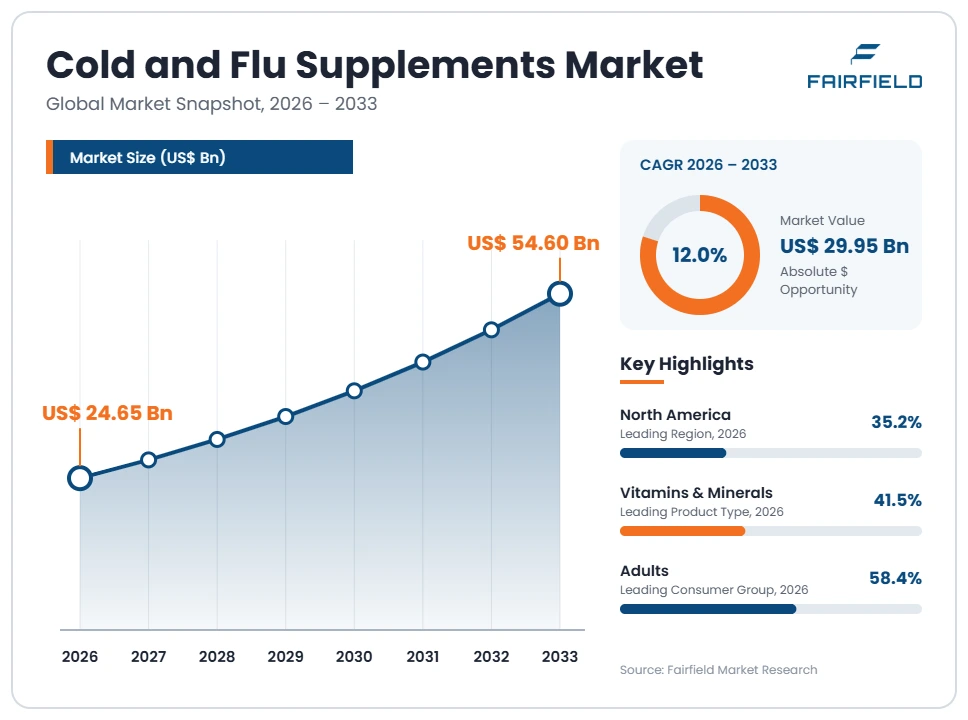
The global cold and flu supplements market size is expected to be valued at US$ 24.65 billion in 2026 and projected to reach US$ 54.60 billion by 2033, growing at a CAGR of 12.0% between 2026 and 2033.
Between 2020 and 2025, the market grew at a CAGR of about 9.8%, with a sharp and short-lived pandemic-era spike in immunity purchases followed by normalization in 2022 and 2023. Growth since then has been supported by three main factors: more severe respiratory seasons, consumer movement toward self-care before visiting a doctor, and wider access to botanical and convenient formats through online retail. The market is moving away from single-ingredient vitamin C products and toward multi-ingredient formulas, premium brands, and clinically supported ingredients such as zinc.
Key Report Takeaways
- By Product Type: Vitamins & Minerals held 41.5% share in 2026, while Herbal & Botanical Supplements are projected to expand at a 13.8% CAGR through 2033, driven by Ayurvedic and elderberry demand.
- By Form: Tablets & Capsules held 38.2% share in 2026, while Powders are projected to expand at a 13.6% CAGR through 2033, driven by multi-ingredient drink-mix sachets.
- By Application: Immune-System Support held 34.6% share in 2026, while Symptom Relief is projected to expand at a 13.0% CAGR through 2033, driven by early zinc use.
- By Consumer Demographics: Adults held 58.4% share in 2026, while Seniors are projected to expand at a 13.4% CAGR through 2033, driven by higher influenza hospitalization risk among older adults.
- By Distribution Channel: Pharmacies & Drugstores held 36.7% share in 2026, while E-commerce is projected to expand at a 14.6% CAGR through 2033, driven by subscriptions and marketplace discovery.
- By Region: North America held 35.2% share in 2026, while Asia Pacific is projected to expand at a 14.1% CAGR through 2033, driven by rising adoption in China and India.
Global Cold and Flu Supplements Market Trends and Insights
Drivers Impact Analysis
Two drivers carry the strongest influence on cold and flu supplements demand.
| Driver | Impact on CAGR Forecast | Geographic Relevance | Impact Timeline |
| Severe respiratory seasons | High | North America, Europe | Short term (≤2 years) |
| Doubts about OTC decongestants | Medium | North America | Medium term (2–4 years) |
Severe Flu Seasons Lift Preventive Demand for Cold and Flu Supplements
Severe respiratory seasons push households to stock immune support supplements earlier and in larger quantities. The Centers for Disease Control and Prevention (CDC) estimates that the 2024–2025 United States season caused 51 million flu illnesses, 23 million medical visits, 710,000 hospitalizations, and 45,000 deaths. Each heavy season lifts repeat purchases of vitamin C supplements, zinc lozenges, and elderberry syrups.
The mechanism is behavioral: when outbreaks dominate the news, consumers buy prevention-positioned products before symptoms appear. The CDC classified 2024–2025 as a high-severity season for all age groups, the first since 2017–2018. Its cumulative hospitalization rate of 127.1 per 100,000 people was the highest since 2010–2011. Co-circulation of influenza, COVID-19, and respiratory syncytial virus also lengthens the retail selling window.
OTC Decongestant Doubts Redirect Spend Toward Cold and Flu Supplements
Uncertainty about conventional over-the-counter cold medicines is opening shelf space and attention for supplement brands. When a familiar drug ingredient is questioned, shoppers explore alternatives. Zinc products, herbal blends, and multi-ingredient immune formulas benefit because they sit in the same aisle and target the same moment of need.
The trigger is regulatory. In November 2024, the U.S. Food and Drug Administration (FDA) proposed removing oral phenylephrine from the OTC monograph after its review found the ingredient ineffective as a nasal decongestant. A year earlier, CVS Health voluntarily removed some of its commonly purchased phenylephrine-based cold products from stores. These actions do not make supplements more effective. They do, however, encourage pharmacists and consumers to compare options, which increases trial of zinc and botanical products.
Restraints Impact Analysis
Two restraints limit how quickly brands convert awareness into sustained revenue.
| Restraint | Impact on CAGR Forecast | Geographic Relevance | Impact Timeline |
| Mixed evidence and claim rules | Medium | North America, Europe | Long term (≥4 years) |
| Seasonal swings and recalls | Medium | Global | Short term (≤2 years) |
Uneven Evidence Limits Cold and Flu Supplements Health Claims
Inconsistent scientific evidence restricts what cold and flu supplement brands can promise on labels and in advertising. Zinc has relatively stronger support for shortening colds when taken early. Vitamin C does not generally prevent colds in the general population, and results for echinacea and elderberry vary by preparation. This gap weakens repeat purchase among skeptical shoppers.
The cause is structural. Under the United States Dietary Supplement Health and Education Act, supplements may carry structure-function claims but cannot claim to treat or prevent disease. The Federal Trade Commission also requires competent scientific evidence for advertising claims. The European Food Safety Authority has rejected many proposed immune claims for botanicals. Running randomized trials for a botanical extract is expensive because each standardized preparation must be studied separately, which raises costs for smaller brands.
Seasonal Swings and Recalls Squeeze Cold and Flu Supplements Margins
Sharp seasonal demand swings and occasional quality failures make revenue planning difficult for cold and flu supplement makers. A mild season leaves retailers holding excess stock, which leads to lower reorders and heavier discounting. In the first quarter of 2025, Church & Dwight reported slowing category growth in the United States and lower retailer inventory levels.
The underlying cost sources are working capital, promotional pricing, and quality control. Manufacturers must build inventory months ahead of a season whose severity cannot be predicted. Quality incidents add direct costs. In June 2025, Church & Dwight recalled Zicam Cold Remedy Nasal Swabs after fungal contamination was found in cotton swab components, covering more than 318,000 cartons. The company later cited recall costs and tariffs as pressures on its adjusted gross margin.
Market Opportunities
Traditional-Medicine Brands Open an Asia Pacific Revenue Pool in Cold and Flu Supplements
Herbal supplements rooted in Ayurveda and traditional Chinese medicine form an underpenetrated revenue pool. Consumers in India and China already trust tulsi, ginger, giloy, and andrographis for seasonal coughs and colds. Packaging these familiar remedies as standardized capsules, gummies, and powders allows brands to sell them at premium price points in modern retail and online.
Large consumer goods groups are positioned to capture this demand. Tata Consumer Products acquired Organic India, a herbal supplements brand present in more than 48 countries, for about INR 1,900 crore. The deal links a trusted herbal portfolio with distribution reaching more than 275 million Indian households. Dabur and Himalaya Wellness also hold deep pharmacy and grocery reach. Export to diaspora communities in North America and Europe extends the opportunity beyond home markets.
Science-Led Premium Formulas Create a Higher-Margin Segment in Cold and Flu Supplements
Premium formulations backed by clinical data and branded ingredients form an emerging, higher-margin revenue pool. Shoppers who question generic vitamin C increasingly pay more for products with clinically studied zinc forms, standardized elderberry extracts, and practitioner endorsement. This segment rewards evidence rather than shelf presence alone.
Brands with research capabilities and practitioner channels can capture this demand. Nestlé Health Science stated in 2025 that it would focus its supplement business on premium brands such as Solgar, Pure Encapsulations, and Garden of Life. In September 2026, it agreed to sell its mainstream portfolio, including Nature's Bounty and Ester-C, to Yellow Wood Partners. Specialists such as Thorne and Life Extension serve clinician-guided buyers, while ingredient suppliers can license patented extracts to these brands.
Segment Analysis
- By Product Type: Vitamins & Minerals Lead While Herbal & Botanical Supplements Gain Momentum
Vitamins & Minerals held 41.5% share in 2026. Vitamin C supplements, zinc supplements, and vitamin D products are familiar to shoppers, low in cost, and stocked in nearly every pharmacy. Brands such as Emergen-C, Zicam, and Nature Made reinforce this lead.
Herbal & Botanical Supplements are the fastest-growing product type, expanding at a 13.8% CAGR through 2033. Consumers increasingly prefer plant-based remedies they see as gentle and natural. Elderberry supplements, echinacea from Schwabe Group and A.Vogel, and Ayurvedic blends from Himalaya Wellness and Dabur are reaching new buyers through online retail. For the broader market, this shift raises average selling prices and rewards companies that control standardized extract supply and can document consistent quality.
- By Form: Tablets & Capsules Hold Volume as Powders Win Convenience Buyers
Tablets & Capsules held 38.2% share in 2026. They are inexpensive to manufacture, easy to dose, stable on shelves, and compatible with pharmacy and private-label programs. Most new immune formulas still launch first as capsules.
Powders are the fastest-growing form, expanding at a 13.6% CAGR through 2033. Drink-mix sachets let brands combine vitamin C, zinc, electrolytes, and botanicals in a single serving, which supports multi-benefit positioning. Haleon expanded Emergen-C with no-water-needed Crystals and promoted single-serve immunity sachets for Centrum in Brazil. The business implication is that format innovation is now a key route to differentiation, but it also requires investment in flavor systems, moisture-resistant packaging, and specialized contract manufacturing.
- By Application: Immune-System Support Dominates While Symptom Relief Accelerates
Immune-System Support held 34.6% share in 2026. Many consumers take daily immune support supplements throughout autumn and winter, not only when sick. This year-round use creates steady volume and supports subscription models. Its broad, compliant claim language suits multivitamins, vitamin D, and probiotics.
Symptom Relief is the fastest-growing application, expanding at a 13.0% CAGR through 2033. Shoppers increasingly buy zinc lozenges and quick-dissolve tablets at the first sign of a cold, encouraged by evidence that early zinc use may shorten duration. Products such as Zicam RapidMelts and zinc-elderberry lozenges serve this growing need. For the market, the shift favors fast-acting formats and pharmacy placement near cold medicines, where purchase decisions happen quickly.
- By Consumer Demographics: Adults Drive Volume as Seniors Become the Growth Engine
Adults held 58.4% share in 2026. Working-age consumers buy most cold and flu supplements because they want to avoid missed work days and manage minor illness themselves. They are also the heaviest online and subscription buyers.
Seniors are the fastest-growing demographic, expanding at a 13.4% CAGR through 2033. Older adults face the greatest influenza risk, and the CDC recorded the highest 2024–2025 cumulative hospitalization rate, 598.8 per 100,000, among people aged 75 years and older. Population aging in Japan, Europe, and China is steadily widening this consumer base. The implication is that companies need senior-friendly formats, such as easy-to-swallow softgels and powders, and clear guidance on interactions with prescription medicines.
- By Distribution Channel: Pharmacies & Drugstores Lead While E-commerce Scales Fastest
Pharmacies & Drugstores held 36.7% share in 2026. Shoppers trust pharmacist advice when choosing between cold medicines and supplements, and chains such as CVS Health, Walgreens, and Boots place immune products next to OTC remedies. This captures impulse purchases when symptoms appear.
E-commerce is the fastest-growing channel, expanding at a 14.6% CAGR through 2033. Online marketplaces offer far more herbal supplements and niche brands than physical shelves. Subscription models smooth seasonal demand by encouraging continuous use, and search-driven discovery helps smaller direct-to-consumer brands reach national audiences without slotting fees. For the market, online growth lowers entry barriers, increases price transparency, and raises the importance of reviews, third-party testing, and verified claims.
Geography Analysis
- Which Region Is Leading the Cold and Flu Supplements Market?
North America is leading the cold and flu supplements market with a 35.2% share in 2026. The United States alone accounts for about US$ 6.91 billion, supported by high supplement usage, strong pharmacy networks, and marketing budgets from Haleon, Church & Dwight, and Pharmavite. Severe respiratory seasons, such as the high-severity 2024–2025 influenza season, sustain preventive buying. The Dietary Supplement Health and Education Act framework allows faster launches than drug approvals. Canada adds demand through its natural health product licensing system. Portfolio restructuring, which separates premium science-led brands from mainstream labels, is reshaping the region.
- Europe Builds Growth on Herbal Medicine Heritage in Cold and Flu Supplements
Europe is a mature market where herbal remedies hold strong cultural acceptance. Germany is the largest country market, supported by pharmacy-led sales and companies such as Schwabe Group and A.Vogel, whose echinacea and pelargonium products are widely recognized. The United Kingdom, France, and Italy follow, with strong demand for effervescent tablets. Strict European Food Safety Authority claim rules limit immune messaging for botanical products sold in the region. Aging populations and dense pharmacy networks keep demand stable. One opportunity is the traditional herbal registration pathway, which lets qualifying plant products carry recognized usage statements and supports premium positioning.
- Which Region Is Growing Fastest in the Cold and Flu Supplements Market?
Asia Pacific is growing fastest in the cold and flu supplements market at a 14.1% CAGR through 2033. China accounted for about US$ 2.96 billion and India about US$ 2.03 billion in 2026. Rising incomes and deep trust in traditional remedies drive adoption. In India, Dabur, Himalaya Wellness, and Tata Consumer Products pair Ayurvedic ingredients with modern formats. In China, cross-border e-commerce widens access to imported brands. Australia and Japan add premium demand through brands such as Blackmores and Otsuka Pharmaceutical. Fragmented regulations remain a barrier, but quick-commerce is shortening the path to purchase.
- Latin America Emerges Through Affordable Formats in Cold and Flu Supplements
Latin America is an emerging region where affordability shapes demand. Brazil and Mexico lead, supported by large pharmacy chains and growing middle-class interest in preventive health. Brands are responding with lower price points and smaller pack sizes. Haleon, for example, introduced Centrum Essencial at a lower price point in Brazil along with single-serve immunity sachets. Key barriers include currency volatility, which raises the cost of imported ingredients, and lengthy product registration with regulators such as ANVISA. One opportunity is the region's rich botanical biodiversity, including propolis from Brazil, which local brands can standardize for domestic and export markets.
- Middle East & Africa Shows Early Adoption in Cold and Flu Supplements
Middle East & Africa is an early-stage region with demand concentrated in the United Arab Emirates, Saudi Arabia, and South Africa. High-income Gulf consumers buy imported vitamin and immune brands through modern pharmacies and online platforms, while government health programs promote preventive care. South Africa leads sub-Saharan demand through established retail chains. Key barriers include low supplement awareness in many African markets, limited cold-chain and retail infrastructure in rural areas, and price sensitivity. One opportunity is e-commerce expansion across the Gulf, which allows international brands to test demand before investing in local distribution.
Competitive Landscape
The cold and flu supplements market is fragmented, with no single company holding a dominant global share. The vendor base spans multinational consumer health groups such as Haleon and Church & Dwight, food and nutrition companies such as Nestlé Health Science, botanical specialists such as Schwabe Group and Gaia Herbs, and regional leaders such as Dabur and Blackmores. Easy access to contract manufacturing lets many private-label and direct-to-consumer brands compete. Consolidation targets capabilities rather than scale.
Vendors compete on brand trust, clinical substantiation, format innovation, and retail placement. Transparency, third-party testing, and flavor matter increasingly online, where reviews influence choice. New entrants often launch gummies or clean-label elderberry products online before entering pharmacies.
Recent strategic moves show where competition is heading. Tata Consumer Products acquired Organic India to build a herbal health platform with international reach. Nestlé Health Science reviewed its mainstream supplement brands in 2025 and agreed in 2026 to sell them to Yellow Wood Partners, concentrating on premium science-led brands. Haleon expanded Emergen-C into new formats, while Church & Dwight managed a Zicam swab recall that showed how quality failures affect leading brands.
Strategy across the industry is shaped by three themes. First, companies are separating premium evidence-based portfolios from mass-market labels because each needs a different operating model. Second, botanical sourcing and standardization are becoming strategic assets. Third, direct e-commerce and subscription programs help brands reduce seasonal volatility and gather purchase data.
Recent Industry Developments
- September 2026: Nestlé agreed to sell Nature's Bounty, Ester-C, and other mainstream brands to Yellow Wood Partners – concentrates its supplement business on premium, science-led brands.
- June 2025: Church & Dwight recalled all lots of Zicam Cold Remedy Nasal Swabs – shows quality control is a competitive differentiator.
- January 2024: Tata Consumer Products agreed to acquire Organic India for about INR 1,900 crore – adds a herbal supplement platform present in 48+ countries.
Companies Covered in the Report
- Haleon
- Church & Dwight
- Nestlé Health Science
- Pharmavite
- Schwabe Group
- Boiron
- PharmaCare (Sambucol)
- Nature's Way
- Blackmores
- Himalaya Wellness
- Dabur
- Tata Consumer Products
Cold and Flu Supplements Market Report Scope
| Metric | Value |
| Study Period | 2020–2033 |
| Market Size 2026 | US$ 24.65 Billion |
| Market Size 2033 | US$ 54.60 Billion |
| CAGR 2026–2033 | 12.0% |
| Absolute Dollar Opportunity | US$ 29.95 Billion |
| Largest Market | North America |
| Fastest-Growing Market | Asia Pacific |
| Market Concentration | Low |
| Major Players | Haleon, Church & Dwight, Nestlé Health Science, Pharmavite, Schwabe Group |
Cold and Flu Supplements Market Segmentation
Product Type
- Vitamins & Minerals
- Herbal & Botanical Supplements
- Probiotics & Synbiotics
- Combination Formulations
- Other Supplements
Form
- Tablets & Capsules
- Gummies
- Powders
- Syrups & Liquids
- Lozenges & Others
Application
- Cold Prevention
- Flu Prevention
- Symptom Relief
- Immune-System Support
- Respiratory Health
Consumer Demographics
- Adults
- Children
- Seniors
Distribution Channel
- Pharmacies & Drugstores
- Supermarkets & Hypermarkets
- Specialty Health Stores
- E-commerce
- Direct-to-Consumer
Regions
- North America
- Europe
- Asia Pacific
- Latin America
- Middle East & Africa
- Executive Summary
- Global Cold and Flu Supplements Market Snapshot
- Future Projections
- Key Report Takeaways
- Regional Snapshot
- Market Overview
- Market Definition and Report Scope
- Historical Trends 2020–2025
- Market Dynamics
- Drivers
- Severe Flu Seasons Lift Preventive Demand for Cold and Flu Supplements
- OTC Decongestant Doubts Redirect Spend Toward Cold and Flu Supplements
- Restraints
- Uneven Evidence Limits Cold and Flu Supplements Health Claims
- Seasonal Swings and Recalls Squeeze Cold and Flu Supplements Margins
- Market Opportunities
- Traditional-Medicine Brands Open an Asia Pacific Revenue Pool in Cold and Flu Supplements
- Science-Led Premium Formulas Create a Higher-Margin Segment in Cold and Flu Supplements
- Drivers
- Global Cold and Flu Supplements Market Outlook, 2020–2033
- Global Cold and Flu Supplements Market Outlook, by Product Type, Value (US$ Billion), 2020–2033
- Vitamins & Minerals
- Herbal & Botanical Supplements
- Probiotics & Synbiotics
- Combination Formulations
- Other Supplements
- Global Cold and Flu Supplements Market Outlook, by Form, Value (US$ Billion), 2020–2033
- Tablets & Capsules
- Gummies
- Powders
- Syrups & Liquids
- Lozenges & Others
- Global Cold and Flu Supplements Market Outlook, by Application, Value (US$ Billion), 2020–2033
- Cold Prevention
- Flu Prevention
- Symptom Relief
- Immune-System Support
- Respiratory Health
- Global Cold and Flu Supplements Market Outlook, by Consumer Demographics, Value (US$ Billion), 2020–2033
- Adults
- Children
- Seniors
- Global Cold and Flu Supplements Market Outlook, by Distribution Channel, Value (US$ Billion), 2020–2033
- Pharmacies & Drugstores
- Supermarkets & Hypermarkets
- Specialty Health Stores
- E-commerce
- Direct-to-Consumer
- Global Cold and Flu Supplements Market Outlook, by Region, Value (US$ Billion), 2020–2033
- North America
- Europe
- Asia Pacific
- Latin America
- Middle East & Africa
- Global Cold and Flu Supplements Market Outlook, by Product Type, Value (US$ Billion), 2020–2033
- North America Cold and Flu Supplements Market Outlook, 2020–2033
- North America Cold and Flu Supplements Market Outlook, by Product Type, Value (US$ Billion), 2020–2033
- Vitamins & Minerals
- Herbal & Botanical Supplements
- Probiotics & Synbiotics
- Combination Formulations
- Other Supplements
- North America Cold and Flu Supplements Market Outlook, by Form, Value (US$ Billion), 2020–2033
- Tablets & Capsules
- Gummies
- Powders
- Syrups & Liquids
- Lozenges & Others
- North America Cold and Flu Supplements Market Outlook, by Application, Value (US$ Billion), 2020–2033
- Cold Prevention
- Flu Prevention
- Symptom Relief
- Immune-System Support
- Respiratory Health
- North America Cold and Flu Supplements Market Outlook, by Consumer Demographics, Value (US$ Billion), 2020–2033
- Adults
- Children
- Seniors
- North America Cold and Flu Supplements Market Outlook, by Distribution Channel, Value (US$ Billion), 2020–2033
- Pharmacies & Drugstores
- Supermarkets & Hypermarkets
- Specialty Health Stores
- E-commerce
- Direct-to-Consumer
- North America Cold and Flu Supplements Market Outlook, by Country, Value (US$ Billion), 2020–2033
- United States Cold and Flu Supplements Market Outlook, by Product Type, 2020–2033
- United States Cold and Flu Supplements Market Outlook, by Form, 2020–2033
- United States Cold and Flu Supplements Market Outlook, by Application, 2020–2033
- United States Cold and Flu Supplements Market Outlook, by Consumer Demographics, 2020–2033
- United States Cold and Flu Supplements Market Outlook, by Distribution Channel, 2020–2033
- Canada Cold and Flu Supplements Market Outlook, by Product Type, 2020–2033
- Canada Cold and Flu Supplements Market Outlook, by Form, 2020–2033
- Canada Cold and Flu Supplements Market Outlook, by Application, 2020–2033
- Canada Cold and Flu Supplements Market Outlook, by Consumer Demographics, 2020–2033
- Canada Cold and Flu Supplements Market Outlook, by Distribution Channel, 2020–2033
- North America Cold and Flu Supplements Market Outlook, by Product Type, Value (US$ Billion), 2020–2033
- Europe Cold and Flu Supplements Market Outlook, 2020–2033
- Europe Cold and Flu Supplements Market Outlook, by Product Type, Value (US$ Billion), 2020–2033
- Vitamins & Minerals
- Herbal & Botanical Supplements
- Probiotics & Synbiotics
- Combination Formulations
- Other Supplements
- Europe Cold and Flu Supplements Market Outlook, by Form, Value (US$ Billion), 2020–2033
- Tablets & Capsules
- Gummies
- Powders
- Syrups & Liquids
- Lozenges & Others
- Europe Cold and Flu Supplements Market Outlook, by Application, Value (US$ Billion), 2020–2033
- Cold Prevention
- Flu Prevention
- Symptom Relief
- Immune-System Support
- Respiratory Health
- Europe Cold and Flu Supplements Market Outlook, by Consumer Demographics, Value (US$ Billion), 2020–2033
- Adults
- Children
- Seniors
- Europe Cold and Flu Supplements Market Outlook, by Distribution Channel, Value (US$ Billion), 2020–2033
- Pharmacies & Drugstores
- Supermarkets & Hypermarkets
- Specialty Health Stores
- E-commerce
- Direct-to-Consumer
- Europe Cold and Flu Supplements Market Outlook, by Country, Value (US$ Billion), 2020–2033
- Germany Cold and Flu Supplements Market Outlook, by Product Type, 2020–2033
- Germany Cold and Flu Supplements Market Outlook, by Form, 2020–2033
- Germany Cold and Flu Supplements Market Outlook, by Application, 2020–2033
- Germany Cold and Flu Supplements Market Outlook, by Consumer Demographics, 2020–2033
- Germany Cold and Flu Supplements Market Outlook, by Distribution Channel, 2020–2033
- United Kingdom Cold and Flu Supplements Market Outlook, by Product Type, 2020–2033
- United Kingdom Cold and Flu Supplements Market Outlook, by Form, 2020–2033
- United Kingdom Cold and Flu Supplements Market Outlook, by Application, 2020–2033
- United Kingdom Cold and Flu Supplements Market Outlook, by Consumer Demographics, 2020–2033
- United Kingdom Cold and Flu Supplements Market Outlook, by Distribution Channel, 2020–2033
- France Cold and Flu Supplements Market Outlook, by Product Type, 2020–2033
- France Cold and Flu Supplements Market Outlook, by Form, 2020–2033
- France Cold and Flu Supplements Market Outlook, by Application, 2020–2033
- France Cold and Flu Supplements Market Outlook, by Consumer Demographics, 2020–2033
- France Cold and Flu Supplements Market Outlook, by Distribution Channel, 2020–2033
- Italy Cold and Flu Supplements Market Outlook, by Product Type, 2020–2033
- Italy Cold and Flu Supplements Market Outlook, by Form, 2020–2033
- Italy Cold and Flu Supplements Market Outlook, by Application, 2020–2033
- Italy Cold and Flu Supplements Market Outlook, by Consumer Demographics, 2020–2033
- Italy Cold and Flu Supplements Market Outlook, by Distribution Channel, 2020–2033
- Europe Cold and Flu Supplements Market Outlook, by Product Type, Value (US$ Billion), 2020–2033
- Asia Pacific Cold and Flu Supplements Market Outlook, 2020–2033
- Asia Pacific Cold and Flu Supplements Market Outlook, by Product Type, Value (US$ Billion), 2020–2033
- Vitamins & Minerals
- Herbal & Botanical Supplements
- Probiotics & Synbiotics
- Combination Formulations
- Other Supplements
- Asia Pacific Cold and Flu Supplements Market Outlook, by Form, Value (US$ Billion), 2020–2033
- Tablets & Capsules
- Gummies
- Powders
- Syrups & Liquids
- Lozenges & Others
- Asia Pacific Cold and Flu Supplements Market Outlook, by Application, Value (US$ Billion), 2020–2033
- Cold Prevention
- Flu Prevention
- Symptom Relief
- Immune-System Support
- Respiratory Health
- Asia Pacific Cold and Flu Supplements Market Outlook, by Consumer Demographics, Value (US$ Billion), 2020–2033
- Adults
- Children
- Seniors
- Asia Pacific Cold and Flu Supplements Market Outlook, by Distribution Channel, Value (US$ Billion), 2020–2033
- Pharmacies & Drugstores
- Supermarkets & Hypermarkets
- Specialty Health Stores
- E-commerce
- Direct-to-Consumer
- Asia Pacific Cold and Flu Supplements Market Outlook, by Country, Value (US$ Billion), 2020–2033
- China Cold and Flu Supplements Market Outlook, by Product Type, 2020–2033
- China Cold and Flu Supplements Market Outlook, by Form, 2020–2033
- China Cold and Flu Supplements Market Outlook, by Application, 2020–2033
- China Cold and Flu Supplements Market Outlook, by Consumer Demographics, 2020–2033
- China Cold and Flu Supplements Market Outlook, by Distribution Channel, 2020–2033
- India Cold and Flu Supplements Market Outlook, by Product Type, 2020–2033
- India Cold and Flu Supplements Market Outlook, by Form, 2020–2033
- India Cold and Flu Supplements Market Outlook, by Application, 2020–2033
- India Cold and Flu Supplements Market Outlook, by Consumer Demographics, 2020–2033
- India Cold and Flu Supplements Market Outlook, by Distribution Channel, 2020–2033
- Australia Cold and Flu Supplements Market Outlook, by Product Type, 2020–2033
- Australia Cold and Flu Supplements Market Outlook, by Form, 2020–2033
- Australia Cold and Flu Supplements Market Outlook, by Application, 2020–2033
- Australia Cold and Flu Supplements Market Outlook, by Consumer Demographics, 2020–2033
- Australia Cold and Flu Supplements Market Outlook, by Distribution Channel, 2020–2033
- Japan Cold and Flu Supplements Market Outlook, by Product Type, 2020–2033
- Japan Cold and Flu Supplements Market Outlook, by Form, 2020–2033
- Japan Cold and Flu Supplements Market Outlook, by Application, 2020–2033
- Japan Cold and Flu Supplements Market Outlook, by Consumer Demographics, 2020–2033
- Japan Cold and Flu Supplements Market Outlook, by Distribution Channel, 2020–2033
- Asia Pacific Cold and Flu Supplements Market Outlook, by Product Type, Value (US$ Billion), 2020–2033
- Latin America Cold and Flu Supplements Market Outlook, 2020–2033
- Latin America Cold and Flu Supplements Market Outlook, by Product Type, Value (US$ Billion), 2020–2033
- Vitamins & Minerals
- Herbal & Botanical Supplements
- Probiotics & Synbiotics
- Combination Formulations
- Other Supplements
- Latin America Cold and Flu Supplements Market Outlook, by Form, Value (US$ Billion), 2020–2033
- Tablets & Capsules
- Gummies
- Powders
- Syrups & Liquids
- Lozenges & Others
- Latin America Cold and Flu Supplements Market Outlook, by Application, Value (US$ Billion), 2020–2033
- Cold Prevention
- Flu Prevention
- Symptom Relief
- Immune-System Support
- Respiratory Health
- Latin America Cold and Flu Supplements Market Outlook, by Consumer Demographics, Value (US$ Billion), 2020–2033
- Adults
- Children
- Seniors
- Latin America Cold and Flu Supplements Market Outlook, by Distribution Channel, Value (US$ Billion), 2020–2033
- Pharmacies & Drugstores
- Supermarkets & Hypermarkets
- Specialty Health Stores
- E-commerce
- Direct-to-Consumer
- Latin America Cold and Flu Supplements Market Outlook, by Country, Value (US$ Billion), 2020–2033
- Brazil Cold and Flu Supplements Market Outlook, by Product Type, 2020–2033
- Brazil Cold and Flu Supplements Market Outlook, by Form, 2020–2033
- Brazil Cold and Flu Supplements Market Outlook, by Application, 2020–2033
- Brazil Cold and Flu Supplements Market Outlook, by Consumer Demographics, 2020–2033
- Brazil Cold and Flu Supplements Market Outlook, by Distribution Channel, 2020–2033
- Mexico Cold and Flu Supplements Market Outlook, by Product Type, 2020–2033
- Mexico Cold and Flu Supplements Market Outlook, by Form, 2020–2033
- Mexico Cold and Flu Supplements Market Outlook, by Application, 2020–2033
- Mexico Cold and Flu Supplements Market Outlook, by Consumer Demographics, 2020–2033
- Mexico Cold and Flu Supplements Market Outlook, by Distribution Channel, 2020–2033
- Latin America Cold and Flu Supplements Market Outlook, by Product Type, Value (US$ Billion), 2020–2033
- Middle East & Africa Cold and Flu Supplements Market Outlook, 2020–2033
- Middle East & Africa Cold and Flu Supplements Market Outlook, by Product Type, Value (US$ Billion), 2020–2033
- Vitamins & Minerals
- Herbal & Botanical Supplements
- Probiotics & Synbiotics
- Combination Formulations
- Other Supplements
- Middle East & Africa Cold and Flu Supplements Market Outlook, by Form, Value (US$ Billion), 2020–2033
- Tablets & Capsules
- Gummies
- Powders
- Syrups & Liquids
- Lozenges & Others
- Middle East & Africa Cold and Flu Supplements Market Outlook, by Application, Value (US$ Billion), 2020–2033
- Cold Prevention
- Flu Prevention
- Symptom Relief
- Immune-System Support
- Respiratory Health
- Middle East & Africa Cold and Flu Supplements Market Outlook, by Consumer Demographics, Value (US$ Billion), 2020–2033
- Adults
- Children
- Seniors
- Middle East & Africa Cold and Flu Supplements Market Outlook, by Distribution Channel, Value (US$ Billion), 2020–2033
- Pharmacies & Drugstores
- Supermarkets & Hypermarkets
- Specialty Health Stores
- E-commerce
- Direct-to-Consumer
- Middle East & Africa Cold and Flu Supplements Market Outlook, by Country, Value (US$ Billion), 2020–2033
- United Arab Emirates Cold and Flu Supplements Market Outlook, by Product Type, 2020–2033
- United Arab Emirates Cold and Flu Supplements Market Outlook, by Form, 2020–2033
- United Arab Emirates Cold and Flu Supplements Market Outlook, by Application, 2020–2033
- United Arab Emirates Cold and Flu Supplements Market Outlook, by Consumer Demographics, 2020–2033
- United Arab Emirates Cold and Flu Supplements Market Outlook, by Distribution Channel, 2020–2033
- Saudi Arabia Cold and Flu Supplements Market Outlook, by Product Type, 2020–2033
- Saudi Arabia Cold and Flu Supplements Market Outlook, by Form, 2020–2033
- Saudi Arabia Cold and Flu Supplements Market Outlook, by Application, 2020–2033
- Saudi Arabia Cold and Flu Supplements Market Outlook, by Consumer Demographics, 2020–2033
- Saudi Arabia Cold and Flu Supplements Market Outlook, by Distribution Channel, 2020–2033
- South Africa Cold and Flu Supplements Market Outlook, by Product Type, 2020–2033
- South Africa Cold and Flu Supplements Market Outlook, by Form, 2020–2033
- South Africa Cold and Flu Supplements Market Outlook, by Application, 2020–2033
- South Africa Cold and Flu Supplements Market Outlook, by Consumer Demographics, 2020–2033
- South Africa Cold and Flu Supplements Market Outlook, by Distribution Channel, 2020–2033
- Middle East & Africa Cold and Flu Supplements Market Outlook, by Product Type, Value (US$ Billion), 2020–2033
- Competitive Landscape
- Market Concentration and Industry Leaders
- Competitive Differentiation
- Strategic Moves and Market Direction
- Recent Industry Developments
- Company Profiles
- Haleon
- Church & Dwight
- Nestlé Health Science
- Pharmavite
- Schwabe Group
- Boiron
- PharmaCare (Sambucol)
- Nature's Way
- Blackmores
- Himalaya Wellness
- Dabur
- Tata Consumer Products
- Appendix
- Research Methodology
- Report Assumptions
- Acronyms and Abbreviations
Product Type
- Vitamins & Minerals
- Herbal & Botanical Supplements
- Probiotics & Synbiotics
- Combination Formulations
- Other Supplements
Form
- Tablets & Capsules
- Gummies
- Powders
- Syrups & Liquids
- Lozenges & Others
Application
- Cold Prevention
- Flu Prevention
- Symptom Relief
- Immune-System Support
- Respiratory Health
Consumer Demographics
- Adults
- Children
- Seniors
Distribution Channel
- Pharmacies & Drugstores
- Supermarkets & Hypermarkets
- Specialty Health Stores
- E-commerce
- Direct-to-Consumer
Regions
- North America
- Europe
- Asia Pacific
- Latin America
- Middle East & Africa
Our Research Methodology
Considering the volatility of business today, traditional approaches to strategizing a game plan can be unfruitful if not detrimental. True ambiguity is no way to determine a forecast. A myriad of predetermined factors must be accounted for such as the degree of risk involved, the magnitude of circumstances, as well as conditions or consequences that are not known or unpredictable. To circumvent binary views that cast uncertainty, the application of market research intelligence to strategically posture, move, and enable actionable outcomes is necessary.
View Methodology
Quality Assured
Rigorous Validation Process

Confidentiality Assured
End-to-end Data Security

Custom Research Services
Tailored To Your Objectives
FAQs
The cold and flu supplements market is valued at US$ 24.65 billion in 2026, led by vitamin, mineral, and immune support products.
The market is projected to reach US$ 54.60 billion by 2033, growing at a 12.0% CAGR and adding US$ 29.95 billion.
Vitamins & Minerals lead with 41.5% share in 2026, supported by familiar ingredients such as vitamin C and zinc.
Asia Pacific is growing fastest at a 14.1% CAGR through 2033, driven by rising supplement adoption in China and India.
North America holds the largest share at 35.2% in 2026, supported by high supplement usage and strong pharmacy networks.
Related Reports
Cell Isolation Market Size, Share, Insights, Competitive Landscape, and Forecast 2026 to 2033
The global cell isolation market is valued at US$4.39 billion in 2026, reaching US$10.14 billion by 2033, growing at a 12.7% CAGR
Cell & Gene Therapy Bioanalytical Testing Services Market Size, Share, Insights, Competitive Landscape, and Forecast 2026 to 2033
The cell & gene therapy bioanalytical testing services market is valued at US$0.633 billion in 2026, reaching US$1.041 billion by 2033, at 7.4% CAGR
AI in Pharmaceutical Market Size, Share, Insights, Competitive Landscape, and Forecast 2026 to 2033
The global AI in pharmaceutical market is valued at US$1.94 billion in 2026, reaching US$13.93 billion by 2033, growing at a 32.5% CAGR
Agentic AI in Pharmaceuticals Market Size, Share, Insights, Competitive Landscape, and Forecast 2026 to 2033
The global agentic AI in pharmaceuticals market is valued at US$1.3 billion in 2026, reaching US$13.0 billion by 2033, growing at a 38.95% CAGR
Sterile Injectable Contract Manufacturing Market Size, Share, Insights, Competitive Landscape, and Forecast 2026 to 2033
The sterile injectable contract manufacturing market will grow from US$16.89 billion in 2026 to US$36.37 billion by 2033, at an 11.6% CAGR.
Genetic Engineering in Agriculture Market Size, Share, Insights, Competitive Landscape, and Forecast 2026 to 2033
Genetic Engineering in Agriculture Market to reach US$60.3 Bn by 2033, growing at 6.8% CAGR, driven by gene editing, crop yields, and climate resilience.