



Acute Repetitive Seizures Market
Acute Repetitive Seizures Market Insights, Competitive Landscape, and Market Forecast - 2033
Global Acute Repetitive Seizures Market Forecast
The acute repetitive seizures market is valued at USD 3.6 Bn in 2026 and is projected to reach USD 7.9 Bn, growing at a CAGR of 12% by 2033.
Quick Report Digest
A Look Back and a Look Forward - Comparative Analysis
The acute repetitive seizures market is witnessing steady growth driven by rising awareness, an increasing prevalence of epilepsy-related conditions, and advancements in treatment options. Antiepileptic drugs (AEDs) dominate the market, with the oral route of administration being the most common.
North America captured the largest market share, while the Asia Pacific region has the highest growth rate. Home care settings and online pharmacies are emerging as distribution channels, reflecting a shift towards patient-centric care and telehealth solutions.
The market witnessed staggered growth during the historical period 2019 - 2025. This is due to the substantial growth of the major end-use application sectors such as hospitals, clinics, and home care settings. However, in some applications, the demand for acute repetitive seizures has increased, such as home care settings.
The future of the acute repetitive seizures market looks promising, with continued growth expected. Telemedicine and remote monitoring will play a greater role in patient care. Furthermore, as awareness and healthcare infrastructure expand, emerging markets, particularly in Asia, will become increasingly important, driving market expansion and innovation.
Key Growth Determinants
- Strong Pipeline, and Increasing R&D Initiatives
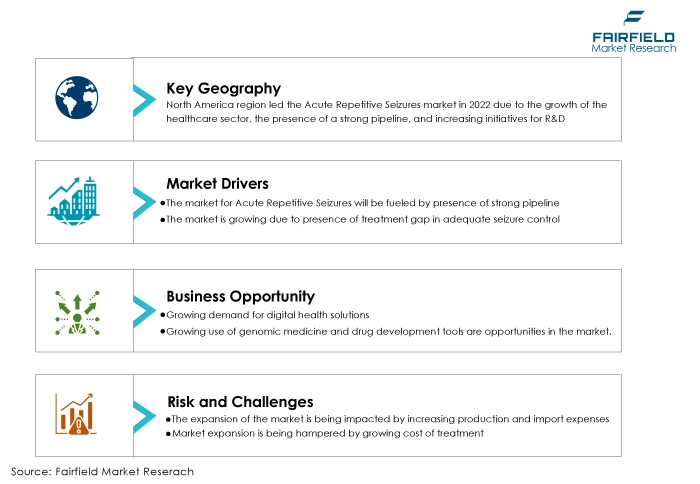
The market for acute repeated seizures is anticipated to expand significantly over the next years because of a strong pipeline and rising R&D spending. The channel features potential treatments with novel methods of action, providing people suffering from this crippling ailment with fresh hope.
Additionally, it is anticipated that stepping up R&D activities may hasten the creation of safer and more effective therapies. This rising dedication to R&D not only encourages innovation but also results in the identification of cutting-edge treatment alternatives that can enhance patient outcomes and quality of life.
Consequently, the market for acute repetitive seizures is anticipated to experience rapid growth in the years to come, which will be advantageous for both patients and the pharmaceutical sector.
- Significant Treatment Gaps in Adequate Seizure Control
The existence of a treatment gap in achieving adequate seizure control is a compelling driver for the acute repetitive seizures market. Many patients currently lack access to effective therapies that can manage their condition optimally. This unmet medical need underscores the demand for innovative treatments, spurring pharmaceutical companies to invest in research and development.
Addressing this treatment gap not only enhances patient care but also represents a significant market opportunity, making it a key factor propelling growth in the acute repetitive seizures market.
- Increasing R&D Investments
R&D advancements are set to propel the acute repetitive seizures market by fostering the development of innovative therapies. Ongoing research is uncovering new drug targets and treatment modalities, offering hope for improved seizure control and fewer side effects. These advancements not only address unmet medical needs but also attract pharmaceutical investment.
With a stronger pipeline of more effective and safer drugs, R&D breakthroughs are pivotal in driving market growth and ultimately enhancing the quality of life for individuals living with acute repetitive seizures.
Major Growth Barriers
- Growing Costs of Treatment
The escalating cost of treatment poses a significant challenge to the acute repetitive seizures market. As treatment expenses rise, it becomes more difficult for patients to afford essential therapies, potentially limiting their access to care. This financial burden also impacts healthcare systems and insurers.
Moreover, high treatment costs may deter pharmaceutical companies from investing in research and development for new therapies, hindering innovation. Finding ways to mitigate and manage the increasing cost of treatment is crucial to ensuring continued accessibility and sustainability within the acute repetitive seizures market.
Key Trends and Opportunities to Look at
The increasing adoption of digital health solutions is driving the acute repetitive seizures market by enabling real-time monitoring and data-driven insights. Wearable devices, mobile apps, and remote monitoring tools help patients to improve their condition more effectively while healthcare providers gain access to crucial patient data for personalised care. This technology not only enhances patient engagement but also contributes to improved seizure management and overall treatment outcomes.
- Growing use of Genomic Medicine
- Drug Development Tools are Becoming Popular
The growing use of genomic medicine technology is driving the acute repetitive seizures market by uncovering genetic factors underlying seizures. By analysing patients' genetic profiles, personalised treatment approaches are emerging, leading to more effective therapies.
The precision medicine approach not only enhances treatment outcomes but also attracts pharmaceutical investment in developing targeted therapies, ultimately expanding the market's potential for improved seizure management.
Drug development tools and technology are driving the acute repetitive seizures market by accelerating the discovery of new medications. Computational modelling and high-throughput screening techniques expedite the drug development process, potentially leading to more effective antiepileptic drugs.
The innovation not only addresses unmet medical needs but also attracts pharmaceutical investments, fostering the expansion of treatment options and market growth in the field of acute repetitive seizures.
How Does the Regulatory Scenario Shape this Industry?
The regulatory scenario plays a pivotal role in shaping the acute repetitive seizures market. Favourable regulatory policies, including fast-track designations and orphan drug status for promising therapies, expedite their development and market entry.
Stringent safety and efficacy standards ensure patient safety while fostering innovation. Additionally, regulatory support for rare disease research incentivizes pharmaceutical companies to invest in this niche area.
The regulations not only streamline the approval process but also encourage research and development efforts, ultimately expanding the acute repetitive seizures market and providing patients with access to safer and more effective treatments.
Fairfield’s Ranking Board
Top Segments
Antiepileptic drugs (AEDs) have captured the largest market share in the acute repetitive seizures market due to their long-established efficacy and widespread use in managing seizures. AEDs offer a well-established treatment modality with a range of options, providing physicians and patients with a variety of choices to tailor treatment to individual needs.
Additionally, continuous research and development in this category have led to improved formulations and reduced side effects, further solidifying their dominance in the market for acute repetitive seizure management.
Benzodiazepines are experiencing the fastest CAGR in the acute repetitive seizures market due to its rapid onset of action and effectiveness in stopping acute seizures. They are often used as first-line treatment in emergencies, offering quick relief to patients.
In addition, their versatility in various administration forms, such as intravenous and intranasal, makes them a preferred choice. As a result, their use is expanding, especially in acute settings, driving their growth at an accelerated pace within the market.
- Oral Route Will Surge Ahead
- Hospitals Lead the Way
The oral route of administration has captured the largest market share in the acute repetitive seizures market due to its convenience, patient compliance, and widespread acceptance. Oral medications are easy to administer, making them a preferred choice for long-term management of acute repetitive seizures. They offer a non-invasive approach, minimising patient discomfort.
Additionally, a broad range of antiepileptic drugs is available in oral forms, allowing healthcare providers to tailor treatments to individual patient needs. These factors collectively contribute to the dominance of the oral route in the market.
The intravenous (IV) route of administration is experiencing the fastest CAGR in the acute repetitive seizures market due to its rapid onset of action and effectiveness, making it a crucial choice in emergencies. IV medications provide quick relief and precise dosing, which is vital in managing acute repetitive seizures effectively.
Moreover, IV formulations are often used in hospital settings, ensuring immediate access to medical care driving their rapid growth within the market.
Hospitals are expected to capture the largest market share in the acute repetitive seizures market because they are the primary care facilities for patients experiencing acute seizures.
Hospitals offer immediate access to specialised medical professionals, diagnostic tools, and emergency care, making them pivotal in managing acute repetitive seizures effectively. They provide a comprehensive range of treatment options and ensure timely interventions. Moreover, patients with severe or recurrent seizures often require hospitalisation, solidifying hospitals as the dominant end-user in this market.
Home care settings are experiencing the fastest CAGR in the acute repetitive seizures market due to the increasing trend toward patient-centric care and the development of user-friendly, portable medical devices. Home care allows patients to manage their condition in a familiar and comfortable environment, reducing hospitalisation costs.
Moreover, telemedicine and remote monitoring technologies enable healthcare professionals to remotely assess and guide patients, making home care a convenient and efficient option, hence driving its rapid growth in the market.
Regional Frontrunners
North America Remains the Largest Revenue Contributor
North America captured the largest market share in the acute repetitive seizures market due to several factors. The region boasts advanced healthcare infrastructure, a high prevalence of epilepsy and related conditions, and strong investments in research and development.
Furthermore, favourable regulatory policies expedite drug approvals, fostering innovation. The presence of key pharmaceutical companies and a well-established healthcare system also contributes to market dominance.
Additionally, growing awareness of neurological disorders and an aging population further fuel the demand for effective seizure management, making North America the largest market for acute repetitive seizure treatment.
Asia Pacific Set for Remarkable Growth
The Asia Pacific region is anticipated the fastest CAGR in the acute repetitive seizures market due to factors such as a large patient population, increasing healthcare infrastructure development, and rising awareness about neurological disorders.
Additionally, the region is witnessing robust economic growth, enabling greater access to healthcare services, and driving pharmaceutical companies to expand their presence. As a result, the Asia Pacific market is evolving rapidly, making it a key growth driver for the acute repetitive seizures market.
Fairfield’s Competitive Landscape Analysis
The global acute repetitive seizures market is a consolidated market with fewer major players present across the globe. The key players are introducing new products as well as working on the distribution channels to enhance their worldwide presence. Moreover, Fairfield Market Research is expecting the market to witness more consolidation over the coming years.
Who are the Leaders in the Global Acute Repetitive Seizures Space?
- Pfizer
- Novartis
- GlaxoSmithKline
- Eisai Co., Ltd
- UCB Pharmaceuticals
- Lundbeck
- UCB
- Aquestive Therapeutics
- Marinus Pharmaceuticals
- Takeda Pharmaceuticals
- SK Biopharmaceuticals
- Supernus Pharmaceuticals
- Neurelis, Inc.
- Sage Therapeutics
- NeuroPace, Inc
An Expert’s Eye
Demand and Future Growth
As per Fairfield’s Analysis, an increase in healthcare facilities demand is driving the market. The acute repetitive seizures market is poised for significant growth due to increasing demand driven by the rising prevalence of epilepsy and related conditions.
With advancements in research, technology, and treatment options, there is a growing focus on addressing unmet medical needs, which is expected to drive future market growth.
Additionally, expanding healthcare infrastructure in emerging markets, coupled with rising awareness and improving access to care, will contribute to sustained demand and the overall development of the acute repetitive seizures market.
Supply-Demand Side of the Market
The supply side of the acute repetitive seizures market encompasses pharmaceutical and biotechnology companies, medical device manufacturers, and healthcare providers. These entities play a crucial role in developing, manufacturing, and distributing antiepileptic drugs, seizure management devices, and related therapies. To produce cutting-edge therapies, pharmaceutical corporations engage in research and development.
Devices for neurostimulation and monitoring are produced by medical device makers. Healthcare providers, including hospitals and clinics, ensure the availability and administration of medicines to patients. Together, these supply-side components work to meet the growing demand for effective solutions in the acute repetitive seizures market.
The Global Acute Repetitive Seizures Market is Segmented as Below:
By Drug Type:
- Antiepileptic Drugs (AEDs)
- Benzodiazepines
- Barbiturates
- Others
By Route of Administration:
- Oral
- Intravenous
- Intranasal Formulations
By Distribution Channel:
- Hospitals
- Specialty Clinics
- Retail Pharmacies
- Online Pharmacies
By End Use:
- Hospitals
- Clinics
- Home Care Settings
By Geographic Coverage:
- North America
- Europe
- Asia Pacific
- Latin America
- Middle East & Africa
- Executive Summary
- Global Acute Repetitive Seizures Market Snapshot
- Future Projections
- Key Market Trends
- Regional Snapshot, by Value, 2026
- Analyst Recommendations
- Market Overview
- Market Definitions and Segmentations
- Market Dynamics
- Drivers
- Restraints
- Market Opportunities
- Value Chain Analysis
- COVID-19 Impact Analysis
- Porter's Five Forces Analysis
- Impact of Russia-Ukraine Conflict
- PESTLE Analysis
- Regulatory Analysis
- Price Trend Analysis
- Current Prices and Future Projections, 2025-2033
- Price Impact Factors
- Global Acute Repetitive Seizures Market Outlook, 2020 - 2033
- Global Acute Repetitive Seizures Market Outlook, by Drug Type, Value (US$ Mn), 2020-2033
- Antiepileptic Drugs (AEDs)
- Benzodiazepines
- Barbiturates
- Others
- Global Acute Repetitive Seizures Market Outlook, by Route of Administration, Value (US$ Mn), 2020-2033
- Oral
- Intravenous
- Intranasal Formulations
- Global Acute Repetitive Seizures Market Outlook, by Distribution Channel, Value (US$ Mn), 2020-2033
- Hospitals
- Specialty Clinics
- Retail Pharmacies
- Online Pharmacies
- Global Acute Repetitive Seizures Market Outlook, by End Use, Value (US$ Mn), 2020-2033
- Hospitals
- Clinics
- Home Care Settings
- Global Acute Repetitive Seizures Market Outlook, by Region, Value (US$ Mn), 2020-2033
- North America
- Europe
- Asia Pacific
- Latin America
- Middle East & Africa
- Global Acute Repetitive Seizures Market Outlook, by Drug Type, Value (US$ Mn), 2020-2033
- North America Acute Repetitive Seizures Market Outlook, 2020 - 2033
- North America Acute Repetitive Seizures Market Outlook, by Drug Type, Value (US$ Mn), 2020-2033
- Antiepileptic Drugs (AEDs)
- Benzodiazepines
- Barbiturates
- Others
- North America Acute Repetitive Seizures Market Outlook, by Route of Administration, Value (US$ Mn), 2020-2033
- Oral
- Intravenous
- Intranasal Formulations
- North America Acute Repetitive Seizures Market Outlook, by Distribution Channel, Value (US$ Mn), 2020-2033
- Hospitals
- Specialty Clinics
- Retail Pharmacies
- Online Pharmacies
- North America Acute Repetitive Seizures Market Outlook, by End Use, Value (US$ Mn), 2020-2033
- Hospitals
- Clinics
- Home Care Settings
- North America Acute Repetitive Seizures Market Outlook, by Country, Value (US$ Mn), 2020-2033
- U.S. Acute Repetitive Seizures Market Outlook, by Drug Type, 2020-2033
- U.S. Acute Repetitive Seizures Market Outlook, by Route of Administration, 2020-2033
- U.S. Acute Repetitive Seizures Market Outlook, by Distribution Channel, 2020-2033
- U.S. Acute Repetitive Seizures Market Outlook, by End Use, 2020-2033
- Canada Acute Repetitive Seizures Market Outlook, by Drug Type, 2020-2033
- Canada Acute Repetitive Seizures Market Outlook, by Route of Administration, 2020-2033
- Canada Acute Repetitive Seizures Market Outlook, by Distribution Channel, 2020-2033
- Canada Acute Repetitive Seizures Market Outlook, by End Use, 2020-2033
- BPS Analysis/Market Attractiveness Analysis
- North America Acute Repetitive Seizures Market Outlook, by Drug Type, Value (US$ Mn), 2020-2033
- Europe Acute Repetitive Seizures Market Outlook, 2020 - 2033
- Europe Acute Repetitive Seizures Market Outlook, by Drug Type, Value (US$ Mn), 2020-2033
- Antiepileptic Drugs (AEDs)
- Benzodiazepines
- Barbiturates
- Others
- Europe Acute Repetitive Seizures Market Outlook, by Route of Administration, Value (US$ Mn), 2020-2033
- Oral
- Intravenous
- Intranasal Formulations
- Europe Acute Repetitive Seizures Market Outlook, by Distribution Channel, Value (US$ Mn), 2020-2033
- Hospitals
- Specialty Clinics
- Retail Pharmacies
- Online Pharmacies
- Europe Acute Repetitive Seizures Market Outlook, by End Use, Value (US$ Mn), 2020-2033
- Hospitals
- Clinics
- Home Care Settings
- Europe Acute Repetitive Seizures Market Outlook, by Country, Value (US$ Mn), 2020-2033
- Germany Acute Repetitive Seizures Market Outlook, by Drug Type, 2020-2033
- Germany Acute Repetitive Seizures Market Outlook, by Route of Administration, 2020-2033
- Germany Acute Repetitive Seizures Market Outlook, by Distribution Channel, 2020-2033
- Germany Acute Repetitive Seizures Market Outlook, by End Use, 2020-2033
- Italy Acute Repetitive Seizures Market Outlook, by Drug Type, 2020-2033
- Italy Acute Repetitive Seizures Market Outlook, by Route of Administration, 2020-2033
- Italy Acute Repetitive Seizures Market Outlook, by Distribution Channel, 2020-2033
- Italy Acute Repetitive Seizures Market Outlook, by End Use, 2020-2033
- France Acute Repetitive Seizures Market Outlook, by Drug Type, 2020-2033
- France Acute Repetitive Seizures Market Outlook, by Route of Administration, 2020-2033
- France Acute Repetitive Seizures Market Outlook, by Distribution Channel, 2020-2033
- France Acute Repetitive Seizures Market Outlook, by End Use, 2020-2033
- U.K. Acute Repetitive Seizures Market Outlook, by Drug Type, 2020-2033
- U.K. Acute Repetitive Seizures Market Outlook, by Route of Administration, 2020-2033
- U.K. Acute Repetitive Seizures Market Outlook, by Distribution Channel, 2020-2033
- U.K. Acute Repetitive Seizures Market Outlook, by End Use, 2020-2033
- Spain Acute Repetitive Seizures Market Outlook, by Drug Type, 2020-2033
- Spain Acute Repetitive Seizures Market Outlook, by Route of Administration, 2020-2033
- Spain Acute Repetitive Seizures Market Outlook, by Distribution Channel, 2020-2033
- Spain Acute Repetitive Seizures Market Outlook, by End Use, 2020-2033
- Russia Acute Repetitive Seizures Market Outlook, by Drug Type, 2020-2033
- Russia Acute Repetitive Seizures Market Outlook, by Route of Administration, 2020-2033
- Russia Acute Repetitive Seizures Market Outlook, by Distribution Channel, 2020-2033
- Russia Acute Repetitive Seizures Market Outlook, by End Use, 2020-2033
- Rest of Europe Acute Repetitive Seizures Market Outlook, by Drug Type, 2020-2033
- Rest of Europe Acute Repetitive Seizures Market Outlook, by Route of Administration, 2020-2033
- Rest of Europe Acute Repetitive Seizures Market Outlook, by Distribution Channel, 2020-2033
- Rest of Europe Acute Repetitive Seizures Market Outlook, by End Use, 2020-2033
- BPS Analysis/Market Attractiveness Analysis
- Europe Acute Repetitive Seizures Market Outlook, by Drug Type, Value (US$ Mn), 2020-2033
- Asia Pacific Acute Repetitive Seizures Market Outlook, 2020 - 2033
- Asia Pacific Acute Repetitive Seizures Market Outlook, by Drug Type, Value (US$ Mn), 2020-2033
- Antiepileptic Drugs (AEDs)
- Benzodiazepines
- Barbiturates
- Others
- Asia Pacific Acute Repetitive Seizures Market Outlook, by Route of Administration, Value (US$ Mn), 2020-2033
- Oral
- Intravenous
- Intranasal Formulations
- Asia Pacific Acute Repetitive Seizures Market Outlook, by Distribution Channel, Value (US$ Mn), 2020-2033
- Hospitals
- Specialty Clinics
- Retail Pharmacies
- Online Pharmacies
- Asia Pacific Acute Repetitive Seizures Market Outlook, by End Use, Value (US$ Mn), 2020-2033
- Hospitals
- Clinics
- Home Care Settings
- Asia Pacific Acute Repetitive Seizures Market Outlook, by Country, Value (US$ Mn), 2020-2033
- China Acute Repetitive Seizures Market Outlook, by Drug Type, 2020-2033
- China Acute Repetitive Seizures Market Outlook, by Route of Administration, 2020-2033
- China Acute Repetitive Seizures Market Outlook, by Distribution Channel, 2020-2033
- China Acute Repetitive Seizures Market Outlook, by End Use, 2020-2033
- Japan Acute Repetitive Seizures Market Outlook, by Drug Type, 2020-2033
- Japan Acute Repetitive Seizures Market Outlook, by Route of Administration, 2020-2033
- Japan Acute Repetitive Seizures Market Outlook, by Distribution Channel, 2020-2033
- Japan Acute Repetitive Seizures Market Outlook, by End Use, 2020-2033
- South Korea Acute Repetitive Seizures Market Outlook, by Drug Type, 2020-2033
- South Korea Acute Repetitive Seizures Market Outlook, by Route of Administration, 2020-2033
- South Korea Acute Repetitive Seizures Market Outlook, by Distribution Channel, 2020-2033
- South Korea Acute Repetitive Seizures Market Outlook, by End Use, 2020-2033
- India Acute Repetitive Seizures Market Outlook, by Drug Type, 2020-2033
- India Acute Repetitive Seizures Market Outlook, by Route of Administration, 2020-2033
- India Acute Repetitive Seizures Market Outlook, by Distribution Channel, 2020-2033
- India Acute Repetitive Seizures Market Outlook, by End Use, 2020-2033
- Southeast Asia Acute Repetitive Seizures Market Outlook, by Drug Type, 2020-2033
- Southeast Asia Acute Repetitive Seizures Market Outlook, by Route of Administration, 2020-2033
- Southeast Asia Acute Repetitive Seizures Market Outlook, by Distribution Channel, 2020-2033
- Southeast Asia Acute Repetitive Seizures Market Outlook, by End Use, 2020-2033
- Rest of SAO Acute Repetitive Seizures Market Outlook, by Drug Type, 2020-2033
- Rest of SAO Acute Repetitive Seizures Market Outlook, by Route of Administration, 2020-2033
- Rest of SAO Acute Repetitive Seizures Market Outlook, by Distribution Channel, 2020-2033
- Rest of SAO Acute Repetitive Seizures Market Outlook, by End Use, 2020-2033
- BPS Analysis/Market Attractiveness Analysis
- Asia Pacific Acute Repetitive Seizures Market Outlook, by Drug Type, Value (US$ Mn), 2020-2033
- Latin America Acute Repetitive Seizures Market Outlook, 2020 - 2033
- Latin America Acute Repetitive Seizures Market Outlook, by Drug Type, Value (US$ Mn), 2020-2033
- Antiepileptic Drugs (AEDs)
- Benzodiazepines
- Barbiturates
- Others
- Latin America Acute Repetitive Seizures Market Outlook, by Route of Administration, Value (US$ Mn), 2020-2033
- Oral
- Intravenous
- Intranasal Formulations
- Latin America Acute Repetitive Seizures Market Outlook, by Distribution Channel, Value (US$ Mn), 2020-2033
- Hospitals
- Specialty Clinics
- Retail Pharmacies
- Online Pharmacies
- Latin America Acute Repetitive Seizures Market Outlook, by End Use, Value (US$ Mn), 2020-2033
- Hospitals
- Clinics
- Home Care Settings
- Latin America Acute Repetitive Seizures Market Outlook, by Country, Value (US$ Mn), 2020-2033
- Brazil Acute Repetitive Seizures Market Outlook, by Drug Type, 2020-2033
- Brazil Acute Repetitive Seizures Market Outlook, by Route of Administration, 2020-2033
- Brazil Acute Repetitive Seizures Market Outlook, by Distribution Channel, 2020-2033
- Brazil Acute Repetitive Seizures Market Outlook, by End Use, 2020-2033
- Mexico Acute Repetitive Seizures Market Outlook, by Drug Type, 2020-2033
- Mexico Acute Repetitive Seizures Market Outlook, by Route of Administration, 2020-2033
- Mexico Acute Repetitive Seizures Market Outlook, by Distribution Channel, 2020-2033
- Mexico Acute Repetitive Seizures Market Outlook, by End Use, 2020-2033
- Argentina Acute Repetitive Seizures Market Outlook, by Drug Type, 2020-2033
- Argentina Acute Repetitive Seizures Market Outlook, by Route of Administration, 2020-2033
- Argentina Acute Repetitive Seizures Market Outlook, by Distribution Channel, 2020-2033
- Argentina Acute Repetitive Seizures Market Outlook, by End Use, 2020-2033
- Rest of LATAM Acute Repetitive Seizures Market Outlook, by Drug Type, 2020-2033
- Rest of LATAM Acute Repetitive Seizures Market Outlook, by Route of Administration, 2020-2033
- Rest of LATAM Acute Repetitive Seizures Market Outlook, by Distribution Channel, 2020-2033
- Rest of LATAM Acute Repetitive Seizures Market Outlook, by End Use, 2020-2033
- BPS Analysis/Market Attractiveness Analysis
- Latin America Acute Repetitive Seizures Market Outlook, by Drug Type, Value (US$ Mn), 2020-2033
- Middle East & Africa Acute Repetitive Seizures Market Outlook, 2020 - 2033
- Middle East & Africa Acute Repetitive Seizures Market Outlook, by Drug Type, Value (US$ Mn), 2020-2033
- Antiepileptic Drugs (AEDs)
- Benzodiazepines
- Barbiturates
- Others
- Middle East & Africa Acute Repetitive Seizures Market Outlook, by Route of Administration, Value (US$ Mn), 2020-2033
- Oral
- Intravenous
- Intranasal Formulations
- Middle East & Africa Acute Repetitive Seizures Market Outlook, by Distribution Channel, Value (US$ Mn), 2020-2033
- Hospitals
- Specialty Clinics
- Retail Pharmacies
- Online Pharmacies
- Middle East & Africa Acute Repetitive Seizures Market Outlook, by End Use, Value (US$ Mn), 2020-2033
- Hospitals
- Clinics
- Home Care Settings
- Middle East & Africa Acute Repetitive Seizures Market Outlook, by Country, Value (US$ Mn), 2020-2033
- GCC Acute Repetitive Seizures Market Outlook, by Drug Type, 2020-2033
- GCC Acute Repetitive Seizures Market Outlook, by Route of Administration, 2020-2033
- GCC Acute Repetitive Seizures Market Outlook, by Distribution Channel, 2020-2033
- GCC Acute Repetitive Seizures Market Outlook, by End Use, 2020-2033
- South Africa Acute Repetitive Seizures Market Outlook, by Drug Type, 2020-2033
- South Africa Acute Repetitive Seizures Market Outlook, by Route of Administration, 2020-2033
- South Africa Acute Repetitive Seizures Market Outlook, by Distribution Channel, 2020-2033
- South Africa Acute Repetitive Seizures Market Outlook, by End Use, 2020-2033
- Egypt Acute Repetitive Seizures Market Outlook, by Drug Type, 2020-2033
- Egypt Acute Repetitive Seizures Market Outlook, by Route of Administration, 2020-2033
- Egypt Acute Repetitive Seizures Market Outlook, by Distribution Channel, 2020-2033
- Egypt Acute Repetitive Seizures Market Outlook, by End Use, 2020-2033
- Nigeria Acute Repetitive Seizures Market Outlook, by Drug Type, 2020-2033
- Nigeria Acute Repetitive Seizures Market Outlook, by Route of Administration, 2020-2033
- Nigeria Acute Repetitive Seizures Market Outlook, by Distribution Channel, 2020-2033
- Nigeria Acute Repetitive Seizures Market Outlook, by End Use, 2020-2033
- Rest of Middle East Acute Repetitive Seizures Market Outlook, by Drug Type, 2020-2033
- Rest of Middle East Acute Repetitive Seizures Market Outlook, by Route of Administration, 2020-2033
- Rest of Middle East Acute Repetitive Seizures Market Outlook, by Distribution Channel, 2020-2033
- Rest of Middle East Acute Repetitive Seizures Market Outlook, by End Use, 2020-2033
- BPS Analysis/Market Attractiveness Analysis
- Middle East & Africa Acute Repetitive Seizures Market Outlook, by Drug Type, Value (US$ Mn), 2020-2033
- Competitive Landscape
- Company Vs Segment Heatmap
- Company Market Share Analysis, 2025
- Competitive Dashboard
- Company Profiles
- Pfizer
- Company Overview
- Product Portfolio
- Financial Overview
- Business Strategies and Developments
- Novartis
- GlaxoSmithKline
- Eisai Co., Ltd
- UCB Pharmaceuticals
- Lundbeck
- UCB
- Aquestive Therapeutics
- Marinus Pharmaceuticals
- Takeda Pharmaceuticals
- Pfizer
- Appendix
- Research Methodology
- Report Assumptions
- Acronyms and Abbreviations
|
BASE YEAR |
HISTORICAL DATA |
FORECAST PERIOD |
UNITS |
|||
 |
2025 |
 |
2019 - 2025 |
 |
2026 - 2033 |
Value: US$ Million |
|
REPORT FEATURES |
DETAILS |
|
Drug Type Coverage |
|
|
Route of Administration Coverage |
|
|
Distribution Channel Coverage |
|
|
End Use Coverage |
|
|
Geographical Coverage |
|
|
Leading Companies |
|
|
Report Highlights |
Key Market Indicators, Macro-micro economic impact analysis, Technological Roadmap, Key Trends, Driver, Restraints, and Future Opportunities & Revenue Pockets, Porter’s 5 Forces Analysis, Historical Trend (2019-2021), Market Estimates and Forecast, Market Dynamics, Industry Trends, Competition Landscape, Category, Region, Country-wise Trends & Analysis, COVID-19 Impact Analysis (Demand and Supply Chain) |
Our Research Methodology
Considering the volatility of business today, traditional approaches to strategizing a game plan can be unfruitful if not detrimental. True ambiguity is no way to determine a forecast. A myriad of predetermined factors must be accounted for such as the degree of risk involved, the magnitude of circumstances, as well as conditions or consequences that are not known or unpredictable. To circumvent binary views that cast uncertainty, the application of market research intelligence to strategically posture, move, and enable actionable outcomes is necessary.
View Methodology
Quality Assured
Rigorous Validation Process

Confidentiality Assured
End-to-end Data Security

Custom Research Services
Tailored To Your Objectives
FAQs
The global acute repetitive seizures market that was worth around USD 3.6 Bn in 2026 will possibly reach a valuation of USD 7.9 Bn by the end of 2033. Between the years of forecast, the market size will exhibit a staggering CAGR of more than 12%.
Pfizer, GlaxoSmithKline, Novartis, Neurelis, Inc., NeuroPace, Inc., Takeda Pharmaceuticals, and Sage Therapeutics are some of the biggest names in this industry.
Currently, North America holds the largest share of the global acute repetitive seizures market.
The primary factors projected to drive the acute repetitive seizures market expansion are the presence of a strong pipeline, increasing initiatives for R&D, and the presence of a treatment gap in adequate seizure control.
The oral route of administration remains prominent, whereas the antiepileptic drugs (AEDs) category continues to account for the largest revenue share of the acute repetitive seizures market.
Related Reports
Genetically Modified Feed Insights, Competitive Landscape, and Market Forecast 2026 to 2033
Genetically Modified Feed Market is valued at US$38.4 billion in 2026 and projected to reach US$54.4 billion by 2033, growing at a 5.1% CAGR.
Enzyme Engineering Insights, Competitive Landscape, and Market Forecast 2026 to 2033
The global Enzyme Engineering Market is projected to grow from US$3.2 billion in 2026 to US$5.7 billion by 2033, expanding at a CAGR of 8.6%.
Enzymatic RNA Manufacturing Market Insights, Competitive Landscape, and Market Forecast - 2033
The enzymatic RNA manufacturing market, valued at USD 1.10 billion in 2026 and projected to reach USD 4.32 billion by 2033, at a 21.6% CAGR
Nephrology Drugs Market Insights, Competitive Landscape, and Market Forecast 2033
The nephrology drugs market is forecast to grow from USD 24.50 billion in 2026 to USD 40.39 billion by 2033, driven by novel disease-modifying treatments.
Active Pharmaceutical Ingredients Market Insights, Competitive Landscape, and Market Forecast 2033
Dementia Care Market Analysis Market Insights, Competitive Landscape, and Market Forecast 2033
Dementia Care Market to reach US$46.60 Mn by 2033, growing at 5.9% CAGR, driven by ageing populations, home care, and specialized dementia services.