



Advanced Semiconductor Cooling Systems Market
Advanced Semiconductor Cooling Systems Market Size, Share, Insights, Competitive Landscape, and Forecast 2026 to 2033
How Fast Is Advanced Semiconductor Cooling Demand Growing?
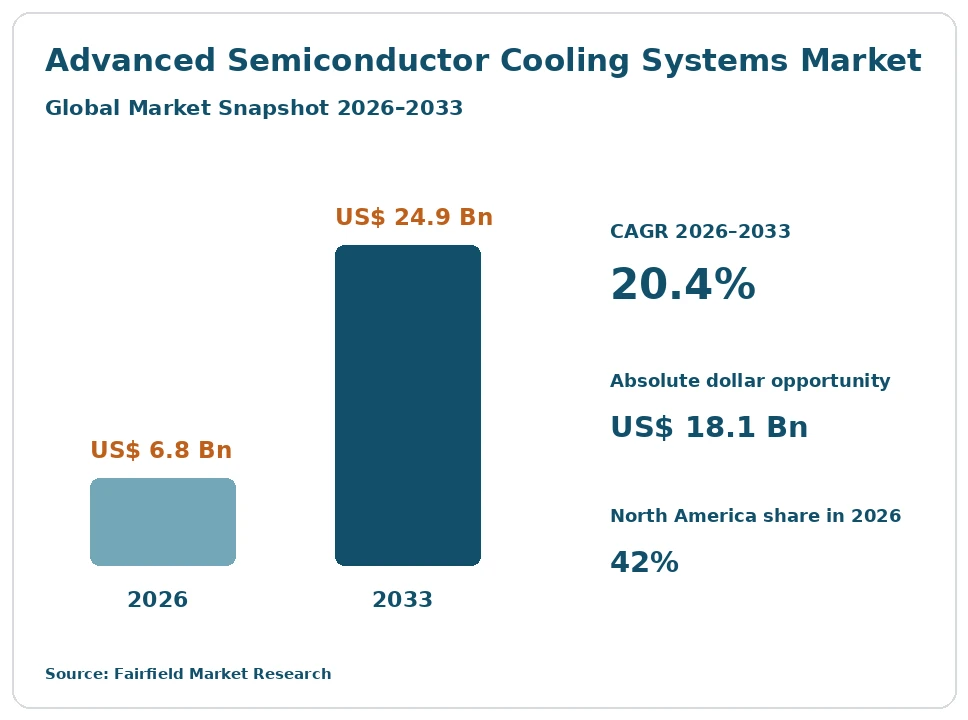
The global Advanced Semiconductor Cooling Systems market size is expected to be valued at US$ 6.8 billion in 2026 and projected to reach US$ 24.9 billion by 2033, growing at a CAGR of 20.4% between 2026 and 2033.
Between 2020 and 2025 the market grew at roughly a 24% CAGR from a small base, as liquid cooling moved out of pilot halls and into production accelerator clusters. Three forces carry growth now. Power per accelerator package has passed the point where air removal is practical within rack airflow and acoustic limits. New facilities are being designed around liquid distribution rather than adapted to it afterwards. Power electronics makers are adopting the same cold plate hardware. The direction is clear but uneven: thermal engineering is settled, while facilities readiness, service skills and loop ownership decide how quickly existing buildings convert.
Key Report Takeaways
- By Cooling Technology: Direct-to-Chip Single-Phase Cold Plates held 38% share in 2026, while Single-Phase Immersion Cooling is projected to expand at a 25.8% CAGR through 2033, as operators seek an alternative to fluorinated two-phase baths.
- By Component: Cold Plates and Manifolds held 31% share in 2026, while Services and Maintenance is projected to expand at a 24.9% CAGR through 2033, because few facility teams employ technicians trained on live liquid loops.
- By Application: Data Centre Artificial Intelligence and High Performance Computing held 62% share in 2026, while Power Electronics and Traction Inverters are projected to expand at a 23.1% CAGR through 2033, driven by silicon carbide switching densities.
- By Deployment Mode: Greenfield Facilities held 58% share in 2026, while Retrofit of Existing Facilities is projected to expand at a 24.2% CAGR through 2033, as operators exhaust air-cooled capacity in halls they already own.
- By Geography: North America held 42% share in 2026, while Asia Pacific is projected to expand at a 23.8% CAGR through 2033, supported by new accelerator capacity in Japan, South Korea, Singapore and India.
Global Advanced Semiconductor Cooling Systems Market Trends and Insights
Drivers Impact Analysis
The two forces below account for most incremental spending on thermal management above conventional air cooling.
Accelerator Power Per Package Has Made Liquid at the Chip the Default Specification
Power density at the package is the single largest source of new demand. Leading accelerator parts now dissipate several hundred to well over a thousand watts each, and a single rack can carry what an entire row once drew. Pushing enough air through that volume fails on fan power, acoustics and floor area, so liquid at the chip has moved from an exotic option to the normal specification for new high-density deployments.
The mechanism is physics with commercial consequences. Liquids carry far more heat per unit volume than air, so a cold plate removes at the die what a fan cannot. Once liquid reaches the chip, everything else follows: manifolds, coolant distribution units, secondary loops, quick disconnects, leak detection and advanced thermal interface materials. ASHRAE Technical Committee 9.9 liquid cooling guidance and its water-cooled equipment classes give designers the temperature envelopes they specify against.
Energy and Heat Reuse Obligations Are Pulling Liquid Systems Into Facility Design
Regulation has become a second, slower-moving driver, strongest in Europe. Reporting duties on data centre energy and water use expose air-cooled inefficiency in a way internal targets never did, and heat reuse requirements in national building and energy codes are difficult to satisfy with warm exhaust air. Liquid returns heat at a useful temperature, so compliance pressure now favours systems that were previously chosen on performance alone.
The causal chain runs from measurement to design. The European Union Energy Efficiency Directive introduced data centre reporting obligations, and a delegated act established a common rating scheme covering energy and water indicators. Germany has gone further, writing waste heat reuse and efficiency duties into national energy efficiency legislation. Operators responding to those duties specify higher coolant return temperatures, which in turn requires direct-to-chip loops rather than room-level air handling.
| Driver | Impact on CAGR Forecast | Geographic Relevance | Impact Timeline |
| Accelerator power per package beyond practical air removal limits | High | North America, Asia Pacific | Short term ≤2 years |
| Energy and heat reuse obligations on data centre operators | Medium | Europe | Medium term 2–4 years |
Restraints Impact Analysis
Both restraints below are operational and commercial rather than thermal, and neither resolves quickly.
Retrofit Cost and Operational Readiness, Not Thermal Engineering, Hold Back Conversion
The brake on this market is operational readiness. Converting an occupied data hall means adding pipework, distribution units, water treatment, leak detection and containment to a building that was never designed for fluid above live electronics. The work displaces revenue-earning capacity while it proceeds, and the capital cost competes directly with simply building new. Many operators therefore defer conversion until an air-cooled hall is genuinely full.
The deeper cause is people and accountability rather than hardware. There are few technicians trained to service a live loop, no settled set of maintenance practices, and persistent ambiguity over who owns the loop between the equipment vendor and the facility operator. Site power and water availability add a further limit, since several large markets now ration grid connections. Water quality duties and cleanliness practice informed by ISO 14644 add commissioning steps that unfamiliar teams underestimate.
Coolant, Fitting and Manifold Fragmentation Leaves Buyers Exposed to Vendor Lock-In
Fragmentation is the second brake, and it slows decisions rather than stopping them. Cold plates, manifolds, quick disconnects and distribution units are not reliably interchangeable between suppliers, so a buyer choosing one vendor often inherits that vendor’s fittings, fluid chemistry and service model for the life of the hall. Procurement teams that have lived through proprietary infrastructure before are cautious, and that caution lengthens sales cycles.
Coolant choice compounds the problem. Treated water and glycol blends require careful chemistry control and carry leak consequences near live electronics; single-phase dielectric oils are heavy and complicate servicing; and the fluorinated fluids used in two-phase immersion face restriction pressure following the per- and polyfluoroalkyl substance restriction proposal published by the European Chemicals Agency. The Open Compute Project cold plate and coolant distribution specifications are the main industry answer, but adoption remains partial.
| Restraint | Impact on CAGR Forecast | Geographic Relevance | Impact Timeline |
| Retrofit cost, hall disruption and shortage of liquid-trained technicians | High | Global | Long term ≥4 years |
| Immature standardisation of coolants, fittings and manifolds | Medium | Global | Medium term 2–4 years |
Market Opportunities
Two revenue pools sit outside the straightforward supply of cold plates into new buildings.
Direct-to-Chip Retrofit Kits Open Revenue Inside Halls That Already Exist
The installed base of air-cooled halls is the largest untapped pool in this market. Rear-door heat exchangers and self-contained direct-to-chip kits with in-rack or in-row distribution let an operator raise density in a few rows without re-plumbing a building. Priced between a full facility conversion and doing nothing, they convert a capital project into an incremental purchase, which suits colocation providers who cannot take whole halls offline.
Capture favours suppliers who sell an engineered package rather than a component: cold plates, a distribution unit, hoses, leak detection, commissioning and a service agreement under one contract. Demand comes from colocation operators adding accelerator suites for tenants, enterprises placing small inference clusters in existing rooms, and research sites upgrading established machines. Liquid-to-air distribution units are the enabling product, because they need no connection to building chilled water.
Heat Reuse and Loop Service Agreements Build a Recurring Revenue Layer
Service and heat recovery turn a one-time equipment sale into an annuity. Liquid loops require fluid analysis, filter and inhibitor replacement, pressure testing, disconnect inspection and documented procedures, and most operators lack the staff to do this. Multi-year maintenance contracts therefore attach naturally to installed systems, and they carry better margins than hardware. Heat rejection and reuse equipment sold as part of the system extends the same relationship.
Equipment vendors, mechanical contractors and facility service firms are all positioned to capture it, often jointly. Demand is strongest where regulation rewards recovered heat: district heating connections in northern Europe, campus networks, and industrial sites that can use warm water directly. The decisive requirement is coolant return temperature, because heat is only worth selling if it arrives hot enough, which pushes designs toward warm-water direct-to-chip operation.
Segment Analysis
By Cooling Technology: Single-Phase Cold Plates Lead While Single-Phase Immersion Accelerates
Direct-to-Chip Single-Phase Cold Plates hold 38% share in 2026, the clear leading position. They are the least disruptive way to remove kilowatt-scale heat at the package, they work with familiar water chemistry, and server vendors now ship factory-fitted cold plate variants of mainstream accelerator platforms. Rear-door heat exchangers remain popular as a first step because they need no change to the servers themselves.
Single-Phase Immersion Cooling grows fastest at a 25.8% CAGR through 2033. It removes fans and most in-rack airflow engineering entirely, and it avoids the restricted fluorinated fluids that complicate two-phase baths. Two-phase cold plates, vapour chambers, heat pipes and microchannel or embedded cooling fill specialised roles where space or heat flux is extreme. The implication is that buyers are converging on fewer, better-understood fluid chemistries.
By Component: Cold Plates and Manifolds Dominate Spend While Services Scale Fastest
Cold Plates and Manifolds account for 31% of spending in 2026. They sit closest to the silicon, carry the most engineering content, and are specified per accelerator platform, so they capture value first in any deployment. Coolant distribution units follow, with quick disconnects, secondary loop piping, advanced thermal interface materials, leak detection and controls completing the hardware mix.
Services and Maintenance expands fastest at a 24.9% CAGR through 2033. Fluid analysis, filter changes, pressure testing and documented service procedures are unavoidable once a hall runs wet, and the technician shortage means operators buy that capability rather than build it. Heat rejection and heat reuse equipment grows alongside. The business implication is that vendors able to field a service organisation will hold accounts that component specialists cannot defend.
By Application: Data Centre Workloads Lead While Traction Inverters Grow Quickest
Data Centre Artificial Intelligence and High Performance Computing holds 62% share in 2026 and sets the technical agenda for the whole market. Training and inference clusters concentrate the highest package powers anywhere in electronics, and their operators have both the budget and the engineering staff to adopt liquid distribution early. Networking and telecom follows, as switch silicon and optical modules push past comfortable air limits.
Power Electronics and Traction Inverters grow fastest at a 23.1% CAGR through 2033. Silicon carbide and gallium nitride devices switch harder in smaller packages, so inverter and charger designers now use cold plates, vapour chambers and high-performance thermal interface materials as standard. High-power industrial and defence electronics complete the mix. For suppliers, the implication is that automotive volumes reward designs that data centre work alone would never justify industrialising.
By Deployment Mode: Greenfield Builds Lead Today While Retrofit Is the Faster-Growing Route
Greenfield Facilities represent 58% of the market in 2026. A building designed around liquid from the outset can site distribution units, risers, treatment plant and heat rejection correctly, carry the structural load, and commission the loop before servers arrive. That is cheaper and far less risky than conversion, so new construction has absorbed most high-density deployment so far.
Retrofit of Existing Facilities grows fastest at a 24.2% CAGR through 2033, because the installed base is large and increasingly unable to host new accelerators. Operators run out of air-cooled headroom in halls that still have years of lease and power contracted. Edge and modular enclosures occupy a smaller niche. The implication is that products engineered for partial, row-level conversion will outsell those assuming a clean building.
Geography Analysis
Which Region Is Leading the Advanced Semiconductor Cooling Systems Market?
North America leads with 42% share in 2026, driven overwhelmingly by the United States with a meaningful contribution from Canada. The region hosts the largest concentration of accelerator capacity, and its hyperscale operators were the first to design halls around liquid distribution rather than adapt them. Several of the established cold plate, coolant distribution unit and immersion specialists are based there, keeping engineering support close to the largest buyers. Utility constraints have become the binding limit in several established hubs, where grid connection queues and water allocation now shape site selection more than land cost. That pressure favours designs with high coolant return temperatures and dry heat rejection. The main change ahead is conversion of the existing colocation estate, which is far larger than the volume of new construction.
Europe Ties Liquid Cooling Adoption to Energy Reporting and Heat Recovery Duties
Europe accounts for 24% of the market in 2026, with Germany, the Netherlands, Ireland, the Nordic countries, France and the United Kingdom leading. Adoption here is driven as much by compliance as by performance. Operators face data centre energy and water reporting obligations under the European Union Energy Efficiency Directive and a delegated rating scheme, while national codes increasingly require recovered heat to be offered to district networks. Germany has written waste heat and efficiency duties into its energy efficiency legislation, and Denmark, Sweden and Finland already connect facilities to municipal heating. Restriction pressure on fluorinated fluids is also felt earliest here. The constraint is planning and grid access in Dublin, Amsterdam and Frankfurt. The opportunity lies in warm-water designs that make recovered heat commercially saleable.
Which Region Is Growing Fastest in the Advanced Semiconductor Cooling Systems Market?
Asia Pacific grows fastest at a 23.8% CAGR between 2026 and 2033, rising from 26% share in 2026, led by China, Japan, South Korea, Singapore, India and Taiwan. New accelerator capacity is being built at speed, and much of it is specified liquid-cooled from the first drawing because the alternative does not fit the available power envelope. Singapore and Japan face acute land and electricity limits that make density mandatory rather than desirable. China is building domestic manufacturing for cold plates, distribution units and immersion tanks, which lowers local system prices. Taiwan and South Korea add demand from semiconductor and server manufacturing itself. Tropical ambient conditions complicate heat rejection and raise water use, which is the region’s principal technical constraint and a growing policy concern.
Latin America Adds High-Density Capacity Slowly Around a Few Metropolitan Hubs
Latin America represents 4% of the market in 2026, concentrated in Brazil, Mexico, Chile and Colombia. Demand comes from a small number of international colocation operators serving regional cloud and financial customers, plus early accelerator deployments at universities and telecom operators. Barriers are substantial: equipment is imported and exposed to duties and currency movement, specialist installation and commissioning skills are scarce, service response times are long, and water availability is contested in parts of Chile and northern Mexico. Most halls remain comfortably within air-cooled density, so there is little internal pressure to convert. The clearest opportunity is new build in São Paulo, Querétaro and Santiago, where operators specifying facilities today can design in liquid distribution at modest incremental cost rather than retrofitting later.
Middle East & Africa Builds Liquid-Ready Capacity Into National Computing Programmes
Middle East & Africa holds 4% of the market in 2026, with activity centred on the United Arab Emirates, Saudi Arabia, Qatar, Israel and South Africa. Sovereign computing programmes in the Gulf are commissioning large accelerator installations, and these are being specified liquid-cooled from the outset because extreme ambient temperatures make air cooling expensive and because the sites are large enough to justify purpose-built plant. Water scarcity is the defining constraint, pushing designs toward closed loops with dry coolers and higher coolant temperatures rather than evaporative rejection. Elsewhere barriers are severe: limited grid capacity, few trained installers and thin service networks. South Africa and Kenya host growing colocation estates, but density remains modest. The opportunity lies in dry-cooled, water-light system designs.
Competitive Landscape
The market is moderately concentrated and still settling. Large power and thermal infrastructure groups hold most facility-side revenue, because coolant distribution units, heat rejection plant and controls sit naturally alongside the uninterruptible power supplies and switchgear those firms already sell. A separate group of thermal specialists, several with long histories in cold plate and heat pipe engineering, supplies the hardware closest to the silicon. A third tier of immersion-focused entrants remains venture-funded and smaller. Consolidation has been steady, typically larger infrastructure and connector groups absorbing cold plate, quick disconnect and distribution specialists to assemble a complete loop offering.
Competition increasingly turns on system responsibility rather than component performance. Buyers ask who warrants the loop, who commissions it, who services it and who is liable if fluid meets live electronics. Vendors therefore compete on validated reference designs with specific accelerator platforms, on leak detection and containment engineering, on fluid chemistry support, and on the size of their field service organisation. Alignment with Open Compute Project cold plate and coolant distribution specifications and with ASHRAE water-cooled equipment classes has become a procurement question in its own right, because buyers want a second source.
Strategic activity has clustered around three moves: acquiring cold plate and quick disconnect capability to own the full fluid path, building regional service and commissioning networks close to new accelerator clusters, and qualifying coolant chemistries that avoid restricted fluorinated fluids. Server manufacturers integrating cooling into factory-fitted racks are a structural change, because it shifts specification away from the facility team.
Strategic direction is converging on standardised interfaces, warm-water operation that makes heat recoverable, and service-led commercial models rather than component sales.
Advanced Semiconductor Cooling Systems Industry Leaders
- Vertiv Holdings Co
- Schneider Electric SE
- CoolIT Systems Inc.
- Boyd Corporation
- nVent Electric plc
Recent Industry Developments
- February 2023: The European Chemicals Agency published a universal restriction proposal on per- and polyfluoroalkyl substances submitted by five national authorities, placing the fluorinated fluids used in two-phase immersion cooling under formal review.
- September 2023: The European Union adopted the recast Energy Efficiency Directive, introducing reporting obligations on data centre energy and water performance and establishing the basis for a common sustainability rating scheme.
- November 2023: Germany brought national energy efficiency legislation into force that sets waste heat reuse and efficiency requirements for data centres, making recoverable heat a design criterion rather than a bonus.
- March 2024: The European Commission adopted a delegated act establishing the first European Union wide scheme for rating data centre sustainability, defining the energy and water indicators operators must report.
Companies Covered in the Report
- Vertiv Holdings Co
- Schneider Electric SE
- CoolIT Systems Inc.
- Boyd Corporation
- LiquidStack Holding B.V.
- Submer Technologies SL
- Asetek A/S
- Motivair Corporation
- nVent Electric plc
- Delta Electronics, Inc.
- Parker Hannifin Corporation
- Henkel AG & Co. KGaA
- Laird Thermal Systems
- Iceotope Technologies Limited
Advanced Semiconductor Cooling Systems Market Report Scope
This report covers thermal management above conventional air cooling for high-power semiconductors and the systems around them: direct-to-chip cold plates, immersion baths, rear-door heat exchangers, coolant distribution units, manifolds, quick disconnects, secondary loops, advanced thermal interface materials, vapour chambers, heat pipes, embedded cooling, and facility heat rejection and reuse sold as part of the system. Conventional air-cooled computer room air handling and the semiconductors themselves are excluded. The base year is 2025, with forecasts from 2026 to 2033 in US$ Billion.
| Metric | Value |
| Study Period | 2020–2033 |
| Market Size 2026 | US$ 6.8 Billion |
| Market Size 2033 | US$ 24.9 Billion |
| CAGR 2026–2033 | 20.4% |
| Absolute Dollar Opportunity | US$ 18.1 Billion |
| Largest Market | North America, 42% share in 2026 |
| Fastest-Growing Market | Asia Pacific, 23.8% CAGR 2026–2033 |
| Market Concentration | Medium |
| Major Players | Vertiv Holdings Co, Schneider Electric SE, Boyd Corporation, CoolIT Systems Inc., LiquidStack Holding B.V. |
Cooling Technology
- Direct-to-Chip Single-Phase Cold Plates
- Direct-to-Chip Two-Phase Cold Plates
- Single-Phase Immersion Cooling
- Two-Phase Immersion Cooling
- Rear-Door Heat Exchangers
- Vapour Chambers and Heat Pipes
- Microchannel and Embedded Cooling
Component
- Cold Plates and Manifolds
- Coolant Distribution Units
- Quick Disconnects and Secondary Loop Piping
- Thermal Interface Materials
- Leak Detection and Controls
- Heat Rejection and Heat Reuse Equipment
- Services and Maintenance
Application
- Data Centre Artificial Intelligence and High Performance Computing
- Networking and Telecom
- Power Electronics and Traction Inverters
- Industrial and Defence Electronics
Deployment Mode
- Greenfield Facilities
- Retrofit of Existing Facilities
- Edge and Modular Enclosures
Regions
- North America
- Europe
- Asia Pacific
- Latin America
- Middle East & Africa
1. Executive Summary
1.1. Global Advanced Semiconductor Cooling Systems Market Snapshot
1.2. Future Projections, 2026-2033
1.3. Key Market Trends
1.4. Regional Snapshot
2. Market Overview
2.1. Market Definition and Report Scope
2.2. Historical Market Trends, 2020-2025
2.3. Market Dynamics
2.3.1. Drivers Impact Analysis
2.3.1.1. Accelerator Power Per Package Has Made Liquid at the Chip the Default Specification
2.3.1.2. Energy and Heat Reuse Obligations Are Pulling Liquid Systems Into Facility Design
2.3.2. Restraints Impact Analysis
2.3.2.1. Retrofit Cost and Operational Readiness, Not Thermal Engineering, Hold Back Conversion
2.3.2.2. Coolant, Fitting and Manifold Fragmentation Leaves Buyers Exposed to Vendor Lock-In
2.3.3. Market Opportunities
2.3.3.1. Direct-to-Chip Retrofit Kits Open Revenue Inside Halls That Already Exist
2.3.3.2. Heat Reuse and Loop Service Agreements Build a Recurring Revenue Layer
3. Global Advanced Semiconductor Cooling Systems Market Outlook, 2020-2033
3.1. Global Advanced Semiconductor Cooling Systems Market Outlook, by Cooling Technology, Value (US$ Billion), 2020-2033
3.1.1. Direct-to-Chip Single-Phase Cold Plates
3.1.2. Direct-to-Chip Two-Phase Cold Plates
3.1.3. Single-Phase Immersion Cooling
3.1.4. Two-Phase Immersion Cooling
3.1.5. Rear-Door Heat Exchangers
3.1.6. Vapour Chambers and Heat Pipes
3.1.7. Microchannel and Embedded Cooling
3.2. Global Advanced Semiconductor Cooling Systems Market Outlook, by Component, Value (US$ Billion), 2020-2033
3.2.1. Cold Plates and Manifolds
3.2.2. Coolant Distribution Units
3.2.3. Quick Disconnects and Secondary Loop Piping
3.2.4. Thermal Interface Materials
3.2.5. Leak Detection and Controls
3.2.6. Heat Rejection and Heat Reuse Equipment
3.2.7. Services and Maintenance
3.3. Global Advanced Semiconductor Cooling Systems Market Outlook, by Application, Value (US$ Billion), 2020-2033
3.3.1. Data Centre Artificial Intelligence and High Performance Computing
3.3.2. Networking and Telecom
3.3.3. Power Electronics and Traction Inverters
3.3.4. Industrial and Defence Electronics
3.4. Global Advanced Semiconductor Cooling Systems Market Outlook, by Deployment Mode, Value (US$ Billion), 2020-2033
3.4.1. Greenfield Facilities
3.4.2. Retrofit of Existing Facilities
3.4.3. Edge and Modular Enclosures
3.5. Global Advanced Semiconductor Cooling Systems Market Outlook, by Region, Value (US$ Billion), 2020-2033
3.5.1. North America
3.5.2. Europe
3.5.3. Asia Pacific
3.5.4. Latin America
3.5.5. Middle East & Africa
4. North America Advanced Semiconductor Cooling Systems Market Outlook, 2020-2033
4.1. North America Advanced Semiconductor Cooling Systems Market Outlook, by Cooling Technology, Value (US$ Billion), 2020-2033
4.1.1. Direct-to-Chip Single-Phase Cold Plates
4.1.2. Direct-to-Chip Two-Phase Cold Plates
4.1.3. Single-Phase Immersion Cooling
4.1.4. Two-Phase Immersion Cooling
4.1.5. Rear-Door Heat Exchangers
4.1.6. Vapour Chambers and Heat Pipes
4.1.7. Microchannel and Embedded Cooling
4.2. North America Advanced Semiconductor Cooling Systems Market Outlook, by Component, Value (US$ Billion), 2020-2033
4.2.1. Cold Plates and Manifolds
4.2.2. Coolant Distribution Units
4.2.3. Quick Disconnects and Secondary Loop Piping
4.2.4. Thermal Interface Materials
4.2.5. Leak Detection and Controls
4.2.6. Heat Rejection and Heat Reuse Equipment
4.2.7. Services and Maintenance
4.3. North America Advanced Semiconductor Cooling Systems Market Outlook, by Application, Value (US$ Billion), 2020-2033
4.3.1. Data Centre Artificial Intelligence and High Performance Computing
4.3.2. Networking and Telecom
4.3.3. Power Electronics and Traction Inverters
4.3.4. Industrial and Defence Electronics
4.4. North America Advanced Semiconductor Cooling Systems Market Outlook, by Deployment Mode, Value (US$ Billion), 2020-2033
4.4.1. Greenfield Facilities
4.4.2. Retrofit of Existing Facilities
4.4.3. Edge and Modular Enclosures
4.5. North America Advanced Semiconductor Cooling Systems Market Outlook, by Country, Value (US$ Billion), 2020-2033
4.5.1. United States Advanced Semiconductor Cooling Systems Market Outlook, by Cooling Technology, 2020-2033
4.5.2. United States Advanced Semiconductor Cooling Systems Market Outlook, by Component, 2020-2033
4.5.3. United States Advanced Semiconductor Cooling Systems Market Outlook, by Application, 2020-2033
4.5.4. United States Advanced Semiconductor Cooling Systems Market Outlook, by Deployment Mode, 2020-2033
4.5.5. Canada Advanced Semiconductor Cooling Systems Market Outlook, by Cooling Technology, 2020-2033
4.5.6. Canada Advanced Semiconductor Cooling Systems Market Outlook, by Component, 2020-2033
4.5.7. Canada Advanced Semiconductor Cooling Systems Market Outlook, by Application, 2020-2033
4.5.8. Canada Advanced Semiconductor Cooling Systems Market Outlook, by Deployment Mode, 2020-2033
5. Europe Advanced Semiconductor Cooling Systems Market Outlook, 2020-2033
5.1. Europe Advanced Semiconductor Cooling Systems Market Outlook, by Cooling Technology, Value (US$ Billion), 2020-2033
5.1.1. Direct-to-Chip Single-Phase Cold Plates
5.1.2. Direct-to-Chip Two-Phase Cold Plates
5.1.3. Single-Phase Immersion Cooling
5.1.4. Two-Phase Immersion Cooling
5.1.5. Rear-Door Heat Exchangers
5.1.6. Vapour Chambers and Heat Pipes
5.1.7. Microchannel and Embedded Cooling
5.2. Europe Advanced Semiconductor Cooling Systems Market Outlook, by Component, Value (US$ Billion), 2020-2033
5.2.1. Cold Plates and Manifolds
5.2.2. Coolant Distribution Units
5.2.3. Quick Disconnects and Secondary Loop Piping
5.2.4. Thermal Interface Materials
5.2.5. Leak Detection and Controls
5.2.6. Heat Rejection and Heat Reuse Equipment
5.2.7. Services and Maintenance
5.3. Europe Advanced Semiconductor Cooling Systems Market Outlook, by Application, Value (US$ Billion), 2020-2033
5.3.1. Data Centre Artificial Intelligence and High Performance Computing
5.3.2. Networking and Telecom
5.3.3. Power Electronics and Traction Inverters
5.3.4. Industrial and Defence Electronics
5.4. Europe Advanced Semiconductor Cooling Systems Market Outlook, by Deployment Mode, Value (US$ Billion), 2020-2033
5.4.1. Greenfield Facilities
5.4.2. Retrofit of Existing Facilities
5.4.3. Edge and Modular Enclosures
5.5. Europe Advanced Semiconductor Cooling Systems Market Outlook, by Country and Subregion, Value (US$ Billion), 2020-2033
5.5.1. Germany Advanced Semiconductor Cooling Systems Market Outlook, by Cooling Technology, 2020-2033
5.5.2. Germany Advanced Semiconductor Cooling Systems Market Outlook, by Component, 2020-2033
5.5.3. Germany Advanced Semiconductor Cooling Systems Market Outlook, by Application, 2020-2033
5.5.4. Germany Advanced Semiconductor Cooling Systems Market Outlook, by Deployment Mode, 2020-2033
5.5.5. Netherlands Advanced Semiconductor Cooling Systems Market Outlook, by Cooling Technology, 2020-2033
5.5.6. Netherlands Advanced Semiconductor Cooling Systems Market Outlook, by Component, 2020-2033
5.5.7. Netherlands Advanced Semiconductor Cooling Systems Market Outlook, by Application, 2020-2033
5.5.8. Netherlands Advanced Semiconductor Cooling Systems Market Outlook, by Deployment Mode, 2020-2033
5.5.9. Ireland Advanced Semiconductor Cooling Systems Market Outlook, by Cooling Technology, 2020-2033
5.5.10. Ireland Advanced Semiconductor Cooling Systems Market Outlook, by Component, 2020-2033
5.5.11. Ireland Advanced Semiconductor Cooling Systems Market Outlook, by Application, 2020-2033
5.5.12. Ireland Advanced Semiconductor Cooling Systems Market Outlook, by Deployment Mode, 2020-2033
5.5.13. Nordic countries Advanced Semiconductor Cooling Systems Market Outlook, by Cooling Technology, 2020-2033
5.5.14. Nordic countries Advanced Semiconductor Cooling Systems Market Outlook, by Component, 2020-2033
5.5.15. Nordic countries Advanced Semiconductor Cooling Systems Market Outlook, by Application, 2020-2033
5.5.16. Nordic countries Advanced Semiconductor Cooling Systems Market Outlook, by Deployment Mode, 2020-2033
5.5.17. France Advanced Semiconductor Cooling Systems Market Outlook, by Cooling Technology, 2020-2033
5.5.18. France Advanced Semiconductor Cooling Systems Market Outlook, by Component, 2020-2033
5.5.19. France Advanced Semiconductor Cooling Systems Market Outlook, by Application, 2020-2033
5.5.20. France Advanced Semiconductor Cooling Systems Market Outlook, by Deployment Mode, 2020-2033
5.5.21. United Kingdom Advanced Semiconductor Cooling Systems Market Outlook, by Cooling Technology, 2020-2033
5.5.22. United Kingdom Advanced Semiconductor Cooling Systems Market Outlook, by Component, 2020-2033
5.5.23. United Kingdom Advanced Semiconductor Cooling Systems Market Outlook, by Application, 2020-2033
5.5.24. United Kingdom Advanced Semiconductor Cooling Systems Market Outlook, by Deployment Mode, 2020-2033
5.5.25. Denmark Advanced Semiconductor Cooling Systems Market Outlook, by Cooling Technology, 2020-2033
5.5.26. Denmark Advanced Semiconductor Cooling Systems Market Outlook, by Component, 2020-2033
5.5.27. Denmark Advanced Semiconductor Cooling Systems Market Outlook, by Application, 2020-2033
5.5.28. Denmark Advanced Semiconductor Cooling Systems Market Outlook, by Deployment Mode, 2020-2033
5.5.29. Sweden Advanced Semiconductor Cooling Systems Market Outlook, by Cooling Technology, 2020-2033
5.5.30. Sweden Advanced Semiconductor Cooling Systems Market Outlook, by Component, 2020-2033
5.5.31. Sweden Advanced Semiconductor Cooling Systems Market Outlook, by Application, 2020-2033
5.5.32. Sweden Advanced Semiconductor Cooling Systems Market Outlook, by Deployment Mode, 2020-2033
5.5.33. Finland Advanced Semiconductor Cooling Systems Market Outlook, by Cooling Technology, 2020-2033
5.5.34. Finland Advanced Semiconductor Cooling Systems Market Outlook, by Component, 2020-2033
5.5.35. Finland Advanced Semiconductor Cooling Systems Market Outlook, by Application, 2020-2033
5.5.36. Finland Advanced Semiconductor Cooling Systems Market Outlook, by Deployment Mode, 2020-2033
6. Asia Pacific Advanced Semiconductor Cooling Systems Market Outlook, 2020-2033
6.1. Asia Pacific Advanced Semiconductor Cooling Systems Market Outlook, by Cooling Technology, Value (US$ Billion), 2020-2033
6.1.1. Direct-to-Chip Single-Phase Cold Plates
6.1.2. Direct-to-Chip Two-Phase Cold Plates
6.1.3. Single-Phase Immersion Cooling
6.1.4. Two-Phase Immersion Cooling
6.1.5. Rear-Door Heat Exchangers
6.1.6. Vapour Chambers and Heat Pipes
6.1.7. Microchannel and Embedded Cooling
6.2. Asia Pacific Advanced Semiconductor Cooling Systems Market Outlook, by Component, Value (US$ Billion), 2020-2033
6.2.1. Cold Plates and Manifolds
6.2.2. Coolant Distribution Units
6.2.3. Quick Disconnects and Secondary Loop Piping
6.2.4. Thermal Interface Materials
6.2.5. Leak Detection and Controls
6.2.6. Heat Rejection and Heat Reuse Equipment
6.2.7. Services and Maintenance
6.3. Asia Pacific Advanced Semiconductor Cooling Systems Market Outlook, by Application, Value (US$ Billion), 2020-2033
6.3.1. Data Centre Artificial Intelligence and High Performance Computing
6.3.2. Networking and Telecom
6.3.3. Power Electronics and Traction Inverters
6.3.4. Industrial and Defence Electronics
6.4. Asia Pacific Advanced Semiconductor Cooling Systems Market Outlook, by Deployment Mode, Value (US$ Billion), 2020-2033
6.4.1. Greenfield Facilities
6.4.2. Retrofit of Existing Facilities
6.4.3. Edge and Modular Enclosures
6.5. Asia Pacific Advanced Semiconductor Cooling Systems Market Outlook, by Country, Value (US$ Billion), 2020-2033
6.5.1. China Advanced Semiconductor Cooling Systems Market Outlook, by Cooling Technology, 2020-2033
6.5.2. China Advanced Semiconductor Cooling Systems Market Outlook, by Component, 2020-2033
6.5.3. China Advanced Semiconductor Cooling Systems Market Outlook, by Application, 2020-2033
6.5.4. China Advanced Semiconductor Cooling Systems Market Outlook, by Deployment Mode, 2020-2033
6.5.5. Japan Advanced Semiconductor Cooling Systems Market Outlook, by Cooling Technology, 2020-2033
6.5.6. Japan Advanced Semiconductor Cooling Systems Market Outlook, by Component, 2020-2033
6.5.7. Japan Advanced Semiconductor Cooling Systems Market Outlook, by Application, 2020-2033
6.5.8. Japan Advanced Semiconductor Cooling Systems Market Outlook, by Deployment Mode, 2020-2033
6.5.9. South Korea Advanced Semiconductor Cooling Systems Market Outlook, by Cooling Technology, 2020-2033
6.5.10. South Korea Advanced Semiconductor Cooling Systems Market Outlook, by Component, 2020-2033
6.5.11. South Korea Advanced Semiconductor Cooling Systems Market Outlook, by Application, 2020-2033
6.5.12. South Korea Advanced Semiconductor Cooling Systems Market Outlook, by Deployment Mode, 2020-2033
6.5.13. Singapore Advanced Semiconductor Cooling Systems Market Outlook, by Cooling Technology, 2020-2033
6.5.14. Singapore Advanced Semiconductor Cooling Systems Market Outlook, by Component, 2020-2033
6.5.15. Singapore Advanced Semiconductor Cooling Systems Market Outlook, by Application, 2020-2033
6.5.16. Singapore Advanced Semiconductor Cooling Systems Market Outlook, by Deployment Mode, 2020-2033
6.5.17. India Advanced Semiconductor Cooling Systems Market Outlook, by Cooling Technology, 2020-2033
6.5.18. India Advanced Semiconductor Cooling Systems Market Outlook, by Component, 2020-2033
6.5.19. India Advanced Semiconductor Cooling Systems Market Outlook, by Application, 2020-2033
6.5.20. India Advanced Semiconductor Cooling Systems Market Outlook, by Deployment Mode, 2020-2033
6.5.21. Taiwan Advanced Semiconductor Cooling Systems Market Outlook, by Cooling Technology, 2020-2033
6.5.22. Taiwan Advanced Semiconductor Cooling Systems Market Outlook, by Component, 2020-2033
6.5.23. Taiwan Advanced Semiconductor Cooling Systems Market Outlook, by Application, 2020-2033
6.5.24. Taiwan Advanced Semiconductor Cooling Systems Market Outlook, by Deployment Mode, 2020-2033
7. Latin America Advanced Semiconductor Cooling Systems Market Outlook, 2020-2033
7.1. Latin America Advanced Semiconductor Cooling Systems Market Outlook, by Cooling Technology, Value (US$ Billion), 2020-2033
7.1.1. Direct-to-Chip Single-Phase Cold Plates
7.1.2. Direct-to-Chip Two-Phase Cold Plates
7.1.3. Single-Phase Immersion Cooling
7.1.4. Two-Phase Immersion Cooling
7.1.5. Rear-Door Heat Exchangers
7.1.6. Vapour Chambers and Heat Pipes
7.1.7. Microchannel and Embedded Cooling
7.2. Latin America Advanced Semiconductor Cooling Systems Market Outlook, by Component, Value (US$ Billion), 2020-2033
7.2.1. Cold Plates and Manifolds
7.2.2. Coolant Distribution Units
7.2.3. Quick Disconnects and Secondary Loop Piping
7.2.4. Thermal Interface Materials
7.2.5. Leak Detection and Controls
7.2.6. Heat Rejection and Heat Reuse Equipment
7.2.7. Services and Maintenance
7.3. Latin America Advanced Semiconductor Cooling Systems Market Outlook, by Application, Value (US$ Billion), 2020-2033
7.3.1. Data Centre Artificial Intelligence and High Performance Computing
7.3.2. Networking and Telecom
7.3.3. Power Electronics and Traction Inverters
7.3.4. Industrial and Defence Electronics
7.4. Latin America Advanced Semiconductor Cooling Systems Market Outlook, by Deployment Mode, Value (US$ Billion), 2020-2033
7.4.1. Greenfield Facilities
7.4.2. Retrofit of Existing Facilities
7.4.3. Edge and Modular Enclosures
7.5. Latin America Advanced Semiconductor Cooling Systems Market Outlook, by Country, Value (US$ Billion), 2020-2033
7.5.1. Brazil Advanced Semiconductor Cooling Systems Market Outlook, by Cooling Technology, 2020-2033
7.5.2. Brazil Advanced Semiconductor Cooling Systems Market Outlook, by Component, 2020-2033
7.5.3. Brazil Advanced Semiconductor Cooling Systems Market Outlook, by Application, 2020-2033
7.5.4. Brazil Advanced Semiconductor Cooling Systems Market Outlook, by Deployment Mode, 2020-2033
7.5.5. Mexico Advanced Semiconductor Cooling Systems Market Outlook, by Cooling Technology, 2020-2033
7.5.6. Mexico Advanced Semiconductor Cooling Systems Market Outlook, by Component, 2020-2033
7.5.7. Mexico Advanced Semiconductor Cooling Systems Market Outlook, by Application, 2020-2033
7.5.8. Mexico Advanced Semiconductor Cooling Systems Market Outlook, by Deployment Mode, 2020-2033
7.5.9. Chile Advanced Semiconductor Cooling Systems Market Outlook, by Cooling Technology, 2020-2033
7.5.10. Chile Advanced Semiconductor Cooling Systems Market Outlook, by Component, 2020-2033
7.5.11. Chile Advanced Semiconductor Cooling Systems Market Outlook, by Application, 2020-2033
7.5.12. Chile Advanced Semiconductor Cooling Systems Market Outlook, by Deployment Mode, 2020-2033
7.5.13. Colombia Advanced Semiconductor Cooling Systems Market Outlook, by Cooling Technology, 2020-2033
7.5.14. Colombia Advanced Semiconductor Cooling Systems Market Outlook, by Component, 2020-2033
7.5.15. Colombia Advanced Semiconductor Cooling Systems Market Outlook, by Application, 2020-2033
7.5.16. Colombia Advanced Semiconductor Cooling Systems Market Outlook, by Deployment Mode, 2020-2033
8. Middle East & Africa Advanced Semiconductor Cooling Systems Market Outlook, 2020-2033
8.1. Middle East & Africa Advanced Semiconductor Cooling Systems Market Outlook, by Cooling Technology, Value (US$ Billion), 2020-2033
8.1.1. Direct-to-Chip Single-Phase Cold Plates
8.1.2. Direct-to-Chip Two-Phase Cold Plates
8.1.3. Single-Phase Immersion Cooling
8.1.4. Two-Phase Immersion Cooling
8.1.5. Rear-Door Heat Exchangers
8.1.6. Vapour Chambers and Heat Pipes
8.1.7. Microchannel and Embedded Cooling
8.2. Middle East & Africa Advanced Semiconductor Cooling Systems Market Outlook, by Component, Value (US$ Billion), 2020-2033
8.2.1. Cold Plates and Manifolds
8.2.2. Coolant Distribution Units
8.2.3. Quick Disconnects and Secondary Loop Piping
8.2.4. Thermal Interface Materials
8.2.5. Leak Detection and Controls
8.2.6. Heat Rejection and Heat Reuse Equipment
8.2.7. Services and Maintenance
8.3. Middle East & Africa Advanced Semiconductor Cooling Systems Market Outlook, by Application, Value (US$ Billion), 2020-2033
8.3.1. Data Centre Artificial Intelligence and High Performance Computing
8.3.2. Networking and Telecom
8.3.3. Power Electronics and Traction Inverters
8.3.4. Industrial and Defence Electronics
8.4. Middle East & Africa Advanced Semiconductor Cooling Systems Market Outlook, by Deployment Mode, Value (US$ Billion), 2020-2033
8.4.1. Greenfield Facilities
8.4.2. Retrofit of Existing Facilities
8.4.3. Edge and Modular Enclosures
8.5. Middle East & Africa Advanced Semiconductor Cooling Systems Market Outlook, by Country and Subregion, Value (US$ Billion), 2020-2033
8.5.1. United Arab Emirates Advanced Semiconductor Cooling Systems Market Outlook, by Cooling Technology, 2020-2033
8.5.2. United Arab Emirates Advanced Semiconductor Cooling Systems Market Outlook, by Component, 2020-2033
8.5.3. United Arab Emirates Advanced Semiconductor Cooling Systems Market Outlook, by Application, 2020-2033
8.5.4. United Arab Emirates Advanced Semiconductor Cooling Systems Market Outlook, by Deployment Mode, 2020-2033
8.5.5. Saudi Arabia Advanced Semiconductor Cooling Systems Market Outlook, by Cooling Technology, 2020-2033
8.5.6. Saudi Arabia Advanced Semiconductor Cooling Systems Market Outlook, by Component, 2020-2033
8.5.7. Saudi Arabia Advanced Semiconductor Cooling Systems Market Outlook, by Application, 2020-2033
8.5.8. Saudi Arabia Advanced Semiconductor Cooling Systems Market Outlook, by Deployment Mode, 2020-2033
8.5.9. Qatar Advanced Semiconductor Cooling Systems Market Outlook, by Cooling Technology, 2020-2033
8.5.10. Qatar Advanced Semiconductor Cooling Systems Market Outlook, by Component, 2020-2033
8.5.11. Qatar Advanced Semiconductor Cooling Systems Market Outlook, by Application, 2020-2033
8.5.12. Qatar Advanced Semiconductor Cooling Systems Market Outlook, by Deployment Mode, 2020-2033
8.5.13. Israel Advanced Semiconductor Cooling Systems Market Outlook, by Cooling Technology, 2020-2033
8.5.14. Israel Advanced Semiconductor Cooling Systems Market Outlook, by Component, 2020-2033
8.5.15. Israel Advanced Semiconductor Cooling Systems Market Outlook, by Application, 2020-2033
8.5.16. Israel Advanced Semiconductor Cooling Systems Market Outlook, by Deployment Mode, 2020-2033
8.5.17. South Africa Advanced Semiconductor Cooling Systems Market Outlook, by Cooling Technology, 2020-2033
8.5.18. South Africa Advanced Semiconductor Cooling Systems Market Outlook, by Component, 2020-2033
8.5.19. South Africa Advanced Semiconductor Cooling Systems Market Outlook, by Application, 2020-2033
8.5.20. South Africa Advanced Semiconductor Cooling Systems Market Outlook, by Deployment Mode, 2020-2033
8.5.21. Gulf Advanced Semiconductor Cooling Systems Market Outlook, by Cooling Technology, 2020-2033
8.5.22. Gulf Advanced Semiconductor Cooling Systems Market Outlook, by Component, 2020-2033
8.5.23. Gulf Advanced Semiconductor Cooling Systems Market Outlook, by Application, 2020-2033
8.5.24. Gulf Advanced Semiconductor Cooling Systems Market Outlook, by Deployment Mode, 2020-2033
8.5.25. Kenya Advanced Semiconductor Cooling Systems Market Outlook, by Cooling Technology, 2020-2033
8.5.26. Kenya Advanced Semiconductor Cooling Systems Market Outlook, by Component, 2020-2033
8.5.27. Kenya Advanced Semiconductor Cooling Systems Market Outlook, by Application, 2020-2033
8.5.28. Kenya Advanced Semiconductor Cooling Systems Market Outlook, by Deployment Mode, 2020-2033
9. Competitive Landscape
9.1. Market Concentration and Industry Leaders
9.2. Competitive Differentiation
9.3. Strategic Initiatives
9.4. Recent Industry Developments
9.5. Company Profiles
9.5.1. Vertiv Holdings Co
9.5.2. Schneider Electric SE
9.5.3. CoolIT Systems Inc.
9.5.4. Boyd Corporation
9.5.5. LiquidStack Holding B.V.
9.5.6. Submer Technologies SL
9.5.7. Asetek A/S
9.5.8. Motivair Corporation
9.5.9. nVent Electric plc
9.5.10. Delta Electronics, Inc.
9.5.11. Parker Hannifin Corporation
9.5.12. Henkel AG & Co. KGaA
9.5.13. Laird Thermal Systems
9.5.14. Iceotope Technologies Limited
10. Appendix
10.1. Research Methodology
10.2. Report Assumptions
10.3. Acronyms and Abbreviations
| Segment | Categories |
|---|---|
| Cooling Technology | Direct-to-Chip Single-Phase Cold Plates, Direct-to-Chip Two-Phase Cold Plates, Single-Phase Immersion Cooling, Two-Phase Immersion Cooling, Rear-Door Heat Exchangers, Vapour Chambers and Heat Pipes, Microchannel and Embedded Cooling |
| Component | Cold Plates and Manifolds, Coolant Distribution Units, Quick Disconnects and Secondary Loop Piping, Thermal Interface Materials, Leak Detection and Controls, Heat Rejection and Heat Reuse Equipment, Services and Maintenance |
| Application | Data Centre Artificial Intelligence and High Performance Computing, Networking and Telecom, Power Electronics and Traction Inverters, Industrial and Defence Electronics |
| Deployment Mode | Greenfield Facilities, Retrofit of Existing Facilities, Edge and Modular Enclosures |
| Regions | North America, Europe, Asia Pacific, Latin America, Middle East & Africa |
Our Research Methodology
Considering the volatility of business today, traditional approaches to strategizing a game plan can be unfruitful if not detrimental. True ambiguity is no way to determine a forecast. A myriad of predetermined factors must be accounted for such as the degree of risk involved, the magnitude of circumstances, as well as conditions or consequences that are not known or unpredictable. To circumvent binary views that cast uncertainty, the application of market research intelligence to strategically posture, move, and enable actionable outcomes is necessary.
View Methodology
Quality Assured
Rigorous Validation Process

Confidentiality Assured
End-to-end Data Security

Custom Research Services
Tailored To Your Objectives
FAQs
The market is valued at US$ 6.8 billion in 2026, covering liquid, immersion and advanced conduction cooling sold above conventional air-cooled room equipment.
The market is projected to reach US$ 24.9 billion by 2033, growing at a 20.4% CAGR and adding US$ 18.1 billion in absolute opportunity.
Direct-to-Chip Single-Phase Cold Plates lead with 38% share in 2026, because they remove kilowatt-scale package heat with familiar water chemistry and minimal disruption.
Retrofit of Existing Facilities grows fastest at a 24.2% CAGR, while Asia Pacific expands at a 23.8% CAGR on new liquid-ready accelerator capacity.
North America holds 42% share in 2026, and the market is moderately concentrated, with infrastructure groups leading facility-side revenue and thermal specialists supplying chip-level hardware.
Related Reports
Plastic Transistors Market Size, Share, Insights, Competitive Landscape, and Forecast 2026 to 2033
The global plastic transistors market is valued at US$0.4 billion in 2026, reaching US$0.9 billion by 2033, growing at a 12.3% CAGR
Multi-Access Edge Computing Market Size, Share, Insights, Competitive Landscape, and Forecast 2026 to 2033
Explore the multi-access edge computing market, valued at US$ 4.2 billion in 2026 and projected to reach US$ 9.8 billion by 2033 at a 12.9% CAGR.
M-commerce Payment Market Size, Share, Insights, Competitive Landscape, and Forecast 2026 to 2033
Explore the m-commerce payment market, valued at US$ 10.05 billion in 2026 and forecast to reach US$ 22.70 billion by 2033, growing at a 12.3% CAGR.
Irrigation Automation Market Size, Share, Insights, Competitive Landscape, and Forecast 2026 to 2033
Irrigation automation market to grow from US$ 6.2 billion in 2026 to US$ 18.5 billion by 2033 at a 16.9% CAGR. Explore components, end users and regional trends.
Underwater LiDAR Market Size, Share, Insights, Competitive Landscape, and Forecast 2026 to 2033
Explore the underwater LiDAR market, projected to reach US$0.9 billion by 2033 at 12.3% CAGR, with platform, application and regional insights.
Aerial Imaging Market Size, Share, Insights, Competitive Landscape, and Forecast 2026 to 2033
The global aerial imaging market is valued at US$3.83 billion in 2026, reaching US$8.13 billion by 2033, growing at an 11.4% CAGR