



M-commerce Payment Market
M-commerce Payment Market Size, Share, Insights, Competitive Landscape, and Forecast 2026 to 2033
M-commerce Payment Market Size, Share, Insights, Competitive Landscape, and Forecast 2026 to 2033
How Fast Is the M-commerce Payment Market Growing?
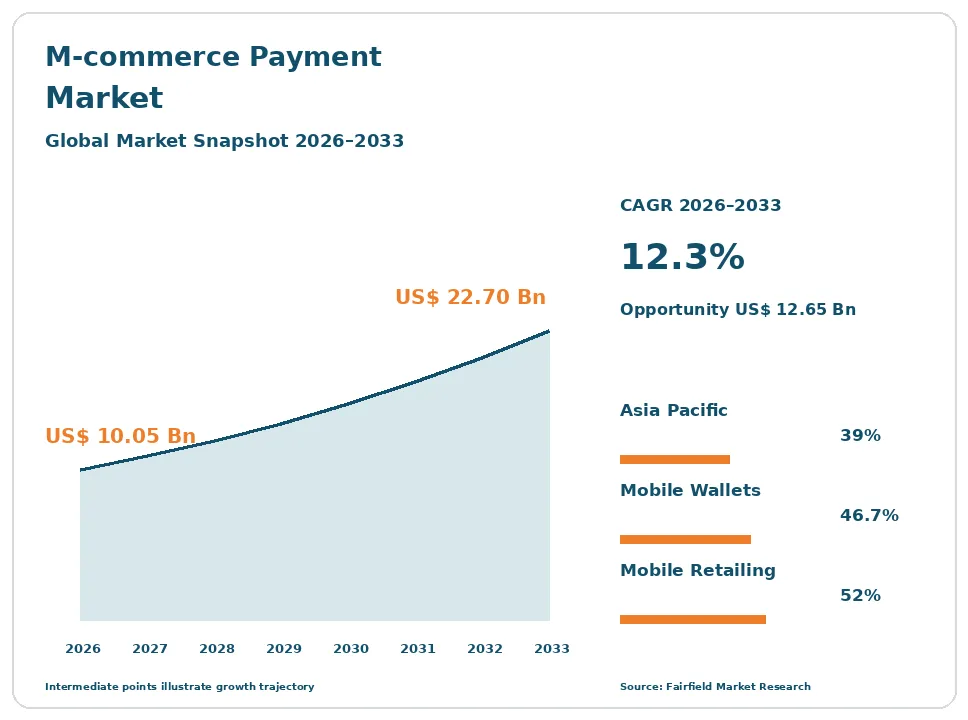
The global m-commerce payment market size is expected to be valued at US$ 10.05 billion in 2026 and projected to reach US$ 22.70 billion by 2033, growing at a CAGR of 12.3% between 2026 and 2033.
Between 2020 and 2025, the market grew at a CAGR of about 14.5%, as pandemic lockdowns pushed shoppers onto smartphones, contactless payments replaced cash in stores, and real-time payment systems spread across emerging economies. M-commerce payments are payments made with a smartphone or other mobile device, through mobile wallets, in-app checkout, QR codes, near field communication taps, carrier billing, and account-to-account transfers. This market measures the revenue earned by wallet providers, payment processors, and technology vendors from these transactions and services. Mobile payment solutions now cover online shopping, ride-hailing, food delivery, ticketing, bill payment, and person-to-person transfers. Growth comes from smartphone adoption, real-time payment rails, digital commerce, and merchant demand for low-cost acceptance. The market is shifting toward super apps, biometric checkout, and embedded finance. In August 2026, India’s Unified Payments Interface processed 24.5 billion transactions in a single month.
Key Report Takeaways
- By Payment Type: Mobile Wallets held 46.7% share in 2026, while QR Code & Account-to-Account Payments are projected to expand at a 15.2% CAGR through 2033, driven by real-time payment systems, low merchant fees, and rapid adoption by small merchants in emerging markets.
- By Mode of Transaction: Mobile Retailing held 52.0% share in 2026, while Mobile Ticketing & Booking is projected to expand at a 13.9% CAGR through 2033, driven by travel, events, and transit apps that rely on fast, secure in-app checkout.
- By End Use: Retail held 39.0% share in 2026, while Hospitality & Tourism is projected to expand at a 13.6% CAGR through 2033, driven by mobile hotel booking, digital room keys, contactless dining payments, and cross-border tourist wallets.
- By Region: Asia Pacific held 39.0% share in 2026, while India is projected to expand at a 15.8% CAGR through 2033, driven by the scale of Unified Payments Interface adoption, low-cost smartphones, and new wallet entrants.
Global M-commerce Payment Market Trends and Insights
Drivers Impact Analysis
| Driver | Impact on CAGR Forecast | Geographic Relevance | Impact Timeline |
| Smartphone adoption and mobile-first commerce | High | Global | Long term (≥4 years) |
| Real-time payment systems and government cashless policies | High | Asia Pacific, Latin America | Medium term (2-4 years) |
Two drivers carry the strongest influence on m-commerce payment demand during the forecast period.
Mobile-First Commerce Is Driving the M-commerce Payment Market
Smartphone adoption and mobile-first commerce are the strongest driver of the m-commerce payment market. Shopping has moved to phones.
The mechanism is the shift of daily spending into apps. Billions of people now own smartphones, and for many in Asia Pacific, Latin America, and Middle East & Africa, the phone is their first and main internet device. Retailers, marketplaces, and delivery platforms design their apps for one-tap checkout with stored cards or wallets. Social commerce and live-stream shopping let buyers pay without leaving the app. Apple Pay was available in 89 markets as of January 2026, and Google Wallet and Samsung Wallet are widely used. Merchants benefit from higher conversion and lower fraud with tokenized payments and biometrics. These habits make mobile payment solutions the default way to pay for a growing share of commerce.
Real-Time Payments Are Expanding the M-commerce Payment Market
Real-time payment systems and government cashless policies are expanding the m-commerce payment market. Public payment rails make mobile payments cheap and instant.
The cause is government investment in national payment infrastructure. India’s Unified Payments Interface handles most of the country’s digital payment volume, and Brazil’s Pix has become one of the most popular ways to pay. Banco Central do Brasil launched Pix Automático for recurring payments in June 2025. Similar systems are growing in Indonesia, Thailand, Malaysia, Mexico, and Colombia. Low or zero merchant fees encourage small shops to accept QR payments. Street vendors, taxis, and small shops that never accepted cards now take mobile payments. Governments also use these systems to pay benefits directly to citizens’ phones. These rails rapidly expand mobile payment use and bring millions of new users online.
Restraints Impact Analysis
| Restraint | Impact on CAGR Forecast | Geographic Relevance | Impact Timeline |
| Fraud, cybersecurity, and data privacy risks | High | Global | Long term (≥4 years) |
| Low fees and regulatory pressure on payment revenue | Medium | Asia Pacific, Europe, Latin America | Medium term (2-4 years) |
Two restraints limit how quickly the m-commerce payment market grows.
Security Risks Slow the M-commerce Payment Market
Fraud, cybersecurity, and data privacy risks slow the m-commerce payment market. Mobile payments attract scammers.
The specific causes are fast, irreversible transfers and social engineering. Real-time payments settle in seconds, so criminals use phishing, fake apps, account takeovers, and authorized push payment scams to trick users into sending money. Older users and first-time digital users are especially vulnerable to these scams. Data breaches at merchants and apps expose personal and financial information. Regulators require stronger authentication, which can add friction at checkout. Consumers who suffer fraud may return to cash or cards. Payment providers must invest heavily in AI-based fraud detection, device security, and customer education. Chargeback rules for mobile and real-time payments are still developing in many countries. These risks slow adoption and raise costs.
Fee Pressure Restricts the M-commerce Payment Market
Low fees and regulatory pressure on payment revenue restrict the m-commerce payment market. Many mobile payments earn little revenue.
The underlying causes are public policy and intense competition. India keeps merchant fees on most Unified Payments Interface transactions at zero, and Pix is free for individuals in Brazil, so wallet providers earn little or nothing per transaction and must find other ways to make money. Regulators in Europe cap card interchange fees and have pushed large platforms to open phone NFC chips to rival wallets. Antitrust cases against app store payment rules add uncertainty for platform owners. Market share caps for large wallets have been discussed in India. Competition among wallets, banks, and fintechs keeps fees low and raises marketing costs, as providers offer cashback to win users. These factors limit revenue growth even as transaction volumes soar.
Market Opportunities
Super Apps and Embedded Finance Open a Fast-Growth Revenue Pool
Super apps and embedded finance open a fast-growth revenue pool in the m-commerce payment market. Payments can lead to other paid services.
Wallet providers and fintechs can capture this opportunity. Super apps combine payments with shopping, ride-hailing, food delivery, bill payment, investing, insurance, and loans, building daily habits that keep users engaged. Buy now, pay later plans and small credit lines offered at checkout earn interest and merchant fees, and credit linked to real-time payment systems is expanding in India. Embedded payments inside software for retailers, restaurants, clinics, and gig platforms create new revenue streams for processors such as Stripe and Adyen. Loyalty programs, targeted offers, and advertising increase engagement and revenue. Companies that monetize payment data and relationships through lending, insurance, and merchant services can grow revenue faster than transaction volumes.
Cross-Border and Emerging Market Payments Create an Expansion Revenue Pool
Cross-border and emerging market payments create an expansion revenue pool in the m-commerce payment market. Mobile users increasingly travel and shop abroad.
Payment networks and wallets can capture this opportunity. Linking national real-time systems allows tourists and migrants to pay with their home apps abroad, and Unified Payments Interface links are expanding to partner countries. Chinese wallets already serve travelers in many destinations. Apple was reported in September 2026 to be preparing an Apple Pay launch in India, a sign that global wallets see room to grow in emerging markets. Remittances via mobile wallets are faster and cheaper than traditional transfers, which matters for migrant workers in the Middle East & Africa and Latin America. Companies that build interoperable, low-cost cross-border services can win high-margin volume.
Segment Analysis
By Payment Type: Mobile Wallets Lead While QR Code & Account-to-Account Payments Grow Fastest
Mobile Wallets held 46.7% share in 2026. Apple Pay, Google Wallet, Samsung Wallet, Alipay, WeChat Pay, PayPal, and PhonePe store cards, bank accounts, and balances for in-store, online, and in-app use. Wallets offer convenience, tokenized security, and loyalty features, making them the most common mobile payment method.
QR Code & Account-to-Account Payments are the fastest-growing payment type, expanding at a 15.2% CAGR through 2033. Scanning a QR code to pay directly from a bank account is cheap for merchants and easy for consumers, driving rapid adoption in India, Brazil, and other parts of Asia Pacific and Latin America. NFC contactless, in-app card payments, carrier billing, and peer-to-peer transfers form other types. For the market, account-to-account growth shifts value toward platforms and services.
By Mode of Transaction: Mobile Retailing Leads While Mobile Ticketing & Booking Grows Fastest
Mobile Retailing held 52.0% share in 2026. Shopping apps, online marketplaces, social commerce, quick-commerce delivery, and in-store mobile payments make up the largest share of mobile transactions. Large marketplaces in China, India, and North America process huge volumes during sales events, and retailers push app-only offers to build loyalty.
Mobile Ticketing & Booking is the fastest-growing mode, expanding at a 13.9% CAGR through 2033. Travel, airline, hotel, event, cinema, and transit apps rely on fast mobile checkout and digital tickets stored in wallets. Cities are adopting tap-to-ride transit payments with phones. Mobile banking and bill payment form other modes, with utility and telecom bills increasingly paid through apps. For the market, ticketing growth supports travel recovery and recurring use.
By End Use: Retail Leads While Hospitality & Tourism Grows Fastest
Retail held 39.0% share in 2026. Supermarkets, fashion, electronics, beauty, grocery delivery, and online marketplaces drive most mobile payment volume, both in stores and online. Small merchants accepting QR payments add very large numbers of everyday transactions.
Hospitality & Tourism is the fastest-growing end use, expanding at a 13.6% CAGR through 2033. Mobile hotel booking, digital room keys, contactless dining payments, and tourist wallets are rising as international travel grows. BFSI, media and entertainment, telecom, and healthcare form other end uses, with streaming subscriptions and digital content paid through apps. Hotels and restaurants also adopt pay-at-table and mobile ordering to reduce staff workload. For the market, hospitality growth adds cross-border volume and higher-value transactions.
Geography Analysis
Why Is North America Important to the M-commerce Payment Market?
North America is important because it hosts many of the world’s largest payment and technology companies, including Apple, Google, PayPal, Visa, Mastercard, Block, and Stripe, which set standards for wallets, tokenization, and in-app checkout used worldwide. The United States has high spending per user, strong in-app and subscription commerce, and growing contactless adoption at stores and transit systems. Venmo and Cash App dominate peer-to-peer payments, and the FedNow service supports instant bank transfers. Canada adds demand through wide contactless use. Key barriers include strong card habits and fraud concerns. One change shaping the region is the rollout of real-time payments.
Europe Expands the M-commerce Payment Market Through Open Banking
Europe is a major m-commerce payment market. The United Kingdom, Germany, the Netherlands, Sweden, and France lead, with very high contactless use and fast growth in phone payments. Open banking rules support account-to-account payments, and national schemes such as iDEAL and Swish are popular. Adyen, Klarna, and Worldline are key regional players, and rules now let rival wallets use iPhone NFC chips. The European Union is also developing a digital euro and instant payment rules that require banks to offer real-time transfers at no extra cost. Key barriers include interchange fee caps and fragmented national systems. One opportunity is open banking-based mobile checkout.
Which Region Is Leading the M-commerce Payment Market?
Asia Pacific is leading the m-commerce payment market with a 39.0% share in 2026. China is the world’s largest mobile payment market, led by Alipay and WeChat Pay, where QR payments are used almost everywhere. India is the fastest-growing country, expanding at a 15.8% CAGR through 2033, as Unified Payments Interface use soars and PhonePe and Google Pay handle most transactions. Indonesia, Japan, South Korea, and Australia add strong demand. Super apps such as GrabPay, GoPay, and PayPay dominate daily payments in their home countries. Key barriers include low fees and fraud. One change shaping the region is cross-border QR interoperability.
Latin America Grows the M-commerce Payment Market Through Pix and Wallets
Latin America is a growing m-commerce payment market. Brazil’s Pix has become one of the most used payment methods in the country, and Mercado Pago, Nubank, and PicPay are major mobile players. Mexico is expanding its CoDi and DiMo systems, and Colombia is launching a national instant payment system. Many adults who lacked bank accounts now use mobile wallets, and e-commerce growth in the region is among the fastest in the world. Merchants welcome lower costs than card payments, and digital banks are attracting millions of young customers. Key barriers include fraud and informal cash use. One opportunity is recurring payments through Pix Automático.
Middle East & Africa Develops the M-commerce Payment Market Through Mobile Money
Middle East & Africa is a developing m-commerce payment market. Kenya’s M-Pesa pioneered mobile money and is used by most adults, while mobile money is widespread in Ghana, Tanzania, and Uganda. Saudi Arabia and the United Arab Emirates are pushing cashless targets, with strong Apple Pay adoption and national instant payment systems. Nigeria has fast-growing fintech wallets such as OPay and Moniepoint, and Egypt is expanding its national instant payment network. Low-cost smartphones and agent networks help bring rural users online. Key barriers include connectivity gaps and regulatory differences. One change shaping the region is government cashless targets.
Competitive Landscape
The m-commerce payment market is moderately consolidated. Apple, Google, Ant Group (Alipay), Tencent (WeChat Pay), and PayPal are leading players, while Samsung, Visa, Mastercard, Block, Stripe, Adyen, and PhonePe compete strongly. Banks, national payment systems, and local fintechs are powerful in many countries, and super apps such as Grab, Mercado Libre, and Paytm combine payments with commerce. Telecom operators run large mobile money services in parts of Middle East & Africa.
Companies compete on user base, convenience, security, merchant acceptance, fees, and added services such as credit and rewards. Platform owners control phone hardware and app stores, while card networks provide tokenization and global acceptance. Local wallets win through integration with national real-time systems and everyday services. Regulation increasingly shapes competition by opening NFC access, capping fees, and setting market share rules. Partnerships between wallets, banks, and merchants are essential to win scale quickly.
Strategic moves show how competition is changing. In January 2024, Visa acquired Pismo to strengthen cloud payment processing. In June 2025, Brazil launched Pix Automático for recurring payments. In September 2026, Apple was reported to be preparing an Apple Pay launch in India. These moves show competition shifting toward emerging markets and account-based payments.
Three themes shape vendor strategy. First, companies are expanding into large emerging markets. Second, they are adding credit, rewards, and other financial services. Third, they are investing in AI to fight fraud.
M-commerce Payment Market Industry Leaders
- Apple
- Ant Group (Alipay)
- Tencent (WeChat Pay)
- PayPal
Recent Industry Developments
- September 2026: Apple was reported to be preparing to launch Apple Pay in India, starting with Axis Bank cards, as Unified Payments Interface processed 24.5 billion transactions in August 2026 - signals rising competition among mobile wallets in India.
- June 2025: Banco Central do Brasil launched Pix Automático, enabling recurring payments through Pix - expands m-commerce payments for subscriptions and bills in Brazil.
- January 2024: Visa acquired Pismo, a Brazil-based cloud banking and payments platform, for about US$ 1 billion - strengthens mobile payment solutions and issuer processing.
Companies Covered in the Report
- Apple
- Ant Group (Alipay)
- Tencent (WeChat Pay)
- PayPal
- Samsung
- Visa
- Mastercard
- Block
- Stripe
- Adyen
- PhonePe
M-commerce Payment Market Report Scope
This report covers m-commerce payments, including mobile wallets, QR code and account-to-account payments, NFC contactless, in-app card payments, carrier billing, and peer-to-peer transfers, across mobile retailing, ticketing and booking, banking, and billing, for retail, hospitality, BFSI, media, telecom, healthcare, and other end uses. The base year is 2025, and the forecast period runs from 2026 to 2033. All values are expressed in US$ Billion.
Payment Type
- Mobile Wallets
- QR Code & Account-to-Account Payments
- NFC Contactless
- In-App Card Payments
- Carrier Billing
Mode of Transaction
- Mobile Retailing
- Mobile Ticketing & Booking
- Mobile Banking
- Mobile Billing
End Use
- Retail
- Hospitality & Tourism
- BFSI
- Media & Entertainment
- IT & Telecom
- Healthcare
- Others
Regions
- North America
- Europe
- Asia Pacific
- Latin America
- Middle East & Africa
Key Questions Answered in the Report
How big is the m-commerce payment market in 2026?
The m-commerce payment market is valued at US$ 10.05 billion in 2026, led by mobile wallets and Asia Pacific.
What is the m-commerce payment market forecast to 2033?
The market is projected to reach US$ 22.70 billion by 2033, growing at a 12.3% CAGR and adding US$ 12.65 billion.
Which payment type is growing fastest in the m-commerce payment market?
QR code and account-to-account payments are growing fastest at a 15.2% CAGR through 2033, driven by real-time payment systems.
Which country is growing fastest in the m-commerce payment market?
India is growing fastest at a 15.8% CAGR through 2033, driven by Unified Payments Interface adoption and low-cost smartphones.
Which region holds the largest m-commerce payment market share?
Asia Pacific holds the largest share at 39.0% in 2026, supported by Alipay, WeChat Pay, and India’s real-time payment system.
1. Executive Summary
1.1. Global M-commerce Payment Market Snapshot
1.2. Future Projections, 2026-2033
1.3. Key Market Trends
1.4. Regional Snapshot
2. Market Overview
2.1. Market Definition and Report Scope
2.2. Historical Market Trends, 2020-2025
2.3. Market Dynamics
2.3.1. Drivers Impact Analysis
2.3.1.1. Mobile-First Commerce Is Driving the M-commerce Payment Market
2.3.1.2. Real-Time Payments Are Expanding the M-commerce Payment Market
2.3.2. Restraints Impact Analysis
2.3.2.1. Security Risks Slow the M-commerce Payment Market
2.3.2.2. Fee Pressure Restricts the M-commerce Payment Market
2.3.3. Market Opportunities
2.3.3.1. Super Apps and Embedded Finance Open a Fast-Growth Revenue Pool
2.3.3.2. Cross-Border and Emerging Market Payments Create an Expansion Revenue Pool
3. Global M-commerce Payment Market Outlook, 2020-2033
3.1. Global M-commerce Payment Market Outlook, by Payment Type, Value (US$ Billion), 2020-2033
3.1.1. Mobile Wallets
3.1.2. QR Code & Account-to-Account Payments
3.1.3. NFC Contactless
3.1.4. In-App Card Payments
3.1.5. Carrier Billing
3.2. Global M-commerce Payment Market Outlook, by Mode of Transaction, Value (US$ Billion), 2020-2033
3.2.1. Mobile Retailing
3.2.2. Mobile Ticketing & Booking
3.2.3. Mobile Banking
3.2.4. Mobile Billing
3.3. Global M-commerce Payment Market Outlook, by End Use, Value (US$ Billion), 2020-2033
3.3.1. Retail
3.3.2. Hospitality & Tourism
3.3.3. BFSI
3.3.4. Media & Entertainment
3.3.5. IT & Telecom
3.3.6. Healthcare
3.3.7. Others
3.4. Global M-commerce Payment Market Outlook, by Region, Value (US$ Billion), 2020-2033
3.4.1. North America
3.4.2. Europe
3.4.3. Asia Pacific
3.4.4. Latin America
3.4.5. Middle East & Africa
4. North America M-commerce Payment Market Outlook, 2020-2033
4.1. North America M-commerce Payment Market Outlook, by Payment Type, Value (US$ Billion), 2020-2033
4.1.1. Mobile Wallets
4.1.2. QR Code & Account-to-Account Payments
4.1.3. NFC Contactless
4.1.4. In-App Card Payments
4.1.5. Carrier Billing
4.2. North America M-commerce Payment Market Outlook, by Mode of Transaction, Value (US$ Billion), 2020-2033
4.2.1. Mobile Retailing
4.2.2. Mobile Ticketing & Booking
4.2.3. Mobile Banking
4.2.4. Mobile Billing
4.3. North America M-commerce Payment Market Outlook, by End Use, Value (US$ Billion), 2020-2033
4.3.1. Retail
4.3.2. Hospitality & Tourism
4.3.3. BFSI
4.3.4. Media & Entertainment
4.3.5. IT & Telecom
4.3.6. Healthcare
4.3.7. Others
4.4. North America M-commerce Payment Market Outlook, by Country, Value (US$ Billion), 2020-2033
4.4.1. United States M-commerce Payment Market Outlook, by Payment Type, 2020-2033
4.4.2. United States M-commerce Payment Market Outlook, by Mode of Transaction, 2020-2033
4.4.3. United States M-commerce Payment Market Outlook, by End Use, 2020-2033
4.4.4. Canada M-commerce Payment Market Outlook, by Payment Type, 2020-2033
4.4.5. Canada M-commerce Payment Market Outlook, by Mode of Transaction, 2020-2033
4.4.6. Canada M-commerce Payment Market Outlook, by End Use, 2020-2033
5. Europe M-commerce Payment Market Outlook, 2020-2033
5.1. Europe M-commerce Payment Market Outlook, by Payment Type, Value (US$ Billion), 2020-2033
5.1.1. Mobile Wallets
5.1.2. QR Code & Account-to-Account Payments
5.1.3. NFC Contactless
5.1.4. In-App Card Payments
5.1.5. Carrier Billing
5.2. Europe M-commerce Payment Market Outlook, by Mode of Transaction, Value (US$ Billion), 2020-2033
5.2.1. Mobile Retailing
5.2.2. Mobile Ticketing & Booking
5.2.3. Mobile Banking
5.2.4. Mobile Billing
5.3. Europe M-commerce Payment Market Outlook, by End Use, Value (US$ Billion), 2020-2033
5.3.1. Retail
5.3.2. Hospitality & Tourism
5.3.3. BFSI
5.3.4. Media & Entertainment
5.3.5. IT & Telecom
5.3.6. Healthcare
5.3.7. Others
5.4. Europe M-commerce Payment Market Outlook, by Country, Value (US$ Billion), 2020-2033
5.4.1. United Kingdom M-commerce Payment Market Outlook, by Payment Type, 2020-2033
5.4.2. United Kingdom M-commerce Payment Market Outlook, by Mode of Transaction, 2020-2033
5.4.3. United Kingdom M-commerce Payment Market Outlook, by End Use, 2020-2033
5.4.4. Germany M-commerce Payment Market Outlook, by Payment Type, 2020-2033
5.4.5. Germany M-commerce Payment Market Outlook, by Mode of Transaction, 2020-2033
5.4.6. Germany M-commerce Payment Market Outlook, by End Use, 2020-2033
5.4.7. Netherlands M-commerce Payment Market Outlook, by Payment Type, 2020-2033
5.4.8. Netherlands M-commerce Payment Market Outlook, by Mode of Transaction, 2020-2033
5.4.9. Netherlands M-commerce Payment Market Outlook, by End Use, 2020-2033
5.4.10. Sweden M-commerce Payment Market Outlook, by Payment Type, 2020-2033
5.4.11. Sweden M-commerce Payment Market Outlook, by Mode of Transaction, 2020-2033
5.4.12. Sweden M-commerce Payment Market Outlook, by End Use, 2020-2033
5.4.13. France M-commerce Payment Market Outlook, by Payment Type, 2020-2033
5.4.14. France M-commerce Payment Market Outlook, by Mode of Transaction, 2020-2033
5.4.15. France M-commerce Payment Market Outlook, by End Use, 2020-2033
6. Asia Pacific M-commerce Payment Market Outlook, 2020-2033
6.1. Asia Pacific M-commerce Payment Market Outlook, by Payment Type, Value (US$ Billion), 2020-2033
6.1.1. Mobile Wallets
6.1.2. QR Code & Account-to-Account Payments
6.1.3. NFC Contactless
6.1.4. In-App Card Payments
6.1.5. Carrier Billing
6.2. Asia Pacific M-commerce Payment Market Outlook, by Mode of Transaction, Value (US$ Billion), 2020-2033
6.2.1. Mobile Retailing
6.2.2. Mobile Ticketing & Booking
6.2.3. Mobile Banking
6.2.4. Mobile Billing
6.3. Asia Pacific M-commerce Payment Market Outlook, by End Use, Value (US$ Billion), 2020-2033
6.3.1. Retail
6.3.2. Hospitality & Tourism
6.3.3. BFSI
6.3.4. Media & Entertainment
6.3.5. IT & Telecom
6.3.6. Healthcare
6.3.7. Others
6.4. Asia Pacific M-commerce Payment Market Outlook, by Country, Value (US$ Billion), 2020-2033
6.4.1. China M-commerce Payment Market Outlook, by Payment Type, 2020-2033
6.4.2. China M-commerce Payment Market Outlook, by Mode of Transaction, 2020-2033
6.4.3. China M-commerce Payment Market Outlook, by End Use, 2020-2033
6.4.4. India M-commerce Payment Market Outlook, by Payment Type, 2020-2033
6.4.5. India M-commerce Payment Market Outlook, by Mode of Transaction, 2020-2033
6.4.6. India M-commerce Payment Market Outlook, by End Use, 2020-2033
6.4.7. Indonesia M-commerce Payment Market Outlook, by Payment Type, 2020-2033
6.4.8. Indonesia M-commerce Payment Market Outlook, by Mode of Transaction, 2020-2033
6.4.9. Indonesia M-commerce Payment Market Outlook, by End Use, 2020-2033
6.4.10. Japan M-commerce Payment Market Outlook, by Payment Type, 2020-2033
6.4.11. Japan M-commerce Payment Market Outlook, by Mode of Transaction, 2020-2033
6.4.12. Japan M-commerce Payment Market Outlook, by End Use, 2020-2033
6.4.13. South Korea M-commerce Payment Market Outlook, by Payment Type, 2020-2033
6.4.14. South Korea M-commerce Payment Market Outlook, by Mode of Transaction, 2020-2033
6.4.15. South Korea M-commerce Payment Market Outlook, by End Use, 2020-2033
6.4.16. Australia M-commerce Payment Market Outlook, by Payment Type, 2020-2033
6.4.17. Australia M-commerce Payment Market Outlook, by Mode of Transaction, 2020-2033
6.4.18. Australia M-commerce Payment Market Outlook, by End Use, 2020-2033
7. Latin America M-commerce Payment Market Outlook, 2020-2033
7.1. Latin America M-commerce Payment Market Outlook, by Payment Type, Value (US$ Billion), 2020-2033
7.1.1. Mobile Wallets
7.1.2. QR Code & Account-to-Account Payments
7.1.3. NFC Contactless
7.1.4. In-App Card Payments
7.1.5. Carrier Billing
7.2. Latin America M-commerce Payment Market Outlook, by Mode of Transaction, Value (US$ Billion), 2020-2033
7.2.1. Mobile Retailing
7.2.2. Mobile Ticketing & Booking
7.2.3. Mobile Banking
7.2.4. Mobile Billing
7.3. Latin America M-commerce Payment Market Outlook, by End Use, Value (US$ Billion), 2020-2033
7.3.1. Retail
7.3.2. Hospitality & Tourism
7.3.3. BFSI
7.3.4. Media & Entertainment
7.3.5. IT & Telecom
7.3.6. Healthcare
7.3.7. Others
7.4. Latin America M-commerce Payment Market Outlook, by Country, Value (US$ Billion), 2020-2033
7.4.1. Brazil M-commerce Payment Market Outlook, by Payment Type, 2020-2033
7.4.2. Brazil M-commerce Payment Market Outlook, by Mode of Transaction, 2020-2033
7.4.3. Brazil M-commerce Payment Market Outlook, by End Use, 2020-2033
7.4.4. Mexico M-commerce Payment Market Outlook, by Payment Type, 2020-2033
7.4.5. Mexico M-commerce Payment Market Outlook, by Mode of Transaction, 2020-2033
7.4.6. Mexico M-commerce Payment Market Outlook, by End Use, 2020-2033
7.4.7. Colombia M-commerce Payment Market Outlook, by Payment Type, 2020-2033
7.4.8. Colombia M-commerce Payment Market Outlook, by Mode of Transaction, 2020-2033
7.4.9. Colombia M-commerce Payment Market Outlook, by End Use, 2020-2033
8. Middle East & Africa M-commerce Payment Market Outlook, 2020-2033
8.1. Middle East & Africa M-commerce Payment Market Outlook, by Payment Type, Value (US$ Billion), 2020-2033
8.1.1. Mobile Wallets
8.1.2. QR Code & Account-to-Account Payments
8.1.3. NFC Contactless
8.1.4. In-App Card Payments
8.1.5. Carrier Billing
8.2. Middle East & Africa M-commerce Payment Market Outlook, by Mode of Transaction, Value (US$ Billion), 2020-2033
8.2.1. Mobile Retailing
8.2.2. Mobile Ticketing & Booking
8.2.3. Mobile Banking
8.2.4. Mobile Billing
8.3. Middle East & Africa M-commerce Payment Market Outlook, by End Use, Value (US$ Billion), 2020-2033
8.3.1. Retail
8.3.2. Hospitality & Tourism
8.3.3. BFSI
8.3.4. Media & Entertainment
8.3.5. IT & Telecom
8.3.6. Healthcare
8.3.7. Others
8.4. Middle East & Africa M-commerce Payment Market Outlook, by Country, Value (US$ Billion), 2020-2033
8.4.1. Kenya M-commerce Payment Market Outlook, by Payment Type, 2020-2033
8.4.2. Kenya M-commerce Payment Market Outlook, by Mode of Transaction, 2020-2033
8.4.3. Kenya M-commerce Payment Market Outlook, by End Use, 2020-2033
8.4.4. Ghana M-commerce Payment Market Outlook, by Payment Type, 2020-2033
8.4.5. Ghana M-commerce Payment Market Outlook, by Mode of Transaction, 2020-2033
8.4.6. Ghana M-commerce Payment Market Outlook, by End Use, 2020-2033
8.4.7. Tanzania M-commerce Payment Market Outlook, by Payment Type, 2020-2033
8.4.8. Tanzania M-commerce Payment Market Outlook, by Mode of Transaction, 2020-2033
8.4.9. Tanzania M-commerce Payment Market Outlook, by End Use, 2020-2033
8.4.10. Uganda M-commerce Payment Market Outlook, by Payment Type, 2020-2033
8.4.11. Uganda M-commerce Payment Market Outlook, by Mode of Transaction, 2020-2033
8.4.12. Uganda M-commerce Payment Market Outlook, by End Use, 2020-2033
8.4.13. Saudi Arabia M-commerce Payment Market Outlook, by Payment Type, 2020-2033
8.4.14. Saudi Arabia M-commerce Payment Market Outlook, by Mode of Transaction, 2020-2033
8.4.15. Saudi Arabia M-commerce Payment Market Outlook, by End Use, 2020-2033
8.4.16. United Arab Emirates M-commerce Payment Market Outlook, by Payment Type, 2020-2033
8.4.17. United Arab Emirates M-commerce Payment Market Outlook, by Mode of Transaction, 2020-2033
8.4.18. United Arab Emirates M-commerce Payment Market Outlook, by End Use, 2020-2033
8.4.19. Nigeria M-commerce Payment Market Outlook, by Payment Type, 2020-2033
8.4.20. Nigeria M-commerce Payment Market Outlook, by Mode of Transaction, 2020-2033
8.4.21. Nigeria M-commerce Payment Market Outlook, by End Use, 2020-2033
8.4.22. Egypt M-commerce Payment Market Outlook, by Payment Type, 2020-2033
8.4.23. Egypt M-commerce Payment Market Outlook, by Mode of Transaction, 2020-2033
8.4.24. Egypt M-commerce Payment Market Outlook, by End Use, 2020-2033
9. Competitive Landscape
9.1. Market Concentration and Industry Leaders
9.2. Competitive Differentiation
9.3. Strategic Initiatives
9.4. Recent Industry Developments
9.5. Company Profiles
9.5.1. Apple
9.5.2. Google
9.5.3. Ant Group (Alipay)
9.5.4. Tencent (WeChat Pay)
9.5.5. PayPal
9.5.6. Samsung
9.5.7. Visa
9.5.8. Mastercard
9.5.9. Block
9.5.10. Stripe
9.5.11. Adyen
9.5.12. PhonePe
10. Appendix
10.1. Research Methodology
10.2. Report Assumptions
10.3. Acronyms and Abbreviations
| Payment Type | Mobile Wallets, QR Code & Account-to-Account Payments, NFC Contactless, In-App Card Payments, Carrier Billing |
| Mode of Transaction | Mobile Retailing, Mobile Ticketing & Booking, Mobile Banking, Mobile Billing |
| End Use | Retail, Hospitality & Tourism, BFSI, Media & Entertainment, IT & Telecom, Healthcare, Others |
| Regions | North America, Europe, Asia Pacific, Latin America, Middle East & Africa |
Our Research Methodology
Considering the volatility of business today, traditional approaches to strategizing a game plan can be unfruitful if not detrimental. True ambiguity is no way to determine a forecast. A myriad of predetermined factors must be accounted for such as the degree of risk involved, the magnitude of circumstances, as well as conditions or consequences that are not known or unpredictable. To circumvent binary views that cast uncertainty, the application of market research intelligence to strategically posture, move, and enable actionable outcomes is necessary.
View Methodology
Quality Assured
Rigorous Validation Process

Confidentiality Assured
End-to-end Data Security

Custom Research Services
Tailored To Your Objectives
FAQs
The m-commerce payment market is valued at US$ 10.05 billion in 2026, led by mobile wallets and Asia Pacific.
The market is projected to reach US$ 22.70 billion by 2033, growing at a 12.3% CAGR and adding US$ 12.65 billion.
QR code and account-to-account payments are growing fastest at a 15.2% CAGR through 2033, driven by real-time payment systems.
India is growing fastest at a 15.8% CAGR through 2033, driven by Unified Payments Interface adoption and low-cost smartphones.
Asia Pacific holds the largest share at 39.0% in 2026, supported by Alipay, WeChat Pay, and India’s real-time payment system.
Related Reports
Multi-Access Edge Computing Market Size, Share, Insights, Competitive Landscape, and Forecast 2026 to 2033
Explore the multi-access edge computing market, valued at US$ 4.2 billion in 2026 and projected to reach US$ 9.8 billion by 2033 at a 12.9% CAGR.
Irrigation Automation Market Size, Share, Insights, Competitive Landscape, and Forecast 2026 to 2033
Irrigation automation market to grow from US$ 6.2 billion in 2026 to US$ 18.5 billion by 2033 at a 16.9% CAGR. Explore components, end users and regional trends.
Underwater LiDAR Market Size, Share, Insights, Competitive Landscape, and Forecast 2026 to 2033
Explore the underwater LiDAR market, projected to reach US$0.9 billion by 2033 at 12.3% CAGR, with platform, application and regional insights.
Aerial Imaging Market Size, Share, Insights, Competitive Landscape, and Forecast 2026 to 2033
The global aerial imaging market is valued at US$3.83 billion in 2026, reaching US$8.13 billion by 2033, growing at an 11.4% CAGR
Satcom Terminal Market Size, Share, Insights, Competitive Landscape, and Forecast 2026 to 2033
The satcom terminal market is projected to grow from US$8.6 billion in 2026 to US$20.6 billion by 2033, at a 13.3% CAGR. Explore segments and key trends.
Non-Dispersive Infrared Market Size, Share, Insights, Competitive Landscape, and Forecast 2026 to 2033
The non-dispersive infrared market is projected to grow from US$1.6 billion in 2026 to US$2.7 billion by 2033, at a 7.8% CAGR. Explore segments and trends.