



Aseptic Filling Machine Market
Aseptic Filling Machine Market Size, Share, Insights, Competitive Landscape, and Forecast 2026 to 2033
Aseptic Filling Machine Market Analysis, 2026–2033
Aseptic Filling Machine Market
Aseptic Filling Machine Market Size, Share, Insights, Competitive Landscape, and Forecast 2026 to 2033
Aseptic Filling Machine Market Size and Trend Analysis
How Fast Is the Aseptic Filling Machine Market Growing?
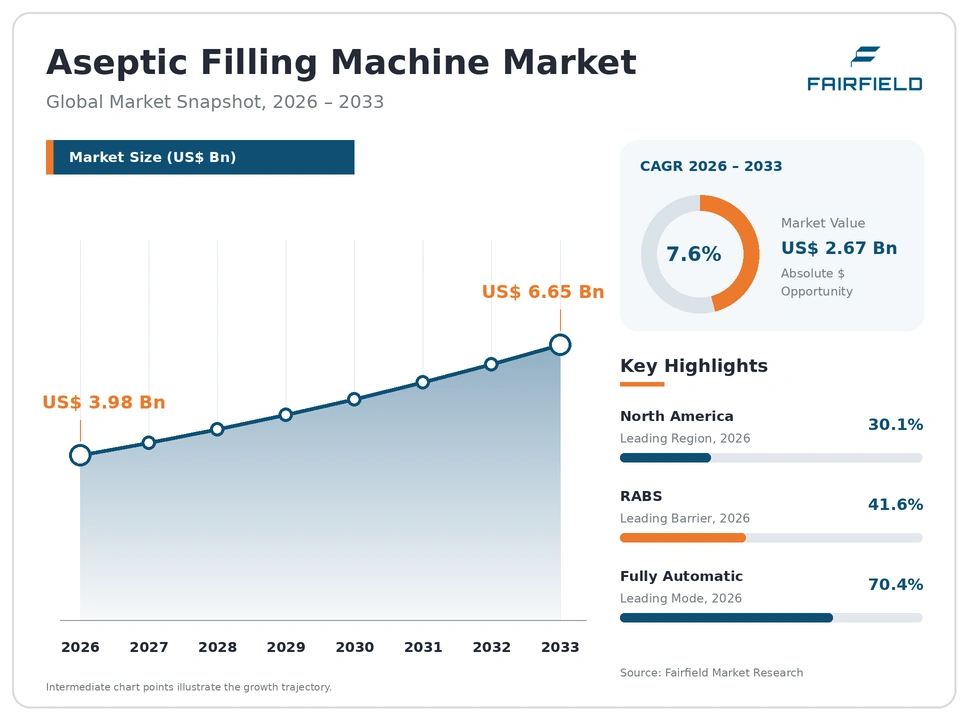
The global aseptic filling machine market size is expected to be valued at US$ 3.98 billion in 2026 and projected to reach US$ 6.65 billion by 2033, growing at a CAGR of 7.6% between 2026 and 2033.
Between 2020 and 2025, the market grew at a CAGR of about 6.3%, as COVID-19 vaccine production created urgent demand for fill-finish capacity, followed by investment in biologics and injectable drug plants. Three factors now drive growth: the rapid rise of injectable biologics and GLP-1 drugs, stricter sterility rules under the revised EU GMP Annex 1, and a shift toward pre-filled syringes and cartridges. The market is moving from open cleanrooms and restricted access barrier systems toward isolator technology, robotics, gloveless lines, and flexible machines that handle small batches of personalized and high-value drugs.
Key Report Takeaways
- By Machine Type: Vials held 29.8% share in 2026, while Pre-filled Syringes are projected to expand at a 9.2% CAGR through 2033, driven by self-injection, biologics, and GLP-1 pens and syringes.
- By Barrier Technology: Restricted Access Barrier Systems held 41.6% share in 2026, while Isolators are projected to expand at a 10.3% CAGR through 2033, driven by Annex 1 contamination control requirements.
- By Mode of Operation: Fully Automatic held 70.4% share in 2026 and is projected to expand at a 8.4% CAGR through 2033, driven by robotics, high-speed lines, and reduced human intervention.
- By Region: North America held 30.1% share in 2026, while Asia Pacific is projected to expand at a 9.6% CAGR through 2033, driven by biologics and vaccine plants in China, India, and South Korea.
Global Aseptic Filling Machine Market Trends and Insights
Drivers Impact Analysis
Two drivers carry the strongest influence on aseptic filling machine demand during the forecast period.
| Driver | Impact on CAGR Forecast | Geographic Relevance | Impact Timeline |
| Growth of injectable biologics and GLP-1 drugs | High | North America, Europe, Asia Pacific | Medium term (2-4 years) |
| Stricter sterility rules under EU GMP Annex 1 | High | Europe, North America, Asia Pacific | Short term (≤2 years) |
Injectable Biologics and GLP-1 Drugs Are Driving the Aseptic Filling Machine Market
The growth of injectable biologics and GLP-1 drugs is the strongest driver of the aseptic filling machine market. These drugs cannot be sterilized after filling, so they must be filled under aseptic conditions.
The mechanism is rising injectable volumes and new production capacity. Monoclonal antibodies, vaccines, insulin, and cell and gene therapies are given by injection. Demand for GLP-1 drugs such as semaglutide and tirzepatide for diabetes and obesity has surged, and Novo Nordisk and Eli Lilly have invested billions of dollars in new fill-finish plants for pens and cartridges. Biosimilar makers in India, South Korea, and China are adding injectable lines. Contract manufacturers are expanding sterile capacity to serve biotech clients. Pharmaceutical companies are building new plants in the United States in response to tariff policies. Each new plant needs aseptic filling machines, isolators, and inspection systems.
Annex 1 Sterility Rules Are Expanding the Aseptic Filling Machine Market
Stricter sterility rules under the revised EU GMP Annex 1 are expanding the aseptic filling machine market. Regulators now expect manufacturers to minimize human contact with sterile products.
The cause is a new focus on contamination control. The revised Annex 1, which took full effect in 2023 and 2024, requires a contamination control strategy and favors closed systems such as isolators and restricted access barrier systems. People are the main source of contamination in cleanrooms, so manufacturers are adopting robotics and gloveless designs. The U.S. Food and Drug Administration and other regulators share similar expectations. Many older filling lines in Europe and North America must be upgraded or replaced to comply. Syntegon launched its gloveless SynTiso fill-finish line in November 2025 to meet these needs. These rules drive replacement demand alongside new capacity.
Restraints Impact Analysis
Two restraints limit how quickly the aseptic filling machine market grows.
| Restraint | Impact on CAGR Forecast | Geographic Relevance | Impact Timeline |
| High capital costs and long lead times | High | Global | Short term (≤2 years) |
| Complex validation and skilled labor shortages | Medium | North America, Europe, Asia Pacific | Medium term (2-4 years) |
High Capital Costs Slow the Aseptic Filling Machine Market
High capital costs and long lead times slow the aseptic filling machine market. Aseptic filling lines are among the most expensive equipment in pharmaceutical manufacturing.
The specific causes are complex engineering and custom designs. A complete isolator-based filling line with washing, sterilization, filling, closing, and inspection can cost tens of millions of dollars. Lines are often customized for specific containers and products, making them hard to reuse. Delivery and installation can take one to two years, and strong demand has stretched supplier lead times. Small biotech companies and contract manufacturers may lack the capital for new lines. Higher interest rates have raised financing costs for new plants. Currency swings can also raise the cost of imported European machines in Asia Pacific and Latin America. These factors delay some investments and push companies to share capacity through contract manufacturers.
Validation and Skill Shortages Restrict the Aseptic Filling Machine Market
Complex validation and skilled labor shortages restrict the aseptic filling machine market. Installing a filling line is only the first step before it can produce medicines.
The underlying causes are strict qualification requirements and limited expertise. Each line must undergo installation, operational, and performance qualification, media fill tests, and regulatory inspection before commercial use. This process can take many months. Operators, engineers, and quality staff with aseptic experience are in short supply. Isolator decontamination cycles and continuous environmental monitoring add complexity. Changes to machines or processes may require revalidation. Regulatory inspection findings can halt production and delay launches. Suppliers increasingly offer validation packages and digital documentation to shorten this phase. These factors slow the speed at which new capacity becomes productive and raise the total cost of ownership for manufacturers.
Market Opportunities
Flexible Robotic Lines for Personalized and Small-batch Drugs Open a High-value Revenue Pool
Flexible robotic lines for personalized and small-batch drugs open a high-value revenue pool in the aseptic filling machine market. Cell and gene therapies, orphan drugs, and clinical trial supplies need small, flexible batches.
Machine makers offering compact robotic isolators can capture this opportunity. These systems handle nested vials, syringes, and cartridges in ready-to-use formats, allowing quick changeovers between products. Robots work inside isolators without human intervention, improving sterility. Vanrx Pharmasystems, part of Cytiva, and Groninger offer gloveless robotic systems. Syntegon’s SynTiso line extends this concept to high-speed production. Contract manufacturers value flexible lines that serve many clients. Digital monitoring and automated documentation reduce batch release times. These systems command premium prices, support personalized medicine growth, and help contract manufacturers serve many clients efficiently.
Aftermarket Services and Line Upgrades Create a Recurring Revenue Pool
Aftermarket services and line upgrades create a recurring revenue pool in the aseptic filling machine market. The large installed base of filling machines needs maintenance, spare parts, and modernization.
Established machine makers can capture this opportunity. Syntegon has about 72,000 installed systems worldwide, creating major service potential. Many older lines need upgrades to meet Annex 1, such as adding barrier systems, automated environmental monitoring, and single-use product paths. Service contracts, remote monitoring, and predictive maintenance improve uptime. Training and validation support help customers pass regulatory inspections. Format parts for new container types add steady sales. Investors see service revenue as stable and high-margin, as shown by Apollo’s purchase of a 37% stake in Syntegon in 2026. Service growth reduces dependence on cyclical new equipment orders.
Segment Analysis
By Machine Type: Vials Lead While Pre-filled Syringes Grow Fastest
Vials held 29.8% share in 2026. Vials are the most common container for injectable drugs, vaccines, and freeze-dried products, and vial filling lines are used by almost all sterile manufacturers. Syntegon, IMA Group, and Bausch+Ströbel supply high-speed vial lines. Bottles, ampoules, bags, and cartridges form other machine types.
Pre-filled Syringes are the fastest-growing machine type, expanding at a 9.2% CAGR through 2033. Pre-filled syringes offer accurate dosing, less drug waste, and easy self-injection, making them popular for biologics, vaccines, and GLP-1 drugs. Autoinjectors and pens use pre-filled syringes or cartridges. Nested ready-to-use syringes simplify filling, and Syntegon has launched machines for this format. For the market, syringe growth shifts demand toward nested container lines.
By Barrier Technology: Restricted Access Barrier Systems Lead While Isolators Grow Fastest
Restricted Access Barrier Systems held 41.6% share in 2026. Restricted access barrier systems separate operators from the filling zone with rigid walls and glove ports while allowing some access. They are widely installed in existing plants and cost less than isolators. Many manufacturers use them as an upgrade path for older cleanroom lines.
Isolators are the fastest-growing barrier technology, expanding at a 10.3% CAGR through 2033. Isolator technology fully encloses the filling zone and is decontaminated with hydrogen peroxide vapor, offering the highest level of sterility assurance. Annex 1 strongly favors isolators for new lines. Gloveless robotic isolators further reduce contamination risk. Conventional cleanroom lines form a declining segment. For the market, isolator growth raises the value of each line.
By Mode of Operation: Fully Automatic Leads and Grows Fastest
Fully Automatic held 70.4% share in 2026. Fully automatic lines handle container washing, sterilization, filling, stoppering, capping, and inspection with minimal human intervention. They offer high speeds, consistent quality, and lower contamination risk, making them standard for large-scale production of vaccines, biologics, and generics.
Fully automatic machines are also the fastest-growing mode, expanding at a 8.4% CAGR through 2033. Robotics, vision inspection, and digital controls are improving flexibility, allowing automatic lines to handle smaller batches. Annex 1 encourages reducing human intervention. Semi-automatic machines remain common for clinical supplies, research, and small manufacturers. Automatic in-line weight checks and camera inspection improve dose accuracy and product quality. For the market, automation growth raises investment per line and supports higher sterility standards.
Geography Analysis
Which Region Is Leading the Aseptic Filling Machine Market?
North America is leading the aseptic filling machine market with a 30.1% share in 2026. The United States has the largest biologics industry and many contract manufacturers such as Catalent, now part of Novo Holdings, and Thermo Fisher Scientific. Large investments in GLP-1 and biologics plants, partly driven by tariff policies, have increased demand for filling lines. Syntegon plans to expand its presence in the United States. Canada has growing vaccine production. Novo Nordisk and Eli Lilly are building large new injectable plants in North Carolina, Indiana, and other states. Strict FDA oversight of sterile manufacturing drives upgrades of older lines. One change shaping the region is onshoring of sterile manufacturing.
Europe Advances the Aseptic Filling Machine Market Through Machine Makers and Annex 1
Europe is a major aseptic filling machine market and home to most leading machine makers. Germany hosts Syntegon, Bausch+Ströbel, OPTIMA packaging group, and Groninger, while Italy hosts IMA Group and Marchesini Group. Denmark, Ireland, Switzerland, and Belgium have large biologics plants. France and the United Kingdom have large vaccine and biologics producers, including Sanofi and GSK. The revised EU GMP Annex 1 requires many older lines to add barrier systems, automated monitoring, and contamination control strategies. European makers also export most of their machines worldwide, giving them strong global service networks. High energy and labor costs encourage automation. One opportunity is line modernization of the large installed base.
Which Region Is Growing Fastest in the Aseptic Filling Machine Market?
Asia Pacific is growing fastest in the aseptic filling machine market at a 9.6% CAGR through 2033. China has a large biologics and vaccine industry and local machine makers such as Truking and Tofflon. India has major generic injectable and vaccine makers such as Serum Institute of India. South Korea hosts Samsung Biologics and Celltrion. Japan has strict sterility standards and local machine makers. Governments in China and India support vaccine self-sufficiency and biosimilar exports, which require lines that meet international standards. Singapore attracts biologics plants from global companies. One challenge is price competition from local machine makers. One opportunity is isolator lines for exporters that need U.S. and European approval.
Latin America Grows the Aseptic Filling Machine Market Through Vaccine Production
Latin America is a growing aseptic filling machine market. Brazil has vaccine producers such as Butantan Institute and Bio-Manguinhos, and Mexico and Argentina have injectable drug makers. The Pan American Health Organization supports regional production of mRNA and other vaccines, and governments seek to reduce reliance on imports after the pandemic. Colombia, Chile, and Argentina are also building vaccine capacity. Multinational drug makers operate large injectable plants in Brazil and Mexico that need upgrades. Key barriers include import costs, currency swings, and limited local engineering support. One opportunity is regional vaccine capacity built with technology transfer partners.
Middle East & Africa Builds the Aseptic Filling Machine Market Through New Plants
Middle East & Africa is an emerging aseptic filling machine market. Saudi Arabia and the United Arab Emirates are building pharmaceutical plants, and South Africa, Egypt, and Senegal are expanding vaccine fill-finish. The African Union aims to produce more of the continent’s vaccines locally, and partners such as BioNTech and Institut Pasteur de Dakar are building facilities. Morocco and Rwanda also have vaccine projects. The governments of Saudi Arabia and the United Arab Emirates support local manufacturing to improve drug security. Key barriers include limited trained staff, high costs, and reliance on imported equipment and services. One opportunity is vaccine supply for regional health programs.
Competitive Landscape
The aseptic filling machine market is moderately concentrated. Syntegon leads with about 12% share, and the top five players, including IMA Group, Bausch+Ströbel, and OPTIMA packaging group, hold about 42% combined. Groninger, Marchesini Group, Vanrx Pharmasystems, Truking, and Tofflon compete in specific segments.
Companies compete on sterility assurance, speed, flexibility, compliance support, lead times, and service networks. Machine makers also partner with isolator, robotics, and container suppliers to offer ready-to-use systems. Acquisitions help them add freeze-drying, inspection, and processing equipment. European makers lead in high-end lines, while Chinese makers such as Truking and Tofflon compete on price and are expanding exports to Asia Pacific, Latin America, and Middle East & Africa. Global service networks and validation support are key factors in winning large orders, since downtime is very costly for drug makers.
Strategic moves show how competition is changing. In June 2024, Syntegon agreed to acquire Telstar to add freeze-dryers and loading systems. In November 2025, Syntegon launched its gloveless SynTiso line. In March 2026, Apollo agreed to buy a 37% stake in Syntegon. These moves show competition shifting toward complete solutions that combine filling, freeze-drying, isolators, and services.
Three themes shape vendor strategy. First, companies are developing gloveless robotic lines for high-speed and small-batch production. Second, they are adding complementary equipment through targeted acquisitions. Third, they are growing services, upgrades, and digital tools for the installed base.
Aseptic Filling Machine Market Industry Leaders
- Syntegon
- IMA Group
- Bausch+Ströbel
- OPTIMA packaging group
- Groninger
Recent Industry Developments
- March 2026: Apollo-managed funds agreed to buy a 37% stake in Syntegon - supports US expansion and aftermarket services growth.
- November 2025: Syntegon launched SynTiso, a gloveless, fully automated, Annex 1-compliant fill-finish line - reduces human intervention in high-speed filling.
- June 2024: Syntegon agreed to acquire Telstar from Azbil - adds freeze-drying and loading systems to its filling portfolio.
Companies Covered in the Report
- Syntegon
- IMA Group
- Bausch+Ströbel
- OPTIMA packaging group
- Groninger
- Marchesini Group
- Vanrx Pharmasystems (Cytiva)
- Truking
- Tofflon
- Steriline
- Fedegari
- Aseptic Technologies
Aseptic Filling Machine Market Report Scope
This report covers aseptic filling machines, including vial, pre-filled syringe, cartridge, ampoule, bottle, and bag filling systems, with isolator, restricted access barrier system, and cleanroom designs, in fully automatic and semi-automatic modes, used for pharmaceuticals, biologics, vaccines, food and beverages, and cosmetics. It excludes non-sterile filling equipment and stand-alone inspection machines. The base year is 2025, and the forecast period runs from 2026 to 2033. All values are expressed in US$ Billion.
Machine Type
- Vials
- Pre-filled Syringes
- Cartridges
- Ampoules
- Bottles
- Bags & Pouches
Barrier Technology
- Isolators
- Restricted Access Barrier Systems
- Conventional Cleanroom
Mode of Operation
- Fully Automatic
- Semi-automatic
Regions
- North America
- Europe
- Asia Pacific
- Latin America
- Middle East & Africa
Key Questions Answered in the Report
How big is the aseptic filling machine market in 2026?
The aseptic filling machine market is valued at US$ 3.98 billion in 2026, led by vial filling lines for injectable drugs.
What is the aseptic filling machine market forecast to 2033?
The market is projected to reach US$ 6.65 billion by 2033, growing at a 7.6% CAGR and adding US$ 2.67 billion.
Which machine type is growing fastest in aseptic filling?
Pre-filled Syringes are growing fastest at a 9.2% CAGR through 2033, driven by self-injection, biologics, and GLP-1 drugs.
Which region is growing fastest in the aseptic filling machine market?
Asia Pacific is growing fastest at a 9.6% CAGR through 2033, driven by biologics and vaccine plants in China and India.
Which region holds the largest aseptic filling machine market share?
North America holds the largest share at 30.1% in 2026, supported by large biologics and GLP-1 investments in the United States.
1. Executive Summary
1.1. Global Aseptic Filling Machine Market Snapshot
1.2. Future Projections
1.3. Key Report Takeaways
1.4. Regional Snapshot
2. Market Overview
2.1. Market Definition and Report Scope
2.2. Historical Trends 2020–2025
2.3. Market Dynamics
2.3.1. Drivers
2.3.1.1. Injectable Biologics and GLP-1 Drugs Are Driving the Aseptic Filling Machine Market
2.3.1.2. Annex 1 Sterility Rules Are Expanding the Aseptic Filling Machine Market
2.3.2. Restraints
2.3.2.1. High Capital Costs Slow the Aseptic Filling Machine Market
2.3.2.2. Validation and Skill Shortages Restrict the Aseptic Filling Machine Market
2.3.3. Market Opportunities
2.3.3.1. Flexible Robotic Lines for Personalized and Small-batch Drugs Open a High-value Revenue Pool
2.3.3.2. Aftermarket Services and Line Upgrades Create a Recurring Revenue Pool
3. Global Aseptic Filling Machine Market Outlook, 2020-2033
3.1. Global Aseptic Filling Machine Market Outlook, by Machine Type, Value (US$ Billion), 2020-2033
3.1.1. Vials
3.1.2. Pre-filled Syringes
3.1.3. Cartridges
3.1.4. Ampoules
3.1.5. Bottles
3.1.6. Bags & Pouches
3.2. Global Aseptic Filling Machine Market Outlook, by Barrier Technology, Value (US$ Billion), 2020-2033
3.2.1. Isolators
3.2.2. Restricted Access Barrier Systems
3.2.3. Conventional Cleanroom
3.3. Global Aseptic Filling Machine Market Outlook, by Mode of Operation, Value (US$ Billion), 2020-2033
3.3.1. Fully Automatic
3.3.2. Semi-automatic
3.4. Global Aseptic Filling Machine Market Outlook, by Region, Value (US$ Billion), 2020-2033
3.4.1. North America
3.4.2. Europe
3.4.3. Asia Pacific
3.4.4. Latin America
3.4.5. Middle East & Africa
4. North America Aseptic Filling Machine Market Outlook, 2020-2033
4.1. North America Aseptic Filling Machine Market Outlook, by Machine Type, Value (US$ Billion), 2020-2033
4.1.1. Vials
4.1.2. Pre-filled Syringes
4.1.3. Cartridges
4.1.4. Ampoules
4.1.5. Bottles
4.1.6. Bags & Pouches
4.2. North America Aseptic Filling Machine Market Outlook, by Barrier Technology, Value (US$ Billion), 2020-2033
4.2.1. Isolators
4.2.2. Restricted Access Barrier Systems
4.2.3. Conventional Cleanroom
4.3. North America Aseptic Filling Machine Market Outlook, by Mode of Operation, Value (US$ Billion), 2020-2033
4.3.1. Fully Automatic
4.3.2. Semi-automatic
4.4. North America Aseptic Filling Machine Market Outlook, by Country, Value (US$ Billion), 2020-2033
4.4.1. United States Aseptic Filling Machine Market Outlook, by Machine Type, 2020-2033
4.4.2. United States Aseptic Filling Machine Market Outlook, by Barrier Technology, 2020-2033
4.4.3. United States Aseptic Filling Machine Market Outlook, by Mode of Operation, 2020-2033
4.4.4. Canada Aseptic Filling Machine Market Outlook, by Machine Type, 2020-2033
4.4.5. Canada Aseptic Filling Machine Market Outlook, by Barrier Technology, 2020-2033
4.4.6. Canada Aseptic Filling Machine Market Outlook, by Mode of Operation, 2020-2033
5. Europe Aseptic Filling Machine Market Outlook, 2020-2033
5.1. Europe Aseptic Filling Machine Market Outlook, by Machine Type, Value (US$ Billion), 2020-2033
5.1.1. Vials
5.1.2. Pre-filled Syringes
5.1.3. Cartridges
5.1.4. Ampoules
5.1.5. Bottles
5.1.6. Bags & Pouches
5.2. Europe Aseptic Filling Machine Market Outlook, by Barrier Technology, Value (US$ Billion), 2020-2033
5.2.1. Isolators
5.2.2. Restricted Access Barrier Systems
5.2.3. Conventional Cleanroom
5.3. Europe Aseptic Filling Machine Market Outlook, by Mode of Operation, Value (US$ Billion), 2020-2033
5.3.1. Fully Automatic
5.3.2. Semi-automatic
5.4. Europe Aseptic Filling Machine Market Outlook, by Country, Value (US$ Billion), 2020-2033
5.4.1. Germany Aseptic Filling Machine Market Outlook, by Machine Type, 2020-2033
5.4.2. Germany Aseptic Filling Machine Market Outlook, by Barrier Technology, 2020-2033
5.4.3. Germany Aseptic Filling Machine Market Outlook, by Mode of Operation, 2020-2033
5.4.4. Italy Aseptic Filling Machine Market Outlook, by Machine Type, 2020-2033
5.4.5. Italy Aseptic Filling Machine Market Outlook, by Barrier Technology, 2020-2033
5.4.6. Italy Aseptic Filling Machine Market Outlook, by Mode of Operation, 2020-2033
5.4.7. Denmark Aseptic Filling Machine Market Outlook, by Machine Type, 2020-2033
5.4.8. Denmark Aseptic Filling Machine Market Outlook, by Barrier Technology, 2020-2033
5.4.9. Denmark Aseptic Filling Machine Market Outlook, by Mode of Operation, 2020-2033
5.4.10. Ireland Aseptic Filling Machine Market Outlook, by Machine Type, 2020-2033
5.4.11. Ireland Aseptic Filling Machine Market Outlook, by Barrier Technology, 2020-2033
5.4.12. Ireland Aseptic Filling Machine Market Outlook, by Mode of Operation, 2020-2033
5.4.13. Switzerland Aseptic Filling Machine Market Outlook, by Machine Type, 2020-2033
5.4.14. Switzerland Aseptic Filling Machine Market Outlook, by Barrier Technology, 2020-2033
5.4.15. Switzerland Aseptic Filling Machine Market Outlook, by Mode of Operation, 2020-2033
5.4.16. Belgium Aseptic Filling Machine Market Outlook, by Machine Type, 2020-2033
5.4.17. Belgium Aseptic Filling Machine Market Outlook, by Barrier Technology, 2020-2033
5.4.18. Belgium Aseptic Filling Machine Market Outlook, by Mode of Operation, 2020-2033
5.4.19. France Aseptic Filling Machine Market Outlook, by Machine Type, 2020-2033
5.4.20. France Aseptic Filling Machine Market Outlook, by Barrier Technology, 2020-2033
5.4.21. France Aseptic Filling Machine Market Outlook, by Mode of Operation, 2020-2033
5.4.22. United Kingdom Aseptic Filling Machine Market Outlook, by Machine Type, 2020-2033
5.4.23. United Kingdom Aseptic Filling Machine Market Outlook, by Barrier Technology, 2020-2033
5.4.24. United Kingdom Aseptic Filling Machine Market Outlook, by Mode of Operation, 2020-2033
6. Asia Pacific Aseptic Filling Machine Market Outlook, 2020-2033
6.1. Asia Pacific Aseptic Filling Machine Market Outlook, by Machine Type, Value (US$ Billion), 2020-2033
6.1.1. Vials
6.1.2. Pre-filled Syringes
6.1.3. Cartridges
6.1.4. Ampoules
6.1.5. Bottles
6.1.6. Bags & Pouches
6.2. Asia Pacific Aseptic Filling Machine Market Outlook, by Barrier Technology, Value (US$ Billion), 2020-2033
6.2.1. Isolators
6.2.2. Restricted Access Barrier Systems
6.2.3. Conventional Cleanroom
6.3. Asia Pacific Aseptic Filling Machine Market Outlook, by Mode of Operation, Value (US$ Billion), 2020-2033
6.3.1. Fully Automatic
6.3.2. Semi-automatic
6.4. Asia Pacific Aseptic Filling Machine Market Outlook, by Country, Value (US$ Billion), 2020-2033
6.4.1. China Aseptic Filling Machine Market Outlook, by Machine Type, 2020-2033
6.4.2. China Aseptic Filling Machine Market Outlook, by Barrier Technology, 2020-2033
6.4.3. China Aseptic Filling Machine Market Outlook, by Mode of Operation, 2020-2033
6.4.4. India Aseptic Filling Machine Market Outlook, by Machine Type, 2020-2033
6.4.5. India Aseptic Filling Machine Market Outlook, by Barrier Technology, 2020-2033
6.4.6. India Aseptic Filling Machine Market Outlook, by Mode of Operation, 2020-2033
6.4.7. South Korea Aseptic Filling Machine Market Outlook, by Machine Type, 2020-2033
6.4.8. South Korea Aseptic Filling Machine Market Outlook, by Barrier Technology, 2020-2033
6.4.9. South Korea Aseptic Filling Machine Market Outlook, by Mode of Operation, 2020-2033
6.4.10. Japan Aseptic Filling Machine Market Outlook, by Machine Type, 2020-2033
6.4.11. Japan Aseptic Filling Machine Market Outlook, by Barrier Technology, 2020-2033
6.4.12. Japan Aseptic Filling Machine Market Outlook, by Mode of Operation, 2020-2033
6.4.13. Singapore Aseptic Filling Machine Market Outlook, by Machine Type, 2020-2033
6.4.14. Singapore Aseptic Filling Machine Market Outlook, by Barrier Technology, 2020-2033
6.4.15. Singapore Aseptic Filling Machine Market Outlook, by Mode of Operation, 2020-2033
7. Latin America Aseptic Filling Machine Market Outlook, 2020-2033
7.1. Latin America Aseptic Filling Machine Market Outlook, by Machine Type, Value (US$ Billion), 2020-2033
7.1.1. Vials
7.1.2. Pre-filled Syringes
7.1.3. Cartridges
7.1.4. Ampoules
7.1.5. Bottles
7.1.6. Bags & Pouches
7.2. Latin America Aseptic Filling Machine Market Outlook, by Barrier Technology, Value (US$ Billion), 2020-2033
7.2.1. Isolators
7.2.2. Restricted Access Barrier Systems
7.2.3. Conventional Cleanroom
7.3. Latin America Aseptic Filling Machine Market Outlook, by Mode of Operation, Value (US$ Billion), 2020-2033
7.3.1. Fully Automatic
7.3.2. Semi-automatic
7.4. Latin America Aseptic Filling Machine Market Outlook, by Country, Value (US$ Billion), 2020-2033
7.4.1. Brazil Aseptic Filling Machine Market Outlook, by Machine Type, 2020-2033
7.4.2. Brazil Aseptic Filling Machine Market Outlook, by Barrier Technology, 2020-2033
7.4.3. Brazil Aseptic Filling Machine Market Outlook, by Mode of Operation, 2020-2033
7.4.4. Mexico Aseptic Filling Machine Market Outlook, by Machine Type, 2020-2033
7.4.5. Mexico Aseptic Filling Machine Market Outlook, by Barrier Technology, 2020-2033
7.4.6. Mexico Aseptic Filling Machine Market Outlook, by Mode of Operation, 2020-2033
7.4.7. Argentina Aseptic Filling Machine Market Outlook, by Machine Type, 2020-2033
7.4.8. Argentina Aseptic Filling Machine Market Outlook, by Barrier Technology, 2020-2033
7.4.9. Argentina Aseptic Filling Machine Market Outlook, by Mode of Operation, 2020-2033
7.4.10. Colombia Aseptic Filling Machine Market Outlook, by Machine Type, 2020-2033
7.4.11. Colombia Aseptic Filling Machine Market Outlook, by Barrier Technology, 2020-2033
7.4.12. Colombia Aseptic Filling Machine Market Outlook, by Mode of Operation, 2020-2033
7.4.13. Chile Aseptic Filling Machine Market Outlook, by Machine Type, 2020-2033
7.4.14. Chile Aseptic Filling Machine Market Outlook, by Barrier Technology, 2020-2033
7.4.15. Chile Aseptic Filling Machine Market Outlook, by Mode of Operation, 2020-2033
8. Middle East & Africa Aseptic Filling Machine Market Outlook, 2020-2033
8.1. Middle East & Africa Aseptic Filling Machine Market Outlook, by Machine Type, Value (US$ Billion), 2020-2033
8.1.1. Vials
8.1.2. Pre-filled Syringes
8.1.3. Cartridges
8.1.4. Ampoules
8.1.5. Bottles
8.1.6. Bags & Pouches
8.2. Middle East & Africa Aseptic Filling Machine Market Outlook, by Barrier Technology, Value (US$ Billion), 2020-2033
8.2.1. Isolators
8.2.2. Restricted Access Barrier Systems
8.2.3. Conventional Cleanroom
8.3. Middle East & Africa Aseptic Filling Machine Market Outlook, by Mode of Operation, Value (US$ Billion), 2020-2033
8.3.1. Fully Automatic
8.3.2. Semi-automatic
8.4. Middle East & Africa Aseptic Filling Machine Market Outlook, by Country, Value (US$ Billion), 2020-2033
8.4.1. Saudi Arabia Aseptic Filling Machine Market Outlook, by Machine Type, 2020-2033
8.4.2. Saudi Arabia Aseptic Filling Machine Market Outlook, by Barrier Technology, 2020-2033
8.4.3. Saudi Arabia Aseptic Filling Machine Market Outlook, by Mode of Operation, 2020-2033
8.4.4. United Arab Emirates Aseptic Filling Machine Market Outlook, by Machine Type, 2020-2033
8.4.5. United Arab Emirates Aseptic Filling Machine Market Outlook, by Barrier Technology, 2020-2033
8.4.6. United Arab Emirates Aseptic Filling Machine Market Outlook, by Mode of Operation, 2020-2033
8.4.7. South Africa Aseptic Filling Machine Market Outlook, by Machine Type, 2020-2033
8.4.8. South Africa Aseptic Filling Machine Market Outlook, by Barrier Technology, 2020-2033
8.4.9. South Africa Aseptic Filling Machine Market Outlook, by Mode of Operation, 2020-2033
8.4.10. Egypt Aseptic Filling Machine Market Outlook, by Machine Type, 2020-2033
8.4.11. Egypt Aseptic Filling Machine Market Outlook, by Barrier Technology, 2020-2033
8.4.12. Egypt Aseptic Filling Machine Market Outlook, by Mode of Operation, 2020-2033
8.4.13. Senegal Aseptic Filling Machine Market Outlook, by Machine Type, 2020-2033
8.4.14. Senegal Aseptic Filling Machine Market Outlook, by Barrier Technology, 2020-2033
8.4.15. Senegal Aseptic Filling Machine Market Outlook, by Mode of Operation, 2020-2033
8.4.16. Morocco Aseptic Filling Machine Market Outlook, by Machine Type, 2020-2033
8.4.17. Morocco Aseptic Filling Machine Market Outlook, by Barrier Technology, 2020-2033
8.4.18. Morocco Aseptic Filling Machine Market Outlook, by Mode of Operation, 2020-2033
8.4.19. Rwanda Aseptic Filling Machine Market Outlook, by Machine Type, 2020-2033
8.4.20. Rwanda Aseptic Filling Machine Market Outlook, by Barrier Technology, 2020-2033
8.4.21. Rwanda Aseptic Filling Machine Market Outlook, by Mode of Operation, 2020-2033
9. Competitive Landscape
9.1. Market Concentration and Industry Leaders
9.2. Competitive Differentiation
9.3. Strategic Moves and Market Direction
9.4. Recent Industry Developments
9.5. Company Profiles
9.5.1. Syntegon
9.5.2. IMA Group
9.5.3. Bausch+Ströbel
9.5.4. OPTIMA packaging group
9.5.5. Groninger
9.5.6. Marchesini Group
9.5.7. Vanrx Pharmasystems (Cytiva)
9.5.8. Truking
9.5.9. Tofflon
9.5.10. Steriline
9.5.11. Fedegari
9.5.12. Aseptic Technologies
10. Appendix
10.1. Research Methodology
10.2. Report Assumptions
10.3. Acronyms and Abbreviations
| Segment | Categories |
|---|---|
| Machine Type | Vials, Pre-filled Syringes, Cartridges, Ampoules, Bottles, Bags & Pouches |
| Barrier Technology | Isolators, Restricted Access Barrier Systems, Conventional Cleanroom |
| Mode of Operation | Fully Automatic, Semi-automatic |
| Regions | North America, Europe, Asia Pacific, Latin America, Middle East & Africa |
Our Research Methodology
Considering the volatility of business today, traditional approaches to strategizing a game plan can be unfruitful if not detrimental. True ambiguity is no way to determine a forecast. A myriad of predetermined factors must be accounted for such as the degree of risk involved, the magnitude of circumstances, as well as conditions or consequences that are not known or unpredictable. To circumvent binary views that cast uncertainty, the application of market research intelligence to strategically posture, move, and enable actionable outcomes is necessary.
View Methodology
Quality Assured
Rigorous Validation Process

Confidentiality Assured
End-to-end Data Security

Custom Research Services
Tailored To Your Objectives
FAQs
The aseptic filling machine market is valued at US$ 3.98 billion in 2026, led by vial filling lines for injectable drugs.
The market is projected to reach US$ 6.65 billion by 2033, growing at a 7.6% CAGR and adding US$ 2.67 billion.
Pre-filled Syringes are growing fastest at a 9.2% CAGR through 2033, driven by self-injection, biologics, and GLP-1 drugs.
Asia Pacific is growing fastest at a 9.6% CAGR through 2033, driven by biologics and vaccine plants in China and India.
North America holds the largest share at 30.1% in 2026, supported by large biologics and GLP-1 investments in the United States.
Related Reports
Multi-Effect Evaporators Market Size, Share, Insights, Competitive Landscape, and Forecast 2026 to 2033
Explore the multi-effect evaporators market, reaching US$ 2.90 billion by 2033 at 5.5% CAGR, with types, end uses and regional insights.
Industrial Belt Scale Market Size, Share, Insights, Competitive Landscape, and Forecast 2026 to 2033
Industrial belt scale market to reach US$909.1 million by 2033 at 6.0% CAGR. Explore product types, accuracy classes, regional trends and key players.
Industrial Automation and Control System Market Size, Share, Insights, Competitive Landscape, and Forecast 2026 to 2033
Industrial automation and control system market to reach US$289.7 billion by 2033 at 6.8% CAGR. Explore trends, segments, regions and key players.
Fabric Filter Market Size, Share, Insights, Competitive Landscape, and Forecast 2026 to 2033
The global fabric filter market is valued at US$11.2 billion in 2026, reaching US$16.4 billion by 2033, growing at a 5.6% CAGR
Grow Lights Market Size, Share, Insights, Competitive Landscape, and Forecast 2026 to 2033
The global grow lights market is valued at US$4.1 billion in 2026, reaching US$7.7 billion by 2033, growing at a 9.4% CAGR
Ground Penetrating Radar Market Size, Share, Insights, Competitive Landscape, and Forecast 2026 to 2033
The global ground penetrating radar market is valued at US$0.70 billion in 2026, reaching US$1.20 billion by 2033, growing at an 8.0% CAGR