



Aviation Carbon Fiber Market
Aviation Carbon Fiber Market Size, Share, Insights, Competitive Landscape, and Forecast 2026 to 2033
How Fast Is the Aviation Carbon Fiber Market Growing?
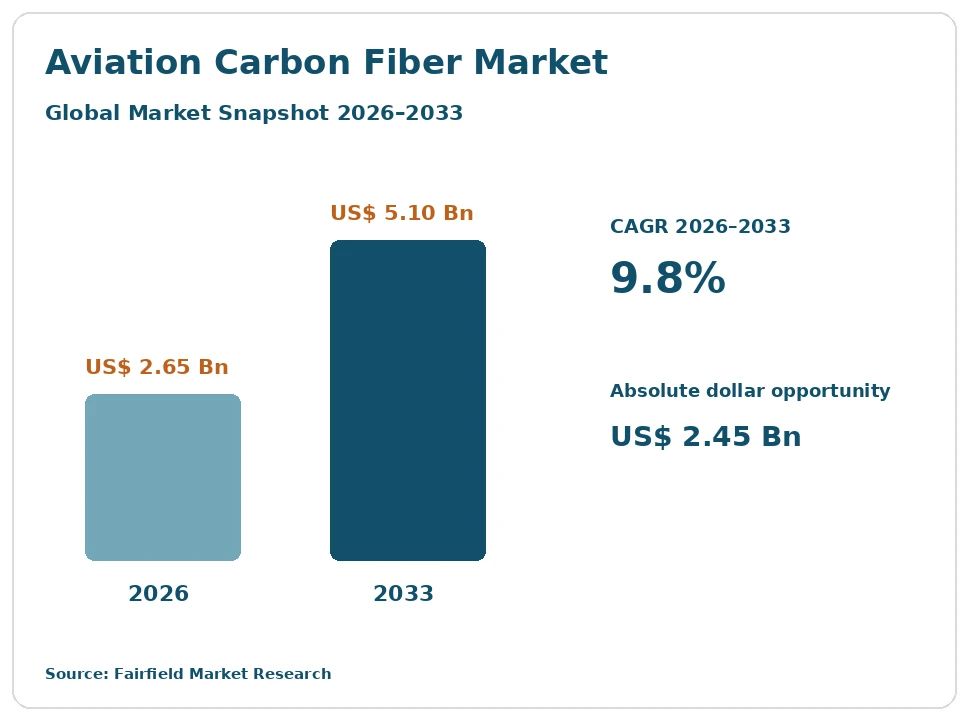
The global aviation carbon fiber market size is expected to be valued at US$ 2.65 billion in 2026 and projected to reach US$ 5.10 billion by 2033, growing at a CAGR of 9.8% between 2026 and 2033.
Between 2020 and 2025, the market grew at a CAGR of about 3.6%, as the pandemic collapse in air travel cut wide-body aircraft production sharply in 2020 and 2021, followed by a slow recovery limited by supply chain problems and quality issues at aircraft makers. The aviation carbon fiber market covers carbon fibers, prepregs, fabrics, and related materials used to build aircraft wings, fuselages, tails, engine parts, interiors, and rotor blades for commercial jets, military aircraft, helicopters, business jets, and new electric air taxis. Most aviation fiber is PAN-based carbon fiber, prized for its high strength and low weight. Aerospace composites made from carbon fiber cut aircraft weight by up to 20%, saving fuel and emissions. Growth comes from rising production of the Boeing 787, Airbus A350, and narrow-body jets, defense programs, and new air mobility aircraft. The market is shifting toward thermoplastic composites and faster automated production. In July 2026, Hexcel expanded its long-term agreements with Boeing.
Key Report Takeaways
- By Raw Material: PAN-based held 78.4% share in 2025, while Pitch-based is projected to expand at a 10.6% CAGR through 2033, driven by its high stiffness and thermal conductivity for satellite structures, defense aircraft, and specialized engine and electronics components.
- By Application: Commercial Fixed-Wing held about 52% share in 2025, while Rotorcraft is projected to expand at a 11.0% CAGR through 2033, driven by electric vertical take-off aircraft, new helicopter programs, and lightweight rotor blades made with carbon fiber composites.
- By Resin Type: Thermoset held about 76% share in 2025, while Thermoplastic is projected to expand at a 12.4% CAGR through 2033, driven by faster production, welding instead of fasteners, recyclability, and plans for high-rate next-generation narrow-body aircraft.
- By Region: North America held about 38% share in 2025, while Asia Pacific is projected to expand at a 11.4% CAGR through 2033, driven by the COMAC C919, Japanese fiber makers, rising aircraft parts production in India, and fast air travel growth.
Global Aviation Carbon Fiber Market Trends and Insights
Drivers Impact Analysis
Two drivers carry the strongest influence on aviation carbon fiber market demand during the forecast period.
| Driver | Impact on CAGR Forecast | Geographic Relevance | Impact Timeline |
| Rising aircraft production and record order backlogs | High | Global, strongest in North America and Europe | Long term (≥4 years) |
| Fuel efficiency and emission reduction goals | Medium | Global | Medium term (2-4 years) |
Aircraft Production Is Driving the Aviation Carbon Fiber Market
Rising aircraft production and record order backlogs are the strongest driver of the aviation carbon fiber market. Aircraft makers have years of orders.
The mechanism is the link between aircraft deliveries and fiber demand. Airbus and Boeing together hold backlogs of more than 15,000 aircraft, enough for about ten years of production at current rates. Wide-body jets such as the Boeing 787 and Airbus A350 are made of about 50% composites by weight, using tons of carbon fiber per aircraft, and both companies plan to raise output as supply chains recover. Narrow-body jets use fiber in tails, engines, and interiors. Airlines are replacing old aircraft and growing fleets for rising travel, especially in Asia Pacific and Middle East & Africa. Engine makers use carbon fiber fan blades and cases in engines such as the GE9X and LEAP. These factors support strong growth in fiber orders.
Efficiency Goals Are Expanding the Aviation Carbon Fiber Market
Fuel efficiency and emission reduction goals are expanding the aviation carbon fiber market. Lighter planes burn less fuel.
The cause is pressure on airlines to cut costs and carbon emissions. Fuel is one of an airline’s largest costs, and every kilogram saved reduces fuel burn across thousands of flights. Industry targets of net-zero emissions by 2050 push aircraft makers to use lighter materials, along with new engines and sustainable fuels. Carbon fiber is stronger and lighter than aluminum and does not corrode, so maintenance costs fall over an aircraft’s life. Future aircraft with longer, thinner wings for better efficiency will need even more carbon fiber. Business jet makers and engine suppliers also chase weight savings to extend range and cut fuel use. Regulators are adding stricter carbon dioxide standards for new aircraft types. These goals support rising composite content in new designs.
Restraints Impact Analysis
Two restraints limit how quickly the aviation carbon fiber market grows.
| Restraint | Impact on CAGR Forecast | Geographic Relevance | Impact Timeline |
| High material and manufacturing costs | High | Global | Long term (≥4 years) |
| Aircraft production delays and supply chain problems | Medium | North America, Europe | Medium term (2-4 years) |
High Costs Slow the Aviation Carbon Fiber Market
High material and manufacturing costs slow the aviation carbon fiber market. Carbon fiber parts are expensive to make.
The specific causes are energy-hungry fiber production and slow manufacturing steps. Making aerospace-grade fiber requires high temperatures and strict quality control, and acrylonitrile raw material prices can swing. Thermoset parts must cure for hours in large autoclaves, limiting production speed. Inspection and certification of composite parts take time and skilled workers. Repairs are more complex than for metal structures. Recycling carbon fiber is still difficult and costly. Smaller aircraft and parts makers often cannot afford the large machines and clean rooms needed for composite work. Production waste can reach a large share of material bought, adding cost. Long qualification times for new materials also add expense for suppliers. These factors raise the price of each part and slow adoption in cost-sensitive aircraft.
Production Delays Restrict the Aviation Carbon Fiber Market
Aircraft production delays and supply chain problems restrict the aviation carbon fiber market. Fewer deliveries mean less fiber demand.
The underlying causes are quality and supply issues at aircraft makers and suppliers. Boeing slowed production after quality problems and a door plug incident in 2024, and a strike in 2024 halted factories for weeks. Engine and parts shortages have limited deliveries at Airbus. Smaller suppliers have struggled with staff and cash. Fiber makers hold extra inventory when build rates slip, and some have cut output or delayed new lines. Shortages of engines, seats, and castings mean that finished airframes sometimes wait for parts, which slows deliveries and payments across the supply chain. Tariffs and trade disputes add cost and uncertainty for global suppliers. Labor shortages in skilled composite work also slow output. These factors restrict growth in the near term even as backlogs stay high.
Market Opportunities
Thermoplastic Composites Open a Fast-Growth Revenue Pool
Thermoplastic composites open a fast-growth revenue pool in the aviation carbon fiber market. Faster processes suit high-rate production.
Material makers can capture this opportunity. Thermoplastic composites can be welded and formed quickly without long curing, which helps build parts at the rates needed for future narrow-body jets that may reach 75 aircraft a month. They can also be recycled more easily. Syensqo, Toray, and Victrex supply thermoplastic materials, and research programs in Europe are testing thermoplastic fuselage sections. Thermoplastic parts are also tougher and can be stored at room temperature, unlike thermoset prepregs that need freezers. Automated tape laying and press forming cut labor costs. Aircraft makers are expected to choose materials for new narrow-body jets in the next few years, so early qualification is critical. Companies offering qualified thermoplastic fibers, tapes, and processes can win future aircraft programs that will run for decades.
Advanced Air Mobility Creates a Growth Revenue Pool
Advanced air mobility creates a growth revenue pool in the aviation carbon fiber market. Electric air taxis are built mostly of composites.
Suppliers can capture this opportunity. Electric vertical take-off and landing aircraft from Joby Aviation, Archer Aviation, Beta Technologies, and EHang need very light structures to maximize battery range, so they use carbon fiber for most of the airframe. Toray and Hexcel supply these makers. Production plans call for hundreds of aircraft a year once certification is complete, which would be much higher rates than typical small aircraft. Air taxi makers also need low-cost, fast processes that differ from those used for large airliners. Military drones and cargo drones add more demand for light composite structures. Partnerships between fiber makers and new aircraft companies are growing. Companies with fast, low-cost processes and design support can grow.
Segment Analysis
By Raw Material: PAN-based Leads While Pitch-based Grows Fastest
PAN-based held 78.4% share in 2025. Fiber made from polyacrylonitrile offers the best mix of strength, toughness, and cost, and nearly all aircraft structures use it. Major makers such as Toray, Hexcel, Teijin, and Mitsubishi Chemical produce large volumes under strict aerospace qualifications. Intermediate and high modulus grades are used in primary structures such as wings and fuselages.
Pitch-based is the fastest-growing raw material, expanding at a 10.6% CAGR through 2033. Fiber made from pitch offers very high stiffness and heat conduction, which suits satellites, space structures, defense aircraft, and parts that must manage heat. Supply is small, few companies make it, and prices are high. For the market, pitch growth adds high-value niches.
By Application: Commercial Fixed-Wing Leads While Rotorcraft Grows Fastest
Commercial Fixed-Wing held about 52% share in 2025. Airliners use the most carbon fiber by far, with wide-body jets using it in wings, fuselages, and tails, and narrow-body jets using it in many parts. Record backlogs at Airbus and Boeing support this segment, and business jets add more demand. Rising wide-body production is expected to lift fiber use sharply in the coming years.
Rotorcraft is the fastest-growing application, expanding at a 11.0% CAGR through 2033. Helicopters use carbon fiber in rotor blades and airframes, and new electric air taxis are built mostly from composites. Military fixed-wing aircraft, including fighters and transports, form another application. For the market, rotorcraft growth adds new customers.
By Resin Type: Thermoset Leads While Thermoplastic Grows Fastest
Thermoset held about 76% share in 2025. Epoxy-based prepregs are the standard material for aircraft structures, with decades of flight experience and full certification. They are used in the wings and fuselages of the 787 and A350, as well as in many engine and interior parts. Their known performance, wide supply base, and proven repair methods make them the safe choice for aircraft makers, and they will dominate current aircraft programs through the forecast period.
Thermoplastic is the fastest-growing resin type, expanding at a 12.4% CAGR through 2033. Thermoplastics allow faster forming, welding, and recycling, making them attractive for future high-rate aircraft. Clips, brackets, and floor beams already use them. For the market, thermoplastic growth supports higher production rates.
Geography Analysis
Which Region Is Leading the Aviation Carbon Fiber Market?
North America is leading the aviation carbon fiber market with about 38% share in 2025. The United States is home to Boeing, Lockheed Martin, Northrop Grumman, GE Aerospace, and many parts suppliers, and Hexcel and Toray’s American units produce aerospace fiber and prepreg. Defense programs such as the F-35 use large amounts of composites. Many electric air taxi makers are also based there, and space launch companies use carbon fiber for rocket parts. Key barriers include production delays and quality problems at aircraft makers. One change shaping the region is recovery of Boeing build rates.
Europe Shapes the Aviation Carbon Fiber Market Through Airbus Production
Europe is a major aviation carbon fiber market. France, Germany, Spain, and the United Kingdom host Airbus factories and suppliers such as GKN Aerospace, Spirit AeroSystems Europe, Safran, and Rolls-Royce, which use composites in wings, fuselages, and engines. Hexcel, Syensqo, and SGL Carbon run plants in the region. European research programs study thermoplastic and recyclable composites, and the Clean Aviation program funds lighter aircraft structures. Rising Airbus narrow-body output supports steady fiber demand across the region. Key barriers include high energy costs. One opportunity is next-generation aircraft research.
Which Region Is Growing Fastest in the Aviation Carbon Fiber Market?
Asia Pacific is growing fastest in the aviation carbon fiber market, expanding at a 11.4% CAGR through 2033. Japan is home to Toray, Teijin, and Mitsubishi Chemical, the largest makers of aerospace fiber, and Japanese companies build large parts of the Boeing 787. China is ramping up the COMAC C919 and building its own fiber industry, and India is growing as an aircraft parts maker. South Korea also supplies aircraft parts and fiber, and air travel in the region is growing fast. Key barriers include export controls. One change shaping the region is local aircraft programs.
Latin America Grows the Aviation Carbon Fiber Market Through Embraer
Latin America is a small aviation carbon fiber market. Brazil is home to Embraer, the region’s main aircraft maker, which builds regional jets, business jets, and military aircraft using composite parts, and Mexico has a growing aerospace parts industry that serves Boeing, Airbus, and engine makers. Most carbon fiber is imported from North America, Europe, and Japan. Embraer plans new aircraft that could use more composites, and lower labor costs attract parts makers to the region from abroad. Key barriers include small production volumes and limited local composite skills. One opportunity is aerospace parts manufacturing in Mexico.
Middle East & Africa Develops the Aviation Carbon Fiber Market Through Local Aerospace Industry
Middle East & Africa is a developing aviation carbon fiber market. The United Arab Emirates hosts Strata Manufacturing, which makes composite parts for Airbus and Boeing, and Saudi Arabia is building an aerospace industry under its national plans. Morocco and South Africa produce aircraft parts and wiring for global makers. Fast-growing airlines in the region order many new wide-body jets, which indirectly drives fiber demand. Governments want to build local supply chains and attract foreign investment in aerospace manufacturing. Key barriers include limited local fiber supply. One change shaping the region is growth in parts manufacturing.
Competitive Landscape
The aviation carbon fiber market is highly consolidated. Toray Industries, Hexcel, Teijin, Mitsubishi Chemical Group, and Syensqo are leading players, while SGL Carbon, HYOSUNG, DowAksa, Zoltek, Park Aerospace, Chomarat, and DuPont compete strongly. Toray is the largest supplier of aerospace carbon fiber, and the long qualification process for aircraft materials gives established suppliers a strong position. New entrants from China are building capacity but face export and qualification barriers.
Companies compete on fiber strength and stiffness, quality and consistency, qualification on aircraft programs, prepreg and resin systems, production capacity, and price. Once a material is qualified on an aircraft, it is rarely changed during the program’s life, giving long-term revenue. Long-term supply agreements with Airbus, Boeing, engine makers, and parts suppliers are central to the business.
Strategic moves show how competition is changing. In June 2024, Airbus said it was studying bio-based carbon fibers to cut emissions from its products. In April 2026, Toray Composite Materials America and Syensqo signed a five-year carbon fiber and prepreg supply agreement for aircraft, space, and defense. In July 2026, Hexcel announced new and extended long-term agreements with Boeing covering commercial, defense, and space programs. These moves show competition focused on securing long-term supply.
Three themes shape vendor strategy. First, companies are signing long-term agreements to secure demand and supply. Second, they are investing in thermoplastic and recyclable composites. Third, they are expanding in Asia Pacific and serving new electric air taxi makers.
Aviation Carbon Fiber Market Industry Leaders
- Toray Industries
- Hexcel
- Teijin
- Mitsubishi Chemical Group
- Syensqo
Recent Industry Developments
- July 2026: Hexcel announced new and extended long-term agreements with Boeing covering composite materials for commercial, defense, and space programs - secures demand for aerospace composites through future production ramps.
- April 2026: Toray Composite Materials America and Syensqo signed a five-year agreement, effective January 2026, for PAN-based carbon fiber and prepreg for aircraft, space, and defense - strengthens supply security in the aviation carbon fiber market.
- June 2024: Airbus said it was investigating bio-based carbon fibers as an alternative to fossil-based materials as part of its plan to cut emissions - supports sustainable composite development.
Companies Covered in the Report
- Toray Industries
- Hexcel
- Teijin
- Mitsubishi Chemical Group
- Syensqo
- SGL Carbon
- HYOSUNG
- DowAksa
- Zoltek
- Park Aerospace
- Chomarat Group
- DuPont
Aviation Carbon Fiber Market Scope
This report covers the aviation carbon fiber market, including PAN-based and pitch-based carbon fiber in continuous, long, and short fiber types, with thermoset and thermoplastic resins, used in commercial fixed-wing aircraft, military fixed-wing aircraft, rotorcraft, and advanced air mobility for structures, engines, and interiors. The base year is 2025, and the forecast period runs from 2026 to 2033. All values are expressed in US$ Billion.
| Metric | Value |
| Study Period | 2020-2033 |
| Market Size 2026 | US$ 2.65 Billion |
| Market Size 2033 | US$ 5.10 Billion |
| CAGR 2026-2033 | 9.8% |
| Absolute Dollar Opportunity | US$ 2.45 Billion |
| Largest Market | North America |
| Fastest-Growing Market | Asia Pacific |
| Market Concentration | Highly Consolidated |
| Major Players | Toray Industries, Hexcel, Teijin, Mitsubishi Chemical Group, Syensqo |
Raw Material
- PAN-based
- Pitch-based
Type
- Continuous
- Long
- Short
Resin Type
- Thermoset
- Thermoplastic
Application
- Commercial Fixed-Wing
- Military Fixed-Wing
- Rotorcraft
Regions
- North America
- Europe
- Asia Pacific
- Latin America
- Middle East & Africa
1. Executive Summary
1.1. Global Aviation Carbon Fiber Market Snapshot
1.2. Future Projections, 2026-2033
1.3. Key Market Trends
1.4. Regional Snapshot
2. Market Overview
2.1. Market Definition and Scope
2.2. Historical Market Trends, 2020-2025
2.3. Market Dynamics
2.3.1. Drivers Impact Analysis
2.3.1.1. Aircraft Production Is Driving the Aviation Carbon Fiber Market
2.3.1.2. Efficiency Goals Are Expanding the Aviation Carbon Fiber Market
2.3.2. Restraints Impact Analysis
2.3.2.1. High Costs Slow the Aviation Carbon Fiber Market
2.3.2.2. Production Delays Restrict the Aviation Carbon Fiber Market
2.3.3. Market Opportunities
2.3.3.1. Thermoplastic Composites Open a Fast-Growth Revenue Pool
2.3.3.2. Advanced Air Mobility Creates a Growth Revenue Pool
3. Global Aviation Carbon Fiber Market Outlook, 2020-2033
3.1. Global Aviation Carbon Fiber Market Outlook, by Raw Material, Value (US$ Billion), 2020-2033
3.1.1. PAN-based
3.1.2. Pitch-based
3.2. Global Aviation Carbon Fiber Market Outlook, by Type, Value (US$ Billion), 2020-2033
3.2.1. Continuous
3.2.2. Long
3.2.3. Short
3.3. Global Aviation Carbon Fiber Market Outlook, by Resin Type, Value (US$ Billion), 2020-2033
3.3.1. Thermoset
3.3.2. Thermoplastic
3.4. Global Aviation Carbon Fiber Market Outlook, by Application, Value (US$ Billion), 2020-2033
3.4.1. Commercial Fixed-Wing
3.4.2. Military Fixed-Wing
3.4.3. Rotorcraft
3.5. Global Aviation Carbon Fiber Market Outlook, by Region, Value (US$ Billion), 2020-2033
3.5.1. North America
3.5.2. Europe
3.5.3. Asia Pacific
3.5.4. Latin America
3.5.5. Middle East & Africa
4. North America Aviation Carbon Fiber Market Outlook, 2020-2033
4.1. North America Aviation Carbon Fiber Market Outlook, by Raw Material, Value (US$ Billion), 2020-2033
4.1.1. PAN-based
4.1.2. Pitch-based
4.2. North America Aviation Carbon Fiber Market Outlook, by Type, Value (US$ Billion), 2020-2033
4.2.1. Continuous
4.2.2. Long
4.2.3. Short
4.3. North America Aviation Carbon Fiber Market Outlook, by Resin Type, Value (US$ Billion), 2020-2033
4.3.1. Thermoset
4.3.2. Thermoplastic
4.4. North America Aviation Carbon Fiber Market Outlook, by Application, Value (US$ Billion), 2020-2033
4.4.1. Commercial Fixed-Wing
4.4.2. Military Fixed-Wing
4.4.3. Rotorcraft
4.5. North America Aviation Carbon Fiber Market Outlook, by Country, Value (US$ Billion), 2020-2033
4.5.1. United States Aviation Carbon Fiber Market Outlook, by Raw Material, 2020-2033
4.5.2. United States Aviation Carbon Fiber Market Outlook, by Type, 2020-2033
4.5.3. United States Aviation Carbon Fiber Market Outlook, by Resin Type, 2020-2033
4.5.4. United States Aviation Carbon Fiber Market Outlook, by Application, 2020-2033
5. Europe Aviation Carbon Fiber Market Outlook, 2020-2033
5.1. Europe Aviation Carbon Fiber Market Outlook, by Raw Material, Value (US$ Billion), 2020-2033
5.1.1. PAN-based
5.1.2. Pitch-based
5.2. Europe Aviation Carbon Fiber Market Outlook, by Type, Value (US$ Billion), 2020-2033
5.2.1. Continuous
5.2.2. Long
5.2.3. Short
5.3. Europe Aviation Carbon Fiber Market Outlook, by Resin Type, Value (US$ Billion), 2020-2033
5.3.1. Thermoset
5.3.2. Thermoplastic
5.4. Europe Aviation Carbon Fiber Market Outlook, by Application, Value (US$ Billion), 2020-2033
5.4.1. Commercial Fixed-Wing
5.4.2. Military Fixed-Wing
5.4.3. Rotorcraft
5.5. Europe Aviation Carbon Fiber Market Outlook, by Country, Value (US$ Billion), 2020-2033
5.5.1. France Aviation Carbon Fiber Market Outlook, by Raw Material, 2020-2033
5.5.2. France Aviation Carbon Fiber Market Outlook, by Type, 2020-2033
5.5.3. France Aviation Carbon Fiber Market Outlook, by Resin Type, 2020-2033
5.5.4. France Aviation Carbon Fiber Market Outlook, by Application, 2020-2033
5.5.5. Germany Aviation Carbon Fiber Market Outlook, by Raw Material, 2020-2033
5.5.6. Germany Aviation Carbon Fiber Market Outlook, by Type, 2020-2033
5.5.7. Germany Aviation Carbon Fiber Market Outlook, by Resin Type, 2020-2033
5.5.8. Germany Aviation Carbon Fiber Market Outlook, by Application, 2020-2033
5.5.9. Spain Aviation Carbon Fiber Market Outlook, by Raw Material, 2020-2033
5.5.10. Spain Aviation Carbon Fiber Market Outlook, by Type, 2020-2033
5.5.11. Spain Aviation Carbon Fiber Market Outlook, by Resin Type, 2020-2033
5.5.12. Spain Aviation Carbon Fiber Market Outlook, by Application, 2020-2033
5.5.13. United Kingdom Aviation Carbon Fiber Market Outlook, by Raw Material, 2020-2033
5.5.14. United Kingdom Aviation Carbon Fiber Market Outlook, by Type, 2020-2033
5.5.15. United Kingdom Aviation Carbon Fiber Market Outlook, by Resin Type, 2020-2033
5.5.16. United Kingdom Aviation Carbon Fiber Market Outlook, by Application, 2020-2033
6. Asia Pacific Aviation Carbon Fiber Market Outlook, 2020-2033
6.1. Asia Pacific Aviation Carbon Fiber Market Outlook, by Raw Material, Value (US$ Billion), 2020-2033
6.1.1. PAN-based
6.1.2. Pitch-based
6.2. Asia Pacific Aviation Carbon Fiber Market Outlook, by Type, Value (US$ Billion), 2020-2033
6.2.1. Continuous
6.2.2. Long
6.2.3. Short
6.3. Asia Pacific Aviation Carbon Fiber Market Outlook, by Resin Type, Value (US$ Billion), 2020-2033
6.3.1. Thermoset
6.3.2. Thermoplastic
6.4. Asia Pacific Aviation Carbon Fiber Market Outlook, by Application, Value (US$ Billion), 2020-2033
6.4.1. Commercial Fixed-Wing
6.4.2. Military Fixed-Wing
6.4.3. Rotorcraft
6.5. Asia Pacific Aviation Carbon Fiber Market Outlook, by Country, Value (US$ Billion), 2020-2033
6.5.1. Japan Aviation Carbon Fiber Market Outlook, by Raw Material, 2020-2033
6.5.2. Japan Aviation Carbon Fiber Market Outlook, by Type, 2020-2033
6.5.3. Japan Aviation Carbon Fiber Market Outlook, by Resin Type, 2020-2033
6.5.4. Japan Aviation Carbon Fiber Market Outlook, by Application, 2020-2033
6.5.5. China Aviation Carbon Fiber Market Outlook, by Raw Material, 2020-2033
6.5.6. China Aviation Carbon Fiber Market Outlook, by Type, 2020-2033
6.5.7. China Aviation Carbon Fiber Market Outlook, by Resin Type, 2020-2033
6.5.8. China Aviation Carbon Fiber Market Outlook, by Application, 2020-2033
6.5.9. India Aviation Carbon Fiber Market Outlook, by Raw Material, 2020-2033
6.5.10. India Aviation Carbon Fiber Market Outlook, by Type, 2020-2033
6.5.11. India Aviation Carbon Fiber Market Outlook, by Resin Type, 2020-2033
6.5.12. India Aviation Carbon Fiber Market Outlook, by Application, 2020-2033
6.5.13. South Korea Aviation Carbon Fiber Market Outlook, by Raw Material, 2020-2033
6.5.14. South Korea Aviation Carbon Fiber Market Outlook, by Type, 2020-2033
6.5.15. South Korea Aviation Carbon Fiber Market Outlook, by Resin Type, 2020-2033
6.5.16. South Korea Aviation Carbon Fiber Market Outlook, by Application, 2020-2033
7. Latin America Aviation Carbon Fiber Market Outlook, 2020-2033
7.1. Latin America Aviation Carbon Fiber Market Outlook, by Raw Material, Value (US$ Billion), 2020-2033
7.1.1. PAN-based
7.1.2. Pitch-based
7.2. Latin America Aviation Carbon Fiber Market Outlook, by Type, Value (US$ Billion), 2020-2033
7.2.1. Continuous
7.2.2. Long
7.2.3. Short
7.3. Latin America Aviation Carbon Fiber Market Outlook, by Resin Type, Value (US$ Billion), 2020-2033
7.3.1. Thermoset
7.3.2. Thermoplastic
7.4. Latin America Aviation Carbon Fiber Market Outlook, by Application, Value (US$ Billion), 2020-2033
7.4.1. Commercial Fixed-Wing
7.4.2. Military Fixed-Wing
7.4.3. Rotorcraft
7.5. Latin America Aviation Carbon Fiber Market Outlook, by Country, Value (US$ Billion), 2020-2033
7.5.1. Brazil Aviation Carbon Fiber Market Outlook, by Raw Material, 2020-2033
7.5.2. Brazil Aviation Carbon Fiber Market Outlook, by Type, 2020-2033
7.5.3. Brazil Aviation Carbon Fiber Market Outlook, by Resin Type, 2020-2033
7.5.4. Brazil Aviation Carbon Fiber Market Outlook, by Application, 2020-2033
7.5.5. Mexico Aviation Carbon Fiber Market Outlook, by Raw Material, 2020-2033
7.5.6. Mexico Aviation Carbon Fiber Market Outlook, by Type, 2020-2033
7.5.7. Mexico Aviation Carbon Fiber Market Outlook, by Resin Type, 2020-2033
7.5.8. Mexico Aviation Carbon Fiber Market Outlook, by Application, 2020-2033
8. Middle East & Africa Aviation Carbon Fiber Market Outlook, 2020-2033
8.1. Middle East & Africa Aviation Carbon Fiber Market Outlook, by Raw Material, Value (US$ Billion), 2020-2033
8.1.1. PAN-based
8.1.2. Pitch-based
8.2. Middle East & Africa Aviation Carbon Fiber Market Outlook, by Type, Value (US$ Billion), 2020-2033
8.2.1. Continuous
8.2.2. Long
8.2.3. Short
8.3. Middle East & Africa Aviation Carbon Fiber Market Outlook, by Resin Type, Value (US$ Billion), 2020-2033
8.3.1. Thermoset
8.3.2. Thermoplastic
8.4. Middle East & Africa Aviation Carbon Fiber Market Outlook, by Application, Value (US$ Billion), 2020-2033
8.4.1. Commercial Fixed-Wing
8.4.2. Military Fixed-Wing
8.4.3. Rotorcraft
8.5. Middle East & Africa Aviation Carbon Fiber Market Outlook, by Country, Value (US$ Billion), 2020-2033
8.5.1. United Arab Emirates Aviation Carbon Fiber Market Outlook, by Raw Material, 2020-2033
8.5.2. United Arab Emirates Aviation Carbon Fiber Market Outlook, by Type, 2020-2033
8.5.3. United Arab Emirates Aviation Carbon Fiber Market Outlook, by Resin Type, 2020-2033
8.5.4. United Arab Emirates Aviation Carbon Fiber Market Outlook, by Application, 2020-2033
8.5.5. Saudi Arabia Aviation Carbon Fiber Market Outlook, by Raw Material, 2020-2033
8.5.6. Saudi Arabia Aviation Carbon Fiber Market Outlook, by Type, 2020-2033
8.5.7. Saudi Arabia Aviation Carbon Fiber Market Outlook, by Resin Type, 2020-2033
8.5.8. Saudi Arabia Aviation Carbon Fiber Market Outlook, by Application, 2020-2033
8.5.9. Morocco Aviation Carbon Fiber Market Outlook, by Raw Material, 2020-2033
8.5.10. Morocco Aviation Carbon Fiber Market Outlook, by Type, 2020-2033
8.5.11. Morocco Aviation Carbon Fiber Market Outlook, by Resin Type, 2020-2033
8.5.12. Morocco Aviation Carbon Fiber Market Outlook, by Application, 2020-2033
8.5.13. South Africa Aviation Carbon Fiber Market Outlook, by Raw Material, 2020-2033
8.5.14. South Africa Aviation Carbon Fiber Market Outlook, by Type, 2020-2033
8.5.15. South Africa Aviation Carbon Fiber Market Outlook, by Resin Type, 2020-2033
8.5.16. South Africa Aviation Carbon Fiber Market Outlook, by Application, 2020-2033
9. Competitive Landscape
9.1. Industry Leaders
9.2. Recent Industry Developments
9.3. Company Profiles
9.3.1. Toray Industries
9.3.2. Hexcel
9.3.3. Teijin
9.3.4. Mitsubishi Chemical Group
9.3.5. Syensqo
9.3.6. SGL Carbon
9.3.7. HYOSUNG
9.3.8. DowAksa
9.3.9. Zoltek
9.3.10. Park Aerospace
9.3.11. Chomarat Group
9.3.12. DuPont
10. Appendix
10.1. Research Methodology
10.2. Report Assumptions
10.3. Acronyms and Abbreviations
| Segment | Categories |
| Raw Material | PAN-based, Pitch-based |
| Type | Continuous, Long, Short |
| Resin Type | Thermoset, Thermoplastic |
| Application | Commercial Fixed-Wing, Military Fixed-Wing, Rotorcraft |
| Regions | North America, Europe, Asia Pacific, Latin America, Middle East & Africa |
Our Research Methodology
Considering the volatility of business today, traditional approaches to strategizing a game plan can be unfruitful if not detrimental. True ambiguity is no way to determine a forecast. A myriad of predetermined factors must be accounted for such as the degree of risk involved, the magnitude of circumstances, as well as conditions or consequences that are not known or unpredictable. To circumvent binary views that cast uncertainty, the application of market research intelligence to strategically posture, move, and enable actionable outcomes is necessary.
View Methodology
Quality Assured
Rigorous Validation Process

Confidentiality Assured
End-to-end Data Security

Custom Research Services
Tailored To Your Objectives
FAQs
The aviation carbon fiber market is valued at US$ 2.65 billion in 2026, led by PAN-based fiber and North America.
The market is projected to reach US$ 5.10 billion by 2033, growing at a 9.8% CAGR and adding US$ 2.45 billion.
Thermoplastic is growing fastest at a 12.4% CAGR through 2033, driven by faster production, welding, recyclability, and future high-rate aircraft.
Asia Pacific is growing fastest at an 11.4% CAGR through 2033, driven by Japanese fiber makers, the C919, and rising travel.
North America holds the largest share at about 38% in 2025, supported by Boeing, defense programs, and major fiber producers.
Related Reports
Detergent Chemicals Market Size, Share, Insights, Competitive Landscape, and Forecast 2026 to 2033
The detergent chemicals market is forecast to grow from US$ 72.0 billion in 2026 to US$ 99.3 billion by 2033 at a 4.7% CAGR.
Transportation Composites Market Size, Share, Insights, Competitive Landscape, and Forecast 2026 to 2033
The global transportation composites market is valued at US$48.6 billion in 2026, reaching US$78.5 billion by 2033, growing at a 7.1% CAGR
Tamper Evident Packaging Market Size, Share, Insights, Competitive Landscape, and Forecast 2026 to 2033
The global tamper evident packaging market is valued at US$18.5 billion in 2026, reaching US$26.9 billion by 2033, growing at a 5.5% CAGR
Personal Care Ingredients Market Size, Share, Insights, Competitive Landscape, and Forecast 2026 to 2033
The global personal care ingredients market is valued at US$18.6 billion in 2026, reaching US$28.2 billion by 2033, growing at a 6.1% CAGR
Medical Polymer Market Size, Share, Insights, Competitive Landscape, and Forecast 2026 to 2033
The global medical polymer market is valued at US$27.4 billion in 2026, reaching US$47.8 billion by 2033, growing at an 8.3% CAGR
Lithium Sulfides Market Size, Share, Insights, Competitive Landscape, and Forecast 2026 to 2033
The global lithium sulfides market is valued at US$0.1 billion in 2026, reaching US$0.7 billion by 2033, growing at a 32.0% CAGR