



Detergent Chemicals Market
Detergent Chemicals Market Size, Share, Insights, Competitive Landscape, and Forecast 2026 to 2033
How Fast Is the Detergent Chemicals Market Growing?
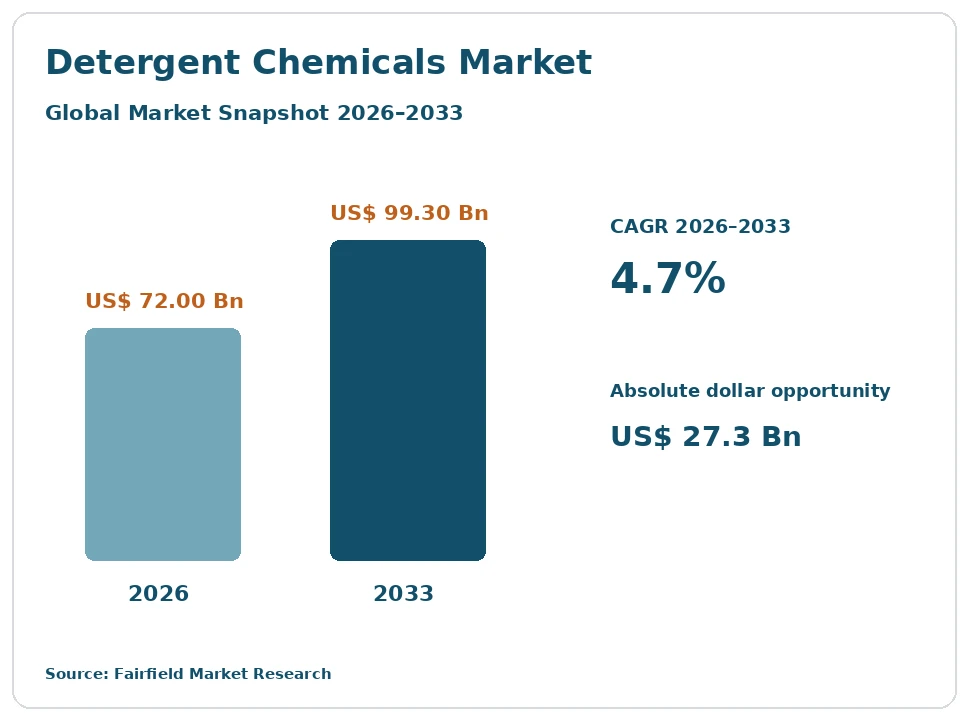
The global Detergent Chemicals market size is expected to be valued at US$ 72.0 billion in 2026 and projected to reach US$ 99.3 billion by 2033, growing at a CAGR of 4.7% between 2026 and 2033.
The market expanded at a 3.8% CAGR between 2020 and 2025 to reach US$ 68.9 billion, with value growth running ahead of tonnage. Three factors shape the forecast. Washing temperatures keep falling, which moves spend from bulk builders toward enzymes and performance polymers that work at 30°C. Dose compaction cuts volume per wash while raising the active content and price per kilogram of what remains. Household formation and appliance ownership in emerging economies add genuine new tonnage, particularly in automatic dishwashing. Regulation continues to remove and replace ingredient classes rather than to shrink the market. The direction is steady value growth on flat to slowly rising physical volume.
Key Report Takeaways
- By Ingredient Type: Surfactants held 48.0% share in 2026, while enzymes are projected to expand at a 7.2% CAGR through 2033, because biological catalysts deliver stain removal that low-temperature washing cannot otherwise achieve.
- By Surfactant Type: Anionic surfactants held 52.0% share in 2026, while non-ionic surfactants are projected to grow at a 5.8% CAGR through 2033, on liquid and compact formats that need low-foam, hard-water-tolerant chemistry.
- By Application: Laundry care held 46.0% share in 2026, while dishwashing is projected to advance at a 5.5% CAGR through 2033, driven by automatic dishwasher ownership spreading beyond high-income households.
- By Feedstock Source: Petrochemical-based ingredients held 61.0% share in 2026, while fermentation-derived ingredients are projected to grow at an 11.5% CAGR through 2033, from a very small base as biosurfactant capacity comes online.
- By Geography: Asia Pacific held 38.0% share in 2026, while Middle East & Africa is projected to expand at a 6.3% CAGR through 2033, on population growth and rising per-capita cleaning product consumption.
Global Detergent Chemicals Market Trends and Insights
Drivers Impact Analysis
Two structural shifts account for most of the forecast value growth in cleaning product ingredients.
| Driver | Impact on CAGR Forecast | Geographic Relevance | Impact Timeline |
| Low-temperature washing and dose compaction shifting value to enzymes and polymers | High | Europe, North America, Asia Pacific | Long term ≥4 years |
| Machine laundry and automatic dishwashing penetration in emerging economies | High | Asia Pacific, Latin America, Middle East & Africa | Medium term 2–4 years |
Cold Washing and Dose Compaction Move Detergent Chemicals Value Toward Enzymes
The shift to cold washing is the single change that reshapes this chemistry. Heating water accounts for most of the energy a washing machine uses, so energy prices and appliance efficiency labelling have pushed typical wash temperatures from 60°C toward 30°C and below. Cleaning at that temperature in a compacted dose cannot be solved by adding more surfactant, which moves formulation spend decisively toward enzymes and performance polymers.
The mechanism is physical chemistry. Fats solidify, soils stay bound to fibres, and surfactant micelle formation weakens as temperature drops, so proteases, amylases, lipases, mannanases and cellulases do work that bulk actives no longer can. Anti-redeposition and soil-release polymers hold detached soil in solution during a short, cool cycle. Each is dosed in grams rather than tens of grams but sells at many times the price per kilogram of commodity surfactant.
Rising Machine Laundry and Automatic Dishwashing Penetration Expands Ingredient Volume
New appliance ownership is the main source of genuine tonnage growth in cleaning chemistry. Households moving from hand washing to machine laundry switch from bar soap and simple powders to built formulations that need builders, chelants, enzymes, polymers and anti-foam packages. Automatic dishwashing has a larger effect per household, because machine dish products are the most chemically complex consumer cleaning formulations sold.
The causal chain starts with reliable electrification, piped water supply and rising disposable income. Urbanisation and small-household formation raise wash frequency per person, while rising washing machine and dishwasher ownership across populous economies converts that behaviour into formulated product demand. Automatic dishwasher detergents additionally require bleach systems, activators, enzymes, phosphate-free builders and glass-protection chemistry to function at all, so each percentage point of appliance penetration pulls a disproportionately high-value ingredient basket.
Restraints Impact Analysis
Two constraints weigh on ingredient suppliers across the forecast period.
| Restraint | Impact on CAGR Forecast | Geographic Relevance | Impact Timeline |
| Oleochemical and petrochemical feedstock volatility with deforestation due diligence costs | High | Global | Short term ≤2 years |
| Commodity surfactant price competition and narrowing preservative approvals | Medium | Europe, Asia Pacific | Medium term 2–4 years |
Oleochemical and Petrochemical Feedstock Exposure Squeezes Detergent Chemicals Margins
Feedstock cost determines margin in this industry far more than demand does. Anionic surfactants depend on linear alkylbenzene from petrochemical routes and on fatty alcohols from palm kernel and coconut oil, and both chains move sharply with crude oil, ethylene oxide availability and tropical harvest conditions. Because supply contracts with large consumer goods customers are renegotiated on indexed formulas, producers absorb the lag between input spikes and price pass-through.
Palm derivatives carry an additional and rising compliance cost. Deforestation due diligence obligations and sustainability certification schemes require traceability to plantation level, segregated or mass-balance supply chains, and documentation that smallholder-sourced material does not come from recently cleared land. That adds auditing expense and limits sourcing flexibility exactly when buyers want cheaper alternatives, so the certified fatty alcohol premium has become a structural cost rather than a temporary one.
Commodity Surfactant Competition and Narrowing Preservative Options Limit Formulation Economics
Price competition in commodity surfactants caps what suppliers can earn on roughly half the market by value. Linear alkylbenzene sulphonate and alcohol ether sulphate are made to published specifications by many producers, so they trade close to feedstock cost plus conversion. Private-label growth intensifies the pressure, because retailer brands are formulated to a target cost rather than a target performance, which strips enzymes and polymers out of the basket.
Preservative availability is the second squeeze. Approval of biocidal active substances and the authorisation of the products containing them has withdrawn several widely used preservatives and restricted others by concentration and application. Formulators working on water-rich liquids must now achieve preservation with a shorter list, often at higher inclusion levels or with multi-component systems, and each reformulation carries stability testing, challenge testing and label revision costs that no customer pays for.
Market Opportunities
Concentrated and Solid Cleaning Formats Open a Higher-Value Detergent Chemicals Pool
Format change is creating an ingredient pool that did not exist at scale a decade ago. Unit-dose capsules, ultra-concentrated liquids, laundry sheets, powder refills and tablet formats all remove water from the product, which shifts the formulation toward higher active loading and demands ingredients that tolerate confinement. Water-soluble films, structurant polymers, non-aqueous solvents, hydrotropes and stabilised enzyme granules are each specified in these formats.
Suppliers of encapsulation, polymer film and enzyme stabilisation technology are positioned to capture the value, selling to brand owners and contract manufacturers rather than to retailers. Demand is driven by logistics economics, since removing water cuts freight and shelf space, and by retailer packaging reduction targets. Scrutiny of synthetic polymer microparticles under chemicals legislation also pushes development toward soluble and biodegradable film chemistry, which favours suppliers investing early.
Biosurfactants and Fermentation Routes Create a Developmental Detergent Chemicals Revenue Pool
Fermentation-derived surfactants represent the clearest new revenue pool, even though the base remains very small. Rhamnolipids, sophorolipids and related glycolipids are produced by microbial fermentation of sugars rather than by petrochemical or palm-based routes, and they offer mildness, biodegradability and a feedstock story independent of tropical oils. First commercial plants have moved the category out of laboratory volumes into tonnage that formulators can specify.
Industrial biotechnology firms and the fermentation businesses inside established chemical producers can capture it, selling first into personal wash and premium household cleaning where mildness justifies the premium. Demand comes from brand owners seeking differentiation that survives ingredient disclosure, and from formulators hedging palm kernel exposure. Cost remains the barrier, so capture depends on fermentation yield improvement and on using agricultural side streams instead of refined sugar.
Segment Analysis
By Ingredient Type: Surfactants Carry the Volume While Enzymes Capture the Value Growth
Surfactants held 48.0% of detergent chemicals value in 2026, the largest class because every cleaning formulation needs them and they are dosed in the highest quantity. Enzymes are the fastest-growing class at a 7.2% CAGR to 2033, as low-temperature washing makes biological catalysis the only practical route to stain removal in short, cool cycles. Builders and chelating agents, including zeolites, citrates, phosphonates, sodium carbonate and aminopolycarboxylates, remain essential for hardness control after phosphate removal. Bleaching systems and activators, anti-redeposition and soil-release polymers, solvents, hydrotropes, pH regulators, preservatives, optical brighteners and fragrances complete the basket. The business implication is a widening gap between a commodity half of the market priced on feedstock and a specialty half priced on performance delivered per gram.
By Surfactant Type: Anionic Chemistry Dominates While Non-Ionic Grades Gain Share
Anionic surfactants accounted for 52.0% of surfactant value in 2026, led by linear alkylbenzene sulphonate and alcohol ether sulphates, which deliver detergency and foam at the lowest cost per wash. Non-ionic surfactants grow fastest at a 5.8% CAGR through 2033, because alcohol ethoxylates and alkyl polyglucosides tolerate hard water, work at low temperature, foam less in machines and compress well into concentrated liquids and unit doses. Cationic surfactants serve fabric conditioning and disinfection, while amphoteric grades such as betaines are specified for mildness in personal wash and hand dishwashing. Alkyl polyglucosides draw additional interest because they are made from glucose and fatty alcohol and carry a favourable biodegradability profile. The implication is gradual mix migration rather than displacement, since most formulations blend classes deliberately.
By Application: Laundry Care Leads the Market While Dishwashing Grows Quickest
Laundry care represented 46.0% of ingredient demand in 2026, the leading application because wash frequency is high, dose sizes are larger than in any other category and formulations carry the broadest ingredient list. Dishwashing is the fastest-expanding application at a 5.5% CAGR through 2033, with automatic dishwasher products driving it as appliance ownership spreads beyond high-income markets. Household surface cleaning, covering hard surface, bathroom, kitchen and floor products, is the third pillar and the most exposed to preservative restrictions because of high water content. Personal wash, including bar soap, body wash, shampoo and hand cleansers, completes the structure and consumes the largest share of mild amphoteric and sugar-based surfactants. The implication is that dishwashing offers the richest ingredient basket per unit of volume growth.
By Feedstock Source: Petrochemical Routes Still Lead While Fermentation Expands Fastest
Petrochemical-based ingredients held 61.0% of the market in 2026, since linear alkylbenzene, ethylene oxide derivatives, acrylic polymers and most solvents originate in refinery and cracker streams that offer scale and price stability. Fermentation-derived ingredients grow fastest at an 11.5% CAGR to 2033, from a base small enough that early commercial plants move the percentage sharply. Oleochemical-based ingredients, principally fatty alcohols and methyl ester derivatives from palm kernel and coconut oil, hold the balance and face the heaviest sustainability scrutiny of the three. Buyers increasingly treat feedstock origin as a procurement risk category rather than a marketing attribute, since deforestation due diligence and carbon reporting now require it. The implication is that suppliers with multiple feedstock routes hold a genuine commercial advantage.
Geography Analysis
North America Buys Premium Detergent Chemistry Under Ingredient Disclosure Rules
North America held 21.0% of detergent chemicals demand in 2026, with the United States supplying most of it. The region is characterised by high appliance ownership, near-universal use of liquid and unit-dose laundry formats, and the highest per-wash enzyme and polymer loading anywhere. Automatic dishwashing penetration is high, which sustains demand for phosphate-free builders, bleach activators and glass protection chemistry. State-level cleaning product right-to-know laws require online and on-pack ingredient disclosure, including intentionally added fragrance allergens, which has pushed brand owners toward ingredients they can publish without explanation. Voluntary safer-ingredient labelling programmes operated by federal environmental authorities reinforce the same effect. The main regional change is reformulation driven by transparency rather than by prohibition.
Europe Reformulates Detergent Chemistry Faster Than Any Other Region
Europe accounted for 23.0% of value in 2026, led by Germany, France, the United Kingdom, Italy and Spain. The region sets the global reformulation pace because its detergent rules combine surfactant biodegradability requirements, ingredient labelling obligations and specific restrictions that removed phosphates from consumer laundry and automatic dishwasher products. Wash temperatures are the lowest in the world, which makes this the most enzyme-intensive and polymer-intensive market by dose. Preservative approvals under biocidal product rules have narrowed the available options faster than elsewhere, and scrutiny of synthetic polymer microparticles reaches certain polymer ingredients. The decisive change ahead is the recast of detergent legislation, which updates labelling, refill sales and product definitions for formats that did not exist when the current rules were written.
Which Region Is Leading the Detergent Chemicals Market?
Asia Pacific leads the detergent chemicals market with 38.0% share in 2026, a position built on population, wash frequency and local ingredient manufacturing. China and India together account for most regional consumption, with China also hosting large linear alkylbenzene, ethoxylate and surfactant capacity that supplies both domestic and export demand. Indonesia, Malaysia and Thailand form the oleochemical heartland, converting palm kernel oil into the fatty alcohols that feed global surfactant production. Japan and South Korea buy the most sophisticated compact formulations in the region. Powder formats still hold a larger share than in Western markets, which sustains builder and sodium carbonate volume. The clearest regional change is the migration from powder to liquid and unit dose in urban middle-income households, which raises ingredient value per wash.
Latin America Combines High Laundry Frequency With Powder-Dominated Formats
Latin America represented 10.0% of demand in 2026, a larger share than regional income alone would suggest, because laundry frequency is high and cleaning products hold a prominent place in household budgets. Brazil and Mexico dominate consumption, with Argentina, Colombia and Chile adding meaningful volume. Powder detergents and multipurpose liquid cleaners retain large shares, and bar laundry soap remains significant in lower-income segments, which keeps builder, soda ash and simple surfactant demand high relative to enzyme demand. Barriers include currency volatility on imported specialty ingredients, price sensitivity that limits premium formulation, and uneven regulatory frameworks across national markets. The clearest opportunity is automatic washing machine penetration, which converts bar and powder users into buyers of built, enzyme-containing formulations.
Which Region Is Growing Fastest in the Detergent Chemicals Market?
Middle East & Africa is the fastest-growing geography at a 6.3% CAGR between 2026 and 2033, from 8.0% share in 2026. Growth is demographic before it is economic: the region has the youngest population and the fastest household formation of any, and per-capita cleaning product consumption starts from a low level, so volume rises with both. Saudi Arabia, the United Arab Emirates, Egypt, Nigeria, South Africa and Kenya drive most of the gain. Gulf markets buy premium imported formats, while large African markets remain dominated by powders, bar soap and sachet packs sold in small units. Barriers include limited local surfactant manufacturing, import dependence, water scarcity that favours low-rinse formulations, and informal retail channels. The main opportunity is local blending capacity, which shortens supply chains and supports affordable pack sizes.
Competitive Landscape
The detergent chemicals market is moderately concentrated and splits clearly along ingredient lines. Commodity surfactants are supplied by a wide field of regional producers competing on feedstock access and conversion cost, so no supplier holds a commanding global position. Enzymes are the opposite: two companies supply the large majority of detergent enzyme volume worldwide, protected by strain libraries, fermentation scale and decades of application data held jointly with formulators. Specialty polymers, chelants and bleach activators sit in between, with a handful of diversified chemical producers holding strong but contestable positions. Vertical integration matters at both ends, since oleochemical producers push downstream into surfactants while large consumer goods customers occasionally backward-integrate into key actives.
Competition is decided on formulation support as much as on molecules. Suppliers win by running application laboratories that demonstrate wash performance in a customer’s base formula, at the customer’s target temperature and dose, against the customer’s benchmark. Regulatory documentation is equally decisive, because biodegradability data, allergen declarations, preservative authorisations and sustainability certification determine whether an ingredient can be listed at all. New approaches come mainly from industrial biotechnology, where fermentation companies enter with biosurfactants and novel enzyme classes, and from specialists in encapsulation and soluble film who sell a delivery technology rather than a chemical.
Strategic activity concentrates on securing certified oleochemical feedstock, building fermentation capacity, acquiring enzyme and biotechnology capability, adding regional blending plants close to growth markets, and reformulating portfolios ahead of preservative and polymer restrictions rather than after them.
Strategic direction centres on three themes: moving the portfolio from tonnage toward performance per gram, reducing exposure to any single feedstock chain, and converting sustainability documentation into a commercial argument with brand owners.
Detergent Chemicals Industry Leaders
- BASF
- Dow
- Clariant
- Stepan Company
- Novonesis
Recent Industry Developments
- June 2013: The European Union restriction on phosphates and other phosphorus compounds in consumer laundry detergents took effect – it removed an entire builder class from the largest detergent category and permanently shifted volume toward zeolites, citrates, carbonates and polycarboxylate polymers.
- September 2013: The European Union Biocidal Products Regulation became applicable, requiring approval of active substances and authorisation of the products containing them – it began the steady narrowing of preservative options that formulators of water-rich cleaning liquids still work around.
- January 2017: The same European Union phosphate restriction extended to consumer automatic dishwasher detergents – it forced the most complex consumer cleaning formulation to be rebuilt around alternative builders, chelants and enzymes within a fixed deadline.
- April 2023: The European Commission proposed a recast of the Detergents Regulation, covering refill sales, digital labelling and product categories such as microbial cleaning products – it signals the next round of reformulation and labelling work for every supplier selling into the region.
- September 2023: The European Commission adopted a restriction under REACH on synthetic polymer microparticles intentionally added to products – it reaches certain polymer ingredients used in cleaning formulations and sets transition periods that suppliers are now designing against.
Companies Covered in the Report
- BASF
- Dow
- Clariant
- Evonik Industries
- Croda International
- Stepan Company
- Kao Corporation
- Nouryon
- Huntsman Corporation
- Sasol
- Shell Chemicals
- Novonesis
- International Flavors & Fragrances
- Galaxy Surfactants
Detergent Chemicals Market Report Scope
This report covers the chemical ingredients formulated into cleaning products: surfactants, builders and chelating agents, enzymes, bleaching systems and activators, polymers, solvents, hydrotropes, pH regulators, preservatives, optical brighteners and fragrances, sold into laundry, dishwashing, household surface cleaning and personal wash. Finished branded cleaning products are not counted, and industrial and institutional cleaning chemicals are examined in a separate report. The base year is 2025 and the forecast period runs from 2026 to 2033, valued in US$ Billion.
| Metric | Value |
| Study Period | 2020–2033 |
| Market Size 2026 | US$ 72.0 Billion |
| Market Size 2033 | US$ 99.3 Billion |
| CAGR 2026–2033 | 4.7% |
| Absolute Dollar Opportunity | US$ 27.3 Billion |
| Largest Market | Asia Pacific (38.0% share, 2026) |
| Fastest-Growing Market | Middle East & Africa (6.3% CAGR, 2026–2033) |
| Market Concentration | Medium |
| Major Players | BASF, Dow, Clariant, Stepan Company, Novonesis |
Ingredient Type
- Surfactants
- Builders and Chelating Agents
- Enzymes
- Bleaching Systems and Activators
- Polymers and Anti-Redeposition Agents
- Solvents and Hydrotropes
- Specialty Additives
Surfactant Type
- Anionic
- Non-Ionic
- Cationic
- Amphoteric
Application
- Laundry Care
- Dishwashing
- Household Surface Cleaning
- Personal Wash
Feedstock Source
- Petrochemical-Based
- Oleochemical-Based
- Fermentation-Derived
Regions
- North America
- Europe
- Asia Pacific
- Latin America
- Middle East & Africa
1. Executive Summary
1.1. Global Detergent Chemicals Market Snapshot
1.2. Future Projections, 2026-2033
1.3. Key Market Trends
1.4. Regional Snapshot
2. Market Overview
2.1. Market Definition and Scope
2.2. Historical Market Trends, 2020-2025
2.3. Market Dynamics
2.3.1. Drivers Impact Analysis
2.3.1.1. Cold Washing and Dose Compaction Move Detergent Chemicals Value Toward Enzymes
2.3.1.2. Rising Machine Laundry and Automatic Dishwashing Penetration Expands Ingredient Volume
2.3.2. Restraints Impact Analysis
2.3.2.1. Oleochemical and Petrochemical Feedstock Exposure Squeezes Detergent Chemicals Margins
2.3.2.2. Commodity Surfactant Competition and Narrowing Preservative Options Limit Formulation Economics
2.3.3. Market Opportunities
2.3.3.1. Concentrated and Solid Cleaning Formats Open a Higher-Value Detergent Chemicals Pool
2.3.3.2. Biosurfactants and Fermentation Routes Create a Developmental Detergent Chemicals Revenue Pool
3. Global Detergent Chemicals Market Outlook, 2020-2033
3.1. Global Detergent Chemicals Market Outlook, by Ingredient Type, Value (US$ Billion), 2020-2033
3.1.1. Surfactants
3.1.2. Builders and Chelating Agents
3.1.3. Enzymes
3.1.4. Bleaching Systems and Activators
3.1.5. Polymers and Anti-Redeposition Agents
3.1.6. Solvents and Hydrotropes
3.1.7. Specialty Additives
3.2. Global Detergent Chemicals Market Outlook, by Surfactant Type, Value (US$ Billion), 2020-2033
3.2.1. Anionic
3.2.2. Non-Ionic
3.2.3. Cationic
3.2.4. Amphoteric
3.3. Global Detergent Chemicals Market Outlook, by Application, Value (US$ Billion), 2020-2033
3.3.1. Laundry Care
3.3.2. Dishwashing
3.3.3. Household Surface Cleaning
3.3.4. Personal Wash
3.4. Global Detergent Chemicals Market Outlook, by Feedstock Source, Value (US$ Billion), 2020-2033
3.4.1. Petrochemical-Based
3.4.2. Oleochemical-Based
3.4.3. Fermentation-Derived
3.5. Global Detergent Chemicals Market Outlook, by Region, Value (US$ Billion), 2020-2033
3.5.1. North America
3.5.2. Europe
3.5.3. Asia Pacific
3.5.4. Latin America
3.5.5. Middle East & Africa
4. North America Detergent Chemicals Market Outlook, 2020-2033
4.1. North America Detergent Chemicals Market Outlook, by Ingredient Type, Value (US$ Billion), 2020-2033
4.1.1. Surfactants
4.1.2. Builders and Chelating Agents
4.1.3. Enzymes
4.1.4. Bleaching Systems and Activators
4.1.5. Polymers and Anti-Redeposition Agents
4.1.6. Solvents and Hydrotropes
4.1.7. Specialty Additives
4.2. North America Detergent Chemicals Market Outlook, by Surfactant Type, Value (US$ Billion), 2020-2033
4.2.1. Anionic
4.2.2. Non-Ionic
4.2.3. Cationic
4.2.4. Amphoteric
4.3. North America Detergent Chemicals Market Outlook, by Application, Value (US$ Billion), 2020-2033
4.3.1. Laundry Care
4.3.2. Dishwashing
4.3.3. Household Surface Cleaning
4.3.4. Personal Wash
4.4. North America Detergent Chemicals Market Outlook, by Feedstock Source, Value (US$ Billion), 2020-2033
4.4.1. Petrochemical-Based
4.4.2. Oleochemical-Based
4.4.3. Fermentation-Derived
4.5. North America Detergent Chemicals Market Outlook, by Country, Value (US$ Billion), 2020-2033
4.5.1. United States Detergent Chemicals Market Outlook, by Ingredient Type, 2020-2033
4.5.2. United States Detergent Chemicals Market Outlook, by Surfactant Type, 2020-2033
4.5.3. United States Detergent Chemicals Market Outlook, by Application, 2020-2033
4.5.4. United States Detergent Chemicals Market Outlook, by Feedstock Source, 2020-2033
5. Europe Detergent Chemicals Market Outlook, 2020-2033
5.1. Europe Detergent Chemicals Market Outlook, by Ingredient Type, Value (US$ Billion), 2020-2033
5.1.1. Surfactants
5.1.2. Builders and Chelating Agents
5.1.3. Enzymes
5.1.4. Bleaching Systems and Activators
5.1.5. Polymers and Anti-Redeposition Agents
5.1.6. Solvents and Hydrotropes
5.1.7. Specialty Additives
5.2. Europe Detergent Chemicals Market Outlook, by Surfactant Type, Value (US$ Billion), 2020-2033
5.2.1. Anionic
5.2.2. Non-Ionic
5.2.3. Cationic
5.2.4. Amphoteric
5.3. Europe Detergent Chemicals Market Outlook, by Application, Value (US$ Billion), 2020-2033
5.3.1. Laundry Care
5.3.2. Dishwashing
5.3.3. Household Surface Cleaning
5.3.4. Personal Wash
5.4. Europe Detergent Chemicals Market Outlook, by Feedstock Source, Value (US$ Billion), 2020-2033
5.4.1. Petrochemical-Based
5.4.2. Oleochemical-Based
5.4.3. Fermentation-Derived
5.5. Europe Detergent Chemicals Market Outlook, by Country, Value (US$ Billion), 2020-2033
5.5.1. Germany Detergent Chemicals Market Outlook, by Ingredient Type, 2020-2033
5.5.2. Germany Detergent Chemicals Market Outlook, by Surfactant Type, 2020-2033
5.5.3. Germany Detergent Chemicals Market Outlook, by Application, 2020-2033
5.5.4. Germany Detergent Chemicals Market Outlook, by Feedstock Source, 2020-2033
5.5.5. France Detergent Chemicals Market Outlook, by Ingredient Type, 2020-2033
5.5.6. France Detergent Chemicals Market Outlook, by Surfactant Type, 2020-2033
5.5.7. France Detergent Chemicals Market Outlook, by Application, 2020-2033
5.5.8. France Detergent Chemicals Market Outlook, by Feedstock Source, 2020-2033
5.5.9. United Kingdom Detergent Chemicals Market Outlook, by Ingredient Type, 2020-2033
5.5.10. United Kingdom Detergent Chemicals Market Outlook, by Surfactant Type, 2020-2033
5.5.11. United Kingdom Detergent Chemicals Market Outlook, by Application, 2020-2033
5.5.12. United Kingdom Detergent Chemicals Market Outlook, by Feedstock Source, 2020-2033
5.5.13. Italy Detergent Chemicals Market Outlook, by Ingredient Type, 2020-2033
5.5.14. Italy Detergent Chemicals Market Outlook, by Surfactant Type, 2020-2033
5.5.15. Italy Detergent Chemicals Market Outlook, by Application, 2020-2033
5.5.16. Italy Detergent Chemicals Market Outlook, by Feedstock Source, 2020-2033
5.5.17. Spain Detergent Chemicals Market Outlook, by Ingredient Type, 2020-2033
5.5.18. Spain Detergent Chemicals Market Outlook, by Surfactant Type, 2020-2033
5.5.19. Spain Detergent Chemicals Market Outlook, by Application, 2020-2033
5.5.20. Spain Detergent Chemicals Market Outlook, by Feedstock Source, 2020-2033
6. Asia Pacific Detergent Chemicals Market Outlook, 2020-2033
6.1. Asia Pacific Detergent Chemicals Market Outlook, by Ingredient Type, Value (US$ Billion), 2020-2033
6.1.1. Surfactants
6.1.2. Builders and Chelating Agents
6.1.3. Enzymes
6.1.4. Bleaching Systems and Activators
6.1.5. Polymers and Anti-Redeposition Agents
6.1.6. Solvents and Hydrotropes
6.1.7. Specialty Additives
6.2. Asia Pacific Detergent Chemicals Market Outlook, by Surfactant Type, Value (US$ Billion), 2020-2033
6.2.1. Anionic
6.2.2. Non-Ionic
6.2.3. Cationic
6.2.4. Amphoteric
6.3. Asia Pacific Detergent Chemicals Market Outlook, by Application, Value (US$ Billion), 2020-2033
6.3.1. Laundry Care
6.3.2. Dishwashing
6.3.3. Household Surface Cleaning
6.3.4. Personal Wash
6.4. Asia Pacific Detergent Chemicals Market Outlook, by Feedstock Source, Value (US$ Billion), 2020-2033
6.4.1. Petrochemical-Based
6.4.2. Oleochemical-Based
6.4.3. Fermentation-Derived
6.5. Asia Pacific Detergent Chemicals Market Outlook, by Country, Value (US$ Billion), 2020-2033
6.5.1. China Detergent Chemicals Market Outlook, by Ingredient Type, 2020-2033
6.5.2. China Detergent Chemicals Market Outlook, by Surfactant Type, 2020-2033
6.5.3. China Detergent Chemicals Market Outlook, by Application, 2020-2033
6.5.4. China Detergent Chemicals Market Outlook, by Feedstock Source, 2020-2033
6.5.5. India Detergent Chemicals Market Outlook, by Ingredient Type, 2020-2033
6.5.6. India Detergent Chemicals Market Outlook, by Surfactant Type, 2020-2033
6.5.7. India Detergent Chemicals Market Outlook, by Application, 2020-2033
6.5.8. India Detergent Chemicals Market Outlook, by Feedstock Source, 2020-2033
6.5.9. Indonesia Detergent Chemicals Market Outlook, by Ingredient Type, 2020-2033
6.5.10. Indonesia Detergent Chemicals Market Outlook, by Surfactant Type, 2020-2033
6.5.11. Indonesia Detergent Chemicals Market Outlook, by Application, 2020-2033
6.5.12. Indonesia Detergent Chemicals Market Outlook, by Feedstock Source, 2020-2033
6.5.13. Malaysia Detergent Chemicals Market Outlook, by Ingredient Type, 2020-2033
6.5.14. Malaysia Detergent Chemicals Market Outlook, by Surfactant Type, 2020-2033
6.5.15. Malaysia Detergent Chemicals Market Outlook, by Application, 2020-2033
6.5.16. Malaysia Detergent Chemicals Market Outlook, by Feedstock Source, 2020-2033
6.5.17. Thailand Detergent Chemicals Market Outlook, by Ingredient Type, 2020-2033
6.5.18. Thailand Detergent Chemicals Market Outlook, by Surfactant Type, 2020-2033
6.5.19. Thailand Detergent Chemicals Market Outlook, by Application, 2020-2033
6.5.20. Thailand Detergent Chemicals Market Outlook, by Feedstock Source, 2020-2033
6.5.21. Japan Detergent Chemicals Market Outlook, by Ingredient Type, 2020-2033
6.5.22. Japan Detergent Chemicals Market Outlook, by Surfactant Type, 2020-2033
6.5.23. Japan Detergent Chemicals Market Outlook, by Application, 2020-2033
6.5.24. Japan Detergent Chemicals Market Outlook, by Feedstock Source, 2020-2033
6.5.25. South Korea Detergent Chemicals Market Outlook, by Ingredient Type, 2020-2033
6.5.26. South Korea Detergent Chemicals Market Outlook, by Surfactant Type, 2020-2033
6.5.27. South Korea Detergent Chemicals Market Outlook, by Application, 2020-2033
6.5.28. South Korea Detergent Chemicals Market Outlook, by Feedstock Source, 2020-2033
7. Latin America Detergent Chemicals Market Outlook, 2020-2033
7.1. Latin America Detergent Chemicals Market Outlook, by Ingredient Type, Value (US$ Billion), 2020-2033
7.1.1. Surfactants
7.1.2. Builders and Chelating Agents
7.1.3. Enzymes
7.1.4. Bleaching Systems and Activators
7.1.5. Polymers and Anti-Redeposition Agents
7.1.6. Solvents and Hydrotropes
7.1.7. Specialty Additives
7.2. Latin America Detergent Chemicals Market Outlook, by Surfactant Type, Value (US$ Billion), 2020-2033
7.2.1. Anionic
7.2.2. Non-Ionic
7.2.3. Cationic
7.2.4. Amphoteric
7.3. Latin America Detergent Chemicals Market Outlook, by Application, Value (US$ Billion), 2020-2033
7.3.1. Laundry Care
7.3.2. Dishwashing
7.3.3. Household Surface Cleaning
7.3.4. Personal Wash
7.4. Latin America Detergent Chemicals Market Outlook, by Feedstock Source, Value (US$ Billion), 2020-2033
7.4.1. Petrochemical-Based
7.4.2. Oleochemical-Based
7.4.3. Fermentation-Derived
7.5. Latin America Detergent Chemicals Market Outlook, by Country, Value (US$ Billion), 2020-2033
7.5.1. Brazil Detergent Chemicals Market Outlook, by Ingredient Type, 2020-2033
7.5.2. Brazil Detergent Chemicals Market Outlook, by Surfactant Type, 2020-2033
7.5.3. Brazil Detergent Chemicals Market Outlook, by Application, 2020-2033
7.5.4. Brazil Detergent Chemicals Market Outlook, by Feedstock Source, 2020-2033
7.5.5. Mexico Detergent Chemicals Market Outlook, by Ingredient Type, 2020-2033
7.5.6. Mexico Detergent Chemicals Market Outlook, by Surfactant Type, 2020-2033
7.5.7. Mexico Detergent Chemicals Market Outlook, by Application, 2020-2033
7.5.8. Mexico Detergent Chemicals Market Outlook, by Feedstock Source, 2020-2033
7.5.9. Argentina Detergent Chemicals Market Outlook, by Ingredient Type, 2020-2033
7.5.10. Argentina Detergent Chemicals Market Outlook, by Surfactant Type, 2020-2033
7.5.11. Argentina Detergent Chemicals Market Outlook, by Application, 2020-2033
7.5.12. Argentina Detergent Chemicals Market Outlook, by Feedstock Source, 2020-2033
7.5.13. Colombia Detergent Chemicals Market Outlook, by Ingredient Type, 2020-2033
7.5.14. Colombia Detergent Chemicals Market Outlook, by Surfactant Type, 2020-2033
7.5.15. Colombia Detergent Chemicals Market Outlook, by Application, 2020-2033
7.5.16. Colombia Detergent Chemicals Market Outlook, by Feedstock Source, 2020-2033
7.5.17. Chile Detergent Chemicals Market Outlook, by Ingredient Type, 2020-2033
7.5.18. Chile Detergent Chemicals Market Outlook, by Surfactant Type, 2020-2033
7.5.19. Chile Detergent Chemicals Market Outlook, by Application, 2020-2033
7.5.20. Chile Detergent Chemicals Market Outlook, by Feedstock Source, 2020-2033
8. Middle East & Africa Detergent Chemicals Market Outlook, 2020-2033
8.1. Middle East & Africa Detergent Chemicals Market Outlook, by Ingredient Type, Value (US$ Billion), 2020-2033
8.1.1. Surfactants
8.1.2. Builders and Chelating Agents
8.1.3. Enzymes
8.1.4. Bleaching Systems and Activators
8.1.5. Polymers and Anti-Redeposition Agents
8.1.6. Solvents and Hydrotropes
8.1.7. Specialty Additives
8.2. Middle East & Africa Detergent Chemicals Market Outlook, by Surfactant Type, Value (US$ Billion), 2020-2033
8.2.1. Anionic
8.2.2. Non-Ionic
8.2.3. Cationic
8.2.4. Amphoteric
8.3. Middle East & Africa Detergent Chemicals Market Outlook, by Application, Value (US$ Billion), 2020-2033
8.3.1. Laundry Care
8.3.2. Dishwashing
8.3.3. Household Surface Cleaning
8.3.4. Personal Wash
8.4. Middle East & Africa Detergent Chemicals Market Outlook, by Feedstock Source, Value (US$ Billion), 2020-2033
8.4.1. Petrochemical-Based
8.4.2. Oleochemical-Based
8.4.3. Fermentation-Derived
8.5. Middle East & Africa Detergent Chemicals Market Outlook, by Country and Subregion, Value (US$ Billion), 2020-2033
8.5.1. Saudi Arabia Detergent Chemicals Market Outlook, by Ingredient Type, 2020-2033
8.5.2. Saudi Arabia Detergent Chemicals Market Outlook, by Surfactant Type, 2020-2033
8.5.3. Saudi Arabia Detergent Chemicals Market Outlook, by Application, 2020-2033
8.5.4. Saudi Arabia Detergent Chemicals Market Outlook, by Feedstock Source, 2020-2033
8.5.5. United Arab Emirates Detergent Chemicals Market Outlook, by Ingredient Type, 2020-2033
8.5.6. United Arab Emirates Detergent Chemicals Market Outlook, by Surfactant Type, 2020-2033
8.5.7. United Arab Emirates Detergent Chemicals Market Outlook, by Application, 2020-2033
8.5.8. United Arab Emirates Detergent Chemicals Market Outlook, by Feedstock Source, 2020-2033
8.5.9. Egypt Detergent Chemicals Market Outlook, by Ingredient Type, 2020-2033
8.5.10. Egypt Detergent Chemicals Market Outlook, by Surfactant Type, 2020-2033
8.5.11. Egypt Detergent Chemicals Market Outlook, by Application, 2020-2033
8.5.12. Egypt Detergent Chemicals Market Outlook, by Feedstock Source, 2020-2033
8.5.13. Nigeria Detergent Chemicals Market Outlook, by Ingredient Type, 2020-2033
8.5.14. Nigeria Detergent Chemicals Market Outlook, by Surfactant Type, 2020-2033
8.5.15. Nigeria Detergent Chemicals Market Outlook, by Application, 2020-2033
8.5.16. Nigeria Detergent Chemicals Market Outlook, by Feedstock Source, 2020-2033
8.5.17. South Africa Detergent Chemicals Market Outlook, by Ingredient Type, 2020-2033
8.5.18. South Africa Detergent Chemicals Market Outlook, by Surfactant Type, 2020-2033
8.5.19. South Africa Detergent Chemicals Market Outlook, by Application, 2020-2033
8.5.20. South Africa Detergent Chemicals Market Outlook, by Feedstock Source, 2020-2033
8.5.21. Kenya Detergent Chemicals Market Outlook, by Ingredient Type, 2020-2033
8.5.22. Kenya Detergent Chemicals Market Outlook, by Surfactant Type, 2020-2033
8.5.23. Kenya Detergent Chemicals Market Outlook, by Application, 2020-2033
8.5.24. Kenya Detergent Chemicals Market Outlook, by Feedstock Source, 2020-2033
8.5.25. Gulf Detergent Chemicals Market Outlook, by Ingredient Type, 2020-2033
8.5.26. Gulf Detergent Chemicals Market Outlook, by Surfactant Type, 2020-2033
8.5.27. Gulf Detergent Chemicals Market Outlook, by Application, 2020-2033
8.5.28. Gulf Detergent Chemicals Market Outlook, by Feedstock Source, 2020-2033
9. Competitive Landscape
9.1. Industry Leaders
9.2. Recent Industry Developments
9.3. Company Profiles
9.3.1. BASF
9.3.2. Dow
9.3.3. Clariant
9.3.4. Evonik Industries
9.3.5. Croda International
9.3.6. Stepan Company
9.3.7. Kao Corporation
9.3.8. Nouryon
9.3.9. Huntsman Corporation
9.3.10. Sasol
9.3.11. Shell Chemicals
9.3.12. Novonesis
9.3.13. International Flavors & Fragrances
9.3.14. Galaxy Surfactants
10. Appendix
10.1. Research Methodology
10.2. Report Assumptions
10.3. Acronyms and Abbreviations
| Segment | Categories |
| Ingredient Type | Surfactants, Builders and Chelating Agents, Enzymes, Bleaching Systems and Activators, Polymers and Anti-Redeposition Agents, Solvents and Hydrotropes, Specialty Additives |
| Surfactant Type | Anionic, Non-Ionic, Cationic, Amphoteric |
| Application | Laundry Care, Dishwashing, Household Surface Cleaning, Personal Wash |
| Feedstock Source | Petrochemical-Based, Oleochemical-Based, Fermentation-Derived |
| Regions | North America, Europe, Asia Pacific, Latin America, Middle East & Africa |
Our Research Methodology
Considering the volatility of business today, traditional approaches to strategizing a game plan can be unfruitful if not detrimental. True ambiguity is no way to determine a forecast. A myriad of predetermined factors must be accounted for such as the degree of risk involved, the magnitude of circumstances, as well as conditions or consequences that are not known or unpredictable. To circumvent binary views that cast uncertainty, the application of market research intelligence to strategically posture, move, and enable actionable outcomes is necessary.
View Methodology
Quality Assured
Rigorous Validation Process

Confidentiality Assured
End-to-end Data Security

Custom Research Services
Tailored To Your Objectives
FAQs
The market is valued at US$ 72.0 billion in 2026, counting formulation ingredients only and excluding finished branded cleaning products sold at retail.
The market is projected to reach US$ 99.3 billion by 2033, growing at a 4.7% CAGR and adding US$ 27.3 billion in absolute dollar opportunity.
Surfactants lead with 48.0% share in 2026, because every cleaning formulation requires them and they are dosed at the highest quantity per wash.
Enzymes grow fastest at a 7.2% CAGR, since low-temperature washing and compact dosing make biological catalysis the only practical route to stain removal.
Asia Pacific leads with 38.0% share in 2026, and concentration is medium, with commodity surfactants fragmented and detergent enzymes supplied by very few companies.
Related Reports
Aviation Carbon Fiber Market Size, Share, Insights, Competitive Landscape, and Forecast 2026 to 2033
The aviation carbon fiber market is forecast to reach US$ 5.10 billion by 2033 from US$ 2.65 billion in 2026, growing at a 9.8% CAGR.
Transportation Composites Market Size, Share, Insights, Competitive Landscape, and Forecast 2026 to 2033
The global transportation composites market is valued at US$48.6 billion in 2026, reaching US$78.5 billion by 2033, growing at a 7.1% CAGR
Tamper Evident Packaging Market Size, Share, Insights, Competitive Landscape, and Forecast 2026 to 2033
The global tamper evident packaging market is valued at US$18.5 billion in 2026, reaching US$26.9 billion by 2033, growing at a 5.5% CAGR
Personal Care Ingredients Market Size, Share, Insights, Competitive Landscape, and Forecast 2026 to 2033
The global personal care ingredients market is valued at US$18.6 billion in 2026, reaching US$28.2 billion by 2033, growing at a 6.1% CAGR
Medical Polymer Market Size, Share, Insights, Competitive Landscape, and Forecast 2026 to 2033
The global medical polymer market is valued at US$27.4 billion in 2026, reaching US$47.8 billion by 2033, growing at an 8.3% CAGR
Lithium Sulfides Market Size, Share, Insights, Competitive Landscape, and Forecast 2026 to 2033
The global lithium sulfides market is valued at US$0.1 billion in 2026, reaching US$0.7 billion by 2033, growing at a 32.0% CAGR