



Transportation Composites Market
Transportation Composites Market Size, Share, Insights, Competitive Landscape, and Forecast 2026 to 2033
Transportation Composites Market Size and Trend Analysis
How Fast Will Composite Parts for Vehicles Grow?
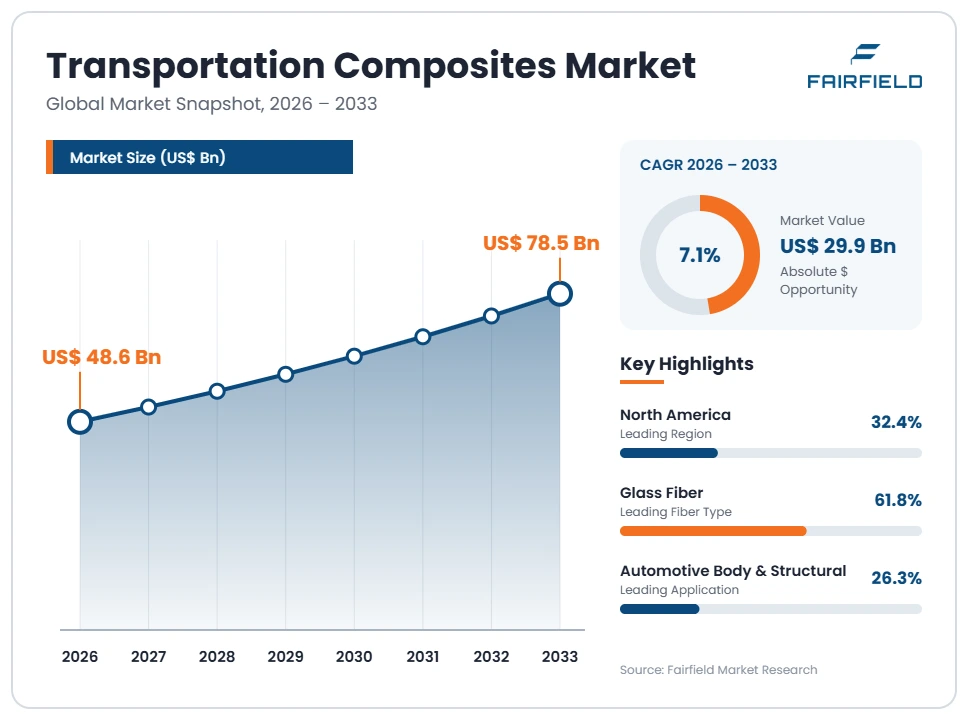
The global Transportation Composites market size is expected to be valued at US$ 48.6 billion in 2026 and projected to reach US$ 78.5 billion by 2033, growing at a CAGR of 7.1% between 2026 and 2033.
Between 2020 and 2025 the market advanced at roughly 5.2% a year, held back by a weak commercial aircraft build rate early in the period and by slow recovery in marine and rail procurement. Three factors shape the forecast. Aircraft production rates are climbing toward and beyond pre-pandemic levels on composite-intensive airframes. Battery electric vehicles need enclosures, covers and structural brackets where mass and thermal behaviour both matter. Compressed gas and hydrogen pressure vessels are a genuine volume application, with no metal alternative at the pressures involved. Growth is solid but disciplined rather than transformative, because cycle time, cost per part and certification effort still decide every programme, and metal remains the default wherever volumes are high.
Key Report Takeaways
- By Fiber Type: Glass Fiber held 61.8% share in 2026, while Carbon Fiber is projected to expand at a 9.2% CAGR through 2033, as aircraft build rates and pressure vessel programmes absorb more high-modulus reinforcement.
- By Resin Type: Polyester and Vinyl Ester held 38.4% share in 2026, while Thermoplastic matrices are projected to grow at a 10.6% CAGR through 2033, because welded joints and short cycles suit higher production rates.
- By Manufacturing Process: Compression Moulding held 22.6% share in 2026, while Automated Fibre and Tape Placement is projected to rise at a 10.9% CAGR through 2033, driven by labour reduction on large aerostructures.
- By Application: Automotive Body and Structural Parts held 26.3% share in 2026, while Battery Enclosures are projected to advance at an 11.8% CAGR through 2033, reflecting electric platform launches and crash containment requirements.
- By Geography: North America held 32.4% share in 2026, while Asia Pacific is projected to grow at a 9.4% CAGR through 2033, supported by shipbuilding, rail investment and electric vehicle assembly.
Global Transportation Composites Market Trends and Insights
Drivers Impact Analysis
Two forces account for most of the incremental demand for composite vehicle structures through 2033.
| Driver | Impact on CAGR Forecast | Geographic Relevance | Impact Timeline |
| Rising aircraft build rates on composite-intensive airframes | High | North America, Europe | Medium term 2–4 years |
| Electric platforms creating enclosure and pressure vessel demand | High | Asia Pacific, Europe | Long term ≥4 years |
Rising Aircraft Build Rates Convert Certified Designs Into Composite Part Volume
Aerospace output is the largest single driver of composite part demand, because certified composite-intensive airframes are now in series production. Wings, fuselage barrels, empennage, nacelles, fairings and interior monuments are already qualified in composite form, so every additional delivery slot converts directly into reinforcement, prepreg and finished part volume. Deliveries, not new design wins, set the growth rate for most suppliers.
The mechanism is certification lock-in. Once a structure is approved under airworthiness requirements covering composite damage tolerance, bonded joints and environmental effects, the material and process are effectively frozen for the programme’s life. Changing a prepreg supplier or a cure cycle triggers requalification against shared allowables databases and a fresh test pyramid, which costs years. That rigidity suppresses switching but guarantees the incumbent material a long, predictable production run, and it makes build rate the one variable that genuinely moves revenue.
Electric Powertrains Create Enclosure and Pressure Vessel Applications Composites Can Win
Electrified and gas-fuelled vehicles are opening the first genuinely high-volume composite applications in road transport. Battery enclosures need stiffness, crash containment, electrical insulation and flame resistance in one part, which suits sheet moulding compound and glass-reinforced thermoplastics. Compressed hydrogen and natural gas cylinders must be filament wound in carbon fibre, because no metal alternative meets the burst pressure and mass targets at the same time.
The causal chain runs from vehicle mass and packaging. Battery packs add hundreds of kilograms, so designers claw mass back from covers, trays and brackets, and composites reduce part count by integrating mounts and seals into single mouldings. Pressure vessels have no metal substitute above moderate working pressures. UNECE vehicle regulations covering electric powertrain safety and crash performance set the gates these parts must pass, and once a composite enclosure is homologated it generally stays for the platform’s life.
Restraints Impact Analysis
Two constraints explain why composites have not displaced metal in mass-market vehicle structures.
| Restraint | Impact on CAGR Forecast | Geographic Relevance | Impact Timeline |
| Cycle time and cost per part against aluminium and advanced steel | High | Global | Long term ≥4 years |
| Repair, inspection and end-of-life uncertainty | Medium | Europe, North America | Medium term 2–4 years |
Cycle Time and Cost Per Part Keep Composites Out of Mass-Market Body Structures
The predicted mass-market automotive composite revolution has not arrived, and cycle time is the reason. A steel body side stamps in seconds and an aluminium casting cures in minutes, while a structural composite part cures in anything from several minutes to several hours. At annual volumes above roughly a hundred thousand units, the tooling and press count needed to match that takt becomes uneconomic, so composites remain confined to low-volume performance cars, niche derivatives and discrete components.
The cost sources are specific rather than general. Carbon fibre precursor and oxidation energy keep fibre prices high, prepreg requires frozen storage and has limited out-life, autoclave cycles consume capital-intensive asset hours, and trimming, drilling and finishing add manual labour that metal processes avoid. Scrap is difficult to reuse. Aluminium and advanced high-strength steel have meanwhile improved their own mass efficiency, holding the cost line and narrowing the weight advantage composites can monetise.
Repair, Inspection and End-of-Life Uncertainty Slow Fleet-Level Adoption
Service economics restrain composite adoption even where the part itself performs well. Impact damage can leave little visible evidence while reducing residual strength, so inspection relies on ultrasonic or thermographic methods and trained technicians. Repairs are bonded, process-controlled and often require a qualified facility, which lengthens vehicle downtime, raises insurance assessments and worries fleet operators who judge total cost over a long service life.
End-of-life is the second unresolved issue. Thermoset laminates cannot be remelted, so recovery depends on mechanical grinding, pyrolysis or solvolysis, none of which returns fibre at original properties or at competitive cost. Automotive recovery and recycled content policy increasingly counts materials that can demonstrate a route back into production, and composites struggle on that test. Rail and marine operators face similar questions at disposal, which makes procurement teams cautious about committing large structures to thermoset construction.
Market Opportunities
Thermoplastic Composites Open a Weldable, Fast-Cycle Revenue Pool
Thermoplastic matrices are the clearest route to a new revenue pool, because they change the economics rather than the material story. Parts can be stamped in minutes, joined by induction or resistance welding instead of fasteners and adhesives, stored without refrigeration and reprocessed from scrap. That combination attacks the three costs that keep thermosets out of higher-rate programmes: cure time, assembly labour and material waste.
Aerostructure suppliers, automotive tier one moulders and pressure vessel makers are best placed to capture it, and demand comes from single-aisle aircraft work packages, battery enclosures and bracketry where build rates are high. Welded joints also remove thousands of fasteners from an airframe, cutting mass and drilling labour. Mechanical characterisation under ISO 14125 and ASTM D7264 supports the design allowables that programmes need before committing to these matrices at scale.
Hydrogen and Compressed Gas Pressure Vessels Build a Durable Filament Winding Business
Pressure vessels are a rare composite application with no credible metal substitute, which makes them a durable revenue pool rather than a cyclical one. Type III and Type IV cylinders use carbon fibre filament wound over metal or polymer liners, and each vessel consumes a large, predictable quantity of fibre and resin. Fuel cell trucks, buses, rail shunters, marine auxiliary power and ground storage all draw on the same manufacturing base.
Filament winding specialists and fibre producers with qualified aerospace-grade supply can capture this demand, and commercial vehicle and bus builders create most of it. Vessel certification is demanding but well defined, which suits suppliers able to fund qualification once and amortise it over long production runs. Hydrogen refuelling infrastructure programmes across several economies underpin the order book and give winders visibility that automotive body programmes rarely offer.
Segment Analysis
- By Fiber Type: Glass Fiber Dominates Volume While Carbon Fiber Grows Quicker
Glass Fiber held 61.8% of transportation composite demand in 2026, because it delivers adequate stiffness at a fraction of carbon fibre’s cost and dominates boat hulls, rail interiors, truck panels, battery enclosures and automotive semi-structural parts. Its processing versatility across spray-up, infusion, pultrusion and compression moulding keeps it the default reinforcement wherever cost governs.
Carbon Fiber is the fastest-growing reinforcement at a 9.2% CAGR through 2033, led by aircraft build rates, pressure vessels and performance vehicle structures where specific stiffness is worth paying for. Aramid Fiber holds specialised positions in ballistic protection, impact liners and friction materials, while Natural Fiber appears in interior trim where weight, acoustics and recycled content policy matter more than strength. The implication for suppliers is a two-speed business: glass carries tonnage and cash flow, while carbon carries growth and qualification risk.
- By Resin Type: Polyester and Vinyl Ester Lead as Thermoplastic Matrices Accelerate
Polyester and Vinyl Ester systems held 38.4% share in 2026, because they underpin marine hulls, rail panels, truck components and sheet moulding compound at a cost no other matrix matches. Epoxy follows, holding the aerospace prepreg and high-performance automotive positions where toughness, fatigue behaviour and hot-wet performance justify a premium, and polyurethane serves pultruded profiles and fast-cycle structural parts.
Thermoplastic matrices grow fastest at a 10.6% CAGR to 2033, including polypropylene, polyamide, polyphenylene sulphide and polyaryletherketone systems. Their advantages are minutes-long forming cycles, weldable joints, indefinite shelf life and reprocessable scrap, all of which suit higher build rates. Qualification data and consolidation quality remain the gating issues for primary structure. The commercial consequence is that matrix choice is increasingly a production-rate decision rather than a purely mechanical one, and part makers are investing in forming presses rather than autoclaves.
- By Manufacturing Process: Compression Moulding Leads While Automated Placement Expands
Compression Moulding of sheet moulding compound and prepreg held 22.6% share in 2026, because it offers the shortest realistic cycle for structural parts and suits truck panels, battery enclosures, underbody shields and class A automotive closures. Resin Transfer Moulding and Infusion follow for large marine and rail structures, while Prepreg and Autoclave retains the aerospace primary structure positions that certification has locked in.
Automated Fibre and Tape Placement is the fastest-growing process at a 10.9% CAGR through 2033, because it removes manual lay-up labour on wing skins, fuselage sections and large shells, and because it supports out-of-autoclave and thermoplastic in-situ consolidation. Pultrusion and Filament Winding grow steadily on rail profiles and pressure vessels, and Thermoplastic Stamping gains with electric vehicle brackets. Process capability now determines which programmes a supplier can even bid for, so capital equipment choice is the central strategic decision.
- By Application: Automotive Parts Hold the Largest Share While Battery Enclosures Surge
Automotive Body and Structural Parts accounted for 26.3% of the market in 2026, covering closures, spoilers, underbody shields, leaf springs, seat structures and semi-structural panels across passenger cars and commercial vehicles. Aerospace Primary and Secondary Structure follows with far higher value per kilogram, and Aircraft Interiors adds a steady stream of panels, monuments and ducting governed by flammability requirements.
Battery Enclosures are the fastest-growing application at an 11.8% CAGR through 2033, as electric platforms multiply and designers consolidate trays, covers and thermal barriers into fewer mouldings. Pressure Vessels grow strongly on hydrogen and compressed gas programmes. Rail Car Bodies and Interiors expand more slowly but reliably, gated by fire, smoke and toxicity rules, while Boat Hulls and Decks track discretionary marine spending. The pattern confirms that composites win where a metal alternative is weak, not where it is merely heavier.
Geography Analysis
- Which Region Is Leading the Transportation Composites Market?
North America leads the transportation composites market with 32.4% share in 2026, because it concentrates large civil aircraft assembly, defence aerostructures, business aviation and the deepest base of qualified prepreg and part manufacturing. The United States supplies most of that demand through airframe programmes, engine nacelles, space launch structures and a substantial recreational boat industry. Canada contributes regional aircraft, rail vehicle production and wind-adjacent fabrication capacity, while Mexico hosts automotive and aerostructure moulding plants serving cross-border supply chains. Growth is paced by aircraft deliveries rather than by road vehicle adoption, since cost comparisons still favour aluminium and advanced steel for mass-market bodies. The clearest regional opportunity is thermoplastic aerostructure work packages and hydrogen cylinder manufacturing, both of which suit the region’s existing qualification infrastructure and skilled fabrication base.
- Certification, Fire Rules and Recycling Policy Define Composite Demand Across Europe
Europe held 29.6% share in 2026, anchored by France, Germany, the United Kingdom, Italy and Spain, which together cover airframe and engine structures, premium automotive, rail vehicle building and a large leisure marine industry. Regulatory gates are unusually specific here: EN 45545 fire, smoke and toxicity requirements govern rail vehicle materials, and ISO 12215 sets small craft hull construction rules, so material selection is decided early in design. Vehicle carbon dioxide standards and end-of-life recovery policy pull in opposite directions, rewarding lightweighting while penalising materials without a recycling route. Growth is moderate and engineering-led. The opportunity lies in recyclable thermoplastic structures and in rail refurbishment programmes, where compliant composite interiors replace heavier assemblies on existing fleets.
- Which Region Is Growing Fastest in the Transportation Composites Market?
Asia Pacific is the fastest-growing geography in the transportation composites market, advancing at a 9.4% CAGR to 2033 from a 27.2% share in 2026. China drives most of that expansion through electric vehicle assembly, high-speed rail rolling stock, shipbuilding and a rapidly maturing domestic carbon fibre industry. Japan supplies advanced reinforcements and aerostructure work packages, and the Republic of Korea combines shipbuilding with battery enclosure and pressure vessel manufacturing. India is adding rail coach production, commercial vehicle components and compressed gas cylinder capacity. Regional growth is helped by lower labour costs, which partly offset the finishing labour that burdens composite parts elsewhere. The main constraint is qualification depth for flight-critical structure, and the main opportunity is localised supply of battery enclosures and gas cylinders.
- Commercial Vehicle Bodies and Marine Work Define Latin America
Latin America accounted for 5.8% of demand in 2026, with Brazil the largest market through bus and truck body construction, rail vehicle assembly, agricultural equipment and a well-established regional aircraft industry that consumes qualified composite structures. Mexico adds automotive moulding capacity, and Argentina and Chile support marine and mining vehicle applications. Demand is concentrated in glass-reinforced polyester and vinyl ester rather than advanced systems. The barriers are real: imported prepreg and carbon fibre carry freight and duty costs, currency volatility complicates long-term contracts, and there is limited local testing and certification infrastructure for structural qualification. The opportunity is bus and coach lightweighting, where composite panels and roofs cut mass on vehicles that run high daily mileage.
- Rail Investment and Marine Fabrication Shape Middle East & Africa
Middle East & Africa represented 5.0% of the market in 2026, the smallest share, but metro and passenger rail investment in Saudi Arabia, the United Arab Emirates, Qatar and Egypt is creating demand for composite interior panels, cab fronts and equipment covers. Leisure and workboat fabrication in the United Arab Emirates and Türkiye-linked supply chains supports marine laminating capacity, and South Africa hosts automotive component moulding tied to export assembly. Almost all advanced reinforcement is imported, local design authority is limited, and skilled laminating and bonding labour is scarce, which pushes complex structures offshore. Industrial localisation policy is the main change under way, creating openings for suppliers willing to train converters and support rail fire certification work.
Competitive Landscape
The transportation composites market is moderately concentrated and splits into distinct competitive layers. A small group of integrated fibre and prepreg producers supplies qualified aerospace material and holds positions that certification makes difficult to dislodge. A much larger and more fragmented population of part manufacturers serves automotive, truck, rail and marine customers, where regional moulders compete on tooling capability, capacity and price. Consolidation has been steady but undramatic, usually taking the form of fibre producers acquiring part makers to reach closer to the aircraft or vehicle programme.
Competition is decided by qualification status, process capability and delivered cost per part rather than by material properties alone. Suppliers compete on whether their material already appears in a shared allowables database, whether they can hold rate, and whether they can absorb design-for-manufacture work for the customer. Automation capability is now a direct differentiator, because automated placement and press forming change the labour content that dominates part cost. New entrants are strongest in thermoplastic forming, out-of-autoclave processing and recycled fibre compounds, where no incumbent holds a certified lock.
Strategic activity concentrates on capacity positioned close to programme demand, on thermoplastic processing capability, and on vertical moves that let fibre producers sell finished structures instead of raw material. Partnerships between part makers and vehicle builders are increasingly formed at the concept stage, because composite parts must be designed around the process from the beginning. Investment in recycling routes and in inspection and repair services is a growing differentiator, particularly for operators judging whole-life cost.
Strategic direction across the industry points toward rate-capable processes, matrices that can be welded and reprocessed, and credible end-of-life answers, with suppliers positioning for applications where metal genuinely cannot compete.
Recent Industry Developments
- January 2024: The first phase of the carbon offsetting and reduction scheme for international aviation, administered by the International Civil Aviation Organization, began – strengthening the commercial case for weight reduction on in-production airframes and sustaining demand for composite structures.
- April 2025: The marine environment protection committee of the International Maritime Organization approved a net-zero framework for international shipping – signalling long-run pressure on vessel efficiency that supports composite superstructures, interiors and auxiliary components.
- May 2025: The European Union amended its car and van carbon dioxide standards to allow compliance to be averaged across 2025, 2026 and 2027 – easing immediate lightweighting pressure on vehicle makers while leaving the longer-term mass reduction trajectory intact.
Companies Covered in the Report
- Toray Industries, Inc.
- Hexcel Corporation
- Teijin Limited
- SGL Carbon SE
- Mitsubishi Chemical Group Corporation
- Owens Corning
- Johns Manville
- Gurit Holding AG
- Spirit AeroSystems Holdings, Inc.
- GKN Aerospace
- Magna International Inc.
- Core Molding Technologies, Inc.
- Exel Composites Oyj
Transportation Composites Market Report Scope
| Metric | Value |
| Study Period | 2020–2033 |
| Market Size 2026 | US$ 48.6 Billion |
| Market Size 2033 | US$ 78.5 Billion |
| CAGR 2026–2033 | 7.1% |
| Absolute Dollar Opportunity | US$ 29.9 Billion |
| Largest Market | North America (32.4% share in 2026) |
| Fastest-Growing Market | Asia Pacific (9.4% CAGR) |
| Market Concentration | Medium |
| Major Players | Toray Industries, Inc., Hexcel Corporation, Teijin Limited, Owens Corning |
Transportation Composites Market Segmentation
Fiber Type
- Carbon Fiber
- Glass Fiber
- Aramid Fiber
- Natural Fiber
Resin Type
- Epoxy
- Polyester and Vinyl Ester
- Polyurethane
- Thermoplastic
Manufacturing Process
- Hand Lay-up
- Resin Transfer Moulding and Infusion
- Prepreg and Autoclave
- Out-of-Autoclave Curing
- Compression Moulding
- Pultrusion
- Filament Winding
- Automated Fibre and Tape Placement
- Thermoplastic Stamping
Application
- Aerospace Primary and Secondary Structure
- Aircraft Interiors
- Automotive Body and Structural Parts
- Battery Enclosures
- Pressure Vessels
- Rail Car Bodies and Interiors
- Boat Hulls and Decks
Regions
- North America
- Europe
- Asia Pacific
- Latin America
- Middle East & Africa
- Executive Summary
- Global Transportation Composites Market Snapshot
- Future Projections, 2026-2033
- Key Market Trends
- Regional Snapshot
- Market Overview
- Market Definition and Report Scope
- Historical Market Trends, 2020-2025
- Market Dynamics
- Drivers Impact Analysis
- Rising Aircraft Build Rates Convert Certified Designs Into Composite Part Volume
- Electric Powertrains Create Enclosure and Pressure Vessel Applications Composites Can Win
- Restraints Impact Analysis
- Cycle Time and Cost Per Part Keep Composites Out of Mass-Market Body Structures
- Repair, Inspection and End-of-Life Uncertainty Slow Fleet-Level Adoption
- Market Opportunities
- Thermoplastic Composites Open a Weldable, Fast-Cycle Revenue Pool
- Hydrogen and Compressed Gas Pressure Vessels Build a Durable Filament Winding Business
- Drivers Impact Analysis
- Global Transportation Composites Market Outlook, 2020-2033
- Global Transportation Composites Market Outlook, by Fiber Type, Value (US$ Billion), 2020-2033
- Carbon Fiber
- Glass Fiber
- Aramid Fiber
- Natural Fiber
- Global Transportation Composites Market Outlook, by Resin Type, Value (US$ Billion), 2020-2033
- Epoxy
- Polyester and Vinyl Ester
- Polyurethane
- Thermoplastic
- Global Transportation Composites Market Outlook, by Manufacturing Process, Value (US$ Billion), 2020-2033
- Hand Lay-up
- Resin Transfer Moulding and Infusion
- Prepreg and Autoclave
- Out-of-Autoclave Curing
- Compression Moulding
- Pultrusion
- Filament Winding
- Automated Fibre and Tape Placement
- Thermoplastic Stamping
- Global Transportation Composites Market Outlook, by Application, Value (US$ Billion), 2020-2033
- Aerospace Primary and Secondary Structure
- Aircraft Interiors
- Automotive Body and Structural Parts
- Battery Enclosures
- Pressure Vessels
- Rail Car Bodies and Interiors
- Boat Hulls and Decks
- Global Transportation Composites Market Outlook, by Region, Value (US$ Billion), 2020-2033
- North America
- Europe
- Asia Pacific
- Latin America
- Middle East & Africa
- Global Transportation Composites Market Outlook, by Fiber Type, Value (US$ Billion), 2020-2033
- North America Transportation Composites Market Outlook, 2020-2033
- North America Transportation Composites Market Outlook, by Fiber Type, Value (US$ Billion), 2020-2033
- Carbon Fiber
- Glass Fiber
- Aramid Fiber
- Natural Fiber
- North America Transportation Composites Market Outlook, by Resin Type, Value (US$ Billion), 2020-2033
- Epoxy
- Polyester and Vinyl Ester
- Polyurethane
- Thermoplastic
- North America Transportation Composites Market Outlook, by Manufacturing Process, Value (US$ Billion), 2020-2033
- Hand Lay-up
- Resin Transfer Moulding and Infusion
- Prepreg and Autoclave
- Out-of-Autoclave Curing
- Compression Moulding
- Pultrusion
- Filament Winding
- Automated Fibre and Tape Placement
- Thermoplastic Stamping
- North America Transportation Composites Market Outlook, by Application, Value (US$ Billion), 2020-2033
- Aerospace Primary and Secondary Structure
- Aircraft Interiors
- Automotive Body and Structural Parts
- Battery Enclosures
- Pressure Vessels
- Rail Car Bodies and Interiors
- Boat Hulls and Decks
- North America Transportation Composites Market Outlook, by Country, Value (US$ Billion), 2020-2033
- United States Transportation Composites Market Outlook, by Fiber Type, 2020-2033
- United States Transportation Composites Market Outlook, by Resin Type, 2020-2033
- United States Transportation Composites Market Outlook, by Manufacturing Process, 2020-2033
- United States Transportation Composites Market Outlook, by Application, 2020-2033
- Canada Transportation Composites Market Outlook, by Fiber Type, 2020-2033
- Canada Transportation Composites Market Outlook, by Resin Type, 2020-2033
- Canada Transportation Composites Market Outlook, by Manufacturing Process, 2020-2033
- Canada Transportation Composites Market Outlook, by Application, 2020-2033
- Mexico Transportation Composites Market Outlook, by Fiber Type, 2020-2033
- Mexico Transportation Composites Market Outlook, by Resin Type, 2020-2033
- Mexico Transportation Composites Market Outlook, by Manufacturing Process, 2020-2033
- Mexico Transportation Composites Market Outlook, by Application, 2020-2033
- North America Transportation Composites Market Outlook, by Fiber Type, Value (US$ Billion), 2020-2033
- Europe Transportation Composites Market Outlook, 2020-2033
- Europe Transportation Composites Market Outlook, by Fiber Type, Value (US$ Billion), 2020-2033
- Carbon Fiber
- Glass Fiber
- Aramid Fiber
- Natural Fiber
- Europe Transportation Composites Market Outlook, by Resin Type, Value (US$ Billion), 2020-2033
- Epoxy
- Polyester and Vinyl Ester
- Polyurethane
- Thermoplastic
- Europe Transportation Composites Market Outlook, by Manufacturing Process, Value (US$ Billion), 2020-2033
- Hand Lay-up
- Resin Transfer Moulding and Infusion
- Prepreg and Autoclave
- Out-of-Autoclave Curing
- Compression Moulding
- Pultrusion
- Filament Winding
- Automated Fibre and Tape Placement
- Thermoplastic Stamping
- Europe Transportation Composites Market Outlook, by Application, Value (US$ Billion), 2020-2033
- Aerospace Primary and Secondary Structure
- Aircraft Interiors
- Automotive Body and Structural Parts
- Battery Enclosures
- Pressure Vessels
- Rail Car Bodies and Interiors
- Boat Hulls and Decks
- Europe Transportation Composites Market Outlook, by Country, Value (US$ Billion), 2020-2033
- France Transportation Composites Market Outlook, by Fiber Type, 2020-2033
- France Transportation Composites Market Outlook, by Resin Type, 2020-2033
- France Transportation Composites Market Outlook, by Manufacturing Process, 2020-2033
- France Transportation Composites Market Outlook, by Application, 2020-2033
- Germany Transportation Composites Market Outlook, by Fiber Type, 2020-2033
- Germany Transportation Composites Market Outlook, by Resin Type, 2020-2033
- Germany Transportation Composites Market Outlook, by Manufacturing Process, 2020-2033
- Germany Transportation Composites Market Outlook, by Application, 2020-2033
- United Kingdom Transportation Composites Market Outlook, by Fiber Type, 2020-2033
- United Kingdom Transportation Composites Market Outlook, by Resin Type, 2020-2033
- United Kingdom Transportation Composites Market Outlook, by Manufacturing Process, 2020-2033
- United Kingdom Transportation Composites Market Outlook, by Application, 2020-2033
- Italy Transportation Composites Market Outlook, by Fiber Type, 2020-2033
- Italy Transportation Composites Market Outlook, by Resin Type, 2020-2033
- Italy Transportation Composites Market Outlook, by Manufacturing Process, 2020-2033
- Italy Transportation Composites Market Outlook, by Application, 2020-2033
- Spain Transportation Composites Market Outlook, by Fiber Type, 2020-2033
- Spain Transportation Composites Market Outlook, by Resin Type, 2020-2033
- Spain Transportation Composites Market Outlook, by Manufacturing Process, 2020-2033
- Spain Transportation Composites Market Outlook, by Application, 2020-2033
- Europe Transportation Composites Market Outlook, by Fiber Type, Value (US$ Billion), 2020-2033
- Asia Pacific Transportation Composites Market Outlook, 2020-2033
- Asia Pacific Transportation Composites Market Outlook, by Fiber Type, Value (US$ Billion), 2020-2033
- Carbon Fiber
- Glass Fiber
- Aramid Fiber
- Natural Fiber
- Asia Pacific Transportation Composites Market Outlook, by Resin Type, Value (US$ Billion), 2020-2033
- Epoxy
- Polyester and Vinyl Ester
- Polyurethane
- Thermoplastic
- Asia Pacific Transportation Composites Market Outlook, by Manufacturing Process, Value (US$ Billion), 2020-2033
- Hand Lay-up
- Resin Transfer Moulding and Infusion
- Prepreg and Autoclave
- Out-of-Autoclave Curing
- Compression Moulding
- Pultrusion
- Filament Winding
- Automated Fibre and Tape Placement
- Thermoplastic Stamping
- Asia Pacific Transportation Composites Market Outlook, by Application, Value (US$ Billion), 2020-2033
- Aerospace Primary and Secondary Structure
- Aircraft Interiors
- Automotive Body and Structural Parts
- Battery Enclosures
- Pressure Vessels
- Rail Car Bodies and Interiors
- Boat Hulls and Decks
- Asia Pacific Transportation Composites Market Outlook, by Country, Value (US$ Billion), 2020-2033
- China Transportation Composites Market Outlook, by Fiber Type, 2020-2033
- China Transportation Composites Market Outlook, by Resin Type, 2020-2033
- China Transportation Composites Market Outlook, by Manufacturing Process, 2020-2033
- China Transportation Composites Market Outlook, by Application, 2020-2033
- Japan Transportation Composites Market Outlook, by Fiber Type, 2020-2033
- Japan Transportation Composites Market Outlook, by Resin Type, 2020-2033
- Japan Transportation Composites Market Outlook, by Manufacturing Process, 2020-2033
- Japan Transportation Composites Market Outlook, by Application, 2020-2033
- Republic of Korea Transportation Composites Market Outlook, by Fiber Type, 2020-2033
- Republic of Korea Transportation Composites Market Outlook, by Resin Type, 2020-2033
- Republic of Korea Transportation Composites Market Outlook, by Manufacturing Process, 2020-2033
- Republic of Korea Transportation Composites Market Outlook, by Application, 2020-2033
- India Transportation Composites Market Outlook, by Fiber Type, 2020-2033
- India Transportation Composites Market Outlook, by Resin Type, 2020-2033
- India Transportation Composites Market Outlook, by Manufacturing Process, 2020-2033
- India Transportation Composites Market Outlook, by Application, 2020-2033
- Asia Pacific Transportation Composites Market Outlook, by Fiber Type, Value (US$ Billion), 2020-2033
- Latin America Transportation Composites Market Outlook, 2020-2033
- Latin America Transportation Composites Market Outlook, by Fiber Type, Value (US$ Billion), 2020-2033
- Carbon Fiber
- Glass Fiber
- Aramid Fiber
- Natural Fiber
- Latin America Transportation Composites Market Outlook, by Resin Type, Value (US$ Billion), 2020-2033
- Epoxy
- Polyester and Vinyl Ester
- Polyurethane
- Thermoplastic
- Latin America Transportation Composites Market Outlook, by Manufacturing Process, Value (US$ Billion), 2020-2033
- Hand Lay-up
- Resin Transfer Moulding and Infusion
- Prepreg and Autoclave
- Out-of-Autoclave Curing
- Compression Moulding
- Pultrusion
- Filament Winding
- Automated Fibre and Tape Placement
- Thermoplastic Stamping
- Latin America Transportation Composites Market Outlook, by Application, Value (US$ Billion), 2020-2033
- Aerospace Primary and Secondary Structure
- Aircraft Interiors
- Automotive Body and Structural Parts
- Battery Enclosures
- Pressure Vessels
- Rail Car Bodies and Interiors
- Boat Hulls and Decks
- Latin America Transportation Composites Market Outlook, by Country, Value (US$ Billion), 2020-2033
- Brazil Transportation Composites Market Outlook, by Fiber Type, 2020-2033
- Brazil Transportation Composites Market Outlook, by Resin Type, 2020-2033
- Brazil Transportation Composites Market Outlook, by Manufacturing Process, 2020-2033
- Brazil Transportation Composites Market Outlook, by Application, 2020-2033
- Mexico Transportation Composites Market Outlook, by Fiber Type, 2020-2033
- Mexico Transportation Composites Market Outlook, by Resin Type, 2020-2033
- Mexico Transportation Composites Market Outlook, by Manufacturing Process, 2020-2033
- Mexico Transportation Composites Market Outlook, by Application, 2020-2033
- Argentina Transportation Composites Market Outlook, by Fiber Type, 2020-2033
- Argentina Transportation Composites Market Outlook, by Resin Type, 2020-2033
- Argentina Transportation Composites Market Outlook, by Manufacturing Process, 2020-2033
- Argentina Transportation Composites Market Outlook, by Application, 2020-2033
- Chile Transportation Composites Market Outlook, by Fiber Type, 2020-2033
- Chile Transportation Composites Market Outlook, by Resin Type, 2020-2033
- Chile Transportation Composites Market Outlook, by Manufacturing Process, 2020-2033
- Chile Transportation Composites Market Outlook, by Application, 2020-2033
- Latin America Transportation Composites Market Outlook, by Fiber Type, Value (US$ Billion), 2020-2033
- Middle East & Africa Transportation Composites Market Outlook, 2020-2033
- Middle East & Africa Transportation Composites Market Outlook, by Fiber Type, Value (US$ Billion), 2020-2033
- Carbon Fiber
- Glass Fiber
- Aramid Fiber
- Natural Fiber
- Middle East & Africa Transportation Composites Market Outlook, by Resin Type, Value (US$ Billion), 2020-2033
- Epoxy
- Polyester and Vinyl Ester
- Polyurethane
- Thermoplastic
- Middle East & Africa Transportation Composites Market Outlook, by Manufacturing Process, Value (US$ Billion), 2020-2033
- Hand Lay-up
- Resin Transfer Moulding and Infusion
- Prepreg and Autoclave
- Out-of-Autoclave Curing
- Compression Moulding
- Pultrusion
- Filament Winding
- Automated Fibre and Tape Placement
- Thermoplastic Stamping
- Middle East & Africa Transportation Composites Market Outlook, by Application, Value (US$ Billion), 2020-2033
- Aerospace Primary and Secondary Structure
- Aircraft Interiors
- Automotive Body and Structural Parts
- Battery Enclosures
- Pressure Vessels
- Rail Car Bodies and Interiors
- Boat Hulls and Decks
- Middle East & Africa Transportation Composites Market Outlook, by Country, Value (US$ Billion), 2020-2033
- Saudi Arabia Transportation Composites Market Outlook, by Fiber Type, 2020-2033
- Saudi Arabia Transportation Composites Market Outlook, by Resin Type, 2020-2033
- Saudi Arabia Transportation Composites Market Outlook, by Manufacturing Process, 2020-2033
- Saudi Arabia Transportation Composites Market Outlook, by Application, 2020-2033
- United Arab Emirates Transportation Composites Market Outlook, by Fiber Type, 2020-2033
- United Arab Emirates Transportation Composites Market Outlook, by Resin Type, 2020-2033
- United Arab Emirates Transportation Composites Market Outlook, by Manufacturing Process, 2020-2033
- United Arab Emirates Transportation Composites Market Outlook, by Application, 2020-2033
- Qatar Transportation Composites Market Outlook, by Fiber Type, 2020-2033
- Qatar Transportation Composites Market Outlook, by Resin Type, 2020-2033
- Qatar Transportation Composites Market Outlook, by Manufacturing Process, 2020-2033
- Qatar Transportation Composites Market Outlook, by Application, 2020-2033
- Egypt Transportation Composites Market Outlook, by Fiber Type, 2020-2033
- Egypt Transportation Composites Market Outlook, by Resin Type, 2020-2033
- Egypt Transportation Composites Market Outlook, by Manufacturing Process, 2020-2033
- Egypt Transportation Composites Market Outlook, by Application, 2020-2033
- Türkiye Transportation Composites Market Outlook, by Fiber Type, 2020-2033
- Türkiye Transportation Composites Market Outlook, by Resin Type, 2020-2033
- Türkiye Transportation Composites Market Outlook, by Manufacturing Process, 2020-2033
- Türkiye Transportation Composites Market Outlook, by Application, 2020-2033
- South Africa Transportation Composites Market Outlook, by Fiber Type, 2020-2033
- South Africa Transportation Composites Market Outlook, by Resin Type, 2020-2033
- South Africa Transportation Composites Market Outlook, by Manufacturing Process, 2020-2033
- South Africa Transportation Composites Market Outlook, by Application, 2020-2033
- Middle East & Africa Transportation Composites Market Outlook, by Fiber Type, Value (US$ Billion), 2020-2033
- Competitive Landscape
- Market Concentration and Industry Leaders
- Competitive Differentiation
- Strategic Initiatives
- Recent Industry Developments
- Company Profiles
- Toray Industries, Inc.
- Hexcel Corporation
- Teijin Limited
- SGL Carbon SE
- Mitsubishi Chemical Group Corporation
- Owens Corning
- Johns Manville
- Gurit Holding AG
- Spirit AeroSystems Holdings, Inc.
- GKN Aerospace
- Magna International Inc.
- Core Molding Technologies, Inc.
- Exel Composites Oyj
- Appendix
- Research Methodology
- Report Assumptions
- Acronyms and Abbreviations
Fiber Type
- Carbon Fiber
- Glass Fiber
- Aramid Fiber
- Natural Fiber
Resin Type
- Epoxy
- Polyester and Vinyl Ester
- Polyurethane
- Thermoplastic
Manufacturing Process
- Hand Lay-up
- Resin Transfer Moulding and Infusion
- Prepreg and Autoclave
- Out-of-Autoclave Curing
- Compression Moulding
- Pultrusion
- Filament Winding
- Automated Fibre and Tape Placement
- Thermoplastic Stamping
Application
- Aerospace Primary and Secondary Structure
- Aircraft Interiors
- Automotive Body and Structural Parts
- Battery Enclosures
- Pressure Vessels
- Rail Car Bodies and Interiors
- Boat Hulls and Decks
Regions
- North America
- Europe
- Asia Pacific
- Latin America
- Middle East & Africa
Our Research Methodology
Considering the volatility of business today, traditional approaches to strategizing a game plan can be unfruitful if not detrimental. True ambiguity is no way to determine a forecast. A myriad of predetermined factors must be accounted for such as the degree of risk involved, the magnitude of circumstances, as well as conditions or consequences that are not known or unpredictable. To circumvent binary views that cast uncertainty, the application of market research intelligence to strategically posture, move, and enable actionable outcomes is necessary.
View Methodology
Quality Assured
Rigorous Validation Process

Confidentiality Assured
End-to-end Data Security

Custom Research Services
Tailored To Your Objectives
FAQs
The market is valued at US$ 48.6 billion in 2026, covering composite parts and the material systems specified into aerospace, road, rail and marine vehicles.
The market is projected to reach US$ 78.5 billion by 2033, growing at a 7.1% CAGR and adding US$ 29.9 billion of absolute opportunity.
Glass Fiber leads with 61.8% share in 2026, because it provides adequate stiffness at low cost across marine, rail, truck and automotive parts.
Battery Enclosures grow fastest at an 11.8% CAGR, while Asia Pacific is the quickest region at a 9.4% CAGR through 2033.
Concentration is medium: qualified aerospace material supply is narrow, while automotive, rail and marine part manufacturing remains regionally fragmented and competitive.
Related Reports
Tamper Evident Packaging Market Size, Share, Insights, Competitive Landscape, and Forecast 2026 to 2033
The global tamper evident packaging market is valued at US$18.5 billion in 2026, reaching US$26.9 billion by 2033, growing at a 5.5% CAGR
Personal Care Ingredients Market Size, Share, Insights, Competitive Landscape, and Forecast 2026 to 2033
The global personal care ingredients market is valued at US$18.6 billion in 2026, reaching US$28.2 billion by 2033, growing at a 6.1% CAGR
Medical Polymer Market Size, Share, Insights, Competitive Landscape, and Forecast 2026 to 2033
The global medical polymer market is valued at US$27.4 billion in 2026, reaching US$47.8 billion by 2033, growing at an 8.3% CAGR
Lithium Sulfides Market Size, Share, Insights, Competitive Landscape, and Forecast 2026 to 2033
The global lithium sulfides market is valued at US$0.1 billion in 2026, reaching US$0.7 billion by 2033, growing at a 32.0% CAGR
Single Coated Adhesive Tapes Market Size, Share, Insights, Competitive Landscape, and Forecast 2026 to 2033
The global single coated adhesive tapes market is valued at US$36.0 billion in 2026, reaching US$51.0 billion by 2033, growing at a 5.1% CAGR
Non-Woven Abrasives Market Size, Share, Insights, Competitive Landscape, and Forecast 2026 to 2033
Non-Woven Abrasives Market is projected to grow from US$ 2.89 billion in 2026 to US$ 4.03 billion by 2033 at a 4.9% CAGR. See key products and trends.