



Single Coated Adhesive Tapes Market
Single Coated Adhesive Tapes Market Size, Share, Insights, Competitive Landscape, and Forecast 2026 to 2033
Single Coated Adhesive Tapes Market Size and Trend Analysis
What Is the Growth Outlook for Single Coated Tapes?
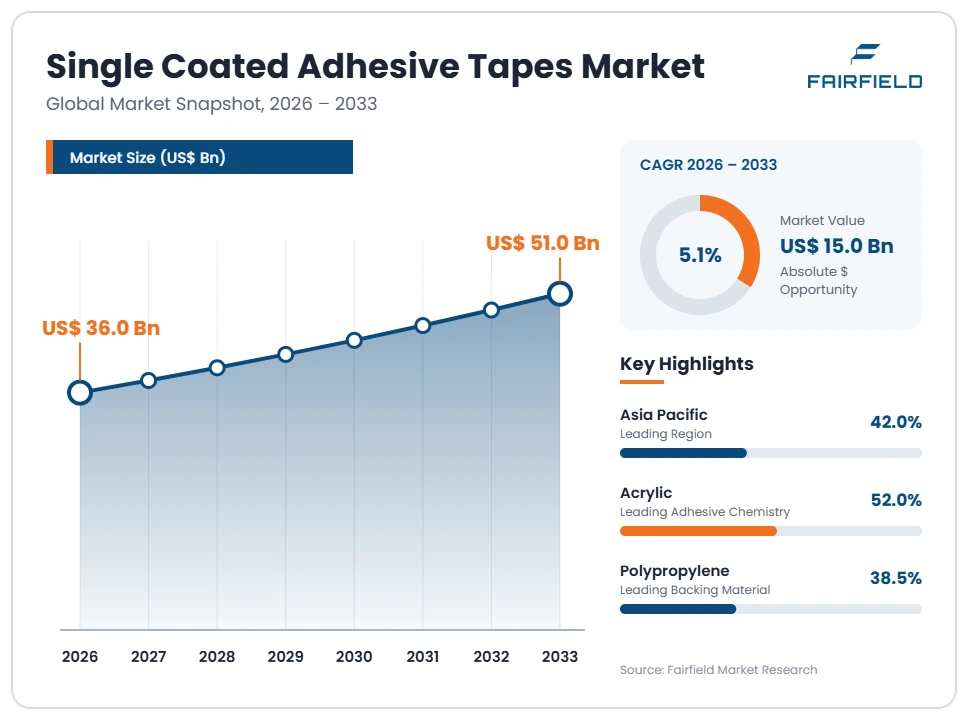
The global single coated adhesive tapes market size is expected to be valued at US$ 36.0 billion in 2026 and projected to reach US$ 51.0 billion by 2033, growing at a CAGR of 5.1% between 2026 and 2033.
Tape demand grew at a 3.9% CAGR between 2020 and 2025, a pace shaped by parcel volumes and by resin cost swings. Three forces lift the outlook. Electronics and battery assembly keep adding qualified specialty grades with high value per square metre. Vehicle wiring, thermal management and trim work are moving fastening from clips to tape. Packaging buyers are converting from film tape to paper-backed grades where recycling rules reward a single fibre stream. Growth stays in mid single digits because carton sealing, the largest application, is a commodity business priced close to raw material cost. Value gains come from specialty mix and from coating technology change rather than from square-metre volume alone.
Key Report Takeaways
- By Backing Material: Polypropylene backings held 38.5% share in 2026, while polyester backings are projected to expand at a 7.1% CAGR through 2033, because electronics and electrical insulation work needs thin films with high dielectric strength.
- By Adhesive Chemistry: Acrylic adhesives held 52.0% share in 2026, while silicone adhesives are projected to grow at a 7.4% CAGR through 2033, as high-temperature masking and low-surface-energy bonding move into battery and semiconductor work.
- By Technology: Solvent-based coating held 33.8% share in 2026, while ultraviolet-cured coating is projected to grow at an 8.0% CAGR through 2033, since curing on the line removes both solvent recovery and drying oven energy.
- By Application: Carton sealing and packaging held 29.5% share in 2026, while automotive and electronics assembly is projected to grow at a 7.6% CAGR through 2033, driven by harness wrapping and battery module construction.
- By Region: Asia Pacific held 42.0% share in 2026, while Middle East & Africa is projected to grow at a 6.6% CAGR through 2033, as converting capacity is built in Saudi Arabia, Egypt and Turkey.
Global Single Coated Adhesive Tapes Market Trends and Insights
Drivers Impact Analysis
Two forces explain most of the value growth behind the forecast.
| Driver | Impact on CAGR Forecast | Geographic Relevance | Impact Timeline |
| Qualified specialty tapes in electronics and vehicle assembly | High | Asia Pacific, Europe | Long term ≥4 years |
| Coating line scale and utilisation economics | Medium | Asia Pacific, North America | Medium term 2–4 years |
Qualified Specialty Grades in Electronics and Vehicle Assembly Lift Tape Value Per Square Metre
Specialty grades carry several times the price of a commodity packaging tape, so a small shift in mix moves revenue more than volume does. Electronics and vehicle assembly now consume thin polyester, foam, foil and silicone-adhesive tapes for insulation, shielding, thermal paths, masking and component fixing. Each of those uses is specified into a bill of materials and audited, which protects price far better than a carton sealing contract ever can.
The mechanism is qualification. A tape used inside a battery module or a wiring harness must hold adhesion, shear and electrical properties through heat, humidity and vibration testing before an assembly plant will release it. Specifications written against ASTM D3330 peel adhesion and ASTM D3654 shear holding power, alongside UL 510 listing for insulating tapes, define that qualification. Once a roll is written into a process document, replacing it requires retesting, so incumbency persists.
Coating Line Scale and Utilisation Decide Who Earns a Margin on Tape
Returns in this business come from coating and converting rather than from chemistry, and that shapes who grows. Resins, films, papers and adhesive raw materials are bought on open markets at similar prices by everyone, so the cost difference between suppliers sits in line speed, coating uniformity, slitting yield and waste. A wide coater running at high utilisation spreads fixed cost across far more square metres than a half-loaded narrow line.
The causal chain runs through capital intensity. A coating line, drying ovens or curing units, and slitting and rewinding equipment represent heavy fixed investment, and depreciation continues whether or not the line runs. Suppliers then chase volume to fill capacity, add a second or third shift before adding a line, and treat yield improvement as a direct margin gain. Converters with poor utilisation lose commodity business first.
Restraints Impact Analysis
Two structural pressures limit pricing power and capacity flexibility.
| Restraint | Impact on CAGR Forecast | Geographic Relevance | Impact Timeline |
| Resin and backing film price volatility against thin margins | High | Global | Short term ≤2 years |
| Emission permitting pressure on solvent-based coating lines | Medium | Europe, North America, Asia Pacific | Long term ≥4 years |
Resin and Backing Film Price Swings Squeeze Thin Commodity Tape Margins
Raw material cost is the dominant line item in a commodity tape, so price volatility passes almost directly into margin. Polypropylene film, paper, polyvinyl chloride and the monomers behind acrylic and rubber adhesives all track petrochemical markets. When feedstock rises quickly, carton sealing contracts written on annual pricing cannot be reset fast enough, and a converter absorbs the gap. When feedstock falls, buyers demand the saving back within a quarter.
The underlying cause is a thin conversion spread on high-volume grades. A standard packaging tape carries a value-added margin measured in single-digit percentages over material and freight, so a small input move erases it. Film gauge reduction is the usual defence, but thinner backing reaches a limit set by tensile strength and by dispenser performance. Long-term supply agreements with indexation help large converters and leave smaller ones exposed.
Solvent Emission Permitting Pushes Capacity Away From Solvent-Coated Grades
Air emission rules have made new solvent coating capacity difficult and expensive to permit, which constrains supply of some high-performance grades. Solvent systems still deliver the best anchorage and the thinnest, most uniform coat weights for demanding electrical and masking tapes. Building a new solvent line now requires thermal oxidisers or solvent recovery, continuous monitoring and a permit that regulators grant slowly, so capacity additions concentrate in a small number of sites.
The driver is regulatory. The European Union Industrial Emissions Directive sets permitting and emission control duties for coating installations, and the United States Environmental Protection Agency applies hazardous air pollutant standards to tape and label surface coating operations. National air rules in China, Japan and South Korea impose volatile organic compound limits on adhesive coating. Converters respond by shifting new investment toward water-based, hot melt and ultraviolet-cured systems.
Market Opportunities
Paper-Backed Recyclable Packaging Tapes Open a Premium Carton Sealing Tier
Paper-backed packaging tape creates the first genuine price tier that commodity carton sealing has seen, because it solves a disposal problem rather than a performance one. A corrugated box sealed with a paper tape can enter a fibre recycling stream whole, with no instruction to the consumer to strip plastic first. Brand owners pay a premium for that, which lifts a flat-priced product into a specified, differentiated one.
The buyers are e-commerce retailers, grocery chains and consumer brands under packaging fee schemes or retailer fibre targets, with Europe moving first. Capture depends on development work: water-based or hot melt adhesives that repulp cleanly, kraft backings that hold tension on automatic case sealers, and reinforced grades that match film tape performance on heavy cases. Converters able to supply at case-sealer speeds will take the volume.
Battery and Electronics Assembly Tapes Create a Qualified High-Margin Revenue Stream
Battery and electronics assembly is the richest new revenue pool for tape makers, because every cell module and display stack uses many small, highly specified pieces. Cell wrapping, busbar insulation, flame-retardant barriers, thermal interface carriers, component masking during conformal coating and display bonding each call for a different construction. Prices per square metre run far above packaging grades, and volumes scale with cell and device output rather than with parcel counts.
Demand comes from battery cell makers, module assemblers, electronics manufacturing services providers and display fabricators, concentrated in China, South Korea, Japan and increasingly Europe and North America. Capture requires flame-retardant and electrolyte-resistant chemistries, cleanroom slitting, tight die-cut tolerances and the documentation an automotive audit demands. Converters offering die-cut parts rather than plain rolls move further up the value chain.
Segment Analysis
- By Backing Material: Polypropylene Leads While Polyester Films Gain Share Fastest
Polypropylene backings, mostly biaxially oriented film, held 38.5% of the market in 2026. They dominate because carton sealing is the largest single application and biaxially oriented polypropylene gives the best combination of tensile strength, clarity, low cost and machine dispensing behaviour. High-volume film lines keep the backing cheap, and the material accepts both acrylic and hot melt adhesives without complex priming.
Polyester backings are the fastest-growing type at a 7.1% CAGR through 2033, pulled by electrical insulation, battery assembly and electronics masking where dielectric strength, dimensional stability and heat resistance matter. Polyvinyl chloride holds a strong position in electrical and lane-marking tapes, paper and crepe serve masking and fibre-based packaging, and cloth, foam, foil and polytetrafluoroethylene grades fill specialist niches. The mix shift toward thin engineered films steadily raises average selling value.
- By Adhesive Chemistry: Acrylic Systems Dominate While Silicone Adhesives Advance Quickest
Acrylic adhesives accounted for 52.0% of single coated tape value in 2026. They resist ultraviolet light, heat and ageing better than rubber systems, hold clear optical appearance, and can be formulated as solvent, water-based or ultraviolet-cured. That versatility makes acrylic the default for packaging tapes that must hold through storage and for electrical grades needing long service life.
Silicone adhesives are the fastest-growing chemistry at a 7.4% CAGR through 2033. They bond to silicone and other low-surface-energy surfaces that acrylics cannot wet, and they survive temperatures where acrylic softens, which suits high-temperature masking, semiconductor processing and battery applications. Rubber and hot melt systems retain large volumes in carton sealing and masking, where instant tack and low cost outweigh ageing performance. Chemistry selection increasingly follows service temperature rather than price.
- By Technology: Solvent Coating Holds Value Share While Ultraviolet Curing Expands Fastest
Solvent-based coating held 33.8% of the market in 2026. It remains the route to the thinnest, most uniform coat weights and the strongest anchorage to difficult films, which is why demanding electrical, masking and electronics grades still use it. A large installed base of permitted solvent lines, particularly in Asia Pacific, keeps the technology commercially important despite its emission burden.
Ultraviolet-cured coating is the fastest-growing technology at an 8.0% CAGR through 2033. Curing with light on the line removes drying ovens, solvent recovery and the associated energy and permitting cost, and it supports thick coat weights in a single pass. Water-based systems carry the bulk of packaging tape volume, while hot melt coating serves carton sealing and masking at very high line speeds. New capacity is now planned almost entirely outside solvent systems.
- By Application: Carton Sealing Carries Volume While Assembly Tapes Grow Fastest
Carton sealing and packaging held 29.5% of tape demand in 2026, making it the volume anchor and the toughest price battleground. Parcel and case volumes from online retail and distribution keep square-metre consumption high, but specifications are simple, switching is easy and regional competition is intense, so margins stay thin across the segment.
Automotive and electronics assembly is the fastest-growing application at a 7.6% CAGR through 2033, as wiring harness wrapping, battery module construction and display assembly add qualified tape content per unit. Masking and painting, electrical insulation, surface protection, splicing, medical and hygiene, and building and construction fill the middle ground with specified grades. The practical implication is that this market behaves as two businesses: a commodity packaging trade and a qualification-protected specialty trade.
Geography Analysis
- North America Buys Specialty Tape Value Rather Than Square Metres
North America held 23.5% of the market in 2026, with a mix weighted toward higher-value grades. Aerospace, medical device, electrical and industrial maintenance customers in the United States and Canada buy qualified tapes with documented performance, and domestic converters serve them with short-run slitting and die-cutting rather than long commodity campaigns. Parcel volumes also sustain large carton sealing consumption.
Regulation shapes the supply base. Hazardous air pollutant standards applied to tape and label surface coating operations have discouraged new solvent capacity, so investment has gone into water-based and hot melt lines. Vehicle assembly in the United States and Mexico is adding harness and battery tape demand as electrified platforms scale. The change to watch is reshoring of electronics and cell manufacturing, which would pull specialty tape converting closer to those plants.
- Europe Sets the Pace on Recyclable and Low-Emission Tape Construction
Europe accounted for 22.5% of global demand in 2026, with Germany, Italy, France, Spain and Poland carrying most converting capacity. The region’s tape industry is weighted toward engineered grades for vehicle assembly, electrical work and industrial masking, where German and Italian converters hold long-standing technical positions and supply global customers from a narrow specialty base.
Environmental rules are the defining regional force. Permitting duties for coating installations under the Industrial Emissions Directive have pushed capacity toward water-based, hot melt and ultraviolet systems, and retailer fibre targets have made paper-backed packaging tape a mainstream specification rather than a niche one. Growth runs below the global average because packaging volumes are mature. The opportunity lies in battery assembly tapes serving new cell plants.
- Which Region Is Leading the Single Coated Adhesive Tapes Market?
Asia Pacific leads the single coated adhesive tapes market with 42.0% share in 2026, because both the coating capacity and the end demand sit there. China holds the largest concentration of tape coating and slitting lines anywhere, supplying packaging, electrical and electronics grades at scale, and India, Vietnam, Thailand and Indonesia are adding converting capacity alongside export manufacturing.
Electronics is the decisive factor. Cell, display, semiconductor and device assembly concentrated in China, South Korea, Japan and Taiwan consumes the highest-value specialty constructions, and tape suppliers locate technical service beside those plants. Domestic film and resin production keeps input costs competitive. The regional change underway is tightening volatile organic compound regulation, which is pushing local converters from solvent systems toward water-based and hot melt coating.
- Latin America Grows With Packaging Converting and Vehicle Assembly
Latin America held 6.5% of the market in 2026, concentrated in Brazil and Mexico with smaller positions in Argentina, Colombia and Chile. Demand follows corrugated box production, food and beverage packaging, and the vehicle and appliance assembly plants that supply both domestic and export markets. Masking tape for refinish and industrial painting is a notably strong local category.
Barriers are mainly economic and logistical. Backing films and adhesive raw materials are frequently imported and dollar-priced, currency volatility complicates contract pricing, and local coating capacity is limited outside the two largest countries, which lengthens lead times for specialty grades. The clearest regional change is growth in online retail, which is raising carton sealing volume and drawing converters toward higher-speed hot melt packaging lines.
- Which Region Is Growing Fastest in the Single Coated Adhesive Tapes Market?
Middle East & Africa is the fastest-growing geography in single coated adhesive tapes at a 6.6% CAGR through 2033, from a 5.5% share in 2026, driven by investment in local converting rather than by end-market maturity. Saudi Arabia, the United Arab Emirates, Egypt and Turkey are adding film production, carton plants and tape slitting capacity as part of broader industrial diversification programmes, which replaces imported finished rolls with local output.
Construction activity across the Gulf states sustains demand for masking, duct and surface protection tapes, while expanding food and consumer goods packaging lifts carton sealing volume. Barriers include dependence on imported specialty backings, hot storage conditions that stress adhesive ageing, and a thin technical service base for qualified grades. The opportunity sits in regional jumbo-roll coating, which would cut lead times and currency exposure for converters across the region.
Competitive Landscape
The single coated adhesive tapes market is moderately concentrated at the top and highly fragmented below it. A handful of global suppliers hold strong positions in specialty electrical, electronics, medical and automotive grades, where coating technology and qualification history matter. Beneath them, several hundred regional converters compete in carton sealing, masking and duct tape, buying jumbo rolls or coating their own and selling within a freight radius. Tape is bulky relative to its value, so shipping finished rolls far rarely pays, and manufacture stays close to the customer. Consolidation happens mostly at the specialty end, where buying a converter adds a qualified position that would take years to earn.
Competition runs on different terms in each half of the market. In packaging grades, buyers compare delivered cost per metre, dispenser compatibility and supply reliability, and switching is quick. In specialty grades, the contest is over qualification: documented peel, shear and tack performance, electrical listing, biocompatibility for skin-contact products, flame-retardant behaviour and audit-ready change control. Converters offering die-cut parts, cleanroom slitting and application engineering compete on service rather than on roll price. New entrants appear mainly as regional coaters in growth markets and as specialists in paper-based recyclable packaging tape.
Strategic activity follows three patterns. Suppliers are shifting capacity from solvent to water-based, hot melt and ultraviolet systems to escape emission permitting constraints. They are moving downstream into converted and die-cut components for electronics and vehicle assembly. They are also building paper-backed and repulpable packaging ranges to meet retailer fibre requirements.
Vendor strategy is drifting toward mix management. Suppliers increasingly defend commodity volume to fill lines while investing growth capital where qualification protects price.
Recent Industry Developments
- 2018: ISO 10993-1 on the biological evaluation of medical devices was revised, confirming the risk-based framework used to qualify skin-contact adhesive tapes – it set the testing expectations that medical and hygiene tape suppliers must now document for every construction.
- May 2021: The European Union Medical Device Regulation became fully applicable, bringing wound-care and skin-contact tapes under stricter clinical evidence and conformity assessment rules – it raised the entry cost for medical tape grades and favoured suppliers with established technical files.
- August 2024: The revised European Union Industrial Emissions Directive entered into force, tightening permitting and emission control duties for coating installations – it made new solvent-based coating capacity harder to justify and accelerated investment in water-based, hot melt and ultraviolet-cured lines.
Companies Covered in the Report
- 3M Company
- tesa SE
- Nitto Denko Corporation
- Avery Dennison Corporation
- Intertape Polymer Group Inc.
- Shurtape Technologies, LLC
- Lintec Corporation
- Mativ Holdings, Inc.
- Saint-Gobain S.A.
- Lohmann GmbH & Co. KG
- Nichiban Co., Ltd.
- Sekisui Chemical Co., Ltd.
- ORAFOL Europe GmbH
Single Coated Adhesive Tapes Market Report Scope
| Metric | Value |
| Study Period | 2020–2033 |
| Market Size 2026 | US$ 36.0 Billion |
| Market Size 2033 | US$ 51.0 Billion |
| CAGR 2026–2033 | 5.1% |
| Absolute Dollar Opportunity | US$ 15.0 Billion |
| Largest Market | Asia Pacific (42.0% share in 2026) |
| Fastest-Growing Market | Middle East & Africa (6.6% CAGR) |
| Market Concentration | Medium |
| Major Players | 3M Company, tesa SE, Nitto Denko Corporation, Avery Dennison Corporation, Intertape Polymer Group Inc. |
Single Coated Adhesive Tapes Market Segmentation
Backing Material
- Polypropylene
- Polyvinyl Chloride
- Polyester
- Paper and Crepe
- Cloth and Duct
- Foam
- Foil and Metallised
- Polytetrafluoroethylene and Specialty Films
Adhesive Chemistry
- Acrylic
- Rubber and Hot Melt
- Silicone
Technology
- Solvent-Based
- Water-Based
- Hot Melt
- Ultraviolet-Cured
Application
- Carton Sealing and Packaging
- Masking and Painting
- Electrical Insulation
- Surface Protection
- Splicing
- Medical and Hygiene
- Building and Construction
- Automotive and Electronics Assembly
Regions
- North America
- Europe
- Asia Pacific
- Latin America
- Middle East & Africa
- Executive Summary
- Global Single Coated Adhesive Tapes Market Snapshot
- Future Projections, 2026-2033
- Key Market Trends
- Regional Snapshot
- Market Overview
- Market Definition and Report Scope
- Historical Market Trends, 2020-2025
- Market Dynamics
- Drivers Impact Analysis
- Qualified Specialty Grades in Electronics and Vehicle Assembly Lift Tape Value Per Square Metre
- Coating Line Scale and Utilisation Decide Who Earns a Margin on Tape
- Restraints Impact Analysis
- Resin and Backing Film Price Swings Squeeze Thin Commodity Tape Margins
- Solvent Emission Permitting Pushes Capacity Away From Solvent-Coated Grades
- Market Opportunities
- Paper-Backed Recyclable Packaging Tapes Open a Premium Carton Sealing Tier
- Battery and Electronics Assembly Tapes Create a Qualified High-Margin Revenue Stream
- Drivers Impact Analysis
- Global Single Coated Adhesive Tapes Market Outlook, 2020-2033
- Global Single Coated Adhesive Tapes Market Outlook, by Backing Material, Value (US$ Billion), 2020-2033
- Polypropylene
- Polyvinyl Chloride
- Polyester
- Paper and Crepe
- Cloth and Duct
- Foam
- Foil and Metallised
- Polytetrafluoroethylene and Specialty Films
- Global Single Coated Adhesive Tapes Market Outlook, by Adhesive Chemistry, Value (US$ Billion), 2020-2033
- Acrylic
- Rubber and Hot Melt
- Silicone
- Global Single Coated Adhesive Tapes Market Outlook, by Technology, Value (US$ Billion), 2020-2033
- Solvent-Based
- Water-Based
- Hot Melt
- Ultraviolet-Cured
- Global Single Coated Adhesive Tapes Market Outlook, by Application, Value (US$ Billion), 2020-2033
- Carton Sealing and Packaging
- Masking and Painting
- Electrical Insulation
- Surface Protection
- Splicing
- Medical and Hygiene
- Building and Construction
- Automotive and Electronics Assembly
- Global Single Coated Adhesive Tapes Market Outlook, by Region, Value (US$ Billion), 2020-2033
- North America
- Europe
- Asia Pacific
- Latin America
- Middle East & Africa
- Global Single Coated Adhesive Tapes Market Outlook, by Backing Material, Value (US$ Billion), 2020-2033
- North America Single Coated Adhesive Tapes Market Outlook, 2020-2033
- North America Single Coated Adhesive Tapes Market Outlook, by Backing Material, Value (US$ Billion), 2020-2033
- Polypropylene
- Polyvinyl Chloride
- Polyester
- Paper and Crepe
- Cloth and Duct
- Foam
- Foil and Metallised
- Polytetrafluoroethylene and Specialty Films
- North America Single Coated Adhesive Tapes Market Outlook, by Adhesive Chemistry, Value (US$ Billion), 2020-2033
- Acrylic
- Rubber and Hot Melt
- Silicone
- North America Single Coated Adhesive Tapes Market Outlook, by Technology, Value (US$ Billion), 2020-2033
- Solvent-Based
- Water-Based
- Hot Melt
- Ultraviolet-Cured
- North America Single Coated Adhesive Tapes Market Outlook, by Application, Value (US$ Billion), 2020-2033
- Carton Sealing and Packaging
- Masking and Painting
- Electrical Insulation
- Surface Protection
- Splicing
- Medical and Hygiene
- Building and Construction
- Automotive and Electronics Assembly
- North America Single Coated Adhesive Tapes Market Outlook, by Country, Value (US$ Billion), 2020-2033
- United States Single Coated Adhesive Tapes Market Outlook, by Backing Material, 2020-2033
- United States Single Coated Adhesive Tapes Market Outlook, by Adhesive Chemistry, 2020-2033
- United States Single Coated Adhesive Tapes Market Outlook, by Technology, 2020-2033
- United States Single Coated Adhesive Tapes Market Outlook, by Application, 2020-2033
- Canada Single Coated Adhesive Tapes Market Outlook, by Backing Material, 2020-2033
- Canada Single Coated Adhesive Tapes Market Outlook, by Adhesive Chemistry, 2020-2033
- Canada Single Coated Adhesive Tapes Market Outlook, by Technology, 2020-2033
- Canada Single Coated Adhesive Tapes Market Outlook, by Application, 2020-2033
- Mexico Single Coated Adhesive Tapes Market Outlook, by Backing Material, 2020-2033
- Mexico Single Coated Adhesive Tapes Market Outlook, by Adhesive Chemistry, 2020-2033
- Mexico Single Coated Adhesive Tapes Market Outlook, by Technology, 2020-2033
- Mexico Single Coated Adhesive Tapes Market Outlook, by Application, 2020-2033
- North America Single Coated Adhesive Tapes Market Outlook, by Backing Material, Value (US$ Billion), 2020-2033
- Europe Single Coated Adhesive Tapes Market Outlook, 2020-2033
- Europe Single Coated Adhesive Tapes Market Outlook, by Backing Material, Value (US$ Billion), 2020-2033
- Polypropylene
- Polyvinyl Chloride
- Polyester
- Paper and Crepe
- Cloth and Duct
- Foam
- Foil and Metallised
- Polytetrafluoroethylene and Specialty Films
- Europe Single Coated Adhesive Tapes Market Outlook, by Adhesive Chemistry, Value (US$ Billion), 2020-2033
- Acrylic
- Rubber and Hot Melt
- Silicone
- Europe Single Coated Adhesive Tapes Market Outlook, by Technology, Value (US$ Billion), 2020-2033
- Solvent-Based
- Water-Based
- Hot Melt
- Ultraviolet-Cured
- Europe Single Coated Adhesive Tapes Market Outlook, by Application, Value (US$ Billion), 2020-2033
- Carton Sealing and Packaging
- Masking and Painting
- Electrical Insulation
- Surface Protection
- Splicing
- Medical and Hygiene
- Building and Construction
- Automotive and Electronics Assembly
- Europe Single Coated Adhesive Tapes Market Outlook, by Country, Value (US$ Billion), 2020-2033
- Germany Single Coated Adhesive Tapes Market Outlook, by Backing Material, 2020-2033
- Germany Single Coated Adhesive Tapes Market Outlook, by Adhesive Chemistry, 2020-2033
- Germany Single Coated Adhesive Tapes Market Outlook, by Technology, 2020-2033
- Germany Single Coated Adhesive Tapes Market Outlook, by Application, 2020-2033
- Italy Single Coated Adhesive Tapes Market Outlook, by Backing Material, 2020-2033
- Italy Single Coated Adhesive Tapes Market Outlook, by Adhesive Chemistry, 2020-2033
- Italy Single Coated Adhesive Tapes Market Outlook, by Technology, 2020-2033
- Italy Single Coated Adhesive Tapes Market Outlook, by Application, 2020-2033
- France Single Coated Adhesive Tapes Market Outlook, by Backing Material, 2020-2033
- France Single Coated Adhesive Tapes Market Outlook, by Adhesive Chemistry, 2020-2033
- France Single Coated Adhesive Tapes Market Outlook, by Technology, 2020-2033
- France Single Coated Adhesive Tapes Market Outlook, by Application, 2020-2033
- Spain Single Coated Adhesive Tapes Market Outlook, by Backing Material, 2020-2033
- Spain Single Coated Adhesive Tapes Market Outlook, by Adhesive Chemistry, 2020-2033
- Spain Single Coated Adhesive Tapes Market Outlook, by Technology, 2020-2033
- Spain Single Coated Adhesive Tapes Market Outlook, by Application, 2020-2033
- Poland Single Coated Adhesive Tapes Market Outlook, by Backing Material, 2020-2033
- Poland Single Coated Adhesive Tapes Market Outlook, by Adhesive Chemistry, 2020-2033
- Poland Single Coated Adhesive Tapes Market Outlook, by Technology, 2020-2033
- Poland Single Coated Adhesive Tapes Market Outlook, by Application, 2020-2033
- Europe Single Coated Adhesive Tapes Market Outlook, by Backing Material, Value (US$ Billion), 2020-2033
- Asia Pacific Single Coated Adhesive Tapes Market Outlook, 2020-2033
- Asia Pacific Single Coated Adhesive Tapes Market Outlook, by Backing Material, Value (US$ Billion), 2020-2033
- Polypropylene
- Polyvinyl Chloride
- Polyester
- Paper and Crepe
- Cloth and Duct
- Foam
- Foil and Metallised
- Polytetrafluoroethylene and Specialty Films
- Asia Pacific Single Coated Adhesive Tapes Market Outlook, by Adhesive Chemistry, Value (US$ Billion), 2020-2033
- Acrylic
- Rubber and Hot Melt
- Silicone
- Asia Pacific Single Coated Adhesive Tapes Market Outlook, by Technology, Value (US$ Billion), 2020-2033
- Solvent-Based
- Water-Based
- Hot Melt
- Ultraviolet-Cured
- Asia Pacific Single Coated Adhesive Tapes Market Outlook, by Application, Value (US$ Billion), 2020-2033
- Carton Sealing and Packaging
- Masking and Painting
- Electrical Insulation
- Surface Protection
- Splicing
- Medical and Hygiene
- Building and Construction
- Automotive and Electronics Assembly
- Asia Pacific Single Coated Adhesive Tapes Market Outlook, by Country, Value (US$ Billion), 2020-2033
- China Single Coated Adhesive Tapes Market Outlook, by Backing Material, 2020-2033
- China Single Coated Adhesive Tapes Market Outlook, by Adhesive Chemistry, 2020-2033
- China Single Coated Adhesive Tapes Market Outlook, by Technology, 2020-2033
- China Single Coated Adhesive Tapes Market Outlook, by Application, 2020-2033
- India Single Coated Adhesive Tapes Market Outlook, by Backing Material, 2020-2033
- India Single Coated Adhesive Tapes Market Outlook, by Adhesive Chemistry, 2020-2033
- India Single Coated Adhesive Tapes Market Outlook, by Technology, 2020-2033
- India Single Coated Adhesive Tapes Market Outlook, by Application, 2020-2033
- Vietnam Single Coated Adhesive Tapes Market Outlook, by Backing Material, 2020-2033
- Vietnam Single Coated Adhesive Tapes Market Outlook, by Adhesive Chemistry, 2020-2033
- Vietnam Single Coated Adhesive Tapes Market Outlook, by Technology, 2020-2033
- Vietnam Single Coated Adhesive Tapes Market Outlook, by Application, 2020-2033
- Thailand Single Coated Adhesive Tapes Market Outlook, by Backing Material, 2020-2033
- Thailand Single Coated Adhesive Tapes Market Outlook, by Adhesive Chemistry, 2020-2033
- Thailand Single Coated Adhesive Tapes Market Outlook, by Technology, 2020-2033
- Thailand Single Coated Adhesive Tapes Market Outlook, by Application, 2020-2033
- Indonesia Single Coated Adhesive Tapes Market Outlook, by Backing Material, 2020-2033
- Indonesia Single Coated Adhesive Tapes Market Outlook, by Adhesive Chemistry, 2020-2033
- Indonesia Single Coated Adhesive Tapes Market Outlook, by Technology, 2020-2033
- Indonesia Single Coated Adhesive Tapes Market Outlook, by Application, 2020-2033
- South Korea Single Coated Adhesive Tapes Market Outlook, by Backing Material, 2020-2033
- South Korea Single Coated Adhesive Tapes Market Outlook, by Adhesive Chemistry, 2020-2033
- South Korea Single Coated Adhesive Tapes Market Outlook, by Technology, 2020-2033
- South Korea Single Coated Adhesive Tapes Market Outlook, by Application, 2020-2033
- Japan Single Coated Adhesive Tapes Market Outlook, by Backing Material, 2020-2033
- Japan Single Coated Adhesive Tapes Market Outlook, by Adhesive Chemistry, 2020-2033
- Japan Single Coated Adhesive Tapes Market Outlook, by Technology, 2020-2033
- Japan Single Coated Adhesive Tapes Market Outlook, by Application, 2020-2033
- Taiwan Single Coated Adhesive Tapes Market Outlook, by Backing Material, 2020-2033
- Taiwan Single Coated Adhesive Tapes Market Outlook, by Adhesive Chemistry, 2020-2033
- Taiwan Single Coated Adhesive Tapes Market Outlook, by Technology, 2020-2033
- Taiwan Single Coated Adhesive Tapes Market Outlook, by Application, 2020-2033
- Asia Pacific Single Coated Adhesive Tapes Market Outlook, by Backing Material, Value (US$ Billion), 2020-2033
- Latin America Single Coated Adhesive Tapes Market Outlook, 2020-2033
- Latin America Single Coated Adhesive Tapes Market Outlook, by Backing Material, Value (US$ Billion), 2020-2033
- Polypropylene
- Polyvinyl Chloride
- Polyester
- Paper and Crepe
- Cloth and Duct
- Foam
- Foil and Metallised
- Polytetrafluoroethylene and Specialty Films
- Latin America Single Coated Adhesive Tapes Market Outlook, by Adhesive Chemistry, Value (US$ Billion), 2020-2033
- Acrylic
- Rubber and Hot Melt
- Silicone
- Latin America Single Coated Adhesive Tapes Market Outlook, by Technology, Value (US$ Billion), 2020-2033
- Solvent-Based
- Water-Based
- Hot Melt
- Ultraviolet-Cured
- Latin America Single Coated Adhesive Tapes Market Outlook, by Application, Value (US$ Billion), 2020-2033
- Carton Sealing and Packaging
- Masking and Painting
- Electrical Insulation
- Surface Protection
- Splicing
- Medical and Hygiene
- Building and Construction
- Automotive and Electronics Assembly
- Latin America Single Coated Adhesive Tapes Market Outlook, by Country, Value (US$ Billion), 2020-2033
- Brazil Single Coated Adhesive Tapes Market Outlook, by Backing Material, 2020-2033
- Brazil Single Coated Adhesive Tapes Market Outlook, by Adhesive Chemistry, 2020-2033
- Brazil Single Coated Adhesive Tapes Market Outlook, by Technology, 2020-2033
- Brazil Single Coated Adhesive Tapes Market Outlook, by Application, 2020-2033
- Mexico Single Coated Adhesive Tapes Market Outlook, by Backing Material, 2020-2033
- Mexico Single Coated Adhesive Tapes Market Outlook, by Adhesive Chemistry, 2020-2033
- Mexico Single Coated Adhesive Tapes Market Outlook, by Technology, 2020-2033
- Mexico Single Coated Adhesive Tapes Market Outlook, by Application, 2020-2033
- Argentina Single Coated Adhesive Tapes Market Outlook, by Backing Material, 2020-2033
- Argentina Single Coated Adhesive Tapes Market Outlook, by Adhesive Chemistry, 2020-2033
- Argentina Single Coated Adhesive Tapes Market Outlook, by Technology, 2020-2033
- Argentina Single Coated Adhesive Tapes Market Outlook, by Application, 2020-2033
- Colombia Single Coated Adhesive Tapes Market Outlook, by Backing Material, 2020-2033
- Colombia Single Coated Adhesive Tapes Market Outlook, by Adhesive Chemistry, 2020-2033
- Colombia Single Coated Adhesive Tapes Market Outlook, by Technology, 2020-2033
- Colombia Single Coated Adhesive Tapes Market Outlook, by Application, 2020-2033
- Chile Single Coated Adhesive Tapes Market Outlook, by Backing Material, 2020-2033
- Chile Single Coated Adhesive Tapes Market Outlook, by Adhesive Chemistry, 2020-2033
- Chile Single Coated Adhesive Tapes Market Outlook, by Technology, 2020-2033
- Chile Single Coated Adhesive Tapes Market Outlook, by Application, 2020-2033
- Latin America Single Coated Adhesive Tapes Market Outlook, by Backing Material, Value (US$ Billion), 2020-2033
- Middle East & Africa Single Coated Adhesive Tapes Market Outlook, 2020-2033
- Middle East & Africa Single Coated Adhesive Tapes Market Outlook, by Backing Material, Value (US$ Billion), 2020-2033
- Polypropylene
- Polyvinyl Chloride
- Polyester
- Paper and Crepe
- Cloth and Duct
- Foam
- Foil and Metallised
- Polytetrafluoroethylene and Specialty Films
- Middle East & Africa Single Coated Adhesive Tapes Market Outlook, by Adhesive Chemistry, Value (US$ Billion), 2020-2033
- Acrylic
- Rubber and Hot Melt
- Silicone
- Middle East & Africa Single Coated Adhesive Tapes Market Outlook, by Technology, Value (US$ Billion), 2020-2033
- Solvent-Based
- Water-Based
- Hot Melt
- Ultraviolet-Cured
- Middle East & Africa Single Coated Adhesive Tapes Market Outlook, by Application, Value (US$ Billion), 2020-2033
- Carton Sealing and Packaging
- Masking and Painting
- Electrical Insulation
- Surface Protection
- Splicing
- Medical and Hygiene
- Building and Construction
- Automotive and Electronics Assembly
- Middle East & Africa Single Coated Adhesive Tapes Market Outlook, by Country and Subregion, Value (US$ Billion), 2020-2033
- Saudi Arabia Single Coated Adhesive Tapes Market Outlook, by Backing Material, 2020-2033
- Saudi Arabia Single Coated Adhesive Tapes Market Outlook, by Adhesive Chemistry, 2020-2033
- Saudi Arabia Single Coated Adhesive Tapes Market Outlook, by Technology, 2020-2033
- Saudi Arabia Single Coated Adhesive Tapes Market Outlook, by Application, 2020-2033
- United Arab Emirates Single Coated Adhesive Tapes Market Outlook, by Backing Material, 2020-2033
- United Arab Emirates Single Coated Adhesive Tapes Market Outlook, by Adhesive Chemistry, 2020-2033
- United Arab Emirates Single Coated Adhesive Tapes Market Outlook, by Technology, 2020-2033
- United Arab Emirates Single Coated Adhesive Tapes Market Outlook, by Application, 2020-2033
- Egypt Single Coated Adhesive Tapes Market Outlook, by Backing Material, 2020-2033
- Egypt Single Coated Adhesive Tapes Market Outlook, by Adhesive Chemistry, 2020-2033
- Egypt Single Coated Adhesive Tapes Market Outlook, by Technology, 2020-2033
- Egypt Single Coated Adhesive Tapes Market Outlook, by Application, 2020-2033
- Turkey Single Coated Adhesive Tapes Market Outlook, by Backing Material, 2020-2033
- Turkey Single Coated Adhesive Tapes Market Outlook, by Adhesive Chemistry, 2020-2033
- Turkey Single Coated Adhesive Tapes Market Outlook, by Technology, 2020-2033
- Turkey Single Coated Adhesive Tapes Market Outlook, by Application, 2020-2033
- Gulf states Single Coated Adhesive Tapes Market Outlook, by Backing Material, 2020-2033
- Gulf states Single Coated Adhesive Tapes Market Outlook, by Adhesive Chemistry, 2020-2033
- Gulf states Single Coated Adhesive Tapes Market Outlook, by Technology, 2020-2033
- Gulf states Single Coated Adhesive Tapes Market Outlook, by Application, 2020-2033
- Middle East & Africa Single Coated Adhesive Tapes Market Outlook, by Backing Material, Value (US$ Billion), 2020-2033
- Competitive Landscape
- Market Concentration and Industry Leaders
- Competitive Differentiation
- Strategic Initiatives
- Recent Industry Developments
- Company Profiles
- 3M Company
- tesa SE
- Nitto Denko Corporation
- Avery Dennison Corporation
- Intertape Polymer Group Inc.
- Shurtape Technologies, LLC
- Lintec Corporation
- Mativ Holdings, Inc.
- Saint-Gobain S.A.
- Lohmann GmbH & Co. KG
- Nichiban Co., Ltd.
- Sekisui Chemical Co., Ltd.
- ORAFOL Europe GmbH
- Appendix
- Research Methodology
- Report Assumptions
- Acronyms and Abbreviations
Backing Material
- Polypropylene
- Polyvinyl Chloride
- Polyester
- Paper and Crepe
- Cloth and Duct
- Foam
- Foil and Metallised
- Polytetrafluoroethylene and Specialty Films
Adhesive Chemistry
- Acrylic
- Rubber and Hot Melt
- Silicone
Technology
- Solvent-Based
- Water-Based
- Hot Melt
- Ultraviolet-Cured
Application
- Carton Sealing and Packaging
- Masking and Painting
- Electrical Insulation
- Surface Protection
- Splicing
- Medical and Hygiene
- Building and Construction
- Automotive and Electronics Assembly
Regions
- North America
- Europe
- Asia Pacific
- Latin America
- Middle East & Africa
Our Research Methodology
Considering the volatility of business today, traditional approaches to strategizing a game plan can be unfruitful if not detrimental. True ambiguity is no way to determine a forecast. A myriad of predetermined factors must be accounted for such as the degree of risk involved, the magnitude of circumstances, as well as conditions or consequences that are not known or unpredictable. To circumvent binary views that cast uncertainty, the application of market research intelligence to strategically posture, move, and enable actionable outcomes is necessary.
View Methodology
Quality Assured
Rigorous Validation Process

Confidentiality Assured
End-to-end Data Security

Custom Research Services
Tailored To Your Objectives
FAQs
The market is valued at US$ 36.0 billion in 2026, covering pressure-sensitive tapes coated on one face across packaging, industrial, electrical and medical applications.
The market is projected to reach US$ 51.0 billion by 2033, growing at a 5.1% CAGR and adding US$ 15.0 billion in absolute dollar opportunity.
Polypropylene leads with 38.5% share in 2026, because biaxially oriented film combines tensile strength, clarity and low cost for high-volume carton sealing.
Ultraviolet-cured coating grows fastest among technologies at an 8.0% CAGR, while Middle East & Africa is the fastest-growing geography at a 6.6% CAGR.
Asia Pacific holds 42.0% share in 2026, supported by concentrated coating capacity in China and electronics assembly across South Korea, Japan and Taiwan.
Related Reports
Non-Woven Abrasives Market Size, Share, Insights, Competitive Landscape, and Forecast 2026 to 2033
Non-Woven Abrasives Market is projected to grow from US$ 2.89 billion in 2026 to US$ 4.03 billion by 2033 at a 4.9% CAGR. See key products and trends.
Agricultural Lubricant Market Size, Share, Insights, Competitive Landscape, and Forecast 2026 to 2033
The agricultural lubricant market is valued at US$ 6.58 billion in 2026 and projected to reach US$ 8.71 billion by 2033 at a CAGR of 4.1%.
Acaricides Market Size, Share, Insights, Competitive Landscape, and Forecast 2026 to 2033
Explore the acaricides market, valued at US$ 393.98 million in 2026 and projected to reach US$ 521.95 million by 2033 at a CAGR of 4.1%.
Rigid Bulk Packaging Market Size, Share, Insights, Competitive Landscape, and Forecast 2026 to 2033
The global rigid bulk packaging market is valued at US$68.5 billion in 2026, reaching US$96.4 billion by 2033, growing at a 5.0% CAGR
Probiotics Packaging Market Size, Share, Insights, Competitive Landscape, and Forecast 2026 to 2033
Explore the probiotics packaging market, valued at US$ 1.4 billion in 2026 and projected to reach US$ 2.4 billion by 2033, growing at an 8.0% CAGR.
Epoxy Composites Market Size, Share, Insights, Competitive Landscape, and Forecast 2026 to 2033
Explore the epoxy composites market, projected to reach US$ 22.3 billion by 2033 at a 6.7% CAGR, with resin, reinforcement and regional insights.