



Epoxy Composites Market
Epoxy Composites Market Size, Share, Insights, Competitive Landscape, and Forecast 2026 to 2033
Epoxy Composites Market Size, Share, Insights, Competitive Landscape, and Forecast 2026 to 2033
What Is the Growth Outlook for Epoxy Composites to 2033?
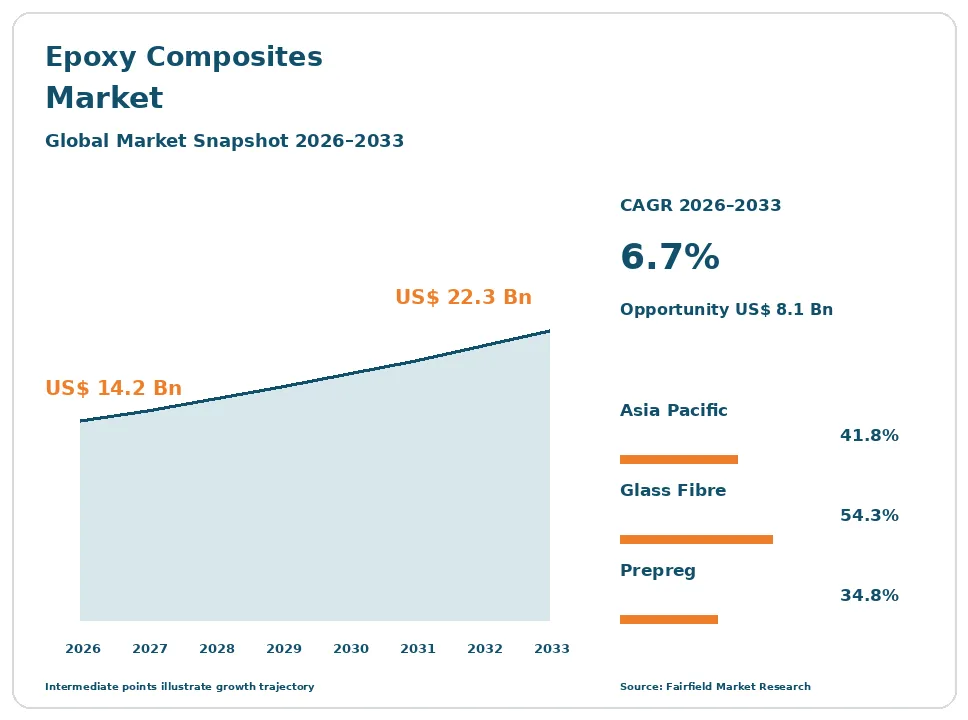
The global Epoxy Composites market size is expected to be valued at US$ 14.2 billion in 2026 and projected to reach US$ 22.3 billion by 2033, growing at a CAGR of 6.7% between 2026 and 2033. The figures cover epoxy matrix composites and the resin and hardener systems supplied for them.
The market advanced at a 5.4% CAGR between 2020 and 2025, held back in the middle of the period by raw material volatility and soft aerospace build rates. Three factors shape the forecast. Wind turbine blades keep growing in length, which raises the share of fatigue-critical structure that only an epoxy matrix can carry economically. Aerospace production rates have recovered and pull prepreg volume with them. Pressure vessels, electrical insulation and printed circuit board laminates add steady non-structural demand. Growth is broad rather than concentrated, with formulation chemistry rather than tonnage carrying most of the value gain.
Key Report Takeaways
- By Resin Type: Bisphenol A Diglycidyl Ether held 58.7% share in 2026, while Bio-attributed Epoxy grades are projected to expand at a 10.6% CAGR through 2033, as brand owners and turbine buyers specify lower-footprint feedstocks in supply contracts.
- By Curing Agent: Amine hardeners held 46.2% share in 2026, while Latent and Imidazole Systems are projected to grow at an 8.9% CAGR through 2033, because one-component formulations simplify handling and extend working life on automated lines.
- By Product Form: Prepreg held 34.8% share in 2026, while Filament Winding and Pultrusion Resins are projected to rise at an 8.6% CAGR through 2033, driven by pultruded blade spar caps and wound pressure vessels.
- By Reinforcement Fibre: Glass Fibre held 54.3% share in 2026, while Carbon Fibre reinforced systems are projected to advance at a 7.9% CAGR through 2033, as stiffness-critical structures outgrow what glass can deliver at acceptable weight.
- By End Use: Wind Energy held 29.4% share in 2026, while Pressure Vessels and Pipes are projected to record a 10.2% CAGR through 2033, following hydrogen and compressed gas storage programmes.
- By Geography: Asia Pacific held 41.8% share in 2026, while Middle East & Africa is projected to grow at an 8.4% CAGR through 2033, supported by hydrogen, desalination and pipeline investment.
Global Epoxy Composites Market Trends and Insights
Drivers Impact Analysis
| Driver | Impact on CAGR Forecast | Geographic Relevance | Impact Timeline |
| Adhesion, low cure shrinkage and toughness that cheaper matrices cannot match | High | Global | Long term (≥4 years) |
| Longer wind blades and electrified transport structures needing fatigue performance | High | Asia Pacific, Europe, North America | Medium term (2–4 years) |
Two conditions explain most of the structural demand for epoxy matrix systems.
Adhesion, Low Shrinkage and Toughness Keep Epoxy the Default Structural Matrix
Epoxy is bought for three properties and paid for in processing cost. It wets and bonds to carbon and glass surfaces better than cheaper matrices, it cures with very little shrinkage so large parts hold tolerance without distortion, and it carries higher strain to failure and interlaminar toughness. Designers who need predictable load transfer into the fibre specify it despite a higher price per kilogram.
The mechanism is chemical. Ring-opening cure of the glycidyl group produces hydroxyl functionality along the chain, which gives strong secondary bonding to sized fibre and to metal substrates, and the addition reaction releases no volatile by-product, so cure shrinkage stays low. That combination is why epoxy dominates aerospace primary structure, blade spar caps, adhesive films and electrical laminates, where ISO 527 and ASTM D3039 mechanical qualification data must hold across production lots.
Longer Blades and Electrified Transport Raise Demand for Fatigue-Resistant Matrices
Structures are getting longer and more highly loaded, and that favours epoxy at the expense of lower-cost matrices. Offshore turbine blades now exceed one hundred metres, which multiplies the fatigue cycles each laminate must survive and makes resin toughness a design variable rather than a procurement detail. Electrified vehicles carry heavier battery masses, pushing body and chassis structures toward stiffer composite reinforcement.
The causal chain runs through qualification. Blade designers must demonstrate fatigue life under the manufacturing and material controls set out in IEC 61400-5, and a matrix with higher strain to failure allows thinner, lighter laminates at the same safety margin. In transport, crash energy absorption and bonded joint durability drive the same selection. Each new platform locks the chosen resin and hardener pair in for the programme’s life.
Restraints Impact Analysis
| Restraint | Impact on CAGR Forecast | Geographic Relevance | Impact Timeline |
| Occupational sensitisation classification and tightening bisphenol restriction | Medium | Europe, North America | Medium term (2–4 years) |
| Thermoset end-of-life and processing cost against thermoplastic alternatives | Medium | Global | Long term (≥4 years) |
Two pressures limit where epoxy matrix composites can be used and how cheaply they can be made.
Sensitisation Classification and Bisphenol Restriction Raise Compliance and Reformulation Cost
The chemistry sits under active regulatory and occupational scrutiny, and that shapes product strategy. Epoxy resins and amine hardeners carry harmonised skin sensitisation classification under the European Union CLP framework, and they are among the more frequently recorded causes of occupational skin disease in construction and composites work. Suppliers carry the cost of labelling, safety data, training content and closed handling systems, and some end users restrict open wet lay-up work outright.
Feedstock exposure adds a second layer. Bisphenol A is on the REACH Candidate List of substances of very high concern, the European Union has moved to restrict it in further uses, and the policy direction points toward wider bisphenol restriction. Epichlorohydrin and amine feedstock prices move with chlor-alkali and ammonia economics. Reformulation toward bisphenol F, novolac and bio-attributed backbones is under way, but requalification is slow and expensive.
Thermoset End-of-Life and Processing Cost Open the Door to Thermoplastic Alternatives
A cured epoxy composite cannot be melted and reformed, and the industry has no settled answer for what happens at end of life. Decommissioned wind blades have made the problem visible, with landfill routes closing in several European markets and cement kiln co-processing serving only part of the volume. Buyers who must document circularity now question epoxy selection at the design stage rather than at disposal.
Processing economics compound the issue. Prepreg needs frozen storage with limited out-life, autoclave cure ties expensive capital to long cycle times, and scrap cannot be reprocessed into new laminate. Thermoplastic composite systems answer both points, offering weld-based joining, minutes-scale forming and remeltability, and they are winning specifications where cycle time or recyclability is written into the requirement. Cleavable and chemically degradable epoxy chemistries are promising but remain developmental.
Market Opportunities
Hydrogen and Compressed Gas Pressure Vessels Open a High-Value Winding Pool
Pressure vessel manufacture is the clearest new revenue pool for epoxy systems. Type IV hydrogen and compressed natural gas cylinders are filament wound over a polymer liner, and the winding resin must combine long pot life, controlled exotherm in thick laminates and high interlaminar strength under cyclic pressure. Resin value per vessel is high, and qualification locks the supplier in for the vessel family’s certified life.
Resin formulators with winding expertise and vessel builders serving mobility and distributed storage capture this pool. Demand comes from heavy transport fleets, bus and rail operators, hydrogen refuelling infrastructure and gas distribution by tube trailer. Cycle testing, burst qualification and permeation requirements favour established toughened systems, and resin suppliers that can support the certification file rather than only ship drums hold the advantage.
Cleavable and Recyclable Epoxy Chemistries Create an Emerging End-of-Life Business
Recyclable epoxy systems are the most interesting technical development in the field and point to a business that does not exist yet at scale. Chemistries built with cleavable linkages, such as acetal or ester bonds designed into the network, allow a cured laminate to be depolymerised under mild conditions so that intact fibre can be recovered and the resin fraction separated. That converts a disposal liability into recovered material value.
Resin developers, blade manufacturers and specialist recyclers are positioned to capture it, with wind energy as the pull application because blade retirement volumes are already visible and owners face disposal scrutiny. Demonstration blades and pilot recovery lines exist, but mechanical equivalence, cost parity and full qualification are not yet proven. The pool should be treated as developmental through the forecast period rather than deployed.
Segment Analysis
By Resin Type: Bisphenol A Backbones Lead While Bio-attributed Grades Climb Fastest
Bisphenol A Diglycidyl Ether accounted for 58.7% of resin value in 2026, holding the lead on cost, availability and a qualification history stretching back decades across aerospace, marine and electrical applications. Bisphenol F Diglycidyl Ether serves lower-viscosity infusion work, Novolac Epoxy covers high-temperature and chemical-resistant duty, and Cycloaliphatic Epoxy supports outdoor electrical insulation where ultraviolet stability matters.
Bio-attributed Epoxy grades are the fastest-growing type at a 10.6% CAGR to 2033, starting from a small base as turbine owners and consumer brands write feedstock footprint into purchase specifications. Mass-balance certification lets suppliers offer them without reformulating the cure chemistry. The practical implication is that resin differentiation is moving toward feedstock origin and regulatory position rather than toward new backbone chemistry.
By Curing Agent: Amines Hold the Lead as Latent Systems Gain Processing Share
Amine hardeners held 46.2% share in 2026, covering aliphatic, cycloaliphatic and aromatic grades used across infusion, wet lay-up and adhesive systems. They lead because they cure at or near ambient temperature, which suits large structures that cannot be ovened. Anhydride systems dominate electrical casting, and Polyamide grades serve marine and maintenance work where flexibility and moisture tolerance are needed.
Latent and Imidazole Systems are expanding fastest at an 8.9% CAGR, because one-component formulations hold a long working life at room temperature and then cure rapidly when heated. That behaviour suits prepreg, automated fibre placement and snap-cure automotive moulding lines running at high takt rates. The business effect is that the hardener, rather than the base resin, increasingly determines the processing window and the storage regime a customer is actually buying.
By Product Form: Prepreg Leads While Winding and Pultrusion Resins Grow Quickest
Prepreg represented 34.8% of the market in 2026, the largest form because aerospace primary and secondary structure is qualified almost entirely on prepreg and because fibre volume fraction and resin content are controlled at the supplier rather than on the shop floor. Infusion and Resin Transfer Moulding Systems, Wet Lay-up Systems and Adhesive and Surfacing Films cover the balance.
Filament Winding and Pultrusion Resins are the fastest-growing form at an 8.6% CAGR, pulled by pultruded carbon spar caps in long blades and by wound pressure vessels. Both processes run continuously and avoid autoclave capital, which lowers cost per kilogram of finished laminate. The commercial implication is that out-of-autoclave forms are taking share from frozen-storage prepreg wherever qualification rules allow it.
By Reinforcement Fibre: Glass Dominates Volume While Carbon Expands Fastest
Glass Fibre reinforced epoxy held 54.3% share in 2026, leading on delivered cost for blade shells, pipes, electrical laminates and marine structures where stiffness per unit mass is not the binding constraint. Aramid Fibre serves ballistic and impact-tolerant parts, and Natural Fibre systems remain a small, interior-focused niche with limited structural qualification.
Carbon Fibre reinforced epoxy is growing fastest at a 7.9% CAGR, as spar caps, aerostructures, pressure vessel overwraps and performance sporting goods hit the stiffness limits of glass. Burn-off and constituent content testing under ASTM D2584 supports resin content verification and lot acceptance across both fibre types. The implication for formulators is a widening gap between high-volume commodity systems sold on price and toughened, aerospace-qualified grades that command far higher margin per kilogram.
By End Use: Wind Energy Leads While Pressure Vessels and Pipes Accelerate
Wind Energy accounted for 29.4% of demand in 2026, the single largest end use because each blade consumes several tonnes of resin and because blade length growth raises resin intensity faster than installed capacity. Aerospace follows on value rather than tonnage, with Electrical and Electronics, Automotive and Transport, Sporting Goods, Marine and Construction strengthening making up the remainder.
Pressure Vessels and Pipes form the fastest-growing end use at a 10.2% CAGR, driven by hydrogen storage, compressed gas transport and corrosion-resistant piping in chemical and water infrastructure. Qualification cycles for certified vessels and pipe systems are long, which protects incumbent resin suppliers once their systems are approved. For suppliers, the shift means engineering support and certification documentation now matter as much as resin price in winning new programmes.
Geography Analysis
North America Combines Aerospace Qualification Depth With Pressure Vessel Demand
North America held 22.6% share in 2026 and is forecast to grow at a 6.4% CAGR to 2033. The United States supplies most of the demand, with Canada contributing aerostructures and Mexico adding wind blade and transport component manufacture. Aerospace gives the region an unusually high share of qualified prepreg and adhesive film consumption, where shared material qualification databases and documented equivalency reduce the cost of adding a second source.
Hydrogen and compressed gas vessel manufacture is the clearest growth engine, supported by infrastructure funding and fleet conversion programmes. Occupational exposure and skin protection requirements shape how wet systems are handled on construction and repair sites. The main constraint is resin and hardener feedstock exposure to chlor-alkali economics, which has made pricing volatile and encouraged buyers to qualify alternative backbones.
Europe Sets the Regulatory Pace for Epoxy Chemistry and Blade Manufacture
Europe accounted for 25.4% share in 2026 and is projected to grow at a 5.8% CAGR, the slowest rate of the five regions but from the largest value base after one other territory. Germany, Spain, Denmark, France, Italy and the United Kingdom anchor demand through wind blade production, aerostructures, rail and high-performance automotive work.
Regulation is the defining regional feature. Harmonised classification and labelling of epoxy resins and amine hardeners, REACH registration and authorisation duties, and the restriction of bisphenol A in further uses all land on formulators here first. Blade disposal scrutiny is also sharpest in this region, which makes recyclable chemistry development a European-led effort. Slow onshore permitting and high energy costs limit near-term volume growth despite strong technical demand.
Which Region Is Leading the Epoxy Composites Market?
Asia Pacific leads with 41.8% share in 2026 and is projected to grow at a 7.3% CAGR through 2033. China accounts for the largest part, supported by Japan, South Korea, India and Taiwan. The region holds most global wind blade manufacturing capacity, the bulk of printed circuit board laminate production and a growing share of pressure vessel and sporting goods output, which together consume more epoxy than any other territory.
Integrated supply is the structural reason for the lead. Epichlorohydrin, bisphenol A and liquid resin capacity sit close to the converters that use them, which shortens supply chains and lowers delivered cost. Japan and South Korea supply high-specification electronic and aerospace grades. The region’s exposure is price competition in commodity resin, which has compressed margins and pushed producers toward specialty hardener and prepreg businesses.
Latin America Builds Epoxy Demand Around Wind Installation and Pipeline Repair
Latin America represented 5.0% share in 2026 and is forecast to grow at a 6.6% CAGR. Brazil leads through wind installation, blade assembly and oil and gas service work, with Mexico adding transport components and Chile and Colombia contributing mining and water infrastructure demand for corrosion-resistant pipe and tank lining.
Barriers are practical. Most resin and hardener is imported, which exposes buyers to currency movement and freight cost, and local technical service for qualification work is thin. Composite repair and strengthening of concrete and steel infrastructure is a steady, low-capital application that suits the region’s contractor base. The clearest change under way is blade manufacture moving closer to installation sites, which pulls resin supply agreements into the region rather than leaving them offshore.
Which Region Is Growing Fastest in the Epoxy Composites Market?
Middle East & Africa is growing fastest at an 8.4% CAGR through 2033, from 5.2% share in 2026. Saudi Arabia, the United Arab Emirates, Egypt, Morocco and South Africa provide most of the activity. Green hydrogen projects, desalination plant piping, oil and gas composite repair systems and new onshore wind capacity all specify epoxy matrix systems, and several Gulf states are adding local composite conversion plants.
Growth runs from a small base, so absolute volumes stay modest. Barriers include limited local qualification and testing infrastructure, dependence on imported resin and hardener, and a shortage of trained laminators, which constrains hand lay-up quality. High ambient temperature also complicates pot life management on site. Training and regional technical service centres are the practical route for suppliers seeking position here.
Competitive Landscape
The market is moderately concentrated, and the degree of concentration differs sharply by tier. Base liquid epoxy resin production is held by a limited group of chemical producers with epichlorohydrin and bisphenol A integration, which gives that layer scale economics and cyclical pricing behaviour. Downstream formulation, prepreg and film manufacture is far more fragmented, with specialist suppliers serving aerospace, wind, electrical and marine customers under separate qualification regimes. Consolidation has largely taken the form of commodity producers buying or divesting epoxy assets while specialists add formulation and prepreg capacity.
Competition turns on qualification position rather than on price alone. Once a resin and hardener pair is written into an aerospace material specification or a blade manufacturing process, switching requires new coupon and element testing, which can take years, so incumbency is valuable and durable. Vendors compete on toughened system performance, out-life and storage requirements, cure cycle length, consistency between lots, technical service during process development, and the completeness of the data package supplied for certification. New entrants arrive from two directions: Asian commodity producers moving up into specialty hardeners and prepreg, and small chemistry houses commercialising recyclable network systems and bio-attributed backbones.
Strategic activity concentrates on reformulation and process cost. Suppliers are developing bisphenol A free and reduced-sensitisation systems ahead of tightening restriction, qualifying infusion and out-of-autoclave grades that remove autoclave capital from the cost base, and extending winding and pultrusion portfolios toward pressure vessels and spar caps.
The prevailing direction is toward selling a qualified process rather than a drum of resin. Vendors are investing in application laboratories, certification support and circularity programmes, while treating commodity liquid resin as a volume business that funds specialty development.
Epoxy Composites Industry Leaders
- Hexcel Corporation
- Toray Industries, Inc.
- Huntsman Corporation
- Olin Corporation
- Westlake Corporation
Recent Industry Developments
- June 2015: The European Union CLP Regulation became fully applicable to mixtures – brought harmonised skin sensitisation classification and labelling to epoxy resin and amine hardener systems sold across the bloc.
- January 2017: Bisphenol A was added to the REACH Candidate List of substances of very high concern – placed a core epoxy feedstock under formal authorisation scrutiny and started the reformulation programmes now under way.
- 2020: The International Electrotechnical Commission published IEC 61400-5 covering wind turbine blade manufacture – gave blade makers and resin suppliers a common basis for material qualification, process control and documentation.
- December 2024: The European Commission adopted a regulation restricting bisphenol A in food contact materials – confirmed the policy direction toward wider bisphenol restriction and sharpened demand for alternative epoxy backbones.
Companies Covered in the Report
- Hexcel Corporation
- Toray Industries, Inc.
- Teijin Limited
- Mitsubishi Chemical Group Corporation
- Huntsman Corporation
- Olin Corporation
- Westlake Corporation
- SGL Carbon SE
- Gurit Holding AG
- Park Aerospace Corp.
- Sika AG
- Grasim Industries Limited
- Kukdo Chemical Co., Ltd.
- Nan Ya Plastics Corporation
- BASF SE
Epoxy Composites Market Report Scope
This study covers fibre-reinforced composites with an epoxy matrix and the resins, curing agents and hardeners supplied for them in prepreg, infusion, winding, pultrusion, wet lay-up and film form. The reinforcing fibres themselves are covered in separate reports, and unsaturated polyester and vinyl ester composites form a separate study. The base year is 2025, the forecast period runs from 2026 to 2033, and values are stated in US$ Billion.
Resin Type
- Bisphenol A Diglycidyl Ether
- Bisphenol F Diglycidyl Ether
- Novolac Epoxy
- Cycloaliphatic Epoxy
- Bio-attributed Epoxy
Curing Agent
- Amine
- Anhydride
- Polyamide
- Latent and Imidazole Systems
Product Form
- Prepreg
- Infusion and Resin Transfer Moulding Systems
- Filament Winding and Pultrusion Resins
- Wet Lay-up Systems
- Adhesive and Surfacing Films
Reinforcement Fibre
- Carbon Fibre
- Glass Fibre
- Aramid Fibre
- Natural Fibre
End Use
- Wind Energy
- Aerospace
- Automotive and Transport
- Pressure Vessels and Pipes
- Electrical and Electronics
- Sporting Goods
- Marine
- Construction
Regions
- North America
- Europe
- Asia Pacific
- Latin America
- Middle East & Africa
Key Questions Answered in the Report
How big is the epoxy composites market in 2026?
The market is valued at US$ 14.2 billion in 2026, covering epoxy matrix composites together with the resin and hardener systems supplied for them.
What is the forecast value and growth rate to 2033?
The market is projected to reach US$ 22.3 billion by 2033, growing at a 6.7% CAGR and adding US$ 8.1 billion of absolute opportunity.
Which epoxy resin type holds the largest share?
Bisphenol A Diglycidyl Ether leads with 58.7% share in 2026, supported by cost, wide availability and decades of accumulated qualification data.
Which end use and product form are growing fastest?
Pressure Vessels and Pipes grow fastest at 10.2%, while Filament Winding and Pultrusion Resins lead product forms at an 8.6% CAGR.
Which region leads and how concentrated is supply?
Asia Pacific leads with 41.8% share in 2026, and concentration is medium, with concentrated base resin supply and fragmented downstream formulation.
1. Executive Summary
1.1. Global Epoxy Composites Market Snapshot
1.2. Future Projections, 2026-2033
1.3. Key Market Trends
1.4. Regional Snapshot
2. Market Overview
2.1. Market Definition and Report Scope
2.2. Historical Market Trends, 2020-2025
2.3. Market Dynamics
2.3.1. Drivers Impact Analysis
2.3.1.1. Adhesion, Low Shrinkage and Toughness Keep Epoxy the Default Structural Matrix
2.3.1.2. Longer Blades and Electrified Transport Raise Demand for Fatigue-Resistant Matrices
2.3.2. Restraints Impact Analysis
2.3.2.1. Sensitisation Classification and Bisphenol Restriction Raise Compliance and Reformulation Cost
2.3.2.2. Thermoset End-of-Life and Processing Cost Open the Door to Thermoplastic Alternatives
2.3.3. Market Opportunities
2.3.3.1. Hydrogen and Compressed Gas Pressure Vessels Open a High-Value Winding Pool
2.3.3.2. Cleavable and Recyclable Epoxy Chemistries Create an Emerging End-of-Life Business
3. Global Epoxy Composites Market Outlook, 2020-2033
3.1. Global Epoxy Composites Market Outlook, by Resin Type, Value (US$ Billion), 2020-2033
3.1.1. Bisphenol A Diglycidyl Ether
3.1.2. Bisphenol F Diglycidyl Ether
3.1.3. Novolac Epoxy
3.1.4. Cycloaliphatic Epoxy
3.1.5. Bio-attributed Epoxy
3.2. Global Epoxy Composites Market Outlook, by Curing Agent, Value (US$ Billion), 2020-2033
3.2.1. Amine
3.2.2. Anhydride
3.2.3. Polyamide
3.2.4. Latent and Imidazole Systems
3.3. Global Epoxy Composites Market Outlook, by Product Form, Value (US$ Billion), 2020-2033
3.3.1. Prepreg
3.3.2. Infusion and Resin Transfer Moulding Systems
3.3.3. Filament Winding and Pultrusion Resins
3.3.4. Wet Lay-up Systems
3.3.5. Adhesive and Surfacing Films
3.4. Global Epoxy Composites Market Outlook, by Reinforcement Fibre, Value (US$ Billion), 2020-2033
3.4.1. Carbon Fibre
3.4.2. Glass Fibre
3.4.3. Aramid Fibre
3.4.4. Natural Fibre
3.5. Global Epoxy Composites Market Outlook, by End Use, Value (US$ Billion), 2020-2033
3.5.1. Wind Energy
3.5.2. Aerospace
3.5.3. Automotive and Transport
3.5.4. Pressure Vessels and Pipes
3.5.5. Electrical and Electronics
3.5.6. Sporting Goods
3.5.7. Marine
3.5.8. Construction
3.6. Global Epoxy Composites Market Outlook, by Region, Value (US$ Billion), 2020-2033
3.6.1. North America
3.6.2. Europe
3.6.3. Asia Pacific
3.6.4. Latin America
3.6.5. Middle East & Africa
4. North America Epoxy Composites Market Outlook, 2020-2033
4.1. North America Epoxy Composites Market Outlook, by Resin Type, Value (US$ Billion), 2020-2033
4.1.1. Bisphenol A Diglycidyl Ether
4.1.2. Bisphenol F Diglycidyl Ether
4.1.3. Novolac Epoxy
4.1.4. Cycloaliphatic Epoxy
4.1.5. Bio-attributed Epoxy
4.2. North America Epoxy Composites Market Outlook, by Curing Agent, Value (US$ Billion), 2020-2033
4.2.1. Amine
4.2.2. Anhydride
4.2.3. Polyamide
4.2.4. Latent and Imidazole Systems
4.3. North America Epoxy Composites Market Outlook, by Product Form, Value (US$ Billion), 2020-2033
4.3.1. Prepreg
4.3.2. Infusion and Resin Transfer Moulding Systems
4.3.3. Filament Winding and Pultrusion Resins
4.3.4. Wet Lay-up Systems
4.3.5. Adhesive and Surfacing Films
4.4. North America Epoxy Composites Market Outlook, by Reinforcement Fibre, Value (US$ Billion), 2020-2033
4.4.1. Carbon Fibre
4.4.2. Glass Fibre
4.4.3. Aramid Fibre
4.4.4. Natural Fibre
4.5. North America Epoxy Composites Market Outlook, by End Use, Value (US$ Billion), 2020-2033
4.5.1. Wind Energy
4.5.2. Aerospace
4.5.3. Automotive and Transport
4.5.4. Pressure Vessels and Pipes
4.5.5. Electrical and Electronics
4.5.6. Sporting Goods
4.5.7. Marine
4.5.8. Construction
4.6. North America Epoxy Composites Market Outlook, by Country, Value (US$ Billion), 2020-2033
4.6.1. United States Epoxy Composites Market Outlook, by Resin Type, 2020-2033
4.6.2. United States Epoxy Composites Market Outlook, by Curing Agent, 2020-2033
4.6.3. United States Epoxy Composites Market Outlook, by Product Form, 2020-2033
4.6.4. United States Epoxy Composites Market Outlook, by Reinforcement Fibre, 2020-2033
4.6.5. United States Epoxy Composites Market Outlook, by End Use, 2020-2033
4.6.6. Canada Epoxy Composites Market Outlook, by Resin Type, 2020-2033
4.6.7. Canada Epoxy Composites Market Outlook, by Curing Agent, 2020-2033
4.6.8. Canada Epoxy Composites Market Outlook, by Product Form, 2020-2033
4.6.9. Canada Epoxy Composites Market Outlook, by Reinforcement Fibre, 2020-2033
4.6.10. Canada Epoxy Composites Market Outlook, by End Use, 2020-2033
4.6.11. Mexico Epoxy Composites Market Outlook, by Resin Type, 2020-2033
4.6.12. Mexico Epoxy Composites Market Outlook, by Curing Agent, 2020-2033
4.6.13. Mexico Epoxy Composites Market Outlook, by Product Form, 2020-2033
4.6.14. Mexico Epoxy Composites Market Outlook, by Reinforcement Fibre, 2020-2033
4.6.15. Mexico Epoxy Composites Market Outlook, by End Use, 2020-2033
5. Europe Epoxy Composites Market Outlook, 2020-2033
5.1. Europe Epoxy Composites Market Outlook, by Resin Type, Value (US$ Billion), 2020-2033
5.1.1. Bisphenol A Diglycidyl Ether
5.1.2. Bisphenol F Diglycidyl Ether
5.1.3. Novolac Epoxy
5.1.4. Cycloaliphatic Epoxy
5.1.5. Bio-attributed Epoxy
5.2. Europe Epoxy Composites Market Outlook, by Curing Agent, Value (US$ Billion), 2020-2033
5.2.1. Amine
5.2.2. Anhydride
5.2.3. Polyamide
5.2.4. Latent and Imidazole Systems
5.3. Europe Epoxy Composites Market Outlook, by Product Form, Value (US$ Billion), 2020-2033
5.3.1. Prepreg
5.3.2. Infusion and Resin Transfer Moulding Systems
5.3.3. Filament Winding and Pultrusion Resins
5.3.4. Wet Lay-up Systems
5.3.5. Adhesive and Surfacing Films
5.4. Europe Epoxy Composites Market Outlook, by Reinforcement Fibre, Value (US$ Billion), 2020-2033
5.4.1. Carbon Fibre
5.4.2. Glass Fibre
5.4.3. Aramid Fibre
5.4.4. Natural Fibre
5.5. Europe Epoxy Composites Market Outlook, by End Use, Value (US$ Billion), 2020-2033
5.5.1. Wind Energy
5.5.2. Aerospace
5.5.3. Automotive and Transport
5.5.4. Pressure Vessels and Pipes
5.5.5. Electrical and Electronics
5.5.6. Sporting Goods
5.5.7. Marine
5.5.8. Construction
5.6. Europe Epoxy Composites Market Outlook, by Country, Value (US$ Billion), 2020-2033
5.6.1. Germany Epoxy Composites Market Outlook, by Resin Type, 2020-2033
5.6.2. Germany Epoxy Composites Market Outlook, by Curing Agent, 2020-2033
5.6.3. Germany Epoxy Composites Market Outlook, by Product Form, 2020-2033
5.6.4. Germany Epoxy Composites Market Outlook, by Reinforcement Fibre, 2020-2033
5.6.5. Germany Epoxy Composites Market Outlook, by End Use, 2020-2033
5.6.6. Spain Epoxy Composites Market Outlook, by Resin Type, 2020-2033
5.6.7. Spain Epoxy Composites Market Outlook, by Curing Agent, 2020-2033
5.6.8. Spain Epoxy Composites Market Outlook, by Product Form, 2020-2033
5.6.9. Spain Epoxy Composites Market Outlook, by Reinforcement Fibre, 2020-2033
5.6.10. Spain Epoxy Composites Market Outlook, by End Use, 2020-2033
5.6.11. Denmark Epoxy Composites Market Outlook, by Resin Type, 2020-2033
5.6.12. Denmark Epoxy Composites Market Outlook, by Curing Agent, 2020-2033
5.6.13. Denmark Epoxy Composites Market Outlook, by Product Form, 2020-2033
5.6.14. Denmark Epoxy Composites Market Outlook, by Reinforcement Fibre, 2020-2033
5.6.15. Denmark Epoxy Composites Market Outlook, by End Use, 2020-2033
5.6.16. France Epoxy Composites Market Outlook, by Resin Type, 2020-2033
5.6.17. France Epoxy Composites Market Outlook, by Curing Agent, 2020-2033
5.6.18. France Epoxy Composites Market Outlook, by Product Form, 2020-2033
5.6.19. France Epoxy Composites Market Outlook, by Reinforcement Fibre, 2020-2033
5.6.20. France Epoxy Composites Market Outlook, by End Use, 2020-2033
5.6.21. Italy Epoxy Composites Market Outlook, by Resin Type, 2020-2033
5.6.22. Italy Epoxy Composites Market Outlook, by Curing Agent, 2020-2033
5.6.23. Italy Epoxy Composites Market Outlook, by Product Form, 2020-2033
5.6.24. Italy Epoxy Composites Market Outlook, by Reinforcement Fibre, 2020-2033
5.6.25. Italy Epoxy Composites Market Outlook, by End Use, 2020-2033
5.6.26. United Kingdom Epoxy Composites Market Outlook, by Resin Type, 2020-2033
5.6.27. United Kingdom Epoxy Composites Market Outlook, by Curing Agent, 2020-2033
5.6.28. United Kingdom Epoxy Composites Market Outlook, by Product Form, 2020-2033
5.6.29. United Kingdom Epoxy Composites Market Outlook, by Reinforcement Fibre, 2020-2033
5.6.30. United Kingdom Epoxy Composites Market Outlook, by End Use, 2020-2033
6. Asia Pacific Epoxy Composites Market Outlook, 2020-2033
6.1. Asia Pacific Epoxy Composites Market Outlook, by Resin Type, Value (US$ Billion), 2020-2033
6.1.1. Bisphenol A Diglycidyl Ether
6.1.2. Bisphenol F Diglycidyl Ether
6.1.3. Novolac Epoxy
6.1.4. Cycloaliphatic Epoxy
6.1.5. Bio-attributed Epoxy
6.2. Asia Pacific Epoxy Composites Market Outlook, by Curing Agent, Value (US$ Billion), 2020-2033
6.2.1. Amine
6.2.2. Anhydride
6.2.3. Polyamide
6.2.4. Latent and Imidazole Systems
6.3. Asia Pacific Epoxy Composites Market Outlook, by Product Form, Value (US$ Billion), 2020-2033
6.3.1. Prepreg
6.3.2. Infusion and Resin Transfer Moulding Systems
6.3.3. Filament Winding and Pultrusion Resins
6.3.4. Wet Lay-up Systems
6.3.5. Adhesive and Surfacing Films
6.4. Asia Pacific Epoxy Composites Market Outlook, by Reinforcement Fibre, Value (US$ Billion), 2020-2033
6.4.1. Carbon Fibre
6.4.2. Glass Fibre
6.4.3. Aramid Fibre
6.4.4. Natural Fibre
6.5. Asia Pacific Epoxy Composites Market Outlook, by End Use, Value (US$ Billion), 2020-2033
6.5.1. Wind Energy
6.5.2. Aerospace
6.5.3. Automotive and Transport
6.5.4. Pressure Vessels and Pipes
6.5.5. Electrical and Electronics
6.5.6. Sporting Goods
6.5.7. Marine
6.5.8. Construction
6.6. Asia Pacific Epoxy Composites Market Outlook, by Country, Value (US$ Billion), 2020-2033
6.6.1. China Epoxy Composites Market Outlook, by Resin Type, 2020-2033
6.6.2. China Epoxy Composites Market Outlook, by Curing Agent, 2020-2033
6.6.3. China Epoxy Composites Market Outlook, by Product Form, 2020-2033
6.6.4. China Epoxy Composites Market Outlook, by Reinforcement Fibre, 2020-2033
6.6.5. China Epoxy Composites Market Outlook, by End Use, 2020-2033
6.6.6. Japan Epoxy Composites Market Outlook, by Resin Type, 2020-2033
6.6.7. Japan Epoxy Composites Market Outlook, by Curing Agent, 2020-2033
6.6.8. Japan Epoxy Composites Market Outlook, by Product Form, 2020-2033
6.6.9. Japan Epoxy Composites Market Outlook, by Reinforcement Fibre, 2020-2033
6.6.10. Japan Epoxy Composites Market Outlook, by End Use, 2020-2033
6.6.11. South Korea Epoxy Composites Market Outlook, by Resin Type, 2020-2033
6.6.12. South Korea Epoxy Composites Market Outlook, by Curing Agent, 2020-2033
6.6.13. South Korea Epoxy Composites Market Outlook, by Product Form, 2020-2033
6.6.14. South Korea Epoxy Composites Market Outlook, by Reinforcement Fibre, 2020-2033
6.6.15. South Korea Epoxy Composites Market Outlook, by End Use, 2020-2033
6.6.16. India Epoxy Composites Market Outlook, by Resin Type, 2020-2033
6.6.17. India Epoxy Composites Market Outlook, by Curing Agent, 2020-2033
6.6.18. India Epoxy Composites Market Outlook, by Product Form, 2020-2033
6.6.19. India Epoxy Composites Market Outlook, by Reinforcement Fibre, 2020-2033
6.6.20. India Epoxy Composites Market Outlook, by End Use, 2020-2033
6.6.21. Taiwan Epoxy Composites Market Outlook, by Resin Type, 2020-2033
6.6.22. Taiwan Epoxy Composites Market Outlook, by Curing Agent, 2020-2033
6.6.23. Taiwan Epoxy Composites Market Outlook, by Product Form, 2020-2033
6.6.24. Taiwan Epoxy Composites Market Outlook, by Reinforcement Fibre, 2020-2033
6.6.25. Taiwan Epoxy Composites Market Outlook, by End Use, 2020-2033
7. Latin America Epoxy Composites Market Outlook, 2020-2033
7.1. Latin America Epoxy Composites Market Outlook, by Resin Type, Value (US$ Billion), 2020-2033
7.1.1. Bisphenol A Diglycidyl Ether
7.1.2. Bisphenol F Diglycidyl Ether
7.1.3. Novolac Epoxy
7.1.4. Cycloaliphatic Epoxy
7.1.5. Bio-attributed Epoxy
7.2. Latin America Epoxy Composites Market Outlook, by Curing Agent, Value (US$ Billion), 2020-2033
7.2.1. Amine
7.2.2. Anhydride
7.2.3. Polyamide
7.2.4. Latent and Imidazole Systems
7.3. Latin America Epoxy Composites Market Outlook, by Product Form, Value (US$ Billion), 2020-2033
7.3.1. Prepreg
7.3.2. Infusion and Resin Transfer Moulding Systems
7.3.3. Filament Winding and Pultrusion Resins
7.3.4. Wet Lay-up Systems
7.3.5. Adhesive and Surfacing Films
7.4. Latin America Epoxy Composites Market Outlook, by Reinforcement Fibre, Value (US$ Billion), 2020-2033
7.4.1. Carbon Fibre
7.4.2. Glass Fibre
7.4.3. Aramid Fibre
7.4.4. Natural Fibre
7.5. Latin America Epoxy Composites Market Outlook, by End Use, Value (US$ Billion), 2020-2033
7.5.1. Wind Energy
7.5.2. Aerospace
7.5.3. Automotive and Transport
7.5.4. Pressure Vessels and Pipes
7.5.5. Electrical and Electronics
7.5.6. Sporting Goods
7.5.7. Marine
7.5.8. Construction
7.6. Latin America Epoxy Composites Market Outlook, by Country, Value (US$ Billion), 2020-2033
7.6.1. Brazil Epoxy Composites Market Outlook, by Resin Type, 2020-2033
7.6.2. Brazil Epoxy Composites Market Outlook, by Curing Agent, 2020-2033
7.6.3. Brazil Epoxy Composites Market Outlook, by Product Form, 2020-2033
7.6.4. Brazil Epoxy Composites Market Outlook, by Reinforcement Fibre, 2020-2033
7.6.5. Brazil Epoxy Composites Market Outlook, by End Use, 2020-2033
7.6.6. Mexico Epoxy Composites Market Outlook, by Resin Type, 2020-2033
7.6.7. Mexico Epoxy Composites Market Outlook, by Curing Agent, 2020-2033
7.6.8. Mexico Epoxy Composites Market Outlook, by Product Form, 2020-2033
7.6.9. Mexico Epoxy Composites Market Outlook, by Reinforcement Fibre, 2020-2033
7.6.10. Mexico Epoxy Composites Market Outlook, by End Use, 2020-2033
7.6.11. Chile Epoxy Composites Market Outlook, by Resin Type, 2020-2033
7.6.12. Chile Epoxy Composites Market Outlook, by Curing Agent, 2020-2033
7.6.13. Chile Epoxy Composites Market Outlook, by Product Form, 2020-2033
7.6.14. Chile Epoxy Composites Market Outlook, by Reinforcement Fibre, 2020-2033
7.6.15. Chile Epoxy Composites Market Outlook, by End Use, 2020-2033
7.6.16. Colombia Epoxy Composites Market Outlook, by Resin Type, 2020-2033
7.6.17. Colombia Epoxy Composites Market Outlook, by Curing Agent, 2020-2033
7.6.18. Colombia Epoxy Composites Market Outlook, by Product Form, 2020-2033
7.6.19. Colombia Epoxy Composites Market Outlook, by Reinforcement Fibre, 2020-2033
7.6.20. Colombia Epoxy Composites Market Outlook, by End Use, 2020-2033
8. Middle East & Africa Epoxy Composites Market Outlook, 2020-2033
8.1. Middle East & Africa Epoxy Composites Market Outlook, by Resin Type, Value (US$ Billion), 2020-2033
8.1.1. Bisphenol A Diglycidyl Ether
8.1.2. Bisphenol F Diglycidyl Ether
8.1.3. Novolac Epoxy
8.1.4. Cycloaliphatic Epoxy
8.1.5. Bio-attributed Epoxy
8.2. Middle East & Africa Epoxy Composites Market Outlook, by Curing Agent, Value (US$ Billion), 2020-2033
8.2.1. Amine
8.2.2. Anhydride
8.2.3. Polyamide
8.2.4. Latent and Imidazole Systems
8.3. Middle East & Africa Epoxy Composites Market Outlook, by Product Form, Value (US$ Billion), 2020-2033
8.3.1. Prepreg
8.3.2. Infusion and Resin Transfer Moulding Systems
8.3.3. Filament Winding and Pultrusion Resins
8.3.4. Wet Lay-up Systems
8.3.5. Adhesive and Surfacing Films
8.4. Middle East & Africa Epoxy Composites Market Outlook, by Reinforcement Fibre, Value (US$ Billion), 2020-2033
8.4.1. Carbon Fibre
8.4.2. Glass Fibre
8.4.3. Aramid Fibre
8.4.4. Natural Fibre
8.5. Middle East & Africa Epoxy Composites Market Outlook, by End Use, Value (US$ Billion), 2020-2033
8.5.1. Wind Energy
8.5.2. Aerospace
8.5.3. Automotive and Transport
8.5.4. Pressure Vessels and Pipes
8.5.5. Electrical and Electronics
8.5.6. Sporting Goods
8.5.7. Marine
8.5.8. Construction
8.6. Middle East & Africa Epoxy Composites Market Outlook, by Country, Value (US$ Billion), 2020-2033
8.6.1. Saudi Arabia Epoxy Composites Market Outlook, by Resin Type, 2020-2033
8.6.2. Saudi Arabia Epoxy Composites Market Outlook, by Curing Agent, 2020-2033
8.6.3. Saudi Arabia Epoxy Composites Market Outlook, by Product Form, 2020-2033
8.6.4. Saudi Arabia Epoxy Composites Market Outlook, by Reinforcement Fibre, 2020-2033
8.6.5. Saudi Arabia Epoxy Composites Market Outlook, by End Use, 2020-2033
8.6.6. United Arab Emirates Epoxy Composites Market Outlook, by Resin Type, 2020-2033
8.6.7. United Arab Emirates Epoxy Composites Market Outlook, by Curing Agent, 2020-2033
8.6.8. United Arab Emirates Epoxy Composites Market Outlook, by Product Form, 2020-2033
8.6.9. United Arab Emirates Epoxy Composites Market Outlook, by Reinforcement Fibre, 2020-2033
8.6.10. United Arab Emirates Epoxy Composites Market Outlook, by End Use, 2020-2033
8.6.11. Egypt Epoxy Composites Market Outlook, by Resin Type, 2020-2033
8.6.12. Egypt Epoxy Composites Market Outlook, by Curing Agent, 2020-2033
8.6.13. Egypt Epoxy Composites Market Outlook, by Product Form, 2020-2033
8.6.14. Egypt Epoxy Composites Market Outlook, by Reinforcement Fibre, 2020-2033
8.6.15. Egypt Epoxy Composites Market Outlook, by End Use, 2020-2033
8.6.16. Morocco Epoxy Composites Market Outlook, by Resin Type, 2020-2033
8.6.17. Morocco Epoxy Composites Market Outlook, by Curing Agent, 2020-2033
8.6.18. Morocco Epoxy Composites Market Outlook, by Product Form, 2020-2033
8.6.19. Morocco Epoxy Composites Market Outlook, by Reinforcement Fibre, 2020-2033
8.6.20. Morocco Epoxy Composites Market Outlook, by End Use, 2020-2033
8.6.21. South Africa Epoxy Composites Market Outlook, by Resin Type, 2020-2033
8.6.22. South Africa Epoxy Composites Market Outlook, by Curing Agent, 2020-2033
8.6.23. South Africa Epoxy Composites Market Outlook, by Product Form, 2020-2033
8.6.24. South Africa Epoxy Composites Market Outlook, by Reinforcement Fibre, 2020-2033
8.6.25. South Africa Epoxy Composites Market Outlook, by End Use, 2020-2033
9. Competitive Landscape
9.1. Market Concentration and Industry Leaders
9.2. Competitive Differentiation
9.3. Strategic Initiatives
9.4. Recent Industry Developments
9.5. Company Profiles
9.5.1. Hexcel Corporation
9.5.2. Toray Industries, Inc.
9.5.3. Teijin Limited
9.5.4. Mitsubishi Chemical Group Corporation
9.5.5. Huntsman Corporation
9.5.6. Olin Corporation
9.5.7. Westlake Corporation
9.5.8. SGL Carbon SE
9.5.9. Gurit Holding AG
9.5.10. Park Aerospace Corp.
9.5.11. Sika AG
9.5.12. Grasim Industries Limited
9.5.13. Kukdo Chemical Co., Ltd.
9.5.14. Nan Ya Plastics Corporation
9.5.15. BASF SE
10. Appendix
10.1. Research Methodology
10.2. Report Assumptions
10.3. Acronyms and Abbreviations
| Resin Type | Bisphenol A Diglycidyl Ether, Bisphenol F Diglycidyl Ether, Novolac Epoxy, Cycloaliphatic Epoxy, Bio-attributed Epoxy |
| Curing Agent | Amine, Anhydride, Polyamide, Latent and Imidazole Systems |
| Product Form | Prepreg, Infusion and Resin Transfer Moulding Systems, Filament Winding and Pultrusion Resins, Wet Lay-up Systems, Adhesive and Surfacing Films |
| Reinforcement Fibre | Carbon Fibre, Glass Fibre, Aramid Fibre, Natural Fibre |
| End Use | Wind Energy, Aerospace, Automotive and Transport, Pressure Vessels and Pipes, Electrical and Electronics, Sporting Goods, Marine, Construction |
| Regions | North America, Europe, Asia Pacific, Latin America, Middle East & Africa |
Our Research Methodology
Considering the volatility of business today, traditional approaches to strategizing a game plan can be unfruitful if not detrimental. True ambiguity is no way to determine a forecast. A myriad of predetermined factors must be accounted for such as the degree of risk involved, the magnitude of circumstances, as well as conditions or consequences that are not known or unpredictable. To circumvent binary views that cast uncertainty, the application of market research intelligence to strategically posture, move, and enable actionable outcomes is necessary.
View Methodology
Quality Assured
Rigorous Validation Process

Confidentiality Assured
End-to-end Data Security

Custom Research Services
Tailored To Your Objectives
FAQs
The market is valued at US$ 14.2 billion in 2026, covering epoxy matrix composites together with the resin and hardener systems supplied for them.
The market is projected to reach US$ 22.3 billion by 2033, growing at a 6.7% CAGR and adding US$ 8.1 billion of absolute opportunity.
Bisphenol A Diglycidyl Ether leads with 58.7% share in 2026, supported by cost, wide availability and decades of accumulated qualification data.
Pressure Vessels and Pipes grow fastest at 10.2%, while Filament Winding and Pultrusion Resins lead product forms at an 8.6% CAGR.
Asia Pacific leads with 41.8% share in 2026, and concentration is medium, with concentrated base resin supply and fragmented downstream formulation.
Related Reports
Advanced Materials Market Size, Share, Insights, Competitive Landscape, and Forecast 2026 to 2033
Explore the advanced materials market, projected to reach US$ 121.08 billion by 2033 at a 6.6% CAGR, with product, application and regional insights.
Biopolymer Coatings Market Size, Share, Insights, Competitive Landscape, and Forecast 2026 to 2033
Explore the biopolymer coatings market, projected to reach US$ 2.5 billion by 2033 at a 7.6% CAGR, with product, technology and regional insights.
Dry Construction Market Size, Share, Insights, Competitive Landscape, and Forecast 2026 to 2033
Explore the dry construction market, projected to reach US$ 134.87 billion by 2033 at a 4.7% CAGR, with material, system and regional insights.
Waterproofing Admixtures Market Size, Share, Insights, Competitive Landscape, and Forecast 2026 to 2033
Waterproofing admixtures market to grow from US$ 2.4 billion in 2026 to US$ 3.6 billion by 2033 at a 6.0% CAGR. Explore products, applications and regions.
Vinyl Flooring Market Size, Share, Insights, Competitive Landscape, and Forecast 2026 to 2033
Vinyl flooring market to grow from US$ 46.5 billion in 2026 to US$ 72.6 billion by 2033 at a 6.6% CAGR. Explore product trends, segments and regional insights.
Unsaturated Polyester Resin Market Size, Share, Insights, Competitive Landscape, and Forecast 2026 to 2033
Explore the unsaturated polyester resin market, forecast to reach US$18.1 billion by 2033 at 4.6% CAGR, with resin, end-use and regional insights.