



Dry Construction Market
Dry Construction Market Size, Share, Insights, Competitive Landscape, and Forecast 2026 to 2033
Dry Construction Market Size, Share, Insights, Competitive Landscape, and Forecast 2026 to 2033
How Fast Is the Dry Construction Market Growing?
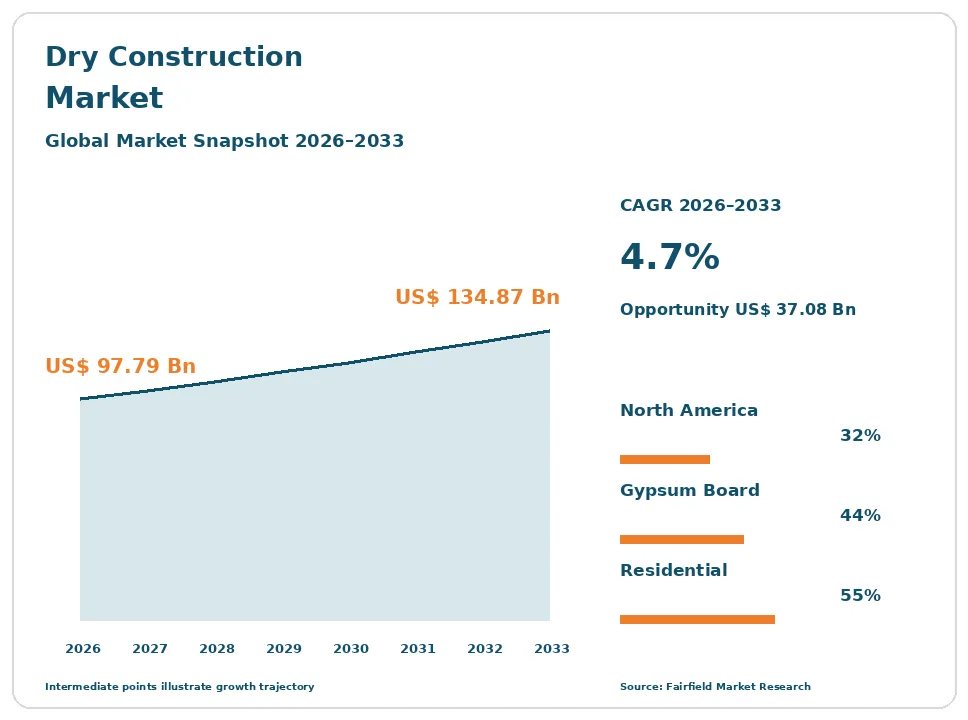
The global dry construction market size is expected to be valued at US$ 97.79 billion in 2026 and projected to reach US$ 134.87 billion by 2033, growing at a CAGR of 4.7% between 2026 and 2033.
Between 2020 and 2025, the market grew at a CAGR of about 4.2%, slowing during pandemic site closures, then recovering as housing, renovation, offices, hospitals, and warehouses resumed construction and builders looked for faster methods. Dry construction uses factory-made boards, panels, and frames that are assembled on site without wet trades such as bricklaying, plastering, or poured concrete for interior walls. Typical drywall systems combine gypsum board with metal studs, insulation, and joint compounds, while ceilings, raised floors, and cladding use similar prefabricated components. These methods cut construction time, reduce water use and site waste, and allow easy changes to layouts. Growth comes from labor shortages, urbanization, renovation, and green building targets. The market is shifting toward lightweight, fire-rated, and acoustic panels, plus prefabricated building systems. In August 2026, Saint-Gobain announced a fourth wallboard line at its plant in Bahia, Brazil.
Key Report Takeaways
- By Material: Gypsum Board held 44.0% share in 2026, while Metal Panels are projected to expand at a 5.6% CAGR through 2033, driven by facade, ceiling, and modular building demand for durable, lightweight, and fire-resistant prefabricated panels.
- By System: Wall Systems held 48.0% share in 2026, while Flooring Systems are projected to expand at a 5.5% CAGR through 2033, driven by raised access floors in data centers, offices, and dry screed systems in renovations.
- By Application: Residential held 55.0% share in 2026, while Commercial is projected to expand at a 5.2% CAGR through 2033, driven by office fit-outs, hospitals, hotels, schools, and data centers that value fast, flexible interior construction.
- By Region: North America held 32.0% share in 2026, while Asia Pacific is projected to expand at a 5.9% CAGR through 2033, driven by urban housing, commercial construction, and rising adoption of drywall systems in India, China, and Indonesia.
Global Dry Construction Market Trends and Insights
Drivers Impact Analysis
| Driver | Impact on CAGR Forecast | Geographic Relevance | Impact Timeline |
| Labor shortages and demand for faster construction | High | Global | Long term (≥4 years) |
| Urbanization, renovation, and green building goals | High | Asia Pacific, Europe, North America | Medium term (2-4 years) |
Two drivers carry the strongest influence on dry construction demand during the forecast period.
Faster Construction Needs Are Driving the Dry Construction Market
Labor shortages and demand for faster construction are the strongest driver of the dry construction market. Builders need to do more with fewer skilled workers.
The mechanism is speed and simplicity on site. Traditional wet construction relies on masons and plasterers, who are increasingly scarce and expensive in North America, Europe, Japan, and parts of Middle East & Africa. Drywall systems can be installed by smaller crews in a fraction of the time, with no curing or drying periods, so other trades can start sooner. Factory-made panels deliver consistent quality and reduce rework. Developers of apartments, hotels, hospitals, and offices value shorter schedules because they reduce financing costs and allow earlier occupancy. Off-site and modular construction, which relies heavily on dry construction components, is expanding. These advantages make dry construction the default choice for interior partitions in many markets.
Urbanization and Renovation Are Expanding the Dry Construction Market
Urbanization, renovation, and green building goals are expanding the dry construction market. Cities need more buildings and better ones.
The cause is population growth in cities and pressure to cut building emissions. Asia Pacific, Latin America, and Middle East & Africa are adding millions of urban residents each year, driving demand for apartments, schools, and offices. In Europe and North America, renovation of older buildings is rising to improve energy efficiency, and lightweight dry systems are easy to add to existing structures. Gypsum board and insulated panels improve thermal and acoustic performance. Dry construction generates less waste and water use than wet methods, helping projects meet green building standards. Recycled gypsum programs further reduce environmental impact and landfill use. These trends support long-term demand.
Restraints Impact Analysis
| Restraint | Impact on CAGR Forecast | Geographic Relevance | Impact Timeline |
| Construction cycle volatility and high interest rates | High | Global | Medium term (2-4 years) |
| Preference for masonry and durability concerns | Medium | Asia Pacific, Latin America, Middle East & Africa | Long term (≥4 years) |
Two restraints limit how quickly the dry construction market grows.
Construction Cycles Slow the Dry Construction Market
Construction cycle volatility and high interest rates slow the dry construction market. Demand depends on building activity.
The specific causes are economic cycles and financing costs. Higher interest rates since 2022 have slowed housing starts and commercial projects in North America, Europe, and China, reducing demand for wallboard and panels. Property market stress in China has cut new residential construction. Energy and raw material costs, including natural gas for drying gypsum board and steel for studs and panels, raise production costs and squeeze margins. Producers must manage capacity carefully when demand swings. Price competition intensifies when plants run below capacity, and some producers have closed older lines. Distributors reduce inventories during downturns, amplifying swings in orders. These cyclical pressures limit growth in some years and make planning new capacity difficult.
Traditional Preferences Restrict the Dry Construction Market
A preference for masonry and durability concerns restrict the dry construction market. Many buyers still trust brick and concrete.
The underlying causes are culture, climate, and perception. In India, much of Latin America, and Middle East & Africa, homeowners often see brick and block walls as stronger, more secure, and better for resale. Concerns about moisture damage, impact resistance, and the ability to hang heavy items persist. Skilled drywall installers are scarce in these markets, and building codes may not fully recognize dry systems. Low labor costs reduce the speed advantage. Builders may also lack training in fire-rated and acoustic system design, which leads to poor installations that reinforce negative perceptions. Manufacturers are investing in training academies and demonstration projects to change attitudes. These factors slow adoption in emerging markets.
Market Opportunities
Modular and Off-Site Construction Opens a Fast-Growth Revenue Pool
Modular and off-site construction opens a fast-growth revenue pool in the dry construction market. Factory building needs prefabricated components.
Board and panel makers can capture this opportunity. Modular homes, hotels, student housing, and healthcare buildings are assembled from factory-made units that use gypsum board, metal framing, and panels. Prefabricated building systems reduce on-site labor and waste and improve quality control. Governments in the United Kingdom, Singapore, and Australia encourage off-site construction to speed housing delivery. Data centers use raised floors and dry partitions extensively, and their rapid buildout adds large orders. Hospitals and schools increasingly use volumetric modules to expand capacity quickly. Companies that supply complete systems, design support, and certified assemblies, and that work closely with modular builders, can win large contracts.
High-Performance and Sustainable Boards Create a Premium Revenue Pool
High-performance and sustainable boards create a premium revenue pool in the dry construction market. Buildings need better fire, acoustic, and moisture performance.
Producers can capture this opportunity with specialty products. Fire-rated, moisture-resistant, impact-resistant, and acoustic boards command higher prices and are required in hospitals, schools, high-rise housing, and data centers. Low-carbon gypsum boards made with recycled gypsum and renewable energy help projects meet embodied carbon targets. Lightweight boards reduce transport costs and installer strain. Smart boards that improve indoor air quality by absorbing pollutants are another niche. Building codes for high-rise timber and steel buildings increasingly specify encapsulation with fire-rated gypsum board. Contractors also value boards that are lighter and faster to finish, which reduces installation time. Companies with strong innovation and environmental product declarations can capture premium demand.
Segment Analysis
By Material: Gypsum Board Leads While Metal Panels Grow Fastest
Gypsum Board held 44.0% share in 2026. Gypsum board, also called plasterboard or drywall, is the core material of interior partitions and ceilings because it is affordable, fire-resistant, easy to cut, and quick to finish. Saint-Gobain, Knauf, Etex, Yoshino Gypsum, and PABCO Gypsum are leading producers, with large plants in every region.
Metal Panels are the fastest-growing material, expanding at a 5.6% CAGR through 2033. Steel and aluminum panels are used in facades, ceilings, cleanrooms, cold storage, and modular buildings, offering durability, fire performance, and fast installation. Wood-based boards, cement boards, plastic panels, and glass form other material segments, with cement board growing in wet areas. For the market, metal panel growth reflects demand for durable and modular systems.
By System: Wall Systems Lead While Flooring Systems Grow Fastest
Wall Systems held 48.0% share in 2026. Partition walls, shaft walls, and wall linings in homes, offices, hospitals, and hotels are the largest use of dry construction, combining boards, studs, insulation, and finishes.
Flooring Systems are the fastest-growing system, expanding at a 5.5% CAGR through 2033. Raised access floors are essential in data centers and offices for cabling and cooling, while dry screed boards speed renovations. Ceiling systems, including suspended acoustic ceilings from Armstrong World Industries, form another major segment with steady demand. Data center construction in North America, Europe, and Asia Pacific is creating large orders for raised floors and fire-rated partitions. For the market, flooring growth links dry construction with data center expansion.
By Application: Residential Leads While Commercial Grows Fastest
Residential held 55.0% share in 2026. Apartments, single-family homes, and renovations use drywall systems for walls and ceilings, especially in North America and Europe, where wood or steel frame houses are common. Home improvement and remodeling add steady demand through retail channels such as Home Depot and Lowe’s.
Commercial is the fastest-growing application, expanding at a 5.2% CAGR through 2033. Office fit-outs, hospitals, hotels, schools, retail, and data centers favor dry construction for speed and flexibility. Tenants often change layouts, which is easier with demountable partitions and dry walls. Healthcare and education projects need specialty boards with fire, acoustic, impact, and hygiene performance. For the market, commercial growth adds higher-value specialty demand.
Geography Analysis
Which Region Is Leading the Dry Construction Market?
North America is leading the dry construction market with a 32.0% share in 2026. The United States has the world’s highest use of drywall in homes, with nearly all interior walls built from gypsum board and wood or steel framing. Knauf, through USG, CertainTeed, part of Saint-Gobain, PABCO Gypsum, and National Gypsum run large plant networks, and USG planned a mill expansion at its Jacksonville wallboard plant in June 2025. Armstrong World Industries leads ceilings. Canada and Mexico add demand, with Panel Rey a key Mexican producer. Key barriers include housing affordability and high interest rates. One change shaping the region is growth in data center and healthcare construction.
Europe Advances the Dry Construction Market Through Renovation
Europe is a major dry construction market. Germany, the United Kingdom, France, Italy, and Poland lead, with Knauf, Saint-Gobain, Etex, and Xella as major producers. Renovation to meet European Union energy efficiency rules supports demand, and recycled gypsum programs reduce waste. Producers are investing in low-carbon plants that use electric or biogas dryers. Off-site construction is growing in the United Kingdom, Sweden, and Germany. Key barriers include weak new housing starts and high energy costs. One opportunity is energy-efficient renovation of older apartment blocks and offices.
Which Region Is Growing Fastest in the Dry Construction Market?
Asia Pacific is growing fastest in the dry construction market at a 5.9% CAGR through 2033. China is the largest producer and user of gypsum board in the region, though its property slowdown weighs on demand. India, Indonesia, Vietnam, and the Philippines are adopting drywall systems in offices, hotels, and apartments as labor costs rise. Japan has high drywall use, with Yoshino Gypsum as leader, and Australia hosts Etex after its purchase of BGC plasterboard. Key barriers include masonry preferences and limited installer skills. One change shaping the region is urban commercial construction in fast-growing cities.
Latin America Grows the Dry Construction Market Through Industrialized Building
Latin America is a growing dry construction market. Brazil and Mexico are the largest markets, with drywall use rising in offices, shopping centers, and apartments. Saint-Gobain announced a fourth gypsum wallboard line in Bahia, Brazil, in August 2026, which it says will be the largest in the region. Chile, Colombia, and Argentina add demand, and Chile uses dry systems widely for seismic safety. Shopping centers and corporate offices in São Paulo and Mexico City have used dry systems for years. Key barriers include masonry traditions and economic volatility. One opportunity is affordable housing programs that use industrialized methods.
Middle East & Africa Develops the Dry Construction Market Through Mega-Projects
Middle East & Africa is a developing dry construction market. Saudi Arabia, the United Arab Emirates, and Qatar use dry construction in hotels, offices, malls, and mega-projects that need fast delivery. Gypsum board, metal framing, and ceiling systems are standard in hotel and office interiors across the region. Egypt and South Africa have local gypsum board production, and large plants in Saudi Arabia and the United Arab Emirates serve regional demand. Hot climates favor insulated panels and reflective ceiling systems. Key barriers include masonry preference in housing and price sensitivity. One change shaping the region is rapid commercial construction.
Competitive Landscape
The dry construction market is moderately consolidated. Saint-Gobain, Knauf, Etex, Armstrong World Industries, and Yoshino Gypsum are leading players, while USG, PABCO Gypsum, Fletcher Building, Sika, Panel Rey, Kingspan, and Xella compete strongly. Many regional producers serve local markets, particularly in Asia Pacific, Latin America, and Middle East & Africa. Knauf owns USG in North America, while Saint-Gobain operates through CertainTeed and other brands.
Companies compete on product range, price, plant locations, distribution, fire and acoustic performance, sustainability, and installer support. Gypsum board is heavy and costly to ship, so local plants matter, and producers with access to natural or synthetic gypsum from power plants gain cost advantages. Strong long-term relationships with distributors, contractors, and architects help win specifications. Training programs and digital design tools for installers and architects build loyalty.
Strategic moves show how competition is changing. In December 2024, Armstrong World Industries acquired A. Zahner Company. In June 2025, USG planned a mill expansion in Jacksonville. In August 2026, Saint-Gobain announced a fourth wallboard line in Brazil. These moves show competition shifting toward new capacity in growth markets and higher-value specialty products.
Three themes shape vendor strategy. First, companies are adding capacity in fast-growing regions. Second, they are making acquisitions to expand product ranges in ceilings, metal panels, and facades. Third, they are lowering carbon through recycled gypsum, efficient dryers, and renewable energy.
Dry Construction Market Industry Leaders
- Saint-Gobain
- Knauf
- Etex
- Armstrong World Industries
- Yoshino Gypsum
Recent Industry Developments
- August 2026: Saint-Gobain announced plans for a fourth production line at its gypsum wallboard plant in Feira de Santana, Bahia, Brazil, which it says will be the largest in the region - expands gypsum board supply in Latin America.
- June 2025: USG planned a US$ 4.5 million mill building expansion at its Jacksonville gypsum wallboard plant in Florida - supports drywall systems supply in North America.
- December 2024: Armstrong World Industries acquired A. Zahner Company, a specialist in architectural metal - strengthens metal panels and specialty dry construction offerings.
Companies Covered in the Report
- Saint-Gobain
- Knauf
- Etex
- Armstrong World Industries
- Yoshino Gypsum
- USG
- PABCO Gypsum
- Fletcher Building
- Sika
- Panel Rey
- Kingspan
- Xella
Dry Construction Market Report Scope
This report covers dry construction materials and systems, including gypsum board, metal panels, wood-based boards, cement boards, plastic panels, and glass, used in wall, ceiling, flooring, and other systems, for residential and commercial applications. The base year is 2025, and the forecast period runs from 2026 to 2033. All values are expressed in US$ Billion.
Material
- Gypsum Board
- Metal Panels
- Wood-Based Boards
- Cement Boards
- Plastic Panels
- Glass
System
- Wall Systems
- Ceiling Systems
- Flooring Systems
- Others
Application
- Residential
- Commercial
Regions
- North America
- Europe
- Asia Pacific
- Latin America
- Middle East & Africa
Key Questions Answered in the Report
How big is the dry construction market in 2026?
The dry construction market is valued at US$ 97.79 billion in 2026, led by gypsum board and North America.
What is the dry construction market forecast to 2033?
The market is projected to reach US$ 134.87 billion by 2033, growing at a 4.7% CAGR and adding US$ 37.08 billion.
Which material is growing fastest in the dry construction market?
Metal panels are growing fastest at a 5.6% CAGR through 2033, driven by facades, ceilings, cleanrooms, and modular buildings.
Which region is growing fastest in the dry construction market?
Asia Pacific is growing fastest at a 5.9% CAGR through 2033, driven by urban construction and drywall adoption in India and Indonesia.
Which region holds the largest dry construction market share?
North America holds the largest share at 32.0% in 2026, supported by near-universal drywall use in United States homes.
1. Executive Summary
1.1. Global Dry Construction Market Snapshot
1.2. Future Projections
1.3. Key Report Takeaways
1.4. Regional Snapshot
2. Market Overview
2.1. Market Definition and Report Scope
2.2. Historical Trends 2020–2025
2.3. Market Dynamics
2.3.1. Drivers
2.3.1.1. Faster Construction Needs Are Driving the Dry Construction Market
2.3.1.2. Urbanization and Renovation Are Expanding the Dry Construction Market
2.3.2. Restraints
2.3.2.1. Construction Cycles Slow the Dry Construction Market
2.3.2.2. Traditional Preferences Restrict the Dry Construction Market
2.3.3. Market Opportunities
2.3.3.1. Modular and Off-Site Construction Opens a Fast-Growth Revenue Pool
2.3.3.2. High-Performance and Sustainable Boards Create a Premium Revenue Pool
3. Global Dry Construction Market Outlook, 2020-2033
3.1. Global Dry Construction Market Outlook, by Material, Value (US$ Billion), 2020-2033
3.1.1. Gypsum Board
3.1.2. Metal Panels
3.1.3. Wood-Based Boards
3.1.4. Cement Boards
3.1.5. Plastic Panels
3.1.6. Glass
3.2. Global Dry Construction Market Outlook, by System, Value (US$ Billion), 2020-2033
3.2.1. Wall Systems
3.2.2. Ceiling Systems
3.2.3. Flooring Systems
3.2.4. Others
3.3. Global Dry Construction Market Outlook, by Application, Value (US$ Billion), 2020-2033
3.3.1. Residential
3.3.2. Commercial
3.4. Global Dry Construction Market Outlook, by Region, Value (US$ Billion), 2020-2033
3.4.1. North America
3.4.2. Europe
3.4.3. Asia Pacific
3.4.4. Latin America
3.4.5. Middle East & Africa
4. North America Dry Construction Market Outlook, 2020-2033
4.1. North America Dry Construction Market Outlook, by Material, Value (US$ Billion), 2020-2033
4.1.1. Gypsum Board
4.1.2. Metal Panels
4.1.3. Wood-Based Boards
4.1.4. Cement Boards
4.1.5. Plastic Panels
4.1.6. Glass
4.2. North America Dry Construction Market Outlook, by System, Value (US$ Billion), 2020-2033
4.2.1. Wall Systems
4.2.2. Ceiling Systems
4.2.3. Flooring Systems
4.2.4. Others
4.3. North America Dry Construction Market Outlook, by Application, Value (US$ Billion), 2020-2033
4.3.1. Residential
4.3.2. Commercial
4.4. North America Dry Construction Market Outlook, by Country, Value (US$ Billion), 2020-2033
4.4.1. United States Dry Construction Market Outlook, by Material, 2020-2033
4.4.2. United States Dry Construction Market Outlook, by System, 2020-2033
4.4.3. United States Dry Construction Market Outlook, by Application, 2020-2033
4.4.4. Canada Dry Construction Market Outlook, by Material, 2020-2033
4.4.5. Canada Dry Construction Market Outlook, by System, 2020-2033
4.4.6. Canada Dry Construction Market Outlook, by Application, 2020-2033
4.4.7. Mexico Dry Construction Market Outlook, by Material, 2020-2033
4.4.8. Mexico Dry Construction Market Outlook, by System, 2020-2033
4.4.9. Mexico Dry Construction Market Outlook, by Application, 2020-2033
5. Europe Dry Construction Market Outlook, 2020-2033
5.1. Europe Dry Construction Market Outlook, by Material, Value (US$ Billion), 2020-2033
5.1.1. Gypsum Board
5.1.2. Metal Panels
5.1.3. Wood-Based Boards
5.1.4. Cement Boards
5.1.5. Plastic Panels
5.1.6. Glass
5.2. Europe Dry Construction Market Outlook, by System, Value (US$ Billion), 2020-2033
5.2.1. Wall Systems
5.2.2. Ceiling Systems
5.2.3. Flooring Systems
5.2.4. Others
5.3. Europe Dry Construction Market Outlook, by Application, Value (US$ Billion), 2020-2033
5.3.1. Residential
5.3.2. Commercial
5.4. Europe Dry Construction Market Outlook, by Country, Value (US$ Billion), 2020-2033
5.4.1. Germany Dry Construction Market Outlook, by Material, 2020-2033
5.4.2. Germany Dry Construction Market Outlook, by System, 2020-2033
5.4.3. Germany Dry Construction Market Outlook, by Application, 2020-2033
5.4.4. United Kingdom Dry Construction Market Outlook, by Material, 2020-2033
5.4.5. United Kingdom Dry Construction Market Outlook, by System, 2020-2033
5.4.6. United Kingdom Dry Construction Market Outlook, by Application, 2020-2033
5.4.7. France Dry Construction Market Outlook, by Material, 2020-2033
5.4.8. France Dry Construction Market Outlook, by System, 2020-2033
5.4.9. France Dry Construction Market Outlook, by Application, 2020-2033
5.4.10. Italy Dry Construction Market Outlook, by Material, 2020-2033
5.4.11. Italy Dry Construction Market Outlook, by System, 2020-2033
5.4.12. Italy Dry Construction Market Outlook, by Application, 2020-2033
5.4.13. Poland Dry Construction Market Outlook, by Material, 2020-2033
5.4.14. Poland Dry Construction Market Outlook, by System, 2020-2033
5.4.15. Poland Dry Construction Market Outlook, by Application, 2020-2033
5.4.16. Sweden Dry Construction Market Outlook, by Material, 2020-2033
5.4.17. Sweden Dry Construction Market Outlook, by System, 2020-2033
5.4.18. Sweden Dry Construction Market Outlook, by Application, 2020-2033
6. Asia Pacific Dry Construction Market Outlook, 2020-2033
6.1. Asia Pacific Dry Construction Market Outlook, by Material, Value (US$ Billion), 2020-2033
6.1.1. Gypsum Board
6.1.2. Metal Panels
6.1.3. Wood-Based Boards
6.1.4. Cement Boards
6.1.5. Plastic Panels
6.1.6. Glass
6.2. Asia Pacific Dry Construction Market Outlook, by System, Value (US$ Billion), 2020-2033
6.2.1. Wall Systems
6.2.2. Ceiling Systems
6.2.3. Flooring Systems
6.2.4. Others
6.3. Asia Pacific Dry Construction Market Outlook, by Application, Value (US$ Billion), 2020-2033
6.3.1. Residential
6.3.2. Commercial
6.4. Asia Pacific Dry Construction Market Outlook, by Country, Value (US$ Billion), 2020-2033
6.4.1. China Dry Construction Market Outlook, by Material, 2020-2033
6.4.2. China Dry Construction Market Outlook, by System, 2020-2033
6.4.3. China Dry Construction Market Outlook, by Application, 2020-2033
6.4.4. India Dry Construction Market Outlook, by Material, 2020-2033
6.4.5. India Dry Construction Market Outlook, by System, 2020-2033
6.4.6. India Dry Construction Market Outlook, by Application, 2020-2033
6.4.7. Indonesia Dry Construction Market Outlook, by Material, 2020-2033
6.4.8. Indonesia Dry Construction Market Outlook, by System, 2020-2033
6.4.9. Indonesia Dry Construction Market Outlook, by Application, 2020-2033
6.4.10. Vietnam Dry Construction Market Outlook, by Material, 2020-2033
6.4.11. Vietnam Dry Construction Market Outlook, by System, 2020-2033
6.4.12. Vietnam Dry Construction Market Outlook, by Application, 2020-2033
6.4.13. Philippines Dry Construction Market Outlook, by Material, 2020-2033
6.4.14. Philippines Dry Construction Market Outlook, by System, 2020-2033
6.4.15. Philippines Dry Construction Market Outlook, by Application, 2020-2033
6.4.16. Japan Dry Construction Market Outlook, by Material, 2020-2033
6.4.17. Japan Dry Construction Market Outlook, by System, 2020-2033
6.4.18. Japan Dry Construction Market Outlook, by Application, 2020-2033
6.4.19. Australia Dry Construction Market Outlook, by Material, 2020-2033
6.4.20. Australia Dry Construction Market Outlook, by System, 2020-2033
6.4.21. Australia Dry Construction Market Outlook, by Application, 2020-2033
7. Latin America Dry Construction Market Outlook, 2020-2033
7.1. Latin America Dry Construction Market Outlook, by Material, Value (US$ Billion), 2020-2033
7.1.1. Gypsum Board
7.1.2. Metal Panels
7.1.3. Wood-Based Boards
7.1.4. Cement Boards
7.1.5. Plastic Panels
7.1.6. Glass
7.2. Latin America Dry Construction Market Outlook, by System, Value (US$ Billion), 2020-2033
7.2.1. Wall Systems
7.2.2. Ceiling Systems
7.2.3. Flooring Systems
7.2.4. Others
7.3. Latin America Dry Construction Market Outlook, by Application, Value (US$ Billion), 2020-2033
7.3.1. Residential
7.3.2. Commercial
7.4. Latin America Dry Construction Market Outlook, by Country, Value (US$ Billion), 2020-2033
7.4.1. Brazil Dry Construction Market Outlook, by Material, 2020-2033
7.4.2. Brazil Dry Construction Market Outlook, by System, 2020-2033
7.4.3. Brazil Dry Construction Market Outlook, by Application, 2020-2033
7.4.4. Mexico Dry Construction Market Outlook, by Material, 2020-2033
7.4.5. Mexico Dry Construction Market Outlook, by System, 2020-2033
7.4.6. Mexico Dry Construction Market Outlook, by Application, 2020-2033
7.4.7. Chile Dry Construction Market Outlook, by Material, 2020-2033
7.4.8. Chile Dry Construction Market Outlook, by System, 2020-2033
7.4.9. Chile Dry Construction Market Outlook, by Application, 2020-2033
7.4.10. Colombia Dry Construction Market Outlook, by Material, 2020-2033
7.4.11. Colombia Dry Construction Market Outlook, by System, 2020-2033
7.4.12. Colombia Dry Construction Market Outlook, by Application, 2020-2033
7.4.13. Argentina Dry Construction Market Outlook, by Material, 2020-2033
7.4.14. Argentina Dry Construction Market Outlook, by System, 2020-2033
7.4.15. Argentina Dry Construction Market Outlook, by Application, 2020-2033
8. Middle East & Africa Dry Construction Market Outlook, 2020-2033
8.1. Middle East & Africa Dry Construction Market Outlook, by Material, Value (US$ Billion), 2020-2033
8.1.1. Gypsum Board
8.1.2. Metal Panels
8.1.3. Wood-Based Boards
8.1.4. Cement Boards
8.1.5. Plastic Panels
8.1.6. Glass
8.2. Middle East & Africa Dry Construction Market Outlook, by System, Value (US$ Billion), 2020-2033
8.2.1. Wall Systems
8.2.2. Ceiling Systems
8.2.3. Flooring Systems
8.2.4. Others
8.3. Middle East & Africa Dry Construction Market Outlook, by Application, Value (US$ Billion), 2020-2033
8.3.1. Residential
8.3.2. Commercial
8.4. Middle East & Africa Dry Construction Market Outlook, by Country, Value (US$ Billion), 2020-2033
8.4.1. Saudi Arabia Dry Construction Market Outlook, by Material, 2020-2033
8.4.2. Saudi Arabia Dry Construction Market Outlook, by System, 2020-2033
8.4.3. Saudi Arabia Dry Construction Market Outlook, by Application, 2020-2033
8.4.4. United Arab Emirates Dry Construction Market Outlook, by Material, 2020-2033
8.4.5. United Arab Emirates Dry Construction Market Outlook, by System, 2020-2033
8.4.6. United Arab Emirates Dry Construction Market Outlook, by Application, 2020-2033
8.4.7. Qatar Dry Construction Market Outlook, by Material, 2020-2033
8.4.8. Qatar Dry Construction Market Outlook, by System, 2020-2033
8.4.9. Qatar Dry Construction Market Outlook, by Application, 2020-2033
8.4.10. Egypt Dry Construction Market Outlook, by Material, 2020-2033
8.4.11. Egypt Dry Construction Market Outlook, by System, 2020-2033
8.4.12. Egypt Dry Construction Market Outlook, by Application, 2020-2033
8.4.13. South Africa Dry Construction Market Outlook, by Material, 2020-2033
8.4.14. South Africa Dry Construction Market Outlook, by System, 2020-2033
8.4.15. South Africa Dry Construction Market Outlook, by Application, 2020-2033
9. Competitive Landscape
9.1. Market Concentration and Industry Leaders
9.2. Competitive Differentiation
9.3. Strategic Moves and Market Direction
9.4. Recent Industry Developments
9.5. Company Profiles
9.5.1. Saint-Gobain
9.5.2. Knauf
9.5.3. Etex
9.5.4. Armstrong World Industries
9.5.5. Yoshino Gypsum
9.5.6. USG
9.5.7. PABCO Gypsum
9.5.8. Fletcher Building
9.5.9. Sika
9.5.10. Panel Rey
9.5.11. Kingspan
9.5.12. Xella
10. Appendix
10.1. Research Methodology
10.2. Report Assumptions
10.3. Acronyms and Abbreviations
| Material | Gypsum Board, Metal Panels, Wood-Based Boards, Cement Boards, Plastic Panels, Glass |
| System | Wall Systems, Ceiling Systems, Flooring Systems, Others |
| Application | Residential, Commercial |
| Regions | North America, Europe, Asia Pacific, Latin America, Middle East & Africa |
Our Research Methodology
Considering the volatility of business today, traditional approaches to strategizing a game plan can be unfruitful if not detrimental. True ambiguity is no way to determine a forecast. A myriad of predetermined factors must be accounted for such as the degree of risk involved, the magnitude of circumstances, as well as conditions or consequences that are not known or unpredictable. To circumvent binary views that cast uncertainty, the application of market research intelligence to strategically posture, move, and enable actionable outcomes is necessary.
View Methodology
Quality Assured
Rigorous Validation Process

Confidentiality Assured
End-to-end Data Security

Custom Research Services
Tailored To Your Objectives
Related Reports
Advanced Materials Market Size, Share, Insights, Competitive Landscape, and Forecast 2026 to 2033
Explore the advanced materials market, projected to reach US$ 121.08 billion by 2033 at a 6.6% CAGR, with product, application and regional insights.
Biopolymer Coatings Market Size, Share, Insights, Competitive Landscape, and Forecast 2026 to 2033
Explore the biopolymer coatings market, projected to reach US$ 2.5 billion by 2033 at a 7.6% CAGR, with product, technology and regional insights.
Waterproofing Admixtures Market Size, Share, Insights, Competitive Landscape, and Forecast 2026 to 2033
Waterproofing admixtures market to grow from US$ 2.4 billion in 2026 to US$ 3.6 billion by 2033 at a 6.0% CAGR. Explore products, applications and regions.
Vinyl Flooring Market Size, Share, Insights, Competitive Landscape, and Forecast 2026 to 2033
Vinyl flooring market to grow from US$ 46.5 billion in 2026 to US$ 72.6 billion by 2033 at a 6.6% CAGR. Explore product trends, segments and regional insights.
Unsaturated Polyester Resin Market Size, Share, Insights, Competitive Landscape, and Forecast 2026 to 2033
Explore the unsaturated polyester resin market, forecast to reach US$18.1 billion by 2033 at 4.6% CAGR, with resin, end-use and regional insights.
Renewable Chemicals Market Size, Share, Insights, Competitive Landscape, and Forecast 2026 to 2033
Explore the renewable chemicals market, projected to reach US$379.48 billion by 2033 at 11.2% CAGR, with product, feedstock and regional insights.