



Unsaturated Polyester Resin Market
Unsaturated Polyester Resin Market Size, Share, Insights, Competitive Landscape, and Forecast 2026 to 2033
Unsaturated Polyester Resin Market Size and Trend Analysis
How Big Is the Unsaturated Polyester Resin Market in 2026?
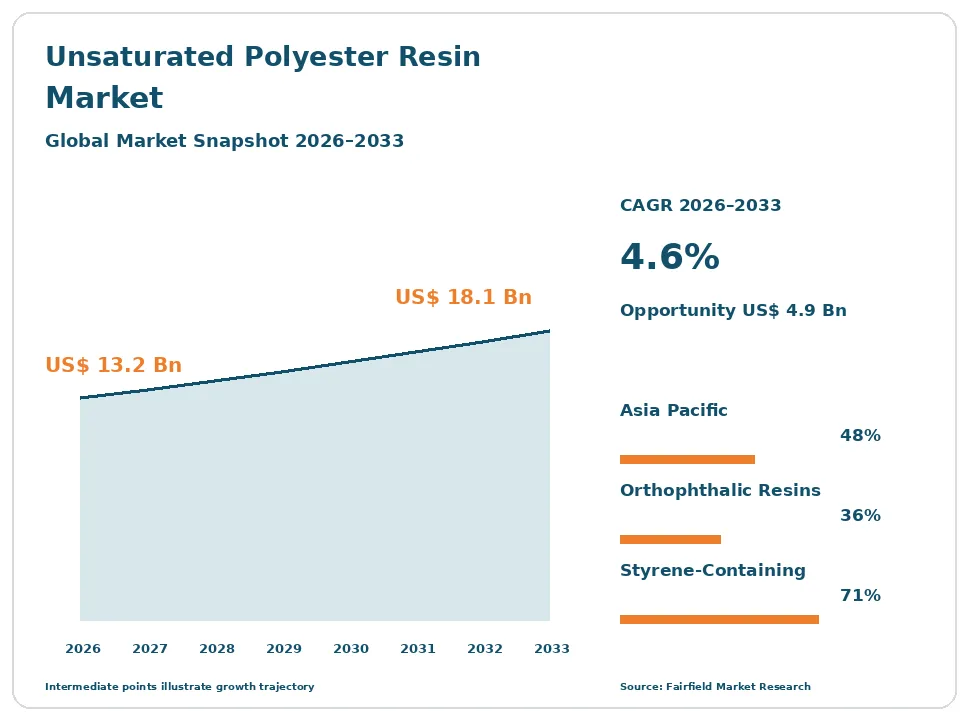
The global unsaturated polyester resin market size is expected to be valued at US$ 13.2 billion in 2026 and projected to reach US$ 18.1 billion by 2033, growing at a CAGR of 4.6% between 2026 and 2033.
Between 2020 and 2025 the market expanded at roughly 3.4% a year, held back by weak marine demand in 2020 and sharp glycol and anhydride price swings in 2022. Three factors now set the pace. Tightening styrene exposure rules keep converting hand lay-up shops to closed moulding and low-styrene grades, which raises the value per tonne of resin sold. Corrosion-resistant tanks and pipes for water and chemical service are absorbing more isophthalic and vinyl ester volume. Pultrusion is adding steady tonnage in construction profiles and electrical gear. The direction is a mature thermoset business with slow volume growth and faster growth in specified, higher-margin grades.
Key Report Takeaways
- By Resin Type: Orthophthalic resins held 36% share in 2026, while vinyl ester resins are projected to expand at a 6.2% CAGR through 2033, driven by chemical and flue-gas service where corrosion resistance is specified rather than preferred.
- By Styrene Content: Styrene-containing formulations held 71% share in 2026, while low-styrene and styrene-free grades are projected to grow at a 7.1% CAGR, driven by workplace exposure limits in open moulding shops.
- By Processing Method: Open moulding held 33% share in 2026, while pultrusion is projected to advance at a 6.4% CAGR through 2033, supported by profile demand in gratings, electrical housings and utility crossarms.
- By End Use: Building and construction held 31% share in 2026, while pipes and tanks are projected to grow at a 5.8% CAGR, driven by water treatment and desalination plant construction.
- By Region: Asia Pacific held 48% share in 2026, while Middle East & Africa is projected to expand at a 5.9% CAGR through 2033, driven by glass fibre reinforced plastic pipe for water transmission schemes.
Global Unsaturated Polyester Resin Market Trends and Insights
Drivers Impact Analysis
| Driver | Impact on CAGR Forecast | Geographic Relevance | Impact Timeline |
| Styrene exposure rules shifting work to closed moulding and low-styrene resins | High | Europe, North America, Asia Pacific | Long term ≥4 years |
| Recycled PET as a commercial glycolysis feedstock for resin grades | Medium | Europe, North America | Medium term 2–4 years |
Two forces explain most of the forecast growth in thermoset composite resin demand.
Styrene Control Rules Are Redirecting Unsaturated Polyester Resin Demand Into Closed Moulding and Low-Styrene Grades
Styrene is the single largest influence on what this industry sells. Unsaturated polyester is dissolved in styrene, which acts as both solvent and cross-linking monomer, and open moulding releases it into the shop air. As exposure and emission rules tightened, fabricators moved work into resin transfer moulding and vacuum infusion, and bought resins formulated to emit less. Those grades carry higher formulation value than commodity orthophthalic resin, so compliance has lifted revenue even where tonnage was flat.
The mechanism is regulatory and direct. The European Union harmonised classification of styrene, national occupational limits across member states, and the United States Occupational Safety and Health Administration permissible exposure limit all bear on the same operation. The National Emission Standards for Hazardous Air Pollutants for reinforced plastic composites production tied allowable emissions to resin chemistry and application method, which made low-styrene and styrene-free formulations a compliance tool rather than a premium option.
Recycled PET Glycolysis Gives Unsaturated Polyester Resin a Circularity Route That Thermosets Rarely Have
Recycled content is becoming a genuine commercial feedstock route in this market rather than a marketing claim. Unsaturated polyester is built from glycols and anhydrides, and depolymerised post-consumer polyethylene terephthalate supplies both the diol and the aromatic acid fragments that certain resin grades need. Several producers now sell orthophthalic and terephthalic grades with measurable recycled input, which lets panel, cultured marble and sheet moulding compound customers answer procurement questions they could not previously answer.
The driver works because the buyer, not the chemist, is asking. Building product manufacturers preparing environmental product declarations need a documented recycled fraction, and bottle-grade PET flake is abundant, specified and traded. Glycolysis of that flake fits existing polyester reactors with limited capital change, so the route scales with feedstock supply rather than with new plant. That makes recycled-content resin one of the few circularity stories in thermosets with an actual supply chain behind it.
Restraints Impact Analysis
| Restraint | Impact on CAGR Forecast | Geographic Relevance | Impact Timeline |
| Cost of styrene compliance and ventilation in open moulding operations | High | North America, Europe | Short term ≤2 years |
| Poor recyclability of cured thermoset composites at end of life | Medium | Europe, North America | Long term ≥4 years |
Two constraints hold back faster expansion of unsaturated polyester resin volumes.
Styrene Compliance Costs Are Closing Small Open Moulding Shops That Buy Commodity Unsaturated Polyester Resin
The same styrene rules that lift product value also destroy demand at the bottom of the market. Meeting an occupational limit in a hand lay-up or spray-up shop means enclosure, local exhaust ventilation, air monitoring, respiratory programmes and record keeping. For a small boatbuilder or tank fabricator those are fixed costs spread over modest output, and many have closed, merged or moved work offshore rather than invest. Every closure removes a steady buyer of commodity orthophthalic resin.
The cost source is specific and measurable. Ventilation air must be heated or cooled, abatement equipment carries energy and maintenance charges, and converting a shop to closed moulding requires tooling, presses or infusion equipment plus retraining. Insurance and liability pricing also reflect the hazard classification. Fabricators in regions with lighter enforcement face none of these charges, so compliance acts as a geographic cost wedge rather than an industry-wide one.
Thermoset Composites Cannot Be Melted and Reprocessed, Which Limits Unsaturated Polyester Resin Specification
Cured unsaturated polyester cannot be remelted, and that single property is now a specification risk. Wind blade operators, boat owners and infrastructure clients are being asked what happens to the laminate at end of life, and the honest answer is mechanical grinding, co-processing in cement kilns, or limited pyrolysis. Where a client scores recyclability, a thermoset composite loses points against a thermoplastic or a metal, and the resin never reaches the specification stage.
Two substitution pressures follow. At the performance end, epoxy takes work where fatigue life, adhesion and dimensional precision matter most, particularly in large structural laminates. Where recyclability is written into the brief, glass-reinforced thermoplastics and reprocessable matrices are gaining attention. Raw material exposure compounds the problem, because glycol, maleic anhydride and phthalic anhydride prices track crude and naphtha, so resin producers cannot always hold price while defending share.
Market Opportunities
Corrosion-Resistant Tanks and Pipes for Water and Chemical Infrastructure Open a Specified, Price-Tolerant Revenue Pool
Corrosion service is the most defensible revenue pool in this market, because the alternative is stainless steel or lined carbon steel at several times the installed cost. Glass fibre reinforced plastic tanks, scrubbers, stacks and buried pipe use isophthalic, bisphenol-A fumarate and vinyl ester resins, and the buyer selects on chemical resistance and design life rather than on resin price. That makes the segment unusually tolerant of feedstock inflation and far less exposed to consumer cycles.
Water utilities, desalination developers, chemical processors, mining operators and flue-gas treatment contractors create the demand. Design and workmanship rules such as EN 13121 for glass-reinforced plastic tanks and vessels, together with ASTM composite standards, give engineers a defensible basis for approving a composite vessel over metal. Producers that maintain documented chemical resistance data, approved fabricator networks and technical service capacity can capture this pool; those selling on price alone cannot.
Pultruded Profiles in Construction and Grid Electrification Create New Volume Outside Traditional Moulding
Pultrusion is the clearest new volume opportunity for thermoset resin suppliers. The process is continuous, enclosed and automated, so it sidesteps the styrene exposure problem that burdens open moulding, and it converts resin into structural profiles at predictable cost. Gratings, handrails, ladder systems, cable trays, utility crossarms and window and door reinforcement profiles are all growing applications that did not exist at scale two decades ago.
Grid operators, utility contractors, offshore and coastal infrastructure owners and modular building fabricators drive the demand, because non-conductive, non-corroding profiles cut maintenance in wet and electrically live environments. Resin producers with pultrusion-specific formulations, fast-cure systems and filled low-shrink grades can serve this base directly. The opportunity suits mid-sized suppliers as well as majors, since profile producers value formulation support and short lead times more than global scale.
Segment Analysis
By Resin Type: Orthophthalic Resins Hold Volume While Vinyl Ester Grades Capture the Growth
Orthophthalic resins held 36% of the market in 2026, the largest single share, because they are the cheapest route to an acceptable laminate in panels, cultured marble, solid surface and general-purpose moulding. Isophthalic, terephthalic, dicyclopentadiene-modified and bisphenol-A fumarate grades divide most of the balance, each solving a specific problem of water resistance, low shrink or chemical attack. Vinyl ester resins are the fastest-growing type at a 6.2% CAGR through 2033.
Vinyl ester grows because corrosion service is being specified rather than chosen. Chemical plants, flue-gas desulphurisation units, mining process equipment and secondary containment increasingly require documented resistance data, and vinyl ester delivers it where isophthalic resin is marginal. Gelcoats remain a small but high-value adjunct that protects the laminate surface. For suppliers, the implication is that tonnage growth and margin growth now sit in different parts of the product range.
By Styrene Content: Conventional Formulations Still Dominate as Low-Styrene Systems Grow Fastest
Styrene-containing formulations accounted for 71% of the market in 2026 because styrene remains the cheapest, best-understood reactive diluent available, and most existing tooling and cure schedules are built around it. Low-styrene and styrene-free systems, including those using alternative reactive diluents and vapour-suppressed chemistry, are the fastest-growing group at a 7.1% CAGR through 2033.
The split is driven almost entirely by workplace exposure management. Fabricators in Europe and North America facing national occupational limits buy reduced-emission grades to lower monitored concentrations without rebuilding the shop, which is cheaper than enclosure. Suppliers price that benefit into the resin. The wider implication is that regulation has become a product development roadmap for this industry, and formulators who can hold mechanical performance while cutting monomer content gain share in the markets that pay most per tonne.
By Processing Method: Open Moulding Leads on Installed Base While Pultrusion Advances Quickest
Open moulding, covering hand lay-up and spray-up, still represented 33% of resin consumption in 2026, reflecting an enormous installed base of low-capital shops in marine craft, tanks and architectural products. Closed moulding by resin transfer moulding and vacuum infusion, sheet and bulk moulding compound, filament winding and casting account for the remainder. Pultrusion is the fastest-growing route at a 6.4% CAGR through 2033.
Pultrusion advances because it is enclosed, continuous and labour-light, which answers both the exposure problem and the skilled-labour shortage that limits hand lay-up output. Sheet and bulk moulding compound remain important in electrical components and vehicle panels, where dimensional stability and flame performance matter. The business implication is that resin suppliers must now formulate for machine processes with tight cure windows, not only for shops that can adjust catalyst levels by hand on the bench.
By End Use: Building and Construction Leads While Pipes and Tanks Expand Most Rapidly
Building and construction held 31% share in 2026, the largest end use, spanning translucent and sandwich panels, cultured marble, solid surface, bathware, cladding and architectural mouldings. Marine craft, transportation, wind energy and electrical applications follow. Pipes and tanks for corrosion service are the fastest-growing end use at a 5.8% CAGR through 2033.
Pipes and tanks grow with water infrastructure rather than with the construction cycle, which makes the demand steadier. Desalination trains, municipal treatment works, chemical storage and mining slurry lines all use glass fibre reinforced plastic because it does not corrode and can be installed in long sections. Wind energy remains a meaningful consumer of resin for blades and nacelle covers, though epoxy dominates the largest blades. For producers, infrastructure end uses offer longer qualification cycles but far more predictable repeat volume.
Geography Analysis
North America Rebuilds Composite Demand Around Closed Moulding and Infrastructure Repair
North America accounted for roughly 19% of global demand in 2026, expanding near 3.4% annually. The United States dominates, with Canada and Mexico contributing marine, tank and transportation fabrication. Demand is concentrated in boats, recreational vehicles, corrosion-resistant process equipment, bathware and electrical components, and the regional fabricator base is unusually well consolidated after two decades of attrition among small shops.
The main cause of that consolidation was emission and exposure regulation of styrene, which raised the entry cost of running a moulding operation. The survivors invested in closed moulding and now operate at higher productivity. Infrastructure renewal is the growth lever, including culvert and sewer rehabilitation, water treatment equipment and utility poles and crossarms. Resin suppliers here compete on technical service and documented compliance data rather than on delivered price per tonne.
Europe Sets the Regulatory Benchmark That Reshapes Resin Formulation Worldwide
Europe held about 20% share in 2026 and grows more slowly, near 3.0% a year, but its influence exceeds its volume. Germany, Italy, France, Poland, Spain and Turkey host the main production and conversion base, with Italy and Turkey strong in marine craft and Germany in industrial tanks and electrical compounds.
Growth is modest because industrial output is flat and energy costs raised the delivered price of resin after 2022. What the region does instead is set the rules. The harmonised hazard classification of styrene, national occupational exposure limits, and REACH registration and restriction processes together define what formulators must achieve, and those requirements propagate into products sold globally. Composite end-of-life policy, particularly around decommissioned wind blades, is the live issue and will shape how thermoset laminates are specified across the region this decade.
Which Region Is Leading the Unsaturated Polyester Resin Market?
Asia Pacific leads the market with 48% share in 2026, and grows at about 5.5% a year to 2033. China holds most of that position, with large integrated producers supplying both domestic moulders and export markets, supported by local maleic anhydride and glycol capacity. India, Taiwan, South Korea, Japan and Vietnam add substantial volume in panels, tanks, pultruded profiles and sanitaryware.
The region leads for three concrete reasons. Feedstock and resin capacity sit close together, which removes freight and import duty from the delivered cost. Fabrication remains labour-intensive and labour is available, so open moulding is still viable at scale. Finally, construction and sanitaryware output is simply larger here than anywhere else. The main change ahead is tightening domestic emissions enforcement in China, which is already pushing larger moulders toward closed processes and reduced-emission resin grades.
Latin America Grows With Sanitaryware, Water Networks and Local Panel Production
Latin America represented about 7% of the market in 2026 and is expanding near 4.5% a year. Brazil and Mexico account for most consumption, with Colombia, Chile, Argentina and Peru adding smaller volumes in tanks, water storage, bathware and translucent roofing panels. Local compounders and moulders serve housing and agricultural buildings, where composite panels compete well against metal sheet.
The barriers are familiar. Resin and glass fibre are frequently imported, so currency movement passes straight into product cost, and credit for small fabricators is expensive. Technical standards enforcement is uneven, which allows thin laminates to undercut properly engineered ones and damages the category’s reputation. The opportunity is municipal water and sanitation investment, where corrosion-resistant pipe and tank systems replace steel and concrete in aggressive soils and coastal conditions.
Which Region Is Growing Fastest in the Unsaturated Polyester Resin Market?
Middle East & Africa is the fastest-growing geography at a 5.9% CAGR between 2026 and 2033, from roughly 6% share in 2026. Saudi Arabia, the United Arab Emirates, Egypt, Qatar and South Africa drive the volume, with Gulf demand centred on large diameter glass fibre reinforced plastic pipe, water storage, cooling tower components and chemical process equipment.
The cause is water. Desalination capacity, transmission mains, irrigation schemes and wastewater reuse plants all require piping and vessels that survive chloride-rich service, and composite systems outperform coated steel on whole-life cost in those conditions. Local pipe winding and tank fabrication capacity has grown alongside. The barriers are a thin specialist labour pool, dependence on imported resin and glass fibre, and project timing that makes demand lumpy. Localisation policies in the Gulf are the change most likely to anchor sustained resin consumption.
Competitive Landscape
The unsaturated polyester resin market is moderately concentrated. A small group of global formulators including AOC LLC, Polynt-Reichhold Group, Ashland Inc., INEOS Composites and Scott Bader Company Ltd. supplies most specified and higher-value resin in Europe and North America, while Asia Pacific remains far more fragmented, with dozens of regional producers serving local moulders on price and availability. Consolidation in the Western market has been substantial over the past decade, driven by the need to spread formulation, regulatory and technical service costs across more tonnes.
Competition rests on a narrow set of factors. Documented chemical resistance and mechanical data matter most in corrosion service, because engineers approve a resin against a design code rather than a datasheet claim. Emission performance is the second factor, since fabricators buy reduced-monomer grades to manage workplace exposure. Cure control, shelf life, colour stability in gelcoats and consistency from batch to batch decide repeat business in production moulding. Price leads only in commodity panel and casting work. New entrants are mostly regional producers in Asia Pacific moving up from general-purpose resin into isophthalic and vinyl ester grades, and a smaller group of formulators building their position on recycled-content chemistry.
Strategic activity across the industry concentrates on three themes rather than on headline transactions. The first is portfolio shift from commodity orthophthalic tonnage toward specified corrosion, pultrusion and low-emission grades. The second is feedstock positioning, including recycled polyethylene terephthalate routes and closer integration with glycol and anhydride supply, which protects margin when naphtha-linked raw materials move. The third is technical service depth, because converting a fabricator from open to closed moulding is a consultative sale that takes months and creates a durable supply relationship once completed. Vendors are also investing in end-of-life research for composite laminates, since recyclability is increasingly raised during specification.
Unsaturated Polyester Resin Industry Leaders
- AOC LLC
- Polynt-Reichhold Group
- Ashland Inc.
- INEOS Composites
- Scott Bader Company Ltd.
Recent Industry Developments
- April 2003: The United States Environmental Protection Agency finalised the National Emission Standards for Hazardous Air Pollutants for reinforced plastic composites production – this rule tied allowable styrene emissions to resin chemistry and application method, and remains the single regulation that most reshaped open moulding practice.
- May 2021: The transposition deadline passed for the European Commission list of indicative occupational exposure limit values covering styrene – it obliged member states to set national workplace limits, standardising the exposure pressure that drives low-styrene resin demand.
- December 2022: The European Union harmonised classification of styrene as a reproductive toxicant with repeated-exposure hazard became mandatory across the European Economic Area – it changed labelling, risk assessment and insurance treatment for every fabricator using styrenated resin.
- August 2024: The revised European Industrial Emissions Directive entered into force – it tightens permitting and emission monitoring for chemical production sites, including polyester resin plants, and raises the compliance baseline for new capacity in Europe.
Companies Covered in the Report
- AOC LLC
- Polynt-Reichhold Group
- Ashland Inc.
- INEOS Composites
- Scott Bader Company Ltd.
- Resonac Holdings Corporation
- DIC Corporation
- UPC Technology Corporation
- Swancor Holding Co., Ltd.
- Eternal Materials Co., Ltd.
- Aekyung Chemical Co., Ltd.
- Japan U-Pica Company Ltd.
- BÜFA Composite Systems GmbH & Co. KG
Unsaturated Polyester Resin Market Report Scope
This report covers thermosetting unsaturated polyester resins, including orthophthalic, isophthalic, terephthalic, dicyclopentadiene-modified and bisphenol-A fumarate chemistries, together with vinyl ester resins sold alongside them and with gelcoats. Vinyl ester is counted in the headline figure. Saturated polyesters, polyurethanes and epoxy systems are excluded. The base year is 2025, the forecast period runs from 2026 to 2033, and all values are stated in US$ Billion.
Resin Type
- Orthophthalic resins
- Isophthalic resins
- Terephthalic resins
- Dicyclopentadiene-modified resins
- Bisphenol-A fumarate resins
- Vinyl ester resins
- Gelcoats
Styrene Content
- Styrene-containing formulations
- Low-styrene formulations
- Styrene-free formulations
Processing Method
- Open moulding (hand lay-up and spray-up)
- Closed moulding (resin transfer moulding and vacuum infusion)
- Sheet and bulk moulding compound
- Pultrusion
- Filament winding
- Casting
End Use
- Building and construction
- Marine craft
- Pipes and tanks
- Transportation
- Wind energy
- Electrical applications
Regions
- North America
- Europe
- Asia Pacific
- Latin America
- Middle East & Africa
Key Questions Answered in the Report
How large is the unsaturated polyester resin market in 2026?
The market is valued at US$ 13.2 billion in 2026, covering thermosetting polyester and vinyl ester resins together with gelcoats sold into composite fabrication worldwide.
What is the forecast size and growth rate to 2033?
The market is projected to reach US$ 18.1 billion by 2033, growing at a 4.6% CAGR and adding US$ 4.9 billion in absolute dollar opportunity.
Which resin type holds the largest share?
Orthophthalic resins lead with 36% share in 2026, because they deliver an acceptable laminate at the lowest cost in panels, castings and general moulding.
Which segment and region are growing fastest?
Low-styrene and styrene-free formulations grow fastest among segments at 7.1%, while Middle East & Africa leads regional growth at a 5.9% CAGR.
Which region holds the largest market share?
Asia Pacific holds 48% share in 2026, supported by integrated feedstock and resin capacity, available fabrication labour and the largest construction output base.
1. Executive Summary
1.1. Global Unsaturated Polyester Resin Market Snapshot
1.2. Future Projections
1.3. Key Report Takeaways
1.4. Regional Snapshot
2. Market Overview
2.1. Market Definition and Report Scope
2.2. Historical Trends 2020–2025
2.3. Market Dynamics
2.3.1. Drivers
2.3.1.1. Styrene Control Rules Are Redirecting Unsaturated Polyester Resin Demand Into Closed Moulding and Low-Styrene Grades
2.3.1.2. Recycled PET Glycolysis Gives Unsaturated Polyester Resin a Circularity Route That Thermosets Rarely Have
2.3.2. Restraints
2.3.2.1. Styrene Compliance Costs Are Closing Small Open Moulding Shops That Buy Commodity Unsaturated Polyester Resin
2.3.2.2. Thermoset Composites Cannot Be Melted and Reprocessed, Which Limits Unsaturated Polyester Resin Specification
2.3.3. Market Opportunities
2.3.3.1. Corrosion-Resistant Tanks and Pipes for Water and Chemical Infrastructure Open a Specified, Price-Tolerant Revenue Pool
2.3.3.2. Pultruded Profiles in Construction and Grid Electrification Create New Volume Outside Traditional Moulding
3. Global Unsaturated Polyester Resin Market Outlook, 2020–2033
3.1. Global Unsaturated Polyester Resin Market Outlook, by Resin Type, Value (US$ Billion), 2020–2033
3.1.1. Orthophthalic resins
3.1.2. Isophthalic resins
3.1.3. Terephthalic resins
3.1.4. Dicyclopentadiene-modified resins
3.1.5. Bisphenol-A fumarate resins
3.1.6. Vinyl ester resins
3.1.7. Gelcoats
3.2. Global Unsaturated Polyester Resin Market Outlook, by Styrene Content, Value (US$ Billion), 2020–2033
3.2.1. Styrene-containing formulations
3.2.2. Low-styrene formulations
3.2.3. Styrene-free formulations
3.3. Global Unsaturated Polyester Resin Market Outlook, by Processing Method, Value (US$ Billion), 2020–2033
3.3.1. Open moulding (hand lay-up and spray-up)
3.3.2. Closed moulding (resin transfer moulding and vacuum infusion)
3.3.3. Sheet and bulk moulding compound
3.3.4. Pultrusion
3.3.5. Filament winding
3.3.6. Casting
3.4. Global Unsaturated Polyester Resin Market Outlook, by End Use, Value (US$ Billion), 2020–2033
3.4.1. Building and construction
3.4.2. Marine craft
3.4.3. Pipes and tanks
3.4.4. Transportation
3.4.5. Wind energy
3.4.6. Electrical applications
3.5. Global Unsaturated Polyester Resin Market Outlook, by Region, Value (US$ Billion), 2020–2033
3.5.1. North America
3.5.2. Europe
3.5.3. Asia Pacific
3.5.4. Latin America
3.5.5. Middle East & Africa
4. North America Unsaturated Polyester Resin Market Outlook, 2020–2033
4.1. North America Unsaturated Polyester Resin Market Outlook, by Resin Type, Value (US$ Billion), 2020–2033
4.1.1. Orthophthalic resins
4.1.2. Isophthalic resins
4.1.3. Terephthalic resins
4.1.4. Dicyclopentadiene-modified resins
4.1.5. Bisphenol-A fumarate resins
4.1.6. Vinyl ester resins
4.1.7. Gelcoats
4.2. North America Unsaturated Polyester Resin Market Outlook, by Styrene Content, Value (US$ Billion), 2020–2033
4.2.1. Styrene-containing formulations
4.2.2. Low-styrene formulations
4.2.3. Styrene-free formulations
4.3. North America Unsaturated Polyester Resin Market Outlook, by Processing Method, Value (US$ Billion), 2020–2033
4.3.1. Open moulding (hand lay-up and spray-up)
4.3.2. Closed moulding (resin transfer moulding and vacuum infusion)
4.3.3. Sheet and bulk moulding compound
4.3.4. Pultrusion
4.3.5. Filament winding
4.3.6. Casting
4.4. North America Unsaturated Polyester Resin Market Outlook, by End Use, Value (US$ Billion), 2020–2033
4.4.1. Building and construction
4.4.2. Marine craft
4.4.3. Pipes and tanks
4.4.4. Transportation
4.4.5. Wind energy
4.4.6. Electrical applications
4.5. North America Unsaturated Polyester Resin Market Outlook, by Country, Value (US$ Billion), 2020–2033
4.5.1. United States Unsaturated Polyester Resin Market Outlook, by Resin Type, 2020–2033
4.5.2. United States Unsaturated Polyester Resin Market Outlook, by Styrene Content, 2020–2033
4.5.3. United States Unsaturated Polyester Resin Market Outlook, by Processing Method, 2020–2033
4.5.4. United States Unsaturated Polyester Resin Market Outlook, by End Use, 2020–2033
4.5.5. Canada Unsaturated Polyester Resin Market Outlook, by Resin Type, 2020–2033
4.5.6. Canada Unsaturated Polyester Resin Market Outlook, by Styrene Content, 2020–2033
4.5.7. Canada Unsaturated Polyester Resin Market Outlook, by Processing Method, 2020–2033
4.5.8. Canada Unsaturated Polyester Resin Market Outlook, by End Use, 2020–2033
4.5.9. Mexico Unsaturated Polyester Resin Market Outlook, by Resin Type, 2020–2033
4.5.10. Mexico Unsaturated Polyester Resin Market Outlook, by Styrene Content, 2020–2033
4.5.11. Mexico Unsaturated Polyester Resin Market Outlook, by Processing Method, 2020–2033
4.5.12. Mexico Unsaturated Polyester Resin Market Outlook, by End Use, 2020–2033
5. Europe Unsaturated Polyester Resin Market Outlook, 2020–2033
5.1. Europe Unsaturated Polyester Resin Market Outlook, by Resin Type, Value (US$ Billion), 2020–2033
5.1.1. Orthophthalic resins
5.1.2. Isophthalic resins
5.1.3. Terephthalic resins
5.1.4. Dicyclopentadiene-modified resins
5.1.5. Bisphenol-A fumarate resins
5.1.6. Vinyl ester resins
5.1.7. Gelcoats
5.2. Europe Unsaturated Polyester Resin Market Outlook, by Styrene Content, Value (US$ Billion), 2020–2033
5.2.1. Styrene-containing formulations
5.2.2. Low-styrene formulations
5.2.3. Styrene-free formulations
5.3. Europe Unsaturated Polyester Resin Market Outlook, by Processing Method, Value (US$ Billion), 2020–2033
5.3.1. Open moulding (hand lay-up and spray-up)
5.3.2. Closed moulding (resin transfer moulding and vacuum infusion)
5.3.3. Sheet and bulk moulding compound
5.3.4. Pultrusion
5.3.5. Filament winding
5.3.6. Casting
5.4. Europe Unsaturated Polyester Resin Market Outlook, by End Use, Value (US$ Billion), 2020–2033
5.4.1. Building and construction
5.4.2. Marine craft
5.4.3. Pipes and tanks
5.4.4. Transportation
5.4.5. Wind energy
5.4.6. Electrical applications
5.5. Europe Unsaturated Polyester Resin Market Outlook, by Country, Value (US$ Billion), 2020–2033
5.5.1. Germany Unsaturated Polyester Resin Market Outlook, by Resin Type, 2020–2033
5.5.2. Germany Unsaturated Polyester Resin Market Outlook, by Styrene Content, 2020–2033
5.5.3. Germany Unsaturated Polyester Resin Market Outlook, by Processing Method, 2020–2033
5.5.4. Germany Unsaturated Polyester Resin Market Outlook, by End Use, 2020–2033
5.5.5. Italy Unsaturated Polyester Resin Market Outlook, by Resin Type, 2020–2033
5.5.6. Italy Unsaturated Polyester Resin Market Outlook, by Styrene Content, 2020–2033
5.5.7. Italy Unsaturated Polyester Resin Market Outlook, by Processing Method, 2020–2033
5.5.8. Italy Unsaturated Polyester Resin Market Outlook, by End Use, 2020–2033
5.5.9. France Unsaturated Polyester Resin Market Outlook, by Resin Type, 2020–2033
5.5.10. France Unsaturated Polyester Resin Market Outlook, by Styrene Content, 2020–2033
5.5.11. France Unsaturated Polyester Resin Market Outlook, by Processing Method, 2020–2033
5.5.12. France Unsaturated Polyester Resin Market Outlook, by End Use, 2020–2033
5.5.13. Poland Unsaturated Polyester Resin Market Outlook, by Resin Type, 2020–2033
5.5.14. Poland Unsaturated Polyester Resin Market Outlook, by Styrene Content, 2020–2033
5.5.15. Poland Unsaturated Polyester Resin Market Outlook, by Processing Method, 2020–2033
5.5.16. Poland Unsaturated Polyester Resin Market Outlook, by End Use, 2020–2033
5.5.17. Spain Unsaturated Polyester Resin Market Outlook, by Resin Type, 2020–2033
5.5.18. Spain Unsaturated Polyester Resin Market Outlook, by Styrene Content, 2020–2033
5.5.19. Spain Unsaturated Polyester Resin Market Outlook, by Processing Method, 2020–2033
5.5.20. Spain Unsaturated Polyester Resin Market Outlook, by End Use, 2020–2033
5.5.21. Turkey Unsaturated Polyester Resin Market Outlook, by Resin Type, 2020–2033
5.5.22. Turkey Unsaturated Polyester Resin Market Outlook, by Styrene Content, 2020–2033
5.5.23. Turkey Unsaturated Polyester Resin Market Outlook, by Processing Method, 2020–2033
5.5.24. Turkey Unsaturated Polyester Resin Market Outlook, by End Use, 2020–2033
6. Asia Pacific Unsaturated Polyester Resin Market Outlook, 2020–2033
6.1. Asia Pacific Unsaturated Polyester Resin Market Outlook, by Resin Type, Value (US$ Billion), 2020–2033
6.1.1. Orthophthalic resins
6.1.2. Isophthalic resins
6.1.3. Terephthalic resins
6.1.4. Dicyclopentadiene-modified resins
6.1.5. Bisphenol-A fumarate resins
6.1.6. Vinyl ester resins
6.1.7. Gelcoats
6.2. Asia Pacific Unsaturated Polyester Resin Market Outlook, by Styrene Content, Value (US$ Billion), 2020–2033
6.2.1. Styrene-containing formulations
6.2.2. Low-styrene formulations
6.2.3. Styrene-free formulations
6.3. Asia Pacific Unsaturated Polyester Resin Market Outlook, by Processing Method, Value (US$ Billion), 2020–2033
6.3.1. Open moulding (hand lay-up and spray-up)
6.3.2. Closed moulding (resin transfer moulding and vacuum infusion)
6.3.3. Sheet and bulk moulding compound
6.3.4. Pultrusion
6.3.5. Filament winding
6.3.6. Casting
6.4. Asia Pacific Unsaturated Polyester Resin Market Outlook, by End Use, Value (US$ Billion), 2020–2033
6.4.1. Building and construction
6.4.2. Marine craft
6.4.3. Pipes and tanks
6.4.4. Transportation
6.4.5. Wind energy
6.4.6. Electrical applications
6.5. Asia Pacific Unsaturated Polyester Resin Market Outlook, by Country, Value (US$ Billion), 2020–2033
6.5.1. China Unsaturated Polyester Resin Market Outlook, by Resin Type, 2020–2033
6.5.2. China Unsaturated Polyester Resin Market Outlook, by Styrene Content, 2020–2033
6.5.3. China Unsaturated Polyester Resin Market Outlook, by Processing Method, 2020–2033
6.5.4. China Unsaturated Polyester Resin Market Outlook, by End Use, 2020–2033
6.5.5. India Unsaturated Polyester Resin Market Outlook, by Resin Type, 2020–2033
6.5.6. India Unsaturated Polyester Resin Market Outlook, by Styrene Content, 2020–2033
6.5.7. India Unsaturated Polyester Resin Market Outlook, by Processing Method, 2020–2033
6.5.8. India Unsaturated Polyester Resin Market Outlook, by End Use, 2020–2033
6.5.9. Taiwan Unsaturated Polyester Resin Market Outlook, by Resin Type, 2020–2033
6.5.10. Taiwan Unsaturated Polyester Resin Market Outlook, by Styrene Content, 2020–2033
6.5.11. Taiwan Unsaturated Polyester Resin Market Outlook, by Processing Method, 2020–2033
6.5.12. Taiwan Unsaturated Polyester Resin Market Outlook, by End Use, 2020–2033
6.5.13. South Korea Unsaturated Polyester Resin Market Outlook, by Resin Type, 2020–2033
6.5.14. South Korea Unsaturated Polyester Resin Market Outlook, by Styrene Content, 2020–2033
6.5.15. South Korea Unsaturated Polyester Resin Market Outlook, by Processing Method, 2020–2033
6.5.16. South Korea Unsaturated Polyester Resin Market Outlook, by End Use, 2020–2033
6.5.17. Japan Unsaturated Polyester Resin Market Outlook, by Resin Type, 2020–2033
6.5.18. Japan Unsaturated Polyester Resin Market Outlook, by Styrene Content, 2020–2033
6.5.19. Japan Unsaturated Polyester Resin Market Outlook, by Processing Method, 2020–2033
6.5.20. Japan Unsaturated Polyester Resin Market Outlook, by End Use, 2020–2033
6.5.21. Vietnam Unsaturated Polyester Resin Market Outlook, by Resin Type, 2020–2033
6.5.22. Vietnam Unsaturated Polyester Resin Market Outlook, by Styrene Content, 2020–2033
6.5.23. Vietnam Unsaturated Polyester Resin Market Outlook, by Processing Method, 2020–2033
6.5.24. Vietnam Unsaturated Polyester Resin Market Outlook, by End Use, 2020–2033
7. Latin America Unsaturated Polyester Resin Market Outlook, 2020–2033
7.1. Latin America Unsaturated Polyester Resin Market Outlook, by Resin Type, Value (US$ Billion), 2020–2033
7.1.1. Orthophthalic resins
7.1.2. Isophthalic resins
7.1.3. Terephthalic resins
7.1.4. Dicyclopentadiene-modified resins
7.1.5. Bisphenol-A fumarate resins
7.1.6. Vinyl ester resins
7.1.7. Gelcoats
7.2. Latin America Unsaturated Polyester Resin Market Outlook, by Styrene Content, Value (US$ Billion), 2020–2033
7.2.1. Styrene-containing formulations
7.2.2. Low-styrene formulations
7.2.3. Styrene-free formulations
7.3. Latin America Unsaturated Polyester Resin Market Outlook, by Processing Method, Value (US$ Billion), 2020–2033
7.3.1. Open moulding (hand lay-up and spray-up)
7.3.2. Closed moulding (resin transfer moulding and vacuum infusion)
7.3.3. Sheet and bulk moulding compound
7.3.4. Pultrusion
7.3.5. Filament winding
7.3.6. Casting
7.4. Latin America Unsaturated Polyester Resin Market Outlook, by End Use, Value (US$ Billion), 2020–2033
7.4.1. Building and construction
7.4.2. Marine craft
7.4.3. Pipes and tanks
7.4.4. Transportation
7.4.5. Wind energy
7.4.6. Electrical applications
7.5. Latin America Unsaturated Polyester Resin Market Outlook, by Country, Value (US$ Billion), 2020–2033
7.5.1. Brazil Unsaturated Polyester Resin Market Outlook, by Resin Type, 2020–2033
7.5.2. Brazil Unsaturated Polyester Resin Market Outlook, by Styrene Content, 2020–2033
7.5.3. Brazil Unsaturated Polyester Resin Market Outlook, by Processing Method, 2020–2033
7.5.4. Brazil Unsaturated Polyester Resin Market Outlook, by End Use, 2020–2033
7.5.5. Mexico Unsaturated Polyester Resin Market Outlook, by Resin Type, 2020–2033
7.5.6. Mexico Unsaturated Polyester Resin Market Outlook, by Styrene Content, 2020–2033
7.5.7. Mexico Unsaturated Polyester Resin Market Outlook, by Processing Method, 2020–2033
7.5.8. Mexico Unsaturated Polyester Resin Market Outlook, by End Use, 2020–2033
7.5.9. Colombia Unsaturated Polyester Resin Market Outlook, by Resin Type, 2020–2033
7.5.10. Colombia Unsaturated Polyester Resin Market Outlook, by Styrene Content, 2020–2033
7.5.11. Colombia Unsaturated Polyester Resin Market Outlook, by Processing Method, 2020–2033
7.5.12. Colombia Unsaturated Polyester Resin Market Outlook, by End Use, 2020–2033
7.5.13. Chile Unsaturated Polyester Resin Market Outlook, by Resin Type, 2020–2033
7.5.14. Chile Unsaturated Polyester Resin Market Outlook, by Styrene Content, 2020–2033
7.5.15. Chile Unsaturated Polyester Resin Market Outlook, by Processing Method, 2020–2033
7.5.16. Chile Unsaturated Polyester Resin Market Outlook, by End Use, 2020–2033
7.5.17. Argentina Unsaturated Polyester Resin Market Outlook, by Resin Type, 2020–2033
7.5.18. Argentina Unsaturated Polyester Resin Market Outlook, by Styrene Content, 2020–2033
7.5.19. Argentina Unsaturated Polyester Resin Market Outlook, by Processing Method, 2020–2033
7.5.20. Argentina Unsaturated Polyester Resin Market Outlook, by End Use, 2020–2033
7.5.21. Peru Unsaturated Polyester Resin Market Outlook, by Resin Type, 2020–2033
7.5.22. Peru Unsaturated Polyester Resin Market Outlook, by Styrene Content, 2020–2033
7.5.23. Peru Unsaturated Polyester Resin Market Outlook, by Processing Method, 2020–2033
7.5.24. Peru Unsaturated Polyester Resin Market Outlook, by End Use, 2020–2033
8. Middle East & Africa Unsaturated Polyester Resin Market Outlook, 2020–2033
8.1. Middle East & Africa Unsaturated Polyester Resin Market Outlook, by Resin Type, Value (US$ Billion), 2020–2033
8.1.1. Orthophthalic resins
8.1.2. Isophthalic resins
8.1.3. Terephthalic resins
8.1.4. Dicyclopentadiene-modified resins
8.1.5. Bisphenol-A fumarate resins
8.1.6. Vinyl ester resins
8.1.7. Gelcoats
8.2. Middle East & Africa Unsaturated Polyester Resin Market Outlook, by Styrene Content, Value (US$ Billion), 2020–2033
8.2.1. Styrene-containing formulations
8.2.2. Low-styrene formulations
8.2.3. Styrene-free formulations
8.3. Middle East & Africa Unsaturated Polyester Resin Market Outlook, by Processing Method, Value (US$ Billion), 2020–2033
8.3.1. Open moulding (hand lay-up and spray-up)
8.3.2. Closed moulding (resin transfer moulding and vacuum infusion)
8.3.3. Sheet and bulk moulding compound
8.3.4. Pultrusion
8.3.5. Filament winding
8.3.6. Casting
8.4. Middle East & Africa Unsaturated Polyester Resin Market Outlook, by End Use, Value (US$ Billion), 2020–2033
8.4.1. Building and construction
8.4.2. Marine craft
8.4.3. Pipes and tanks
8.4.4. Transportation
8.4.5. Wind energy
8.4.6. Electrical applications
8.5. Middle East & Africa Unsaturated Polyester Resin Market Outlook, by Country, Value (US$ Billion), 2020–2033
8.5.1. Saudi Arabia Unsaturated Polyester Resin Market Outlook, by Resin Type, 2020–2033
8.5.2. Saudi Arabia Unsaturated Polyester Resin Market Outlook, by Styrene Content, 2020–2033
8.5.3. Saudi Arabia Unsaturated Polyester Resin Market Outlook, by Processing Method, 2020–2033
8.5.4. Saudi Arabia Unsaturated Polyester Resin Market Outlook, by End Use, 2020–2033
8.5.5. United Arab Emirates Unsaturated Polyester Resin Market Outlook, by Resin Type, 2020–2033
8.5.6. United Arab Emirates Unsaturated Polyester Resin Market Outlook, by Styrene Content, 2020–2033
8.5.7. United Arab Emirates Unsaturated Polyester Resin Market Outlook, by Processing Method, 2020–2033
8.5.8. United Arab Emirates Unsaturated Polyester Resin Market Outlook, by End Use, 2020–2033
8.5.9. Egypt Unsaturated Polyester Resin Market Outlook, by Resin Type, 2020–2033
8.5.10. Egypt Unsaturated Polyester Resin Market Outlook, by Styrene Content, 2020–2033
8.5.11. Egypt Unsaturated Polyester Resin Market Outlook, by Processing Method, 2020–2033
8.5.12. Egypt Unsaturated Polyester Resin Market Outlook, by End Use, 2020–2033
8.5.13. Qatar Unsaturated Polyester Resin Market Outlook, by Resin Type, 2020–2033
8.5.14. Qatar Unsaturated Polyester Resin Market Outlook, by Styrene Content, 2020–2033
8.5.15. Qatar Unsaturated Polyester Resin Market Outlook, by Processing Method, 2020–2033
8.5.16. Qatar Unsaturated Polyester Resin Market Outlook, by End Use, 2020–2033
8.5.17. South Africa Unsaturated Polyester Resin Market Outlook, by Resin Type, 2020–2033
8.5.18. South Africa Unsaturated Polyester Resin Market Outlook, by Styrene Content, 2020–2033
8.5.19. South Africa Unsaturated Polyester Resin Market Outlook, by Processing Method, 2020–2033
8.5.20. South Africa Unsaturated Polyester Resin Market Outlook, by End Use, 2020–2033
9. Competitive Landscape
9.1. Market Concentration and Industry Leaders
9.2. Competitive Differentiation
9.3. Strategic Moves and Market Direction
9.4. Recent Industry Developments
9.5. Company Profiles
9.5.1. AOC LLC
9.5.2. Polynt-Reichhold Group
9.5.3. Ashland Inc.
9.5.4. INEOS Composites
9.5.5. Scott Bader Company Ltd.
9.5.6. Resonac Holdings Corporation
9.5.7. DIC Corporation
9.5.8. UPC Technology Corporation
9.5.9. Swancor Holding Co., Ltd.
9.5.10. Eternal Materials Co., Ltd.
9.5.11. Aekyung Chemical Co., Ltd.
9.5.12. Japan U-Pica Company Ltd.
9.5.13. BÜFA Composite Systems GmbH & Co. KG
10. Appendix
10.1. Research Methodology
10.2. Report Assumptions
10.3. Acronyms and Abbreviations
| Resin Type | Orthophthalic resins, Isophthalic resins, Terephthalic resins, Dicyclopentadiene-modified resins, Bisphenol-A fumarate resins, Vinyl ester resins, Gelcoats |
| Styrene Content | Styrene-containing formulations, Low-styrene formulations, Styrene-free formulations |
| Processing Method | Open moulding (hand lay-up and spray-up), Closed moulding (resin transfer moulding and vacuum infusion), Sheet and bulk moulding compound, Pultrusion, Filament winding, Casting |
| End Use | Building and construction, Marine craft, Pipes and tanks, Transportation, Wind energy, Electrical applications |
| Regions | North America, Europe, Asia Pacific, Latin America, Middle East & Africa |
Our Research Methodology
Considering the volatility of business today, traditional approaches to strategizing a game plan can be unfruitful if not detrimental. True ambiguity is no way to determine a forecast. A myriad of predetermined factors must be accounted for such as the degree of risk involved, the magnitude of circumstances, as well as conditions or consequences that are not known or unpredictable. To circumvent binary views that cast uncertainty, the application of market research intelligence to strategically posture, move, and enable actionable outcomes is necessary.
View Methodology
Quality Assured
Rigorous Validation Process

Confidentiality Assured
End-to-end Data Security

Custom Research Services
Tailored To Your Objectives
FAQs
The market is valued at US$ 13.2 billion in 2026, covering thermosetting polyester and vinyl ester resins together with gelcoats sold into composite fabrication worldwide.
The market is projected to reach US$ 18.1 billion by 2033, growing at a 4.6% CAGR and adding US$ 4.9 billion in absolute dollar opportunity.
Orthophthalic resins lead with 36% share in 2026, because they deliver an acceptable laminate at the lowest cost in panels, castings and general moulding.
Low-styrene and styrene-free formulations grow fastest among segments at 7.1%, while Middle East & Africa leads regional growth at a 5.9% CAGR.
Asia Pacific holds 48% share in 2026, supported by integrated feedstock and resin capacity, available fabrication labour and the largest construction output base.
Related Reports
Renewable Chemicals Market Size, Share, Insights, Competitive Landscape, and Forecast 2026 to 2033
Explore the renewable chemicals market, projected to reach US$379.48 billion by 2033 at 11.2% CAGR, with product, feedstock and regional insights.
Ultra high Molecular Weight Polyethylene Market Size, Share, Insights, Competitive Landscape, and Forecast 2026 to 2033
Explore the UHMWPE market, forecast to reach US$4.8 billion by 2033 at 7.5% CAGR, with insights into grades, applications, regions and leading companies.
Steel Drums & IBCs Market Size, Share, Insights, Competitive Landscape, and Forecast 2026 to 2033
Explore the steel drums & IBCs market, projected to reach US$29.8 billion by 2033 at 4.8% CAGR, with segment, regional and competitive insights.
Semiconductor Gases Market Size, Share, Insights, Competitive Landscape, and Forecast 2026 to 2033
The semiconductor gases market is projected to grow from US$9.6 billion in 2026 to US$16.8 billion by 2033, at an 8.3% CAGR. Explore segments and trends.
Non-load Bearing Walls Market Size, Share, Insights, Competitive Landscape, and Forecast 2026 to 2033
The non-load bearing walls market is projected to grow from US$96.0 billion in 2026 to US$136.0 billion by 2033, at a 5.1% CAGR. Explore key trends.
Nanoparticle Technology Market Size, Share, Insights, Competitive Landscape, and Forecast 2026 to 2033
The nanoparticle technology market is projected to grow from US$24.0 billion in 2026 to US$48.0 billion by 2033, at a 10.4% CAGR. Explore key trends.