



Non-load Bearing Walls Market
Non-load Bearing Walls Market Size, Share, Insights, Competitive Landscape, and Forecast 2026 to 2033
Non-load Bearing Walls Market Size and Trend Analysis
How Fast Is the Non-load Bearing Walls Market Growing?
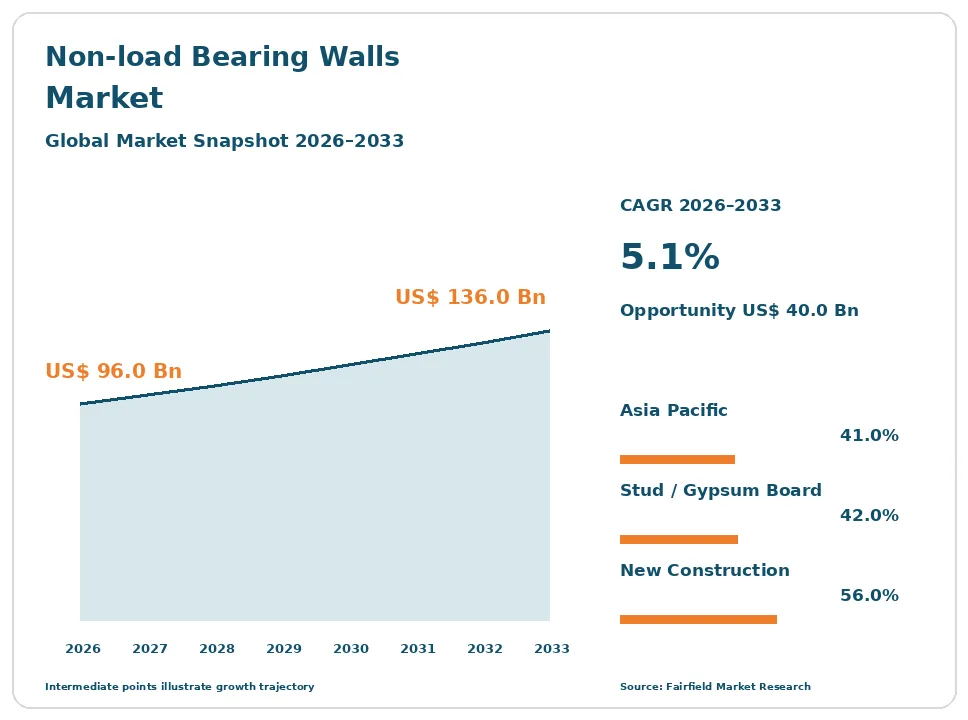
The global Non-load Bearing Walls market size is expected to be valued at US$ 96.0 billion in 2026 and projected to reach US$ 136.0 billion by 2033, growing at a CAGR of 5.1% between 2026 and 2033.
The market grew at an estimated 4.2% CAGR between 2020 and 2025, held back first by site shutdowns and then lifted by a wave of workplace re-planning. Three factors shape the outlook. Partition demand follows tenant churn and change of use rather than building completions, so it repeats on a far shorter cycle than construction. Fire and acoustic rating rules push specifiers toward tested wall systems instead of loose components, which raises value per square metre. Healthcare, education and data centre programmes keep institutional fit-out volumes firm while office construction stays subdued. The direction is steady and replacement-led, with mature markets contributing refurbishment value and Asia Pacific contributing new build volume.
Key Report Takeaways
- By Product Type: Stud and Gypsum Board Partitions held 42% share in 2026, while Demountable and Relocatable Partition Systems are projected to expand at a 7.6% CAGR through 2033, driven by occupiers who reconfigure space often and want the asset back.
- By Material: Gypsum held 37% share in 2026, while Glass is projected to expand at a 6.8% CAGR through 2033, driven by daylight-sharing layouts and acoustic glazed fronts in open-plan office conversions.
- By Application: Commercial Offices held 28% share in 2026, while Data Centres are projected to expand at an 8.4% CAGR through 2033, driven by fire-compartment and white-space separation requirements in new capacity.
- By Construction Activity: New Construction held 56% share in 2026, while Fit-out and Refurbishment is projected to expand at a 6.2% CAGR through 2033, driven by lease events and change-of-use conversions in ageing building stock.
- By Geography: Asia Pacific held 41% share in 2026, while Middle East & Africa is projected to expand at a 6.9% CAGR through 2033, driven by large mixed-use and public building programmes in the Gulf states.
Global Non-load Bearing Walls Market Trends and Insights
Drivers Impact Analysis
| Driver | Impact on CAGR Forecast | Geographic Relevance | Impact Timeline |
| Tenant turnover and office reconfiguration | High | Global, strongest in North America and Europe | Short term ≤2 years |
| Fire and acoustic performance requirements | Medium | Global, strongest in Europe and North America | Long term ≥4 years |
The two strongest demand forces are interior churn and the shift to certified, tested wall assemblies.
Fit-out Churn Rather Than Construction Sets the Pace of Partition Demand
Fit-out churn, not new construction, sets the pace of partition demand. A non-load bearing wall exists so a building can be reconfigured without touching its frame, so the buying trigger is a lease event: a tenant moves in, a department expands, or a floor changes use. Offices are typically re-planned every five to seven years, far faster than the building cycle, so one structure generates partition revenue repeatedly over its life.
The mechanism became visible after 2020. Hybrid working cut desk counts but raised the number of enclosed meeting rooms, phone booths and quiet spaces per floor, so occupiers rebuilt interiors rather than buildings. Landlords holding older stock now fund fit-out as a leasing incentive. Change of use adds a second stream, because converting offices to residential, laboratory or clinical space requires a complete new internal layout with different fire and acoustic ratings.
Tested Fire and Acoustic Ratings Make the Certified Wall System the Unit of Sale
These walls are sold on tested performance, not on material. A partition is specified by its fire resistance rating and its sound insulation rating, and both are properties of the complete tested assembly rather than of any single component. Substituting a stud gauge, a screw pattern, a board thickness or a sealant can void the rating, so the manufacturer sells a certified system with fixed components and documented details, not a list of parts.
Test standards make this concrete. EN 1364 covers fire resistance tests for non-loadbearing elements and EN 13501 sets the classification, while ASTM E119 and UL assembly designs serve North America. Acoustic ratings come from EN ISO 10140 and EN ISO 717 or ASTM E90 and ASTM E413, giving the Rw and STC values written into briefs. System sellers capture more value per wall than component suppliers.
Restraints Impact Analysis
| Restraint | Impact on CAGR Forecast | Geographic Relevance | Impact Timeline |
| Shortage of skilled drylining and glazing installers | High | North America, Europe, Middle East & Africa | Medium term 2–4 years |
| Commercial real estate weakness and office vacancy | High | North America, Europe | Short term ≤2 years |
Installed capacity and tenant budgets constrain the market more than product supply does.
Drylining and Glazing Installer Shortage Caps Installed Partition Volume
The binding constraint is labour, not product. Boards, studs and glazed frames are widely available, but certified installation requires trained drylining and glazing crews, and the trade has an ageing workforce with weak apprenticeship intake. Contractors report that partition packages set the programme on fit-out jobs, so projects are sequenced around crew availability. Where crews are scarce, wage rates rise and smaller refurbishment jobs are deferred or simplified.
The cause is structural. Drylining is physically demanding, project-based and often subcontracted several tiers down, which makes earnings irregular and discourages entrants. Fire-rated and acoustic work compounds the problem, because a rated wall only performs if penetrations, head details and junctions are built exactly as tested, and that requires supervised, competent labour. Inspection regimes now check these details, so poor workmanship creates rework rather than passing unnoticed.
Office Vacancy and Input Cost Remove the Budget That Funds Partition Work
Weak commercial real estate removes the money that pays for partitions. Elevated office vacancy in major business districts lowers landlord cash flow and delays the capital expenditure cycle that funds category-A and category-B fit-outs. When a floor sits empty, no one buys walls for it. Valuation write-downs and tighter lending for office assets have extended this pause across several mature markets.
Input cost adds a second squeeze. Gypsum board pricing follows energy-intensive calcination and freight, light-gauge framing follows steel coil, and glazed partitions follow flat glass and aluminium. These pass through quickly into tender prices, so fixed fit-out budgets buy less wall. Demountable systems face the sharpest test, because they can cost several times a stud-and-board wall, and the reconfiguration argument must beat a cheap alternative that works.
Market Opportunities
Reusable Demountable Walls Open a Circular and Relocation Revenue Pool
Demountable and relocatable partitions open a revenue pool that conventional walls cannot reach. Because the components unclip and travel, they can be sold as an asset that moves with the occupier, leased, taken back or refurbished, which adds service revenue to the original sale. Corporate occupiers that reorganise annually, serviced office operators and laboratory users are the natural buyers, since they pay for change rather than for construction.
Circularity policy and corporate reporting strengthen the case. Demolition waste from stud-and-board partitions is bulky and hard to recycle, so clients tracking embodied carbon and construction waste increasingly favour assemblies that can be dismantled and reused. Low-emission certification for boards, adhesives and finishes supports the same specification, since reusable systems are typically dry-fixed with fewer wet trades. Manufacturers can capture take-back, reconfiguration and refurbishment work as recurring income.
Healthcare, Data Centre and Prefabricated Partition Programmes Create a Specification-Led Pool
Healthcare and data centre construction creates a high-specification pool that pays above commodity rates. Hospitals need partitions with tested fire compartmentation, impact resistance, cleanable surfaces and lead or radiofrequency shielding, while data centres need compartment walls between white space and plant, and seismic bracing for non-structural components in code-covered regions. Both buyer groups accept higher unit cost because failure is expensive and rework is disruptive.
Prefabricated and panelised assemblies let suppliers serve these programmes despite the labour shortage. Factory-finished partition panels, pre-glazed frames and pre-cut light-gauge steel kits move hours off site, shorten programmes and improve the repeatability that certified ratings depend on. Specialist contractors, system manufacturers and modular builders can capture the work, with acoustic upgrades in open-plan office conversions forming a related and sizeable adjacent stream.
Segment Analysis
By Product Type: Stud and Board Partitions Lead While Demountable Systems Gain Momentum
Stud and Gypsum Board Partitions held 42% of the market in 2026, because light-gauge steel or timber framing with gypsum board remains the cheapest route to a tested fire and acoustic rating. The assembly is familiar to every contractor, suits any floor plan and uses components available from multiple suppliers, which keeps tender prices competitive.
Demountable and Relocatable Partition Systems are the fastest-growing product type at a 7.6% CAGR to 2033. Occupiers that reconfigure often value the ability to move walls over a weekend without wet trades, dust or permits. Glass and glazed partitions, operable and movable walls, precast and autoclaved aerated concrete panels, gypsum and clay block partitions and non-structural infill façade panels fill the remainder. The implication is a slow shift of value from commodity boards toward engineered, warranted systems sold with installation detailing.
By Material: Gypsum Holds the Base While Glass Expands Fastest
Gypsum accounted for 37% of material value in 2026. It dominates because board thickness, layering and cavity depth give designers a calibrated way to buy fire and acoustic performance, and because ASTM C840, EN 520 and related installation standards make results predictable. Steel framing, mineral wool infill, trims and finishing compounds follow gypsum into the same assemblies.
Glass is the fastest-growing material at a 6.8% CAGR through 2033. Single and double glazed partitions let daylight reach the core of deep floor plates, which supports wellbeing certification targets, while double-glazed and switchable units deliver the acoustic privacy that open-plan conversions removed. Timber, concrete and autoclaved aerated concrete, aluminium and composite materials take the balance. For manufacturers, the mix shift raises the glazing and sealing competence required of their installer networks.
By Application: Commercial Offices Lead While Data Centres Grow Quickest
Commercial Offices held 28% share in 2026, the largest application, because offices combine large floor areas, frequent tenant turnover and a high ratio of internal partition to floor plate. Fit-out cycles in this sector also carry the richest specifications, including glazed fronts, acoustic ratings and demountable systems.
Data Centres are growing fastest at an 8.4% CAGR to 2033, as operators build compartment walls between white space, electrical rooms and plant areas to satisfy fire strategies and insurer requirements. Healthcare, education, hospitality, retail, industrial buildings and residential make up the rest, with healthcare the most specification-intensive of them. The business implication is that suppliers with tested, documented systems and seismic bracing details can follow capital into data centre and hospital programmes while office demand stays uneven.
By Construction Activity: New Build Leads on Volume While Refurbishment Grows Faster
New Construction held 56% of 2026 value, supported by sustained building completions in Asia Pacific and the Gulf states, where shell-and-core delivery includes substantial internal partitioning. New build also carries the bulk of non-structural infill façade panel and block partition volume.
Fit-out and Refurbishment is the faster-growing activity at a 6.2% CAGR to 2033. Mature markets have more existing floor area than new starts, so the installed stock sets demand, and every lease event, department move and change of use triggers partition work independently of construction activity. Refurbishment also commands higher value per square metre, because occupied or partially occupied buildings require dry, low-noise systems and out-of-hours work. Suppliers increasingly organise sales and logistics around small, repeat refurbishment orders rather than single large shipments.
Geography Analysis
North America Converts Vacant Office Floors Into Repeat Partition Work
North America held 23% of the market in 2026 and is forecast to grow at 4.6% through 2033. The United States and Canada combine a very large installed commercial floor area with high tenant mobility, so refurbishment supplies most demand. Fire-rated assemblies are specified through UL designs and ASTM E119 testing, and sound ratings through ASTM E90 and ASTM E413, which makes the tested system the commercial unit.
Office vacancy remains the principal barrier, delaying landlord-funded fit-out in several central business districts. The offsetting change is conversion: owners are repurposing obsolete offices into residential, laboratory and medical space, and each conversion needs a new internal layout. Data centre construction and hospital capital programmes add steady, high-specification partition volume that is largely insulated from office cycles.
Europe Pairs Strict Fire Classification With a Deep Renovation Pipeline
Europe accounted for 24% of 2026 revenue and should grow at 4.3% to 2033. Germany, the United Kingdom, France and the Nordic countries lead demand, supported by a renovation pipeline in ageing commercial and public buildings. Fire resistance testing to EN 1364 and classification to EN 13501 are mandatory reference points, while EN ISO 10140 and EN ISO 717 govern the acoustic values written into specifications.
Post-Grenfell regulatory tightening in the United Kingdom has raised the evidentiary burden on wall system certification, which favours manufacturers that hold complete test evidence and traceable component lists. Barriers include a shortage of qualified drylining labour and high energy costs in gypsum and glass production. The clearest opportunity is reusable partitioning, pulled by circular construction and embodied carbon reporting.
Which Region Is Leading the Non-load Bearing Walls Market?
Asia Pacific leads the market with 41% share in 2026 and is forecast to grow at 5.6% through 2033, the largest absolute gain of any region. China, India, Japan, Australia and the Republic of Korea drive volumes, with new commercial, institutional and high-rise residential completions still substantially ahead of other regions.
Lightweight partitioning is displacing heavy masonry in multi-storey construction, because it cuts dead load, speeds programmes and reduces wet trades. Gypsum board, autoclaved aerated concrete panels and light-gauge steel framing all benefit. National codes increasingly set explicit fire and acoustic requirements for internal walls, which lifts the share of tested systems over site-built masonry. Rising office quality expectations in India and Australia are also pulling glazed and demountable partitions into mainstream specifications.
Latin America Builds Partition Demand Around Retail and Hospitality Refits
Latin America represented 6% of 2026 revenue and is projected to grow at 5.0% through 2033. Brazil, Mexico and Chile generate most activity, led by retail, hospitality and corporate office refits in large metropolitan centres, plus nearshoring-driven industrial and warehouse construction in northern Mexico.
Barriers are real. Currency volatility raises the landed cost of imported glazed systems and specialty boards, interest rates constrain commercial development finance, and masonry remains the default internal wall in much of the residential sector. Certification practice is also less uniform, which slows the move to tested assemblies. The main opportunity lies in local gypsum board and steel framing capacity, which shortens supply chains and makes lightweight partitioning price-competitive against block construction for commercial buyers.
Which Region Is Growing Fastest in the Non-load Bearing Walls Market?
Middle East & Africa is growing fastest at a 6.9% CAGR through 2033, from a 6% share in 2026. Saudi Arabia, the United Arab Emirates and Qatar anchor the growth with large mixed-use, hospitality, healthcare and public building programmes, while Egypt, Morocco and South Africa add steadier commercial volumes.
Programme speed is the decisive factor. Owners work to fixed opening dates, so prefabricated and panelised partition systems that compress site time win specifications even at a cost premium. Fire and acoustic requirements in these projects typically follow EN or ASTM test regimes, which favours international system suppliers. Barriers include dependence on imported boards and glazed frames, skilled installer shortages and exposure to oil-linked capital budgets, which can pause programmes quickly when revenues fall.
Competitive Landscape
The market is moderately concentrated at the material level and fragmented at the system level. A small number of global manufacturers supply most gypsum board, framing and mineral wool, because plasterboard plants are capital-intensive and freight-limited, which keeps production regional and entry costly. Beyond those materials, hundreds of regional specialists supply demountable systems, glazed partitions, operable walls and block panels, and most installation is carried out by local subcontractors. Consolidation has largely taken the form of material producers buying system and finishing businesses to move closer to the specified assembly.
Competition turns on certified performance rather than price alone. Vendors compete on the breadth of their tested fire and acoustic assemblies, the quality of the test evidence behind them, lead time, detailing support for junctions and penetrations, and the availability of trained installers. Technical service matters because a rating is only valid as built, so manufacturers that supply drawings, specification tools and site training reduce a contractor’s risk. Newer entrants have come from the furniture and interiors side, offering demountable architectural walls sold as relocatable assets rather than construction, and from modular builders offering factory-finished panel kits.
Strategically, suppliers are moving from selling components to selling warranted systems with documented component lists, because substitution anywhere in an assembly voids its rating. Several have invested in acoustic and fire testing capacity, digital specification libraries and building information modelling objects so that specifiers can select a complete tested wall rather than assemble one. Product development is concentrated on lighter boards, thinner high-performance partitions that recover lettable floor area, low-emission finishes, and dismantlable connections that support reuse. The common direction is to own the specification early and protect it through to installation.
Non-load Bearing Walls Industry Leaders
- Compagnie de Saint-Gobain
- Knauf Gips KG
- Etex Group NV
- Kingspan Group plc
- DIRTT Environmental Solutions Ltd.
Recent Industry Developments
- December 2022: Amendments to the building regulations in England lowered the height threshold for the ban on combustible materials in external walls from 18 metres to 11 metres – it narrowed material choice for non-structural infill and spandrel panels on mid-rise buildings.
- May 2023: The National Construction Code 2022 took effect across most states and territories of Australia, adding condensation management and liveable housing provisions – it changed internal lining, vapour control and clearance detailing in residential partitions.
- October 2023: The new building control regime for higher-risk buildings under the Building Safety Act 2022 began operating in England, with gateway approvals and mandatory change control – tested wall specifications can no longer be varied freely on site.
- September 2024: The Grenfell Tower Inquiry published its Phase 2 report in the United Kingdom, identifying systemic failures in construction product testing, marketing and certification – it raised the evidentiary burden on fire-rated wall system certification across the supply chain.
Companies Covered in the Report
- Compagnie de Saint-Gobain
- Knauf Gips KG
- Etex Group NV
- Kingspan Group plc
- James Hardie Industries plc
- Georgia-Pacific LLC
- National Gypsum Company
- Xella Group
- Lindner Group KG
- DIRTT Environmental Solutions Ltd.
- Steelcase Inc.
- Haworth, Inc.
- Maars Living Walls
Non-load Bearing Walls Market Report Scope
The study covers interior and exterior wall assemblies that carry no structural load beyond their own weight, including stud and board partitions, demountable systems, glazed partitions, operable walls, lightweight concrete and block panels, non-structural infill panels, and the framing, insulation, acoustic infill and finishing products sold with them. On-site installation labour and load-bearing walls are excluded. The base year is 2025, and the forecast period runs from 2026 to 2033 in US$ Billion.
Product Type
- Stud and Gypsum Board Partitions
- Demountable and Relocatable Partition Systems
- Glass and Glazed Partitions
- Operable and Movable Walls
- Precast and Autoclaved Aerated Concrete Panels
- Gypsum and Clay Block Partitions
- Non-structural Infill Façade Panels
Material
- Gypsum
- Steel
- Glass
- Timber
- Concrete and Autoclaved Aerated Concrete
- Aluminium
- Other Materials
Application
- Commercial Offices
- Healthcare
- Education
- Hospitality and Retail
- Data Centres
- Industrial Buildings
- Residential
Construction Activity
- New Construction
- Fit-out and Refurbishment
Regions
- North America
- Europe
- Asia Pacific
- Latin America
- Middle East & Africa
Key Questions Answered in the Report
How big is the non-load bearing walls market in 2026?
The market is valued at US$ 96.0 billion in 2026, covering partition systems, panels and the framing, insulation and finishing products sold with them.
What is the forecast size and growth rate to 2033?
Revenue is projected to reach US$ 136.0 billion by 2033, a 5.1% CAGR and an absolute dollar opportunity of US$ 40.0 billion over the period.
Which product type leads the non-load bearing walls market?
Stud and Gypsum Board Partitions lead with 42% share in 2026, because framing and board remain the cheapest route to tested fire and acoustic ratings.
Which segment and region are growing fastest?
Demountable and Relocatable Partition Systems grow fastest at 7.6%, and Middle East & Africa is the quickest region at a 6.9% CAGR to 2033.
Which region holds the largest share and how concentrated is the market?
Asia Pacific holds 41% share in 2026, and concentration is medium, with global material producers and many regional partition system specialists.
1. Executive Summary
1.1. Global Non-load Bearing Walls Market Snapshot
1.2. Future Projections
1.3. Key Report Takeaways
1.4. Regional Snapshot
2. Market Overview
2.1. Market Definition and Report Scope
2.2. Historical Trends 2020–2025
2.3. Market Dynamics
2.3.1. Drivers
2.3.1.1. Fit-out Churn Rather Than Construction Sets the Pace of Partition Demand
2.3.1.2. Tested Fire and Acoustic Ratings Make the Certified Wall System the Unit of Sale
2.3.2. Restraints
2.3.2.1. Drylining and Glazing Installer Shortage Caps Installed Partition Volume
2.3.2.2. Office Vacancy and Input Cost Remove the Budget That Funds Partition Work
2.3.3. Market Opportunities
2.3.3.1. Reusable Demountable Walls Open a Circular and Relocation Revenue Pool
2.3.3.2. Healthcare, Data Centre and Prefabricated Partition Programmes Create a Specification-Led Pool
3. Global Non-load Bearing Walls Market Outlook, 2020–2033
3.1. Global Non-load Bearing Walls Market Outlook, by Product Type, Value (US$ Billion), 2020–2033
3.1.1. Stud and Gypsum Board Partitions
3.1.2. Demountable and Relocatable Partition Systems
3.1.3. Glass and Glazed Partitions
3.1.4. Operable and Movable Walls
3.1.5. Precast and Autoclaved Aerated Concrete Panels
3.1.6. Gypsum and Clay Block Partitions
3.1.7. Non-structural Infill Façade Panels
3.2. Global Non-load Bearing Walls Market Outlook, by Material, Value (US$ Billion), 2020–2033
3.2.1. Gypsum
3.2.2. Steel
3.2.3. Glass
3.2.4. Timber
3.2.5. Concrete and Autoclaved Aerated Concrete
3.2.6. Aluminium
3.2.7. Other Materials
3.3. Global Non-load Bearing Walls Market Outlook, by Application, Value (US$ Billion), 2020–2033
3.3.1. Commercial Offices
3.3.2. Healthcare
3.3.3. Education
3.3.4. Hospitality and Retail
3.3.5. Data Centres
3.3.6. Industrial Buildings
3.3.7. Residential
3.4. Global Non-load Bearing Walls Market Outlook, by Construction Activity, Value (US$ Billion), 2020–2033
3.4.1. New Construction
3.4.2. Fit-out and Refurbishment
3.5. Global Non-load Bearing Walls Market Outlook, by Region, Value (US$ Billion), 2020–2033
3.5.1. North America
3.5.2. Europe
3.5.3. Asia Pacific
3.5.4. Latin America
3.5.5. Middle East & Africa
4. North America Non-load Bearing Walls Market Outlook, 2020–2033
4.1. North America Non-load Bearing Walls Market Outlook, by Product Type, Value (US$ Billion), 2020–2033
4.1.1. Stud and Gypsum Board Partitions
4.1.2. Demountable and Relocatable Partition Systems
4.1.3. Glass and Glazed Partitions
4.1.4. Operable and Movable Walls
4.1.5. Precast and Autoclaved Aerated Concrete Panels
4.1.6. Gypsum and Clay Block Partitions
4.1.7. Non-structural Infill Façade Panels
4.2. North America Non-load Bearing Walls Market Outlook, by Material, Value (US$ Billion), 2020–2033
4.2.1. Gypsum
4.2.2. Steel
4.2.3. Glass
4.2.4. Timber
4.2.5. Concrete and Autoclaved Aerated Concrete
4.2.6. Aluminium
4.2.7. Other Materials
4.3. North America Non-load Bearing Walls Market Outlook, by Application, Value (US$ Billion), 2020–2033
4.3.1. Commercial Offices
4.3.2. Healthcare
4.3.3. Education
4.3.4. Hospitality and Retail
4.3.5. Data Centres
4.3.6. Industrial Buildings
4.3.7. Residential
4.4. North America Non-load Bearing Walls Market Outlook, by Construction Activity, Value (US$ Billion), 2020–2033
4.4.1. New Construction
4.4.2. Fit-out and Refurbishment
4.5. North America Non-load Bearing Walls Market Outlook, by Country, Value (US$ Billion), 2020–2033
4.5.1. United States Non-load Bearing Walls Market Outlook, by Product Type, 2020–2033
4.5.2. United States Non-load Bearing Walls Market Outlook, by Material, 2020–2033
4.5.3. United States Non-load Bearing Walls Market Outlook, by Application, 2020–2033
4.5.4. United States Non-load Bearing Walls Market Outlook, by Construction Activity, 2020–2033
4.5.5. Canada Non-load Bearing Walls Market Outlook, by Product Type, 2020–2033
4.5.6. Canada Non-load Bearing Walls Market Outlook, by Material, 2020–2033
4.5.7. Canada Non-load Bearing Walls Market Outlook, by Application, 2020–2033
4.5.8. Canada Non-load Bearing Walls Market Outlook, by Construction Activity, 2020–2033
5. Europe Non-load Bearing Walls Market Outlook, 2020–2033
5.1. Europe Non-load Bearing Walls Market Outlook, by Product Type, Value (US$ Billion), 2020–2033
5.1.1. Stud and Gypsum Board Partitions
5.1.2. Demountable and Relocatable Partition Systems
5.1.3. Glass and Glazed Partitions
5.1.4. Operable and Movable Walls
5.1.5. Precast and Autoclaved Aerated Concrete Panels
5.1.6. Gypsum and Clay Block Partitions
5.1.7. Non-structural Infill Façade Panels
5.2. Europe Non-load Bearing Walls Market Outlook, by Material, Value (US$ Billion), 2020–2033
5.2.1. Gypsum
5.2.2. Steel
5.2.3. Glass
5.2.4. Timber
5.2.5. Concrete and Autoclaved Aerated Concrete
5.2.6. Aluminium
5.2.7. Other Materials
5.3. Europe Non-load Bearing Walls Market Outlook, by Application, Value (US$ Billion), 2020–2033
5.3.1. Commercial Offices
5.3.2. Healthcare
5.3.3. Education
5.3.4. Hospitality and Retail
5.3.5. Data Centres
5.3.6. Industrial Buildings
5.3.7. Residential
5.4. Europe Non-load Bearing Walls Market Outlook, by Construction Activity, Value (US$ Billion), 2020–2033
5.4.1. New Construction
5.4.2. Fit-out and Refurbishment
5.5. Europe Non-load Bearing Walls Market Outlook, by Country, Value (US$ Billion), 2020–2033
5.5.1. Germany Non-load Bearing Walls Market Outlook, by Product Type, 2020–2033
5.5.2. Germany Non-load Bearing Walls Market Outlook, by Material, 2020–2033
5.5.3. Germany Non-load Bearing Walls Market Outlook, by Application, 2020–2033
5.5.4. Germany Non-load Bearing Walls Market Outlook, by Construction Activity, 2020–2033
5.5.5. United Kingdom Non-load Bearing Walls Market Outlook, by Product Type, 2020–2033
5.5.6. United Kingdom Non-load Bearing Walls Market Outlook, by Material, 2020–2033
5.5.7. United Kingdom Non-load Bearing Walls Market Outlook, by Application, 2020–2033
5.5.8. United Kingdom Non-load Bearing Walls Market Outlook, by Construction Activity, 2020–2033
5.5.9. France Non-load Bearing Walls Market Outlook, by Product Type, 2020–2033
5.5.10. France Non-load Bearing Walls Market Outlook, by Material, 2020–2033
5.5.11. France Non-load Bearing Walls Market Outlook, by Application, 2020–2033
5.5.12. France Non-load Bearing Walls Market Outlook, by Construction Activity, 2020–2033
6. Asia Pacific Non-load Bearing Walls Market Outlook, 2020–2033
6.1. Asia Pacific Non-load Bearing Walls Market Outlook, by Product Type, Value (US$ Billion), 2020–2033
6.1.1. Stud and Gypsum Board Partitions
6.1.2. Demountable and Relocatable Partition Systems
6.1.3. Glass and Glazed Partitions
6.1.4. Operable and Movable Walls
6.1.5. Precast and Autoclaved Aerated Concrete Panels
6.1.6. Gypsum and Clay Block Partitions
6.1.7. Non-structural Infill Façade Panels
6.2. Asia Pacific Non-load Bearing Walls Market Outlook, by Material, Value (US$ Billion), 2020–2033
6.2.1. Gypsum
6.2.2. Steel
6.2.3. Glass
6.2.4. Timber
6.2.5. Concrete and Autoclaved Aerated Concrete
6.2.6. Aluminium
6.2.7. Other Materials
6.3. Asia Pacific Non-load Bearing Walls Market Outlook, by Application, Value (US$ Billion), 2020–2033
6.3.1. Commercial Offices
6.3.2. Healthcare
6.3.3. Education
6.3.4. Hospitality and Retail
6.3.5. Data Centres
6.3.6. Industrial Buildings
6.3.7. Residential
6.4. Asia Pacific Non-load Bearing Walls Market Outlook, by Construction Activity, Value (US$ Billion), 2020–2033
6.4.1. New Construction
6.4.2. Fit-out and Refurbishment
6.5. Asia Pacific Non-load Bearing Walls Market Outlook, by Country, Value (US$ Billion), 2020–2033
6.5.1. China Non-load Bearing Walls Market Outlook, by Product Type, 2020–2033
6.5.2. China Non-load Bearing Walls Market Outlook, by Material, 2020–2033
6.5.3. China Non-load Bearing Walls Market Outlook, by Application, 2020–2033
6.5.4. China Non-load Bearing Walls Market Outlook, by Construction Activity, 2020–2033
6.5.5. India Non-load Bearing Walls Market Outlook, by Product Type, 2020–2033
6.5.6. India Non-load Bearing Walls Market Outlook, by Material, 2020–2033
6.5.7. India Non-load Bearing Walls Market Outlook, by Application, 2020–2033
6.5.8. India Non-load Bearing Walls Market Outlook, by Construction Activity, 2020–2033
6.5.9. Japan Non-load Bearing Walls Market Outlook, by Product Type, 2020–2033
6.5.10. Japan Non-load Bearing Walls Market Outlook, by Material, 2020–2033
6.5.11. Japan Non-load Bearing Walls Market Outlook, by Application, 2020–2033
6.5.12. Japan Non-load Bearing Walls Market Outlook, by Construction Activity, 2020–2033
6.5.13. Australia Non-load Bearing Walls Market Outlook, by Product Type, 2020–2033
6.5.14. Australia Non-load Bearing Walls Market Outlook, by Material, 2020–2033
6.5.15. Australia Non-load Bearing Walls Market Outlook, by Application, 2020–2033
6.5.16. Australia Non-load Bearing Walls Market Outlook, by Construction Activity, 2020–2033
6.5.17. Republic of Korea Non-load Bearing Walls Market Outlook, by Product Type, 2020–2033
6.5.18. Republic of Korea Non-load Bearing Walls Market Outlook, by Material, 2020–2033
6.5.19. Republic of Korea Non-load Bearing Walls Market Outlook, by Application, 2020–2033
6.5.20. Republic of Korea Non-load Bearing Walls Market Outlook, by Construction Activity, 2020–2033
7. Latin America Non-load Bearing Walls Market Outlook, 2020–2033
7.1. Latin America Non-load Bearing Walls Market Outlook, by Product Type, Value (US$ Billion), 2020–2033
7.1.1. Stud and Gypsum Board Partitions
7.1.2. Demountable and Relocatable Partition Systems
7.1.3. Glass and Glazed Partitions
7.1.4. Operable and Movable Walls
7.1.5. Precast and Autoclaved Aerated Concrete Panels
7.1.6. Gypsum and Clay Block Partitions
7.1.7. Non-structural Infill Façade Panels
7.2. Latin America Non-load Bearing Walls Market Outlook, by Material, Value (US$ Billion), 2020–2033
7.2.1. Gypsum
7.2.2. Steel
7.2.3. Glass
7.2.4. Timber
7.2.5. Concrete and Autoclaved Aerated Concrete
7.2.6. Aluminium
7.2.7. Other Materials
7.3. Latin America Non-load Bearing Walls Market Outlook, by Application, Value (US$ Billion), 2020–2033
7.3.1. Commercial Offices
7.3.2. Healthcare
7.3.3. Education
7.3.4. Hospitality and Retail
7.3.5. Data Centres
7.3.6. Industrial Buildings
7.3.7. Residential
7.4. Latin America Non-load Bearing Walls Market Outlook, by Construction Activity, Value (US$ Billion), 2020–2033
7.4.1. New Construction
7.4.2. Fit-out and Refurbishment
7.5. Latin America Non-load Bearing Walls Market Outlook, by Country, Value (US$ Billion), 2020–2033
7.5.1. Brazil Non-load Bearing Walls Market Outlook, by Product Type, 2020–2033
7.5.2. Brazil Non-load Bearing Walls Market Outlook, by Material, 2020–2033
7.5.3. Brazil Non-load Bearing Walls Market Outlook, by Application, 2020–2033
7.5.4. Brazil Non-load Bearing Walls Market Outlook, by Construction Activity, 2020–2033
7.5.5. Mexico Non-load Bearing Walls Market Outlook, by Product Type, 2020–2033
7.5.6. Mexico Non-load Bearing Walls Market Outlook, by Material, 2020–2033
7.5.7. Mexico Non-load Bearing Walls Market Outlook, by Application, 2020–2033
7.5.8. Mexico Non-load Bearing Walls Market Outlook, by Construction Activity, 2020–2033
7.5.9. Chile Non-load Bearing Walls Market Outlook, by Product Type, 2020–2033
7.5.10. Chile Non-load Bearing Walls Market Outlook, by Material, 2020–2033
7.5.11. Chile Non-load Bearing Walls Market Outlook, by Application, 2020–2033
7.5.12. Chile Non-load Bearing Walls Market Outlook, by Construction Activity, 2020–2033
8. Middle East & Africa Non-load Bearing Walls Market Outlook, 2020–2033
8.1. Middle East & Africa Non-load Bearing Walls Market Outlook, by Product Type, Value (US$ Billion), 2020–2033
8.1.1. Stud and Gypsum Board Partitions
8.1.2. Demountable and Relocatable Partition Systems
8.1.3. Glass and Glazed Partitions
8.1.4. Operable and Movable Walls
8.1.5. Precast and Autoclaved Aerated Concrete Panels
8.1.6. Gypsum and Clay Block Partitions
8.1.7. Non-structural Infill Façade Panels
8.2. Middle East & Africa Non-load Bearing Walls Market Outlook, by Material, Value (US$ Billion), 2020–2033
8.2.1. Gypsum
8.2.2. Steel
8.2.3. Glass
8.2.4. Timber
8.2.5. Concrete and Autoclaved Aerated Concrete
8.2.6. Aluminium
8.2.7. Other Materials
8.3. Middle East & Africa Non-load Bearing Walls Market Outlook, by Application, Value (US$ Billion), 2020–2033
8.3.1. Commercial Offices
8.3.2. Healthcare
8.3.3. Education
8.3.4. Hospitality and Retail
8.3.5. Data Centres
8.3.6. Industrial Buildings
8.3.7. Residential
8.4. Middle East & Africa Non-load Bearing Walls Market Outlook, by Construction Activity, Value (US$ Billion), 2020–2033
8.4.1. New Construction
8.4.2. Fit-out and Refurbishment
8.5. Middle East & Africa Non-load Bearing Walls Market Outlook, by Country, Value (US$ Billion), 2020–2033
8.5.1. Saudi Arabia Non-load Bearing Walls Market Outlook, by Product Type, 2020–2033
8.5.2. Saudi Arabia Non-load Bearing Walls Market Outlook, by Material, 2020–2033
8.5.3. Saudi Arabia Non-load Bearing Walls Market Outlook, by Application, 2020–2033
8.5.4. Saudi Arabia Non-load Bearing Walls Market Outlook, by Construction Activity, 2020–2033
8.5.5. United Arab Emirates Non-load Bearing Walls Market Outlook, by Product Type, 2020–2033
8.5.6. United Arab Emirates Non-load Bearing Walls Market Outlook, by Material, 2020–2033
8.5.7. United Arab Emirates Non-load Bearing Walls Market Outlook, by Application, 2020–2033
8.5.8. United Arab Emirates Non-load Bearing Walls Market Outlook, by Construction Activity, 2020–2033
8.5.9. Qatar Non-load Bearing Walls Market Outlook, by Product Type, 2020–2033
8.5.10. Qatar Non-load Bearing Walls Market Outlook, by Material, 2020–2033
8.5.11. Qatar Non-load Bearing Walls Market Outlook, by Application, 2020–2033
8.5.12. Qatar Non-load Bearing Walls Market Outlook, by Construction Activity, 2020–2033
8.5.13. Egypt Non-load Bearing Walls Market Outlook, by Product Type, 2020–2033
8.5.14. Egypt Non-load Bearing Walls Market Outlook, by Material, 2020–2033
8.5.15. Egypt Non-load Bearing Walls Market Outlook, by Application, 2020–2033
8.5.16. Egypt Non-load Bearing Walls Market Outlook, by Construction Activity, 2020–2033
8.5.17. Morocco Non-load Bearing Walls Market Outlook, by Product Type, 2020–2033
8.5.18. Morocco Non-load Bearing Walls Market Outlook, by Material, 2020–2033
8.5.19. Morocco Non-load Bearing Walls Market Outlook, by Application, 2020–2033
8.5.20. Morocco Non-load Bearing Walls Market Outlook, by Construction Activity, 2020–2033
8.5.21. South Africa Non-load Bearing Walls Market Outlook, by Product Type, 2020–2033
8.5.22. South Africa Non-load Bearing Walls Market Outlook, by Material, 2020–2033
8.5.23. South Africa Non-load Bearing Walls Market Outlook, by Application, 2020–2033
8.5.24. South Africa Non-load Bearing Walls Market Outlook, by Construction Activity, 2020–2033
9. Competitive Landscape
9.1. Market Concentration and Industry Leaders
9.2. Competitive Differentiation
9.3. Strategic Moves and Market Direction
9.4. Recent Industry Developments
9.5. Company Profiles
9.5.1. Compagnie de Saint-Gobain
9.5.2. Knauf Gips KG
9.5.3. Etex Group NV
9.5.4. Kingspan Group plc
9.5.5. James Hardie Industries plc
9.5.6. Georgia-Pacific LLC
9.5.7. National Gypsum Company
9.5.8. Xella Group
9.5.9. Lindner Group KG
9.5.10. DIRTT Environmental Solutions Ltd.
9.5.11. Steelcase Inc.
9.5.12. Haworth, Inc.
9.5.13. Maars Living Walls
10. Appendix
10.1. Research Methodology
10.2. Report Assumptions
10.3. Acronyms and Abbreviations
| Product Type | Stud and Gypsum Board Partitions, Demountable and Relocatable Partition Systems, Glass and Glazed Partitions, Operable and Movable Walls, Precast and Autoclaved Aerated Concrete Panels, Gypsum and Clay Block Partitions, Non-structural Infill Façade Panels |
| Material | Gypsum, Steel, Glass, Timber, Concrete and Autoclaved Aerated Concrete, Aluminium, Other Materials |
| Application | Commercial Offices, Healthcare, Education, Hospitality and Retail, Data Centres, Industrial Buildings, Residential |
| Construction Activity | New Construction, Fit-out and Refurbishment |
| Regions | North America, Europe, Asia Pacific, Latin America, Middle East & Africa |
Our Research Methodology
Considering the volatility of business today, traditional approaches to strategizing a game plan can be unfruitful if not detrimental. True ambiguity is no way to determine a forecast. A myriad of predetermined factors must be accounted for such as the degree of risk involved, the magnitude of circumstances, as well as conditions or consequences that are not known or unpredictable. To circumvent binary views that cast uncertainty, the application of market research intelligence to strategically posture, move, and enable actionable outcomes is necessary.
View Methodology
Quality Assured
Rigorous Validation Process

Confidentiality Assured
End-to-end Data Security

Custom Research Services
Tailored To Your Objectives
FAQs
The market is valued at US$ 96.0 billion in 2026, covering partition systems, panels and the framing, insulation and finishing products sold with them.
Revenue is projected to reach US$ 136.0 billion by 2033, a 5.1% CAGR and an absolute dollar opportunity of US$ 40.0 billion over the period.
Stud and Gypsum Board Partitions lead with 42% share in 2026, because framing and board remain the cheapest route to tested fire and acoustic ratings.
Demountable and Relocatable Partition Systems grow fastest at 7.6%, and Middle East & Africa is the quickest region at a 6.9% CAGR to 2033.
Asia Pacific holds 41% share in 2026, and concentration is medium, with global material producers and many regional partition system specialists.
Related Reports
Ultra high Molecular Weight Polyethylene Market Size, Share, Insights, Competitive Landscape, and Forecast 2026 to 2033
Explore the UHMWPE market, forecast to reach US$4.8 billion by 2033 at 7.5% CAGR, with insights into grades, applications, regions and leading companies.
Steel Drums & IBCs Market Size, Share, Insights, Competitive Landscape, and Forecast 2026 to 2033
Explore the steel drums & IBCs market, projected to reach US$29.8 billion by 2033 at 4.8% CAGR, with segment, regional and competitive insights.
Semiconductor Gases Market Size, Share, Insights, Competitive Landscape, and Forecast 2026 to 2033
The semiconductor gases market is projected to grow from US$9.6 billion in 2026 to US$16.8 billion by 2033, at an 8.3% CAGR. Explore segments and trends.
Nanoparticle Technology Market Size, Share, Insights, Competitive Landscape, and Forecast 2026 to 2033
The nanoparticle technology market is projected to grow from US$24.0 billion in 2026 to US$48.0 billion by 2033, at a 10.4% CAGR. Explore key trends.
Expanded PTFE (ePTFE) Market Size, Share, Insights, Competitive Landscape, and Forecast 2026 to 2033
The expanded PTFE market is projected to grow from US$2.4 billion in 2026 to US$3.8 billion by 2033, at a 6.8% CAGR. Explore segments and regional trends.
Ethylene Dichloride Market Size, Share, Insights, Competitive Landscape, and Forecast 2026 to 2033
The ethylene dichloride market is projected to grow from US$24.5 billion in 2026 to US$31.0 billion by 2033, at a 3.4% CAGR. Explore segments and regions.