



Expanded PTFE (ePTFE) Market
Expanded PTFE (ePTFE) Market Size, Share, Insights, Competitive Landscape, and Forecast 2026 to 2033
Expanded PTFE (ePTFE) Market Size and Trend Analysis
How Fast Is the Expanded PTFE Market Growing to 2033?
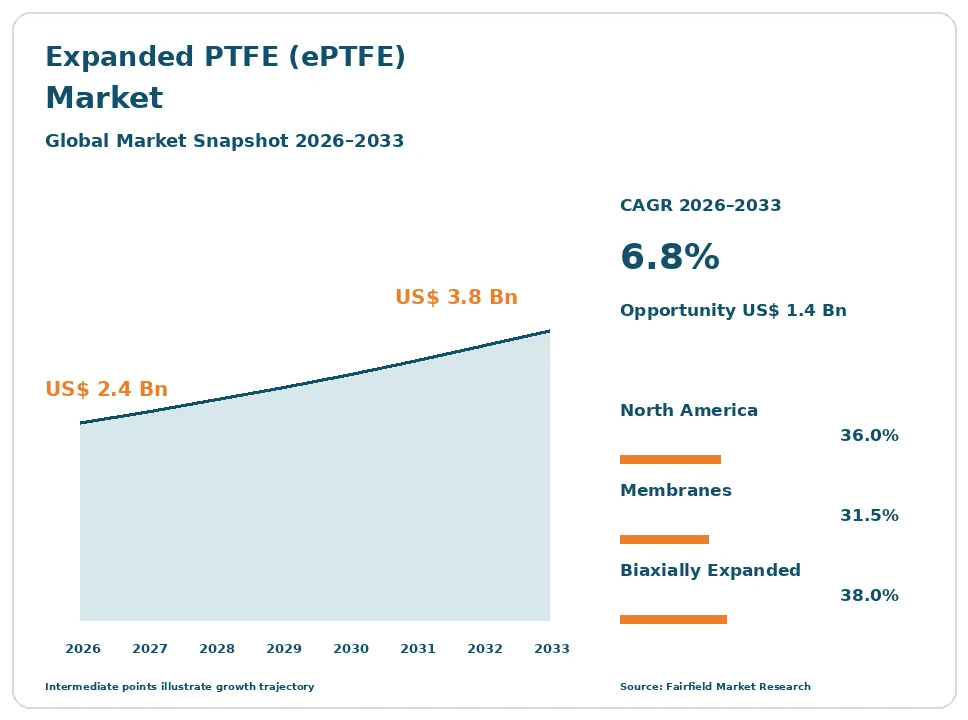
The global Expanded PTFE (ePTFE) market size is expected to be valued at US$ 2.4 billion in 2026 and projected to reach US$ 3.8 billion by 2033, growing at a CAGR of 6.8% between 2026 and 2033.
The market grew at a 4.5% CAGR between 2020 and 2025 to reach US$ 2.25 billion, with the gain coming from mix rather than tonnage. Vascular grafts, cardiovascular patches and soft-tissue reconstruction expanded with procedure volumes and with endovascular techniques that depend on thin-wall expanded fluoropolymer. Industrial particulate limits pushed baghouse operators from depth filtration toward membrane laminates, which cut emissions and extend bag life. Semiconductor fabrication became a third anchor, because process filtration, venting and chamber sealing demand materials that shed almost nothing. Against that, the regulatory question hanging over fluoropolymers slowed new design-ins in consumer-facing uses. The direction is a small, defended market whose value rests on processing know-how rather than resin access.
Key Report Takeaways
- By Product Form: Membranes held 31.5% share in 2026, while tubing is projected to expand at an 8.5% CAGR through 2033, as thin-wall catheter shafts and ultrapure chemical delivery lines adopt expanded liners.
- By Application: Medical implants and devices held 25.5% share in 2026, while industrial filtration and venting is projected to grow at an 8.3% CAGR through 2033, on surface-filtration retrofits at cement, steel and waste-to-energy plants.
- By End Use Industry: Healthcare and medical devices held 27.0% share in 2026, while semiconductor and electronics is projected to grow at a 9.4% CAGR through 2033, driven by new wafer fabrication plants and their extractables limits.
- By Expansion Process: Biaxially expanded material held 38.0% share in 2026, while laminated and composite structures are projected to advance at an 8.7% CAGR through 2033, because bonded constructions carry most of the engineering value.
- By Geography: North America held 36.0% share in 2026, while Asia Pacific is projected to expand at an 8.8% CAGR through 2033, on industrial filtration retrofits and new electronics and battery plant investment.
Global Expanded PTFE (ePTFE) Market Trends and Insights
Drivers Impact Analysis
| Driver | Impact on CAGR Forecast | Geographic Relevance | Impact Timeline |
| Implantable and interventional device demand for node-and-fibril structures | High | North America, Europe, Asia Pacific | Long term ≥4 years |
| Surface-filtration retrofits under tightening particulate emission limits | High | Asia Pacific, Europe | Medium term 2–4 years |
Two demand pools account for most of the forecast growth in expanded fluoropolymer materials.
Implantable Device Demand Keeps Expanded PTFE Specified Where No Substitute Is Qualified
Implantable applications remain the most valuable pull on expanded fluoropolymer, because the material is written into device files that took years to assemble. Vascular grafts, endovascular stent graft coverings, cardiac and hernia patches, sutures and dural substitutes all rely on a controlled node-and-fibril structure that resists thrombosis while allowing tissue ingrowth at a defined pore size. Ageing populations and rising interventional procedure volumes translate directly into material demand.
The mechanism is qualification rather than preference. Biological evaluation under ISO 10993 and conformity assessment under the European Union Medical Device Regulation both tie approval to a named material, a named supplier and a fixed process route. Changing the membrane means repeating biocompatibility testing, animal work and in some cases clinical evaluation, so device makers keep buying the qualified grade even when cheaper polymers look adequate on paper.
Tighter Particulate Limits Are Converting Baghouse Operators to Expanded PTFE Membrane Laminates
Industrial dust control is the largest volume driver for expanded fluoropolymer membrane. As permitted particulate limits fall, plants that once complied with woven or needle-felt bags alone are laminating a microporous membrane onto the felt surface. The membrane converts depth filtration into surface filtration, so dust releases cleanly on the pulse-jet cycle, emissions fall by an order of magnitude and bag life lengthens by years.
The causal chain runs from permit to purchase order. Cement kilns, steel sinter plants, waste-to-energy lines, asphalt plants and metal smelters now operate under continuous emission monitoring and enforceable limits in most industrial economies. Operators choose laminated media because it avoids rebuilding the filter house, because lower and more stable differential pressure cuts fan energy across the whole cleaning cycle, and because fewer bag changes reduce planned shutdown time.
Restraints Impact Analysis
| Restraint | Impact on CAGR Forecast | Geographic Relevance | Impact Timeline |
| Regulatory overhang on fluoropolymers and producer exits from the chemistry | High | Europe, North America | Long term ≥4 years |
| Qualification burden and cost premium against non-fluorinated alternatives | Medium | Global | Medium term 2–4 years |
Two constraints weigh on the outlook for expanded fluoropolymer materials over the forecast period.
The PFAS Restriction Debate and Supplier Exits Threaten Expanded PTFE Continuity of Supply
The proposed universal restriction on per- and polyfluoroalkyl substances submitted to the European Chemicals Agency by five national authorities is the central commercial risk in this market. Industry bodies argue that fluoropolymers meet the criteria for polymers of low concern, being insoluble, non-bioavailable and thermally stable, so they should be assessed separately from mobile low-molecular-weight substances. Regulators and civil society groups contest that position, pointing to processing aids, manufacturing emissions and end-of-life fate, and the question remains open.
The commercial damage arrives before any decision does. Several producers have narrowed or withdrawn from fluoropolymer chemistry on liability and permitting grounds, and each exit forces customers into requalification programmes that run for years in implanted and semiconductor uses. Buyers respond by dual-sourcing where they can, holding strategic inventory against a supplier withdrawal, and postponing new design-ins.
Qualification Cost and Price Premium Confine Expanded PTFE to Applications That Cannot Compromise
Expanded fluoropolymer loses wherever performance is merely desirable rather than essential, because its installed cost is several times that of polypropylene, polyethersulfone, polyester or silicone alternatives. The premium is defensible in an implant or a reactor seal, but not in a general-purpose filter or a mid-market garment, so the addressable base is narrower than the material’s property set suggests. Specifiers under budget pressure routinely trade down one performance tier.
Two cost sources explain the gap. Expansion requires paste extrusion, calendering and controlled high-temperature stretching on dedicated lines, with yield losses that rise as the structure gets finer and the web gets thinner. End of life adds a second cost, since the polymer cannot be melt-reprocessed, laminated constructions resist separation into clean streams, and high-temperature destruction outlets are limited and expensive.
Market Opportunities
Semiconductor and Battery Plant Construction Opens a Cleanroom Filtration and Venting Revenue Pool
New wafer fabrication and cell manufacturing investment creates the fastest-expanding addressable pool for expanded fluoropolymer. Each fab consumes point-of-use chemical filters, photoresist and slurry filtration cartridges, ultrapure water polishing elements, wafer carrier vent filters and chamber seals, all specified on extractables, particle shedding and chemical resistance rather than on price. Cell plants add electrode drying filtration, dry-room air handling and pressure-equalisation vents built directly into modules and finished packs.
Suppliers with validated low-extractable grades and cleanroom converting lines can capture it, selling to equipment builders, chemical distributors and plant operators rather than to end users. Demand is underwritten by industrial policy support for domestic chip manufacturing in several economies, and by semiconductor purity and extractables requirements that treat material selection as a yield variable rather than as a routine procurement decision.
Hydrogen Electrolysers and Pressure-Equalisation Venting Create New Expanded PTFE Revenue Pools
Two adjacent revenue pools are opening at once. Water electrolysis stacks use expanded fluoropolymer as gasket and sealing material, as mechanical reinforcement inside composite membranes, and in gas-liquid separation, all under conditions that attack conventional elastomers. Separately, protective venting has become a standard component rather than an option, with small laminated vents fitted to battery packs, electronic control units, outdoor lighting, sensors and telecom enclosures to equalise pressure while blocking water and dust.
Converters with die-cutting, welding and assembly skills are best placed to capture the venting pool, because customers buy a finished part rather than material by the roll. Electrolyser demand favours suppliers already qualified in chemical processing seals. Both pools expand with national electrification programmes and with the ingress protection ratings now written into automotive, telecom and infrastructure specifications.
Segment Analysis
By Product Form: Membranes Lead the Base While Tubing Grows Fastest
Membranes held 31.5% of the expanded fluoropolymer market in 2026, the largest single form because the same microporous sheet serves filtration media, garment laminates, venting components and medical patches. Tubing is the fastest-growing form at an 8.5% CAGR to 2033, pulled by thin-wall catheter shaft liners, balloon and graft constructions, and ultrapure chemical delivery lines inside fabrication tools. Sheet and tape, joint sealant cord, gaskets, fibre and yarn, and fabricated components make up the balance, with joint sealant cord holding a steady industrial position because it seals irregular and glass-lined flanges that cut gaskets cannot. The commercial implication is that forms requiring secondary conversion carry higher margin than bulk sheet, so suppliers increasingly sell finished parts rather than material by the roll.
By Application: Medical Implants Hold the Value While Filtration and Venting Expand Quickest
Medical implants and devices accounted for 25.5% of demand in 2026, the leading application because implanted grafts, patches and sutures command the highest value per kilogram and lock in supply through regulatory filings. Industrial filtration and venting grows fastest at an 8.3% CAGR through 2033, as surface-filtration laminates replace conventional felt media wherever particulate limits tighten. Sealing and gasketing for chemical process and semiconductor fabrication forms the third pillar, where expanded joint sealant seals flanges that machined gaskets cannot. Textiles and laminates, wire and cable insulation, pharmaceutical and food processing, and architectural membranes complete the structure, with architectural fabric remaining small but highly visible in stadium and terminal roofing. The implication is that growth and margin sit in different applications, so portfolio balance matters more than share in any single one.
By End Use Industry: Healthcare Leads While Semiconductor and Electronics Sets the Pace
Healthcare and medical devices led end use with 27.0% share in 2026, reflecting both implant value and the breadth of single-use filtration in pharmaceutical manufacturing. Semiconductor and electronics is the fastest-expanding industry at a 9.4% CAGR through 2033, driven by new fabrication plants, by the move to smaller geometries that tightens particle and extractable limits, and by venting components in consumer and automotive electronics. Chemical processing remains the largest industrial consumer of sealing products, while automotive and transportation, energy and power, textiles and apparel, construction and architecture, and food and beverage complete the structure. Textiles face the most direct substitution pressure from non-fluorinated membranes. The business implication is that industrial diversity cushions the market against regulatory action aimed at any single consumer-facing use.
By Expansion Process: Biaxial Expansion Dominates While Laminated Constructions Gain Share
Biaxially expanded material held 38.0% share in 2026, since stretching in two directions produces the balanced, fine-pore membranes used in filtration, venting and garment laminates. Laminated and composite structures are the fastest-growing route at an 8.7% CAGR through 2033, because customers increasingly buy a bonded assembly of membrane, scrim, felt or textile rather than a bare film. Uniaxially expanded product remains essential for tape, joint sealant cord, fibre and yarn, where directional strength is the point, while filled and pigmented grades serve creep-resistant sealing. The underlying insight is that value accrues to process control, specifically node and fibril geometry, stretch ratio and lamination integrity, which is why this market is defended by manufacturing experience and process patents rather than by raw material access.
Geography Analysis
Which Region Is Leading the Expanded PTFE (ePTFE) Market?
North America leads the expanded fluoropolymer market with 36.0% share in 2026, a position built on the concentration of medical device manufacturing and on the region’s long history with the expansion process itself. The United States hosts the largest cluster of vascular, cardiovascular and surgical implant producers, and these buyers pay for qualified material rather than for commodity polymer. Semiconductor investment in Texas, Arizona, Ohio and New York adds a second demand centre for process filtration and sealing, while chemical processing, aerospace wire and cable and architectural membrane projects supply steady industrial volume. The main regional change is regulatory: state restrictions on intentionally added per- and polyfluoroalkyl substances in consumer products, with exemptions that differ by state, are reshaping which applications remain commercially viable.
Europe Buys Expanded PTFE Under the Heaviest Regulatory Scrutiny Anywhere
Europe accounted for 26.0% of demand in 2026, led by Germany, Italy, France, the United Kingdom and Switzerland. The regional profile is unusual, because the jurisdiction that hosts demanding chemical process, pharmaceutical and medical device industries is also where the restriction proposal on per- and polyfluoroalkyl substances is being assessed. Buyers are therefore documenting use cases in detail, since derogations are being considered sector by sector and the burden falls on users to show that no alternative performs. Industrial emission permitting sustains filtration demand, and protective clothing remains a large laminate outlet despite substitution pressure. The decisive variable is the restriction outcome, which will determine whether sealing, filtration and implant uses continue under derogation or face transition deadlines.
Which Region Is Growing Fastest in the Expanded PTFE (ePTFE) Market?
Asia Pacific is the fastest-growing geography at an 8.8% CAGR between 2026 and 2033, from 29.0% share in 2026. China drives volume through cement, steel, waste-to-energy and coal-fired power filtration retrofits, which consume laminated membrane media at a scale no other market matches. Japan and South Korea supply high-specification membranes, tapes and venting components, and host chip and display fabrication that buys ultrapure filtration and sealing. Taiwan adds foundry demand, while India, Vietnam and Malaysia expand filtration and electronics assembly together. Domestic producers have narrowed the technical gap in industrial grades, though implantable and semiconductor-critical material still comes largely from established suppliers. The regional opportunity is battery and electronics manufacturing, which pulls venting and cleanroom filtration demand quickly.
Latin America Uses Expanded PTFE Mainly for Industrial Sealing and Dust Control
Latin America represented 5.0% of expanded fluoropolymer demand in 2026, concentrated in Brazil and Mexico, with Chile, Peru and Argentina adding mining-related volume. Consumption is weighted toward industrial rather than medical uses: joint sealant cord and gaskets for chemical, pulp and paper, fertiliser and refining plants, and membrane filter bags for cement, mining and smelting operations where dust control obligations have tightened. Medical use is limited to tertiary hospitals and largely served by imported finished devices. Barriers are structural, including currency exposure on imported material, long lead times, limited local converting and inconsistent enforcement of particulate limits. The clearest opportunity is retrofit of ageing filter houses, where membrane lamination delivers compliance without rebuilding the installation.
Middle East & Africa Demand Follows Petrochemical Sealing and Infrastructure Projects
Middle East & Africa held 4.0% share in 2026, with Saudi Arabia, the United Arab Emirates and Qatar accounting for most consumption and South Africa, Egypt and Nigeria adding industrial volume. Demand is dominated by sealing products for refineries, petrochemical complexes, fertiliser plants and desalination facilities, where expanded joint sealant is valued for sealing large, distorted flanges under aggressive service. Architectural membrane for stadium, airport and mall roofing is a visible secondary outlet suited to intense sun and heat. Barriers include near-total dependence on imported material, limited local fabrication and technical service, and project payment cycles that delay orders. The main opportunity lies in planned refining and chemical expansions, where sealing specifications are written at the engineering stage.
Competitive Landscape
The expanded fluoropolymer market is highly concentrated at the top and fragmented below it. One private company established the expansion process commercially and still holds a dominant position in implantable, high-performance laminate and venting products, supported by decades of accumulated process know-how. Around it sits a second tier of filtration, sealing and membrane specialists with strong positions in particular applications, and a long tail of regional converters that buy or produce base material and sell cut parts. Entry at the industrial end has become easier as original process patents expired, but entry into implantable and semiconductor-critical grades remains close to impossible without qualification history.
Competition turns on process control rather than on chemistry. Node and fibril geometry, pore size distribution, thickness uniformity, lamination bond strength and extractables performance are the properties customers test, and consistency across lots matters more than any single data sheet value. Suppliers also compete on regulatory documentation, since biological evaluation files, food contact statements and material disclosure packages decide whether a material can be designed in at all. New entrants have come mainly from established fluoropolymer producers in Asia Pacific moving downstream into expansion and lamination.
Strategic activity concentrates on securing base resin supply as fewer producers remain in fluoropolymer chemistry, on adding converting and cleanroom assembly lines close to semiconductor and medical device customers, and on building the exposure and emissions data that regulators and customers now request. Several suppliers are developing non-fluorinated membranes in parallel for consumer-facing uses.
Strategic direction centres on three themes: defending qualified positions where substitution is impractical, documenting essential use for the regulatory process, and moving from material supply toward finished components.
Expanded PTFE (ePTFE) Industry Leaders
- W. L. Gore & Associates
- Donaldson Company
- Nitto Denko Corporation
- Saint-Gobain Performance Plastics
- Sumitomo Electric Industries
Recent Industry Developments
- August 2018: The International Organization for Standardization published the current edition of ISO 10993-1, the framework for biological evaluation of medical devices within a risk management process – it defines the data package a supplier must hold before implanted expanded fluoropolymer can be designed into a device.
- October 2020: The European Commission adopted its Chemicals Strategy for Sustainability, which set out a group approach to per- and polyfluoroalkyl substances and introduced the essential use concept – it established the policy logic now applied to fluoropolymer derogations.
- July 2021: The OECD published reconciled terminology and a structural definition of per- and polyfluoroalkyl substances – the definition places fluoropolymers inside the class on structure alone, which is the starting point for the dispute over whether they belong with mobile, low-molecular-weight substances.
- April 2024: The European Commission published guiding criteria and principles for applying the essential use concept in chemicals legislation – it gives medical, semiconductor and industrial sealing users a defined test to argue that no alternative material performs.
Companies Covered in the Report
- W. L. Gore & Associates
- Donaldson Company
- Saint-Gobain Performance Plastics
- Nitto Denko Corporation
- Sumitomo Electric Industries
- Zeus Company
- Pall Corporation
- Entegris
- Daikin Industries
- Chukoh Chemical Industries
- Nippon Valqua Industries
- Teadit Group
- Lenzing Plastics
- Yeu Ming Tai Chemical Industrial
Expanded PTFE (ePTFE) Market Report Scope
This report covers polytetrafluoroethylene stretched into a microporous node-and-fibril structure, supplied as membranes, sheet and tape, joint sealant cord, gaskets, fibre and yarn, tubing and fabricated components. Unexpanded PTFE resin, skived PTFE film and other fluoropolymers are excluded and belong to the adjacent fluoropolymer films market. The base year is 2025 and the forecast period runs from 2026 to 2033, valued in US$ Billion.
Product Form
- Membranes
- Sheet and Tape
- Joint Sealant Cord
- Gaskets and Sealing Components
- Fibre and Yarn
- Tubing
- Fabricated Components
Application
- Medical Implants and Devices
- Industrial Filtration and Venting
- Sealing and Gasketing
- Textiles and Laminates
- Wire and Cable Insulation
- Pharmaceutical and Food Processing
- Architectural Membranes
End Use Industry
- Healthcare and Medical Devices
- Chemical Processing
- Semiconductor and Electronics
- Automotive and Transportation
- Energy and Power
- Textiles and Apparel
- Construction and Architecture
- Food and Beverage
Expansion Process
- Biaxially Expanded
- Uniaxially Expanded
- Laminated and Composite Structures
- Filled and Pigmented Grades
Regions
- North America
- Europe
- Asia Pacific
- Latin America
- Middle East & Africa
Key Questions Answered in the Report
How big is the expanded PTFE market in 2026?
The expanded PTFE market is valued at US$ 2.4 billion in 2026, counting microporous expanded material and fabricated parts but excluding unexpanded resin.
What is the expanded PTFE market forecast and CAGR to 2033?
The market is projected to reach US$ 3.8 billion by 2033, growing at a 6.8% CAGR and adding US$ 1.4 billion in absolute dollar opportunity.
Which expanded PTFE product form holds the largest share?
Membranes lead with 31.5% share in 2026, because one microporous sheet serves filtration media, garment laminates, venting components and medical patches alike.
Which expanded PTFE application is growing fastest through 2033?
Industrial filtration and venting grows fastest at an 8.3% CAGR, as surface-filtration membrane laminates replace conventional felt media under tightening particulate limits.
Which region leads the expanded PTFE market and how concentrated is it?
North America leads with 36.0% share in 2026, and concentration is high, with one supplier dominant in implantable, laminate and venting product lines.
1. Executive Summary
1.1. Global Expanded PTFE (ePTFE) Market Snapshot
1.2. Future Projections
1.3. Key Report Takeaways
1.4. Regional Snapshot
2. Market Overview
2.1. Market Definition and Report Scope
2.2. Historical Trends 2020–2025
2.3. Market Dynamics
2.3.1. Drivers
2.3.1.1. Implantable Device Demand Keeps Expanded PTFE Specified Where No Substitute Is Qualified
2.3.1.2. Tighter Particulate Limits Are Converting Baghouse Operators to Expanded PTFE Membrane Laminates
2.3.2. Restraints
2.3.2.1. The PFAS Restriction Debate and Supplier Exits Threaten Expanded PTFE Continuity of Supply
2.3.2.2. Qualification Cost and Price Premium Confine Expanded PTFE to Applications That Cannot Compromise
2.3.3. Market Opportunities
2.3.3.1. Semiconductor and Battery Plant Construction Opens a Cleanroom Filtration and Venting Revenue Pool
2.3.3.2. Hydrogen Electrolysers and Pressure-Equalisation Venting Create New Expanded PTFE Revenue Pools
3. Global Expanded PTFE (ePTFE) Market Outlook, 2020–2033
3.1. Global Expanded PTFE (ePTFE) Market Outlook, by Product Form, Value (US$ Billion), 2020–2033
3.1.1. Membranes
3.1.2. Sheet and Tape
3.1.3. Joint Sealant Cord
3.1.4. Gaskets and Sealing Components
3.1.5. Fibre and Yarn
3.1.6. Tubing
3.1.7. Fabricated Components
3.2. Global Expanded PTFE (ePTFE) Market Outlook, by Application, Value (US$ Billion), 2020–2033
3.2.1. Medical Implants and Devices
3.2.2. Industrial Filtration and Venting
3.2.3. Sealing and Gasketing
3.2.4. Textiles and Laminates
3.2.5. Wire and Cable Insulation
3.2.6. Pharmaceutical and Food Processing
3.2.7. Architectural Membranes
3.3. Global Expanded PTFE (ePTFE) Market Outlook, by End Use Industry, Value (US$ Billion), 2020–2033
3.3.1. Healthcare and Medical Devices
3.3.2. Chemical Processing
3.3.3. Semiconductor and Electronics
3.3.4. Automotive and Transportation
3.3.5. Energy and Power
3.3.6. Textiles and Apparel
3.3.7. Construction and Architecture
3.3.8. Food and Beverage
3.4. Global Expanded PTFE (ePTFE) Market Outlook, by Expansion Process, Value (US$ Billion), 2020–2033
3.4.1. Biaxially Expanded
3.4.2. Uniaxially Expanded
3.4.3. Laminated and Composite Structures
3.4.4. Filled and Pigmented Grades
3.5. Global Expanded PTFE (ePTFE) Market Outlook, by Region, Value (US$ Billion), 2020–2033
3.5.1. North America
3.5.2. Europe
3.5.3. Asia Pacific
3.5.4. Latin America
3.5.5. Middle East & Africa
4. North America Expanded PTFE (ePTFE) Market Outlook, 2020–2033
4.1. North America Expanded PTFE (ePTFE) Market Outlook, by Product Form, Value (US$ Billion), 2020–2033
4.1.1. Membranes
4.1.2. Sheet and Tape
4.1.3. Joint Sealant Cord
4.1.4. Gaskets and Sealing Components
4.1.5. Fibre and Yarn
4.1.6. Tubing
4.1.7. Fabricated Components
4.2. North America Expanded PTFE (ePTFE) Market Outlook, by Application, Value (US$ Billion), 2020–2033
4.2.1. Medical Implants and Devices
4.2.2. Industrial Filtration and Venting
4.2.3. Sealing and Gasketing
4.2.4. Textiles and Laminates
4.2.5. Wire and Cable Insulation
4.2.6. Pharmaceutical and Food Processing
4.2.7. Architectural Membranes
4.3. North America Expanded PTFE (ePTFE) Market Outlook, by End Use Industry, Value (US$ Billion), 2020–2033
4.3.1. Healthcare and Medical Devices
4.3.2. Chemical Processing
4.3.3. Semiconductor and Electronics
4.3.4. Automotive and Transportation
4.3.5. Energy and Power
4.3.6. Textiles and Apparel
4.3.7. Construction and Architecture
4.3.8. Food and Beverage
4.4. North America Expanded PTFE (ePTFE) Market Outlook, by Expansion Process, Value (US$ Billion), 2020–2033
4.4.1. Biaxially Expanded
4.4.2. Uniaxially Expanded
4.4.3. Laminated and Composite Structures
4.4.4. Filled and Pigmented Grades
4.5. North America Expanded PTFE (ePTFE) Market Outlook, by Country, Value (US$ Billion), 2020–2033
4.5.1. United States Expanded PTFE (ePTFE) Market Outlook, by Product Form, 2020–2033
4.5.2. United States Expanded PTFE (ePTFE) Market Outlook, by Application, 2020–2033
4.5.3. United States Expanded PTFE (ePTFE) Market Outlook, by End Use Industry, 2020–2033
4.5.4. United States Expanded PTFE (ePTFE) Market Outlook, by Expansion Process, 2020–2033
5. Europe Expanded PTFE (ePTFE) Market Outlook, 2020–2033
5.1. Europe Expanded PTFE (ePTFE) Market Outlook, by Product Form, Value (US$ Billion), 2020–2033
5.1.1. Membranes
5.1.2. Sheet and Tape
5.1.3. Joint Sealant Cord
5.1.4. Gaskets and Sealing Components
5.1.5. Fibre and Yarn
5.1.6. Tubing
5.1.7. Fabricated Components
5.2. Europe Expanded PTFE (ePTFE) Market Outlook, by Application, Value (US$ Billion), 2020–2033
5.2.1. Medical Implants and Devices
5.2.2. Industrial Filtration and Venting
5.2.3. Sealing and Gasketing
5.2.4. Textiles and Laminates
5.2.5. Wire and Cable Insulation
5.2.6. Pharmaceutical and Food Processing
5.2.7. Architectural Membranes
5.3. Europe Expanded PTFE (ePTFE) Market Outlook, by End Use Industry, Value (US$ Billion), 2020–2033
5.3.1. Healthcare and Medical Devices
5.3.2. Chemical Processing
5.3.3. Semiconductor and Electronics
5.3.4. Automotive and Transportation
5.3.5. Energy and Power
5.3.6. Textiles and Apparel
5.3.7. Construction and Architecture
5.3.8. Food and Beverage
5.4. Europe Expanded PTFE (ePTFE) Market Outlook, by Expansion Process, Value (US$ Billion), 2020–2033
5.4.1. Biaxially Expanded
5.4.2. Uniaxially Expanded
5.4.3. Laminated and Composite Structures
5.4.4. Filled and Pigmented Grades
5.5. Europe Expanded PTFE (ePTFE) Market Outlook, by Country, Value (US$ Billion), 2020–2033
5.5.1. Germany Expanded PTFE (ePTFE) Market Outlook, by Product Form, 2020–2033
5.5.2. Germany Expanded PTFE (ePTFE) Market Outlook, by Application, 2020–2033
5.5.3. Germany Expanded PTFE (ePTFE) Market Outlook, by End Use Industry, 2020–2033
5.5.4. Germany Expanded PTFE (ePTFE) Market Outlook, by Expansion Process, 2020–2033
5.5.5. Italy Expanded PTFE (ePTFE) Market Outlook, by Product Form, 2020–2033
5.5.6. Italy Expanded PTFE (ePTFE) Market Outlook, by Application, 2020–2033
5.5.7. Italy Expanded PTFE (ePTFE) Market Outlook, by End Use Industry, 2020–2033
5.5.8. Italy Expanded PTFE (ePTFE) Market Outlook, by Expansion Process, 2020–2033
5.5.9. France Expanded PTFE (ePTFE) Market Outlook, by Product Form, 2020–2033
5.5.10. France Expanded PTFE (ePTFE) Market Outlook, by Application, 2020–2033
5.5.11. France Expanded PTFE (ePTFE) Market Outlook, by End Use Industry, 2020–2033
5.5.12. France Expanded PTFE (ePTFE) Market Outlook, by Expansion Process, 2020–2033
5.5.13. United Kingdom Expanded PTFE (ePTFE) Market Outlook, by Product Form, 2020–2033
5.5.14. United Kingdom Expanded PTFE (ePTFE) Market Outlook, by Application, 2020–2033
5.5.15. United Kingdom Expanded PTFE (ePTFE) Market Outlook, by End Use Industry, 2020–2033
5.5.16. United Kingdom Expanded PTFE (ePTFE) Market Outlook, by Expansion Process, 2020–2033
5.5.17. Switzerland Expanded PTFE (ePTFE) Market Outlook, by Product Form, 2020–2033
5.5.18. Switzerland Expanded PTFE (ePTFE) Market Outlook, by Application, 2020–2033
5.5.19. Switzerland Expanded PTFE (ePTFE) Market Outlook, by End Use Industry, 2020–2033
5.5.20. Switzerland Expanded PTFE (ePTFE) Market Outlook, by Expansion Process, 2020–2033
6. Asia Pacific Expanded PTFE (ePTFE) Market Outlook, 2020–2033
6.1. Asia Pacific Expanded PTFE (ePTFE) Market Outlook, by Product Form, Value (US$ Billion), 2020–2033
6.1.1. Membranes
6.1.2. Sheet and Tape
6.1.3. Joint Sealant Cord
6.1.4. Gaskets and Sealing Components
6.1.5. Fibre and Yarn
6.1.6. Tubing
6.1.7. Fabricated Components
6.2. Asia Pacific Expanded PTFE (ePTFE) Market Outlook, by Application, Value (US$ Billion), 2020–2033
6.2.1. Medical Implants and Devices
6.2.2. Industrial Filtration and Venting
6.2.3. Sealing and Gasketing
6.2.4. Textiles and Laminates
6.2.5. Wire and Cable Insulation
6.2.6. Pharmaceutical and Food Processing
6.2.7. Architectural Membranes
6.3. Asia Pacific Expanded PTFE (ePTFE) Market Outlook, by End Use Industry, Value (US$ Billion), 2020–2033
6.3.1. Healthcare and Medical Devices
6.3.2. Chemical Processing
6.3.3. Semiconductor and Electronics
6.3.4. Automotive and Transportation
6.3.5. Energy and Power
6.3.6. Textiles and Apparel
6.3.7. Construction and Architecture
6.3.8. Food and Beverage
6.4. Asia Pacific Expanded PTFE (ePTFE) Market Outlook, by Expansion Process, Value (US$ Billion), 2020–2033
6.4.1. Biaxially Expanded
6.4.2. Uniaxially Expanded
6.4.3. Laminated and Composite Structures
6.4.4. Filled and Pigmented Grades
6.5. Asia Pacific Expanded PTFE (ePTFE) Market Outlook, by Country, Value (US$ Billion), 2020–2033
6.5.1. China Expanded PTFE (ePTFE) Market Outlook, by Product Form, 2020–2033
6.5.2. China Expanded PTFE (ePTFE) Market Outlook, by Application, 2020–2033
6.5.3. China Expanded PTFE (ePTFE) Market Outlook, by End Use Industry, 2020–2033
6.5.4. China Expanded PTFE (ePTFE) Market Outlook, by Expansion Process, 2020–2033
6.5.5. Japan Expanded PTFE (ePTFE) Market Outlook, by Product Form, 2020–2033
6.5.6. Japan Expanded PTFE (ePTFE) Market Outlook, by Application, 2020–2033
6.5.7. Japan Expanded PTFE (ePTFE) Market Outlook, by End Use Industry, 2020–2033
6.5.8. Japan Expanded PTFE (ePTFE) Market Outlook, by Expansion Process, 2020–2033
6.5.9. South Korea Expanded PTFE (ePTFE) Market Outlook, by Product Form, 2020–2033
6.5.10. South Korea Expanded PTFE (ePTFE) Market Outlook, by Application, 2020–2033
6.5.11. South Korea Expanded PTFE (ePTFE) Market Outlook, by End Use Industry, 2020–2033
6.5.12. South Korea Expanded PTFE (ePTFE) Market Outlook, by Expansion Process, 2020–2033
6.5.13. Taiwan Expanded PTFE (ePTFE) Market Outlook, by Product Form, 2020–2033
6.5.14. Taiwan Expanded PTFE (ePTFE) Market Outlook, by Application, 2020–2033
6.5.15. Taiwan Expanded PTFE (ePTFE) Market Outlook, by End Use Industry, 2020–2033
6.5.16. Taiwan Expanded PTFE (ePTFE) Market Outlook, by Expansion Process, 2020–2033
6.5.17. India Expanded PTFE (ePTFE) Market Outlook, by Product Form, 2020–2033
6.5.18. India Expanded PTFE (ePTFE) Market Outlook, by Application, 2020–2033
6.5.19. India Expanded PTFE (ePTFE) Market Outlook, by End Use Industry, 2020–2033
6.5.20. India Expanded PTFE (ePTFE) Market Outlook, by Expansion Process, 2020–2033
6.5.21. Vietnam Expanded PTFE (ePTFE) Market Outlook, by Product Form, 2020–2033
6.5.22. Vietnam Expanded PTFE (ePTFE) Market Outlook, by Application, 2020–2033
6.5.23. Vietnam Expanded PTFE (ePTFE) Market Outlook, by End Use Industry, 2020–2033
6.5.24. Vietnam Expanded PTFE (ePTFE) Market Outlook, by Expansion Process, 2020–2033
6.5.25. Malaysia Expanded PTFE (ePTFE) Market Outlook, by Product Form, 2020–2033
6.5.26. Malaysia Expanded PTFE (ePTFE) Market Outlook, by Application, 2020–2033
6.5.27. Malaysia Expanded PTFE (ePTFE) Market Outlook, by End Use Industry, 2020–2033
6.5.28. Malaysia Expanded PTFE (ePTFE) Market Outlook, by Expansion Process, 2020–2033
7. Latin America Expanded PTFE (ePTFE) Market Outlook, 2020–2033
7.1. Latin America Expanded PTFE (ePTFE) Market Outlook, by Product Form, Value (US$ Billion), 2020–2033
7.1.1. Membranes
7.1.2. Sheet and Tape
7.1.3. Joint Sealant Cord
7.1.4. Gaskets and Sealing Components
7.1.5. Fibre and Yarn
7.1.6. Tubing
7.1.7. Fabricated Components
7.2. Latin America Expanded PTFE (ePTFE) Market Outlook, by Application, Value (US$ Billion), 2020–2033
7.2.1. Medical Implants and Devices
7.2.2. Industrial Filtration and Venting
7.2.3. Sealing and Gasketing
7.2.4. Textiles and Laminates
7.2.5. Wire and Cable Insulation
7.2.6. Pharmaceutical and Food Processing
7.2.7. Architectural Membranes
7.3. Latin America Expanded PTFE (ePTFE) Market Outlook, by End Use Industry, Value (US$ Billion), 2020–2033
7.3.1. Healthcare and Medical Devices
7.3.2. Chemical Processing
7.3.3. Semiconductor and Electronics
7.3.4. Automotive and Transportation
7.3.5. Energy and Power
7.3.6. Textiles and Apparel
7.3.7. Construction and Architecture
7.3.8. Food and Beverage
7.4. Latin America Expanded PTFE (ePTFE) Market Outlook, by Expansion Process, Value (US$ Billion), 2020–2033
7.4.1. Biaxially Expanded
7.4.2. Uniaxially Expanded
7.4.3. Laminated and Composite Structures
7.4.4. Filled and Pigmented Grades
7.5. Latin America Expanded PTFE (ePTFE) Market Outlook, by Country, Value (US$ Billion), 2020–2033
7.5.1. Brazil Expanded PTFE (ePTFE) Market Outlook, by Product Form, 2020–2033
7.5.2. Brazil Expanded PTFE (ePTFE) Market Outlook, by Application, 2020–2033
7.5.3. Brazil Expanded PTFE (ePTFE) Market Outlook, by End Use Industry, 2020–2033
7.5.4. Brazil Expanded PTFE (ePTFE) Market Outlook, by Expansion Process, 2020–2033
7.5.5. Mexico Expanded PTFE (ePTFE) Market Outlook, by Product Form, 2020–2033
7.5.6. Mexico Expanded PTFE (ePTFE) Market Outlook, by Application, 2020–2033
7.5.7. Mexico Expanded PTFE (ePTFE) Market Outlook, by End Use Industry, 2020–2033
7.5.8. Mexico Expanded PTFE (ePTFE) Market Outlook, by Expansion Process, 2020–2033
7.5.9. Chile Expanded PTFE (ePTFE) Market Outlook, by Product Form, 2020–2033
7.5.10. Chile Expanded PTFE (ePTFE) Market Outlook, by Application, 2020–2033
7.5.11. Chile Expanded PTFE (ePTFE) Market Outlook, by End Use Industry, 2020–2033
7.5.12. Chile Expanded PTFE (ePTFE) Market Outlook, by Expansion Process, 2020–2033
7.5.13. Peru Expanded PTFE (ePTFE) Market Outlook, by Product Form, 2020–2033
7.5.14. Peru Expanded PTFE (ePTFE) Market Outlook, by Application, 2020–2033
7.5.15. Peru Expanded PTFE (ePTFE) Market Outlook, by End Use Industry, 2020–2033
7.5.16. Peru Expanded PTFE (ePTFE) Market Outlook, by Expansion Process, 2020–2033
7.5.17. Argentina Expanded PTFE (ePTFE) Market Outlook, by Product Form, 2020–2033
7.5.18. Argentina Expanded PTFE (ePTFE) Market Outlook, by Application, 2020–2033
7.5.19. Argentina Expanded PTFE (ePTFE) Market Outlook, by End Use Industry, 2020–2033
7.5.20. Argentina Expanded PTFE (ePTFE) Market Outlook, by Expansion Process, 2020–2033
8. Middle East & Africa Expanded PTFE (ePTFE) Market Outlook, 2020–2033
8.1. Middle East & Africa Expanded PTFE (ePTFE) Market Outlook, by Product Form, Value (US$ Billion), 2020–2033
8.1.1. Membranes
8.1.2. Sheet and Tape
8.1.3. Joint Sealant Cord
8.1.4. Gaskets and Sealing Components
8.1.5. Fibre and Yarn
8.1.6. Tubing
8.1.7. Fabricated Components
8.2. Middle East & Africa Expanded PTFE (ePTFE) Market Outlook, by Application, Value (US$ Billion), 2020–2033
8.2.1. Medical Implants and Devices
8.2.2. Industrial Filtration and Venting
8.2.3. Sealing and Gasketing
8.2.4. Textiles and Laminates
8.2.5. Wire and Cable Insulation
8.2.6. Pharmaceutical and Food Processing
8.2.7. Architectural Membranes
8.3. Middle East & Africa Expanded PTFE (ePTFE) Market Outlook, by End Use Industry, Value (US$ Billion), 2020–2033
8.3.1. Healthcare and Medical Devices
8.3.2. Chemical Processing
8.3.3. Semiconductor and Electronics
8.3.4. Automotive and Transportation
8.3.5. Energy and Power
8.3.6. Textiles and Apparel
8.3.7. Construction and Architecture
8.3.8. Food and Beverage
8.4. Middle East & Africa Expanded PTFE (ePTFE) Market Outlook, by Expansion Process, Value (US$ Billion), 2020–2033
8.4.1. Biaxially Expanded
8.4.2. Uniaxially Expanded
8.4.3. Laminated and Composite Structures
8.4.4. Filled and Pigmented Grades
8.5. Middle East & Africa Expanded PTFE (ePTFE) Market Outlook, by Country, Value (US$ Billion), 2020–2033
8.5.1. Saudi Arabia Expanded PTFE (ePTFE) Market Outlook, by Product Form, 2020–2033
8.5.2. Saudi Arabia Expanded PTFE (ePTFE) Market Outlook, by Application, 2020–2033
8.5.3. Saudi Arabia Expanded PTFE (ePTFE) Market Outlook, by End Use Industry, 2020–2033
8.5.4. Saudi Arabia Expanded PTFE (ePTFE) Market Outlook, by Expansion Process, 2020–2033
8.5.5. United Arab Emirates Expanded PTFE (ePTFE) Market Outlook, by Product Form, 2020–2033
8.5.6. United Arab Emirates Expanded PTFE (ePTFE) Market Outlook, by Application, 2020–2033
8.5.7. United Arab Emirates Expanded PTFE (ePTFE) Market Outlook, by End Use Industry, 2020–2033
8.5.8. United Arab Emirates Expanded PTFE (ePTFE) Market Outlook, by Expansion Process, 2020–2033
8.5.9. Qatar Expanded PTFE (ePTFE) Market Outlook, by Product Form, 2020–2033
8.5.10. Qatar Expanded PTFE (ePTFE) Market Outlook, by Application, 2020–2033
8.5.11. Qatar Expanded PTFE (ePTFE) Market Outlook, by End Use Industry, 2020–2033
8.5.12. Qatar Expanded PTFE (ePTFE) Market Outlook, by Expansion Process, 2020–2033
8.5.13. South Africa Expanded PTFE (ePTFE) Market Outlook, by Product Form, 2020–2033
8.5.14. South Africa Expanded PTFE (ePTFE) Market Outlook, by Application, 2020–2033
8.5.15. South Africa Expanded PTFE (ePTFE) Market Outlook, by End Use Industry, 2020–2033
8.5.16. South Africa Expanded PTFE (ePTFE) Market Outlook, by Expansion Process, 2020–2033
8.5.17. Egypt Expanded PTFE (ePTFE) Market Outlook, by Product Form, 2020–2033
8.5.18. Egypt Expanded PTFE (ePTFE) Market Outlook, by Application, 2020–2033
8.5.19. Egypt Expanded PTFE (ePTFE) Market Outlook, by End Use Industry, 2020–2033
8.5.20. Egypt Expanded PTFE (ePTFE) Market Outlook, by Expansion Process, 2020–2033
8.5.21. Nigeria Expanded PTFE (ePTFE) Market Outlook, by Product Form, 2020–2033
8.5.22. Nigeria Expanded PTFE (ePTFE) Market Outlook, by Application, 2020–2033
8.5.23. Nigeria Expanded PTFE (ePTFE) Market Outlook, by End Use Industry, 2020–2033
8.5.24. Nigeria Expanded PTFE (ePTFE) Market Outlook, by Expansion Process, 2020–2033
9. Competitive Landscape
9.1. Market Concentration and Industry Leaders
9.2. Competitive Differentiation
9.3. Strategic Moves and Market Direction
9.4. Recent Industry Developments
9.5. Company Profiles
9.5.1. W. L. Gore & Associates
9.5.2. Donaldson Company
9.5.3. Saint-Gobain Performance Plastics
9.5.4. Nitto Denko Corporation
9.5.5. Sumitomo Electric Industries
9.5.6. Zeus Company
9.5.7. Pall Corporation
9.5.8. Entegris
9.5.9. Daikin Industries
9.5.10. Chukoh Chemical Industries
9.5.11. Nippon Valqua Industries
9.5.12. Teadit Group
9.5.13. Lenzing Plastics
9.5.14. Yeu Ming Tai Chemical Industrial
10. Appendix
10.1. Research Methodology
10.2. Report Assumptions
10.3. Acronyms and Abbreviations
| Product Form | Membranes, Sheet and Tape, Joint Sealant Cord, Gaskets and Sealing Components, Fibre and Yarn, Tubing, Fabricated Components |
| Application | Medical Implants and Devices, Industrial Filtration and Venting, Sealing and Gasketing, Textiles and Laminates, Wire and Cable Insulation, Pharmaceutical and Food Processing, Architectural Membranes |
| End Use Industry | Healthcare and Medical Devices, Chemical Processing, Semiconductor and Electronics, Automotive and Transportation, Energy and Power, Textiles and Apparel, Construction and Architecture, Food and Beverage |
| Expansion Process | Biaxially Expanded, Uniaxially Expanded, Laminated and Composite Structures, Filled and Pigmented Grades |
| Regions | North America, Europe, Asia Pacific, Latin America, Middle East & Africa |
Our Research Methodology
Considering the volatility of business today, traditional approaches to strategizing a game plan can be unfruitful if not detrimental. True ambiguity is no way to determine a forecast. A myriad of predetermined factors must be accounted for such as the degree of risk involved, the magnitude of circumstances, as well as conditions or consequences that are not known or unpredictable. To circumvent binary views that cast uncertainty, the application of market research intelligence to strategically posture, move, and enable actionable outcomes is necessary.
View Methodology
Quality Assured
Rigorous Validation Process

Confidentiality Assured
End-to-end Data Security

Custom Research Services
Tailored To Your Objectives
FAQs
The expanded PTFE market is valued at US$ 2.4 billion in 2026, counting microporous expanded material and fabricated parts but excluding unexpanded resin.
The market is projected to reach US$ 3.8 billion by 2033, growing at a 6.8% CAGR and adding US$ 1.4 billion in absolute dollar opportunity.
Membranes lead with 31.5% share in 2026, because one microporous sheet serves filtration media, garment laminates, venting components and medical patches alike.
Industrial filtration and venting grows fastest at an 8.3% CAGR, as surface-filtration membrane laminates replace conventional felt media under tightening particulate limits.
North America leads with 36.0% share in 2026, and concentration is high, with one supplier dominant in implantable, laminate and venting product lines.
Related Reports
Ultra high Molecular Weight Polyethylene Market Size, Share, Insights, Competitive Landscape, and Forecast 2026 to 2033
Explore the UHMWPE market, forecast to reach US$4.8 billion by 2033 at 7.5% CAGR, with insights into grades, applications, regions and leading companies.
Steel Drums & IBCs Market Size, Share, Insights, Competitive Landscape, and Forecast 2026 to 2033
Explore the steel drums & IBCs market, projected to reach US$29.8 billion by 2033 at 4.8% CAGR, with segment, regional and competitive insights.
Semiconductor Gases Market Size, Share, Insights, Competitive Landscape, and Forecast 2026 to 2033
The semiconductor gases market is projected to grow from US$9.6 billion in 2026 to US$16.8 billion by 2033, at an 8.3% CAGR. Explore segments and trends.
Non-load Bearing Walls Market Size, Share, Insights, Competitive Landscape, and Forecast 2026 to 2033
The non-load bearing walls market is projected to grow from US$96.0 billion in 2026 to US$136.0 billion by 2033, at a 5.1% CAGR. Explore key trends.
Nanoparticle Technology Market Size, Share, Insights, Competitive Landscape, and Forecast 2026 to 2033
The nanoparticle technology market is projected to grow from US$24.0 billion in 2026 to US$48.0 billion by 2033, at a 10.4% CAGR. Explore key trends.
Ethylene Dichloride Market Size, Share, Insights, Competitive Landscape, and Forecast 2026 to 2033
The ethylene dichloride market is projected to grow from US$24.5 billion in 2026 to US$31.0 billion by 2033, at a 3.4% CAGR. Explore segments and regions.