



Ultra high Molecular Weight Polyethylene Market
Ultra high Molecular Weight Polyethylene Market Size, Share, Insights, Competitive Landscape, and Forecast 2026 to 2033
Ultra high Molecular Weight Polyethylene Market Size and Trend Analysis
What Is Driving Growth in the UHMWPE Market?
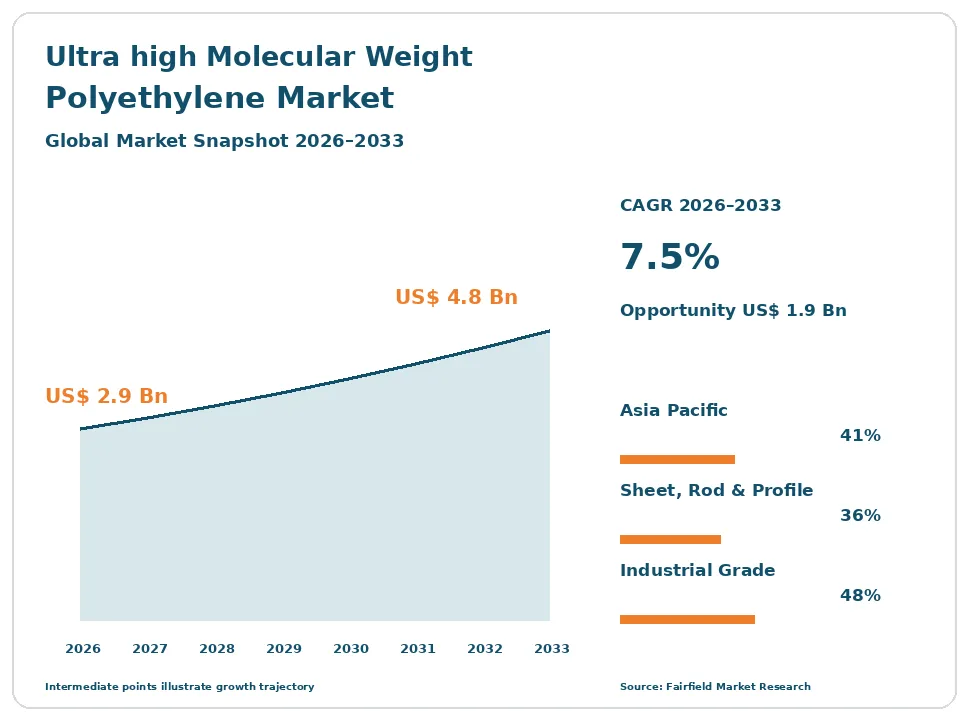
The global ultra high molecular weight polyethylene market size is expected to be valued at US$ 2.9 billion in 2026 and projected to reach US$ 4.8 billion by 2033, growing at a CAGR of 7.5% between 2026 and 2033.
Revenue grew at a 6.5% CAGR between 2020 and 2025, reaching about US$ 2.7 billion at the close of 2025. Three forces explain the trajectory. Lithium-ion battery separator film pulled large volumes of high-molecular-weight resin into a wholly new end use. Mining and bulk handling operators continued replacing steel and rubber liners with cast wear sheet. Orthopaedic demand grew steadily as implant-grade resin moved toward highly crosslinked and vitamin-E stabilised formulations. Growth is capacity-led rather than demand-led, because the polymer cannot be processed on conventional equipment. Expansion depends on new reactor trains, press capacity and gel-spinning lines, all of which take years to commission.
Key Report Takeaways
- By Form: Sheet, rod and profile held 36% share in 2026, while porous and membrane grades are projected to expand at a 9.8% CAGR through 2033, driven by wet-process separator film for high-energy lithium-ion cells.
- By Grade: Standard industrial grade held 48% share in 2026, while medical implant grade is projected to expand at an 8.8% CAGR through 2033, driven by crosslinked and vitamin-E stabilised bearing surfaces in joint replacement.
- By Processing Method: Compression moulding held 44% share in 2026, while gel spinning and solution processing is projected to expand at a 9.1% CAGR through 2033, driven by high-strength yarn and membrane output.
- By Application: Industrial wear parts and material handling held 26% share in 2026, while lithium-ion battery separators are projected to expand at an 11.2% CAGR through 2033, driven by cell plant construction worldwide.
- By Geography: Asia Pacific held 41% share in 2026, while Latin America is projected to expand at an 8.6% CAGR through 2033, driven by copper and iron ore handling liners in Chile, Peru and Brazil.
Global Ultra high Molecular Weight Polyethylene Market Trends and Insights
Drivers Impact Analysis
| Driver | Impact on CAGR Forecast | Geographic Relevance | Impact Timeline |
| Separator film demand from lithium-ion cell manufacturing | High | Asia Pacific, North America, Europe | Medium term 2–4 years |
| Substitution of steel, rubber and bronze in abrasive wear service | High | Global | Long term ≥4 years |
Two forces account for most of the incremental resin and converted-form demand expected through the forecast period.
Lithium-Ion Separator Film Pulls Ultra high Molecular Weight Polyethylene Into Volume Energy Markets
Battery separator film has become the fastest-moving outlet for very high molecular weight polyethylene resin. A separator is a thin microporous membrane that keeps electrodes apart while letting ions pass, and it must survive mechanical stress during winding and thermal stress during abuse. The molecular weight that makes this polymer difficult to process is exactly what gives a five-micron film enough puncture strength to hold up. Every new cell plant adds a committed, repeating resin requirement.
The mechanism is the wet separator process. Resin is dissolved in a solvent or oil, cast, biaxially stretched and then extracted to leave a controlled pore network. Thinner films raise cell energy density, and thinner films need higher molecular weight to keep strength. Safety and performance expectations framed by IEC 62660 and UL 2580 push cell makers toward separators with better shutdown and shrinkage behaviour, which favours this resin over commodity polyethylene.
Abrasion Resistance and Low Friction Replace Steel and Rubber in Mining and Bulk Handling
Wear parts remain the commercial backbone of this polymer, and substitution is still running. Cast sheet lining a chute, hopper, truck bed or railcar outlasts mild steel in abrasive sliding service, weighs far less, damps noise and stops material hanging up in wet conditions. Maintenance teams buy it because downtime falls, not because the material is cheap. Each replacement cycle converts a steel or rubber specification permanently.
The causal mechanism is the polymer’s extremely long molecular chains, which resist chain scission under repeated impact and give a very low coefficient of friction against bulk solids. Material specifications written to ASTM D4020 let buyers compare grades by molecular weight and verify performance consistency. Mining operators handling copper, iron ore and oil sands have standardised on it for liners, while food and beverage plants use the same stock shapes for guides and star wheels.
Restraints Impact Analysis
| Restraint | Impact on CAGR Forecast | Geographic Relevance | Impact Timeline |
| Non-melt-flow behaviour forcing compression moulding, ram extrusion or gel spinning | High | Global | Long term ≥4 years |
| Limited heat resistance, creep under load and poor bondability | Medium | Global | Long term ≥4 years |
Two structural constraints limit how far this polymer can expand beyond its established applications.
Non-Melt-Flow Processing Keeps Ultra high Molecular Weight Polyethylene Out of High-Volume Parts
This polymer cannot be injection moulded or conventionally extruded, and that single fact caps its addressable market. Above roughly three million grams per mole the melt viscosity is so high that the material does not flow under normal screw processing. It must be sintered under pressure, ram extruded slowly, or dissolved and spun. Parts are then machined from stock shapes rather than moulded to net shape, which adds machining cost and scrap on every component.
The economics follow directly from the process. Compression moulding a large sheet is a long, press-bound cycle measured in hours, not the seconds of an injection cycle. Ram extrusion delivers rod and tube at low throughput per line. Gel spinning needs solvent handling, multi-stage drawing and solvent recovery. Capital intensity per tonne is therefore high, and designers choosing between materials for a million-piece part rarely select this one.
Thermal Limits, Creep and an Inert Surface Narrow the Engineering Envelope
Three material limitations rule this polymer out of applications it would otherwise win. Continuous service temperature is modest, around 80 degrees Celsius for most grades, so hot process equipment is closed to it. It creeps under sustained static load, which disqualifies it from structural bearings and heavily loaded fasteners. Dimensional stability over wide temperature swings is also poor compared with filled engineering plastics, forcing generous clearances in machined assemblies.
The surface causes a separate problem. Non-polar, low-energy polyethylene resists adhesives, inks and coatings, so bonding, printing and welding all require plasma, corona or chemical pre-treatment that adds a process step and a quality risk. Fabricators therefore rely on mechanical fastening. Where heat, load or bonded assembly matters, specifiers move to polyamide, polyoxymethylene, polyetheretherketone or aramid, and those materials hold ground in several overlapping uses.
Market Opportunities
Battery Separator Film Opens the Largest New Revenue Pool for High-Molecular-Weight Resin
Separator film is the clearest untapped revenue pool for resin producers, because the quantity of cell capacity under construction far exceeds installed separator supply. A gigafactory consumes a continuous, specified resin stream for its operating life, and qualification locks that supply in for years. Resin sold into this route commands a premium over industrial grades, since particle morphology, molecular weight distribution and ash content must be tightly controlled.
The producers able to capture it are those with reactor flexibility and the analytical capability to hold narrow specifications batch to batch. Demand comes from separator converters and the cell makers behind them, concentrated in China, Republic of Korea, Japan, Germany, Hungary and the United States. Regional battery rules that reward local content and verified carbon footprint push converters to source resin closer to their plants, which creates openings for producers outside the established supply base.
Synthetic Rope and Mooring Lines Replace Steel Wire Across Marine and Offshore Operations
High-strength fibre rope is displacing steel wire in marine and offshore service, and that substitution is still early. A gel-spun fibre rope of equal breaking strength weighs a fraction of steel, floats, does not corrode and can be handled by smaller crews without heavy winching. Deepwater station keeping, towing, subsea lifting and mooring lines are each converting, and chafe protection and jacketing add further converted-form volume.
Rope makers and offshore contractors capture this, with demand created by operators cutting vessel deck load and crew injury exposure. Classification society acceptance of synthetic mooring systems and the cordage standards governing construction, testing and retirement are what made the change bankable, because asset owners needed documented residual strength criteria. Aquaculture, port towage and heavy-lift rigging follow the same logic and expand the pool beyond oil and gas.
Segment Analysis
By Form: Machinable Stock Shapes Lead While Porous and Membrane Grades Surge
Sheet, rod and profile held 36% share in 2026, the largest form by value. Compression-moulded sheet and ram-extruded stock are what fabricators buy to machine liners, guides, bearings, bushings and wear strips, and the global network of machining shops that serves industrial maintenance runs on these shapes. Resin and powder sold directly to converters accounted for a further 24%, with gel-spun fibre and yarn at 22%.
Porous and membrane grades, at 11% of the market, are the fastest-growing form at a 9.8% CAGR through 2033. Battery separator film dominates this category, with filtration media and venting membranes adding steady volume. Tape and unidirectional laminate held the remaining 7%.
The business implication is that value is shifting from bulk machinable stock toward thin, specification-controlled film, which rewards producers holding tight control over molecular weight distribution rather than simple tonnage capacity.
By Grade: Standard Industrial Resin Dominates as Implant Grade Climbs Fastest
Standard industrial grade held 48% share in 2026. It covers the wear sheet, liners and machined parts that make up the bulk of consumption, and it is specified by mechanical property and molecular weight rather than by any regulatory qualification. High-performance and premium grades, used for fibre, film and demanding chemical service, take most of the remainder, with food-contact grade a smaller but stable slice.
Medical implant grade is the fastest-growing at an 8.8% CAGR through 2033. ISO 5834 parts 1 and 2 and ASTM F648 define what qualifies as implant grade for powder and fabricated forms, and ASTM F2565 and ASTM F2759 govern crosslinked material and component characterisation. Highly crosslinked and vitamin-E stabilised formulations reduced wear debris and extended bearing life.
Implant grade carries by far the highest price per kilogram, so a small tonnage share contributes disproportionately to value and justifies dedicated, fully traceable production lines.
By Processing Method: Compression Moulding Leads While Solution Routes Expand Quickest
Compression moulding held 44% share in 2026. Pressing resin powder into large sheet and billet under heat and pressure is the only practical way to make the big stock shapes that fabricators machine, and the installed press base is wide and long-lived. Ram extrusion supplies rod, tube and profile at steady but lower throughput, serving bearing and bushing fabricators.
Gel spinning and solution processing is the fastest-growing method at a 9.1% CAGR through 2033. Both high-strength yarn and wet-process membrane film depend on dissolving resin, forming it and then removing solvent, and both are where new capital is going. Sintering and porous processing serves filtration and venting media.
Because every route is capital-intensive and none is fast, converter capacity rather than resin availability often sets delivery times, which keeps conversion economics attractive for established specialist processors.
By Application: Industrial Wear Parts Lead While Battery Separators Grow Fastest
Industrial wear parts and material handling held 26% share in 2026, the largest single application. Conveyor components, chute liners, guide rails and machine wear parts are replaced on maintenance cycles, which makes this demand recurring and recession-resistant. Mining and bulk handling liners form the next block, followed by marine and offshore ropes, moorings and chafe protection.
Lithium-ion battery separators are the fastest-growing application at an 11.2% CAGR through 2033, tracking cell plant commissioning worldwide. Medical implants and orthopaedics, food and beverage processing and sporting goods complete the mix. Ballistic and cut-resistant protection remains a substantial fibre outlet, with the finished garment market examined in a separate study.
The spread matters commercially: industrial and mining demand is steady and price-sensitive, while separators and implants are specification-driven and far less cyclical, so a balanced application portfolio smooths earnings across the economic cycle.
Geography Analysis
North America Buys Implant-Grade Resin, Mining Liners and Growing Separator Volumes
North America held 23% share in 2026 and is forecast to grow at a 6.3% CAGR through 2033. The United States dominates, with Canada adding oil sands and mining demand and Mexico contributing automotive and food processing consumption. The region is unusual in its application mix: it holds the largest concentration of orthopaedic implant manufacturing, which consumes a disproportionate share of high-value implant-grade resin and machined bearing components.
Industrial wear parts, bulk handling liners and food-contact components make up the volume base, supported by a dense network of plastics machining shops serving plant maintenance. Battery cell plant construction is the main change underway, creating domestic separator demand where little existed before. Food contact approvals for processing components and a strong aftermarket culture keep replacement cycles short and predictable.
Europe Combines Precision Converters With Strict Material Documentation Requirements
Europe held 21% share in 2026 and is forecast to grow at a 5.9% CAGR, the slowest of the five regions. Germany, the Netherlands, Switzerland, Italy and Belgium host the most established specialist converters, with deep capability in compression-moulded sheet, machined components and gel-spun fibre. Demand is weighted toward high-specification applications rather than bulk tonnage.
Food and beverage processing equipment, pharmaceutical handling and conveyor engineering are large and mature outlets, and European machine builders export components worldwide. Cell plant investment in Germany, Hungary, Poland and Sweden is building separator demand. Documentation expectations are the regional signature: buyers want full traceability, declared material specifications and lifecycle data. Slow industrial output growth and high energy costs are the main brakes, while recycled and bio-attributed resin grades are the clearest regional opportunity.
Which Region Is Leading the Ultra high Molecular Weight Polyethylene Market?
Asia Pacific leads the ultra high molecular weight polyethylene market with 41% share in 2026, growing at an 8.1% CAGR through 2033. China holds most of it, combining the largest resin production base, the largest concentration of separator film converters and very large domestic consumption in mining, conveying and bulk handling. Japan and the Republic of Korea contribute advanced fibre, film and premium resin capability, while India is scaling industrial and rope demand quickly.
Cell manufacturing is the structural advantage: the region builds most of the world’s lithium-ion capacity, so separator resin demand is anchored here. Port, shipyard and aquaculture activity support synthetic rope consumption. The main constraint is price competition in commodity sheet, which compresses converter margins and pushes producers toward specification-controlled grades.
Which Region Is Growing Fastest in the Ultra high Molecular Weight Polyethylene Market?
Latin America is growing fastest in the ultra high molecular weight polyethylene market, at an 8.6% CAGR through 2033 from 7% share in 2026. Mining is the reason. Chile and Peru run some of the world’s largest copper operations, and Brazil moves enormous volumes of iron ore, so chute liners, truck bed liners, screen panels and conveyor components are consumed continuously in highly abrasive service. The region also hosts resin production capacity, which shortens supply lines.
Marine and port activity, aquaculture in Chile and agricultural bulk handling in Brazil and Argentina add further demand. Barriers are real: converter capacity is thinner than in the leading regions, import duties raise landed cost, and currency volatility complicates long-term supply contracts. Deeper local conversion capability is the main opportunity.
Middle East & Africa Demand Is Concentrated in Mining, Ports and Desalination
Middle East & Africa held 8% share in 2026 and is forecast to grow at a 7.4% CAGR through 2033. South Africa anchors demand through platinum, coal, chrome and manganese operations that consume liners and conveyor components heavily, while Zambia and the Democratic Republic of the Congo add copper and cobalt handling. Gulf states contribute through ports, desalination plants, petrochemical handling and marine rope consumption.
The region imports nearly all its resin and most of its converted stock shapes, so availability and lead time shape buying decisions more than price. Thin local machining capacity, foreign exchange constraints and logistics costs are the main barriers. The clearest opportunity is local conversion and machining investment near mining clusters, which would shorten replacement lead times and raise the share of value captured regionally.
Competitive Landscape
The ultra high molecular weight polyethylene market is highly concentrated at the resin level and fragmented at the conversion level, and the processing constraint explains the split. Only a handful of companies worldwide operate the slurry reactor technology and catalyst systems needed to make polyethylene at these molecular weights with consistent particle morphology, and gel-spun fibre capacity is concentrated even more tightly among a few producers. Below them sits a broad layer of specialist converters, compression moulders, ram extruders and machining shops, many of them regional and privately held, serving local maintenance markets. Consolidation has occurred mainly in the fibre segment, where ownership of major high-strength yarn businesses has changed hands, while the converter layer remains stable and fragmented.
Vendors compete on grade portfolio breadth, batch-to-batch consistency, technical service and qualification support rather than on price in the premium grades. Molecular weight control, ash content and particle size distribution decide whether a resin can be used for separator film or implant components, and those qualifications take years to win. In industrial grades competition is closer to a commodity contest fought on sheet price, delivery lead time and machining support. New entrants are appearing mainly in China, where capacity additions target separator and fibre grades, and among converters offering recycled or mass-balance bio-attributed feedstock.
Strategic activity centres on moving up the specification ladder. Resin producers are expanding premium grade capability rather than general tonnage, converters are adding machining and assembly to sell finished parts instead of stock shapes, and fibre producers are integrating forward into rope, tape and laminate.
Strategic direction converges on three themes: capacity dedicated to specification-controlled grades, forward integration into converted products, and sustainability credentials that customers increasingly require.
Ultra high Molecular Weight Polyethylene Industry Leaders
- Celanese Corporation
- Braskem S.A.
- Mitsui Chemicals, Inc.
- Avient Corporation
- Asahi Kasei Corporation
Recent Industry Developments
- February 2024: The European Union batteries regulation began to apply, introducing performance, safety, carbon footprint and recycled content duties across the battery value chain – raises qualification and documentation requirements for separator film and the resin behind it.
- July 2024: The European Union Ecodesign for Sustainable Products Regulation entered into force – extends durability, repairability and recycled content requirements toward engineering plastics used in industrial components.
- December 2024: The fifth session of the intergovernmental negotiating committee on a global plastics treaty closed in Busan, Republic of Korea, without agreement – leaves polymer producers planning against national rules rather than one harmonised instrument.
- August 2025: The resumed session of the global plastics treaty negotiations in Geneva ended without a final text – extends regulatory uncertainty for polyethylene producers and their industrial customers.
Companies Covered in the Report
- Celanese Corporation
- Braskem S.A.
- Mitsui Chemicals, Inc.
- Asahi Kasei Corporation
- Avient Corporation
- Honeywell International Inc.
- Röchling Group
- Mitsubishi Chemical Group Corporation
- China Petroleum & Chemical Corporation
- Toyobo Co., Ltd.
- Teijin Limited
- Orthoplastics Ltd
- Garware Technical Fibres Limited
Ultra high Molecular Weight Polyethylene Market Report Scope
This study covers the polymer and its primary converted forms: resin and powder, compression-moulded sheet, rod and profile, ram-extruded stock shapes, gel-spun fibre and yarn, tape and unidirectional laminate, porous and membrane grades including battery separator film, and medical implant-grade resin. Finished protective garments and finished orthopaedic implants are examined in separate studies and excluded. The base year is 2025, with a forecast period of 2026 to 2033 in US$ Billion.
Form
- Resin and powder
- Sheet, rod and profile
- Gel-spun fibre and yarn
- Tape and unidirectional laminate
- Porous and membrane grades
Grade
- Standard industrial grade
- High-performance and premium grade
- Medical implant grade
- Food-contact grade
Processing Method
- Compression moulding
- Ram extrusion
- Gel spinning and solution processing
- Sintering and porous processing
Application
- Industrial wear parts and material handling
- Mining and bulk handling liners
- Marine and offshore ropes, moorings and chafe protection
- Ballistic and cut-resistant protection
- Medical implants and orthopaedics
- Lithium-ion battery separators
- Food and beverage processing
- Sporting goods
Regions
- North America
- Europe
- Asia Pacific
- Latin America
- Middle East & Africa
Key Questions Answered in the Report
How big is the ultra high molecular weight polyethylene market in 2026?
The market is valued at US$ 2.9 billion in 2026, covering resin, powder, machinable stock shapes, gel-spun fibre, tape, membrane grades and implant-grade material.
What is the UHMWPE market forecast and CAGR to 2033?
The market is projected to reach US$ 4.8 billion by 2033, a 7.5% CAGR and an absolute dollar opportunity of US$ 1.9 billion.
Which UHMWPE form holds the largest market share?
Sheet, rod and profile hold the largest share at 36% in 2026, because fabricators machine liners, bearings and wear parts from these stock shapes.
Which UHMWPE application is growing fastest through 2033?
Lithium-ion battery separators grow fastest at an 11.2% CAGR, as new cell plants create continuous, specification-controlled demand for wet-process microporous membrane film.
How concentrated is the UHMWPE supplier landscape?
Concentration is high at resin level, where few producers run the required reactor technology, and fragmented among the many regional converters and machining specialists.
1. Executive Summary
1.1. Global Ultra high Molecular Weight Polyethylene Market Snapshot
1.2. Future Projections
1.3. Key Report Takeaways
1.4. Regional Snapshot
2. Market Overview
2.1. Market Definition and Report Scope
2.2. Historical Trends 2020–2025
2.3. Market Dynamics
2.3.1. Drivers
2.3.1.1. Lithium-Ion Separator Film Pulls Ultra high Molecular Weight Polyethylene Into Volume Energy Markets
2.3.1.2. Abrasion Resistance and Low Friction Replace Steel and Rubber in Mining and Bulk Handling
2.3.2. Restraints
2.3.2.1. Non-Melt-Flow Processing Keeps Ultra high Molecular Weight Polyethylene Out of High-Volume Parts
2.3.2.2. Thermal Limits, Creep and an Inert Surface Narrow the Engineering Envelope
2.3.3. Market Opportunities
2.3.3.1. Battery Separator Film Opens the Largest New Revenue Pool for High-Molecular-Weight Resin
2.3.3.2. Synthetic Rope and Mooring Lines Replace Steel Wire Across Marine and Offshore Operations
3. Global Ultra high Molecular Weight Polyethylene Market Outlook, 2020–2033
3.1. Global Ultra high Molecular Weight Polyethylene Market Outlook, by Form, Value (US$ Billion), 2020–2033
3.1.1. Resin and powder
3.1.2. Sheet, rod and profile
3.1.3. Gel-spun fibre and yarn
3.1.4. Tape and unidirectional laminate
3.1.5. Porous and membrane grades
3.2. Global Ultra high Molecular Weight Polyethylene Market Outlook, by Grade, Value (US$ Billion), 2020–2033
3.2.1. Standard industrial grade
3.2.2. High-performance and premium grade
3.2.3. Medical implant grade
3.2.4. Food-contact grade
3.3. Global Ultra high Molecular Weight Polyethylene Market Outlook, by Processing Method, Value (US$ Billion), 2020–2033
3.3.1. Compression moulding
3.3.2. Ram extrusion
3.3.3. Gel spinning and solution processing
3.3.4. Sintering and porous processing
3.4. Global Ultra high Molecular Weight Polyethylene Market Outlook, by Application, Value (US$ Billion), 2020–2033
3.4.1. Industrial wear parts and material handling
3.4.2. Mining and bulk handling liners
3.4.3. Marine and offshore ropes, moorings and chafe protection
3.4.4. Ballistic and cut-resistant protection
3.4.5. Medical implants and orthopaedics
3.4.6. Lithium-ion battery separators
3.4.7. Food and beverage processing
3.4.8. Sporting goods
3.5. Global Ultra high Molecular Weight Polyethylene Market Outlook, by Region, Value (US$ Billion), 2020–2033
3.5.1. North America
3.5.2. Europe
3.5.3. Asia Pacific
3.5.4. Latin America
3.5.5. Middle East & Africa
4. North America Ultra high Molecular Weight Polyethylene Market Outlook, 2020–2033
4.1. North America Ultra high Molecular Weight Polyethylene Market Outlook, by Form, Value (US$ Billion), 2020–2033
4.1.1. Resin and powder
4.1.2. Sheet, rod and profile
4.1.3. Gel-spun fibre and yarn
4.1.4. Tape and unidirectional laminate
4.1.5. Porous and membrane grades
4.2. North America Ultra high Molecular Weight Polyethylene Market Outlook, by Grade, Value (US$ Billion), 2020–2033
4.2.1. Standard industrial grade
4.2.2. High-performance and premium grade
4.2.3. Medical implant grade
4.2.4. Food-contact grade
4.3. North America Ultra high Molecular Weight Polyethylene Market Outlook, by Processing Method, Value (US$ Billion), 2020–2033
4.3.1. Compression moulding
4.3.2. Ram extrusion
4.3.3. Gel spinning and solution processing
4.3.4. Sintering and porous processing
4.4. North America Ultra high Molecular Weight Polyethylene Market Outlook, by Application, Value (US$ Billion), 2020–2033
4.4.1. Industrial wear parts and material handling
4.4.2. Mining and bulk handling liners
4.4.3. Marine and offshore ropes, moorings and chafe protection
4.4.4. Ballistic and cut-resistant protection
4.4.5. Medical implants and orthopaedics
4.4.6. Lithium-ion battery separators
4.4.7. Food and beverage processing
4.4.8. Sporting goods
4.5. North America Ultra high Molecular Weight Polyethylene Market Outlook, by Country, Value (US$ Billion), 2020–2033
4.5.1. United States Ultra high Molecular Weight Polyethylene Market Outlook, by Form, 2020–2033
4.5.2. United States Ultra high Molecular Weight Polyethylene Market Outlook, by Grade, 2020–2033
4.5.3. United States Ultra high Molecular Weight Polyethylene Market Outlook, by Processing Method, 2020–2033
4.5.4. United States Ultra high Molecular Weight Polyethylene Market Outlook, by Application, 2020–2033
4.5.5. Canada Ultra high Molecular Weight Polyethylene Market Outlook, by Form, 2020–2033
4.5.6. Canada Ultra high Molecular Weight Polyethylene Market Outlook, by Grade, 2020–2033
4.5.7. Canada Ultra high Molecular Weight Polyethylene Market Outlook, by Processing Method, 2020–2033
4.5.8. Canada Ultra high Molecular Weight Polyethylene Market Outlook, by Application, 2020–2033
4.5.9. Mexico Ultra high Molecular Weight Polyethylene Market Outlook, by Form, 2020–2033
4.5.10. Mexico Ultra high Molecular Weight Polyethylene Market Outlook, by Grade, 2020–2033
4.5.11. Mexico Ultra high Molecular Weight Polyethylene Market Outlook, by Processing Method, 2020–2033
4.5.12. Mexico Ultra high Molecular Weight Polyethylene Market Outlook, by Application, 2020–2033
5. Europe Ultra high Molecular Weight Polyethylene Market Outlook, 2020–2033
5.1. Europe Ultra high Molecular Weight Polyethylene Market Outlook, by Form, Value (US$ Billion), 2020–2033
5.1.1. Resin and powder
5.1.2. Sheet, rod and profile
5.1.3. Gel-spun fibre and yarn
5.1.4. Tape and unidirectional laminate
5.1.5. Porous and membrane grades
5.2. Europe Ultra high Molecular Weight Polyethylene Market Outlook, by Grade, Value (US$ Billion), 2020–2033
5.2.1. Standard industrial grade
5.2.2. High-performance and premium grade
5.2.3. Medical implant grade
5.2.4. Food-contact grade
5.3. Europe Ultra high Molecular Weight Polyethylene Market Outlook, by Processing Method, Value (US$ Billion), 2020–2033
5.3.1. Compression moulding
5.3.2. Ram extrusion
5.3.3. Gel spinning and solution processing
5.3.4. Sintering and porous processing
5.4. Europe Ultra high Molecular Weight Polyethylene Market Outlook, by Application, Value (US$ Billion), 2020–2033
5.4.1. Industrial wear parts and material handling
5.4.2. Mining and bulk handling liners
5.4.3. Marine and offshore ropes, moorings and chafe protection
5.4.4. Ballistic and cut-resistant protection
5.4.5. Medical implants and orthopaedics
5.4.6. Lithium-ion battery separators
5.4.7. Food and beverage processing
5.4.8. Sporting goods
5.5. Europe Ultra high Molecular Weight Polyethylene Market Outlook, by Country, Value (US$ Billion), 2020–2033
5.5.1. Germany Ultra high Molecular Weight Polyethylene Market Outlook, by Form, 2020–2033
5.5.2. Germany Ultra high Molecular Weight Polyethylene Market Outlook, by Grade, 2020–2033
5.5.3. Germany Ultra high Molecular Weight Polyethylene Market Outlook, by Processing Method, 2020–2033
5.5.4. Germany Ultra high Molecular Weight Polyethylene Market Outlook, by Application, 2020–2033
5.5.5. the Netherlands Ultra high Molecular Weight Polyethylene Market Outlook, by Form, 2020–2033
5.5.6. the Netherlands Ultra high Molecular Weight Polyethylene Market Outlook, by Grade, 2020–2033
5.5.7. the Netherlands Ultra high Molecular Weight Polyethylene Market Outlook, by Processing Method, 2020–2033
5.5.8. the Netherlands Ultra high Molecular Weight Polyethylene Market Outlook, by Application, 2020–2033
5.5.9. Switzerland Ultra high Molecular Weight Polyethylene Market Outlook, by Form, 2020–2033
5.5.10. Switzerland Ultra high Molecular Weight Polyethylene Market Outlook, by Grade, 2020–2033
5.5.11. Switzerland Ultra high Molecular Weight Polyethylene Market Outlook, by Processing Method, 2020–2033
5.5.12. Switzerland Ultra high Molecular Weight Polyethylene Market Outlook, by Application, 2020–2033
5.5.13. Italy Ultra high Molecular Weight Polyethylene Market Outlook, by Form, 2020–2033
5.5.14. Italy Ultra high Molecular Weight Polyethylene Market Outlook, by Grade, 2020–2033
5.5.15. Italy Ultra high Molecular Weight Polyethylene Market Outlook, by Processing Method, 2020–2033
5.5.16. Italy Ultra high Molecular Weight Polyethylene Market Outlook, by Application, 2020–2033
5.5.17. Belgium Ultra high Molecular Weight Polyethylene Market Outlook, by Form, 2020–2033
5.5.18. Belgium Ultra high Molecular Weight Polyethylene Market Outlook, by Grade, 2020–2033
5.5.19. Belgium Ultra high Molecular Weight Polyethylene Market Outlook, by Processing Method, 2020–2033
5.5.20. Belgium Ultra high Molecular Weight Polyethylene Market Outlook, by Application, 2020–2033
5.5.21. Hungary Ultra high Molecular Weight Polyethylene Market Outlook, by Form, 2020–2033
5.5.22. Hungary Ultra high Molecular Weight Polyethylene Market Outlook, by Grade, 2020–2033
5.5.23. Hungary Ultra high Molecular Weight Polyethylene Market Outlook, by Processing Method, 2020–2033
5.5.24. Hungary Ultra high Molecular Weight Polyethylene Market Outlook, by Application, 2020–2033
5.5.25. Poland Ultra high Molecular Weight Polyethylene Market Outlook, by Form, 2020–2033
5.5.26. Poland Ultra high Molecular Weight Polyethylene Market Outlook, by Grade, 2020–2033
5.5.27. Poland Ultra high Molecular Weight Polyethylene Market Outlook, by Processing Method, 2020–2033
5.5.28. Poland Ultra high Molecular Weight Polyethylene Market Outlook, by Application, 2020–2033
5.5.29. Sweden Ultra high Molecular Weight Polyethylene Market Outlook, by Form, 2020–2033
5.5.30. Sweden Ultra high Molecular Weight Polyethylene Market Outlook, by Grade, 2020–2033
5.5.31. Sweden Ultra high Molecular Weight Polyethylene Market Outlook, by Processing Method, 2020–2033
5.5.32. Sweden Ultra high Molecular Weight Polyethylene Market Outlook, by Application, 2020–2033
6. Asia Pacific Ultra high Molecular Weight Polyethylene Market Outlook, 2020–2033
6.1. Asia Pacific Ultra high Molecular Weight Polyethylene Market Outlook, by Form, Value (US$ Billion), 2020–2033
6.1.1. Resin and powder
6.1.2. Sheet, rod and profile
6.1.3. Gel-spun fibre and yarn
6.1.4. Tape and unidirectional laminate
6.1.5. Porous and membrane grades
6.2. Asia Pacific Ultra high Molecular Weight Polyethylene Market Outlook, by Grade, Value (US$ Billion), 2020–2033
6.2.1. Standard industrial grade
6.2.2. High-performance and premium grade
6.2.3. Medical implant grade
6.2.4. Food-contact grade
6.3. Asia Pacific Ultra high Molecular Weight Polyethylene Market Outlook, by Processing Method, Value (US$ Billion), 2020–2033
6.3.1. Compression moulding
6.3.2. Ram extrusion
6.3.3. Gel spinning and solution processing
6.3.4. Sintering and porous processing
6.4. Asia Pacific Ultra high Molecular Weight Polyethylene Market Outlook, by Application, Value (US$ Billion), 2020–2033
6.4.1. Industrial wear parts and material handling
6.4.2. Mining and bulk handling liners
6.4.3. Marine and offshore ropes, moorings and chafe protection
6.4.4. Ballistic and cut-resistant protection
6.4.5. Medical implants and orthopaedics
6.4.6. Lithium-ion battery separators
6.4.7. Food and beverage processing
6.4.8. Sporting goods
6.5. Asia Pacific Ultra high Molecular Weight Polyethylene Market Outlook, by Country, Value (US$ Billion), 2020–2033
6.5.1. China Ultra high Molecular Weight Polyethylene Market Outlook, by Form, 2020–2033
6.5.2. China Ultra high Molecular Weight Polyethylene Market Outlook, by Grade, 2020–2033
6.5.3. China Ultra high Molecular Weight Polyethylene Market Outlook, by Processing Method, 2020–2033
6.5.4. China Ultra high Molecular Weight Polyethylene Market Outlook, by Application, 2020–2033
6.5.5. Japan Ultra high Molecular Weight Polyethylene Market Outlook, by Form, 2020–2033
6.5.6. Japan Ultra high Molecular Weight Polyethylene Market Outlook, by Grade, 2020–2033
6.5.7. Japan Ultra high Molecular Weight Polyethylene Market Outlook, by Processing Method, 2020–2033
6.5.8. Japan Ultra high Molecular Weight Polyethylene Market Outlook, by Application, 2020–2033
6.5.9. Republic of Korea Ultra high Molecular Weight Polyethylene Market Outlook, by Form, 2020–2033
6.5.10. Republic of Korea Ultra high Molecular Weight Polyethylene Market Outlook, by Grade, 2020–2033
6.5.11. Republic of Korea Ultra high Molecular Weight Polyethylene Market Outlook, by Processing Method, 2020–2033
6.5.12. Republic of Korea Ultra high Molecular Weight Polyethylene Market Outlook, by Application, 2020–2033
6.5.13. India Ultra high Molecular Weight Polyethylene Market Outlook, by Form, 2020–2033
6.5.14. India Ultra high Molecular Weight Polyethylene Market Outlook, by Grade, 2020–2033
6.5.15. India Ultra high Molecular Weight Polyethylene Market Outlook, by Processing Method, 2020–2033
6.5.16. India Ultra high Molecular Weight Polyethylene Market Outlook, by Application, 2020–2033
7. Latin America Ultra high Molecular Weight Polyethylene Market Outlook, 2020–2033
7.1. Latin America Ultra high Molecular Weight Polyethylene Market Outlook, by Form, Value (US$ Billion), 2020–2033
7.1.1. Resin and powder
7.1.2. Sheet, rod and profile
7.1.3. Gel-spun fibre and yarn
7.1.4. Tape and unidirectional laminate
7.1.5. Porous and membrane grades
7.2. Latin America Ultra high Molecular Weight Polyethylene Market Outlook, by Grade, Value (US$ Billion), 2020–2033
7.2.1. Standard industrial grade
7.2.2. High-performance and premium grade
7.2.3. Medical implant grade
7.2.4. Food-contact grade
7.3. Latin America Ultra high Molecular Weight Polyethylene Market Outlook, by Processing Method, Value (US$ Billion), 2020–2033
7.3.1. Compression moulding
7.3.2. Ram extrusion
7.3.3. Gel spinning and solution processing
7.3.4. Sintering and porous processing
7.4. Latin America Ultra high Molecular Weight Polyethylene Market Outlook, by Application, Value (US$ Billion), 2020–2033
7.4.1. Industrial wear parts and material handling
7.4.2. Mining and bulk handling liners
7.4.3. Marine and offshore ropes, moorings and chafe protection
7.4.4. Ballistic and cut-resistant protection
7.4.5. Medical implants and orthopaedics
7.4.6. Lithium-ion battery separators
7.4.7. Food and beverage processing
7.4.8. Sporting goods
7.5. Latin America Ultra high Molecular Weight Polyethylene Market Outlook, by Country, Value (US$ Billion), 2020–2033
7.5.1. Chile Ultra high Molecular Weight Polyethylene Market Outlook, by Form, 2020–2033
7.5.2. Chile Ultra high Molecular Weight Polyethylene Market Outlook, by Grade, 2020–2033
7.5.3. Chile Ultra high Molecular Weight Polyethylene Market Outlook, by Processing Method, 2020–2033
7.5.4. Chile Ultra high Molecular Weight Polyethylene Market Outlook, by Application, 2020–2033
7.5.5. Peru Ultra high Molecular Weight Polyethylene Market Outlook, by Form, 2020–2033
7.5.6. Peru Ultra high Molecular Weight Polyethylene Market Outlook, by Grade, 2020–2033
7.5.7. Peru Ultra high Molecular Weight Polyethylene Market Outlook, by Processing Method, 2020–2033
7.5.8. Peru Ultra high Molecular Weight Polyethylene Market Outlook, by Application, 2020–2033
7.5.9. Brazil Ultra high Molecular Weight Polyethylene Market Outlook, by Form, 2020–2033
7.5.10. Brazil Ultra high Molecular Weight Polyethylene Market Outlook, by Grade, 2020–2033
7.5.11. Brazil Ultra high Molecular Weight Polyethylene Market Outlook, by Processing Method, 2020–2033
7.5.12. Brazil Ultra high Molecular Weight Polyethylene Market Outlook, by Application, 2020–2033
7.5.13. Argentina Ultra high Molecular Weight Polyethylene Market Outlook, by Form, 2020–2033
7.5.14. Argentina Ultra high Molecular Weight Polyethylene Market Outlook, by Grade, 2020–2033
7.5.15. Argentina Ultra high Molecular Weight Polyethylene Market Outlook, by Processing Method, 2020–2033
7.5.16. Argentina Ultra high Molecular Weight Polyethylene Market Outlook, by Application, 2020–2033
8. Middle East & Africa Ultra high Molecular Weight Polyethylene Market Outlook, 2020–2033
8.1. Middle East & Africa Ultra high Molecular Weight Polyethylene Market Outlook, by Form, Value (US$ Billion), 2020–2033
8.1.1. Resin and powder
8.1.2. Sheet, rod and profile
8.1.3. Gel-spun fibre and yarn
8.1.4. Tape and unidirectional laminate
8.1.5. Porous and membrane grades
8.2. Middle East & Africa Ultra high Molecular Weight Polyethylene Market Outlook, by Grade, Value (US$ Billion), 2020–2033
8.2.1. Standard industrial grade
8.2.2. High-performance and premium grade
8.2.3. Medical implant grade
8.2.4. Food-contact grade
8.3. Middle East & Africa Ultra high Molecular Weight Polyethylene Market Outlook, by Processing Method, Value (US$ Billion), 2020–2033
8.3.1. Compression moulding
8.3.2. Ram extrusion
8.3.3. Gel spinning and solution processing
8.3.4. Sintering and porous processing
8.4. Middle East & Africa Ultra high Molecular Weight Polyethylene Market Outlook, by Application, Value (US$ Billion), 2020–2033
8.4.1. Industrial wear parts and material handling
8.4.2. Mining and bulk handling liners
8.4.3. Marine and offshore ropes, moorings and chafe protection
8.4.4. Ballistic and cut-resistant protection
8.4.5. Medical implants and orthopaedics
8.4.6. Lithium-ion battery separators
8.4.7. Food and beverage processing
8.4.8. Sporting goods
8.5. Middle East & Africa Ultra high Molecular Weight Polyethylene Market Outlook, by Country, Value (US$ Billion), 2020–2033
8.5.1. South Africa Ultra high Molecular Weight Polyethylene Market Outlook, by Form, 2020–2033
8.5.2. South Africa Ultra high Molecular Weight Polyethylene Market Outlook, by Grade, 2020–2033
8.5.3. South Africa Ultra high Molecular Weight Polyethylene Market Outlook, by Processing Method, 2020–2033
8.5.4. South Africa Ultra high Molecular Weight Polyethylene Market Outlook, by Application, 2020–2033
8.5.5. Zambia Ultra high Molecular Weight Polyethylene Market Outlook, by Form, 2020–2033
8.5.6. Zambia Ultra high Molecular Weight Polyethylene Market Outlook, by Grade, 2020–2033
8.5.7. Zambia Ultra high Molecular Weight Polyethylene Market Outlook, by Processing Method, 2020–2033
8.5.8. Zambia Ultra high Molecular Weight Polyethylene Market Outlook, by Application, 2020–2033
8.5.9. Democratic Republic of the Congo Ultra high Molecular Weight Polyethylene Market Outlook, by Form, 2020–2033
8.5.10. Democratic Republic of the Congo Ultra high Molecular Weight Polyethylene Market Outlook, by Grade, 2020–2033
8.5.11. Democratic Republic of the Congo Ultra high Molecular Weight Polyethylene Market Outlook, by Processing Method, 2020–2033
8.5.12. Democratic Republic of the Congo Ultra high Molecular Weight Polyethylene Market Outlook, by Application, 2020–2033
9. Competitive Landscape
9.1. Market Concentration and Industry Leaders
9.2. Competitive Differentiation
9.3. Strategic Moves and Market Direction
9.4. Recent Industry Developments
9.5. Company Profiles
9.5.1. Celanese Corporation
9.5.2. Braskem S.A.
9.5.3. Mitsui Chemicals, Inc.
9.5.4. Asahi Kasei Corporation
9.5.5. Avient Corporation
9.5.6. Honeywell International Inc.
9.5.7. Röchling Group
9.5.8. Mitsubishi Chemical Group Corporation
9.5.9. China Petroleum & Chemical Corporation
9.5.10. Toyobo Co., Ltd.
9.5.11. Teijin Limited
9.5.12. Orthoplastics Ltd
9.5.13. Garware Technical Fibres Limited
10. Appendix
10.1. Research Methodology
10.2. Report Assumptions
10.3. Acronyms and Abbreviations
| Form | Resin and powder, Sheet, rod and profile, Gel-spun fibre and yarn, Tape and unidirectional laminate, Porous and membrane grades |
| Grade | Standard industrial grade, High-performance and premium grade, Medical implant grade, Food-contact grade |
| Processing Method | Compression moulding, Ram extrusion, Gel spinning and solution processing, Sintering and porous processing |
| Application | Industrial wear parts and material handling, Mining and bulk handling liners, Marine and offshore ropes, moorings and chafe protection, Ballistic and cut-resistant protection, Medical implants and orthopaedics, Lithium-ion battery separators, Food and beverage processing, Sporting goods |
| Regions | North America, Europe, Asia Pacific, Latin America, Middle East & Africa |
Our Research Methodology
Considering the volatility of business today, traditional approaches to strategizing a game plan can be unfruitful if not detrimental. True ambiguity is no way to determine a forecast. A myriad of predetermined factors must be accounted for such as the degree of risk involved, the magnitude of circumstances, as well as conditions or consequences that are not known or unpredictable. To circumvent binary views that cast uncertainty, the application of market research intelligence to strategically posture, move, and enable actionable outcomes is necessary.
View Methodology
Quality Assured
Rigorous Validation Process

Confidentiality Assured
End-to-end Data Security

Custom Research Services
Tailored To Your Objectives
FAQs
The market is valued at US$ 2.9 billion in 2026, covering resin, powder, machinable stock shapes, gel-spun fibre, tape, membrane grades and implant-grade material.
The market is projected to reach US$ 4.8 billion by 2033, a 7.5% CAGR and an absolute dollar opportunity of US$ 1.9 billion.
Sheet, rod and profile hold the largest share at 36% in 2026, because fabricators machine liners, bearings and wear parts from these stock shapes.
Lithium-ion battery separators grow fastest at an 11.2% CAGR, as new cell plants create continuous, specification-controlled demand for wet-process microporous membrane film.
Concentration is high at resin level, where few producers run the required reactor technology, and fragmented among the many regional converters and machining specialists.
Related Reports
Steel Drums & IBCs Market Size, Share, Insights, Competitive Landscape, and Forecast 2026 to 2033
Explore the steel drums & IBCs market, projected to reach US$29.8 billion by 2033 at 4.8% CAGR, with segment, regional and competitive insights.
Semiconductor Gases Market Size, Share, Insights, Competitive Landscape, and Forecast 2026 to 2033
The semiconductor gases market is projected to grow from US$9.6 billion in 2026 to US$16.8 billion by 2033, at an 8.3% CAGR. Explore segments and trends.
Non-load Bearing Walls Market Size, Share, Insights, Competitive Landscape, and Forecast 2026 to 2033
The non-load bearing walls market is projected to grow from US$96.0 billion in 2026 to US$136.0 billion by 2033, at a 5.1% CAGR. Explore key trends.
Nanoparticle Technology Market Size, Share, Insights, Competitive Landscape, and Forecast 2026 to 2033
The nanoparticle technology market is projected to grow from US$24.0 billion in 2026 to US$48.0 billion by 2033, at a 10.4% CAGR. Explore key trends.
Expanded PTFE (ePTFE) Market Size, Share, Insights, Competitive Landscape, and Forecast 2026 to 2033
The expanded PTFE market is projected to grow from US$2.4 billion in 2026 to US$3.8 billion by 2033, at a 6.8% CAGR. Explore segments and regional trends.
Ethylene Dichloride Market Size, Share, Insights, Competitive Landscape, and Forecast 2026 to 2033
The ethylene dichloride market is projected to grow from US$24.5 billion in 2026 to US$31.0 billion by 2033, at a 3.4% CAGR. Explore segments and regions.