



Biopolymer Coatings Market
Biopolymer Coatings Market Size, Share, Insights, Competitive Landscape, and Forecast 2026 to 2033
Biopolymer Coatings Market Size, Share, Insights, Competitive Landscape, and Forecast 2026 to 2033
How Fast Is the Biopolymer Coatings Market Growing?
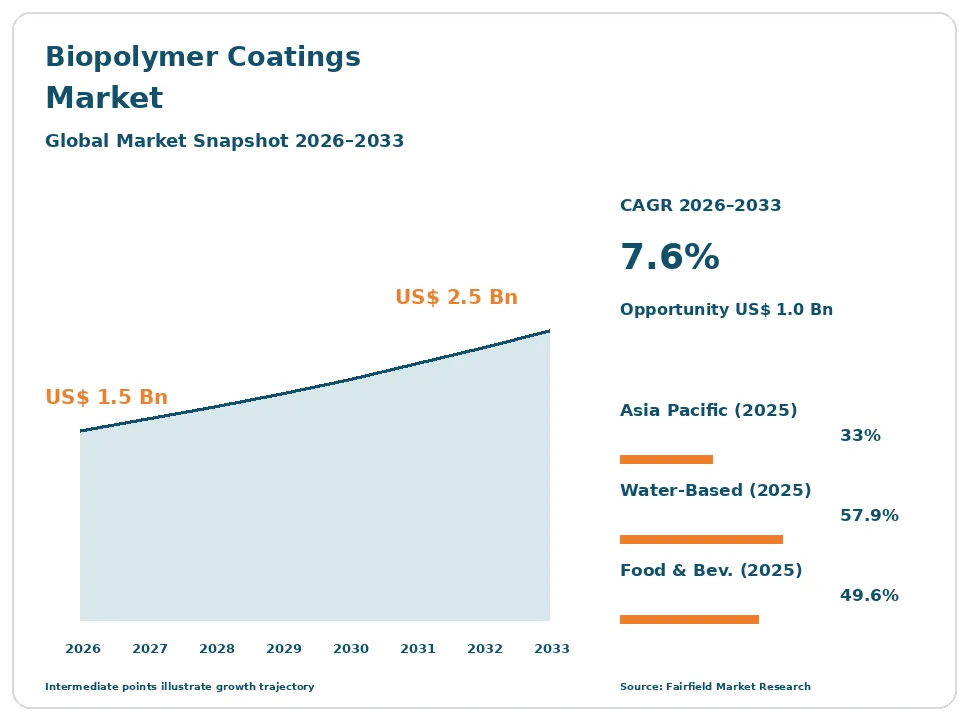
The global biopolymer coatings market size is expected to be valued at US$ 1.5 billion in 2026 and projected to reach US$ 2.5 billion by 2033, growing at a CAGR of 7.6% between 2026 and 2033.
Between 2020 and 2025, the market grew at a CAGR of about 6.5%, as brand owners and governments pushed to replace plastic films and fluorochemical treatments in packaging with renewable, recyclable, and compostable alternatives. Biopolymer coatings are thin layers made from renewable materials such as starch, cellulose, chitosan, proteins, polylactic acid, and polyhydroxyalkanoates, applied to paper, board, textiles, metals, and medical products to provide grease, water, oxygen, or moisture resistance. As bio-based barrier coatings, they allow fiber-based packaging to replace plastic laminates while staying recyclable in paper streams. Growth comes from single-use plastic bans, PFAS restrictions, food-service demand, and corporate sustainability targets. The market is shifting toward water-based dispersions and compostable coatings with better barrier performance. In April 2026, Michelman launched bio-based barrier coatings for fiber-based food packaging.
Key Report Takeaways
- By Product: Polysaccharide-Based held 38.9% share in 2025, while Bio-Based Polyesters are projected to expand at a 9.1% CAGR through 2033, driven by PLA and PHA coatings that deliver compostable moisture and grease barriers for food packaging.
- By Technology: Water-Based held 57.9% share in 2025, while Hot-Melt is projected to expand at a 8.2% CAGR through 2033, driven by solvent-free processing, fast line speeds, and strong barrier layers on paper and board.
- By End Use: Food & Beverage held 49.6% share in 2025, while Healthcare & Pharmaceutical is projected to expand at a 8.6% CAGR through 2033, driven by biocompatible coatings for tablets, medical devices, wound care, and sustainable medical packaging.
- By Region: Asia Pacific held 33.0% share in 2025, while Europe is projected to expand at a 7.7% CAGR through 2033, driven by the European Union packaging rules, PFAS restrictions, and strong demand for recyclable fiber-based packaging.
Global Biopolymer Coatings Market Trends and Insights
Drivers Impact Analysis
| Driver | Impact on CAGR Forecast | Geographic Relevance | Impact Timeline |
| Plastic reduction rules and PFAS restrictions | High | Europe, North America, Asia Pacific | Long term (≥4 years) |
| Brand owner shift to fiber-based packaging | High | Global | Medium term (2-4 years) |
Two drivers carry the strongest influence on biopolymer coatings demand during the forecast period.
Plastic and PFAS Regulations Are Driving the Biopolymer Coatings Market
Plastic reduction rules and PFAS restrictions are the strongest driver of the biopolymer coatings market. Regulators are removing plastic and fluorochemicals from packaging.
The mechanism is new laws that make conventional coatings harder to use. The European Union’s Single-Use Plastics Directive and Packaging and Packaging Waste Regulation push packaging toward recyclable and reusable designs, and they restrict PFAS in food-contact packaging. Many U.S. states, including California, New York, and Washington, ban intentionally added PFAS in food packaging. India, China, and several countries across Asia Pacific restrict single-use plastics. Paper cups, plates, wraps, and takeaway boxes once relied on polyethylene films or fluorochemical grease barriers. Biopolymer coatings offer compliant alternatives that keep paper recyclable or compostable. These regulations create urgent demand for new barrier solutions across food service and packaging.
Fiber-Based Packaging Is Expanding the Biopolymer Coatings Market
The brand owner shift to fiber-based packaging is expanding the biopolymer coatings market. Major brands are replacing plastic with paper.
The cause is corporate sustainability goals and consumer preference. Food, beverage, and personal care companies have pledged to make packaging recyclable, reusable, or compostable and to cut virgin plastic use. Fiber-based packaging appeals to consumers but needs barrier coatings to protect food from moisture, grease, and oxygen. UPM and Paramelt have developed paper-based food packaging with PHA-containing water-based coatings, and Michelman has launched new bio-based barriers. Quick-service restaurants and retailers are switching to coated paper bags, cups, and trays. E-commerce adds demand for coated mailers, protective paper wraps, and fiber-based cushioning that replaces plastic air pillows. These shifts expand the addressable market quickly.
Restraints Impact Analysis
| Restraint | Impact on CAGR Forecast | Geographic Relevance | Impact Timeline |
| Higher cost than petroleum-based coatings | High | Global | Long term (≥4 years) |
| Performance gaps in moisture and oxygen barriers | Medium | Global | Medium term (2-4 years) |
Two restraints limit how quickly the biopolymer coatings market grows.
Higher Costs Slow the Biopolymer Coatings Market
Higher cost than petroleum-based coatings slows the biopolymer coatings market. Bio-based materials are still more expensive.
The specific causes are small production scale and feedstock costs. PLA, PHA, and specialty bio-polyesters are produced in far smaller volumes than polyethylene and conventional acrylics, so unit costs remain higher. Some biopolymers depend on crops such as corn, cassava, and sugarcane, whose prices vary with weather and demand. Converters may need to adjust coating lines, drying, and curing conditions, adding capital costs. Price-sensitive buyers in emerging markets often choose cheaper conventional options when rules are weak. Compostable packaging also needs industrial composting, which is limited in many areas. Small converters may lack technical teams to test new coatings. These cost gaps slow adoption outside regulated markets and premium brands.
Performance Gaps Restrict the Biopolymer Coatings Market
Performance gaps in moisture and oxygen barriers restrict the biopolymer coatings market. Not all applications can switch yet.
The underlying causes are material properties. Many polysaccharide and protein coatings absorb moisture, which weakens barriers in humid conditions or with wet foods. Achieving long shelf life for oxygen-sensitive products such as coffee, snacks, and meat remains difficult without plastic or aluminum layers. Heat sealing and stiffness can be harder to achieve. Testing and food-contact approvals take time. Coating weights may need to be higher than with conventional polymers, which can affect recyclability and cost. Brand owners worry about product recalls if new packaging fails in transport or storage, so they adopt cautiously with long trials. Research into nanocellulose, layered coatings, and hybrid systems is improving performance, but commercial scale is still limited. These limits keep some high-barrier packaging on conventional materials for now.
Market Opportunities
PFAS-Free and Plastic-Free Food Service Opens a Fast-Growth Revenue Pool
PFAS-free and plastic-free food service opens a fast-growth revenue pool in the biopolymer coatings market. Food service packaging must change quickly.
Coating makers and paper converters can capture this opportunity. Paper cups, bowls, clamshells, wraps, pizza boxes, and bakery bags need grease and water resistance without PFAS or plastic films. Water-based bio-based barrier coatings can be applied on existing paper machines and recycled easily. Compostable coatings suit food-service items that end up contaminated with food waste. Large restaurant chains, airlines, and stadiums are switching to certified compostable ware. Cities that collect food waste for composting favor packaging that can go in the same bin. Companies that offer high-performance, food-safe, and certified solutions can win large volume contracts with converters and brands.
Biopolymer Capacity and Healthcare Uses Create a Diversified Revenue Pool
New biopolymer capacity and healthcare uses create a diversified revenue pool in the biopolymer coatings market. Supply is growing and new uses are emerging.
Biopolymer producers and formulators can capture this opportunity. NatureWorks opened a fully integrated 75,000-tonne Ingeo PLA plant in Thailand in April 2026, expanding global PLA supply and supporting lower costs. PHA producers are scaling up as well, improving supply security and price stability for coating formulators. In healthcare, biopolymer coatings are used on tablets, capsules, stents, sutures, and wound dressings for controlled release and biocompatibility. Textile coatings using bio-based materials provide water repellency without fluorochemicals. Agricultural uses, such as seed coatings and controlled-release fertilizers, add further demand. Companies that serve both packaging and healthcare can reduce risk, balance demand cycles, and capture higher margins.
Segment Analysis
By Product: Polysaccharide-Based Leads While Bio-Based Polyesters Grow Fastest
Polysaccharide-Based held 38.9% share in 2025. Starch, cellulose, alginate, and chitosan coatings are widely available, low cost, and compatible with paper recycling. They provide good grease and oxygen barriers and are used in food packaging, paper, and board. EcoSynthetix, Solenis, and paper chemical suppliers offer starch-based solutions.
Bio-Based Polyesters are the fastest-growing product, expanding at a 9.1% CAGR through 2033. PLA, PHA, and bio-based PBS coatings provide moisture and heat-seal barriers that can replace polyethylene on cups and food-service items. NatureWorks, TotalEnergies Corbion, Danimer Scientific, and Novamont supply these materials. Protein-based and other biopolymers form smaller segments. For the market, polyester growth expands coatings into higher-barrier applications.
By Technology: Water-Based Leads While Hot-Melt Grows Fastest
Water-Based held 57.9% share in 2025. Water-based dispersions are applied with standard coating equipment, have low emissions, and keep paper repulpable. Michelman, Solenis, BASF, and Kuraray are leading suppliers of water-based barrier dispersions, often working directly with paper mills.
Hot-Melt is the fastest-growing technology, expanding at a 8.2% CAGR through 2033. Hot-melt coatings need no drying, allow high line speeds, and deliver strong moisture barriers. Paramelt and wax specialists offer bio-based hot-melt grades. Hot-melt systems also suit heat-sealable coatings for cups and lids. Solvent-based and powder technologies are smaller and face tighter emission rules. For the market, hot-melt growth adds efficient processing options for converters.
By End Use: Food & Beverage Leads While Healthcare & Pharmaceutical Grows Fastest
Food & Beverage held 49.6% share in 2025. Cups, food containers, wraps, bags, and beverage packaging are the largest use, driven by plastic bans and brand pledges. Food service and fresh food packaging lead adoption, with quick-service restaurants, coffee chains, and bakeries switching first. Dry foods, frozen foods, and beverage cartons are following as barrier performance improves.
Healthcare & Pharmaceutical is the fastest-growing end use, expanding at a 8.6% CAGR through 2033. Biocompatible coatings support drug delivery, implants, and wound care, and sustainable medical packaging adds demand. Personal care, agriculture, textiles, and consumer goods are other end uses. Pharmaceutical companies use plant-based film coatings to meet clean-label demand. For the market, healthcare growth adds high-value demand.
Geography Analysis
North America Expands the Biopolymer Coatings Market Through PFAS Bans
North America is a major biopolymer coatings market. The United States has strong demand from quick-service restaurants, retailers, and food brands, and state laws in California, New York, Washington, and Maine ban PFAS in food packaging. NatureWorks, Michelman, Solenis, Eastman Chemical, and Danimer Scientific are based in the region. Paper mills are adding barrier coating lines to replace plastic laminates. Canada has banned many single-use plastics, increasing demand for coated paper alternatives. Key barriers include limited composting infrastructure and cost sensitivity. One change shaping the region is the rapid shift to PFAS-free food-service packaging.
Which Region Is Growing Fastest in the Biopolymer Coatings Market?
Europe is growing fastest in the biopolymer coatings market at a 7.7% CAGR through 2033. Germany, France, Italy, Finland, and the Netherlands lead, supported by the European Union Packaging and Packaging Waste Regulation and Single-Use Plastics Directive. BASF, Novamont, UPM, Paramelt, and TotalEnergies Corbion are active suppliers, and Paramelt and UPM unveiled a PHA-based paper packaging concept in March 2026. Strong recycling and composting systems support adoption, and Finland and Sweden have large paper industries. Key barriers include higher costs. One change shaping the region is PFAS restrictions.
Which Region Is Leading the Biopolymer Coatings Market?
Asia Pacific is leading the biopolymer coatings market with a 33.0% share in 2025. China, Japan, India, South Korea, and Thailand have large packaging and food-service industries and growing plastic restrictions. NatureWorks opened its new PLA plant in Thailand in April 2026, and Kuraray supplies barrier polymers from Japan. India bans many single-use plastics and has strict rules on plastic packaging waste. Rapid growth in food delivery and e-commerce raises demand for coated paper packaging. Key barriers include price sensitivity and uneven enforcement. One change shaping the region is local biopolymer production capacity.
Latin America Grows the Biopolymer Coatings Market Through Plastic Bans
Latin America is a growing biopolymer coatings market. Brazil, Mexico, Chile, and Colombia have introduced bans or limits on single-use plastics in many cities. Brazil has abundant sugarcane and pulp resources that support bio-based materials and paper packaging. Chile has strict plastic bag and food-service rules, and Mexico City bans many single-use plastic items. Food exporters of fruit, coffee, and seafood need sustainable packaging to meet buyer requirements in Europe and North America. Local paper makers are adding barrier coating capability. Key barriers include higher costs and limited composting. One opportunity is coated paper packaging for food exports and retail.
Middle East & Africa Develops the Biopolymer Coatings Market Through Sustainability Programs
Middle East & Africa is a developing biopolymer coatings market. The United Arab Emirates and Saudi Arabia have announced bans on single-use plastic bags and food-service items, while Kenya and Rwanda have strict plastic bans. Hotels, airlines, and food delivery firms are shifting to paper packaging. South Africa has a strong paper and packaging industry. Large tourism and events projects in the region favor sustainable packaging. Coatings are mainly imported from Europe and Asia Pacific, which raises costs for local converters. Key barriers include limited local production and import costs. One change shaping the region is plastic ban enforcement.
Competitive Landscape
The biopolymer coatings market is moderately fragmented. BASF, NatureWorks, Michelman, Solenis, and Kuraray are leading players, while Novamont, TotalEnergies Corbion, Eastman Chemical, EcoSynthetix, Arkema, Paramelt, and Danimer Scientific compete strongly. Paper makers and converters, such as UPM, Stora Enso, and Mondi, also develop proprietary coating solutions. Startups focused on PHA, chitosan, seaweed, and plant-based waxes are attracting venture investment and partnerships with large brands.
Companies compete on barrier performance, food-contact approvals, recyclability and compostability certifications, cost, and technical support for converters. Partnerships across the value chain are very common, linking biopolymer producers, coating formulators, paper mills, converters, and brand owners. Suppliers that help customers pass recycling and compost tests gain an advantage. Scale also matters, because larger biopolymer producers can offer more stable prices and supply. Patents on barrier formulations protect early innovators.
Strategic moves show how competition is changing. In March 2026, Paramelt and UPM unveiled a paper-based food packaging concept using a PHA-containing water-based coating. In April 2026, Michelman launched new bio-based barrier coatings, and NatureWorks opened its integrated PLA plant in Thailand. These moves show competition shifting toward high-barrier, plastic-free packaging and larger, lower-cost biopolymer supply.
Three themes shape vendor strategy. First, companies are developing PFAS-free and plastic-free barriers. Second, they are expanding biopolymer capacity to lower costs. Third, they are partnering with paper makers and brands to speed adoption.
Biopolymer Coatings Market Industry Leaders
- BASF
- NatureWorks
- Michelman
- Solenis
- Kuraray
Recent Industry Developments
- April 2026: Michelman introduced Nuvita Life 4002 and 4605, bio-based barrier coatings for fiber-based food packaging - expands bio-based barrier coatings for plastic-free packaging.
- April 2026: NatureWorks opened its fully integrated 75,000-tonne Ingeo PLA biopolymer facility in Nakhon Sawan, Thailand - increases supply of PLA for compostable coatings.
- March 2026: Paramelt and UPM unveiled a paper-based food packaging concept using Aquavate Bio SB 2383, a water-based coating with bio-based PHA - advances recyclable biopolymer coatings.
Companies Covered in the Report
- BASF
- NatureWorks
- Michelman
- Solenis
- Kuraray
- Novamont
- TotalEnergies Corbion
- Eastman Chemical
- EcoSynthetix
- Arkema
- Paramelt
- Danimer Scientific
Biopolymer Coatings Market Report Scope
This report covers biopolymer coatings, including polysaccharide-based, protein-based, bio-based polyester, and other biopolymer coatings, applied through water-based, hot-melt, and other technologies, on paper and paperboard, plastics, textiles, and metals, for food and beverage, healthcare and pharmaceutical, personal care, and other end uses. The base year is 2025, and the forecast period runs from 2026 to 2033. All values are expressed in US$ Billion.
Product
- Polysaccharide-Based
- Protein-Based
- Bio-Based Polyesters
- Others
Technology
- Water-Based
- Hot-Melt
- Others
End Use
- Food & Beverage
- Healthcare & Pharmaceutical
- Personal Care
- Others
Regions
- North America
- Europe
- Asia Pacific
- Latin America
- Middle East & Africa
Key Questions Answered in the Report
How big is the biopolymer coatings market in 2026?
The biopolymer coatings market is valued at US$ 1.5 billion in 2026, led by polysaccharide-based coatings and Asia Pacific.
What is the biopolymer coatings market forecast to 2033?
The market is projected to reach US$ 2.5 billion by 2033, growing at a 7.6% CAGR and adding US$ 1.0 billion.
Which product is growing fastest in the biopolymer coatings market?
Bio-based polyesters are growing fastest at a 9.1% CAGR through 2033, driven by PLA and PHA coatings for food packaging.
Which region is growing fastest in the biopolymer coatings market?
Europe is growing fastest at a 7.7% CAGR through 2033, driven by packaging regulations, PFAS restrictions, and strong recycling systems.
Which region holds the largest biopolymer coatings market share?
Asia Pacific holds the largest share at 33.0% in 2025, supported by large packaging industries and growing plastic restrictions.
1. Executive Summary
1.1. Global Biopolymer Coatings Market Snapshot
1.2. Future Projections
1.3. Key Report Takeaways
1.4. Regional Snapshot
2. Market Overview
2.1. Market Definition and Report Scope
2.2. Historical Trends 2020–2025
2.3. Market Dynamics
2.3.1. Drivers
2.3.1.1. Plastic and PFAS Regulations Are Driving the Biopolymer Coatings Market
2.3.1.2. Fiber-Based Packaging Is Expanding the Biopolymer Coatings Market
2.3.2. Restraints
2.3.2.1. Higher Costs Slow the Biopolymer Coatings Market
2.3.2.2. Performance Gaps Restrict the Biopolymer Coatings Market
2.3.3. Market Opportunities
2.3.3.1. PFAS-Free and Plastic-Free Food Service Opens a Fast-Growth Revenue Pool
2.3.3.2. Biopolymer Capacity and Healthcare Uses Create a Diversified Revenue Pool
3. Global Biopolymer Coatings Market Outlook, 2020-2033
3.1. Global Biopolymer Coatings Market Outlook, by Product, Value (US$ Billion), 2020-2033
3.1.1. Polysaccharide-Based
3.1.2. Protein-Based
3.1.3. Bio-Based Polyesters
3.1.4. Others
3.2. Global Biopolymer Coatings Market Outlook, by Technology, Value (US$ Billion), 2020-2033
3.2.1. Water-Based
3.2.2. Hot-Melt
3.2.3. Others
3.3. Global Biopolymer Coatings Market Outlook, by End Use, Value (US$ Billion), 2020-2033
3.3.1. Food & Beverage
3.3.2. Healthcare & Pharmaceutical
3.3.3. Personal Care
3.3.4. Others
3.4. Global Biopolymer Coatings Market Outlook, by Region, Value (US$ Billion), 2020-2033
3.4.1. North America
3.4.2. Europe
3.4.3. Asia Pacific
3.4.4. Latin America
3.4.5. Middle East & Africa
4. North America Biopolymer Coatings Market Outlook, 2020-2033
4.1. North America Biopolymer Coatings Market Outlook, by Product, Value (US$ Billion), 2020-2033
4.1.1. Polysaccharide-Based
4.1.2. Protein-Based
4.1.3. Bio-Based Polyesters
4.1.4. Others
4.2. North America Biopolymer Coatings Market Outlook, by Technology, Value (US$ Billion), 2020-2033
4.2.1. Water-Based
4.2.2. Hot-Melt
4.2.3. Others
4.3. North America Biopolymer Coatings Market Outlook, by End Use, Value (US$ Billion), 2020-2033
4.3.1. Food & Beverage
4.3.2. Healthcare & Pharmaceutical
4.3.3. Personal Care
4.3.4. Others
4.4. North America Biopolymer Coatings Market Outlook, by Country, Value (US$ Billion), 2020-2033
4.4.1. United States Biopolymer Coatings Market Outlook, by Product, 2020-2033
4.4.2. United States Biopolymer Coatings Market Outlook, by Technology, 2020-2033
4.4.3. United States Biopolymer Coatings Market Outlook, by End Use, 2020-2033
4.4.4. Canada Biopolymer Coatings Market Outlook, by Product, 2020-2033
4.4.5. Canada Biopolymer Coatings Market Outlook, by Technology, 2020-2033
4.4.6. Canada Biopolymer Coatings Market Outlook, by End Use, 2020-2033
5. Europe Biopolymer Coatings Market Outlook, 2020-2033
5.1. Europe Biopolymer Coatings Market Outlook, by Product, Value (US$ Billion), 2020-2033
5.1.1. Polysaccharide-Based
5.1.2. Protein-Based
5.1.3. Bio-Based Polyesters
5.1.4. Others
5.2. Europe Biopolymer Coatings Market Outlook, by Technology, Value (US$ Billion), 2020-2033
5.2.1. Water-Based
5.2.2. Hot-Melt
5.2.3. Others
5.3. Europe Biopolymer Coatings Market Outlook, by End Use, Value (US$ Billion), 2020-2033
5.3.1. Food & Beverage
5.3.2. Healthcare & Pharmaceutical
5.3.3. Personal Care
5.3.4. Others
5.4. Europe Biopolymer Coatings Market Outlook, by Country, Value (US$ Billion), 2020-2033
5.4.1. Germany Biopolymer Coatings Market Outlook, by Product, 2020-2033
5.4.2. Germany Biopolymer Coatings Market Outlook, by Technology, 2020-2033
5.4.3. Germany Biopolymer Coatings Market Outlook, by End Use, 2020-2033
5.4.4. France Biopolymer Coatings Market Outlook, by Product, 2020-2033
5.4.5. France Biopolymer Coatings Market Outlook, by Technology, 2020-2033
5.4.6. France Biopolymer Coatings Market Outlook, by End Use, 2020-2033
5.4.7. Italy Biopolymer Coatings Market Outlook, by Product, 2020-2033
5.4.8. Italy Biopolymer Coatings Market Outlook, by Technology, 2020-2033
5.4.9. Italy Biopolymer Coatings Market Outlook, by End Use, 2020-2033
5.4.10. Finland Biopolymer Coatings Market Outlook, by Product, 2020-2033
5.4.11. Finland Biopolymer Coatings Market Outlook, by Technology, 2020-2033
5.4.12. Finland Biopolymer Coatings Market Outlook, by End Use, 2020-2033
5.4.13. Netherlands Biopolymer Coatings Market Outlook, by Product, 2020-2033
5.4.14. Netherlands Biopolymer Coatings Market Outlook, by Technology, 2020-2033
5.4.15. Netherlands Biopolymer Coatings Market Outlook, by End Use, 2020-2033
5.4.16. Sweden Biopolymer Coatings Market Outlook, by Product, 2020-2033
5.4.17. Sweden Biopolymer Coatings Market Outlook, by Technology, 2020-2033
5.4.18. Sweden Biopolymer Coatings Market Outlook, by End Use, 2020-2033
6. Asia Pacific Biopolymer Coatings Market Outlook, 2020-2033
6.1. Asia Pacific Biopolymer Coatings Market Outlook, by Product, Value (US$ Billion), 2020-2033
6.1.1. Polysaccharide-Based
6.1.2. Protein-Based
6.1.3. Bio-Based Polyesters
6.1.4. Others
6.2. Asia Pacific Biopolymer Coatings Market Outlook, by Technology, Value (US$ Billion), 2020-2033
6.2.1. Water-Based
6.2.2. Hot-Melt
6.2.3. Others
6.3. Asia Pacific Biopolymer Coatings Market Outlook, by End Use, Value (US$ Billion), 2020-2033
6.3.1. Food & Beverage
6.3.2. Healthcare & Pharmaceutical
6.3.3. Personal Care
6.3.4. Others
6.4. Asia Pacific Biopolymer Coatings Market Outlook, by Country, Value (US$ Billion), 2020-2033
6.4.1. China Biopolymer Coatings Market Outlook, by Product, 2020-2033
6.4.2. China Biopolymer Coatings Market Outlook, by Technology, 2020-2033
6.4.3. China Biopolymer Coatings Market Outlook, by End Use, 2020-2033
6.4.4. Japan Biopolymer Coatings Market Outlook, by Product, 2020-2033
6.4.5. Japan Biopolymer Coatings Market Outlook, by Technology, 2020-2033
6.4.6. Japan Biopolymer Coatings Market Outlook, by End Use, 2020-2033
6.4.7. India Biopolymer Coatings Market Outlook, by Product, 2020-2033
6.4.8. India Biopolymer Coatings Market Outlook, by Technology, 2020-2033
6.4.9. India Biopolymer Coatings Market Outlook, by End Use, 2020-2033
6.4.10. South Korea Biopolymer Coatings Market Outlook, by Product, 2020-2033
6.4.11. South Korea Biopolymer Coatings Market Outlook, by Technology, 2020-2033
6.4.12. South Korea Biopolymer Coatings Market Outlook, by End Use, 2020-2033
6.4.13. Thailand Biopolymer Coatings Market Outlook, by Product, 2020-2033
6.4.14. Thailand Biopolymer Coatings Market Outlook, by Technology, 2020-2033
6.4.15. Thailand Biopolymer Coatings Market Outlook, by End Use, 2020-2033
7. Latin America Biopolymer Coatings Market Outlook, 2020-2033
7.1. Latin America Biopolymer Coatings Market Outlook, by Product, Value (US$ Billion), 2020-2033
7.1.1. Polysaccharide-Based
7.1.2. Protein-Based
7.1.3. Bio-Based Polyesters
7.1.4. Others
7.2. Latin America Biopolymer Coatings Market Outlook, by Technology, Value (US$ Billion), 2020-2033
7.2.1. Water-Based
7.2.2. Hot-Melt
7.2.3. Others
7.3. Latin America Biopolymer Coatings Market Outlook, by End Use, Value (US$ Billion), 2020-2033
7.3.1. Food & Beverage
7.3.2. Healthcare & Pharmaceutical
7.3.3. Personal Care
7.3.4. Others
7.4. Latin America Biopolymer Coatings Market Outlook, by Country, Value (US$ Billion), 2020-2033
7.4.1. Brazil Biopolymer Coatings Market Outlook, by Product, 2020-2033
7.4.2. Brazil Biopolymer Coatings Market Outlook, by Technology, 2020-2033
7.4.3. Brazil Biopolymer Coatings Market Outlook, by End Use, 2020-2033
7.4.4. Mexico Biopolymer Coatings Market Outlook, by Product, 2020-2033
7.4.5. Mexico Biopolymer Coatings Market Outlook, by Technology, 2020-2033
7.4.6. Mexico Biopolymer Coatings Market Outlook, by End Use, 2020-2033
7.4.7. Chile Biopolymer Coatings Market Outlook, by Product, 2020-2033
7.4.8. Chile Biopolymer Coatings Market Outlook, by Technology, 2020-2033
7.4.9. Chile Biopolymer Coatings Market Outlook, by End Use, 2020-2033
7.4.10. Colombia Biopolymer Coatings Market Outlook, by Product, 2020-2033
7.4.11. Colombia Biopolymer Coatings Market Outlook, by Technology, 2020-2033
7.4.12. Colombia Biopolymer Coatings Market Outlook, by End Use, 2020-2033
8. Middle East & Africa Biopolymer Coatings Market Outlook, 2020-2033
8.1. Middle East & Africa Biopolymer Coatings Market Outlook, by Product, Value (US$ Billion), 2020-2033
8.1.1. Polysaccharide-Based
8.1.2. Protein-Based
8.1.3. Bio-Based Polyesters
8.1.4. Others
8.2. Middle East & Africa Biopolymer Coatings Market Outlook, by Technology, Value (US$ Billion), 2020-2033
8.2.1. Water-Based
8.2.2. Hot-Melt
8.2.3. Others
8.3. Middle East & Africa Biopolymer Coatings Market Outlook, by End Use, Value (US$ Billion), 2020-2033
8.3.1. Food & Beverage
8.3.2. Healthcare & Pharmaceutical
8.3.3. Personal Care
8.3.4. Others
8.4. Middle East & Africa Biopolymer Coatings Market Outlook, by Country, Value (US$ Billion), 2020-2033
8.4.1. United Arab Emirates Biopolymer Coatings Market Outlook, by Product, 2020-2033
8.4.2. United Arab Emirates Biopolymer Coatings Market Outlook, by Technology, 2020-2033
8.4.3. United Arab Emirates Biopolymer Coatings Market Outlook, by End Use, 2020-2033
8.4.4. Saudi Arabia Biopolymer Coatings Market Outlook, by Product, 2020-2033
8.4.5. Saudi Arabia Biopolymer Coatings Market Outlook, by Technology, 2020-2033
8.4.6. Saudi Arabia Biopolymer Coatings Market Outlook, by End Use, 2020-2033
8.4.7. Kenya Biopolymer Coatings Market Outlook, by Product, 2020-2033
8.4.8. Kenya Biopolymer Coatings Market Outlook, by Technology, 2020-2033
8.4.9. Kenya Biopolymer Coatings Market Outlook, by End Use, 2020-2033
8.4.10. Rwanda Biopolymer Coatings Market Outlook, by Product, 2020-2033
8.4.11. Rwanda Biopolymer Coatings Market Outlook, by Technology, 2020-2033
8.4.12. Rwanda Biopolymer Coatings Market Outlook, by End Use, 2020-2033
8.4.13. South Africa Biopolymer Coatings Market Outlook, by Product, 2020-2033
8.4.14. South Africa Biopolymer Coatings Market Outlook, by Technology, 2020-2033
8.4.15. South Africa Biopolymer Coatings Market Outlook, by End Use, 2020-2033
9. Competitive Landscape
9.1. Market Concentration and Industry Leaders
9.2. Competitive Differentiation
9.3. Strategic Moves and Market Direction
9.4. Recent Industry Developments
9.5. Company Profiles
9.5.1. BASF
9.5.2. NatureWorks
9.5.3. Michelman
9.5.4. Solenis
9.5.5. Kuraray
9.5.6. Novamont
9.5.7. TotalEnergies Corbion
9.5.8. Eastman Chemical
9.5.9. EcoSynthetix
9.5.10. Arkema
9.5.11. Paramelt
9.5.12. Danimer Scientific
10. Appendix
10.1. Research Methodology
10.2. Report Assumptions
10.3. Acronyms and Abbreviations
| Product | Polysaccharide-Based, Protein-Based, Bio-Based Polyesters, Others |
| Technology | Water-Based, Hot-Melt, Others |
| End Use | Food & Beverage, Healthcare & Pharmaceutical, Personal Care, Others |
| Regions | North America, Europe, Asia Pacific, Latin America, Middle East & Africa |
Our Research Methodology
Considering the volatility of business today, traditional approaches to strategizing a game plan can be unfruitful if not detrimental. True ambiguity is no way to determine a forecast. A myriad of predetermined factors must be accounted for such as the degree of risk involved, the magnitude of circumstances, as well as conditions or consequences that are not known or unpredictable. To circumvent binary views that cast uncertainty, the application of market research intelligence to strategically posture, move, and enable actionable outcomes is necessary.
View Methodology
Quality Assured
Rigorous Validation Process

Confidentiality Assured
End-to-end Data Security

Custom Research Services
Tailored To Your Objectives
FAQs
The biopolymer coatings market is valued at US$ 1.5 billion in 2026, led by polysaccharide-based coatings and Asia Pacific.
The market is projected to reach US$ 2.5 billion by 2033, growing at a 7.6% CAGR and adding US$ 1.0 billion.
Bio-based polyesters are growing fastest at a 9.1% CAGR through 2033, driven by PLA and PHA coatings for food packaging.
Europe is growing fastest at a 7.7% CAGR through 2033, driven by packaging regulations, PFAS restrictions, and strong recycling systems.
Asia Pacific holds the largest share at 33.0% in 2025, supported by large packaging industries and growing plastic restrictions.
Related Reports
Advanced Materials Market Size, Share, Insights, Competitive Landscape, and Forecast 2026 to 2033
Explore the advanced materials market, projected to reach US$ 121.08 billion by 2033 at a 6.6% CAGR, with product, application and regional insights.
Dry Construction Market Size, Share, Insights, Competitive Landscape, and Forecast 2026 to 2033
Explore the dry construction market, projected to reach US$ 134.87 billion by 2033 at a 4.7% CAGR, with material, system and regional insights.
Waterproofing Admixtures Market Size, Share, Insights, Competitive Landscape, and Forecast 2026 to 2033
Waterproofing admixtures market to grow from US$ 2.4 billion in 2026 to US$ 3.6 billion by 2033 at a 6.0% CAGR. Explore products, applications and regions.
Vinyl Flooring Market Size, Share, Insights, Competitive Landscape, and Forecast 2026 to 2033
Vinyl flooring market to grow from US$ 46.5 billion in 2026 to US$ 72.6 billion by 2033 at a 6.6% CAGR. Explore product trends, segments and regional insights.
Unsaturated Polyester Resin Market Size, Share, Insights, Competitive Landscape, and Forecast 2026 to 2033
Explore the unsaturated polyester resin market, forecast to reach US$18.1 billion by 2033 at 4.6% CAGR, with resin, end-use and regional insights.
Renewable Chemicals Market Size, Share, Insights, Competitive Landscape, and Forecast 2026 to 2033
Explore the renewable chemicals market, projected to reach US$379.48 billion by 2033 at 11.2% CAGR, with product, feedstock and regional insights.