



Waterproofing Admixtures Market
Waterproofing Admixtures Market Size, Share, Insights, Competitive Landscape, and Forecast 2026 to 2033
Waterproofing Admixtures Market Size and Trend Analysis
How Fast Is the Waterproofing Admixtures Market Growing?
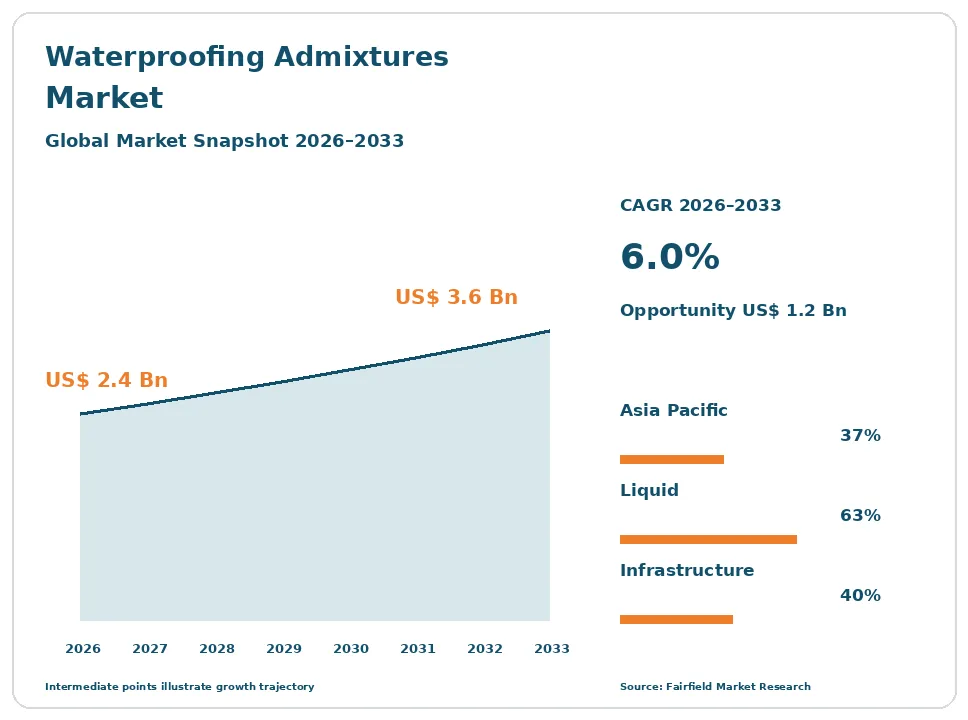
The global waterproofing admixtures market size is expected to be valued at US$ 2.4 billion in 2026 and projected to reach US$ 3.6 billion by 2033, growing at a CAGR of 6.0% between 2026 and 2033.
Growth averaged about 5.5% a year from 2020 to 2025, interrupted by site shutdowns in 2020 and cement price inflation in 2022. Three factors now set the pace. Integral admixtures remove a wet trade from the programme, so contractors adopt them where schedule compression matters most. Public procurement increasingly specifies durability and service life rather than strength alone, which pulls permeability-reducing products into infrastructure concrete. Tunnelling and water-retaining construction continue to expand. This remains a small specialty corner of the construction chemicals business, and volumes are tied to concrete placed rather than to building floor area.
Key Report Takeaways
- By Product Type: Hydrophobic and water-repellent admixtures held 34% share in 2026, while crystalline admixtures are projected to expand at a 7.4% CAGR through 2033, driven by self-sealing behaviour in structures that cannot be reached for later repair.
- By Form: Liquid admixtures held 63% share in 2026, while powder admixtures are projected to grow at a 6.8% CAGR, driven by precast plants and site-batched mortar where dispenser equipment is unavailable.
- By Application: Basements and foundations held 29% share in 2026, while tunnels and underground structures are projected to advance at a 7.5% CAGR, supported by metro and conveyance tunnelling programmes.
- By End Use: Infrastructure held 40% share in 2026, while commercial construction is projected to grow at a 6.6% CAGR, driven by below-grade parking and plant rooms in dense urban developments.
- By Region: Asia Pacific held 37% share in 2026, while Middle East & Africa is projected to expand at a 7.6% CAGR through 2033, driven by desalination, conveyance and coastal structures in aggressive ground conditions.
Global Waterproofing Admixtures Market Trends and Insights
Drivers Impact Analysis
| Driver | Impact on CAGR Forecast | Geographic Relevance | Impact Timeline |
| Removal of a membrane trade from the construction programme and its installation risk | High | Asia Pacific, North America, Middle East & Africa | Long term ≥4 years |
| Durability and service-life requirements written into public infrastructure procurement | Medium | Europe, North America, Asia Pacific | Medium term 2–4 years |
Two commercial arguments, not two chemistries, explain the growth of integral waterproofing.
Waterproofing Admixtures Sell on Labour and Programme Time Rather Than on Chemistry
The commercial case for an integral admixture is about construction sequence, not about molecules. The product is dosed at the batch plant and arrives inside the concrete, so there is no membrane to lap, prime, protect or inspect. It cannot be punctured by reinforcement fixers, torn by formwork strikers, damaged by following trades or blown off in wind. That eliminates a wet trade, its curing time and the rework that follows a failed inspection.
The argument is strongest where later access is impossible. A basement wall cast against sheet piling, a buried tank, a tunnel lining or a capping slab beneath a building cannot be re-waterproofed without demolition, so the owner is buying certainty rather than product. Contractors value the programme saving, because removing a membrane operation from a critical path can shorten a substructure sequence by weeks on a large site. That is the whole commercial proposition.
Service-Life Specification in Public Procurement Pulls Admixtures Into Infrastructure Concrete
Public clients have changed what they ask for, and that change creates demand. Highway authorities, water utilities, rail operators and port authorities now specify a design service life and durability performance rather than a cube strength alone, which forces the designer to control water and chloride ingress explicitly. A permeability-reducing admixture is one of the few levers available once the binder and cover are fixed.
The mechanism runs through codes and test evidence. Exposure classes in the European concrete standard EN 206, durability provisions in ACI 350 for environmental engineering concrete structures, and absorption and chloride-permeability testing under ASTM C1585 and ASTM C1202 give engineers a measurable way to justify the addition. Where a contract carries a long defects liability period or a whole-life cost assessment, the admixture cost is trivial against the risk it reduces, so it is written in at design stage.
Restraints Impact Analysis
| Restraint | Impact on CAGR Forecast | Geographic Relevance | Impact Timeline |
| Inability of an admixture to bridge moving cracks, construction joints and poor workmanship | High | Global | Long term ≥4 years |
| Weak comparability of performance claims and limited correlation between tests and field results | Medium | Europe, North America, Asia Pacific | Medium term 2–4 years |
Two constraints keep adoption of integral waterproofing below its theoretical ceiling.
An Admixture Cannot Bridge a Moving Crack, So It Supplements Rather Than Replaces a Membrane
The honest limit of this technology is structural, and it caps the market. An integral admixture densifies the concrete matrix and, in crystalline products, can seal fine static cracks when water is present. It cannot span a construction joint that was badly formed, a movement joint that opens and closes, a penetration sealed by someone else, or a shrinkage crack that keeps working. Water finds those paths, not the pore structure.
For that reason many engineers treat the admixture as one layer in a system that still includes waterjoints, hydrophilic strips, injection provision and, on critical structures, a membrane. Specifiers who present the two approaches as interchangeable get it wrong, and failures caused by that assumption damage confidence in the whole category. In simple above-grade and non-hydrostatic work the competing membrane or coating is also inexpensive and well understood, which removes the labour argument altogether.
Performance Claims Are Hard to Compare, Which Keeps Specifiers Conservative
The second restraint is evidential. Buyers cannot easily rank one waterproofing admixture against another, because manufacturers quote results from different tests under different conditions. Absorption, permeability, chloride penetration and depth-of-water-penetration tests measure related but distinct properties, and none predicts field performance reliably on its own. Faced with that, many engineers default to the membrane detail they have always drawn, and the admixture is specified only as an additional precaution.
The underlying cause is a classification and testing gap. EN 934-2 sets conformity requirements for defined admixture families, and ASTM C494 classifies chemical admixtures by function, but neither was built around hydrostatic waterproofing claims. Dosage sensitivity makes it worse: performance varies with cement chemistry, water-to-binder ratio, curing and interaction with superplasticisers and air-entraining agents, so a result from one mix design does not transfer to another.
Market Opportunities
Water Infrastructure and Tunnelling Open a Specification-Led Revenue Pool for Permeability-Reducing Admixtures
Water and underground infrastructure is the most attractive revenue pool in this market, because the structures are exactly the ones a membrane serves worst. Reservoirs, treatment tanks, conveyance tunnels, metro boxes, pumping stations, culverts and sea outfalls are large, heavily reinforced, often cast against the ground, and effectively unreachable after handover. Admixture volumes per project are large, and specification decisions are made once and repeated across a programme.
Utilities, transport authorities, tunnelling contractors and precast segment manufacturers create the demand. Precast tunnel linings are a particularly good fit, since factory batching gives tight dosage control that site concrete cannot match. Suppliers able to provide mix-specific trial data, site technical support and documented compliance with ACI 350 and relevant national admixture standards such as IS 9103 in India can capture this work. The sales cycle is long, but the resulting specification is durable.
Low-Clinker and Supplementary Cementitious Binders Create a Genuine Reformulation Opportunity
The shift away from high-clinker cement is quietly reopening this product category. Concrete made with substantial ground granulated blast-furnace slag, fly ash, calcined clay or limestone filler behaves differently in the pore structure: it is often less permeable at maturity but slower to develop that resistance, more sensitive to curing and chemically different in the way crystalline and stearate systems react. Existing admixture formulations were optimised for binders that are being replaced.
That mismatch is the opportunity. Suppliers that recharacterise their products across low-clinker binders, publish comparative absorption and chloride-permeability data, and adjust dosage guidance will be the ones specified on decarbonised concrete projects. Ready-mix producers, precast manufacturers and cement companies developing blended binders all need that support. Guidance from the American Concrete Institute on admixtures and from bodies such as the International Concrete Repair Institute on crystalline products gives the technical framework for that repositioning.
Segment Analysis
By Product Type: Hydrophobic Systems Hold the Volume While Crystalline Admixtures Grow Fastest
Hydrophobic and water-repellent admixtures, based on fatty acids, stearates and silanes, held 34% share in 2026, the largest product group, because they are inexpensive, widely available and effective against capillary absorption in residential and general building concrete. Pore-blocking and densifying admixtures and polymer-based permeability-reducing products divide much of the remainder. Crystalline admixtures grow fastest at a 7.4% CAGR through 2033.
Crystalline products expand because they offer something the others do not: a reaction with moisture and cement hydration by-products that continues to form pore-blocking crystals over time and can reseal fine static cracks. That self-healing behaviour is valuable precisely where repair access is impossible. They cost more per cubic metre and demand tighter dosage control, so they are concentrated in infrastructure and below-grade commercial work. The practical implication is a widening price and performance gap within a single product category.
By Form: Liquid Dosing Dominates Ready-Mix Supply as Powder Grows More Quickly
Liquid admixtures represented 63% of the market in 2026, the leading form, because ready-mix concrete plants are built around automated liquid dispensing, which gives accurate, recorded and repeatable dosing across every load. Liquids also disperse more readily in the mixer. Powder and dry admixtures are the faster-growing form at a 6.8% CAGR through 2033.
Powder grows where the dispenser does not exist. Precast yards batching small specialist mixes, site-mixed mortars and renders, repair contractors and projects in locations without ready-mix infrastructure all favour a pre-weighed bag over bulk liquid. Powders also travel better and store longer in hot climates, which matters in parts of Asia Pacific and Middle East & Africa. For suppliers, offering both forms of the same chemistry is now a practical requirement rather than a differentiator, since the specification follows the product, not the packaging.
By Application: Basements and Foundations Lead While Tunnelling Expands Fastest
Basements and foundations accounted for 29% of demand in 2026, the largest application, because below-grade building elements are the most common hydrostatic condition in construction and the most expensive to remediate after completion. Water-retaining structures, bridges and parking decks, marine and coastal structures, and roofs and terraces make up the balance. Tunnels and underground structures are the fastest-growing application at a 7.5% CAGR through 2033.
Tunnelling grows with metro extensions, water conveyance schemes, road tunnels and utility corridors, especially across Asia Pacific and the Gulf. Precast segmental linings suit integral waterproofing well, because factory batching controls dosage precisely and a sheet membrane is impractical on a bolted ring. Parking decks and bridge elements add chloride resistance demand where de-icing salt or marine spray is present. The implication is that growth is concentrated in heavy civil work, where procurement is slower but order sizes are far larger.
By End Use: Infrastructure Carries the Market While Commercial Construction Grows Faster
Infrastructure held 40% share in 2026, the leading end use, reflecting the concrete volumes involved in water, transport, energy and coastal projects and the durability requirements written into public contracts. Residential and industrial construction take most of the rest, with residential volumes large but dosed at lower specification levels. Commercial construction is the fastest-growing end use at a 6.6% CAGR through 2033.
Commercial work grows because dense urban development pushes parking, plant rooms, retail and storage below ground, and because developers increasingly sell lettable basement area that must stay dry. Data centres, logistics facilities and mixed-use podiums add further below-grade concrete. Commercial clients also respond to programme arguments more readily than public ones, since earlier handover has direct revenue value. For suppliers, this end use offers shorter decision cycles than infrastructure and better margins than volume housing.
Geography Analysis
North America Buys Admixtures on Service-Life Codes and Below-Grade Risk Transfer
North America held 24% share in 2026 and grows at about 5.2% a year. The United States dominates, with Canada contributing substantial tunnelling and water infrastructure demand. The market is unusually standards-literate: engineers specify against ASTM C494 and evidence performance with absorption and chloride-permeability testing, and crystalline products have a long-established presence in below-grade commercial and municipal work.
Three causes explain the position. Federal and state infrastructure funding has sustained water, transit and bridge construction through a weak private building cycle. Litigation exposure around basement water ingress makes owners and contractors willing to pay for a belt-and-braces approach. The ready-mix sector is consolidated and well equipped for accurate liquid dosing. The change ahead is binder-related, as low-clinker mixes enter mainstream specification and force suppliers to requalify dosage guidance across new cement blends.
Europe Applies the Tightest Conformity Rules and the Most Cautious Specification Culture
Europe accounted for 23% of the market in 2026 and grows more slowly, near 4.6% a year. Germany, the United Kingdom, France, Italy, Spain, Poland and the Nordic countries lead demand, with strong use in tunnelling, water treatment and basement construction in high water-table cities such as Amsterdam, Hamburg and London.
Growth is restrained by flat construction output and by a conservative engineering culture that still treats a tanked or drained cavity structure as the default below-grade solution. Conformity requirements under EN 934-2 and exposure classes in EN 206 set a clear framework for admixture declaration, but neither resolves how to compare competing hydrostatic performance claims, so designers hedge. The opportunity is decarbonised concrete, since the region is furthest along in replacing clinker and most willing to pay for admixtures validated on blended binders.
Which Region Is Leading the Waterproofing Admixtures Market?
Asia Pacific leads the market with 37% share in 2026 and grows at about 7.0% a year. China places more concrete than the rest of the world combined, and India, Japan, South Korea, Vietnam, Indonesia and Australia add large volumes. Metro construction, water conveyance, flood defence and high-rise basements concentrate demand in exactly the structures where integral waterproofing performs best.
The region leads for practical reasons. Monsoon climates and high water tables make water ingress a routine design problem rather than an exception. Labour availability for membrane installation is tightening in China, Japan and South Korea, which strengthens the programme argument. National standards such as IS 9103 in India give admixture suppliers a recognised conformity route into a very large market. The main constraint is price competition from local producers, which compresses margins on commodity hydrophobic products while leaving crystalline systems better protected.
Latin America Grows With Urban Basements, Mining and Water Projects
Latin America represented 8% of the market in 2026 and expands near 6.1% a year. Brazil, Mexico, Chile, Peru and Colombia drive demand through urban commercial basements, mining process structures, hydroelectric works and municipal water infrastructure. Regional ready-mix networks are well developed in the major cities, which makes accurate liquid dosing feasible for most specified projects.
The barriers are familiar to anyone selling construction chemicals here. Public investment is volatile and project starts slip with political and budget cycles. Imported specialty chemistry is exposed to currency movement, and price-driven tendering favours the cheapest compliant option over a documented durability case. Technical capacity among smaller contractors is limited, which raises the risk of dosage error. The opportunity lies in mining and water utility clients, who assess whole-life cost and can be persuaded by field performance data.
Which Region Is Growing Fastest in the Waterproofing Admixtures Market?
Middle East & Africa is the fastest-growing geography at a 7.6% CAGR between 2026 and 2033, from 8% share in 2026. Saudi Arabia, the United Arab Emirates, Qatar and Egypt lead, with South Africa, Morocco, Kenya and Nigeria forming a smaller base. Giga-project construction, desalination and conveyance infrastructure, coastal development and metro schemes all generate large below-grade concrete volumes.
Ground conditions explain the growth. Sabkha soils, saline groundwater, high sulphate and chloride concentrations and extreme heat attack both membranes and concrete, and a membrane applied in forty-degree site conditions is difficult to install reliably. Integral admixtures avoid that workmanship exposure entirely. The barriers are a reliance on imported product, dosage control on remote sites, and rapid concrete setting in heat, which narrows the working window. Local blending and technical service capacity is the change most likely to lift sustained consumption.
Competitive Landscape
The waterproofing admixtures market is moderately concentrated, and the structure is unusual. A handful of global construction chemicals groups, including Sika AG, Master Builders Solutions, Mapei S.p.A., Fosroc International Ltd. and The Euclid Chemical Company, sell these products as one line within broad admixture and building products portfolios. Alongside them sits a distinct group of specialists, such as Xypex Chemical Corporation, Kryton International Inc., Penetron International Ltd. and Hycrete, Inc., whose entire business is integral waterproofing. The specialists hold disproportionate influence in crystalline technology and in specification writing, while the generalists win on ready-mix account relationships and distribution reach.
Competition is decided on evidence and service more than on price. Suppliers compete on published absorption and chloride-permeability data, on project case histories in comparable ground conditions, on warranty and liability cover, and on the ability to attend trial mixes and first pours. Dosage support matters because performance varies with cement chemistry and with interaction between admixtures, so a supplier who can tune a mix at the batch plant is worth more than one who ships drums. Approval on an authority’s accepted products list is often the real barrier to entry. New entrants are mostly regional admixture producers in Asia Pacific and the Gulf, moving from plasticisers into permeability-reducing products.
Strategic direction across the sector follows three themes. The first is consolidation, as diversified groups acquire regional admixture businesses to secure ready-mix channels and local technical teams. The second is technical repositioning around low-clinker binders, where permeability behaviour changes and existing dosage guidance no longer holds. The third is a push to improve comparability, with suppliers publishing standardised test data and supporting industry work on methods that correlate better with field performance, since the credibility problem limits every vendor equally.
Waterproofing Admixtures Industry Leaders
- Sika AG
- Master Builders Solutions
- Mapei S.p.A.
- Fosroc International Ltd.
- The Euclid Chemical Company
Recent Industry Developments
- 2004: ASTM International published its standard test method for the rate of absorption of water by hydraulic-cement concretes, known as ASTM C1585 – it gave suppliers and specifiers a common sorptivity measurement to evidence permeability-reduction claims.
- 2010: The American Concrete Institute report on chemical admixtures for concrete introduced classifications for permeability-reducing admixtures under non-hydrostatic and hydrostatic conditions – this is the terminology specifiers now use to separate general damp-proofing products from true waterproofing systems.
- 2012: The amended European standard EN 934-2 for admixtures for concrete, mortar and grout took effect – it set the conformity, marking and performance declaration framework that admixture suppliers must satisfy across the European market.
- November 2021: The United States infrastructure investment and jobs legislation was signed into law – its multi-year funding for water systems, bridges, tunnels and transit underpins the durability-specified concrete demand that supports this market through the forecast period.
Companies Covered in the Report
- Sika AG
- Master Builders Solutions
- Mapei S.p.A.
- Fosroc International Ltd.
- The Euclid Chemical Company
- Chryso Group
- GCP Applied Technologies Inc.
- Xypex Chemical Corporation
- Kryton International Inc.
- Penetron International Ltd.
- Hycrete, Inc.
- MC-Bauchemie Müller GmbH & Co. KG
- Pidilite Industries Limited
- Kerakoll S.p.A.
Waterproofing Admixtures Market Report Scope
This report covers chemical admixtures dosed into concrete and mortar to reduce water penetration: crystalline, hydrophobic and water-repellent, pore-blocking and densifying, and other permeability-reducing admixtures for non-hydrostatic and hydrostatic conditions. Membranes, coatings, and sheet and liquid-applied waterproofing systems are the competing approach and are not counted. The base year is 2025, the forecast period is 2026 to 2033, and all values are stated in US$ Billion.
Product Type
- Crystalline admixtures
- Hydrophobic and water-repellent admixtures
- Pore-blocking and densifying admixtures
- Other permeability-reducing admixtures
Form
- Liquid
- Powder
Application
- Basements and foundations
- Water-retaining structures
- Tunnels and underground structures
- Bridges and parking decks
- Marine and coastal structures
- Roofs and terraces
End Use
- Residential
- Commercial
- Industrial
- Infrastructure
Regions
- North America
- Europe
- Asia Pacific
- Latin America
- Middle East & Africa
Key Questions Answered in the Report
How large is the waterproofing admixtures market in 2026?
The market is valued at US$ 2.4 billion in 2026, covering crystalline, hydrophobic, densifying and other permeability-reducing admixtures for concrete and mortar.
What is the forecast size and CAGR to 2033?
The market is projected to reach US$ 3.6 billion by 2033 at a 6.0% CAGR, an absolute dollar opportunity of US$ 1.2 billion.
Which product type holds the largest share?
Hydrophobic and water-repellent admixtures lead with 34% share in 2026, being inexpensive and effective against capillary absorption in general building concrete.
Which segment and region are growing fastest?
Crystalline admixtures grow fastest among products at a 7.4% CAGR, while Middle East & Africa leads regional growth at a 7.6% CAGR.
Which region holds the largest share of this market?
Asia Pacific holds 37% share in 2026, supported by the world’s largest concrete volumes, high water tables and extensive metro and water infrastructure programmes.
1. Executive Summary
1.1. Global Waterproofing Admixtures Market Snapshot
1.2. Future Projections
1.3. Key Report Takeaways
1.4. Regional Snapshot
2. Market Overview
2.1. Market Definition and Report Scope
2.2. Historical Trends 2020–2025
2.3. Market Dynamics
2.3.1. Drivers
2.3.1.1. Waterproofing Admixtures Sell on Labour and Programme Time Rather Than on Chemistry
2.3.1.2. Service-Life Specification in Public Procurement Pulls Admixtures Into Infrastructure Concrete
2.3.2. Restraints
2.3.2.1. An Admixture Cannot Bridge a Moving Crack, So It Supplements Rather Than Replaces a Membrane
2.3.2.2. Performance Claims Are Hard to Compare, Which Keeps Specifiers Conservative
2.3.3. Market Opportunities
2.3.3.1. Water Infrastructure and Tunnelling Open a Specification-Led Revenue Pool for Permeability-Reducing Admixtures
2.3.3.2. Low-Clinker and Supplementary Cementitious Binders Create a Genuine Reformulation Opportunity
3. Global Waterproofing Admixtures Market Outlook, 2020–2033
3.1. Global Waterproofing Admixtures Market Outlook, by Product Type, Value (US$ Billion), 2020–2033
3.1.1. Crystalline admixtures
3.1.2. Hydrophobic and water-repellent admixtures
3.1.3. Pore-blocking and densifying admixtures
3.1.4. Other permeability-reducing admixtures
3.2. Global Waterproofing Admixtures Market Outlook, by Form, Value (US$ Billion), 2020–2033
3.2.1. Liquid
3.2.2. Powder
3.3. Global Waterproofing Admixtures Market Outlook, by Application, Value (US$ Billion), 2020–2033
3.3.1. Basements and foundations
3.3.2. Water-retaining structures
3.3.3. Tunnels and underground structures
3.3.4. Bridges and parking decks
3.3.5. Marine and coastal structures
3.3.6. Roofs and terraces
3.4. Global Waterproofing Admixtures Market Outlook, by End Use, Value (US$ Billion), 2020–2033
3.4.1. Residential
3.4.2. Commercial
3.4.3. Industrial
3.4.4. Infrastructure
3.5. Global Waterproofing Admixtures Market Outlook, by Region, Value (US$ Billion), 2020–2033
3.5.1. North America
3.5.2. Europe
3.5.3. Asia Pacific
3.5.4. Latin America
3.5.5. Middle East & Africa
4. North America Waterproofing Admixtures Market Outlook, 2020–2033
4.1. North America Waterproofing Admixtures Market Outlook, by Product Type, Value (US$ Billion), 2020–2033
4.1.1. Crystalline admixtures
4.1.2. Hydrophobic and water-repellent admixtures
4.1.3. Pore-blocking and densifying admixtures
4.1.4. Other permeability-reducing admixtures
4.2. North America Waterproofing Admixtures Market Outlook, by Form, Value (US$ Billion), 2020–2033
4.2.1. Liquid
4.2.2. Powder
4.3. North America Waterproofing Admixtures Market Outlook, by Application, Value (US$ Billion), 2020–2033
4.3.1. Basements and foundations
4.3.2. Water-retaining structures
4.3.3. Tunnels and underground structures
4.3.4. Bridges and parking decks
4.3.5. Marine and coastal structures
4.3.6. Roofs and terraces
4.4. North America Waterproofing Admixtures Market Outlook, by End Use, Value (US$ Billion), 2020–2033
4.4.1. Residential
4.4.2. Commercial
4.4.3. Industrial
4.4.4. Infrastructure
4.5. North America Waterproofing Admixtures Market Outlook, by Country, Value (US$ Billion), 2020–2033
4.5.1. United States Waterproofing Admixtures Market Outlook, by Product Type, 2020–2033
4.5.2. United States Waterproofing Admixtures Market Outlook, by Form, 2020–2033
4.5.3. United States Waterproofing Admixtures Market Outlook, by Application, 2020–2033
4.5.4. United States Waterproofing Admixtures Market Outlook, by End Use, 2020–2033
4.5.5. Canada Waterproofing Admixtures Market Outlook, by Product Type, 2020–2033
4.5.6. Canada Waterproofing Admixtures Market Outlook, by Form, 2020–2033
4.5.7. Canada Waterproofing Admixtures Market Outlook, by Application, 2020–2033
4.5.8. Canada Waterproofing Admixtures Market Outlook, by End Use, 2020–2033
5. Europe Waterproofing Admixtures Market Outlook, 2020–2033
5.1. Europe Waterproofing Admixtures Market Outlook, by Product Type, Value (US$ Billion), 2020–2033
5.1.1. Crystalline admixtures
5.1.2. Hydrophobic and water-repellent admixtures
5.1.3. Pore-blocking and densifying admixtures
5.1.4. Other permeability-reducing admixtures
5.2. Europe Waterproofing Admixtures Market Outlook, by Form, Value (US$ Billion), 2020–2033
5.2.1. Liquid
5.2.2. Powder
5.3. Europe Waterproofing Admixtures Market Outlook, by Application, Value (US$ Billion), 2020–2033
5.3.1. Basements and foundations
5.3.2. Water-retaining structures
5.3.3. Tunnels and underground structures
5.3.4. Bridges and parking decks
5.3.5. Marine and coastal structures
5.3.6. Roofs and terraces
5.4. Europe Waterproofing Admixtures Market Outlook, by End Use, Value (US$ Billion), 2020–2033
5.4.1. Residential
5.4.2. Commercial
5.4.3. Industrial
5.4.4. Infrastructure
5.5. Europe Waterproofing Admixtures Market Outlook, by Country, Value (US$ Billion), 2020–2033
5.5.1. Germany Waterproofing Admixtures Market Outlook, by Product Type, 2020–2033
5.5.2. Germany Waterproofing Admixtures Market Outlook, by Form, 2020–2033
5.5.3. Germany Waterproofing Admixtures Market Outlook, by Application, 2020–2033
5.5.4. Germany Waterproofing Admixtures Market Outlook, by End Use, 2020–2033
5.5.5. United Kingdom Waterproofing Admixtures Market Outlook, by Product Type, 2020–2033
5.5.6. United Kingdom Waterproofing Admixtures Market Outlook, by Form, 2020–2033
5.5.7. United Kingdom Waterproofing Admixtures Market Outlook, by Application, 2020–2033
5.5.8. United Kingdom Waterproofing Admixtures Market Outlook, by End Use, 2020–2033
5.5.9. France Waterproofing Admixtures Market Outlook, by Product Type, 2020–2033
5.5.10. France Waterproofing Admixtures Market Outlook, by Form, 2020–2033
5.5.11. France Waterproofing Admixtures Market Outlook, by Application, 2020–2033
5.5.12. France Waterproofing Admixtures Market Outlook, by End Use, 2020–2033
5.5.13. Italy Waterproofing Admixtures Market Outlook, by Product Type, 2020–2033
5.5.14. Italy Waterproofing Admixtures Market Outlook, by Form, 2020–2033
5.5.15. Italy Waterproofing Admixtures Market Outlook, by Application, 2020–2033
5.5.16. Italy Waterproofing Admixtures Market Outlook, by End Use, 2020–2033
5.5.17. Spain Waterproofing Admixtures Market Outlook, by Product Type, 2020–2033
5.5.18. Spain Waterproofing Admixtures Market Outlook, by Form, 2020–2033
5.5.19. Spain Waterproofing Admixtures Market Outlook, by Application, 2020–2033
5.5.20. Spain Waterproofing Admixtures Market Outlook, by End Use, 2020–2033
5.5.21. Poland Waterproofing Admixtures Market Outlook, by Product Type, 2020–2033
5.5.22. Poland Waterproofing Admixtures Market Outlook, by Form, 2020–2033
5.5.23. Poland Waterproofing Admixtures Market Outlook, by Application, 2020–2033
5.5.24. Poland Waterproofing Admixtures Market Outlook, by End Use, 2020–2033
5.5.25. Nordic countries Waterproofing Admixtures Market Outlook, by Product Type, 2020–2033
5.5.26. Nordic countries Waterproofing Admixtures Market Outlook, by Form, 2020–2033
5.5.27. Nordic countries Waterproofing Admixtures Market Outlook, by Application, 2020–2033
5.5.28. Nordic countries Waterproofing Admixtures Market Outlook, by End Use, 2020–2033
6. Asia Pacific Waterproofing Admixtures Market Outlook, 2020–2033
6.1. Asia Pacific Waterproofing Admixtures Market Outlook, by Product Type, Value (US$ Billion), 2020–2033
6.1.1. Crystalline admixtures
6.1.2. Hydrophobic and water-repellent admixtures
6.1.3. Pore-blocking and densifying admixtures
6.1.4. Other permeability-reducing admixtures
6.2. Asia Pacific Waterproofing Admixtures Market Outlook, by Form, Value (US$ Billion), 2020–2033
6.2.1. Liquid
6.2.2. Powder
6.3. Asia Pacific Waterproofing Admixtures Market Outlook, by Application, Value (US$ Billion), 2020–2033
6.3.1. Basements and foundations
6.3.2. Water-retaining structures
6.3.3. Tunnels and underground structures
6.3.4. Bridges and parking decks
6.3.5. Marine and coastal structures
6.3.6. Roofs and terraces
6.4. Asia Pacific Waterproofing Admixtures Market Outlook, by End Use, Value (US$ Billion), 2020–2033
6.4.1. Residential
6.4.2. Commercial
6.4.3. Industrial
6.4.4. Infrastructure
6.5. Asia Pacific Waterproofing Admixtures Market Outlook, by Country, Value (US$ Billion), 2020–2033
6.5.1. China Waterproofing Admixtures Market Outlook, by Product Type, 2020–2033
6.5.2. China Waterproofing Admixtures Market Outlook, by Form, 2020–2033
6.5.3. China Waterproofing Admixtures Market Outlook, by Application, 2020–2033
6.5.4. China Waterproofing Admixtures Market Outlook, by End Use, 2020–2033
6.5.5. India Waterproofing Admixtures Market Outlook, by Product Type, 2020–2033
6.5.6. India Waterproofing Admixtures Market Outlook, by Form, 2020–2033
6.5.7. India Waterproofing Admixtures Market Outlook, by Application, 2020–2033
6.5.8. India Waterproofing Admixtures Market Outlook, by End Use, 2020–2033
6.5.9. Japan Waterproofing Admixtures Market Outlook, by Product Type, 2020–2033
6.5.10. Japan Waterproofing Admixtures Market Outlook, by Form, 2020–2033
6.5.11. Japan Waterproofing Admixtures Market Outlook, by Application, 2020–2033
6.5.12. Japan Waterproofing Admixtures Market Outlook, by End Use, 2020–2033
6.5.13. South Korea Waterproofing Admixtures Market Outlook, by Product Type, 2020–2033
6.5.14. South Korea Waterproofing Admixtures Market Outlook, by Form, 2020–2033
6.5.15. South Korea Waterproofing Admixtures Market Outlook, by Application, 2020–2033
6.5.16. South Korea Waterproofing Admixtures Market Outlook, by End Use, 2020–2033
6.5.17. Vietnam Waterproofing Admixtures Market Outlook, by Product Type, 2020–2033
6.5.18. Vietnam Waterproofing Admixtures Market Outlook, by Form, 2020–2033
6.5.19. Vietnam Waterproofing Admixtures Market Outlook, by Application, 2020–2033
6.5.20. Vietnam Waterproofing Admixtures Market Outlook, by End Use, 2020–2033
6.5.21. Indonesia Waterproofing Admixtures Market Outlook, by Product Type, 2020–2033
6.5.22. Indonesia Waterproofing Admixtures Market Outlook, by Form, 2020–2033
6.5.23. Indonesia Waterproofing Admixtures Market Outlook, by Application, 2020–2033
6.5.24. Indonesia Waterproofing Admixtures Market Outlook, by End Use, 2020–2033
6.5.25. Australia Waterproofing Admixtures Market Outlook, by Product Type, 2020–2033
6.5.26. Australia Waterproofing Admixtures Market Outlook, by Form, 2020–2033
6.5.27. Australia Waterproofing Admixtures Market Outlook, by Application, 2020–2033
6.5.28. Australia Waterproofing Admixtures Market Outlook, by End Use, 2020–2033
7. Latin America Waterproofing Admixtures Market Outlook, 2020–2033
7.1. Latin America Waterproofing Admixtures Market Outlook, by Product Type, Value (US$ Billion), 2020–2033
7.1.1. Crystalline admixtures
7.1.2. Hydrophobic and water-repellent admixtures
7.1.3. Pore-blocking and densifying admixtures
7.1.4. Other permeability-reducing admixtures
7.2. Latin America Waterproofing Admixtures Market Outlook, by Form, Value (US$ Billion), 2020–2033
7.2.1. Liquid
7.2.2. Powder
7.3. Latin America Waterproofing Admixtures Market Outlook, by Application, Value (US$ Billion), 2020–2033
7.3.1. Basements and foundations
7.3.2. Water-retaining structures
7.3.3. Tunnels and underground structures
7.3.4. Bridges and parking decks
7.3.5. Marine and coastal structures
7.3.6. Roofs and terraces
7.4. Latin America Waterproofing Admixtures Market Outlook, by End Use, Value (US$ Billion), 2020–2033
7.4.1. Residential
7.4.2. Commercial
7.4.3. Industrial
7.4.4. Infrastructure
7.5. Latin America Waterproofing Admixtures Market Outlook, by Country, Value (US$ Billion), 2020–2033
7.5.1. Brazil Waterproofing Admixtures Market Outlook, by Product Type, 2020–2033
7.5.2. Brazil Waterproofing Admixtures Market Outlook, by Form, 2020–2033
7.5.3. Brazil Waterproofing Admixtures Market Outlook, by Application, 2020–2033
7.5.4. Brazil Waterproofing Admixtures Market Outlook, by End Use, 2020–2033
7.5.5. Mexico Waterproofing Admixtures Market Outlook, by Product Type, 2020–2033
7.5.6. Mexico Waterproofing Admixtures Market Outlook, by Form, 2020–2033
7.5.7. Mexico Waterproofing Admixtures Market Outlook, by Application, 2020–2033
7.5.8. Mexico Waterproofing Admixtures Market Outlook, by End Use, 2020–2033
7.5.9. Chile Waterproofing Admixtures Market Outlook, by Product Type, 2020–2033
7.5.10. Chile Waterproofing Admixtures Market Outlook, by Form, 2020–2033
7.5.11. Chile Waterproofing Admixtures Market Outlook, by Application, 2020–2033
7.5.12. Chile Waterproofing Admixtures Market Outlook, by End Use, 2020–2033
7.5.13. Peru Waterproofing Admixtures Market Outlook, by Product Type, 2020–2033
7.5.14. Peru Waterproofing Admixtures Market Outlook, by Form, 2020–2033
7.5.15. Peru Waterproofing Admixtures Market Outlook, by Application, 2020–2033
7.5.16. Peru Waterproofing Admixtures Market Outlook, by End Use, 2020–2033
7.5.17. Colombia Waterproofing Admixtures Market Outlook, by Product Type, 2020–2033
7.5.18. Colombia Waterproofing Admixtures Market Outlook, by Form, 2020–2033
7.5.19. Colombia Waterproofing Admixtures Market Outlook, by Application, 2020–2033
7.5.20. Colombia Waterproofing Admixtures Market Outlook, by End Use, 2020–2033
8. Middle East & Africa Waterproofing Admixtures Market Outlook, 2020–2033
8.1. Middle East & Africa Waterproofing Admixtures Market Outlook, by Product Type, Value (US$ Billion), 2020–2033
8.1.1. Crystalline admixtures
8.1.2. Hydrophobic and water-repellent admixtures
8.1.3. Pore-blocking and densifying admixtures
8.1.4. Other permeability-reducing admixtures
8.2. Middle East & Africa Waterproofing Admixtures Market Outlook, by Form, Value (US$ Billion), 2020–2033
8.2.1. Liquid
8.2.2. Powder
8.3. Middle East & Africa Waterproofing Admixtures Market Outlook, by Application, Value (US$ Billion), 2020–2033
8.3.1. Basements and foundations
8.3.2. Water-retaining structures
8.3.3. Tunnels and underground structures
8.3.4. Bridges and parking decks
8.3.5. Marine and coastal structures
8.3.6. Roofs and terraces
8.4. Middle East & Africa Waterproofing Admixtures Market Outlook, by End Use, Value (US$ Billion), 2020–2033
8.4.1. Residential
8.4.2. Commercial
8.4.3. Industrial
8.4.4. Infrastructure
8.5. Middle East & Africa Waterproofing Admixtures Market Outlook, by Country, Value (US$ Billion), 2020–2033
8.5.1. Saudi Arabia Waterproofing Admixtures Market Outlook, by Product Type, 2020–2033
8.5.2. Saudi Arabia Waterproofing Admixtures Market Outlook, by Form, 2020–2033
8.5.3. Saudi Arabia Waterproofing Admixtures Market Outlook, by Application, 2020–2033
8.5.4. Saudi Arabia Waterproofing Admixtures Market Outlook, by End Use, 2020–2033
8.5.5. United Arab Emirates Waterproofing Admixtures Market Outlook, by Product Type, 2020–2033
8.5.6. United Arab Emirates Waterproofing Admixtures Market Outlook, by Form, 2020–2033
8.5.7. United Arab Emirates Waterproofing Admixtures Market Outlook, by Application, 2020–2033
8.5.8. United Arab Emirates Waterproofing Admixtures Market Outlook, by End Use, 2020–2033
8.5.9. Qatar Waterproofing Admixtures Market Outlook, by Product Type, 2020–2033
8.5.10. Qatar Waterproofing Admixtures Market Outlook, by Form, 2020–2033
8.5.11. Qatar Waterproofing Admixtures Market Outlook, by Application, 2020–2033
8.5.12. Qatar Waterproofing Admixtures Market Outlook, by End Use, 2020–2033
8.5.13. Egypt Waterproofing Admixtures Market Outlook, by Product Type, 2020–2033
8.5.14. Egypt Waterproofing Admixtures Market Outlook, by Form, 2020–2033
8.5.15. Egypt Waterproofing Admixtures Market Outlook, by Application, 2020–2033
8.5.16. Egypt Waterproofing Admixtures Market Outlook, by End Use, 2020–2033
8.5.17. South Africa Waterproofing Admixtures Market Outlook, by Product Type, 2020–2033
8.5.18. South Africa Waterproofing Admixtures Market Outlook, by Form, 2020–2033
8.5.19. South Africa Waterproofing Admixtures Market Outlook, by Application, 2020–2033
8.5.20. South Africa Waterproofing Admixtures Market Outlook, by End Use, 2020–2033
8.5.21. Morocco Waterproofing Admixtures Market Outlook, by Product Type, 2020–2033
8.5.22. Morocco Waterproofing Admixtures Market Outlook, by Form, 2020–2033
8.5.23. Morocco Waterproofing Admixtures Market Outlook, by Application, 2020–2033
8.5.24. Morocco Waterproofing Admixtures Market Outlook, by End Use, 2020–2033
8.5.25. Kenya Waterproofing Admixtures Market Outlook, by Product Type, 2020–2033
8.5.26. Kenya Waterproofing Admixtures Market Outlook, by Form, 2020–2033
8.5.27. Kenya Waterproofing Admixtures Market Outlook, by Application, 2020–2033
8.5.28. Kenya Waterproofing Admixtures Market Outlook, by End Use, 2020–2033
8.5.29. Nigeria Waterproofing Admixtures Market Outlook, by Product Type, 2020–2033
8.5.30. Nigeria Waterproofing Admixtures Market Outlook, by Form, 2020–2033
8.5.31. Nigeria Waterproofing Admixtures Market Outlook, by Application, 2020–2033
8.5.32. Nigeria Waterproofing Admixtures Market Outlook, by End Use, 2020–2033
9. Competitive Landscape
9.1. Market Concentration and Industry Leaders
9.2. Competitive Differentiation
9.3. Strategic Moves and Market Direction
9.4. Recent Industry Developments
9.5. Company Profiles
9.5.1. Sika AG
9.5.2. Master Builders Solutions
9.5.3. Mapei S.p.A.
9.5.4. Fosroc International Ltd.
9.5.5. The Euclid Chemical Company
9.5.6. Chryso Group
9.5.7. GCP Applied Technologies Inc.
9.5.8. Xypex Chemical Corporation
9.5.9. Kryton International Inc.
9.5.10. Penetron International Ltd.
9.5.11. Hycrete, Inc.
9.5.12. MC-Bauchemie Müller GmbH & Co. KG
9.5.13. Pidilite Industries Limited
9.5.14. Kerakoll S.p.A.
10. Appendix
10.1. Research Methodology
10.2. Report Assumptions
10.3. Acronyms and Abbreviations
| Product Type | Crystalline admixtures, Hydrophobic and water-repellent admixtures, Pore-blocking and densifying admixtures, Other permeability-reducing admixtures |
| Form | Liquid, Powder |
| Application | Basements and foundations, Water-retaining structures, Tunnels and underground structures, Bridges and parking decks, Marine and coastal structures, Roofs and terraces |
| End Use | Residential, Commercial, Industrial, Infrastructure |
| Regions | North America, Europe, Asia Pacific, Latin America, Middle East & Africa |
Our Research Methodology
Considering the volatility of business today, traditional approaches to strategizing a game plan can be unfruitful if not detrimental. True ambiguity is no way to determine a forecast. A myriad of predetermined factors must be accounted for such as the degree of risk involved, the magnitude of circumstances, as well as conditions or consequences that are not known or unpredictable. To circumvent binary views that cast uncertainty, the application of market research intelligence to strategically posture, move, and enable actionable outcomes is necessary.
View Methodology
Quality Assured
Rigorous Validation Process

Confidentiality Assured
End-to-end Data Security

Custom Research Services
Tailored To Your Objectives
FAQs
The market is valued at US$ 2.4 billion in 2026, covering crystalline, hydrophobic, densifying and other permeability-reducing admixtures for concrete and mortar.
The market is projected to reach US$ 3.6 billion by 2033 at a 6.0% CAGR, an absolute dollar opportunity of US$ 1.2 billion.
Hydrophobic and water-repellent admixtures lead with 34% share in 2026, being inexpensive and effective against capillary absorption in general building concrete.
Crystalline admixtures grow fastest among products at a 7.4% CAGR, while Middle East & Africa leads regional growth at a 7.6% CAGR.
Asia Pacific holds 37% share in 2026, supported by the world’s largest concrete volumes, high water tables and extensive metro and water infrastructure programmes.
Related Reports
Advanced Materials Market Size, Share, Insights, Competitive Landscape, and Forecast 2026 to 2033
Explore the advanced materials market, projected to reach US$ 121.08 billion by 2033 at a 6.6% CAGR, with product, application and regional insights.
Biopolymer Coatings Market Size, Share, Insights, Competitive Landscape, and Forecast 2026 to 2033
Explore the biopolymer coatings market, projected to reach US$ 2.5 billion by 2033 at a 7.6% CAGR, with product, technology and regional insights.
Dry Construction Market Size, Share, Insights, Competitive Landscape, and Forecast 2026 to 2033
Explore the dry construction market, projected to reach US$ 134.87 billion by 2033 at a 4.7% CAGR, with material, system and regional insights.
Vinyl Flooring Market Size, Share, Insights, Competitive Landscape, and Forecast 2026 to 2033
Vinyl flooring market to grow from US$ 46.5 billion in 2026 to US$ 72.6 billion by 2033 at a 6.6% CAGR. Explore product trends, segments and regional insights.
Unsaturated Polyester Resin Market Size, Share, Insights, Competitive Landscape, and Forecast 2026 to 2033
Explore the unsaturated polyester resin market, forecast to reach US$18.1 billion by 2033 at 4.6% CAGR, with resin, end-use and regional insights.
Renewable Chemicals Market Size, Share, Insights, Competitive Landscape, and Forecast 2026 to 2033
Explore the renewable chemicals market, projected to reach US$379.48 billion by 2033 at 11.2% CAGR, with product, feedstock and regional insights.