



Vinyl Flooring Market
Vinyl Flooring Market Size, Share, Insights, Competitive Landscape, and Forecast 2026 to 2033
Vinyl Flooring Market Size and Trend Analysis
What Is the Growth Outlook for Vinyl Flooring to 2033?
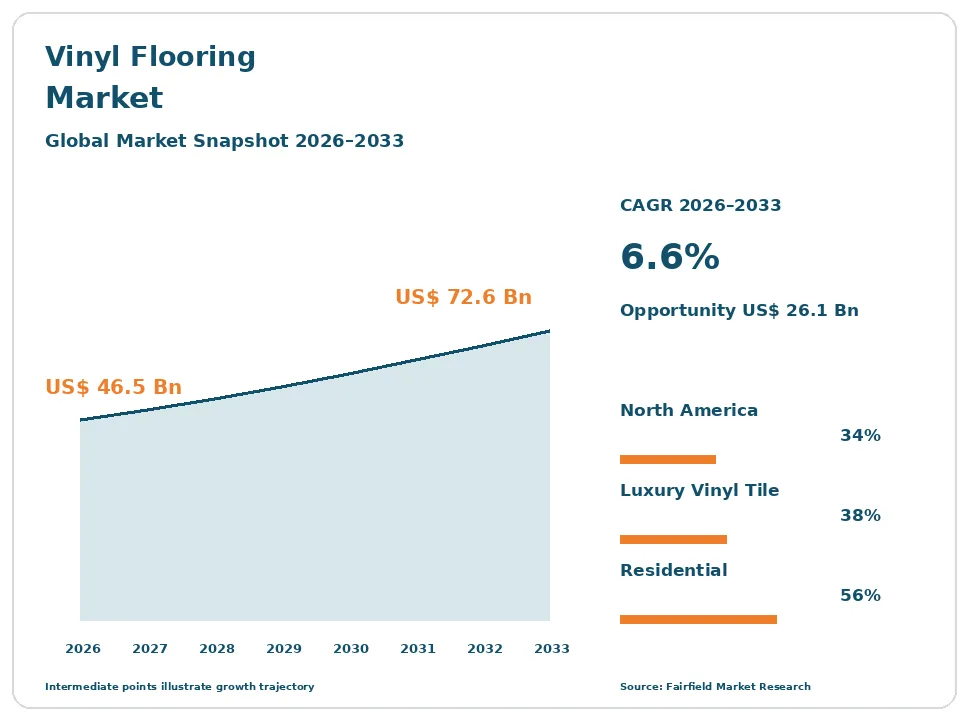
The global vinyl flooring market size is expected to be valued at US$ 46.5 billion in 2026 and projected to reach US$ 72.6 billion by 2033, growing at a CAGR of 6.6% between 2026 and 2033.
The category grew at roughly 6.9% a year between 2020 and 2025, with a surge during the home improvement boom and a correction once interest rates rose in 2023. Three forces now carry it. Rigid core boards that click together without adhesive made installation a weekend job and a one-night commercial fit-out, which widened the buyer base far beyond trade installers. Print film and embossing technology closed most of the visual gap with natural materials. Commercial specification in healthcare and education continues to convert on hygiene and maintenance grounds. Growth is therefore steady rather than explosive, with the mix shifting toward engineered rigid products and away from commodity tile.
Key Report Takeaways
- By Product Type: Luxury vinyl tile and plank held 38% share in 2026, while rigid core products are projected to expand at an 8.4% CAGR through 2033, driven by dimensional stability that tolerates temperature swing and subfloor imperfection.
- By Installation Format: Dryback glue-down held 43% share in 2026, while click-lock floating formats are projected to grow at an 8.1% CAGR, driven by adhesive-free fitting that removes cure time from the programme.
- By End Use: Residential applications held 56% share in 2026, while healthcare is projected to advance at a 7.8% CAGR through 2033, supported by seamless welded sheet and infection control requirements.
- By Construction Activity: Renovation and replacement held 64% share in 2026, while new construction is projected to grow at a 7.2% CAGR, driven by housing completions across emerging economies.
- By Region: North America held 34% share in 2026, while Asia Pacific is projected to expand at a 7.9% CAGR through 2033, driven by Indian urban housing and rising domestic resilient flooring capacity.
Global Vinyl Flooring Market Trends and Insights
Drivers Impact Analysis
| Driver | Impact on CAGR Forecast | Geographic Relevance | Impact Timeline |
| Rigid core boards with click-lock jointing that remove the need for a trade installer | High | North America, Europe, Asia Pacific | Long term ≥4 years |
| Digital print films and embossed-in-register texture supporting premium price points | Medium | North America, Europe | Medium term 2–4 years |
Two product-level changes explain most of the growth in resilient vinyl floor coverings.
Click-Lock Rigid Core Boards Changed Who Installs a Vinyl Floor, and That Changed the Market
The growth of this category is an installation story before it is a design story. A stone-plastic or wood-plastic composite core is stiff and dimensionally stable, so a board can carry a machined locking profile and sit as a floating floor without adhesive. That removes trowelling, open time, cure time and most subfloor preparation. A homeowner can fit a room in a day, and a retail or office fit-out can be handed back overnight rather than after a weekend.
The mechanism is mechanical, not chemical. A rigid core resists the thermal movement and telegraphing that forced flexible tile to be bonded down, which is why the locking joint became reliable enough to sell at volume. Home improvement retailers and online sellers then built whole ranges around a product that ships flat, needs no site trade and carries a clear fitting instruction. Distribution economics followed the engineering.
Digital Print Film and Embossed-in-Register Surfacing Let Vinyl Flooring Hold Premium Price Points
Surface technology is the second driver, because it decides what the floor can be sold for. A vinyl plank is a laminate of backing, core, printed film and transparent wear layer. Digital printing removed the repeat limitation of rotogravure cylinders, so a range can carry dozens of unique board faces instead of six. Embossed-in-register pressing then aligns the surface texture with the printed grain or stone vein, which is what makes the floor convincing underfoot and under light.
That capability shifted the category upmarket. Manufacturers can differentiate on design rather than on price per square metre, and wear layer thickness gives a transparent ladder of residential, light commercial and heavy commercial grades. Specifiers use that ladder to match warranty to traffic. The result is a product family with real price architecture, which is unusual among hard floor coverings and protects margin during soft demand.
Restraints Impact Analysis
| Restraint | Impact on CAGR Forecast | Geographic Relevance | Impact Timeline |
| Restrictions on chlorine-based polymers in green building and materials transparency programmes | High | North America, Europe | Long term ≥4 years |
| Exposure to PVC resin and plasticiser prices and to import duties on concentrated supply | Medium | North America, Europe, Latin America | Short term ≤2 years |
Two constraints limit how far vinyl floor coverings can expand.
The Chlorine Chemistry Objection Costs Vinyl Flooring Credits and Specifications on Institutional Projects
The category’s defining commercial risk is a dispute about its base polymer. Several green building rating schemes, materials transparency programmes and institutional specifiers restrict or penalise polyvinyl chloride, citing chlorine feedstock, additive disclosure and end-of-life concerns. Health systems, universities and some public clients carry those positions into tender documents. Where a scheme awards a credit for avoiding the material, the floor is excluded before performance is assessed, and the sale is lost on chemistry rather than on merit.
The vinyl industry disputes the basis of those restrictions. European producers point to voluntary stewardship under VinylPlus, documented recycled content, controlled-loop collection through Recovinyl, and the shift away from low-molecular-weight phthalate plasticisers, and argue that modern formulations and published environmental product declarations answer the original objections. Both positions are held by serious organisations, the evidence is contested, and specifiers currently decide case by case rather than on settled consensus.
Feedstock Price Swings and Import Duties Keep Vinyl Flooring Sourcing and Margins Unstable
Margins in this category move with two inputs the manufacturer does not control. Polyvinyl chloride resin price tracks ethylene and chlor-alkali economics, and plasticiser price tracks oxo-alcohol and phthalic anhydride feedstocks, so a board’s raw material cost can move materially inside a quarter. Retail price lists are set seasonally and shipped in catalogues, which means cost increases are absorbed before they can be passed on.
Supply concentration compounds the exposure. A very large share of world rigid core and luxury vinyl tile output is produced in a small number of clusters, and duties applied to those origins change the landed cost of a container without warning. Importers have responded by qualifying second-source plants in other countries, which costs sample approval time and working capital. Smaller brands without the balance sheet to hold dual inventory are the most affected.
Market Opportunities
Healthcare and Education Specification Opens a Repeat, Standards-Led Revenue Pool for Commercial Vinyl Flooring
Institutional commercial work is the most durable revenue pool available to this category. Hospitals, clinics, laboratories, schools and universities buy homogeneous and heterogeneous sheet for its seamless heat-welded joints, coved skirting detail and cleanability, and they replace it on a planned cycle rather than on consumer whim. Budgets are approved in advance, and the specification is written by an estates team that values documented performance over fashion.
Manufacturers with slip resistance classifications, fire performance test evidence, acoustic and wheeled-load data, and published environmental product declarations and health product declarations can bid this work. Flooring contractors with certified welders capture the installation side. The demand is created by infection control policy, by the maintenance cost of alternatives and by refurbishment of ageing estates. It is also the pool least exposed to interest rates, which makes it a useful counterweight to residential renovation.
Recycled Content and Take-Back Schemes Turn the Specification Objection Into a Commercial Position
Recycled content is where the category can convert its biggest criticism into a selling point. Post-industrial trim, installation offcuts and recovered sheet can re-enter backings and cores, and products carrying a verified recycled fraction qualify for credits under materials transparency programmes that would otherwise score the floor down. Collection schemes for commercial installation waste give contractors a documented disposal route, which increasingly appears as a tender requirement in its own right.
Contract manufacturers, large brands and flooring contractors share this pool. The demand comes from institutional and corporate clients with procurement rules on recycled input and construction waste diversion, reinforced by extended producer responsibility obligations on building products in some European markets. The honest limitation is separation: single-polymer sheet recycles well, while mixed-construction rigid core boards combining mineral filler, core, film and wear layer are far harder to reclaim cleanly.
Segment Analysis
By Product Type: Luxury Vinyl Tile and Plank Leads While Rigid Core Boards Set the Pace
Luxury vinyl tile and plank held 38% share in 2026, the largest product group, because it spans the widest price range and serves both residential renovation and light commercial work. Sheet vinyl, including homogeneous and heterogeneous commercial grades, remains essential in healthcare and education, while vinyl composition tile holds a declining but stable position in low-cost institutional work. Rigid core products, covering stone-plastic and wood-plastic composite, grow fastest at an 8.4% CAGR through 2033.
Rigid core expands because a stiff board tolerates subfloor imperfection and temperature movement that flexible tile cannot. The honest limit is physical: rigid core performs poorly under sustained heat in conservatories and under heavy point loads, where indentation recovery is weaker than homogeneous sheet. Manufacturers manage that with wear layer specification and clear application guidance, and the practical result is a segmented product family rather than one board for every room.
By Installation Format: Glue-Down Still Carries Commercial Work as Click-Lock Grows Quickest
Dryback glue-down accounted for 43% of the market in 2026, the leading format, because bonded installation remains the requirement wherever rolling loads, heavy furniture, underfloor heating or large uninterrupted areas are involved. Loose-lay and peel-and-stick formats serve retrofit and tenant-improvement work where speed matters more than permanence. Click-lock floating installation is the fastest-growing format at an 8.1% CAGR through 2033.
Click-lock grows because it removes adhesive, cure time and skilled trowelling from the job. That matters to a homeowner fitting a room and to a retailer who must reopen a store the next morning. It also matters to leased space, since a floating floor can be lifted and reused. The implication for manufacturers is that profile engineering, locking strength and joint tolerance have become competitive assets, and they are protected by patents as seriously as any surface design.
By End Use: Residential Volume Dominates While Healthcare Specification Grows Fastest
Residential applications held 56% share in 2026, reflecting the renovation channel, home improvement retail and the do-it-yourself fitting that click-lock products enabled. Retail and hospitality, offices and education divide most of the commercial balance, each buying on traffic rating and refurbishment cycle. Healthcare is the fastest-growing end use at a 7.8% CAGR through 2033.
Healthcare grows because the specification is written around hygiene and maintenance rather than purchase price. Heat-welded homogeneous sheet produces a continuous, coved, cleanable surface with no joints for contamination, and its total cost over fifteen years compares well with alternatives that need sealing or replacement. Infection control policy, wheeled equipment loads and slip resistance requirements all point the same way. For suppliers, this end use demands test evidence and technical support, which raises the barrier to entry and protects pricing.
By Construction Activity: Renovation Carries the Volume While New Build Grows Faster
Renovation and replacement work represented 64% of demand in 2026, the dominant channel, because most floors are bought to replace a worn surface rather than to finish a new building. Renovation also suits the product, since a floating board can be laid over an existing hard floor with minimal preparation and no disruption to skirting or doors. New construction is the faster-growing activity at a 7.2% CAGR through 2033.
New build grows faster from a smaller base, driven by housing completions in India, Southeast markets, the Gulf and parts of Latin America, where vinyl is specified from the outset in apartments and serviced accommodation. Developers like predictable unit cost and fast installation across repeated floor plates. The implication is a two-speed demand structure: renovation delivers steady replacement volume in mature markets, while builder and developer channels decide growth in emerging ones.
Geography Analysis
Which Region Is Leading the Vinyl Flooring Market?
North America leads the market with 34% share in 2026, growing at about 6.1% a year to 2033. The United States accounts for most of it, with Canada and Mexico adding residential and hospitality volume. The region adopted luxury vinyl tile and rigid core earlier and more completely than anywhere else, and home improvement retail chains and online sellers built the category into a mainstream consumer purchase.
Three causes explain the position. Housing stock is large, old and frequently remodelled, which sustains replacement demand. Do-it-yourself culture and wide retail distribution suit a click-together board. Commercial refurbishment in healthcare and education is consistently funded. The structural change underway is sourcing: brands are qualifying production outside the traditional supply clusters in response to duty exposure, and some domestic rigid core manufacturing has been established to shorten lead times and reduce landed cost risk.
Europe Buys on Standards, Transparency Documents and Commercial Sheet Performance
Europe held 22% share in 2026 and grows more slowly, near 5.1% a year, but it is the most specification-driven region in the category. Germany, France, the United Kingdom, Poland, Belgium and the Nordic countries lead consumption, with a strong domestic manufacturing base in homogeneous and heterogeneous commercial sheet rather than in imported rigid core boards.
Growth is restrained by slow construction output and by the strongest institutional scrutiny of polyvinyl chloride anywhere. Buyers expect environmental product declarations, health product declarations and evidence of recycled input as a condition of tender. The industry’s voluntary stewardship and controlled-loop collection commitments were developed largely in response. Extended producer responsibility obligations on building and construction products, already in force in some member states, are the change most likely to reshape take-back logistics and product design here.
Which Region Is Growing Fastest in the Vinyl Flooring Market?
Asia Pacific is the fastest-growing geography at a 7.9% CAGR between 2026 and 2033, from 33% share in 2026. China dominates manufacturing and also consumes heavily, while India is the fastest-expanding national market, followed by Vietnam, Indonesia, Thailand, Japan, South Korea and Australia. The region combines the world’s largest resilient flooring production base with rapidly rising domestic demand.
India drives the growth. Urban apartment completions, organised retail, hospital construction and a shift away from site-laid stone and ceramic in mid-income housing all favour a factory-finished board installed in hours. Local manufacturing capacity has expanded to serve that demand and to reduce dependence on imports. The constraints are price sensitivity, limited installer training outside major cities and inconsistent subfloor quality, which manufacturers address with thicker cores and more tolerant locking profiles.
Latin America Builds Volume Through Apartment Construction and Local Converting
Latin America accounted for 7% of the market in 2026 and grows near 6.6% a year. Brazil and Mexico lead, with Chile, Colombia, Peru and Argentina contributing. Demand is strongest in apartment developments, retail chains and hotels, where a hard-wearing floor must be installed quickly across repeated layouts, and local converting and distribution networks have matured considerably.
The barriers are economic rather than technical. Most rigid core board is imported, so exchange rate movement and port costs feed directly into shelf price, and consumer credit for renovation is expensive. Installer training is uneven, which produces joint failures that damage confidence in the category. The opportunity is nearshore production, since Mexican converting capacity can serve both domestic demand and northern export markets while avoiding the freight and duty exposure of long-haul supply.
Middle East & Africa Grows With Hospitality, Healthcare and Institutional Fit-Out
Middle East & Africa represented 4% of the market in 2026 and expands at about 7.4% a year. The Gulf states lead, with Saudi Arabia, the United Arab Emirates and Qatar driving demand through hotels, hospitals, airports, schools and large mixed-use developments. Egypt, Morocco, Nigeria, Kenya and South Africa form a smaller but widening base.
Demand here is specification-led and project-driven rather than retail-driven. Contractors buy commercial sheet and heavy-duty tile against fire performance and slip resistance requirements written into project documents. The barriers are heavy dependence on imports, long and variable lead times, extreme summer temperatures that expose dimensional stability weaknesses in poorly engineered boards, and a shortage of trained installers. Local distribution partnerships and climate-appropriate product specification are the main routes to sustained share.
Competitive Landscape
The vinyl flooring market is moderately concentrated at the top and highly fragmented below it. Mohawk Industries, Inc., Shaw Industries Group, Inc., Tarkett S.A., Gerflor Group and Forbo Holding AG hold strong positions in their home regions and in commercial specification, but hundreds of converters, private-label suppliers and importers compete in residential rigid core, where tooling is widely available and brand loyalty is weak. Commercial sheet is the concentrated end of the business, because welding systems, test evidence and specification relationships take years to build.
Competition runs on several distinct axes. Design range and refresh rate decide shelf space in retail. Locking profile performance, wear layer construction and warranty length decide trade and specification work. Documentation has become a competitive factor in its own right: environmental product declarations, health product declarations, recycled content statements, slip resistance classification and fire performance evidence are now routinely requested before a product is shortlisted. Price matters most in builder and commodity tile channels. New entrants are mainly Asian converters moving from contract manufacturing into their own branded ranges, alongside specialist digital print houses supplying decor film to multiple board makers.
Strategic direction across the industry points in four consistent ways. The first is sourcing diversification, as brands qualify production in additional countries to limit duty and freight exposure. The second is vertical integration into decor film and core extrusion, which protects design exclusivity and shortens development cycles. The third is a documented sustainability position, including recycled content, take-back of installation waste and transparency disclosures, which exists largely to answer institutional scrutiny of the base polymer. The fourth is deeper investment in commercial channels, where margins are steadier and the specification relationship is harder for a new entrant to displace.
Vinyl Flooring Industry Leaders
- Mohawk Industries, Inc.
- Tarkett S.A.
- Shaw Industries Group, Inc.
- Gerflor Group
- Forbo Holding AG
Recent Industry Developments
- October 1974: The United States Occupational Safety and Health Administration issued its permanent standard for occupational exposure to vinyl chloride – it set the worker protection baseline for upstream monomer and resin production that still governs the category’s feedstock chain.
- June 2021: The European polyvinyl chloride industry launched the VinylPlus 2030 voluntary commitment – it extended recycled tonnage targets, additive stewardship and controlled-loop collection, and gave the sector a documented answer to institutional scrutiny of the polymer.
- May 2023: France’s extended producer responsibility scheme for building and construction products came into effect – it obliged producers to finance collection and treatment of construction waste, which brought take-back planning into flooring product design.
- December 2023: The United States Environmental Protection Agency designated vinyl chloride a high-priority substance for risk evaluation under the Toxic Substances Control Act – the outcome will shape upstream monomer regulation and, indirectly, specification confidence in downstream vinyl products.
Companies Covered in the Report
- Mohawk Industries, Inc.
- Shaw Industries Group, Inc.
- Tarkett S.A.
- Forbo Holding AG
- Gerflor Group
- AHF Products
- Mannington Mills, Inc.
- LX Hausys, Ltd.
- Beaulieu International Group
- Polyflor Ltd.
- Karndean Designflooring
- HMTX Industries LLC
- Novalis Innovative Flooring
- Responsive Industries Limited
Vinyl Flooring Market Report Scope
This report covers resilient floor coverings based on polyvinyl chloride: luxury vinyl tile and plank, rigid core stone-plastic and wood-plastic composite boards, loose-lay and dryback formats, sheet vinyl including homogeneous and heterogeneous commercial grades, and vinyl composition tile, with their wear layers, print films, backings and click-lock profiles. The total floor covering market is examined separately. The base year is 2025, the forecast period is 2026 to 2033, and values are in US$ Billion.
Product Type
- Luxury vinyl tile and plank
- Rigid core (stone-plastic composite and wood-plastic composite)
- Sheet vinyl (homogeneous and heterogeneous)
- Vinyl composition tile
Installation Format
- Click-lock floating
- Dryback glue-down
- Loose-lay
- Peel-and-stick
End Use
- Residential
- Healthcare
- Education
- Retail and hospitality
- Offices and other commercial
Construction Activity
- Renovation and replacement
- New construction
Regions
- North America
- Europe
- Asia Pacific
- Latin America
- Middle East & Africa
Key Questions Answered in the Report
How big is the vinyl flooring market in 2026?
The market is valued at US$ 46.5 billion in 2026, covering luxury vinyl tile, rigid core boards, sheet vinyl and vinyl composition tile worldwide.
What is the forecast size and CAGR to 2033?
The market is projected to reach US$ 72.6 billion by 2033 at a 6.6% CAGR, an absolute dollar opportunity of US$ 26.1 billion.
Which product type holds the largest share?
Luxury vinyl tile and plank leads with 38% share in 2026, spanning the widest price range across residential renovation and light commercial projects.
Which segment and region are growing fastest?
Rigid core products grow fastest among segments at an 8.4% CAGR, while Asia Pacific leads regional growth at a 7.9% CAGR to 2033.
Which region holds the largest share and how concentrated is supply?
North America holds 34% share in 2026, and concentration is medium, with leading brands strongest in commercial sheet and fragmented competition in residential boards.
1. Executive Summary
1.1. Global Vinyl Flooring Market Snapshot
1.2. Future Projections
1.3. Key Report Takeaways
1.4. Regional Snapshot
2. Market Overview
2.1. Market Definition and Report Scope
2.2. Historical Trends 2020–2025
2.3. Market Dynamics
2.3.1. Drivers
2.3.1.1. Click-Lock Rigid Core Boards Changed Who Installs a Vinyl Floor, and That Changed the Market
2.3.1.2. Digital Print Film and Embossed-in-Register Surfacing Let Vinyl Flooring Hold Premium Price Points
2.3.2. Restraints
2.3.2.1. The Chlorine Chemistry Objection Costs Vinyl Flooring Credits and Specifications on Institutional Projects
2.3.2.2. Feedstock Price Swings and Import Duties Keep Vinyl Flooring Sourcing and Margins Unstable
2.3.3. Market Opportunities
2.3.3.1. Healthcare and Education Specification Opens a Repeat, Standards-Led Revenue Pool for Commercial Vinyl Flooring
2.3.3.2. Recycled Content and Take-Back Schemes Turn the Specification Objection Into a Commercial Position
3. Global Vinyl Flooring Market Outlook, 2020–2033
3.1. Global Vinyl Flooring Market Outlook, by Product Type, Value (US$ Billion), 2020–2033
3.1.1. Luxury vinyl tile and plank
3.1.2. Rigid core (stone-plastic composite and wood-plastic composite)
3.1.3. Sheet vinyl (homogeneous and heterogeneous)
3.1.4. Vinyl composition tile
3.2. Global Vinyl Flooring Market Outlook, by Installation Format, Value (US$ Billion), 2020–2033
3.2.1. Click-lock floating
3.2.2. Dryback glue-down
3.2.3. Loose-lay
3.2.4. Peel-and-stick
3.3. Global Vinyl Flooring Market Outlook, by End Use, Value (US$ Billion), 2020–2033
3.3.1. Residential
3.3.2. Healthcare
3.3.3. Education
3.3.4. Retail and hospitality
3.3.5. Offices and other commercial
3.4. Global Vinyl Flooring Market Outlook, by Construction Activity, Value (US$ Billion), 2020–2033
3.4.1. Renovation and replacement
3.4.2. New construction
3.5. Global Vinyl Flooring Market Outlook, by Region, Value (US$ Billion), 2020–2033
3.5.1. North America
3.5.2. Europe
3.5.3. Asia Pacific
3.5.4. Latin America
3.5.5. Middle East & Africa
4. North America Vinyl Flooring Market Outlook, 2020–2033
4.1. North America Vinyl Flooring Market Outlook, by Product Type, Value (US$ Billion), 2020–2033
4.1.1. Luxury vinyl tile and plank
4.1.2. Rigid core (stone-plastic composite and wood-plastic composite)
4.1.3. Sheet vinyl (homogeneous and heterogeneous)
4.1.4. Vinyl composition tile
4.2. North America Vinyl Flooring Market Outlook, by Installation Format, Value (US$ Billion), 2020–2033
4.2.1. Click-lock floating
4.2.2. Dryback glue-down
4.2.3. Loose-lay
4.2.4. Peel-and-stick
4.3. North America Vinyl Flooring Market Outlook, by End Use, Value (US$ Billion), 2020–2033
4.3.1. Residential
4.3.2. Healthcare
4.3.3. Education
4.3.4. Retail and hospitality
4.3.5. Offices and other commercial
4.4. North America Vinyl Flooring Market Outlook, by Construction Activity, Value (US$ Billion), 2020–2033
4.4.1. Renovation and replacement
4.4.2. New construction
4.5. North America Vinyl Flooring Market Outlook, by Country, Value (US$ Billion), 2020–2033
4.5.1. United States Vinyl Flooring Market Outlook, by Product Type, 2020–2033
4.5.2. United States Vinyl Flooring Market Outlook, by Installation Format, 2020–2033
4.5.3. United States Vinyl Flooring Market Outlook, by End Use, 2020–2033
4.5.4. United States Vinyl Flooring Market Outlook, by Construction Activity, 2020–2033
4.5.5. Canada Vinyl Flooring Market Outlook, by Product Type, 2020–2033
4.5.6. Canada Vinyl Flooring Market Outlook, by Installation Format, 2020–2033
4.5.7. Canada Vinyl Flooring Market Outlook, by End Use, 2020–2033
4.5.8. Canada Vinyl Flooring Market Outlook, by Construction Activity, 2020–2033
4.5.9. Mexico Vinyl Flooring Market Outlook, by Product Type, 2020–2033
4.5.10. Mexico Vinyl Flooring Market Outlook, by Installation Format, 2020–2033
4.5.11. Mexico Vinyl Flooring Market Outlook, by End Use, 2020–2033
4.5.12. Mexico Vinyl Flooring Market Outlook, by Construction Activity, 2020–2033
5. Europe Vinyl Flooring Market Outlook, 2020–2033
5.1. Europe Vinyl Flooring Market Outlook, by Product Type, Value (US$ Billion), 2020–2033
5.1.1. Luxury vinyl tile and plank
5.1.2. Rigid core (stone-plastic composite and wood-plastic composite)
5.1.3. Sheet vinyl (homogeneous and heterogeneous)
5.1.4. Vinyl composition tile
5.2. Europe Vinyl Flooring Market Outlook, by Installation Format, Value (US$ Billion), 2020–2033
5.2.1. Click-lock floating
5.2.2. Dryback glue-down
5.2.3. Loose-lay
5.2.4. Peel-and-stick
5.3. Europe Vinyl Flooring Market Outlook, by End Use, Value (US$ Billion), 2020–2033
5.3.1. Residential
5.3.2. Healthcare
5.3.3. Education
5.3.4. Retail and hospitality
5.3.5. Offices and other commercial
5.4. Europe Vinyl Flooring Market Outlook, by Construction Activity, Value (US$ Billion), 2020–2033
5.4.1. Renovation and replacement
5.4.2. New construction
5.5. Europe Vinyl Flooring Market Outlook, by Country, Value (US$ Billion), 2020–2033
5.5.1. Germany Vinyl Flooring Market Outlook, by Product Type, 2020–2033
5.5.2. Germany Vinyl Flooring Market Outlook, by Installation Format, 2020–2033
5.5.3. Germany Vinyl Flooring Market Outlook, by End Use, 2020–2033
5.5.4. Germany Vinyl Flooring Market Outlook, by Construction Activity, 2020–2033
5.5.5. France Vinyl Flooring Market Outlook, by Product Type, 2020–2033
5.5.6. France Vinyl Flooring Market Outlook, by Installation Format, 2020–2033
5.5.7. France Vinyl Flooring Market Outlook, by End Use, 2020–2033
5.5.8. France Vinyl Flooring Market Outlook, by Construction Activity, 2020–2033
5.5.9. United Kingdom Vinyl Flooring Market Outlook, by Product Type, 2020–2033
5.5.10. United Kingdom Vinyl Flooring Market Outlook, by Installation Format, 2020–2033
5.5.11. United Kingdom Vinyl Flooring Market Outlook, by End Use, 2020–2033
5.5.12. United Kingdom Vinyl Flooring Market Outlook, by Construction Activity, 2020–2033
5.5.13. Poland Vinyl Flooring Market Outlook, by Product Type, 2020–2033
5.5.14. Poland Vinyl Flooring Market Outlook, by Installation Format, 2020–2033
5.5.15. Poland Vinyl Flooring Market Outlook, by End Use, 2020–2033
5.5.16. Poland Vinyl Flooring Market Outlook, by Construction Activity, 2020–2033
5.5.17. Belgium Vinyl Flooring Market Outlook, by Product Type, 2020–2033
5.5.18. Belgium Vinyl Flooring Market Outlook, by Installation Format, 2020–2033
5.5.19. Belgium Vinyl Flooring Market Outlook, by End Use, 2020–2033
5.5.20. Belgium Vinyl Flooring Market Outlook, by Construction Activity, 2020–2033
5.5.21. Nordic countries Vinyl Flooring Market Outlook, by Product Type, 2020–2033
5.5.22. Nordic countries Vinyl Flooring Market Outlook, by Installation Format, 2020–2033
5.5.23. Nordic countries Vinyl Flooring Market Outlook, by End Use, 2020–2033
5.5.24. Nordic countries Vinyl Flooring Market Outlook, by Construction Activity, 2020–2033
6. Asia Pacific Vinyl Flooring Market Outlook, 2020–2033
6.1. Asia Pacific Vinyl Flooring Market Outlook, by Product Type, Value (US$ Billion), 2020–2033
6.1.1. Luxury vinyl tile and plank
6.1.2. Rigid core (stone-plastic composite and wood-plastic composite)
6.1.3. Sheet vinyl (homogeneous and heterogeneous)
6.1.4. Vinyl composition tile
6.2. Asia Pacific Vinyl Flooring Market Outlook, by Installation Format, Value (US$ Billion), 2020–2033
6.2.1. Click-lock floating
6.2.2. Dryback glue-down
6.2.3. Loose-lay
6.2.4. Peel-and-stick
6.3. Asia Pacific Vinyl Flooring Market Outlook, by End Use, Value (US$ Billion), 2020–2033
6.3.1. Residential
6.3.2. Healthcare
6.3.3. Education
6.3.4. Retail and hospitality
6.3.5. Offices and other commercial
6.4. Asia Pacific Vinyl Flooring Market Outlook, by Construction Activity, Value (US$ Billion), 2020–2033
6.4.1. Renovation and replacement
6.4.2. New construction
6.5. Asia Pacific Vinyl Flooring Market Outlook, by Country, Value (US$ Billion), 2020–2033
6.5.1. China Vinyl Flooring Market Outlook, by Product Type, 2020–2033
6.5.2. China Vinyl Flooring Market Outlook, by Installation Format, 2020–2033
6.5.3. China Vinyl Flooring Market Outlook, by End Use, 2020–2033
6.5.4. China Vinyl Flooring Market Outlook, by Construction Activity, 2020–2033
6.5.5. India Vinyl Flooring Market Outlook, by Product Type, 2020–2033
6.5.6. India Vinyl Flooring Market Outlook, by Installation Format, 2020–2033
6.5.7. India Vinyl Flooring Market Outlook, by End Use, 2020–2033
6.5.8. India Vinyl Flooring Market Outlook, by Construction Activity, 2020–2033
6.5.9. Vietnam Vinyl Flooring Market Outlook, by Product Type, 2020–2033
6.5.10. Vietnam Vinyl Flooring Market Outlook, by Installation Format, 2020–2033
6.5.11. Vietnam Vinyl Flooring Market Outlook, by End Use, 2020–2033
6.5.12. Vietnam Vinyl Flooring Market Outlook, by Construction Activity, 2020–2033
6.5.13. Indonesia Vinyl Flooring Market Outlook, by Product Type, 2020–2033
6.5.14. Indonesia Vinyl Flooring Market Outlook, by Installation Format, 2020–2033
6.5.15. Indonesia Vinyl Flooring Market Outlook, by End Use, 2020–2033
6.5.16. Indonesia Vinyl Flooring Market Outlook, by Construction Activity, 2020–2033
6.5.17. Thailand Vinyl Flooring Market Outlook, by Product Type, 2020–2033
6.5.18. Thailand Vinyl Flooring Market Outlook, by Installation Format, 2020–2033
6.5.19. Thailand Vinyl Flooring Market Outlook, by End Use, 2020–2033
6.5.20. Thailand Vinyl Flooring Market Outlook, by Construction Activity, 2020–2033
6.5.21. Japan Vinyl Flooring Market Outlook, by Product Type, 2020–2033
6.5.22. Japan Vinyl Flooring Market Outlook, by Installation Format, 2020–2033
6.5.23. Japan Vinyl Flooring Market Outlook, by End Use, 2020–2033
6.5.24. Japan Vinyl Flooring Market Outlook, by Construction Activity, 2020–2033
6.5.25. South Korea Vinyl Flooring Market Outlook, by Product Type, 2020–2033
6.5.26. South Korea Vinyl Flooring Market Outlook, by Installation Format, 2020–2033
6.5.27. South Korea Vinyl Flooring Market Outlook, by End Use, 2020–2033
6.5.28. South Korea Vinyl Flooring Market Outlook, by Construction Activity, 2020–2033
6.5.29. Australia Vinyl Flooring Market Outlook, by Product Type, 2020–2033
6.5.30. Australia Vinyl Flooring Market Outlook, by Installation Format, 2020–2033
6.5.31. Australia Vinyl Flooring Market Outlook, by End Use, 2020–2033
6.5.32. Australia Vinyl Flooring Market Outlook, by Construction Activity, 2020–2033
7. Latin America Vinyl Flooring Market Outlook, 2020–2033
7.1. Latin America Vinyl Flooring Market Outlook, by Product Type, Value (US$ Billion), 2020–2033
7.1.1. Luxury vinyl tile and plank
7.1.2. Rigid core (stone-plastic composite and wood-plastic composite)
7.1.3. Sheet vinyl (homogeneous and heterogeneous)
7.1.4. Vinyl composition tile
7.2. Latin America Vinyl Flooring Market Outlook, by Installation Format, Value (US$ Billion), 2020–2033
7.2.1. Click-lock floating
7.2.2. Dryback glue-down
7.2.3. Loose-lay
7.2.4. Peel-and-stick
7.3. Latin America Vinyl Flooring Market Outlook, by End Use, Value (US$ Billion), 2020–2033
7.3.1. Residential
7.3.2. Healthcare
7.3.3. Education
7.3.4. Retail and hospitality
7.3.5. Offices and other commercial
7.4. Latin America Vinyl Flooring Market Outlook, by Construction Activity, Value (US$ Billion), 2020–2033
7.4.1. Renovation and replacement
7.4.2. New construction
7.5. Latin America Vinyl Flooring Market Outlook, by Country, Value (US$ Billion), 2020–2033
7.5.1. Brazil Vinyl Flooring Market Outlook, by Product Type, 2020–2033
7.5.2. Brazil Vinyl Flooring Market Outlook, by Installation Format, 2020–2033
7.5.3. Brazil Vinyl Flooring Market Outlook, by End Use, 2020–2033
7.5.4. Brazil Vinyl Flooring Market Outlook, by Construction Activity, 2020–2033
7.5.5. Mexico Vinyl Flooring Market Outlook, by Product Type, 2020–2033
7.5.6. Mexico Vinyl Flooring Market Outlook, by Installation Format, 2020–2033
7.5.7. Mexico Vinyl Flooring Market Outlook, by End Use, 2020–2033
7.5.8. Mexico Vinyl Flooring Market Outlook, by Construction Activity, 2020–2033
7.5.9. Chile Vinyl Flooring Market Outlook, by Product Type, 2020–2033
7.5.10. Chile Vinyl Flooring Market Outlook, by Installation Format, 2020–2033
7.5.11. Chile Vinyl Flooring Market Outlook, by End Use, 2020–2033
7.5.12. Chile Vinyl Flooring Market Outlook, by Construction Activity, 2020–2033
7.5.13. Colombia Vinyl Flooring Market Outlook, by Product Type, 2020–2033
7.5.14. Colombia Vinyl Flooring Market Outlook, by Installation Format, 2020–2033
7.5.15. Colombia Vinyl Flooring Market Outlook, by End Use, 2020–2033
7.5.16. Colombia Vinyl Flooring Market Outlook, by Construction Activity, 2020–2033
7.5.17. Peru Vinyl Flooring Market Outlook, by Product Type, 2020–2033
7.5.18. Peru Vinyl Flooring Market Outlook, by Installation Format, 2020–2033
7.5.19. Peru Vinyl Flooring Market Outlook, by End Use, 2020–2033
7.5.20. Peru Vinyl Flooring Market Outlook, by Construction Activity, 2020–2033
7.5.21. Argentina Vinyl Flooring Market Outlook, by Product Type, 2020–2033
7.5.22. Argentina Vinyl Flooring Market Outlook, by Installation Format, 2020–2033
7.5.23. Argentina Vinyl Flooring Market Outlook, by End Use, 2020–2033
7.5.24. Argentina Vinyl Flooring Market Outlook, by Construction Activity, 2020–2033
8. Middle East & Africa Vinyl Flooring Market Outlook, 2020–2033
8.1. Middle East & Africa Vinyl Flooring Market Outlook, by Product Type, Value (US$ Billion), 2020–2033
8.1.1. Luxury vinyl tile and plank
8.1.2. Rigid core (stone-plastic composite and wood-plastic composite)
8.1.3. Sheet vinyl (homogeneous and heterogeneous)
8.1.4. Vinyl composition tile
8.2. Middle East & Africa Vinyl Flooring Market Outlook, by Installation Format, Value (US$ Billion), 2020–2033
8.2.1. Click-lock floating
8.2.2. Dryback glue-down
8.2.3. Loose-lay
8.2.4. Peel-and-stick
8.3. Middle East & Africa Vinyl Flooring Market Outlook, by End Use, Value (US$ Billion), 2020–2033
8.3.1. Residential
8.3.2. Healthcare
8.3.3. Education
8.3.4. Retail and hospitality
8.3.5. Offices and other commercial
8.4. Middle East & Africa Vinyl Flooring Market Outlook, by Construction Activity, Value (US$ Billion), 2020–2033
8.4.1. Renovation and replacement
8.4.2. New construction
8.5. Middle East & Africa Vinyl Flooring Market Outlook, by Country, Value (US$ Billion), 2020–2033
8.5.1. Saudi Arabia Vinyl Flooring Market Outlook, by Product Type, 2020–2033
8.5.2. Saudi Arabia Vinyl Flooring Market Outlook, by Installation Format, 2020–2033
8.5.3. Saudi Arabia Vinyl Flooring Market Outlook, by End Use, 2020–2033
8.5.4. Saudi Arabia Vinyl Flooring Market Outlook, by Construction Activity, 2020–2033
8.5.5. United Arab Emirates Vinyl Flooring Market Outlook, by Product Type, 2020–2033
8.5.6. United Arab Emirates Vinyl Flooring Market Outlook, by Installation Format, 2020–2033
8.5.7. United Arab Emirates Vinyl Flooring Market Outlook, by End Use, 2020–2033
8.5.8. United Arab Emirates Vinyl Flooring Market Outlook, by Construction Activity, 2020–2033
8.5.9. Qatar Vinyl Flooring Market Outlook, by Product Type, 2020–2033
8.5.10. Qatar Vinyl Flooring Market Outlook, by Installation Format, 2020–2033
8.5.11. Qatar Vinyl Flooring Market Outlook, by End Use, 2020–2033
8.5.12. Qatar Vinyl Flooring Market Outlook, by Construction Activity, 2020–2033
8.5.13. Egypt Vinyl Flooring Market Outlook, by Product Type, 2020–2033
8.5.14. Egypt Vinyl Flooring Market Outlook, by Installation Format, 2020–2033
8.5.15. Egypt Vinyl Flooring Market Outlook, by End Use, 2020–2033
8.5.16. Egypt Vinyl Flooring Market Outlook, by Construction Activity, 2020–2033
8.5.17. Morocco Vinyl Flooring Market Outlook, by Product Type, 2020–2033
8.5.18. Morocco Vinyl Flooring Market Outlook, by Installation Format, 2020–2033
8.5.19. Morocco Vinyl Flooring Market Outlook, by End Use, 2020–2033
8.5.20. Morocco Vinyl Flooring Market Outlook, by Construction Activity, 2020–2033
8.5.21. Nigeria Vinyl Flooring Market Outlook, by Product Type, 2020–2033
8.5.22. Nigeria Vinyl Flooring Market Outlook, by Installation Format, 2020–2033
8.5.23. Nigeria Vinyl Flooring Market Outlook, by End Use, 2020–2033
8.5.24. Nigeria Vinyl Flooring Market Outlook, by Construction Activity, 2020–2033
8.5.25. Kenya Vinyl Flooring Market Outlook, by Product Type, 2020–2033
8.5.26. Kenya Vinyl Flooring Market Outlook, by Installation Format, 2020–2033
8.5.27. Kenya Vinyl Flooring Market Outlook, by End Use, 2020–2033
8.5.28. Kenya Vinyl Flooring Market Outlook, by Construction Activity, 2020–2033
8.5.29. South Africa Vinyl Flooring Market Outlook, by Product Type, 2020–2033
8.5.30. South Africa Vinyl Flooring Market Outlook, by Installation Format, 2020–2033
8.5.31. South Africa Vinyl Flooring Market Outlook, by End Use, 2020–2033
8.5.32. South Africa Vinyl Flooring Market Outlook, by Construction Activity, 2020–2033
9. Competitive Landscape
9.1. Market Concentration and Industry Leaders
9.2. Competitive Differentiation
9.3. Strategic Moves and Market Direction
9.4. Recent Industry Developments
9.5. Company Profiles
9.5.1. Mohawk Industries, Inc.
9.5.2. Shaw Industries Group, Inc.
9.5.3. Tarkett S.A.
9.5.4. Forbo Holding AG
9.5.5. Gerflor Group
9.5.6. AHF Products
9.5.7. Mannington Mills, Inc.
9.5.8. LX Hausys, Ltd.
9.5.9. Beaulieu International Group
9.5.10. Polyflor Ltd.
9.5.11. Karndean Designflooring
9.5.12. HMTX Industries LLC
9.5.13. Novalis Innovative Flooring
9.5.14. Responsive Industries Limited
10. Appendix
10.1. Research Methodology
10.2. Report Assumptions
10.3. Acronyms and Abbreviations
| Product Type | Luxury vinyl tile and plank, Rigid core (stone-plastic composite and wood-plastic composite), Sheet vinyl (homogeneous and heterogeneous), Vinyl composition tile |
| Installation Format | Click-lock floating, Dryback glue-down, Loose-lay, Peel-and-stick |
| End Use | Residential, Healthcare, Education, Retail and hospitality, Offices and other commercial |
| Construction Activity | Renovation and replacement, New construction |
| Regions | North America, Europe, Asia Pacific, Latin America, Middle East & Africa |
Our Research Methodology
Considering the volatility of business today, traditional approaches to strategizing a game plan can be unfruitful if not detrimental. True ambiguity is no way to determine a forecast. A myriad of predetermined factors must be accounted for such as the degree of risk involved, the magnitude of circumstances, as well as conditions or consequences that are not known or unpredictable. To circumvent binary views that cast uncertainty, the application of market research intelligence to strategically posture, move, and enable actionable outcomes is necessary.
View Methodology
Quality Assured
Rigorous Validation Process

Confidentiality Assured
End-to-end Data Security

Custom Research Services
Tailored To Your Objectives
FAQs
The market is valued at US$ 46.5 billion in 2026, covering luxury vinyl tile, rigid core boards, sheet vinyl and vinyl composition tile worldwide.
The market is projected to reach US$ 72.6 billion by 2033 at a 6.6% CAGR, an absolute dollar opportunity of US$ 26.1 billion.
Luxury vinyl tile and plank leads with 38% share in 2026, spanning the widest price range across residential renovation and light commercial projects.
Rigid core products grow fastest among segments at an 8.4% CAGR, while Asia Pacific leads regional growth at a 7.9% CAGR to 2033.
North America holds 34% share in 2026, and concentration is medium, with leading brands strongest in commercial sheet and fragmented competition in residential boards.
Related Reports
Advanced Materials Market Size, Share, Insights, Competitive Landscape, and Forecast 2026 to 2033
Explore the advanced materials market, projected to reach US$ 121.08 billion by 2033 at a 6.6% CAGR, with product, application and regional insights.
Biopolymer Coatings Market Size, Share, Insights, Competitive Landscape, and Forecast 2026 to 2033
Explore the biopolymer coatings market, projected to reach US$ 2.5 billion by 2033 at a 7.6% CAGR, with product, technology and regional insights.
Dry Construction Market Size, Share, Insights, Competitive Landscape, and Forecast 2026 to 2033
Explore the dry construction market, projected to reach US$ 134.87 billion by 2033 at a 4.7% CAGR, with material, system and regional insights.
Waterproofing Admixtures Market Size, Share, Insights, Competitive Landscape, and Forecast 2026 to 2033
Waterproofing admixtures market to grow from US$ 2.4 billion in 2026 to US$ 3.6 billion by 2033 at a 6.0% CAGR. Explore products, applications and regions.
Unsaturated Polyester Resin Market Size, Share, Insights, Competitive Landscape, and Forecast 2026 to 2033
Explore the unsaturated polyester resin market, forecast to reach US$18.1 billion by 2033 at 4.6% CAGR, with resin, end-use and regional insights.
Renewable Chemicals Market Size, Share, Insights, Competitive Landscape, and Forecast 2026 to 2033
Explore the renewable chemicals market, projected to reach US$379.48 billion by 2033 at 11.2% CAGR, with product, feedstock and regional insights.