



Non-Woven Abrasives Market
Non-Woven Abrasives Market Size, Share, Insights, Competitive Landscape, and Forecast 2026 to 2033
How Fast Is the Non-Woven Abrasives Market Growing?
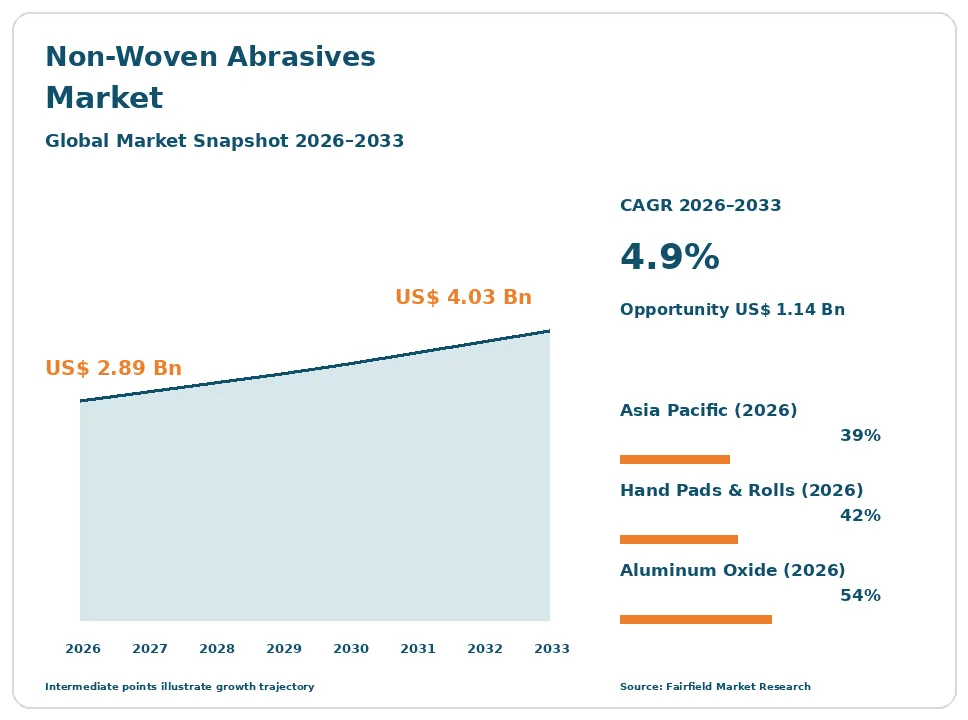
The global non-woven abrasives market size is expected to be valued at US$ 2.89 billion in 2026 and projected to reach US$ 4.03 billion by 2033, growing at a CAGR of 4.9% between 2026 and 2033.
Between 2020 and 2025, the market grew at a CAGR of about 4.2%, dipping in 2020 as factories and body shops closed, then recovering with automotive repair, metal fabrication, construction, and electronics manufacturing. Non-woven abrasives are made of open, three-dimensional webs of nylon or polyester fibers coated with abrasive grains such as aluminum oxide, silicon carbide, or ceramic, bonded with resin. Unlike sandpaper, they are flexible, conform to curved surfaces, resist clogging, and give a consistent, uniform finish. Products include hand pads, rolls, belts, discs, wheels, and brushes used for surface finishing, cleaning, deburring, blending, polishing, and removing rust and paint. Growth comes from manufacturing output, automotive refinishing, stainless steel and aluminum fabrication, and household cleaning. The market is shifting toward ceramic grains, dust-free systems, and automated finishing. In March 2026, Gemtex introduced new surface conditioning flap discs that combine several finishing steps in one tool.
Key Report Takeaways
- By Product: Hand Pads & Rolls held 42.0% share in 2026, while Discs are projected to expand at a 5.6% CAGR through 2033, driven by power tool use in metal fabrication, weld cleaning, and fast surface preparation in automotive and shipbuilding work.
- By End Use: Transportation held 31.0% share in 2026, while Electronics & Semiconductor is projected to expand at a 6.2% CAGR through 2033, driven by precision finishing of devices, components, and equipment that require scratch-free, uniform surfaces.
- By Abrasive Material: Aluminum Oxide held 54.0% share in 2026, while Silicon Carbide is projected to expand at a 5.4% CAGR through 2033, driven by low-sparking cleaning tools, finishing of non-ferrous metals, and fine polishing applications.
- By Region: Asia Pacific held 39.0% share in 2026, while India is projected to expand at a 6.8% CAGR through 2033, driven by manufacturing incentives, automotive production, infrastructure construction, and rapid growth in metal fabrication.
Global Non-Woven Abrasives Market Trends and Insights
Drivers Impact Analysis
Two drivers carry the strongest influence on non-woven abrasives demand during the forecast period.
Manufacturing Output Is Driving the Non-Woven Abrasives Market
Growth in metal fabrication and manufacturing output is the strongest driver of the non-woven abrasives market. Almost every metal part needs finishing.
The mechanism is the large and growing volume of metal and composite parts that must be cleaned, deburred, and finished before use. Stainless steel kitchen equipment, food processing machinery, medical devices, aerospace parts, appliances, furniture, and architectural metal all require attractive, uniform surface finishes, and non-woven products deliver these without gouging the surface. Weld seams must be blended and cleaned. Aluminum use is rising in electric vehicles, aircraft, and buildings, and non-woven abrasives are ideal for soft metals because they do not load up. Manufacturing is expanding in India, Vietnam, Mexico, and other countries as companies diversify supply chains. Government programs that support domestic production add new factories. These trends steadily increase demand for surface conditioning abrasives.
Automotive Refinishing Is Expanding the Non-Woven Abrasives Market
Automotive repair and refinishing demand is expanding the non-woven abrasives market. Body shops use non-woven pads every day.
The cause is the large global vehicle fleet and the need to repair and repaint cars after accidents. Body shops use non-woven pads and rolls to scuff surfaces before painting, clean edges and hard-to-reach areas, and blend repairs. Original equipment manufacturers use them in paint shops and component finishing. Mirka, 3M, and sia Abrasives sell complete systems to body shops, and Mirka strengthened its presence in Australia in December 2025. Rising vehicle complexity, with more aluminum panels and advanced coatings, increases repair value and the need for gentle surface preparation. Electric vehicle production adds new finishing work on battery housings and lightweight frames. These trends support steady demand from both repair shops and factories.
| Driver | Impact on CAGR Forecast | Geographic Relevance | Impact Timeline |
| Growth in metal fabrication and manufacturing output | High | Asia Pacific, North America, Europe | Long term (≥4 years) |
| Automotive repair and refinishing demand | Medium | Global | Medium term (2-4 years) |
Restraints Impact Analysis
Two restraints limit how quickly the non-woven abrasives market grows.
Raw Material Costs Slow the Non-Woven Abrasives Market
Volatile raw material and energy costs slow the non-woven abrasives market. Producers face rising input prices.
The specific causes are dependence on petrochemicals and minerals. Nylon and polyester fibers and phenolic or urethane resins come from oil-based chemicals whose prices follow crude oil, while abrasive grains such as aluminum oxide and silicon carbide require energy-intensive production. Energy costs in Europe have risen sharply since 2022. Price competition from lower-cost producers in China and India limits the ability to raise prices. Freight costs add to the burden for bulky products. Supply disruptions for some grains, especially from China, have also caused shortages and delays for manufacturers in other regions. Smaller producers lack the buying power to secure stable prices, and customers often resist price increases in competitive tenders. These pressures squeeze margins and slow investment.
Alternative Methods Restrict the Non-Woven Abrasives Market
Competition from alternative finishing methods restricts the non-woven abrasives market. Some manufacturers can finish parts without abrasives.
The underlying causes are new technologies and changes in how parts are designed and made. Laser cleaning can remove rust, paint, and oxide layers without contact or consumables, and dry ice blasting, chemical stripping, and electropolishing compete in some cleaning and finishing tasks. Pre-finished and coated metal sheets reduce the need for finishing after fabrication, and powder coating hides minor surface flaws. Additive manufacturing changes part shapes and creates surfaces that need different finishing methods, such as tumbling or chemical smoothing. Plastic and composite parts sometimes replace metal parts that once needed finishing. Although these alternatives often have high equipment costs, large factories can justify them for high-volume work. These alternatives limit growth in some applications and push abrasive makers to show clear cost and quality benefits.
| Restraint | Impact on CAGR Forecast | Geographic Relevance | Impact Timeline |
| Volatile raw material and energy costs | High | Global | Medium term (2-4 years) |
| Competition from alternative finishing methods | Medium | North America, Europe | Long term (≥4 years) |
Market Opportunities
Automation and Robotic Finishing Open a Fast-Growth Revenue Pool
Automation and robotic finishing open a fast-growth revenue pool in the non-woven abrasives market. Factories want consistent, automated surface finishing.
Abrasive makers and automation partners can capture this opportunity. Skilled finishing workers are scarce and finishing work is tiring and dusty, so manufacturers are adding robots fitted with non-woven discs, wheels, and brushes that deliver the same finish on every part. Wide belts and roll systems finish sheet metal, panels, and coils automatically at high speed. Abrasive suppliers must design products with predictable wear and long life so that robots can run for hours without changes, and they increasingly work with robot makers and system integrators. Sensors and software can track abrasive wear and adjust pressure. Companies that design abrasives and process know-how for robotic use can win long-term supply contracts with automotive, aerospace, and appliance makers.
Ceramic Grains and Dust-Free Systems Create a Premium Revenue Pool
Ceramic grains and dust-free systems create a premium revenue pool in the non-woven abrasives market. Users want faster cutting and healthier workplaces.
Premium suppliers can capture this opportunity. Ceramic grain non-woven discs cut faster, stay sharp longer, and run cooler than standard grains, saving labor time, and Weiler Abrasives launched ceramic and silicon carbide non-woven strip discs in February 2025. Multi-step products, such as Gemtex’s new flap discs, reduce tool changes. Dust extraction systems and net-based abrasives improve worker health and meet stricter air quality rules, a strength of Mirka. Contaminant-free products suit stainless steel, food equipment, and medical device finishing, where iron particles could cause rust. Companies with high-performance, safer products and strong training programs can earn premium prices and loyal customers.
Segment Analysis
By Product: Hand Pads & Rolls Lead While Discs Grow Fastest
Hand Pads & Rolls held 42.0% share in 2026. Hand pads are used everywhere, from body shops and metal workshops to kitchens and homes, for cleaning, scuffing, and light finishing, and rolls can be cut to any size. Household scouring pads are also a large volume category. 3M’s Scotch-Brite brand is widely known in both industrial and consumer markets.
Discs are the fastest-growing product, expanding at a 5.6% CAGR through 2033. Non-woven discs, including surface conditioning, strip, and flap discs, fit angle grinders and power tools, making cleaning, weld blending, and rust removal much faster than hand work. They are popular in metal fabrication, shipbuilding, and construction. Belts and wheels serve production finishing. For the market, disc growth reflects the shift to power tools.
By End Use: Transportation Leads While Electronics & Semiconductor Grows Fastest
Transportation held 31.0% share in 2026. Automotive body repair, paint preparation, and component finishing, along with aerospace, rail, and marine applications, use large volumes of non-woven abrasives. Body shops are steady buyers because every repair needs surface preparation.
Electronics & Semiconductor is the fastest-growing end use, expanding at a 6.2% CAGR through 2033. Precision finishing of device housings, heat sinks, connectors, and semiconductor equipment parts requires uniform, scratch-free surfaces. Household, construction, and metal fabrication form other end uses. Smartphone, laptop, and appliance makers in Asia Pacific use non-woven products to create brushed metal finishes that consumers value. Semiconductor equipment parts need very clean surfaces to avoid contamination. For the market, electronics growth adds high-precision demand.
By Abrasive Material: Aluminum Oxide Leads While Silicon Carbide Grows Fastest
Aluminum Oxide held 54.0% share in 2026. Aluminum oxide is tough, affordable, and suitable for most steel and general finishing work, which makes it the standard grain for hand pads, rolls, and general-purpose discs. It is widely available from many producers worldwide.
Silicon Carbide is the fastest-growing material, expanding at a 5.4% CAGR through 2033. Its sharp grains suit non-ferrous metals, plastics, and fine finishing, and they produce fewer sparks, which matters in confined or hazardous spaces. Ceramic grains form a premium segment, valued for faster cutting and longer life on hard metals such as stainless steel and titanium, and their share is rising as users focus on total cost rather than unit price. Diamond and other specialty grains serve niche uses. For the market, silicon carbide growth reflects precision and safety needs.
Geography Analysis
Why Is North America Important to the Non-Woven Abrasives Market?
North America is important because it is home to leading companies such as 3M, Weiler Abrasives, Osborn, and DEWALT, and it has large automotive repair, aerospace, metal fabrication, and food equipment industries that buy premium finishing products. The United States has a huge network of collision repair shops and growing reshored manufacturing, supported by federal incentives for semiconductors and electric vehicles. Saint-Gobain’s Norton brand also has a strong presence. Mexico and Canada add manufacturing demand. Key barriers include labor shortages in finishing jobs. One change shaping the region is the spread of robotic surface finishing.
Europe Advances the Non-Woven Abrasives Market Through Precision Manufacturing
Europe is a major non-woven abrasives market. Germany, Italy, France, Switzerland, and Finland host PFERD, Klingspor, sia Abrasives, Mirka, and Tyrolit, and the region has strong automotive, machinery, aerospace, and stainless steel industries. Strict workplace dust rules favor dust-free sanding systems, and furniture and woodworking industries in Italy and Poland add demand. Mirka expanded its precision grinding range by acquiring bonded abrasive assets of Hermes Schleifmittel in September 2025. Key barriers include high energy and labor costs. One opportunity is dust-free and automated finishing in factories and workshops.
Which Region Is Leading the Non-Woven Abrasives Market?
Asia Pacific is leading the non-woven abrasives market with a 39.0% share in 2026. China is the world’s largest manufacturer of metal products, appliances, vehicles, and electronics, and a large producer of abrasives. India is the fastest-growing country, expanding at a 6.8% CAGR through 2033, supported by manufacturing incentives, automotive growth, and infrastructure construction, with Carborundum Universal as a major local producer. Japan, South Korea, and Vietnam add demand from electronics and automotive production. Key barriers include strong price competition from local producers. One change shaping the region is supply chain diversification toward India and Vietnam.
Latin America Grows the Non-Woven Abrasives Market Through Automotive Production
Latin America is a growing non-woven abrasives market. Mexico has a large automotive and appliance manufacturing base linked to North America, while Brazil has strong automotive, agricultural machinery, and metalworking industries. Argentina, Colombia, and Chile add demand from body repair, mining equipment maintenance, and construction. Distributors serve many small workshops and body shops, and global brands compete with low-cost imports. Mining equipment maintenance in Chile and Peru uses abrasives for cleaning and repair work. Key barriers include currency swings and imports of low-cost products. One opportunity is nearshoring of manufacturing to Mexico and Brazil.
Middle East & Africa Develops the Non-Woven Abrasives Market Through Construction
Middle East & Africa is a developing non-woven abrasives market. Saudi Arabia, the United Arab Emirates, and Qatar use abrasives in construction, steel fabrication, oil and gas maintenance, and shipyards, supported by large infrastructure projects. South Africa, Egypt, and Morocco have automotive and metalworking industries, and Morocco has become a major car exporter. Growing hospitality and food processing sectors use stainless steel equipment that needs finishing. Most products are imported through regional distributors and dealers. Key barriers include price sensitivity, counterfeit products, and reliance on imports. One change shaping the region is industrial diversification programs.
Competitive Landscape
The non-woven abrasives market is moderately consolidated. 3M, Saint-Gobain, Mirka, sia Abrasives, and PFERD are leading players, while Klingspor, Carborundum Universal, Tyrolit, Weiler Abrasives, Osborn, TGA Abrasives, and DEWALT compete strongly. Many regional and private-label producers supply lower-cost products, especially in Asia Pacific and other price-sensitive regions.
Companies compete on cutting performance, finish quality, product life, range breadth, brand strength, distribution reach, technical support, and price. Large global players offer complete abrasive portfolios across coated, bonded, and non-woven products, which helps them win multi-year supply agreements with industrial distributors and large manufacturers. Training and productivity assessments help suppliers show cost savings. Private-label products sold through large hardware and industrial retailers compete on price. Innovation in grain technology, fiber webs, and resin systems is the main way premium brands stay ahead, and acquisitions help them add products and distribution.
Strategic moves show how competition is changing. In February 2025, Weiler Abrasives launched ceramic and silicon carbide non-woven strip discs. In December 2025, Mirka acquired its Australian distributor. In March 2026, Gemtex introduced multi-purpose surface conditioning flap discs. These moves show competition shifting toward high-performance, multi-purpose products and direct control of distribution in key markets.
Three themes shape vendor strategy. First, companies are launching ceramic and multi-step products. Second, they are expanding direct distribution through acquisitions. Third, they are supporting automated, robotic, and dust-free finishing systems.
Non-Woven Abrasives Market Industry Leaders
- 3M
- Saint-Gobain
- Mirka
- sia Abrasives
- PFERD
Recent Industry Developments
- March 2026: Gemtex introduced Britepress surface conditioning flap discs that combine deburring, cleaning, blending, and finishing in one tool - expands non-woven abrasives for metal fabrication.
- December 2025: Mirka acquired Best Abrasives, its authorized importer and distributor in Australia, and formed Mirka Australia - strengthens surface finishing distribution in Asia Pacific.
- February 2025: Weiler Abrasives introduced Tiger Ceramic and Tiger SiC non-woven strip discs for coating and rust removal - advances surface conditioning abrasives for weld cleaning and surface prep.
Companies Covered in the Report
- 3M
- Saint-Gobain
- Mirka
- sia Abrasives
- PFERD
- Klingspor
- Carborundum Universal
- Tyrolit
- Weiler Abrasives
- Osborn
- TGA Abrasives
- DEWALT
Non-Woven Abrasives Market Report Scope
This report covers non-woven abrasives, including hand pads and rolls, belts, discs, wheels, and other products, made with aluminum oxide, silicon carbide, ceramic, and other abrasive grains, for household, electronics and semiconductor, transportation, construction, metal fabrication, and other end uses. The base year is 2025, and the forecast period runs from 2026 to 2033. All values are expressed in US$ Billion.
Product
- Hand Pads & Rolls
- Belts
- Discs
- Wheels & Others
End Use
- Household
- Electronics & Semiconductor
- Transportation
- Construction
- Metal Fabrication & Others
Abrasive Material
- Aluminum Oxide
- Silicon Carbide
- Ceramic & Others
Regions
- North America
- Europe
- Asia Pacific
- Latin America
- Middle East & Africa
1. Executive Summary
1.1. Global Non-Woven Abrasives Market Snapshot
1.2. Future Projections, 2026-2033
1.3. Key Market Trends
1.4. Regional Snapshot
2. Market Overview
2.1. Market Definition and Report Scope
2.2. Historical Market Trends, 2020-2025
2.3. Market Dynamics
2.3.1. Drivers Impact Analysis
2.3.1.1. Manufacturing Output Is Driving the Non-Woven Abrasives Market
2.3.1.2. Automotive Refinishing Is Expanding the Non-Woven Abrasives Market
2.3.2. Restraints Impact Analysis
2.3.2.1. Raw Material Costs Slow the Non-Woven Abrasives Market
2.3.2.2. Alternative Methods Restrict the Non-Woven Abrasives Market
2.3.3. Market Opportunities
2.3.3.1. Automation and Robotic Finishing Open a Fast-Growth Revenue Pool
2.3.3.2. Ceramic Grains and Dust-Free Systems Create a Premium Revenue Pool
3. Global Non-Woven Abrasives Market Outlook, 2020-2033
3.1. Global Non-Woven Abrasives Market Outlook, by Product, Value (US$ Billion), 2020-2033
3.1.1. Hand Pads & Rolls
3.1.2. Belts
3.1.3. Discs
3.1.4. Wheels & Others
3.2. Global Non-Woven Abrasives Market Outlook, by End Use, Value (US$ Billion), 2020-2033
3.2.1. Household
3.2.2. Electronics & Semiconductor
3.2.3. Transportation
3.2.4. Construction
3.2.5. Metal Fabrication & Others
3.3. Global Non-Woven Abrasives Market Outlook, by Abrasive Material, Value (US$ Billion), 2020-2033
3.3.1. Aluminum Oxide
3.3.2. Silicon Carbide
3.3.3. Ceramic & Others
3.4. Global Non-Woven Abrasives Market Outlook, by Region, Value (US$ Billion), 2020-2033
3.4.1. North America
3.4.2. Europe
3.4.3. Asia Pacific
3.4.4. Latin America
3.4.5. Middle East & Africa
4. North America Non-Woven Abrasives Market Outlook, 2020-2033
4.1. North America Non-Woven Abrasives Market Outlook, by Product, Value (US$ Billion), 2020-2033
4.1.1. Hand Pads & Rolls
4.1.2. Belts
4.1.3. Discs
4.1.4. Wheels & Others
4.2. North America Non-Woven Abrasives Market Outlook, by End Use, Value (US$ Billion), 2020-2033
4.2.1. Household
4.2.2. Electronics & Semiconductor
4.2.3. Transportation
4.2.4. Construction
4.2.5. Metal Fabrication & Others
4.3. North America Non-Woven Abrasives Market Outlook, by Abrasive Material, Value (US$ Billion), 2020-2033
4.3.1. Aluminum Oxide
4.3.2. Silicon Carbide
4.3.3. Ceramic & Others
4.4. North America Non-Woven Abrasives Market Outlook, by Country, Value (US$ Billion), 2020-2033
4.4.1. United States Non-Woven Abrasives Market Outlook, by Product, 2020-2033
4.4.2. United States Non-Woven Abrasives Market Outlook, by End Use, 2020-2033
4.4.3. United States Non-Woven Abrasives Market Outlook, by Abrasive Material, 2020-2033
4.4.4. Mexico Non-Woven Abrasives Market Outlook, by Product, 2020-2033
4.4.5. Mexico Non-Woven Abrasives Market Outlook, by End Use, 2020-2033
4.4.6. Mexico Non-Woven Abrasives Market Outlook, by Abrasive Material, 2020-2033
4.4.7. Canada Non-Woven Abrasives Market Outlook, by Product, 2020-2033
4.4.8. Canada Non-Woven Abrasives Market Outlook, by End Use, 2020-2033
4.4.9. Canada Non-Woven Abrasives Market Outlook, by Abrasive Material, 2020-2033
5. Europe Non-Woven Abrasives Market Outlook, 2020-2033
5.1. Europe Non-Woven Abrasives Market Outlook, by Product, Value (US$ Billion), 2020-2033
5.1.1. Hand Pads & Rolls
5.1.2. Belts
5.1.3. Discs
5.1.4. Wheels & Others
5.2. Europe Non-Woven Abrasives Market Outlook, by End Use, Value (US$ Billion), 2020-2033
5.2.1. Household
5.2.2. Electronics & Semiconductor
5.2.3. Transportation
5.2.4. Construction
5.2.5. Metal Fabrication & Others
5.3. Europe Non-Woven Abrasives Market Outlook, by Abrasive Material, Value (US$ Billion), 2020-2033
5.3.1. Aluminum Oxide
5.3.2. Silicon Carbide
5.3.3. Ceramic & Others
5.4. Europe Non-Woven Abrasives Market Outlook, by Country, Value (US$ Billion), 2020-2033
5.4.1. Germany Non-Woven Abrasives Market Outlook, by Product, 2020-2033
5.4.2. Germany Non-Woven Abrasives Market Outlook, by End Use, 2020-2033
5.4.3. Germany Non-Woven Abrasives Market Outlook, by Abrasive Material, 2020-2033
5.4.4. Italy Non-Woven Abrasives Market Outlook, by Product, 2020-2033
5.4.5. Italy Non-Woven Abrasives Market Outlook, by End Use, 2020-2033
5.4.6. Italy Non-Woven Abrasives Market Outlook, by Abrasive Material, 2020-2033
5.4.7. France Non-Woven Abrasives Market Outlook, by Product, 2020-2033
5.4.8. France Non-Woven Abrasives Market Outlook, by End Use, 2020-2033
5.4.9. France Non-Woven Abrasives Market Outlook, by Abrasive Material, 2020-2033
5.4.10. Switzerland Non-Woven Abrasives Market Outlook, by Product, 2020-2033
5.4.11. Switzerland Non-Woven Abrasives Market Outlook, by End Use, 2020-2033
5.4.12. Switzerland Non-Woven Abrasives Market Outlook, by Abrasive Material, 2020-2033
5.4.13. Finland Non-Woven Abrasives Market Outlook, by Product, 2020-2033
5.4.14. Finland Non-Woven Abrasives Market Outlook, by End Use, 2020-2033
5.4.15. Finland Non-Woven Abrasives Market Outlook, by Abrasive Material, 2020-2033
5.4.16. Poland Non-Woven Abrasives Market Outlook, by Product, 2020-2033
5.4.17. Poland Non-Woven Abrasives Market Outlook, by End Use, 2020-2033
5.4.18. Poland Non-Woven Abrasives Market Outlook, by Abrasive Material, 2020-2033
6. Asia Pacific Non-Woven Abrasives Market Outlook, 2020-2033
6.1. Asia Pacific Non-Woven Abrasives Market Outlook, by Product, Value (US$ Billion), 2020-2033
6.1.1. Hand Pads & Rolls
6.1.2. Belts
6.1.3. Discs
6.1.4. Wheels & Others
6.2. Asia Pacific Non-Woven Abrasives Market Outlook, by End Use, Value (US$ Billion), 2020-2033
6.2.1. Household
6.2.2. Electronics & Semiconductor
6.2.3. Transportation
6.2.4. Construction
6.2.5. Metal Fabrication & Others
6.3. Asia Pacific Non-Woven Abrasives Market Outlook, by Abrasive Material, Value (US$ Billion), 2020-2033
6.3.1. Aluminum Oxide
6.3.2. Silicon Carbide
6.3.3. Ceramic & Others
6.4. Asia Pacific Non-Woven Abrasives Market Outlook, by Country, Value (US$ Billion), 2020-2033
6.4.1. China Non-Woven Abrasives Market Outlook, by Product, 2020-2033
6.4.2. China Non-Woven Abrasives Market Outlook, by End Use, 2020-2033
6.4.3. China Non-Woven Abrasives Market Outlook, by Abrasive Material, 2020-2033
6.4.4. India Non-Woven Abrasives Market Outlook, by Product, 2020-2033
6.4.5. India Non-Woven Abrasives Market Outlook, by End Use, 2020-2033
6.4.6. India Non-Woven Abrasives Market Outlook, by Abrasive Material, 2020-2033
6.4.7. Japan Non-Woven Abrasives Market Outlook, by Product, 2020-2033
6.4.8. Japan Non-Woven Abrasives Market Outlook, by End Use, 2020-2033
6.4.9. Japan Non-Woven Abrasives Market Outlook, by Abrasive Material, 2020-2033
6.4.10. South Korea Non-Woven Abrasives Market Outlook, by Product, 2020-2033
6.4.11. South Korea Non-Woven Abrasives Market Outlook, by End Use, 2020-2033
6.4.12. South Korea Non-Woven Abrasives Market Outlook, by Abrasive Material, 2020-2033
6.4.13. Vietnam Non-Woven Abrasives Market Outlook, by Product, 2020-2033
6.4.14. Vietnam Non-Woven Abrasives Market Outlook, by End Use, 2020-2033
6.4.15. Vietnam Non-Woven Abrasives Market Outlook, by Abrasive Material, 2020-2033
7. Latin America Non-Woven Abrasives Market Outlook, 2020-2033
7.1. Latin America Non-Woven Abrasives Market Outlook, by Product, Value (US$ Billion), 2020-2033
7.1.1. Hand Pads & Rolls
7.1.2. Belts
7.1.3. Discs
7.1.4. Wheels & Others
7.2. Latin America Non-Woven Abrasives Market Outlook, by End Use, Value (US$ Billion), 2020-2033
7.2.1. Household
7.2.2. Electronics & Semiconductor
7.2.3. Transportation
7.2.4. Construction
7.2.5. Metal Fabrication & Others
7.3. Latin America Non-Woven Abrasives Market Outlook, by Abrasive Material, Value (US$ Billion), 2020-2033
7.3.1. Aluminum Oxide
7.3.2. Silicon Carbide
7.3.3. Ceramic & Others
7.4. Latin America Non-Woven Abrasives Market Outlook, by Country, Value (US$ Billion), 2020-2033
7.4.1. Mexico Non-Woven Abrasives Market Outlook, by Product, 2020-2033
7.4.2. Mexico Non-Woven Abrasives Market Outlook, by End Use, 2020-2033
7.4.3. Mexico Non-Woven Abrasives Market Outlook, by Abrasive Material, 2020-2033
7.4.4. Brazil Non-Woven Abrasives Market Outlook, by Product, 2020-2033
7.4.5. Brazil Non-Woven Abrasives Market Outlook, by End Use, 2020-2033
7.4.6. Brazil Non-Woven Abrasives Market Outlook, by Abrasive Material, 2020-2033
7.4.7. Argentina Non-Woven Abrasives Market Outlook, by Product, 2020-2033
7.4.8. Argentina Non-Woven Abrasives Market Outlook, by End Use, 2020-2033
7.4.9. Argentina Non-Woven Abrasives Market Outlook, by Abrasive Material, 2020-2033
7.4.10. Colombia Non-Woven Abrasives Market Outlook, by Product, 2020-2033
7.4.11. Colombia Non-Woven Abrasives Market Outlook, by End Use, 2020-2033
7.4.12. Colombia Non-Woven Abrasives Market Outlook, by Abrasive Material, 2020-2033
7.4.13. Chile Non-Woven Abrasives Market Outlook, by Product, 2020-2033
7.4.14. Chile Non-Woven Abrasives Market Outlook, by End Use, 2020-2033
7.4.15. Chile Non-Woven Abrasives Market Outlook, by Abrasive Material, 2020-2033
7.4.16. Peru Non-Woven Abrasives Market Outlook, by Product, 2020-2033
7.4.17. Peru Non-Woven Abrasives Market Outlook, by End Use, 2020-2033
7.4.18. Peru Non-Woven Abrasives Market Outlook, by Abrasive Material, 2020-2033
8. Middle East & Africa Non-Woven Abrasives Market Outlook, 2020-2033
8.1. Middle East & Africa Non-Woven Abrasives Market Outlook, by Product, Value (US$ Billion), 2020-2033
8.1.1. Hand Pads & Rolls
8.1.2. Belts
8.1.3. Discs
8.1.4. Wheels & Others
8.2. Middle East & Africa Non-Woven Abrasives Market Outlook, by End Use, Value (US$ Billion), 2020-2033
8.2.1. Household
8.2.2. Electronics & Semiconductor
8.2.3. Transportation
8.2.4. Construction
8.2.5. Metal Fabrication & Others
8.3. Middle East & Africa Non-Woven Abrasives Market Outlook, by Abrasive Material, Value (US$ Billion), 2020-2033
8.3.1. Aluminum Oxide
8.3.2. Silicon Carbide
8.3.3. Ceramic & Others
8.4. Middle East & Africa Non-Woven Abrasives Market Outlook, by Country, Value (US$ Billion), 2020-2033
8.4.1. Saudi Arabia Non-Woven Abrasives Market Outlook, by Product, 2020-2033
8.4.2. Saudi Arabia Non-Woven Abrasives Market Outlook, by End Use, 2020-2033
8.4.3. Saudi Arabia Non-Woven Abrasives Market Outlook, by Abrasive Material, 2020-2033
8.4.4. United Arab Emirates Non-Woven Abrasives Market Outlook, by Product, 2020-2033
8.4.5. United Arab Emirates Non-Woven Abrasives Market Outlook, by End Use, 2020-2033
8.4.6. United Arab Emirates Non-Woven Abrasives Market Outlook, by Abrasive Material, 2020-2033
8.4.7. Qatar Non-Woven Abrasives Market Outlook, by Product, 2020-2033
8.4.8. Qatar Non-Woven Abrasives Market Outlook, by End Use, 2020-2033
8.4.9. Qatar Non-Woven Abrasives Market Outlook, by Abrasive Material, 2020-2033
8.4.10. South Africa Non-Woven Abrasives Market Outlook, by Product, 2020-2033
8.4.11. South Africa Non-Woven Abrasives Market Outlook, by End Use, 2020-2033
8.4.12. South Africa Non-Woven Abrasives Market Outlook, by Abrasive Material, 2020-2033
8.4.13. Egypt Non-Woven Abrasives Market Outlook, by Product, 2020-2033
8.4.14. Egypt Non-Woven Abrasives Market Outlook, by End Use, 2020-2033
8.4.15. Egypt Non-Woven Abrasives Market Outlook, by Abrasive Material, 2020-2033
8.4.16. Morocco Non-Woven Abrasives Market Outlook, by Product, 2020-2033
8.4.17. Morocco Non-Woven Abrasives Market Outlook, by End Use, 2020-2033
8.4.18. Morocco Non-Woven Abrasives Market Outlook, by Abrasive Material, 2020-2033
9. Competitive Landscape
9.1. Market Concentration and Industry Leaders
9.2. Competitive Differentiation
9.3. Strategic Initiatives
9.4. Recent Industry Developments
9.5. Company Profiles
9.5.1. 3M
9.5.2. Saint-Gobain
9.5.3. Mirka
9.5.4. sia Abrasives
9.5.5. PFERD
9.5.6. Klingspor
9.5.7. Carborundum Universal
9.5.8. Tyrolit
9.5.9. Weiler Abrasives
9.5.10. Osborn
9.5.11. TGA Abrasives
9.5.12. DEWALT
10. Appendix
10.1. Research Methodology
10.2. Report Assumptions
10.3. Acronyms and Abbreviations
| Product | Hand Pads & Rolls, Belts, Discs, Wheels & Others |
| End Use | Household, Electronics & Semiconductor, Transportation, Construction, Metal Fabrication & Others |
| Abrasive Material | Aluminum Oxide, Silicon Carbide, Ceramic & Others |
| Regions | North America, Europe, Asia Pacific, Latin America, Middle East & Africa |
Our Research Methodology
Considering the volatility of business today, traditional approaches to strategizing a game plan can be unfruitful if not detrimental. True ambiguity is no way to determine a forecast. A myriad of predetermined factors must be accounted for such as the degree of risk involved, the magnitude of circumstances, as well as conditions or consequences that are not known or unpredictable. To circumvent binary views that cast uncertainty, the application of market research intelligence to strategically posture, move, and enable actionable outcomes is necessary.
View Methodology
Quality Assured
Rigorous Validation Process

Confidentiality Assured
End-to-end Data Security

Custom Research Services
Tailored To Your Objectives
FAQs
The non-woven abrasives market is valued at US$ 2.89 billion in 2026, led by hand pads and rolls and Asia Pacific.
The market is projected to reach US$ 4.03 billion by 2033, growing at a 4.9% CAGR and adding US$ 1.14 billion.
Electronics and semiconductor is growing fastest at a 6.2% CAGR through 2033, driven by precision finishing of devices and components.
India is growing fastest at a 6.8% CAGR through 2033, driven by manufacturing incentives, automotive production, and strong construction.
Asia Pacific holds the largest share at 39.0% in 2026, supported by large manufacturing bases in China, Japan, and India.
Related Reports
Agricultural Lubricant Market Size, Share, Insights, Competitive Landscape, and Forecast 2026 to 2033
The agricultural lubricant market is valued at US$ 6.58 billion in 2026 and projected to reach US$ 8.71 billion by 2033 at a CAGR of 4.1%.
Acaricides Market Size, Share, Insights, Competitive Landscape, and Forecast 2026 to 2033
Explore the acaricides market, valued at US$ 393.98 million in 2026 and projected to reach US$ 521.95 million by 2033 at a CAGR of 4.1%.
Rigid Bulk Packaging Market Size, Share, Insights, Competitive Landscape, and Forecast 2026 to 2033
The global rigid bulk packaging market is valued at US$68.5 billion in 2026, reaching US$96.4 billion by 2033, growing at a 5.0% CAGR
Probiotics Packaging Market Size, Share, Insights, Competitive Landscape, and Forecast 2026 to 2033
Explore the probiotics packaging market, valued at US$ 1.4 billion in 2026 and projected to reach US$ 2.4 billion by 2033, growing at an 8.0% CAGR.
Epoxy Composites Market Size, Share, Insights, Competitive Landscape, and Forecast 2026 to 2033
Explore the epoxy composites market, projected to reach US$ 22.3 billion by 2033 at a 6.7% CAGR, with resin, reinforcement and regional insights.
Advanced Materials Market Size, Share, Insights, Competitive Landscape, and Forecast 2026 to 2033
Explore the advanced materials market, projected to reach US$ 121.08 billion by 2033 at a 6.6% CAGR, with product, application and regional insights.