



Acaricides Market
Acaricides Market Size, Share, Insights, Competitive Landscape, and Forecast 2026 to 2033
How Fast Is the Acaricides Market Growing?
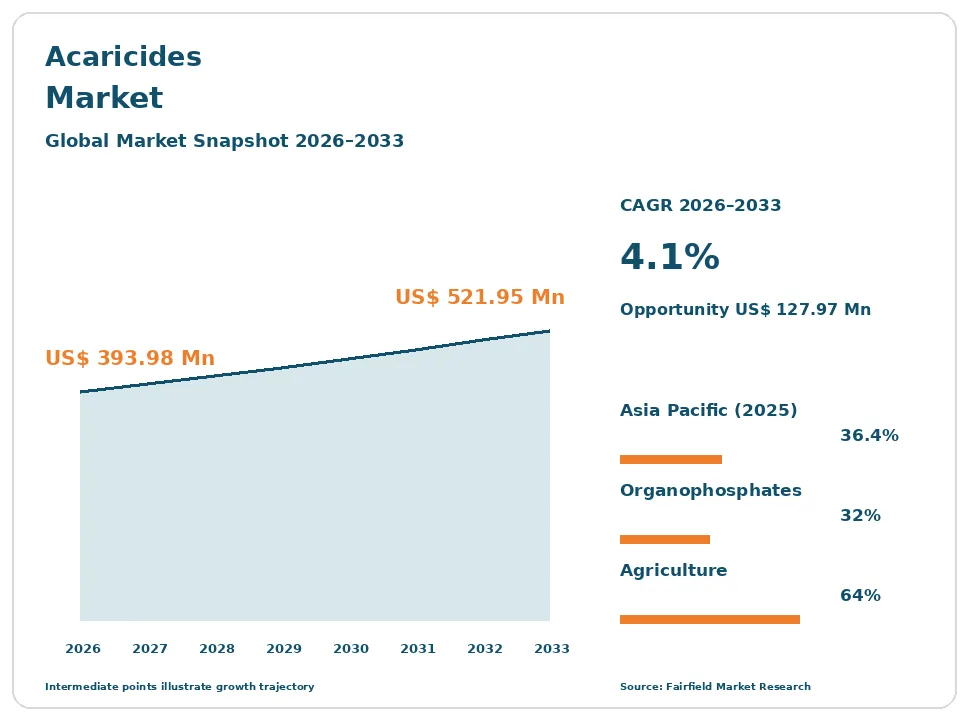
The global acaricides market size is expected to be valued at US$ 393.98 million in 2026 and projected to reach US$ 521.95 million by 2033, growing at a CAGR of 4.1% between 2026 and 2033.
Between 2020 and 2025, the market grew at a CAGR of about 3.6%, supported by rising mite pressure on fruit, vegetable, cotton, and plantation crops, growing tick problems in livestock, and the need to replace older products that lost registration. Acaricides are pesticides that kill or control mites and ticks, which damage crops by sucking plant juices and harm animals by feeding on blood and spreading diseases. Products include synthetic chemicals such as organophosphates, pyrethroids, carbamates, spirodiclofen, abamectin, and newer modes of action, along with biological and botanical options based on fungi, oils, and plant extracts. They are used in agriculture, animal husbandry, public health, and household pest control. Growth comes from climate change that favors mite outbreaks, high-value crop expansion, and resistance management needs. The market is shifting toward biological acaricides and products with new modes of action. In March 2026, BASF completed its acquisition of AgBiTech, expanding its biological crop protection portfolio.
Key Report Takeaways
- By Type: Organophosphates held 32.0% share in 2026, while Biological & Botanical Acaricides are projected to expand at a 6.8% CAGR through 2033, driven by residue limits, organic farming, and resistance to older chemistries in mites and ticks.
- By Application: Agriculture held 64.0% share in 2026, while Animal Husbandry is projected to expand at a 4.9% CAGR through 2033, driven by tick-borne disease control in cattle, rising meat and dairy demand, and pet care spending.
- By Mode of Application: Spray held 58.0% share in 2026, while Dipping & Pour-On is projected to expand at a 4.8% CAGR through 2033, driven by livestock tick control programs and convenient animal health formulations.
- By Region: Asia Pacific held 36.4% share in 2025, while Latin America is projected to expand at a 5.2% CAGR through 2033, driven by citrus, coffee, soybean, and cotton production and severe cattle tick problems in Brazil and Argentina.
Global Acaricides Market Trends and Insights
Drivers Impact Analysis
| Driver | Impact on CAGR Forecast | Geographic Relevance | Impact Timeline |
| Rising mite pressure on high-value crops | High | Asia Pacific, Latin America, Europe | Long term (≥4 years) |
| Livestock tick control and animal health needs | Medium | Latin America, Middle East & Africa, Asia Pacific | Medium term (2-4 years) |
Two drivers carry the strongest influence on acaricides demand during the forecast period.
Rising Mite Pressure Is Driving the Acaricides Market
Rising mite pressure on high-value crops is the strongest driver of the acaricides market. Mites cause large yield and quality losses.
The mechanism is the combination of warmer weather, intensive farming, and crop value. Spider mites, rust mites, and broad mites multiply quickly in hot, dry conditions, and climate change is lengthening the seasons when outbreaks occur. Fruits, vegetables, citrus, tea, cotton, grapes, and ornamental plants are especially vulnerable, and growers cannot afford damaged produce that fails export quality standards. Greenhouses create ideal conditions for mites year-round. Mites also develop resistance quickly, so growers need to rotate products with different modes of action, which supports demand for new miticides. Syngenta expanded the availability of its PLINAZOLIN technology acaricide in September 2025. These conditions keep crop protection chemicals for mite control in steady demand across major farming regions.
Livestock Tick Control Is Expanding the Acaricides Market
Livestock tick control and animal health needs are expanding the acaricides market. Ticks threaten cattle, sheep, and pets.
The cause is the economic and health damage ticks cause. Ticks reduce weight gain, milk yield, and hide quality, and they transmit diseases such as babesiosis, anaplasmosis, and theileriosis to cattle. In tropical and subtropical regions, including Brazil, India, Australia, and much of Middle East & Africa, cattle ticks are a major problem. Rising demand for meat and dairy encourages farmers to invest in animal health. Pet owners also spend more on tick prevention for dogs and cats because ticks spread Lyme disease and other illnesses to people and animals. Governments in several tropical countries run dipping programs and vaccination campaigns that include acaricide treatments. Veterinary product makers are launching easier-to-use treatments for herds. These needs support acaricide demand outside crops.
Restraints Impact Analysis
| Restraint | Impact on CAGR Forecast | Geographic Relevance | Impact Timeline |
| Strict regulations and product bans | High | Europe, North America | Long term (≥4 years) |
| Resistance development in mites and ticks | Medium | Global | Medium term (2-4 years) |
Two restraints limit how quickly the acaricides market grows.
Strict Regulations Slow the Acaricides Market
Strict regulations and product bans slow the acaricides market. Many older chemicals are being withdrawn.
The specific causes are health and environmental concerns. Regulators in Europe and North America have banned or restricted several organophosphates, carbamates, and other older acaricides because of risks to people, bees, aquatic life, and soil. Maximum residue limits on food exports are getting stricter, so growers must choose products carefully and respect waiting periods before harvest. Registering a new active ingredient can take ten years and cost hundreds of millions of dollars, which discourages investment in small markets like acaricides. Generic producers in China and India keep prices low for older products. Bee safety rules and limits on spray drift add further restrictions near flowering crops and water bodies. These factors limit value growth and remove some established products from the market.
Resistance Development Restricts the Acaricides Market
Resistance development in mites and ticks restricts the acaricides market. Pests quickly adapt to chemicals.
The underlying causes are short life cycles and overuse. Spider mites can complete a generation in about a week, so resistance develops fast when the same product is used repeatedly. Cattle ticks in Brazil, Australia, and Mexico resist many common treatments. Resistance reduces product effectiveness and shortens commercial life, cutting returns on development. Farmers may apply higher doses, increasing costs and residue risks. Resistance testing services and advice from agronomists help, but many small farmers lack access to them. Companies must invest constantly in new products to stay ahead of resistance, and some older products are already failing in key growing regions. These problems push buyers toward integrated pest management and reduce reliance on single products.
Market Opportunities
Biological and Botanical Acaricides Open a Fast-Growth Revenue Pool
Biological acaricides and botanical products open a fast-growth revenue pool in the acaricides market. Growers need safer tools that still work.
Crop protection companies and biological specialists can capture this opportunity. Products based on fungi such as Beauveria and Metarhizium, predatory mites released into greenhouses, plant oils, neem extracts, and other natural compounds control mites with low residues and short waiting periods before harvest. They suit organic farming, export crops that must meet strict residue limits, and resistance management programs that rotate different tools. Retailers and food companies in Europe and North America increasingly ask suppliers to reduce chemical residues, which pushes growers toward these products. BASF’s acquisition of AgBiTech shows large companies investing in biological portfolios. Better formulations are improving shelf life and field performance. Companies that combine biologicals with chemical programs and grower advice can capture growing demand.
New Modes of Action and Combinations Create a Premium Revenue Pool
New modes of action and combination products create a premium revenue pool in the acaricides market. Resistance management needs new chemistry.
Research-driven companies can capture this opportunity. New active ingredients that attack mites in different ways help growers control populations that no longer respond to older products, and dual-action mixtures control mites and insects with a single spray, saving labor and fuel. CropChem launched a spirodiclofen and abamectin mixture for citrus and coffee in October 2025, and Syngenta is expanding its PLINAZOLIN technology. Seed treatments and longer-lasting formulations reduce the number of applications needed. New veterinary products, including oral tablets and long-acting injections for pets and cattle, add premium value in animal health. Companies with innovative, well-registered products and strong distribution can earn premium prices and longer product lives.
Segment Analysis
By Type: Organophosphates Lead While Biological & Botanical Acaricides Grow Fastest
Organophosphates held 32.0% share in 2026. Organophosphates are low-cost, broad-spectrum products that farmers have used for decades on crops and livestock, especially in Asia Pacific, Latin America, and Middle East & Africa. Generic suppliers in China and India produce them in large volumes. Their share is slowly declining as regulators restrict use in Europe and North America and as resistance spreads.
Biological & Botanical Acaricides are the fastest-growing type, expanding at a 6.8% CAGR through 2033. Fungal, oil-based, predatory mite, and plant-extract products meet residue limits, organic standards, and sustainability goals. Pyrethroids and pyrethrins, carbamates, and newer synthetic chemistries such as spirodiclofen, abamectin, bifenazate, and etoxazole form other types. For the market, biological growth reflects safer and more sustainable farming.
By Application: Agriculture Leads While Animal Husbandry Grows Fastest
Agriculture held 64.0% share in 2026. Fruits, vegetables, cotton, citrus, tea, grapes, soybeans, and ornamental plants use the most acaricides, and greenhouse growers apply them regularly. Export growers spend heavily to protect fruit appearance and meet buyer standards.
Animal Husbandry is the fastest-growing application, expanding at a 4.9% CAGR through 2033. Cattle, sheep, goats, and pets need protection from ticks and mites that cause disease and production losses, and veterinary products such as dips, pour-ons, and long-acting treatments are expanding. Public health and household uses, including tick control in parks and homes, form another segment. Rising pet ownership in cities adds steady demand for tick treatments. For the market, livestock growth broadens demand beyond crops.
By Mode of Application: Spray Leads While Dipping & Pour-On Grows Fastest
Spray held 58.0% share in 2026. Foliar sprays applied with tractors, backpack sprayers, and drones are the main method for crops, allowing fast coverage of leaves where mites feed. Drone spraying is spreading quickly in China and other parts of Asia Pacific.
Dipping & Pour-On is the fastest-growing mode, expanding at a 4.8% CAGR through 2033. Cattle are walked through dip baths or treated with pour-on liquids along the back, which is quick and effective for herds. Spot-on and oral products serve pets. Other modes include dusting, fogging, ear tags, and soil treatments, each suited to particular pests and settings. For the market, this growth reflects expanding animal health programs and easier treatment methods.
Geography Analysis
North America Supports the Acaricides Market Through Specialty Crops
North America is a major acaricides market. The United States uses acaricides on almonds, citrus, strawberries, grapes, hops, apples, and cotton, where spider mites cause serious damage in hot, dry seasons. California is a key market because of its large fruit and nut industry. Pet tick control is a large and growing business, driven by concern about Lyme disease. Canada and Mexico add demand, with Mexico a major exporter of berries and vegetables. Almond and citrus growers increasingly release predatory mites alongside sprays. Key barriers include strict regulation of older chemicals. One change shaping the region is the growing use of biological products.
Europe Shapes the Acaricides Market Through Regulation
Europe is a significant acaricides market. Spain, Italy, France, the Netherlands, and Greece use acaricides on citrus, grapes, tomatoes, peppers, and greenhouse crops. The European Union has removed many older active ingredients, so growers rely on newer chemistries, biological products, and predatory mites. Greenhouse growers in Spain and the Netherlands are leaders in biological control, often combining predatory mites with selective chemical products. Retailers in the region set residue limits stricter than the law requires, which shapes product choices. Livestock and pet tick control add further demand. Key barriers include product bans and strict residue limits. One opportunity is the fast-growing market for biological acaricides.
Which Region Is Leading the Acaricides Market?
Asia Pacific is leading the acaricides market with a 36.4% share in 2025. China and India are the largest users and producers, applying acaricides on cotton, tea, citrus, apples, vegetables, and chili. Japan has a strong research base, with Nissan Chemical, Nihon Nohyaku, and Sumitomo Chemical developing new acaricides. Australia faces serious cattle tick problems in the north. Protected farming is expanding across the region, including in China, India, and South Korea, raising year-round mite pressure. Key barriers include resistance from overuse and low-cost generic competition. One change shaping the region is the rise of drone spraying and greenhouse farming.
Which Region Is Growing Fastest in the Acaricides Market?
Latin America is growing fastest in the acaricides market at a 5.2% CAGR through 2033. Brazil is one of the world’s largest crop protection markets, with heavy acaricide use on citrus, coffee, soybeans, and cotton, and it has one of the largest cattle herds affected by ticks. Argentina, Mexico, Colombia, and Peru add demand from fruit, flower, and livestock production. Export agriculture keeps growers focused on quality, and Brazil’s large citrus juice industry relies on mite control to prevent disease spread. Warm climates allow mites and ticks to breed all year, increasing the number of treatments needed. Key barriers include resistance in cattle ticks. One opportunity is citrus and coffee protection.
Middle East & Africa Develops the Acaricides Market Through Livestock Health
Middle East & Africa is a developing acaricides market. Ticks are a major threat to cattle, sheep, and goats across the region, spreading diseases that kill animals and reduce milk and meat output, and governments run dipping programs in Kenya, Uganda, Tanzania, and South Africa. Egypt, Morocco, and South Africa use acaricides on citrus, grapes, and vegetables for export. Key barriers include costs, counterfeit products, and limited access for small farmers. Donor programs and veterinary services help provide treatments to pastoral communities. One change shaping the region is the expansion of national tick control programs.
Competitive Landscape
The acaricides market is moderately consolidated. Syngenta, Bayer, BASF, FMC, and UPL are leading players, while Corteva Agriscience, Sumitomo Chemical, Nufarm, ADAMA, Nissan Chemical, Nihon Nohyaku, and PI Industries compete strongly. Many generic manufacturers in China and India supply older active ingredients at low prices, and animal health companies serve livestock and pet markets.
Companies compete on product effectiveness, mode of action, resistance management, safety profile, registration coverage, price, and distribution networks. Research-based companies hold patents on newer chemistries and invest in biologicals, while generic producers compete on cost. Strong relationships with distributors, dealers, and farmer advisers are important, especially in emerging markets. Biological specialists and startups are entering the market with new natural products, often partnering with large companies for distribution.
Strategic moves show how competition is changing. In September 2025, Syngenta expanded its PLINAZOLIN acaricide to more markets. In October 2025, CropChem launched a dual-action acaricide for citrus and coffee. In March 2026, BASF completed its acquisition of AgBiTech. These moves show competition shifting toward new chemistry, combination products, and biological solutions. Partnerships between crop protection and animal health businesses are also increasing, as companies seek to share research costs across both markets and reach more customers.
Three themes shape vendor strategy. First, companies are developing new modes of action for resistance management. Second, they are expanding biological portfolios through research and acquisitions. Third, they are growing in Latin America and Asia Pacific, where demand is rising fastest.
Acaricides Market Industry Leaders
- Syngenta
- Bayer
- BASF
- FMC
- UPL
Recent Industry Developments
- March 2026: BASF Agricultural Solutions completed its acquisition of AgBiTech, a biological crop protection developer - expands biological acaricides and biological solutions.
- October 2025: CropChem launched Perseus Duo, a dual-action acaricide and insecticide combining spirodiclofen and abamectin for citrus and coffee crops - adds new miticides for resistance management.
- September 2025: Syngenta expanded commercial availability of its PLINAZOLIN technology acaricide for soybeans and corn in more markets - strengthens crop protection chemicals for mite control.
Companies Covered in the Report
- Syngenta
- Bayer
- BASF
- FMC
- UPL
- Corteva Agriscience
- Sumitomo Chemical
- Nufarm
- ADAMA
- Nissan Chemical
- Nihon Nohyaku
- PI Industries
Acaricides Market Report Scope
This report covers acaricides, including organophosphates, pyrethroids and pyrethrins, carbamates, organochlorines, newer synthetic chemistries, and biological and botanical acaricides, applied by spray, dipping and pour-on, and other methods, for agriculture, animal husbandry, and public health and household uses. The base year is 2025, and the forecast period runs from 2026 to 2033. All values are expressed in US$ Million.
Type
- Organophosphates
- Pyrethroids & Pyrethrins
- Carbamates
- Other Synthetic Chemistries
- Biological & Botanical Acaricides
Application
- Agriculture
- Animal Husbandry
- Public Health & Household
Mode of Application
- Spray
- Dipping & Pour-On
- Others
Regions
- North America
- Europe
- Asia Pacific
- Latin America
- Middle East & Africa
Key Questions Answered in the Report
How big is the acaricides market in 2026?
The global acaricides market is valued at US$ 393.98 million in 2026, led by organophosphates and Asia Pacific.
What is the acaricides market forecast to 2033?
The market is projected to reach US$ 521.95 million by 2033, growing at a 4.1% CAGR and adding US$ 127.97 million.
Which type is growing fastest in the acaricides market?
Biological and botanical acaricides are growing fastest at a 6.8% CAGR through 2033, driven by residue limits and resistance management.
Which region is growing fastest in the acaricides market?
Latin America is growing fastest at a 5.2% CAGR through 2033, driven by citrus, coffee, and soybean crops and cattle ticks in Brazil.
Which region holds the largest acaricides market share?
Asia Pacific holds the largest share at 36.4% in 2025, supported by large fruit, vegetable, cotton, and tea production in China and India.
1. Executive Summary
1.1. Global Acaricides Market Snapshot
1.2. Future Projections, 2026-2033
1.3. Key Market Trends
1.4. Regional Snapshot
2. Market Overview
2.1. Market Definition and Report Scope
2.2. Historical Market Trends, 2020-2025
2.3. Market Dynamics
2.3.1. Drivers Impact Analysis
2.3.1.1. Rising Mite Pressure Is Driving the Acaricides Market
2.3.1.2. Livestock Tick Control Is Expanding the Acaricides Market
2.3.2. Restraints Impact Analysis
2.3.2.1. Strict Regulations Slow the Acaricides Market
2.3.2.2. Resistance Development Restricts the Acaricides Market
2.3.3. Market Opportunities
2.3.3.1. Biological and Botanical Acaricides Open a Fast-Growth Revenue Pool
2.3.3.2. New Modes of Action and Combinations Create a Premium Revenue Pool
3. Global Acaricides Market Outlook, 2020-2033
3.1. Global Acaricides Market Outlook, by Type, Value (US$ Million), 2020-2033
3.1.1. Organophosphates
3.1.2. Pyrethroids & Pyrethrins
3.1.3. Carbamates
3.1.4. Other Synthetic Chemistries
3.1.5. Biological & Botanical Acaricides
3.2. Global Acaricides Market Outlook, by Application, Value (US$ Million), 2020-2033
3.2.1. Agriculture
3.2.2. Animal Husbandry
3.2.3. Public Health & Household
3.3. Global Acaricides Market Outlook, by Mode of Application, Value (US$ Million), 2020-2033
3.3.1. Spray
3.3.2. Dipping & Pour-On
3.3.3. Others
3.4. Global Acaricides Market Outlook, by Region, Value (US$ Million), 2020-2033
3.4.1. North America
3.4.2. Europe
3.4.3. Asia Pacific
3.4.4. Latin America
3.4.5. Middle East & Africa
4. North America Acaricides Market Outlook, 2020-2033
4.1. North America Acaricides Market Outlook, by Type, Value (US$ Million), 2020-2033
4.1.1. Organophosphates
4.1.2. Pyrethroids & Pyrethrins
4.1.3. Carbamates
4.1.4. Other Synthetic Chemistries
4.1.5. Biological & Botanical Acaricides
4.2. North America Acaricides Market Outlook, by Application, Value (US$ Million), 2020-2033
4.2.1. Agriculture
4.2.2. Animal Husbandry
4.2.3. Public Health & Household
4.3. North America Acaricides Market Outlook, by Mode of Application, Value (US$ Million), 2020-2033
4.3.1. Spray
4.3.2. Dipping & Pour-On
4.3.3. Others
4.4. North America Acaricides Market Outlook, by Country, Value (US$ Million), 2020-2033
4.4.1. United States Acaricides Market Outlook, by Type, 2020-2033
4.4.2. United States Acaricides Market Outlook, by Application, 2020-2033
4.4.3. United States Acaricides Market Outlook, by Mode of Application, 2020-2033
4.4.4. Canada Acaricides Market Outlook, by Type, 2020-2033
4.4.5. Canada Acaricides Market Outlook, by Application, 2020-2033
4.4.6. Canada Acaricides Market Outlook, by Mode of Application, 2020-2033
4.4.7. Mexico Acaricides Market Outlook, by Type, 2020-2033
4.4.8. Mexico Acaricides Market Outlook, by Application, 2020-2033
4.4.9. Mexico Acaricides Market Outlook, by Mode of Application, 2020-2033
5. Europe Acaricides Market Outlook, 2020-2033
5.1. Europe Acaricides Market Outlook, by Type, Value (US$ Million), 2020-2033
5.1.1. Organophosphates
5.1.2. Pyrethroids & Pyrethrins
5.1.3. Carbamates
5.1.4. Other Synthetic Chemistries
5.1.5. Biological & Botanical Acaricides
5.2. Europe Acaricides Market Outlook, by Application, Value (US$ Million), 2020-2033
5.2.1. Agriculture
5.2.2. Animal Husbandry
5.2.3. Public Health & Household
5.3. Europe Acaricides Market Outlook, by Mode of Application, Value (US$ Million), 2020-2033
5.3.1. Spray
5.3.2. Dipping & Pour-On
5.3.3. Others
5.4. Europe Acaricides Market Outlook, by Country, Value (US$ Million), 2020-2033
5.4.1. Spain Acaricides Market Outlook, by Type, 2020-2033
5.4.2. Spain Acaricides Market Outlook, by Application, 2020-2033
5.4.3. Spain Acaricides Market Outlook, by Mode of Application, 2020-2033
5.4.4. Italy Acaricides Market Outlook, by Type, 2020-2033
5.4.5. Italy Acaricides Market Outlook, by Application, 2020-2033
5.4.6. Italy Acaricides Market Outlook, by Mode of Application, 2020-2033
5.4.7. France Acaricides Market Outlook, by Type, 2020-2033
5.4.8. France Acaricides Market Outlook, by Application, 2020-2033
5.4.9. France Acaricides Market Outlook, by Mode of Application, 2020-2033
5.4.10. Netherlands Acaricides Market Outlook, by Type, 2020-2033
5.4.11. Netherlands Acaricides Market Outlook, by Application, 2020-2033
5.4.12. Netherlands Acaricides Market Outlook, by Mode of Application, 2020-2033
5.4.13. Greece Acaricides Market Outlook, by Type, 2020-2033
5.4.14. Greece Acaricides Market Outlook, by Application, 2020-2033
5.4.15. Greece Acaricides Market Outlook, by Mode of Application, 2020-2033
6. Asia Pacific Acaricides Market Outlook, 2020-2033
6.1. Asia Pacific Acaricides Market Outlook, by Type, Value (US$ Million), 2020-2033
6.1.1. Organophosphates
6.1.2. Pyrethroids & Pyrethrins
6.1.3. Carbamates
6.1.4. Other Synthetic Chemistries
6.1.5. Biological & Botanical Acaricides
6.2. Asia Pacific Acaricides Market Outlook, by Application, Value (US$ Million), 2020-2033
6.2.1. Agriculture
6.2.2. Animal Husbandry
6.2.3. Public Health & Household
6.3. Asia Pacific Acaricides Market Outlook, by Mode of Application, Value (US$ Million), 2020-2033
6.3.1. Spray
6.3.2. Dipping & Pour-On
6.3.3. Others
6.4. Asia Pacific Acaricides Market Outlook, by Country, Value (US$ Million), 2020-2033
6.4.1. China Acaricides Market Outlook, by Type, 2020-2033
6.4.2. China Acaricides Market Outlook, by Application, 2020-2033
6.4.3. China Acaricides Market Outlook, by Mode of Application, 2020-2033
6.4.4. India Acaricides Market Outlook, by Type, 2020-2033
6.4.5. India Acaricides Market Outlook, by Application, 2020-2033
6.4.6. India Acaricides Market Outlook, by Mode of Application, 2020-2033
6.4.7. Japan Acaricides Market Outlook, by Type, 2020-2033
6.4.8. Japan Acaricides Market Outlook, by Application, 2020-2033
6.4.9. Japan Acaricides Market Outlook, by Mode of Application, 2020-2033
6.4.10. Australia Acaricides Market Outlook, by Type, 2020-2033
6.4.11. Australia Acaricides Market Outlook, by Application, 2020-2033
6.4.12. Australia Acaricides Market Outlook, by Mode of Application, 2020-2033
6.4.13. South Korea Acaricides Market Outlook, by Type, 2020-2033
6.4.14. South Korea Acaricides Market Outlook, by Application, 2020-2033
6.4.15. South Korea Acaricides Market Outlook, by Mode of Application, 2020-2033
7. Latin America Acaricides Market Outlook, 2020-2033
7.1. Latin America Acaricides Market Outlook, by Type, Value (US$ Million), 2020-2033
7.1.1. Organophosphates
7.1.2. Pyrethroids & Pyrethrins
7.1.3. Carbamates
7.1.4. Other Synthetic Chemistries
7.1.5. Biological & Botanical Acaricides
7.2. Latin America Acaricides Market Outlook, by Application, Value (US$ Million), 2020-2033
7.2.1. Agriculture
7.2.2. Animal Husbandry
7.2.3. Public Health & Household
7.3. Latin America Acaricides Market Outlook, by Mode of Application, Value (US$ Million), 2020-2033
7.3.1. Spray
7.3.2. Dipping & Pour-On
7.3.3. Others
7.4. Latin America Acaricides Market Outlook, by Country, Value (US$ Million), 2020-2033
7.4.1. Brazil Acaricides Market Outlook, by Type, 2020-2033
7.4.2. Brazil Acaricides Market Outlook, by Application, 2020-2033
7.4.3. Brazil Acaricides Market Outlook, by Mode of Application, 2020-2033
7.4.4. Argentina Acaricides Market Outlook, by Type, 2020-2033
7.4.5. Argentina Acaricides Market Outlook, by Application, 2020-2033
7.4.6. Argentina Acaricides Market Outlook, by Mode of Application, 2020-2033
7.4.7. Mexico Acaricides Market Outlook, by Type, 2020-2033
7.4.8. Mexico Acaricides Market Outlook, by Application, 2020-2033
7.4.9. Mexico Acaricides Market Outlook, by Mode of Application, 2020-2033
7.4.10. Colombia Acaricides Market Outlook, by Type, 2020-2033
7.4.11. Colombia Acaricides Market Outlook, by Application, 2020-2033
7.4.12. Colombia Acaricides Market Outlook, by Mode of Application, 2020-2033
7.4.13. Peru Acaricides Market Outlook, by Type, 2020-2033
7.4.14. Peru Acaricides Market Outlook, by Application, 2020-2033
7.4.15. Peru Acaricides Market Outlook, by Mode of Application, 2020-2033
8. Middle East & Africa Acaricides Market Outlook, 2020-2033
8.1. Middle East & Africa Acaricides Market Outlook, by Type, Value (US$ Million), 2020-2033
8.1.1. Organophosphates
8.1.2. Pyrethroids & Pyrethrins
8.1.3. Carbamates
8.1.4. Other Synthetic Chemistries
8.1.5. Biological & Botanical Acaricides
8.2. Middle East & Africa Acaricides Market Outlook, by Application, Value (US$ Million), 2020-2033
8.2.1. Agriculture
8.2.2. Animal Husbandry
8.2.3. Public Health & Household
8.3. Middle East & Africa Acaricides Market Outlook, by Mode of Application, Value (US$ Million), 2020-2033
8.3.1. Spray
8.3.2. Dipping & Pour-On
8.3.3. Others
8.4. Middle East & Africa Acaricides Market Outlook, by Country, Value (US$ Million), 2020-2033
8.4.1. Kenya Acaricides Market Outlook, by Type, 2020-2033
8.4.2. Kenya Acaricides Market Outlook, by Application, 2020-2033
8.4.3. Kenya Acaricides Market Outlook, by Mode of Application, 2020-2033
8.4.4. Uganda Acaricides Market Outlook, by Type, 2020-2033
8.4.5. Uganda Acaricides Market Outlook, by Application, 2020-2033
8.4.6. Uganda Acaricides Market Outlook, by Mode of Application, 2020-2033
8.4.7. Tanzania Acaricides Market Outlook, by Type, 2020-2033
8.4.8. Tanzania Acaricides Market Outlook, by Application, 2020-2033
8.4.9. Tanzania Acaricides Market Outlook, by Mode of Application, 2020-2033
8.4.10. South Africa Acaricides Market Outlook, by Type, 2020-2033
8.4.11. South Africa Acaricides Market Outlook, by Application, 2020-2033
8.4.12. South Africa Acaricides Market Outlook, by Mode of Application, 2020-2033
8.4.13. Egypt Acaricides Market Outlook, by Type, 2020-2033
8.4.14. Egypt Acaricides Market Outlook, by Application, 2020-2033
8.4.15. Egypt Acaricides Market Outlook, by Mode of Application, 2020-2033
8.4.16. Morocco Acaricides Market Outlook, by Type, 2020-2033
8.4.17. Morocco Acaricides Market Outlook, by Application, 2020-2033
8.4.18. Morocco Acaricides Market Outlook, by Mode of Application, 2020-2033
9. Competitive Landscape
9.1. Market Concentration and Industry Leaders
9.2. Competitive Differentiation
9.3. Strategic Initiatives
9.4. Recent Industry Developments
9.5. Company Profiles
9.5.1. Syngenta
9.5.2. Bayer
9.5.3. BASF
9.5.4. FMC
9.5.5. UPL
9.5.6. Corteva Agriscience
9.5.7. Sumitomo Chemical
9.5.8. Nufarm
9.5.9. ADAMA
9.5.10. Nissan Chemical
9.5.11. Nihon Nohyaku
9.5.12. PI Industries
10. Appendix
10.1. Research Methodology
10.2. Report Assumptions
10.3. Acronyms and Abbreviations
| Type | Organophosphates, Pyrethroids & Pyrethrins, Carbamates, Other Synthetic Chemistries, Biological & Botanical Acaricides |
| Application | Agriculture, Animal Husbandry, Public Health & Household |
| Mode of Application | Spray, Dipping & Pour-On, Others |
| Regions | North America, Europe, Asia Pacific, Latin America, Middle East & Africa |
Our Research Methodology
Considering the volatility of business today, traditional approaches to strategizing a game plan can be unfruitful if not detrimental. True ambiguity is no way to determine a forecast. A myriad of predetermined factors must be accounted for such as the degree of risk involved, the magnitude of circumstances, as well as conditions or consequences that are not known or unpredictable. To circumvent binary views that cast uncertainty, the application of market research intelligence to strategically posture, move, and enable actionable outcomes is necessary.
View Methodology
Quality Assured
Rigorous Validation Process

Confidentiality Assured
End-to-end Data Security

Custom Research Services
Tailored To Your Objectives
FAQs
The global acaricides market is valued at US$ 393.98 million in 2026, led by organophosphates and Asia Pacific.
The market is projected to reach US$ 521.95 million by 2033, growing at a 4.1% CAGR and adding US$ 127.97 million.
Biological and botanical acaricides are growing fastest at a 6.8% CAGR through 2033, driven by residue limits and resistance management.
Latin America is growing fastest at a 5.2% CAGR through 2033, driven by citrus, coffee, and soybean crops and cattle ticks in Brazil.
Asia Pacific holds the largest share at 36.4% in 2025, supported by large fruit, vegetable, cotton, and tea production in China and India.
Related Reports
Non-Woven Abrasives Market Size, Share, Insights, Competitive Landscape, and Forecast 2026 to 2033
Non-Woven Abrasives Market is projected to grow from US$ 2.89 billion in 2026 to US$ 4.03 billion by 2033 at a 4.9% CAGR. See key products and trends.
Agricultural Lubricant Market Size, Share, Insights, Competitive Landscape, and Forecast 2026 to 2033
The agricultural lubricant market is valued at US$ 6.58 billion in 2026 and projected to reach US$ 8.71 billion by 2033 at a CAGR of 4.1%.
Rigid Bulk Packaging Market Size, Share, Insights, Competitive Landscape, and Forecast 2026 to 2033
The global rigid bulk packaging market is valued at US$68.5 billion in 2026, reaching US$96.4 billion by 2033, growing at a 5.0% CAGR
Probiotics Packaging Market Size, Share, Insights, Competitive Landscape, and Forecast 2026 to 2033
Explore the probiotics packaging market, valued at US$ 1.4 billion in 2026 and projected to reach US$ 2.4 billion by 2033, growing at an 8.0% CAGR.
Epoxy Composites Market Size, Share, Insights, Competitive Landscape, and Forecast 2026 to 2033
Explore the epoxy composites market, projected to reach US$ 22.3 billion by 2033 at a 6.7% CAGR, with resin, reinforcement and regional insights.
Advanced Materials Market Size, Share, Insights, Competitive Landscape, and Forecast 2026 to 2033
Explore the advanced materials market, projected to reach US$ 121.08 billion by 2033 at a 6.6% CAGR, with product, application and regional insights.