



Lithium Sulfides Market
Lithium Sulfides Market Size, Share, Insights, Competitive Landscape, and Forecast 2026 to 2033
Lithium Sulfides Market Size and Trend Analysis
How Large Is the Lithium Sulfide Precursor Market Today?
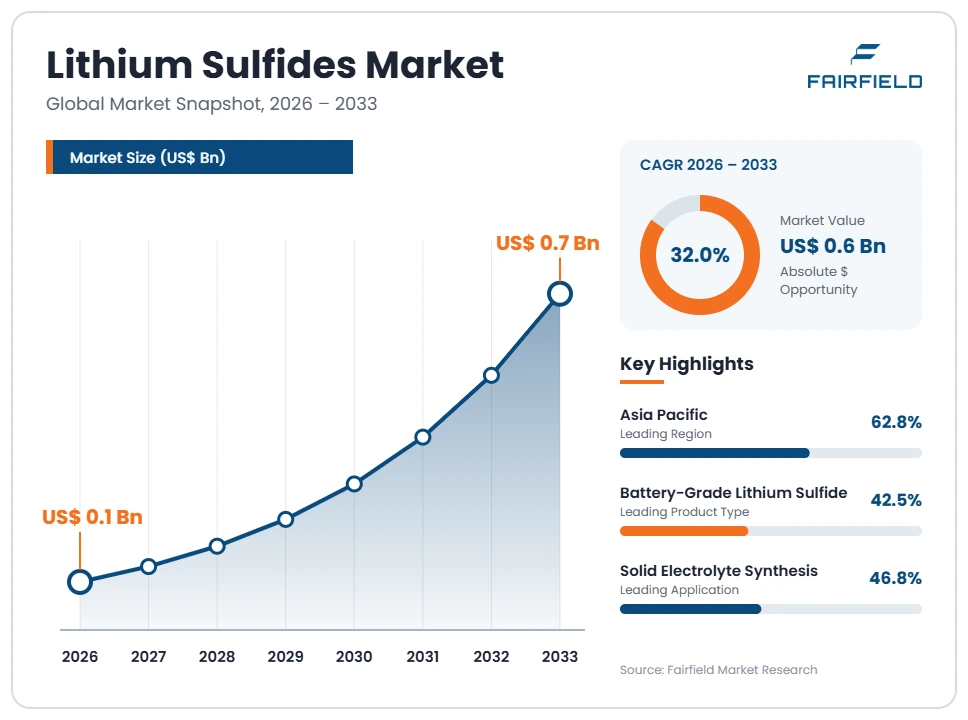
The global Lithium Sulfides market size is expected to be valued at US$ 0.1 billion in 2026 and projected to reach US$ 0.7 billion by 2033, growing at a CAGR of 32.0% between 2026 and 2033.
That base is genuinely small, roughly a hundred million dollars, and it is pilot-scale. Lithium sulfide today supplies sample quantities, laboratory programmes and pilot electrolyte lines, not gigafactories. Between 2020 and 2025 demand grew quickly in percentage terms from almost nothing, as solid-state battery development programmes multiplied. The forecast rests on one condition: sulfide-based solid-state cells reaching series production. That has not happened. Oxide, polymer and halide electrolytes remain live alternatives, so sulfide’s eventual share is unresolved. Growth is therefore high in rate and modest in dollars, and the figures should be read as a qualification-volume market rather than a commodity one.
Key Report Takeaways
- By Product Type: Battery-Grade Lithium Sulfide held 42.5% share in 2026, while Argyrodite-Type Sulfide Electrolytes are projected to expand at a 37.4% CAGR through 2033, as pilot cell builders buy finished electrolyte rather than precursor.
- By Synthesis Route: Sulfidation of Lithium Hydroxide held 46.2% share in 2026, while Carbothermal Reduction of Lithium Sulfate is projected to grow at a 35.8% CAGR through 2033, because feedstock cost is lower at scale.
- By Application: Sulfide Solid Electrolyte Synthesis held 46.8% share in 2026, while Cell and Pilot Line Qualification is projected to rise at a 36.8% CAGR through 2033, reflecting new prototype lines rather than production demand.
- By End Use: Electrolyte and Materials Producers held 34.6% share in 2026, while Automotive Battery Developers are projected to advance at a 37.2% CAGR through 2033, as carmakers fund internal solid-state programmes.
- By Geography: Asia Pacific held 62.8% share in 2026, while North America is projected to grow at a 35.8% CAGR through 2033, supported by national battery materials funding and start-up pilot lines.
Global Lithium Sulfides Market Trends and Insights
Drivers Impact Analysis
Both drivers below are development-stage forces, and neither yet represents commercial battery production volume.
| Driver | Impact on CAGR Forecast | Geographic Relevance | Impact Timeline |
| Sulfide electrolyte pilot lines consuming qualification quantities | High | Asia Pacific, North America | Medium term 2–4 years |
| National battery materials and critical raw material programmes | Medium | North America, Europe | Long term ≥4 years |
Pilot Electrolyte Lines Are the Only Real Source of Lithium Sulfide Demand
Nearly all current consumption comes from pilot and prototype electrolyte production, and that is the honest demand picture. Cell developers building argyrodite, glass-ceramic and LGPS-type electrolytes buy lithium sulfide in kilogram to tonne quantities to make sample material, run coating trials and build demonstrator pouch and prismatic cells. Orders are intermittent, specification-driven and tied to development milestones rather than to vehicle production schedules.
The mechanism is simple chemistry and programme timing. Sulfide electrolytes are synthesised from lithium sulfide combined with phosphorus pentasulfide and a halide, so every gram of electrolyte requires precursor of matched quality. As each developer moves from gram-scale to pilot-line quantities, consumption steps up by orders of magnitude while remaining tiny in absolute terms. Eventual qualification context is set by cell safety and performance testing frameworks such as IEC 62660 and UL 2580, which developers must eventually satisfy before volume supply agreements can follow.
Battery Materials Security Programmes Are Funding Precursor Qualification Work
Public funding is the second force sustaining demand, because very little of this market would exist on commercial merit alone today. Battery materials and critical raw material programmes in the European Union, the United States, Japan, the Republic of Korea and China support domestic precursor capability, pilot plants and qualification testing. That support converts research interest into actual purchase orders for lithium sulfide and sulfide electrolytes.
The causal link runs through supply-chain policy rather than battery economics. Governments treat lithium chemicals and advanced electrolytes as strategic inputs and fund capability so that any future solid-state supply chain is not entirely imported. The European Union batteries framework adds carbon footprint and due diligence direction that will eventually reach cell materials, pushing developers to document precursor origin early. For suppliers, the practical consequence is that programme funding, not battery demand, currently determines which precursor plants get built.
Restraints Impact Analysis
The restraints below are technical and economic, and they sit alongside an unresolved question about which solid electrolyte family will prevail.
| Restraint | Impact on CAGR Forecast | Geographic Relevance | Impact Timeline |
| Moisture sensitivity, hydrogen sulfide release and controlled handling | High | Global | Long term ≥4 years |
| Severe purity thresholds and very high cost per kilogram | High | Global | Long term ≥4 years |
Moisture Sensitivity and Hydrogen Sulfide Release Drive Handling and Shipping Cost
Handling requirements are the biggest practical barrier to scaling this material. Lithium sulfide is extremely moisture sensitive and reacts with water to release hydrogen sulfide, a toxic and flammable gas. Synthesis, milling, classification, packaging, storage and transfer must therefore take place under dry inert atmosphere in gloveboxes or dry rooms. That requirement raises capital cost per tonne of capacity far above conventional battery chemicals and limits how quickly output can expand.
The specific cost sources are dew-point control, inert gas consumption, sealed packaging and specialised logistics. Dry rooms held at very low dew points consume substantial energy continuously, and operators must manage occupational exposure limits for hydrogen sulfide with monitoring, ventilation and emergency procedures. Shipment is governed by dangerous goods rules for water-reactive solids, which dictate packaging group, container design and documentation. Each of these adds cost that cannot be designed away, only engineered down.
Purity Thresholds and Cost Per Kilogram Keep Lithium Sulfide Far From Commercial Viability
Price is the second hard restraint, and the gap is measured in orders of magnitude rather than percentages. Lithium sulfide currently costs far more per kilogram than the lithium salts used in liquid electrolytes, and electrolyte-grade material commands a further premium. At present pricing, a sulfide solid-state cell cannot compete on cost with a lithium-ion cell, which is why no large commercial supply contract has displaced liquid electrolyte chemistry.
The underlying causes are purity and yield. Trace oxygen, moisture, carbonate, sulfate and metallic contaminants degrade ionic conductivity and can generate gas inside a cell, so specifications run to very low impurity thresholds that force extra purification steps and reject material. Yields from current routes are modest, inert handling adds overhead to every step, and volumes are too small to amortise plant costs. Cost reduction depends on process routes that are still being developed rather than on scale alone.
Market Opportunities
Backward Integration by Electrolyte Producers Opens a Captive Precursor Pool
Electrolyte makers integrating backward into precursor production is the clearest commercial opportunity, because it converts an uncertain merchant market into secured internal supply. Producers of argyrodite and glass-ceramic electrolytes depend entirely on lithium sulfide quality, and buying it on the open market exposes them to both price and specification risk. Making it in-house lets them control impurity profiles, particle size and moisture exposure across the whole chain.
Chemical producers with lithium feedstock positions and inert handling experience are best placed to capture this, and the demand comes from electrolyte and cell developers rather than from carmakers directly. Joint ventures and long-term development agreements are the typical structure, because neither side can justify standalone capacity at current volumes. Dangerous goods transport rules reinforce the logic, since co-locating precursor and electrolyte production removes a difficult shipping step entirely.
Lower-Cost Synthesis Routes Could Unlock Qualification Volumes at Acceptable Prices
Process innovation is the opportunity with the largest potential value, because cost is the single factor keeping sulfide electrolytes out of commercial cells. Routes that start from lithium sulfate or lithium carbonate rather than lithium metal, that use carbothermal or gas-phase reduction, or that recover and recycle sulfur streams, all target a substantially lower cost per kilogram. Any route that reaches electrolyte-grade purity at lower cost changes the technology’s commercial prospects.
Specialty chemical producers and licensors with sulfur process experience can capture this pool, and the customer group is electrolyte producers preparing for pilot-line scale-up. Success depends on proving that cheaper routes still meet impurity thresholds after scale-up, which requires cell-level validation rather than analytical data alone. Regional supply security programmes provide the funding that makes such process development bankable while end demand remains pre-commercial.
Segment Analysis
- By Product Type: Battery-Grade Precursor Leads While Finished Argyrodite Electrolytes Grow Fastest
Battery-Grade Lithium Sulfide held 42.5% of the market in 2026, because most buyers are electrolyte developers who want precursor they can convert themselves using their own proprietary compositions. Ultra-High-Purity Lithium Sulfide serves the most demanding cell programmes, while Technical-Grade material supplies organic synthesis and specialty chemical users who do not need battery specifications.
Argyrodite-Type Sulfide Electrolytes are the fastest-growing product at a 37.4% CAGR through 2033, because cell developers increasingly prefer to buy finished electrolyte rather than build synthesis capability in-house. LGPS-Type and Glass-Ceramic Sulfide Electrolytes follow, each with different conductivity, stability and processing trade-offs. The business implication is a gradual shift in where value sits: today the merchant market is mainly precursor, but as pilot lines mature, more of the revenue moves downstream into formulated electrolyte sold by the kilogram.
- By Synthesis Route: Hydroxide Sulfidation Dominates as Sulfate Reduction Scales
Sulfidation of Lithium Hydroxide held 46.2% share in 2026, because it is the best-established industrial route and delivers the low oxygen and carbonate levels that electrolyte-grade material demands. Direct reaction of lithium metal with sulfur is used where the highest purity is needed, but lithium metal cost and handling risk restrict it to small quantities, while Solution-Phase and Wet-Chemical Routes remain largely developmental.
Carbothermal Reduction of Lithium Sulfate is the fastest-growing route at a 35.8% CAGR to 2033, because lithium sulfate is a cheaper and more abundant feedstock, and because sulfate streams arise within existing lithium refining. The challenge is residual carbon and sulfate after reduction, which must be driven to very low levels. The commercial stake is large: whichever route first proves electrolyte-grade purity at materially lower cost will shape the industry’s cost structure for a decade.
- By Application: Electrolyte Synthesis Leads While Pilot Line Qualification Expands Quickest
Sulfide Solid Electrolyte Synthesis accounted for 46.8% of consumption in 2026, since converting precursor into argyrodite, glass-ceramic or LGPS-type electrolyte is the dominant use. Organic Synthesis and Specialty Chemicals form a small but genuinely commercial base, using lithium sulfide as a sulfur transfer and thiolation reagent, and Research and Academic Use absorbs steady gram-scale quantities.
Cell and Pilot Line Qualification is the fastest-growing application at a 36.8% CAGR through 2033, as developers move from coin cells to multi-ampere-hour pouch and prismatic formats and consume far more material per experiment. Lithium Sulfur Battery Materials, including prelithiation and sulfur cathode work, add a separate development pull. The honest reading is that almost all of this demand remains qualification demand, and it converts into production volume only if sulfide cells reach manufacturing scale.
- By End Use: Materials Producers Buy Most Today While Carmakers Grow Fastest
Electrolyte and Materials Producers held 34.6% of demand in 2026, because they sit between precursor supply and cell manufacturing and buy the largest single quantities for synthesis and process development. Cell and Battery Manufacturers follow, running internal solid-state programmes, while Research Institutes and National Laboratories and Chemical and Pharmaceutical Manufacturers account for the remainder.
Automotive Battery Developers are the fastest-growing end user at a 37.2% CAGR to 2033, as vehicle makers fund in-house solid-state teams, build prototype lines and buy precursor directly to retain control of cell chemistry. Consumer Electronics and Medical Device Developers represent a smaller but earlier-adopting group, because small cells tolerate higher material cost. The implication for suppliers is that customer concentration is extreme: a handful of programmes can move a large share of annual volume, and a single cancelled programme can remove it.
Geography Analysis
- Which Region Is Growing Fastest in the Lithium Sulfides Market?
North America is the fastest-growing geography in the lithium sulfides market, expanding at a 35.8% CAGR to 2033 from an 18.4% share in 2026. The United States accounts for almost all of that activity through solid-state battery start-ups, national laboratory programmes and specialty chemical suppliers that provide precursor at research and pilot scale. Federal battery materials funding and critical minerals policy have directly financed pilot lines and precursor qualification work, which is why growth outpaces the global rate from a small base. Canada contributes lithium chemical refining capability that could feed precursor production later. The constraint is that domestic capacity for electrolyte-grade lithium sulfide remains very limited, so developers import or make material themselves. The opportunity is qualified domestic supply tied to procurement and content requirements.
- Why European Battery Policy Rather Than Volume Drives Regional Demand
Europe held 15.2% of demand in 2026, concentrated in Germany, France, the Netherlands and the Nordic countries, where automotive groups, research institutes and battery start-ups run solid-state development programmes. Demand is policy-led rather than volume-led. The regional batteries framework introduces carbon footprint declaration, recycled content and due diligence expectations that will eventually reach cell materials, and critical raw materials policy sets benchmarks for domestic processing of strategic inputs including lithium. Those rules push developers to document precursor origin and environmental performance long before commercial supply exists. Dangerous goods rules for water-reactive solids are applied strictly across the region, raising inbound logistics cost. The opportunity is a European precursor plant positioned to satisfy both qualification needs and future content expectations for cell materials.
- Which Region Is Leading the Lithium Sulfides Market?
Asia Pacific leads the lithium sulfides market with 62.8% share in 2026, because the region hosts the deepest concentration of sulfide electrolyte expertise and the companies that have worked on this chemistry longest. Japan is the single most important source, with established producers of lithium sulfide and argyrodite electrolytes and a long record of sulfide solid-state research. The Republic of Korea contributes cell makers running advanced pilot lines and materials groups scaling electrolyte synthesis. China is expanding rapidly through lithium chemical producers and battery manufacturers exploring sulfide alongside oxide and polymer routes, supported by state battery materials programmes. Regional strength is reinforced by proximity between precursor supply, electrolyte synthesis and cell assembly, which avoids shipping a water-reactive solid across borders.
- Upstream Lithium Resources Without Downstream Precursor Conversion in Latin America
Latin America accounted for 1.9% of demand in 2026, and almost none of that is precursor conversion. Chile, Argentina and Bolivia hold a large share of global lithium brine resources and supply carbonate and hydroxide into the battery chain, but lithium sulfide production requires sulfur chemistry, inert handling and electrolyte-grade purification capability that the region does not yet have. Brazil adds modest specialty chemical and research activity. The barriers are specific: no local solid-state cell development to pull demand, limited dry-room infrastructure, and dangerous goods logistics that make importing small research quantities expensive. The realistic opportunity is further downstream processing of lithium chemicals, which would be the necessary first step before any precursor conversion could be justified locally.
- Minimal Activity and Import Dependence Across Middle East & Africa
Middle East & Africa represented 1.7% of the market in 2026, the smallest share, and activity is confined to university and institute research alongside small volumes of technical-grade material used in specialty chemistry. Saudi Arabia and the United Arab Emirates have announced broad battery and advanced materials ambitions as part of industrial diversification, and both have chemical industry infrastructure that could in principle support sulfur-based processing. South Africa hosts limited electrochemical research capability. The barriers are the absence of any local cell development programme, no dry-room or inert handling capacity at production scale, and complete reliance on imported material under dangerous goods rules. The opportunity is long-dated and tied to whether regional battery manufacturing investment eventually extends to advanced materials rather than cell assembly alone.
Competitive Landscape
The lithium sulfides market is highly concentrated, which is normal for a pre-commercial material. A small number of Japanese chemical and smelting companies have produced lithium sulfide and sulfide electrolytes for years and hold the deepest process knowledge. Alongside them sit a handful of solid-state battery developers that make their own electrolyte, a few lithium chemical producers adding precursor capability, and research chemical suppliers that sell small quantities at catalogue prices. There is no merchant commodity market, and prices are negotiated programme by programme.
Competition is based on purity consistency, particle characteristics, moisture control through the supply chain and the ability to deliver reproducible lots at increasing scale. Buyers qualify a supplier against cell performance, not against a certificate of analysis alone, so demonstrated lot-to-lot consistency matters more than headline purity. Secure, documented supply is a further differentiator, because a developer cannot risk a specification change mid-programme. New entrants are appearing from two directions: specialty chemical firms with sulfur process experience, and lithium refiners seeking to move downstream.
Strategic activity concentrates on capability building rather than market share. The recurring patterns are joint development agreements between precursor makers and electrolyte producers, co-location of synthesis and conversion to avoid shipping a water-reactive solid, and process development aimed at cheaper feedstocks. Several participants hedge by working on more than one electrolyte family at once, because oxide, polymer and halide systems have not been eliminated and the eventual winner is not known.
Strategic direction therefore favours optionality: modest, flexible capacity, close customer coupling and cost reduction work, rather than large committed plants built for a demand curve that has not yet appeared.
Recent Industry Developments
- February 2024: The European Union batteries framework became applicable, beginning phased carbon footprint, recycled content and supply chain due diligence obligations – extending documentation expectations down the value chain toward cell materials including electrolyte precursors.
- May 2024: The European Union critical raw materials framework entered into force, setting benchmarks for domestic extraction, processing and recycling of strategic materials including lithium – strengthening the policy case for regional precursor and electrolyte capacity.
- January 2025: The 2025 edition of the European agreement concerning the international carriage of dangerous goods by road took effect – reaffirming the packaging, labelling and documentation requirements that govern shipment of water-reactive solids such as lithium sulfide.
Companies Covered in the Report
- Idemitsu Kosan Co., Ltd.
- Mitsui Mining & Smelting Co., Ltd.
- Albemarle Corporation
- Ganfeng Lithium Group Co., Ltd.
- Nippon Chemical Industrial Co., Ltd.
- Solid Power, Inc.
- Ampcera Inc.
- NEI Corporation
- American Elements
- Merck KGaA
- Thermo Fisher Scientific Inc.
- Lorad Chemical Corporation
Lithium Sulfides Market Report Scope
| Metric | Value |
| Study Period | 2020–2033 |
| Market Size 2026 | US$ 0.1 Billion |
| Market Size 2033 | US$ 0.7 Billion |
| CAGR 2026–2033 | 32.0% |
| Absolute Dollar Opportunity | US$ 0.6 Billion |
| Largest Market | Asia Pacific (62.8% share in 2026) |
| Fastest-Growing Market | North America (35.8% CAGR) |
| Market Concentration | High |
| Major Players | Idemitsu Kosan Co., Ltd., Mitsui Mining & Smelting Co., Ltd., Albemarle Corporation, Solid Power, Inc. |
Lithium Sulfides Market Segmentation
Product Type
- Battery-Grade Lithium Sulfide
- Ultra-High-Purity Lithium Sulfide
- Technical-Grade Lithium Sulfide
- Argyrodite-Type Sulfide Electrolytes
- LGPS-Type and Glass-Ceramic Sulfide Electrolytes
Synthesis Route
- Sulfidation of Lithium Hydroxide
- Direct Reaction of Lithium Metal with Sulfur
- Carbothermal Reduction of Lithium Sulfate
- Solution-Phase and Wet-Chemical Routes
Application
- Sulfide Solid Electrolyte Synthesis
- Cell and Pilot Line Qualification
- Lithium Sulfur Battery Materials
- Organic Synthesis and Specialty Chemicals
- Research and Academic Use
End Use
- Electrolyte and Materials Producers
- Cell and Battery Manufacturers
- Automotive Battery Developers
- Consumer Electronics and Medical Device Developers
- Research Institutes and National Laboratories
- Chemical and Pharmaceutical Manufacturers
Regions
- North America
- Europe
- Asia Pacific
- Latin America
- Middle East & Africa
- Executive Summary
- Global Lithium Sulfides Market Snapshot
- Future Projections, 2026-2033
- Key Market Trends
- Regional Snapshot
- Market Overview
- Market Definition and Report Scope
- Historical Market Trends, 2020-2025
- Market Dynamics
- Drivers Impact Analysis
- Pilot Electrolyte Lines Are the Only Real Source of Lithium Sulfide Demand
- Battery Materials Security Programmes Are Funding Precursor Qualification Work
- Restraints Impact Analysis
- Moisture Sensitivity and Hydrogen Sulfide Release Drive Handling and Shipping Cost
- Purity Thresholds and Cost Per Kilogram Keep Lithium Sulfide Far From Commercial Viability
- Market Opportunities
- Backward Integration by Electrolyte Producers Opens a Captive Precursor Pool
- Lower-Cost Synthesis Routes Could Unlock Qualification Volumes at Acceptable Prices
- Drivers Impact Analysis
- Global Lithium Sulfides Market Outlook, 2020-2033
- Global Lithium Sulfides Market Outlook, by Product Type, Value (US$ Billion), 2020-2033
- Battery-Grade Lithium Sulfide
- Ultra-High-Purity Lithium Sulfide
- Technical-Grade Lithium Sulfide
- Argyrodite-Type Sulfide Electrolytes
- LGPS-Type and Glass-Ceramic Sulfide Electrolytes
- Global Lithium Sulfides Market Outlook, by Synthesis Route, Value (US$ Billion), 2020-2033
- Sulfidation of Lithium Hydroxide
- Direct Reaction of Lithium Metal with Sulfur
- Carbothermal Reduction of Lithium Sulfate
- Solution-Phase and Wet-Chemical Routes
- Global Lithium Sulfides Market Outlook, by Application, Value (US$ Billion), 2020-2033
- Sulfide Solid Electrolyte Synthesis
- Cell and Pilot Line Qualification
- Lithium Sulfur Battery Materials
- Organic Synthesis and Specialty Chemicals
- Research and Academic Use
- Global Lithium Sulfides Market Outlook, by End Use, Value (US$ Billion), 2020-2033
- Electrolyte and Materials Producers
- Cell and Battery Manufacturers
- Automotive Battery Developers
- Consumer Electronics and Medical Device Developers
- Research Institutes and National Laboratories
- Chemical and Pharmaceutical Manufacturers
- Global Lithium Sulfides Market Outlook, by Region, Value (US$ Billion), 2020-2033
- North America
- Europe
- Asia Pacific
- Latin America
- Middle East & Africa
- Global Lithium Sulfides Market Outlook, by Product Type, Value (US$ Billion), 2020-2033
- North America Lithium Sulfides Market Outlook, 2020-2033
- North America Lithium Sulfides Market Outlook, by Product Type, Value (US$ Billion), 2020-2033
- Battery-Grade Lithium Sulfide
- Ultra-High-Purity Lithium Sulfide
- Technical-Grade Lithium Sulfide
- Argyrodite-Type Sulfide Electrolytes
- LGPS-Type and Glass-Ceramic Sulfide Electrolytes
- North America Lithium Sulfides Market Outlook, by Synthesis Route, Value (US$ Billion), 2020-2033
- Sulfidation of Lithium Hydroxide
- Direct Reaction of Lithium Metal with Sulfur
- Carbothermal Reduction of Lithium Sulfate
- Solution-Phase and Wet-Chemical Routes
- North America Lithium Sulfides Market Outlook, by Application, Value (US$ Billion), 2020-2033
- Sulfide Solid Electrolyte Synthesis
- Cell and Pilot Line Qualification
- Lithium Sulfur Battery Materials
- Organic Synthesis and Specialty Chemicals
- Research and Academic Use
- North America Lithium Sulfides Market Outlook, by End Use, Value (US$ Billion), 2020-2033
- Electrolyte and Materials Producers
- Cell and Battery Manufacturers
- Automotive Battery Developers
- Consumer Electronics and Medical Device Developers
- Research Institutes and National Laboratories
- Chemical and Pharmaceutical Manufacturers
- North America Lithium Sulfides Market Outlook, by Country, Value (US$ Billion), 2020-2033
- United States Lithium Sulfides Market Outlook, by Product Type, 2020-2033
- United States Lithium Sulfides Market Outlook, by Synthesis Route, 2020-2033
- United States Lithium Sulfides Market Outlook, by Application, 2020-2033
- United States Lithium Sulfides Market Outlook, by End Use, 2020-2033
- Canada Lithium Sulfides Market Outlook, by Product Type, 2020-2033
- Canada Lithium Sulfides Market Outlook, by Synthesis Route, 2020-2033
- Canada Lithium Sulfides Market Outlook, by Application, 2020-2033
- Canada Lithium Sulfides Market Outlook, by End Use, 2020-2033
- North America Lithium Sulfides Market Outlook, by Product Type, Value (US$ Billion), 2020-2033
- Europe Lithium Sulfides Market Outlook, 2020-2033
- Europe Lithium Sulfides Market Outlook, by Product Type, Value (US$ Billion), 2020-2033
- Battery-Grade Lithium Sulfide
- Ultra-High-Purity Lithium Sulfide
- Technical-Grade Lithium Sulfide
- Argyrodite-Type Sulfide Electrolytes
- LGPS-Type and Glass-Ceramic Sulfide Electrolytes
- Europe Lithium Sulfides Market Outlook, by Synthesis Route, Value (US$ Billion), 2020-2033
- Sulfidation of Lithium Hydroxide
- Direct Reaction of Lithium Metal with Sulfur
- Carbothermal Reduction of Lithium Sulfate
- Solution-Phase and Wet-Chemical Routes
- Europe Lithium Sulfides Market Outlook, by Application, Value (US$ Billion), 2020-2033
- Sulfide Solid Electrolyte Synthesis
- Cell and Pilot Line Qualification
- Lithium Sulfur Battery Materials
- Organic Synthesis and Specialty Chemicals
- Research and Academic Use
- Europe Lithium Sulfides Market Outlook, by End Use, Value (US$ Billion), 2020-2033
- Electrolyte and Materials Producers
- Cell and Battery Manufacturers
- Automotive Battery Developers
- Consumer Electronics and Medical Device Developers
- Research Institutes and National Laboratories
- Chemical and Pharmaceutical Manufacturers
- Europe Lithium Sulfides Market Outlook, by Country and Subregion, Value (US$ Billion), 2020-2033
- Germany Lithium Sulfides Market Outlook, by Product Type, 2020-2033
- Germany Lithium Sulfides Market Outlook, by Synthesis Route, 2020-2033
- Germany Lithium Sulfides Market Outlook, by Application, 2020-2033
- Germany Lithium Sulfides Market Outlook, by End Use, 2020-2033
- France Lithium Sulfides Market Outlook, by Product Type, 2020-2033
- France Lithium Sulfides Market Outlook, by Synthesis Route, 2020-2033
- France Lithium Sulfides Market Outlook, by Application, 2020-2033
- France Lithium Sulfides Market Outlook, by End Use, 2020-2033
- Netherlands Lithium Sulfides Market Outlook, by Product Type, 2020-2033
- Netherlands Lithium Sulfides Market Outlook, by Synthesis Route, 2020-2033
- Netherlands Lithium Sulfides Market Outlook, by Application, 2020-2033
- Netherlands Lithium Sulfides Market Outlook, by End Use, 2020-2033
- Nordic countries Lithium Sulfides Market Outlook, by Product Type, 2020-2033
- Nordic countries Lithium Sulfides Market Outlook, by Synthesis Route, 2020-2033
- Nordic countries Lithium Sulfides Market Outlook, by Application, 2020-2033
- Nordic countries Lithium Sulfides Market Outlook, by End Use, 2020-2033
- Europe Lithium Sulfides Market Outlook, by Product Type, Value (US$ Billion), 2020-2033
- Asia Pacific Lithium Sulfides Market Outlook, 2020-2033
- Asia Pacific Lithium Sulfides Market Outlook, by Product Type, Value (US$ Billion), 2020-2033
- Battery-Grade Lithium Sulfide
- Ultra-High-Purity Lithium Sulfide
- Technical-Grade Lithium Sulfide
- Argyrodite-Type Sulfide Electrolytes
- LGPS-Type and Glass-Ceramic Sulfide Electrolytes
- Asia Pacific Lithium Sulfides Market Outlook, by Synthesis Route, Value (US$ Billion), 2020-2033
- Sulfidation of Lithium Hydroxide
- Direct Reaction of Lithium Metal with Sulfur
- Carbothermal Reduction of Lithium Sulfate
- Solution-Phase and Wet-Chemical Routes
- Asia Pacific Lithium Sulfides Market Outlook, by Application, Value (US$ Billion), 2020-2033
- Sulfide Solid Electrolyte Synthesis
- Cell and Pilot Line Qualification
- Lithium Sulfur Battery Materials
- Organic Synthesis and Specialty Chemicals
- Research and Academic Use
- Asia Pacific Lithium Sulfides Market Outlook, by End Use, Value (US$ Billion), 2020-2033
- Electrolyte and Materials Producers
- Cell and Battery Manufacturers
- Automotive Battery Developers
- Consumer Electronics and Medical Device Developers
- Research Institutes and National Laboratories
- Chemical and Pharmaceutical Manufacturers
- Asia Pacific Lithium Sulfides Market Outlook, by Country, Value (US$ Billion), 2020-2033
- Japan Lithium Sulfides Market Outlook, by Product Type, 2020-2033
- Japan Lithium Sulfides Market Outlook, by Synthesis Route, 2020-2033
- Japan Lithium Sulfides Market Outlook, by Application, 2020-2033
- Japan Lithium Sulfides Market Outlook, by End Use, 2020-2033
- Republic of Korea Lithium Sulfides Market Outlook, by Product Type, 2020-2033
- Republic of Korea Lithium Sulfides Market Outlook, by Synthesis Route, 2020-2033
- Republic of Korea Lithium Sulfides Market Outlook, by Application, 2020-2033
- Republic of Korea Lithium Sulfides Market Outlook, by End Use, 2020-2033
- China Lithium Sulfides Market Outlook, by Product Type, 2020-2033
- China Lithium Sulfides Market Outlook, by Synthesis Route, 2020-2033
- China Lithium Sulfides Market Outlook, by Application, 2020-2033
- China Lithium Sulfides Market Outlook, by End Use, 2020-2033
- Asia Pacific Lithium Sulfides Market Outlook, by Product Type, Value (US$ Billion), 2020-2033
- Latin America Lithium Sulfides Market Outlook, 2020-2033
- Latin America Lithium Sulfides Market Outlook, by Product Type, Value (US$ Billion), 2020-2033
- Battery-Grade Lithium Sulfide
- Ultra-High-Purity Lithium Sulfide
- Technical-Grade Lithium Sulfide
- Argyrodite-Type Sulfide Electrolytes
- LGPS-Type and Glass-Ceramic Sulfide Electrolytes
- Latin America Lithium Sulfides Market Outlook, by Synthesis Route, Value (US$ Billion), 2020-2033
- Sulfidation of Lithium Hydroxide
- Direct Reaction of Lithium Metal with Sulfur
- Carbothermal Reduction of Lithium Sulfate
- Solution-Phase and Wet-Chemical Routes
- Latin America Lithium Sulfides Market Outlook, by Application, Value (US$ Billion), 2020-2033
- Sulfide Solid Electrolyte Synthesis
- Cell and Pilot Line Qualification
- Lithium Sulfur Battery Materials
- Organic Synthesis and Specialty Chemicals
- Research and Academic Use
- Latin America Lithium Sulfides Market Outlook, by End Use, Value (US$ Billion), 2020-2033
- Electrolyte and Materials Producers
- Cell and Battery Manufacturers
- Automotive Battery Developers
- Consumer Electronics and Medical Device Developers
- Research Institutes and National Laboratories
- Chemical and Pharmaceutical Manufacturers
- Latin America Lithium Sulfides Market Outlook, by Country, Value (US$ Billion), 2020-2033
- Chile Lithium Sulfides Market Outlook, by Product Type, 2020-2033
- Chile Lithium Sulfides Market Outlook, by Synthesis Route, 2020-2033
- Chile Lithium Sulfides Market Outlook, by Application, 2020-2033
- Chile Lithium Sulfides Market Outlook, by End Use, 2020-2033
- Argentina Lithium Sulfides Market Outlook, by Product Type, 2020-2033
- Argentina Lithium Sulfides Market Outlook, by Synthesis Route, 2020-2033
- Argentina Lithium Sulfides Market Outlook, by Application, 2020-2033
- Argentina Lithium Sulfides Market Outlook, by End Use, 2020-2033
- Bolivia Lithium Sulfides Market Outlook, by Product Type, 2020-2033
- Bolivia Lithium Sulfides Market Outlook, by Synthesis Route, 2020-2033
- Bolivia Lithium Sulfides Market Outlook, by Application, 2020-2033
- Bolivia Lithium Sulfides Market Outlook, by End Use, 2020-2033
- Brazil Lithium Sulfides Market Outlook, by Product Type, 2020-2033
- Brazil Lithium Sulfides Market Outlook, by Synthesis Route, 2020-2033
- Brazil Lithium Sulfides Market Outlook, by Application, 2020-2033
- Brazil Lithium Sulfides Market Outlook, by End Use, 2020-2033
- Latin America Lithium Sulfides Market Outlook, by Product Type, Value (US$ Billion), 2020-2033
- Middle East & Africa Lithium Sulfides Market Outlook, 2020-2033
- Middle East & Africa Lithium Sulfides Market Outlook, by Product Type, Value (US$ Billion), 2020-2033
- Battery-Grade Lithium Sulfide
- Ultra-High-Purity Lithium Sulfide
- Technical-Grade Lithium Sulfide
- Argyrodite-Type Sulfide Electrolytes
- LGPS-Type and Glass-Ceramic Sulfide Electrolytes
- Middle East & Africa Lithium Sulfides Market Outlook, by Synthesis Route, Value (US$ Billion), 2020-2033
- Sulfidation of Lithium Hydroxide
- Direct Reaction of Lithium Metal with Sulfur
- Carbothermal Reduction of Lithium Sulfate
- Solution-Phase and Wet-Chemical Routes
- Middle East & Africa Lithium Sulfides Market Outlook, by Application, Value (US$ Billion), 2020-2033
- Sulfide Solid Electrolyte Synthesis
- Cell and Pilot Line Qualification
- Lithium Sulfur Battery Materials
- Organic Synthesis and Specialty Chemicals
- Research and Academic Use
- Middle East & Africa Lithium Sulfides Market Outlook, by End Use, Value (US$ Billion), 2020-2033
- Electrolyte and Materials Producers
- Cell and Battery Manufacturers
- Automotive Battery Developers
- Consumer Electronics and Medical Device Developers
- Research Institutes and National Laboratories
- Chemical and Pharmaceutical Manufacturers
- Middle East & Africa Lithium Sulfides Market Outlook, by Country, Value (US$ Billion), 2020-2033
- Saudi Arabia Lithium Sulfides Market Outlook, by Product Type, 2020-2033
- Saudi Arabia Lithium Sulfides Market Outlook, by Synthesis Route, 2020-2033
- Saudi Arabia Lithium Sulfides Market Outlook, by Application, 2020-2033
- Saudi Arabia Lithium Sulfides Market Outlook, by End Use, 2020-2033
- United Arab Emirates Lithium Sulfides Market Outlook, by Product Type, 2020-2033
- United Arab Emirates Lithium Sulfides Market Outlook, by Synthesis Route, 2020-2033
- United Arab Emirates Lithium Sulfides Market Outlook, by Application, 2020-2033
- United Arab Emirates Lithium Sulfides Market Outlook, by End Use, 2020-2033
- South Africa Lithium Sulfides Market Outlook, by Product Type, 2020-2033
- South Africa Lithium Sulfides Market Outlook, by Synthesis Route, 2020-2033
- South Africa Lithium Sulfides Market Outlook, by Application, 2020-2033
- South Africa Lithium Sulfides Market Outlook, by End Use, 2020-2033
- Middle East & Africa Lithium Sulfides Market Outlook, by Product Type, Value (US$ Billion), 2020-2033
- Competitive Landscape
- Market Concentration and Industry Leaders
- Competitive Differentiation
- Strategic Initiatives
- Recent Industry Developments
- Company Profiles
- Idemitsu Kosan Co., Ltd.
- Mitsui Mining & Smelting Co., Ltd.
- Albemarle Corporation
- Ganfeng Lithium Group Co., Ltd.
- Nippon Chemical Industrial Co., Ltd.
- Solid Power, Inc.
- Ampcera Inc.
- NEI Corporation
- American Elements
- Merck KGaA
- Thermo Fisher Scientific Inc.
- Lorad Chemical Corporation
- Appendix
- Research Methodology
- Report Assumptions
- Acronyms and Abbreviations
Product Type
- Battery-Grade Lithium Sulfide
- Ultra-High-Purity Lithium Sulfide
- Technical-Grade Lithium Sulfide
- Argyrodite-Type Sulfide Electrolytes
- LGPS-Type and Glass-Ceramic Sulfide Electrolytes
Synthesis Route
- Sulfidation of Lithium Hydroxide
- Direct Reaction of Lithium Metal with Sulfur
- Carbothermal Reduction of Lithium Sulfate
- Solution-Phase and Wet-Chemical Routes
Application
- Sulfide Solid Electrolyte Synthesis
- Cell and Pilot Line Qualification
- Lithium Sulfur Battery Materials
- Organic Synthesis and Specialty Chemicals
- Research and Academic Use
End Use
- Electrolyte and Materials Producers
- Cell and Battery Manufacturers
- Automotive Battery Developers
- Consumer Electronics and Medical Device Developers
- Research Institutes and National Laboratories
- Chemical and Pharmaceutical Manufacturers
Regions
- North America
- Europe
- Asia Pacific
- Latin America
- Middle East & Africa
Our Research Methodology
Considering the volatility of business today, traditional approaches to strategizing a game plan can be unfruitful if not detrimental. True ambiguity is no way to determine a forecast. A myriad of predetermined factors must be accounted for such as the degree of risk involved, the magnitude of circumstances, as well as conditions or consequences that are not known or unpredictable. To circumvent binary views that cast uncertainty, the application of market research intelligence to strategically posture, move, and enable actionable outcomes is necessary.
View Methodology
Quality Assured
Rigorous Validation Process

Confidentiality Assured
End-to-end Data Security

Custom Research Services
Tailored To Your Objectives
FAQs
The market is valued at US$ 0.1 billion in 2026, a pilot-scale base supplying sample and development quantities rather than commercial battery production.
The market is projected to reach US$ 0.7 billion by 2033, a 32.0% CAGR, adding US$ 0.6 billion of absolute opportunity from a tiny base.
Battery-Grade Lithium Sulfide leads with 42.5% share in 2026, because electrolyte developers prefer to convert precursor using their own proprietary compositions.
Argyrodite-Type Sulfide Electrolytes grow fastest at a 37.4% CAGR, while North America is the quickest region at 35.8% through 2033.
Concentration is high, with few qualified producers, programme-by-programme pricing, and no settled answer on which solid electrolyte family will prevail.
Related Reports
Personal Care Ingredients Market Size, Share, Insights, Competitive Landscape, and Forecast 2026 to 2033
The global personal care ingredients market is valued at US$18.6 billion in 2026, reaching US$28.2 billion by 2033, growing at a 6.1% CAGR
Medical Polymer Market Size, Share, Insights, Competitive Landscape, and Forecast 2026 to 2033
The global medical polymer market is valued at US$27.4 billion in 2026, reaching US$47.8 billion by 2033, growing at an 8.3% CAGR
Single Coated Adhesive Tapes Market Size, Share, Insights, Competitive Landscape, and Forecast 2026 to 2033
The global single coated adhesive tapes market is valued at US$36.0 billion in 2026, reaching US$51.0 billion by 2033, growing at a 5.1% CAGR
Non-Woven Abrasives Market Size, Share, Insights, Competitive Landscape, and Forecast 2026 to 2033
Non-Woven Abrasives Market is projected to grow from US$ 2.89 billion in 2026 to US$ 4.03 billion by 2033 at a 4.9% CAGR. See key products and trends.
Agricultural Lubricant Market Size, Share, Insights, Competitive Landscape, and Forecast 2026 to 2033
The agricultural lubricant market is valued at US$ 6.58 billion in 2026 and projected to reach US$ 8.71 billion by 2033 at a CAGR of 4.1%.
Acaricides Market Size, Share, Insights, Competitive Landscape, and Forecast 2026 to 2033
Explore the acaricides market, valued at US$ 393.98 million in 2026 and projected to reach US$ 521.95 million by 2033 at a CAGR of 4.1%.