



Medical Polymer Market
Medical Polymer Market Size, Share, Insights, Competitive Landscape, and Forecast 2026 to 2033
Medical Polymer Market Size and Trend Analysis
What Is the Growth Outlook for Medical Grade Plastics?
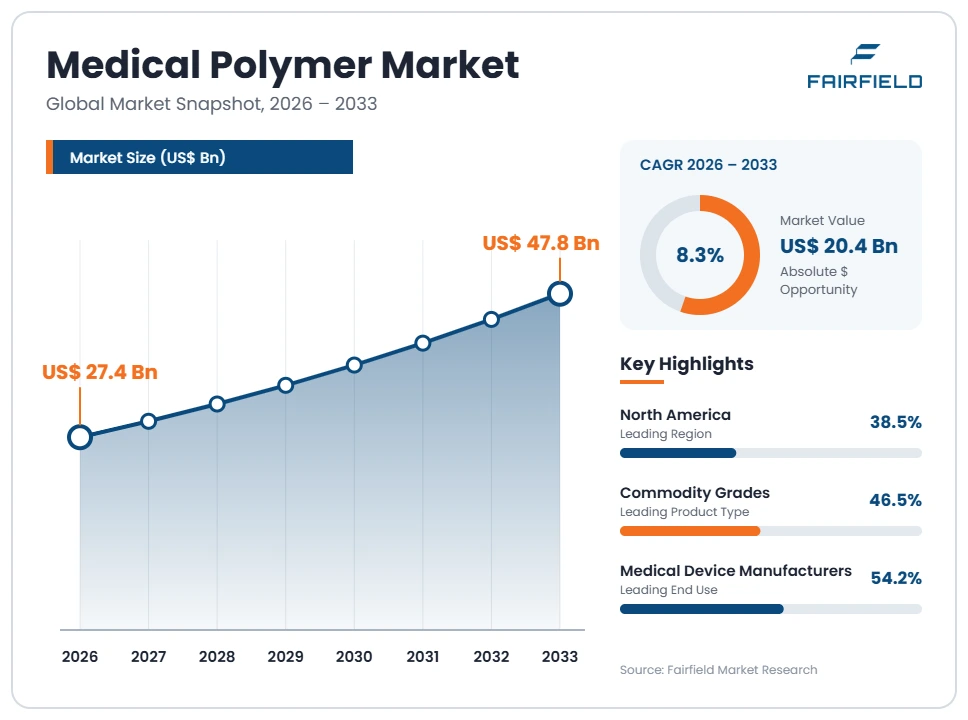
The global Medical Polymer market size is expected to be valued at US$ 27.4 billion in 2026 and projected to reach US$ 47.8 billion by 2033, growing at a CAGR of 8.3% between 2026 and 2033.
Between 2020 and 2025 the market grew at roughly 6.4% a year, as single-use device volumes recovered and pharmaceutical packaging demand climbed. Three factors shape the forecast. Sterilisation policy is changing resin selection, because tighter ethylene oxide emission limits push devices toward radiation and low-temperature routes. Drug delivery systems, wearable injectors and diagnostic consumables use more engineering and high-performance grades per unit. Resorbable polymers and metal replacement widen the implant pool, while high-performance grades continue to displace stainless steel in instruments and spinal hardware. Direction is steady rather than explosive, since qualification cycles are long, change control is slow and validated materials rarely move, but the overall mix is shifting toward higher-value healthcare polymers.
Key Report Takeaways
- By Product Type: Commodity Grades held 46.5% share in 2026, while Resorbable Polymers are projected to expand at a 12.6% CAGR through 2033, driven by fixation implants and long-acting injectable depot systems.
- By Application: Disposables and Single-Use Devices held 28.4% share in 2026, while Syringes and Drug Delivery is projected to grow at an 11.4% CAGR through 2033, supported by wearable injector platforms.
- By Sterilisation Method Compatibility: Ethylene Oxide held 38.6% share in 2026, while Electron Beam is projected to advance at a 10.9% CAGR through 2033, as device makers move cycles away from gas sterilisation.
- By End Use: Medical Device Manufacturers held 54.2% share in 2026, while Contract Manufacturing Organisations are projected to rise at a 9.6% CAGR through 2033, reflecting outsourced moulding and assembly.
- By Geography: North America held 38.5% share in 2026, while Asia Pacific is projected to grow at a 10.4% CAGR through 2033, helped by domestic device manufacturing and local resin qualification.
Global Medical Polymer Market Trends and Insights
Drivers Impact Analysis
The two forces below explain most of the incremental demand for medical grade plastics through 2033.
| Driver | Impact on CAGR Forecast | Geographic Relevance | Impact Timeline |
| Tighter ethylene oxide emission rules redirecting sterilisation routes | High | North America, Europe | Medium term 2–4 years |
| Plasticiser restrictions rewriting tubing and bag specifications | Medium | Europe, North America | Long term ≥4 years |
Tighter Ethylene Oxide Emission Rules Are Redirecting Resin Selection
Sterilisation policy is now the strongest single pull on medical polymer demand. Device makers facing tighter ethylene oxide emission limits are moving products to gamma, electron beam and low-temperature methods, and every move forces a resin review. Radiation-stable polypropylene, polycarbonate and polyolefin grades with tailored stabilisation packages replace older compounds, lifting value per kilogram even where unit volumes are flat.
The mechanism is physical rather than commercial. Radiation doses cause chain scission in polypropylene and crosslinking in polyethylene, producing yellowing, embrittlement and odour unless antioxidants and clarifiers are adjusted. ISO 11137 sets the dose validation that exposes these effects, ISO 11135 governs ethylene oxide cycles, and ISO 17665 governs moist heat for autoclavable parts. Because United States Environmental Protection Agency emission standards have constrained commercial gas sterilisation capacity, converters are qualifying radiation-ready grades, and suppliers now sell formulation support alongside the resin.
Plasticiser Restrictions Are Rewriting Tubing and Fluid Management Specifications
Plasticiser rules are changing what buyers will accept in flexible tubing and bags, and that is a direct demand driver for alternatives. Hospitals and device makers increasingly specify non-DEHP formulations or non-PVC constructions for infusion sets, blood bags, enteral feeding lines and extracorporeal circuits. Each respecification shifts volume toward alternative plasticiser systems, polyolefin blends, thermoplastic elastomers and medical silicone, all priced above general purpose flexible PVC.
The cause is regulatory and contractual, not a clinical verdict. Under the European Union device framework, products containing phthalates classified as carcinogenic, mutagenic or toxic for reproduction above a defined threshold must be labelled and the choice justified, which pushes manufacturers to document alternatives. National procurement programmes add further preferences. Suppliers have answered with citrate, trimellitate and polymeric plasticisers, and with polyolefin tubing that meets kink resistance, clarity and bond strength targets, turning compliance work into a materials sales opportunity.
Restraints Impact Analysis
Two structural constraints hold growth below what end-market device demand alone would suggest.
| Restraint | Impact on CAGR Forecast | Geographic Relevance | Impact Timeline |
| Change control turning every material switch into a regulatory event | High | Global | Long term ≥4 years |
| Price gap to industrial grades and concentrated high-performance supply | Medium | Asia Pacific, Latin America | Medium term 2–4 years |
Change Control Makes Switching Medical Device Materials Extremely Slow
Switching cost, not price, is the dominant restraint in this market. Once a resin grade is designed into a device, any change of polymer, grade, additive package, colourant or manufacturing site becomes a documented regulatory event for the device manufacturer. Design history files, biological evaluation, packaging validation and sterilisation validation may all need revisiting, so validated materials often stay in production for a decade or longer.
The underlying cost is verification work rather than raw material spend. A single grade change can require re-running extractables and leachables studies, re-validating the sterilisation dose, repeating accelerated ageing on the package, and notifying a regulator or notified body. USP chapters covering plastic packaging systems and their materials of construction, together with work under ICH Q3E on extractables and leachables, set the evidence expectations. The result is that even clearly better polymers enter slowly, and suppliers must fund long qualification programmes before earning revenue.
Price Gap to Industrial Resins and Narrow High-Performance Supply Limit Adoption
Cost and supply concentration restrain volume growth at both ends of the portfolio. Medical grades carry a premium over chemically identical industrial resins because of change notification commitments, traceability, controlled manufacturing and documentation, and in price-sensitive public tenders that premium limits upgrades. At the top end, PEEK, polysulfone, polyphenylsulfone and liquid crystal polymer come from a small number of qualified plants, so lead times lengthen whenever a single line is disrupted.
The cause is the economics of small, highly regulated volumes. Medical demand is a minor share of most polymer producers’ output, yet it carries disproportionate liability, which makes several suppliers cautious about long-term implant programmes and restricts the grades they will certify for permanent tissue contact. ISO 15378 good manufacturing practice for primary packaging materials adds audited process control on the packaging side. Together these conditions keep qualified capacity thin and give buyers little negotiating room.
Market Opportunities
Resorbable Polymers and Metal Replacement Open a Premium Implant Revenue Pool
Resorbable polymers are the highest-value opportunity in medical device materials, because they sell at specialty prices into procedures that previously used metal. Polylactic acid, polyglycolic acid, their copolymers and polycaprolactone are used in fixation screws, pins, anchors, barrier membranes and drug-eluting matrices. Alongside them, PEEK and polyphenylsulfone continue to replace stainless steel and titanium in spinal cages, trauma hardware and reusable instrument handles.
Suppliers with implant-grade documentation and controlled synthesis capacity are positioned to capture this pool, and the demand comes from orthopaedic, sports medicine, dental and long-acting injectable developers. Degradation profile control is the commercial differentiator, since surgeons need predictable strength retention and clearance. ISO 11137 dose validation matters here too, because radiation shortens polymer chains and alters resorption timing, so suppliers that can guarantee performance after sterilisation win specification positions and multi-year supply agreements.
Wearable Injectors and Prefilled Delivery Systems Create a New Engineering Grade Pool
Drug delivery hardware is becoming a distinct revenue pool for engineering and high-performance grades. Prefilled syringes, autoinjectors, on-body injectors and connected pen systems each use cyclic olefins, polycarbonate, polyamides, polyesters and silicone in combinations that did not exist in volume a decade ago. Because these are combination products, resin choice is tied to drug stability, so material value per device is far above that of a simple disposable.
Pharmaceutical companies and their contract manufacturers create the demand, and polymer producers that can supply extractables and leachables data packages alongside the resin are best placed to serve it. United States Food and Drug Administration and European Union drug contact expectations govern primary container materials, and biologic formulations are sensitive to leachables. Suppliers offering low-extractable grades, documented container closure compatibility and secure capacity convert that technical requirement into durable, specified business.
Segment Analysis
- By Product Type: Commodity Grades Lead While Resorbable Polymers Scale Fastest
Commodity Grades held 46.5% of the medical polymer market in 2026, because medical polyethylene, polypropylene, PVC and polystyrene supply the enormous volume of disposables, trays, bags and tubing used daily in hospitals. Their cost, processability and long regulatory history make them the default for single-use parts. Engineering Grades follow, carrying housings, connectors and diagnostic cartridges, while High-Performance Grades and Elastomers and Silicones serve implants, instruments and sealing.
Resorbable Polymers are the fastest-growing family at a 12.6% CAGR to 2033, from a small base. Demand comes from fixation devices, barrier membranes and depot drug delivery, where controlled degradation removes a second surgery. Supply remains limited to a few producers with implant-grade documentation. The practical implication is a widening value gap: tonnage sits in commodity grades, but margin and growth concentrate in resorbables and high-performance resins.
- By Application: Disposables Hold the Largest Share as Drug Delivery Accelerates
Disposables and Single-Use Devices accounted for 28.4% of demand in 2026, reflecting the sheer volume of syringes, catheters, gloves, trays, drapes and procedure kits consumed by hospitals and clinics. Tubing and Fluid Management, Diagnostic Consumables and Medical and Pharmaceutical Packaging follow, with packaging benefiting from sterile barrier requirements and growing biologic volumes.
Syringes and Drug Delivery is the fastest-growing application at an 11.4% CAGR through 2033, driven by prefilled formats, autoinjectors and on-body devices for chronic therapies. These products use more resin value per unit and demand tighter extractables control than basic disposables. Implants, Orthopaedic and Dental grows steadily on an ageing population and metal replacement, while Wound Care expands with advanced dressings and polymer films. For suppliers, the message is that unit growth sits in disposables, but revenue growth sits in delivery systems.
- By Sterilisation Method Compatibility: Ethylene Oxide Still Leads While Electron Beam Advances
Ethylene Oxide compatible grades held 38.6% share in 2026, because the method processes complex assemblies, long lumens and heat-sensitive electronics at low temperature, and because tens of thousands of devices are validated to it. Steam Autoclave compatibility remains essential for reusable instruments, favouring polyphenylsulfone, polysulfone, PEEK and certain polyamides that survive repeated moist heat cycles.
Electron Beam compatibility is the fastest-growing category at a 10.9% CAGR to 2033, as device makers respond to emission limits on gas sterilisation and to the speed and throughput of in-line beam processing. Gamma remains important where penetration depth matters, while Low-Temperature Alternatives such as vaporised hydrogen peroxide and nitrogen dioxide gain niche positions. The business consequence is clear: stabilisation chemistry, colour stability and dose tolerance have become front-line selling points for sterilisation compatible polymers.
- By End Use: Device Manufacturers Dominate While Contract Manufacturers Grow Quickest
Medical Device Manufacturers held 54.2% of consumption in 2026, since they own the design history files, control material specifications and buy directly from resin producers for high-volume platforms. Pharmaceutical and Biologics Companies form the second group, purchasing primary packaging resins and delivery system components, and they apply the strictest extractables and container closure requirements.
Contract Manufacturing Organisations are the fastest-growing end user at a 9.6% CAGR through 2033, as device owners outsource moulding, extrusion, assembly and packaging to shorten capital cycles. Contract manufacturers increasingly hold the process knowledge for tight-tolerance parts and influence grade selection even when the brand owner signs the specification. Diagnostic and laboratory customers round out demand. For resin suppliers, this shift means technical selling must now target the converter as well as the device brand, because the converter often sets achievable processing windows.
Geography Analysis
- Which Region Is Leading the Medical Polymer Market?
North America leads the medical polymer market with 38.5% share in 2026, because it concentrates device design, regulated moulding capacity and pharmaceutical packaging demand in one place. The United States accounts for most of that volume, supported by a large installed base of sterilisation service providers, a deep contract manufacturing network and reimbursement levels that sustain premium materials. Canada adds diagnostic and orthopaedic manufacturing. Regional demand is being reshaped by United States Environmental Protection Agency emission standards for commercial ethylene oxide sterilisation, which have tightened available gas capacity and pushed programmes toward radiation methods. The opportunity is reformulation: converters re-qualifying products need radiation-stable grades, new stabilisation packages and supporting test data, which favours suppliers with local technical service and documented change notification practices.
- Why Packaging and Device Rules Shape Regional Demand Across Europe
Europe held 26.2% share in 2026, anchored by Germany, Ireland, Switzerland, France and Italy, where device assembly, sterile packaging and pharmaceutical filling capacity cluster. The region sets the pace on material restrictions: phthalate labelling and justification duties under the device framework, strict chemical rules, and ISO 15378 good manufacturing practice for primary packaging materials. Sustainability policy is now a second force, with packaging waste rules pressing converters toward thinner structures, mono-material designs and recycled content wherever sterility and drug contact requirements allow. Market growth is moderate rather than rapid, because conformity assessment capacity is tight and product portfolios are being pruned. The clearest opportunity lies in compliant lower-carbon packaging resins and in non-PVC fluid management systems specified by public hospital buyers.
- Which Region Is Growing Fastest in the Medical Polymer Market?
Asia Pacific is the fastest-growing geography in the medical polymer market, expanding at a 10.4% CAGR to 2033 from a 25.8% share in 2026. China is scaling domestic device manufacturing and procurement policies that favour locally made products, which pulls resin qualification into the region. Japan supplies high-performance and elastomer grades and hosts demanding implant programmes. India is adding large disposables and syringe capacity for domestic and export markets, while the Republic of Korea and Singapore host diagnostic and drug delivery production. Hospital construction and insurance expansion raise procedure volumes across the region. The main constraint is uneven regulatory maturity, which lengthens qualification. The opportunity is local technical service, since converters increasingly want grades qualified and supplied within the region.
- Local Device Assembly and Import Reliance Define Latin America
Latin America accounted for 5.6% of demand in 2026, with Mexico the central manufacturing hub, hosting a large base of contract moulders and assemblers serving export markets, and Brazil the largest domestic consumption market. Argentina, Colombia and Costa Rica add device and diagnostic production, with Costa Rica focused on higher-value devices. Growth tracks healthcare spending and export assembly rather than domestic resin supply. The main barriers are import dependence for medical grades, currency volatility that distorts tender pricing, customs delays on temperature-sensitive materials, and uneven regulatory harmonisation that forces duplicate registrations. The practical opportunity is regional distribution and stocking, since converters pay for guaranteed availability of qualified lots, and for local extrusion of tubing that was previously imported finished.
- Hospital Investment and Limited Local Compounding Shape Middle East & Africa
Middle East & Africa represented 3.9% of the market in 2026, the smallest share, but hospital construction in Saudi Arabia, the United Arab Emirates and Qatar is lifting consumption of disposables, fluid management sets and packaging. South Africa, Egypt and Morocco host modest device and consumables manufacturing. Almost all medical grade resin is imported, and there is very little local compounding or medical-standard moulding capacity, so lead times and freight costs weigh on pricing. Additional barriers include fragmented procurement, limited sterilisation infrastructure outside major cities, and a shortage of trained validation staff. Localisation programmes tied to industrial diversification policy are the main change under way, creating openings for suppliers willing to support new converters through qualification.
Competitive Landscape
The medical polymer market is moderately concentrated. A handful of large chemical producers supply most commodity and engineering grades, while a narrower group controls high-performance resins such as PEEK, polysulfone, polyphenylsulfone and fluoropolymers. Concentration rises sharply as requirements tighten: many suppliers will sell a medical grade for short-term skin contact, far fewer will certify one for implantation. Compounders, distributors and stock shape producers occupy an important middle layer, converting base resins into validated formulations and holding qualified inventory for smaller device makers.
Competition turns on documentation as much as polymer performance. Vendors compete on change notification commitments, regulatory support files, biocompatibility and extractables data packages, lot traceability, supply security and the breadth of grades qualified for each sterilisation route. Price matters mainly in commodity disposables, where medical grades compete against the temptation to use industrial resin. New approaches are coming from specialist resorbable polymer producers, from silicone and thermoplastic elastomer houses targeting PVC replacement, and from compounders offering radiation-stabilised versions of familiar polymers.
Strategic activity is concentrated in capability rather than volume. Suppliers are expanding technical service centres, medical-dedicated production lines and documentation systems, and several have narrowed portfolios to grades they can support with full regulatory files. Partnerships between resin producers and contract manufacturers are becoming the standard route to specification, because the converter controls the processing window. Distribution agreements that guarantee qualified inventory are another competitive lever, particularly for smaller device firms that cannot hold stock.
Strategic direction across the industry points three ways: deeper regulatory support as a paid service, portfolios built around sterilisation route compatibility, and early positioning in lower-carbon and recycled-content packaging materials where regulation permits their use.
Recent Industry Developments
- March 2024: The United States Environmental Protection Agency finalised tighter national emission standards for commercial ethylene oxide sterilisation facilities – the single most important regulatory change for resin selection, because it constrains gas sterilisation capacity and pushes devices toward radiation routes.
- December 2024: The fifth session of the intergovernmental negotiating committee on plastic pollution, convened under the United Nations Environment Programme in Busan, closed without agreed treaty text – leaving the future treatment of single-use medical plastics unresolved and keeping exemption questions open for device and packaging makers.
- February 2025: The European Union packaging and packaging waste regulation entered into force – extending recyclability, minimisation and recycled content obligations across packaging, with derogations that medical and pharmaceutical converters must now map against sterile barrier requirements.
Companies Covered in the Report
- SABIC
- Covestro AG
- Evonik Industries AG
- Celanese Corporation
- BASF SE
- DuPont de Nemours, Inc.
- Victrex plc
- Eastman Chemical Company
- Trinseo PLC
- Arkema S.A.
- Dow Inc.
- Mitsubishi Chemical Group Corporation
- Röhm GmbH
Medical Polymer Market Report Scope
| Metric | Value |
| Study Period | 2020–2033 |
| Market Size 2026 | US$ 27.4 Billion |
| Market Size 2033 | US$ 47.8 Billion |
| CAGR 2026–2033 | 8.3% |
| Absolute Dollar Opportunity | US$ 20.4 Billion |
| Largest Market | North America (38.5% share in 2026) |
| Fastest-Growing Market | Asia Pacific (10.4% CAGR) |
| Market Concentration | Medium |
| Major Players | SABIC, Covestro AG, Evonik Industries AG, Celanese Corporation |
Medical Polymer Market Segmentation
Product Type
- Commodity Grades
- Engineering Grades
- High-Performance Grades
- Elastomers and Silicones
- Resorbable Polymers
Application
- Disposables and Single-Use Devices
- Tubing and Fluid Management
- Syringes and Drug Delivery
- Diagnostic Consumables
- Implants, Orthopaedic and Dental
- Wound Care
- Medical and Pharmaceutical Packaging
Sterilisation Method Compatibility
- Ethylene Oxide
- Gamma Irradiation
- Electron Beam
- Steam Autoclave
- Low-Temperature Alternatives
End Use
- Medical Device Manufacturers
- Pharmaceutical and Biologics Companies
- Contract Manufacturing Organisations
- Diagnostic and Laboratory Providers
Regions
- North America
- Europe
- Asia Pacific
- Latin America
- Middle East & Africa
- Executive Summary
- Global Medical Polymer Market Snapshot
- Future Projections, 2026-2033
- Key Market Trends
- Regional Snapshot
- Market Overview
- Market Definition and Report Scope
- Historical Market Trends, 2020-2025
- Market Dynamics
- Drivers Impact Analysis
- Tighter Ethylene Oxide Emission Rules Are Redirecting Resin Selection
- Plasticiser Restrictions Are Rewriting Tubing and Fluid Management Specifications
- Restraints Impact Analysis
- Change Control Makes Switching Medical Device Materials Extremely Slow
- Price Gap to Industrial Resins and Narrow High-Performance Supply Limit Adoption
- Market Opportunities
- Resorbable Polymers and Metal Replacement Open a Premium Implant Revenue Pool
- Wearable Injectors and Prefilled Delivery Systems Create a New Engineering Grade Pool
- Drivers Impact Analysis
- Global Medical Polymer Market Outlook, 2020-2033
- Global Medical Polymer Market Outlook, by Product Type, Value (US$ Billion), 2020-2033
- Commodity Grades
- Engineering Grades
- High-Performance Grades
- Elastomers and Silicones
- Resorbable Polymers
- Global Medical Polymer Market Outlook, by Application, Value (US$ Billion), 2020-2033
- Disposables and Single-Use Devices
- Tubing and Fluid Management
- Syringes and Drug Delivery
- Diagnostic Consumables
- Implants, Orthopaedic and Dental
- Wound Care
- Medical and Pharmaceutical Packaging
- Global Medical Polymer Market Outlook, by Sterilisation Method Compatibility, Value (US$ Billion), 2020-2033
- Ethylene Oxide
- Gamma Irradiation
- Electron Beam
- Steam Autoclave
- Low-Temperature Alternatives
- Global Medical Polymer Market Outlook, by End Use, Value (US$ Billion), 2020-2033
- Medical Device Manufacturers
- Pharmaceutical and Biologics Companies
- Contract Manufacturing Organisations
- Diagnostic and Laboratory Providers
- Global Medical Polymer Market Outlook, by Region, Value (US$ Billion), 2020-2033
- North America
- Europe
- Asia Pacific
- Latin America
- Middle East & Africa
- Global Medical Polymer Market Outlook, by Product Type, Value (US$ Billion), 2020-2033
- North America Medical Polymer Market Outlook, 2020-2033
- North America Medical Polymer Market Outlook, by Product Type, Value (US$ Billion), 2020-2033
- Commodity Grades
- Engineering Grades
- High-Performance Grades
- Elastomers and Silicones
- Resorbable Polymers
- North America Medical Polymer Market Outlook, by Application, Value (US$ Billion), 2020-2033
- Disposables and Single-Use Devices
- Tubing and Fluid Management
- Syringes and Drug Delivery
- Diagnostic Consumables
- Implants, Orthopaedic and Dental
- Wound Care
- Medical and Pharmaceutical Packaging
- North America Medical Polymer Market Outlook, by Sterilisation Method Compatibility, Value (US$ Billion), 2020-2033
- Ethylene Oxide
- Gamma Irradiation
- Electron Beam
- Steam Autoclave
- Low-Temperature Alternatives
- North America Medical Polymer Market Outlook, by End Use, Value (US$ Billion), 2020-2033
- Medical Device Manufacturers
- Pharmaceutical and Biologics Companies
- Contract Manufacturing Organisations
- Diagnostic and Laboratory Providers
- North America Medical Polymer Market Outlook, by Country, Value (US$ Billion), 2020-2033
- United States Medical Polymer Market Outlook, by Product Type, 2020-2033
- United States Medical Polymer Market Outlook, by Application, 2020-2033
- United States Medical Polymer Market Outlook, by Sterilisation Method Compatibility, 2020-2033
- United States Medical Polymer Market Outlook, by End Use, 2020-2033
- Canada Medical Polymer Market Outlook, by Product Type, 2020-2033
- Canada Medical Polymer Market Outlook, by Application, 2020-2033
- Canada Medical Polymer Market Outlook, by Sterilisation Method Compatibility, 2020-2033
- Canada Medical Polymer Market Outlook, by End Use, 2020-2033
- North America Medical Polymer Market Outlook, by Product Type, Value (US$ Billion), 2020-2033
- Europe Medical Polymer Market Outlook, 2020-2033
- Europe Medical Polymer Market Outlook, by Product Type, Value (US$ Billion), 2020-2033
- Commodity Grades
- Engineering Grades
- High-Performance Grades
- Elastomers and Silicones
- Resorbable Polymers
- Europe Medical Polymer Market Outlook, by Application, Value (US$ Billion), 2020-2033
- Disposables and Single-Use Devices
- Tubing and Fluid Management
- Syringes and Drug Delivery
- Diagnostic Consumables
- Implants, Orthopaedic and Dental
- Wound Care
- Medical and Pharmaceutical Packaging
- Europe Medical Polymer Market Outlook, by Sterilisation Method Compatibility, Value (US$ Billion), 2020-2033
- Ethylene Oxide
- Gamma Irradiation
- Electron Beam
- Steam Autoclave
- Low-Temperature Alternatives
- Europe Medical Polymer Market Outlook, by End Use, Value (US$ Billion), 2020-2033
- Medical Device Manufacturers
- Pharmaceutical and Biologics Companies
- Contract Manufacturing Organisations
- Diagnostic and Laboratory Providers
- Europe Medical Polymer Market Outlook, by Country, Value (US$ Billion), 2020-2033
- Germany Medical Polymer Market Outlook, by Product Type, 2020-2033
- Germany Medical Polymer Market Outlook, by Application, 2020-2033
- Germany Medical Polymer Market Outlook, by Sterilisation Method Compatibility, 2020-2033
- Germany Medical Polymer Market Outlook, by End Use, 2020-2033
- Ireland Medical Polymer Market Outlook, by Product Type, 2020-2033
- Ireland Medical Polymer Market Outlook, by Application, 2020-2033
- Ireland Medical Polymer Market Outlook, by Sterilisation Method Compatibility, 2020-2033
- Ireland Medical Polymer Market Outlook, by End Use, 2020-2033
- Switzerland Medical Polymer Market Outlook, by Product Type, 2020-2033
- Switzerland Medical Polymer Market Outlook, by Application, 2020-2033
- Switzerland Medical Polymer Market Outlook, by Sterilisation Method Compatibility, 2020-2033
- Switzerland Medical Polymer Market Outlook, by End Use, 2020-2033
- France Medical Polymer Market Outlook, by Product Type, 2020-2033
- France Medical Polymer Market Outlook, by Application, 2020-2033
- France Medical Polymer Market Outlook, by Sterilisation Method Compatibility, 2020-2033
- France Medical Polymer Market Outlook, by End Use, 2020-2033
- Italy Medical Polymer Market Outlook, by Product Type, 2020-2033
- Italy Medical Polymer Market Outlook, by Application, 2020-2033
- Italy Medical Polymer Market Outlook, by Sterilisation Method Compatibility, 2020-2033
- Italy Medical Polymer Market Outlook, by End Use, 2020-2033
- Europe Medical Polymer Market Outlook, by Product Type, Value (US$ Billion), 2020-2033
- Asia Pacific Medical Polymer Market Outlook, 2020-2033
- Asia Pacific Medical Polymer Market Outlook, by Product Type, Value (US$ Billion), 2020-2033
- Commodity Grades
- Engineering Grades
- High-Performance Grades
- Elastomers and Silicones
- Resorbable Polymers
- Asia Pacific Medical Polymer Market Outlook, by Application, Value (US$ Billion), 2020-2033
- Disposables and Single-Use Devices
- Tubing and Fluid Management
- Syringes and Drug Delivery
- Diagnostic Consumables
- Implants, Orthopaedic and Dental
- Wound Care
- Medical and Pharmaceutical Packaging
- Asia Pacific Medical Polymer Market Outlook, by Sterilisation Method Compatibility, Value (US$ Billion), 2020-2033
- Ethylene Oxide
- Gamma Irradiation
- Electron Beam
- Steam Autoclave
- Low-Temperature Alternatives
- Asia Pacific Medical Polymer Market Outlook, by End Use, Value (US$ Billion), 2020-2033
- Medical Device Manufacturers
- Pharmaceutical and Biologics Companies
- Contract Manufacturing Organisations
- Diagnostic and Laboratory Providers
- Asia Pacific Medical Polymer Market Outlook, by Country, Value (US$ Billion), 2020-2033
- China Medical Polymer Market Outlook, by Product Type, 2020-2033
- China Medical Polymer Market Outlook, by Application, 2020-2033
- China Medical Polymer Market Outlook, by Sterilisation Method Compatibility, 2020-2033
- China Medical Polymer Market Outlook, by End Use, 2020-2033
- Japan Medical Polymer Market Outlook, by Product Type, 2020-2033
- Japan Medical Polymer Market Outlook, by Application, 2020-2033
- Japan Medical Polymer Market Outlook, by Sterilisation Method Compatibility, 2020-2033
- Japan Medical Polymer Market Outlook, by End Use, 2020-2033
- India Medical Polymer Market Outlook, by Product Type, 2020-2033
- India Medical Polymer Market Outlook, by Application, 2020-2033
- India Medical Polymer Market Outlook, by Sterilisation Method Compatibility, 2020-2033
- India Medical Polymer Market Outlook, by End Use, 2020-2033
- Republic of Korea Medical Polymer Market Outlook, by Product Type, 2020-2033
- Republic of Korea Medical Polymer Market Outlook, by Application, 2020-2033
- Republic of Korea Medical Polymer Market Outlook, by Sterilisation Method Compatibility, 2020-2033
- Republic of Korea Medical Polymer Market Outlook, by End Use, 2020-2033
- Singapore Medical Polymer Market Outlook, by Product Type, 2020-2033
- Singapore Medical Polymer Market Outlook, by Application, 2020-2033
- Singapore Medical Polymer Market Outlook, by Sterilisation Method Compatibility, 2020-2033
- Singapore Medical Polymer Market Outlook, by End Use, 2020-2033
- Asia Pacific Medical Polymer Market Outlook, by Product Type, Value (US$ Billion), 2020-2033
- Latin America Medical Polymer Market Outlook, 2020-2033
- Latin America Medical Polymer Market Outlook, by Product Type, Value (US$ Billion), 2020-2033
- Commodity Grades
- Engineering Grades
- High-Performance Grades
- Elastomers and Silicones
- Resorbable Polymers
- Latin America Medical Polymer Market Outlook, by Application, Value (US$ Billion), 2020-2033
- Disposables and Single-Use Devices
- Tubing and Fluid Management
- Syringes and Drug Delivery
- Diagnostic Consumables
- Implants, Orthopaedic and Dental
- Wound Care
- Medical and Pharmaceutical Packaging
- Latin America Medical Polymer Market Outlook, by Sterilisation Method Compatibility, Value (US$ Billion), 2020-2033
- Ethylene Oxide
- Gamma Irradiation
- Electron Beam
- Steam Autoclave
- Low-Temperature Alternatives
- Latin America Medical Polymer Market Outlook, by End Use, Value (US$ Billion), 2020-2033
- Medical Device Manufacturers
- Pharmaceutical and Biologics Companies
- Contract Manufacturing Organisations
- Diagnostic and Laboratory Providers
- Latin America Medical Polymer Market Outlook, by Country, Value (US$ Billion), 2020-2033
- Mexico Medical Polymer Market Outlook, by Product Type, 2020-2033
- Mexico Medical Polymer Market Outlook, by Application, 2020-2033
- Mexico Medical Polymer Market Outlook, by Sterilisation Method Compatibility, 2020-2033
- Mexico Medical Polymer Market Outlook, by End Use, 2020-2033
- Brazil Medical Polymer Market Outlook, by Product Type, 2020-2033
- Brazil Medical Polymer Market Outlook, by Application, 2020-2033
- Brazil Medical Polymer Market Outlook, by Sterilisation Method Compatibility, 2020-2033
- Brazil Medical Polymer Market Outlook, by End Use, 2020-2033
- Argentina Medical Polymer Market Outlook, by Product Type, 2020-2033
- Argentina Medical Polymer Market Outlook, by Application, 2020-2033
- Argentina Medical Polymer Market Outlook, by Sterilisation Method Compatibility, 2020-2033
- Argentina Medical Polymer Market Outlook, by End Use, 2020-2033
- Colombia Medical Polymer Market Outlook, by Product Type, 2020-2033
- Colombia Medical Polymer Market Outlook, by Application, 2020-2033
- Colombia Medical Polymer Market Outlook, by Sterilisation Method Compatibility, 2020-2033
- Colombia Medical Polymer Market Outlook, by End Use, 2020-2033
- Costa Rica Medical Polymer Market Outlook, by Product Type, 2020-2033
- Costa Rica Medical Polymer Market Outlook, by Application, 2020-2033
- Costa Rica Medical Polymer Market Outlook, by Sterilisation Method Compatibility, 2020-2033
- Costa Rica Medical Polymer Market Outlook, by End Use, 2020-2033
- Latin America Medical Polymer Market Outlook, by Product Type, Value (US$ Billion), 2020-2033
- Middle East & Africa Medical Polymer Market Outlook, 2020-2033
- Middle East & Africa Medical Polymer Market Outlook, by Product Type, Value (US$ Billion), 2020-2033
- Commodity Grades
- Engineering Grades
- High-Performance Grades
- Elastomers and Silicones
- Resorbable Polymers
- Middle East & Africa Medical Polymer Market Outlook, by Application, Value (US$ Billion), 2020-2033
- Disposables and Single-Use Devices
- Tubing and Fluid Management
- Syringes and Drug Delivery
- Diagnostic Consumables
- Implants, Orthopaedic and Dental
- Wound Care
- Medical and Pharmaceutical Packaging
- Middle East & Africa Medical Polymer Market Outlook, by Sterilisation Method Compatibility, Value (US$ Billion), 2020-2033
- Ethylene Oxide
- Gamma Irradiation
- Electron Beam
- Steam Autoclave
- Low-Temperature Alternatives
- Middle East & Africa Medical Polymer Market Outlook, by End Use, Value (US$ Billion), 2020-2033
- Medical Device Manufacturers
- Pharmaceutical and Biologics Companies
- Contract Manufacturing Organisations
- Diagnostic and Laboratory Providers
- Middle East & Africa Medical Polymer Market Outlook, by Country, Value (US$ Billion), 2020-2033
- Saudi Arabia Medical Polymer Market Outlook, by Product Type, 2020-2033
- Saudi Arabia Medical Polymer Market Outlook, by Application, 2020-2033
- Saudi Arabia Medical Polymer Market Outlook, by Sterilisation Method Compatibility, 2020-2033
- Saudi Arabia Medical Polymer Market Outlook, by End Use, 2020-2033
- United Arab Emirates Medical Polymer Market Outlook, by Product Type, 2020-2033
- United Arab Emirates Medical Polymer Market Outlook, by Application, 2020-2033
- United Arab Emirates Medical Polymer Market Outlook, by Sterilisation Method Compatibility, 2020-2033
- United Arab Emirates Medical Polymer Market Outlook, by End Use, 2020-2033
- Qatar Medical Polymer Market Outlook, by Product Type, 2020-2033
- Qatar Medical Polymer Market Outlook, by Application, 2020-2033
- Qatar Medical Polymer Market Outlook, by Sterilisation Method Compatibility, 2020-2033
- Qatar Medical Polymer Market Outlook, by End Use, 2020-2033
- South Africa Medical Polymer Market Outlook, by Product Type, 2020-2033
- South Africa Medical Polymer Market Outlook, by Application, 2020-2033
- South Africa Medical Polymer Market Outlook, by Sterilisation Method Compatibility, 2020-2033
- South Africa Medical Polymer Market Outlook, by End Use, 2020-2033
- Egypt Medical Polymer Market Outlook, by Product Type, 2020-2033
- Egypt Medical Polymer Market Outlook, by Application, 2020-2033
- Egypt Medical Polymer Market Outlook, by Sterilisation Method Compatibility, 2020-2033
- Egypt Medical Polymer Market Outlook, by End Use, 2020-2033
- Morocco Medical Polymer Market Outlook, by Product Type, 2020-2033
- Morocco Medical Polymer Market Outlook, by Application, 2020-2033
- Morocco Medical Polymer Market Outlook, by Sterilisation Method Compatibility, 2020-2033
- Morocco Medical Polymer Market Outlook, by End Use, 2020-2033
- Middle East & Africa Medical Polymer Market Outlook, by Product Type, Value (US$ Billion), 2020-2033
- Competitive Landscape
- Market Concentration and Industry Leaders
- Competitive Differentiation
- Strategic Initiatives
- Recent Industry Developments
- Company Profiles
- SABIC
- Covestro AG
- Evonik Industries AG
- Celanese Corporation
- BASF SE
- DuPont de Nemours, Inc.
- Victrex plc
- Eastman Chemical Company
- Trinseo PLC
- Arkema S.A.
- Dow Inc.
- Mitsubishi Chemical Group Corporation
- Röhm GmbH
- Appendix
- Research Methodology
- Report Assumptions
- Acronyms and Abbreviations
Product Type
- Commodity Grades
- Engineering Grades
- High-Performance Grades
- Elastomers and Silicones
- Resorbable Polymers
Application
- Disposables and Single-Use Devices
- Tubing and Fluid Management
- Syringes and Drug Delivery
- Diagnostic Consumables
- Implants, Orthopaedic and Dental
- Wound Care
- Medical and Pharmaceutical Packaging
Sterilisation Method Compatibility
- Ethylene Oxide
- Gamma Irradiation
- Electron Beam
- Steam Autoclave
- Low-Temperature Alternatives
End Use
- Medical Device Manufacturers
- Pharmaceutical and Biologics Companies
- Contract Manufacturing Organisations
- Diagnostic and Laboratory Providers
Regions
- North America
- Europe
- Asia Pacific
- Latin America
- Middle East & Africa
Our Research Methodology
Considering the volatility of business today, traditional approaches to strategizing a game plan can be unfruitful if not detrimental. True ambiguity is no way to determine a forecast. A myriad of predetermined factors must be accounted for such as the degree of risk involved, the magnitude of circumstances, as well as conditions or consequences that are not known or unpredictable. To circumvent binary views that cast uncertainty, the application of market research intelligence to strategically posture, move, and enable actionable outcomes is necessary.
View Methodology
Quality Assured
Rigorous Validation Process

Confidentiality Assured
End-to-end Data Security

Custom Research Services
Tailored To Your Objectives
FAQs
The market is valued at US$ 27.4 billion in 2026, covering medical grade resins, compounds and elastomers sold to device and packaging manufacturers worldwide.
The market is projected to reach US$ 47.8 billion by 2033, growing at an 8.3% CAGR and adding US$ 20.4 billion of absolute opportunity.
Commodity Grades lead with 46.5% share in 2026, because polyethylene, polypropylene, PVC and polystyrene supply high-volume disposables, tubing and packaging.
Resorbable Polymers grow fastest at a 12.6% CAGR, while Asia Pacific is the quickest region at a 10.4% CAGR through 2033.
Concentration is medium, with broad supply in commodity grades but few qualified producers of PEEK, polysulfone, polyphenylsulfone, fluoropolymers and implant-grade resorbable polymers.
Related Reports
Personal Care Ingredients Market Size, Share, Insights, Competitive Landscape, and Forecast 2026 to 2033
The global personal care ingredients market is valued at US$18.6 billion in 2026, reaching US$28.2 billion by 2033, growing at a 6.1% CAGR
Lithium Sulfides Market Size, Share, Insights, Competitive Landscape, and Forecast 2026 to 2033
The global lithium sulfides market is valued at US$0.1 billion in 2026, reaching US$0.7 billion by 2033, growing at a 32.0% CAGR
Single Coated Adhesive Tapes Market Size, Share, Insights, Competitive Landscape, and Forecast 2026 to 2033
The global single coated adhesive tapes market is valued at US$36.0 billion in 2026, reaching US$51.0 billion by 2033, growing at a 5.1% CAGR
Non-Woven Abrasives Market Size, Share, Insights, Competitive Landscape, and Forecast 2026 to 2033
Non-Woven Abrasives Market is projected to grow from US$ 2.89 billion in 2026 to US$ 4.03 billion by 2033 at a 4.9% CAGR. See key products and trends.
Agricultural Lubricant Market Size, Share, Insights, Competitive Landscape, and Forecast 2026 to 2033
The agricultural lubricant market is valued at US$ 6.58 billion in 2026 and projected to reach US$ 8.71 billion by 2033 at a CAGR of 4.1%.
Acaricides Market Size, Share, Insights, Competitive Landscape, and Forecast 2026 to 2033
Explore the acaricides market, valued at US$ 393.98 million in 2026 and projected to reach US$ 521.95 million by 2033 at a CAGR of 4.1%.