



Tamper Evident Packaging Market
Tamper Evident Packaging Market Size, Share, Insights, Competitive Landscape, and Forecast 2026 to 2033
Tamper Evident Packaging Market Size and Trend Analysis
How Fast Is Tamper Evident Packaging Demand Growing?
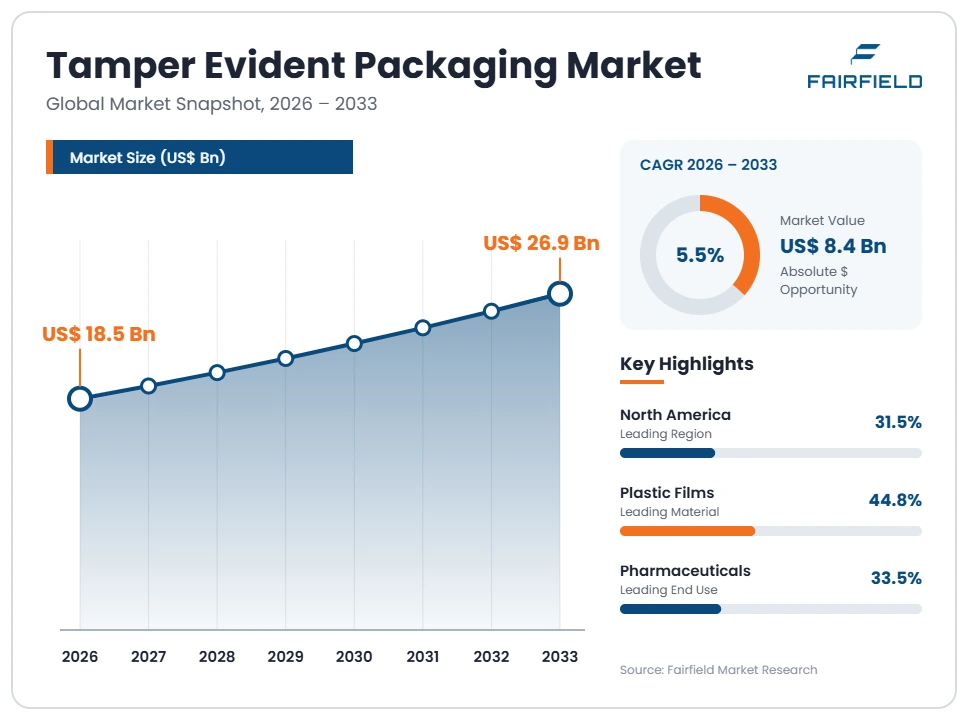
The global tamper evident packaging market size is expected to be valued at US$ 18.5 billion in 2026 and projected to reach US$ 26.9 billion by 2033, growing at a CAGR of 5.5% between 2026 and 2033.
Demand rose at a 4.1% CAGR between 2020 and 2025, a steady rate set by rules rather than shopper preference. Three forces lift the outlook. Medicine anti-tampering mandates keep widening into new countries and new product classes. Parcel volumes keep climbing, and a shipment passing through many hands needs visible proof of interference at each handover. Brand owners in cosmetics and supplements are adding authentication features to defend against refill fraud. Growth stays in mid single digits because tamper evidence is a feature on a pack rather than a pack in itself, and its cost is counted in fractions of a cent. Value gains come from wider mandates and richer feature content rather than from packaging volume alone.
Key Report Takeaways
- By Product Type: Induction and heat seals and liners held 26.4% share in 2026, while tamper-evident labels and void films are projected to expand at a 7.2% CAGR through 2033, because a printed label adds evidence without changing the container itself.
- By Material: Plastic films held 44.8% share in 2026, while paper and paperboard constructions are projected to grow at a 6.9% CAGR through 2033, as recyclability targets push converters toward fibre-based seals and bands.
- By Authentication Feature: Overt features held 62.0% share in 2026, while covert features are projected to grow at a 7.5% CAGR through 2033, since hidden markers are checked by trained inspectors rather than by distracted shoppers.
- By End Use: Pharmaceuticals held 33.5% share in 2026, while logistics and e-commerce is projected to grow at an 8.1% CAGR through 2033, driven by parcel theft and the cost of disputed delivery claims.
- By Region: North America held 31.5% share in 2026, while Asia Pacific is projected to grow at a 7.1% CAGR through 2033, as pharmacy regulation tightens across India, China and Indonesia.
Global Tamper Evident Packaging Market Trends and Insights
Drivers Impact Analysis
Two forces explain most of the feature adoption behind the forecast.
| Driver | Impact on CAGR Forecast | Geographic Relevance | Impact Timeline |
| Medicine anti-tampering and serialisation mandates | High | North America, Europe, Asia Pacific | Long term ≥4 years |
| Parcel handover risk in e-commerce fulfilment | Medium | North America, Asia Pacific | Medium term 2–4 years |
Medicine Anti-Tampering Mandates Make Tamper Evidence a Condition of Market Access
Tamper evidence on a medicine pack is a legal requirement rather than a marketing choice, and that single fact drives most of this market. A pack without a compliant anti-tampering device cannot be released into the regulated channel, so demand follows the reach of the rule rather than any willingness to pay. Each extension of the rule into a new country or a new product class converts a fixed population of packs into guaranteed feature volume.
The mechanism is direct. The United States Food and Drug Administration has required tamper-evident packaging on over-the-counter human drug products since 1982, after historic product tampering incidents forced a federal response. The European Union falsified medicines framework went further, requiring both a unique identifier and an anti-tampering device on prescription packs. ISO 21976 now sets out how a tamper verification feature on medicinal packaging is specified and checked.
Parcel Handover Risk Pushes Tamper Evident Seals Into E-Commerce Fulfilment
Online order volume creates seal demand well outside the regulated categories, and that is the fastest-moving part of this market. A parcel changes hands between a fulfilment centre, a line-haul carrier, a sorting hub, a last-mile driver and sometimes a locker before the buyer opens it. Every handover is a point where substitution or loss can happen, and a void-indicating seal is the cheapest way to establish where a shipment was opened.
The commercial trigger is the cost of disputed claims rather than theft alone. Retailers reimburse buyers who report missing or swapped contents, and without physical evidence the seller absorbs that loss. Security tapes, void-indicating labels and tamper-evident mailer bags give both carrier and seller an audit point. Mobile devices, fine fragrance and prescription home delivery adopt these seals first, with sealed chilled grocery bags following closely behind.
Restraints Impact Analysis
Two commercial limits hold back adoption outside the regulated categories.
| Restraint | Impact on CAGR Forecast | Geographic Relevance | Impact Timeline |
| Cost per pack in price-sensitive food and personal care | High | Asia Pacific, Latin America | Medium term 2–4 years |
| Conflict between tamper evidence and pack recyclability | High | Europe, North America | Long term ≥4 years |
Cost Per Pack Keeps Tamper Evidence Out of Price-Sensitive Food and Personal Care Lines
Outside regulated categories tamper evidence is an optional cost, and it loses most budget arguments. A shrink band, an induction liner or a void label adds a fraction of a cent to a unit, which sounds trivial until multiplied across hundreds of millions of packs a year. Private-label food, household cleaners and mass-market personal care run on thin gross margins, so the feature is specified only where a known fraud or safety exposure exists.
The cost sits in the line as much as the component. A shrink band needs a heat tunnel, an induction liner needs a sealing head, and both need inspection to confirm correct application. That means line capital, an added changeover step and a reject stream when a seal fails. Validation and artwork approval consume engineering time. Where retail price points are fixed and competition runs on shelf price, these costs cannot be passed through.
Pack Recyclability Rules Collide With Multi-Material Tamper Evident Constructions
Recyclability requirements now work against the very features that make interference visible, and that conflict limits where traditional constructions can be used. A tamper-evident design usually adds a second material: a foil and polymer induction liner on a polyolefin bottle, a shrink band on a polyethylene terephthalate container, or an adhesive label carrying a release layer. Each addition complicates sorting and reprocessing of the container it protects, so packaging teams face a genuine trade-off.
Pressure comes from design-for-recycling guidance and from fee structures that charge more for packs sorting plants cannot handle. A sleeve of the wrong density can make a bottle sink during float-sink separation and be lost. Adhesives that do not release in a hot caustic wash leave residue on reclaimed flake. Brand owners answering these rules sometimes drop a band where no regulation demands one, which removes feature volume outright.
Market Opportunities
Single-Polymer Tamper Evident Seals Open a Premium Conversion Revenue Pool
Designs that keep tamper evidence while staying recyclable are the clearest new revenue pool in this business. A band, liner or label made from the same polymer family as its container passes through sorting and washing without contaminating the stream, letting a brand owner keep the safety feature and the recyclability claim together. Converters can charge a premium for these constructions because they settle a compliance problem rather than a cosmetic one.
The buyers are food, beverage and personal care brand owners in markets where packaging fees track recyclability, plus pharmaceutical companies redesigning bottle packs. Capture depends on development work: polyolefin shrink films that behave on existing tunnels, wash-off adhesives that release cleanly, and liners that seal without an aluminium layer. Suppliers able to prove performance through established seal integrity and closure torque methods such as ASTM D3198 will win qualification first.
Cosmetics and Supplement Authentication Creates a Feature Pool Beyond Medicine Packs
Authentication in cosmetics and dietary supplements is an untapped pool, because these categories carry medicine-level counterfeit exposure without medicine-level rules. Refilled fragrance bottles, diverted skincare and falsified supplement packs reach buyers through online marketplaces, and no legal mandate forces a response. Brands that act do so to protect price and reputation, which makes them willing to buy layered features rather than minimum compliance.
Demand comes from prestige beauty houses, clinical skincare brands and supplement marketers selling through third-party platforms. The feature mix differs from a medicine pack: a visible breakable seal to reassure the buyer, a covert taggant or printed marker for field inspection, and a forensic marker that will stand up in litigation. Converters combining seal production with covert inks and verification support sell a service rather than a component, at distinctly better margin.
Segment Analysis
- By Product Type: Induction Seals Lead While Void-Indicating Labels Gain Ground
Induction and heat seals and liners held 26.4% of the market in 2026. They remain the default because a welded foil membrane across a bottle mouth cannot be removed and replaced without visible damage, and because the same seal also delivers leak protection and shelf life. The component is cheap, the application step is fast, and the feature works equally well on supplements, sauces, chemicals and oral liquids.
Tamper-evident labels, seals and void-indicating films are the fastest-growing product type at a 7.2% CAGR through 2033. A label can be added to an existing pack with no tooling change, which suits e-commerce cartons and mailer bags. Shrink bands and sleeves hold a strong position on bottled products, while blister and strip packs serve solid-dose medicines and breakable closures with tamper rings dominate caps. Suppliers increasingly sell the feature as a retrofit rather than a redesign.
- By Material: Plastic Films Dominate While Fibre-Based Constructions Advance
Plastic films accounted for 44.8% of tamper evident packaging value in 2026. Polyolefin and polyester films carry the shrink bands, void labels and security tapes that make up most unit volume, because they shrink predictably, print well and hold adhesive bonds through distribution. Film also delivers the controlled tear and fibre-tear behaviour that lets a seal show interference clearly.
Paper and paperboard constructions are the fastest-growing material at a 6.9% CAGR through 2033, pulled along by recyclability targets and by paper-based e-commerce packaging. Aluminium foil remains essential inside induction liners and blister lidding, where barrier and weldability matter more than recycling simplicity. Composite laminates serve high-security applications needing layered covert features. Material choice is now decided alongside the recycling route for the whole pack rather than on seal performance alone.
- By Authentication Feature: Overt Devices Carry Volume While Covert Markers Expand Fastest
Overt features held 62.0% of the market in 2026. A visible band, a broken ring or a colour-shifting void message works without equipment and without training, so it suits any pack a consumer handles. Overt devices also satisfy most regulatory wording, which asks for evidence that is apparent to the person opening the pack.
Covert features are the fastest-growing authentication type at a 7.5% CAGR through 2033. Hidden taggants, microtext and machine-readable markers answer the known weakness of overt devices: a feature only protects a buyer who actually looks at it. Covert markers move the check to inspectors, customs officers and field investigators who are paid to look. Forensic features stay a small, high-value tier used for legal proof. Layering two or three levels on one pack is becoming standard for high-value goods.
- By End Use: Pharmaceuticals Anchor Demand While Logistics and E-Commerce Scale Quickest
Pharmaceuticals held 33.5% of tamper evident packaging demand in 2026 and remain the anchor application. Prescription and over-the-counter packs carry mandated anti-tampering devices in major regulated markets, so volume is non-discretionary and specification is tightly controlled. Blister packs, induction liners, carton seals and closure rings are all qualified as part of the marketing authorisation, which keeps supplier change slow and pricing stable.
Logistics and e-commerce is the fastest-growing end use at an 8.1% CAGR through 2033, as parcel volume and claim costs push security tapes and sealed bags into routine use. Food and beverage contributes large volumes through closures and bands, while cosmetics and personal care buy the richest feature mix per unit. Electronics, chemicals and industrial users seal high-value or hazardous goods. The spread beyond medicine packs is what keeps this market growing above packaging volume.
Geography Analysis
- Which Region Is Leading the Tamper Evident Packaging Market?
North America leads the tamper evident packaging market with 31.5% share in 2026, because its rules arrived earliest and reach furthest. The United States Food and Drug Administration has required tamper-evident packaging on over-the-counter human drug products for more than four decades, which built a mature supply base of liner, band and closure converters serving every consumer health brand.
The Drug Supply Chain Security Act adds serialisation and verification duties across the prescription distribution chain, so packaging lines already carry coding and inspection hardware that pairs naturally with seal application. Parcel volumes in the United States and Canada are the largest per household anywhere, which sustains heavy use of security tape and void-indicating mailer seals. The change to watch is retailer pressure for recyclable constructions on consumer goods packs.
- Europe Applies Safety Features Across Every Prescription Medicine Pack
Europe held 28.0% of the market in 2026, supported by the most prescriptive anti-tampering requirement anywhere. The falsified medicines framework and its delegated regulation on safety features oblige manufacturers to place both a unique identifier and an anti-tampering device on prescription packs, and verification at dispensing closes the loop. Germany, France, Italy, Spain and Poland account for most regional volume.
The region is also where the recyclability conflict bites hardest. Fee structures reward packs that sort and reprocess cleanly, so converters are reformulating bands, liners and label adhesives to keep seals compatible with established recycling streams. Luxury cosmetics and spirits producers add covert and forensic features to protect brand value. Regional growth runs below the global average because mandated coverage is already close to complete.
- Which Region Is Growing Fastest in the Tamper Evident Packaging Market?
Asia Pacific is the fastest-growing geography in tamper evident packaging at a 7.1% CAGR through 2033, from a 27.5% share in 2026, driven by pharmacy regulation catching up with a very large medicine output. India operates track-and-trace requirements on exported drug formulations and has extended barcoding duties to widely used domestic brands, which brings seal and coding investment to a huge generic manufacturing base.
China, Japan, South Korea and Indonesia add demand through drug serialisation programmes, infant nutrition safeguards and fast-expanding online retail. Regional converting capacity for labels, films and closures is extensive and growing, which keeps component prices competitive and shortens qualification lead times. The main change underway is the move from export-only compliance to domestic enforcement, which multiplies the number of packs that must carry a verified tamper-evident feature.
- Latin America Adds Tamper Evidence as Pharmacy and Food Rules Tighten
Latin America accounted for 7.0% of global demand in 2026, with activity concentrated in Brazil, Mexico, Argentina and Colombia. National medicine traceability programmes have progressed unevenly but steadily, and each step brings coding, sealing and verification requirements to domestic pharmaceutical plants. Food safety rules covering sealed dairy, edible oil and sauce containers add steady induction liner volume.
Barriers are mainly economic. Film, foil and adhesive raw materials are dollar-priced, currency swings make line investment hard to plan, and informal retail channels weaken the commercial case for premium authentication. Converting capacity outside Brazil and Mexico is limited, which lengthens lead times. The clearest regional change is growth in cross-border parcel delivery, which is pulling security tape and sealed-bag demand into logistics operators serving the whole region.
- Middle East & Africa Uses Seals to Deter Medicine Diversion and Falsification
Middle East & Africa held 6.0% of the market in 2026 and grows with public health procurement rather than with retail. Falsified and diverted medicines are a documented problem across parts of the region, so health authorities and donor-funded programmes specify sealed, verifiable packs for tenders. Saudi Arabia and the United Arab Emirates operate drug traceability systems that pair serialisation with pack-level security features.
Barriers include limited local converting capacity outside South Africa, Egypt and Turkey, reliance on imported films and foils, and hot storage conditions that stress adhesives and shrink materials. Enforcement capacity varies widely between countries. The opportunity sits in regional converting investment, which would shorten supply lines, and in covert markers that let inspectors verify authenticity at border posts and in distribution without laboratory equipment.
Competitive Landscape
The tamper evident packaging market is moderately concentrated, and the structure differs sharply by product. Global flexible packaging and label groups hold strong positions in induction liners, shrink sleeves and pressure-sensitive security labels, where coating and printing scale matter. Closures with tamper rings are supplied largely by injection moulders serving regional bottlers, and specialist security printers dominate covert and forensic work. No single supplier spans every feature type, so brand owners routinely buy seals, closures and authentication from different vendors. Consolidation has been steady rather than dramatic, usually adding a feature capability or a regional plant rather than building end-to-end coverage.
Competition turns on qualification rather than on unit price, particularly in regulated categories. Buyers evaluate seal integrity across the full shelf life, application reliability at line speed, compatibility with existing capping and tunnel equipment, and documented testing against recognised closure torque and seal strength methods. For pharmaceutical work, change control and audit history carry as much weight as cost, because a supplier switch can require regulatory notification. New entrants appear mostly as digital printers offering short-run variable security labels, and as material developers selling recyclable band and liner constructions.
Strategic activity follows three patterns. Suppliers are extending from component supply into authentication services, bundling covert markers with field verification and reporting. They are developing recyclable and mono-material seal constructions to answer packaging fee rules. They are also adding inspection and vision capability so a customer can confirm that every pack leaving the line carries an intact, correctly applied feature.
Vendor strategy is converging on proof. Suppliers increasingly sell documented performance evidence and compliance support rather than a component alone, which raises switching costs and protects price in a market where the feature itself is inexpensive.
Recent Industry Developments
- 2018: ISO 21976 was published, setting out how tamper verification features on medicinal product packaging are specified, applied and assessed – it gave regulators, auditors and converters a shared technical benchmark for a feature that had been judged subjectively.
- February 2019: The European Union falsified medicines safety features became applicable, requiring a unique identifier and an anti-tampering device on prescription medicine packs across member states – it converted tamper evidence from good practice into a condition of market access for an entire product class.
- November 2023: The enhanced drug distribution security requirements of the United States Drug Supply Chain Security Act took effect, with the Food and Drug Administration allowing a stabilisation period for trading partners – it locked serialisation and verification hardware onto pharmaceutical packaging lines that also apply seals.
- October 2024: The Food and Drug Administration issued exemptions staggering Drug Supply Chain Security Act electronic traceability compliance across trading partner categories into 2025 – the phased dates spread packaging line upgrades over a longer window and smoothed demand for coding and sealing equipment.
Companies Covered in the Report
- Amcor plc
- CCL Industries Inc.
- Avery Dennison Corporation
- 3M Company
- Sealed Air Corporation
- Constantia Flexibles Group GmbH
- Selig Group
- Tekni-Plex, Inc.
- Schreiner Group GmbH & Co. KG
- Multi-Color Corporation
- UPM Raflatac Oy
- Brady Corporation
- Winpak Ltd.
- Coveris Holdings S.A.
Tamper Evident Packaging Market Report Scope
| Metric | Value |
| Study Period | 2020–2033 |
| Market Size 2026 | US$ 18.5 Billion |
| Market Size 2033 | US$ 26.9 Billion |
| CAGR 2026–2033 | 5.5% |
| Absolute Dollar Opportunity | US$ 8.4 Billion |
| Largest Market | North America (31.5% share in 2026) |
| Fastest-Growing Market | Asia Pacific (7.1% CAGR) |
| Market Concentration | Medium |
| Major Players | Amcor plc, CCL Industries Inc., Avery Dennison Corporation, 3M Company, Sealed Air Corporation |
Tamper Evident Packaging Market Segmentation
Product Type
- Induction and Heat Seals and Liners
- Shrink Bands and Sleeves
- Tamper-Evident Closures and Caps
- Tamper-Evident Labels, Seals and Void Films
- Blister and Strip Packs
- Security Tapes and Bags
Material
- Plastic Films
- Paper and Paperboard
- Aluminium Foil
- Composite Laminates
Authentication Feature
- Overt Features
- Covert Features
- Forensic Features
End Use
- Pharmaceuticals
- Food and Beverage
- Cosmetics and Personal Care
- Electronics and High-Value Goods
- Chemicals and Industrial
- Logistics and E-Commerce
Regions
- North America
- Europe
- Asia Pacific
- Latin America
- Middle East & Africa
- Executive Summary
- Global Tamper Evident Packaging Market Snapshot
- Future Projections, 2026-2033
- Key Market Trends
- Regional Snapshot
- Market Overview
- Market Definition and Report Scope
- Historical Market Trends, 2020-2025
- Market Dynamics
- Drivers Impact Analysis
- Medicine Anti-Tampering Mandates Make Tamper Evidence a Condition of Market Access
- Parcel Handover Risk Pushes Tamper Evident Seals Into E-Commerce Fulfilment
- Restraints Impact Analysis
- Cost Per Pack Keeps Tamper Evidence Out of Price-Sensitive Food and Personal Care Lines
- Pack Recyclability Rules Collide With Multi-Material Tamper Evident Constructions
- Market Opportunities
- Single-Polymer Tamper Evident Seals Open a Premium Conversion Revenue Pool
- Cosmetics and Supplement Authentication Creates a Feature Pool Beyond Medicine Packs
- Drivers Impact Analysis
- Global Tamper Evident Packaging Market Outlook, 2020-2033
- Global Tamper Evident Packaging Market Outlook, by Product Type, Value (US$ Billion), 2020-2033
- Induction and Heat Seals and Liners
- Shrink Bands and Sleeves
- Tamper-Evident Closures and Caps
- Tamper-Evident Labels, Seals and Void Films
- Blister and Strip Packs
- Security Tapes and Bags
- Global Tamper Evident Packaging Market Outlook, by Material, Value (US$ Billion), 2020-2033
- Plastic Films
- Paper and Paperboard
- Aluminium Foil
- Composite Laminates
- Global Tamper Evident Packaging Market Outlook, by Authentication Feature, Value (US$ Billion), 2020-2033
- Overt Features
- Covert Features
- Forensic Features
- Global Tamper Evident Packaging Market Outlook, by End Use, Value (US$ Billion), 2020-2033
- Pharmaceuticals
- Food and Beverage
- Cosmetics and Personal Care
- Electronics and High-Value Goods
- Chemicals and Industrial
- Logistics and E-Commerce
- Global Tamper Evident Packaging Market Outlook, by Region, Value (US$ Billion), 2020-2033
- North America
- Europe
- Asia Pacific
- Latin America
- Middle East & Africa
- Global Tamper Evident Packaging Market Outlook, by Product Type, Value (US$ Billion), 2020-2033
- North America Tamper Evident Packaging Market Outlook, 2020-2033
- North America Tamper Evident Packaging Market Outlook, by Product Type, Value (US$ Billion), 2020-2033
- Induction and Heat Seals and Liners
- Shrink Bands and Sleeves
- Tamper-Evident Closures and Caps
- Tamper-Evident Labels, Seals and Void Films
- Blister and Strip Packs
- Security Tapes and Bags
- North America Tamper Evident Packaging Market Outlook, by Material, Value (US$ Billion), 2020-2033
- Plastic Films
- Paper and Paperboard
- Aluminium Foil
- Composite Laminates
- North America Tamper Evident Packaging Market Outlook, by Authentication Feature, Value (US$ Billion), 2020-2033
- Overt Features
- Covert Features
- Forensic Features
- North America Tamper Evident Packaging Market Outlook, by End Use, Value (US$ Billion), 2020-2033
- Pharmaceuticals
- Food and Beverage
- Cosmetics and Personal Care
- Electronics and High-Value Goods
- Chemicals and Industrial
- Logistics and E-Commerce
- North America Tamper Evident Packaging Market Outlook, by Country, Value (US$ Billion), 2020-2033
- United States Tamper Evident Packaging Market Outlook, by Product Type, 2020-2033
- United States Tamper Evident Packaging Market Outlook, by Material, 2020-2033
- United States Tamper Evident Packaging Market Outlook, by Authentication Feature, 2020-2033
- United States Tamper Evident Packaging Market Outlook, by End Use, 2020-2033
- Canada Tamper Evident Packaging Market Outlook, by Product Type, 2020-2033
- Canada Tamper Evident Packaging Market Outlook, by Material, 2020-2033
- Canada Tamper Evident Packaging Market Outlook, by Authentication Feature, 2020-2033
- Canada Tamper Evident Packaging Market Outlook, by End Use, 2020-2033
- North America Tamper Evident Packaging Market Outlook, by Product Type, Value (US$ Billion), 2020-2033
- Europe Tamper Evident Packaging Market Outlook, 2020-2033
- Europe Tamper Evident Packaging Market Outlook, by Product Type, Value (US$ Billion), 2020-2033
- Induction and Heat Seals and Liners
- Shrink Bands and Sleeves
- Tamper-Evident Closures and Caps
- Tamper-Evident Labels, Seals and Void Films
- Blister and Strip Packs
- Security Tapes and Bags
- Europe Tamper Evident Packaging Market Outlook, by Material, Value (US$ Billion), 2020-2033
- Plastic Films
- Paper and Paperboard
- Aluminium Foil
- Composite Laminates
- Europe Tamper Evident Packaging Market Outlook, by Authentication Feature, Value (US$ Billion), 2020-2033
- Overt Features
- Covert Features
- Forensic Features
- Europe Tamper Evident Packaging Market Outlook, by End Use, Value (US$ Billion), 2020-2033
- Pharmaceuticals
- Food and Beverage
- Cosmetics and Personal Care
- Electronics and High-Value Goods
- Chemicals and Industrial
- Logistics and E-Commerce
- Europe Tamper Evident Packaging Market Outlook, by Country, Value (US$ Billion), 2020-2033
- Germany Tamper Evident Packaging Market Outlook, by Product Type, 2020-2033
- Germany Tamper Evident Packaging Market Outlook, by Material, 2020-2033
- Germany Tamper Evident Packaging Market Outlook, by Authentication Feature, 2020-2033
- Germany Tamper Evident Packaging Market Outlook, by End Use, 2020-2033
- France Tamper Evident Packaging Market Outlook, by Product Type, 2020-2033
- France Tamper Evident Packaging Market Outlook, by Material, 2020-2033
- France Tamper Evident Packaging Market Outlook, by Authentication Feature, 2020-2033
- France Tamper Evident Packaging Market Outlook, by End Use, 2020-2033
- Italy Tamper Evident Packaging Market Outlook, by Product Type, 2020-2033
- Italy Tamper Evident Packaging Market Outlook, by Material, 2020-2033
- Italy Tamper Evident Packaging Market Outlook, by Authentication Feature, 2020-2033
- Italy Tamper Evident Packaging Market Outlook, by End Use, 2020-2033
- Spain Tamper Evident Packaging Market Outlook, by Product Type, 2020-2033
- Spain Tamper Evident Packaging Market Outlook, by Material, 2020-2033
- Spain Tamper Evident Packaging Market Outlook, by Authentication Feature, 2020-2033
- Spain Tamper Evident Packaging Market Outlook, by End Use, 2020-2033
- Poland Tamper Evident Packaging Market Outlook, by Product Type, 2020-2033
- Poland Tamper Evident Packaging Market Outlook, by Material, 2020-2033
- Poland Tamper Evident Packaging Market Outlook, by Authentication Feature, 2020-2033
- Poland Tamper Evident Packaging Market Outlook, by End Use, 2020-2033
- Europe Tamper Evident Packaging Market Outlook, by Product Type, Value (US$ Billion), 2020-2033
- Asia Pacific Tamper Evident Packaging Market Outlook, 2020-2033
- Asia Pacific Tamper Evident Packaging Market Outlook, by Product Type, Value (US$ Billion), 2020-2033
- Induction and Heat Seals and Liners
- Shrink Bands and Sleeves
- Tamper-Evident Closures and Caps
- Tamper-Evident Labels, Seals and Void Films
- Blister and Strip Packs
- Security Tapes and Bags
- Asia Pacific Tamper Evident Packaging Market Outlook, by Material, Value (US$ Billion), 2020-2033
- Plastic Films
- Paper and Paperboard
- Aluminium Foil
- Composite Laminates
- Asia Pacific Tamper Evident Packaging Market Outlook, by Authentication Feature, Value (US$ Billion), 2020-2033
- Overt Features
- Covert Features
- Forensic Features
- Asia Pacific Tamper Evident Packaging Market Outlook, by End Use, Value (US$ Billion), 2020-2033
- Pharmaceuticals
- Food and Beverage
- Cosmetics and Personal Care
- Electronics and High-Value Goods
- Chemicals and Industrial
- Logistics and E-Commerce
- Asia Pacific Tamper Evident Packaging Market Outlook, by Country, Value (US$ Billion), 2020-2033
- India Tamper Evident Packaging Market Outlook, by Product Type, 2020-2033
- India Tamper Evident Packaging Market Outlook, by Material, 2020-2033
- India Tamper Evident Packaging Market Outlook, by Authentication Feature, 2020-2033
- India Tamper Evident Packaging Market Outlook, by End Use, 2020-2033
- China Tamper Evident Packaging Market Outlook, by Product Type, 2020-2033
- China Tamper Evident Packaging Market Outlook, by Material, 2020-2033
- China Tamper Evident Packaging Market Outlook, by Authentication Feature, 2020-2033
- China Tamper Evident Packaging Market Outlook, by End Use, 2020-2033
- Japan Tamper Evident Packaging Market Outlook, by Product Type, 2020-2033
- Japan Tamper Evident Packaging Market Outlook, by Material, 2020-2033
- Japan Tamper Evident Packaging Market Outlook, by Authentication Feature, 2020-2033
- Japan Tamper Evident Packaging Market Outlook, by End Use, 2020-2033
- South Korea Tamper Evident Packaging Market Outlook, by Product Type, 2020-2033
- South Korea Tamper Evident Packaging Market Outlook, by Material, 2020-2033
- South Korea Tamper Evident Packaging Market Outlook, by Authentication Feature, 2020-2033
- South Korea Tamper Evident Packaging Market Outlook, by End Use, 2020-2033
- Indonesia Tamper Evident Packaging Market Outlook, by Product Type, 2020-2033
- Indonesia Tamper Evident Packaging Market Outlook, by Material, 2020-2033
- Indonesia Tamper Evident Packaging Market Outlook, by Authentication Feature, 2020-2033
- Indonesia Tamper Evident Packaging Market Outlook, by End Use, 2020-2033
- Asia Pacific Tamper Evident Packaging Market Outlook, by Product Type, Value (US$ Billion), 2020-2033
- Latin America Tamper Evident Packaging Market Outlook, 2020-2033
- Latin America Tamper Evident Packaging Market Outlook, by Product Type, Value (US$ Billion), 2020-2033
- Induction and Heat Seals and Liners
- Shrink Bands and Sleeves
- Tamper-Evident Closures and Caps
- Tamper-Evident Labels, Seals and Void Films
- Blister and Strip Packs
- Security Tapes and Bags
- Latin America Tamper Evident Packaging Market Outlook, by Material, Value (US$ Billion), 2020-2033
- Plastic Films
- Paper and Paperboard
- Aluminium Foil
- Composite Laminates
- Latin America Tamper Evident Packaging Market Outlook, by Authentication Feature, Value (US$ Billion), 2020-2033
- Overt Features
- Covert Features
- Forensic Features
- Latin America Tamper Evident Packaging Market Outlook, by End Use, Value (US$ Billion), 2020-2033
- Pharmaceuticals
- Food and Beverage
- Cosmetics and Personal Care
- Electronics and High-Value Goods
- Chemicals and Industrial
- Logistics and E-Commerce
- Latin America Tamper Evident Packaging Market Outlook, by Country, Value (US$ Billion), 2020-2033
- Brazil Tamper Evident Packaging Market Outlook, by Product Type, 2020-2033
- Brazil Tamper Evident Packaging Market Outlook, by Material, 2020-2033
- Brazil Tamper Evident Packaging Market Outlook, by Authentication Feature, 2020-2033
- Brazil Tamper Evident Packaging Market Outlook, by End Use, 2020-2033
- Mexico Tamper Evident Packaging Market Outlook, by Product Type, 2020-2033
- Mexico Tamper Evident Packaging Market Outlook, by Material, 2020-2033
- Mexico Tamper Evident Packaging Market Outlook, by Authentication Feature, 2020-2033
- Mexico Tamper Evident Packaging Market Outlook, by End Use, 2020-2033
- Argentina Tamper Evident Packaging Market Outlook, by Product Type, 2020-2033
- Argentina Tamper Evident Packaging Market Outlook, by Material, 2020-2033
- Argentina Tamper Evident Packaging Market Outlook, by Authentication Feature, 2020-2033
- Argentina Tamper Evident Packaging Market Outlook, by End Use, 2020-2033
- Colombia Tamper Evident Packaging Market Outlook, by Product Type, 2020-2033
- Colombia Tamper Evident Packaging Market Outlook, by Material, 2020-2033
- Colombia Tamper Evident Packaging Market Outlook, by Authentication Feature, 2020-2033
- Colombia Tamper Evident Packaging Market Outlook, by End Use, 2020-2033
- Latin America Tamper Evident Packaging Market Outlook, by Product Type, Value (US$ Billion), 2020-2033
- Middle East & Africa Tamper Evident Packaging Market Outlook, 2020-2033
- Middle East & Africa Tamper Evident Packaging Market Outlook, by Product Type, Value (US$ Billion), 2020-2033
- Induction and Heat Seals and Liners
- Shrink Bands and Sleeves
- Tamper-Evident Closures and Caps
- Tamper-Evident Labels, Seals and Void Films
- Blister and Strip Packs
- Security Tapes and Bags
- Middle East & Africa Tamper Evident Packaging Market Outlook, by Material, Value (US$ Billion), 2020-2033
- Plastic Films
- Paper and Paperboard
- Aluminium Foil
- Composite Laminates
- Middle East & Africa Tamper Evident Packaging Market Outlook, by Authentication Feature, Value (US$ Billion), 2020-2033
- Overt Features
- Covert Features
- Forensic Features
- Middle East & Africa Tamper Evident Packaging Market Outlook, by End Use, Value (US$ Billion), 2020-2033
- Pharmaceuticals
- Food and Beverage
- Cosmetics and Personal Care
- Electronics and High-Value Goods
- Chemicals and Industrial
- Logistics and E-Commerce
- Middle East & Africa Tamper Evident Packaging Market Outlook, by Country, Value (US$ Billion), 2020-2033
- Saudi Arabia Tamper Evident Packaging Market Outlook, by Product Type, 2020-2033
- Saudi Arabia Tamper Evident Packaging Market Outlook, by Material, 2020-2033
- Saudi Arabia Tamper Evident Packaging Market Outlook, by Authentication Feature, 2020-2033
- Saudi Arabia Tamper Evident Packaging Market Outlook, by End Use, 2020-2033
- United Arab Emirates Tamper Evident Packaging Market Outlook, by Product Type, 2020-2033
- United Arab Emirates Tamper Evident Packaging Market Outlook, by Material, 2020-2033
- United Arab Emirates Tamper Evident Packaging Market Outlook, by Authentication Feature, 2020-2033
- United Arab Emirates Tamper Evident Packaging Market Outlook, by End Use, 2020-2033
- South Africa Tamper Evident Packaging Market Outlook, by Product Type, 2020-2033
- South Africa Tamper Evident Packaging Market Outlook, by Material, 2020-2033
- South Africa Tamper Evident Packaging Market Outlook, by Authentication Feature, 2020-2033
- South Africa Tamper Evident Packaging Market Outlook, by End Use, 2020-2033
- Egypt Tamper Evident Packaging Market Outlook, by Product Type, 2020-2033
- Egypt Tamper Evident Packaging Market Outlook, by Material, 2020-2033
- Egypt Tamper Evident Packaging Market Outlook, by Authentication Feature, 2020-2033
- Egypt Tamper Evident Packaging Market Outlook, by End Use, 2020-2033
- Turkey Tamper Evident Packaging Market Outlook, by Product Type, 2020-2033
- Turkey Tamper Evident Packaging Market Outlook, by Material, 2020-2033
- Turkey Tamper Evident Packaging Market Outlook, by Authentication Feature, 2020-2033
- Turkey Tamper Evident Packaging Market Outlook, by End Use, 2020-2033
- Middle East & Africa Tamper Evident Packaging Market Outlook, by Product Type, Value (US$ Billion), 2020-2033
- Competitive Landscape
- Market Concentration and Industry Leaders
- Competitive Differentiation
- Strategic Initiatives
- Recent Industry Developments
- Company Profiles
- Amcor plc
- CCL Industries Inc.
- Avery Dennison Corporation
- 3M Company
- Sealed Air Corporation
- Constantia Flexibles Group GmbH
- Selig Group
- Tekni-Plex, Inc.
- Schreiner Group GmbH & Co. KG
- Multi-Color Corporation
- UPM Raflatac Oy
- Brady Corporation
- Winpak Ltd.
- Coveris Holdings S.A.
- Appendix
- Research Methodology
- Report Assumptions
- Acronyms and Abbreviations
Product Type
- Induction and Heat Seals and Liners
- Shrink Bands and Sleeves
- Tamper-Evident Closures and Caps
- Tamper-Evident Labels, Seals and Void Films
- Blister and Strip Packs
- Security Tapes and Bags
Material
- Plastic Films
- Paper and Paperboard
- Aluminium Foil
- Composite Laminates
Authentication Feature
- Overt Features
- Covert Features
- Forensic Features
End Use
- Pharmaceuticals
- Food and Beverage
- Cosmetics and Personal Care
- Electronics and High-Value Goods
- Chemicals and Industrial
- Logistics and E-Commerce
Regions
- North America
- Europe
- Asia Pacific
- Latin America
- Middle East & Africa
Our Research Methodology
Considering the volatility of business today, traditional approaches to strategizing a game plan can be unfruitful if not detrimental. True ambiguity is no way to determine a forecast. A myriad of predetermined factors must be accounted for such as the degree of risk involved, the magnitude of circumstances, as well as conditions or consequences that are not known or unpredictable. To circumvent binary views that cast uncertainty, the application of market research intelligence to strategically posture, move, and enable actionable outcomes is necessary.
View Methodology
Quality Assured
Rigorous Validation Process

Confidentiality Assured
End-to-end Data Security

Custom Research Services
Tailored To Your Objectives
FAQs
The market is valued at US$ 18.5 billion in 2026, covering seals, liners, bands, closures, labels, security tapes and layered authentication features worldwide.
The market is projected to reach US$ 26.9 billion by 2033, growing at a 5.5% CAGR and adding US$ 8.4 billion in absolute dollar opportunity.
Induction and heat seals and liners lead with 26.4% share in 2026, because a welded foil membrane cannot be removed and replaced without visible damage.
Logistics and e-commerce grows fastest among end uses at an 8.1% CAGR, while Asia Pacific is the fastest-growing geography at a 7.1% CAGR.
North America holds 31.5% share in 2026, supported by four decades of over-the-counter drug packaging rules and the largest parcel delivery volumes.
Related Reports
Transportation Composites Market Size, Share, Insights, Competitive Landscape, and Forecast 2026 to 2033
The global transportation composites market is valued at US$48.6 billion in 2026, reaching US$78.5 billion by 2033, growing at a 7.1% CAGR
Personal Care Ingredients Market Size, Share, Insights, Competitive Landscape, and Forecast 2026 to 2033
The global personal care ingredients market is valued at US$18.6 billion in 2026, reaching US$28.2 billion by 2033, growing at a 6.1% CAGR
Medical Polymer Market Size, Share, Insights, Competitive Landscape, and Forecast 2026 to 2033
The global medical polymer market is valued at US$27.4 billion in 2026, reaching US$47.8 billion by 2033, growing at an 8.3% CAGR
Lithium Sulfides Market Size, Share, Insights, Competitive Landscape, and Forecast 2026 to 2033
The global lithium sulfides market is valued at US$0.1 billion in 2026, reaching US$0.7 billion by 2033, growing at a 32.0% CAGR
Single Coated Adhesive Tapes Market Size, Share, Insights, Competitive Landscape, and Forecast 2026 to 2033
The global single coated adhesive tapes market is valued at US$36.0 billion in 2026, reaching US$51.0 billion by 2033, growing at a 5.1% CAGR
Non-Woven Abrasives Market Size, Share, Insights, Competitive Landscape, and Forecast 2026 to 2033
Non-Woven Abrasives Market is projected to grow from US$ 2.89 billion in 2026 to US$ 4.03 billion by 2033 at a 4.9% CAGR. See key products and trends.