



Baby Car Seat Market
Baby Car Seat Market Size, Share, Insights, Competitive Landscape, and Forecast 2026 to 2033
How Fast Is the Baby Car Seat Market Growing?
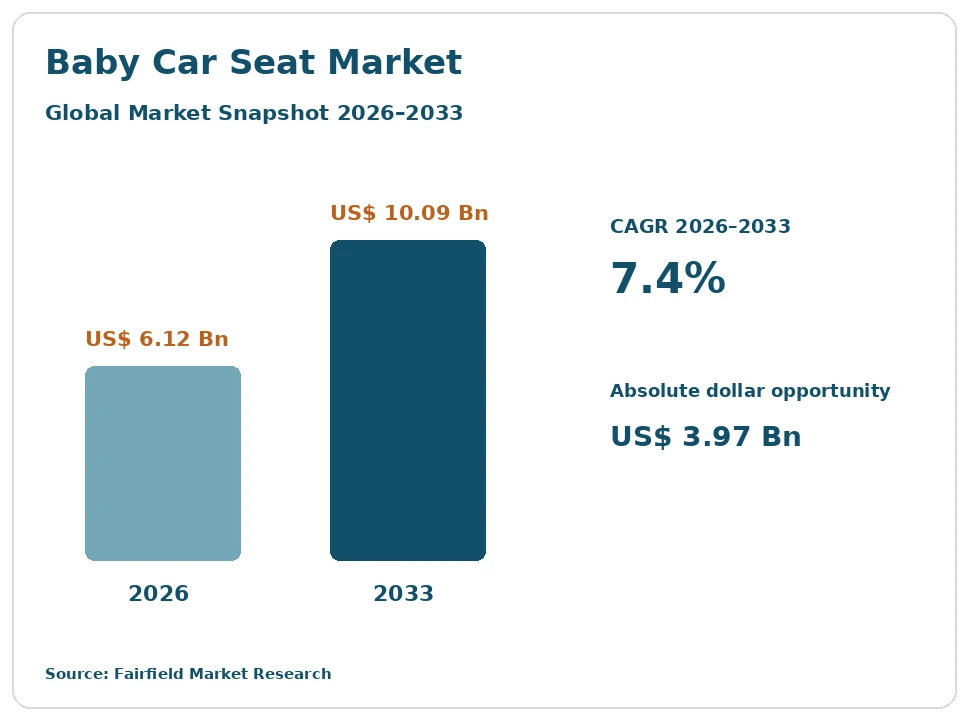
The global baby car seat market size is expected to be valued at US$ 6.12 billion in 2026 and projected to reach US$ 10.09 billion by 2033, growing at a CAGR of 7.4% between 2026 and 2033.
Between 2020 and 2025, the market grew at a CAGR of about 5.8%, as store closures in 2020 cut sales, then online buying, stricter safety laws, and premium product launches pushed growth even as birth rates fell in many countries. The baby car seat market covers infant car seats, convertible car seats, all-in-one seats, combination seats, and booster seats that protect babies and children in vehicles, installed with seat belts or ISOFIX and LATCH anchor systems in rear-facing or forward-facing positions. Child car seats sharply reduce the risk of death and serious injury in crashes, and laws in most high-income countries require them. Growth comes from stricter safety rules such as ECE R129 i-Size, rising awareness in Asia Pacific and Latin America, rising incomes, and parents paying more for safety and convenience. The market is shifting toward rotating seats, lighter designs, side-impact protection, and smart seats with sensors. In March 2024, Chicco launched a convertible seat with improved side-impact protection.
Key Report Takeaways
- By Product: Convertible held about 41% share in 2025, while Infant is projected to expand at a 8.3% CAGR through 2033, driven by travel system bundles with strollers, rear-facing safety guidance for newborns, and lightweight carriers that click into bases and prams.
- By Installation: Seat Belt held about 55% share in 2025, while ISOFIX and LATCH is projected to expand at a 9.1% CAGR through 2033, driven by i-Size rules, easier and safer installation, and anchor points now standard in most new vehicles.
- By Distribution Channel: Specialty Stores held about 39% share in 2025, while Online is projected to expand at a 10.2% CAGR through 2033, driven by detailed product reviews, price comparison, home delivery, and baby product brands selling directly to parents.
- By Region: North America held about 35% share in 2025, while Europe is projected to expand at a 8.1% CAGR through 2033, driven by ECE R129 i-Size rules, which fully replaced older R44 sales in 2024, and strong premium seat demand.
Global Baby Car Seat Market Trends and Insights
Drivers Impact Analysis
Two drivers carry the strongest influence on baby car seat market demand during the forecast period.
| Driver | Impact on CAGR Forecast | Geographic Relevance | Impact Timeline |
| Stricter child safety laws and standards | High | Europe, North America, Asia Pacific | Long term (≥4 years) |
| Rising safety awareness and premium spending by parents | Medium | Global, strongest in Asia Pacific and Latin America | Medium term (2-4 years) |
Safety Laws Are Driving the Baby Car Seat Market
Stricter child safety laws and standards are the strongest driver of the baby car seat market. Governments require and upgrade car seats.
The mechanism is regulation that makes car seats mandatory and raises their technical standards. Correctly used car seats reduce infant deaths in crashes by about 70%. Most countries in North America and Europe require car seats for young children. In Europe, the ECE R129 i-Size standard adds side-impact testing, height-based sizing, and longer rear-facing travel, and sales of older R44 seats ended in September 2024, pushing parents to buy new seats. In the United States, NHTSA has adopted a new side-impact standard for seats, which takes effect in December 2026. China, India, and other countries are adding or tightening car seat rules. These laws drive steady demand and push makers to redesign products.
Safety Awareness Is Expanding the Baby Car Seat Market
Rising safety awareness and premium spending by parents are expanding the baby car seat market. Parents spend more on safety.
The cause is better information and changing family patterns. Parents have fewer children and often have them later, so they spend more per child on safety products. Hospitals, pediatricians, and online communities teach parents about correct car seat use. Crash test results from groups such as ADAC guide buying. Premium seats with rotation, lighter frames, and better fabrics are popular. Rising car ownership in Asia Pacific adds new buyers, and many middle-class families in China now buy premium imported brands. Grandparents and other relatives often buy second seats for their own cars. Car rental and ride-hailing firms also offer seats. Gift registries and baby showers support sales of travel systems. These trends support higher spending.
Restraints Impact Analysis
Two restraints limit how quickly the baby car seat market grows.
| Restraint | Impact on CAGR Forecast | Geographic Relevance | Impact Timeline |
| Falling birth rates in major markets | High | Europe, North America, Asia Pacific | Long term (≥4 years) |
| High prices and low enforcement in emerging markets | Medium | Asia Pacific, Latin America, Middle East & Africa | Medium term (2-4 years) |
Falling Birth Rates Slow the Baby Car Seat Market
Falling birth rates in major markets slow the baby car seat market. Fewer babies mean fewer seats.
The specific causes are economic pressure, later marriage, and changing lifestyles. Birth rates have fallen to record lows in China, Japan, South Korea, Italy, Germany, and the United States, and China’s births have dropped sharply since 2017. Each baby typically needs two or three seats over the years, so fewer births directly reduce volumes. Second-hand seats and hand-me-downs also cut new sales, although safety advice warns against using old seats. Smaller families often reuse seats for a second child, and some parents buy only one convertible seat instead of several. These factors limit volume growth, so makers rely on higher prices and premium features to grow revenue.
Low Enforcement Restricts the Baby Car Seat Market
High prices and low enforcement in emerging markets restrict the baby car seat market. Many families do not use car seats.
The underlying causes are cost and weak laws. In parts of India, Indonesia, Brazil, and Nigeria, car seat laws are missing or not enforced, and many families travel on motorbikes or in crowded cars. Quality seats can cost more than a month’s income for many families, and some parents believe that holding a baby is safe. Imported premium brands are expensive because of duties and shipping. Fake and uncertified seats sold online or in markets may fail in crashes. Awareness campaigns are limited in rural areas, and few police officers check child restraints. Many cars in these countries are small and older. These factors restrict adoption in large markets.
Market Opportunities
Smart and Rotating Car Seats Open a Fast-Growth Revenue Pool
Smart and rotating car seats open a fast-growth revenue pool in the baby car seat market. Parents pay more for convenience and safety tech.
Makers can capture this opportunity. Rotating seats let parents turn the seat toward the door to load a child easily, and smart seats with sensors alert parents if a child is left in a car or if the seat is installed incorrectly. Cybex, Nuna, Maxi-Cosi, and Joie sell premium rotating models. Some vehicles now offer rear seat reminders, and connected seats can link to phone apps. Lighter materials make seats easier to move between cars. Sustainable fabrics free of flame-retardant chemicals appeal to parents. Prices for premium rotating seats can exceed US$ 500. Companies leading in safety technology can win higher margins.
Emerging Market Growth Creates a Growth Revenue Pool
Emerging market growth creates a growth revenue pool in the baby car seat market. New laws and car ownership create new buyers.
Makers can capture this opportunity. China, India, Brazil, and Mexico are adding or tightening laws, and car ownership is rising among young families. Awareness campaigns by hospitals, insurers, and road safety groups help, and some governments offer free or low-cost seats to poor families. E-commerce platforms such as Tmall, Amazon, and Mercado Libre make seats easy to buy. Local production can lower prices, and simple booster seats are an affordable starting point for many families. Rising births in India, Nigeria, and Egypt contrast with falling births elsewhere, offering long-term volume. Companies offering affordable, certified models with good distribution can grow quickly.
Segment Analysis
By Product: Convertible Leads While Infant Grows Fastest
Convertible held about 41% share in 2025. Convertible seats can be used rear-facing for babies and then turned forward-facing for toddlers, so one seat lasts several years, which appeals to cost-conscious parents. All-in-one versions that convert into boosters add further value, and safety experts recommend keeping children rear-facing as long as possible, which convertible seats support. Large retailers stock many convertible models at different price points.
Infant is the fastest-growing product, expanding at a 8.3% CAGR through 2033. Infant carriers click into car bases and strollers, forming travel systems that make it easy to move a sleeping baby. Booster and combination seats form other products. Lightweight infant seats with ISOFIX bases are popular in Europe, and parents often buy a new infant seat for each baby. For the market, infant growth supports bundle sales.
By Installation: Seat Belt Leads While ISOFIX and LATCH Grows Fastest
Seat Belt held about 55% share in 2025. Seats installed with vehicle seat belts work in almost any car, including older vehicles without anchor points, taxis, and rental cars. They are common in North America, Latin America, and Asia Pacific, where many cars are older. However, belt installation is more often done incorrectly, so safety groups run free checking events to help parents install seats properly.
ISOFIX and LATCH is the fastest-growing installation type, expanding at a 9.1% CAGR through 2033. Anchor systems make installation easier, quicker, and more secure, reducing misuse, and i-Size seats in Europe use ISOFIX as standard. Most new cars sold worldwide now include anchor points. Load legs and top tethers add stability. For the market, anchor growth supports safer products.
By Distribution Channel: Specialty Stores Lead While Online Grows Fastest
Specialty Stores held about 39% share in 2025. Baby stores offer advice, fitting help, and the chance to try seats in a car before buying, which matters for such an important safety purchase. Chains such as buybuy BABY and Mothercare, along with independent shops, sell premium brands. Hypermarkets and supermarkets such as Walmart and Target sell many budget seats.
Online is the fastest-growing channel, expanding at a 10.2% CAGR through 2033. Parents compare prices, read reviews, and watch installation videos online, and platforms such as Amazon, Walmart.com, and Tmall sell many brands. Direct-to-consumer brand sites are growing, and fast delivery helps parents buy close to a baby’s birth. For the market, online growth widens reach.
Geography Analysis
Which Region Is Leading the Baby Car Seat Market?
North America is leading the baby car seat market with about 35% share in 2025. The United States requires car seats in all states, and Canada has similar rules. Strong safety awareness, many child passenger safety technicians, and high incomes support demand for premium seats. Graco, Evenflo, Britax, Chicco, and Clek are popular brands. NHTSA’s side-impact rule takes effect in December 2026. Hospitals often check that a car seat is ready before a newborn goes home. Key barriers include falling births. One change shaping the region is the new side-impact rule.
Which Region Is Growing Fastest in the Baby Car Seat Market?
Europe is growing fastest in the baby car seat market, expanding at a 8.1% CAGR through 2033. Germany, the United Kingdom, France, Italy, Sweden, and Norway lead, with strong demand for premium and rear-facing seats. The end of R44 sales in 2024 pushed parents toward i-Size seats, and ADAC crash tests shape buying. Cybex, Maxi-Cosi, Britax Römer, and Joie are popular brands. Many families keep children rear-facing until age four, and Sweden is known for very long rear-facing use. Key barriers include low birth rates. One change shaping the region is i-Size.
Asia Pacific Expands the Baby Car Seat Market Through New Laws
Asia Pacific is a growing baby car seat market. China, Japan, Australia, South Korea, and India lead. China introduced national car seat requirements for young children in 2021, and online platforms sell many local and imported brands. Australia has strict local standards, and Japan has high use rates. Goodbaby is a major Chinese maker. Key barriers include falling births. One change shaping the region is rising awareness.
Latin America Grows the Baby Car Seat Market Through Car Ownership
Latin America is a growing baby car seat market. Brazil and Mexico lead, with Argentina, Chile, and Colombia adding demand. Brazil has required car seats since 2010 and updated rules in 2021, and Mexico is tightening enforcement. Rising car ownership and online sales help, and local makers in Brazil produce affordable seats that meet national standards. Ride-hailing use is high in cities, where many families travel without seats. Public campaigns and hospital programs are raising awareness among new parents, and police checks are increasing in some cities. Key barriers include cost. One opportunity is new laws.
Middle East & Africa Develops the Baby Car Seat Market Through Awareness
Middle East & Africa is a developing baby car seat market. Saudi Arabia and the United Arab Emirates lead, with the United Arab Emirates requiring car seats for young children since 2017. South Africa has car seat laws and awareness programs. High incomes in the region support premium brands, and large malls and online stores carry global names. Many families still let children ride unbelted, so awareness campaigns by governments and hospitals are important. Qatar and Oman are adding rules, and expat families bring strong car seat habits. Key barriers include low use. One change shaping the region is new rules.
Competitive Landscape
The baby car seat market is moderately consolidated. Newell Brands, through Graco, Dorel Juvenile, through Maxi-Cosi and Safety 1st, Goodbaby International, through Cybex and Evenflo, Britax Römer, and Artsana, through Chicco, are leading players, while Nuna, Joie, Peg Perego, Recaro Kids, Diono, Combi, and Clek compete strongly. Many local brands in China, India, and Brazil sell low-cost seats, and retailers offer private label options. Premium European brands lead in design and crash test ratings.
Companies compete on safety ratings, ease of installation, comfort, weight, design, fabrics, price, and brand trust. Independent crash tests by ADAC and consumer groups strongly influence buying, especially in Europe. Parents value seats that last longer, rotate easily, and fit in small cars. Partnerships with stroller brands to create travel systems, along with strong online reviews, help win sales. Recalls can quickly damage brand reputation, so quality control is critical.
Strategic moves show how competition is changing. In January 2024, Britax added SafeCell energy-absorbing technology to its infant and convertible seats. In February 2024, Graco launched eco-friendly seats made with more sustainable materials. In March 2024, Chicco launched a convertible seat with better side-impact protection, ahead of the new U.S. side-impact rule. These moves show competition shifting toward advanced safety features and sustainability.
Three themes shape vendor strategy. First, companies are redesigning seats to meet i-Size and new side-impact rules. Second, they are adding rotation, sensors, and lighter materials. Third, they are growing online sales and expanding in Asia Pacific, Latin America, and Middle East & Africa, where new laws are creating demand.
Baby Car Seat Market Industry Leaders
- Newell Brands (Graco)
- Dorel Juvenile (Maxi-Cosi)
- Goodbaby International (Cybex)
- Britax Römer
- Artsana (Chicco)
Recent Industry Developments
- March 2024: Chicco launched a new convertible car seat with improved side-impact protection and an adjustable headrest - supports demand for safer child car seats.
- February 2024: Graco added eco-friendly car seat models made with more sustainable materials - responds to parent interest in greener products in the baby car seat market.
- January 2024: Britax added its SafeCell energy-absorbing technology to its infant and convertible seats - raises crash protection across its ISOFIX and belt-installed range.
Companies Covered in the Report
- Newell Brands (Graco)
- Dorel Juvenile (Maxi-Cosi)
- Goodbaby International (Cybex)
- Britax Römer
- Artsana (Chicco)
- Nuna
- Joie
- Peg Perego
- Recaro Kids
- Diono
- Combi
- Clek
Baby Car Seat Market Scope
This report covers the baby car seat market, including infant, convertible, all-in-one, combination, and booster car seats, installed with seat belts or ISOFIX and LATCH systems in rear-facing and forward-facing positions, sold through specialty stores, hypermarkets and supermarkets, and online channels. The base year is 2025, and the forecast period runs from 2026 to 2033. All values are expressed in US$ Billion.
| Metric | Value |
| Study Period | 2020-2033 |
| Market Size 2026 | US$ 6.12 Billion |
| Market Size 2033 | US$ 10.09 Billion |
| CAGR 2026-2033 | 7.4% |
| Absolute Dollar Opportunity | US$ 3.97 Billion |
| Largest Market | North America |
| Fastest-Growing Market | Europe |
| Market Concentration | Moderately Consolidated |
| Major Players | Newell Brands (Graco), Dorel Juvenile (Maxi-Cosi), Goodbaby International, Britax Römer, Artsana (Chicco) |
Product
- Infant
- Convertible
- All-in-One
- Booster and Combination
Installation
- Seat Belt
- ISOFIX and LATCH
Distribution Channel
- Specialty Stores
- Hypermarkets and Supermarkets
- Online
Regions
- North America
- Europe
- Asia Pacific
- Latin America
- Middle East & Africa
1. Executive Summary
1.1. Global Baby Car Seat Market Snapshot
1.2. Future Projections, 2026-2033
1.3. Key Market Trends
1.4. Regional Snapshot
2. Market Overview
2.1. Market Definition and Scope
2.2. Historical Market Trends, 2020-2025
2.3. Market Dynamics
2.3.1. Drivers Impact Analysis
2.3.1.1. Safety Laws Are Driving the Baby Car Seat Market
2.3.1.2. Safety Awareness Is Expanding the Baby Car Seat Market
2.3.2. Restraints Impact Analysis
2.3.2.1. Falling Birth Rates Slow the Baby Car Seat Market
2.3.2.2. Low Enforcement Restricts the Baby Car Seat Market
2.3.3. Market Opportunities
2.3.3.1. Smart and Rotating Car Seats Open a Fast-Growth Revenue Pool
2.3.3.2. Emerging Market Growth Creates a Growth Revenue Pool
3. Global Baby Car Seat Market Outlook, 2020-2033
3.1. Global Baby Car Seat Market Outlook, by Product, Value (US$ Billion), 2020-2033
3.1.1. Infant
3.1.2. Convertible
3.1.3. All-in-One
3.1.4. Booster and Combination
3.2. Global Baby Car Seat Market Outlook, by Installation, Value (US$ Billion), 2020-2033
3.2.1. Seat Belt
3.2.2. ISOFIX and LATCH
3.3. Global Baby Car Seat Market Outlook, by Distribution Channel, Value (US$ Billion), 2020-2033
3.3.1. Specialty Stores
3.3.2. Hypermarkets and Supermarkets
3.3.3. Online
3.4. Global Baby Car Seat Market Outlook, by Region, Value (US$ Billion), 2020-2033
3.4.1. North America
3.4.2. Europe
3.4.3. Asia Pacific
3.4.4. Latin America
3.4.5. Middle East & Africa
4. North America Baby Car Seat Market Outlook, 2020-2033
4.1. North America Baby Car Seat Market Outlook, by Product, Value (US$ Billion), 2020-2033
4.1.1. Infant
4.1.2. Convertible
4.1.3. All-in-One
4.1.4. Booster and Combination
4.2. North America Baby Car Seat Market Outlook, by Installation, Value (US$ Billion), 2020-2033
4.2.1. Seat Belt
4.2.2. ISOFIX and LATCH
4.3. North America Baby Car Seat Market Outlook, by Distribution Channel, Value (US$ Billion), 2020-2033
4.3.1. Specialty Stores
4.3.2. Hypermarkets and Supermarkets
4.3.3. Online
4.4. North America Baby Car Seat Market Outlook, by Country, Value (US$ Billion), 2020-2033
4.4.1. United States Baby Car Seat Market Outlook, by Product, 2020-2033
4.4.2. United States Baby Car Seat Market Outlook, by Installation, 2020-2033
4.4.3. United States Baby Car Seat Market Outlook, by Distribution Channel, 2020-2033
4.4.4. Canada Baby Car Seat Market Outlook, by Product, 2020-2033
4.4.5. Canada Baby Car Seat Market Outlook, by Installation, 2020-2033
4.4.6. Canada Baby Car Seat Market Outlook, by Distribution Channel, 2020-2033
5. Europe Baby Car Seat Market Outlook, 2020-2033
5.1. Europe Baby Car Seat Market Outlook, by Product, Value (US$ Billion), 2020-2033
5.1.1. Infant
5.1.2. Convertible
5.1.3. All-in-One
5.1.4. Booster and Combination
5.2. Europe Baby Car Seat Market Outlook, by Installation, Value (US$ Billion), 2020-2033
5.2.1. Seat Belt
5.2.2. ISOFIX and LATCH
5.3. Europe Baby Car Seat Market Outlook, by Distribution Channel, Value (US$ Billion), 2020-2033
5.3.1. Specialty Stores
5.3.2. Hypermarkets and Supermarkets
5.3.3. Online
5.4. Europe Baby Car Seat Market Outlook, by Country, Value (US$ Billion), 2020-2033
5.4.1. Germany Baby Car Seat Market Outlook, by Product, 2020-2033
5.4.2. Germany Baby Car Seat Market Outlook, by Installation, 2020-2033
5.4.3. Germany Baby Car Seat Market Outlook, by Distribution Channel, 2020-2033
5.4.4. United Kingdom Baby Car Seat Market Outlook, by Product, 2020-2033
5.4.5. United Kingdom Baby Car Seat Market Outlook, by Installation, 2020-2033
5.4.6. United Kingdom Baby Car Seat Market Outlook, by Distribution Channel, 2020-2033
5.4.7. France Baby Car Seat Market Outlook, by Product, 2020-2033
5.4.8. France Baby Car Seat Market Outlook, by Installation, 2020-2033
5.4.9. France Baby Car Seat Market Outlook, by Distribution Channel, 2020-2033
5.4.10. Italy Baby Car Seat Market Outlook, by Product, 2020-2033
5.4.11. Italy Baby Car Seat Market Outlook, by Installation, 2020-2033
5.4.12. Italy Baby Car Seat Market Outlook, by Distribution Channel, 2020-2033
5.4.13. Sweden Baby Car Seat Market Outlook, by Product, 2020-2033
5.4.14. Sweden Baby Car Seat Market Outlook, by Installation, 2020-2033
5.4.15. Sweden Baby Car Seat Market Outlook, by Distribution Channel, 2020-2033
5.4.16. Norway Baby Car Seat Market Outlook, by Product, 2020-2033
5.4.17. Norway Baby Car Seat Market Outlook, by Installation, 2020-2033
5.4.18. Norway Baby Car Seat Market Outlook, by Distribution Channel, 2020-2033
6. Asia Pacific Baby Car Seat Market Outlook, 2020-2033
6.1. Asia Pacific Baby Car Seat Market Outlook, by Product, Value (US$ Billion), 2020-2033
6.1.1. Infant
6.1.2. Convertible
6.1.3. All-in-One
6.1.4. Booster and Combination
6.2. Asia Pacific Baby Car Seat Market Outlook, by Installation, Value (US$ Billion), 2020-2033
6.2.1. Seat Belt
6.2.2. ISOFIX and LATCH
6.3. Asia Pacific Baby Car Seat Market Outlook, by Distribution Channel, Value (US$ Billion), 2020-2033
6.3.1. Specialty Stores
6.3.2. Hypermarkets and Supermarkets
6.3.3. Online
6.4. Asia Pacific Baby Car Seat Market Outlook, by Country, Value (US$ Billion), 2020-2033
6.4.1. China Baby Car Seat Market Outlook, by Product, 2020-2033
6.4.2. China Baby Car Seat Market Outlook, by Installation, 2020-2033
6.4.3. China Baby Car Seat Market Outlook, by Distribution Channel, 2020-2033
6.4.4. Japan Baby Car Seat Market Outlook, by Product, 2020-2033
6.4.5. Japan Baby Car Seat Market Outlook, by Installation, 2020-2033
6.4.6. Japan Baby Car Seat Market Outlook, by Distribution Channel, 2020-2033
6.4.7. Australia Baby Car Seat Market Outlook, by Product, 2020-2033
6.4.8. Australia Baby Car Seat Market Outlook, by Installation, 2020-2033
6.4.9. Australia Baby Car Seat Market Outlook, by Distribution Channel, 2020-2033
6.4.10. South Korea Baby Car Seat Market Outlook, by Product, 2020-2033
6.4.11. South Korea Baby Car Seat Market Outlook, by Installation, 2020-2033
6.4.12. South Korea Baby Car Seat Market Outlook, by Distribution Channel, 2020-2033
6.4.13. India Baby Car Seat Market Outlook, by Product, 2020-2033
6.4.14. India Baby Car Seat Market Outlook, by Installation, 2020-2033
6.4.15. India Baby Car Seat Market Outlook, by Distribution Channel, 2020-2033
7. Latin America Baby Car Seat Market Outlook, 2020-2033
7.1. Latin America Baby Car Seat Market Outlook, by Product, Value (US$ Billion), 2020-2033
7.1.1. Infant
7.1.2. Convertible
7.1.3. All-in-One
7.1.4. Booster and Combination
7.2. Latin America Baby Car Seat Market Outlook, by Installation, Value (US$ Billion), 2020-2033
7.2.1. Seat Belt
7.2.2. ISOFIX and LATCH
7.3. Latin America Baby Car Seat Market Outlook, by Distribution Channel, Value (US$ Billion), 2020-2033
7.3.1. Specialty Stores
7.3.2. Hypermarkets and Supermarkets
7.3.3. Online
7.4. Latin America Baby Car Seat Market Outlook, by Country, Value (US$ Billion), 2020-2033
7.4.1. Brazil Baby Car Seat Market Outlook, by Product, 2020-2033
7.4.2. Brazil Baby Car Seat Market Outlook, by Installation, 2020-2033
7.4.3. Brazil Baby Car Seat Market Outlook, by Distribution Channel, 2020-2033
7.4.4. Mexico Baby Car Seat Market Outlook, by Product, 2020-2033
7.4.5. Mexico Baby Car Seat Market Outlook, by Installation, 2020-2033
7.4.6. Mexico Baby Car Seat Market Outlook, by Distribution Channel, 2020-2033
7.4.7. Argentina Baby Car Seat Market Outlook, by Product, 2020-2033
7.4.8. Argentina Baby Car Seat Market Outlook, by Installation, 2020-2033
7.4.9. Argentina Baby Car Seat Market Outlook, by Distribution Channel, 2020-2033
7.4.10. Chile Baby Car Seat Market Outlook, by Product, 2020-2033
7.4.11. Chile Baby Car Seat Market Outlook, by Installation, 2020-2033
7.4.12. Chile Baby Car Seat Market Outlook, by Distribution Channel, 2020-2033
7.4.13. Colombia Baby Car Seat Market Outlook, by Product, 2020-2033
7.4.14. Colombia Baby Car Seat Market Outlook, by Installation, 2020-2033
7.4.15. Colombia Baby Car Seat Market Outlook, by Distribution Channel, 2020-2033
8. Middle East & Africa Baby Car Seat Market Outlook, 2020-2033
8.1. Middle East & Africa Baby Car Seat Market Outlook, by Product, Value (US$ Billion), 2020-2033
8.1.1. Infant
8.1.2. Convertible
8.1.3. All-in-One
8.1.4. Booster and Combination
8.2. Middle East & Africa Baby Car Seat Market Outlook, by Installation, Value (US$ Billion), 2020-2033
8.2.1. Seat Belt
8.2.2. ISOFIX and LATCH
8.3. Middle East & Africa Baby Car Seat Market Outlook, by Distribution Channel, Value (US$ Billion), 2020-2033
8.3.1. Specialty Stores
8.3.2. Hypermarkets and Supermarkets
8.3.3. Online
8.4. Middle East & Africa Baby Car Seat Market Outlook, by Country, Value (US$ Billion), 2020-2033
8.4.1. Saudi Arabia Baby Car Seat Market Outlook, by Product, 2020-2033
8.4.2. Saudi Arabia Baby Car Seat Market Outlook, by Installation, 2020-2033
8.4.3. Saudi Arabia Baby Car Seat Market Outlook, by Distribution Channel, 2020-2033
8.4.4. United Arab Emirates Baby Car Seat Market Outlook, by Product, 2020-2033
8.4.5. United Arab Emirates Baby Car Seat Market Outlook, by Installation, 2020-2033
8.4.6. United Arab Emirates Baby Car Seat Market Outlook, by Distribution Channel, 2020-2033
8.4.7. South Africa Baby Car Seat Market Outlook, by Product, 2020-2033
8.4.8. South Africa Baby Car Seat Market Outlook, by Installation, 2020-2033
8.4.9. South Africa Baby Car Seat Market Outlook, by Distribution Channel, 2020-2033
8.4.10. Qatar Baby Car Seat Market Outlook, by Product, 2020-2033
8.4.11. Qatar Baby Car Seat Market Outlook, by Installation, 2020-2033
8.4.12. Qatar Baby Car Seat Market Outlook, by Distribution Channel, 2020-2033
8.4.13. Oman Baby Car Seat Market Outlook, by Product, 2020-2033
8.4.14. Oman Baby Car Seat Market Outlook, by Installation, 2020-2033
8.4.15. Oman Baby Car Seat Market Outlook, by Distribution Channel, 2020-2033
9. Competitive Landscape
9.1. Industry Leaders
9.2. Recent Industry Developments
9.3. Company Profiles
9.3.1. Newell Brands (Graco)
9.3.2. Dorel Juvenile (Maxi-Cosi)
9.3.3. Goodbaby International (Cybex)
9.3.4. Britax Römer
9.3.5. Artsana (Chicco)
9.3.6. Nuna
9.3.7. Joie
9.3.8. Peg Perego
9.3.9. Recaro Kids
9.3.10. Diono
9.3.11. Combi
9.3.12. Clek
10. Appendix
10.1. Research Methodology
10.2. Report Assumptions
10.3. Acronyms and Abbreviations
| Segment | Categories |
| Product | Infant, Convertible, All-in-One, Booster and Combination |
| Installation | Seat Belt, ISOFIX and LATCH |
| Distribution Channel | Specialty Stores, Hypermarkets and Supermarkets, Online |
| Regions | North America, Europe, Asia Pacific, Latin America, Middle East & Africa |
Our Research Methodology
Considering the volatility of business today, traditional approaches to strategizing a game plan can be unfruitful if not detrimental. True ambiguity is no way to determine a forecast. A myriad of predetermined factors must be accounted for such as the degree of risk involved, the magnitude of circumstances, as well as conditions or consequences that are not known or unpredictable. To circumvent binary views that cast uncertainty, the application of market research intelligence to strategically posture, move, and enable actionable outcomes is necessary.
View Methodology
Quality Assured
Rigorous Validation Process

Confidentiality Assured
End-to-end Data Security

Custom Research Services
Tailored To Your Objectives
FAQs
The baby car seat market is valued at US$ 6.12 billion in 2026, led by convertible seats and North America.
The market is projected to reach US$ 10.09 billion by 2033, growing at a 7.4% CAGR and adding US$ 3.97 billion.
Online is growing fastest at a 10.2% CAGR through 2033, driven by product reviews, price comparison, home delivery, and direct brand sales.
Europe is growing fastest at an 8.1% CAGR through 2033, driven by ECE R129 i-Size rules and strong premium seat demand.
North America holds the largest share at about 35% in 2025, supported by mandatory car seat laws in every United States state.
Related Reports
Aloe Vera Extract Market Size, Share, Insights, Competitive Landscape, and Forecast 2026 to 2033
The aloe vera extract market is projected to grow from US$ 1.1 billion in 2026 to US$ 1.7 billion by 2033 at a 6.4% CAGR.
Household Cooking Appliance Market Size, Share, Insights, Competitive Landscape, and Forecast 2026 to 2033
Household cooking appliance market to reach US$ 580.24 billion by 2033 from US$ 366.11 billion in 2026 at a 6.8% CAGR. Explore products and regional trends.
Toilet Paper Market Size, Share, Insights, Competitive Landscape, and Forecast 2026 to 2033
The global toilet paper market is valued at US$54.27 billion in 2026, reaching US$67.98 billion by 2033, growing at a 3.27% CAGR
Vertical Garden Construction Market Size, Share, Insights, Competitive Landscape, and Forecast 2026 to 2033
The global vertical garden construction market is valued at US$1.28 billion in 2026, reaching US$2.26 billion by 2033, growing at an 8.5% CAGR
Zero Gravity Entertainment Market Size, Share, Insights, Competitive Landscape, and Forecast 2026 to 2033
Zero gravity entertainment market to grow from US$ 0.3 billion in 2026 to US$ 0.8 billion by 2033 at a 15.0% CAGR. Explore experiences, channels and regions.
Veterinary Wearable Devices Market Size, Share, Insights, Competitive Landscape, and Forecast 2026 to 2033
The veterinary wearable devices market is projected to grow from US$3.10 billion in 2026 to US$7.69 billion by 2033, at a 13.9% CAGR, led by pet and herd monitoring.