



Baby Safety Products Market
Baby Safety Products Market Size, Share, Insights, Competitive Landscape, and Forecast 2026 to 2033
Report Overview
Baby Safety Products Market Size and Trend Analysis
How Fast Is the Baby Safety Products Market Growing?
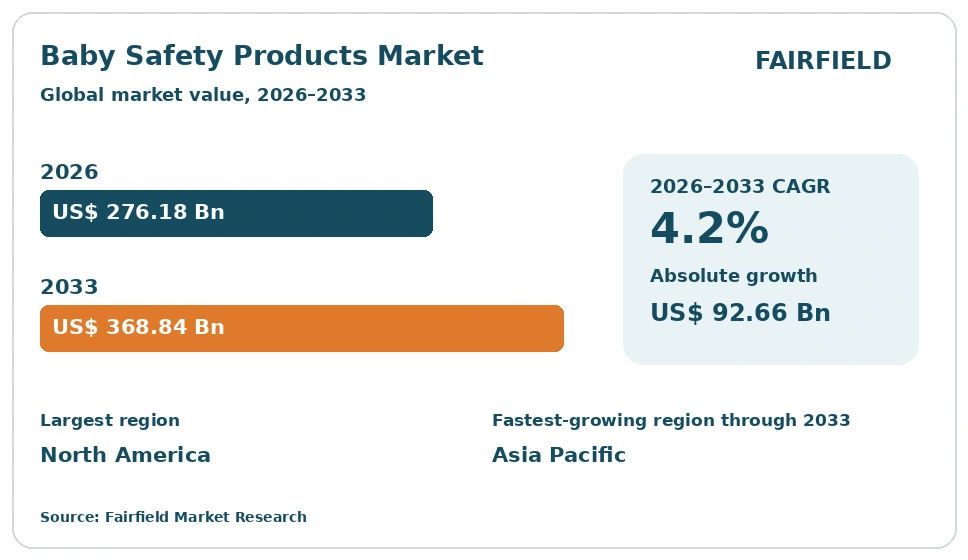
The global baby safety products market size is expected to be valued at US$ 276.18 billion in 2026 and projected to reach US$ 368.84 billion by 2033, growing at a CAGR of 4.2% between 2026 and 2033.
Between 2020 and 2025, the market grew at a CAGR of about 3.7%, reaching about US$ 265.0 billion in 2025, as store closures disrupted sales in 2020, then online shopping, premium products, and smart devices lifted demand while falling birth rates in some countries slowed volumes. The baby safety products market covers products that protect babies and young children from injury at home, in vehicles, and on the move. It includes infant car seats, convertible and booster seats, strollers and travel systems, baby monitors with audio, video, and breathing or oxygen tracking, safety gates, cabinet locks, outlet covers, corner guards, bath and sleep safety products, and baby helmets. Products are sold through specialty stores, supermarkets, department stores, and online channels. Growth comes from car seat laws, rising incomes, smart technology, and parents’ focus on child safety. In February 2026, Graco launched its first rotating infant car seat.
Key Report Takeaways
- By Product Type: Car Seats held about 60% share in 2025, while Baby Monitors is projected to expand at a 6.8% CAGR through 2033, driven by video and app-connected monitors, wearable sleep sensors, and parents’ demand for real-time alerts.
- By Age Group: Infants held about 52% share in 2025, while Toddlers is projected to expand at a 4.9% CAGR through 2033, driven by convertible and booster seats, safety gates, and childproofing as children become mobile.
- By Distribution Channel: Offline held about 75.6% share in 2025, while Online is projected to expand at a 6.2% CAGR through 2033, driven by baby registries, product reviews, home delivery, and direct-to-consumer brands.
- By Region: North America held about 37.7% share in 2025, while Asia Pacific is projected to expand at a 5.6% CAGR through 2033, driven by rising incomes, car ownership, new child seat rules, and premium product demand in China and India.
Global Baby Safety Products Market Trends and Insights
Drivers Impact Analysis
Two drivers carry the strongest influence on baby safety products market demand during the forecast period.
| Driver | Impact on CAGR Forecast | Geographic Relevance | Impact Timeline |
| Child safety laws and rising safety awareness | High | Global | Long term (≥4 years) |
| Smart monitors and premium product innovation | Medium | North America, Europe, Asia Pacific | Medium term (2-4 years) |
Safety Laws and Awareness Are Driving the Baby Safety Products Market
Child safety laws and rising safety awareness are the strongest driver of the baby safety products market. Parents and governments focus on preventing injuries.
The mechanism is regulation and education. Road crashes remain a leading cause of death for young children, and most high-income countries require children to ride in approved car seats, with rules on rear-facing travel and booster seats. Standards such as UN R129 (i-Size) in Europe and federal standards in the United States set strict crash-test requirements, and many countries in Asia Pacific, Latin America, and Middle East & Africa are adopting or tightening child seat laws. Awareness campaigns on safe sleep, furniture tip-overs, and household hazards encourage parents to buy gates, locks, and anchors. Rising car ownership in China and India expands demand. These trends support long-term demand.
Smart Products Are Expanding the Baby Safety Products Market
Smart monitors and premium product innovation are expanding the baby safety products market. Parents pay more for features and peace of mind.
The cause is technology and changing parent preferences. Baby monitors now offer high-definition video, smartphone apps, cry detection, sleep tracking, and wearable sensors that track heart rate and oxygen levels. Owlet holds FDA clearance for over-the-counter infant monitoring and launched its Dream Sock in Australia and New Zealand in December 2025. Car seats with rotating bases, load legs, and anti-rebound bars make installation and use easier, and premium strollers and travel systems sell at high prices. Lighter, more compact designs appeal to city parents who use public transport and ride-hailing. Parents also research products online and rely on independent crash-test ratings, rewarding brands that invest in safety beyond legal minimums. These trends expand sales.
Restraints Impact Analysis
Two restraints limit how quickly the baby safety products market grows.
| Restraint | Impact on CAGR Forecast | Geographic Relevance | Impact Timeline |
| Falling birth rates in major markets | High | Asia Pacific, Europe, North America | Long term (≥4 years) |
| Product recalls, counterfeits, and high prices | Medium | Global | Medium term (2-4 years) |
Falling Birth Rates Slow the Baby Safety Products Market
Falling birth rates in major markets slow the baby safety products market. Fewer babies mean fewer first-time buyers.
The specific causes are demographic shifts. Birth rates have fallen sharply in China, Japan, South Korea, Italy, Germany, and the United States, reducing the number of families buying car seats, strollers, and monitors each year. Higher living costs, later marriages, and smaller families mean fewer children per household, and hand-me-down products reduce new purchases for second and third children. Second-hand marketplaces for strollers and gates are growing, though experts warn against used car seats. Brands must compete harder for a smaller group of parents, leading to price promotions and heavy marketing spending. These factors slow volume growth and push companies toward premium products and new markets.
Recalls and Prices Restrict the Baby Safety Products Market
Product recalls, counterfeits, and high prices restrict the baby safety products market. Safety failures damage trust.
The underlying causes are quality risks and affordability. Recalls of car seats, sleepers, and gates due to defects or injuries harm brand reputations and cost money. Counterfeit car seats sold online may fail crash tests. Counterfeit car seats sold online may look genuine but fail crash tests, and regulators have warned parents to buy only from trusted sellers. Unapproved infant monitors that claim to track health without regulatory review have prompted FDA warnings. Premium products are too expensive for many families in emerging markets, where some parents hold babies on their laps in cars. Product liability lawsuits and insurance costs add to expenses for manufacturers. Tariffs on products imported from China have raised prices in the United States. These factors restrict growth.
Market Opportunities
Smart and Connected Safety Products Open a Fast-Growth Revenue Pool
Smart and connected safety products open a fast-growth revenue pool in the baby safety products market. Technology adds value and recurring revenue.
Brands can capture this opportunity with connected products. Parents increasingly want monitors with video, sleep analytics, and health tracking, along with car seats that alert caregivers if a child is left in a vehicle or a buckle is unfastened. Subscription services offering sleep insights and expert guidance create recurring revenue beyond the device sale, and Owlet has built a paying subscriber base through its Owlet360 service. Regulatory clearance for health-tracking monitors builds trust and creates barriers for unapproved rivals. Integration with smart home systems, phones, and smartwatches adds convenience for busy parents. Companies combining safe hardware with useful software and strong data privacy protection can win premium customers.
Emerging Market Expansion Creates a Growth Revenue Pool
Emerging market expansion creates a growth revenue pool in the baby safety products market. Many families are buying car seats for the first time.
Brands can capture this opportunity. Rising car ownership, new child seat laws, and growing middle classes in India, China, Indonesia, Brazil, and Saudi Arabia are creating new demand. Affordable, locally made car seats and childproofing products can reach first-time buyers. Online marketplaces and education campaigns help build awareness. Rental and subscription models for car seats and strollers can lower costs for families, and hospitals and insurers can distribute seats to new parents. Government programs that provide free or subsidized car seats to low-income families also create demand. Companies with affordable lines, local manufacturing, and strong retail partners can grow quickly in these markets.
Segment Analysis
By Product Type: Car Seats Lead While Baby Monitors Grow Fastest
Car Seats held about 60% share in 2025. Infant car seats, convertible seats, all-in-one seats, and boosters are required by law in many countries and are among the most expensive baby safety purchases. Rotating seats, ISOFIX and LATCH systems, load legs, and anti-rebound bars improve safety and ease of use, and in February 2026, Graco launched its SnugRide Turn & Slide rotating infant seat. Strollers and travel systems form another large category.
Baby Monitors is the fastest-growing product type, expanding at a 6.8% CAGR through 2033. Video monitors, app-connected cameras, and wearable sensors from Owlet, Nanit, Philips, and Motorola are replacing basic audio monitors. Safety gates, locks and latches, outlet covers, and other childproofing products form further segments. For the market, monitor growth adds technology value.
By Age Group: Infants Lead While Toddlers Grow Fastest
Infants held about 52% share in 2025. Parents of newborns buy infant car seats, monitors, bassinets, and travel systems, often through baby registries before the baby is born, and first-time parents tend to spend the most on safety products. Hospitals and pediatricians influence choices for car seats and safe sleep products.
Toddlers is the fastest-growing age group, expanding at a 4.9% CAGR through 2033. As children begin to crawl and walk, parents buy safety gates, cabinet locks, furniture anchors, and corner guards, and they move to convertible and booster car seats. Preschool children form another segment, buying booster seats, helmets, and outdoor safety products. Childproofing kits that bundle many items are popular with first-time parents moving into larger homes. For the market, toddler growth extends spending after infancy.
By Distribution Channel: Offline Leads While Online Grows Fastest
Offline held about 75.6% share in 2025. Specialty baby stores, department stores, hypermarkets, and pharmacies let parents see and try car seats and strollers, and staff can help with installation questions. Retailers such as Target, Walmart, Mothercare, and Babies”R”Us offer wide ranges and in-store demonstrations.
Online is the fastest-growing channel, expanding at a 6.2% CAGR through 2033. Baby registries on Amazon and Babylist, product reviews, and direct-to-consumer brands make online shopping easy for busy parents. Online marketplaces are growing fast in China and India, and live-stream shopping helps brands demonstrate products. Some parents still prefer to see car seats in stores before buying online. For the market, online growth widens access.
Geography Analysis
Which Region Is Leading the Baby Safety Products Market?
North America is leading the baby safety products market with about 37.7% share in 2025. The United States has strict car seat laws in every state, high spending per child, and strong brands such as Graco, Evenflo, Chicco, Britax, Owlet, and Nanit. Baby registries and large retailers drive sales, and smart monitors are widely adopted. The Consumer Product Safety Commission sets strict rules for sleep and nursery products. Canada, the fastest-growing country in the region, adds demand. Key barriers include falling births and recall risks. One change shaping the region is the shift to smart and rotating products.
Europe Shapes the Baby Safety Products Market Through Strict Standards
Europe is a major baby safety products market. Germany, the United Kingdom, France, Italy, and Spain have strict car seat rules under UN R129, and parents favor high-quality products. Britax Römer, Maxi-Cosi, Chicco, Cybex, and Bugaboo are major brands in the region. The United Kingdom is the fastest-growing country in Europe, supported by online sales. Retailers offer car seat fitting checks, and second-hand sales of strollers are growing. Key barriers include low birth rates and high prices. One opportunity is premium rotating seats and smart monitors.
Which Region Is Growing Fastest in the Baby Safety Products Market?
Asia Pacific is growing fastest in the baby safety products market, expanding at a 5.6% CAGR through 2033. China is the largest market in the region, with major producers such as Goodbaby International, owner of Cybex and Evenflo, and growing online sales of premium products. India is the fastest-growing country, with rising car ownership and awareness of child seat safety. Japan, South Korea, and Australia have strict standards. Key barriers include falling births in China and Japan and low car seat use in some countries. One change shaping the region is new child seat laws.
Latin America Grows the Baby Safety Products Market Through Car Seat Laws
Latin America is a growing baby safety products market. Brazil, Mexico, Argentina, Chile, and Colombia have introduced or strengthened child seat laws, raising demand for car seats and boosters. Rising car ownership and modern retail support sales, and global brands compete with local producers and imports from Asia Pacific. Online sales and baby registries are growing in Brazil and Mexico, and pharmacies sell childproofing items. Key barriers include economic swings, high import costs, counterfeit products, and low enforcement in some areas. One opportunity is affordable car seats and boosters for first-time buyers and growing families in cities.
Middle East & Africa Builds the Baby Safety Products Market Through Rising Awareness
Middle East & Africa is an emerging baby safety products market. Saudi Arabia, the United Arab Emirates, and Qatar have recently introduced child seat laws and have strong demand for premium imported brands. South Africa, Egypt, and Nigeria have growing urban middle classes, high birth rates, and rising car ownership, and awareness campaigns are promoting child seat use. Online shopping is growing in major cities. Key barriers include limited awareness, low incomes, and weak enforcement in many countries. One opportunity is premium imported products and smart monitors in wealthy cities such as Riyadh and Dubai.
Competitive Landscape
The baby safety products market is highly fragmented. Dorel Industries, Newell Brands (Graco), Artsana (Chicco), Goodbaby International (Cybex), and Britax Römer are leading players, while Owlet, Nanit, Kids2 (Summer Infant), Bugaboo International, Jané Group, Philips, and Munchkin compete strongly. Large juvenile product groups dominate car seats and strollers, technology companies lead in smart monitors, and many small brands and private labels compete in gates, locks, and childproofing products.
Companies compete on crash-test performance, certifications, ease of installation, design, smart features, brand trust, and price. Safety ratings from independent testers and recommendations from hospitals and parent communities strongly influence choices. Recalls can quickly damage reputations, so strong quality systems and testing are essential, while subscriptions and apps help smart device makers build ongoing relationships with parents.
Strategic moves show how competition is changing. In April 2024, Maxi-Cosi introduced its 360 Pro rotating and sliding car seats. In December 2025, Owlet launched its TGA-approved Dream Sock and Owlet360 subscription in Australia and New Zealand. In February 2026, Graco launched its first rotating infant car seat, the SnugRide Turn & Slide. These moves show competition shifting toward convenience features and connected monitoring.
Three themes shape vendor strategy. First, companies are adding rotating, sliding, and easy-install features to car seats. Second, they are building smart monitors with subscriptions and health tracking. Third, they are expanding in Asia Pacific and other regions where child seat laws are spreading.
Baby Safety Products Market Industry Leaders
- Dorel Industries
- Newell Brands (Graco)
- Artsana (Chicco)
- Goodbaby International (Cybex)
- Britax Römer
Recent Industry Developments
- February 2026: Graco launched the SnugRide Turn & Slide, its first rotating infant car seat, which turns 180 degrees and glides toward the caregiver, priced at US$ 349.99 - advances infant car seats in the baby safety products market.
- December 2025: Owlet launched its TGA-approved Dream Sock and Owlet360 subscription in Australia and New Zealand, its first international subscription rollout - expands smart baby monitors in Asia Pacific.
- April 2024: Maxi-Cosi introduced its 360 Pro family of car seats that rotate and slide toward parents - shows rising demand for easier-to-use seats.
Companies Covered in the Report
- Dorel Industries
- Newell Brands (Graco)
- Artsana (Chicco)
- Goodbaby International (Cybex)
- Britax Römer
- Owlet
- Nanit
- Kids2 (Summer Infant)
- Bugaboo International
- Jané Group
- Philips
- Munchkin
Baby Safety Products Market Report Scope
This report covers the baby safety products market, including car seats, strollers and travel systems, baby monitors, safety gates, locks and latches, outlet covers, and other childproofing products, for infants, toddlers, and preschool children, sold through offline channels such as specialty and department stores and online channels. The base year is 2025, and the forecast period runs from 2026 to 2033. All values are expressed in US$ Billion.
| Product Type | Car Seats, Strollers and Travel Systems, Baby Monitors, Safety Gates and Childproofing, Others |
| Age Group | Infants, Toddlers, Preschool Children |
| Distribution Channel | Offline, Online |
| Regions | North America, Europe, Asia Pacific, Latin America, Middle East & Africa |
1. Executive Summary
1.1 Baby Safety Products Market Snapshot
1.2 Future Projections
1.3 Key Market Trends
1.4 Regional Snapshot
2. Market Overview
2.1 Market Definition and Report Scope
2.2 Historical Market Trends
2.3 Market Dynamics
2.3.1 Drivers
2.3.1.1 Safety Laws and Awareness Are Driving the Baby Safety Products Market
2.3.1.2 Smart Products Are Expanding the Baby Safety Products Market
2.3.2 Restraints
2.3.2.1 Falling Birth Rates Slow the Baby Safety Products Market
2.3.2.2 Recalls and Prices Restrict the Baby Safety Products Market
2.3.3 Market Opportunities
2.3.3.1 Smart and Connected Safety Products Open a Fast-Growth Revenue Pool
2.3.3.2 Emerging Market Expansion Creates a Growth Revenue Pool
3. Global Baby Safety Products Market Outlook, 2020–2033
3.1 Global Baby Safety Products Market Outlook, by Product Type, Value (US$ Billion), 2020–2033
3.1.1 Car Seats
3.1.2 Strollers and Travel Systems
3.1.3 Baby Monitors
3.1.4 Safety Gates and Childproofing
3.1.5 Others
3.2 Global Baby Safety Products Market Outlook, by Age Group, Value (US$ Billion), 2020–2033
3.2.1 Infants
3.2.2 Toddlers
3.2.3 Preschool Children
3.3 Global Baby Safety Products Market Outlook, by Distribution Channel, Value (US$ Billion), 2020–2033
3.3.1 Offline
3.3.2 Online
3.4 Global Baby Safety Products Market Outlook, by Region, Value (US$ Billion), 2020–2033
3.4.1 North America
3.4.2 Europe
3.4.3 Asia Pacific
3.4.4 Latin America
3.4.5 Middle East & Africa
4. North America Baby Safety Products Market Outlook, 2020–2033
4.1 North America Baby Safety Products Market Outlook, by Product Type, Value (US$ Billion), 2020–2033
4.1.1 Car Seats
4.1.2 Strollers and Travel Systems
4.1.3 Baby Monitors
4.1.4 Safety Gates and Childproofing
4.1.5 Others
4.2 North America Baby Safety Products Market Outlook, by Age Group, Value (US$ Billion), 2020–2033
4.2.1 Infants
4.2.2 Toddlers
4.2.3 Preschool Children
4.3 North America Baby Safety Products Market Outlook, by Distribution Channel, Value (US$ Billion), 2020–2033
4.3.1 Offline
4.3.2 Online
4.4 North America Baby Safety Products Market Outlook, by Country, Value (US$ Billion), 2020–2033
4.4.1 United States Baby Safety Products Market Outlook, by Product Type, 2020–2033
4.4.2 United States Baby Safety Products Market Outlook, by Age Group, 2020–2033
4.4.3 United States Baby Safety Products Market Outlook, by Distribution Channel, 2020–2033
4.4.4 Canada Baby Safety Products Market Outlook, by Product Type, 2020–2033
4.4.5 Canada Baby Safety Products Market Outlook, by Age Group, 2020–2033
4.4.6 Canada Baby Safety Products Market Outlook, by Distribution Channel, 2020–2033
5. Europe Baby Safety Products Market Outlook, 2020–2033
5.1 Europe Baby Safety Products Market Outlook, by Product Type, Value (US$ Billion), 2020–2033
5.1.1 Car Seats
5.1.2 Strollers and Travel Systems
5.1.3 Baby Monitors
5.1.4 Safety Gates and Childproofing
5.1.5 Others
5.2 Europe Baby Safety Products Market Outlook, by Age Group, Value (US$ Billion), 2020–2033
5.2.1 Infants
5.2.2 Toddlers
5.2.3 Preschool Children
5.3 Europe Baby Safety Products Market Outlook, by Distribution Channel, Value (US$ Billion), 2020–2033
5.3.1 Offline
5.3.2 Online
5.4 Europe Baby Safety Products Market Outlook, by Country, Value (US$ Billion), 2020–2033
5.4.1 Germany Baby Safety Products Market Outlook, by Product Type, 2020–2033
5.4.2 Germany Baby Safety Products Market Outlook, by Age Group, 2020–2033
5.4.3 Germany Baby Safety Products Market Outlook, by Distribution Channel, 2020–2033
5.4.4 United Kingdom Baby Safety Products Market Outlook, by Product Type, 2020–2033
5.4.5 United Kingdom Baby Safety Products Market Outlook, by Age Group, 2020–2033
5.4.6 United Kingdom Baby Safety Products Market Outlook, by Distribution Channel, 2020–2033
5.4.7 France Baby Safety Products Market Outlook, by Product Type, 2020–2033
5.4.8 France Baby Safety Products Market Outlook, by Age Group, 2020–2033
5.4.9 France Baby Safety Products Market Outlook, by Distribution Channel, 2020–2033
5.4.10 Italy Baby Safety Products Market Outlook, by Product Type, 2020–2033
5.4.11 Italy Baby Safety Products Market Outlook, by Age Group, 2020–2033
5.4.12 Italy Baby Safety Products Market Outlook, by Distribution Channel, 2020–2033
5.4.13 Spain Baby Safety Products Market Outlook, by Product Type, 2020–2033
5.4.14 Spain Baby Safety Products Market Outlook, by Age Group, 2020–2033
5.4.15 Spain Baby Safety Products Market Outlook, by Distribution Channel, 2020–2033
6. Asia Pacific Baby Safety Products Market Outlook, 2020–2033
6.1 Asia Pacific Baby Safety Products Market Outlook, by Product Type, Value (US$ Billion), 2020–2033
6.1.1 Car Seats
6.1.2 Strollers and Travel Systems
6.1.3 Baby Monitors
6.1.4 Safety Gates and Childproofing
6.1.5 Others
6.2 Asia Pacific Baby Safety Products Market Outlook, by Age Group, Value (US$ Billion), 2020–2033
6.2.1 Infants
6.2.2 Toddlers
6.2.3 Preschool Children
6.3 Asia Pacific Baby Safety Products Market Outlook, by Distribution Channel, Value (US$ Billion), 2020–2033
6.3.1 Offline
6.3.2 Online
6.4 Asia Pacific Baby Safety Products Market Outlook, by Country, Value (US$ Billion), 2020–2033
6.4.1 China Baby Safety Products Market Outlook, by Product Type, 2020–2033
6.4.2 China Baby Safety Products Market Outlook, by Age Group, 2020–2033
6.4.3 China Baby Safety Products Market Outlook, by Distribution Channel, 2020–2033
6.4.4 India Baby Safety Products Market Outlook, by Product Type, 2020–2033
6.4.5 India Baby Safety Products Market Outlook, by Age Group, 2020–2033
6.4.6 India Baby Safety Products Market Outlook, by Distribution Channel, 2020–2033
6.4.7 Japan Baby Safety Products Market Outlook, by Product Type, 2020–2033
6.4.8 Japan Baby Safety Products Market Outlook, by Age Group, 2020–2033
6.4.9 Japan Baby Safety Products Market Outlook, by Distribution Channel, 2020–2033
6.4.10 South Korea Baby Safety Products Market Outlook, by Product Type, 2020–2033
6.4.11 South Korea Baby Safety Products Market Outlook, by Age Group, 2020–2033
6.4.12 South Korea Baby Safety Products Market Outlook, by Distribution Channel, 2020–2033
6.4.13 Australia Baby Safety Products Market Outlook, by Product Type, 2020–2033
6.4.14 Australia Baby Safety Products Market Outlook, by Age Group, 2020–2033
6.4.15 Australia Baby Safety Products Market Outlook, by Distribution Channel, 2020–2033
7. Latin America Baby Safety Products Market Outlook, 2020–2033
7.1 Latin America Baby Safety Products Market Outlook, by Product Type, Value (US$ Billion), 2020–2033
7.1.1 Car Seats
7.1.2 Strollers and Travel Systems
7.1.3 Baby Monitors
7.1.4 Safety Gates and Childproofing
7.1.5 Others
7.2 Latin America Baby Safety Products Market Outlook, by Age Group, Value (US$ Billion), 2020–2033
7.2.1 Infants
7.2.2 Toddlers
7.2.3 Preschool Children
7.3 Latin America Baby Safety Products Market Outlook, by Distribution Channel, Value (US$ Billion), 2020–2033
7.3.1 Offline
7.3.2 Online
7.4 Latin America Baby Safety Products Market Outlook, by Country, Value (US$ Billion), 2020–2033
7.4.1 Brazil Baby Safety Products Market Outlook, by Product Type, 2020–2033
7.4.2 Brazil Baby Safety Products Market Outlook, by Age Group, 2020–2033
7.4.3 Brazil Baby Safety Products Market Outlook, by Distribution Channel, 2020–2033
7.4.4 Mexico Baby Safety Products Market Outlook, by Product Type, 2020–2033
7.4.5 Mexico Baby Safety Products Market Outlook, by Age Group, 2020–2033
7.4.6 Mexico Baby Safety Products Market Outlook, by Distribution Channel, 2020–2033
7.4.7 Argentina Baby Safety Products Market Outlook, by Product Type, 2020–2033
7.4.8 Argentina Baby Safety Products Market Outlook, by Age Group, 2020–2033
7.4.9 Argentina Baby Safety Products Market Outlook, by Distribution Channel, 2020–2033
7.4.10 Chile Baby Safety Products Market Outlook, by Product Type, 2020–2033
7.4.11 Chile Baby Safety Products Market Outlook, by Age Group, 2020–2033
7.4.12 Chile Baby Safety Products Market Outlook, by Distribution Channel, 2020–2033
7.4.13 Colombia Baby Safety Products Market Outlook, by Product Type, 2020–2033
7.4.14 Colombia Baby Safety Products Market Outlook, by Age Group, 2020–2033
7.4.15 Colombia Baby Safety Products Market Outlook, by Distribution Channel, 2020–2033
8. Middle East & Africa Baby Safety Products Market Outlook, 2020–2033
8.1 Middle East & Africa Baby Safety Products Market Outlook, by Product Type, Value (US$ Billion), 2020–2033
8.1.1 Car Seats
8.1.2 Strollers and Travel Systems
8.1.3 Baby Monitors
8.1.4 Safety Gates and Childproofing
8.1.5 Others
8.2 Middle East & Africa Baby Safety Products Market Outlook, by Age Group, Value (US$ Billion), 2020–2033
8.2.1 Infants
8.2.2 Toddlers
8.2.3 Preschool Children
8.3 Middle East & Africa Baby Safety Products Market Outlook, by Distribution Channel, Value (US$ Billion), 2020–2033
8.3.1 Offline
8.3.2 Online
8.4 Middle East & Africa Baby Safety Products Market Outlook, by Country, Value (US$ Billion), 2020–2033
8.4.1 Saudi Arabia Baby Safety Products Market Outlook, by Product Type, 2020–2033
8.4.2 Saudi Arabia Baby Safety Products Market Outlook, by Age Group, 2020–2033
8.4.3 Saudi Arabia Baby Safety Products Market Outlook, by Distribution Channel, 2020–2033
8.4.4 United Arab Emirates Baby Safety Products Market Outlook, by Product Type, 2020–2033
8.4.5 United Arab Emirates Baby Safety Products Market Outlook, by Age Group, 2020–2033
8.4.6 United Arab Emirates Baby Safety Products Market Outlook, by Distribution Channel, 2020–2033
8.4.7 Qatar Baby Safety Products Market Outlook, by Product Type, 2020–2033
8.4.8 Qatar Baby Safety Products Market Outlook, by Age Group, 2020–2033
8.4.9 Qatar Baby Safety Products Market Outlook, by Distribution Channel, 2020–2033
8.4.10 South Africa Baby Safety Products Market Outlook, by Product Type, 2020–2033
8.4.11 South Africa Baby Safety Products Market Outlook, by Age Group, 2020–2033
8.4.12 South Africa Baby Safety Products Market Outlook, by Distribution Channel, 2020–2033
8.4.13 Egypt Baby Safety Products Market Outlook, by Product Type, 2020–2033
8.4.14 Egypt Baby Safety Products Market Outlook, by Age Group, 2020–2033
8.4.15 Egypt Baby Safety Products Market Outlook, by Distribution Channel, 2020–2033
8.4.16 Nigeria Baby Safety Products Market Outlook, by Product Type, 2020–2033
8.4.17 Nigeria Baby Safety Products Market Outlook, by Age Group, 2020–2033
8.4.18 Nigeria Baby Safety Products Market Outlook, by Distribution Channel, 2020–2033
9. Competitive Landscape
9.1 Baby Safety Products Market Industry Leaders
9.2 Recent Industry Developments
9.3 Company Profiles
9.3.1 Dorel Industries
9.3.2 Newell Brands (Graco)
9.3.3 Artsana (Chicco)
9.3.4 Goodbaby International (Cybex)
9.3.5 Britax Römer
9.3.6 Owlet
9.3.7 Nanit
9.3.8 Kids2 (Summer Infant)
9.3.9 Bugaboo International
9.3.10 Jané Group
9.3.11 Philips
9.3.12 Munchkin
10. Appendix
10.1 Research Methodology
10.2 Report Assumptions
10.3 Acronyms and Abbreviations
| Product Type | Car Seats, Strollers and Travel Systems, Baby Monitors, Safety Gates and Childproofing, Others |
| Age Group | Infants, Toddlers, Preschool Children |
| Distribution Channel | Offline, Online |
| Regions | North America, Europe, Asia Pacific, Latin America, Middle East & Africa |
Our Research Methodology
Considering the volatility of business today, traditional approaches to strategizing a game plan can be unfruitful if not detrimental. True ambiguity is no way to determine a forecast. A myriad of predetermined factors must be accounted for such as the degree of risk involved, the magnitude of circumstances, as well as conditions or consequences that are not known or unpredictable. To circumvent binary views that cast uncertainty, the application of market research intelligence to strategically posture, move, and enable actionable outcomes is necessary.
View Methodology
Quality Assured
Rigorous Validation Process

Confidentiality Assured
End-to-end Data Security

Custom Research Services
Tailored To Your Objectives
FAQs
The baby safety products market is valued at US$ 276.18 billion in 2026, led by car seats, offline sales, and North America.
The market is projected to reach US$ 368.84 billion by 2033, growing at a 4.2% CAGR and adding US$ 92.66 billion.
Baby monitors are growing fastest at a 6.8% CAGR through 2033, driven by video monitors, wearable sensors, and real-time app alerts.
Asia Pacific is growing fastest at a 5.6% CAGR through 2033, driven by car ownership and new seat laws in China and India.
North America holds the largest share at about 37.7% in 2025, supported by strict car seat laws, high spending, and strong brands.
Related Reports
Bathroom Renovation Market Size, Share, Insights, Competitive Landscape, and Forecast 2026 to 2033
The global bathroom renovation market is valued at US$433.43 billion in 2026, reaching US$574.21 billion by 2033, growing at a 4.1% CAGR
Baby Wipes Market Size, Share, Insights, Competitive Landscape, and Forecast 2026 to 2033
The global baby wipes market is valued at US$6.64 billion in 2026, reaching US$11.29 billion by 2033, growing at a 7.9% CAGR
FDM Candle Market Size, Share, Insights, Competitive Landscape, and Forecast 2026 to 2033
Explore the FDM candle market outlook for 2026–2033, with product formats, wax types, retail trends, regional demand, and competitive insights.
Aloe Vera Gel Market Size, Share, Insights, Competitive Landscape, and Forecast 2026 to 2033
Explore the aloe vera gel market outlook for 2026–2033, including organic grades, application trends, regional insights, and competitive analysis.
Food Waste Disposers Market Size, Share, Insights, Competitive Landscape, and Forecast 2026 to 2033
The global food waste disposers market is valued at US$3.2 billion in 2026, reaching US$5.1 billion by 2033, growing at a 6.9% CAGR
Baby Car Seat Market Size, Share, Insights, Competitive Landscape, and Forecast 2026 to 2033
The baby car seat market is forecast to grow from US$ 6.12 billion in 2026 to US$ 10.09 billion by 2033 at a 7.4% CAGR.