



Food Waste Disposers Market
Food Waste Disposers Market Size, Share, Insights, Competitive Landscape, and Forecast 2026 to 2033
Food Waste Disposers Market Size and Trend Analysis
What Is Driving Food Waste Disposer Demand Through 2033?
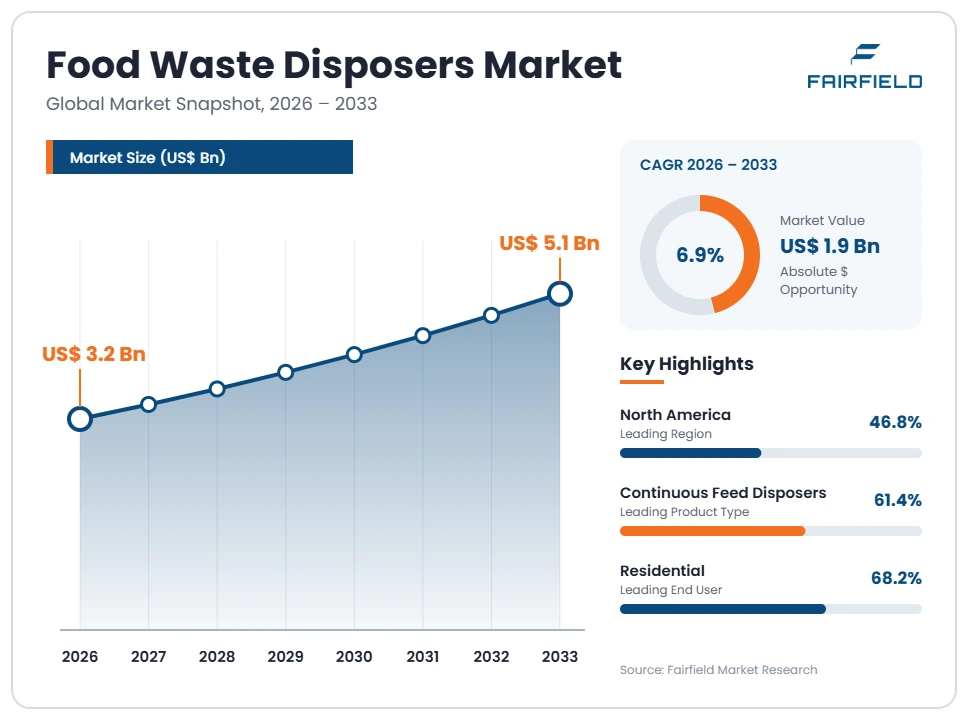
The global Food Waste Disposers market size is expected to be valued at US$ 3.2 billion in 2026 and projected to reach US$ 5.1 billion by 2033, growing at a CAGR of 6.9% between 2026 and 2033. Growth reflects three forces working together. Organic waste diversion policy is pushing food scraps out of landfill bins and toward on-site grinding. Kitchen renovation activity keeps lifting disposer attachment rates on new and replacement sinks. Commercial kitchens are adopting larger disposers and pulping systems to cut waste hauling volume. Historical growth ran at a CAGR of 5.6% between 2020 and 2025, and the forecast period adds an absolute dollar opportunity of US$ 1.9 billion.
Key Report Takeaways
- By Product Type: Continuous feed disposers led with 61.4% share in 2026, while commercial disposers and pulping systems are projected to expand at an 8.2% CAGR through 2033, driven by foodservice operators cutting wet waste hauling volume.
- By Power Rating: The 3/4 HP class led with 42.6% share in 2026, while 1 HP and above units are projected to expand at an 8.0% CAGR through 2033, driven by tougher grind demands from fibrous and bone waste.
- By End User: Residential kitchens led with 68.2% share in 2026, while foodservice and hospitality is projected to expand at an 8.4% CAGR through 2033, driven by hotel and restaurant kitchen refurbishment cycles.
- By Distribution Channel: Home improvement and specialty retail led with 38.5% share in 2026, while online retail is projected to expand at a 9.1% CAGR through 2033, driven by do-it-yourself replacement buyers comparing models directly.
- By Region: North America led with 46.8% share in 2026, while Asia Pacific is projected to expand at a 9.3% CAGR through 2033; Europe, Latin America and Middle East & Africa add steady replacement and institutional kitchen demand.
Global Food Waste Disposers Market Trends and Insights
Market Growth Drivers
Organic Waste Diversion Policy Is Pushing Separation at the Kitchen Sink
Organic waste diversion rules are turning the kitchen sink into a practical disposal point for food scraps. Jurisdictions that restrict food waste in general refuse bins create immediate demand for grinding at the source. Households and commercial kitchens need a simple way to keep wet organic matter out of mixed waste, and disposers do that without a separate collection trip.
The policy direction is broad rather than tied to any single jurisdiction. Landfill diversion targets, separate organics collection schemes and rising tipping fees all raise the cost of sending food scraps to landfill. Where wastewater utilities operate anaerobic digestion, ground food waste can become a feedstock for biogas rather than a disposal burden. Equipment makers increasingly position disposers alongside composting and organics collection as complementary tools, which widens their role in waste planning.
Kitchen Renovation Activity Is Lifting Disposer Attachment Rates on New Sinks
Kitchen remodelling is the single most reliable route to a disposer sale. A disposer is installed under the sink, so the purchase decision usually rides on a sink, faucet or countertop project rather than standing alone. Rising renovation spending in mature housing markets therefore converts directly into unit volume, and it also pulls buyers toward higher power ratings than the units being replaced.
Behind this sits a long replacement cycle and a steadily ageing installed base. Many disposers in service were fitted a decade or more ago, and failures tend to prompt an upgrade rather than a like-for-like swap. Builders and plumbing contractors increasingly specify disposers as standard in mid and upper-tier housing, while sink and faucet brands bundle them into coordinated kitchen packages. That bundling normalises the product and reduces the decision effort for buyers.
Market Restraints
Municipal Sewer and Wastewater Restrictions Limit Installed Base Expansion
Sewer and wastewater rules remain the hardest ceiling on disposer penetration. Some municipalities discourage or prohibit household disposers because of concerns about grease accumulation, sewer blockages, hydraulic load and added solids reaching treatment plants. Where those restrictions apply, demand stalls regardless of consumer interest, and manufacturers cannot sell their way past a plumbing code.
The constraint is strongest in older urban areas with combined sewers and limited treatment headroom. Utilities there often favour separate organics collection or composting over sink grinding, and public guidance reflects that preference. Even where disposers are permitted, buildings on septic systems face capacity and maintenance concerns that deter installation. Manufacturers respond with finer grind technology, septic-compatible models and enzyme dosing systems, but acceptance ultimately depends on local utility policy and sewer capacity rather than product design alone.
Retrofit Cost and Low Awareness Slow Adoption Outside Mature Markets
Outside North America and a handful of developed markets, disposer ownership stays low because retrofitting is awkward and unfamiliar. Installation needs suitable sink drain geometry, under-sink clearance, a dedicated electrical supply and, in many cases, a plumber. Those requirements turn a modest appliance purchase into a small project, and the total installed cost often exceeds the price of the unit itself.
Awareness is the second barrier. In many regions food scraps are composted, fed to animals or collected separately, so the category has no established habit to build on. Retail shelf presence is thin, demonstration is rare, and buyers struggle to judge grind performance before purchase. Cultural attitudes toward putting food into drains also vary widely. Manufacturers are addressing this with compact models, simplified mounting systems and dealer training, but adoption builds slowly in these markets.
Market Opportunities
Commercial Pulping and Dewatering Systems Open a Higher-Value Equipment Segment
Commercial pulping and dewatering systems are the clearest route to higher revenue per installation. These systems grind food waste, extract water and deliver a compact, lower-weight residue, which cuts the volume and cost of waste hauling for large kitchens. Hotels, hospitals, campus dining halls, airports and stadium caterers gain measurable operating savings, so the purchase is justified on economics rather than convenience.
This segment also carries better aftermarket economics than residential units. Systems are specified by foodservice consultants, installed as part of dish room design and supported by service contracts, spare parts and consumables over long lifecycles. Growing interest in weighing and tracking food waste adds a data layer that connects the equipment to sustainability reporting. For manufacturers, commercial lines diversify revenue away from housing cycles and build durable relationships with institutional operators.
Quiet, Efficient and Connected Disposers Are Creating Premium Replacement Demand
Noise, efficiency and smarter controls are giving manufacturers a credible reason to charge more. Open-plan kitchens have made disposer noise a genuine purchase criterion, and insulated grind chambers, anti-vibration mounts and refined motor designs now anchor premium product tiers. Buyers replacing an older unit are willing to trade up for quieter operation, faster grinding and reduced jamming, which lifts average selling prices across mature markets.
Technology is extending this further. Brushless and higher-efficiency motors improve torque while drawing less power, and overload protection with automatic reversing reduces service calls. Some models add sensing that adjusts grind cycles to load, or connectivity that flags faults and maintenance needs. Pairing disposers with water-saving controls and compatible sink systems supports whole-kitchen propositions. Together these features move the category from a commodity fitting toward a specified, branded appliance.
Segment Analysis
- Why Do Continuous Feed Disposers Hold the Largest Share?
Continuous feed disposers led the market with 61.4% share in 2026 because they match how most kitchens actually work. Scraps can be added while the unit runs, which suits ongoing meal preparation and cleanup rather than batch loading. They are also cheaper to manufacture, simpler to install and widely stocked, so they dominate builder specifications and retail shelves. Batch feed units hold a smaller, safety-led niche where a stopper must be fitted before operation.
Commercial disposers and pulping systems are the fastest-growing product type at an 8.2% CAGR through 2033. Foodservice operators adopt them to reduce wet waste weight, hauling frequency and back-of-house odour. These systems carry far higher unit values and attach service contracts, spares and consumables. The result is a product mix shifting gradually toward engineered, specified equipment, which lifts overall market value faster than unit volume alone.
- Mid-Range 3/4 HP Motors Balance Grind Capacity and Installed Cost
The 3/4 HP class led the power rating segment with 42.6% share in 2026. It sits at the point where grind capability, noise and price converge for a typical household. These motors handle everyday vegetable trimmings, soft bones and fibrous waste without the jamming common in entry-level units, yet they remain affordable enough for builders to specify at scale. Units up to 1/2 HP still serve price-sensitive and compact-kitchen buyers.
Motors rated 1 HP and above are growing fastest at an 8.0% CAGR through 2033. Demand comes from larger households, premium renovations and light commercial kitchens handling heavier loads. Higher-rated units also carry better insulation, multi-stage grinding and stronger warranties, which supports premium pricing. As more buyers trade up during replacement, the power mix shifts upward and average selling prices rise across the installed base.
- Which End User Is Driving the Fastest Growth in Food Waste Disposers?
Foodservice and hospitality is the fastest-growing end user at an 8.4% CAGR through 2033, driven by waste hauling costs and kitchen refurbishment cycles. Hotels, restaurants and contract caterers face rising disposal charges and tighter organics rules, so grinding and pulping equipment pays back through reduced waste volume and labour. Institutional and healthcare kitchens follow similar logic across hospitals, campuses and correctional facilities.
Residential kitchens nonetheless led with 68.2% share in 2026, reflecting the enormous installed base in North American housing and steady replacement demand. Household purchases are tied to renovation and appliance failure rather than operating economics. The practical implication is a two-speed market: residential supplies stable volume and brand recognition, while commercial channels supply the value growth. Manufacturers serving both gain resilience when housing activity softens.
- Online Retail Is Reshaping How Households Buy Replacement Disposers
Home improvement and specialty retail led distribution with 38.5% share in 2026, because most disposer purchases still happen alongside sinks, faucets and plumbing fittings. Store staff advise on sizing, and stock availability matters when a failed unit needs replacing quickly. Plumbing and trade distribution serves contractors and builders, while direct and original equipment supply covers project and commercial installations.
Online retail is the fastest-growing channel at a 9.1% CAGR through 2033. Replacement buyers research horsepower, noise ratings and mounting compatibility online, then order directly, often fitting the unit themselves using standard mount systems. Manufacturer websites, marketplaces and video guidance have reduced the perceived difficulty of installation. For vendors this channel improves margin and customer data, but it also increases price transparency and raises the importance of clear model differentiation.
Geography Analysis
- Which Region Is Leading the Food Waste Disposers Market?
North America leads the market with 46.8% share in 2026, supported by the deepest installed base and the most permissive plumbing norms. The United States accounts for the bulk of demand, with Canada adding steady replacement volume. Disposers have been standard in American kitchens for decades, so household penetration is high and annual sales are driven largely by failure replacement and renovation upgrades.
Several factors sustain this position. Building codes and wastewater infrastructure broadly accommodate sink grinding, large-format home improvement retail gives the category constant shelf presence, and builders specify disposers in most new mid-tier housing. Organic waste diversion programmes in several states and provinces reinforce the case further. Commercial demand from restaurant chains, hotels and campus dining strengthens the higher-value end, keeping regional revenue growth above unit growth.
- Europe Grows Through Commercial Kitchens Rather Than Household Penetration
Europe holds 22.4% share in 2026, with demand concentrated in the United Kingdom, Germany, Italy and the Nordic countries. Household penetration stays far below North American levels because many municipalities prefer separate organics collection and composting, and some wastewater authorities actively discourage sink grinding. That keeps the residential opportunity uneven across the region.
Growth instead comes from commercial and institutional kitchens. Hotel refurbishment, contract catering and hospital dish room upgrades favour pulping and dewatering systems that cut waste weight before collection. Landfill diversion targets and rising gate fees strengthen the payback case. In markets where utilities run anaerobic digestion, ground food waste is viewed more favourably as a digester feedstock. European buyers also weight noise, energy efficiency and build quality heavily, which supports premium product positioning.
- Which Region Is Growing Fastest in the Food Waste Disposers Market?
Asia Pacific is the fastest-growing region at a 9.3% CAGR through 2033, expanding from 21.1% share in 2026. Growth is led by China, where domestic appliance manufacturers have built the category quickly, alongside Japan, South Korea, Australia and urban India. Rapid high-rise residential construction creates kitchens where on-site grinding is attractive because waste storage space is limited.
Policy and urbanisation drive the pace. Several Chinese cities have introduced household waste classification rules that make food waste separation a daily requirement, which raises interest in sink-level solutions. Rising disposable incomes, modular kitchen adoption and strong e-commerce distribution shorten the path from awareness to purchase. Hotel and restaurant expansion across the region adds commercial volume, while local manufacturing keeps prices competitive and accelerates penetration beyond premium housing.
- Latin America Builds Demand From Hospitality and Premium Housing Projects
Latin America accounts for 5.9% share in 2026, with Brazil, Mexico, Chile and Colombia representing most of the regional opportunity. Adoption concentrates in upper-income housing and newly built apartment developments where kitchens are fitted with imported or premium sink packages. Mainstream household penetration remains limited by installation cost and uneven plumbing standards.
Hospitality is the stronger pull. Tourism-led hotel construction, international restaurant chains and expanding shopping centre food courts create demand for commercial disposers that reduce back-of-house waste handling. Mexican proximity to North American supply chains supports availability and service, while Brazilian appliance distribution reaches major metropolitan markets effectively. Municipal waste collection pressures in large cities are gradually improving the argument for on-site grinding, though regulation remains less developed than in mature regions.
- Middle East & Africa Demand Concentrates in Hospitality and Institutional Kitchens
Middle East & Africa holds 3.8% share in 2026, the smallest regional position, with activity centred on the United Arab Emirates, Saudi Arabia, Qatar and South Africa. Large-scale hotel, resort, hospital and catering projects across the Gulf create consistent demand for commercial disposers and pulping systems specified during construction.
Residential adoption is narrower and follows premium villa and apartment developments where international kitchen brands are used. Water scarcity is a genuine consideration, so buyers favour low-water grinding and dewatering systems that minimise consumption. Across much of Africa, limited sewer infrastructure and low household appliance penetration restrict the category to high-end urban projects. Growth therefore depends on construction pipelines, tourism investment and facility management standards rather than mass household uptake.
Competitive Landscape
The food waste disposers market is moderately concentrated. A small group of long-established manufacturers holds most residential volume in North America, while the commercial side is served by specialist foodservice equipment builders with deep dish room expertise. Regional appliance groups in Asia Pacific have built strong domestic positions and are now broadening their export reach. Consolidation has largely taken the form of disposer brands being absorbed into wider kitchen and plumbing portfolios, which signals a market maturing from standalone appliance to integrated kitchen component.
Competition turns on grind performance, noise, motor efficiency, durability and ease of installation. Multi-stage grinding, anti-jamming reversal, insulated chambers and quick-mount collars are the features vendors use to separate tiers. In commercial lines the contest shifts to throughput, dewatering efficiency, water consumption, serviceability and compliance with foodservice hygiene standards. Newer entrants from Asia Pacific compete on price and compact designs suited to smaller kitchens, pressuring entry-level pricing and forcing established brands to defend the mid and premium tiers.
Strategic activity concentrates on product line extension, channel development and sustainability positioning. Vendors broaden power ratings and noise grades to cover more price points, strengthen online and trade channels, and invest in dealer and plumber training that protects installation quality. Partnerships with sink, faucet and cabinetry brands support bundled kitchen offers. Investment in quieter, more efficient motors and in waste measurement capability for commercial customers reflects the growing weight of sustainability reporting in purchasing decisions.
Competitive direction is shifting toward whole-kitchen and whole-waste-stream propositions. Vendors increasingly sell disposal capability as part of a system rather than a single fitting, combining hardware, service and documentation of diverted waste volumes.
Industry Leaders
- Whirlpool Corporation (InSinkErator)
- Anaheim Manufacturing Company (Waste King)
- Fortune Brands Innovations, Inc. (Moen)
- Haier Smart Home Co., Ltd.
- Franke Group
- Salvajor Company
Companies Covered in the Report
- Whirlpool Corporation (InSinkErator)
- Anaheim Manufacturing Company (Waste King, Whirlaway)
- Fortune Brands Innovations, Inc. (Moen)
- Haier Smart Home Co., Ltd.
- GE Appliances
- Midea Group Co., Ltd.
- Franke Group
- BLANCO GmbH + Co KG
- Elkay Manufacturing Company
- Electrolux AB
- Salvajor Company
- Illinois Tool Works Inc. (Hobart)
- Somat Company
- Becbas
Food Waste Disposers Market Report Scope
| Metric | Value |
| Study Period | 2020–2033 |
| Market Size 2026 | US$ 3.2 Billion |
| Market Size 2033 | US$ 5.1 Billion |
| CAGR 2026–2033 | 6.9% |
| Absolute Dollar Opportunity | US$ 1.9 Billion |
| Largest Market | North America (46.8% share in 2026) |
| Fastest-Growing Market | Asia Pacific (9.3% CAGR 2026–2033) |
| Market Concentration | Moderately Concentrated |
| Major Players | Whirlpool Corporation (InSinkErator), Anaheim Manufacturing Company (Waste King), Fortune Brands Innovations, Inc. (Moen), Haier Smart Home Co., Ltd., Franke Group |
Food Waste Disposers Market Segmentation
- Executive Summary
- Global Food Waste Disposers Market Snapshot
- Future Projections, 2026–2033
- Key Industry Highlights
- Regional Snapshot
- Market Overview
- Market Definition and Report Scope
- Historical Market Trends
- Market Dynamics
- Drivers
- Restraints
- Market Opportunities
- Global Food Waste Disposers Market Outlook, 2026–2033
- Global Food Waste Disposers Market Outlook, by Product Type, Value (US$ Billion), 2026–2033
- Continuous Feed Disposers
- Batch Feed Disposers
- Commercial Disposers and Pulping Systems
- Global Food Waste Disposers Market Outlook, by Power Rating, Value (US$ Billion), 2026–2033
- Up to 1/2 HP
- 3/4 HP
- 1 HP and Above
- Global Food Waste Disposers Market Outlook, by End User, Value (US$ Billion), 2026–2033
- Residential
- Foodservice and Hospitality
- Institutional and Healthcare
- Global Food Waste Disposers Market Outlook, by Distribution Channel, Value (US$ Billion), 2026–2033
- Home Improvement and Specialty Retail
- Plumbing and Trade Distribution
- Online Retail
- Direct and Original Equipment Supply
- Global Food Waste Disposers Market Outlook, by Region, Value (US$ Billion), 2026–2033
- North America
- Europe
- Asia Pacific
- Latin America
- Middle East & Africa
- Global Food Waste Disposers Market Outlook, by Product Type, Value (US$ Billion), 2026–2033
- North America Food Waste Disposers Market Outlook, 2026–2033
- North America Food Waste Disposers Market Outlook, by Product Type, Value (US$ Billion), 2026–2033
- Continuous Feed Disposers
- Batch Feed Disposers
- Commercial Disposers and Pulping Systems
- North America Food Waste Disposers Market Outlook, by Power Rating, Value (US$ Billion), 2026–2033
- Up to 1/2 HP
- 3/4 HP
- 1 HP and Above
- North America Food Waste Disposers Market Outlook, by End User, Value (US$ Billion), 2026–2033
- Residential
- Foodservice and Hospitality
- Institutional and Healthcare
- North America Food Waste Disposers Market Outlook, by Distribution Channel, Value (US$ Billion), 2026–2033
- Home Improvement and Specialty Retail
- Plumbing and Trade Distribution
- Online Retail
- Direct and Original Equipment Supply
- North America Food Waste Disposers Market Outlook, by Country, Value (US$ Billion), 2026–2033
- United States Food Waste Disposers Market Outlook, by Product Type, 2026–2033
- United States Food Waste Disposers Market Outlook, by Power Rating, 2026–2033
- United States Food Waste Disposers Market Outlook, by End User, 2026–2033
- United States Food Waste Disposers Market Outlook, by Distribution Channel, 2026–2033
- Canada Food Waste Disposers Market Outlook, by Product Type, 2026–2033
- Canada Food Waste Disposers Market Outlook, by Power Rating, 2026–2033
- Canada Food Waste Disposers Market Outlook, by End User, 2026–2033
- Canada Food Waste Disposers Market Outlook, by Distribution Channel, 2026–2033
- North America Food Waste Disposers Market Outlook, by Product Type, Value (US$ Billion), 2026–2033
- Europe Food Waste Disposers Market Outlook, 2026–2033
- Europe Food Waste Disposers Market Outlook, by Product Type, Value (US$ Billion), 2026–2033
- Continuous Feed Disposers
- Batch Feed Disposers
- Commercial Disposers and Pulping Systems
- Europe Food Waste Disposers Market Outlook, by Power Rating, Value (US$ Billion), 2026–2033
- Up to 1/2 HP
- 3/4 HP
- 1 HP and Above
- Europe Food Waste Disposers Market Outlook, by End User, Value (US$ Billion), 2026–2033
- Residential
- Foodservice and Hospitality
- Institutional and Healthcare
- Europe Food Waste Disposers Market Outlook, by Distribution Channel, Value (US$ Billion), 2026–2033
- Home Improvement and Specialty Retail
- Plumbing and Trade Distribution
- Online Retail
- Direct and Original Equipment Supply
- Europe Food Waste Disposers Market Outlook, by Country and Subregion, Value (US$ Billion), 2026–2033
- United Kingdom Food Waste Disposers Market Outlook, by Product Type, 2026–2033
- United Kingdom Food Waste Disposers Market Outlook, by Power Rating, 2026–2033
- United Kingdom Food Waste Disposers Market Outlook, by End User, 2026–2033
- United Kingdom Food Waste Disposers Market Outlook, by Distribution Channel, 2026–2033
- Germany Food Waste Disposers Market Outlook, by Product Type, 2026–2033
- Germany Food Waste Disposers Market Outlook, by Power Rating, 2026–2033
- Germany Food Waste Disposers Market Outlook, by End User, 2026–2033
- Germany Food Waste Disposers Market Outlook, by Distribution Channel, 2026–2033
- Italy Food Waste Disposers Market Outlook, by Product Type, 2026–2033
- Italy Food Waste Disposers Market Outlook, by Power Rating, 2026–2033
- Italy Food Waste Disposers Market Outlook, by End User, 2026–2033
- Italy Food Waste Disposers Market Outlook, by Distribution Channel, 2026–2033
- Nordic countries Food Waste Disposers Market Outlook, by Product Type, 2026–2033
- Nordic countries Food Waste Disposers Market Outlook, by Power Rating, 2026–2033
- Nordic countries Food Waste Disposers Market Outlook, by End User, 2026–2033
- Nordic countries Food Waste Disposers Market Outlook, by Distribution Channel, 2026–2033
- Europe Food Waste Disposers Market Outlook, by Product Type, Value (US$ Billion), 2026–2033
- Asia Pacific Food Waste Disposers Market Outlook, 2026–2033
- Asia Pacific Food Waste Disposers Market Outlook, by Product Type, Value (US$ Billion), 2026–2033
- Continuous Feed Disposers
- Batch Feed Disposers
- Commercial Disposers and Pulping Systems
- Asia Pacific Food Waste Disposers Market Outlook, by Power Rating, Value (US$ Billion), 2026–2033
- Up to 1/2 HP
- 3/4 HP
- 1 HP and Above
- Asia Pacific Food Waste Disposers Market Outlook, by End User, Value (US$ Billion), 2026–2033
- Residential
- Foodservice and Hospitality
- Institutional and Healthcare
- Asia Pacific Food Waste Disposers Market Outlook, by Distribution Channel, Value (US$ Billion), 2026–2033
- Home Improvement and Specialty Retail
- Plumbing and Trade Distribution
- Online Retail
- Direct and Original Equipment Supply
- Asia Pacific Food Waste Disposers Market Outlook, by Country, Value (US$ Billion), 2026–2033
- China Food Waste Disposers Market Outlook, by Product Type, 2026–2033
- China Food Waste Disposers Market Outlook, by Power Rating, 2026–2033
- China Food Waste Disposers Market Outlook, by End User, 2026–2033
- China Food Waste Disposers Market Outlook, by Distribution Channel, 2026–2033
- Japan Food Waste Disposers Market Outlook, by Product Type, 2026–2033
- Japan Food Waste Disposers Market Outlook, by Power Rating, 2026–2033
- Japan Food Waste Disposers Market Outlook, by End User, 2026–2033
- Japan Food Waste Disposers Market Outlook, by Distribution Channel, 2026–2033
- South Korea Food Waste Disposers Market Outlook, by Product Type, 2026–2033
- South Korea Food Waste Disposers Market Outlook, by Power Rating, 2026–2033
- South Korea Food Waste Disposers Market Outlook, by End User, 2026–2033
- South Korea Food Waste Disposers Market Outlook, by Distribution Channel, 2026–2033
- Australia Food Waste Disposers Market Outlook, by Product Type, 2026–2033
- Australia Food Waste Disposers Market Outlook, by Power Rating, 2026–2033
- Australia Food Waste Disposers Market Outlook, by End User, 2026–2033
- Australia Food Waste Disposers Market Outlook, by Distribution Channel, 2026–2033
- India Food Waste Disposers Market Outlook, by Product Type, 2026–2033
- India Food Waste Disposers Market Outlook, by Power Rating, 2026–2033
- India Food Waste Disposers Market Outlook, by End User, 2026–2033
- India Food Waste Disposers Market Outlook, by Distribution Channel, 2026–2033
- Asia Pacific Food Waste Disposers Market Outlook, by Product Type, Value (US$ Billion), 2026–2033
- Latin America Food Waste Disposers Market Outlook, 2026–2033
- Latin America Food Waste Disposers Market Outlook, by Product Type, Value (US$ Billion), 2026–2033
- Continuous Feed Disposers
- Batch Feed Disposers
- Commercial Disposers and Pulping Systems
- Latin America Food Waste Disposers Market Outlook, by Power Rating, Value (US$ Billion), 2026–2033
- Up to 1/2 HP
- 3/4 HP
- 1 HP and Above
- Latin America Food Waste Disposers Market Outlook, by End User, Value (US$ Billion), 2026–2033
- Residential
- Foodservice and Hospitality
- Institutional and Healthcare
- Latin America Food Waste Disposers Market Outlook, by Distribution Channel, Value (US$ Billion), 2026–2033
- Home Improvement and Specialty Retail
- Plumbing and Trade Distribution
- Online Retail
- Direct and Original Equipment Supply
- Latin America Food Waste Disposers Market Outlook, by Country, Value (US$ Billion), 2026–2033
- Brazil Food Waste Disposers Market Outlook, by Product Type, 2026–2033
- Brazil Food Waste Disposers Market Outlook, by Power Rating, 2026–2033
- Brazil Food Waste Disposers Market Outlook, by End User, 2026–2033
- Brazil Food Waste Disposers Market Outlook, by Distribution Channel, 2026–2033
- Mexico Food Waste Disposers Market Outlook, by Product Type, 2026–2033
- Mexico Food Waste Disposers Market Outlook, by Power Rating, 2026–2033
- Mexico Food Waste Disposers Market Outlook, by End User, 2026–2033
- Mexico Food Waste Disposers Market Outlook, by Distribution Channel, 2026–2033
- Chile Food Waste Disposers Market Outlook, by Product Type, 2026–2033
- Chile Food Waste Disposers Market Outlook, by Power Rating, 2026–2033
- Chile Food Waste Disposers Market Outlook, by End User, 2026–2033
- Chile Food Waste Disposers Market Outlook, by Distribution Channel, 2026–2033
- Colombia Food Waste Disposers Market Outlook, by Product Type, 2026–2033
- Colombia Food Waste Disposers Market Outlook, by Power Rating, 2026–2033
- Colombia Food Waste Disposers Market Outlook, by End User, 2026–2033
- Colombia Food Waste Disposers Market Outlook, by Distribution Channel, 2026–2033
- Latin America Food Waste Disposers Market Outlook, by Product Type, Value (US$ Billion), 2026–2033
- Middle East & Africa Food Waste Disposers Market Outlook, 2026–2033
- Middle East & Africa Food Waste Disposers Market Outlook, by Product Type, Value (US$ Billion), 2026–2033
- Continuous Feed Disposers
- Batch Feed Disposers
- Commercial Disposers and Pulping Systems
- Middle East & Africa Food Waste Disposers Market Outlook, by Power Rating, Value (US$ Billion), 2026–2033
- Up to 1/2 HP
- 3/4 HP
- 1 HP and Above
- Middle East & Africa Food Waste Disposers Market Outlook, by End User, Value (US$ Billion), 2026–2033
- Residential
- Foodservice and Hospitality
- Institutional and Healthcare
- Middle East & Africa Food Waste Disposers Market Outlook, by Distribution Channel, Value (US$ Billion), 2026–2033
- Home Improvement and Specialty Retail
- Plumbing and Trade Distribution
- Online Retail
- Direct and Original Equipment Supply
- Middle East & Africa Food Waste Disposers Market Outlook, by Country and Subregion, Value (US$ Billion), 2026–2033
- United Arab Emirates Food Waste Disposers Market Outlook, by Product Type, 2026–2033
- United Arab Emirates Food Waste Disposers Market Outlook, by Power Rating, 2026–2033
- United Arab Emirates Food Waste Disposers Market Outlook, by End User, 2026–2033
- United Arab Emirates Food Waste Disposers Market Outlook, by Distribution Channel, 2026–2033
- Saudi Arabia Food Waste Disposers Market Outlook, by Product Type, 2026–2033
- Saudi Arabia Food Waste Disposers Market Outlook, by Power Rating, 2026–2033
- Saudi Arabia Food Waste Disposers Market Outlook, by End User, 2026–2033
- Saudi Arabia Food Waste Disposers Market Outlook, by Distribution Channel, 2026–2033
- Qatar Food Waste Disposers Market Outlook, by Product Type, 2026–2033
- Qatar Food Waste Disposers Market Outlook, by Power Rating, 2026–2033
- Qatar Food Waste Disposers Market Outlook, by End User, 2026–2033
- Qatar Food Waste Disposers Market Outlook, by Distribution Channel, 2026–2033
- South Africa Food Waste Disposers Market Outlook, by Product Type, 2026–2033
- South Africa Food Waste Disposers Market Outlook, by Power Rating, 2026–2033
- South Africa Food Waste Disposers Market Outlook, by End User, 2026–2033
- South Africa Food Waste Disposers Market Outlook, by Distribution Channel, 2026–2033
- Gulf Food Waste Disposers Market Outlook, by Product Type, 2026–2033
- Gulf Food Waste Disposers Market Outlook, by Power Rating, 2026–2033
- Gulf Food Waste Disposers Market Outlook, by End User, 2026–2033
- Gulf Food Waste Disposers Market Outlook, by Distribution Channel, 2026–2033
- Middle East & Africa Food Waste Disposers Market Outlook, by Product Type, Value (US$ Billion), 2026–2033
- Competitive Landscape
- Industry Leaders
- Company Profiles
- Whirlpool Corporation (InSinkErator)
- Anaheim Manufacturing Company (Waste King, Whirlaway)
- Fortune Brands Innovations, Inc. (Moen)
- Haier Smart Home Co., Ltd.
- GE Appliances
- Midea Group Co., Ltd.
- Franke Group
- BLANCO GmbH + Co KG
- Elkay Manufacturing Company
- Electrolux AB
- Salvajor Company
- Illinois Tool Works Inc. (Hobart)
- Somat Company
- Becbas
- Appendix
- Research Methodology
- Report Assumptions
- Acronyms and Abbreviations
Product Type
- Continuous Feed Disposers
- Batch Feed Disposers
- Commercial Disposers and Pulping Systems
Power Rating
- Up to 1/2 HP
- 3/4 HP
- 1 HP and Above
End User
- Residential
- Foodservice and Hospitality
- Institutional and Healthcare
Distribution Channel
- Home Improvement and Specialty Retail
- Plumbing and Trade Distribution
- Online Retail
- Direct and Original Equipment Supply
Region
- North America
- Europe
- Asia Pacific
- Latin America
- Middle East & Africa
Our Research Methodology
Considering the volatility of business today, traditional approaches to strategizing a game plan can be unfruitful if not detrimental. True ambiguity is no way to determine a forecast. A myriad of predetermined factors must be accounted for such as the degree of risk involved, the magnitude of circumstances, as well as conditions or consequences that are not known or unpredictable. To circumvent binary views that cast uncertainty, the application of market research intelligence to strategically posture, move, and enable actionable outcomes is necessary.
View Methodology
Quality Assured
Rigorous Validation Process

Confidentiality Assured
End-to-end Data Security

Custom Research Services
Tailored To Your Objectives
FAQs
The market is valued at US$ 3.2 billion in 2026 and is projected to reach US$ 5.1 billion by 2033 across all segments.
The market is expected to grow at a CAGR of 6.9% between 2026 and 2033, adding an absolute dollar opportunity of US$ 1.9 billion.
Continuous feed disposers led with 61.4% share in 2026, helped by lower cost, simpler installation and wide availability through retail and builder channels.
Asia Pacific is growing fastest at a 9.3% CAGR through 2033, supported by urban high-rise housing, waste classification rules and local manufacturing.
Related Reports
Aloe Vera Gel Market Size, Share, Insights, Competitive Landscape, and Forecast 2026 to 2033
Explore the aloe vera gel market outlook for 2026–2033, including organic grades, application trends, regional insights, and competitive analysis.
Baby Car Seat Market Size, Share, Insights, Competitive Landscape, and Forecast 2026 to 2033
The baby car seat market is forecast to grow from US$ 6.12 billion in 2026 to US$ 10.09 billion by 2033 at a 7.4% CAGR.
Aloe Vera Extract Market Size, Share, Insights, Competitive Landscape, and Forecast 2026 to 2033
The aloe vera extract market is projected to grow from US$ 1.1 billion in 2026 to US$ 1.7 billion by 2033 at a 6.4% CAGR.
Household Cooking Appliance Market Size, Share, Insights, Competitive Landscape, and Forecast 2026 to 2033
Household cooking appliance market to reach US$ 580.24 billion by 2033 from US$ 366.11 billion in 2026 at a 6.8% CAGR. Explore products and regional trends.
Toilet Paper Market Size, Share, Insights, Competitive Landscape, and Forecast 2026 to 2033
The global toilet paper market is valued at US$54.27 billion in 2026, reaching US$67.98 billion by 2033, growing at a 3.27% CAGR
Vertical Garden Construction Market Size, Share, Insights, Competitive Landscape, and Forecast 2026 to 2033
The global vertical garden construction market is valued at US$1.28 billion in 2026, reaching US$2.26 billion by 2033, growing at an 8.5% CAGR