



Baby Wipes Market
Baby Wipes Market Size, Share, Insights, Competitive Landscape, and Forecast 2026 to 2033
Baby Wipes Market Size and Trend Analysis
How Fast Is the Baby Wipes Market Growing?
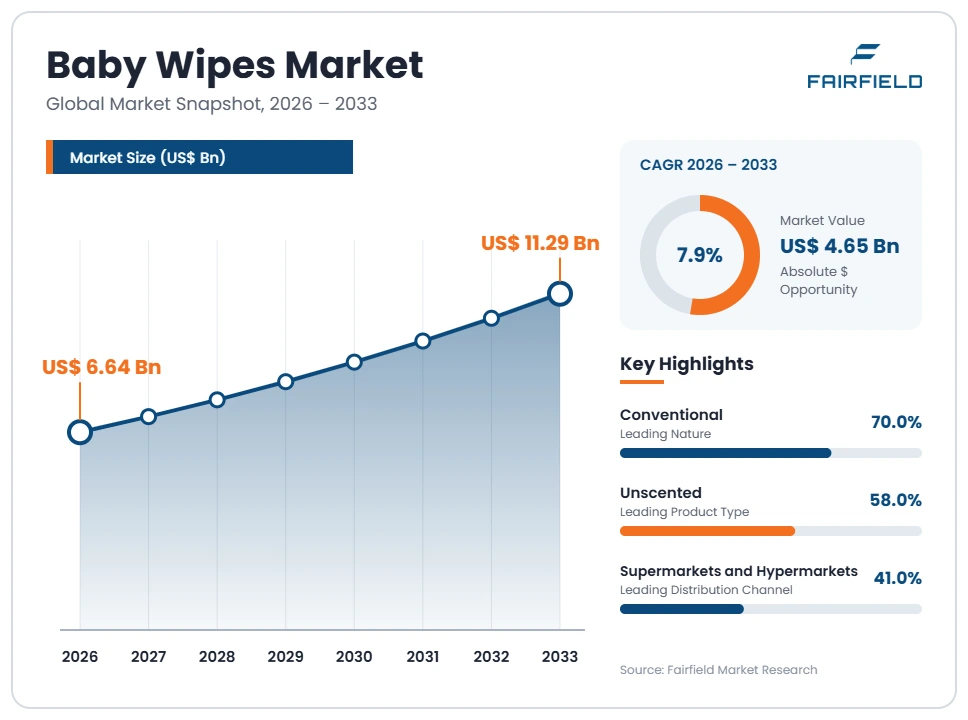
The global baby wipes market size is expected to be valued at US$ 6.64 billion in 2026 and projected to reach US$ 11.29 billion by 2033, growing at a CAGR of 7.9% between 2026 and 2033.
Between 2020 and 2025, the market grew at a CAGR of about 6.8%, as hygiene concerns during the pandemic lifted wipe use for babies and whole households in 2020, then premium, natural, and plastic-free products drove value growth while falling birth rates in some countries limited volumes. The baby wipes market covers pre-moistened and dry wipes made for cleaning a baby’s skin during diaper changes, feeding, and travel. Products include scented and unscented wipes, sensitive-skin and water-based wipes, organic and natural wipes, and biodegradable baby wipes made from plant fibers such as viscose, cotton, and bamboo instead of plastic-based polyester and polypropylene. They are sold in packs, tubs, and travel packs through supermarkets, pharmacies, convenience stores, and online channels. Growth comes from rising incomes, urbanization, working parents, and demand for gentle, safe ingredients. In January 2026, Harper Hygienics launched its Kindii Water Care wipes.
Key Report Takeaways
- By Nature: Conventional held about 70% share in 2025, while Organic and Natural is projected to expand at a 10.2% CAGR through 2033, driven by parents seeking plant-based fibers, fewer chemicals, and certified natural ingredients for sensitive skin.
- By Product Type: Unscented held about 58% share in 2025 and is projected to expand at an 8.6% CAGR through 2033, the fastest pace, driven by pediatrician advice, fragrance-free trends, and lower risk of skin irritation and allergies.
- By Distribution Channel: Supermarkets and Hypermarkets held about 41% share in 2025, while Online Stores is projected to expand at an 11.4% CAGR through 2033, driven by subscriptions, bulk buying, and direct-to-consumer brands.
- By Region: North America held about 34% share in 2025, while Asia Pacific is projected to expand at a 9.6% CAGR through 2033, driven by rising incomes, urban lifestyles, and fast growth of modern retail in China, India, and Indonesia.
Global Baby Wipes Market Trends and Insights
Drivers Impact Analysis
Two drivers carry the strongest influence on baby wipes market demand during the forecast period.
| Driver | Impact on CAGR Forecast | Geographic Relevance | Impact Timeline |
| Rising hygiene awareness, incomes, and urban lifestyles | High | Asia Pacific, Latin America, Middle East & Africa | Long term (≥4 years) |
| Demand for natural, sensitive, and premium wipes | Medium | North America, Europe | Medium term (2-4 years) |
Hygiene Awareness Is Driving the Baby Wipes Market
Rising hygiene awareness, incomes, and urban lifestyles are the strongest driver of the baby wipes market. Parents want convenient cleaning.
The mechanism is changing family life and spending. In India, Indonesia, Vietnam, Nigeria, and Brazil, rising incomes and urbanization are bringing more families into packaged baby care, and disposable diaper use is growing, which goes hand in hand with wipes. Busy working parents value wipes that clean quickly at home, in the car, and on the go. Modern retail chains and online stores make baby wipes easy to find in cities and towns. Awareness of hygiene, diaper rash prevention, and infection control increased after the pandemic, and parents now use wipes for hands, faces, and surfaces as well as diaper changes. Larger households also buy baby wipes for adult use. These trends support steady, long-term demand across emerging markets.
Natural and Premium Demand Is Expanding the Baby Wipes Market
Demand for natural, sensitive, and premium wipes is expanding the baby wipes market. Parents read ingredient labels closely.
The cause is concern about chemicals and skin health. Many parents worry about fragrances, preservatives, alcohol, and other ingredients that can irritate a newborn’s delicate skin, and they choose fragrance-free, hypoallergenic, and dermatologist-tested products. Water-based wipes such as WaterWipes, made mostly of purified water, have grown quickly. Organic and plant-fiber wipes appeal to parents who care about health and the environment. Premium products sell at higher prices per wipe, raising market value even when volumes are flat. Social media reviews and parenting forums spread information about ingredients quickly, and new parents trust recommendations from hospitals and other parents. Thicker, stronger wipes that use fewer sheets per change also justify higher prices. These trends expand sales.
Restraints Impact Analysis
Two restraints limit how quickly the baby wipes market grows.
| Restraint | Impact on CAGR Forecast | Geographic Relevance | Impact Timeline |
| Environmental concerns and plastic wipe bans | High | Europe, North America | Long term (≥4 years) |
| Falling birth rates and product safety concerns | Medium | Europe, Asia Pacific, North America | Medium term (2-4 years) |
Environmental Concerns Slow the Baby Wipes Market
Environmental concerns and plastic wipe bans slow the baby wipes market. Wipes create waste and sewer blockages.
The specific causes are plastic content and improper disposal. Many wipes contain polyester or polypropylene fibers that do not break down, and wipes flushed down toilets combine with fats to form large blockages in sewers, costing water companies millions to remove. Plastic fibers from wipes also add to pollution in rivers and seas. The United Kingdom has passed laws banning wet wipes containing plastic, with the ban taking effect in 2027 in England and Scotland, and other countries are considering similar rules and labeling requirements. Switching to plant-based fibers raises costs for manufacturers and can change product strength and feel. These factors slow growth for conventional products and push the industry to reformulate.
Falling Births Restrict the Baby Wipes Market
Falling birth rates and product safety concerns restrict the baby wipes market. Fewer babies mean fewer buyers.
The underlying causes are demographic and quality factors. Birth rates are falling in China, Japan, South Korea, Germany, Italy, and the United States, shrinking the core customer base. Higher costs of raising children and later parenthood mean fewer babies per family, so brands must win a larger share of a shrinking group. Product recalls due to bacterial contamination have hurt trust in some brands, and regulators have tightened rules on preservatives. Some parents switch to reusable cloth wipes or plain water and cotton to save money and reduce waste. Rising costs of nonwoven fabrics and pulp also squeeze margins. Private label products push prices down. These factors restrict growth.
Market Opportunities
Biodegradable and Plastic-Free Wipes Open a Fast-Growth Revenue Pool
Biodegradable and plastic-free wipes open a fast-growth revenue pool in the baby wipes market. Bans and consumer demand favor greener products.
Manufacturers can capture this opportunity. With plastic wipe bans coming in the United Kingdom and pressure growing in Europe and North America, brands are switching to biodegradable baby wipes made from viscose, lyocell, cotton, bamboo, and wood pulp. Retailers are giving more shelf space to plastic-free products, and parents are willing to pay more for wipes that are gentle on skin and kinder to the environment. Compostable packaging, refill packs, and fewer ingredients add further appeal for buyers. Nonwoven fabric makers are investing in new plant-fiber lines. Companies that move early to certified plastic-free wipes can gain share and build loyalty as rules tighten worldwide.
Online and Emerging Markets Create a Growth Revenue Pool
Online and emerging markets create a growth revenue pool in the baby wipes market. Many families are buying wipes for the first time.
Brands can capture this opportunity. Online stores, subscriptions, and quick commerce apps in India, China, Indonesia, and Brazil make it easy to buy wipes in bulk and have them delivered. Smaller packs and affordable prices help reach lower-income families in rural areas and small towns. Direct-to-consumer brands can build loyalty through reviews, influencers, and social media. Growing use of disposable diapers in these countries naturally brings wipe use with it, and pediatric clinics and hospitals introduce new parents to brands. Local manufacturing lowers costs and supports affordable prices. Companies offering affordable, trusted products and strong online and pharmacy presence can grow quickly.
Segment Analysis
- By Nature: Conventional Leads While Organic and Natural Grows Fastest
Conventional held about 70% share in 2025. Conventional wipes use synthetic or blended nonwoven fabrics and standard lotions, and they are widely available at lower prices in supermarkets and convenience stores. Large brands from Procter & Gamble, Kimberly-Clark, and Unicharm dominate this segment, offering scented and sensitive versions in many pack sizes.
Organic and Natural is the fastest-growing nature, expanding at a 10.2% CAGR through 2033. These wipes use plant-based fibers, natural extracts, and few or no synthetic additives, and many carry organic or plant-based certifications. Plastic wipe bans and parent concern about ingredients are driving growth in Europe and North America, and premium brands are expanding in Asia Pacific. For the market, natural growth raises value per pack.
- By Product Type: Unscented Leads and Grows Fastest
Unscented held about 58% share in 2025 and is projected to expand at an 8.6% CAGR through 2033, the fastest pace. Pediatricians and dermatologists often recommend fragrance-free wipes for newborns and babies with sensitive skin or eczema, and many parents now avoid added fragrances altogether. Water-based wipes and sensitive lines from major brands are leading this shift.
Scented wipes form the other segment, offering light fragrances that many parents associate with freshness, and they remain popular in Latin America, Middle East & Africa, and parts of Asia Pacific. Brands are using milder, naturally derived scents to keep appeal while reducing irritation. Dry wipes form a smaller niche. For the market, unscented growth reflects safety concerns.
- By Distribution Channel: Supermarkets and Hypermarkets Lead While Online Stores Grow Fastest
Supermarkets and Hypermarkets held about 41% share in 2025. Large stores offer wide brand choice, promotions, and multipacks, and parents often buy wipes with diapers and groceries. Private label wipes from retailers such as Costco’s Kirkland, Walmart, and Aldi compete on price.
Online Stores is the fastest-growing channel, expanding at an 11.4% CAGR through 2033. Subscriptions, bulk packs, and home delivery suit busy parents, and online marketplaces help niche and premium brands reach customers. Pharmacies and drug stores, convenience stores, and specialty baby stores form other channels, with pharmacies important for sensitive and dermatologist-recommended wipes. Quick commerce apps deliver wipes within minutes in large cities in India. For the market, online growth widens reach.
Geography Analysis
- Which Region Is Leading the Baby Wipes Market?
North America is leading the baby wipes market with about 34% share in 2025. The United States has high use of disposable diapers and wipes, strong brands such as Pampers, Huggies, and WaterWipes, and large private label programs at Costco, Walmart, and Target. Parents increasingly choose sensitive, fragrance-free, and plant-based wipes, and online subscription sales are growing. In November 2025, Kimberly-Clark agreed to acquire Kenvue, owner of Johnson’s Baby. Canada adds premium demand. Key barriers include falling birth rates and concerns about flushing wipes. One change shaping the region is the shift to plastic-free products.
- Europe Shapes the Baby Wipes Market Through Plastic-Free Rules
Europe is a major baby wipes market. The United Kingdom, Germany, France, Italy, and Spain have high wipe use and strong demand for natural and sensitive products. The United Kingdom will ban wet wipes containing plastic from 2027, and the European Union single-use plastics rules require labeling of plastic content in wipes. WaterWipes is based in Ireland, and Harper Hygienics is a major producer in Poland. Retailers in Germany and France promote plant-based private label wipes. Key barriers include low birth rates and higher costs for plastic-free materials. One opportunity is plastic-free and organic wipes.
- Which Region Is Growing Fastest in the Baby Wipes Market?
Asia Pacific is growing fastest in the baby wipes market, expanding at a 9.6% CAGR through 2033. China is a large market with strong online sales and premium brands, while India, Indonesia, Vietnam, and the Philippines have large young populations and rising use of diapers and wipes. Japan’s Unicharm and China’s Hengan International are major producers. Online and quick commerce platforms are expanding access in smaller cities. Key barriers include falling births in China, Japan, and South Korea, and price sensitivity in rural areas. One change shaping the region is rising disposable diaper use.
- Latin America Grows the Baby Wipes Market Through Modern Retail
Latin America is a growing baby wipes market. Brazil, Mexico, Argentina, Colombia, and Chile have growing use of disposable diapers and wipes, supported by modern retail chains and pharmacies. Global brands compete with strong local producers and retailer private labels. Scented wipes are popular, though sensitive and natural versions are gaining share. Online sales are growing in Brazil and Mexico, and local producers export to neighboring countries. Key barriers include economic swings, currency changes, high import duties, and price sensitivity among lower-income families. One opportunity is affordable packs sold through pharmacies and online stores.
- Middle East & Africa Builds the Baby Wipes Market Through Young Populations
Middle East & Africa is an emerging baby wipes market. Nigeria, Egypt, Kenya, and Ethiopia have high birth rates and growing urban populations, while Saudi Arabia and the United Arab Emirates have strong demand for premium imported brands. Supermarket chains and pharmacies are expanding in major cities, and young, growing populations create a large base of future customers. Online marketplaces are growing in Egypt and Nigeria. Key barriers include low incomes in many countries, limited retail access in rural areas, limited distribution networks, and reliance on imports. One opportunity is affordable wipes produced locally for growing urban families.
Competitive Landscape
The baby wipes market is moderately consolidated. Procter & Gamble, Kimberly-Clark, Kenvue (Johnson’s Baby), Unicharm, and WaterWipes are leading players, while Hengan International, Harper Hygienics, Nice-Pak Products, Rockline Industries, The Himalaya Drug Company, Ontex, and Medline Industries compete strongly. Global brands such as Pampers and Huggies hold large shares, while private label manufacturers supply retailers, and many regional and natural brands compete in specific countries and niches.
Companies compete on gentleness, ingredient safety, softness and strength, brand trust, sustainability, price, and retail and online presence. Private label wipes made by contract manufacturers compete strongly on price at large retailers, so branded players invest in sensitive, natural, and plastic-free lines to justify higher prices. Partnerships with nonwoven fabric suppliers are important as brands switch to plant-based fibers.
Strategic moves show how competition is changing. In November 2025, Kimberly-Clark agreed to acquire Kenvue, owner of Johnson’s Baby, for about US$ 48.7 billion. In December 2025, the United Kingdom confirmed its ban on wet wipes containing plastic will apply from 2027. In January 2026, Harper Hygienics launched its Kindii Water Care wipes. These moves show competition shifting toward scale, gentle formulas, and plastic-free products.
Three themes shape vendor strategy. First, companies are reformulating wipes with plant-based, plastic-free fibers. Second, they are expanding water-based and sensitive-skin lines. Third, they are growing in Asia Pacific and online channels, where demand is rising fastest.
Baby Wipes Market Industry Leaders
Procter & Gamble Kimberly-Clark Kenvue (Johnson’s Baby) Unicharm WaterWipes
Recent Industry Developments
- January 2026: Harper Hygienics launched Kindii Water Care, a new line of water-based baby wipes - expands water-based wipes in the baby wipes market.
- December 2025: The United Kingdom confirmed the legal start of its ban on wet wipes containing plastic for 2027, with a transition period for businesses - pushes producers toward biodegradable baby wipes.
- November 2025: Kimberly-Clark agreed to acquire Kenvue, owner of Johnson’s Baby, in a cash and stock deal worth about US$ 48.7 billion - combines major baby care brands.
Companies Covered in the Report
- Procter & Gamble
- Kimberly-Clark
- Kenvue (Johnson’s Baby)
- Unicharm
- WaterWipes
- Hengan International
- Harper Hygienics
- Nice-Pak Products
- Rockline Industries
- The Himalaya Drug Company
- Ontex
- Medline Industries
Baby Wipes Market Report Scope
| Metric | Value |
| Study Period | 2020-2033 |
| Market Size 2026 | US$ 6.64 Billion |
| Market Size 2033 | US$ 11.29 Billion |
| CAGR 2026-2033 | 7.9% |
| Absolute Dollar Opportunity | US$ 4.65 Billion |
| Largest Market | North America |
| Fastest-Growing Market | Asia Pacific |
| Market Concentration | Moderately Consolidated |
| Major Players | Procter & Gamble, Kimberly-Clark, Kenvue (Johnson’s Baby), Unicharm, WaterWipes |
Baby Wipes Market Segmentation
- Executive Summary
- Baby Wipes Market Snapshot
- Future Projections
- Key Market Trends
- Regional Snapshot
- Market Overview
- Market Definition and Report Scope
- Historical Market Trends
- Market Dynamics
- Drivers
- Hygiene Awareness Is Driving the Baby Wipes Market
- Natural and Premium Demand Is Expanding the Baby Wipes Market
- Restraints
- Environmental Concerns Slow the Baby Wipes Market
- Falling Births Restrict the Baby Wipes Market
- Market Opportunities
- Biodegradable and Plastic-Free Wipes Open a Fast-Growth Revenue Pool
- Online and Emerging Markets Create a Growth Revenue Pool
- Drivers
- Global Baby Wipes Market Outlook, 2020–2033
- Global Baby Wipes Market Outlook, by Nature, Value (US$ Billion), 2020–2033
- Conventional
- Organic and Natural
- Global Baby Wipes Market Outlook, by Product Type, Value (US$ Billion), 2020–2033
- Scented
- Unscented
- Dry Wipes
- Global Baby Wipes Market Outlook, by Distribution Channel, Value (US$ Billion), 2020–2033
- Supermarkets and Hypermarkets
- Pharmacies and Drug Stores
- Convenience Stores
- Specialty Baby Stores
- Online Stores
- Global Baby Wipes Market Outlook, by Region, Value (US$ Billion), 2020–2033
- North America
- Europe
- Asia Pacific
- Latin America
- Middle East & Africa
- Global Baby Wipes Market Outlook, by Nature, Value (US$ Billion), 2020–2033
- North America Baby Wipes Market Outlook, 2020–2033
- North America Baby Wipes Market Outlook, by Nature, Value (US$ Billion), 2020–2033
- Conventional
- Organic and Natural
- North America Baby Wipes Market Outlook, by Product Type, Value (US$ Billion), 2020–2033
- Scented
- Unscented
- Dry Wipes
- North America Baby Wipes Market Outlook, by Distribution Channel, Value (US$ Billion), 2020–2033
- Supermarkets and Hypermarkets
- Pharmacies and Drug Stores
- Convenience Stores
- Specialty Baby Stores
- Online Stores
- North America Baby Wipes Market Outlook, by Country, Value (US$ Billion), 2020–2033
- United States Baby Wipes Market Outlook, by Nature, 2020–2033
- United States Baby Wipes Market Outlook, by Product Type, 2020–2033
- United States Baby Wipes Market Outlook, by Distribution Channel, 2020–2033
- Canada Baby Wipes Market Outlook, by Nature, 2020–2033
- Canada Baby Wipes Market Outlook, by Product Type, 2020–2033
- Canada Baby Wipes Market Outlook, by Distribution Channel, 2020–2033
- North America Baby Wipes Market Outlook, by Nature, Value (US$ Billion), 2020–2033
- Europe Baby Wipes Market Outlook, 2020–2033
- Europe Baby Wipes Market Outlook, by Nature, Value (US$ Billion), 2020–2033
- Conventional
- Organic and Natural
- Europe Baby Wipes Market Outlook, by Product Type, Value (US$ Billion), 2020–2033
- Scented
- Unscented
- Dry Wipes
- Europe Baby Wipes Market Outlook, by Distribution Channel, Value (US$ Billion), 2020–2033
- Supermarkets and Hypermarkets
- Pharmacies and Drug Stores
- Convenience Stores
- Specialty Baby Stores
- Online Stores
- Europe Baby Wipes Market Outlook, by Country, Value (US$ Billion), 2020–2033
- United Kingdom Baby Wipes Market Outlook, by Nature, 2020–2033
- United Kingdom Baby Wipes Market Outlook, by Product Type, 2020–2033
- United Kingdom Baby Wipes Market Outlook, by Distribution Channel, 2020–2033
- Germany Baby Wipes Market Outlook, by Nature, 2020–2033
- Germany Baby Wipes Market Outlook, by Product Type, 2020–2033
- Germany Baby Wipes Market Outlook, by Distribution Channel, 2020–2033
- France Baby Wipes Market Outlook, by Nature, 2020–2033
- France Baby Wipes Market Outlook, by Product Type, 2020–2033
- France Baby Wipes Market Outlook, by Distribution Channel, 2020–2033
- Italy Baby Wipes Market Outlook, by Nature, 2020–2033
- Italy Baby Wipes Market Outlook, by Product Type, 2020–2033
- Italy Baby Wipes Market Outlook, by Distribution Channel, 2020–2033
- Spain Baby Wipes Market Outlook, by Nature, 2020–2033
- Spain Baby Wipes Market Outlook, by Product Type, 2020–2033
- Spain Baby Wipes Market Outlook, by Distribution Channel, 2020–2033
- Ireland Baby Wipes Market Outlook, by Nature, 2020–2033
- Ireland Baby Wipes Market Outlook, by Product Type, 2020–2033
- Ireland Baby Wipes Market Outlook, by Distribution Channel, 2020–2033
- Poland Baby Wipes Market Outlook, by Nature, 2020–2033
- Poland Baby Wipes Market Outlook, by Product Type, 2020–2033
- Poland Baby Wipes Market Outlook, by Distribution Channel, 2020–2033
- Europe Baby Wipes Market Outlook, by Nature, Value (US$ Billion), 2020–2033
- Asia Pacific Baby Wipes Market Outlook, 2020–2033
- Asia Pacific Baby Wipes Market Outlook, by Nature, Value (US$ Billion), 2020–2033
- Conventional
- Organic and Natural
- Asia Pacific Baby Wipes Market Outlook, by Product Type, Value (US$ Billion), 2020–2033
- Scented
- Unscented
- Dry Wipes
- Asia Pacific Baby Wipes Market Outlook, by Distribution Channel, Value (US$ Billion), 2020–2033
- Supermarkets and Hypermarkets
- Pharmacies and Drug Stores
- Convenience Stores
- Specialty Baby Stores
- Online Stores
- Asia Pacific Baby Wipes Market Outlook, by Country, Value (US$ Billion), 2020–2033
- China Baby Wipes Market Outlook, by Nature, 2020–2033
- China Baby Wipes Market Outlook, by Product Type, 2020–2033
- China Baby Wipes Market Outlook, by Distribution Channel, 2020–2033
- India Baby Wipes Market Outlook, by Nature, 2020–2033
- India Baby Wipes Market Outlook, by Product Type, 2020–2033
- India Baby Wipes Market Outlook, by Distribution Channel, 2020–2033
- Indonesia Baby Wipes Market Outlook, by Nature, 2020–2033
- Indonesia Baby Wipes Market Outlook, by Product Type, 2020–2033
- Indonesia Baby Wipes Market Outlook, by Distribution Channel, 2020–2033
- Vietnam Baby Wipes Market Outlook, by Nature, 2020–2033
- Vietnam Baby Wipes Market Outlook, by Product Type, 2020–2033
- Vietnam Baby Wipes Market Outlook, by Distribution Channel, 2020–2033
- Philippines Baby Wipes Market Outlook, by Nature, 2020–2033
- Philippines Baby Wipes Market Outlook, by Product Type, 2020–2033
- Philippines Baby Wipes Market Outlook, by Distribution Channel, 2020–2033
- Japan Baby Wipes Market Outlook, by Nature, 2020–2033
- Japan Baby Wipes Market Outlook, by Product Type, 2020–2033
- Japan Baby Wipes Market Outlook, by Distribution Channel, 2020–2033
- South Korea Baby Wipes Market Outlook, by Nature, 2020–2033
- South Korea Baby Wipes Market Outlook, by Product Type, 2020–2033
- South Korea Baby Wipes Market Outlook, by Distribution Channel, 2020–2033
- Asia Pacific Baby Wipes Market Outlook, by Nature, Value (US$ Billion), 2020–2033
- Latin America Baby Wipes Market Outlook, 2020–2033
- Latin America Baby Wipes Market Outlook, by Nature, Value (US$ Billion), 2020–2033
- Conventional
- Organic and Natural
- Latin America Baby Wipes Market Outlook, by Product Type, Value (US$ Billion), 2020–2033
- Scented
- Unscented
- Dry Wipes
- Latin America Baby Wipes Market Outlook, by Distribution Channel, Value (US$ Billion), 2020–2033
- Supermarkets and Hypermarkets
- Pharmacies and Drug Stores
- Convenience Stores
- Specialty Baby Stores
- Online Stores
- Latin America Baby Wipes Market Outlook, by Country, Value (US$ Billion), 2020–2033
- Brazil Baby Wipes Market Outlook, by Nature, 2020–2033
- Brazil Baby Wipes Market Outlook, by Product Type, 2020–2033
- Brazil Baby Wipes Market Outlook, by Distribution Channel, 2020–2033
- Mexico Baby Wipes Market Outlook, by Nature, 2020–2033
- Mexico Baby Wipes Market Outlook, by Product Type, 2020–2033
- Mexico Baby Wipes Market Outlook, by Distribution Channel, 2020–2033
- Argentina Baby Wipes Market Outlook, by Nature, 2020–2033
- Argentina Baby Wipes Market Outlook, by Product Type, 2020–2033
- Argentina Baby Wipes Market Outlook, by Distribution Channel, 2020–2033
- Colombia Baby Wipes Market Outlook, by Nature, 2020–2033
- Colombia Baby Wipes Market Outlook, by Product Type, 2020–2033
- Colombia Baby Wipes Market Outlook, by Distribution Channel, 2020–2033
- Chile Baby Wipes Market Outlook, by Nature, 2020–2033
- Chile Baby Wipes Market Outlook, by Product Type, 2020–2033
- Chile Baby Wipes Market Outlook, by Distribution Channel, 2020–2033
- Latin America Baby Wipes Market Outlook, by Nature, Value (US$ Billion), 2020–2033
- Middle East & Africa Baby Wipes Market Outlook, 2020–2033
- Middle East & Africa Baby Wipes Market Outlook, by Nature, Value (US$ Billion), 2020–2033
- Conventional
- Organic and Natural
- Middle East & Africa Baby Wipes Market Outlook, by Product Type, Value (US$ Billion), 2020–2033
- Scented
- Unscented
- Dry Wipes
- Middle East & Africa Baby Wipes Market Outlook, by Distribution Channel, Value (US$ Billion), 2020–2033
- Supermarkets and Hypermarkets
- Pharmacies and Drug Stores
- Convenience Stores
- Specialty Baby Stores
- Online Stores
- Middle East & Africa Baby Wipes Market Outlook, by Country, Value (US$ Billion), 2020–2033
- Nigeria Baby Wipes Market Outlook, by Nature, 2020–2033
- Nigeria Baby Wipes Market Outlook, by Product Type, 2020–2033
- Nigeria Baby Wipes Market Outlook, by Distribution Channel, 2020–2033
- Egypt Baby Wipes Market Outlook, by Nature, 2020–2033
- Egypt Baby Wipes Market Outlook, by Product Type, 2020–2033
- Egypt Baby Wipes Market Outlook, by Distribution Channel, 2020–2033
- Kenya Baby Wipes Market Outlook, by Nature, 2020–2033
- Kenya Baby Wipes Market Outlook, by Product Type, 2020–2033
- Kenya Baby Wipes Market Outlook, by Distribution Channel, 2020–2033
- Ethiopia Baby Wipes Market Outlook, by Nature, 2020–2033
- Ethiopia Baby Wipes Market Outlook, by Product Type, 2020–2033
- Ethiopia Baby Wipes Market Outlook, by Distribution Channel, 2020–2033
- Saudi Arabia Baby Wipes Market Outlook, by Nature, 2020–2033
- Saudi Arabia Baby Wipes Market Outlook, by Product Type, 2020–2033
- Saudi Arabia Baby Wipes Market Outlook, by Distribution Channel, 2020–2033
- United Arab Emirates Baby Wipes Market Outlook, by Nature, 2020–2033
- United Arab Emirates Baby Wipes Market Outlook, by Product Type, 2020–2033
- United Arab Emirates Baby Wipes Market Outlook, by Distribution Channel, 2020–2033
- Middle East & Africa Baby Wipes Market Outlook, by Nature, Value (US$ Billion), 2020–2033
- Competitive Landscape
- Baby Wipes Market Industry Leaders
- Recent Industry Developments
- Company Profiles
- Procter & Gamble
- Kimberly-Clark
- Kenvue (Johnson's Baby)
- Unicharm
- WaterWipes
- Hengan International
- Harper Hygienics
- Nice-Pak Products
- Rockline Industries
- The Himalaya Drug Company
- Ontex
- Medline Industries
- Appendix
- Research Methodology
- Report Assumptions
- Acronyms and Abbreviations
Nature
- Conventional
- Organic and Natural
Product Type
- Scented
- Unscented
- Dry Wipes
Distribution Channel
- Supermarkets and Hypermarkets
- Pharmacies and Drug Stores
- Convenience Stores
- Specialty Baby Stores
- Online Stores
Regions
- North America
- Europe
- Asia Pacific
- Latin America
- Middle East & Africa
Our Research Methodology
Considering the volatility of business today, traditional approaches to strategizing a game plan can be unfruitful if not detrimental. True ambiguity is no way to determine a forecast. A myriad of predetermined factors must be accounted for such as the degree of risk involved, the magnitude of circumstances, as well as conditions or consequences that are not known or unpredictable. To circumvent binary views that cast uncertainty, the application of market research intelligence to strategically posture, move, and enable actionable outcomes is necessary.
View Methodology
Quality Assured
Rigorous Validation Process

Confidentiality Assured
End-to-end Data Security

Custom Research Services
Tailored To Your Objectives
FAQs
The baby wipes market is valued at US$ 6.64 billion in 2026, led by conventional, unscented wipes and North America.
The market is projected to reach US$ 11.29 billion by 2033, growing at a 7.9% CAGR and adding US$ 4.65 billion.
Organic and natural wipes are growing fastest at a 10.2% CAGR through 2033, driven by plant-based fibers and fewer chemicals.
Asia Pacific is growing fastest at a 9.6% CAGR through 2033, driven by rising incomes and modern retail growth in China and India.
North America holds the largest share at about 34% in 2025, supported by high diaper use, strong brands, and private label sales.
Related Reports
Bathroom Renovation Market Size, Share, Insights, Competitive Landscape, and Forecast 2026 to 2033
The global bathroom renovation market is valued at US$433.43 billion in 2026, reaching US$574.21 billion by 2033, growing at a 4.1% CAGR
Baby Safety Products Market Size, Share, Insights, Competitive Landscape, and Forecast 2026 to 2033
Explore the baby safety products market outlook for 2026–2033, covering car seats, monitors, age groups, sales channels, regions, and key companies.
FDM Candle Market Size, Share, Insights, Competitive Landscape, and Forecast 2026 to 2033
Explore the FDM candle market outlook for 2026–2033, with product formats, wax types, retail trends, regional demand, and competitive insights.
Aloe Vera Gel Market Size, Share, Insights, Competitive Landscape, and Forecast 2026 to 2033
Explore the aloe vera gel market outlook for 2026–2033, including organic grades, application trends, regional insights, and competitive analysis.
Food Waste Disposers Market Size, Share, Insights, Competitive Landscape, and Forecast 2026 to 2033
The global food waste disposers market is valued at US$3.2 billion in 2026, reaching US$5.1 billion by 2033, growing at a 6.9% CAGR
Baby Car Seat Market Size, Share, Insights, Competitive Landscape, and Forecast 2026 to 2033
The baby car seat market is forecast to grow from US$ 6.12 billion in 2026 to US$ 10.09 billion by 2033 at a 7.4% CAGR.