



Construction Robot Market
Construction Robot Market Size, Share, Insights, Competitive Landscape, and Forecast 2026 to 2033
Report Overview
Construction Robot Market Size and Trend Analysis
How Fast Is the Construction Robot Market Growing?
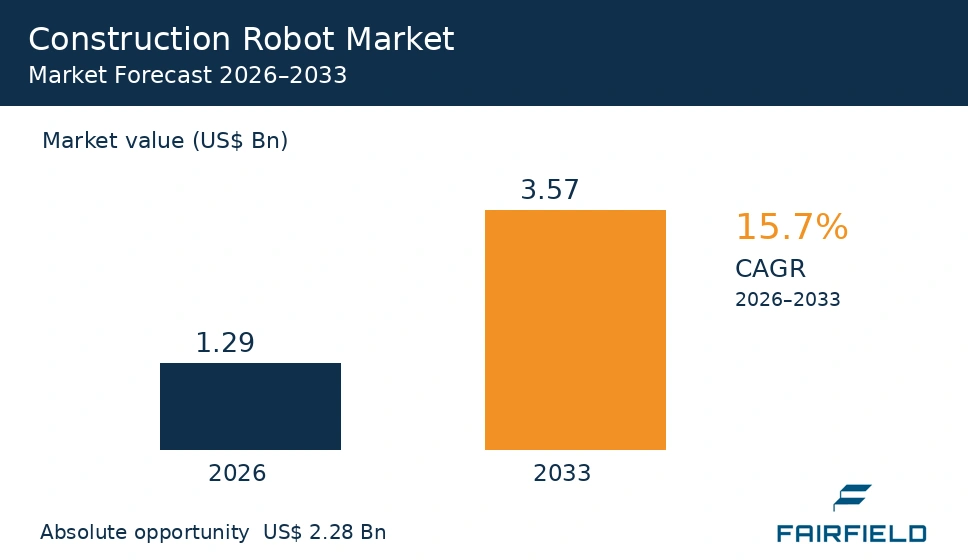
The global construction robot market size is expected to be valued at US$ 1.29 billion in 2026 and projected to reach US$ 3.57 billion by 2033, growing at a CAGR of 15.7% between 2026 and 2033.
Between 2020 and 2025, the market grew at a CAGR of about 15.3%, rising from roughly US$ 0.55 billion to about US$ 1.12 billion, as construction labor shortages worsened after the pandemic, contractors tested robots for layout, drilling, and demolition, and venture capital poured into construction technology startups. The construction robot market covers machines that carry out building and infrastructure tasks with partial or full automation, reducing manual labor, improving safety, and raising accuracy. Main products include remote-controlled demolition robots, robotic arms for drilling, welding, and bricklaying, 3D concrete printing robots, autonomous earthmoving and pile-driving systems, layout and printing robots, inspection robots, and exoskeletons that support workers. These robots are used on commercial, residential, industrial, and infrastructure projects. In July 2026, Built Robotics signed a US$ 75 million contract with Blattner to scale autonomous construction systems.
Key Report Takeaways
- By Type: Robotic Arms held about 60% share in 2025, while 3D Printing Robots are projected to expand at a 19.5% CAGR through 2033, driven by faster house building, design freedom, lower material waste, and growing government interest in affordable housing.
- By Automation: Semi-Autonomous held about 65% share in 2025, while Fully Autonomous is projected to expand at an 18.5% CAGR through 2033, driven by artificial intelligence, better sensors, and large funding rounds for autonomous construction equipment developers.
- By End Use: Commercial held about 40% share in 2025, while Infrastructure and Energy is projected to expand at an 18.0% CAGR through 2033, driven by solar farm, data center, power line, and transport projects that need repetitive work at large scale.
- By Region: North America held about 37% share in 2025, while Asia Pacific is projected to expand at an 18.0% CAGR through 2033, driven by ageing workforces in Japan and South Korea, government programs in Singapore, and huge construction volumes in China.
Global Construction Robot Market Trends and Insights
Drivers Impact Analysis
Two drivers carry the strongest influence on construction robot market demand during the forecast period.
| Driver | Impact on CAGR Forecast | Geographic Relevance | Impact Timeline |
| Skilled labor shortages and rising wages | High | Global | Long term (≥4 years) |
| Safety and productivity requirements | Medium | North America, Europe, Asia Pacific | Medium term (2-4 years) |
Labor Shortages Are Driving the Construction Robot Market
Skilled labor shortages and rising wages are the strongest driver of the construction robot market. Contractors cannot find enough workers.
The mechanism is that construction workforces are ageing in North America, Europe, Japan, and South Korea, and fewer young people are entering the trades, creating shortages of carpenters, bricklayers, electricians, drywall finishers, and equipment operators. At the same time, demand for housing, data centers, power plants, and infrastructure is rising, so contractors need to do more work with fewer people. Wages for skilled trades have climbed, making automation more cost-effective. Robots that handle repetitive, physically demanding tasks such as drilling ceilings, laying bricks, finishing drywall, or driving solar piles allow small crews to complete larger projects. These pressures are pushing contractors to adopt robots across many job types.
Safety and Productivity Are Expanding the Construction Robot Market
Safety and productivity requirements are expanding the construction robot market. Construction remains a dangerous and slow industry.
The cause is that construction has one of the highest rates of workplace injuries and deaths, from falls, collapses, dust, noise, and vibration, and regulators and insurers are pushing companies to reduce these risks. Demolition robots let operators work at a safe distance, ceiling drilling robots reduce overhead work and silica dust, and exoskeletons ease strain on backs and shoulders. Construction productivity has grown slowly compared with manufacturing for decades, and owners want faster schedules and fewer errors. Robots such as layout printers transfer digital building plans directly to floors with high accuracy, cutting rework. Insurance companies may also offer better terms to firms that reduce risky manual work. These safety and efficiency benefits make robots attractive to large general contractors and specialty trades.
Restraints Impact Analysis
Two restraints limit how quickly the construction robot market grows.
| Restraint | Impact on CAGR Forecast | Geographic Relevance | Impact Timeline |
| High upfront cost and unclear return on investment | High | Global | Medium term (2-4 years) |
| Unstructured job sites and workforce resistance | Medium | Global | Long term (≥4 years) |
High Costs Slow the Construction Robot Market
High upfront cost and unclear return on investment slow the construction robot market. Many contractors work on thin margins.
The problem is that construction robots can cost tens or hundreds of thousands of dollars, plus software subscriptions, training, maintenance, and transport between sites. Most construction companies are small or medium firms with tight profit margins and limited capital to spend on new technology. Each project is different, so it can be hard to prove savings before buying a robot, and many contractors wait for others to test new systems first. Some startups have struggled to scale beyond pilot projects, and a few have closed, which makes buyers cautious. Robotics-as-a-service and rental models help but are not yet widely available. These factors slow adoption, especially among smaller firms.
Job Site Complexity Restricts the Construction Robot Market
Unstructured job sites and workforce resistance restrict the construction robot market. Building sites are hard places for robots.
The constraint is that, unlike factories, construction sites change every day, with uneven ground, weather, dust, moving workers, and temporary structures, which makes navigation and reliable operation difficult for robots. Many robots can handle only a single task, requiring contractors to manage multiple machines and vendors. Integration with design software and building information models is still uneven. Some workers and unions worry that robots will replace jobs, and training staff to operate and maintain robots takes time. Safety standards and regulations for autonomous machines on job sites are still developing in many countries. Connectivity on remote sites can also be poor. These factors limit the speed at which robots move from trials to everyday use.
Market Opportunities
Physical AI and Autonomous Equipment Open a Fast-Growth Revenue Pool
Physical AI and autonomous equipment open a fast-growth revenue pool. Smarter machines can handle more tasks.
The opportunity comes from advances in artificial intelligence, computer vision, and robot foundation models that let machines understand changing job sites and perform more complex work. Investors are backing this shift strongly. In February 2026, Bedrock Robotics raised US$ 270 million to develop autonomous construction technology, and in March 2026, Boston Dynamics partnered with FieldAI to extend autonomous robots into construction sites. Retrofit kits that turn existing excavators, loaders, and pile drivers into autonomous machines lower costs for contractors. Simulation tools and large datasets from past projects help train these systems faster. Companies that combine reliable autonomy, safety systems, remote monitoring, and simple operation can win large fleet contracts with contractors and equipment rental firms in every region.
Energy, Data Center, and Housing Projects Create a Growth Revenue Pool
Energy, data center, and housing projects create a growth revenue pool. Large repetitive projects suit robots well.
The opportunity reflects massive investment in solar farms, wind projects, power lines, battery storage, and data centers, where thousands of identical piles, panels, and supports must be installed quickly. In July 2026, Built Robotics signed a US$ 75 million contract with Blattner to scale autonomous solar construction. Housing shortages in many countries are also driving interest in 3D printed homes and robotic bricklaying, and Monumental raised US$ 32 million in July 2026 to expand its bricklaying robots. Public housing agencies are also testing robotic methods to cut costs. Companies that target these high-volume project types, offer flexible leasing, and prove clear time savings can scale quickly and build lasting customer relationships.
Segment Analysis
By Type: Robotic Arms Lead While 3D Printing Robots Grow Fastest
Robotic Arms held about 60% share in 2025. Robotic arms mounted on mobile bases or tracked carriers perform drilling, welding, bricklaying, painting, and installation tasks, and they are the most versatile type of construction robot. Remote-controlled demolition machines with hydraulic arms from Brokk and Husqvarna are widely used in renovation, tunneling, and industrial maintenance.
3D Printing Robots are the fastest-growing type, expanding at a 19.5% CAGR through 2033. Large printers extrude concrete layer by layer to build walls, homes, and infrastructure parts with less labor and waste. Traditional Robots, Exoskeletons, and Layout and Inspection Robots form other segments. For the market, 3D printing growth reflects strong interest in faster, lower-cost housing construction and more creative building designs.
By Automation: Semi-Autonomous Leads While Fully Autonomous Grows Fastest
Semi-Autonomous held about 65% share in 2025. Most construction robots today work with a human operator who controls or supervises them, such as remote demolition machines, ceiling drilling robots, and robotic total stations. This approach balances safety, flexibility, and lower cost, and it fits current regulations on job sites where workers and machines share space.
Fully Autonomous is the fastest-growing automation level, expanding at an 18.5% CAGR through 2033. Autonomous excavators, pile drivers, compact track loaders, and layout robots can work for long hours with little supervision, guided by GPS and laser sensors. Retrofit kits allow contractors to automate machines they already own. For the market, autonomy growth increases productivity, allows night work, and reduces dependence on skilled operators.
By End Use: Commercial Leads While Infrastructure and Energy Grows Fastest
Commercial held about 40% share in 2025. Offices, hospitals, airports, factories, and data centers involve large interior fit-out work such as layout, ceiling drilling, and drywall finishing, where robots are already proven. Large general contractors on commercial projects have the budgets and in-house innovation teams to test new technology across many sites.
Infrastructure and Energy is the fastest-growing end use, expanding at an 18.0% CAGR through 2033. Solar farms, roads, bridges, tunnels, and power projects need repetitive earthmoving and installation work over large areas, often in remote places. Residential and Industrial form other segments, with residential growth tied to 3D printed homes. For the market, infrastructure growth creates large fleet orders and long-term service contracts.
Geography Analysis
Which Region Is Leading the Construction Robot Market?
North America is leading the construction robot market with about 37% share in 2025. The United States faces severe skilled labor shortages, high wages, and strong demand for data centers, solar farms, and housing, while venture capital funds many construction robotics startups. Boston Dynamics, Built Robotics, Dusty Robotics, Bedrock Robotics, and Construction Robotics are based in the region, and Oshkosh’s JLG acquired technology from drywall robot maker Canvas. Canada adds demand from infrastructure and mining projects. Key barriers include high costs and safety rules. One change shaping the region is autonomous solar and earthmoving fleets.
Europe Shapes the Construction Robot Market Through Demolition and Safety Leadership
Europe is a major construction robot market. Sweden is home to Brokk, Husqvarna, and Conjet, global leaders in remote-controlled demolition and hydrodemolition robots, while Liechtenstein-based Hilti offers ceiling drilling robots. Germany, the United Kingdom, France, and the Netherlands have strong worker safety rules, high labor costs, and large renovation demand. Key barriers include fragmented construction markets, strict labor rules, and high certification costs. One opportunity is renovation and concrete repair robots, supported by startups such as Sitegeist and Monumental, which operate in the region, and by European Union funding for construction digitalization.
Which Region Is Growing Fastest in the Construction Robot Market?
Asia Pacific is the fastest-growing construction robot market, expanding at an 18.0% CAGR through 2033. Japan has a rapidly ageing construction workforce, and contractors and Komatsu are leaders in automated and remote-controlled equipment. China has the largest construction market and growing robotics manufacturers, while South Korea and Singapore fund construction automation programs. Australia is home to bricklaying robot maker FBR, and India is starting to test robots on large infrastructure projects. Key barriers include high cost, low labor costs in some countries, and fragmented contractors. One change shaping the region is government-backed robot deployment on public housing and infrastructure projects.
Latin America Grows the Construction Robot Market Through Mining and Infrastructure
Latin America is an emerging construction robot market. Brazil, Mexico, Chile, Colombia, and Argentina are investing in roads, ports, energy projects, airports, and housing, and Chile and Brazil have large mining sectors that already use remote-controlled demolition and tunneling robots. Key barriers include lower labor costs, limited capital, import duties, and few local suppliers or service centers. Construction automation is still at an early stage in most countries. One opportunity is remote demolition and tunneling robots for mining and infrastructure work, supported by safety rules, solar farm construction, and growing interest in automated equipment among large contractors.
Middle East & Africa Builds the Construction Robot Market Through Mega Projects
Middle East & Africa is a growing construction robot market. Saudi Arabia and the United Arab Emirates are building new cities, airports, and tourism projects, and Dubai has set goals for 3D printed buildings. Qatar also invests in construction technology, and extreme summer heat makes automation attractive for outdoor work. South Africa uses demolition robots in mining, and Egypt is building new cities. Key barriers include reliance on low-cost migrant labor, limited local expertise, and few service centers. One opportunity is 3D printing and automation for mega projects, supported by government innovation goals, large public budgets, and partnerships with global robotics companies.
Competitive Landscape
The construction robot market is fragmented. Brokk AB, Husqvarna AB, Hilti Group, Komatsu Ltd., and Boston Dynamics are leading players, while Built Robotics, Dusty Robotics, Construction Robotics, FBR, Conjet, Oshkosh (JLG), and Bedrock Robotics compete strongly. Established equipment and tool makers lead in proven categories such as remote demolition, hydrodemolition, ceiling drilling, and automated earthmoving, while dozens of venture-backed startups focus on single tasks such as layout, drywall finishing, bricklaying, rebar tying, and autonomous excavation. No company offers a complete range of robots for every construction task.
Companies compete on reliability in harsh site conditions, autonomy level, safety features, ease of use, integration with building information models, productivity gains, service support, and pricing models such as leasing and robotics-as-a-service. Partnerships with large contractors that test and deploy robots across many sites are especially valuable.
Strategic moves show how competition is changing. In February 2026, Bedrock Robotics raised US$ 270 million, and in March 2026, Boston Dynamics partnered with FieldAI. In July 2026, Built Robotics won a US$ 75 million contract from Blattner, and Monumental raised US$ 32 million. Hilti previously partnered with Canvas, whose core technology was later acquired by Oshkosh.
Three themes shape vendor strategy. First, companies are using artificial intelligence to make robots work in changing job sites. Second, equipment makers are buying or partnering with startups to add robotics. Third, vendors are targeting large repetitive projects such as solar farms and data centers.
Construction Robot Market Industry Leaders
Brokk AB Husqvarna AB Hilti Group Komatsu Ltd. Boston Dynamics
Recent Industry Developments
- July 2026: Built Robotics and Blattner announced a US$ 75 million contract to scale autonomous construction systems across Blattner projects nationwide - shows autonomous robots moving to fleet scale in the construction robot market.
- July 2026: Monumental raised US$ 32 million led by Khosla Ventures to launch in the United States, scale its European robot fleet, and expand its robots’ tasks - supports growth of robotic bricklaying.
- March 2026: Boston Dynamics and FieldAI announced a partnership combining Spot robots with FieldAI’s foundation models to advance robotics in construction and other complex environments - extends autonomous inspection on job sites.
- February 2026: Bedrock Robotics raised US$ 270 million in Series B funding at a US$ 1.75 billion valuation to accelerate autonomous construction technology - one of the largest funding rounds in the sector.
Companies Covered in the Report
- Brokk AB
- Husqvarna AB
- Hilti Group
- Komatsu Ltd.
- Boston Dynamics
- Built Robotics
- Dusty Robotics
- Construction Robotics LLC
- FBR Ltd
- Conjet AB
- Oshkosh Corporation (JLG)
- Bedrock Robotics
Construction Robot Market Report Scope
This report covers the construction robot market, including robotic arms, 3D printing robots, traditional robots, exoskeletons, and layout and inspection robots, with semi-autonomous and fully autonomous operation, used in commercial, infrastructure and energy, residential, and industrial construction. The base year is 2025, and the forecast period runs from 2026 to 2033. All values are expressed in US$ Billion.
| Type | Robotic Arms, 3D Printing Robots, Traditional Robots, Exoskeletons, Layout and Inspection Robots |
| Automation | Semi-Autonomous, Fully Autonomous |
| End Use | Commercial, Infrastructure and Energy, Residential, Industrial |
| Regions | North America, Europe, Asia Pacific, Latin America, Middle East & Africa |
1. Executive Summary
1.1 Construction Robot Market Snapshot
1.2 Future Projections
1.3 Key Market Trends
1.4 Regional Snapshot
2. Market Overview
2.1 Market Definition and Report Scope
2.2 Historical Market Trends
2.3 Market Dynamics
2.3.1 Drivers
2.3.1.1 Labor Shortages Are Driving the Construction Robot Market
2.3.1.2 Safety and Productivity Are Expanding the Construction Robot Market
2.3.2 Restraints
2.3.2.1 High Costs Slow the Construction Robot Market
2.3.2.2 Job Site Complexity Restricts the Construction Robot Market
2.3.3 Market Opportunities
2.3.3.1 Physical AI and Autonomous Equipment Open a Fast-Growth Revenue Pool
2.3.3.2 Energy, Data Center, and Housing Projects Create a Growth Revenue Pool
3. Global Construction Robot Market Outlook, 2020–2033
3.1 Global Construction Robot Market Outlook, by Type, Value (US$ Billion), 2020–2033
3.1.1 Robotic Arms
3.1.2 3D Printing Robots
3.1.3 Traditional Robots
3.1.4 Exoskeletons
3.1.5 Layout and Inspection Robots
3.2 Global Construction Robot Market Outlook, by Automation, Value (US$ Billion), 2020–2033
3.2.1 Semi-Autonomous
3.2.2 Fully Autonomous
3.3 Global Construction Robot Market Outlook, by End Use, Value (US$ Billion), 2020–2033
3.3.1 Commercial
3.3.2 Infrastructure and Energy
3.3.3 Residential
3.3.4 Industrial
3.4 Global Construction Robot Market Outlook, by Region, Value (US$ Billion), 2020–2033
3.4.1 North America
3.4.2 Europe
3.4.3 Asia Pacific
3.4.4 Latin America
3.4.5 Middle East & Africa
4. North America Construction Robot Market Outlook, 2020–2033
4.1 North America Construction Robot Market Outlook, by Type, Value (US$ Billion), 2020–2033
4.1.1 Robotic Arms
4.1.2 3D Printing Robots
4.1.3 Traditional Robots
4.1.4 Exoskeletons
4.1.5 Layout and Inspection Robots
4.2 North America Construction Robot Market Outlook, by Automation, Value (US$ Billion), 2020–2033
4.2.1 Semi-Autonomous
4.2.2 Fully Autonomous
4.3 North America Construction Robot Market Outlook, by End Use, Value (US$ Billion), 2020–2033
4.3.1 Commercial
4.3.2 Infrastructure and Energy
4.3.3 Residential
4.3.4 Industrial
4.4 North America Construction Robot Market Outlook, by Country, Value (US$ Billion), 2020–2033
4.4.1 United States Construction Robot Market Outlook, by Type, 2020–2033
4.4.2 United States Construction Robot Market Outlook, by Automation, 2020–2033
4.4.3 United States Construction Robot Market Outlook, by End Use, 2020–2033
4.4.4 Canada Construction Robot Market Outlook, by Type, 2020–2033
4.4.5 Canada Construction Robot Market Outlook, by Automation, 2020–2033
4.4.6 Canada Construction Robot Market Outlook, by End Use, 2020–2033
5. Europe Construction Robot Market Outlook, 2020–2033
5.1 Europe Construction Robot Market Outlook, by Type, Value (US$ Billion), 2020–2033
5.1.1 Robotic Arms
5.1.2 3D Printing Robots
5.1.3 Traditional Robots
5.1.4 Exoskeletons
5.1.5 Layout and Inspection Robots
5.2 Europe Construction Robot Market Outlook, by Automation, Value (US$ Billion), 2020–2033
5.2.1 Semi-Autonomous
5.2.2 Fully Autonomous
5.3 Europe Construction Robot Market Outlook, by End Use, Value (US$ Billion), 2020–2033
5.3.1 Commercial
5.3.2 Infrastructure and Energy
5.3.3 Residential
5.3.4 Industrial
5.4 Europe Construction Robot Market Outlook, by Country, Value (US$ Billion), 2020–2033
5.4.1 Sweden Construction Robot Market Outlook, by Type, 2020–2033
5.4.2 Sweden Construction Robot Market Outlook, by Automation, 2020–2033
5.4.3 Sweden Construction Robot Market Outlook, by End Use, 2020–2033
5.4.4 Germany Construction Robot Market Outlook, by Type, 2020–2033
5.4.5 Germany Construction Robot Market Outlook, by Automation, 2020–2033
5.4.6 Germany Construction Robot Market Outlook, by End Use, 2020–2033
5.4.7 United Kingdom Construction Robot Market Outlook, by Type, 2020–2033
5.4.8 United Kingdom Construction Robot Market Outlook, by Automation, 2020–2033
5.4.9 United Kingdom Construction Robot Market Outlook, by End Use, 2020–2033
5.4.10 France Construction Robot Market Outlook, by Type, 2020–2033
5.4.11 France Construction Robot Market Outlook, by Automation, 2020–2033
5.4.12 France Construction Robot Market Outlook, by End Use, 2020–2033
5.4.13 Netherlands Construction Robot Market Outlook, by Type, 2020–2033
5.4.14 Netherlands Construction Robot Market Outlook, by Automation, 2020–2033
5.4.15 Netherlands Construction Robot Market Outlook, by End Use, 2020–2033
6. Asia Pacific Construction Robot Market Outlook, 2020–2033
6.1 Asia Pacific Construction Robot Market Outlook, by Type, Value (US$ Billion), 2020–2033
6.1.1 Robotic Arms
6.1.2 3D Printing Robots
6.1.3 Traditional Robots
6.1.4 Exoskeletons
6.1.5 Layout and Inspection Robots
6.2 Asia Pacific Construction Robot Market Outlook, by Automation, Value (US$ Billion), 2020–2033
6.2.1 Semi-Autonomous
6.2.2 Fully Autonomous
6.3 Asia Pacific Construction Robot Market Outlook, by End Use, Value (US$ Billion), 2020–2033
6.3.1 Commercial
6.3.2 Infrastructure and Energy
6.3.3 Residential
6.3.4 Industrial
6.4 Asia Pacific Construction Robot Market Outlook, by Country, Value (US$ Billion), 2020–2033
6.4.1 Japan Construction Robot Market Outlook, by Type, 2020–2033
6.4.2 Japan Construction Robot Market Outlook, by Automation, 2020–2033
6.4.3 Japan Construction Robot Market Outlook, by End Use, 2020–2033
6.4.4 China Construction Robot Market Outlook, by Type, 2020–2033
6.4.5 China Construction Robot Market Outlook, by Automation, 2020–2033
6.4.6 China Construction Robot Market Outlook, by End Use, 2020–2033
6.4.7 South Korea Construction Robot Market Outlook, by Type, 2020–2033
6.4.8 South Korea Construction Robot Market Outlook, by Automation, 2020–2033
6.4.9 South Korea Construction Robot Market Outlook, by End Use, 2020–2033
6.4.10 Singapore Construction Robot Market Outlook, by Type, 2020–2033
6.4.11 Singapore Construction Robot Market Outlook, by Automation, 2020–2033
6.4.12 Singapore Construction Robot Market Outlook, by End Use, 2020–2033
6.4.13 Australia Construction Robot Market Outlook, by Type, 2020–2033
6.4.14 Australia Construction Robot Market Outlook, by Automation, 2020–2033
6.4.15 Australia Construction Robot Market Outlook, by End Use, 2020–2033
6.4.16 India Construction Robot Market Outlook, by Type, 2020–2033
6.4.17 India Construction Robot Market Outlook, by Automation, 2020–2033
6.4.18 India Construction Robot Market Outlook, by End Use, 2020–2033
7. Latin America Construction Robot Market Outlook, 2020–2033
7.1 Latin America Construction Robot Market Outlook, by Type, Value (US$ Billion), 2020–2033
7.1.1 Robotic Arms
7.1.2 3D Printing Robots
7.1.3 Traditional Robots
7.1.4 Exoskeletons
7.1.5 Layout and Inspection Robots
7.2 Latin America Construction Robot Market Outlook, by Automation, Value (US$ Billion), 2020–2033
7.2.1 Semi-Autonomous
7.2.2 Fully Autonomous
7.3 Latin America Construction Robot Market Outlook, by End Use, Value (US$ Billion), 2020–2033
7.3.1 Commercial
7.3.2 Infrastructure and Energy
7.3.3 Residential
7.3.4 Industrial
7.4 Latin America Construction Robot Market Outlook, by Country, Value (US$ Billion), 2020–2033
7.4.1 Brazil Construction Robot Market Outlook, by Type, 2020–2033
7.4.2 Brazil Construction Robot Market Outlook, by Automation, 2020–2033
7.4.3 Brazil Construction Robot Market Outlook, by End Use, 2020–2033
7.4.4 Mexico Construction Robot Market Outlook, by Type, 2020–2033
7.4.5 Mexico Construction Robot Market Outlook, by Automation, 2020–2033
7.4.6 Mexico Construction Robot Market Outlook, by End Use, 2020–2033
7.4.7 Chile Construction Robot Market Outlook, by Type, 2020–2033
7.4.8 Chile Construction Robot Market Outlook, by Automation, 2020–2033
7.4.9 Chile Construction Robot Market Outlook, by End Use, 2020–2033
7.4.10 Colombia Construction Robot Market Outlook, by Type, 2020–2033
7.4.11 Colombia Construction Robot Market Outlook, by Automation, 2020–2033
7.4.12 Colombia Construction Robot Market Outlook, by End Use, 2020–2033
7.4.13 Argentina Construction Robot Market Outlook, by Type, 2020–2033
7.4.14 Argentina Construction Robot Market Outlook, by Automation, 2020–2033
7.4.15 Argentina Construction Robot Market Outlook, by End Use, 2020–2033
8. Middle East & Africa Construction Robot Market Outlook, 2020–2033
8.1 Middle East & Africa Construction Robot Market Outlook, by Type, Value (US$ Billion), 2020–2033
8.1.1 Robotic Arms
8.1.2 3D Printing Robots
8.1.3 Traditional Robots
8.1.4 Exoskeletons
8.1.5 Layout and Inspection Robots
8.2 Middle East & Africa Construction Robot Market Outlook, by Automation, Value (US$ Billion), 2020–2033
8.2.1 Semi-Autonomous
8.2.2 Fully Autonomous
8.3 Middle East & Africa Construction Robot Market Outlook, by End Use, Value (US$ Billion), 2020–2033
8.3.1 Commercial
8.3.2 Infrastructure and Energy
8.3.3 Residential
8.3.4 Industrial
8.4 Middle East & Africa Construction Robot Market Outlook, by Country, Value (US$ Billion), 2020–2033
8.4.1 Saudi Arabia Construction Robot Market Outlook, by Type, 2020–2033
8.4.2 Saudi Arabia Construction Robot Market Outlook, by Automation, 2020–2033
8.4.3 Saudi Arabia Construction Robot Market Outlook, by End Use, 2020–2033
8.4.4 United Arab Emirates Construction Robot Market Outlook, by Type, 2020–2033
8.4.5 United Arab Emirates Construction Robot Market Outlook, by Automation, 2020–2033
8.4.6 United Arab Emirates Construction Robot Market Outlook, by End Use, 2020–2033
8.4.7 Qatar Construction Robot Market Outlook, by Type, 2020–2033
8.4.8 Qatar Construction Robot Market Outlook, by Automation, 2020–2033
8.4.9 Qatar Construction Robot Market Outlook, by End Use, 2020–2033
8.4.10 South Africa Construction Robot Market Outlook, by Type, 2020–2033
8.4.11 South Africa Construction Robot Market Outlook, by Automation, 2020–2033
8.4.12 South Africa Construction Robot Market Outlook, by End Use, 2020–2033
8.4.13 Egypt Construction Robot Market Outlook, by Type, 2020–2033
8.4.14 Egypt Construction Robot Market Outlook, by Automation, 2020–2033
8.4.15 Egypt Construction Robot Market Outlook, by End Use, 2020–2033
9. Competitive Landscape
9.1 Construction Robot Market Industry Leaders
9.2 Recent Industry Developments
9.3 Company Profiles
9.3.1 Brokk AB
9.3.2 Husqvarna AB
9.3.3 Hilti Group
9.3.4 Komatsu Ltd.
9.3.5 Boston Dynamics
9.3.6 Built Robotics
9.3.7 Dusty Robotics
9.3.8 Construction Robotics LLC
9.3.9 FBR Ltd
9.3.10 Conjet AB
9.3.11 Oshkosh Corporation (JLG)
9.3.12 Bedrock Robotics
10. Appendix
10.1 Research Methodology
10.2 Report Assumptions
10.3 Acronyms and Abbreviations
| Type | Robotic Arms, 3D Printing Robots, Traditional Robots, Exoskeletons, Layout and Inspection Robots |
| Automation | Semi-Autonomous, Fully Autonomous |
| End Use | Commercial, Infrastructure and Energy, Residential, Industrial |
| Regions | North America, Europe, Asia Pacific, Latin America, Middle East & Africa |
Our Research Methodology
Considering the volatility of business today, traditional approaches to strategizing a game plan can be unfruitful if not detrimental. True ambiguity is no way to determine a forecast. A myriad of predetermined factors must be accounted for such as the degree of risk involved, the magnitude of circumstances, as well as conditions or consequences that are not known or unpredictable. To circumvent binary views that cast uncertainty, the application of market research intelligence to strategically posture, move, and enable actionable outcomes is necessary.
View Methodology
Quality Assured
Rigorous Validation Process

Confidentiality Assured
End-to-end Data Security

Custom Research Services
Tailored To Your Objectives
FAQs
The global construction robot market is expected to be valued at US$ 1.29 billion in 2026, driven by labor shortages and safety needs.
The market is projected to grow at a 15.7% CAGR from 2026 to 2033, reaching about US$ 3.57 billion by 2033.
North America leads with about 37% share, supported by severe labor shortages, high wages, and many construction robotics startups based there.
Robotic Arms dominate with about 60% share, because they handle drilling, demolition, bricklaying, and installation tasks across many job types.
Key players include Brokk, Husqvarna, Hilti, Komatsu, and Boston Dynamics, competing on reliability, autonomy, safety, and cost.
Related Reports
Asphalt Pavers Market Size, Share, Insights, Competitive Landscape, and Forecast 2026 to 2033
The asphalt pavers market is projected to reach US$ 4.55 billion by 2033, growing at 5.1% CAGR from US$ 3.21 billion in 2026.
Spherical Roller Bearings Market Size, Share, Insights, Competitive Landscape, and Forecast 2026 to 2033
Explore the spherical roller bearings market, forecast to reach US$9.1 billion by 2033 at 5.4% CAGR, with insights on bore sizes, designs, uses, and regions.
Micro Motor Market Size, Share, Insights, Competitive Landscape, and Forecast 2026 to 2033
Explore the micro motor market, forecast to reach US$72.65 billion by 2033 at 6.9% CAGR, with insights on technology, types, applications, and regions.
Thermal Management Technologies Market Size, Share, Insights, Competitive Landscape, and Forecast 2026 to 2033
Explore the thermal management technologies market, forecast to reach US$25.29 billion by 2033 at 6.0% CAGR, with insights on products and applications.
Compact Wheel Loaders Market Size, Share, Insights, Competitive Landscape, and Forecast 2026 to 2033
Explore the compact wheel loaders market outlook for 2026–2033, covering product segments, applications, regional trends, and leading companies.
Heating Radiator Market Size, Share, Insights, Competitive Landscape, and Forecast 2026 to 2033
The global heating radiator market is valued at US$8.4 billion in 2026, reaching US$12.0 billion by 2033, growing at a 5.2% CAGR