



Micro Motor Market
Micro Motor Market Size, Share, Insights, Competitive Landscape, and Forecast 2026 to 2033
Report Overview
Micro Motor Market Size and Trend Analysis
How Fast Is the Micro Motor Market Growing?
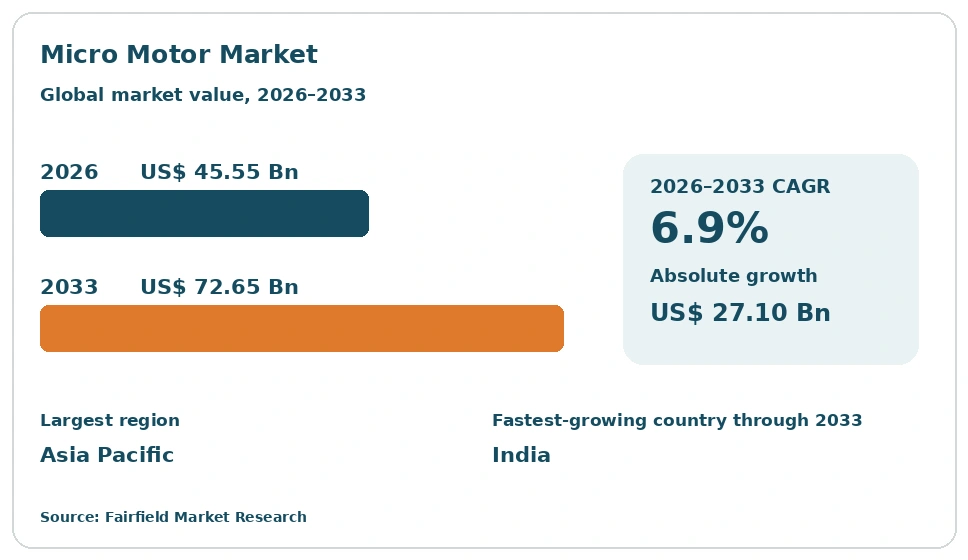
The global micro motor market size is expected to be valued at US$ 45.55 billion in 2026 and projected to reach US$ 72.65 billion by 2033, growing at a CAGR of 6.9% between 2026 and 2033.
Between 2020 and 2025, the market grew at a CAGR of about 3.2%, rising from roughly US$ 36.5 billion to about US$ 42.6 billion, as automotive production recovered from pandemic and chip-shortage disruptions, home appliance and personal care device sales rose, and factories invested in automation. The micro motor market covers small electric motors, usually less than about 160 mm in diameter or with low rated power, that convert electrical energy into precise motion. Main types include brushed DC motors, brushless DC motors, coreless motors, stepper motors, and small AC motors. They power car mirrors, seats, windows, and HVAC flaps, as well as smartphones, cameras, drones, power tools, toothbrushes, surgical tools, insulin pumps, robots, and industrial equipment. In January 2026, Mabuchi Motor completed its acquisition of Nippon Pulse Motor, adding precision motors and motion control technology.
Key Report Takeaways
- By Technology: Brushed Motors held about 63% share in 2025, while Brushless Motors are projected to expand at an 8.9% CAGR through 2033, driven by higher efficiency, longer life, quieter operation, and growing use in electric vehicles, drones, robots, and medical devices.
- By Type: AC Motors held about 71% share in 2025, while DC Motors are projected to expand at an 8.0% CAGR through 2033, driven by battery-powered devices, cordless tools, portable medical equipment, and the rising number of electronic systems in cars.
- By Application: Automotive held about 30% share in 2025, while Medical Devices are projected to expand at a 9.2% CAGR through 2033, driven by surgical robots, wearable drug pumps, powered surgical tools, and miniaturized diagnostic equipment for hospitals and home care.
- By Region: Asia Pacific held about 38% share in 2025, while India is projected to expand at an 8.6% CAGR through 2033, driven by expanding electronics manufacturing, rising vehicle and two-wheeler production, and government incentives for local component production.
Global Micro Motor Market Trends and Insights
Drivers Impact Analysis
Two drivers carry the strongest influence on micro motor market demand during the forecast period.
| Driver | Impact on CAGR Forecast | Geographic Relevance | Impact Timeline |
| Rising motor content in vehicles | High | Global | Long term (≥4 years) |
| Growth of robotics, automation, and medical devices | Medium | North America, Europe, Asia Pacific | Medium term (2-4 years) |
Vehicle Motor Content Is Driving the Micro Motor Market
Rising motor content in vehicles is the strongest driver of the micro motor market. Modern cars use dozens of small motors.
The mechanism is that a typical new car now contains many micro motors for power windows, seats, mirrors, door locks, sunroofs, wipers, HVAC flaps, headlight leveling, electric parking brakes, and fuel or coolant pumps, and premium vehicles can contain more than 100. Comfort and convenience features keep spreading from luxury cars to mass-market models. Electric vehicles add motors for battery cooling pumps, thermal management valves, charging port doors, active grille shutters, and flush door handles. Advanced driver assistance systems use motors for sensor cleaning and adjustment. Rising vehicle production in China, India, and Mexico supports volume. These trends create steady, high-volume demand for automotive micro motors.
Robotics and Medical Devices Are Expanding the Micro Motor Market
Growth of robotics, automation, and medical devices is expanding the micro motor market. Precise motion is needed in many new machines.
The cause is that factories, warehouses, and laboratories are adding robots, collaborative arms, automated guided vehicles, and pick-and-place systems that use many small, precise motors. Humanoid robots are an important new opportunity, since each robot hand and joint needs compact, high-torque motors, and companies such as maxon Group, Faulhaber, Portescap, and Johnson Electric are developing products for them. In healthcare, surgical robots, powered surgical drills, insulin and infusion pumps, ventilators, and diagnostic analyzers rely on reliable micro motors. Aging populations increase medical device demand. Drones and camera stabilizers add further uses. These trends support high-value motor sales and long-term supply agreements with equipment makers.
Restraints Impact Analysis
Two restraints limit how quickly the micro motor market grows.
| Restraint | Impact on CAGR Forecast | Geographic Relevance | Impact Timeline |
| Rare earth and copper price volatility | High | Global | Medium term (2-4 years) |
| Intense price competition and slower consumer demand | Medium | Asia Pacific, Europe | Long term (≥4 years) |
Material Costs Slow the Micro Motor Market
Rare earth and copper price volatility slows the micro motor market. Small motors depend on key raw materials.
The problem is that many brushless and high-performance micro motors use neodymium magnets containing rare earth elements such as neodymium, praseodymium, and dysprosium, and China controls most global rare earth mining and processing. Export controls and supply restrictions on rare earths and magnets have raised concerns for motor makers in North America, Europe, Japan, and other regions. Copper, used in motor windings, has also seen large price swings, and steel prices affect laminations and housings. Motor makers often cannot pass all cost increases to large automotive and electronics customers. Developing magnet-free or reduced rare earth designs takes time and investment. These factors squeeze margins and create supply risk.
Price Competition Restricts the Micro Motor Market
Intense price competition and slower consumer demand restrict the micro motor market. Many companies make similar products.
The constraint is that standard brushed DC motors for toys, appliances, and simple devices are mature products made by many manufacturers, especially in China, which leads to strong price competition and thin margins. Large customers in automotive and consumer electronics demand annual price cuts. Sales of smartphones, laptops, and some home appliances have slowed in many markets, reducing demand for vibration motors and small fans. Some product makers have switched to other technologies, such as solid-state haptics in place of vibration motors. Trade tariffs between the United States and China have also disrupted supply chains. These pressures limit growth for commodity motor suppliers and push them to move into higher-value products.
Market Opportunities
Humanoid Robots and Precision Drives Open a Fast-Growth Revenue Pool
Humanoid robots and precision drives open a fast-growth revenue pool. The robotics industry needs new kinds of motors.
The opportunity comes from rapid investment in humanoid and service robots in the United States, China, Japan, South Korea, and Germany. Each humanoid robot may use dozens of motors in its hands, wrists, arms, legs, and head, and these motors must be small, light, powerful, efficient, and quiet. Companies are developing complete actuator modules that combine motors, gearboxes, encoders, and controllers. In 2025, maxon Group took a minority stake in motion control firm Synapticon to strengthen its integrated drive offering. Surgical robots and exoskeletons need similar precision drives. Suppliers that offer high-torque brushless and coreless motors, integrated actuators, and strong engineering support can win high-value, long-term contracts.
Electrification and Medical Miniaturization Create a Growth Revenue Pool
Electrification and medical miniaturization create a growth revenue pool. More products now run on small electric motors.
The opportunity reflects the shift from mechanical and hydraulic systems to electric actuation in cars, homes, and factories, such as electric brakes, electric valves, smart locks, and motorized blinds. Cordless power tools, garden tools, e-bikes, and scooters use brushless DC motors. In healthcare, wearable insulin pumps, portable oxygen concentrators, robotic surgical tools, and dental handpieces need tiny, reliable motors that meet strict medical standards. Home care devices are also growing quickly as populations age in many countries. Mabuchi Motor is expanding into medical and precision fields through several acquisitions. Suppliers that offer certified medical-grade motors, low-noise designs, and custom solutions can capture strong growth across automotive, home, and healthcare markets worldwide.
Segment Analysis
By Technology: Brushed Motors Lead While Brushless Motors Grow Fastest
Brushed Motors held about 63% share in 2025. These motors use carbon brushes and a commutator to switch current, making them simple, low-cost, and easy to control. They are widely used in automotive body systems such as windows, mirrors, and seats, as well as in toys, appliances, and personal care devices produced in huge volumes.
Brushless Motors are the fastest-growing technology, expanding at an 8.9% CAGR through 2033. They use electronic commutation, which improves efficiency, reduces noise and wear, and extends service life. They are increasingly used in electric vehicle pumps and fans, drones, cordless tools, robots, medical devices, and computer cooling. Coreless and stepper designs add further options. For the market, brushless growth raises average selling prices.
By Type: AC Motors Lead While DC Motors Grow Fastest
AC Motors held about 71% share in 2025. Small AC motors are widely used in household appliances, fans, pumps, office equipment, and industrial machines that run directly from mains power. Synchronous and induction designs are common in these applications, and many are produced in very large volumes.
DC Motors are the fastest-growing type, expanding at an 8.0% CAGR through 2033. Battery-powered products, from cordless tools and robot vacuums to wearable medical devices and electric vehicle systems, rely on DC motors. Rising use of 12-volt and 48-volt vehicle electrical systems adds further demand, along with growth in e-bikes, scooters, and small electric garden equipment. For the market, DC growth follows the shift to portable, battery-powered products.
By Application: Automotive Leads While Medical Devices Grow Fastest
Automotive held about 30% share in 2025. Cars use micro motors in body, comfort, thermal management, and safety systems, and electric vehicles add new uses. Automakers buy motors in very large volumes through Tier 1 suppliers, and each new vehicle generation adds more motorized comfort and convenience features. Long vehicle programs give motor makers steady orders for several years.
Medical Devices are the fastest-growing application, expanding at a 9.2% CAGR through 2033. Surgical robots, powered instruments, drug delivery pumps, ventilators, prosthetics, and laboratory analyzers need small, precise, and reliable motors. Consumer Electronics, Industrial Automation, Home Appliances, and Aerospace and Defense form further segments. For the market, medical growth supports premium, high-margin motor sales and rewards suppliers with strong quality systems and medical certifications.
Geography Analysis
Why Is North America Important to the Micro Motor Market?
North America is important to the micro motor market because it holds about 27% share in 2025 and leads in high-value applications such as surgical robots, medical devices, aerospace, defense, and advanced robotics. The United States is home to major medical device makers and many humanoid robot developers that need precision motors. Portescap, part of Regal Rexnord, and Allied Motion are based in the region. Mexico is a growing hub for automotive motor production. Key barriers include high costs and reliance on imported magnets. One opportunity is local supply chains for magnets and precision motors, supported by government programs.
Europe Shapes the Micro Motor Market Through Precision Engineering
Europe is a major micro motor market, holding about 24% share in 2025. Germany, Switzerland, France, Italy, and the United Kingdom have strong automotive, industrial automation, and medical technology industries. maxon Group in Switzerland, Faulhaber and Bühler Motor in Germany, and Schaeffler are leading suppliers of precision drives. European automakers use many micro motors in premium and electric vehicles. Key barriers include high energy and labor costs. One opportunity is precision drives for robotics and medical devices, supported by strong engineering skills, research institutes, and close ties with leading equipment makers across the region.
Which Region Is Leading the Micro Motor Market?
Asia Pacific is leading the micro motor market with about 38% share in 2025. China is the world’s largest producer and user of micro motors, with huge automotive, electronics, appliance, and toy industries and many local motor makers. Japan is home to Nidec Corporation, Mabuchi Motor, MinebeaMitsumi, and Mitsuba, while Hong Kong-based Johnson Electric runs large plants in China. South Korea, Vietnam, and Thailand add production. Key barriers include price competition and rare earth supply risks. One change shaping the region is rapid growth in humanoid and service robots, especially in China.
Latin America Grows the Micro Motor Market Through Vehicle and Appliance Production
Latin America is a growing micro motor market. Brazil and Argentina have large automotive and home appliance industries that use small motors for windows, seats, fans, and pumps. Global motor suppliers serve local assembly plants. Colombia and Chile add demand through appliances, medical devices, and mining equipment. Key barriers include economic swings, currency changes, and reliance on imports. One opportunity is local assembly of motors for automotive suppliers, which can cut import costs and delivery times. Growing sales of air conditioners, washing machines, and small kitchen appliances in Brazil and Mexico also add demand for small motors. Medical device use is rising in private hospitals.
Middle East & Africa Builds the Micro Motor Market Through Industrial Diversification
Middle East & Africa is an emerging micro motor market. Saudi Arabia and the United Arab Emirates are investing in manufacturing, robotics, smart cities, and healthcare as part of plans to diversify their economies. Israel has a strong medical device and defense technology sector. South Africa and Morocco have growing automotive production, and Egypt has a large appliance industry serving local and export markets. Hospitals in the region are also buying more medical equipment. Key barriers include limited local manufacturing and reliance on imports. One opportunity is motors for new automotive and electronics plants, supported by government incentives, free trade zones, and growing investment by global manufacturers across the region.
Competitive Landscape
The micro motor market is fragmented. Nidec Corporation, Johnson Electric, Mabuchi Motor, maxon Group, and MinebeaMitsumi are leading players, while Mitsuba Corporation, Faulhaber, Portescap, Bühler Motor, Denso Corporation, Allied Motion Technologies, and Constar Micromotor compete strongly. Large Japanese and Chinese producers make billions of motors a year for automotive, appliance, and electronics customers, while Swiss, German, and American specialists focus on high-precision motors for medical, robotics, aerospace, and industrial uses. Hundreds of smaller manufacturers in China compete on price for standard motors.
Companies compete on size, power density, efficiency, noise, reliability, service life, price, production scale, and the ability to customize motors for each customer. Integrated drive systems that combine motors, gearheads, encoders, and controllers are becoming more important, since customers want complete motion solutions. Medical and aerospace buyers value quality certifications and long product lifecycles, while automotive buyers focus on cost and delivery.
Strategic moves show how competition is changing. In July 2025, Mabuchi Motor completed the purchase of Oki Micro Engineering’s small motor business, and in January 2026, it completed its acquisition of Nippon Pulse Motor. In 2025, maxon Group took a minority stake in Synapticon to add intelligent motion control, reflecting strong interest in robotics.
Three themes shape vendor strategy. First, companies are acquiring specialists to move into precision, medical, and industrial applications. Second, they are developing brushless, coreless, and integrated actuator products for humanoid robots and electric vehicles. Third, they are reducing rare earth dependence and diversifying production in India, Vietnam, Mexico, and other locations.
Micro Motor Market Industry Leaders
- Nidec Corporation
- Johnson Electric
- Mabuchi Motor
- maxon Group
- MinebeaMitsumi
Recent Industry Developments
- January 2026: Mabuchi Motor completed its acquisition of Nippon Pulse Motor, renaming it Mabuchi Motor NPM - adds precision small motors and motion control technology for medical, semiconductor, and industrial uses in the micro motor market.
- September 2025: maxon Group took a minority stake in motion control company Synapticon - strengthens integrated, intelligent drive systems for robotics and humanoid robot customers.
- July 2025: Mabuchi Motor completed its acquisition of the small motor business of Oki Micro Engineering, launching Mabuchi Motor Micro Tech - adds compact, high-torque brushless motor technology.
Companies Covered in the Report
- Nidec Corporation
- Johnson Electric
- Mabuchi Motor
- maxon Group
- MinebeaMitsumi
- Mitsuba Corporation
- Faulhaber
- Portescap
- Bühler Motor
- Denso Corporation
- Allied Motion Technologies
- Constar Micromotor
Micro Motor Market Report Scope
This report covers the micro motor market, including brushed and brushless motors, AC and DC types, used in automotive, medical devices, consumer electronics, industrial automation, home appliances, and aerospace and defense applications worldwide. The base year is 2025, and the forecast period runs from 2026 to 2033. All values are expressed in US$ Billion, based on revenue from motor sales.
| Technology | Brushed Motors, Brushless Motors |
| Type | AC Motors, DC Motors |
| Application | Automotive, Medical Devices, Consumer Electronics, Industrial Automation, Home Appliances, Aerospace and Defense |
| Regions | North America, Europe, Asia Pacific, Latin America, Middle East & Africa |
1. Executive Summary
1.1 Micro Motor Market Snapshot
1.2 Future Projections
1.3 Key Market Trends
1.4 Regional Snapshot
2. Market Overview
2.1 Market Definition and Report Scope
2.2 Historical Market Trends
2.3 Market Dynamics
2.3.1 Drivers
2.3.1.1 Vehicle Motor Content Is Driving the Micro Motor Market
2.3.1.2 Robotics and Medical Devices Are Expanding the Micro Motor Market
2.3.2 Restraints
2.3.2.1 Material Costs Slow the Micro Motor Market
2.3.2.2 Price Competition Restricts the Micro Motor Market
2.3.3 Market Opportunities
2.3.3.1 Humanoid Robots and Precision Drives Open a Fast-Growth Revenue Pool
2.3.3.2 Electrification and Medical Miniaturization Create a Growth Revenue Pool
3. Global Micro Motor Market Outlook, 2020–2033
3.1 Global Micro Motor Market Outlook, by Technology, Value (US$ Billion), 2020–2033
3.1.1 Brushed Motors
3.1.2 Brushless Motors
3.2 Global Micro Motor Market Outlook, by Type, Value (US$ Billion), 2020–2033
3.2.1 AC Motors
3.2.2 DC Motors
3.3 Global Micro Motor Market Outlook, by Application, Value (US$ Billion), 2020–2033
3.3.1 Automotive
3.3.2 Medical Devices
3.3.3 Consumer Electronics
3.3.4 Industrial Automation
3.3.5 Home Appliances
3.3.6 Aerospace and Defense
3.4 Global Micro Motor Market Outlook, by Region, Value (US$ Billion), 2020–2033
3.4.1 North America
3.4.2 Europe
3.4.3 Asia Pacific
3.4.4 Latin America
3.4.5 Middle East & Africa
4. North America Micro Motor Market Outlook, 2020–2033
4.1 North America Micro Motor Market Outlook, by Technology, Value (US$ Billion), 2020–2033
4.1.1 Brushed Motors
4.1.2 Brushless Motors
4.2 North America Micro Motor Market Outlook, by Type, Value (US$ Billion), 2020–2033
4.2.1 AC Motors
4.2.2 DC Motors
4.3 North America Micro Motor Market Outlook, by Application, Value (US$ Billion), 2020–2033
4.3.1 Automotive
4.3.2 Medical Devices
4.3.3 Consumer Electronics
4.3.4 Industrial Automation
4.3.5 Home Appliances
4.3.6 Aerospace and Defense
4.4 North America Micro Motor Market Outlook, by Country, Value (US$ Billion), 2020–2033
4.4.1 United States Micro Motor Market Outlook, by Technology, 2020–2033
4.4.2 United States Micro Motor Market Outlook, by Type, 2020–2033
4.4.3 United States Micro Motor Market Outlook, by Application, 2020–2033
4.4.4 Mexico Micro Motor Market Outlook, by Technology, 2020–2033
4.4.5 Mexico Micro Motor Market Outlook, by Type, 2020–2033
4.4.6 Mexico Micro Motor Market Outlook, by Application, 2020–2033
5. Europe Micro Motor Market Outlook, 2020–2033
5.1 Europe Micro Motor Market Outlook, by Technology, Value (US$ Billion), 2020–2033
5.1.1 Brushed Motors
5.1.2 Brushless Motors
5.2 Europe Micro Motor Market Outlook, by Type, Value (US$ Billion), 2020–2033
5.2.1 AC Motors
5.2.2 DC Motors
5.3 Europe Micro Motor Market Outlook, by Application, Value (US$ Billion), 2020–2033
5.3.1 Automotive
5.3.2 Medical Devices
5.3.3 Consumer Electronics
5.3.4 Industrial Automation
5.3.5 Home Appliances
5.3.6 Aerospace and Defense
5.4 Europe Micro Motor Market Outlook, by Country, Value (US$ Billion), 2020–2033
5.4.1 Germany Micro Motor Market Outlook, by Technology, 2020–2033
5.4.2 Germany Micro Motor Market Outlook, by Type, 2020–2033
5.4.3 Germany Micro Motor Market Outlook, by Application, 2020–2033
5.4.4 Switzerland Micro Motor Market Outlook, by Technology, 2020–2033
5.4.5 Switzerland Micro Motor Market Outlook, by Type, 2020–2033
5.4.6 Switzerland Micro Motor Market Outlook, by Application, 2020–2033
5.4.7 France Micro Motor Market Outlook, by Technology, 2020–2033
5.4.8 France Micro Motor Market Outlook, by Type, 2020–2033
5.4.9 France Micro Motor Market Outlook, by Application, 2020–2033
5.4.10 Italy Micro Motor Market Outlook, by Technology, 2020–2033
5.4.11 Italy Micro Motor Market Outlook, by Type, 2020–2033
5.4.12 Italy Micro Motor Market Outlook, by Application, 2020–2033
5.4.13 United Kingdom Micro Motor Market Outlook, by Technology, 2020–2033
5.4.14 United Kingdom Micro Motor Market Outlook, by Type, 2020–2033
5.4.15 United Kingdom Micro Motor Market Outlook, by Application, 2020–2033
6. Asia Pacific Micro Motor Market Outlook, 2020–2033
6.1 Asia Pacific Micro Motor Market Outlook, by Technology, Value (US$ Billion), 2020–2033
6.1.1 Brushed Motors
6.1.2 Brushless Motors
6.2 Asia Pacific Micro Motor Market Outlook, by Type, Value (US$ Billion), 2020–2033
6.2.1 AC Motors
6.2.2 DC Motors
6.3 Asia Pacific Micro Motor Market Outlook, by Application, Value (US$ Billion), 2020–2033
6.3.1 Automotive
6.3.2 Medical Devices
6.3.3 Consumer Electronics
6.3.4 Industrial Automation
6.3.5 Home Appliances
6.3.6 Aerospace and Defense
6.4 Asia Pacific Micro Motor Market Outlook, by Country, Value (US$ Billion), 2020–2033
6.4.1 China Micro Motor Market Outlook, by Technology, 2020–2033
6.4.2 China Micro Motor Market Outlook, by Type, 2020–2033
6.4.3 China Micro Motor Market Outlook, by Application, 2020–2033
6.4.4 Japan Micro Motor Market Outlook, by Technology, 2020–2033
6.4.5 Japan Micro Motor Market Outlook, by Type, 2020–2033
6.4.6 Japan Micro Motor Market Outlook, by Application, 2020–2033
6.4.7 South Korea Micro Motor Market Outlook, by Technology, 2020–2033
6.4.8 South Korea Micro Motor Market Outlook, by Type, 2020–2033
6.4.9 South Korea Micro Motor Market Outlook, by Application, 2020–2033
6.4.10 Vietnam Micro Motor Market Outlook, by Technology, 2020–2033
6.4.11 Vietnam Micro Motor Market Outlook, by Type, 2020–2033
6.4.12 Vietnam Micro Motor Market Outlook, by Application, 2020–2033
6.4.13 Thailand Micro Motor Market Outlook, by Technology, 2020–2033
6.4.14 Thailand Micro Motor Market Outlook, by Type, 2020–2033
6.4.15 Thailand Micro Motor Market Outlook, by Application, 2020–2033
7. Latin America Micro Motor Market Outlook, 2020–2033
7.1 Latin America Micro Motor Market Outlook, by Technology, Value (US$ Billion), 2020–2033
7.1.1 Brushed Motors
7.1.2 Brushless Motors
7.2 Latin America Micro Motor Market Outlook, by Type, Value (US$ Billion), 2020–2033
7.2.1 AC Motors
7.2.2 DC Motors
7.3 Latin America Micro Motor Market Outlook, by Application, Value (US$ Billion), 2020–2033
7.3.1 Automotive
7.3.2 Medical Devices
7.3.3 Consumer Electronics
7.3.4 Industrial Automation
7.3.5 Home Appliances
7.3.6 Aerospace and Defense
7.4 Latin America Micro Motor Market Outlook, by Country, Value (US$ Billion), 2020–2033
7.4.1 Brazil Micro Motor Market Outlook, by Technology, 2020–2033
7.4.2 Brazil Micro Motor Market Outlook, by Type, 2020–2033
7.4.3 Brazil Micro Motor Market Outlook, by Application, 2020–2033
7.4.4 Argentina Micro Motor Market Outlook, by Technology, 2020–2033
7.4.5 Argentina Micro Motor Market Outlook, by Type, 2020–2033
7.4.6 Argentina Micro Motor Market Outlook, by Application, 2020–2033
7.4.7 Colombia Micro Motor Market Outlook, by Technology, 2020–2033
7.4.8 Colombia Micro Motor Market Outlook, by Type, 2020–2033
7.4.9 Colombia Micro Motor Market Outlook, by Application, 2020–2033
7.4.10 Chile Micro Motor Market Outlook, by Technology, 2020–2033
7.4.11 Chile Micro Motor Market Outlook, by Type, 2020–2033
7.4.12 Chile Micro Motor Market Outlook, by Application, 2020–2033
7.4.13 Mexico Micro Motor Market Outlook, by Technology, 2020–2033
7.4.14 Mexico Micro Motor Market Outlook, by Type, 2020–2033
7.4.15 Mexico Micro Motor Market Outlook, by Application, 2020–2033
8. Middle East & Africa Micro Motor Market Outlook, 2020–2033
8.1 Middle East & Africa Micro Motor Market Outlook, by Technology, Value (US$ Billion), 2020–2033
8.1.1 Brushed Motors
8.1.2 Brushless Motors
8.2 Middle East & Africa Micro Motor Market Outlook, by Type, Value (US$ Billion), 2020–2033
8.2.1 AC Motors
8.2.2 DC Motors
8.3 Middle East & Africa Micro Motor Market Outlook, by Application, Value (US$ Billion), 2020–2033
8.3.1 Automotive
8.3.2 Medical Devices
8.3.3 Consumer Electronics
8.3.4 Industrial Automation
8.3.5 Home Appliances
8.3.6 Aerospace and Defense
8.4 Middle East & Africa Micro Motor Market Outlook, by Country, Value (US$ Billion), 2020–2033
8.4.1 Saudi Arabia Micro Motor Market Outlook, by Technology, 2020–2033
8.4.2 Saudi Arabia Micro Motor Market Outlook, by Type, 2020–2033
8.4.3 Saudi Arabia Micro Motor Market Outlook, by Application, 2020–2033
8.4.4 United Arab Emirates Micro Motor Market Outlook, by Technology, 2020–2033
8.4.5 United Arab Emirates Micro Motor Market Outlook, by Type, 2020–2033
8.4.6 United Arab Emirates Micro Motor Market Outlook, by Application, 2020–2033
8.4.7 Israel Micro Motor Market Outlook, by Technology, 2020–2033
8.4.8 Israel Micro Motor Market Outlook, by Type, 2020–2033
8.4.9 Israel Micro Motor Market Outlook, by Application, 2020–2033
8.4.10 South Africa Micro Motor Market Outlook, by Technology, 2020–2033
8.4.11 South Africa Micro Motor Market Outlook, by Type, 2020–2033
8.4.12 South Africa Micro Motor Market Outlook, by Application, 2020–2033
8.4.13 Morocco Micro Motor Market Outlook, by Technology, 2020–2033
8.4.14 Morocco Micro Motor Market Outlook, by Type, 2020–2033
8.4.15 Morocco Micro Motor Market Outlook, by Application, 2020–2033
8.4.16 Egypt Micro Motor Market Outlook, by Technology, 2020–2033
8.4.17 Egypt Micro Motor Market Outlook, by Type, 2020–2033
8.4.18 Egypt Micro Motor Market Outlook, by Application, 2020–2033
9. Competitive Landscape
9.1 Micro Motor Market Industry Leaders
9.2 Recent Industry Developments
9.3 Company Profiles
9.3.1 Nidec Corporation
9.3.2 Johnson Electric
9.3.3 Mabuchi Motor
9.3.4 maxon Group
9.3.5 MinebeaMitsumi
9.3.6 Mitsuba Corporation
9.3.7 Faulhaber
9.3.8 Portescap
9.3.9 Bühler Motor
9.3.10 Denso Corporation
9.3.11 Allied Motion Technologies
9.3.12 Constar Micromotor
10. Appendix
10.1 Research Methodology
10.2 Report Assumptions
10.3 Acronyms and Abbreviations
| Technology | Brushed Motors, Brushless Motors |
| Type | AC Motors, DC Motors |
| Application | Automotive, Medical Devices, Consumer Electronics, Industrial Automation, Home Appliances, Aerospace and Defense |
| Regions | North America, Europe, Asia Pacific, Latin America, Middle East & Africa |
Our Research Methodology
Considering the volatility of business today, traditional approaches to strategizing a game plan can be unfruitful if not detrimental. True ambiguity is no way to determine a forecast. A myriad of predetermined factors must be accounted for such as the degree of risk involved, the magnitude of circumstances, as well as conditions or consequences that are not known or unpredictable. To circumvent binary views that cast uncertainty, the application of market research intelligence to strategically posture, move, and enable actionable outcomes is necessary.
View Methodology
Quality Assured
Rigorous Validation Process

Confidentiality Assured
End-to-end Data Security

Custom Research Services
Tailored To Your Objectives
FAQs
The market is valued at US$ 45.55 billion in 2026, led by brushed motors, automotive uses, and Asia Pacific.
The market is projected to reach US$ 72.65 billion by 2033, growing at a 6.9% CAGR and adding US$ 27.10 billion.
Medical Devices are growing fastest at a 9.2% CAGR through 2033, driven by surgical robots, drug pumps, and powered tools.
India is growing fastest at an 8.6% CAGR through 2033, driven by expanding electronics manufacturing and rising vehicle production.
Asia Pacific holds the largest share at about 38% in 2025, supported by China’s huge manufacturing base and strong Japanese suppliers.
Related Reports
Thermal Management Technologies Market Size, Share, Insights, Competitive Landscape, and Forecast 2026 to 2033
Explore the thermal management technologies market, forecast to reach US$25.29 billion by 2033 at 6.0% CAGR, with insights on products and applications.
Compact Wheel Loaders Market Size, Share, Insights, Competitive Landscape, and Forecast 2026 to 2033
Explore the compact wheel loaders market outlook for 2026–2033, covering product segments, applications, regional trends, and leading companies.
Heating Radiator Market Size, Share, Insights, Competitive Landscape, and Forecast 2026 to 2033
The global heating radiator market is valued at US$8.4 billion in 2026, reaching US$12.0 billion by 2033, growing at a 5.2% CAGR
Fermenters Market Size, Share, Insights, Competitive Landscape, and Forecast 2026 to 2033
The global fermenters market is valued at US$2.0 billion in 2026, reaching US$2.87 billion by 2033, growing at a 5.3% CAGR
Diamond Tools Market Size, Share, Insights, Competitive Landscape, and Forecast 2026 to 2033
The global diamond tools market is valued at US$11.2 billion in 2026, reaching US$16.8 billion by 2033, growing at a 6.0% CAGR
CO2 Glass Tube Laser Market Size, Share, Insights, Competitive Landscape, and Forecast 2026 to 2033
The global CO2 glass tube laser market is valued at US$0.78 billion in 2026, reaching US$1.18 billion by 2033, growing at a 6.1% CAGR