



Thermal Management Technologies Market
Thermal Management Technologies Market Size, Share, Insights, Competitive Landscape, and Forecast 2026 to 2033
Report Overview
Thermal Management Technologies Market Size and Trend Analysis
How Fast Is the Thermal Management Technologies Market Growing?
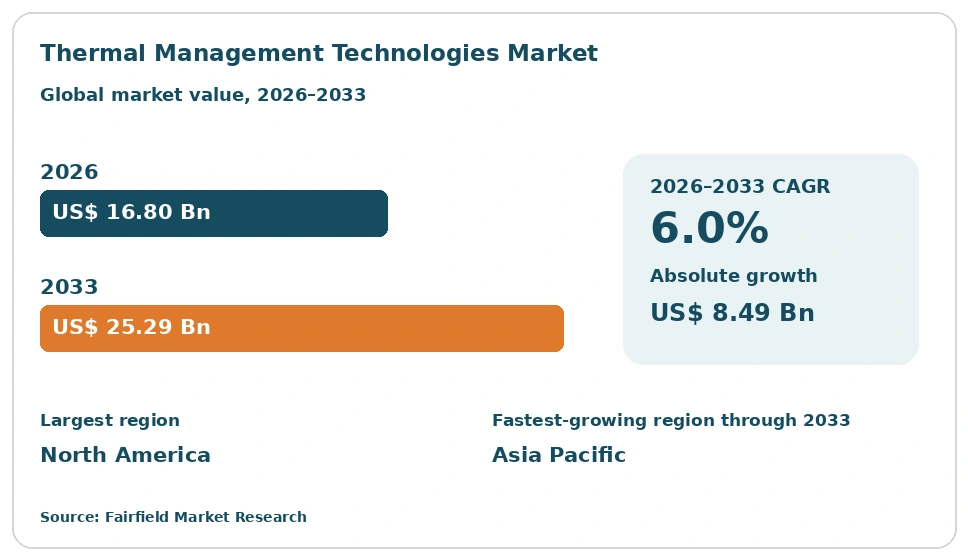
The global thermal management technologies market size is expected to be valued at US$ 16.80 billion in 2026 and projected to reach US$ 25.29 billion by 2033, growing at a CAGR of 6.0% between 2026 and 2033.
Between 2020 and 2025, the market grew at a CAGR of about 6.1%, rising from roughly US$ 11.6 billion to US$ 15.6 billion, as remote work boosted laptop and server sales, electric vehicle production grew quickly, 5G networks were built, and artificial intelligence data centers began using much more powerful chips that create more heat. The thermal management technologies market covers hardware, software, interface materials, and substrates used to remove or control heat in electronic and electrical systems. Products include heat sinks, fans, heat pipes, vapor chambers, thermal interface materials, gap fillers, cold plates, liquid cooling and immersion systems, thermoelectric coolers, and thermal simulation software. They are used in computers, data centers, phones, telecom equipment, cars, batteries, power electronics, LED lighting, and renewable energy systems. In March 2026, Eaton completed its US$ 9.5 billion acquisition of Boyd Thermal.
Key Report Takeaways
- By Product: Hardware held about 55% share in 2025, while Interface Materials are projected to expand at a 7.6% CAGR through 2033, driven by higher chip power, electric vehicle batteries, and the need for thin, reliable materials that move heat between components.
- By Device Type: Convection Cooling held about 45% share in 2025, while Advanced Cooling is projected to expand at a 9.8% CAGR through 2033, driven by direct-to-chip liquid cooling, immersion cooling, and vapor chambers for high-power processors.
- By Application: Computers and Data Centers held about 32% share in 2025, while Automotive is projected to expand at a 9.2% CAGR through 2033, driven by electric vehicle batteries, power electronics, and advanced driver assistance computers.
- By Region: North America held about 36% share in 2025, while Asia Pacific is projected to expand at a 7.4% CAGR through 2033, driven by electronics manufacturing, electric vehicle production, and data center construction in China, India, and Japan.
Global Thermal Management Technologies Market Trends and Insights
Drivers Impact Analysis
Two drivers carry the strongest influence on thermal management technologies market demand during the forecast period.
| Driver | Impact on CAGR Forecast | Geographic Relevance | Impact Timeline |
| AI data centers and high-power chips | High | North America, Asia Pacific, Europe | Long term (≥4 years) |
| Electric vehicles and battery systems | High | Global | Medium term (2-4 years) |
AI Data Centers Are Driving the Thermal Management Technologies Market
AI data centers and high-power chips are the strongest driver of the thermal management technologies market. Modern processors produce far more heat than older ones.
The mechanism is the rapid rise in power used by graphics processors and AI accelerators. A single AI server rack can now draw many times more power than a traditional rack, and air cooling alone can no longer remove the heat. Data center operators are adopting direct-to-chip cold plates, coolant distribution units, rear-door heat exchangers, and immersion cooling, along with better thermal interface materials and vapor chambers inside servers. Large cloud companies are building new AI campuses in North America, Europe, and Asia Pacific. Equipment makers such as Vertiv, Eaton, and Trane Technologies are buying liquid cooling specialists to keep up. These trends raise spending on advanced thermal products per server and per facility.
Electric Vehicles Are Expanding the Thermal Management Technologies Market
Electric vehicles and battery systems are expanding the thermal management technologies market. Batteries and motors must stay within safe temperatures.
The cause is the shift from engines to electric drivetrains. Lithium-ion batteries lose performance, age faster, and can catch fire if they get too hot, so electric vehicles use cooling plates, gap fillers, thermal pads, insulation, and heat pumps. Inverters, onboard chargers, and fast-charging stations also produce large amounts of heat. Advanced driver assistance computers and in-car screens add further cooling needs. China is the world’s largest electric vehicle producer, while Europe and North America are also growing. Grid batteries for solar and wind farms use similar thermal systems. Companies such as Henkel, Parker Hannifin, and Gentherm supply materials and systems to automakers and battery makers. These trends raise thermal content per vehicle.
Restraints Impact Analysis
Two restraints limit how quickly the thermal management technologies market grows.
| Restraint | Impact on CAGR Forecast | Geographic Relevance | Impact Timeline |
| High costs and design complexity of advanced cooling | High | Global | Medium term (2-4 years) |
| Raw material price swings and supply chain risks | Medium | Global | Short term (≤2 years) |
High Costs Slow the Thermal Management Technologies Market
High costs and design complexity of advanced cooling slow the thermal management technologies market. New cooling systems are expensive to install.
The problem is that liquid and immersion cooling require pumps, pipes, heat exchangers, special fluids, leak detection, and changes to building design, which raise upfront costs for data centers. Many existing facilities were built for air cooling and are hard to retrofit. Operators also worry about leaks, maintenance, and a lack of common standards between suppliers. In consumer electronics, makers must fit cooling into thinner devices while keeping prices low, which limits room for premium materials. Smaller companies may lack the engineering skills to design complex thermal systems. Some fluids used in immersion cooling also face environmental rules. These factors slow adoption of the most advanced technologies, especially outside large cloud operators.
Raw Material Swings Restrict the Thermal Management Technologies Market
Raw material price swings and supply chain risks restrict the thermal management technologies market. Many products depend on metals and specialty chemicals.
The constraint is that heat sinks, cold plates, and heat pipes use copper and aluminum, whose prices change sharply with global demand and trade policies. Thermal interface materials use silicones, ceramics, graphite, and other fillers that can face supply shortages. Tariffs and trade restrictions between major economies have raised costs and pushed companies to move production. Long lead times for pumps, valves, and electronic parts can delay data center projects. Price pressure from electronics and automotive customers makes it hard for suppliers to pass on higher costs. Rules on certain chemicals, such as fluorinated substances, may also force material changes. These pressures squeeze margins and add uncertainty for manufacturers.
Market Opportunities
Liquid and Immersion Cooling Open a Fast-Growth Revenue Pool
Liquid and immersion cooling for data centers open a fast-growth revenue pool. AI computing is changing how data centers are built.
The opportunity comes from the need to cool racks that use tens or even hundreds of kilowatts. Direct-to-chip cold plates, coolant distribution units, and single-phase and two-phase immersion systems can remove heat far more efficiently than air and allow waste heat to be reused for district heating. Chip makers are designing new processors with liquid cooling in mind. Major suppliers are acquiring specialists, such as Eaton buying Boyd Thermal, Trane Technologies buying LiquidStack, and Vertiv buying Strategic Thermal Labs. Service contracts for installation, fluid management, and monitoring add recurring revenue. Companies that offer complete systems from chip to chiller can win large, long-term data center projects.
Advanced Materials Create a Growth Revenue Pool
Advanced thermal materials create a growth revenue pool. Better materials help devices run cooler and last longer.
The opportunity reflects strong demand for high-performance thermal interface materials, phase-change materials, graphite sheets, liquid metal compounds, ceramic substrates, and dispensable gap fillers. These materials are needed in AI processors, smartphones, electric vehicle batteries, power modules made with silicon carbide and gallium nitride, and 5G base stations. Manufacturers want materials that conduct heat well, stay reliable for many years, and can be applied by automated equipment. Suppliers such as Henkel, Parker Hannifin, Honeywell, and Momentive are investing in new formulations. Testing and qualification can take years, which rewards trusted suppliers. Companies with strong research, application engineering, and close customer relationships can earn premium prices in this growing segment.
Segment Analysis
By Product: Hardware Leads While Interface Materials Grow Fastest
Hardware held about 55% share in 2025. It includes heat sinks, fans, blowers, heat pipes, vapor chambers, heat exchangers, cold plates, pumps, and thermoelectric modules used in computers, servers, telecom equipment, vehicles, and industrial systems. Hardware is essential in almost every electronic product, which explains its large share across applications.
Interface Materials are the fastest-growing product, expanding at a 7.6% CAGR through 2033. Thermal pastes, pads, gap fillers, phase-change materials, and adhesives fill tiny air gaps between chips, batteries, and cooling hardware, greatly improving heat transfer. Rising chip power and electric vehicle battery production drive demand. Software for thermal simulation and Substrates form other segments. For the market, interface material growth adds high-value consumable sales across many industries.
By Device Type: Convection Cooling Leads While Advanced Cooling Grows Fastest
Convection Cooling held about 45% share in 2025. Fans, blowers, and heat sinks move air over hot parts and remain the most common and lowest-cost cooling method in computers, consumer electronics, telecom equipment, and industrial controls. Improved fan designs and larger heat sinks keep air cooling useful in many products.
Advanced Cooling is the fastest-growing device type, expanding at a 9.8% CAGR through 2033. It includes direct-to-chip liquid cooling, immersion cooling, vapor chambers, and two-phase systems used where air cannot remove enough heat, especially in AI servers, electric vehicles, and power electronics. Conduction Cooling and Hybrid Cooling form other segments. Chip makers increasingly design processors that require these methods. For the market, advanced cooling growth shifts spending toward complex, higher-value systems and related services.
By Application: Computers and Data Centers Lead While Automotive Grows Fastest
Computers and Data Centers held about 32% share in 2025. Servers, storage systems, personal computers, and networking equipment need reliable cooling to prevent overheating and failure, and AI data centers are adding large new demand for liquid cooling and advanced materials. Personal computers with AI features also need better cooling in thin designs.
Automotive is the fastest-growing application, expanding at a 9.2% CAGR through 2033. Electric vehicles need cooling for batteries, motors, inverters, chargers, and driver assistance computers. Consumer Electronics, Telecommunication, Renewable Energy, Aerospace and Defense, and Healthcare form other applications, with telecom growing through 5G networks. Fast-charging networks also need cooled cables and power cabinets. For the market, automotive growth raises thermal content per vehicle.
Geography Analysis
Which Region Is Leading the Thermal Management Technologies Market?
North America is leading the thermal management technologies market with about 36% share in 2025. The United States is home to the largest cloud and AI data center operators, leading chip designers, and major thermal suppliers such as Honeywell, Parker Hannifin, Vertiv, Eaton, Trane Technologies, and Gentherm. Huge investments in AI data centers are creating strong demand for liquid cooling and advanced materials. Aerospace, defense, and electric vehicle programs add further demand. Canada and Mexico contribute through data centers and automotive manufacturing. Key barriers include power limits and high costs. One change shaping the region is rapid adoption of liquid cooling.
Europe Shapes the Thermal Management Technologies Market Through Efficiency Rules
Europe is a major thermal management technologies market. Germany, France, the United Kingdom, the Netherlands, and Ireland have large automotive, industrial, and data center sectors, and companies such as Henkel and Autoneum are based in the region. European Union energy efficiency rules for data centers encourage efficient cooling and waste heat reuse. Electric vehicle and battery factories are growing. Key barriers include high energy costs and strict chemical rules. Data center growth around Frankfurt, London, Amsterdam, Paris, and Dublin adds demand for efficient cooling. Several countries now require new data centers to report energy use. One opportunity is reusing data center heat for district heating.
Which Region Is Growing Fastest in the Thermal Management Technologies Market?
Asia Pacific is the fastest-growing thermal management technologies market, expanding at a 7.4% CAGR through 2033. China is the largest producer of electronics, electric vehicles, and batteries, creating huge demand for cooling hardware and materials. Taiwan and South Korea lead in chip and server manufacturing, while Japan has strong materials companies such as Fujikura. India is building data centers and expanding electronics production. Delta Electronics and other regional suppliers are growing quickly. Key barriers include price competition. Vietnam, Malaysia, and Thailand are attracting electronics factories. One change shaping the region is fast data center construction.
Latin America Grows the Thermal Management Technologies Market Through Data Centers
Latin America is a growing thermal management technologies market. Brazil and Mexico are attracting new data center investments from global cloud providers, and Mexico has large automotive and electronics factories serving North America. Chile and Colombia are also adding data centers, while renewable energy projects need cooling for inverters and batteries. Hot climates increase cooling needs. Key barriers include high import costs, currency swings, and limited local manufacturing. Telecom operators are also expanding 5G networks across the region. Local assembly of cooling equipment is starting in Mexico. One opportunity is efficient cooling for new data centers and electric vehicle assembly.
Middle East & Africa Builds the Thermal Management Technologies Market Through New Infrastructure
Middle East & Africa is an emerging thermal management technologies market. Saudi Arabia and the United Arab Emirates are building large AI data centers and smart city projects, where extreme heat makes efficient cooling essential. Israel has strong electronics, defense, and chip design industries. South Africa, Egypt, Kenya, and Nigeria are adding data centers and telecom networks. Key barriers include high temperatures, water scarcity, and limited local expertise. Telecom towers in remote areas need cooling that works with little maintenance. Governments are investing heavily in digital infrastructure. One opportunity is liquid cooling designed for hot, dry climates.
Competitive Landscape
The thermal management technologies market is fragmented. Honeywell, Parker Hannifin, Henkel, Vertiv, and Eaton are leading players, while Trane Technologies, Gentherm, Laird Thermal Systems, Delta Electronics, Fujikura, Momentive Performance Materials, and Advanced Cooling Technologies compete strongly. The market spans several groups of suppliers, including materials companies, makers of heat sinks and fans, automotive thermal suppliers, and data center cooling equipment makers. Many regional manufacturers in China and Taiwan produce lower-cost hardware for electronics makers.
Companies compete on thermal performance, reliability, size and weight, energy efficiency, price, and engineering support. Close design partnerships with chip makers, server builders, automakers, and battery makers are essential, because cooling must be designed into products early. In data centers, buyers increasingly want complete systems covering cold plates, coolant distribution, heat rejection, controls, and service from one supplier.
Strategic moves show how competition is changing. In February 2026, Trane Technologies agreed to buy LiquidStack. In March 2026, Eaton completed its US$ 9.5 billion purchase of Boyd Thermal. In April 2026, Vertiv acquired Strategic Thermal Labs. These moves show large power and building equipment companies racing to own liquid cooling technology for AI data centers.
Three themes shape vendor strategy. First, companies are building end-to-end liquid cooling portfolios through acquisitions and partnerships. Second, materials suppliers are developing higher-performance interface materials for AI chips and electric vehicle batteries. Third, suppliers are expanding manufacturing in Asia Pacific and North America to serve customers locally and reduce trade risks.
Thermal Management Technologies Market Industry Leaders
- Honeywell
- Parker Hannifin
- Henkel
- Vertiv
- Eaton
Recent Industry Developments
- April 2026: Vertiv acquired Strategic Thermal Labs, a specialist in cold-plate design and server-side liquid cooling - strengthens chip-to-facility engineering in the thermal management technologies market.
- March 2026: Eaton completed its US$ 9.5 billion acquisition of Boyd Thermal - adds liquid cooling and thermal systems for AI data centers to its power portfolio.
- February 2026: Trane Technologies agreed to acquire LiquidStack, a maker of direct-to-chip and immersion cooling systems - expands its end-to-end data center cooling offering.
Companies Covered in the Report
- Honeywell
- Parker Hannifin
- Henkel
- Vertiv
- Eaton
- Trane Technologies
- Gentherm
- Laird Thermal Systems
- Delta Electronics
- Fujikura
- Momentive Performance Materials
- Advanced Cooling Technologies
Thermal Management Technologies Market Report Scope
This report covers the thermal management technologies market, including hardware, software, interface materials, and substrates, across convection, conduction, advanced, and hybrid cooling, used in computers and data centers, consumer electronics, telecommunication, automotive, renewable energy, aerospace and defense, and healthcare. The base year is 2025, and the forecast period runs from 2026 to 2033. All values are expressed in US$ Billion.
| Product | Hardware, Software, Interface Materials, Substrates |
| Device Type | Convection Cooling, Conduction Cooling, Advanced Cooling, Hybrid Cooling |
| Application | Computers and Data Centers, Consumer Electronics, Telecommunication, Automotive, Renewable Energy, Aerospace and Defense, Healthcare |
| Regions | North America, Europe, Asia Pacific, Latin America, Middle East & Africa |
1. Executive Summary
1.1 Thermal Management Technologies Market Snapshot
1.2 Future Projections
1.3 Key Market Trends
1.4 Regional Snapshot
2. Market Overview
2.1 Market Definition and Report Scope
2.2 Historical Market Trends
2.3 Market Dynamics
2.3.1 Drivers
2.3.1.1 AI Data Centers Are Driving the Thermal Management Technologies Market
2.3.1.2 Electric Vehicles Are Expanding the Thermal Management Technologies Market
2.3.2 Restraints
2.3.2.1 High Costs Slow the Thermal Management Technologies Market
2.3.2.2 Raw Material Swings Restrict the Thermal Management Technologies Market
2.3.3 Market Opportunities
2.3.3.1 Liquid and Immersion Cooling Open a Fast-Growth Revenue Pool
2.3.3.2 Advanced Materials Create a Growth Revenue Pool
3. Global Thermal Management Technologies Market Outlook, 2020–2033
3.1 Global Thermal Management Technologies Market Outlook, by Product, Value (US$ Billion), 2020–2033
3.1.1 Hardware
3.1.2 Software
3.1.3 Interface Materials
3.1.4 Substrates
3.2 Global Thermal Management Technologies Market Outlook, by Device Type, Value (US$ Billion), 2020–2033
3.2.1 Convection Cooling
3.2.2 Conduction Cooling
3.2.3 Advanced Cooling
3.2.4 Hybrid Cooling
3.3 Global Thermal Management Technologies Market Outlook, by Application, Value (US$ Billion), 2020–2033
3.3.1 Computers and Data Centers
3.3.2 Consumer Electronics
3.3.3 Telecommunication
3.3.4 Automotive
3.3.5 Renewable Energy
3.3.6 Aerospace and Defense
3.3.7 Healthcare
3.4 Global Thermal Management Technologies Market Outlook, by Region, Value (US$ Billion), 2020–2033
3.4.1 North America
3.4.2 Europe
3.4.3 Asia Pacific
3.4.4 Latin America
3.4.5 Middle East & Africa
4. North America Thermal Management Technologies Market Outlook, 2020–2033
4.1 North America Thermal Management Technologies Market Outlook, by Product, Value (US$ Billion), 2020–2033
4.1.1 Hardware
4.1.2 Software
4.1.3 Interface Materials
4.1.4 Substrates
4.2 North America Thermal Management Technologies Market Outlook, by Device Type, Value (US$ Billion), 2020–2033
4.2.1 Convection Cooling
4.2.2 Conduction Cooling
4.2.3 Advanced Cooling
4.2.4 Hybrid Cooling
4.3 North America Thermal Management Technologies Market Outlook, by Application, Value (US$ Billion), 2020–2033
4.3.1 Computers and Data Centers
4.3.2 Consumer Electronics
4.3.3 Telecommunication
4.3.4 Automotive
4.3.5 Renewable Energy
4.3.6 Aerospace and Defense
4.3.7 Healthcare
4.4 North America Thermal Management Technologies Market Outlook, by Country, Value (US$ Billion), 2020–2033
4.4.1 United States Thermal Management Technologies Market Outlook, by Product, 2020–2033
4.4.2 United States Thermal Management Technologies Market Outlook, by Device Type, 2020–2033
4.4.3 United States Thermal Management Technologies Market Outlook, by Application, 2020–2033
4.4.4 Canada Thermal Management Technologies Market Outlook, by Product, 2020–2033
4.4.5 Canada Thermal Management Technologies Market Outlook, by Device Type, 2020–2033
4.4.6 Canada Thermal Management Technologies Market Outlook, by Application, 2020–2033
4.4.7 Mexico Thermal Management Technologies Market Outlook, by Product, 2020–2033
4.4.8 Mexico Thermal Management Technologies Market Outlook, by Device Type, 2020–2033
4.4.9 Mexico Thermal Management Technologies Market Outlook, by Application, 2020–2033
5. Europe Thermal Management Technologies Market Outlook, 2020–2033
5.1 Europe Thermal Management Technologies Market Outlook, by Product, Value (US$ Billion), 2020–2033
5.1.1 Hardware
5.1.2 Software
5.1.3 Interface Materials
5.1.4 Substrates
5.2 Europe Thermal Management Technologies Market Outlook, by Device Type, Value (US$ Billion), 2020–2033
5.2.1 Convection Cooling
5.2.2 Conduction Cooling
5.2.3 Advanced Cooling
5.2.4 Hybrid Cooling
5.3 Europe Thermal Management Technologies Market Outlook, by Application, Value (US$ Billion), 2020–2033
5.3.1 Computers and Data Centers
5.3.2 Consumer Electronics
5.3.3 Telecommunication
5.3.4 Automotive
5.3.5 Renewable Energy
5.3.6 Aerospace and Defense
5.3.7 Healthcare
5.4 Europe Thermal Management Technologies Market Outlook, by Country, Value (US$ Billion), 2020–2033
5.4.1 Germany Thermal Management Technologies Market Outlook, by Product, 2020–2033
5.4.2 Germany Thermal Management Technologies Market Outlook, by Device Type, 2020–2033
5.4.3 Germany Thermal Management Technologies Market Outlook, by Application, 2020–2033
5.4.4 France Thermal Management Technologies Market Outlook, by Product, 2020–2033
5.4.5 France Thermal Management Technologies Market Outlook, by Device Type, 2020–2033
5.4.6 France Thermal Management Technologies Market Outlook, by Application, 2020–2033
5.4.7 United Kingdom Thermal Management Technologies Market Outlook, by Product, 2020–2033
5.4.8 United Kingdom Thermal Management Technologies Market Outlook, by Device Type, 2020–2033
5.4.9 United Kingdom Thermal Management Technologies Market Outlook, by Application, 2020–2033
5.4.10 Netherlands Thermal Management Technologies Market Outlook, by Product, 2020–2033
5.4.11 Netherlands Thermal Management Technologies Market Outlook, by Device Type, 2020–2033
5.4.12 Netherlands Thermal Management Technologies Market Outlook, by Application, 2020–2033
5.4.13 Ireland Thermal Management Technologies Market Outlook, by Product, 2020–2033
5.4.14 Ireland Thermal Management Technologies Market Outlook, by Device Type, 2020–2033
5.4.15 Ireland Thermal Management Technologies Market Outlook, by Application, 2020–2033
6. Asia Pacific Thermal Management Technologies Market Outlook, 2020–2033
6.1 Asia Pacific Thermal Management Technologies Market Outlook, by Product, Value (US$ Billion), 2020–2033
6.1.1 Hardware
6.1.2 Software
6.1.3 Interface Materials
6.1.4 Substrates
6.2 Asia Pacific Thermal Management Technologies Market Outlook, by Device Type, Value (US$ Billion), 2020–2033
6.2.1 Convection Cooling
6.2.2 Conduction Cooling
6.2.3 Advanced Cooling
6.2.4 Hybrid Cooling
6.3 Asia Pacific Thermal Management Technologies Market Outlook, by Application, Value (US$ Billion), 2020–2033
6.3.1 Computers and Data Centers
6.3.2 Consumer Electronics
6.3.3 Telecommunication
6.3.4 Automotive
6.3.5 Renewable Energy
6.3.6 Aerospace and Defense
6.3.7 Healthcare
6.4 Asia Pacific Thermal Management Technologies Market Outlook, by Country, Value (US$ Billion), 2020–2033
6.4.1 China Thermal Management Technologies Market Outlook, by Product, 2020–2033
6.4.2 China Thermal Management Technologies Market Outlook, by Device Type, 2020–2033
6.4.3 China Thermal Management Technologies Market Outlook, by Application, 2020–2033
6.4.4 Taiwan Thermal Management Technologies Market Outlook, by Product, 2020–2033
6.4.5 Taiwan Thermal Management Technologies Market Outlook, by Device Type, 2020–2033
6.4.6 Taiwan Thermal Management Technologies Market Outlook, by Application, 2020–2033
6.4.7 South Korea Thermal Management Technologies Market Outlook, by Product, 2020–2033
6.4.8 South Korea Thermal Management Technologies Market Outlook, by Device Type, 2020–2033
6.4.9 South Korea Thermal Management Technologies Market Outlook, by Application, 2020–2033
6.4.10 Japan Thermal Management Technologies Market Outlook, by Product, 2020–2033
6.4.11 Japan Thermal Management Technologies Market Outlook, by Device Type, 2020–2033
6.4.12 Japan Thermal Management Technologies Market Outlook, by Application, 2020–2033
6.4.13 India Thermal Management Technologies Market Outlook, by Product, 2020–2033
6.4.14 India Thermal Management Technologies Market Outlook, by Device Type, 2020–2033
6.4.15 India Thermal Management Technologies Market Outlook, by Application, 2020–2033
6.4.16 Vietnam Thermal Management Technologies Market Outlook, by Product, 2020–2033
6.4.17 Vietnam Thermal Management Technologies Market Outlook, by Device Type, 2020–2033
6.4.18 Vietnam Thermal Management Technologies Market Outlook, by Application, 2020–2033
6.4.19 Malaysia Thermal Management Technologies Market Outlook, by Product, 2020–2033
6.4.20 Malaysia Thermal Management Technologies Market Outlook, by Device Type, 2020–2033
6.4.21 Malaysia Thermal Management Technologies Market Outlook, by Application, 2020–2033
6.4.22 Thailand Thermal Management Technologies Market Outlook, by Product, 2020–2033
6.4.23 Thailand Thermal Management Technologies Market Outlook, by Device Type, 2020–2033
6.4.24 Thailand Thermal Management Technologies Market Outlook, by Application, 2020–2033
7. Latin America Thermal Management Technologies Market Outlook, 2020–2033
7.1 Latin America Thermal Management Technologies Market Outlook, by Product, Value (US$ Billion), 2020–2033
7.1.1 Hardware
7.1.2 Software
7.1.3 Interface Materials
7.1.4 Substrates
7.2 Latin America Thermal Management Technologies Market Outlook, by Device Type, Value (US$ Billion), 2020–2033
7.2.1 Convection Cooling
7.2.2 Conduction Cooling
7.2.3 Advanced Cooling
7.2.4 Hybrid Cooling
7.3 Latin America Thermal Management Technologies Market Outlook, by Application, Value (US$ Billion), 2020–2033
7.3.1 Computers and Data Centers
7.3.2 Consumer Electronics
7.3.3 Telecommunication
7.3.4 Automotive
7.3.5 Renewable Energy
7.3.6 Aerospace and Defense
7.3.7 Healthcare
7.4 Latin America Thermal Management Technologies Market Outlook, by Country, Value (US$ Billion), 2020–2033
7.4.1 Brazil Thermal Management Technologies Market Outlook, by Product, 2020–2033
7.4.2 Brazil Thermal Management Technologies Market Outlook, by Device Type, 2020–2033
7.4.3 Brazil Thermal Management Technologies Market Outlook, by Application, 2020–2033
7.4.4 Mexico Thermal Management Technologies Market Outlook, by Product, 2020–2033
7.4.5 Mexico Thermal Management Technologies Market Outlook, by Device Type, 2020–2033
7.4.6 Mexico Thermal Management Technologies Market Outlook, by Application, 2020–2033
7.4.7 Chile Thermal Management Technologies Market Outlook, by Product, 2020–2033
7.4.8 Chile Thermal Management Technologies Market Outlook, by Device Type, 2020–2033
7.4.9 Chile Thermal Management Technologies Market Outlook, by Application, 2020–2033
7.4.10 Colombia Thermal Management Technologies Market Outlook, by Product, 2020–2033
7.4.11 Colombia Thermal Management Technologies Market Outlook, by Device Type, 2020–2033
7.4.12 Colombia Thermal Management Technologies Market Outlook, by Application, 2020–2033
8. Middle East & Africa Thermal Management Technologies Market Outlook, 2020–2033
8.1 Middle East & Africa Thermal Management Technologies Market Outlook, by Product, Value (US$ Billion), 2020–2033
8.1.1 Hardware
8.1.2 Software
8.1.3 Interface Materials
8.1.4 Substrates
8.2 Middle East & Africa Thermal Management Technologies Market Outlook, by Device Type, Value (US$ Billion), 2020–2033
8.2.1 Convection Cooling
8.2.2 Conduction Cooling
8.2.3 Advanced Cooling
8.2.4 Hybrid Cooling
8.3 Middle East & Africa Thermal Management Technologies Market Outlook, by Application, Value (US$ Billion), 2020–2033
8.3.1 Computers and Data Centers
8.3.2 Consumer Electronics
8.3.3 Telecommunication
8.3.4 Automotive
8.3.5 Renewable Energy
8.3.6 Aerospace and Defense
8.3.7 Healthcare
8.4 Middle East & Africa Thermal Management Technologies Market Outlook, by Country, Value (US$ Billion), 2020–2033
8.4.1 Saudi Arabia Thermal Management Technologies Market Outlook, by Product, 2020–2033
8.4.2 Saudi Arabia Thermal Management Technologies Market Outlook, by Device Type, 2020–2033
8.4.3 Saudi Arabia Thermal Management Technologies Market Outlook, by Application, 2020–2033
8.4.4 United Arab Emirates Thermal Management Technologies Market Outlook, by Product, 2020–2033
8.4.5 United Arab Emirates Thermal Management Technologies Market Outlook, by Device Type, 2020–2033
8.4.6 United Arab Emirates Thermal Management Technologies Market Outlook, by Application, 2020–2033
8.4.7 Israel Thermal Management Technologies Market Outlook, by Product, 2020–2033
8.4.8 Israel Thermal Management Technologies Market Outlook, by Device Type, 2020–2033
8.4.9 Israel Thermal Management Technologies Market Outlook, by Application, 2020–2033
8.4.10 South Africa Thermal Management Technologies Market Outlook, by Product, 2020–2033
8.4.11 South Africa Thermal Management Technologies Market Outlook, by Device Type, 2020–2033
8.4.12 South Africa Thermal Management Technologies Market Outlook, by Application, 2020–2033
8.4.13 Egypt Thermal Management Technologies Market Outlook, by Product, 2020–2033
8.4.14 Egypt Thermal Management Technologies Market Outlook, by Device Type, 2020–2033
8.4.15 Egypt Thermal Management Technologies Market Outlook, by Application, 2020–2033
8.4.16 Kenya Thermal Management Technologies Market Outlook, by Product, 2020–2033
8.4.17 Kenya Thermal Management Technologies Market Outlook, by Device Type, 2020–2033
8.4.18 Kenya Thermal Management Technologies Market Outlook, by Application, 2020–2033
8.4.19 Nigeria Thermal Management Technologies Market Outlook, by Product, 2020–2033
8.4.20 Nigeria Thermal Management Technologies Market Outlook, by Device Type, 2020–2033
8.4.21 Nigeria Thermal Management Technologies Market Outlook, by Application, 2020–2033
9. Competitive Landscape
9.1 Thermal Management Technologies Market Industry Leaders
9.2 Recent Industry Developments
9.3 Company Profiles
9.3.1 Honeywell
9.3.2 Parker Hannifin
9.3.3 Henkel
9.3.4 Vertiv
9.3.5 Eaton
9.3.6 Trane Technologies
9.3.7 Gentherm
9.3.8 Laird Thermal Systems
9.3.9 Delta Electronics
9.3.10 Fujikura
9.3.11 Momentive Performance Materials
9.3.12 Advanced Cooling Technologies
10. Appendix
10.1 Research Methodology
10.2 Report Assumptions
10.3 Acronyms and Abbreviations
| Product | Hardware, Software, Interface Materials, Substrates |
| Device Type | Convection Cooling, Conduction Cooling, Advanced Cooling, Hybrid Cooling |
| Application | Computers and Data Centers, Consumer Electronics, Telecommunication, Automotive, Renewable Energy, Aerospace and Defense, Healthcare |
| Regions | North America, Europe, Asia Pacific, Latin America, Middle East & Africa |
Our Research Methodology
Considering the volatility of business today, traditional approaches to strategizing a game plan can be unfruitful if not detrimental. True ambiguity is no way to determine a forecast. A myriad of predetermined factors must be accounted for such as the degree of risk involved, the magnitude of circumstances, as well as conditions or consequences that are not known or unpredictable. To circumvent binary views that cast uncertainty, the application of market research intelligence to strategically posture, move, and enable actionable outcomes is necessary.
View Methodology
Quality Assured
Rigorous Validation Process

Confidentiality Assured
End-to-end Data Security

Custom Research Services
Tailored To Your Objectives
FAQs
The thermal management technologies market is valued at US$ 16.80 billion in 2026, led by hardware and North America.
The market is projected to reach US$ 25.29 billion by 2033, growing at a 6.0% CAGR and adding US$ 8.49 billion.
Advanced cooling is growing fastest at a 9.8% CAGR through 2033, driven by liquid and immersion cooling for AI servers.
Asia Pacific is growing fastest at a 7.4% CAGR through 2033, driven by electronics manufacturing, electric vehicles, and data center construction.
North America holds the largest share at about 36% in 2025, supported by AI data centers and major thermal suppliers.
Related Reports
Micro Motor Market Size, Share, Insights, Competitive Landscape, and Forecast 2026 to 2033
Explore the micro motor market, forecast to reach US$72.65 billion by 2033 at 6.9% CAGR, with insights on technology, types, applications, and regions.
Compact Wheel Loaders Market Size, Share, Insights, Competitive Landscape, and Forecast 2026 to 2033
Explore the compact wheel loaders market outlook for 2026–2033, covering product segments, applications, regional trends, and leading companies.
Heating Radiator Market Size, Share, Insights, Competitive Landscape, and Forecast 2026 to 2033
The global heating radiator market is valued at US$8.4 billion in 2026, reaching US$12.0 billion by 2033, growing at a 5.2% CAGR
Fermenters Market Size, Share, Insights, Competitive Landscape, and Forecast 2026 to 2033
The global fermenters market is valued at US$2.0 billion in 2026, reaching US$2.87 billion by 2033, growing at a 5.3% CAGR
Diamond Tools Market Size, Share, Insights, Competitive Landscape, and Forecast 2026 to 2033
The global diamond tools market is valued at US$11.2 billion in 2026, reaching US$16.8 billion by 2033, growing at a 6.0% CAGR
CO2 Glass Tube Laser Market Size, Share, Insights, Competitive Landscape, and Forecast 2026 to 2033
The global CO2 glass tube laser market is valued at US$0.78 billion in 2026, reaching US$1.18 billion by 2033, growing at a 6.1% CAGR