



Compact Wheel Loaders Market
Compact Wheel Loaders Market Size, Share, Insights, Competitive Landscape, and Forecast 2026 to 2033
Report Overview
Compact Wheel Loaders Market Size and Trend Analysis
How Fast Is the Compact Wheel Loaders Market Growing?
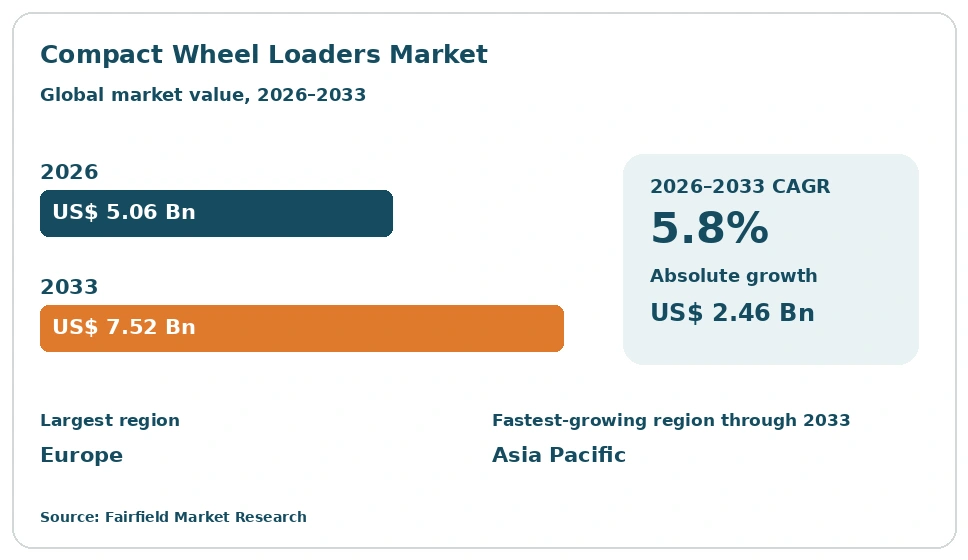
The global compact wheel loaders market size is expected to be valued at US$ 5.06 billion in 2026 and projected to reach US$ 7.52 billion by 2033, growing at a CAGR of 5.8% between 2026 and 2033.
Between 2020 and 2025, the market grew at a CAGR of about 5.8%, rising from roughly US$ 3.6 billion to US$ 4.78 billion, as construction and landscaping work recovered after the pandemic, rental fleets expanded, and farmers and municipalities bought more versatile machines to cope with labor shortages. The compact wheel loaders market covers small, articulated wheel loaders, usually weighing up to about six tonnes, used to move soil, gravel, snow, feed, pallets, and building materials in tight spaces. They are used in construction, landscaping, agriculture, dairy and livestock farms, municipal work, nurseries, and material handling. Quick couplers let operators switch between buckets, forks, sweepers, snow blades, and grapples, making one machine do many jobs. Rubber tires let them drive on paved surfaces without damage. In March 2026, Volvo Construction Equipment launched its electric L20 and L25 compact wheel loaders in North America.
Key Report Takeaways
- By Engine Type: Diesel held about 88% share in 2025, while Electric is projected to expand at an 18.0% CAGR through 2033, driven by zero-emission rules for city job sites, quieter operation for indoor and night work, and falling battery costs.
- By Operating Weight: 3 to 5 Tons held about 55% share in 2025, while Below 3 Tons is projected to expand at a 6.4% CAGR through 2033, driven by demand from landscapers, small farms, and rental companies for easy-to-transport machines.
- By Application: Construction held about 40% share in 2025, while Landscaping is projected to expand at a 6.6% CAGR through 2033, driven by residential gardening projects, golf course and park maintenance, and growth in professional landscaping services.
- By Region: Europe held about 38% share in 2025, while Asia Pacific is projected to expand at a 7.2% CAGR through 2033, driven by urban construction, farm mechanization, and growing rental fleets in China, India, and Japan.
Global Compact Wheel Loaders Market Trends and Insights
Drivers Impact Analysis
Two drivers carry the strongest influence on compact wheel loaders market demand during the forecast period.
| Driver | Impact on CAGR Forecast | Geographic Relevance | Impact Timeline |
| Urban construction and labor shortages | High | Global | Long term (≥4 years) |
| Growth of rental fleets and versatile attachments | Medium | North America, Europe | Medium term (2-4 years) |
Urban Construction Is Driving the Compact Wheel Loaders Market
Urban construction and labor shortages are the strongest driver of the compact wheel loaders market. Small machines suit crowded job sites.
The mechanism is that cities are growing denser, and many projects take place in narrow streets, backyards, basements, and existing buildings where large loaders cannot fit. Compact wheel loaders are small, agile, and easy to move between sites on a trailer, yet they can lift and carry heavy materials quickly. At the same time, construction, landscaping, and farming face shortages of workers, so contractors and farmers use machines to replace manual shoveling and carrying. Infrastructure programs for roads, utilities, and housing in Europe, North America, and Asia Pacific add steady demand. Municipalities use compact loaders for snow removal, park maintenance, and road repair. These trends support long-term demand across many customer types.
Rental and Attachments Are Expanding the Compact Wheel Loaders Market
Growth of rental fleets and versatile attachments is expanding the compact wheel loaders market. Customers want one machine that does many jobs.
The cause is that many contractors and landscapers prefer to rent equipment rather than buy it, to save capital and access newer machines. Large rental companies in North America and Europe are expanding their compact equipment fleets, and they buy machines in large batches. Compact wheel loaders are popular rental machines because they are easy to use and can carry many attachments, such as buckets, pallet forks, sweepers, snow plows, augers, and grapples. Quick coupler systems let operators change tools in minutes. Manufacturers are also improving cab comfort, visibility, and safety, which makes the machines attractive to less experienced operators. These trends raise sales volumes and the value of attachments sold with each machine.
Restraints Impact Analysis
Two restraints limit how quickly the compact wheel loaders market grows.
| Restraint | Impact on CAGR Forecast | Geographic Relevance | Impact Timeline |
| Construction cycles and high interest rates | High | Europe, North America | Short term (≤2 years) |
| Competition from skid steer and track loaders | Medium | North America | Long term (≥4 years) |
Construction Cycles Slow the Compact Wheel Loaders Market
Construction cycles and high interest rates slow the compact wheel loaders market. Equipment buying follows building activity.
The problem is that when interest rates rise or housing construction slows, contractors and rental companies delay buying new machines. Higher rates in 2023 and 2024 made equipment financing more expensive, and weak housing markets in parts of Europe, especially Germany, reduced orders. Farmers also cut spending when crop and milk prices fall. Rising steel, engine, and component costs pushed up machine prices, while new emission rules added engineering costs. Dealers built up large inventories and then reduced orders, causing swings in factory output. Trade tariffs on equipment and parts also add uncertainty for global manufacturers. Used machine prices also fall when demand weakens. These factors make sales volatile from year to year and slow overall growth.
Skid Steer Competition Restricts the Compact Wheel Loaders Market
Competition from skid steer and compact track loaders restricts the compact wheel loaders market. Customers can choose from several compact machines.
The constraint is that in North America, skid steer loaders and compact track loaders are very popular and have long dominated the compact equipment market. They are often cheaper, more familiar to operators, and widely available from dealers and rental companies. Many contractors already own skid steers and attachments that fit them. Although compact wheel loaders offer better visibility, smoother ride, lower tire wear, and less ground damage, many buyers still choose skid steers out of habit. Telehandlers and compact tractors with front loaders also compete in farming and landscaping. Manufacturers must spend on marketing and demonstrations to convince buyers to switch. This competition limits growth in some markets.
Market Opportunities
Electric Compact Loaders Open a Fast-Growth Revenue Pool
Electric compact wheel loaders open a fast-growth revenue pool. Cities want quieter, cleaner job sites.
The opportunity comes from zero-emission job site rules in cities such as Oslo, Copenhagen, Amsterdam, and London, and from public projects that require low-emission equipment. Electric loaders produce no exhaust and little noise, so they can work indoors, in hospitals, in tunnels, in greenhouses, and at night in residential areas. Battery prices are falling, and new models such as Volvo’s L20 Electric and L25 Electric, Case’s 12EV, and electric machines from Wacker Neuson, Kramer, and JCB offer full working shifts on one charge. Lower energy and maintenance costs help offset higher purchase prices. Manufacturers that offer reliable electric models, charging solutions, and financing can win strong demand from cities and rental companies.
North America and Asia Pacific Create a Growth Revenue Pool
North America and Asia Pacific create a growth revenue pool. Compact wheel loaders are still under-used in both regions.
The opportunity reflects rising awareness of compact wheel loaders in North America, where contractors and landscapers are discovering their advantages over skid steers, and manufacturers such as Wacker Neuson, Volvo, and Caterpillar are launching new models there. In Asia Pacific, growing construction in cities, farm mechanization, and expanding rental markets in China, India, Japan, and Australia support demand. Local makers such as LiuGong, XCMG, and Sany offer lower-cost models. Dealers that offer demonstrations, training, and attachment packages can help convert new customers. Online sales tools and financing apps also help reach smaller buyers. Manufacturers that build strong dealer networks in these regions can capture fast growth.
Segment Analysis
By Engine Type: Diesel Leads While Electric Grows Fastest
Diesel held about 88% share in 2025. Diesel compact loaders offer long run times, strong power, fast refueling, and a large dealer and service network. Most construction, farm, and rental customers still choose diesel models, especially for long working days and remote sites without charging.
Electric is the fastest-growing engine type, expanding at an 18.0% CAGR through 2033. Battery-powered loaders produce no exhaust and little noise, making them ideal for city centers, indoor work, greenhouses, livestock barns, and night shifts. Falling battery costs and subsidies support adoption. Hybrid models form a small additional segment. Rental companies are adding electric units to meet customer climate goals. For the market, electric growth raises machine value and opens new uses.
By Operating Weight: 3 to 5 Tons Leads While Below 3 Tons Grows Fastest
3 to 5 Tons held about 55% share in 2025. Machines in this range balance lifting power, bucket size, and compact size, making them suitable for construction, farming, landscaping, and municipal work. They are the most common choice for contractors and rental fleets.
Below 3 Tons is the fastest-growing weight class, expanding at a 6.4% CAGR through 2033. Smaller loaders are easy to transport on light trailers, fit through garden gates and doorways, and cause little ground damage, making them popular with landscapers, small farms, and homeowners. Above 5 Tons forms another segment for heavier work. Some of these machines can be towed behind a pickup truck, avoiding the need for larger trucks. For the market, small machine growth widens the customer base.
By Application: Construction Leads While Landscaping Grows Fastest
Construction held about 40% share in 2025. Contractors use compact wheel loaders to move soil, gravel, sand, and building materials, clean up sites, and load trucks on residential, commercial, and road projects. Their speed and agility on paved surfaces suit urban sites.
Landscaping is the fastest-growing application, expanding at a 6.6% CAGR through 2033. Landscapers use small loaders with buckets, forks, and grapples to move mulch, stone, plants, and pavers without damaging lawns. Agriculture and Material Handling form other applications, with dairy and livestock farms using loaders for feeding and cleaning. Golf courses, sports fields, and public parks also use loaders for daily maintenance work. Garden centers and nurseries use them to move pallets and soil. For the market, landscaping growth supports smaller machines.
Geography Analysis
Which Region Is Leading the Compact Wheel Loaders Market?
Europe is leading the compact wheel loaders market with about 38% share in 2025. Germany, France, the United Kingdom, the Netherlands, and Italy have long used compact wheel loaders in construction, farming, landscaping, and municipal work, and many leading manufacturers are based in the region, including Wacker Neuson, Kramer, Liebherr, Schäffer, and Volvo Construction Equipment. Dairy and livestock farms are major users. Zero-emission rules in several cities support electric models. Key barriers include weak housing construction and high costs. One change shaping the region is rising electric loader adoption.
North America Shapes the Compact Wheel Loaders Market Through Rental Growth
North America is a growing compact wheel loaders market. The United States has a large construction, landscaping, and rental equipment industry, and manufacturers such as Caterpillar, John Deere, Volvo, Wacker Neuson, and JCB are expanding compact wheel loader ranges. Many contractors are switching from skid steers for better visibility and comfort. Canada uses compact loaders for snow removal and farming. Key barriers include skid steer competition and interest rates. Landscapers in the United States are among the fastest adopters. Dealers are offering more demonstration days to show the benefits. Interest in electric models is growing in California and other states with clean air rules. One opportunity is rental fleet expansion.
Which Region Is Growing Fastest in the Compact Wheel Loaders Market?
Asia Pacific is the fastest-growing compact wheel loaders market, expanding at a 7.2% CAGR through 2033. China has large construction and agriculture sectors and local makers such as LiuGong, XCMG, and Sany that offer low-cost models. Japan has major compact equipment makers such as Kubota, Takeuchi, and Yanmar. India is expanding infrastructure and farm mechanization, while Australia uses compact loaders in construction and agriculture. Key barriers include low awareness and price sensitivity. Labor shortages in Japan and South Korea also encourage machine use on small sites. One change shaping the region is rental market growth.
Latin America Grows the Compact Wheel Loaders Market Through Agriculture and Infrastructure
Latin America is a growing compact wheel loaders market. Brazil has large farms, agribusiness facilities, and construction projects, while Mexico is adding industrial parks and infrastructure linked to nearshoring. Argentina, Chile, and Colombia use compact loaders in farming, mining support, and municipal work. Dealers are expanding rental options. Key barriers include currency swings, high import duties, and limited financing. Sugarcane, coffee, and livestock farms use loaders for feed and material handling. Chinese brands are expanding their dealer presence across the region. Used machines imported from North America also compete with new sales. One opportunity is affordable machines for farms and small contractors.
Middle East & Africa Builds the Compact Wheel Loaders Market Through Large Projects
Middle East & Africa is an emerging compact wheel loaders market. Saudi Arabia, the United Arab Emirates, and Qatar have large construction, landscaping, and urban development projects that use compact machines for site work and maintenance. South Africa, Egypt, Morocco, and Kenya use compact loaders in construction, farming, and municipal services. Key barriers include hot climates, dusty conditions, and limited dealer networks. Large hotels, resorts, and airports also use compact loaders for grounds maintenance. Chinese manufacturers are expanding sales across the region with lower-cost models. Cooling and air filtration systems are important features for buyers. One opportunity is rental fleets for large projects.
Competitive Landscape
The compact wheel loaders market is moderately fragmented. Caterpillar, Volvo Construction Equipment, Wacker Neuson, Liebherr, and Komatsu are leading players, while John Deere, JCB, CNH Industrial, Doosan Bobcat, Kubota, Manitou, and LiuGong compete strongly. European specialists such as Wacker Neuson and its Kramer brand, Schäffer, and Liebherr have long experience in compact wheel loaders, while global construction equipment makers offer broad product lines. Chinese manufacturers compete on price in Asia Pacific and emerging markets.
Companies compete on reliability, performance, comfort, visibility, attachment compatibility, fuel and energy efficiency, price, and dealer and service support. Strong dealer networks and relationships with rental companies are essential, because many machines are sold through dealers or bought in large rental fleet orders. Electric models, telematics, and operator assistance features are becoming important ways to stand out.
Strategic moves show how competition is changing. In June 2024, Case Construction Equipment added the electric 12EV loader. In March 2026, Volvo Construction Equipment brought its third-generation L20 Electric and L25 Electric to North America, while Wacker Neuson introduced three new models there. In September 2026, Volvo upgraded its L30 and L35 loaders. These moves show competition focused on electric models and expansion in North America.
Three themes shape vendor strategy. First, manufacturers are expanding electric compact loader ranges and charging support. Second, they are improving cab comfort, safety, and attachment systems to win new users. Third, they are growing dealer and rental networks in North America and Asia Pacific, where compact wheel loaders are still gaining acceptance.
Compact Wheel Loaders Market Industry Leaders
- Caterpillar
- Volvo Construction Equipment
- Wacker Neuson
- Liebherr
- Komatsu
Recent Industry Developments
- September 2026: Volvo Construction Equipment announced upgrades to its L30 and L35 compact wheel loaders, including a redesigned frame and cab entrance - improves access and comfort in the compact wheel loaders market.
- March 2026: Wacker Neuson introduced the WL750, WL950, and WL1150 compact wheel loaders for North America at CONEXPO-CON/AGG 2026 - expands its range in the region.
- March 2026: Volvo Construction Equipment made its third-generation L20 Electric and L25 Electric compact wheel loaders available in North America, with larger standard battery capacity and air conditioning - expands electric compact loaders.
- June 2024: Case Construction Equipment added the 12EV electric compact wheeled loader to its zero-emission range - widens battery-powered choices for contractors.
Companies Covered in the Report
- Caterpillar
- Volvo Construction Equipment
- Wacker Neuson
- Liebherr
- Komatsu
- John Deere
- JCB
- CNH Industrial
- Doosan Bobcat
- Kubota
- Manitou
- LiuGong
Compact Wheel Loaders Market Report Scope
This report covers the compact wheel loaders market, including diesel, electric, and hybrid machines in operating weights below 3 tons, 3 to 5 tons, and above 5 tons, used in construction, landscaping, agriculture, and material handling by contractors, farmers, municipalities, and rental companies. The base year is 2025, and the forecast period runs from 2026 to 2033. All values are expressed in US$ Billion.
| Engine Type | Diesel, Electric, Hybrid |
| Operating Weight | Below 3 Tons, 3 to 5 Tons, Above 5 Tons |
| Application | Construction, Landscaping, Agriculture, Material Handling |
| Regions | North America, Europe, Asia Pacific, Latin America, Middle East & Africa |
1. Executive Summary
1.1 Compact Wheel Loaders Market Snapshot
1.2 Future Projections
1.3 Key Market Trends
1.4 Regional Snapshot
2. Market Overview
2.1 Market Definition and Report Scope
2.2 Historical Market Trends
2.3 Market Dynamics
2.3.1 Drivers
2.3.1.1 Urban Construction Is Driving the Compact Wheel Loaders Market
2.3.1.2 Rental and Attachments Are Expanding the Compact Wheel Loaders Market
2.3.2 Restraints
2.3.2.1 Construction Cycles Slow the Compact Wheel Loaders Market
2.3.2.2 Skid Steer Competition Restricts the Compact Wheel Loaders Market
2.3.3 Market Opportunities
2.3.3.1 Electric Compact Loaders Open a Fast-Growth Revenue Pool
2.3.3.2 North America and Asia Pacific Create a Growth Revenue Pool
3. Global Compact Wheel Loaders Market Outlook, 2020–2033
3.1 Global Compact Wheel Loaders Market Outlook, by Engine Type, Value (US$ Billion), 2020–2033
3.1.1 Diesel
3.1.2 Electric
3.1.3 Hybrid
3.2 Global Compact Wheel Loaders Market Outlook, by Operating Weight, Value (US$ Billion), 2020–2033
3.2.1 Below 3 Tons
3.2.2 3 to 5 Tons
3.2.3 Above 5 Tons
3.3 Global Compact Wheel Loaders Market Outlook, by Application, Value (US$ Billion), 2020–2033
3.3.1 Construction
3.3.2 Landscaping
3.3.3 Agriculture
3.3.4 Material Handling
3.4 Global Compact Wheel Loaders Market Outlook, by Region, Value (US$ Billion), 2020–2033
3.4.1 North America
3.4.2 Europe
3.4.3 Asia Pacific
3.4.4 Latin America
3.4.5 Middle East & Africa
4. Europe Compact Wheel Loaders Market Outlook, 2020–2033
4.1 Europe Compact Wheel Loaders Market Outlook, by Engine Type, Value (US$ Billion), 2020–2033
4.1.1 Diesel
4.1.2 Electric
4.1.3 Hybrid
4.2 Europe Compact Wheel Loaders Market Outlook, by Operating Weight, Value (US$ Billion), 2020–2033
4.2.1 Below 3 Tons
4.2.2 3 to 5 Tons
4.2.3 Above 5 Tons
4.3 Europe Compact Wheel Loaders Market Outlook, by Application, Value (US$ Billion), 2020–2033
4.3.1 Construction
4.3.2 Landscaping
4.3.3 Agriculture
4.3.4 Material Handling
4.4 Europe Compact Wheel Loaders Market Outlook, by Country, Value (US$ Billion), 2020–2033
4.4.1 Germany Compact Wheel Loaders Market Outlook, by Engine Type, 2020–2033
4.4.2 Germany Compact Wheel Loaders Market Outlook, by Operating Weight, 2020–2033
4.4.3 Germany Compact Wheel Loaders Market Outlook, by Application, 2020–2033
4.4.4 France Compact Wheel Loaders Market Outlook, by Engine Type, 2020–2033
4.4.5 France Compact Wheel Loaders Market Outlook, by Operating Weight, 2020–2033
4.4.6 France Compact Wheel Loaders Market Outlook, by Application, 2020–2033
4.4.7 United Kingdom Compact Wheel Loaders Market Outlook, by Engine Type, 2020–2033
4.4.8 United Kingdom Compact Wheel Loaders Market Outlook, by Operating Weight, 2020–2033
4.4.9 United Kingdom Compact Wheel Loaders Market Outlook, by Application, 2020–2033
4.4.10 Netherlands Compact Wheel Loaders Market Outlook, by Engine Type, 2020–2033
4.4.11 Netherlands Compact Wheel Loaders Market Outlook, by Operating Weight, 2020–2033
4.4.12 Netherlands Compact Wheel Loaders Market Outlook, by Application, 2020–2033
4.4.13 Italy Compact Wheel Loaders Market Outlook, by Engine Type, 2020–2033
4.4.14 Italy Compact Wheel Loaders Market Outlook, by Operating Weight, 2020–2033
4.4.15 Italy Compact Wheel Loaders Market Outlook, by Application, 2020–2033
5. North America Compact Wheel Loaders Market Outlook, 2020–2033
5.1 North America Compact Wheel Loaders Market Outlook, by Engine Type, Value (US$ Billion), 2020–2033
5.1.1 Diesel
5.1.2 Electric
5.1.3 Hybrid
5.2 North America Compact Wheel Loaders Market Outlook, by Operating Weight, Value (US$ Billion), 2020–2033
5.2.1 Below 3 Tons
5.2.2 3 to 5 Tons
5.2.3 Above 5 Tons
5.3 North America Compact Wheel Loaders Market Outlook, by Application, Value (US$ Billion), 2020–2033
5.3.1 Construction
5.3.2 Landscaping
5.3.3 Agriculture
5.3.4 Material Handling
5.4 North America Compact Wheel Loaders Market Outlook, by Country, Value (US$ Billion), 2020–2033
5.4.1 United States Compact Wheel Loaders Market Outlook, by Engine Type, 2020–2033
5.4.2 United States Compact Wheel Loaders Market Outlook, by Operating Weight, 2020–2033
5.4.3 United States Compact Wheel Loaders Market Outlook, by Application, 2020–2033
5.4.4 Canada Compact Wheel Loaders Market Outlook, by Engine Type, 2020–2033
5.4.5 Canada Compact Wheel Loaders Market Outlook, by Operating Weight, 2020–2033
5.4.6 Canada Compact Wheel Loaders Market Outlook, by Application, 2020–2033
6. Asia Pacific Compact Wheel Loaders Market Outlook, 2020–2033
6.1 Asia Pacific Compact Wheel Loaders Market Outlook, by Engine Type, Value (US$ Billion), 2020–2033
6.1.1 Diesel
6.1.2 Electric
6.1.3 Hybrid
6.2 Asia Pacific Compact Wheel Loaders Market Outlook, by Operating Weight, Value (US$ Billion), 2020–2033
6.2.1 Below 3 Tons
6.2.2 3 to 5 Tons
6.2.3 Above 5 Tons
6.3 Asia Pacific Compact Wheel Loaders Market Outlook, by Application, Value (US$ Billion), 2020–2033
6.3.1 Construction
6.3.2 Landscaping
6.3.3 Agriculture
6.3.4 Material Handling
6.4 Asia Pacific Compact Wheel Loaders Market Outlook, by Country, Value (US$ Billion), 2020–2033
6.4.1 China Compact Wheel Loaders Market Outlook, by Engine Type, 2020–2033
6.4.2 China Compact Wheel Loaders Market Outlook, by Operating Weight, 2020–2033
6.4.3 China Compact Wheel Loaders Market Outlook, by Application, 2020–2033
6.4.4 Japan Compact Wheel Loaders Market Outlook, by Engine Type, 2020–2033
6.4.5 Japan Compact Wheel Loaders Market Outlook, by Operating Weight, 2020–2033
6.4.6 Japan Compact Wheel Loaders Market Outlook, by Application, 2020–2033
6.4.7 India Compact Wheel Loaders Market Outlook, by Engine Type, 2020–2033
6.4.8 India Compact Wheel Loaders Market Outlook, by Operating Weight, 2020–2033
6.4.9 India Compact Wheel Loaders Market Outlook, by Application, 2020–2033
6.4.10 Australia Compact Wheel Loaders Market Outlook, by Engine Type, 2020–2033
6.4.11 Australia Compact Wheel Loaders Market Outlook, by Operating Weight, 2020–2033
6.4.12 Australia Compact Wheel Loaders Market Outlook, by Application, 2020–2033
6.4.13 South Korea Compact Wheel Loaders Market Outlook, by Engine Type, 2020–2033
6.4.14 South Korea Compact Wheel Loaders Market Outlook, by Operating Weight, 2020–2033
6.4.15 South Korea Compact Wheel Loaders Market Outlook, by Application, 2020–2033
7. Latin America Compact Wheel Loaders Market Outlook, 2020–2033
7.1 Latin America Compact Wheel Loaders Market Outlook, by Engine Type, Value (US$ Billion), 2020–2033
7.1.1 Diesel
7.1.2 Electric
7.1.3 Hybrid
7.2 Latin America Compact Wheel Loaders Market Outlook, by Operating Weight, Value (US$ Billion), 2020–2033
7.2.1 Below 3 Tons
7.2.2 3 to 5 Tons
7.2.3 Above 5 Tons
7.3 Latin America Compact Wheel Loaders Market Outlook, by Application, Value (US$ Billion), 2020–2033
7.3.1 Construction
7.3.2 Landscaping
7.3.3 Agriculture
7.3.4 Material Handling
7.4 Latin America Compact Wheel Loaders Market Outlook, by Country, Value (US$ Billion), 2020–2033
7.4.1 Brazil Compact Wheel Loaders Market Outlook, by Engine Type, 2020–2033
7.4.2 Brazil Compact Wheel Loaders Market Outlook, by Operating Weight, 2020–2033
7.4.3 Brazil Compact Wheel Loaders Market Outlook, by Application, 2020–2033
7.4.4 Mexico Compact Wheel Loaders Market Outlook, by Engine Type, 2020–2033
7.4.5 Mexico Compact Wheel Loaders Market Outlook, by Operating Weight, 2020–2033
7.4.6 Mexico Compact Wheel Loaders Market Outlook, by Application, 2020–2033
7.4.7 Argentina Compact Wheel Loaders Market Outlook, by Engine Type, 2020–2033
7.4.8 Argentina Compact Wheel Loaders Market Outlook, by Operating Weight, 2020–2033
7.4.9 Argentina Compact Wheel Loaders Market Outlook, by Application, 2020–2033
7.4.10 Chile Compact Wheel Loaders Market Outlook, by Engine Type, 2020–2033
7.4.11 Chile Compact Wheel Loaders Market Outlook, by Operating Weight, 2020–2033
7.4.12 Chile Compact Wheel Loaders Market Outlook, by Application, 2020–2033
7.4.13 Colombia Compact Wheel Loaders Market Outlook, by Engine Type, 2020–2033
7.4.14 Colombia Compact Wheel Loaders Market Outlook, by Operating Weight, 2020–2033
7.4.15 Colombia Compact Wheel Loaders Market Outlook, by Application, 2020–2033
8. Middle East & Africa Compact Wheel Loaders Market Outlook, 2020–2033
8.1 Middle East & Africa Compact Wheel Loaders Market Outlook, by Engine Type, Value (US$ Billion), 2020–2033
8.1.1 Diesel
8.1.2 Electric
8.1.3 Hybrid
8.2 Middle East & Africa Compact Wheel Loaders Market Outlook, by Operating Weight, Value (US$ Billion), 2020–2033
8.2.1 Below 3 Tons
8.2.2 3 to 5 Tons
8.2.3 Above 5 Tons
8.3 Middle East & Africa Compact Wheel Loaders Market Outlook, by Application, Value (US$ Billion), 2020–2033
8.3.1 Construction
8.3.2 Landscaping
8.3.3 Agriculture
8.3.4 Material Handling
8.4 Middle East & Africa Compact Wheel Loaders Market Outlook, by Country, Value (US$ Billion), 2020–2033
8.4.1 Saudi Arabia Compact Wheel Loaders Market Outlook, by Engine Type, 2020–2033
8.4.2 Saudi Arabia Compact Wheel Loaders Market Outlook, by Operating Weight, 2020–2033
8.4.3 Saudi Arabia Compact Wheel Loaders Market Outlook, by Application, 2020–2033
8.4.4 United Arab Emirates Compact Wheel Loaders Market Outlook, by Engine Type, 2020–2033
8.4.5 United Arab Emirates Compact Wheel Loaders Market Outlook, by Operating Weight, 2020–2033
8.4.6 United Arab Emirates Compact Wheel Loaders Market Outlook, by Application, 2020–2033
8.4.7 Qatar Compact Wheel Loaders Market Outlook, by Engine Type, 2020–2033
8.4.8 Qatar Compact Wheel Loaders Market Outlook, by Operating Weight, 2020–2033
8.4.9 Qatar Compact Wheel Loaders Market Outlook, by Application, 2020–2033
8.4.10 South Africa Compact Wheel Loaders Market Outlook, by Engine Type, 2020–2033
8.4.11 South Africa Compact Wheel Loaders Market Outlook, by Operating Weight, 2020–2033
8.4.12 South Africa Compact Wheel Loaders Market Outlook, by Application, 2020–2033
8.4.13 Egypt Compact Wheel Loaders Market Outlook, by Engine Type, 2020–2033
8.4.14 Egypt Compact Wheel Loaders Market Outlook, by Operating Weight, 2020–2033
8.4.15 Egypt Compact Wheel Loaders Market Outlook, by Application, 2020–2033
8.4.16 Morocco Compact Wheel Loaders Market Outlook, by Engine Type, 2020–2033
8.4.17 Morocco Compact Wheel Loaders Market Outlook, by Operating Weight, 2020–2033
8.4.18 Morocco Compact Wheel Loaders Market Outlook, by Application, 2020–2033
8.4.19 Kenya Compact Wheel Loaders Market Outlook, by Engine Type, 2020–2033
8.4.20 Kenya Compact Wheel Loaders Market Outlook, by Operating Weight, 2020–2033
8.4.21 Kenya Compact Wheel Loaders Market Outlook, by Application, 2020–2033
9. Competitive Landscape
9.1 Compact Wheel Loaders Market Industry Leaders
9.2 Recent Industry Developments
9.3 Company Profiles
9.3.1 Caterpillar
9.3.2 Volvo Construction Equipment
9.3.3 Wacker Neuson
9.3.4 Liebherr
9.3.5 Komatsu
9.3.6 John Deere
9.3.7 JCB
9.3.8 CNH Industrial
9.3.9 Doosan Bobcat
9.3.10 Kubota
9.3.11 Manitou
9.3.12 LiuGong
10. Appendix
10.1 Research Methodology
10.2 Report Assumptions
10.3 Acronyms and Abbreviations
| Engine Type | Diesel, Electric, Hybrid |
| Operating Weight | Below 3 Tons, 3 to 5 Tons, Above 5 Tons |
| Application | Construction, Landscaping, Agriculture, Material Handling |
| Regions | North America, Europe, Asia Pacific, Latin America, Middle East & Africa |
Our Research Methodology
Considering the volatility of business today, traditional approaches to strategizing a game plan can be unfruitful if not detrimental. True ambiguity is no way to determine a forecast. A myriad of predetermined factors must be accounted for such as the degree of risk involved, the magnitude of circumstances, as well as conditions or consequences that are not known or unpredictable. To circumvent binary views that cast uncertainty, the application of market research intelligence to strategically posture, move, and enable actionable outcomes is necessary.
View Methodology
Quality Assured
Rigorous Validation Process

Confidentiality Assured
End-to-end Data Security

Custom Research Services
Tailored To Your Objectives
FAQs
The compact wheel loaders market is valued at US$ 5.06 billion in 2026, led by diesel machines, construction, and Europe.
The market is projected to reach US$ 7.52 billion by 2033, growing at a 5.8% CAGR and adding US$ 2.46 billion.
Electric is growing fastest at an 18.0% CAGR through 2033, driven by zero-emission city rules, quiet operation, and falling battery costs.
Asia Pacific is growing fastest at a 7.2% CAGR through 2033, driven by urban construction, farm mechanization, and growing rental fleets.
Europe holds the largest share at about 38% in 2025, supported by long-established use and many leading manufacturers.
Related Reports
Micro Motor Market Size, Share, Insights, Competitive Landscape, and Forecast 2026 to 2033
Explore the micro motor market, forecast to reach US$72.65 billion by 2033 at 6.9% CAGR, with insights on technology, types, applications, and regions.
Thermal Management Technologies Market Size, Share, Insights, Competitive Landscape, and Forecast 2026 to 2033
Explore the thermal management technologies market, forecast to reach US$25.29 billion by 2033 at 6.0% CAGR, with insights on products and applications.
Heating Radiator Market Size, Share, Insights, Competitive Landscape, and Forecast 2026 to 2033
The global heating radiator market is valued at US$8.4 billion in 2026, reaching US$12.0 billion by 2033, growing at a 5.2% CAGR
Fermenters Market Size, Share, Insights, Competitive Landscape, and Forecast 2026 to 2033
The global fermenters market is valued at US$2.0 billion in 2026, reaching US$2.87 billion by 2033, growing at a 5.3% CAGR
Diamond Tools Market Size, Share, Insights, Competitive Landscape, and Forecast 2026 to 2033
The global diamond tools market is valued at US$11.2 billion in 2026, reaching US$16.8 billion by 2033, growing at a 6.0% CAGR
CO2 Glass Tube Laser Market Size, Share, Insights, Competitive Landscape, and Forecast 2026 to 2033
The global CO2 glass tube laser market is valued at US$0.78 billion in 2026, reaching US$1.18 billion by 2033, growing at a 6.1% CAGR