



Spherical Roller Bearings Market
Spherical Roller Bearings Market Size, Share, Insights, Competitive Landscape, and Forecast 2026 to 2033
Report Overview
Spherical Roller Bearings Market Size and Trend Analysis
How Fast Will Spherical Roller Bearings Demand Grow?
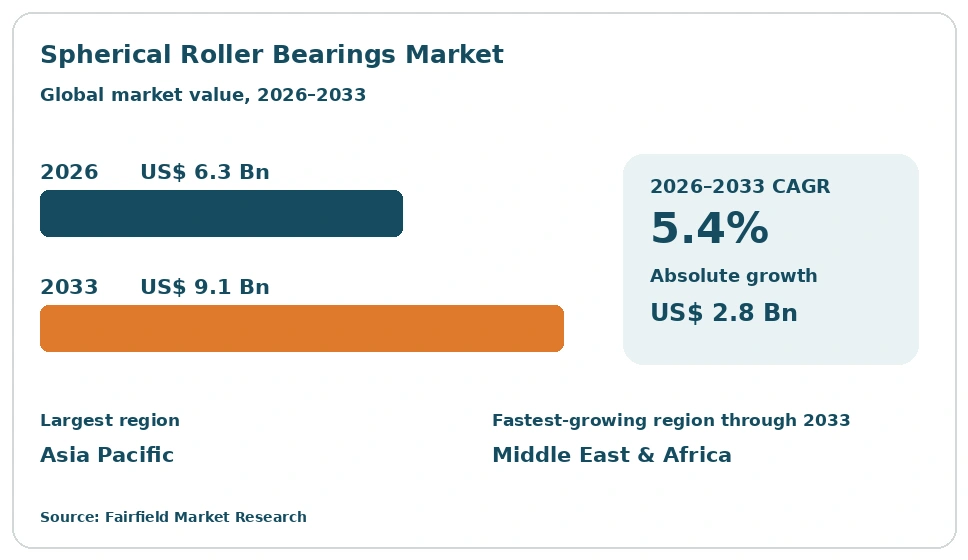
The global Spherical Roller Bearings market size is expected to be valued at US$ 6.3 billion in 2026 and projected to reach US$ 9.1 billion by 2033, growing at a CAGR of 5.4% between 2026 and 2033. Demand is anchored in heavy industry, where self-aligning designs absorb misalignment and shock loads. The market expanded at a 4.1% CAGR between 2020 and 2025, held back by uneven mining capital spending. Growth now accelerates as wind energy, cement and steel operators replace worn arrangements and specify sealed units. Replacement cycles in process plants keep volumes steady through the period. The absolute dollar opportunity over the forecast period reaches US$ 2.8 billion.
Key Report Takeaways
- By Bore Size: 100 mm to 200 mm bearings led with 34.6% share in 2026, while the above 400 mm class is projected to expand at a 6.8% CAGR through 2033, driven by larger gearboxes in wind turbines and grinding mills.
- By Design Type: Standard open designs held 61.2% share in 2026, while sealed spherical roller bearings are set to grow at a 6.9% CAGR through 2033, driven by contamination control in wet and dusty processing plants.
- By Sales Channel: OEM supply accounted for 58.5% share in 2026, while the aftermarket is projected to advance at a 5.9% CAGR through 2033, driven by scheduled relubrication programmes and planned bearing changeouts at ageing plants.
- By End-use Industry: Mining led with 23.4% share in 2026, while wind energy is forecast to rise at a 7.6% CAGR through 2033, driven by main shaft and gearbox bearing content in larger onshore and offshore turbines.
- By Region: North America, Europe, Asia Pacific, Latin America and Middle East & Africa form the regional scope; Asia Pacific led with 41.8% share in 2026, while Middle East & Africa is projected to grow at a 6.5% CAGR through 2033, driven by new mining concessions and cement lines.
Market Trends and Insights
Market Growth Drivers
Mining and Cement Capacity Growth Lifts Heavy-Duty Bearing Demand
Spherical roller bearings gain demand as mining and cement operators push equipment toward longer duty cycles. These bearings carry heavy radial loads and tolerate shaft misalignment in crushers, screens, conveyor pulleys and kiln supports. Replacing older arrangements with self-aligning designs cuts unplanned stoppages. Each avoided failure protects output, so maintenance buyers accept higher unit prices for bearings that extend service intervals.
Mine operators are moving more ore per hour, which raises loads on conveyor pulleys, vibrating screens and grinding mills. Cement producers are rebuilding kiln and roller press lines for alternative fuels and higher clinker throughput. Both shifts favour self-aligning designs, because housings move under thermal growth and foundation settlement. Bearing makers have responded with cleaner steels, improved cage designs and application engineering that helps plants choose the right internal clearance and lubrication interval.
Wind Power Buildout Expands Demand for Large-Bore Bearings
Wind energy is the fastest-rising source of new demand for large spherical roller bearings. Turbine main shafts, gearbox stages and yaw arrangements need bearings that handle combined radial and axial loads under constant direction changes. As rotor diameters grow, bore sizes above 400 mm move from niche to routine. Each added megawatt of installed capacity therefore raises bearing value per turbine rather than simply raising unit counts.
Turbine makers and their gearbox suppliers qualify bearing designs over long programmes, so approvals create durable supply positions. Offshore projects raise the stakes further, because access costs make a failed bearing far more expensive than the part itself. That pushes specifications toward cleaner steels, tighter geometry control and sensor-ready arrangements. Manufacturers with large-ring grinding and heat treatment capacity are best placed to serve these programmes.
Restraints Impact Analysis of Market
Counterfeit Bearings in the Aftermarket Erode Trust and Revenue
Counterfeit bearings remain a genuine problem in the replacement market and hold back legitimate aftermarket revenue. Fake products copy well-known markings but use uncontrolled steel, incorrect heat treatment and loose tolerances. When one fails early, the plant usually blames the brand rather than the counterfeit, so maintenance teams lose confidence in distribution channels. Buyers then delay purchases or over-specify, which slows normal replacement demand.
The industry has responded with authorised distributor networks, tamper-evident packaging, serialised labels and digital verification tools. Trade bodies and customs authorities also run awareness and enforcement programmes aimed at online marketplaces, where unverified listings are hardest to police. Even so, price pressure in emerging aftermarkets keeps demand for cheap lookalikes alive, particularly for common bore sizes used in conveyors and fans. Weak traceability at small workshops continues to cap genuine aftermarket growth.
Steel Cost Swings and Capital-Heavy Production Squeeze Margins
Raw material and energy costs limit how quickly bearing makers can expand output profitably. Spherical roller bearings use through-hardening or case-hardening bearing steel, and price swings in that input pass through slowly to contract customers. Large rings also need long grinding and heat treatment cycles on expensive machine tools. When demand softens, that fixed cost base stays, so plants run below capacity and margins compress.
Clean bearing steel is produced by a limited set of mills, which concentrates supply risk and lengthens qualification when a source changes. Energy-intensive heat treatment adds further exposure where industrial power tariffs are volatile. Manufacturers manage this through index-linked contracts, dual sourcing and tighter forging yields, yet these measures take time to show results. Smaller producers without scale or long-term steel agreements face the sharpest squeeze.
Market Opportunities
Sensor-Equipped and Sealed Designs Open a Premium Product Tier
Condition-monitoring features and integrated seals create a higher-value product tier above commodity bearings. Sealed spherical roller bearings hold grease in and keep slurry, dust and washdown water out, which extends life in mining and pulp applications. Adding temperature, speed and vibration sensing turns the bearing into a data source for plant maintenance systems. Customers pay for that capability because it converts unplanned downtime into scheduled work.
Industrial plants are connecting rotating equipment to asset management platforms, and bearings sit at the point where failure usually starts. Wireless sensing, edge analytics and standard interfaces have made retrofit monitoring practical on conveyors, fans and pumps. Seal materials have improved too, with designs that cut friction while resisting abrasive ingress. Together these advances let suppliers sell guaranteed running hours rather than parts alone, which deepens customer relationships.
Remanufacturing and Service Contracts Create New Aftermarket Revenue
Bearing remanufacturing turns a replacement sale into a recurring service relationship. Large spherical roller bearings carry high material and machining value, so refurbishing rings and replacing rollers and cages can restore service life at a fraction of new cost. Mining, steel and paper plants with many large bearings gain the most. For suppliers, reman work secures the installed base and keeps independent repairers out of the account.
Corporate decarbonisation targets support this shift, because remanufacturing avoids most of the energy used to make a new bearing. Operators increasingly measure embedded carbon in maintenance spending, and refurbishment offers a documented reduction. Suppliers are pairing it with inspection, root cause analysis, lubrication management and mounting services delivered by field engineers. Bundled into multi-year contracts, these services smooth revenue across industrial cycles and reveal recurring failure modes.
Category-wise Insights
Why Do 100 mm to 200 mm Bores Lead the Market?
Bearings with bores of 100 mm to 200 mm lead because they match the shaft sizes used across most heavy industrial machinery, holding 34.6% share in 2026. This class covers conveyor pulleys, fan shafts, crusher countershafts and gearbox stages in cement, steel and mining plants. Standard dimensions keep them available from distributor stock, which matters when a production line is down. The above 400 mm class is the fastest growing, at a 6.8% CAGR between 2026 and 2033. Growth follows larger wind turbine drivetrains, bigger grinding mills and higher-capacity port cranes. These rings demand specialised forging, grinding and heat treatment, so fewer plants can supply them and lead times run long. For the wider market, the split means steady replacement volume in mid-range bores alongside richer value per unit at the top end.
Sealed Designs Gain Ground as Contamination Control Becomes Critical
Standard open spherical roller bearings still dominate, with 61.2% share in 2026, because they are cheapest and simplest to relubricate in clean, well-maintained drives. Sealed designs are growing fastest, at a 6.9% CAGR through 2033. They retain grease for the service life and block slurry, dust and washdown water, which is decisive in mineral processing, quarrying and pulp mills. Plants adopting them cut relubrication labour and grease consumption, and they reduce the contamination behind most premature failures. Split designs hold a small share but solve a specific problem, allowing replacement on long shafts such as stirrers and conveyor drives without dismantling couplings or gearboxes. The direction of travel is clear: buyers increasingly judge bearings on total cost of ownership rather than purchase price, which shifts mix toward sealed and serviceable designs.
OEM Supply Holds Volume While the Aftermarket Adds Value
OEM channels account for 58.5% of revenue in 2026, because equipment builders in mining, construction and wind energy specify bearings during design and buy under long-term agreements. Approval cycles are long, so incumbency is durable and pricing is contractual. The aftermarket is growing faster, at a 5.9% CAGR through 2033. An ageing installed base, higher plant utilisation and formal reliability programmes raise replacement frequency, and aftermarket units usually carry better margins than OEM supply. Distributors are adding technical services such as mounting, alignment, lubrication surveys and failure analysis to defend that business. Counterfeit product remains the channel’s main weakness, pushing manufacturers toward authorised networks and verifiable packaging. The practical implication is that suppliers need both channels: OEM positions place the product, and the aftermarket converts it into repeat revenue.
Which End-use Industry Buys the Most Spherical Roller Bearings?
Mining is the largest end-use industry, at 23.4% share in 2026, because ore handling equipment runs continuously under shock loads, abrasive dust and misalignment. Crushers, screens, apron feeders and long conveyor systems consume large quantities of medium and large bores, and replacement cycles are short. Cement and steel follow, driven by kiln, mill and rolling line duty at high temperature. Wind energy is the fastest-growing industry, at a 7.6% CAGR through 2033, as new installations add main shaft, gearbox and yaw bearing content and as larger turbines raise value per machine. Pulp and paper, marine and construction equipment provide steadier baseline demand tied to maintenance budgets and machine shipments. The pattern matters because mining sets volume and pricing pressure, while wind energy sets the technical bar for large, highly engineered bearings.
Geography Analysis
North America Anchors Demand on Mining and Process Plant Upgrades
North America held 20.6% share in 2026 and is set to grow at a 4.6% CAGR through 2033. The United States and Canada drive demand through copper, potash and iron ore operations, large pulp and paper mills, and a steel sector modernising around electric arc furnaces. Plants here are mature, so spending concentrates on reliability upgrades rather than greenfield capacity, which favours sealed bearings and condition monitoring. Mexico adds volume through cement production and construction equipment assembly. A deep distributor network and established predictive maintenance practice support premium products, while reshoring of industrial manufacturing and onshore wind repowering provide incremental demand for larger bore sizes.
Europe Leans on Wind Energy and Precision Machinery
Europe accounted for 24.3% share in 2026 and grows at a 4.4% CAGR through 2033. Germany, Italy, Sweden and France host both major bearing manufacturing and the machinery builders that consume the output. Wind energy is the standout application, with onshore repowering and offshore projects requiring large-bore bearings and long qualification programmes. Cement, steel and pulp producers across the region are investing in energy efficiency and emissions reduction, which brings drive train rebuilds and bearing replacement. Strict machinery safety rules and corporate sustainability reporting push buyers toward documented quality and remanufacturing. Growth stays modest because industrial output is mature and energy costs remain high.
Which Region Is Leading the Spherical Roller Bearings Market?
Asia Pacific leads the market with 41.8% share in 2026, and it continues to expand at a 6.0% CAGR through 2033. China combines the world’s largest cement, steel and coal handling base with extensive domestic bearing manufacturing, which keeps both demand and supply concentrated there. India adds fast-growing mining, cement and construction equipment demand supported by infrastructure programmes. Japan and South Korea contribute advanced machinery, shipbuilding and precision manufacturing, and host several global bearing makers. Australia and Indonesia supply heavy mining demand tied to iron ore, coal and nickel. Local production scale keeps prices competitive, while rising quality expectations lift the share of sealed and monitored designs.
Latin America Grows With Copper and Iron Ore Output
Latin America held 6.4% share in 2026 and is forecast to grow at a 5.2% CAGR through 2033. Chile and Peru anchor demand through copper concentrators, where grinding mills, crushers and long overland conveyors consume large bearings under abrasive conditions. Brazil adds iron ore, pulp and sugar processing, all of which run equipment continuously during harvest or shipping peaks. Replacement demand dominates, because most spending sustains existing operations rather than new builds. Imported product supplies most of the market, so currency movements and port logistics shape buying patterns and distributors hold wide stock. Falling ore grades and deeper pits push operators toward sealed bearings that survive wet, gritty duty.
Which Region Is Growing Fastest in the Spherical Roller Bearings Market?
Middle East & Africa is the fastest-growing region, advancing at a 6.5% CAGR through 2033 from 6.9% share in 2026. Growth comes from mining in South Africa, the Democratic Republic of the Congo and Zambia, where copper and cobalt output is expanding. Saudi Arabia and the United Arab Emirates are adding cement, steel, mineral processing and port handling capacity under economic diversification plans, and each project installs heavy rotating equipment. High ambient temperatures, dust and limited local repair capacity favour sealed designs and supplier service contracts. A thinner distribution base than other regions means availability and technical support often decide which brand a plant specifies.
Competitive Landscape
The spherical roller bearings market is moderately concentrated. A small group of global manufacturers holds most high-specification volume, supported by long OEM approvals, proprietary steel and heat treatment practice, and worldwide distribution. Below them sit large regional producers, particularly in China and India, that compete strongly on standard bores and price. Consolidation has been limited, so position shifts come mainly from capacity investment and qualification wins rather than acquisitions.
Competition runs on bearing life rather than list price. Vendors differentiate through steel cleanliness, surface finish, cage material and internal geometry, all of which affect how long a bearing survives contamination and misalignment. Sealing technology is now a primary battleground, as is the ability to produce very large rings for wind and mining duty. Compliance with ISO and ABMA dimensional and tolerance conventions is assumed, so differentiation happens above that baseline.
Strategic activity centres on capacity for large-bore products, expansion of remanufacturing and service networks, and the addition of sensing and lubrication offerings. These moves matter because they lock suppliers into the customer’s maintenance process, which is harder for a competitor to displace than a parts contract. Several manufacturers are also localising production nearer major mining and wind markets to shorten lead times and reduce freight exposure.
Vendor strategy is shaped by three themes: proving total cost of ownership with field data, protecting the aftermarket from counterfeit product, and supporting customer emissions goals through low-friction designs and refurbishment. Suppliers that combine engineering depth with reliable availability are best positioned as industrial maintenance becomes more data-driven.
Industry Leaders
- SKF
- Schaeffler AG
- NSK Ltd.
- NTN Corporation
- JTEKT Corporation
- The Timken Company
Companies Covered in the Report
- SKF
- Schaeffler AG
- NSK Ltd.
- NTN Corporation
- JTEKT Corporation
- The Timken Company
- NACHI-Fujikoshi Corp.
- C&U Group
- Luoyang LYC Bearing Co., Ltd.
- Wafangdian Bearing Group Corporation
- Harbin Bearing Manufacturing Co., Ltd.
- ZKL Group
- NBI Bearings Europe, S.A.
- Regal Rexnord Corporation
- RBC Bearings Incorporated
Spherical Roller Bearings Market Report Scope
Fairfield Market Research segments the global spherical roller bearings market as follows.
| By Bore Size | Up to 100 mm, 100 mm to 200 mm, 200 mm to 400 mm, Above 400 mm |
| By Design Type | Standard, Sealed, Split |
| By Sales Channel | OEM, Aftermarket |
| By End-use Industry | Mining, Cement, Steel, Pulp and Paper, Wind Energy, Marine, Construction Equipment, Others |
| By Region | North America, Europe, Asia Pacific, Latin America, Middle East & Africa |
1. Executive Summary
1.1 Spherical Roller Bearings Market Snapshot
1.2 Future Projections
1.3 Key Market Trends
1.4 Regional Snapshot
2. Market Overview
2.1 Market Definition and Report Scope
2.2 Historical Market Trends
2.3 Market Dynamics
2.3.1 Drivers
2.3.1.1 Mining and Cement Capacity Growth Lifts Heavy-Duty Bearing Demand
2.3.1.2 Wind Power Buildout Expands Demand for Large-Bore Bearings
2.3.2 Restraints
2.3.2.1 Counterfeit Bearings in the Aftermarket Erode Trust and Revenue
2.3.2.2 Steel Cost Swings and Capital-Heavy Production Squeeze Margins
2.3.3 Market Opportunities
2.3.3.1 Sensor-Equipped and Sealed Designs Open a Premium Product Tier
2.3.3.2 Remanufacturing and Service Contracts Create New Aftermarket Revenue
3. Global Spherical Roller Bearings Market Outlook, 2026–2033
3.1 Global Spherical Roller Bearings Market Outlook, by Bore Size, Value (US$ Billion), 2026–2033
3.1.1 Up to 100 mm
3.1.2 100 mm to 200 mm
3.1.3 200 mm to 400 mm
3.1.4 Above 400 mm
3.2 Global Spherical Roller Bearings Market Outlook, by Design Type, Value (US$ Billion), 2026–2033
3.2.1 Standard
3.2.2 Sealed
3.2.3 Split
3.3 Global Spherical Roller Bearings Market Outlook, by Sales Channel, Value (US$ Billion), 2026–2033
3.3.1 OEM
3.3.2 Aftermarket
3.4 Global Spherical Roller Bearings Market Outlook, by End-use Industry, Value (US$ Billion), 2026–2033
3.4.1 Mining
3.4.2 Cement
3.4.3 Steel
3.4.4 Pulp and Paper
3.4.5 Wind Energy
3.4.6 Marine
3.4.7 Construction Equipment
3.4.8 Others
3.5 Global Spherical Roller Bearings Market Outlook, by Region, Value (US$ Billion), 2026–2033
3.5.1 North America
3.5.2 Europe
3.5.3 Asia Pacific
3.5.4 Latin America
3.5.5 Middle East & Africa
4. North America Spherical Roller Bearings Market Outlook, 2026–2033
4.1 North America Spherical Roller Bearings Market Outlook, by Bore Size, Value (US$ Billion), 2026–2033
4.1.1 Up to 100 mm
4.1.2 100 mm to 200 mm
4.1.3 200 mm to 400 mm
4.1.4 Above 400 mm
4.2 North America Spherical Roller Bearings Market Outlook, by Design Type, Value (US$ Billion), 2026–2033
4.2.1 Standard
4.2.2 Sealed
4.2.3 Split
4.3 North America Spherical Roller Bearings Market Outlook, by Sales Channel, Value (US$ Billion), 2026–2033
4.3.1 OEM
4.3.2 Aftermarket
4.4 North America Spherical Roller Bearings Market Outlook, by End-use Industry, Value (US$ Billion), 2026–2033
4.4.1 Mining
4.4.2 Cement
4.4.3 Steel
4.4.4 Pulp and Paper
4.4.5 Wind Energy
4.4.6 Marine
4.4.7 Construction Equipment
4.4.8 Others
4.5 North America Spherical Roller Bearings Market Outlook, by Country, Value (US$ Billion), 2026–2033
4.5.1 United States Spherical Roller Bearings Market Outlook, by Bore Size, 2026–2033
4.5.2 United States Spherical Roller Bearings Market Outlook, by Design Type, 2026–2033
4.5.3 United States Spherical Roller Bearings Market Outlook, by Sales Channel, 2026–2033
4.5.4 United States Spherical Roller Bearings Market Outlook, by End-use Industry, 2026–2033
4.5.5 Canada Spherical Roller Bearings Market Outlook, by Bore Size, 2026–2033
4.5.6 Canada Spherical Roller Bearings Market Outlook, by Design Type, 2026–2033
4.5.7 Canada Spherical Roller Bearings Market Outlook, by Sales Channel, 2026–2033
4.5.8 Canada Spherical Roller Bearings Market Outlook, by End-use Industry, 2026–2033
4.5.9 Mexico Spherical Roller Bearings Market Outlook, by Bore Size, 2026–2033
4.5.10 Mexico Spherical Roller Bearings Market Outlook, by Design Type, 2026–2033
4.5.11 Mexico Spherical Roller Bearings Market Outlook, by Sales Channel, 2026–2033
4.5.12 Mexico Spherical Roller Bearings Market Outlook, by End-use Industry, 2026–2033
5. Europe Spherical Roller Bearings Market Outlook, 2026–2033
5.1 Europe Spherical Roller Bearings Market Outlook, by Bore Size, Value (US$ Billion), 2026–2033
5.1.1 Up to 100 mm
5.1.2 100 mm to 200 mm
5.1.3 200 mm to 400 mm
5.1.4 Above 400 mm
5.2 Europe Spherical Roller Bearings Market Outlook, by Design Type, Value (US$ Billion), 2026–2033
5.2.1 Standard
5.2.2 Sealed
5.2.3 Split
5.3 Europe Spherical Roller Bearings Market Outlook, by Sales Channel, Value (US$ Billion), 2026–2033
5.3.1 OEM
5.3.2 Aftermarket
5.4 Europe Spherical Roller Bearings Market Outlook, by End-use Industry, Value (US$ Billion), 2026–2033
5.4.1 Mining
5.4.2 Cement
5.4.3 Steel
5.4.4 Pulp and Paper
5.4.5 Wind Energy
5.4.6 Marine
5.4.7 Construction Equipment
5.4.8 Others
5.5 Europe Spherical Roller Bearings Market Outlook, by Country, Value (US$ Billion), 2026–2033
5.5.1 Germany Spherical Roller Bearings Market Outlook, by Bore Size, 2026–2033
5.5.2 Germany Spherical Roller Bearings Market Outlook, by Design Type, 2026–2033
5.5.3 Germany Spherical Roller Bearings Market Outlook, by Sales Channel, 2026–2033
5.5.4 Germany Spherical Roller Bearings Market Outlook, by End-use Industry, 2026–2033
5.5.5 Italy Spherical Roller Bearings Market Outlook, by Bore Size, 2026–2033
5.5.6 Italy Spherical Roller Bearings Market Outlook, by Design Type, 2026–2033
5.5.7 Italy Spherical Roller Bearings Market Outlook, by Sales Channel, 2026–2033
5.5.8 Italy Spherical Roller Bearings Market Outlook, by End-use Industry, 2026–2033
5.5.9 Sweden Spherical Roller Bearings Market Outlook, by Bore Size, 2026–2033
5.5.10 Sweden Spherical Roller Bearings Market Outlook, by Design Type, 2026–2033
5.5.11 Sweden Spherical Roller Bearings Market Outlook, by Sales Channel, 2026–2033
5.5.12 Sweden Spherical Roller Bearings Market Outlook, by End-use Industry, 2026–2033
5.5.13 France Spherical Roller Bearings Market Outlook, by Bore Size, 2026–2033
5.5.14 France Spherical Roller Bearings Market Outlook, by Design Type, 2026–2033
5.5.15 France Spherical Roller Bearings Market Outlook, by Sales Channel, 2026–2033
5.5.16 France Spherical Roller Bearings Market Outlook, by End-use Industry, 2026–2033
6. Asia Pacific Spherical Roller Bearings Market Outlook, 2026–2033
6.1 Asia Pacific Spherical Roller Bearings Market Outlook, by Bore Size, Value (US$ Billion), 2026–2033
6.1.1 Up to 100 mm
6.1.2 100 mm to 200 mm
6.1.3 200 mm to 400 mm
6.1.4 Above 400 mm
6.2 Asia Pacific Spherical Roller Bearings Market Outlook, by Design Type, Value (US$ Billion), 2026–2033
6.2.1 Standard
6.2.2 Sealed
6.2.3 Split
6.3 Asia Pacific Spherical Roller Bearings Market Outlook, by Sales Channel, Value (US$ Billion), 2026–2033
6.3.1 OEM
6.3.2 Aftermarket
6.4 Asia Pacific Spherical Roller Bearings Market Outlook, by End-use Industry, Value (US$ Billion), 2026–2033
6.4.1 Mining
6.4.2 Cement
6.4.3 Steel
6.4.4 Pulp and Paper
6.4.5 Wind Energy
6.4.6 Marine
6.4.7 Construction Equipment
6.4.8 Others
6.5 Asia Pacific Spherical Roller Bearings Market Outlook, by Country, Value (US$ Billion), 2026–2033
6.5.1 China Spherical Roller Bearings Market Outlook, by Bore Size, 2026–2033
6.5.2 China Spherical Roller Bearings Market Outlook, by Design Type, 2026–2033
6.5.3 China Spherical Roller Bearings Market Outlook, by Sales Channel, 2026–2033
6.5.4 China Spherical Roller Bearings Market Outlook, by End-use Industry, 2026–2033
6.5.5 India Spherical Roller Bearings Market Outlook, by Bore Size, 2026–2033
6.5.6 India Spherical Roller Bearings Market Outlook, by Design Type, 2026–2033
6.5.7 India Spherical Roller Bearings Market Outlook, by Sales Channel, 2026–2033
6.5.8 India Spherical Roller Bearings Market Outlook, by End-use Industry, 2026–2033
6.5.9 Japan Spherical Roller Bearings Market Outlook, by Bore Size, 2026–2033
6.5.10 Japan Spherical Roller Bearings Market Outlook, by Design Type, 2026–2033
6.5.11 Japan Spherical Roller Bearings Market Outlook, by Sales Channel, 2026–2033
6.5.12 Japan Spherical Roller Bearings Market Outlook, by End-use Industry, 2026–2033
6.5.13 South Korea Spherical Roller Bearings Market Outlook, by Bore Size, 2026–2033
6.5.14 South Korea Spherical Roller Bearings Market Outlook, by Design Type, 2026–2033
6.5.15 South Korea Spherical Roller Bearings Market Outlook, by Sales Channel, 2026–2033
6.5.16 South Korea Spherical Roller Bearings Market Outlook, by End-use Industry, 2026–2033
6.5.17 Australia Spherical Roller Bearings Market Outlook, by Bore Size, 2026–2033
6.5.18 Australia Spherical Roller Bearings Market Outlook, by Design Type, 2026–2033
6.5.19 Australia Spherical Roller Bearings Market Outlook, by Sales Channel, 2026–2033
6.5.20 Australia Spherical Roller Bearings Market Outlook, by End-use Industry, 2026–2033
6.5.21 Indonesia Spherical Roller Bearings Market Outlook, by Bore Size, 2026–2033
6.5.22 Indonesia Spherical Roller Bearings Market Outlook, by Design Type, 2026–2033
6.5.23 Indonesia Spherical Roller Bearings Market Outlook, by Sales Channel, 2026–2033
6.5.24 Indonesia Spherical Roller Bearings Market Outlook, by End-use Industry, 2026–2033
7. Latin America Spherical Roller Bearings Market Outlook, 2026–2033
7.1 Latin America Spherical Roller Bearings Market Outlook, by Bore Size, Value (US$ Billion), 2026–2033
7.1.1 Up to 100 mm
7.1.2 100 mm to 200 mm
7.1.3 200 mm to 400 mm
7.1.4 Above 400 mm
7.2 Latin America Spherical Roller Bearings Market Outlook, by Design Type, Value (US$ Billion), 2026–2033
7.2.1 Standard
7.2.2 Sealed
7.2.3 Split
7.3 Latin America Spherical Roller Bearings Market Outlook, by Sales Channel, Value (US$ Billion), 2026–2033
7.3.1 OEM
7.3.2 Aftermarket
7.4 Latin America Spherical Roller Bearings Market Outlook, by End-use Industry, Value (US$ Billion), 2026–2033
7.4.1 Mining
7.4.2 Cement
7.4.3 Steel
7.4.4 Pulp and Paper
7.4.5 Wind Energy
7.4.6 Marine
7.4.7 Construction Equipment
7.4.8 Others
7.5 Latin America Spherical Roller Bearings Market Outlook, by Country, Value (US$ Billion), 2026–2033
7.5.1 Chile Spherical Roller Bearings Market Outlook, by Bore Size, 2026–2033
7.5.2 Chile Spherical Roller Bearings Market Outlook, by Design Type, 2026–2033
7.5.3 Chile Spherical Roller Bearings Market Outlook, by Sales Channel, 2026–2033
7.5.4 Chile Spherical Roller Bearings Market Outlook, by End-use Industry, 2026–2033
7.5.5 Peru Spherical Roller Bearings Market Outlook, by Bore Size, 2026–2033
7.5.6 Peru Spherical Roller Bearings Market Outlook, by Design Type, 2026–2033
7.5.7 Peru Spherical Roller Bearings Market Outlook, by Sales Channel, 2026–2033
7.5.8 Peru Spherical Roller Bearings Market Outlook, by End-use Industry, 2026–2033
7.5.9 Brazil Spherical Roller Bearings Market Outlook, by Bore Size, 2026–2033
7.5.10 Brazil Spherical Roller Bearings Market Outlook, by Design Type, 2026–2033
7.5.11 Brazil Spherical Roller Bearings Market Outlook, by Sales Channel, 2026–2033
7.5.12 Brazil Spherical Roller Bearings Market Outlook, by End-use Industry, 2026–2033
8. Middle East & Africa Spherical Roller Bearings Market Outlook, 2026–2033
8.1 Middle East & Africa Spherical Roller Bearings Market Outlook, by Bore Size, Value (US$ Billion), 2026–2033
8.1.1 Up to 100 mm
8.1.2 100 mm to 200 mm
8.1.3 200 mm to 400 mm
8.1.4 Above 400 mm
8.2 Middle East & Africa Spherical Roller Bearings Market Outlook, by Design Type, Value (US$ Billion), 2026–2033
8.2.1 Standard
8.2.2 Sealed
8.2.3 Split
8.3 Middle East & Africa Spherical Roller Bearings Market Outlook, by Sales Channel, Value (US$ Billion), 2026–2033
8.3.1 OEM
8.3.2 Aftermarket
8.4 Middle East & Africa Spherical Roller Bearings Market Outlook, by End-use Industry, Value (US$ Billion), 2026–2033
8.4.1 Mining
8.4.2 Cement
8.4.3 Steel
8.4.4 Pulp and Paper
8.4.5 Wind Energy
8.4.6 Marine
8.4.7 Construction Equipment
8.4.8 Others
8.5 Middle East & Africa Spherical Roller Bearings Market Outlook, by Country, Value (US$ Billion), 2026–2033
8.5.1 South Africa Spherical Roller Bearings Market Outlook, by Bore Size, 2026–2033
8.5.2 South Africa Spherical Roller Bearings Market Outlook, by Design Type, 2026–2033
8.5.3 South Africa Spherical Roller Bearings Market Outlook, by Sales Channel, 2026–2033
8.5.4 South Africa Spherical Roller Bearings Market Outlook, by End-use Industry, 2026–2033
8.5.5 Saudi Arabia Spherical Roller Bearings Market Outlook, by Bore Size, 2026–2033
8.5.6 Saudi Arabia Spherical Roller Bearings Market Outlook, by Design Type, 2026–2033
8.5.7 Saudi Arabia Spherical Roller Bearings Market Outlook, by Sales Channel, 2026–2033
8.5.8 Saudi Arabia Spherical Roller Bearings Market Outlook, by End-use Industry, 2026–2033
8.5.9 United Arab Emirates Spherical Roller Bearings Market Outlook, by Bore Size, 2026–2033
8.5.10 United Arab Emirates Spherical Roller Bearings Market Outlook, by Design Type, 2026–2033
8.5.11 United Arab Emirates Spherical Roller Bearings Market Outlook, by Sales Channel, 2026–2033
8.5.12 United Arab Emirates Spherical Roller Bearings Market Outlook, by End-use Industry, 2026–2033
9. Competitive Landscape
9.1 Industry Leaders
9.2 Company Profiles
9.2.1 SKF
9.2.2 Schaeffler AG
9.2.3 NSK Ltd.
9.2.4 NTN Corporation
9.2.5 JTEKT Corporation
9.2.6 The Timken Company
9.2.7 NACHI-Fujikoshi Corp.
9.2.8 C&U Group
9.2.9 Luoyang LYC Bearing Co., Ltd.
9.2.10 Wafangdian Bearing Group Corporation
9.2.11 Harbin Bearing Manufacturing Co., Ltd.
9.2.12 ZKL Group
9.2.13 NBI Bearings Europe, S.A.
9.2.14 Regal Rexnord Corporation
9.2.15 RBC Bearings Incorporated
10. Appendix
10.1 Research Methodology
10.2 Report Assumptions
10.3 Acronyms and Abbreviations
| By Bore Size | Up to 100 mm, 100 mm to 200 mm, 200 mm to 400 mm, Above 400 mm |
| By Design Type | Standard, Sealed, Split |
| By Sales Channel | OEM, Aftermarket |
| By End-use Industry | Mining, Cement, Steel, Pulp and Paper, Wind Energy, Marine, Construction Equipment, Others |
| By Region | North America, Europe, Asia Pacific, Latin America, Middle East & Africa |
Our Research Methodology
Considering the volatility of business today, traditional approaches to strategizing a game plan can be unfruitful if not detrimental. True ambiguity is no way to determine a forecast. A myriad of predetermined factors must be accounted for such as the degree of risk involved, the magnitude of circumstances, as well as conditions or consequences that are not known or unpredictable. To circumvent binary views that cast uncertainty, the application of market research intelligence to strategically posture, move, and enable actionable outcomes is necessary.
View Methodology
Quality Assured
Rigorous Validation Process

Confidentiality Assured
End-to-end Data Security

Custom Research Services
Tailored To Your Objectives
FAQs
The global spherical roller bearings market is valued at US$ 6.3 billion in 2026 and is projected to reach US$ 9.1 billion by 2033.
The market is forecast to grow at a 5.4% CAGR between 2026 and 2033, creating an absolute dollar opportunity of US$ 2.8 billion.
Mining leads with 23.4% share in 2026, while wind energy grows fastest at a 7.6% CAGR as turbine drivetrains add large bearing content.
Asia Pacific leads with 41.8% share in 2026, supported by large cement, steel, mining and machinery bases in China, India and Japan.
Leading manufacturers include SKF, Schaeffler AG, NSK Ltd., NTN Corporation, JTEKT Corporation and The Timken Company, alongside large regional producers serving standard bore sizes.
Related Reports
Micro Motor Market Size, Share, Insights, Competitive Landscape, and Forecast 2026 to 2033
Explore the micro motor market, forecast to reach US$72.65 billion by 2033 at 6.9% CAGR, with insights on technology, types, applications, and regions.
Thermal Management Technologies Market Size, Share, Insights, Competitive Landscape, and Forecast 2026 to 2033
Explore the thermal management technologies market, forecast to reach US$25.29 billion by 2033 at 6.0% CAGR, with insights on products and applications.
Compact Wheel Loaders Market Size, Share, Insights, Competitive Landscape, and Forecast 2026 to 2033
Explore the compact wheel loaders market outlook for 2026–2033, covering product segments, applications, regional trends, and leading companies.
Heating Radiator Market Size, Share, Insights, Competitive Landscape, and Forecast 2026 to 2033
The global heating radiator market is valued at US$8.4 billion in 2026, reaching US$12.0 billion by 2033, growing at a 5.2% CAGR
Fermenters Market Size, Share, Insights, Competitive Landscape, and Forecast 2026 to 2033
The global fermenters market is valued at US$2.0 billion in 2026, reaching US$2.87 billion by 2033, growing at a 5.3% CAGR
Diamond Tools Market Size, Share, Insights, Competitive Landscape, and Forecast 2026 to 2033
The global diamond tools market is valued at US$11.2 billion in 2026, reaching US$16.8 billion by 2033, growing at a 6.0% CAGR