



Electric Vehicle Sound Generator Market
Electric Vehicle Sound Generator Market Size, Share, Insights, Competitive Landscape, and Forecast 2026 to 2033
Electric Vehicle Sound Generator Market Size and Trend Analysis
What Is Driving Electric Vehicle Sound Generator Market Growth?
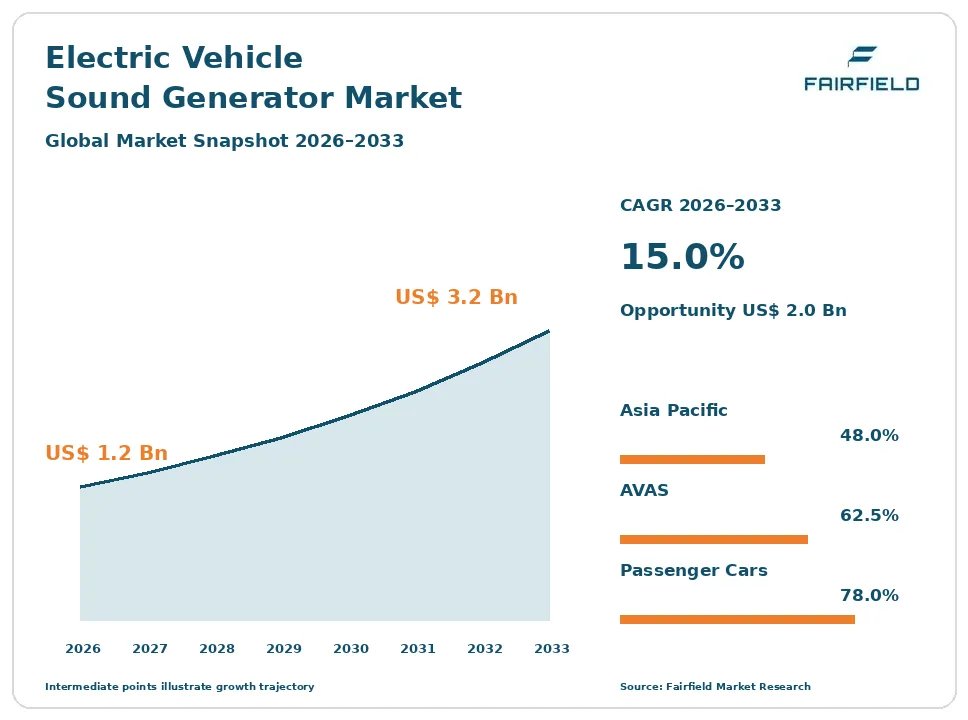
The global electric vehicle sound generator market size is expected to be valued at US$ 1.2 billion in 2026 and projected to reach US$ 3.2 billion by 2033, growing at a CAGR of 15.0% between 2026 and 2033.
The market expanded at roughly 22% a year between 2020 and 2025, the period in which pedestrian-alerting sound moved from optional to legally required across major vehicle markets. Growth now rests on three things. Electrified vehicle output is the base: every battery electric, plug-in hybrid, hybrid and fuel cell vehicle sold in a regulated market must carry an alerting system, so unit volume tracks production directly. Content value is rising as manufacturers commission composed exterior and interior sounds instead of accepting a generic tone. Commercial vehicle electrification adds a new fitment pool. The direction is high percentage growth on a small absolute base, with per-vehicle price under steady pressure.
Key Report Takeaways
- By System Type: Acoustic vehicle alerting systems held 62.5% share in 2026, while interior active sound design and engine sound enhancement is projected to grow at a 16.9% CAGR through 2033, driven by brand sound identity programmes extending inside the cabin.
- By Component: The sound generator module and controller held 33.8% share in 2026, while software and sound profiles are projected to expand at a 20.3% CAGR through 2033, driven by over-the-air updatable acoustic content replacing fixed stored waveforms.
- By Propulsion Type: Battery electric vehicles held 58.0% share in 2026, while plug-in hybrids are projected to grow at a 16.4% CAGR through 2033, driven by rapid plug-in hybrid output in China and Europe-bound exports.
- By Vehicle Type: Passenger cars held 78.0% share in 2026, while heavy commercial vehicles are projected to advance at a 20.6% CAGR through 2033, driven by electrified tractor units and refuse trucks entering regulated fleet operation.
- By Geography: Asia Pacific held 48.0% share in 2026, while Latin America is projected to post a 19.8% CAGR through 2033, driven by hybrid and electric assembly scaling from a very small installed base.
Global Electric Vehicle Sound Generator Market Trends and Insights
Drivers Impact Analysis
| Driver | Impact on CAGR Forecast | Geographic Relevance | Impact Timeline |
| Mandatory minimum sound requirements for quiet vehicles at low speed | High | Europe, North America, Asia Pacific | Long term (≥4 years) |
| Composed sound used as brand identity above the regulatory minimum | Medium | Europe, North America, Asia Pacific | Medium term (2–4 years) |
One mandate creates the market, and one discretionary layer determines how much value sits above the compliance minimum.
Pedestrian Safety Mandates Make the Alerting System a Required Fitment on Every Electrified Vehicle
This component is fitted because the law requires it, not because buyers ask for it. Electrified vehicles produce very little noise at low speed, which makes them hard for pedestrians to detect, and especially hard for blind and partially sighted pedestrians who rely on engine sound to judge approach and distance. Regulators responded by requiring a minimum emitted sound below a specified speed, so demand is a direct function of electrified vehicle production volume.
Two regimes define the requirement. UNECE Regulation No. 138 on the approval of quiet road transport vehicles is applied in the European Union through the regulation on the sound level of motor vehicles, making an acoustic vehicle alerting system mandatory on new electric and hybrid vehicles. FMVSS 141 sets the equivalent United States requirement through its phase-in and compliance dates. China and Japan operate their own national requirements, so there is no significant unregulated production volume left.
Composed Exterior and Interior Sound Turns a Compliance Part Into a Brand Asset
The second driver is discretionary and it is where margin lives. With no engine note to inherit, vehicle manufacturers have begun treating the sound a car makes as part of brand identity. Exterior alerting tones and interior active sound profiles are now commissioned as design work, in some cases from well-known composers, and specified alongside lighting signatures and interior materials. A programme that buys a composed sound set pays several times what a generic compliance tone costs.
The mechanism is competitive differentiation in a category where mechanical character has flattened. Powertrains across brands feel increasingly similar, so manufacturers look for perceptual cues a customer can recognise. Interior active sound design, delivered through the cabin audio chain and modulated by torque request, speed and gear state, gives acceleration a legible character. Sound design, tuning and homologation services have grown into a distinct supplier category serving exactly this work.
Restraints Impact Analysis
| Restraint | Impact on CAGR Forecast | Geographic Relevance | Impact Timeline |
| Cost pressure on a mandated component driving integration into existing hardware | High | Global | Short term (≤2 years) |
| Regulatory ceiling and floor on sound level, frequency content and pitch shift | Medium | Europe, North America, Asia Pacific | Medium term (2–4 years) |
Two pressures hold back value per vehicle even as fitment volume rises, and a third is social rather than technical.
Cost Pressure on a Mandated Part Squeezes Standalone Sound Generator Suppliers
A legally required part with no showroom appeal attracts relentless cost reduction, which holds revenue growth below unit growth. Purchasing teams treat the alerting system as a compliance line item, not a feature, so each programme renegotiation targets a lower price. Unit volume therefore rises faster than market value, and suppliers selling only a discrete box face steady erosion of both price and content.
The structural cause is architectural consolidation. The alerting function is a signal generator, an amplifier stage and a transducer, and all three already exist elsewhere in the vehicle. Manufacturers increasingly fold the generator into the audio amplifier, the body controller or a vehicle domain controller, which eliminates a housing, a connector and a wiring run. That change moves the value from a standalone module supplier toward whoever owns the amplifier or the domain controller, leaving the exterior speaker or exciter as the main remaining discrete part.
Regulatory Limits on Level, Frequency and Pitch Shift Raise Homologation Cost
Regulation both creates this market and constrains what can be sold into it. The rules specify a minimum sound pressure level across defined speed bands, require energy in specified one-third octave bands so the sound is detectable against urban background noise, and require the sound to shift in pitch with vehicle speed so pedestrians can judge whether a vehicle is approaching. A maximum level also applies, so the sound cannot simply be made louder.
The cost sits in verification. Every sound profile must be measured under controlled test-track conditions using the applicable ISO methods for minimum sound emission, and UNECE Regulation No. 51 on vehicle noise emission governs the upper bound alongside its additional sound emission provisions. A creative sound that fails a band requirement must be redesigned and retested, so the engineering loop between sound designer and homologation is long. Residential noise objections add political friction in dense cities.
Market Opportunities
Software-Defined and Over-the-Air Updatable Sound Profiles Open Recurring Revenue
Treating the sound as software rather than a stored waveform creates a revenue pool that did not exist when the function was a fixed module. If the acoustic profile lives in updatable firmware on an amplifier or domain controller, a manufacturer can ship a new sound set after delivery, offer alternative profiles as a paid option, and correct a homologation issue without a workshop visit. That converts a one-time hardware sale into a software line with repeat revenue.
Vehicle manufacturers running software-defined architectures create the demand, and tier-one suppliers who own the amplifier or audio domain are best placed to capture it. The enabling development is regulatory as much as technical: UNECE Regulation No. 155 on cybersecurity management and UNECE Regulation No. 156 on software update management apply precisely because a sound profile is software, and they give manufacturers an approved framework for changing it after type approval.
Electrified Buses and Trucks Open a New Fitment Pool for Exterior Alerting Sound
Commercial vehicle electrification opens a fitment pool that barely existed when the mandates were written for passenger cars. Electric city buses, refuse trucks, delivery vans and depot-based tractor units operate at low speed in exactly the pedestrian-dense environments the rules target, and they carry higher duty cycles and longer service lives. Specification is also less price-driven than in passenger cars, because fleet buyers weigh durability and serviceability more heavily than unit cost.
Bus operators, municipal fleets and logistics companies create this demand, often under procurement rules that require electrified vehicles in urban zones. Transducers must survive road spray, vibration and wash cycles that a passenger car speaker never sees, which supports a more robust and better-paid component. A second emerging pool is exterior sound used to communicate intent in automated driving, where a vehicle without a driver needs a way to signal yielding to pedestrians.
Segment Analysis
By System Type: Exterior Alerting Systems Dominate While Interior Sound Design Accelerates
Acoustic vehicle alerting systems held 62.5% share in 2026, the clear majority, because exterior pedestrian-alerting sound is legally required on every electrified vehicle sold in a regulated market while the interior function remains optional. The exterior system comprises a controller or sound generator module, an outward-facing speaker or exciter, and vehicle-speed and gear-state inputs that modulate pitch and level as the vehicle moves.
Interior active sound design and engine sound enhancement, at 29.0% share, grows fastest at a 16.9% CAGR through 2033, as manufacturers extend brand sound identity into the cabin and modulate it against torque request rather than simply masking road noise. Sound design, tuning and homologation services account for the remaining 8.5%, a small but high-margin pool. The implication is that suppliers who can deliver the exterior hardware, the interior function and the tuning work together hold the stronger position.
By Component: The Generator Module Leads as Software and Sound Profiles Grow Quickest
The sound generator module and controller held 33.8% share in 2026, the largest component pool, because it carries the processing, the stored or synthesised profile and the diagnostic logic that type approval requires. Exterior speakers and exciters took 26.4%, a durable share because the transducer cannot be virtualised away and must survive water, grit and thermal cycling on the vehicle exterior. Amplifier-integrated sound units accounted for 18.2%.
Software and sound profiles, at 13.1% share, grow fastest at a 20.3% CAGR through 2033, as acoustic content separates from the hardware it runs on and becomes updatable after delivery. Wiring and mounting hardware holds the remaining 8.5% and declines in relative terms as integration removes connectors. The business implication is that component value is migrating from the discrete box toward software and toward the one part that must stay physical.
By Propulsion Type: Battery Electric Vehicles Lead While Plug-in Hybrids Expand Fastest
Battery electric vehicles held 58.0% share in 2026, the largest propulsion pool, because a battery electric vehicle is silent at all low speeds and therefore needs the alerting system active across the full regulated speed band. Hybrid electric vehicles took 18.8%, requiring the system only while running in electric mode, and fuel cell electric vehicles accounted for 0.7% from a very small production base.
Plug-in hybrid electric vehicles, at 22.5% share, grow fastest at a 16.4% CAGR through 2033, because plug-in hybrid output has scaled sharply in China and in export programmes aimed at Europe, where the same homologation requirements apply as for battery vehicles. For suppliers, the practical implication is that hybrid applications need more complex logic, since the system must engage and disengage as the powertrain switches modes without producing audible artefacts at the transition.
By Vehicle Type: Passenger Cars Carry Volume While Heavy Commercial Vehicles Grow Fastest
Passenger cars held 78.0% share in 2026 and will continue to carry most unit volume, simply because passenger car production dwarfs every other vehicle class and electrification reached it first. Light commercial vehicles took 14.5%, led by electric delivery vans operating in urban low-emission zones. Buses accounted for 4.5%, a disproportionately high share relative to their unit count because transit specifications demand more robust and more serviceable equipment.
Heavy commercial vehicles hold 3.0% share and grow fastest at a 20.6% CAGR through 2033, from the smallest base. Electrified tractor units, refuse collection trucks and municipal vehicles are entering service in regulated fleets, and each requires exterior alerting equipment rated for far harsher exposure than passenger car hardware. The implication is a distinct product line with different qualification testing, not a passenger car part carried across.
Geography Analysis
North America Anchors Demand Around a Single Federal Minimum Sound Standard
North America accounted for 18.5% of the electric vehicle sound generator market in 2026 and grows at 14.6% a year through 2033. The United States dominates, with Canada and Mexico contributing assembly volume, much of it exported. A single federal minimum sound standard, FMVSS 141, governs the requirement, which simplifies homologation compared with multi-jurisdiction markets and lets suppliers qualify one configuration for the whole region.
The pace is set by electrified light vehicle output rather than by regulation, which is already settled. Pickup trucks and large crossovers make up an unusually high share of the electrified mix here, and their size and frontal geometry affect speaker placement and the sound level needed for detectability. Content value is supported by premium programmes commissioning distinctive exterior and interior sound. The change to watch is consolidation of the function into audio amplifiers as vehicle electrical architectures centralise.
Europe Sets the Regulatory Template That Other Markets Follow
Europe held 27.0% share in 2026 and grows at 13.6% through 2033, the slowest regional rate because its electrified fleet is already large and its fitment requirement is fully phased in. Germany, France, the United Kingdom, Norway, the Netherlands and Sweden lead consumption. UNECE Regulation No. 138, applied through the regulation on the sound level of motor vehicles, is the template other jurisdictions have adapted, and the removal of the pause-switch allowance tightened it further.
Value per vehicle is the highest of any region. German and Nordic manufacturers treat sound as a brand signature, commission composed profiles and invest in interior active sound design, which lifts average content well above the compliance minimum. UNECE Regulations No. 155 and 156 on cybersecurity and software update management apply directly here, since sound profiles are software. The main friction is residential noise objection in dense historic cities, which constrains how assertive exterior sound may be.
Which Region Is Leading the Electric Vehicle Sound Generator Market?
Asia Pacific is leading the electric vehicle sound generator market, with 48.0% share in 2026 and a 15.5% CAGR through 2033. China alone accounts for most of that volume, as the largest producer of battery electric and plug-in hybrid vehicles anywhere, with Japan, Korea and India adding significant output. China and Japan operate their own national minimum sound requirements, so domestic production is fully within scope.
Three causes explain the position. Electrified vehicle production volume is simply larger here than in the rest of the world combined. A dense local supply base of speaker, amplifier and controller manufacturers keeps unit cost low, which suits a mandated part under price pressure. Exports to regulated markets force local suppliers to meet multiple homologation regimes on one platform. The change underway is premiumisation, as Chinese and Korean brands commission distinctive sound identities to differentiate crowded model line-ups.
Which Region Is Growing Fastest in the Electric Vehicle Sound Generator Market?
Latin America is growing fastest in the electric vehicle sound generator market, at a 19.8% CAGR through 2033, though from only 3.5% share in 2026 and the smallest installed base of electrified vehicles in any major producing region. Brazil and Mexico account for almost all of it, with Colombia and Chile adding import-led demand concentrated in buses and urban delivery fleets.
The growth comes from a very low base rather than from scale. Mexico assembles electrified vehicles for export to jurisdictions where alerting systems are mandatory, which pulls compliant hardware into the regional supply chain regardless of domestic rules. Brazil is electrifying urban bus fleets under municipal procurement. The barriers are real: domestic minimum sound requirements are less developed, charging infrastructure is thin, and affordability limits private electric vehicle uptake. Electric bus tenders are the clearest near-term opportunity.
Middle East & Africa Builds Early Volume Through Fleet and Bus Electrification
Middle East & Africa held 3.0% share in 2026 and grows at 18.0% through 2033, the second-fastest rate from the smallest base of the five regions. The United Arab Emirates, Saudi Arabia, Israel, Egypt and South Africa account for most demand. Volume arrives mainly through imported vehicles that already carry alerting systems fitted for their home-market approval, rather than through local specification.
Growth is driven by government fleet electrification targets, by electric bus and taxi programmes in Gulf cities, and by new urban developments designed around low-emission transport. South Africa contributes assembly volume for export. The barriers are substantial: most national vehicle rules do not yet mandate minimum sound independently, service networks for electrified vehicles are thin, and high ambient temperatures stress exterior-mounted transducers. The opportunity lies in adoption of internationally aligned type approval, which would standardise specification across the region.
Competitive Landscape
The electric vehicle sound generator market is moderately concentrated, shaped by the fact that the product sits at the intersection of automotive audio, body electronics and acoustic engineering. Large tier-one suppliers that already deliver amplifiers, infotainment hardware or body control modules hold the strongest positions, because they can absorb the alerting function into hardware a manufacturer is buying anyway. Alongside them sits a smaller group of acoustic specialists and sound design houses that compete on creative and homologation capability rather than on hardware scale. Specialist speaker and exciter makers hold durable niches, since the transducer is the one element integration cannot remove.
Competition runs on four factors. Cost per vehicle dominates for the compliance baseline, which favours suppliers with existing amplifier or controller content. Homologation capability is the second, because a sound that cannot pass the applicable test methods has no commercial value regardless of how it sounds. Creative sound design capability separates premium programmes from commodity ones, and some manufacturers engage composers and acoustic studios directly rather than through a tier one. Finally, software competence matters increasingly, since profiles must be updatable within approved cybersecurity and update management frameworks.
Strategic activity centres on integration rather than on standalone product. Suppliers are positioning the alerting function as a feature of an audio or domain controller platform, bundling it with active noise control and interior sound design so that a single electronic control unit covers several acoustic workloads. Sound design studios and acoustic engineering consultancies have moved closer to vehicle programmes, selling tuning and homologation as a service. Transducer specialists are developing exciters and weather-sealed exterior speakers rated for commercial vehicle duty cycles.
Strategic direction across the supplier base points the same way: defend content value by owning either the software layer or the physical transducer, because the middle of the stack is being absorbed.
Electric Vehicle Sound Generator Industry Leaders
- Continental AG
- Robert Bosch GmbH
- DENSO Corporation
- HARMAN International Industries, Incorporated
- Hyundai Mobis Co., Ltd.
Recent Industry Developments
- July 2019: UNECE Regulation No. 138 requirements for acoustic vehicle alerting systems began applying to new type approvals of electric and hybrid electric vehicles in the European Union – it created the first large block of mandatory fitment and set the technical template later referenced elsewhere.
- September 2020: FMVSS 141 reached full compliance in the United States, requiring all new hybrid and electric light vehicles to emit a minimum sound at low speed – it closed the last major unregulated passenger vehicle market and fixed a second homologation regime suppliers must meet.
- July 2021: The alerting system requirement extended to all new electric and hybrid electric vehicles registered in the European Union, not only newly approved types – it converted the mandate from a forward-looking rule into full fleet coverage, lifting fitment to effectively every electrified unit sold.
- July 2024: UNECE Regulation No. 155 on cybersecurity management became applicable to all new vehicles in the European Union, alongside UNECE Regulation No. 156 on software update management – it brought software-defined sound profiles and their over-the-air update paths formally into the approval process.
Companies Covered in the Report
- Continental AG
- Robert Bosch GmbH
- DENSO Corporation
- HARMAN International Industries, Incorporated
- Hyundai Mobis Co., Ltd.
- Alps Alpine Co., Ltd.
- Bose Corporation
- Marelli Holdings Co., Ltd.
- Eberspächer Group
- Group Lotus Limited
- Panasonic Automotive Systems Co., Ltd.
- HEAD acoustics GmbH
- Hottinger Brüel & Kjær
- Siemens Digital Industries Software
Electric Vehicle Sound Generator Market Report Scope
This report covers acoustic vehicle alerting systems, interior active sound design and engine sound enhancement, and the related sound design, tuning and homologation services fitted to electrified vehicles. In-cabin entertainment audio, speakers sold for music reproduction and aftermarket head units are excluded, since exterior alerting sound is a separate workload. The base year is 2025, the forecast period runs from 2026 to 2033, and values are expressed in US$ Billion.
System Type
- Acoustic Vehicle Alerting Systems
- Interior Active Sound Design and Engine Sound Enhancement
- Sound Design, Tuning and Homologation Services
Component
- Sound Generator Module and Controller
- Exterior Speaker and Exciter
- Amplifier-Integrated Sound Unit
- Software and Sound Profiles
- Wiring and Mounting Hardware
Propulsion Type
- Battery Electric Vehicle
- Plug-in Hybrid Electric Vehicle
- Hybrid Electric Vehicle
- Fuel Cell Electric Vehicle
Vehicle Type
- Passenger Cars
- Light Commercial Vehicles
- Buses
- Heavy Commercial Vehicles
Regions
- North America
- Europe
- Asia Pacific
- Latin America
- Middle East & Africa
Key Questions Answered in the Report
How big is the electric vehicle sound generator market in 2026?
The global electric vehicle sound generator market is valued at US$ 1.2 billion in 2026, covering exterior alerting systems, interior sound enhancement and related homologation services.
What is the forecast size and CAGR of the electric vehicle sound generator market by 2033?
The market is projected to reach US$ 3.2 billion by 2033 at a 15.0% CAGR, an absolute opportunity of US$ 2.0 billion.
Which system type leads the electric vehicle sound generator market?
Acoustic vehicle alerting systems lead with 62.5% share in 2026, because exterior pedestrian-alerting sound is legally mandatory on electrified vehicles in every major market.
Which segment and region are growing fastest in the electric vehicle sound generator market?
Software and sound profiles grow fastest at 20.3%, and Latin America is the fastest region at a 19.8% CAGR from a very small base.
Which region holds the largest electric vehicle sound generator market share?
Asia Pacific holds 48.0% share in 2026, reflecting China producing more battery electric and plug-in hybrid vehicles than all other countries combined.
1. Executive Summary
1.1. Global Electric Vehicle Sound Generator Market Snapshot
1.2. Future Projections
1.3. Key Report Takeaways
1.4. Regional Snapshot
2. Market Overview
2.1. Market Definition and Report Scope
2.2. Historical Trends 2020–2025
2.3. Market Dynamics
2.3.1. Drivers
2.3.1.1. Pedestrian Safety Mandates Make the Alerting System a Required Fitment on Every Electrified Vehicle
2.3.1.2. Composed Exterior and Interior Sound Turns a Compliance Part Into a Brand Asset
2.3.2. Restraints
2.3.2.1. Cost Pressure on a Mandated Part Squeezes Standalone Sound Generator Suppliers
2.3.2.2. Regulatory Limits on Level, Frequency and Pitch Shift Raise Homologation Cost
2.3.3. Market Opportunities
2.3.3.1. Software-Defined and Over-the-Air Updatable Sound Profiles Open Recurring Revenue
2.3.3.2. Electrified Buses and Trucks Open a New Fitment Pool for Exterior Alerting Sound
3. Global Electric Vehicle Sound Generator Market Outlook, 2020–2033
3.1. Global Electric Vehicle Sound Generator Market Outlook, by System Type, Value (US$ Billion), 2020–2033
3.1.1. Acoustic Vehicle Alerting Systems
3.1.2. Interior Active Sound Design and Engine Sound Enhancement
3.1.3. Sound Design, Tuning and Homologation Services
3.2. Global Electric Vehicle Sound Generator Market Outlook, by Component, Value (US$ Billion), 2020–2033
3.2.1. Sound Generator Module and Controller
3.2.2. Exterior Speaker and Exciter
3.2.3. Amplifier-Integrated Sound Unit
3.2.4. Software and Sound Profiles
3.2.5. Wiring and Mounting Hardware
3.3. Global Electric Vehicle Sound Generator Market Outlook, by Propulsion Type, Value (US$ Billion), 2020–2033
3.3.1. Battery Electric Vehicle
3.3.2. Plug-in Hybrid Electric Vehicle
3.3.3. Hybrid Electric Vehicle
3.3.4. Fuel Cell Electric Vehicle
3.4. Global Electric Vehicle Sound Generator Market Outlook, by Vehicle Type, Value (US$ Billion), 2020–2033
3.4.1. Passenger Cars
3.4.2. Light Commercial Vehicles
3.4.3. Buses
3.4.4. Heavy Commercial Vehicles
3.5. Global Electric Vehicle Sound Generator Market Outlook, by Region, Value (US$ Billion), 2020–2033
3.5.1. North America
3.5.2. Europe
3.5.3. Asia Pacific
3.5.4. Latin America
3.5.5. Middle East & Africa
4. North America Electric Vehicle Sound Generator Market Outlook, 2020–2033
4.1. North America Electric Vehicle Sound Generator Market Outlook, by System Type, Value (US$ Billion), 2020–2033
4.1.1. Acoustic Vehicle Alerting Systems
4.1.2. Interior Active Sound Design and Engine Sound Enhancement
4.1.3. Sound Design, Tuning and Homologation Services
4.2. North America Electric Vehicle Sound Generator Market Outlook, by Component, Value (US$ Billion), 2020–2033
4.2.1. Sound Generator Module and Controller
4.2.2. Exterior Speaker and Exciter
4.2.3. Amplifier-Integrated Sound Unit
4.2.4. Software and Sound Profiles
4.2.5. Wiring and Mounting Hardware
4.3. North America Electric Vehicle Sound Generator Market Outlook, by Propulsion Type, Value (US$ Billion), 2020–2033
4.3.1. Battery Electric Vehicle
4.3.2. Plug-in Hybrid Electric Vehicle
4.3.3. Hybrid Electric Vehicle
4.3.4. Fuel Cell Electric Vehicle
4.4. North America Electric Vehicle Sound Generator Market Outlook, by Vehicle Type, Value (US$ Billion), 2020–2033
4.4.1. Passenger Cars
4.4.2. Light Commercial Vehicles
4.4.3. Buses
4.4.4. Heavy Commercial Vehicles
4.5. North America Electric Vehicle Sound Generator Market Outlook, by Country, Value (US$ Billion), 2020–2033
4.5.1. United States Electric Vehicle Sound Generator Market Outlook, by System Type, 2020–2033
4.5.2. United States Electric Vehicle Sound Generator Market Outlook, by Component, 2020–2033
4.5.3. United States Electric Vehicle Sound Generator Market Outlook, by Propulsion Type, 2020–2033
4.5.4. United States Electric Vehicle Sound Generator Market Outlook, by Vehicle Type, 2020–2033
4.5.5. Canada Electric Vehicle Sound Generator Market Outlook, by System Type, 2020–2033
4.5.6. Canada Electric Vehicle Sound Generator Market Outlook, by Component, 2020–2033
4.5.7. Canada Electric Vehicle Sound Generator Market Outlook, by Propulsion Type, 2020–2033
4.5.8. Canada Electric Vehicle Sound Generator Market Outlook, by Vehicle Type, 2020–2033
4.5.9. Mexico Electric Vehicle Sound Generator Market Outlook, by System Type, 2020–2033
4.5.10. Mexico Electric Vehicle Sound Generator Market Outlook, by Component, 2020–2033
4.5.11. Mexico Electric Vehicle Sound Generator Market Outlook, by Propulsion Type, 2020–2033
4.5.12. Mexico Electric Vehicle Sound Generator Market Outlook, by Vehicle Type, 2020–2033
5. Europe Electric Vehicle Sound Generator Market Outlook, 2020–2033
5.1. Europe Electric Vehicle Sound Generator Market Outlook, by System Type, Value (US$ Billion), 2020–2033
5.1.1. Acoustic Vehicle Alerting Systems
5.1.2. Interior Active Sound Design and Engine Sound Enhancement
5.1.3. Sound Design, Tuning and Homologation Services
5.2. Europe Electric Vehicle Sound Generator Market Outlook, by Component, Value (US$ Billion), 2020–2033
5.2.1. Sound Generator Module and Controller
5.2.2. Exterior Speaker and Exciter
5.2.3. Amplifier-Integrated Sound Unit
5.2.4. Software and Sound Profiles
5.2.5. Wiring and Mounting Hardware
5.3. Europe Electric Vehicle Sound Generator Market Outlook, by Propulsion Type, Value (US$ Billion), 2020–2033
5.3.1. Battery Electric Vehicle
5.3.2. Plug-in Hybrid Electric Vehicle
5.3.3. Hybrid Electric Vehicle
5.3.4. Fuel Cell Electric Vehicle
5.4. Europe Electric Vehicle Sound Generator Market Outlook, by Vehicle Type, Value (US$ Billion), 2020–2033
5.4.1. Passenger Cars
5.4.2. Light Commercial Vehicles
5.4.3. Buses
5.4.4. Heavy Commercial Vehicles
5.5. Europe Electric Vehicle Sound Generator Market Outlook, by Country, Value (US$ Billion), 2020–2033
5.5.1. Germany Electric Vehicle Sound Generator Market Outlook, by System Type, 2020–2033
5.5.2. Germany Electric Vehicle Sound Generator Market Outlook, by Component, 2020–2033
5.5.3. Germany Electric Vehicle Sound Generator Market Outlook, by Propulsion Type, 2020–2033
5.5.4. Germany Electric Vehicle Sound Generator Market Outlook, by Vehicle Type, 2020–2033
5.5.5. France Electric Vehicle Sound Generator Market Outlook, by System Type, 2020–2033
5.5.6. France Electric Vehicle Sound Generator Market Outlook, by Component, 2020–2033
5.5.7. France Electric Vehicle Sound Generator Market Outlook, by Propulsion Type, 2020–2033
5.5.8. France Electric Vehicle Sound Generator Market Outlook, by Vehicle Type, 2020–2033
5.5.9. United Kingdom Electric Vehicle Sound Generator Market Outlook, by System Type, 2020–2033
5.5.10. United Kingdom Electric Vehicle Sound Generator Market Outlook, by Component, 2020–2033
5.5.11. United Kingdom Electric Vehicle Sound Generator Market Outlook, by Propulsion Type, 2020–2033
5.5.12. United Kingdom Electric Vehicle Sound Generator Market Outlook, by Vehicle Type, 2020–2033
5.5.13. Norway Electric Vehicle Sound Generator Market Outlook, by System Type, 2020–2033
5.5.14. Norway Electric Vehicle Sound Generator Market Outlook, by Component, 2020–2033
5.5.15. Norway Electric Vehicle Sound Generator Market Outlook, by Propulsion Type, 2020–2033
5.5.16. Norway Electric Vehicle Sound Generator Market Outlook, by Vehicle Type, 2020–2033
5.5.17. Netherlands Electric Vehicle Sound Generator Market Outlook, by System Type, 2020–2033
5.5.18. Netherlands Electric Vehicle Sound Generator Market Outlook, by Component, 2020–2033
5.5.19. Netherlands Electric Vehicle Sound Generator Market Outlook, by Propulsion Type, 2020–2033
5.5.20. Netherlands Electric Vehicle Sound Generator Market Outlook, by Vehicle Type, 2020–2033
5.5.21. Sweden Electric Vehicle Sound Generator Market Outlook, by System Type, 2020–2033
5.5.22. Sweden Electric Vehicle Sound Generator Market Outlook, by Component, 2020–2033
5.5.23. Sweden Electric Vehicle Sound Generator Market Outlook, by Propulsion Type, 2020–2033
5.5.24. Sweden Electric Vehicle Sound Generator Market Outlook, by Vehicle Type, 2020–2033
6. Asia Pacific Electric Vehicle Sound Generator Market Outlook, 2020–2033
6.1. Asia Pacific Electric Vehicle Sound Generator Market Outlook, by System Type, Value (US$ Billion), 2020–2033
6.1.1. Acoustic Vehicle Alerting Systems
6.1.2. Interior Active Sound Design and Engine Sound Enhancement
6.1.3. Sound Design, Tuning and Homologation Services
6.2. Asia Pacific Electric Vehicle Sound Generator Market Outlook, by Component, Value (US$ Billion), 2020–2033
6.2.1. Sound Generator Module and Controller
6.2.2. Exterior Speaker and Exciter
6.2.3. Amplifier-Integrated Sound Unit
6.2.4. Software and Sound Profiles
6.2.5. Wiring and Mounting Hardware
6.3. Asia Pacific Electric Vehicle Sound Generator Market Outlook, by Propulsion Type, Value (US$ Billion), 2020–2033
6.3.1. Battery Electric Vehicle
6.3.2. Plug-in Hybrid Electric Vehicle
6.3.3. Hybrid Electric Vehicle
6.3.4. Fuel Cell Electric Vehicle
6.4. Asia Pacific Electric Vehicle Sound Generator Market Outlook, by Vehicle Type, Value (US$ Billion), 2020–2033
6.4.1. Passenger Cars
6.4.2. Light Commercial Vehicles
6.4.3. Buses
6.4.4. Heavy Commercial Vehicles
6.5. Asia Pacific Electric Vehicle Sound Generator Market Outlook, by Country, Value (US$ Billion), 2020–2033
6.5.1. China Electric Vehicle Sound Generator Market Outlook, by System Type, 2020–2033
6.5.2. China Electric Vehicle Sound Generator Market Outlook, by Component, 2020–2033
6.5.3. China Electric Vehicle Sound Generator Market Outlook, by Propulsion Type, 2020–2033
6.5.4. China Electric Vehicle Sound Generator Market Outlook, by Vehicle Type, 2020–2033
6.5.5. Japan Electric Vehicle Sound Generator Market Outlook, by System Type, 2020–2033
6.5.6. Japan Electric Vehicle Sound Generator Market Outlook, by Component, 2020–2033
6.5.7. Japan Electric Vehicle Sound Generator Market Outlook, by Propulsion Type, 2020–2033
6.5.8. Japan Electric Vehicle Sound Generator Market Outlook, by Vehicle Type, 2020–2033
6.5.9. Korea Electric Vehicle Sound Generator Market Outlook, by System Type, 2020–2033
6.5.10. Korea Electric Vehicle Sound Generator Market Outlook, by Component, 2020–2033
6.5.11. Korea Electric Vehicle Sound Generator Market Outlook, by Propulsion Type, 2020–2033
6.5.12. Korea Electric Vehicle Sound Generator Market Outlook, by Vehicle Type, 2020–2033
6.5.13. India Electric Vehicle Sound Generator Market Outlook, by System Type, 2020–2033
6.5.14. India Electric Vehicle Sound Generator Market Outlook, by Component, 2020–2033
6.5.15. India Electric Vehicle Sound Generator Market Outlook, by Propulsion Type, 2020–2033
6.5.16. India Electric Vehicle Sound Generator Market Outlook, by Vehicle Type, 2020–2033
7. Latin America Electric Vehicle Sound Generator Market Outlook, 2020–2033
7.1. Latin America Electric Vehicle Sound Generator Market Outlook, by System Type, Value (US$ Billion), 2020–2033
7.1.1. Acoustic Vehicle Alerting Systems
7.1.2. Interior Active Sound Design and Engine Sound Enhancement
7.1.3. Sound Design, Tuning and Homologation Services
7.2. Latin America Electric Vehicle Sound Generator Market Outlook, by Component, Value (US$ Billion), 2020–2033
7.2.1. Sound Generator Module and Controller
7.2.2. Exterior Speaker and Exciter
7.2.3. Amplifier-Integrated Sound Unit
7.2.4. Software and Sound Profiles
7.2.5. Wiring and Mounting Hardware
7.3. Latin America Electric Vehicle Sound Generator Market Outlook, by Propulsion Type, Value (US$ Billion), 2020–2033
7.3.1. Battery Electric Vehicle
7.3.2. Plug-in Hybrid Electric Vehicle
7.3.3. Hybrid Electric Vehicle
7.3.4. Fuel Cell Electric Vehicle
7.4. Latin America Electric Vehicle Sound Generator Market Outlook, by Vehicle Type, Value (US$ Billion), 2020–2033
7.4.1. Passenger Cars
7.4.2. Light Commercial Vehicles
7.4.3. Buses
7.4.4. Heavy Commercial Vehicles
7.5. Latin America Electric Vehicle Sound Generator Market Outlook, by Country, Value (US$ Billion), 2020–2033
7.5.1. Brazil Electric Vehicle Sound Generator Market Outlook, by System Type, 2020–2033
7.5.2. Brazil Electric Vehicle Sound Generator Market Outlook, by Component, 2020–2033
7.5.3. Brazil Electric Vehicle Sound Generator Market Outlook, by Propulsion Type, 2020–2033
7.5.4. Brazil Electric Vehicle Sound Generator Market Outlook, by Vehicle Type, 2020–2033
7.5.5. Mexico Electric Vehicle Sound Generator Market Outlook, by System Type, 2020–2033
7.5.6. Mexico Electric Vehicle Sound Generator Market Outlook, by Component, 2020–2033
7.5.7. Mexico Electric Vehicle Sound Generator Market Outlook, by Propulsion Type, 2020–2033
7.5.8. Mexico Electric Vehicle Sound Generator Market Outlook, by Vehicle Type, 2020–2033
7.5.9. Colombia Electric Vehicle Sound Generator Market Outlook, by System Type, 2020–2033
7.5.10. Colombia Electric Vehicle Sound Generator Market Outlook, by Component, 2020–2033
7.5.11. Colombia Electric Vehicle Sound Generator Market Outlook, by Propulsion Type, 2020–2033
7.5.12. Colombia Electric Vehicle Sound Generator Market Outlook, by Vehicle Type, 2020–2033
7.5.13. Chile Electric Vehicle Sound Generator Market Outlook, by System Type, 2020–2033
7.5.14. Chile Electric Vehicle Sound Generator Market Outlook, by Component, 2020–2033
7.5.15. Chile Electric Vehicle Sound Generator Market Outlook, by Propulsion Type, 2020–2033
7.5.16. Chile Electric Vehicle Sound Generator Market Outlook, by Vehicle Type, 2020–2033
8. Middle East & Africa Electric Vehicle Sound Generator Market Outlook, 2020–2033
8.1. Middle East & Africa Electric Vehicle Sound Generator Market Outlook, by System Type, Value (US$ Billion), 2020–2033
8.1.1. Acoustic Vehicle Alerting Systems
8.1.2. Interior Active Sound Design and Engine Sound Enhancement
8.1.3. Sound Design, Tuning and Homologation Services
8.2. Middle East & Africa Electric Vehicle Sound Generator Market Outlook, by Component, Value (US$ Billion), 2020–2033
8.2.1. Sound Generator Module and Controller
8.2.2. Exterior Speaker and Exciter
8.2.3. Amplifier-Integrated Sound Unit
8.2.4. Software and Sound Profiles
8.2.5. Wiring and Mounting Hardware
8.3. Middle East & Africa Electric Vehicle Sound Generator Market Outlook, by Propulsion Type, Value (US$ Billion), 2020–2033
8.3.1. Battery Electric Vehicle
8.3.2. Plug-in Hybrid Electric Vehicle
8.3.3. Hybrid Electric Vehicle
8.3.4. Fuel Cell Electric Vehicle
8.4. Middle East & Africa Electric Vehicle Sound Generator Market Outlook, by Vehicle Type, Value (US$ Billion), 2020–2033
8.4.1. Passenger Cars
8.4.2. Light Commercial Vehicles
8.4.3. Buses
8.4.4. Heavy Commercial Vehicles
8.5. Middle East & Africa Electric Vehicle Sound Generator Market Outlook, by Country, Value (US$ Billion), 2020–2033
8.5.1. United Arab Emirates Electric Vehicle Sound Generator Market Outlook, by System Type, 2020–2033
8.5.2. United Arab Emirates Electric Vehicle Sound Generator Market Outlook, by Component, 2020–2033
8.5.3. United Arab Emirates Electric Vehicle Sound Generator Market Outlook, by Propulsion Type, 2020–2033
8.5.4. United Arab Emirates Electric Vehicle Sound Generator Market Outlook, by Vehicle Type, 2020–2033
8.5.5. Saudi Arabia Electric Vehicle Sound Generator Market Outlook, by System Type, 2020–2033
8.5.6. Saudi Arabia Electric Vehicle Sound Generator Market Outlook, by Component, 2020–2033
8.5.7. Saudi Arabia Electric Vehicle Sound Generator Market Outlook, by Propulsion Type, 2020–2033
8.5.8. Saudi Arabia Electric Vehicle Sound Generator Market Outlook, by Vehicle Type, 2020–2033
8.5.9. Israel Electric Vehicle Sound Generator Market Outlook, by System Type, 2020–2033
8.5.10. Israel Electric Vehicle Sound Generator Market Outlook, by Component, 2020–2033
8.5.11. Israel Electric Vehicle Sound Generator Market Outlook, by Propulsion Type, 2020–2033
8.5.12. Israel Electric Vehicle Sound Generator Market Outlook, by Vehicle Type, 2020–2033
8.5.13. Egypt Electric Vehicle Sound Generator Market Outlook, by System Type, 2020–2033
8.5.14. Egypt Electric Vehicle Sound Generator Market Outlook, by Component, 2020–2033
8.5.15. Egypt Electric Vehicle Sound Generator Market Outlook, by Propulsion Type, 2020–2033
8.5.16. Egypt Electric Vehicle Sound Generator Market Outlook, by Vehicle Type, 2020–2033
8.5.17. South Africa Electric Vehicle Sound Generator Market Outlook, by System Type, 2020–2033
8.5.18. South Africa Electric Vehicle Sound Generator Market Outlook, by Component, 2020–2033
8.5.19. South Africa Electric Vehicle Sound Generator Market Outlook, by Propulsion Type, 2020–2033
8.5.20. South Africa Electric Vehicle Sound Generator Market Outlook, by Vehicle Type, 2020–2033
9. Competitive Landscape
9.1. Market Concentration and Industry Leaders
9.2. Competitive Differentiation
9.3. Strategic Moves and Market Direction
9.4. Recent Industry Developments
9.5. Company Profiles
9.5.1. Continental AG
9.5.2. Robert Bosch GmbH
9.5.3. DENSO Corporation
9.5.4. HARMAN International Industries, Incorporated
9.5.5. Hyundai Mobis Co., Ltd.
9.5.6. Alps Alpine Co., Ltd.
9.5.7. Bose Corporation
9.5.8. Marelli Holdings Co., Ltd.
9.5.9. Eberspächer Group
9.5.10. Group Lotus Limited
9.5.11. Panasonic Automotive Systems Co., Ltd.
9.5.12. HEAD acoustics GmbH
9.5.13. Hottinger Brüel & Kjær
9.5.14. Siemens Digital Industries Software
10. Appendix
10.1. Research Methodology
10.2. Report Assumptions
10.3. Acronyms and Abbreviations
| System Type | Acoustic Vehicle Alerting Systems, Interior Active Sound Design and Engine Sound Enhancement, Sound Design, Tuning and Homologation Services |
| Component | Sound Generator Module and Controller, Exterior Speaker and Exciter, Amplifier-Integrated Sound Unit, Software and Sound Profiles, Wiring and Mounting Hardware |
| Propulsion Type | Battery Electric Vehicle, Plug-in Hybrid Electric Vehicle, Hybrid Electric Vehicle, Fuel Cell Electric Vehicle |
| Vehicle Type | Passenger Cars, Light Commercial Vehicles, Buses, Heavy Commercial Vehicles |
| Regions | North America, Europe, Asia Pacific, Latin America, Middle East & Africa |
Our Research Methodology
Considering the volatility of business today, traditional approaches to strategizing a game plan can be unfruitful if not detrimental. True ambiguity is no way to determine a forecast. A myriad of predetermined factors must be accounted for such as the degree of risk involved, the magnitude of circumstances, as well as conditions or consequences that are not known or unpredictable. To circumvent binary views that cast uncertainty, the application of market research intelligence to strategically posture, move, and enable actionable outcomes is necessary.
View Methodology
Quality Assured
Rigorous Validation Process

Confidentiality Assured
End-to-end Data Security

Custom Research Services
Tailored To Your Objectives
FAQs
The global electric vehicle sound generator market is valued at US$ 1.2 billion in 2026, covering exterior alerting systems, interior sound enhancement and related homologation services.
The market is projected to reach US$ 3.2 billion by 2033 at a 15.0% CAGR, an absolute opportunity of US$ 2.0 billion.
Acoustic vehicle alerting systems lead with 62.5% share in 2026, because exterior pedestrian-alerting sound is legally mandatory on electrified vehicles in every major market.
Software and sound profiles grow fastest at 20.3%, and Latin America is the fastest region at a 19.8% CAGR from a very small base.
Asia Pacific holds 48.0% share in 2026, reflecting China producing more battery electric and plug-in hybrid vehicles than all other countries combined.
Related Reports
On-Demand Warehousing Market Size, Share, Insights, Competitive Landscape, and Forecast 2026 to 2033
On-demand warehousing market to grow from US$17.20 Bn in 2026 to US$47.51 Bn by 2033 at 15.6% CAGR. Explore services, storage duration and regional trends.
On-Demand Trucking Market Size, Share, Insights, Competitive Landscape, and Forecast 2026 to 2033
On-demand trucking market to grow from US$11.00 Bn in 2026 to US$30.52 Bn by 2033 at 15.7% CAGR. Explore truck types, services, industries and regions.
On-Demand Transportation Market Size, Share, Insights, Competitive Landscape, and Forecast 2026 to 2033
On-demand transportation market to grow from US$289.18 Bn in 2026 to US$779.10 Bn by 2033 at 15.2% CAGR. Explore services, vehicles and regional trends.
On-Board Diagnostics (OBD) Aftermarket Size, Share, Insights, Competitive Landscape, and Forecast 2026 to 2033
On-board diagnostics (OBD) aftermarket to grow from US$4.74 Bn in 2026 to US$21.02 Bn by 2033 at 23.7% CAGR. Explore connectivity, applications and regions.
On-Board Charger Market Size, Share, Insights, Competitive Landscape, and Forecast 2026 to 2033
On-board charger market to grow from US$10.13 Bn in 2026 to US$27.16 Bn by 2033 at 15.1% CAGR. Explore propulsion, power output, vehicles and regions.
Second Life EV Battery Market Size, Share, Insights, Competitive Landscape, and Forecast 2026 to 2033
Second life EV battery market to reach US$ 19.52 billion by 2033 at a 41.7% CAGR. Explore applications, battery chemistries and regional trends.