



On-Demand Trucking Market
On-Demand Trucking Market Size, Share, Insights, Competitive Landscape, and Forecast 2026 to 2033
On-Demand Trucking Market Analysis, 2026–2033
On-Demand Trucking Market
On-Demand Trucking Market Size, Share, Insights, Competitive Landscape, and Forecast 2026 to 2033
On-Demand Trucking Market Size and Trend Analysis
How Fast Is the On-Demand Trucking Market Growing?
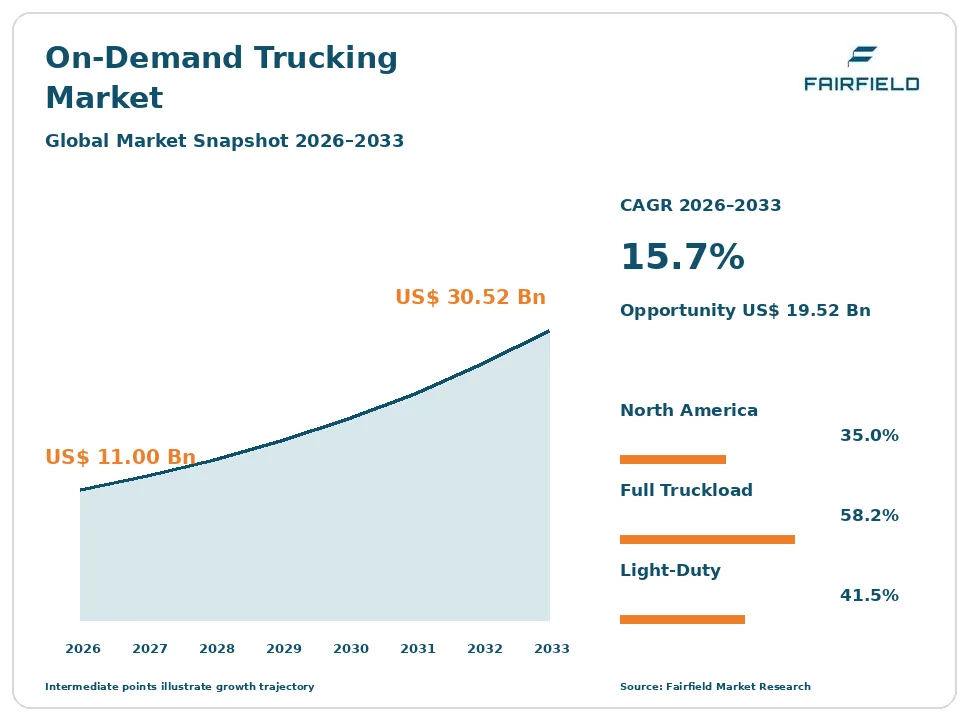
The global on-demand trucking market size is expected to be valued at US$ 11.00 billion in 2026 and projected to reach US$ 30.52 billion by 2033, growing at a CAGR of 15.7% between 2026 and 2033.
Between 2020 and 2025, the market grew at a CAGR of about 14%, as e-commerce boomed during the pandemic, followed by a freight recession in 2023 and 2024. Three factors now drive growth: rising e-commerce and last-mile delivery volumes, the need for shippers and carriers to fill empty trucks, and wider use of mobile apps and AI for digital freight matching. The market is shifting from phone-based freight brokerage toward automated platforms and load boards that match loads with trucks in seconds, set prices instantly, verify carriers, and pay drivers quickly. Electric trucks, autonomous long-haul pilots, and truck-as-a-service models are adding new options for full truckload and regional freight.
Key Report Takeaways
- By Truck Type: Light-Duty held 41.5% share in 2026, while Heavy-Duty is projected to expand at a 17.2% CAGR through 2033, driven by digital matching of long-haul loads and autonomous truck pilots.
- By Service Type: Full Truckload held 58.2% share in 2026, while Less-than-Truckload is projected to expand at a 17.8% CAGR through 2033, driven by smaller e-commerce shipments and shared loads.
- By Industry: Retail & E-commerce held 32.4% share in 2026, while Food & Beverage is projected to expand at a 17.5% CAGR through 2033, driven by refrigerated delivery and fresh grocery demand.
- By Region: North America held 35.0% share in 2026, while Asia Pacific is projected to expand at an 18.6% CAGR through 2033, driven by app-based truck booking in India, China, and Indonesia.
Global On-Demand Trucking Market Trends and Insights
Drivers Impact Analysis
| Driver | Impact on CAGR Forecast | Geographic Relevance | Impact Timeline |
| E-commerce growth and fast delivery expectations | High | Global | Long term (≥4 years) |
| Digital freight matching and AI | High | North America, Asia Pacific, Europe | Medium term (2-4 years) |
Two drivers carry the strongest influence on on-demand trucking demand during the forecast period.
E-commerce Growth Is Driving the On-Demand Trucking Market
E-commerce growth and fast delivery expectations are the strongest driver of the on-demand trucking market. Online orders create frequent, small, and time-sensitive shipments.
The mechanism is changing shopping habits and supply chain design. Global e-commerce sales keep rising, and consumers expect same-day or next-day delivery. Retailers need trucks on short notice to move goods between warehouses, stores, and fulfillment centers. Seasonal peaks such as holiday sales require extra capacity that shippers cannot keep year-round. Small and medium businesses lack their own fleets and book trucks through apps. Last-mile delivery in cities uses light commercial vehicles booked on demand through platforms such as Porter in India and Lalamove in Asia Pacific. Nearshoring to Mexico is increasing cross-border trucking. These factors keep demand for flexible truck capacity growing.
Digital Freight Matching Is Expanding the On-Demand Trucking Market
Digital freight matching and AI are expanding the on-demand trucking market. Technology is replacing manual phone calls and emails in freight brokerage.
The cause is the high share of empty miles and inefficient booking. Trucks in many countries travel a large share of miles empty, wasting fuel and driver time, and traditional freight brokerage relies on phone calls. Digital platforms use algorithms to match available trucks with loads, suggest backhauls, and set prices based on real-time market data. Mobile apps let owner-operators find loads, upload documents, and get paid quickly. Uber Freight launched an AI logistics network in 2025 that automates planning and execution for shippers. DAT Freight & Analytics agreed in 2025 to acquire the Convoy platform to add automated matching to its load boards. AI tools also detect fraud and verify carriers. These advances raise efficiency and platform adoption.
Restraints Impact Analysis
| Restraint | Impact on CAGR Forecast | Geographic Relevance | Impact Timeline |
| Freight market cycles and thin margins | High | North America, Europe | Short term (≤2 years) |
| Fragmented carriers and driver shortages | Medium | Global | Medium term (2-4 years) |
Two restraints limit how quickly the on-demand trucking market grows.
Freight Cycles Slow the On-Demand Trucking Market
Freight market cycles and thin margins slow the on-demand trucking market. Trucking demand and rates swing sharply with the economy.
The specific causes are overcapacity, falling rates, and high operating costs. After the pandemic boom, freight volumes fell in 2023 and 2024 while many new carriers had entered the market, pushing spot rates down. Convoy, once valued at US$ 3.8 billion, collapsed in 2023, and other digital brokers cut staff. Tariffs and trade uncertainty in 2025 disrupted cross-border flows. Fuel, insurance, and equipment costs remain high, squeezing small carriers. Brokers earn small margins between shipper rates and carrier payments. Investors have become more cautious about funding loss-making platforms, and some shippers returned to traditional brokers. These factors slow revenue growth, while consolidation weeds out weaker players.
Fragmented Carriers and Driver Shortages Restrict the On-Demand Trucking Market
Fragmented carriers and driver shortages restrict the on-demand trucking market. Many trucking firms are very small and use little technology.
The underlying causes are industry structure and workforce challenges. In the United States, most trucking companies operate fewer than 10 trucks, and in India and Indonesia many trucks are owned by individual drivers. Small operators may lack smartphones, digital payment accounts, or trust in platforms. Driver shortages in Europe, North America, and Asia Pacific limit available capacity, especially for long-haul routes and night work. Freight fraud and identity theft have risen, making shippers cautious about unknown carriers. Poor roads and paperwork at borders slow trips. Language barriers and low digital skills among older drivers also limit app use. These factors limit platform reach and service reliability.
Market Opportunities
AI, Electric, and Autonomous Trucking Open a Technology Revenue Pool
AI, electric, and autonomous trucking open a technology revenue pool in the on-demand trucking market. New technology can lower costs per mile and improve reliability.
Platforms and fleet operators that adopt new vehicles and software can capture this opportunity. AI pricing, routing, and load consolidation reduce empty miles and improve margins. Electric trucks for regional and urban routes cut fuel costs and help shippers meet emissions targets, and truck-as-a-service models such as Volvo on Demand lower upfront costs. Autonomous trucks from Aurora, Kodiak, and others are running commercial freight on highways in Texas. Platforms that dispatch autonomous and electric trucks alongside human drivers can win large shipper contracts. Data services and embedded finance such as quick pay, fuel cards, and insurance add revenue. Carbon tracking tools help shippers report emissions from full truckload and shared shipments.
Asia Pacific App-Based Logistics Creates a Volume Revenue Pool
App-based logistics in Asia Pacific creates a volume revenue pool in the on-demand trucking market. The region has huge, fragmented trucking sectors moving online.
Local platforms and investors can capture this opportunity. India has millions of trucks, mostly owned by small operators, and platforms such as Porter, BlackBuck, and Rivigo digitize booking, tracking, and payments. Porter raised US$ 200 million in 2025 and became a unicorn. China has large freight apps such as Full Truck Alliance that connect millions of drivers and shippers. Indonesia, Vietnam, and the Philippines have fast-growing e-commerce and last-mile apps. Government digital tax and e-way bill systems support adoption. Cheap smartphones and mobile payments such as UPI in India help drivers join platforms. Platforms that also offer fuel cards, tolls, and loans can lock in loyal drivers.
Segment Analysis
By Truck Type: Light-Duty Leads While Heavy-Duty Grows Fastest
Light-Duty held 41.5% share in 2026. Light-duty trucks and vans handle urban and last-mile delivery for e-commerce, retail, and small businesses. They are easy to book through apps for short trips, house moves, and small loads. Porter, Lalamove, and GoShare focus on this segment. Medium-duty trucks serve regional distribution and construction materials.
Heavy-Duty is the fastest-growing truck type, expanding at a 17.2% CAGR through 2033. Long-haul tractor-trailers carry most freight by value in North America, Europe, and China. Digital freight matching platforms and load boards are moving more of this freight online. Autonomous truck pilots focus on heavy-duty highway routes. For the market, heavy-duty growth raises revenue per load.
By Service Type: Full Truckload Leads While Less-than-Truckload Grows Fastest
Full Truckload held 58.2% share in 2026. Full truckload shipments fill an entire trailer for a single shipper, moving directly from origin to destination. They are the main business of digital brokers such as Uber Freight, C.H. Robinson, and Transfix. Spot and contract freight are both booked through apps, and shippers increasingly use automated tenders that send loads to platforms when contract carriers decline.
Less-than-Truckload is the fastest-growing service type, expanding at a 17.8% CAGR through 2033. Smaller shipments from many shippers share space on one truck, reducing costs for small businesses and e-commerce sellers. Shared truckload platforms such as Flock Freight use AI to combine loads. Traditional carriers such as XPO and Old Dominion also offer digital booking. For the market, shared loads raise truck use and cut emissions per shipment.
By Industry: Retail & E-commerce Lead While Food & Beverage Grows Fastest
Retail & E-commerce held 32.4% share in 2026. Online and store-based retailers book trucks for replenishment, fulfillment, returns, and peak season surges. Marketplaces and direct-to-consumer brands rely on flexible capacity. Manufacturing, construction, and automotive industries form other large users, moving raw materials, parts, and finished goods on flexible schedules.
Food & Beverage is the fastest-growing industry, expanding at a 17.5% CAGR through 2033. Grocery delivery, quick commerce, and fresh food supply chains need refrigerated trucks booked on short notice. Temperature tracking, food safety records, and fast payments matter for food carriers. Quick commerce apps in India and Europe book small refrigerated vans throughout the day. For the market, food growth adds refrigerated capacity demand.
Geography Analysis
Which Region Is Leading the On-Demand Trucking Market?
North America is leading the on-demand trucking market with a 35.0% share in 2026. The United States has the world’s largest trucking market by revenue, a large spot freight market, and leading platforms such as Uber Freight, C.H. Robinson, J.B. Hunt with J.B. Hunt 360, Schneider, and DAT Freight & Analytics. Autonomous trucking pilots run in Texas and Arizona. Cross-border freight with Mexico is growing because of nearshoring. Canada adds demand through platforms linking cross-border lanes. One change shaping the region is the use of AI to fight freight fraud.
Europe Advances the On-Demand Trucking Market Through Digital Freight Platforms
Europe is a major on-demand trucking market. Germany, France, Poland, the Netherlands, and Spain have dense road freight networks and many small carriers. Platforms such as Sennder, Timocom, Trans.eu, and Uber Freight connect shippers and carriers across borders. Driver shortages and rising road tolls based on carbon dioxide emissions in Germany push carriers to cut empty miles and improve efficiency. The European Union is promoting electronic freight documents, which make digital booking easier. Key barriers include driver shortages and complex cross-border rules and taxes. One opportunity is electric trucks for regional routes.
Which Region Is Growing Fastest in the On-Demand Trucking Market?
Asia Pacific is growing fastest in the on-demand trucking market at an 18.6% CAGR through 2033. India has a large, fragmented truck fleet and fast-growing platforms such as Porter and BlackBuck. China has Full Truck Alliance, one of the world’s largest digital freight platforms, along with Lalamove for urban delivery. Indonesia and Vietnam have rapidly growing e-commerce and logistics apps. Australia and Japan add mature freight markets, and Japan faces driver hour limits that raise the value of efficient matching. Government programs support logistics digitization across the region. One opportunity is digitizing small fleet owners.
Latin America Grows the On-Demand Trucking Market Through Nearshoring
Latin America is a growing on-demand trucking market. Mexico is seeing more freight as companies move production closer to the United States, and platforms such as Nuvocargo and Frete.com connect shippers and carriers. Brazil relies heavily on trucks for grain, agriculture, and retail, and digital platforms like CargoX are growing. Colombia, Chile, and Peru add demand from mining, agriculture, and retail. Digital platforms help small carriers find return loads and get paid faster. Key barriers include cargo theft, poor roads, and high fuel costs. One opportunity is cross-border digital freight with the United States.
Middle East & Africa Builds the On-Demand Trucking Market
Middle East & Africa is an emerging on-demand trucking market. Saudi Arabia and the United Arab Emirates are investing heavily in logistics hubs, and truck booking apps such as Trukker and Shahn are growing. Egypt has platforms such as Trella, and Morocco is growing as a logistics hub for trade with Europe. Kenya and Nigeria have digital freight startups such as Lori Systems and Kobo360, which connect shippers with small truck owners on major trade routes. Mobile money in Kenya helps drivers receive payment quickly. Key barriers include fragmented carriers, informal pricing, and border delays. One opportunity is regional trade corridors.
Competitive Landscape
The on-demand trucking market is fragmented. C.H. Robinson, Convoy (now part of DAT), and DHL Supply Chain together held more than 12% of the market in 2023. Other important players include Uber Freight, J.B. Hunt Transport Services, Schneider National, XPO, RXO, Flock Freight, Transfix, Sennder, BlackBuck, Porter, Full Truck Alliance, and Lalamove.
Companies compete on capacity coverage, price, speed of matching, reliability, technology, fraud protection, and fast payment to carriers. Traditional brokers have built digital platforms, while digital-native firms have faced strong pressure to reach profitability. Network size is critical, because more carriers attract more shippers and more shippers attract carriers. Large asset-based carriers use their own trucks to guarantee capacity, while asset-light brokers rely on third-party carriers. Freight fraud has made carrier vetting tools a key selling point, and integrations with shipper transport management systems help platforms win contract freight.
Strategic moves show how competition is changing. In May 2025, Uber Freight launched an AI logistics network for shippers, and Porter raised US$ 200 million to expand in India. In July 2025, DAT Freight & Analytics agreed to acquire the Convoy platform from Flexport. These moves show competition shifting toward AI automation and consolidation.
Three themes shape vendor strategy. First, platforms are adding AI for pricing, planning, and fraud detection. Second, they are consolidating to gain network scale. Third, they are expanding in Asia Pacific.
On-Demand Trucking Market Industry Leaders
- C.H. Robinson
- Uber Freight
- DHL Supply Chain
- J.B. Hunt Transport Services
- DAT Freight & Analytics
Recent Industry Developments
- July 2025: DAT Freight & Analytics agreed to acquire the Convoy platform from Flexport - adds automated digital freight matching to the largest truckload marketplace in North America.
- May 2025: Uber Freight launched an AI logistics network at scale for shippers - automates freight planning, booking, and execution.
- May 2025: Porter raised US$ 200 million in a Series F round led by Kedaara Capital and Wellington Management - expands app-based goods transport in India.
- May 2024: Volvo launched Volvo on Demand, a truck-as-a-service model - eases adoption of battery-electric trucks by fleets.
Companies Covered in the Report
- C.H. Robinson
- Uber Freight
- DHL Supply Chain
- J.B. Hunt Transport Services
- DAT Freight & Analytics
- Schneider National
- RXO
- Flock Freight
- Sennder
- BlackBuck
- Porter
- Full Truck Alliance
On-Demand Trucking Market Report Scope
This report covers on-demand trucking services booked through digital platforms and mobile apps, including full truckload and less-than-truckload services using light-, medium-, and heavy-duty trucks, for retail and e-commerce, food and beverage, manufacturing, construction, automotive, and other industries. It excludes contract dedicated fleets and parcel networks. The base year is 2025, and the forecast period runs from 2026 to 2033. All values are expressed in US$ Billion.
Truck Type
- Light-Duty
- Medium-Duty
- Heavy-Duty
Service Type
- Full Truckload
- Less-than-Truckload
Industry
- Retail & E-commerce
- Food & Beverage
- Manufacturing
- Construction
- Automotive
- Others
Regions
- North America
- Europe
- Asia Pacific
- Latin America
- Middle East & Africa
Key Questions Answered in the Report
How big is the on-demand trucking market in 2026?
The on-demand trucking market is valued at US$ 11.00 billion in 2026, led by full truckload services in North America.
What is the on-demand trucking market forecast to 2033?
The market is projected to reach US$ 30.52 billion by 2033, growing at a 15.7% CAGR and adding US$ 19.52 billion.
Which service type is growing fastest in on-demand trucking?
Less-than-truckload is growing fastest at a 17.8% CAGR through 2033, driven by smaller e-commerce shipments and shared loads.
Which region is growing fastest in the on-demand trucking market?
Asia Pacific is growing fastest at an 18.6% CAGR through 2033, driven by app-based truck booking in India and China.
Which region holds the largest on-demand trucking market share?
North America holds the largest share at 35.0% in 2026, supported by a large spot freight market and leading platforms.
1. Executive Summary
1.1. Global On-Demand Trucking Market Snapshot
1.2. Future Projections
1.3. Key Report Takeaways
1.4. Regional Snapshot
2. Market Overview
2.1. Market Definition and Report Scope
2.2. Historical Trends 2020–2025
2.3. Market Dynamics
2.3.1. Drivers
2.3.1.1. E-commerce Growth Is Driving the On-Demand Trucking Market
2.3.1.2. Digital Freight Matching Is Expanding the On-Demand Trucking Market
2.3.2. Restraints
2.3.2.1. Freight Cycles Slow the On-Demand Trucking Market
2.3.2.2. Fragmented Carriers and Driver Shortages Restrict the On-Demand Trucking Market
2.3.3. Market Opportunities
2.3.3.1. AI, Electric, and Autonomous Trucking Open a Technology Revenue Pool
2.3.3.2. Asia Pacific App-Based Logistics Creates a Volume Revenue Pool
3. Global On-Demand Trucking Market Outlook, 2020-2033
3.1. Global On-Demand Trucking Market Outlook, by Truck Type, Value (US$ Billion), 2020-2033
3.1.1. Light-Duty
3.1.2. Medium-Duty
3.1.3. Heavy-Duty
3.2. Global On-Demand Trucking Market Outlook, by Service Type, Value (US$ Billion), 2020-2033
3.2.1. Full Truckload
3.2.2. Less-than-Truckload
3.3. Global On-Demand Trucking Market Outlook, by Industry, Value (US$ Billion), 2020-2033
3.3.1. Retail & E-commerce
3.3.2. Food & Beverage
3.3.3. Manufacturing
3.3.4. Construction
3.3.5. Automotive
3.3.6. Others
3.4. Global On-Demand Trucking Market Outlook, by Region, Value (US$ Billion), 2020-2033
3.4.1. North America
3.4.2. Europe
3.4.3. Asia Pacific
3.4.4. Latin America
3.4.5. Middle East & Africa
4. North America On-Demand Trucking Market Outlook, 2020-2033
4.1. North America On-Demand Trucking Market Outlook, by Truck Type, Value (US$ Billion), 2020-2033
4.1.1. Light-Duty
4.1.2. Medium-Duty
4.1.3. Heavy-Duty
4.2. North America On-Demand Trucking Market Outlook, by Service Type, Value (US$ Billion), 2020-2033
4.2.1. Full Truckload
4.2.2. Less-than-Truckload
4.3. North America On-Demand Trucking Market Outlook, by Industry, Value (US$ Billion), 2020-2033
4.3.1. Retail & E-commerce
4.3.2. Food & Beverage
4.3.3. Manufacturing
4.3.4. Construction
4.3.5. Automotive
4.3.6. Others
4.4. North America On-Demand Trucking Market Outlook, by Country, Value (US$ Billion), 2020-2033
4.4.1. United States On-Demand Trucking Market Outlook, by Truck Type, 2020-2033
4.4.2. United States On-Demand Trucking Market Outlook, by Service Type, 2020-2033
4.4.3. United States On-Demand Trucking Market Outlook, by Industry, 2020-2033
4.4.4. Mexico On-Demand Trucking Market Outlook, by Truck Type, 2020-2033
4.4.5. Mexico On-Demand Trucking Market Outlook, by Service Type, 2020-2033
4.4.6. Mexico On-Demand Trucking Market Outlook, by Industry, 2020-2033
4.4.7. Canada On-Demand Trucking Market Outlook, by Truck Type, 2020-2033
4.4.8. Canada On-Demand Trucking Market Outlook, by Service Type, 2020-2033
4.4.9. Canada On-Demand Trucking Market Outlook, by Industry, 2020-2033
5. Europe On-Demand Trucking Market Outlook, 2020-2033
5.1. Europe On-Demand Trucking Market Outlook, by Truck Type, Value (US$ Billion), 2020-2033
5.1.1. Light-Duty
5.1.2. Medium-Duty
5.1.3. Heavy-Duty
5.2. Europe On-Demand Trucking Market Outlook, by Service Type, Value (US$ Billion), 2020-2033
5.2.1. Full Truckload
5.2.2. Less-than-Truckload
5.3. Europe On-Demand Trucking Market Outlook, by Industry, Value (US$ Billion), 2020-2033
5.3.1. Retail & E-commerce
5.3.2. Food & Beverage
5.3.3. Manufacturing
5.3.4. Construction
5.3.5. Automotive
5.3.6. Others
5.4. Europe On-Demand Trucking Market Outlook, by Country, Value (US$ Billion), 2020-2033
5.4.1. Germany On-Demand Trucking Market Outlook, by Truck Type, 2020-2033
5.4.2. Germany On-Demand Trucking Market Outlook, by Service Type, 2020-2033
5.4.3. Germany On-Demand Trucking Market Outlook, by Industry, 2020-2033
5.4.4. France On-Demand Trucking Market Outlook, by Truck Type, 2020-2033
5.4.5. France On-Demand Trucking Market Outlook, by Service Type, 2020-2033
5.4.6. France On-Demand Trucking Market Outlook, by Industry, 2020-2033
5.4.7. Poland On-Demand Trucking Market Outlook, by Truck Type, 2020-2033
5.4.8. Poland On-Demand Trucking Market Outlook, by Service Type, 2020-2033
5.4.9. Poland On-Demand Trucking Market Outlook, by Industry, 2020-2033
5.4.10. Netherlands On-Demand Trucking Market Outlook, by Truck Type, 2020-2033
5.4.11. Netherlands On-Demand Trucking Market Outlook, by Service Type, 2020-2033
5.4.12. Netherlands On-Demand Trucking Market Outlook, by Industry, 2020-2033
5.4.13. Spain On-Demand Trucking Market Outlook, by Truck Type, 2020-2033
5.4.14. Spain On-Demand Trucking Market Outlook, by Service Type, 2020-2033
5.4.15. Spain On-Demand Trucking Market Outlook, by Industry, 2020-2033
6. Asia Pacific On-Demand Trucking Market Outlook, 2020-2033
6.1. Asia Pacific On-Demand Trucking Market Outlook, by Truck Type, Value (US$ Billion), 2020-2033
6.1.1. Light-Duty
6.1.2. Medium-Duty
6.1.3. Heavy-Duty
6.2. Asia Pacific On-Demand Trucking Market Outlook, by Service Type, Value (US$ Billion), 2020-2033
6.2.1. Full Truckload
6.2.2. Less-than-Truckload
6.3. Asia Pacific On-Demand Trucking Market Outlook, by Industry, Value (US$ Billion), 2020-2033
6.3.1. Retail & E-commerce
6.3.2. Food & Beverage
6.3.3. Manufacturing
6.3.4. Construction
6.3.5. Automotive
6.3.6. Others
6.4. Asia Pacific On-Demand Trucking Market Outlook, by Country, Value (US$ Billion), 2020-2033
6.4.1. India On-Demand Trucking Market Outlook, by Truck Type, 2020-2033
6.4.2. India On-Demand Trucking Market Outlook, by Service Type, 2020-2033
6.4.3. India On-Demand Trucking Market Outlook, by Industry, 2020-2033
6.4.4. China On-Demand Trucking Market Outlook, by Truck Type, 2020-2033
6.4.5. China On-Demand Trucking Market Outlook, by Service Type, 2020-2033
6.4.6. China On-Demand Trucking Market Outlook, by Industry, 2020-2033
6.4.7. Indonesia On-Demand Trucking Market Outlook, by Truck Type, 2020-2033
6.4.8. Indonesia On-Demand Trucking Market Outlook, by Service Type, 2020-2033
6.4.9. Indonesia On-Demand Trucking Market Outlook, by Industry, 2020-2033
6.4.10. Vietnam On-Demand Trucking Market Outlook, by Truck Type, 2020-2033
6.4.11. Vietnam On-Demand Trucking Market Outlook, by Service Type, 2020-2033
6.4.12. Vietnam On-Demand Trucking Market Outlook, by Industry, 2020-2033
6.4.13. Australia On-Demand Trucking Market Outlook, by Truck Type, 2020-2033
6.4.14. Australia On-Demand Trucking Market Outlook, by Service Type, 2020-2033
6.4.15. Australia On-Demand Trucking Market Outlook, by Industry, 2020-2033
6.4.16. Japan On-Demand Trucking Market Outlook, by Truck Type, 2020-2033
6.4.17. Japan On-Demand Trucking Market Outlook, by Service Type, 2020-2033
6.4.18. Japan On-Demand Trucking Market Outlook, by Industry, 2020-2033
7. Latin America On-Demand Trucking Market Outlook, 2020-2033
7.1. Latin America On-Demand Trucking Market Outlook, by Truck Type, Value (US$ Billion), 2020-2033
7.1.1. Light-Duty
7.1.2. Medium-Duty
7.1.3. Heavy-Duty
7.2. Latin America On-Demand Trucking Market Outlook, by Service Type, Value (US$ Billion), 2020-2033
7.2.1. Full Truckload
7.2.2. Less-than-Truckload
7.3. Latin America On-Demand Trucking Market Outlook, by Industry, Value (US$ Billion), 2020-2033
7.3.1. Retail & E-commerce
7.3.2. Food & Beverage
7.3.3. Manufacturing
7.3.4. Construction
7.3.5. Automotive
7.3.6. Others
7.4. Latin America On-Demand Trucking Market Outlook, by Country, Value (US$ Billion), 2020-2033
7.4.1. Mexico On-Demand Trucking Market Outlook, by Truck Type, 2020-2033
7.4.2. Mexico On-Demand Trucking Market Outlook, by Service Type, 2020-2033
7.4.3. Mexico On-Demand Trucking Market Outlook, by Industry, 2020-2033
7.4.4. Brazil On-Demand Trucking Market Outlook, by Truck Type, 2020-2033
7.4.5. Brazil On-Demand Trucking Market Outlook, by Service Type, 2020-2033
7.4.6. Brazil On-Demand Trucking Market Outlook, by Industry, 2020-2033
7.4.7. Colombia On-Demand Trucking Market Outlook, by Truck Type, 2020-2033
7.4.8. Colombia On-Demand Trucking Market Outlook, by Service Type, 2020-2033
7.4.9. Colombia On-Demand Trucking Market Outlook, by Industry, 2020-2033
7.4.10. Chile On-Demand Trucking Market Outlook, by Truck Type, 2020-2033
7.4.11. Chile On-Demand Trucking Market Outlook, by Service Type, 2020-2033
7.4.12. Chile On-Demand Trucking Market Outlook, by Industry, 2020-2033
7.4.13. Peru On-Demand Trucking Market Outlook, by Truck Type, 2020-2033
7.4.14. Peru On-Demand Trucking Market Outlook, by Service Type, 2020-2033
7.4.15. Peru On-Demand Trucking Market Outlook, by Industry, 2020-2033
8. Middle East & Africa On-Demand Trucking Market Outlook, 2020-2033
8.1. Middle East & Africa On-Demand Trucking Market Outlook, by Truck Type, Value (US$ Billion), 2020-2033
8.1.1. Light-Duty
8.1.2. Medium-Duty
8.1.3. Heavy-Duty
8.2. Middle East & Africa On-Demand Trucking Market Outlook, by Service Type, Value (US$ Billion), 2020-2033
8.2.1. Full Truckload
8.2.2. Less-than-Truckload
8.3. Middle East & Africa On-Demand Trucking Market Outlook, by Industry, Value (US$ Billion), 2020-2033
8.3.1. Retail & E-commerce
8.3.2. Food & Beverage
8.3.3. Manufacturing
8.3.4. Construction
8.3.5. Automotive
8.3.6. Others
8.4. Middle East & Africa On-Demand Trucking Market Outlook, by Country, Value (US$ Billion), 2020-2033
8.4.1. Saudi Arabia On-Demand Trucking Market Outlook, by Truck Type, 2020-2033
8.4.2. Saudi Arabia On-Demand Trucking Market Outlook, by Service Type, 2020-2033
8.4.3. Saudi Arabia On-Demand Trucking Market Outlook, by Industry, 2020-2033
8.4.4. United Arab Emirates On-Demand Trucking Market Outlook, by Truck Type, 2020-2033
8.4.5. United Arab Emirates On-Demand Trucking Market Outlook, by Service Type, 2020-2033
8.4.6. United Arab Emirates On-Demand Trucking Market Outlook, by Industry, 2020-2033
8.4.7. Egypt On-Demand Trucking Market Outlook, by Truck Type, 2020-2033
8.4.8. Egypt On-Demand Trucking Market Outlook, by Service Type, 2020-2033
8.4.9. Egypt On-Demand Trucking Market Outlook, by Industry, 2020-2033
8.4.10. Morocco On-Demand Trucking Market Outlook, by Truck Type, 2020-2033
8.4.11. Morocco On-Demand Trucking Market Outlook, by Service Type, 2020-2033
8.4.12. Morocco On-Demand Trucking Market Outlook, by Industry, 2020-2033
8.4.13. Kenya On-Demand Trucking Market Outlook, by Truck Type, 2020-2033
8.4.14. Kenya On-Demand Trucking Market Outlook, by Service Type, 2020-2033
8.4.15. Kenya On-Demand Trucking Market Outlook, by Industry, 2020-2033
8.4.16. Nigeria On-Demand Trucking Market Outlook, by Truck Type, 2020-2033
8.4.17. Nigeria On-Demand Trucking Market Outlook, by Service Type, 2020-2033
8.4.18. Nigeria On-Demand Trucking Market Outlook, by Industry, 2020-2033
9. Competitive Landscape
9.1. Market Concentration and Industry Leaders
9.2. Competitive Differentiation
9.3. Strategic Moves and Market Direction
9.4. Recent Industry Developments
9.5. Company Profiles
9.5.1. C.H. Robinson
9.5.2. Uber Freight
9.5.3. DHL Supply Chain
9.5.4. J.B. Hunt Transport Services
9.5.5. DAT Freight & Analytics
9.5.6. Schneider National
9.5.7. RXO
9.5.8. Flock Freight
9.5.9. Sennder
9.5.10. BlackBuck
9.5.11. Porter
9.5.12. Full Truck Alliance
10. Appendix
10.1. Research Methodology
10.2. Report Assumptions
10.3. Acronyms and Abbreviations
| Truck Type | Light-Duty, Medium-Duty, Heavy-Duty |
| Service Type | Full Truckload, Less-than-Truckload |
| Industry | Retail & E-commerce, Food & Beverage, Manufacturing, Construction, Automotive, Others |
| Regions | North America, Europe, Asia Pacific, Latin America, Middle East & Africa |
Our Research Methodology
Considering the volatility of business today, traditional approaches to strategizing a game plan can be unfruitful if not detrimental. True ambiguity is no way to determine a forecast. A myriad of predetermined factors must be accounted for such as the degree of risk involved, the magnitude of circumstances, as well as conditions or consequences that are not known or unpredictable. To circumvent binary views that cast uncertainty, the application of market research intelligence to strategically posture, move, and enable actionable outcomes is necessary.
View Methodology
Quality Assured
Rigorous Validation Process

Confidentiality Assured
End-to-end Data Security

Custom Research Services
Tailored To Your Objectives
FAQs
The on-demand trucking market is valued at US$ 11.00 billion in 2026, led by full truckload services in North America.
The market is projected to reach US$ 30.52 billion by 2033, growing at a 15.7% CAGR and adding US$ 19.52 billion.
Less-than-truckload is growing fastest at a 17.8% CAGR through 2033, driven by smaller e-commerce shipments and shared loads.
Asia Pacific is growing fastest at an 18.6% CAGR through 2033, driven by app-based truck booking in India and China.
North America holds the largest share at 35.0% in 2026, supported by a large spot freight market and leading platforms.
Related Reports
Electric Vehicle Sound Generator Market Size, Share, Insights, Competitive Landscape, and Forecast 2026 to 2033
Electric vehicle sound generator market to grow from US$1.2 Bn in 2026 to US$3.2 Bn by 2033 at 15.0% CAGR. Explore systems, components and regions.
On-Demand Warehousing Market Size, Share, Insights, Competitive Landscape, and Forecast 2026 to 2033
On-demand warehousing market to grow from US$17.20 Bn in 2026 to US$47.51 Bn by 2033 at 15.6% CAGR. Explore services, storage duration and regional trends.
On-Demand Transportation Market Size, Share, Insights, Competitive Landscape, and Forecast 2026 to 2033
On-demand transportation market to grow from US$289.18 Bn in 2026 to US$779.10 Bn by 2033 at 15.2% CAGR. Explore services, vehicles and regional trends.
On-Board Diagnostics (OBD) Aftermarket Size, Share, Insights, Competitive Landscape, and Forecast 2026 to 2033
On-board diagnostics (OBD) aftermarket to grow from US$4.74 Bn in 2026 to US$21.02 Bn by 2033 at 23.7% CAGR. Explore connectivity, applications and regions.
On-Board Charger Market Size, Share, Insights, Competitive Landscape, and Forecast 2026 to 2033
On-board charger market to grow from US$10.13 Bn in 2026 to US$27.16 Bn by 2033 at 15.1% CAGR. Explore propulsion, power output, vehicles and regions.
Second Life EV Battery Market Size, Share, Insights, Competitive Landscape, and Forecast 2026 to 2033
Second life EV battery market to reach US$ 19.52 billion by 2033 at a 41.7% CAGR. Explore applications, battery chemistries and regional trends.