



On-Demand Warehousing Market
On-Demand Warehousing Market Size, Share, Insights, Competitive Landscape, and Forecast 2026 to 2033
On-Demand Warehousing Market Analysis, 2026–2033
On-Demand Warehousing Market
On-Demand Warehousing Market Size, Share, Insights, Competitive Landscape, and Forecast 2026 to 2033
On-Demand Warehousing Market Size and Trend Analysis
How Fast Is the On-Demand Warehousing Market Growing?
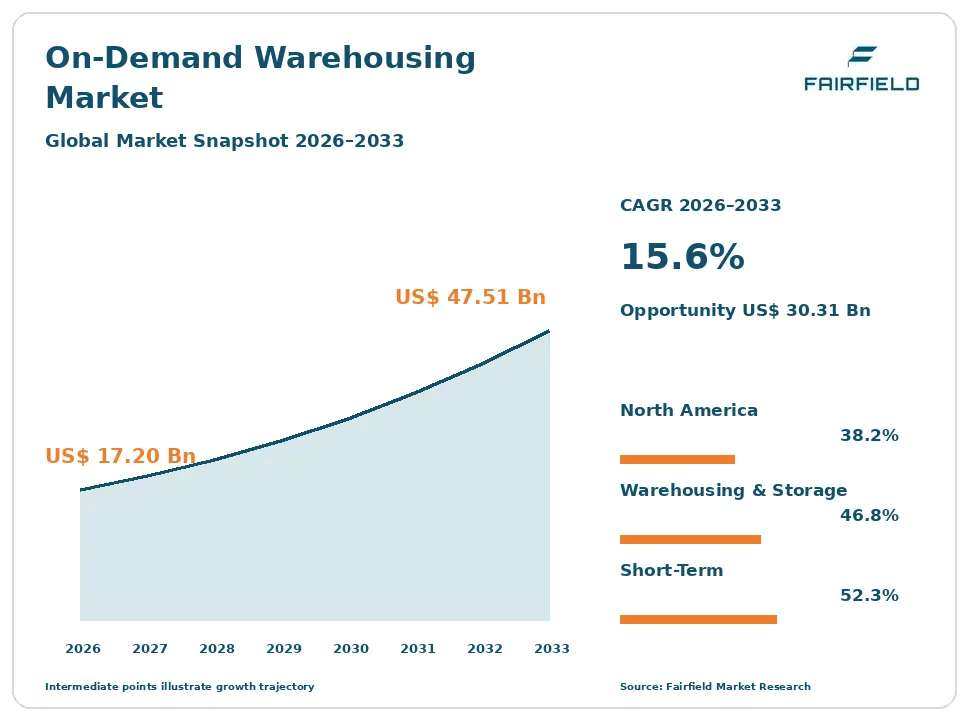
The global on-demand warehousing market size is expected to be valued at US$ 17.20 billion in 2026 and projected to reach US$ 47.51 billion by 2033, growing at a CAGR of 15.6% between 2026 and 2033.
Between 2020 and 2025, the market grew at a CAGR of about 14%, as online shopping surged and supply chain disruptions pushed brands to hold more inventory near customers. Three factors now drive growth: rapid e-commerce fulfillment growth, the need for flexible space to handle seasonal peaks and uncertain demand, and rising warehouse rents that make long leases risky. The market is shifting from traditional multi-year leases toward flexible warehousing booked by the month or pallet through a warehouse marketplace, with shared warehousing networks that let brands place stock in many locations without owning buildings. Third-party logistics providers and software platforms are adding automation, real-time inventory visibility, and integrated order fulfillment.
Key Report Takeaways
- By Service Type: Warehousing & Storage held 46.8% share in 2026, while Distribution & Fulfillment is projected to expand at a 17.6% CAGR through 2033, driven by direct-to-consumer brands needing fast delivery.
- By Storage Duration: Short-Term held 52.3% share in 2026, while Medium-Term is projected to expand at a 16.8% CAGR through 2033, driven by brands holding buffer stock against supply chain and tariff risks.
- By Industry: E-commerce & Retail held 36.4% share in 2026, while Consumer Packaged Goods is projected to expand at a 17.1% CAGR through 2033, driven by regional distribution and promotional peaks.
- By Region: North America held 38.2% share in 2026, while Asia Pacific is projected to expand at an 18.3% CAGR through 2033, driven by e-commerce growth in India, China, and Indonesia.
Global On-Demand Warehousing Market Trends and Insights
Drivers Impact Analysis
| Driver | Impact on CAGR Forecast | Geographic Relevance | Impact Timeline |
| E-commerce growth and faster delivery expectations | High | Global | Long term (≥4 years) |
| Supply chain volatility and demand for flexible capacity | High | North America, Europe, Asia Pacific | Medium term (2-4 years) |
Two drivers carry the strongest influence on on-demand warehousing demand during the forecast period.
E-commerce Growth Is Driving the On-Demand Warehousing Market
E-commerce growth and faster delivery expectations are the strongest driver of the on-demand warehousing market. Online sellers need inventory close to customers.
The mechanism is the shift to online shopping and next-day delivery. Global online retail sales keep rising, and e-commerce needs about three times as much warehouse space as store-based retail because of individual order picking and returns. Consumers expect delivery in one or two days, pushing brands to spread stock across several regional warehouses. Direct-to-consumer brands and marketplace sellers on Amazon, Shopify, Walmart, and Temu often lack their own warehouses. ShipBob partnered with Temu in 2025 to support marketplace sellers in the United States. Returns processing adds further space needs. These factors drive demand for flexible e-commerce fulfillment capacity.
Supply Chain Volatility Is Expanding the On-Demand Warehousing Market
Supply chain volatility and demand for flexible capacity are expanding the on-demand warehousing market. Companies want space they can add or remove quickly.
The cause is repeated disruptions and uncertain demand. Pandemic port congestion, the Red Sea shipping crisis, and changing tariffs in 2025 forced companies to hold more safety stock or move inventory on short notice. Industrial vacancy rates in North America and Europe fell to record lows in 2022, and rents rose sharply, making long leases expensive. Flexible warehousing lets companies pay only for the space they use, by pallet or square foot, for weeks or months. Retailers need extra space for holiday seasons and promotions. Manufacturers use on-demand space when launching products or shifting production. These benefits are attracting more mid-sized and large companies.
Restraints Impact Analysis
| Restraint | Impact on CAGR Forecast | Geographic Relevance | Impact Timeline |
| Inconsistent service quality and integration challenges | Medium | Global | Medium term (2-4 years) |
| Higher unit costs and limited capacity in peak periods | High | North America, Europe | Short term (≤2 years) |
Two restraints limit how quickly the on-demand warehousing market grows.
Service Quality Concerns Slow the On-Demand Warehousing Market
Inconsistent service quality and integration challenges slow the on-demand warehousing market. Networks of independent warehouses can vary widely in performance.
The specific causes are fragmented operators and technology gaps. On-demand networks bring together many warehouse operators with different systems, staff skills, and processes, which can lead to errors, delays, and damaged goods. Integrating each warehouse with a brand’s order management, enterprise resource planning, and shipping systems takes time. Shippers may lose visibility of inventory spread across many locations. Some operators lack modern warehouse management software or automation. Security and food safety certifications vary. Large brands often prefer dedicated contract logistics for control. Customers also worry about data security when sharing sales and inventory data with platforms. These factors slow adoption for complex and high-value goods, although better software is narrowing the gap.
Peak Capacity Limits Restrict the On-Demand Warehousing Market
Higher unit costs and limited capacity during peak periods restrict the on-demand warehousing market. Flexible space often costs more per unit than long-term leases.
The underlying causes are pricing models and seasonal demand. On-demand providers charge premiums for short contracts and handling services, so long-term high-volume users may find dedicated space cheaper. During holiday peaks, many companies seek extra space at the same time, raising prices and limiting availability. Labor shortages in warehouses push up wages, especially during peak seasons. Warehouse vacancy has risen since 2023 in some markets, lowering costs, but prime locations near cities remain scarce. Automation investment is harder to justify for short contracts. Long-term users may also face price rises at contract renewal. These factors limit use for steady, large-volume storage.
Market Opportunities
Distributed Fulfillment and Automation Open a Technology Revenue Pool
Distributed fulfillment networks and automation open a technology revenue pool in the on-demand warehousing market. Brands want fast delivery without building their own networks.
Platforms and third-party logistics providers with software and automation can capture this opportunity. Stord acquired Ware2Go from UPS in 2025, adding 21 fulfillment centers and about 2.5 million square feet to its network. Software that routes orders to the nearest warehouse cuts delivery times and shipping costs. Robots, automated storage, and AI forecasting improve productivity in shared facilities. Business-to-business and retail replenishment services add volume. Data analytics on inventory and demand create recurring software revenue. These services command higher margins than basic storage, and shared warehousing networks with common software can scale quickly. Partnerships with parcel carriers lower shipping costs for customers. Sustainability features such as solar-powered sites and electric delivery vans also attract brands with climate targets.
Asia Pacific E-commerce Growth Creates a Volume Revenue Pool
E-commerce growth in Asia Pacific creates a volume revenue pool in the on-demand warehousing market. The region has the world’s fastest-growing online shopping markets.
Local warehouse platforms and global providers can capture this opportunity. India has rapidly growing e-commerce, quick commerce, and direct-to-consumer brands, with platforms such as WareIQ and Shiprocket offering flexible fulfillment. China has the largest e-commerce market and many shared warehouse networks. Indonesia, Vietnam, and the Philippines have young, digital populations. Japan and Australia have strong demand for urban fulfillment space. Government investment in logistics parks and new tax rules support organized warehousing. Cross-border e-commerce sellers also need regional hubs, and investors such as Blackstone, ESR, and GLP are building modern logistics parks in the region. Digital platforms help small warehouse owners rent unused space and raise standards.
Segment Analysis
By Service Type: Warehousing & Storage Leads While Distribution & Fulfillment Grows Fastest
Warehousing & Storage held 46.8% share in 2026. Storage services cover pallet, shelf, bin, and bulk storage with basic receiving and inventory management. Companies use them for overflow, seasonal, and buffer stock. Flexe, Flowspace, Warehowz, and Waredock connect shippers with available space through a warehouse marketplace model. Value-added services such as kitting, labeling, and returns processing form another service type.
Distribution & Fulfillment is the fastest-growing service type, expanding at a 17.6% CAGR through 2033. E-commerce fulfillment includes picking, packing, and shipping individual orders, often within the same day. ShipBob, Stord, and Red Stag Fulfillment offer networks of fulfillment centers with integrated software. Same-day and next-day delivery promises require stock in several cities. For the market, fulfillment growth raises revenue per pallet.
By Storage Duration: Short-Term Leads While Medium-Term Grows Fastest
Short-Term held 52.3% share in 2026. Short-term storage of weeks to a few months covers seasonal peaks, promotions, product launches, and port overflow. Companies value the ability to add space quickly and release it after peaks. Kinaxia Logistics launched a flexible seasonal warehousing service in 2024. Long-term storage covers stable inventory for established brands.
Medium-Term is the fastest-growing storage duration, expanding at a 16.8% CAGR through 2033. Brands are holding buffer stock for six to twelve months to protect against supply chain and tariff risks. Medium-term contracts offer flexibility without short-term premiums. Importers stored more goods ahead of tariff changes in 2025, and manufacturers keep spare parts closer to plants. For the market, medium-term growth stabilizes provider revenue.
By Industry: E-commerce & Retail Lead While Consumer Packaged Goods Grows Fastest
E-commerce & Retail held 36.4% share in 2026. Online sellers and retailers need flexible space for direct-to-consumer orders, store replenishment, and returns. Marketplace sellers on Amazon, Walmart, and Temu use on-demand networks to meet delivery promises. Manufacturing, food and beverage, healthcare, and automotive industries form other users, with healthcare needing certified and temperature-controlled space.
Consumer Packaged Goods is the fastest-growing industry, expanding at a 17.1% CAGR through 2033. Food, beverage, personal care, and household goods companies use shared warehousing for regional distribution, promotional peaks, and new product launches. Some need temperature-controlled space. Retailer delivery windows and promotional calendars create sharp peaks that suit flexible space. For the market, packaged goods growth adds high-volume, steady demand.
Geography Analysis
Which Region Is Leading the On-Demand Warehousing Market?
North America is leading the on-demand warehousing market with a 38.2% share in 2026. The United States has a large e-commerce market, strong direct-to-consumer brands, and leading platforms such as Flexe, Stord, ShipBob, Flowspace, and Extensiv. Tight industrial markets in California, New Jersey, and Texas have pushed companies toward flexible space. Tariff changes in 2025 led importers to store more inventory near ports. Canada has growing e-commerce and logistics demand in Ontario. Nearshoring is raising warehouse demand in Mexico. One change shaping the region is consolidation among fulfillment networks.
Europe Advances the On-Demand Warehousing Market Through Cross-Border E-commerce
Europe is a major on-demand warehousing market. The United Kingdom, Germany, the Netherlands, France, and Poland have large e-commerce sectors and dense logistics networks. Platforms such as Waredock in Estonia and Wareflex in the United Kingdom connect shippers with available space across many countries. Cross-border online sales within the European Union need regional fulfillment hubs. High land costs and planning rules limit new warehouses near cities. Rising demand for returns processing and resale also supports flexible space. Key barriers include different tax and labor rules across countries. One opportunity is multi-country fulfillment networks.
Which Region Is Growing Fastest in the On-Demand Warehousing Market?
Asia Pacific is growing fastest in the on-demand warehousing market at an 18.3% CAGR through 2033. India is the fastest-growing country, with booming e-commerce, quick commerce, and new logistics parks supported by government policy. China has the largest shared warehouse networks and e-commerce volumes in the region. Indonesia, Vietnam, and Thailand have fast-growing online shopping markets. Japan and Australia need urban fulfillment space, and Singapore serves as a regional hub. Large investors are building modern logistics parks, and many small warehouses are joining digital marketplaces. One opportunity is flexible space for direct-to-consumer brands.
Latin America Grows the On-Demand Warehousing Market Through E-commerce
Latin America is a growing on-demand warehousing market. Brazil and Mexico have fast-growing e-commerce led by Mercado Libre, Amazon, and Shopee, and Mexico is seeing new warehouse demand from nearshoring. Colombia, Chile, and Argentina add growing demand from online retail and grocery delivery. Local platforms connect shippers with spare space, and new logistics parks near São Paulo, Monterrey, and Guadalajara are expanding modern supply. Many small sellers cannot afford their own warehouses. Key barriers include tax complexity, cargo security, and currency swings. One opportunity is flexible fulfillment for marketplace sellers.
Middle East & Africa Builds the On-Demand Warehousing Market
Middle East & Africa is an emerging on-demand warehousing market. Saudi Arabia and the United Arab Emirates are investing in logistics hubs and free zones, and e-commerce is growing quickly in both countries. Egypt, Nigeria, Kenya, and South Africa have growing online retail sectors and young, mobile-first consumers. Shared warehouse platforms are emerging in Dubai and Riyadh, serving local brands and international sellers. Saudi Arabia’s logistics plans aim to make the country a regional hub. Key barriers include limited modern warehouse stock and high rents in prime areas. One opportunity is free zone fulfillment hubs.
Competitive Landscape
The on-demand warehousing market is fragmented. Digital platforms such as Flexe, Stord, ShipBob, Flowspace, Extensiv, Warehowz, and Waredock compete with large third-party logistics providers such as DHL Supply Chain, GXO Logistics, Ryder, and Kenco that offer flexible contracts. Thousands of independent warehouse operators supply space through marketplaces.
Companies compete on network size and location, technology integration, inventory visibility, service quality, pricing flexibility, and speed of onboarding. Software platforms that connect to e-commerce stores, marketplaces, and enterprise systems win more customers. Asset-light marketplaces grow quickly by adding partner warehouses, while asset-based providers offer more control over quality. Consolidation is increasing as larger networks buy smaller ones to gain locations and customers. Large retailers such as Amazon and Walmart and carriers also offer fulfillment services to outside sellers, adding competition. Pricing models range from pay-per-pallet to bundled fulfillment fees.
Strategic moves show how competition is changing. In June 2024, Kinaxia Logistics launched seasonal on-demand warehousing. In August 2024, Warehowz partnered with Nexterus to simplify finding warehouse space. In April 2025, ShipBob partnered with Temu. In May 2025, Stord acquired Ware2Go from UPS, and Kenco acquired the logistics arm of Drexel Industries. These moves show competition shifting toward consolidation and marketplace partnerships.
Three themes shape vendor strategy. First, providers are consolidating to gain network scale. Second, they are adding software and automation. Third, they are partnering with marketplaces and carriers.
On-Demand Warehousing Market Industry Leaders
- Flexe
- Stord
- ShipBob
- Flowspace
- Extensiv
Recent Industry Developments
- May 2025: Stord acquired Ware2Go from UPS, adding 21 fulfillment centers and about 2.5 million square feet - expands its flexible fulfillment network in the United States.
- April 2025: ShipBob partnered with Temu to support marketplace logistics in the United States - brings more sellers into on-demand fulfillment.
- August 2024: Warehowz partnered with Nexterus, using a database of more than 2,500 properties - simplifies finding flexible warehouse space.
- June 2024: Kinaxia Logistics launched a flexible on-demand warehousing service for seasonal storage - targets retailers, manufacturers, and wholesalers.
Companies Covered in the Report
- Flexe
- Stord
- ShipBob
- Flowspace
- Extensiv
- Red Stag Fulfillment
- Warehowz
- Waredock
- Wareflex
- ZhenHub Technologies
- DHL Supply Chain
- GXO Logistics
On-Demand Warehousing Market Report Scope
This report covers on-demand warehousing, including warehousing and storage, distribution and fulfillment, and value-added services, offered on flexible short-, medium-, and long-term contracts through digital marketplaces and third-party logistics networks, for e-commerce, retail, packaged goods, manufacturing, food, healthcare, and other industries. It excludes owner-operated sites. The base year is 2025, and the forecast period runs from 2026 to 2033. All values are expressed in US$ Billion.
Service Type
- Warehousing & Storage
- Distribution & Fulfillment
- Value-Added Services
Storage Duration
- Short-Term
- Medium-Term
- Long-Term
Industry
- E-commerce & Retail
- Consumer Packaged Goods
- Manufacturing
- Food & Beverage
- Healthcare
- Others
Regions
- North America
- Europe
- Asia Pacific
- Latin America
- Middle East & Africa
Key Questions Answered in the Report
How big is the on-demand warehousing market in 2026?
The on-demand warehousing market is valued at US$ 17.20 billion in 2026, led by warehousing and storage services in North America.
What is the on-demand warehousing market forecast to 2033?
The market is projected to reach US$ 47.51 billion by 2033, growing at a 15.6% CAGR and adding US$ 30.31 billion.
Which service type is growing fastest in on-demand warehousing?
Distribution and fulfillment is growing fastest at a 17.6% CAGR through 2033, driven by direct-to-consumer brands needing fast delivery.
Which region is growing fastest in the on-demand warehousing market?
Asia Pacific is growing fastest at an 18.3% CAGR through 2033, driven by e-commerce growth in India, China, and Indonesia.
Which region holds the largest on-demand warehousing market share?
North America holds the largest share at 38.2% in 2026, supported by strong e-commerce and leading flexible warehousing platforms.
1. Executive Summary
1.1. Global On-Demand Warehousing Market Snapshot
1.2. Future Projections
1.3. Key Report Takeaways
1.4. Regional Snapshot
2. Market Overview
2.1. Market Definition and Report Scope
2.2. Historical Trends 2020–2025
2.3. Market Dynamics
2.3.1. Drivers
2.3.1.1. E-commerce Growth Is Driving the On-Demand Warehousing Market
2.3.1.2. Supply Chain Volatility Is Expanding the On-Demand Warehousing Market
2.3.2. Restraints
2.3.2.1. Service Quality Concerns Slow the On-Demand Warehousing Market
2.3.2.2. Peak Capacity Limits Restrict the On-Demand Warehousing Market
2.3.3. Market Opportunities
2.3.3.1. Distributed Fulfillment and Automation Open a Technology Revenue Pool
2.3.3.2. Asia Pacific E-commerce Growth Creates a Volume Revenue Pool
3. Global On-Demand Warehousing Market Outlook, 2020-2033
3.1. Global On-Demand Warehousing Market Outlook, by Service Type, Value (US$ Billion), 2020-2033
3.1.1. Warehousing & Storage
3.1.2. Distribution & Fulfillment
3.1.3. Value-Added Services
3.2. Global On-Demand Warehousing Market Outlook, by Storage Duration, Value (US$ Billion), 2020-2033
3.2.1. Short-Term
3.2.2. Medium-Term
3.2.3. Long-Term
3.3. Global On-Demand Warehousing Market Outlook, by Industry, Value (US$ Billion), 2020-2033
3.3.1. E-commerce & Retail
3.3.2. Consumer Packaged Goods
3.3.3. Manufacturing
3.3.4. Food & Beverage
3.3.5. Healthcare
3.3.6. Others
3.4. Global On-Demand Warehousing Market Outlook, by Region, Value (US$ Billion), 2020-2033
3.4.1. North America
3.4.2. Europe
3.4.3. Asia Pacific
3.4.4. Latin America
3.4.5. Middle East & Africa
4. North America On-Demand Warehousing Market Outlook, 2020-2033
4.1. North America On-Demand Warehousing Market Outlook, by Service Type, Value (US$ Billion), 2020-2033
4.1.1. Warehousing & Storage
4.1.2. Distribution & Fulfillment
4.1.3. Value-Added Services
4.2. North America On-Demand Warehousing Market Outlook, by Storage Duration, Value (US$ Billion), 2020-2033
4.2.1. Short-Term
4.2.2. Medium-Term
4.2.3. Long-Term
4.3. North America On-Demand Warehousing Market Outlook, by Industry, Value (US$ Billion), 2020-2033
4.3.1. E-commerce & Retail
4.3.2. Consumer Packaged Goods
4.3.3. Manufacturing
4.3.4. Food & Beverage
4.3.5. Healthcare
4.3.6. Others
4.4. North America On-Demand Warehousing Market Outlook, by Country, Value (US$ Billion), 2020-2033
4.4.1. United States On-Demand Warehousing Market Outlook, by Service Type, 2020-2033
4.4.2. United States On-Demand Warehousing Market Outlook, by Storage Duration, 2020-2033
4.4.3. United States On-Demand Warehousing Market Outlook, by Industry, 2020-2033
4.4.4. Canada On-Demand Warehousing Market Outlook, by Service Type, 2020-2033
4.4.5. Canada On-Demand Warehousing Market Outlook, by Storage Duration, 2020-2033
4.4.6. Canada On-Demand Warehousing Market Outlook, by Industry, 2020-2033
4.4.7. Mexico On-Demand Warehousing Market Outlook, by Service Type, 2020-2033
4.4.8. Mexico On-Demand Warehousing Market Outlook, by Storage Duration, 2020-2033
4.4.9. Mexico On-Demand Warehousing Market Outlook, by Industry, 2020-2033
5. Europe On-Demand Warehousing Market Outlook, 2020-2033
5.1. Europe On-Demand Warehousing Market Outlook, by Service Type, Value (US$ Billion), 2020-2033
5.1.1. Warehousing & Storage
5.1.2. Distribution & Fulfillment
5.1.3. Value-Added Services
5.2. Europe On-Demand Warehousing Market Outlook, by Storage Duration, Value (US$ Billion), 2020-2033
5.2.1. Short-Term
5.2.2. Medium-Term
5.2.3. Long-Term
5.3. Europe On-Demand Warehousing Market Outlook, by Industry, Value (US$ Billion), 2020-2033
5.3.1. E-commerce & Retail
5.3.2. Consumer Packaged Goods
5.3.3. Manufacturing
5.3.4. Food & Beverage
5.3.5. Healthcare
5.3.6. Others
5.4. Europe On-Demand Warehousing Market Outlook, by Country, Value (US$ Billion), 2020-2033
5.4.1. United Kingdom On-Demand Warehousing Market Outlook, by Service Type, 2020-2033
5.4.2. United Kingdom On-Demand Warehousing Market Outlook, by Storage Duration, 2020-2033
5.4.3. United Kingdom On-Demand Warehousing Market Outlook, by Industry, 2020-2033
5.4.4. Germany On-Demand Warehousing Market Outlook, by Service Type, 2020-2033
5.4.5. Germany On-Demand Warehousing Market Outlook, by Storage Duration, 2020-2033
5.4.6. Germany On-Demand Warehousing Market Outlook, by Industry, 2020-2033
5.4.7. Netherlands On-Demand Warehousing Market Outlook, by Service Type, 2020-2033
5.4.8. Netherlands On-Demand Warehousing Market Outlook, by Storage Duration, 2020-2033
5.4.9. Netherlands On-Demand Warehousing Market Outlook, by Industry, 2020-2033
5.4.10. France On-Demand Warehousing Market Outlook, by Service Type, 2020-2033
5.4.11. France On-Demand Warehousing Market Outlook, by Storage Duration, 2020-2033
5.4.12. France On-Demand Warehousing Market Outlook, by Industry, 2020-2033
5.4.13. Poland On-Demand Warehousing Market Outlook, by Service Type, 2020-2033
5.4.14. Poland On-Demand Warehousing Market Outlook, by Storage Duration, 2020-2033
5.4.15. Poland On-Demand Warehousing Market Outlook, by Industry, 2020-2033
5.4.16. Estonia On-Demand Warehousing Market Outlook, by Service Type, 2020-2033
5.4.17. Estonia On-Demand Warehousing Market Outlook, by Storage Duration, 2020-2033
5.4.18. Estonia On-Demand Warehousing Market Outlook, by Industry, 2020-2033
6. Asia Pacific On-Demand Warehousing Market Outlook, 2020-2033
6.1. Asia Pacific On-Demand Warehousing Market Outlook, by Service Type, Value (US$ Billion), 2020-2033
6.1.1. Warehousing & Storage
6.1.2. Distribution & Fulfillment
6.1.3. Value-Added Services
6.2. Asia Pacific On-Demand Warehousing Market Outlook, by Storage Duration, Value (US$ Billion), 2020-2033
6.2.1. Short-Term
6.2.2. Medium-Term
6.2.3. Long-Term
6.3. Asia Pacific On-Demand Warehousing Market Outlook, by Industry, Value (US$ Billion), 2020-2033
6.3.1. E-commerce & Retail
6.3.2. Consumer Packaged Goods
6.3.3. Manufacturing
6.3.4. Food & Beverage
6.3.5. Healthcare
6.3.6. Others
6.4. Asia Pacific On-Demand Warehousing Market Outlook, by Country, Value (US$ Billion), 2020-2033
6.4.1. India On-Demand Warehousing Market Outlook, by Service Type, 2020-2033
6.4.2. India On-Demand Warehousing Market Outlook, by Storage Duration, 2020-2033
6.4.3. India On-Demand Warehousing Market Outlook, by Industry, 2020-2033
6.4.4. China On-Demand Warehousing Market Outlook, by Service Type, 2020-2033
6.4.5. China On-Demand Warehousing Market Outlook, by Storage Duration, 2020-2033
6.4.6. China On-Demand Warehousing Market Outlook, by Industry, 2020-2033
6.4.7. Indonesia On-Demand Warehousing Market Outlook, by Service Type, 2020-2033
6.4.8. Indonesia On-Demand Warehousing Market Outlook, by Storage Duration, 2020-2033
6.4.9. Indonesia On-Demand Warehousing Market Outlook, by Industry, 2020-2033
6.4.10. Vietnam On-Demand Warehousing Market Outlook, by Service Type, 2020-2033
6.4.11. Vietnam On-Demand Warehousing Market Outlook, by Storage Duration, 2020-2033
6.4.12. Vietnam On-Demand Warehousing Market Outlook, by Industry, 2020-2033
6.4.13. Thailand On-Demand Warehousing Market Outlook, by Service Type, 2020-2033
6.4.14. Thailand On-Demand Warehousing Market Outlook, by Storage Duration, 2020-2033
6.4.15. Thailand On-Demand Warehousing Market Outlook, by Industry, 2020-2033
6.4.16. Japan On-Demand Warehousing Market Outlook, by Service Type, 2020-2033
6.4.17. Japan On-Demand Warehousing Market Outlook, by Storage Duration, 2020-2033
6.4.18. Japan On-Demand Warehousing Market Outlook, by Industry, 2020-2033
6.4.19. Australia On-Demand Warehousing Market Outlook, by Service Type, 2020-2033
6.4.20. Australia On-Demand Warehousing Market Outlook, by Storage Duration, 2020-2033
6.4.21. Australia On-Demand Warehousing Market Outlook, by Industry, 2020-2033
6.4.22. Singapore On-Demand Warehousing Market Outlook, by Service Type, 2020-2033
6.4.23. Singapore On-Demand Warehousing Market Outlook, by Storage Duration, 2020-2033
6.4.24. Singapore On-Demand Warehousing Market Outlook, by Industry, 2020-2033
7. Latin America On-Demand Warehousing Market Outlook, 2020-2033
7.1. Latin America On-Demand Warehousing Market Outlook, by Service Type, Value (US$ Billion), 2020-2033
7.1.1. Warehousing & Storage
7.1.2. Distribution & Fulfillment
7.1.3. Value-Added Services
7.2. Latin America On-Demand Warehousing Market Outlook, by Storage Duration, Value (US$ Billion), 2020-2033
7.2.1. Short-Term
7.2.2. Medium-Term
7.2.3. Long-Term
7.3. Latin America On-Demand Warehousing Market Outlook, by Industry, Value (US$ Billion), 2020-2033
7.3.1. E-commerce & Retail
7.3.2. Consumer Packaged Goods
7.3.3. Manufacturing
7.3.4. Food & Beverage
7.3.5. Healthcare
7.3.6. Others
7.4. Latin America On-Demand Warehousing Market Outlook, by Country, Value (US$ Billion), 2020-2033
7.4.1. Brazil On-Demand Warehousing Market Outlook, by Service Type, 2020-2033
7.4.2. Brazil On-Demand Warehousing Market Outlook, by Storage Duration, 2020-2033
7.4.3. Brazil On-Demand Warehousing Market Outlook, by Industry, 2020-2033
7.4.4. Mexico On-Demand Warehousing Market Outlook, by Service Type, 2020-2033
7.4.5. Mexico On-Demand Warehousing Market Outlook, by Storage Duration, 2020-2033
7.4.6. Mexico On-Demand Warehousing Market Outlook, by Industry, 2020-2033
7.4.7. Colombia On-Demand Warehousing Market Outlook, by Service Type, 2020-2033
7.4.8. Colombia On-Demand Warehousing Market Outlook, by Storage Duration, 2020-2033
7.4.9. Colombia On-Demand Warehousing Market Outlook, by Industry, 2020-2033
7.4.10. Chile On-Demand Warehousing Market Outlook, by Service Type, 2020-2033
7.4.11. Chile On-Demand Warehousing Market Outlook, by Storage Duration, 2020-2033
7.4.12. Chile On-Demand Warehousing Market Outlook, by Industry, 2020-2033
7.4.13. Argentina On-Demand Warehousing Market Outlook, by Service Type, 2020-2033
7.4.14. Argentina On-Demand Warehousing Market Outlook, by Storage Duration, 2020-2033
7.4.15. Argentina On-Demand Warehousing Market Outlook, by Industry, 2020-2033
8. Middle East & Africa On-Demand Warehousing Market Outlook, 2020-2033
8.1. Middle East & Africa On-Demand Warehousing Market Outlook, by Service Type, Value (US$ Billion), 2020-2033
8.1.1. Warehousing & Storage
8.1.2. Distribution & Fulfillment
8.1.3. Value-Added Services
8.2. Middle East & Africa On-Demand Warehousing Market Outlook, by Storage Duration, Value (US$ Billion), 2020-2033
8.2.1. Short-Term
8.2.2. Medium-Term
8.2.3. Long-Term
8.3. Middle East & Africa On-Demand Warehousing Market Outlook, by Industry, Value (US$ Billion), 2020-2033
8.3.1. E-commerce & Retail
8.3.2. Consumer Packaged Goods
8.3.3. Manufacturing
8.3.4. Food & Beverage
8.3.5. Healthcare
8.3.6. Others
8.4. Middle East & Africa On-Demand Warehousing Market Outlook, by Country, Value (US$ Billion), 2020-2033
8.4.1. Saudi Arabia On-Demand Warehousing Market Outlook, by Service Type, 2020-2033
8.4.2. Saudi Arabia On-Demand Warehousing Market Outlook, by Storage Duration, 2020-2033
8.4.3. Saudi Arabia On-Demand Warehousing Market Outlook, by Industry, 2020-2033
8.4.4. United Arab Emirates On-Demand Warehousing Market Outlook, by Service Type, 2020-2033
8.4.5. United Arab Emirates On-Demand Warehousing Market Outlook, by Storage Duration, 2020-2033
8.4.6. United Arab Emirates On-Demand Warehousing Market Outlook, by Industry, 2020-2033
8.4.7. Egypt On-Demand Warehousing Market Outlook, by Service Type, 2020-2033
8.4.8. Egypt On-Demand Warehousing Market Outlook, by Storage Duration, 2020-2033
8.4.9. Egypt On-Demand Warehousing Market Outlook, by Industry, 2020-2033
8.4.10. Nigeria On-Demand Warehousing Market Outlook, by Service Type, 2020-2033
8.4.11. Nigeria On-Demand Warehousing Market Outlook, by Storage Duration, 2020-2033
8.4.12. Nigeria On-Demand Warehousing Market Outlook, by Industry, 2020-2033
8.4.13. Kenya On-Demand Warehousing Market Outlook, by Service Type, 2020-2033
8.4.14. Kenya On-Demand Warehousing Market Outlook, by Storage Duration, 2020-2033
8.4.15. Kenya On-Demand Warehousing Market Outlook, by Industry, 2020-2033
8.4.16. South Africa On-Demand Warehousing Market Outlook, by Service Type, 2020-2033
8.4.17. South Africa On-Demand Warehousing Market Outlook, by Storage Duration, 2020-2033
8.4.18. South Africa On-Demand Warehousing Market Outlook, by Industry, 2020-2033
9. Competitive Landscape
9.1. Market Concentration and Industry Leaders
9.2. Competitive Differentiation
9.3. Strategic Moves and Market Direction
9.4. Recent Industry Developments
9.5. Company Profiles
9.5.1. Flexe
9.5.2. Stord
9.5.3. ShipBob
9.5.4. Flowspace
9.5.5. Extensiv
9.5.6. Red Stag Fulfillment
9.5.7. Warehowz
9.5.8. Waredock
9.5.9. Wareflex
9.5.10. ZhenHub Technologies
9.5.11. DHL Supply Chain
9.5.12. GXO Logistics
10. Appendix
10.1. Research Methodology
10.2. Report Assumptions
10.3. Acronyms and Abbreviations
| Service Type | Warehousing & Storage, Distribution & Fulfillment, Value-Added Services |
| Storage Duration | Short-Term, Medium-Term, Long-Term |
| Industry | E-commerce & Retail, Consumer Packaged Goods, Manufacturing, Food & Beverage, Healthcare, Others |
| Regions | North America, Europe, Asia Pacific, Latin America, Middle East & Africa |
Our Research Methodology
Considering the volatility of business today, traditional approaches to strategizing a game plan can be unfruitful if not detrimental. True ambiguity is no way to determine a forecast. A myriad of predetermined factors must be accounted for such as the degree of risk involved, the magnitude of circumstances, as well as conditions or consequences that are not known or unpredictable. To circumvent binary views that cast uncertainty, the application of market research intelligence to strategically posture, move, and enable actionable outcomes is necessary.
View Methodology
Quality Assured
Rigorous Validation Process

Confidentiality Assured
End-to-end Data Security

Custom Research Services
Tailored To Your Objectives
FAQs
The on-demand warehousing market is valued at US$ 17.20 billion in 2026, led by warehousing and storage services in North America.
The market is projected to reach US$ 47.51 billion by 2033, growing at a 15.6% CAGR and adding US$ 30.31 billion.
Distribution and fulfillment is growing fastest at a 17.6% CAGR through 2033, driven by direct-to-consumer brands needing fast delivery.
Asia Pacific is growing fastest at an 18.3% CAGR through 2033, driven by e-commerce growth in India, China, and Indonesia.
North America holds the largest share at 38.2% in 2026, supported by strong e-commerce and leading flexible warehousing platforms.
Related Reports
Electric Vehicle Sound Generator Market Size, Share, Insights, Competitive Landscape, and Forecast 2026 to 2033
Electric vehicle sound generator market to grow from US$1.2 Bn in 2026 to US$3.2 Bn by 2033 at 15.0% CAGR. Explore systems, components and regions.
On-Demand Trucking Market Size, Share, Insights, Competitive Landscape, and Forecast 2026 to 2033
On-demand trucking market to grow from US$11.00 Bn in 2026 to US$30.52 Bn by 2033 at 15.7% CAGR. Explore truck types, services, industries and regions.
On-Demand Transportation Market Size, Share, Insights, Competitive Landscape, and Forecast 2026 to 2033
On-demand transportation market to grow from US$289.18 Bn in 2026 to US$779.10 Bn by 2033 at 15.2% CAGR. Explore services, vehicles and regional trends.
On-Board Diagnostics (OBD) Aftermarket Size, Share, Insights, Competitive Landscape, and Forecast 2026 to 2033
On-board diagnostics (OBD) aftermarket to grow from US$4.74 Bn in 2026 to US$21.02 Bn by 2033 at 23.7% CAGR. Explore connectivity, applications and regions.
On-Board Charger Market Size, Share, Insights, Competitive Landscape, and Forecast 2026 to 2033
On-board charger market to grow from US$10.13 Bn in 2026 to US$27.16 Bn by 2033 at 15.1% CAGR. Explore propulsion, power output, vehicles and regions.
Second Life EV Battery Market Size, Share, Insights, Competitive Landscape, and Forecast 2026 to 2033
Second life EV battery market to reach US$ 19.52 billion by 2033 at a 41.7% CAGR. Explore applications, battery chemistries and regional trends.