



On-Board Charger Market
On-Board Charger Market Size, Share, Insights, Competitive Landscape, and Forecast 2026 to 2033
On-Board Charger Market Analysis, 2026–2033
On-Board Charger Market
On-Board Charger Market Size, Share, Insights, Competitive Landscape, and Forecast 2026 to 2033
On-Board Charger Market Size and Trend Analysis
How Fast Is the On-Board Charger Market Growing?
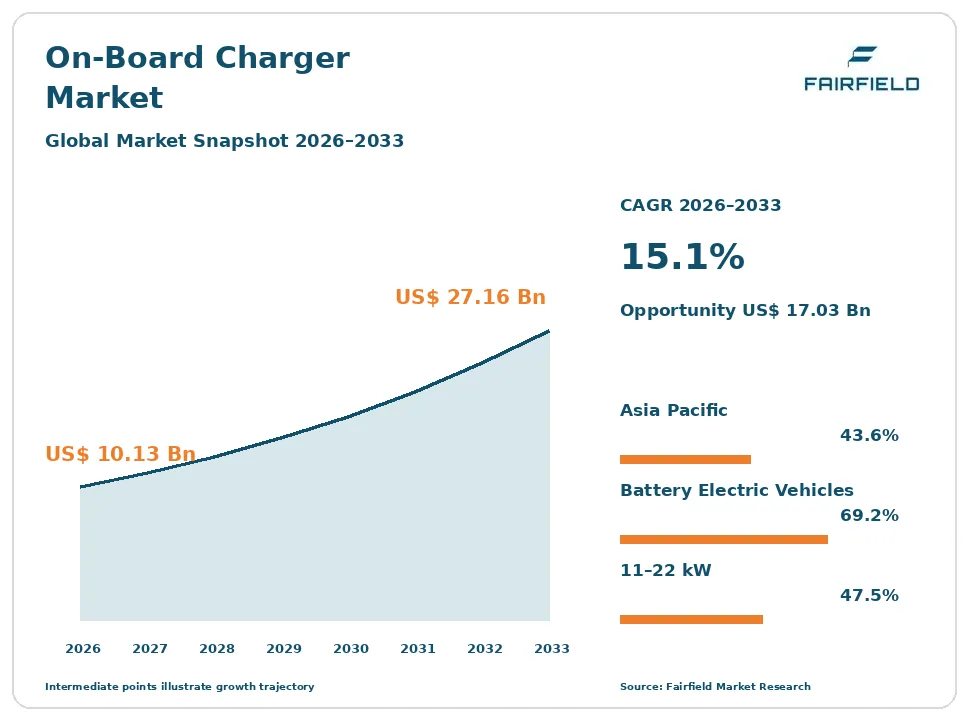
The global on-board charger market size is expected to be valued at US$ 10.13 billion in 2026 and projected to reach US$ 27.16 billion by 2033, growing at a CAGR of 15.1% between 2026 and 2033.
Between 2020 and 2025, the market grew at a CAGR of more than 30%, as global electric vehicle sales rose from about 3 million units in 2020 to more than 17 million in 2024, led by China. Three factors now drive growth: continued growth of battery electric vehicles and plug-in hybrids, the move to higher charging power for faster home and workplace charging, and the shift to 800V architecture in premium and commercial vehicles. The market is shifting from simple one-way chargers of 3.3 kW to 7.4 kW toward 11 kW and 22 kW units with bidirectional charging for vehicle-to-home and vehicle-to-grid services. Silicon carbide semiconductors are making chargers smaller and more efficient.
Key Report Takeaways
- By Propulsion: Battery Electric Vehicles held 69.2% share in 2026, while Plug-in Hybrid Electric Vehicles are projected to expand at a 16.1% CAGR through 2033, driven by strong range-extender and hybrid sales in China and Europe.
- By Power Output: 11-22 kW held 47.5% share in 2026, while Above 22 kW is projected to expand at an 18.2% CAGR through 2033, driven by commercial vehicles and premium cars needing faster AC charging.
- By Vehicle Type: Passenger Cars held 57.3% share in 2026, while Commercial Vehicles are projected to expand at a 17.4% CAGR through 2033, driven by electric vans, buses, and trucks for fleets.
- By Region: Asia Pacific held 43.6% share in 2026, while India is projected to expand at a 20.4% CAGR through 2033, driven by electric car, three-wheeler, and bus adoption under government incentives.
Global On-Board Charger Market Trends and Insights
Drivers Impact Analysis
| Driver | Impact on CAGR Forecast | Geographic Relevance | Impact Timeline |
| Rising electric vehicle production | High | Asia Pacific, Europe, North America | Long term (≥4 years) |
| Higher power and bidirectional charging | High | Europe, North America, Asia Pacific | Medium term (2-4 years) |
Two drivers carry the strongest influence on on-board charger demand during the forecast period.
Electric Vehicle Growth Is Driving the On-Board Charger Market
Rising electric vehicle production is the strongest driver of the on-board charger market. Every plug-in car, van, bus, and truck needs a charger to convert AC grid power into DC battery power.
The mechanism is government policy, falling battery costs, and wider model choice. China sells more than half of the world’s electric vehicles, supported by purchase incentives, licence plate rules, and a strong domestic industry led by BYD, Geely, and SAIC. The European Union has strict fleet carbon dioxide targets, and many countries offer purchase subsidies, with Germany restarting incentives in 2026. South Korea increased its electric vehicle subsidy budget for 2026. Battery pack prices have fallen sharply, bringing electric car prices closer to petrol models. Carmakers are launching affordable models in more segments. Most charging happens at home and work using AC power through the on-board charger. These factors support strong unit growth.
Higher Power and Bidirectional Charging Are Expanding the On-Board Charger Market
Higher power ratings and bidirectional charging are expanding the on-board charger market. Drivers want faster AC charging and new ways to use their car batteries.
The cause is larger batteries and new energy services. Larger battery packs need higher-power chargers to refill overnight or during a workday, so 11 kW and 22 kW units are replacing 7.4 kW units in many models. Bidirectional chargers let cars power homes during outages, appliances at campsites, or the grid during peak demand through vehicle-to-grid programs. BorgWarner won a contract to supply an 800V bidirectional on-board charger to a North American carmaker for production from 2027. Nissan plans an affordable AC bidirectional charging system with an integrated charger. Volkswagen, Vattenfall, and partners launched bidirectional charging pilots in Sweden in 2026. These features raise the value of each charger.
Restraints Impact Analysis
| Restraint | Impact on CAGR Forecast | Geographic Relevance | Impact Timeline |
| Slower electric vehicle adoption in some markets | High | North America, Europe | Short term (≤2 years) |
| Price pressure and DC fast charging competition | Medium | Global | Medium term (2-4 years) |
Two restraints limit how quickly the on-board charger market grows.
Slower EV Adoption Slows the On-Board Charger Market
Slower electric vehicle adoption in some markets slows the on-board charger market. Growth outside China has been uneven.
The specific causes are policy changes, price concerns, and charging worries. The United States ended federal electric vehicle tax credits in 2025, and several carmakers delayed or cancelled electric models and battery plants. Some countries in Europe cut subsidies in 2023 and 2024, causing sales dips before new incentives. Many buyers still worry about upfront prices, range, charging access, and resale values. High interest rates raised the cost of car loans. Carmakers have shifted some plans back toward hybrids. Tariffs on Chinese electric vehicles and components in the United States and European Union add uncertainty for supply chains. These factors lower demand forecasts and create volatility for charger suppliers.
Price Pressure Restricts the On-Board Charger Market
Price pressure and competition from DC fast charging restrict the on-board charger market. Carmakers are pushing hard to cut costs per vehicle.
The underlying causes are fierce price competition and changing charging habits. Electric vehicle price wars in China have forced suppliers to cut charger prices sharply. Carmakers increasingly integrate the on-board charger, DC-DC converter, and inverter into single power units, which reduces the number of separate products and squeezes margins. Many Chinese carmakers make chargers in-house. Expanding DC fast charging networks can reduce the need for high-power AC chargers in some vehicles. Silicon carbide chips remain costly, although prices are falling. Long carmaker approval cycles also make it hard for new suppliers to win contracts. These factors limit value growth even as unit volumes rise.
Market Opportunities
Bidirectional and 800V Chargers Open a Premium Revenue Pool
Bidirectional and 800V architecture chargers open a premium revenue pool in the on-board charger market. Carmakers want chargers that support energy services and faster charging.
Suppliers with power electronics and software expertise can capture this opportunity. Vehicle-to-grid programs let owners earn money by supplying power to the grid, and utilities in Europe, Japan, and the United States are testing them. Vehicle-to-home features provide backup power during outages. 800V systems used by Hyundai, Kia, Porsche, Lucid, and Chinese brands need compatible chargers. Silicon carbide and gallium nitride devices from Infineon, STMicroelectronics, Wolfspeed, and onsemi raise efficiency. Software for grid communication and cybersecurity adds value. Over-the-air software updates can add features after sale. These chargers command higher prices and stronger margins.
Commercial Vehicles and India Create a Volume Revenue Pool
Commercial electric vehicles and fast-growing markets such as India create a volume revenue pool in the on-board charger market. Fleets and emerging markets are electrifying quickly.
Suppliers with rugged, high-power, and low-cost products can capture this opportunity. Electric vans, buses, and trucks need high-power on-board chargers above 22 kW for depot charging. BRUSA Hypower launched an on-board charger and DC-DC converter for heavy-duty vehicles in 2025. India has large electric three-wheeler and two-wheeler markets and growing electric car and bus sales supported by government schemes. Indonesia, Thailand, and Vietnam are adding electric vehicle plants. Local production lowers costs and helps meet localization rules. Off-highway machines such as forklifts, mining trucks, and construction equipment add further demand.
Segment Analysis
By Propulsion: Battery Electric Vehicles Lead While Plug-in Hybrids Grow Fastest
Battery Electric Vehicles held 69.2% share in 2026. Battery electric vehicles rely entirely on charging and have large batteries, so they usually need higher-power on-board chargers of 11 kW or more. Tesla, BYD, Volkswagen, Hyundai, and Geely sell large volumes of battery electric cars. Battery electric buses and vans add commercial demand. Higher power and bidirectional features raise the charger value per car.
Plug-in Hybrid Electric Vehicles are the fastest-growing propulsion type, expanding at a 16.1% CAGR through 2033. Plug-in hybrids and range-extended electric vehicles have strong sales in China, led by BYD, Li Auto, and AITO. Carmakers in Europe and North America are adding hybrids as a bridge for buyers worried about range. These vehicles mostly use 3.3 kW to 7.4 kW chargers. For the market, hybrid growth adds unit volume.
By Power Output: 11-22 kW Leads While Above 22 kW Grows Fastest
11-22 kW held 47.5% share in 2026. Chargers in this range suit three-phase home and workplace charging in Europe and higher-power single-phase charging in North America, refilling most batteries overnight. Many new models in Europe offer 11 kW as standard and 22 kW as an option. Chargers below 11 kW remain common in hybrids, small cars, and markets with single-phase power such as Japan and India.
Above 22 kW is the fastest-growing power output, expanding at an 18.2% CAGR through 2033. High-power AC charging helps buses, trucks, and vans recharge quickly at depots without expensive DC equipment. Premium cars also offer higher power options. Silicon carbide devices make these chargers compact enough to fit. For the market, high-power growth raises value per unit.
By Vehicle Type: Passenger Cars Lead While Commercial Vehicles Grow Fastest
Passenger Cars held 57.3% share in 2026. Electric cars, SUVs, and pickups make up most electric vehicle sales worldwide, and nearly all need an on-board charger. Competition among carmakers drives demand for compact, efficient, and low-cost chargers. Two- and three-wheelers use smaller chargers, often off-board.
Commercial Vehicles are the fastest-growing vehicle type, expanding at a 17.4% CAGR through 2033. Delivery companies, transit agencies, and logistics fleets are switching to electric vans, buses, and trucks to cut fuel and maintenance costs and meet emission rules. These vehicles need robust, high-power chargers. Zapi Group bought Stercom Power Solutions in 2025 to expand in this area. For the market, commercial growth adds high-value demand.
Geography Analysis
North America Advances the On-Board Charger Market Through 800V Platforms
North America is a significant on-board charger market. The United States has strong electric vehicle sales from Tesla, General Motors, Ford, Hyundai, and Rivian, and growing adoption of electric pickups and delivery vans. BorgWarner will supply an 800V bidirectional charger to a North American carmaker from 2027. The end of federal tax credits in 2025 slowed sales, but state incentives, fleet electrification, and new models support demand. Canada has zero-emission vehicle sales mandates. Mexico hosts many automotive electronics plants. One change shaping the region is vehicle-to-home charging for backup power.
Europe Builds the On-Board Charger Market Through High-Power AC Charging
Europe is a major on-board charger market. Germany, France, the United Kingdom, Norway, the Netherlands, and Sweden have high electric vehicle sales. Three-phase power is common, so 11 kW and 22 kW chargers are widely used. Valeo, Bosch, MAHLE, BRUSA Hypower, and Vitesco Technologies (now part of Schaeffler) are major suppliers. Germany restarted electric vehicle subsidies in 2026, and European Union carbon dioxide targets push carmakers to sell more electric models. Bidirectional pilots are expanding in Sweden and Germany. Key barriers include cost pressure from Chinese competition. One opportunity is vehicle-to-grid services.
Which Region Is Leading the On-Board Charger Market?
Asia Pacific is leading the on-board charger market with a 43.6% share in 2026. China is the world’s largest electric vehicle market and production base, with carmakers such as BYD, Geely, SAIC, Li Auto, and NIO, and charger suppliers such as Shinry, Tiecheng, and Delta Electronics. Many Chinese carmakers make chargers in-house. Japan and South Korea have large automotive and electronics industries, with Toyota Industries, Hyundai Mobis, and LG Magna as suppliers. Thailand and Indonesia are building electric vehicle plants. One change shaping the region is fierce price competition among suppliers.
Which Country Is Growing Fastest in the On-Board Charger Market?
India is growing fastest in the on-board charger market at a 20.4% CAGR through 2033, within Asia Pacific. India has the world’s largest electric three-wheeler market and a fast-growing electric two-wheeler sector led by Ola Electric, TVS Motor, Bajaj Auto, and Ather Energy. Electric car sales from Tata Motors, Mahindra, MG Motor, and Hyundai are rising. Government schemes support electric buses and local manufacturing of components. Charging infrastructure is expanding in major cities, and production-linked incentives encourage local electronics manufacturing. Global suppliers are setting up plants in Pune and Chennai. One opportunity is low-cost chargers for small vehicles.
Latin America Grows the On-Board Charger Market Through Fleet Electrification
Latin America is a growing on-board charger market. Brazil and Mexico are seeing rising electric vehicle sales, helped by Chinese brands such as BYD, which is building a plant in Brazil. Chile and Colombia have very large electric bus fleets in Santiago and Bogotá. VEMO secured financing in 2025 to expand charging and electric fleets in Mexico. Argentina and Uruguay are also adding electric buses and taxis. Several countries have cut import duties on electric vehicles. Key barriers include high vehicle prices, limited charging, and currency swings. One opportunity is electric buses and delivery fleets.
Middle East & Africa Builds the On-Board Charger Market
Middle East & Africa is an emerging on-board charger market. The United Arab Emirates and Saudi Arabia are promoting electric vehicles, building charging networks, and investing in local production through Ceer and Lucid’s plant in Saudi Arabia. Israel has fast-growing electric car sales. South Africa, Morocco, and Egypt have automotive industries considering electric models. Morocco is becoming an export hub for car parts, including electronics for Europe. Jordan has high electric car adoption due to lower import taxes. Key barriers include low electric vehicle adoption and limited charging. One opportunity is local assembly.
Competitive Landscape
The on-board charger market is moderately concentrated. Valeo is the market leader with more than 9% share, and the top five suppliers, Valeo, Robert Bosch, BorgWarner, MAHLE, and Delta Electronics, hold about 35% combined. Other players include Vitesco Technologies, Toyota Industries, LG Magna, Hyundai Mobis, Shinry, BRUSA Hypower, Zapi Group, Eaton, and Kostal, while carmakers such as Tesla and BYD build their own chargers.
Companies compete on power density, efficiency, cost, bidirectional capability, software, and the ability to supply large volumes reliably. Integration of the charger with the DC-DC converter and other power electronics is a key trend that favors suppliers with broad portfolios. Semiconductor makers such as Infineon, STMicroelectronics, onsemi, and Texas Instruments supply key chips and reference designs. Chinese suppliers compete aggressively on price.
Strategic moves show how competition is changing. In October 2024, Nissan announced plans for an affordable bidirectional AC charging system with an integrated charger. In August 2025, Zapi Group acquired a majority stake in Stercom Power Solutions, and BRUSA Hypower launched a charger and converter for heavy-duty vehicles. In February 2026, Valeo announced more than US$ 200 million of investment under its Elevate 2028 plan. These moves show competition shifting toward bidirectional and commercial vehicle chargers.
Three themes shape vendor strategy. First, suppliers are integrating power electronics. Second, they are adopting silicon carbide and gallium nitride. Third, they are expanding in commercial vehicles.
On-Board Charger Market Industry Leaders
- Valeo
- BorgWarner
- Robert Bosch
- MAHLE
- Delta Electronics
Recent Industry Developments
- February 2026: Valeo announced more than US$ 200 million of investment under its Elevate 2028 plan - strengthens its electrification and power electronics business.
- August 2025: Zapi Group acquired a majority stake in Stercom Power Solutions - expands its on-board charging range for electric drive applications.
- August 2025: BRUSA Hypower launched an on-board charger and DC-DC converter for heavy-duty electric vehicles - targets fast-growing commercial fleets.
- October 2024: Nissan announced an affordable AC bidirectional charging system with an integrated on-board charger planned for 2026 - supports vehicle-to-home and vehicle-to-grid use.
Companies Covered in the Report
- Valeo
- BorgWarner
- Robert Bosch
- MAHLE
- Delta Electronics
- Vitesco Technologies (Schaeffler)
- Toyota Industries
- LG Magna e-Powertrain
- Hyundai Mobis
- Shenzhen Shinry Technologies
- BRUSA Hypower
- Zapi Group
On-Board Charger Market Report Scope
This report covers on-board chargers for battery electric and plug-in hybrid electric vehicles, including unidirectional and bidirectional units below 11 kW, from 11 to 22 kW, and above 22 kW, for passenger cars and commercial vehicles, supplied to carmakers and the aftermarket. It excludes off-board DC fast chargers and wallbox chargers. The base year is 2025, and the forecast period runs from 2026 to 2033. All values are expressed in US$ Billion.
Propulsion
- Battery Electric Vehicles
- Plug-in Hybrid Electric Vehicles
Power Output
- Below 11 kW
- 11-22 kW
- Above 22 kW
Vehicle Type
- Passenger Cars
- Commercial Vehicles
Regions
- North America
- Europe
- Asia Pacific
- Latin America
- Middle East & Africa
Key Questions Answered in the Report
How big is the on-board charger market in 2026?
The on-board charger market is valued at US$ 10.13 billion in 2026, led by chargers for battery electric passenger cars.
What is the on-board charger market forecast to 2033?
The on-board charger market is projected to reach US$ 27.16 billion by 2033, growing at a 15.1% CAGR and adding US$ 17.03 billion.
Which power output is growing fastest in the on-board charger market?
Chargers above 22 kW are growing fastest at an 18.2% CAGR through 2033, driven by commercial vehicles and premium cars.
Which country is growing fastest in the on-board charger market?
India is growing fastest at a 20.4% CAGR through 2033, driven by electric car, three-wheeler, and bus adoption under government incentives.
Which region holds the largest on-board charger market share?
Asia Pacific holds the largest share at 43.6% in 2026, supported by China’s large electric vehicle production base.
1. Executive Summary
1.1. Global On-Board Charger Market Snapshot
1.2. Future Projections
1.3. Key Report Takeaways
1.4. Regional Snapshot
2. Market Overview
2.1. Market Definition and Report Scope
2.2. Historical Trends 2020–2025
2.3. Market Dynamics
2.3.1. Drivers
2.3.1.1. Electric Vehicle Growth Is Driving the On-Board Charger Market
2.3.1.2. Higher Power and Bidirectional Charging Are Expanding the On-Board Charger Market
2.3.2. Restraints
2.3.2.1. Slower EV Adoption Slows the On-Board Charger Market
2.3.2.2. Price Pressure Restricts the On-Board Charger Market
2.3.3. Market Opportunities
2.3.3.1. Bidirectional and 800V Chargers Open a Premium Revenue Pool
2.3.3.2. Commercial Vehicles and India Create a Volume Revenue Pool
3. Global On-Board Charger Market Outlook, 2020-2033
3.1. Global On-Board Charger Market Outlook, by Propulsion, Value (US$ Billion), 2020-2033
3.1.1. Battery Electric Vehicles
3.1.2. Plug-in Hybrid Electric Vehicles
3.2. Global On-Board Charger Market Outlook, by Power Output, Value (US$ Billion), 2020-2033
3.2.1. Below 11 kW
3.2.2. 11-22 kW
3.2.3. Above 22 kW
3.3. Global On-Board Charger Market Outlook, by Vehicle Type, Value (US$ Billion), 2020-2033
3.3.1. Passenger Cars
3.3.2. Commercial Vehicles
3.4. Global On-Board Charger Market Outlook, by Region, Value (US$ Billion), 2020-2033
3.4.1. North America
3.4.2. Europe
3.4.3. Asia Pacific
3.4.4. Latin America
3.4.5. Middle East & Africa
4. North America On-Board Charger Market Outlook, 2020-2033
4.1. North America On-Board Charger Market Outlook, by Propulsion, Value (US$ Billion), 2020-2033
4.1.1. Battery Electric Vehicles
4.1.2. Plug-in Hybrid Electric Vehicles
4.2. North America On-Board Charger Market Outlook, by Power Output, Value (US$ Billion), 2020-2033
4.2.1. Below 11 kW
4.2.2. 11-22 kW
4.2.3. Above 22 kW
4.3. North America On-Board Charger Market Outlook, by Vehicle Type, Value (US$ Billion), 2020-2033
4.3.1. Passenger Cars
4.3.2. Commercial Vehicles
4.4. North America On-Board Charger Market Outlook, by Country, Value (US$ Billion), 2020-2033
4.4.1. United States On-Board Charger Market Outlook, by Propulsion, 2020-2033
4.4.2. United States On-Board Charger Market Outlook, by Power Output, 2020-2033
4.4.3. United States On-Board Charger Market Outlook, by Vehicle Type, 2020-2033
4.4.4. Canada On-Board Charger Market Outlook, by Propulsion, 2020-2033
4.4.5. Canada On-Board Charger Market Outlook, by Power Output, 2020-2033
4.4.6. Canada On-Board Charger Market Outlook, by Vehicle Type, 2020-2033
4.4.7. Mexico On-Board Charger Market Outlook, by Propulsion, 2020-2033
4.4.8. Mexico On-Board Charger Market Outlook, by Power Output, 2020-2033
4.4.9. Mexico On-Board Charger Market Outlook, by Vehicle Type, 2020-2033
5. Europe On-Board Charger Market Outlook, 2020-2033
5.1. Europe On-Board Charger Market Outlook, by Propulsion, Value (US$ Billion), 2020-2033
5.1.1. Battery Electric Vehicles
5.1.2. Plug-in Hybrid Electric Vehicles
5.2. Europe On-Board Charger Market Outlook, by Power Output, Value (US$ Billion), 2020-2033
5.2.1. Below 11 kW
5.2.2. 11-22 kW
5.2.3. Above 22 kW
5.3. Europe On-Board Charger Market Outlook, by Vehicle Type, Value (US$ Billion), 2020-2033
5.3.1. Passenger Cars
5.3.2. Commercial Vehicles
5.4. Europe On-Board Charger Market Outlook, by Country, Value (US$ Billion), 2020-2033
5.4.1. Germany On-Board Charger Market Outlook, by Propulsion, 2020-2033
5.4.2. Germany On-Board Charger Market Outlook, by Power Output, 2020-2033
5.4.3. Germany On-Board Charger Market Outlook, by Vehicle Type, 2020-2033
5.4.4. France On-Board Charger Market Outlook, by Propulsion, 2020-2033
5.4.5. France On-Board Charger Market Outlook, by Power Output, 2020-2033
5.4.6. France On-Board Charger Market Outlook, by Vehicle Type, 2020-2033
5.4.7. United Kingdom On-Board Charger Market Outlook, by Propulsion, 2020-2033
5.4.8. United Kingdom On-Board Charger Market Outlook, by Power Output, 2020-2033
5.4.9. United Kingdom On-Board Charger Market Outlook, by Vehicle Type, 2020-2033
5.4.10. Norway On-Board Charger Market Outlook, by Propulsion, 2020-2033
5.4.11. Norway On-Board Charger Market Outlook, by Power Output, 2020-2033
5.4.12. Norway On-Board Charger Market Outlook, by Vehicle Type, 2020-2033
5.4.13. Netherlands On-Board Charger Market Outlook, by Propulsion, 2020-2033
5.4.14. Netherlands On-Board Charger Market Outlook, by Power Output, 2020-2033
5.4.15. Netherlands On-Board Charger Market Outlook, by Vehicle Type, 2020-2033
5.4.16. Sweden On-Board Charger Market Outlook, by Propulsion, 2020-2033
5.4.17. Sweden On-Board Charger Market Outlook, by Power Output, 2020-2033
5.4.18. Sweden On-Board Charger Market Outlook, by Vehicle Type, 2020-2033
6. Asia Pacific On-Board Charger Market Outlook, 2020-2033
6.1. Asia Pacific On-Board Charger Market Outlook, by Propulsion, Value (US$ Billion), 2020-2033
6.1.1. Battery Electric Vehicles
6.1.2. Plug-in Hybrid Electric Vehicles
6.2. Asia Pacific On-Board Charger Market Outlook, by Power Output, Value (US$ Billion), 2020-2033
6.2.1. Below 11 kW
6.2.2. 11-22 kW
6.2.3. Above 22 kW
6.3. Asia Pacific On-Board Charger Market Outlook, by Vehicle Type, Value (US$ Billion), 2020-2033
6.3.1. Passenger Cars
6.3.2. Commercial Vehicles
6.4. Asia Pacific On-Board Charger Market Outlook, by Country, Value (US$ Billion), 2020-2033
6.4.1. China On-Board Charger Market Outlook, by Propulsion, 2020-2033
6.4.2. China On-Board Charger Market Outlook, by Power Output, 2020-2033
6.4.3. China On-Board Charger Market Outlook, by Vehicle Type, 2020-2033
6.4.4. Japan On-Board Charger Market Outlook, by Propulsion, 2020-2033
6.4.5. Japan On-Board Charger Market Outlook, by Power Output, 2020-2033
6.4.6. Japan On-Board Charger Market Outlook, by Vehicle Type, 2020-2033
6.4.7. South Korea On-Board Charger Market Outlook, by Propulsion, 2020-2033
6.4.8. South Korea On-Board Charger Market Outlook, by Power Output, 2020-2033
6.4.9. South Korea On-Board Charger Market Outlook, by Vehicle Type, 2020-2033
6.4.10. Thailand On-Board Charger Market Outlook, by Propulsion, 2020-2033
6.4.11. Thailand On-Board Charger Market Outlook, by Power Output, 2020-2033
6.4.12. Thailand On-Board Charger Market Outlook, by Vehicle Type, 2020-2033
6.4.13. Indonesia On-Board Charger Market Outlook, by Propulsion, 2020-2033
6.4.14. Indonesia On-Board Charger Market Outlook, by Power Output, 2020-2033
6.4.15. Indonesia On-Board Charger Market Outlook, by Vehicle Type, 2020-2033
6.4.16. India On-Board Charger Market Outlook, by Propulsion, 2020-2033
6.4.17. India On-Board Charger Market Outlook, by Power Output, 2020-2033
6.4.18. India On-Board Charger Market Outlook, by Vehicle Type, 2020-2033
7. Latin America On-Board Charger Market Outlook, 2020-2033
7.1. Latin America On-Board Charger Market Outlook, by Propulsion, Value (US$ Billion), 2020-2033
7.1.1. Battery Electric Vehicles
7.1.2. Plug-in Hybrid Electric Vehicles
7.2. Latin America On-Board Charger Market Outlook, by Power Output, Value (US$ Billion), 2020-2033
7.2.1. Below 11 kW
7.2.2. 11-22 kW
7.2.3. Above 22 kW
7.3. Latin America On-Board Charger Market Outlook, by Vehicle Type, Value (US$ Billion), 2020-2033
7.3.1. Passenger Cars
7.3.2. Commercial Vehicles
7.4. Latin America On-Board Charger Market Outlook, by Country, Value (US$ Billion), 2020-2033
7.4.1. Brazil On-Board Charger Market Outlook, by Propulsion, 2020-2033
7.4.2. Brazil On-Board Charger Market Outlook, by Power Output, 2020-2033
7.4.3. Brazil On-Board Charger Market Outlook, by Vehicle Type, 2020-2033
7.4.4. Mexico On-Board Charger Market Outlook, by Propulsion, 2020-2033
7.4.5. Mexico On-Board Charger Market Outlook, by Power Output, 2020-2033
7.4.6. Mexico On-Board Charger Market Outlook, by Vehicle Type, 2020-2033
7.4.7. Chile On-Board Charger Market Outlook, by Propulsion, 2020-2033
7.4.8. Chile On-Board Charger Market Outlook, by Power Output, 2020-2033
7.4.9. Chile On-Board Charger Market Outlook, by Vehicle Type, 2020-2033
7.4.10. Colombia On-Board Charger Market Outlook, by Propulsion, 2020-2033
7.4.11. Colombia On-Board Charger Market Outlook, by Power Output, 2020-2033
7.4.12. Colombia On-Board Charger Market Outlook, by Vehicle Type, 2020-2033
7.4.13. Argentina On-Board Charger Market Outlook, by Propulsion, 2020-2033
7.4.14. Argentina On-Board Charger Market Outlook, by Power Output, 2020-2033
7.4.15. Argentina On-Board Charger Market Outlook, by Vehicle Type, 2020-2033
7.4.16. Uruguay On-Board Charger Market Outlook, by Propulsion, 2020-2033
7.4.17. Uruguay On-Board Charger Market Outlook, by Power Output, 2020-2033
7.4.18. Uruguay On-Board Charger Market Outlook, by Vehicle Type, 2020-2033
8. Middle East & Africa On-Board Charger Market Outlook, 2020-2033
8.1. Middle East & Africa On-Board Charger Market Outlook, by Propulsion, Value (US$ Billion), 2020-2033
8.1.1. Battery Electric Vehicles
8.1.2. Plug-in Hybrid Electric Vehicles
8.2. Middle East & Africa On-Board Charger Market Outlook, by Power Output, Value (US$ Billion), 2020-2033
8.2.1. Below 11 kW
8.2.2. 11-22 kW
8.2.3. Above 22 kW
8.3. Middle East & Africa On-Board Charger Market Outlook, by Vehicle Type, Value (US$ Billion), 2020-2033
8.3.1. Passenger Cars
8.3.2. Commercial Vehicles
8.4. Middle East & Africa On-Board Charger Market Outlook, by Country, Value (US$ Billion), 2020-2033
8.4.1. United Arab Emirates On-Board Charger Market Outlook, by Propulsion, 2020-2033
8.4.2. United Arab Emirates On-Board Charger Market Outlook, by Power Output, 2020-2033
8.4.3. United Arab Emirates On-Board Charger Market Outlook, by Vehicle Type, 2020-2033
8.4.4. Saudi Arabia On-Board Charger Market Outlook, by Propulsion, 2020-2033
8.4.5. Saudi Arabia On-Board Charger Market Outlook, by Power Output, 2020-2033
8.4.6. Saudi Arabia On-Board Charger Market Outlook, by Vehicle Type, 2020-2033
8.4.7. Israel On-Board Charger Market Outlook, by Propulsion, 2020-2033
8.4.8. Israel On-Board Charger Market Outlook, by Power Output, 2020-2033
8.4.9. Israel On-Board Charger Market Outlook, by Vehicle Type, 2020-2033
8.4.10. South Africa On-Board Charger Market Outlook, by Propulsion, 2020-2033
8.4.11. South Africa On-Board Charger Market Outlook, by Power Output, 2020-2033
8.4.12. South Africa On-Board Charger Market Outlook, by Vehicle Type, 2020-2033
8.4.13. Morocco On-Board Charger Market Outlook, by Propulsion, 2020-2033
8.4.14. Morocco On-Board Charger Market Outlook, by Power Output, 2020-2033
8.4.15. Morocco On-Board Charger Market Outlook, by Vehicle Type, 2020-2033
8.4.16. Egypt On-Board Charger Market Outlook, by Propulsion, 2020-2033
8.4.17. Egypt On-Board Charger Market Outlook, by Power Output, 2020-2033
8.4.18. Egypt On-Board Charger Market Outlook, by Vehicle Type, 2020-2033
8.4.19. Jordan On-Board Charger Market Outlook, by Propulsion, 2020-2033
8.4.20. Jordan On-Board Charger Market Outlook, by Power Output, 2020-2033
8.4.21. Jordan On-Board Charger Market Outlook, by Vehicle Type, 2020-2033
9. Competitive Landscape
9.1. Market Concentration and Industry Leaders
9.2. Competitive Differentiation
9.3. Strategic Moves and Market Direction
9.4. Recent Industry Developments
9.5. Company Profiles
9.5.1. Valeo
9.5.2. BorgWarner
9.5.3. Robert Bosch
9.5.4. MAHLE
9.5.5. Delta Electronics
9.5.6. Vitesco Technologies (Schaeffler)
9.5.7. Toyota Industries
9.5.8. LG Magna e-Powertrain
9.5.9. Hyundai Mobis
9.5.10. Shenzhen Shinry Technologies
9.5.11. BRUSA Hypower
9.5.12. Zapi Group
10. Appendix
10.1. Research Methodology
10.2. Report Assumptions
10.3. Acronyms and Abbreviations
| Propulsion | Battery Electric Vehicles, Plug-in Hybrid Electric Vehicles |
| Power Output | Below 11 kW, 11-22 kW, Above 22 kW |
| Vehicle Type | Passenger Cars, Commercial Vehicles |
| Regions | North America, Europe, Asia Pacific, Latin America, Middle East & Africa |
Our Research Methodology
Considering the volatility of business today, traditional approaches to strategizing a game plan can be unfruitful if not detrimental. True ambiguity is no way to determine a forecast. A myriad of predetermined factors must be accounted for such as the degree of risk involved, the magnitude of circumstances, as well as conditions or consequences that are not known or unpredictable. To circumvent binary views that cast uncertainty, the application of market research intelligence to strategically posture, move, and enable actionable outcomes is necessary.
View Methodology
Quality Assured
Rigorous Validation Process

Confidentiality Assured
End-to-end Data Security

Custom Research Services
Tailored To Your Objectives
FAQs
The on-board charger market is valued at US$ 10.13 billion in 2026, led by chargers for battery electric passenger cars.
The on-board charger market is projected to reach US$ 27.16 billion by 2033, growing at a 15.1% CAGR and adding US$ 17.03 billion.
Chargers above 22 kW are growing fastest at an 18.2% CAGR through 2033, driven by commercial vehicles and premium cars.
India is growing fastest at a 20.4% CAGR through 2033, driven by electric car, three-wheeler, and bus adoption under government incentives.
Asia Pacific holds the largest share at 43.6% in 2026, supported by China’s large electric vehicle production base.
Related Reports
Electric Vehicle Sound Generator Market Size, Share, Insights, Competitive Landscape, and Forecast 2026 to 2033
Electric vehicle sound generator market to grow from US$1.2 Bn in 2026 to US$3.2 Bn by 2033 at 15.0% CAGR. Explore systems, components and regions.
On-Demand Warehousing Market Size, Share, Insights, Competitive Landscape, and Forecast 2026 to 2033
On-demand warehousing market to grow from US$17.20 Bn in 2026 to US$47.51 Bn by 2033 at 15.6% CAGR. Explore services, storage duration and regional trends.
On-Demand Trucking Market Size, Share, Insights, Competitive Landscape, and Forecast 2026 to 2033
On-demand trucking market to grow from US$11.00 Bn in 2026 to US$30.52 Bn by 2033 at 15.7% CAGR. Explore truck types, services, industries and regions.
On-Demand Transportation Market Size, Share, Insights, Competitive Landscape, and Forecast 2026 to 2033
On-demand transportation market to grow from US$289.18 Bn in 2026 to US$779.10 Bn by 2033 at 15.2% CAGR. Explore services, vehicles and regional trends.
On-Board Diagnostics (OBD) Aftermarket Size, Share, Insights, Competitive Landscape, and Forecast 2026 to 2033
On-board diagnostics (OBD) aftermarket to grow from US$4.74 Bn in 2026 to US$21.02 Bn by 2033 at 23.7% CAGR. Explore connectivity, applications and regions.
Second Life EV Battery Market Size, Share, Insights, Competitive Landscape, and Forecast 2026 to 2033
Second life EV battery market to reach US$ 19.52 billion by 2033 at a 41.7% CAGR. Explore applications, battery chemistries and regional trends.