



Electric Vehicle Tire Inflator Market
Electric Vehicle Tire Inflator Market Size, Share, Insights, Competitive Landscape, and Forecast 2026 to 2033
Electric Vehicle Tire Inflator Market Size and Trend Analysis
How Fast Is the Electric Vehicle Tire Inflator Market Growing?
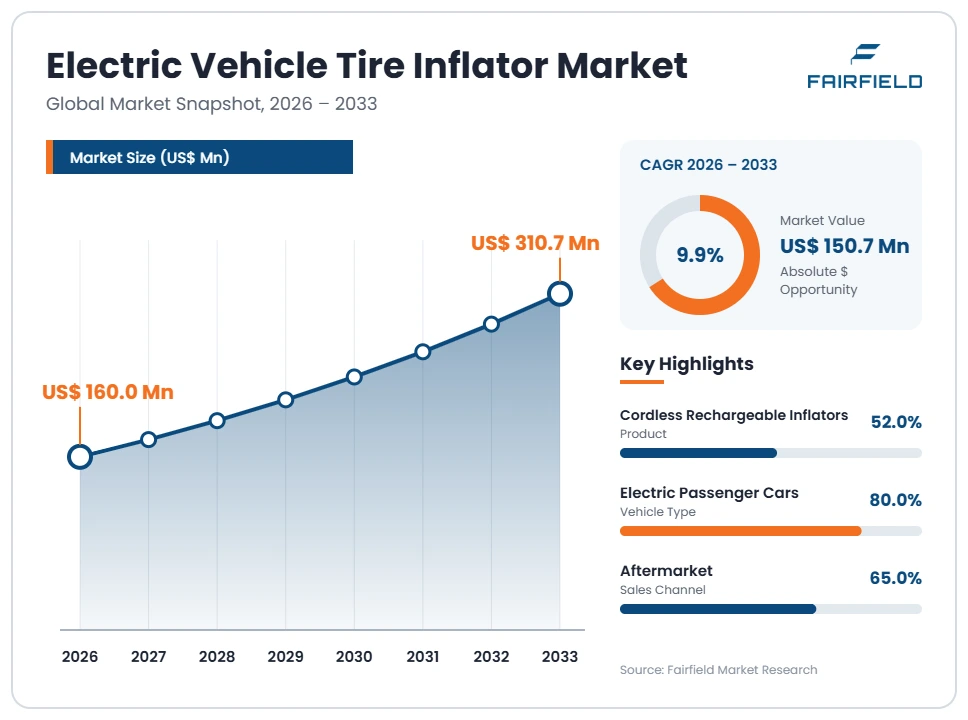
The global electric vehicle tire inflator market size is expected to be valued at US$ 160.0 million in 2026 and projected to reach US$ 310.7 million by 2033, growing at a CAGR of 9.9% between 2026 and 2033.
Between 2020 and 2025, the market grew at a CAGR of about 21.5%, rising from roughly US$ 55.0 million to about US$ 145.5 million, as electric vehicle sales rose sharply, many automakers removed spare tires to save weight and space, and compact rechargeable inflators became popular accessories sold online. The electric vehicle tire inflator market covers portable air compressors and inflation kits used to maintain correct tire pressure on battery-electric and plug-in hybrid cars, electric two-wheelers, buses, and trucks. EVs are heavier than similar petrol cars, so correct tire pressure is important for range, safety, and tire wear. Main products include cordless rechargeable inflators, 12V plug-in inflators that draw power from the vehicle, and tire repair kits that combine an inflator with puncture sealant. In November 2026, Wolfbox launched its HyperFlow 35 inflator that runs on 20V tool batteries.
Key Report Takeaways
- By Product: Cordless Rechargeable Inflators held about 52% share in 2025, while Tire Repair Kits with Inflator are projected to expand at an 11.0% CAGR through 2033, driven by spare-tire deletion in EVs and automakers supplying sealant and compressor kits as standard equipment.
- By Vehicle Type: Electric Passenger Cars held about 80% share in 2025, while Electric Two-Wheelers are projected to expand at a 12.0% CAGR through 2033, driven by fast growth of electric scooters and motorcycles in India, China, and Indonesia, and compact high-pressure inflators.
- By Sales Channel: Aftermarket held about 65% share in 2025, while OEM is projected to expand at an 11.5% CAGR through 2033, driven by automakers bundling inflators and repair kits with new EVs and selling branded accessories through their own online stores.
- By Region: Asia Pacific held about 45% share in 2025, while India is projected to expand at a 13.0% CAGR through 2033, driven by rising electric car and scooter sales, growing online retail, and new local accessory brands offering affordable portable inflators.
Global Electric Vehicle Tire Inflator Market Trends and Insights
Drivers Impact Analysis
Two drivers carry the strongest influence on electric vehicle tire inflator market demand during the forecast period.
| Driver | Impact on CAGR Forecast | Geographic Relevance | Impact Timeline |
| Rising EV sales and spare-tire deletion | High | Global | Long term (≥4 years) |
| Focus on range, safety, and tire life | Medium | Asia Pacific, Europe, North America | Medium term (2-4 years) |
EV Sales and Spare-Tire Deletion Are Driving the Electric Vehicle Tire Inflator Market
Rising EV sales and spare-tire deletion are the strongest driver of the electric vehicle tire inflator market. More EV owners need their own inflation tools.
The mechanism is that global electric vehicle sales have grown to millions of units each year, led by China, Europe, and North America, and every new EV owner is a potential buyer of a tire inflator. Many EV makers have removed the spare tire to save weight, space, and cost, and to make room for batteries and storage under the floor, so drivers rely on a compressor and sealant kit or a portable inflator after a puncture. Tesla, for example, sells its own air compressor and tire repair kit as an accessory. Ride-hailing and delivery fleets using EVs also need regular tire checks. These trends create strong and growing demand for compact, reliable inflators that fit in the vehicle.
Range and Safety Focus Is Expanding the Electric Vehicle Tire Inflator Market
Focus on range, safety, and tire life is expanding the electric vehicle tire inflator market. Correct pressure matters more for EVs.
The cause is that electric vehicles are heavier than comparable petrol cars because of their batteries, and they deliver instant torque, which increases tire wear. Underinflated tires raise rolling resistance, which reduces driving range, a top concern for EV owners. They also increase the risk of blowouts and poor handling. Tire pressure monitoring systems alert drivers when pressure drops, encouraging them to keep an inflator on hand. Cold weather lowers tire pressure, adding to the need for regular top-ups. EV-specific tires are often more expensive, so owners want to protect them. Smart inflators with preset pressure, digital displays, and auto shut-off make correct inflation simple for drivers.
Restraints Impact Analysis
Two restraints limit how quickly the electric vehicle tire inflator market grows.
| Restraint | Impact on CAGR Forecast | Geographic Relevance | Impact Timeline |
| Low-cost competition and product quality issues | Medium | Global | Medium term (2-4 years) |
| Slower EV adoption in some markets | Medium | North America, Europe | Long term (≥4 years) |
Low-Cost Competition Slows the Electric Vehicle Tire Inflator Market
Low-cost competition and product quality issues slow the electric vehicle tire inflator market. Prices are falling quickly.
The problem is that portable tire inflators are relatively simple products, and hundreds of brands, many based in China, sell similar models through online marketplaces at very low prices, which squeezes margins for established companies. Some cheap inflators have inaccurate gauges, overheat, or fail quickly, which can damage consumer trust in the category. Battery safety concerns and certification requirements add costs for honest manufacturers. Many drivers also use free air pumps at petrol stations, tire shops, or charging stations, reducing the need to buy their own device. Some inflators struggle with the higher pressures and larger tires used on electric SUVs and pickups. These factors limit value growth even as unit sales rise.
Slower EV Adoption Restricts the Electric Vehicle Tire Inflator Market
Slower EV adoption in some markets restricts the electric vehicle tire inflator market. Demand follows EV sales.
The constraint is that electric vehicle sales growth has slowed in parts of North America and Europe because of high prices, reduced purchase incentives, charging concerns, and policy changes such as the end of federal EV tax credits in the United States. Fewer new EV buyers mean fewer first-time purchases of inflators and repair kits. Some automakers have shifted investment toward hybrid vehicles, which more often keep a spare tire. Run-flat and self-sealing tires on some EVs also reduce the need for emergency inflation. Roadside assistance programs included with new vehicles cover flat tires for many owners. Economic uncertainty also leads some consumers to delay accessory purchases. These factors slow growth in some developed markets.
Market Opportunities
Smart and Multifunction Inflators Open a Fast-Growth Revenue Pool
Smart and multifunction inflators open a fast-growth revenue pool. Drivers want more from each device.
The opportunity comes from inflators that add digital pressure presets, app connectivity, LED lights, power bank functions, jump starters, and vacuum cleaners in one compact device. In March 2026, Fanttik launched more than 20 compact tools, including X10 Pro and X10 Pro Max tire inflators with accurate fill-and-release functions. In November 2026, Wolfbox launched the HyperFlow 35, which runs on 20V batteries from brands such as DeWalt and Milwaukee, removing the need for a separate battery. Inflators that work with tire pressure monitoring data from the car's app are also emerging. Companies that combine accuracy, speed, safety certifications, and attractive design can win premium pricing and loyal EV owners worldwide.
OEM Partnerships and Emerging Markets Create a Growth Revenue Pool
OEM partnerships and emerging markets create a growth revenue pool. Automakers and new buyers are adding demand.
The opportunity reflects automakers removing spare tires and supplying tire mobility kits as standard equipment or branded accessories, creating long-term supply contracts for inflator makers such as Continental and specialist suppliers. EV makers in China increasingly offer branded inflators through their apps, websites, and stores. At the same time, electric two-wheeler and car sales are rising fast in India, Indonesia, Vietnam, Thailand, and Brazil, where online marketplaces make affordable inflators easy to buy. Local brands are also entering with low-cost models. Companies that offer automaker-quality kits, affordable models for scooters, local service, and strong online sales can capture growth in these fast-expanding markets.
Segment Analysis
- By Product: Cordless Rechargeable Inflators Lead While Tire Repair Kits with Inflator Grow Fastest
Cordless Rechargeable Inflators held about 52% share in 2025. Battery-powered inflators are small, light, and easy to use anywhere without connecting to the car, and many charge by USB-C and offer digital pressure presets and auto shut-off. Brands such as Xiaomi, Fanttik, and AstroAI sell large volumes online, making this the most popular product type among EV owners.
Tire Repair Kits with Inflator are the fastest-growing product, expanding at an 11.0% CAGR through 2033. These kits combine a compressor with puncture sealant to let drivers fix small holes and continue driving, replacing the spare tire in many EVs. 12V Plug-In Inflators form another segment, drawing power from the vehicle's outlet. For the market, repair kit growth reflects automaker decisions to remove spare tires.
- By Vehicle Type: Electric Passenger Cars Lead While Electric Two-Wheelers Grow Fastest
Electric Passenger Cars held about 80% share in 2025. Battery-electric and plug-in hybrid cars, SUVs, and crossovers make up most EV sales worldwide, and their owners are the main buyers of portable inflators and repair kits. Heavier electric SUVs need inflators that reach higher pressures quickly, supporting sales of premium models.
Electric Two-Wheelers are the fastest-growing vehicle type, expanding at a 12.0% CAGR through 2033. Electric scooters and motorcycles are spreading quickly in Asia Pacific, and riders need compact inflators for small tires. Electric Buses and Trucks form another segment, using heavy-duty compressors and fleet inflation systems at depots. For the market, two-wheeler growth adds large unit volumes of low-cost, compact inflators sold mainly online.
- By Sales Channel: Aftermarket Leads While OEM Grows Fastest
Aftermarket held about 65% share in 2025. Most EV owners buy inflators through online marketplaces, auto parts stores, and electronics retailers, where wide choice, customer reviews, frequent discounts, and low prices attract buyers. Many purchases happen soon after buying a new EV, when owners discover there is no spare tire, and holiday sales events drive large volumes of gift purchases.
OEM is the fastest-growing channel, expanding at an 11.5% CAGR through 2033. Automakers supply tire mobility kits as standard equipment in vehicles without spare tires and sell branded inflators through dealerships and online accessory stores. Chinese EV makers often bundle inflators with new cars. For the market, OEM growth brings larger, longer contracts and higher quality requirements for suppliers.
Geography Analysis
- Why Is North America Important to the Electric Vehicle Tire Inflator Market?
North America is a major electric vehicle tire inflator market. The United States has a large EV fleet led by Tesla, along with electric pickups and SUVs that need high-pressure, high-volume inflators. Tesla sells its own air compressor and tire repair kit, and brands such as Slime, VIAIR, Milwaukee, and Wolfbox are popular. Canada's cold winters increase demand for tire pressure top-ups, since tire pressure drops as temperatures fall. Key barriers include slower EV sales and low-cost imports. One change shaping the region is growth of cordless inflators that share power tool batteries and higher-pressure models for electric trucks.
- Europe Shapes the Electric Vehicle Tire Inflator Market Through Safety Rules
Europe is a major electric vehicle tire inflator market. Germany, France, the United Kingdom, Norway, and the Netherlands have high EV adoption, and European Union rules require tire pressure monitoring on new cars, raising driver awareness. Continental, Bosch, and Ring Automotive offer inflators and tire mobility kits to drivers and automakers. Many European EVs come without a spare tire, and drivers rely on repair kits. Key barriers include strong price competition, slower EV sales, and battery safety rules. One opportunity is OEM tire mobility kits, supported by automaker partnerships, growing EV fleets, and strict product safety rules.
- Which Region Is Leading the Electric Vehicle Tire Inflator Market?
Asia Pacific is leading the electric vehicle tire inflator market with about 45% share in 2025, while India is the fastest-growing country, expanding at a 13.0% CAGR through 2033. China is the world's largest EV market and home to Xiaomi, Baseus, 70mai, and many other inflator makers. India has fast-growing electric scooter and car sales, while Japan, South Korea, Thailand, and Indonesia add demand. Key barriers include intense price competition and low brand loyalty. One change shaping the region is fast online sales growth through large e-commerce platforms and social commerce channels.
- Latin America Grows the Electric Vehicle Tire Inflator Market Through Rising EV Imports
Latin America is a growing electric vehicle tire inflator market. Brazil, Mexico, Chile, Colombia, and Argentina are seeing rising imports of electric cars, especially from Chinese brands such as BYD, and growing electric two-wheeler use for delivery and commuting in large cities. Online marketplaces such as Mercado Libre make portable inflators easy to buy. Key barriers include high EV prices, currency swings, and limited charging. One opportunity is affordable inflators for new EV owners and delivery riders, supported by e-commerce growth, rising electric bus fleets, and new EV assembly plants in Brazil.
- Middle East & Africa Builds the Electric Vehicle Tire Inflator Market Through Early EV Adoption
Middle East & Africa is an emerging electric vehicle tire inflator market. The United Arab Emirates and Saudi Arabia are expanding EV sales and charging networks, and hot desert climates cause large daily tire pressure changes. Israel has growing EV adoption and a strong online retail market. South Africa and Morocco have early EV markets, and Egypt is attracting new electric vehicle brands. Key barriers include low EV adoption, limited charging outside large cities, and price sensitivity. One opportunity is premium inflators for EV owners, supported by government EV targets, growing online retail, and new EV showrooms in large cities.
Competitive Landscape
The electric vehicle tire inflator market is fragmented. Xiaomi Corporation, Fanttik, Illinois Tool Works Inc. (Slime), Continental AG, and Wolfbox are leading players, while AstroAI, VIAIR, Ring Automotive, Bosch, Stanley Black & Decker, 70mai, and Baseus compete strongly. The market includes consumer electronics brands that sell smart inflators online, automotive accessory companies, power tool makers that offer inflators on shared battery platforms, and tire and parts suppliers that provide tire mobility kits to automakers. Hundreds of smaller brands sell through online marketplaces, especially in Asia Pacific and North America.
Companies compete on inflation speed, pressure accuracy, maximum pressure, battery capacity, size, noise, safety certifications, design, smart features, brand trust, online reviews, and price. OEM suppliers also compete on durability, sealant quality, and the ability to meet automaker specifications and volumes.
Strategic moves show how competition is changing. In March 2026, Fanttik launched more than 20 new compact tools, including new inflators. In June 2026, Wolfbox introduced the heavy-duty HyperFlow 60D, and in November 2026, it launched the HyperFlow 35 that runs on power tool batteries. Ring Automotive also launched new cordless inflators and a combined jump starter and inflator in 2026.
Three themes shape vendor strategy. First, companies are adding smart presets, multifunction features, and shared battery platforms. Second, they are building higher-pressure models for heavy EVs and pickups. Third, they are expanding online sales and OEM partnerships in Asia Pacific and other fast-growing EV markets.
Electric Vehicle Tire Inflator Market Industry Leaders
- Xiaomi Corporation
- Fanttik
- Illinois Tool Works Inc. (Slime)
- Continental AG
- Wolfbox
Recent Industry Developments
- November 2026: Wolfbox launched the HyperFlow 35 portable tire inflator, which runs on 20V tool batteries from brands such as DeWalt and Milwaukee, switches to DC power when the battery runs low, and delivers up to 80 PSI - expands battery-sharing options in the electric vehicle tire inflator market.
- June 2026: Wolfbox launched the HyperFlow 60D, a dual-cylinder portable inflator with a 100% duty cycle for trucks, SUVs, and off-road vehicles - targets larger, heavier vehicles including electric pickups.
- March 2026: Fanttik launched more than 20 compact tools, including the X10 Pro and X10 Pro Max tire inflators with accurate fill-and-release functions - strengthens its smart cordless inflator range.
Companies Covered in the Report
- Xiaomi Corporation
- Fanttik
- Illinois Tool Works Inc. (Slime)
- Continental AG
- Wolfbox
- AstroAI
- VIAIR Corporation
- Ring Automotive
- Robert Bosch GmbH
- Stanley Black & Decker, Inc.
- 70mai
- Baseus
Electric Vehicle Tire Inflator Market Report Scope
| Metric | Value |
| Study Period | 2020-2033 |
| Market Size 2026 | US$ 160.0 Million |
| Market Size 2033 | US$ 310.7 Million |
| CAGR 2026-2033 | 9.9% |
| Absolute Dollar Opportunity | US$ 150.7 Million |
| Largest Market | Asia Pacific |
| Fastest-Growing Market | India |
| Market Concentration | Fragmented |
| Major Players | Xiaomi Corporation, Fanttik, Illinois Tool Works Inc. (Slime), Continental AG, Wolfbox |
Electric Vehicle Tire Inflator Market Segmentation
- Executive Summary
- Electric Vehicle Tire Inflator Market Snapshot
- Future Projections
- Key Market Trends
- Regional Snapshot
- Market Overview
- Market Definition and Report Scope
- Historical Market Trends
- Market Dynamics
- Drivers
- EV Sales and Spare-Tire Deletion Are Driving the Electric Vehicle Tire Inflator Market
- Range and Safety Focus Is Expanding the Electric Vehicle Tire Inflator Market
- Restraints
- Low-Cost Competition Slows the Electric Vehicle Tire Inflator Market
- Slower EV Adoption Restricts the Electric Vehicle Tire Inflator Market
- Market Opportunities
- Smart and Multifunction Inflators Open a Fast-Growth Revenue Pool
- OEM Partnerships and Emerging Markets Create a Growth Revenue Pool
- Drivers
- Global Electric Vehicle Tire Inflator Market Outlook, 2020–2033
- Global Electric Vehicle Tire Inflator Market Outlook, by Product, Value (US$ Million), 2020–2033
- Cordless Rechargeable Inflators
- 12V Plug-In Inflators
- Tire Repair Kits with Inflator
- Global Electric Vehicle Tire Inflator Market Outlook, by Vehicle Type, Value (US$ Million), 2020–2033
- Electric Passenger Cars
- Electric Two-Wheelers
- Electric Buses and Trucks
- Global Electric Vehicle Tire Inflator Market Outlook, by Sales Channel, Value (US$ Million), 2020–2033
- Aftermarket
- OEM
- Global Electric Vehicle Tire Inflator Market Outlook, by Region, Value (US$ Million), 2020–2033
- North America
- Europe
- Asia Pacific
- Latin America
- Middle East & Africa
- Global Electric Vehicle Tire Inflator Market Outlook, by Product, Value (US$ Million), 2020–2033
- North America Electric Vehicle Tire Inflator Market Outlook, 2020–2033
- North America Electric Vehicle Tire Inflator Market Outlook, by Product, Value (US$ Million), 2020–2033
- Cordless Rechargeable Inflators
- 12V Plug-In Inflators
- Tire Repair Kits with Inflator
- North America Electric Vehicle Tire Inflator Market Outlook, by Vehicle Type, Value (US$ Million), 2020–2033
- Electric Passenger Cars
- Electric Two-Wheelers
- Electric Buses and Trucks
- North America Electric Vehicle Tire Inflator Market Outlook, by Sales Channel, Value (US$ Million), 2020–2033
- Aftermarket
- OEM
- North America Electric Vehicle Tire Inflator Market Outlook, by Country, Value (US$ Million), 2020–2033
- United States Electric Vehicle Tire Inflator Market Outlook, by Product, 2020–2033
- United States Electric Vehicle Tire Inflator Market Outlook, by Vehicle Type, 2020–2033
- United States Electric Vehicle Tire Inflator Market Outlook, by Sales Channel, 2020–2033
- Canada Electric Vehicle Tire Inflator Market Outlook, by Product, 2020–2033
- Canada Electric Vehicle Tire Inflator Market Outlook, by Vehicle Type, 2020–2033
- Canada Electric Vehicle Tire Inflator Market Outlook, by Sales Channel, 2020–2033
- North America Electric Vehicle Tire Inflator Market Outlook, by Product, Value (US$ Million), 2020–2033
- Europe Electric Vehicle Tire Inflator Market Outlook, 2020–2033
- Europe Electric Vehicle Tire Inflator Market Outlook, by Product, Value (US$ Million), 2020–2033
- Cordless Rechargeable Inflators
- 12V Plug-In Inflators
- Tire Repair Kits with Inflator
- Europe Electric Vehicle Tire Inflator Market Outlook, by Vehicle Type, Value (US$ Million), 2020–2033
- Electric Passenger Cars
- Electric Two-Wheelers
- Electric Buses and Trucks
- Europe Electric Vehicle Tire Inflator Market Outlook, by Sales Channel, Value (US$ Million), 2020–2033
- Aftermarket
- OEM
- Europe Electric Vehicle Tire Inflator Market Outlook, by Country, Value (US$ Million), 2020–2033
- Germany Electric Vehicle Tire Inflator Market Outlook, by Product, 2020–2033
- Germany Electric Vehicle Tire Inflator Market Outlook, by Vehicle Type, 2020–2033
- Germany Electric Vehicle Tire Inflator Market Outlook, by Sales Channel, 2020–2033
- France Electric Vehicle Tire Inflator Market Outlook, by Product, 2020–2033
- France Electric Vehicle Tire Inflator Market Outlook, by Vehicle Type, 2020–2033
- France Electric Vehicle Tire Inflator Market Outlook, by Sales Channel, 2020–2033
- United Kingdom Electric Vehicle Tire Inflator Market Outlook, by Product, 2020–2033
- United Kingdom Electric Vehicle Tire Inflator Market Outlook, by Vehicle Type, 2020–2033
- United Kingdom Electric Vehicle Tire Inflator Market Outlook, by Sales Channel, 2020–2033
- Norway Electric Vehicle Tire Inflator Market Outlook, by Product, 2020–2033
- Norway Electric Vehicle Tire Inflator Market Outlook, by Vehicle Type, 2020–2033
- Norway Electric Vehicle Tire Inflator Market Outlook, by Sales Channel, 2020–2033
- Netherlands Electric Vehicle Tire Inflator Market Outlook, by Product, 2020–2033
- Netherlands Electric Vehicle Tire Inflator Market Outlook, by Vehicle Type, 2020–2033
- Netherlands Electric Vehicle Tire Inflator Market Outlook, by Sales Channel, 2020–2033
- Europe Electric Vehicle Tire Inflator Market Outlook, by Product, Value (US$ Million), 2020–2033
- Asia Pacific Electric Vehicle Tire Inflator Market Outlook, 2020–2033
- Asia Pacific Electric Vehicle Tire Inflator Market Outlook, by Product, Value (US$ Million), 2020–2033
- Cordless Rechargeable Inflators
- 12V Plug-In Inflators
- Tire Repair Kits with Inflator
- Asia Pacific Electric Vehicle Tire Inflator Market Outlook, by Vehicle Type, Value (US$ Million), 2020–2033
- Electric Passenger Cars
- Electric Two-Wheelers
- Electric Buses and Trucks
- Asia Pacific Electric Vehicle Tire Inflator Market Outlook, by Sales Channel, Value (US$ Million), 2020–2033
- Aftermarket
- OEM
- Asia Pacific Electric Vehicle Tire Inflator Market Outlook, by Country, Value (US$ Million), 2020–2033
- India Electric Vehicle Tire Inflator Market Outlook, by Product, 2020–2033
- India Electric Vehicle Tire Inflator Market Outlook, by Vehicle Type, 2020–2033
- India Electric Vehicle Tire Inflator Market Outlook, by Sales Channel, 2020–2033
- China Electric Vehicle Tire Inflator Market Outlook, by Product, 2020–2033
- China Electric Vehicle Tire Inflator Market Outlook, by Vehicle Type, 2020–2033
- China Electric Vehicle Tire Inflator Market Outlook, by Sales Channel, 2020–2033
- Japan Electric Vehicle Tire Inflator Market Outlook, by Product, 2020–2033
- Japan Electric Vehicle Tire Inflator Market Outlook, by Vehicle Type, 2020–2033
- Japan Electric Vehicle Tire Inflator Market Outlook, by Sales Channel, 2020–2033
- South Korea Electric Vehicle Tire Inflator Market Outlook, by Product, 2020–2033
- South Korea Electric Vehicle Tire Inflator Market Outlook, by Vehicle Type, 2020–2033
- South Korea Electric Vehicle Tire Inflator Market Outlook, by Sales Channel, 2020–2033
- Thailand Electric Vehicle Tire Inflator Market Outlook, by Product, 2020–2033
- Thailand Electric Vehicle Tire Inflator Market Outlook, by Vehicle Type, 2020–2033
- Thailand Electric Vehicle Tire Inflator Market Outlook, by Sales Channel, 2020–2033
- Indonesia Electric Vehicle Tire Inflator Market Outlook, by Product, 2020–2033
- Indonesia Electric Vehicle Tire Inflator Market Outlook, by Vehicle Type, 2020–2033
- Indonesia Electric Vehicle Tire Inflator Market Outlook, by Sales Channel, 2020–2033
- Asia Pacific Electric Vehicle Tire Inflator Market Outlook, by Product, Value (US$ Million), 2020–2033
- Latin America Electric Vehicle Tire Inflator Market Outlook, 2020–2033
- Latin America Electric Vehicle Tire Inflator Market Outlook, by Product, Value (US$ Million), 2020–2033
- Cordless Rechargeable Inflators
- 12V Plug-In Inflators
- Tire Repair Kits with Inflator
- Latin America Electric Vehicle Tire Inflator Market Outlook, by Vehicle Type, Value (US$ Million), 2020–2033
- Electric Passenger Cars
- Electric Two-Wheelers
- Electric Buses and Trucks
- Latin America Electric Vehicle Tire Inflator Market Outlook, by Sales Channel, Value (US$ Million), 2020–2033
- Aftermarket
- OEM
- Latin America Electric Vehicle Tire Inflator Market Outlook, by Country, Value (US$ Million), 2020–2033
- Brazil Electric Vehicle Tire Inflator Market Outlook, by Product, 2020–2033
- Brazil Electric Vehicle Tire Inflator Market Outlook, by Vehicle Type, 2020–2033
- Brazil Electric Vehicle Tire Inflator Market Outlook, by Sales Channel, 2020–2033
- Mexico Electric Vehicle Tire Inflator Market Outlook, by Product, 2020–2033
- Mexico Electric Vehicle Tire Inflator Market Outlook, by Vehicle Type, 2020–2033
- Mexico Electric Vehicle Tire Inflator Market Outlook, by Sales Channel, 2020–2033
- Chile Electric Vehicle Tire Inflator Market Outlook, by Product, 2020–2033
- Chile Electric Vehicle Tire Inflator Market Outlook, by Vehicle Type, 2020–2033
- Chile Electric Vehicle Tire Inflator Market Outlook, by Sales Channel, 2020–2033
- Colombia Electric Vehicle Tire Inflator Market Outlook, by Product, 2020–2033
- Colombia Electric Vehicle Tire Inflator Market Outlook, by Vehicle Type, 2020–2033
- Colombia Electric Vehicle Tire Inflator Market Outlook, by Sales Channel, 2020–2033
- Argentina Electric Vehicle Tire Inflator Market Outlook, by Product, 2020–2033
- Argentina Electric Vehicle Tire Inflator Market Outlook, by Vehicle Type, 2020–2033
- Argentina Electric Vehicle Tire Inflator Market Outlook, by Sales Channel, 2020–2033
- Latin America Electric Vehicle Tire Inflator Market Outlook, by Product, Value (US$ Million), 2020–2033
- Middle East & Africa Electric Vehicle Tire Inflator Market Outlook, 2020–2033
- Middle East & Africa Electric Vehicle Tire Inflator Market Outlook, by Product, Value (US$ Million), 2020–2033
- Cordless Rechargeable Inflators
- 12V Plug-In Inflators
- Tire Repair Kits with Inflator
- Middle East & Africa Electric Vehicle Tire Inflator Market Outlook, by Vehicle Type, Value (US$ Million), 2020–2033
- Electric Passenger Cars
- Electric Two-Wheelers
- Electric Buses and Trucks
- Middle East & Africa Electric Vehicle Tire Inflator Market Outlook, by Sales Channel, Value (US$ Million), 2020–2033
- Aftermarket
- OEM
- Middle East & Africa Electric Vehicle Tire Inflator Market Outlook, by Country, Value (US$ Million), 2020–2033
- United Arab Emirates Electric Vehicle Tire Inflator Market Outlook, by Product, 2020–2033
- United Arab Emirates Electric Vehicle Tire Inflator Market Outlook, by Vehicle Type, 2020–2033
- United Arab Emirates Electric Vehicle Tire Inflator Market Outlook, by Sales Channel, 2020–2033
- Saudi Arabia Electric Vehicle Tire Inflator Market Outlook, by Product, 2020–2033
- Saudi Arabia Electric Vehicle Tire Inflator Market Outlook, by Vehicle Type, 2020–2033
- Saudi Arabia Electric Vehicle Tire Inflator Market Outlook, by Sales Channel, 2020–2033
- Israel Electric Vehicle Tire Inflator Market Outlook, by Product, 2020–2033
- Israel Electric Vehicle Tire Inflator Market Outlook, by Vehicle Type, 2020–2033
- Israel Electric Vehicle Tire Inflator Market Outlook, by Sales Channel, 2020–2033
- South Africa Electric Vehicle Tire Inflator Market Outlook, by Product, 2020–2033
- South Africa Electric Vehicle Tire Inflator Market Outlook, by Vehicle Type, 2020–2033
- South Africa Electric Vehicle Tire Inflator Market Outlook, by Sales Channel, 2020–2033
- Morocco Electric Vehicle Tire Inflator Market Outlook, by Product, 2020–2033
- Morocco Electric Vehicle Tire Inflator Market Outlook, by Vehicle Type, 2020–2033
- Morocco Electric Vehicle Tire Inflator Market Outlook, by Sales Channel, 2020–2033
- Egypt Electric Vehicle Tire Inflator Market Outlook, by Product, 2020–2033
- Egypt Electric Vehicle Tire Inflator Market Outlook, by Vehicle Type, 2020–2033
- Egypt Electric Vehicle Tire Inflator Market Outlook, by Sales Channel, 2020–2033
- Middle East & Africa Electric Vehicle Tire Inflator Market Outlook, by Product, Value (US$ Million), 2020–2033
- Competitive Landscape
- Electric Vehicle Tire Inflator Market Industry Leaders
- Recent Industry Developments
- Company Profiles
- Xiaomi Corporation
- Fanttik
- Illinois Tool Works Inc. (Slime)
- Continental AG
- Wolfbox
- AstroAI
- VIAIR Corporation
- Ring Automotive
- Robert Bosch GmbH
- Stanley Black & Decker, Inc.
- 70mai
- Baseus
- Appendix
- Research Methodology
- Report Assumptions
- Acronyms and Abbreviations
Product
- Cordless Rechargeable Inflators
- 12V Plug-In Inflators
- Tire Repair Kits with Inflator
Vehicle Type
- Electric Passenger Cars
- Electric Two-Wheelers
- Electric Buses and Trucks
Sales Channel
- Aftermarket
- OEM
Regions
- North America
- Europe
- Asia Pacific
- Latin America
- Middle East & Africa
Our Research Methodology
Considering the volatility of business today, traditional approaches to strategizing a game plan can be unfruitful if not detrimental. True ambiguity is no way to determine a forecast. A myriad of predetermined factors must be accounted for such as the degree of risk involved, the magnitude of circumstances, as well as conditions or consequences that are not known or unpredictable. To circumvent binary views that cast uncertainty, the application of market research intelligence to strategically posture, move, and enable actionable outcomes is necessary.
View Methodology
Quality Assured
Rigorous Validation Process

Confidentiality Assured
End-to-end Data Security

Custom Research Services
Tailored To Your Objectives
FAQs
The global electric vehicle tire inflator market is expected to be valued at US$ 160.0 million in 2026, driven by rising EV sales.
The market is projected to grow at a 9.9% CAGR from 2026 to 2033, reaching about US$ 310.7 million by 2033.
Asia Pacific leads with about 45% share, supported by huge EV sales in China and many local inflator manufacturers and brands.
India is growing fastest at a 13.0% CAGR, driven by rising electric scooter and car sales and growing online retail.
Key players include Xiaomi, Fanttik, Slime, Continental, and Wolfbox, competing on accuracy, speed, battery life, design, and price.
Related Reports
Automotive Tools Market Size, Share, Insights, Competitive Landscape, and Forecast 2026 to 2033
The global automotive tools market is valued at US$53.58 billion in 2026, reaching US$77.53 billion by 2033, growing at a 5.4% CAGR
Automotive Defroster Market Size, Share, Insights, Competitive Landscape, and Forecast 2026 to 2033
The global automotive defroster market is valued at US$2.40 billion in 2026, reaching US$3.27 billion by 2033, growing at a 4.5% CAGR
Automobile E-Axle Market Size, Share, Insights, Competitive Landscape, and Forecast 2026 to 2033
The global automobile e-axle market is valued at US$7.10 billion in 2026, reaching US$20.08 billion by 2033, growing at a 16.0% CAGR
Automated Front Load Garbage Trucks Market Size, Share, Insights, Competitive Landscape, and Forecast 2026 to 2033
The global automated front load garbage trucks market is valued at US$8.24 billion in 2026, reaching US$12.60 billion by 2033, growing at a 6.3% CAGR
Off-the-road Tire (OTR) Market Insights, Competitive Landscape, and Market Forecast - 2033
Off-the-road tire market driven by rising industrial activity, agricultural expansion in Asia Pacific, and robust demand from the mining sector post-COVID.
Light Commercial Vehicles Market Insights, Competitive Landscape, and Market Forecast - 2033
Light commercial vehicles market grows on rising urban demand, regulation shifts, and preference for compact, efficient transport in metro and suburban areas.