



Enterprise Agentic AI Market
Enterprise Agentic AI Market Insights, Competitive Landscape, and Market Forecast - 2033
Market Overview
Enterprise agentic AI encompasses AI systems capable of autonomously planning, executing, and adapting multi-step workflows on behalf of enterprise users, moving beyond conversational or single-response AI assistance toward systems that independently pursue defined objectives across business applications, data sources, and operational tools. As large language model capability has matured, enterprises have increasingly explored agentic architectures that can handle complex, multi-step business processes with reduced human oversight, spanning customer service resolution, IT operations, and sales and marketing workflow automation.
Demand growth through the 2026-2033 window is closely tied to rapidly maturing large language model reasoning and tool-use capability enabling increasingly reliable autonomous task execution, intensifying enterprise pressure to improve operational efficiency and reduce manual process overhead across business functions, and expanding enterprise software vendor integration of agentic capability into existing business application ecosystems. Growing enterprise confidence in AI system reliability and governance, supported by improving monitoring and control frameworks, continues to accelerate adoption beyond early pilot deployments toward production-scale implementation.
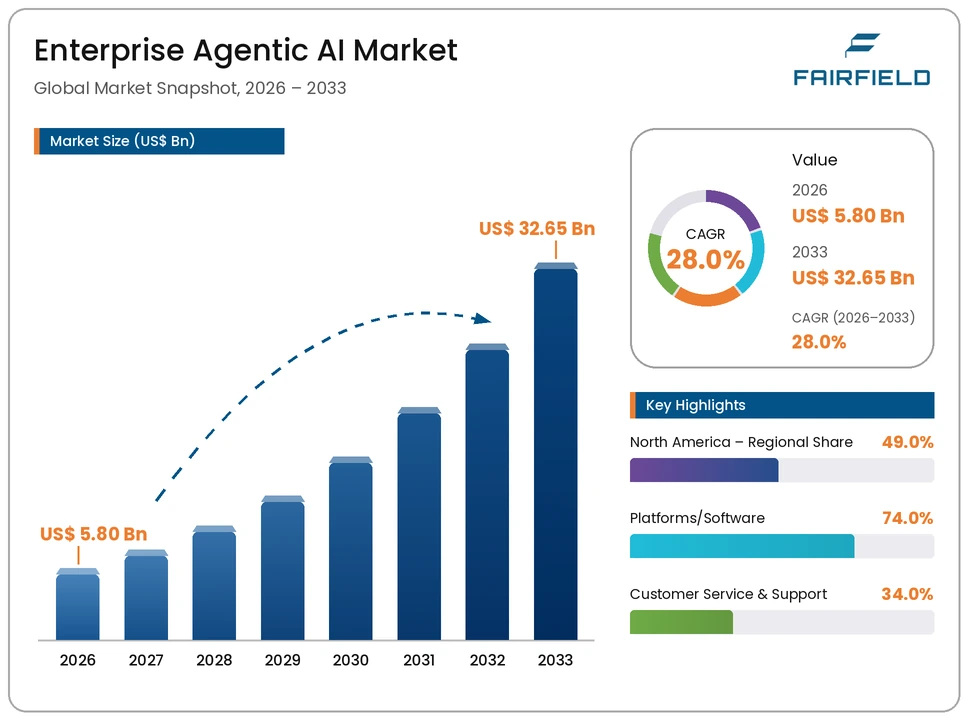
The market is valued at USD 5.80 Billion in 2026, with providers directing substantial investment toward improved agent reliability, governance, and integration capability that supports enterprise-scale deployment across mission-critical business processes. By 2033, the market is forecast to reach USD 32.65 Billion, reflecting rapid growth across established customer service applications alongside accelerating IT operations and automation adoption.
Key Highlights
- The global enterprise agentic AI market is valued at USD 5.80 Billion in 2026 and is projected to reach USD 32.65 Billion by 2033, expanding at a CAGR of 28.0% across the 2026-2033 forecast period.
- Platforms/Software lead the component segment with a 74.0% share in 2026, equivalent to USD 4.29 Billion.
- Customer Service & Support remains the dominant application, accounting for 34.0% of global demand, or USD 1.97 Billion, in 2026.
- North America commands the largest regional share at 49.0% of the global market in 2026.
- IT operations and automation applications are emerging as the fastest-growing application through 2033.
Key Growth Drivers
Growth in the enterprise agentic AI market is driven primarily by rapidly maturing large language model reasoning and tool-use capability, as improving foundation model performance increasingly enables reliable autonomous execution of complex, multi-step business tasks that were previously beyond the reach of earlier-generation AI systems.
A second driver is intensifying enterprise pressure to improve operational efficiency, as organizations facing sustained cost management priorities increasingly view agentic AI as a mechanism to automate labor-intensive business processes across customer service, IT operations, and administrative functions without proportional headcount growth.
Key Restraints
Enterprise concerns regarding AI system reliability, accuracy, and governance create adoption hesitancy for mission-critical business processes, as organizations require robust monitoring, control, and escalation frameworks before extending autonomous agent authority across sensitive operational decisions.
Additionally, the technical complexity of integrating agentic AI systems with diverse, often legacy enterprise applications and data sources creates implementation challenges, requiring substantial technical investment to achieve reliable, secure connectivity across an organization's existing technology ecosystem.
Market Opportunities
The expansion of IT operations and automation applications presents a substantial opportunity, as enterprises increasingly explore agentic AI for infrastructure monitoring, incident response, and routine IT administrative tasks, an application area offering significant efficiency gains given the structured, rules-based nature of many IT operational workflows.
A second opportunity lies in the continued development of improved agent governance and monitoring frameworks that build enterprise confidence in extending autonomous agent authority across increasingly sensitive and complex business processes. Providers that successfully advance these governance capabilities stand to capture growing enterprise demand as agentic AI transitions from pilot programs to production-scale deployment.
Segmentation Analysis
- By Component
Platforms/Software lead the component segment, accounting for 74.0% of global market value in 2026, equivalent to USD 4.29 Billion. Their leadership reflects the centrality of agent orchestration and workflow automation software within enterprise agentic AI deployments. Services represent the fastest-growing component category through 2033, driven by growing enterprise demand for implementation, integration, and governance consulting support.
- By Application
Customer Service & Support forms the leading application segment, representing 34.0% of global demand in 2026, or USD 1.97 Billion, reflecting this function's well-defined, high-volume interaction patterns that are particularly well suited to autonomous agent handling. Sales & Marketing Automation represents a significant, established application area. IT Operations & Automation represents the fastest-growing application category, propelled by enterprises extending agentic capability to infrastructure monitoring and incident response workflows.
Regional Insights
- North America
North America holds the largest regional share, at 49.0% of the global market in 2026, equivalent to USD 2.84 Billion. The region's leadership reflects concentrated enterprise AI investment and early adoption of agentic AI platforms across the United States and Canada.
- Europe
Europe accounts for 23.0% of the global market in 2026, valued at USD 1.33 Billion. Demand is supported by growing enterprise AI adoption and increasing focus on operational efficiency across major European markets.
- Asia Pacific
Asia Pacific represents 21.0% of the global market in 2026, or USD 1.22 Billion. Growth is underpinned by expanding enterprise technology investment and growing AI adoption across China, Japan, and India.
- Latin America
Latin America contributes 4.0% of the global market in 2026, equivalent to USD 0.23 Billion. Growth is linked to gradually expanding enterprise AI adoption in Brazil and Mexico.
- Middle East & Africa
Middle East & Africa holds 3.0% of the global market in 2026, valued at USD 0.17 Billion. Growth remains at an early stage, tied to gradual expansion of enterprise AI investment across the region.
Competitive Landscape
The global enterprise agentic AI market is moderately fragmented, with a mix of large enterprise software companies integrating agentic capability into existing platforms and specialized AI companies developing purpose-built agentic systems. Competition centers on agent reliability and reasoning sophistication, breadth of enterprise application and data source integration, and the strength of governance and monitoring frameworks supporting enterprise-scale deployment. Companies are increasingly differentiating through improved agent governance and reliability rather than competing on raw capability claims alone.
Key Market Players
- Microsoft Corporation
- Salesforce, Inc.
- ServiceNow, Inc.
- UiPath Inc.
- Anthropic PBC
- OpenAI, Inc.
- Google LLC
- IBM Corporation
- SAP SE
- Workday, Inc.
Market Segmentation
By Component
- Platforms/Software
- Services
By Application
- Customer Service & Support
- IT Operations & Automation
- Sales & Marketing Automation
- Others
By Organization Size
- Large Enterprises
- Small & Medium Enterprises
By Geography
- North America
- Europe
- Asia Pacific
- Latin America
- Middle East & Africa
- Executive Summary
- Global Enterprise Agentic AI Market Snapshot
- Future Projections
- Key Market Trends
- Regional Snapshot, by Value, 2026
- Analyst Recommendations
- Market Overview
- Market Definitions and Segmentations
- Market Dynamics
- Drivers
- Restraints
- Market Opportunities
- Value Chain Analysis
- COVID-19 Impact Analysis
- Porter's Five Forces Analysis
- Impact of Russia-Ukraine Conflict
- PESTLE Analysis
- Regulatory Analysis
- Price Trend Analysis
- Current Prices and Future Projections, 2025-2033
- Price Impact Factors
- Global Enterprise Agentic AI Market Outlook, 2020 - 2033
- Global Enterprise Agentic AI Market Outlook, by Component, Value (US$ Mn), 2020-2033
- Platforms/Software
- Services
- Global Enterprise Agentic AI Market Outlook, by Organization Size, Value (US$ Mn), 2020-2033
- Large Enterprises
- Small & Medium Enterprises
- Global Enterprise Agentic AI Market Outlook, by Application, Value (US$ Mn), 2020-2033
- Customer Service & Support
- IT Operations & Automation
- Sales & Marketing Automation
- Others
- Global Enterprise Agentic AI Market Outlook, by Region, Value (US$ Mn), 2020-2033
- North America
- Europe
- Asia Pacific
- Latin America
- Middle East & Africa
- Global Enterprise Agentic AI Market Outlook, by Component, Value (US$ Mn), 2020-2033
- North America Enterprise Agentic AI Market Outlook, 2020 - 2033
- North America Enterprise Agentic AI Market Outlook, by Component, Value (US$ Mn), 2020-2033
- Platforms/Software
- Services
- North America Enterprise Agentic AI Market Outlook, by Organization Size, Value (US$ Mn), 2020-2033
- Large Enterprises
- Small & Medium Enterprises
- North America Enterprise Agentic AI Market Outlook, by Application, Value (US$ Mn), 2020-2033
- Customer Service & Support
- IT Operations & Automation
- Sales & Marketing Automation
- Others
- North America Enterprise Agentic AI Market Outlook, by Country, Value (US$ Mn), 2020-2033
- U.S. Enterprise Agentic AI Market Outlook, by Component, 2020-2033
- U.S. Enterprise Agentic AI Market Outlook, by Organization Size, 2020-2033
- U.S. Enterprise Agentic AI Market Outlook, by Application, 2020-2033
- Canada Enterprise Agentic AI Market Outlook, by Component, 2020-2033
- Canada Enterprise Agentic AI Market Outlook, by Organization Size, 2020-2033
- Canada Enterprise Agentic AI Market Outlook, by Application, 2020-2033
- BPS Analysis/Market Attractiveness Analysis
- North America Enterprise Agentic AI Market Outlook, by Component, Value (US$ Mn), 2020-2033
- Europe Enterprise Agentic AI Market Outlook, 2020 - 2033
- Europe Enterprise Agentic AI Market Outlook, by Component, Value (US$ Mn), 2020-2033
- Platforms/Software
- Services
- Europe Enterprise Agentic AI Market Outlook, by Organization Size, Value (US$ Mn), 2020-2033
- Large Enterprises
- Small & Medium Enterprises
- Europe Enterprise Agentic AI Market Outlook, by Application, Value (US$ Mn), 2020-2033
- Customer Service & Support
- IT Operations & Automation
- Sales & Marketing Automation
- Others
- Europe Enterprise Agentic AI Market Outlook, by Country, Value (US$ Mn), 2020-2033
- Germany Enterprise Agentic AI Market Outlook, by Component, 2020-2033
- Germany Enterprise Agentic AI Market Outlook, by Organization Size, 2020-2033
- Germany Enterprise Agentic AI Market Outlook, by Application, 2020-2033
- Italy Enterprise Agentic AI Market Outlook, by Component, 2020-2033
- Italy Enterprise Agentic AI Market Outlook, by Organization Size, 2020-2033
- Italy Enterprise Agentic AI Market Outlook, by Application, 2020-2033
- France Enterprise Agentic AI Market Outlook, by Component, 2020-2033
- France Enterprise Agentic AI Market Outlook, by Organization Size, 2020-2033
- France Enterprise Agentic AI Market Outlook, by Application, 2020-2033
- U.K. Enterprise Agentic AI Market Outlook, by Component, 2020-2033
- U.K. Enterprise Agentic AI Market Outlook, by Organization Size, 2020-2033
- U.K. Enterprise Agentic AI Market Outlook, by Application, 2020-2033
- Spain Enterprise Agentic AI Market Outlook, by Component, 2020-2033
- Spain Enterprise Agentic AI Market Outlook, by Organization Size, 2020-2033
- Spain Enterprise Agentic AI Market Outlook, by Application, 2020-2033
- Russia Enterprise Agentic AI Market Outlook, by Component, 2020-2033
- Russia Enterprise Agentic AI Market Outlook, by Organization Size, 2020-2033
- Russia Enterprise Agentic AI Market Outlook, by Application, 2020-2033
- Rest of Europe Enterprise Agentic AI Market Outlook, by Component, 2020-2033
- Rest of Europe Enterprise Agentic AI Market Outlook, by Organization Size, 2020-2033
- Rest of Europe Enterprise Agentic AI Market Outlook, by Application, 2020-2033
- BPS Analysis/Market Attractiveness Analysis
- Europe Enterprise Agentic AI Market Outlook, by Component, Value (US$ Mn), 2020-2033
- Asia Pacific Enterprise Agentic AI Market Outlook, 2020 - 2033
- Asia Pacific Enterprise Agentic AI Market Outlook, by Component, Value (US$ Mn), 2020-2033
- Platforms/Software
- Services
- Asia Pacific Enterprise Agentic AI Market Outlook, by Organization Size, Value (US$ Mn), 2020-2033
- Large Enterprises
- Small & Medium Enterprises
- Asia Pacific Enterprise Agentic AI Market Outlook, by Application, Value (US$ Mn), 2020-2033
- Customer Service & Support
- IT Operations & Automation
- Sales & Marketing Automation
- Others
- Asia Pacific Enterprise Agentic AI Market Outlook, by Country, Value (US$ Mn), 2020-2033
- China Enterprise Agentic AI Market Outlook, by Component, 2020-2033
- China Enterprise Agentic AI Market Outlook, by Organization Size, 2020-2033
- China Enterprise Agentic AI Market Outlook, by Application, 2020-2033
- Japan Enterprise Agentic AI Market Outlook, by Component, 2020-2033
- Japan Enterprise Agentic AI Market Outlook, by Organization Size, 2020-2033
- Japan Enterprise Agentic AI Market Outlook, by Application, 2020-2033
- South Korea Enterprise Agentic AI Market Outlook, by Component, 2020-2033
- South Korea Enterprise Agentic AI Market Outlook, by Organization Size, 2020-2033
- South Korea Enterprise Agentic AI Market Outlook, by Application, 2020-2033
- India Enterprise Agentic AI Market Outlook, by Component, 2020-2033
- India Enterprise Agentic AI Market Outlook, by Organization Size, 2020-2033
- India Enterprise Agentic AI Market Outlook, by Application, 2020-2033
- Southeast Asia Enterprise Agentic AI Market Outlook, by Component, 2020-2033
- Southeast Asia Enterprise Agentic AI Market Outlook, by Organization Size, 2020-2033
- Southeast Asia Enterprise Agentic AI Market Outlook, by Application, 2020-2033
- Rest of SAO Enterprise Agentic AI Market Outlook, by Component, 2020-2033
- Rest of SAO Enterprise Agentic AI Market Outlook, by Organization Size, 2020-2033
- Rest of SAO Enterprise Agentic AI Market Outlook, by Application, 2020-2033
- BPS Analysis/Market Attractiveness Analysis
- Asia Pacific Enterprise Agentic AI Market Outlook, by Component, Value (US$ Mn), 2020-2033
- Latin America Enterprise Agentic AI Market Outlook, 2020 - 2033
- Latin America Enterprise Agentic AI Market Outlook, by Component, Value (US$ Mn), 2020-2033
- Platforms/Software
- Services
- Latin America Enterprise Agentic AI Market Outlook, by Organization Size, Value (US$ Mn), 2020-2033
- Large Enterprises
- Small & Medium Enterprises
- Latin America Enterprise Agentic AI Market Outlook, by Application, Value (US$ Mn), 2020-2033
- Customer Service & Support
- IT Operations & Automation
- Sales & Marketing Automation
- Others
- Latin America Enterprise Agentic AI Market Outlook, by Country, Value (US$ Mn), 2020-2033
- Brazil Enterprise Agentic AI Market Outlook, by Component, 2020-2033
- Brazil Enterprise Agentic AI Market Outlook, by Organization Size, 2020-2033
- Brazil Enterprise Agentic AI Market Outlook, by Application, 2020-2033
- Mexico Enterprise Agentic AI Market Outlook, by Component, 2020-2033
- Mexico Enterprise Agentic AI Market Outlook, by Organization Size, 2020-2033
- Mexico Enterprise Agentic AI Market Outlook, by Application, 2020-2033
- Argentina Enterprise Agentic AI Market Outlook, by Component, 2020-2033
- Argentina Enterprise Agentic AI Market Outlook, by Organization Size, 2020-2033
- Argentina Enterprise Agentic AI Market Outlook, by Application, 2020-2033
- Rest of LATAM Enterprise Agentic AI Market Outlook, by Component, 2020-2033
- Rest of LATAM Enterprise Agentic AI Market Outlook, by Organization Size, 2020-2033
- Rest of LATAM Enterprise Agentic AI Market Outlook, by Application, 2020-2033
- BPS Analysis/Market Attractiveness Analysis
- Latin America Enterprise Agentic AI Market Outlook, by Component, Value (US$ Mn), 2020-2033
- Middle East & Africa Enterprise Agentic AI Market Outlook, 2020 - 2033
- Middle East & Africa Enterprise Agentic AI Market Outlook, by Component, Value (US$ Mn), 2020-2033
- Platforms/Software
- Services
- Middle East & Africa Enterprise Agentic AI Market Outlook, by Organization Size, Value (US$ Mn), 2020-2033
- Large Enterprises
- Small & Medium Enterprises
- Middle East & Africa Enterprise Agentic AI Market Outlook, by Application, Value (US$ Mn), 2020-2033
- Customer Service & Support
- IT Operations & Automation
- Sales & Marketing Automation
- Others
- Middle East & Africa Enterprise Agentic AI Market Outlook, by Country, Value (US$ Mn), 2020-2033
- GCC Enterprise Agentic AI Market Outlook, by Component, 2020-2033
- GCC Enterprise Agentic AI Market Outlook, by Organization Size, 2020-2033
- GCC Enterprise Agentic AI Market Outlook, by Application, 2020-2033
- South Africa Enterprise Agentic AI Market Outlook, by Component, 2020-2033
- South Africa Enterprise Agentic AI Market Outlook, by Organization Size, 2020-2033
- South Africa Enterprise Agentic AI Market Outlook, by Application, 2020-2033
- Egypt Enterprise Agentic AI Market Outlook, by Component, 2020-2033
- Egypt Enterprise Agentic AI Market Outlook, by Organization Size, 2020-2033
- Egypt Enterprise Agentic AI Market Outlook, by Application, 2020-2033
- Nigeria Enterprise Agentic AI Market Outlook, by Component, 2020-2033
- Nigeria Enterprise Agentic AI Market Outlook, by Organization Size, 2020-2033
- Nigeria Enterprise Agentic AI Market Outlook, by Application, 2020-2033
- Rest of Middle East Enterprise Agentic AI Market Outlook, by Component, 2020-2033
- Rest of Middle East Enterprise Agentic AI Market Outlook, by Organization Size, 2020-2033
- Rest of Middle East Enterprise Agentic AI Market Outlook, by Application, 2020-2033
- BPS Analysis/Market Attractiveness Analysis
- Middle East & Africa Enterprise Agentic AI Market Outlook, by Component, Value (US$ Mn), 2020-2033
- Competitive Landscape
- Company Vs Segment Heatmap
- Company Market Share Analysis, 2025
- Competitive Dashboard
- Company Profiles
- Microsoft Corporation
- Company Overview
- Product Portfolio
- Financial Overview
- Business Strategies and Developments
- Salesforce, Inc.
- ServiceNow, Inc.
- UiPath Inc.
- Anthropic PBC
- OpenAI, Inc.
- Google LLC
- IBM Corporation
- SAP SE
- Workday, Inc.
- Microsoft Corporation
- Appendix
- Research Methodology
- Report Assumptions
- Acronyms and Abbreviations
By Component
- Platforms/Software
- Services
By Application
- Customer Service & Support
- IT Operations & Automation
- Sales & Marketing Automation
- Others
By Organization Size
- Large Enterprises
- Small & Medium Enterprises
By Geography
- North America
- Europe
- Asia Pacific
- Latin America
- Middle East & Africa
Our Research Methodology
Considering the volatility of business today, traditional approaches to strategizing a game plan can be unfruitful if not detrimental. True ambiguity is no way to determine a forecast. A myriad of predetermined factors must be accounted for such as the degree of risk involved, the magnitude of circumstances, as well as conditions or consequences that are not known or unpredictable. To circumvent binary views that cast uncertainty, the application of market research intelligence to strategically posture, move, and enable actionable outcomes is necessary.
View Methodology
Quality Assured
Rigorous Validation Process

Confidentiality Assured
End-to-end Data Security

Custom Research Services
Tailored To Your Objectives
FAQs
The global enterprise agentic AI market is valued at USD 5.80 Billion in 2026, reflecting rapidly growing enterprise adoption of autonomous AI workflow automation.
The market is projected to grow at a CAGR of 28.0%, reaching USD 32.65 Billion by 2033, driven by maturing AI reasoning capability and enterprise efficiency priorities.
Platforms/Software lead with a 74.0% share in 2026, reflecting the centrality of agent orchestration software in enterprise deployments.
North America leads with a 49.0% share in 2026, supported by concentrated enterprise AI investment and early platform adoption.
The largest opportunity lies in IT operations and automation applications, expanding as enterprises extend agentic capability to infrastructure and incident management.
Related Reports
Smart Water Management Market Size, Share, Insights, Competitive Landscape, and Forecast 2026 to 2033
Explore the smart water management market, reaching US$ 45.2 billion by 2033 at 11.0% CAGR, with solution, regional and competitive insights.
Infusion Pump Software Market Size, Share, Insights, Competitive Landscape, and Forecast 2026 to 2033
Explore the infusion pump software market, reaching US$ 2.4 billion by 2033 at 10.4% CAGR, with software, regional and competitive insights.
Database Security Market Size, Share, Insights, Competitive Landscape, and Forecast 2026 to 2033
Explore the database security market, reaching US$ 28.5 billion by 2033 at 14.3% CAGR, with offering, regional and competitive insights.
Smart Home Appliances Market Size, Share, Insights, Competitive Landscape, and Forecast 2026 to 2033
Explore the smart home appliances market, reaching US$ 113.0 billion by 2033 at 13.0% CAGR, with product, regional and competitive insights.
Smart Cities Market Size, Share, Insights, Competitive Landscape, and Forecast 2026 to 2033
Explore the smart cities market, reaching US$ 420.0 billion by 2033 at 12.7% CAGR, with solution, regional and competitive insights.
Industrial Robotics Market Size, Share, Insights, Competitive Landscape, and Forecast 2026 to 2033
Explore the industrial robotics market, reaching US$ 95.0 billion by 2033 at 8.4% CAGR, with robot types, regional and competitive insights.