



Exosuit Materials Market
Exosuit Materials Market Size, Share, Insights, Competitive Landscape, and Forecast 2026 to 2033
Exosuit Materials Market Size and Trend Analysis
How Fast Is the Exosuit Materials Market Growing?
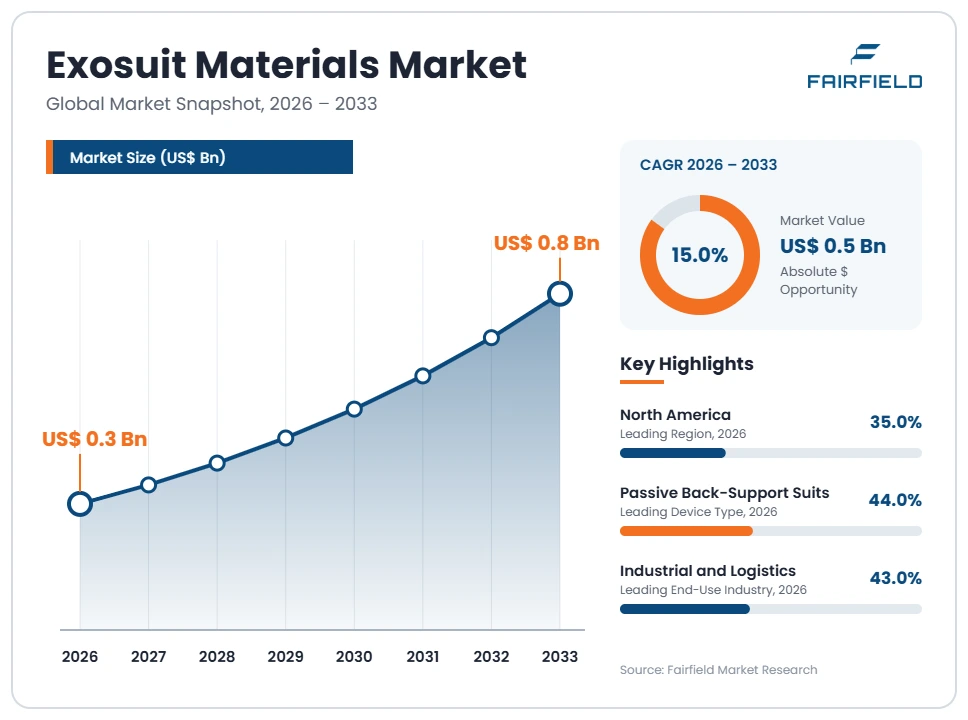
The global Exosuit Materials market size is expected to be valued at US$ 0.3 billion in 2026 and projected to reach US$ 0.8 billion by 2033, growing at a CAGR of 15.0% between 2026 and 2033.
Material demand grew at an estimated 17.4% CAGR from 2020 to 2025, lifted by industrial adoption of passive back-support garments rather than powered systems. Spend on the materials layer reached roughly US$ 263 million in 2025 and is forecast at US$ 302 million in 2026, rising to about US$ 805 million by 2033. Three forces drive the trajectory. Warehouse and logistics employers are buying unpowered suits to reduce lifting injuries. Rehabilitation programmes are adopting soft wearable assistance under clinical supervision. Standards work is giving procurement teams a basis for comparison. Powered soft exosuits remain largely in research, so near-term material volume is concentrated in textiles, webbing, elastomers and anchoring structures.
Key Report Takeaways
- By Material Type: Technical textiles and webbing held 37% share in 2026, while flexible conductors and electroactive polymers are projected to expand at a 19.8% CAGR through 2033, as sensing and actuation move from rigid modules into the garment itself.
- By Functional Layer: The structural and anchoring layer held 41% share in 2026, while the sensing and electronics layer is set to grow at a 20.6% CAGR through 2033, driven by demand for load monitoring and usage data in workplace deployments.
- By Device Type: Passive back-support suits held 44% share in 2026, while active powered soft exosuits are forecast to rise at a 19.4% CAGR through 2033, supported by improving actuator power density and smaller battery packs.
- By End-Use Industry: Industrial and logistics applications held 43% share in 2026, while healthcare and rehabilitation is projected to grow at an 18.6% CAGR through 2033, reflecting clinical gait and upper-limb therapy programmes.
- By Geography: North America held 35% share in 2026, while Asia Pacific is projected to expand at an 18.4% CAGR through 2033, led by electronics assembly, automotive plants and ageing-workforce pressure.
Global Exosuit Materials Market Trends and Insights
Drivers Impact Analysis
Two demand forces account for most of the growth in soft wearable assistive device materials.
| Driver | Impact on CAGR Forecast | Geographic Relevance | Impact Timeline |
| Occupational lifting injuries and ergonomic programmes in warehousing and manufacturing | High | North America, Europe, Asia Pacific | Short term (≤2 years) |
| Standards and regulatory clarity that let procurement teams qualify soft exosuits | Medium | Europe, North America | Medium term (2–4 years) |
Workplace Back Injury Costs Pull Technical Textiles Into Industrial Ergonomics Budgets
Lifting injury cost is the clearest commercial driver for exosuit materials today. Manual handling injuries to the lower back generate lost workdays, compensation claims and recruitment churn in warehousing, parcel logistics, automotive assembly and food processing. Employers buy passive support garments as personal protective equipment, which places recurring material demand on webbing, elastic bands, padded interfaces and composite anchor plates rather than on electronics.
The mechanism runs through procurement, not research. OSHA ergonomics guidance and equivalent national frameworks push employers to document control measures for repetitive lifting. A passive suit is cheap, needs no charging and can be issued in quantity, so it fits an existing safety budget line. Each deployment of several hundred garments consumes measurable volumes of high-tenacity textile, elastomeric energy-storing elements and moulded polymer components, creating steady repeat orders as garments wear out.
Exoskeleton Standards Work Gives Buyers a Basis to Qualify Soft Wearable Assistive Devices
Formal standards activity is converting cautious interest into purchase orders, which raises material consumption across the category. Safety managers previously had no agreed way to compare products or define acceptable performance. Published terminology, safety and performance documents now let buyers write specifications, run structured trials and justify spending internally. That shift moves soft exosuits from pilot projects into multi-site rollouts.
The causal link runs through documentation and liability. ASTM International Committee F48 develops standards covering terminology, safety and performance for exoskeletons and exosuits, while ISO 13482 addresses safety requirements for personal care robots and ISO/TC 299 continues broader robotics work. Suppliers must then prove material properties such as flame behaviour, tensile strength, skin contact safety and wash durability. Those evidence requirements favour qualified industrial textiles and certified elastomers over improvised prototype materials.
Restraints Impact Analysis
Two constraints keep exosuit material volumes well below the forecasts published earlier in this decade.
| Restraint | Impact on CAGR Forecast | Geographic Relevance | Impact Timeline |
| Battery mass and actuator power density limits in powered soft exosuits | High | Global | Long term (≥4 years) |
| Laundering, abrasion and durability failures in daily industrial use | Medium | North America, Europe, Asia Pacific | Medium term (2–4 years) |
Battery Mass and Actuator Power Density Keep Powered Soft Exosuits Out of Volume Use
Powered soft exosuits remain a small slice of material demand because the energy system is still too heavy. A worker must carry the actuator, transmission, controller and battery for a full shift. Added mass at the torso or hips increases metabolic cost, which can cancel the assistance the suit provides. Buyers therefore default to unpowered garments, and the advanced actuator and conductor materials stay in research volumes.
The cost and weight source is specific. Lithium-ion packs sized for an eight-hour shift, geared electric motors with Bowden cable transmission, and the thermal management those motors require together dominate the mass budget. Shape-memory alloy and dielectric elastomer actuators promise lighter alternatives but deliver limited strain, slow cycling or high driving voltages. Until power density improves materially, active systems cannot displace passive ones in industrial fleets.
Laundering and Abrasion Failures Shorten Service Life and Deter Repeat Material Orders
Durability problems in daily use directly suppress repeat orders for exosuit materials. A garment worn against the body across a full shift absorbs sweat, dust and lubricant, then needs cleaning. Industrial laundering degrades elastomeric elements, delaminates bonded seams and damages printed conductors. When suits fail early, safety managers pause rollouts, and suppliers lose the volume that would justify tooling investment.
The underlying cause is a materials conflict. Energy-storing elastomers and textile-integrated conductors need flexibility, while industrial wash cycles apply heat, detergent and mechanical agitation. Encapsulation that survives washing adds stiffness and reduces comfort, which lowers worker acceptance. Abrasion at shoulder straps, thigh cuffs and cable routing points concentrates wear in small areas. Qualifying materials against repeated wash and abrasion testing adds development cost that small suppliers struggle to carry.
Market Opportunities
Two revenue pools sit beyond today’s passive industrial garment business.
Washable Textile Sensing Opens a Data-Linked Revenue Pool in Workplace Safety Programmes
Washable textile-integrated sensing is the most accessible new revenue pool for exosuit material suppliers. Employers increasingly want evidence that a safety intervention works. Sensors woven into straps and interfaces can record lifting frequency, posture and suit usage without a separate wearable. Material suppliers who deliver a qualified sensing textile, rather than a bare conductor, can sell at a far higher value per metre.
Large logistics and manufacturing employers create the demand, since they already run ergonomics analytics programmes. Capture requires three capabilities: stretchable conductor systems that survive wash cycles, encapsulation chemistry that keeps hand feel acceptable, and connector designs that tolerate repeated flexing. Advances in printed stretchable electronics and conductive yarn production have made these achievable at garment scale, turning a passive support product into a monitored safety asset with recurring service value.
Clinical Rehabilitation Programmes Create Demand for Certified Skin-Contact Exosuit Materials
Rehabilitation is a distinct and under-supplied revenue pool for exosuit materials. Soft suits used for gait training after stroke or spinal cord injury contact fragile skin for long sessions under clinical supervision. That application demands biocompatible interface materials, documented cleaning protocols and traceable supply, all of which command higher margins than industrial webbing sold by the roll.
Hospitals, rehabilitation clinics and academic research centres generate the demand, and clinical evidence from gait assistance studies supports it. Suppliers can capture the pool by providing material dossiers suitable for a device technical file, since a product making a rehabilitation claim falls under Regulation (EU) 2017/745 on medical devices in Europe. Silicone interface layers, low-abrasion liners and certified textile substrates with full batch traceability then become specified components rather than interchangeable commodities. Switching costs rise accordingly, which protects margins across the device lifecycle.
Segment Analysis
- By Material Type: Technical Textiles Dominate While Flexible Conductors Grow Fastest
Technical textiles and webbing held 37% of material value in 2026, the largest share, because every exosuit needs load paths, straps and anchoring panels regardless of whether it is powered. High-tenacity nylon, polyester and aramid webbing carry assistive forces to the hips and shoulders. Elastomers and silicones followed at 21%, used for energy-storing bands and skin interfaces. Lightweight composites held 18%, mainly in anchor plates and frames. Flexible conductors and electroactive polymers represent only 13% but grow fastest at a 19.8% CAGR, as sensing and soft actuation migrate into the garment. Shape-memory alloys held 11%. The implication is that near-term revenue sits with established textile and polymer suppliers, while the higher-growth value will accrue to firms able to qualify stretchable electronic materials for washable, body-worn use.
- By Functional Layer: Structural Components Lead as Sensing and Electronics Scale Quickly
The structural and anchoring layer held 41% share in 2026, the largest functional category, because force transmission determines whether a suit works at all. This layer includes webbing, harness panels, composite anchor plates and stitched load paths. Actuation and transmission components, covering Bowden cables, tendons, clutches and pneumatic artificial muscles, accounted for 26%. The interface and padding layer held 19%, driven by comfort requirements that determine worker acceptance. The sensing and electronics layer is smallest at 14% but fastest-growing at a 20.6% CAGR, as buyers seek usage data and adaptive control. Supporting this shift are printed stretchable circuits and conductive yarns that survive flexing. For suppliers, the business implication is clear: structural materials deliver volume today, while the sensing layer determines differentiation and pricing power later in the forecast period.
- By Device Type: Passive Back-Support Suits Hold Volume as Active Systems Accelerate
Passive back-support suits held 44% of exosuit material consumption in 2026, the leading device category, because they are inexpensive, need no charging and address the most common workplace injury. Passive shoulder and upper-limb suits took 27%, widely used in overhead assembly and painting tasks. Quasi-passive and clutched systems, which engage assistance only during specific motions, held 17%. Active powered soft exosuits accounted for just 12% but expand fastest at a 19.4% CAGR, helped by improving actuator power density, smaller lithium-ion packs and clinical rehabilitation adoption. This split shapes supplier strategy directly. Volume orders today come from textile and elastomer production for unpowered garments, while the growth segment requires competence in cables, motors, flexible conductors and the encapsulation needed to keep electronics working inside a worn garment.
- By End-Use Industry: Industrial Buyers Supply Scale While Rehabilitation Expands Fastest
Industrial and logistics applications accounted for 43% of exosuit material demand in 2026, the dominant end use, because warehousing, parcel handling, automotive assembly and food processing deploy garments in large fleets. Healthcare and rehabilitation held 22% and grows fastest at an 18.6% CAGR, driven by gait training after stroke and upper-limb therapy programmes in clinical settings. Construction and agriculture together held 16%, limited by harsh environments and contract labour patterns. Defense and military accounted for 12%, focused on load carriage research. Consumer and sports use remains small at 7%. The commercial implication is that industrial buyers set cost and durability specifications for the whole supply base, while clinical customers pull suppliers toward certified, biocompatible and traceable materials that carry higher margins per unit.
Geography Analysis
- Which Region Is Leading the Exosuit Materials Market?
North America leads the exosuit materials market with 35% share in 2026. The United States supplies most of that demand, with Canada adding smaller volumes through manufacturing and clinical research. Three causes explain the position. Large parcel logistics, warehousing and automotive employers have run multi-site ergonomic trials and moved several to fleet deployment. Workers’ compensation economics make injury reduction a measurable financial case. OSHA ergonomics guidance gives safety teams a reason to document control measures for manual handling. The region also hosts several soft exosuit developers that specify materials locally. The main change shaping demand is the shift from pilot purchases to standing replacement orders, which turns intermittent prototype sourcing into predictable industrial textile and elastomer supply contracts.
- Europe Links Machinery and Medical Device Rules to Qualified Exosuit Material Specifications
Europe held 31% share in 2026, the second-largest position, supported by strong manufacturing employment and a demanding regulatory environment. Germany, France, Italy, the Netherlands and the Nordic countries drive demand through automotive assembly, logistics and public rehabilitation services. Two regulatory instruments shape material choice. Regulation (EU) 2023/1230 on machinery, which applies from January 2027, governs products treated as machinery. Regulation (EU) 2017/745 applies where a device carries a rehabilitation or medical claim. Both push suppliers to document material properties, biocompatibility and durability. Works councils and occupational health services also influence purchasing, so comfort and worker acceptance carry unusual weight. The notable change is procurement consolidation, with large employers writing material specifications into framework agreements rather than buying garments product by product.
- Which Region Is Growing Fastest in the Exosuit Materials Market?
Asia Pacific is the fastest-growing geography at an 18.4% CAGR between 2026 and 2033, from 26% share in 2026. Japan, China, South Korea, Singapore and Australia drive the expansion. Japan faces acute workforce ageing in logistics, nursing and agriculture, which has made assistive garments a mainstream policy topic rather than a novelty. China contributes both large-scale assembly employment and a growing domestic supply base for textiles, elastomers and actuators. South Korea adds electronics manufacturing demand and strong materials science capability. Local production of high-tenacity fibre and silicone keeps input costs competitive. The barrier is price sensitivity among contract manufacturers. The change to watch is domestic brands supplying low-cost passive suits at volumes that lift regional material consumption sharply.
- Latin America Shows Early Industrial Interest Constrained by Capital and Import Costs
Latin America held 4% share in 2026, a small base concentrated in Brazil, Mexico, Argentina and Chile. Demand comes mainly from automotive plants, agribusiness packing operations and mining support activities where manual handling is intense. Multinational employers introduce the technology through global safety programmes rather than local procurement decisions. The barriers are significant. Imported garments carry duties and freight costs that raise unit prices well above local safety budgets, currency volatility complicates multi-year contracts, and few distributors can support sizing, fitting and replacement parts. Limited local testing capability also slows qualification. The opportunity lies in regional assembly, where imported webbing, elastomer bands and composite plates are converted into finished garments close to the customer, cutting landed cost and shortening replacement cycles.
- Middle East & Africa Build Demand Around Logistics Hubs and Industrial Safety Investment
Middle East & Africa accounted for 4% share in 2026, with activity concentrated in the United Arab Emirates, Saudi Arabia, Qatar and South Africa. Large logistics hubs, port operations, construction megaprojects and mining create genuine manual handling exposure. National industrial strategies and rising occupational safety enforcement are increasing interest in wearable support. The barriers are practical. Heat and humidity make thick padded garments uncomfortable for outdoor work, a large share of the workforce is contract labour with high turnover that discourages per-worker equipment spending, and local technical support for fitting and repair is scarce. The opportunity is heat-adapted material design, using breathable spacer fabrics and minimal-contact anchoring, which would make soft support garments viable in climates where current designs are rejected.
Competitive Landscape
The exosuit materials market is fragmented with low concentration, because value is split across two very different supplier groups. Large chemical and fibre producers supply elastomers, silicones, high-tenacity yarn and composite reinforcement into many industries, with exosuits a minor application. Small device makers design and assemble finished garments and specify materials for their own products. No participant controls the materials layer. Consolidation has been limited, although several device developers have been absorbed by larger industrial or medical groups seeking a wearable portfolio.
Competition rests on measurable material performance rather than brand. Suppliers compete on tensile strength and elongation consistency, abrasion and wash durability, skin contact safety, weight per unit of assistive force, and the ability to document properties for safety qualification. Price matters heavily in passive garments, where buyers purchase in fleets. New entrants come from technical textile mills moving into finished components, from printed electronics specialists offering stretchable conductors, and from soft robotics groups commercialising actuator materials.
Strategic activity centres on qualification and integration rather than capacity. Material suppliers are building test data packages covering laundering, abrasion and biocompatibility so device makers can reuse them in safety submissions. Several are developing bonded and welded seam systems that replace stitching at load points. Others are co-developing anchoring geometries with device designers, which locks in material specification early.
Strategic direction across the sector is converging on durability, comfort and documentation. Vendors are designing for industrial wash cycles, reducing garment mass, and aligning material evidence with emerging exoskeleton standards, positioning for the point when powered systems become practical at scale.
Recent Industry Developments
- 2014: ISO published ISO 13482, the safety requirements standard for personal care robots covering physical assistant devices – it gave the first international safety reference for wearable assistive systems and shaped early material testing expectations.
- 2017: ASTM International formed Committee F48 on exoskeletons and exosuits – it created a dedicated standards body for terminology, safety, performance and ergonomics, giving procurement teams a comparison framework that material suppliers now design toward.
- May 2021: Regulation (EU) 2017/745 on medical devices became fully applicable – it raised the biocompatibility, traceability and documentation burden for any exosuit making a rehabilitation claim, directly affecting interface material selection.
- June 2023: Regulation (EU) 2023/1230 on machinery was adopted and published, applying from January 2027 – it modernises essential health and safety requirements for machinery and sets the compliance framework that powered soft exosuits sold in Europe must meet.
Companies Covered in the Report
- Ottobock SE & Co. KGaA
- HeroWear, LLC
- Levitate Technologies, Inc.
- Verve Motion, Inc.
- Comau S.p.A.
- German Bionic Systems GmbH
- Toray Industries, Inc.
- Teijin Limited
- DuPont de Nemours, Inc.
- Dow Inc.
- Wacker Chemie AG
- Myant Inc.
Exosuit Materials Market Report Scope
| Metric | Value |
| Study Period | 2020–2033 |
| Market Size 2026 | US$ 0.3 Billion |
| Market Size 2033 | US$ 0.8 Billion |
| CAGR 2026–2033 | 15.0% |
| Absolute Dollar Opportunity | US$ 0.5 Billion |
| Largest Market | North America, with 35% share in 2026 |
| Fastest-Growing Market | Asia Pacific, at an 18.4% CAGR |
| Market Concentration | Low |
| Major Players | Ottobock SE & Co. KGaA, HeroWear, LLC, Levitate Technologies, Inc., Verve Motion, Inc., Toray Industries, Inc. |
Exosuit Materials Market Segmentation
Material Type
- Technical Textiles and Webbing
- Elastomers and Silicones
- Lightweight Composites
- Flexible Conductors and Electroactive Polymers
- Shape-Memory Alloys
Functional Layer
- Structural and Anchoring Layer
- Actuation and Transmission Components
- Interface and Padding Layer
- Sensing and Electronics Layer
Device Type
- Passive Back-Support Suits
- Passive Shoulder and Upper-Limb Suits
- Quasi-Passive and Clutched Systems
- Active Powered Soft Exosuits
End-Use Industry
- Industrial and Logistics
- Healthcare and Rehabilitation
- Construction and Agriculture
- Defense and Military
- Consumer and Sports
Regions
- North America
- Europe
- Asia Pacific
- Latin America
- Middle East & Africa
- Executive Summary
- Global Exosuit Materials Market Snapshot
- Future Projections
- Key Report Takeaways
- Regional Snapshot
- Market Overview
- Market Definition and Report Scope
- Historical Trends 2020–2025
- Market Dynamics
- Drivers
- Workplace Back Injury Costs Pull Technical Textiles Into Industrial Ergonomics Budgets
- Exoskeleton Standards Work Gives Buyers a Basis to Qualify Soft Wearable Assistive Devices
- Restraints
- Battery Mass and Actuator Power Density Keep Powered Soft Exosuits Out of Volume Use
- Laundering and Abrasion Failures Shorten Service Life and Deter Repeat Material Orders
- Market Opportunities
- Washable Textile Sensing Opens a Data-Linked Revenue Pool in Workplace Safety Programmes
- Clinical Rehabilitation Programmes Create Demand for Certified Skin-Contact Exosuit Materials
- Drivers
- Global Exosuit Materials Market Outlook, 2020–2033
- Global Exosuit Materials Market Outlook, by Material Type, Value (US$ Billion), 2020–2033
- Technical Textiles and Webbing
- Elastomers and Silicones
- Lightweight Composites
- Flexible Conductors and Electroactive Polymers
- Shape-Memory Alloys
- Global Exosuit Materials Market Outlook, by Functional Layer, Value (US$ Billion), 2020–2033
- Structural and Anchoring Layer
- Actuation and Transmission Components
- Interface and Padding Layer
- Sensing and Electronics Layer
- Global Exosuit Materials Market Outlook, by Device Type, Value (US$ Billion), 2020–2033
- Passive Back-Support Suits
- Passive Shoulder and Upper-Limb Suits
- Quasi-Passive and Clutched Systems
- Active Powered Soft Exosuits
- Global Exosuit Materials Market Outlook, by End-Use Industry, Value (US$ Billion), 2020–2033
- Industrial and Logistics
- Healthcare and Rehabilitation
- Construction and Agriculture
- Defense and Military
- Consumer and Sports
- Global Exosuit Materials Market Outlook, by Region, Value (US$ Billion), 2020–2033
- North America
- Europe
- Asia Pacific
- Latin America
- Middle East & Africa
- Global Exosuit Materials Market Outlook, by Material Type, Value (US$ Billion), 2020–2033
- North America Exosuit Materials Market Outlook, 2020–2033
- North America Exosuit Materials Market Outlook, by Material Type, Value (US$ Billion), 2020–2033
- Technical Textiles and Webbing
- Elastomers and Silicones
- Lightweight Composites
- Flexible Conductors and Electroactive Polymers
- Shape-Memory Alloys
- North America Exosuit Materials Market Outlook, by Functional Layer, Value (US$ Billion), 2020–2033
- Structural and Anchoring Layer
- Actuation and Transmission Components
- Interface and Padding Layer
- Sensing and Electronics Layer
- North America Exosuit Materials Market Outlook, by Device Type, Value (US$ Billion), 2020–2033
- Passive Back-Support Suits
- Passive Shoulder and Upper-Limb Suits
- Quasi-Passive and Clutched Systems
- Active Powered Soft Exosuits
- North America Exosuit Materials Market Outlook, by End-Use Industry, Value (US$ Billion), 2020–2033
- Industrial and Logistics
- Healthcare and Rehabilitation
- Construction and Agriculture
- Defense and Military
- Consumer and Sports
- North America Exosuit Materials Market Outlook, by Country, Value (US$ Billion), 2020–2033
- United States Exosuit Materials Market Outlook, by Material Type, 2020–2033
- United States Exosuit Materials Market Outlook, by Functional Layer, 2020–2033
- United States Exosuit Materials Market Outlook, by Device Type, 2020–2033
- United States Exosuit Materials Market Outlook, by End-Use Industry, 2020–2033
- Canada Exosuit Materials Market Outlook, by Material Type, 2020–2033
- Canada Exosuit Materials Market Outlook, by Functional Layer, 2020–2033
- Canada Exosuit Materials Market Outlook, by Device Type, 2020–2033
- Canada Exosuit Materials Market Outlook, by End-Use Industry, 2020–2033
- North America Exosuit Materials Market Outlook, by Material Type, Value (US$ Billion), 2020–2033
- Europe Exosuit Materials Market Outlook, 2020–2033
- Europe Exosuit Materials Market Outlook, by Material Type, Value (US$ Billion), 2020–2033
- Technical Textiles and Webbing
- Elastomers and Silicones
- Lightweight Composites
- Flexible Conductors and Electroactive Polymers
- Shape-Memory Alloys
- Europe Exosuit Materials Market Outlook, by Functional Layer, Value (US$ Billion), 2020–2033
- Structural and Anchoring Layer
- Actuation and Transmission Components
- Interface and Padding Layer
- Sensing and Electronics Layer
- Europe Exosuit Materials Market Outlook, by Device Type, Value (US$ Billion), 2020–2033
- Passive Back-Support Suits
- Passive Shoulder and Upper-Limb Suits
- Quasi-Passive and Clutched Systems
- Active Powered Soft Exosuits
- Europe Exosuit Materials Market Outlook, by End-Use Industry, Value (US$ Billion), 2020–2033
- Industrial and Logistics
- Healthcare and Rehabilitation
- Construction and Agriculture
- Defense and Military
- Consumer and Sports
- Europe Exosuit Materials Market Outlook, by Country, Value (US$ Billion), 2020–2033
- Germany Exosuit Materials Market Outlook, by Material Type, 2020–2033
- Germany Exosuit Materials Market Outlook, by Functional Layer, 2020–2033
- Germany Exosuit Materials Market Outlook, by Device Type, 2020–2033
- Germany Exosuit Materials Market Outlook, by End-Use Industry, 2020–2033
- France Exosuit Materials Market Outlook, by Material Type, 2020–2033
- France Exosuit Materials Market Outlook, by Functional Layer, 2020–2033
- France Exosuit Materials Market Outlook, by Device Type, 2020–2033
- France Exosuit Materials Market Outlook, by End-Use Industry, 2020–2033
- Italy Exosuit Materials Market Outlook, by Material Type, 2020–2033
- Italy Exosuit Materials Market Outlook, by Functional Layer, 2020–2033
- Italy Exosuit Materials Market Outlook, by Device Type, 2020–2033
- Italy Exosuit Materials Market Outlook, by End-Use Industry, 2020–2033
- Netherlands Exosuit Materials Market Outlook, by Material Type, 2020–2033
- Netherlands Exosuit Materials Market Outlook, by Functional Layer, 2020–2033
- Netherlands Exosuit Materials Market Outlook, by Device Type, 2020–2033
- Netherlands Exosuit Materials Market Outlook, by End-Use Industry, 2020–2033
- Nordic countries Exosuit Materials Market Outlook, by Material Type, 2020–2033
- Nordic countries Exosuit Materials Market Outlook, by Functional Layer, 2020–2033
- Nordic countries Exosuit Materials Market Outlook, by Device Type, 2020–2033
- Nordic countries Exosuit Materials Market Outlook, by End-Use Industry, 2020–2033
- Europe Exosuit Materials Market Outlook, by Material Type, Value (US$ Billion), 2020–2033
- Asia Pacific Exosuit Materials Market Outlook, 2020–2033
- Asia Pacific Exosuit Materials Market Outlook, by Material Type, Value (US$ Billion), 2020–2033
- Technical Textiles and Webbing
- Elastomers and Silicones
- Lightweight Composites
- Flexible Conductors and Electroactive Polymers
- Shape-Memory Alloys
- Asia Pacific Exosuit Materials Market Outlook, by Functional Layer, Value (US$ Billion), 2020–2033
- Structural and Anchoring Layer
- Actuation and Transmission Components
- Interface and Padding Layer
- Sensing and Electronics Layer
- Asia Pacific Exosuit Materials Market Outlook, by Device Type, Value (US$ Billion), 2020–2033
- Passive Back-Support Suits
- Passive Shoulder and Upper-Limb Suits
- Quasi-Passive and Clutched Systems
- Active Powered Soft Exosuits
- Asia Pacific Exosuit Materials Market Outlook, by End-Use Industry, Value (US$ Billion), 2020–2033
- Industrial and Logistics
- Healthcare and Rehabilitation
- Construction and Agriculture
- Defense and Military
- Consumer and Sports
- Asia Pacific Exosuit Materials Market Outlook, by Country, Value (US$ Billion), 2020–2033
- Japan Exosuit Materials Market Outlook, by Material Type, 2020–2033
- Japan Exosuit Materials Market Outlook, by Functional Layer, 2020–2033
- Japan Exosuit Materials Market Outlook, by Device Type, 2020–2033
- Japan Exosuit Materials Market Outlook, by End-Use Industry, 2020–2033
- China Exosuit Materials Market Outlook, by Material Type, 2020–2033
- China Exosuit Materials Market Outlook, by Functional Layer, 2020–2033
- China Exosuit Materials Market Outlook, by Device Type, 2020–2033
- China Exosuit Materials Market Outlook, by End-Use Industry, 2020–2033
- South Korea Exosuit Materials Market Outlook, by Material Type, 2020–2033
- South Korea Exosuit Materials Market Outlook, by Functional Layer, 2020–2033
- South Korea Exosuit Materials Market Outlook, by Device Type, 2020–2033
- South Korea Exosuit Materials Market Outlook, by End-Use Industry, 2020–2033
- Singapore Exosuit Materials Market Outlook, by Material Type, 2020–2033
- Singapore Exosuit Materials Market Outlook, by Functional Layer, 2020–2033
- Singapore Exosuit Materials Market Outlook, by Device Type, 2020–2033
- Singapore Exosuit Materials Market Outlook, by End-Use Industry, 2020–2033
- Australia Exosuit Materials Market Outlook, by Material Type, 2020–2033
- Australia Exosuit Materials Market Outlook, by Functional Layer, 2020–2033
- Australia Exosuit Materials Market Outlook, by Device Type, 2020–2033
- Australia Exosuit Materials Market Outlook, by End-Use Industry, 2020–2033
- Asia Pacific Exosuit Materials Market Outlook, by Material Type, Value (US$ Billion), 2020–2033
- Latin America Exosuit Materials Market Outlook, 2020–2033
- Latin America Exosuit Materials Market Outlook, by Material Type, Value (US$ Billion), 2020–2033
- Technical Textiles and Webbing
- Elastomers and Silicones
- Lightweight Composites
- Flexible Conductors and Electroactive Polymers
- Shape-Memory Alloys
- Latin America Exosuit Materials Market Outlook, by Functional Layer, Value (US$ Billion), 2020–2033
- Structural and Anchoring Layer
- Actuation and Transmission Components
- Interface and Padding Layer
- Sensing and Electronics Layer
- Latin America Exosuit Materials Market Outlook, by Device Type, Value (US$ Billion), 2020–2033
- Passive Back-Support Suits
- Passive Shoulder and Upper-Limb Suits
- Quasi-Passive and Clutched Systems
- Active Powered Soft Exosuits
- Latin America Exosuit Materials Market Outlook, by End-Use Industry, Value (US$ Billion), 2020–2033
- Industrial and Logistics
- Healthcare and Rehabilitation
- Construction and Agriculture
- Defense and Military
- Consumer and Sports
- Latin America Exosuit Materials Market Outlook, by Country, Value (US$ Billion), 2020–2033
- Brazil Exosuit Materials Market Outlook, by Material Type, 2020–2033
- Brazil Exosuit Materials Market Outlook, by Functional Layer, 2020–2033
- Brazil Exosuit Materials Market Outlook, by Device Type, 2020–2033
- Brazil Exosuit Materials Market Outlook, by End-Use Industry, 2020–2033
- Mexico Exosuit Materials Market Outlook, by Material Type, 2020–2033
- Mexico Exosuit Materials Market Outlook, by Functional Layer, 2020–2033
- Mexico Exosuit Materials Market Outlook, by Device Type, 2020–2033
- Mexico Exosuit Materials Market Outlook, by End-Use Industry, 2020–2033
- Argentina Exosuit Materials Market Outlook, by Material Type, 2020–2033
- Argentina Exosuit Materials Market Outlook, by Functional Layer, 2020–2033
- Argentina Exosuit Materials Market Outlook, by Device Type, 2020–2033
- Argentina Exosuit Materials Market Outlook, by End-Use Industry, 2020–2033
- Chile Exosuit Materials Market Outlook, by Material Type, 2020–2033
- Chile Exosuit Materials Market Outlook, by Functional Layer, 2020–2033
- Chile Exosuit Materials Market Outlook, by Device Type, 2020–2033
- Chile Exosuit Materials Market Outlook, by End-Use Industry, 2020–2033
- Latin America Exosuit Materials Market Outlook, by Material Type, Value (US$ Billion), 2020–2033
- Middle East & Africa Exosuit Materials Market Outlook, 2020–2033
- Middle East & Africa Exosuit Materials Market Outlook, by Material Type, Value (US$ Billion), 2020–2033
- Technical Textiles and Webbing
- Elastomers and Silicones
- Lightweight Composites
- Flexible Conductors and Electroactive Polymers
- Shape-Memory Alloys
- Middle East & Africa Exosuit Materials Market Outlook, by Functional Layer, Value (US$ Billion), 2020–2033
- Structural and Anchoring Layer
- Actuation and Transmission Components
- Interface and Padding Layer
- Sensing and Electronics Layer
- Middle East & Africa Exosuit Materials Market Outlook, by Device Type, Value (US$ Billion), 2020–2033
- Passive Back-Support Suits
- Passive Shoulder and Upper-Limb Suits
- Quasi-Passive and Clutched Systems
- Active Powered Soft Exosuits
- Middle East & Africa Exosuit Materials Market Outlook, by End-Use Industry, Value (US$ Billion), 2020–2033
- Industrial and Logistics
- Healthcare and Rehabilitation
- Construction and Agriculture
- Defense and Military
- Consumer and Sports
- Middle East & Africa Exosuit Materials Market Outlook, by Country, Value (US$ Billion), 2020–2033
- United Arab Emirates Exosuit Materials Market Outlook, by Material Type, 2020–2033
- United Arab Emirates Exosuit Materials Market Outlook, by Functional Layer, 2020–2033
- United Arab Emirates Exosuit Materials Market Outlook, by Device Type, 2020–2033
- United Arab Emirates Exosuit Materials Market Outlook, by End-Use Industry, 2020–2033
- Saudi Arabia Exosuit Materials Market Outlook, by Material Type, 2020–2033
- Saudi Arabia Exosuit Materials Market Outlook, by Functional Layer, 2020–2033
- Saudi Arabia Exosuit Materials Market Outlook, by Device Type, 2020–2033
- Saudi Arabia Exosuit Materials Market Outlook, by End-Use Industry, 2020–2033
- Qatar Exosuit Materials Market Outlook, by Material Type, 2020–2033
- Qatar Exosuit Materials Market Outlook, by Functional Layer, 2020–2033
- Qatar Exosuit Materials Market Outlook, by Device Type, 2020–2033
- Qatar Exosuit Materials Market Outlook, by End-Use Industry, 2020–2033
- South Africa Exosuit Materials Market Outlook, by Material Type, 2020–2033
- South Africa Exosuit Materials Market Outlook, by Functional Layer, 2020–2033
- South Africa Exosuit Materials Market Outlook, by Device Type, 2020–2033
- South Africa Exosuit Materials Market Outlook, by End-Use Industry, 2020–2033
- Middle East & Africa Exosuit Materials Market Outlook, by Material Type, Value (US$ Billion), 2020–2033
- Competitive Landscape
- Market Concentration and Industry Leaders
- Competitive Differentiation
- Strategic Moves and Market Direction
- Recent Industry Developments
- Company Profiles
- Ottobock SE & Co. KGaA
- HeroWear, LLC
- Levitate Technologies, Inc.
- Verve Motion, Inc.
- Comau S.p.A.
- German Bionic Systems GmbH
- Toray Industries, Inc.
- Teijin Limited
- DuPont de Nemours, Inc.
- Dow Inc.
- Wacker Chemie AG
- Myant Inc.
- Appendix
- Research Methodology
- Report Assumptions
- Acronyms and Abbreviations
Material Type
- Technical Textiles and Webbing
- Elastomers and Silicones
- Lightweight Composites
- Flexible Conductors and Electroactive Polymers
- Shape-Memory Alloys
Functional Layer
- Structural and Anchoring Layer
- Actuation and Transmission Components
- Interface and Padding Layer
- Sensing and Electronics Layer
Device Type
- Passive Back-Support Suits
- Passive Shoulder and Upper-Limb Suits
- Quasi-Passive and Clutched Systems
- Active Powered Soft Exosuits
End-Use Industry
- Industrial and Logistics
- Healthcare and Rehabilitation
- Construction and Agriculture
- Defense and Military
- Consumer and Sports
Regions
- North America
- Europe
- Asia Pacific
- Latin America
- Middle East & Africa
Our Research Methodology
Considering the volatility of business today, traditional approaches to strategizing a game plan can be unfruitful if not detrimental. True ambiguity is no way to determine a forecast. A myriad of predetermined factors must be accounted for such as the degree of risk involved, the magnitude of circumstances, as well as conditions or consequences that are not known or unpredictable. To circumvent binary views that cast uncertainty, the application of market research intelligence to strategically posture, move, and enable actionable outcomes is necessary.
View Methodology
Quality Assured
Rigorous Validation Process

Confidentiality Assured
End-to-end Data Security

Custom Research Services
Tailored To Your Objectives
FAQs
The materials layer is valued at US$ 0.3 billion in 2026, equal to roughly US$ 302 million of textile, polymer, composite and electronic material consumption.
The market is projected to reach US$ 0.8 billion by 2033, growing at a 15.0% CAGR and adding US$ 0.5 billion in absolute opportunity.
Technical textiles and webbing lead with 37% share in 2026, because every soft wearable assistive device needs load paths, straps and anchoring panels.
Flexible conductors and electroactive polymers grow fastest at a 19.8% CAGR, while Asia Pacific expands quickest among geographies at an 18.4% CAGR.
North America holds 35% share in 2026, and concentration is low, with value split between large fibre and polymer producers and small device makers.
Related Reports
Electric Vehicle Fluids Market Size, Share, Insights, Competitive Landscape, and Forecast 2026 to 2033
The global electric vehicle fluids market is valued at US$2.8 billion in 2026, reaching US$7.6 billion by 2033, growing at a 15.3% CAGR
Foamed Plastic Insulation Products Market Size, Share, Insights, Competitive Landscape, and Forecast 2026 to 2033
The global foamed plastic insulation products market is valued at US$42.0 billion in 2026, reaching US$62.0 billion by 2033, growing at a 5.7% CAGR
Expandable Microspheres Market Size, Share, Insights, Competitive Landscape, and Forecast 2026 to 2033
The global expandable microspheres market is valued at US$0.9 billion in 2026, reaching US$1.5 billion by 2033, growing at a 7.6% CAGR
3D Injection-Molded Plastic Market Size, Share, Insights, Competitive Landscape, and Forecast 2026 to 2033
The global 3D injection-molded plastic market is valued at US$362.01 billion in 2026, reaching US$537.18 billion by 2033, growing at a 5.8% CAGR
Zinc-Nickel Plating Market Size, Share, Insights, Competitive Landscape, and Forecast 2026 to 2033
The global zinc-nickel plating market is valued at US$1.9 billion in 2026, reaching US$2.9 billion by 2033, growing at a 6.2% CAGR
Zinc Citrate Market Size, Share, Insights, Competitive Landscape, and Forecast 2026 to 2033
The global zinc citrate market is valued at US$0.3 billion in 2026, reaching US$0.5 billion by 2033, growing at a 7.6% CAGR