



Zinc Citrate Market
Zinc Citrate Market Size, Share, Insights, Competitive Landscape, and Forecast 2026 to 2033
Zinc Citrate Market Size and Trend Analysis
How Fast Is the Zinc Citrate Market Growing?
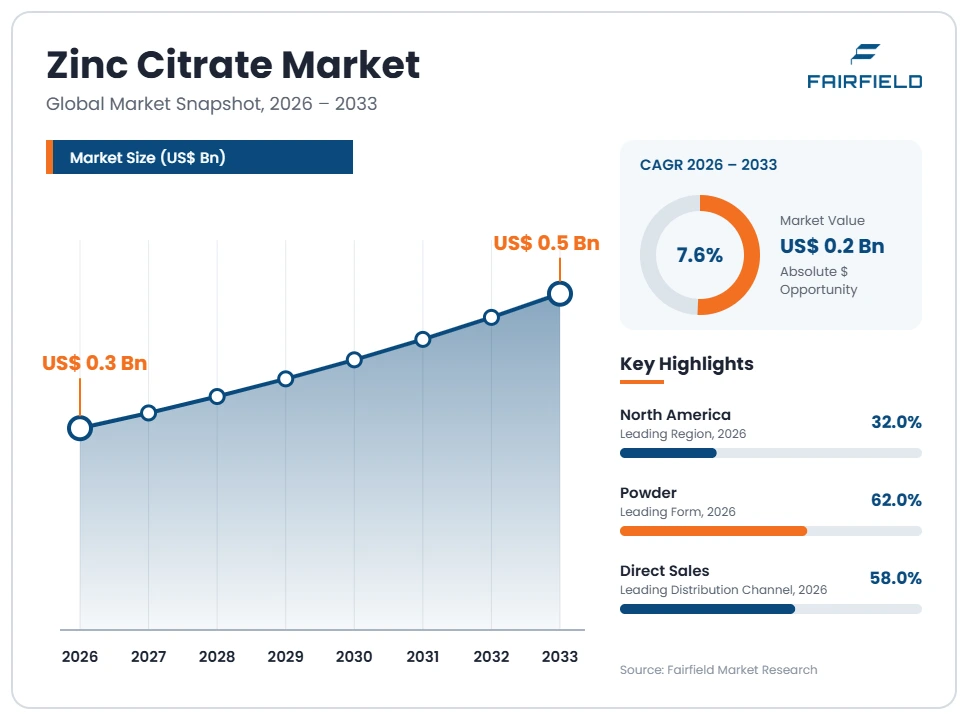
The global Zinc Citrate market size is expected to be valued at US$ 0.3 billion in 2026 and projected to reach US$ 0.5 billion by 2033, growing at a CAGR of 7.6% between 2026 and 2033.
Revenue in 2026 is close to US$ 312 million, rising to roughly US$ 520 million by 2033. Between 2020 and 2025 the salt advanced at about 4.7% a year, reaching near US$ 290 million. Three forces explain the faster outlook. Mineral fortification of staple foods keeps widening, and zinc citrate sits among the permitted zinc sources under Regulation (EC) No 1925/2006. Oral care formulators continue using the salt as a plaque and calculus control active in toothpaste and mouthrinse. Supplement brands favour its neutral taste and low dosing volume against zinc sulphate. This study counts the citrate salt itself in food, pharmaceutical, cosmetic and feed grades, and excludes finished tablets, toothpastes and formulated beverages.
Key Report Takeaways
- By Grade: Food Grade held 41% share in 2026, while Pharmaceutical Grade is projected to expand at a 9.1% CAGR through 2033, driven by monograph-compliant sourcing for oral zinc dosage forms under United States Pharmacopeia specifications.
- By Form: Powder held 62% share in 2026, while Granules are projected to expand at an 8.6% CAGR through 2033, driven by direct-compression tableting lines that need better flow and lower dust capture losses.
- By Application: Dietary Supplements held 36% share in 2026, while Oral Care is projected to expand at a 9.0% CAGR through 2033, driven by reformulation of anticaries and antigingivitis toothpastes toward zinc-based calculus control systems.
- By Distribution Channel: Direct Sales held 58% share in 2026, while Online B2B Platforms are projected to expand at a 9.4% CAGR through 2033, driven by small-batch nutraceutical brands buying documented mineral salts without distributor intermediaries.
- By Geography: North America held 32% share in 2026, while Asia Pacific is projected to expand at a 9.6% CAGR through 2033, driven by local fortification programmes and fast-growing contract supplement manufacturing capacity.
Global Zinc Citrate Market Trends and Insights
Drivers Impact Analysis
Two demand forces account for most of the forecast growth in zinc citrate consumption.
| Driver | Impact on CAGR Forecast | Geographic Relevance | Impact Timeline |
| Authorised zinc health claims supporting supplement and fortified food formulation | High | Europe, North America | Medium term 2–4 years |
| Shift of oral care formulations toward zinc salts for plaque and calculus control | Medium | Global | Long term ≥4 years |
Authorised Zinc Claims Give Zinc Citrate a Defensible Position in Supplement Formulation
Regulatory clarity is the single strongest pull on zinc citrate volumes. Zinc is one of the few minerals with a settled list of authorised claims in the European Union, which lets brand owners make specific statements on pack without case-by-case dossiers. That certainty shortens product development cycles and moves formulators toward well-documented zinc sources rather than untested alternatives.
Commission Regulation (EU) No 432/2012 established the list of permitted health claims, and the zinc entries cover contributions to normal immune system function and to the maintenance of normal skin, hair and nails. Because Regulation (EC) No 1925/2006 also lists the zinc compounds that may be added to foods, a formulator can pair an approved source with an approved claim. Zinc citrate qualifies on both counts, so it travels easily from capsule brands into fortified cereals, dairy drinks and powdered beverage mixes.
Toothpaste Reformulation Toward Zinc Actives Lifts Cosmetic-Grade Zinc Citrate Offtake
Oral care has become the second engine of demand. Zinc citrate is used in toothpaste and mouthrinse as an active for plaque and calculus control, and the ingredient now appears across mass-market, sensitivity and whitening lines. Because dentifrice batches are large and reorder cycles are short, even a modest number of reformulated stock-keeping units moves meaningful tonnage.
The mechanism is formulation chemistry rather than fashion. Zinc citrate is compatible with fluoride anticaries systems and with silica abrasives, so brands can add calculus control without rebuilding the base paste. In the United States the Food and Drug Administration over-the-counter monograph framework governs anticaries and antigingivitis actives, which pushes developers toward ingredients with established specifications and consistent heavy-metal profiles. Suppliers able to document particle size, solubility and residual solvent data therefore win placement on approved vendor lists.
Restraints Impact Analysis
Two structural constraints hold back value capture even as zinc citrate volumes expand.
| Restraint | Impact on CAGR Forecast | Geographic Relevance | Impact Timeline |
| Direct substitution by competing zinc salts and amino-acid chelates | High | Global | Short term ≤2 years |
| Upper intake limits and labelling ceilings capping dose per serving | Medium | Europe, North America | Medium term 2–4 years |
Competing Zinc Salts Keep Zinc Citrate Priced as a Commodity Mineral Input
Substitution is the hardest ceiling on margins. Zinc citrate competes head-on with zinc gluconate, zinc sulphate, zinc oxide and amino-acid chelates such as zinc bisglycinate. All deliver elemental zinc, all are widely available, and most buyers treat them as interchangeable once bioavailability data and taste profiles are reviewed. Switching costs are low, so price lists are compared line by line at every contract renewal.
The cost mechanism sits upstream. Zinc citrate is made by reacting a zinc source with citric acid, and citric acid itself is a fermentation commodity whose price tracks corn and energy markets. Zinc oxide is cheaper per unit of elemental zinc, which gives low-cost formulations an easy alternative. With no patent protection and no novelty argument, suppliers differentiate on documentation, particle engineering and supply reliability rather than on chemistry, which limits realised price premiums to a narrow band.
Intake Ceilings and Labelling Rules Limit Zinc Citrate Loading per Serving
Dose caps restrain revenue per unit far more than demand itself. Zinc is a mineral where regulators set explicit ceilings, so a formulator cannot simply raise inclusion levels to differentiate a product. That caps the grams of mineral salt sold inside each finished unit and forces growth to come from more units rather than richer formulas.
The underlying cause is toxicological. The European Food Safety Authority framework sets a tolerable upper intake level for zinc in adults, and national authorities translate it into maximum permitted amounts in supplements and fortified foods. In the United States, the Food and Drug Administration dietary supplement framework requires declaration against the Reference Daily Intake for zinc, which anchors typical label claims. Elemental zinc content of zinc citrate is also fixed by stoichiometry, so suppliers cannot concentrate the active beyond what the salt allows.
Market Opportunities
Pharmaceutical-Grade Zinc Citrate Opens a Documented, Higher-Margin Revenue Pool
Pharmaceutical grade is the clearest escape from commodity pricing. Oral zinc dosage forms, hospital preparations and compounded products require mineral salts manufactured and tested to pharmacopoeial standards, and buyers in that channel pay for assurance rather than tonnage. The grade carries far smaller volumes than food grade, but gross margins are several times wider.
Capture favours suppliers with audited sites and complete regulatory files. Monographs for zinc salts in the European Pharmacopoeia and the United States Pharmacopeia define identity, assay and impurity limits, and customers expect elemental impurity data aligned with modern expectations. Contract manufacturers serving regulated dosage forms are the demand centre, followed by hospital pharmacy suppliers. Producers that already run food-grade zinc citrate lines can qualify a dedicated suite, add stability and residual solvent testing, and move existing customers up the grade ladder.
Fortified Dairy and Infant Nutrition Categories Create a New Zinc Citrate Volume Base
Fortified nutrition is the largest untapped volume pool. Zinc citrate is used as a mineral source in infant formula, follow-on formula and fortified dairy products, where its solubility and low off-taste matter more than price. National fortification programmes in emerging economies add institutional demand that is contracted rather than promotional, giving suppliers unusually stable order books.
The buyers are large formula and dairy processors with rigorous supplier qualification. They need heavy-metal profiles well below statutory limits, allergen-free manufacturing and multi-year supply commitments, which narrows the field to producers with dedicated nutrition-grade lines. Codex standards for infant formula composition and national micronutrient fortification rules shape the specifications these processors write. Suppliers that invest in traceability from citric acid feedstock to finished mineral salt are best placed to serve this nutraceutical ingredient demand.
Segment Analysis
- By Grade: Food Grade Dominates While Pharmaceutical Grade Builds the Fastest
Food Grade holds 41% of zinc citrate revenue in 2026 because fortified foods, beverages and mainstream supplements consume the largest tonnage of the salt. The grade carries moderate documentation requirements and broad approval across food codes, so it suits the high-volume, price-sensitive core of the market. Pharmaceutical Grade is the fastest-growing category at a 9.1% CAGR, as oral zinc dosage forms and hospital preparations demand monograph compliance from the European Pharmacopoeia and the United States Pharmacopeia. Cosmetic Grade supplies the oral care chain, where particle size and heavy-metal profiles dominate specifications, while Feed Grade serves livestock mineral premixes at the lowest price point. The business implication is clear: tonnage growth sits in food and feed, but value growth concentrates in audited pharmaceutical lines, so grade mix now determines supplier profitability more than total output does.
- By Form: Powder Leads Volume While Granules Capture Momentum in Tableting
Powder accounts for 62% of zinc citrate demand in 2026, reflecting its versatility across wet blends, beverage premixes, toothpaste slurries and feed premixes. Fine powder disperses readily and is the default form in most supplier catalogues. Granules grow fastest at an 8.6% CAGR because direct-compression tablet lines need free-flowing material that resists segregation and reduces dust losses during high-speed compression. Granulated zinc citrate also improves content uniformity in multivitamin and multimineral tablets, which matters as label claim tolerances tighten. Liquid dispersions remain a small niche serving syrup and ready-to-drink formats. For suppliers, the practical implication is that physical engineering, not chemistry, is where differentiation is still possible, and granulation capacity has become a reason customers consolidate purchases with one mineral salts producer rather than shopping each order.
- By Application: Dietary Supplements Hold the Base as Oral Care Accelerates
Dietary Supplements command 36% of zinc citrate consumption in 2026, supported by immune and skin-related positioning that rests on authorised claims in the European Union and on established labelling practice in the United States. Capsules, tablets, gummies and effervescent formats all use the salt. Oral Care expands fastest at a 9.0% CAGR as toothpaste and mouthrinse brands adopt zinc systems for plaque and calculus control alongside fluoride anticaries actives. Food and Beverage Fortification follows, with cereals, dairy drinks and bakery premixes adding zinc as a mineral fortification ingredient. Infant Formula is smaller but highly specified, while Pharmaceuticals and Animal Feed round out demand. The implication for suppliers is that oral care buyers purchase in large, predictable batches, so winning a dentifrice platform delivers steadier volume than chasing fragmented supplement brands.
- By Distribution Channel: Direct Sales Dominate While Online B2B Platforms Scale Quickly
Direct Sales represent 58% of zinc citrate revenue in 2026 because large food, oral care and pharmaceutical buyers negotiate annual contracts, audit plants and require technical service that distributors cannot fully replicate. Volume concentration makes direct relationships economic for both sides. Online B2B Platforms grow fastest at a 9.4% CAGR as small nutraceutical brands, contract blenders and laboratory buyers source documented mineral salts in pallet quantities without a traditional distributor. Specialty Distributors remain essential for regional coverage, local-language regulatory support and warehousing in markets where suppliers hold no inventory. The commercial consequence is a widening split: strategic accounts move deeper into direct supply with multi-year pricing, while the long tail migrates to digital procurement, leaving distributors to defend the mid-sized accounts that value technical advice and short lead times.
Geography Analysis
- Which Region Is Leading the Zinc Citrate Market?
North America leads the zinc citrate market with 32% share in 2026, worth close to US$ 100 million. The United States drives most of this, supported by the largest supplement industry in the world and a dense base of contract manufacturers in Utah, California and New Jersey. The Food and Drug Administration dietary supplement framework, built on the Dietary Supplement Health and Education Act, gives brands a predictable path to market, while the Reference Daily Intake for zinc anchors label design. Oral care demand adds a second pillar, since major dentifrice plants reformulating toward zinc actives buy cosmetic-grade salt in bulk. Canada contributes through its licensed natural health product regime. The regional opportunity lies in reshoring mineral salt supply, as buyers increasingly ask for documented, non-Asian sourcing for pharmaceutical and infant nutrition programmes.
- Europe Converts Authorised Zinc Claims Into Steady Fortification Demand
Europe holds 28% of zinc citrate revenue in 2026, the second-largest position and the most regulation-driven. Germany, France, Italy and the United Kingdom are the core consuming markets. The decisive factor is that zinc carries authorised health claims under Commission Regulation (EU) No 432/2012, so brands can state immune and skin-related functions on pack without new dossiers. Regulation (EC) No 1925/2006 separately lists permitted zinc sources for food addition, which gives formulators a clear compliance route. The region also hosts several of the world’s established mineral salts producers, so local supply is deep and quality expectations are high. Maximum permitted amounts set by national authorities cap dose per serving, which pushes growth toward more product formats rather than stronger ones. Premium oral care manufacturing adds further cosmetic-grade demand.
- Which Region Is Growing Fastest in the Zinc Citrate Market?
Asia Pacific is growing fastest in the zinc citrate market at a 9.6% CAGR between 2026 and 2033, from a 27% share in 2026. China and India supply much of the world’s citric acid and mineral salt capacity, which keeps input costs low and local availability high. Domestic demand is the bigger story: rising household spending on supplements, government micronutrient fortification programmes, and a rapidly expanding contract manufacturing base serving export brands. India’s food safety authority has built fortification standards that include zinc, while Japan and South Korea contribute premium supplement and oral care demand. The structural change underway is upgrading, as regional producers invest in pharmacopoeia-compliant lines and tighter heavy-metal control to qualify for pharmaceutical and infant nutrition customers that previously bought only from Western suppliers.
- Latin America Builds Zinc Citrate Demand Through National Fortification Mandates
Latin America accounts for 7% of zinc citrate consumption in 2026, with Brazil and Mexico taking the bulk. Public health fortification policy is the main demand creator, since several countries mandate or encourage micronutrient addition to flour, dairy and complementary foods. A sizeable domestic supplement industry in Brazil adds commercial pull, and local toothpaste manufacturing provides a steady cosmetic-grade base. The principal barriers are import dependence for the salt itself, currency volatility that makes dollar-denominated raw material pricing unpredictable, and customs clearance delays that force buyers to hold costly safety stock. Registration requirements differ by country, which raises compliance cost for smaller brands. The clearest regional opportunity is regional blending and repacking hubs, which shorten lead times and let suppliers quote in local currency against annual fortification tenders.
- Middle East & Africa Emerges on Imported Mineral Premixes and Supplement Growth
Middle East & Africa represents 6% of zinc citrate demand in 2026, the smallest share but a genuinely underpenetrated base. Gulf states, particularly Saudi Arabia and the United Arab Emirates, drive value through premium imported supplements and a growing local nutraceutical manufacturing sector. Egypt, Nigeria and South Africa add volume through food fortification and generic supplement production. Barriers are substantial: limited domestic mineral salt manufacturing, fragmented and sometimes slow registration systems, cold-chain and warehousing gaps, and price sensitivity that favours cheaper zinc sources. Public health programmes addressing micronutrient gaps provide the most reliable demand, often funded through institutional procurement rather than retail. The region’s opportunity sits in premix manufacturing, where local blenders import zinc citrate in bulk and supply fortification programmes and feed producers across neighbouring markets.
Competitive Landscape
The zinc citrate market is fragmented with low concentration, and no supplier approaches a dominant global position. Dozens of mineral salt producers operate across Europe, North America, China and India, ranging from integrated citric acid fermenters to specialist fine-chemical houses that buy acid and run only the salt-forming step. Jungbunzlauer Suisse AG benefits from upstream citric acid integration, while Dr. Paul Lohmann GmbH KG, Gadot Biochemical Industries Ltd. and Jost Chemical Co. compete as broad-line mineral salts specialists with strong pharmaceutical credentials. Consolidation has been limited, because the product is unpatented and manufacturing know-how is widely diffused.
Competition runs on four axes rather than on chemistry. The first is grade documentation, meaning pharmacopoeial compliance, elemental impurity data and audited quality systems. The second is physical form, where granulation, controlled particle size and bulk density decide suitability for tableting and dentifrice lines. The third is supply reliability, including dual sourcing of citric acid and regional warehousing. The fourth is price, which remains decisive in feed and commodity food applications. New entrants are mainly Asian producers moving up from technical grade into nutrition and pharmaceutical grades.
Strategic activity concentrates on capability rather than scale. Established suppliers have widened mineral salt portfolios so customers can buy zinc, magnesium, calcium and iron compounds from one qualified vendor, and several have added granulation and micronised lines to serve direct-compression tableting. Capacity investment tends to be incremental debottlenecking rather than greenfield plants, reflecting modest absolute market size.
Strategic direction across the vendor base points toward documentation depth, traceable sourcing from citric acid feedstock onward, and sustainability reporting demanded by multinational food and oral care customers.
Recent Industry Developments
- October 1994: The United States Congress enacted the Dietary Supplement Health and Education Act – it created the regulatory category under which most zinc citrate supplement demand is sold today.
- December 2006: The European Union adopted Regulation (EC) No 1924/2006 on nutrition and health claims and Regulation (EC) No 1925/2006 on the addition of vitamins and minerals to foods – together they define both the claims and the permitted zinc sources that govern formulation.
- May 2012: The European Commission adopted Commission Regulation (EU) No 432/2012 establishing the list of permitted health claims – the authorised zinc entries gave supplement and fortified food brands a settled basis for on-pack statements.
- May 2016: The Food and Drug Administration published its final rule revising the Nutrition and Supplement Facts labels, setting the Daily Value for zinc at 11 mg – it reset label declarations across the United States supplement and fortified food industry.
- March 2020: The United States Congress enacted over-the-counter monograph reform within the CARES Act – it replaced the old rulemaking process with an order-based system for anticaries and antigingivitis oral care actives.
Companies Covered in the Report
- Jungbunzlauer Suisse AG
- Dr. Paul Lohmann GmbH KG
- Gadot Biochemical Industries Ltd.
- Jost Chemical Co.
- Balchem Corporation
- Merck KGaA
- Weifang Ensign Industry Co. Ltd.
- Global Calcium Pvt. Ltd.
- Nikunj Chemicals Pvt. Ltd.
- Brother Enterprises Holding Co. Ltd.
- American Elements
- Pat Impex
Zinc Citrate Market Report Scope
| Metric | Value |
| Study Period | 2020–2033 |
| Market Size 2026 | US$ 0.3 Billion |
| Market Size 2033 | US$ 0.5 Billion |
| CAGR 2026–2033 | 7.6% |
| Absolute Dollar Opportunity | US$ 0.2 Billion |
| Largest Market | North America |
| Fastest-Growing Market | Asia Pacific |
| Market Concentration | Low |
| Major Players | Jungbunzlauer Suisse AG, Dr. Paul Lohmann GmbH KG, Gadot Biochemical Industries Ltd., Jost Chemical Co., Balchem Corporation |
Zinc Citrate Market Segmentation
Grade
- Food Grade
- Pharmaceutical Grade
- Cosmetic Grade
- Feed Grade
Form
- Powder
- Granules
- Liquid Dispersions
Application
- Dietary Supplements
- Oral Care
- Food and Beverage Fortification
- Infant Formula
- Pharmaceuticals
- Animal Feed
Distribution Channel
- Direct Sales
- Specialty Distributors
- Online B2B Platforms
Regions
- North America
- Europe
- Asia Pacific
- Latin America
- Middle East & Africa
- Executive Summary
- Global Zinc Citrate Market Snapshot
- Future Projections
- Key Report Takeaways
- Regional Snapshot
- Market Overview
- Market Definition and Report Scope
- Historical Trends 2020–2025
- Market Dynamics
- Drivers
- Authorised Zinc Claims Give Zinc Citrate a Defensible Position in Supplement Formulation
- Toothpaste Reformulation Toward Zinc Actives Lifts Cosmetic-Grade Zinc Citrate Offtake
- Restraints
- Competing Zinc Salts Keep Zinc Citrate Priced as a Commodity Mineral Input
- Intake Ceilings and Labelling Rules Limit Zinc Citrate Loading per Serving
- Market Opportunities
- Pharmaceutical-Grade Zinc Citrate Opens a Documented, Higher-Margin Revenue Pool
- Fortified Dairy and Infant Nutrition Categories Create a New Zinc Citrate Volume Base
- Drivers
- Global Zinc Citrate Market Outlook, 2020–2033
- Global Zinc Citrate Market Outlook, by Grade, Value (US$ Billion), 2020–2033
- Food Grade
- Pharmaceutical Grade
- Cosmetic Grade
- Feed Grade
- Global Zinc Citrate Market Outlook, by Form, Value (US$ Billion), 2020–2033
- Powder
- Granules
- Liquid Dispersions
- Global Zinc Citrate Market Outlook, by Application, Value (US$ Billion), 2020–2033
- Dietary Supplements
- Oral Care
- Food and Beverage Fortification
- Infant Formula
- Pharmaceuticals
- Animal Feed
- Global Zinc Citrate Market Outlook, by Distribution Channel, Value (US$ Billion), 2020–2033
- Direct Sales
- Specialty Distributors
- Online B2B Platforms
- Global Zinc Citrate Market Outlook, by Region, Value (US$ Billion), 2020–2033
- North America
- Europe
- Asia Pacific
- Latin America
- Middle East & Africa
- Global Zinc Citrate Market Outlook, by Grade, Value (US$ Billion), 2020–2033
- North America Zinc Citrate Market Outlook, 2020–2033
- North America Zinc Citrate Market Outlook, by Grade, Value (US$ Billion), 2020–2033
- Food Grade
- Pharmaceutical Grade
- Cosmetic Grade
- Feed Grade
- North America Zinc Citrate Market Outlook, by Form, Value (US$ Billion), 2020–2033
- Powder
- Granules
- Liquid Dispersions
- North America Zinc Citrate Market Outlook, by Application, Value (US$ Billion), 2020–2033
- Dietary Supplements
- Oral Care
- Food and Beverage Fortification
- Infant Formula
- Pharmaceuticals
- Animal Feed
- North America Zinc Citrate Market Outlook, by Distribution Channel, Value (US$ Billion), 2020–2033
- Direct Sales
- Specialty Distributors
- Online B2B Platforms
- North America Zinc Citrate Market Outlook, by Country, Value (US$ Billion), 2020–2033
- United States Zinc Citrate Market Outlook, by Grade, 2020–2033
- United States Zinc Citrate Market Outlook, by Form, 2020–2033
- United States Zinc Citrate Market Outlook, by Application, 2020–2033
- United States Zinc Citrate Market Outlook, by Distribution Channel, 2020–2033
- Canada Zinc Citrate Market Outlook, by Grade, 2020–2033
- Canada Zinc Citrate Market Outlook, by Form, 2020–2033
- Canada Zinc Citrate Market Outlook, by Application, 2020–2033
- Canada Zinc Citrate Market Outlook, by Distribution Channel, 2020–2033
- North America Zinc Citrate Market Outlook, by Grade, Value (US$ Billion), 2020–2033
- Europe Zinc Citrate Market Outlook, 2020–2033
- Europe Zinc Citrate Market Outlook, by Grade, Value (US$ Billion), 2020–2033
- Food Grade
- Pharmaceutical Grade
- Cosmetic Grade
- Feed Grade
- Europe Zinc Citrate Market Outlook, by Form, Value (US$ Billion), 2020–2033
- Powder
- Granules
- Liquid Dispersions
- Europe Zinc Citrate Market Outlook, by Application, Value (US$ Billion), 2020–2033
- Dietary Supplements
- Oral Care
- Food and Beverage Fortification
- Infant Formula
- Pharmaceuticals
- Animal Feed
- Europe Zinc Citrate Market Outlook, by Distribution Channel, Value (US$ Billion), 2020–2033
- Direct Sales
- Specialty Distributors
- Online B2B Platforms
- Europe Zinc Citrate Market Outlook, by Country, Value (US$ Billion), 2020–2033
- Germany Zinc Citrate Market Outlook, by Grade, 2020–2033
- Germany Zinc Citrate Market Outlook, by Form, 2020–2033
- Germany Zinc Citrate Market Outlook, by Application, 2020–2033
- Germany Zinc Citrate Market Outlook, by Distribution Channel, 2020–2033
- France Zinc Citrate Market Outlook, by Grade, 2020–2033
- France Zinc Citrate Market Outlook, by Form, 2020–2033
- France Zinc Citrate Market Outlook, by Application, 2020–2033
- France Zinc Citrate Market Outlook, by Distribution Channel, 2020–2033
- Italy Zinc Citrate Market Outlook, by Grade, 2020–2033
- Italy Zinc Citrate Market Outlook, by Form, 2020–2033
- Italy Zinc Citrate Market Outlook, by Application, 2020–2033
- Italy Zinc Citrate Market Outlook, by Distribution Channel, 2020–2033
- United Kingdom Zinc Citrate Market Outlook, by Grade, 2020–2033
- United Kingdom Zinc Citrate Market Outlook, by Form, 2020–2033
- United Kingdom Zinc Citrate Market Outlook, by Application, 2020–2033
- United Kingdom Zinc Citrate Market Outlook, by Distribution Channel, 2020–2033
- Europe Zinc Citrate Market Outlook, by Grade, Value (US$ Billion), 2020–2033
- Asia Pacific Zinc Citrate Market Outlook, 2020–2033
- Asia Pacific Zinc Citrate Market Outlook, by Grade, Value (US$ Billion), 2020–2033
- Food Grade
- Pharmaceutical Grade
- Cosmetic Grade
- Feed Grade
- Asia Pacific Zinc Citrate Market Outlook, by Form, Value (US$ Billion), 2020–2033
- Powder
- Granules
- Liquid Dispersions
- Asia Pacific Zinc Citrate Market Outlook, by Application, Value (US$ Billion), 2020–2033
- Dietary Supplements
- Oral Care
- Food and Beverage Fortification
- Infant Formula
- Pharmaceuticals
- Animal Feed
- Asia Pacific Zinc Citrate Market Outlook, by Distribution Channel, Value (US$ Billion), 2020–2033
- Direct Sales
- Specialty Distributors
- Online B2B Platforms
- Asia Pacific Zinc Citrate Market Outlook, by Country, Value (US$ Billion), 2020–2033
- China Zinc Citrate Market Outlook, by Grade, 2020–2033
- China Zinc Citrate Market Outlook, by Form, 2020–2033
- China Zinc Citrate Market Outlook, by Application, 2020–2033
- China Zinc Citrate Market Outlook, by Distribution Channel, 2020–2033
- India Zinc Citrate Market Outlook, by Grade, 2020–2033
- India Zinc Citrate Market Outlook, by Form, 2020–2033
- India Zinc Citrate Market Outlook, by Application, 2020–2033
- India Zinc Citrate Market Outlook, by Distribution Channel, 2020–2033
- Japan Zinc Citrate Market Outlook, by Grade, 2020–2033
- Japan Zinc Citrate Market Outlook, by Form, 2020–2033
- Japan Zinc Citrate Market Outlook, by Application, 2020–2033
- Japan Zinc Citrate Market Outlook, by Distribution Channel, 2020–2033
- South Korea Zinc Citrate Market Outlook, by Grade, 2020–2033
- South Korea Zinc Citrate Market Outlook, by Form, 2020–2033
- South Korea Zinc Citrate Market Outlook, by Application, 2020–2033
- South Korea Zinc Citrate Market Outlook, by Distribution Channel, 2020–2033
- Asia Pacific Zinc Citrate Market Outlook, by Grade, Value (US$ Billion), 2020–2033
- Latin America Zinc Citrate Market Outlook, 2020–2033
- Latin America Zinc Citrate Market Outlook, by Grade, Value (US$ Billion), 2020–2033
- Food Grade
- Pharmaceutical Grade
- Cosmetic Grade
- Feed Grade
- Latin America Zinc Citrate Market Outlook, by Form, Value (US$ Billion), 2020–2033
- Powder
- Granules
- Liquid Dispersions
- Latin America Zinc Citrate Market Outlook, by Application, Value (US$ Billion), 2020–2033
- Dietary Supplements
- Oral Care
- Food and Beverage Fortification
- Infant Formula
- Pharmaceuticals
- Animal Feed
- Latin America Zinc Citrate Market Outlook, by Distribution Channel, Value (US$ Billion), 2020–2033
- Direct Sales
- Specialty Distributors
- Online B2B Platforms
- Latin America Zinc Citrate Market Outlook, by Country, Value (US$ Billion), 2020–2033
- Brazil Zinc Citrate Market Outlook, by Grade, 2020–2033
- Brazil Zinc Citrate Market Outlook, by Form, 2020–2033
- Brazil Zinc Citrate Market Outlook, by Application, 2020–2033
- Brazil Zinc Citrate Market Outlook, by Distribution Channel, 2020–2033
- Mexico Zinc Citrate Market Outlook, by Grade, 2020–2033
- Mexico Zinc Citrate Market Outlook, by Form, 2020–2033
- Mexico Zinc Citrate Market Outlook, by Application, 2020–2033
- Mexico Zinc Citrate Market Outlook, by Distribution Channel, 2020–2033
- Latin America Zinc Citrate Market Outlook, by Grade, Value (US$ Billion), 2020–2033
- Middle East & Africa Zinc Citrate Market Outlook, 2020–2033
- Middle East & Africa Zinc Citrate Market Outlook, by Grade, Value (US$ Billion), 2020–2033
- Food Grade
- Pharmaceutical Grade
- Cosmetic Grade
- Feed Grade
- Middle East & Africa Zinc Citrate Market Outlook, by Form, Value (US$ Billion), 2020–2033
- Powder
- Granules
- Liquid Dispersions
- Middle East & Africa Zinc Citrate Market Outlook, by Application, Value (US$ Billion), 2020–2033
- Dietary Supplements
- Oral Care
- Food and Beverage Fortification
- Infant Formula
- Pharmaceuticals
- Animal Feed
- Middle East & Africa Zinc Citrate Market Outlook, by Distribution Channel, Value (US$ Billion), 2020–2033
- Direct Sales
- Specialty Distributors
- Online B2B Platforms
- Middle East & Africa Zinc Citrate Market Outlook, by Country, Value (US$ Billion), 2020–2033
- Saudi Arabia Zinc Citrate Market Outlook, by Grade, 2020–2033
- Saudi Arabia Zinc Citrate Market Outlook, by Form, 2020–2033
- Saudi Arabia Zinc Citrate Market Outlook, by Application, 2020–2033
- Saudi Arabia Zinc Citrate Market Outlook, by Distribution Channel, 2020–2033
- United Arab Emirates Zinc Citrate Market Outlook, by Grade, 2020–2033
- United Arab Emirates Zinc Citrate Market Outlook, by Form, 2020–2033
- United Arab Emirates Zinc Citrate Market Outlook, by Application, 2020–2033
- United Arab Emirates Zinc Citrate Market Outlook, by Distribution Channel, 2020–2033
- Egypt Zinc Citrate Market Outlook, by Grade, 2020–2033
- Egypt Zinc Citrate Market Outlook, by Form, 2020–2033
- Egypt Zinc Citrate Market Outlook, by Application, 2020–2033
- Egypt Zinc Citrate Market Outlook, by Distribution Channel, 2020–2033
- Nigeria Zinc Citrate Market Outlook, by Grade, 2020–2033
- Nigeria Zinc Citrate Market Outlook, by Form, 2020–2033
- Nigeria Zinc Citrate Market Outlook, by Application, 2020–2033
- Nigeria Zinc Citrate Market Outlook, by Distribution Channel, 2020–2033
- South Africa Zinc Citrate Market Outlook, by Grade, 2020–2033
- South Africa Zinc Citrate Market Outlook, by Form, 2020–2033
- South Africa Zinc Citrate Market Outlook, by Application, 2020–2033
- South Africa Zinc Citrate Market Outlook, by Distribution Channel, 2020–2033
- Middle East & Africa Zinc Citrate Market Outlook, by Grade, Value (US$ Billion), 2020–2033
- Competitive Landscape
- Market Concentration and Industry Leaders
- Competitive Differentiation
- Strategic Moves and Market Direction
- Recent Industry Developments
- Company Profiles
- Jungbunzlauer Suisse AG
- Dr. Paul Lohmann GmbH KG
- Gadot Biochemical Industries Ltd.
- Jost Chemical Co.
- Balchem Corporation
- Merck KGaA
- Weifang Ensign Industry Co. Ltd.
- Global Calcium Pvt. Ltd.
- Nikunj Chemicals Pvt. Ltd.
- Brother Enterprises Holding Co. Ltd.
- American Elements
- Pat Impex
- Appendix
- Research Methodology
- Report Assumptions
- Acronyms and Abbreviations
Grade
- Food Grade
- Pharmaceutical Grade
- Cosmetic Grade
- Feed Grade
Form
- Powder
- Granules
- Liquid Dispersions
Application
- Dietary Supplements
- Oral Care
- Food and Beverage Fortification
- Infant Formula
- Pharmaceuticals
- Animal Feed
Distribution Channel
- Direct Sales
- Specialty Distributors
- Online B2B Platforms
Regions
- North America
- Europe
- Asia Pacific
- Latin America
- Middle East & Africa
Our Research Methodology
Considering the volatility of business today, traditional approaches to strategizing a game plan can be unfruitful if not detrimental. True ambiguity is no way to determine a forecast. A myriad of predetermined factors must be accounted for such as the degree of risk involved, the magnitude of circumstances, as well as conditions or consequences that are not known or unpredictable. To circumvent binary views that cast uncertainty, the application of market research intelligence to strategically posture, move, and enable actionable outcomes is necessary.
View Methodology
Quality Assured
Rigorous Validation Process

Confidentiality Assured
End-to-end Data Security

Custom Research Services
Tailored To Your Objectives
FAQs
The zinc citrate market is valued at about US$ 0.3 billion in 2026, equal to roughly US$ 312 million of mineral salt revenue worldwide.
Revenue is projected to reach US$ 0.5 billion by 2033, expanding at a 7.6% CAGR and adding US$ 0.2 billion of absolute dollar opportunity.
Food Grade leads with 41% share in 2026, because fortified foods, beverages and mainstream supplements consume the largest tonnage of the salt.
Oral Care is growing fastest at a 9.0% CAGR, as toothpaste and mouthrinse brands adopt zinc systems for plaque and calculus control.
North America holds the largest share at 32% in 2026, supported by the world’s biggest supplement industry and large dentifrice manufacturing operations.
Related Reports
Zinc-Nickel Plating Market Size, Share, Insights, Competitive Landscape, and Forecast 2026 to 2033
The global zinc-nickel plating market is valued at US$1.9 billion in 2026, reaching US$2.9 billion by 2033, growing at a 6.2% CAGR
2-Methoxy-2-Methylheptane Market Size, Share, Insights, Competitive Landscape, and Forecast 2026 to 2033
The global 2-methoxy-2-methylheptane market is valued at US$0.04 billion in 2026, reaching US$0.07 billion by 2033, growing at an 8.3% CAGR
2D Materials Market Size, Share, Insights, Competitive Landscape, and Forecast 2026 to 2033
The global 2D materials market is valued at US$3.65 billion in 2026, reaching US$10.20 billion by 2033, growing at a 15.8% CAGR
2,4-Dichloro-5-Fluorobenzoic Acid Market Size, Share, Insights, Competitive Landscape, and Forecast 2026 to 2033
The global 2,4-dichloro-5-fluorobenzoic acid market is valued at US$0.09 billion in 2026, reaching US$0.12 billion by 2033, at a 4.2% CAGR
1,5-Hexadiene Market Size, Share, Insights, Competitive Landscape, and Forecast 2026 to 2033
The global 1,5-hexadiene market is valued at US$0.14 billion in 2026, reaching US$0.22 billion by 2033, growing at a 6.7% CAGR
Automotive NVH Materials Market Size, Share, Insights, Competitive Landscape, and Forecast 2026 to 2033
The global automotive NVH materials market is valued at US$13.8 billion in 2026, reaching US$20.5 billion by 2033, growing at a 5.82% CAGR