



Zinc-Nickel Plating Market
Zinc-Nickel Plating Market Size, Share, Insights, Competitive Landscape, and Forecast 2026 to 2033
Zinc-Nickel Plating Market Size and Trend Analysis
What Is the Outlook for Zinc-Nickel Plating Demand?
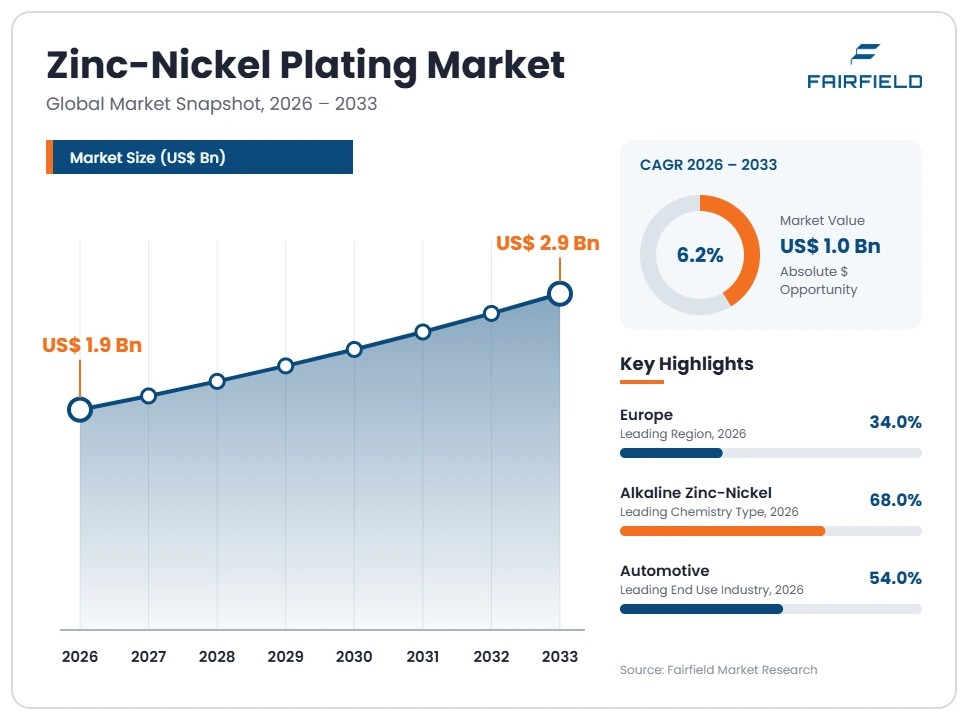
The global Zinc-Nickel Plating market size is expected to be valued at US$ 1.9 billion in 2026 and projected to reach US$ 2.9 billion by 2033, growing at a CAGR of 6.2% between 2026 and 2033.
Revenue rose from about US$ 1.42 billion in 2020 to roughly US$ 1.81 billion in 2025, a historical CAGR of 5.0%. The 2026 estimate of US$ 1,920 million counts process chemicals, plating equipment and the value of job-shop and captive plating services together, since most buyers purchase a finished coated part rather than a drum of chemistry. Growth rests on three specific shifts: substitution away from hexavalent chromium and cadmium finishes under chemicals legislation, longer vehicle corrosion warranties that plain zinc cannot meet, and electrified powertrains with more corrosion-exposed steel hardware. This remains a specialty finishing market priced on performance, not tonnage.
Key Report Takeaways
- By Chemistry Type: Alkaline Zinc-Nickel held 68% share in 2026, while Composite & Specialty Zinc-Nickel is projected to expand at an 8.4% CAGR through 2033, as co-deposited lubricants and ceramics cut torque scatter on threaded assemblies.
- By Offering: Plating Services held 57% share in 2026, while Equipment & Systems is projected to expand at a 7.3% CAGR through 2033, driven by effluent treatment, rectifier and bath-analysis investment that regulators now effectively require.
- By Component Type: Fasteners held 31% share in 2026, while Electrical Connectors & Housings are projected to expand at a 7.9% CAGR through 2033, reflecting high-voltage enclosure hardware that must resist galvanic attack against aluminium.
- By End Use Industry: Automotive held 54% share in 2026, while Aerospace & Defence is projected to expand at an 8.6% CAGR through 2033, because zinc-nickel is the leading qualified replacement for cadmium on structural fasteners.
- By Geography: Europe held 34% share in 2026, while Asia Pacific is projected to expand at a 7.6% CAGR through 2033, supported by vehicle production volumes and the export of parts into European specifications.
Global Zinc-Nickel Plating Market Trends and Insights
Drivers Impact Analysis
Two regulatory and engineering shifts account for most forecast growth in zinc-nickel alloy coatings.
| Driver | Impact on CAGR Forecast | Geographic Relevance | Impact Timeline |
| Restrictions on hexavalent chromium and cadmium in vehicles and aircraft | High | Europe, North America | Long term (≥4 years) |
| Longer corrosion warranties and electrified powertrain hardware | High | Global | Medium term (2–4 years) |
Chemicals Legislation on Hexavalent Chromium and Cadmium Expands Zinc-Nickel Specification
Regulatory restriction, not cost advantage, is the main reason engineers specify zinc-nickel alloy coatings. Finishes that previously relied on cadmium plating or hexavalent chromium passivation have been progressively closed off in vehicles, aircraft and electrical equipment. Specifiers need a replacement that survives salt spray testing and galvanic contact with aluminium, and an alloy carrying 12 to 15 percent nickel is the qualified answer in most cases.
The causal mechanism is substitution under legal deadlines. Chromium trioxide sits on the REACH authorisation list, so European users must justify continued use rather than assume it. The End-of-Life Vehicles Directive and the RoHS Directive restrict hexavalent chromium and cadmium in vehicles and electrical products, with only narrow exemptions. In aerospace, cadmium replacement programmes have qualified zinc-nickel against established material specifications, and ASTM B841 provides the coating standard that purchasers reference.
Longer Corrosion Warranties and Electrified Powertrains Raise Zinc-Nickel Content Per Vehicle
Vehicle manufacturers now underwrite perforation corrosion for a decade or more, and that warranty obligation pulls zinc-nickel onto parts that once carried plain zinc. The alloy delivers several times the neutral salt spray life of conventional zinc at equivalent thickness, and it holds up at the elevated temperatures found near brake assemblies and exhaust routing. Each specification change adds coated surface area per vehicle.
The mechanism is a change in the parts themselves rather than in plating technology. Battery electric vehicles carry heavy structural battery enclosures, high-voltage connector housings, cooling circuit fittings and mounting hardware, much of it steel bolted directly to aluminium castings. That bimetallic contact accelerates galvanic corrosion, and zinc-nickel sits closer to aluminium electrochemically than zinc does. Brake and chassis components also face winter road salt and increasingly aggressive de-icing chemistry across northern markets.
Restraints Impact Analysis
Two cost and process barriers keep zinc-nickel from displacing cheaper finishes in general industrial work.
| Restraint | Impact on CAGR Forecast | Geographic Relevance | Impact Timeline |
| Nickel wastewater treatment and discharge compliance costs | High | Europe, North America, Asia Pacific | Long term (≥4 years) |
| Price premium and bath control complexity versus plain zinc | High | Global | Medium term (2–4 years) |
Nickel Discharge Limits and Effluent Treatment Costs Squeeze Zinc-Nickel Job Shop Margins
Wastewater compliance is the largest fixed cost barrier to entering or expanding zinc-nickel plating, and it falls hardest on independent job shops. Nickel in rinse water is tightly limited under industrial discharge rules, so a line cannot simply be connected to the sewer. Shops must install and staff treatment plant before they take a single order, which raises the volume needed to break even.
The specific cost sources are chemical precipitation, chelate breaking and sludge disposal. Alkaline zinc-nickel baths contain complexing agents that hold nickel in solution and defeat ordinary hydroxide precipitation, so operators add oxidative or acidic pretreatment stages. Resulting filter cake is a regulated hazardous waste with per-tonne disposal charges. Nickel compounds also carry hazard classifications under REACH that trigger worker exposure controls and monitoring. Together these obligations add overhead that plain zinc lines never incur.
Price Premium and Narrow Bath Operating Windows Keep Plain Zinc in General Industrial Work
Cost keeps zinc-nickel out of the large majority of plated steel parts, where plain zinc remains entirely adequate. The coating typically costs two to three times more per square metre, so buyers of agricultural hardware, construction fixings, shelving and general fabrication see no reason to switch. Demand therefore concentrates in a narrow band of safety-critical and warranty-exposed components.
The underlying cause is chemistry and process control rather than raw material price alone. Nickel content must stay within a few percentage points for the coating to deliver its corrosion performance, and that ratio drifts with current density, temperature, metal ratio and organic breakdown products. Shops need analytical instrumentation, trained chemists and frequent bath additions. Anode configuration and rectifier capacity differ from zinc lines, so conversion means capital spending. Recessed areas also plate unevenly, requiring careful rack design on complex parts.
Market Opportunities
Two revenue pools are opening beyond the established European automotive plating base.
Chromium-Free Passivation and Sealer Chemistry Creates a Recurring Post-Treatment Revenue Pool
Post-treatment chemistry is becoming a larger profit pool than the plating bath itself, because every zinc-nickel part now needs a passivate and often a sealer. Trivalent chromium conversion coatings, organic and inorganic topcoats and torque-tension modifying sealers are consumed continuously and sold at specialty margins. They also lock in the supplier, since the approved finish is qualified as a complete system rather than as separate steps.
Chemical formulators with coating qualification experience are best placed to capture this. Demand comes from vehicle manufacturers that must remove hexavalent chromium from passivation while holding the same salt spray and friction specifications, and from fastener producers whose customers specify a controlled coefficient of friction for bolted joints. Tightening restrictions on chromium trioxide make requalification unavoidable, which converts a one-off substitution into repeat formulation and approval work.
Captive Line Conversion in Emerging Vehicle Manufacturing Hubs Opens an Equipment and Licensing Pool
Converting captive plating lines inside component plants in emerging manufacturing hubs opens an equipment, licensing and technical service pool distinct from chemical sales. Tier-one suppliers in these countries increasingly export into specifications written in Europe and North America, and shipping parts abroad for finishing destroys their cost advantage. Installing a qualified in-house line is the logical response.
Chemistry licensors, barrel and rack plant builders and effluent treatment specialists can capture this, usually as a single package rather than as separate purchases. Demand comes from fastener, brake, driveline and connector suppliers in India, Mexico, Thailand and Vietnam serving global vehicle programmes. Customer audits increasingly require documented bath control, nickel analysis records and discharge compliance, so buyers need a supplier that provides process guarantees, laboratory support and operator training alongside the hardware itself.
Segment Analysis
- By Chemistry Type: Alkaline Baths Lead Production While Composite Systems Advance Fastest
Alkaline Zinc-Nickel held 68% share in 2026, the dominant chemistry, because it deposits a uniform nickel content across varying current densities and therefore coats recessed and complex geometries reliably. That consistency is what automotive and aerospace approvals demand. Acid Zinc-Nickel retains a defined role on cast iron, hardened steel and heat-treated parts, where higher plating speed and lower hydrogen embrittlement risk matter more than distribution. Composite & Specialty Zinc-Nickel is the fastest-growing chemistry at an 8.4% CAGR through 2033, as co-deposited polymer and ceramic particles reduce friction scatter in threaded joints and improve wear resistance on sliding parts. Suppliers are also reformulating to reduce chelating agents that complicate effluent treatment. The practical implication is that chemistry choice is now driven as much by wastewater cost as by coating performance.
- By Offering: Plating Services Capture Most Value While Equipment Investment Grows Quickest
Plating Services accounted for 57% of market value in 2026, the largest share, because buyers purchase finished coated components and job shops capture the labour, energy, racking, inspection and compliance cost embedded in that price. Process Chemicals form the second largest category, covering brighteners, carriers, additives, passivates and sealers sold on repeat consumption. Equipment & Systems is the fastest-growing offering at a 7.3% CAGR to 2033, driven by wastewater treatment plant, automated bath analysis, rectifiers and barrel and rack lines that shops must install to hold nickel discharge within limits and keep alloy composition stable. Captive lines inside component plants are expanding in parallel. The business implication is that chemical suppliers increasingly sell equipment and technical service to defend their consumable position.
- By Component Type: Fasteners Hold the Largest Volume While Connector Hardware Expands Fastest
Fasteners held 31% share in 2026, the leading component category, since bolts, nuts, studs and clips are plated in enormous volumes and their corrosion failure has safety consequences on both vehicles and aircraft. Brake & Chassis Components follow, exposed directly to road salt and water spray across a vehicle’s life. Powertrain & Engine Components rely on zinc-nickel for its thermal stability near heat sources. Electrical Connectors & Housings are the fastest-growing category at a 7.9% CAGR through 2033, as high-voltage enclosures, busbar hardware and sensor housings require coatings that resist galvanic attack where steel contacts aluminium. Aerospace Structural Parts generate the highest value per part under cadmium replacement programmes. The implication is that growth is migrating from traditional underbody hardware toward electrical architecture components.
- By End Use Industry: Automotive Dominates Consumption While Aerospace and Defence Grow Fastest
Automotive represented 54% of demand in 2026, the dominant end use, because vehicle manufacturers write the corrosion specifications that most plating lines are built to satisfy and their volumes dwarf every other sector. Industrial Machinery and Construction & Agricultural Equipment follow, specifying zinc-nickel selectively on hydraulic fittings and exposed hardware. Electrical & Electronics demand comes from enclosures, switchgear parts and connector shells. Oil & Gas uses the coating on downhole and surface hardware facing sour and saline conditions. Aerospace & Defence is the fastest-growing industry at an 8.6% CAGR to 2033, because zinc-nickel is the leading qualified substitute for cadmium on landing gear hardware, structural fasteners and airframe fittings. For suppliers, aerospace offers margin and qualification lock-in, while automotive supplies the volume that keeps lines loaded.
Geography Analysis
- North America Expands Zinc-Nickel Capacity Around Aerospace Cadmium Replacement Programmes
North America holds 22% share in 2026 and grows at a 5.3% CAGR, with demand concentrated in the United States and Mexico. Aerospace and defence set the tone: cadmium elimination on landing gear components, structural fasteners and airframe fittings has made zinc-nickel a qualified finish across prime contractors and their approved processors, and that qualification work is slow, documented and difficult to reverse. Automotive demand is substantial but more price-sensitive than in other developed markets. Mexico has added capacity rapidly as vehicle and component assembly expanded near the border. Environmental permitting for nickel discharge is the binding constraint on new lines, and skilled plating labour is scarce. The clearest opportunity is defence sustainment work, where legacy cadmium finishes must be replaced during overhaul rather than at design stage.
- Which Region Is Leading the Zinc-Nickel Plating Market?
Europe leads the zinc-nickel plating market with 34% share in 2026, and its position comes directly from regulation combined with vehicle engineering standards. Germany is the single largest national market, because German vehicle manufacturers wrote many of the corrosion specifications that made zinc-nickel the default underbody finish, and their tier-one suppliers plate to those standards across the continent. France, Italy, Spain, Sweden, the Czech Republic and Poland all host significant job-shop capacity. Chemicals legislation reinforces this: chromium trioxide requires authorisation, the End-of-Life Vehicles Directive restricts heavy metals in vehicles, and the RoHS Directive limits hexavalent chromium in electrical products. Industrial emissions rules impose strict nickel discharge limits, which raises costs but also protects established operators. Slower vehicle output is the main downside risk.
- Which Region Is Growing Fastest in the Zinc-Nickel Plating Market?
Asia Pacific is growing fastest in the zinc-nickel plating market, at a 7.6% CAGR between 2026 and 2033 from 33% share in 2026. China accounts for most of this, combining the world’s largest vehicle output with a rapidly electrifying fleet that adds connector housings, battery enclosure hardware and cooling circuit fittings to the coated parts list. Japan and South Korea contribute mature, high-specification demand from vehicle and electronics manufacturers with their own plating chemistry suppliers. India is the fastest-moving national market, as fastener and brake component exporters install captive lines to meet customer specifications written abroad. Thailand and Vietnam are adding capacity alongside assembly investment. Tightening effluent enforcement in China has closed smaller non-compliant shops, consolidating volume into larger, better-equipped plating operations.
- Latin America Builds Zinc-Nickel Capacity Around Export Vehicle Assembly
Latin America represents 5% share in 2026 and grows at a 6.0% CAGR, with activity concentrated in Brazil and Argentina alongside the component clusters serving them. Vehicle and agricultural equipment assembly drives nearly all demand, and the parts that receive zinc-nickel are usually those destined for export programmes carrying foreign corrosion specifications. Domestic-market vehicles more often retain plain zinc finishes. The barriers are capital and compliance related: effluent treatment plant is expensive to import, electricity costs are volatile, and nickel discharge enforcement varies considerably between jurisdictions. Technical support for bath control is thinner than in established markets, which lengthens qualification. The opportunity lies in brake and chassis component suppliers upgrading finishes to retain export contracts, since losing a specification approval costs far more than the plating premium.
- Middle East & Africa Ties Zinc-Nickel Demand to Oil Field Hardware and Vehicle Assembly
Middle East & Africa accounts for 6% share in 2026 and grows at a 6.5% CAGR, with demand split between Gulf industrial hardware and South African vehicle manufacturing. In Saudi Arabia, the United Arab Emirates and Oman, oil and gas operators specify corrosion-resistant finishes on surface fittings, valve hardware and instrumentation exposed to saline air and sour service. South Africa hosts established vehicle assembly plants that export into European specifications, which pulls zinc-nickel into local component supply chains. Turkey, Egypt and Morocco are adding automotive component capacity. The barriers are a limited plating service base, scarce analytical and wastewater expertise, and high landed costs for imported chemistry. Industrial localisation policies across the Gulf present the main opportunity, since they favour qualified finishing capacity built close to the assembly plants it serves.
Competitive Landscape
The zinc-nickel plating market is moderately concentrated in chemistry and highly fragmented in services. A small group of specialty chemical suppliers, including Atotech, MacDermid Enthone, SurTec, Chemetall, Dipsol Chemicals, C. Uyemura & Co. and Okuno Chemical Industries, supply most of the proprietary alkaline and acid processes used worldwide, and their formulations are written into customer specifications. Below them sit thousands of independent job shops and captive lines, such as Kuntz Electroplating, Curtiss-Wright Surface Technologies, Advanced Plating Technologies, Hohman Plating, Electroplating Engineers of India and Sharretts Plating Company, competing on geography, capacity and approvals. Consolidation has been steady on the chemical side, where scale supports research and global approval support, and slower among plating shops because customers value proximity.
Competition is based on qualification rather than price. A chemistry wins by being named in a vehicle manufacturer’s or airframer’s approved process list, after salt spray, hydrogen embrittlement, torque-tension and thermal testing that can take years. Suppliers then compete on bath stability, tolerance to contamination, nickel content consistency across current densities, and how easily rinse water can be treated. Technical service matters heavily, since shops depend on supplier chemists for troubleshooting. New entrants come mainly from regional chemical producers in Asia offering lower-cost equivalents to processes whose patents have expired.
Strategic activity focuses on reformulating to remove hexavalent chromium from passivation steps, cutting chelating agents that complicate effluent treatment, and bundling bath analysis equipment with chemical supply. Suppliers also expand technical centres near new vehicle manufacturing clusters to support qualification locally.
Strategic direction is moving toward complete qualified systems, combining plating chemistry, passivate, sealer, equipment and compliance support rather than individual products.
Recent Industry Developments
- September 2000: The European Union adopted the End-of-Life Vehicles Directive 2000/53/EC, restricting lead, mercury, cadmium and hexavalent chromium in vehicles subject to Annex II exemptions – this began the systematic removal of cadmium and chromate finishes from automotive hardware.
- June 2011: The European Union adopted the recast RoHS Directive 2011/65/EU, holding hexavalent chromium and cadmium to strict concentration limits in electrical and electronic equipment – it extended substitution pressure from vehicles into connectors, enclosures and switchgear hardware.
- September 2017: The sunset date for chromium trioxide under REACH Annex XIV took effect, meaning continued use in the European Union requires an authorisation – this made chromium-free passivation over zinc-nickel a compliance requirement rather than a preference.
- July 2023: The European Commission proposed a new End-of-Life Vehicles Regulation to replace Directive 2000/53/EC, covering vehicle circularity and restricted substances – a tighter successor instrument would sustain substitution pressure on legacy coatings through the forecast period.
Companies Covered in the Report
- Atotech
- MacDermid Enthone
- SurTec
- Chemetall
- Dipsol Chemicals
- C. Uyemura & Co.
- Okuno Chemical Industries
- Columbia Chemical
- Pavco
- NOF Corporation
- Curtiss-Wright Surface Technologies
- Kuntz Electroplating
- Advanced Plating Technologies
- Hohman Plating
- Electroplating Engineers of India
- Sharretts Plating Company
Zinc-Nickel Plating Market Report Scope
| Metric | Value |
| Study Period | 2020–2033 |
| Market Size 2026 | US$ 1.9 Billion |
| Market Size 2033 | US$ 2.9 Billion |
| CAGR 2026–2033 | 6.2% |
| Absolute Dollar Opportunity | US$ 1.0 Billion |
| Largest Market | Europe (34% share in 2026) |
| Fastest-Growing Market | Asia Pacific (7.6% CAGR) |
| Market Concentration | Medium |
| Major Players | Atotech, MacDermid Enthone, SurTec, Dipsol Chemicals, Chemetall |
Zinc-Nickel Plating Market Segmentation
Chemistry Type
- Alkaline Zinc-Nickel
- Acid Zinc-Nickel
- Composite & Specialty Zinc-Nickel
Offering
- Process Chemicals
- Plating Services
- Equipment & Systems
Component Type
- Fasteners
- Brake & Chassis Components
- Powertrain & Engine Components
- Electrical Connectors & Housings
- Aerospace Structural Parts
End Use Industry
- Automotive
- Aerospace & Defence
- Industrial Machinery
- Electrical & Electronics
- Oil & Gas
- Construction & Agricultural Equipment
Regions
- North America
- Europe
- Asia Pacific
- Latin America
- Middle East & Africa
- Executive Summary
- Global Zinc-Nickel Plating Market Snapshot
- Future Projections
- Key Report Takeaways
- Regional Snapshot
- Market Overview
- Market Definition and Report Scope
- Historical Trends 2020–2025
- Market Dynamics
- Drivers
- Chemicals Legislation on Hexavalent Chromium and Cadmium Expands Zinc-Nickel Specification
- Longer Corrosion Warranties and Electrified Powertrains Raise Zinc-Nickel Content Per Vehicle
- Restraints
- Nickel Discharge Limits and Effluent Treatment Costs Squeeze Zinc-Nickel Job Shop Margins
- Price Premium and Narrow Bath Operating Windows Keep Plain Zinc in General Industrial Work
- Market Opportunities
- Chromium-Free Passivation and Sealer Chemistry Creates a Recurring Post-Treatment Revenue Pool
- Captive Line Conversion in Emerging Vehicle Manufacturing Hubs Opens an Equipment and Licensing Pool
- Drivers
- Global Zinc-Nickel Plating Market Outlook, 2020–2033
- Global Zinc-Nickel Plating Market Outlook, by Chemistry Type, Value (US$ Billion), 2020–2033
- Alkaline Zinc-Nickel
- Acid Zinc-Nickel
- Composite & Specialty Zinc-Nickel
- Global Zinc-Nickel Plating Market Outlook, by Offering, Value (US$ Billion), 2020–2033
- Process Chemicals
- Plating Services
- Equipment & Systems
- Global Zinc-Nickel Plating Market Outlook, by Component Type, Value (US$ Billion), 2020–2033
- Fasteners
- Brake & Chassis Components
- Powertrain & Engine Components
- Electrical Connectors & Housings
- Aerospace Structural Parts
- Global Zinc-Nickel Plating Market Outlook, by End Use Industry, Value (US$ Billion), 2020–2033
- Automotive
- Aerospace & Defence
- Industrial Machinery
- Electrical & Electronics
- Oil & Gas
- Construction & Agricultural Equipment
- Global Zinc-Nickel Plating Market Outlook, by Region, Value (US$ Billion), 2020–2033
- North America
- Europe
- Asia Pacific
- Latin America
- Middle East & Africa
- Global Zinc-Nickel Plating Market Outlook, by Chemistry Type, Value (US$ Billion), 2020–2033
- North America Zinc-Nickel Plating Market Outlook, 2020–2033
- North America Zinc-Nickel Plating Market Outlook, by Chemistry Type, Value (US$ Billion), 2020–2033
- Alkaline Zinc-Nickel
- Acid Zinc-Nickel
- Composite & Specialty Zinc-Nickel
- North America Zinc-Nickel Plating Market Outlook, by Offering, Value (US$ Billion), 2020–2033
- Process Chemicals
- Plating Services
- Equipment & Systems
- North America Zinc-Nickel Plating Market Outlook, by Component Type, Value (US$ Billion), 2020–2033
- Fasteners
- Brake & Chassis Components
- Powertrain & Engine Components
- Electrical Connectors & Housings
- Aerospace Structural Parts
- North America Zinc-Nickel Plating Market Outlook, by End Use Industry, Value (US$ Billion), 2020–2033
- Automotive
- Aerospace & Defence
- Industrial Machinery
- Electrical & Electronics
- Oil & Gas
- Construction & Agricultural Equipment
- North America Zinc-Nickel Plating Market Outlook, by Country, Value (US$ Billion), 2020–2033
- United States Zinc-Nickel Plating Market Outlook, by Chemistry Type, 2020–2033
- United States Zinc-Nickel Plating Market Outlook, by Offering, 2020–2033
- United States Zinc-Nickel Plating Market Outlook, by Component Type, 2020–2033
- United States Zinc-Nickel Plating Market Outlook, by End Use Industry, 2020–2033
- Mexico Zinc-Nickel Plating Market Outlook, by Chemistry Type, 2020–2033
- Mexico Zinc-Nickel Plating Market Outlook, by Offering, 2020–2033
- Mexico Zinc-Nickel Plating Market Outlook, by Component Type, 2020–2033
- Mexico Zinc-Nickel Plating Market Outlook, by End Use Industry, 2020–2033
- North America Zinc-Nickel Plating Market Outlook, by Chemistry Type, Value (US$ Billion), 2020–2033
- Europe Zinc-Nickel Plating Market Outlook, 2020–2033
- Europe Zinc-Nickel Plating Market Outlook, by Chemistry Type, Value (US$ Billion), 2020–2033
- Alkaline Zinc-Nickel
- Acid Zinc-Nickel
- Composite & Specialty Zinc-Nickel
- Europe Zinc-Nickel Plating Market Outlook, by Offering, Value (US$ Billion), 2020–2033
- Process Chemicals
- Plating Services
- Equipment & Systems
- Europe Zinc-Nickel Plating Market Outlook, by Component Type, Value (US$ Billion), 2020–2033
- Fasteners
- Brake & Chassis Components
- Powertrain & Engine Components
- Electrical Connectors & Housings
- Aerospace Structural Parts
- Europe Zinc-Nickel Plating Market Outlook, by End Use Industry, Value (US$ Billion), 2020–2033
- Automotive
- Aerospace & Defence
- Industrial Machinery
- Electrical & Electronics
- Oil & Gas
- Construction & Agricultural Equipment
- Europe Zinc-Nickel Plating Market Outlook, by Country, Value (US$ Billion), 2020–2033
- Germany Zinc-Nickel Plating Market Outlook, by Chemistry Type, 2020–2033
- Germany Zinc-Nickel Plating Market Outlook, by Offering, 2020–2033
- Germany Zinc-Nickel Plating Market Outlook, by Component Type, 2020–2033
- Germany Zinc-Nickel Plating Market Outlook, by End Use Industry, 2020–2033
- France Zinc-Nickel Plating Market Outlook, by Chemistry Type, 2020–2033
- France Zinc-Nickel Plating Market Outlook, by Offering, 2020–2033
- France Zinc-Nickel Plating Market Outlook, by Component Type, 2020–2033
- France Zinc-Nickel Plating Market Outlook, by End Use Industry, 2020–2033
- Italy Zinc-Nickel Plating Market Outlook, by Chemistry Type, 2020–2033
- Italy Zinc-Nickel Plating Market Outlook, by Offering, 2020–2033
- Italy Zinc-Nickel Plating Market Outlook, by Component Type, 2020–2033
- Italy Zinc-Nickel Plating Market Outlook, by End Use Industry, 2020–2033
- Spain Zinc-Nickel Plating Market Outlook, by Chemistry Type, 2020–2033
- Spain Zinc-Nickel Plating Market Outlook, by Offering, 2020–2033
- Spain Zinc-Nickel Plating Market Outlook, by Component Type, 2020–2033
- Spain Zinc-Nickel Plating Market Outlook, by End Use Industry, 2020–2033
- Sweden Zinc-Nickel Plating Market Outlook, by Chemistry Type, 2020–2033
- Sweden Zinc-Nickel Plating Market Outlook, by Offering, 2020–2033
- Sweden Zinc-Nickel Plating Market Outlook, by Component Type, 2020–2033
- Sweden Zinc-Nickel Plating Market Outlook, by End Use Industry, 2020–2033
- Czech Republic Zinc-Nickel Plating Market Outlook, by Chemistry Type, 2020–2033
- Czech Republic Zinc-Nickel Plating Market Outlook, by Offering, 2020–2033
- Czech Republic Zinc-Nickel Plating Market Outlook, by Component Type, 2020–2033
- Czech Republic Zinc-Nickel Plating Market Outlook, by End Use Industry, 2020–2033
- Poland Zinc-Nickel Plating Market Outlook, by Chemistry Type, 2020–2033
- Poland Zinc-Nickel Plating Market Outlook, by Offering, 2020–2033
- Poland Zinc-Nickel Plating Market Outlook, by Component Type, 2020–2033
- Poland Zinc-Nickel Plating Market Outlook, by End Use Industry, 2020–2033
- Europe Zinc-Nickel Plating Market Outlook, by Chemistry Type, Value (US$ Billion), 2020–2033
- Asia Pacific Zinc-Nickel Plating Market Outlook, 2020–2033
- Asia Pacific Zinc-Nickel Plating Market Outlook, by Chemistry Type, Value (US$ Billion), 2020–2033
- Alkaline Zinc-Nickel
- Acid Zinc-Nickel
- Composite & Specialty Zinc-Nickel
- Asia Pacific Zinc-Nickel Plating Market Outlook, by Offering, Value (US$ Billion), 2020–2033
- Process Chemicals
- Plating Services
- Equipment & Systems
- Asia Pacific Zinc-Nickel Plating Market Outlook, by Component Type, Value (US$ Billion), 2020–2033
- Fasteners
- Brake & Chassis Components
- Powertrain & Engine Components
- Electrical Connectors & Housings
- Aerospace Structural Parts
- Asia Pacific Zinc-Nickel Plating Market Outlook, by End Use Industry, Value (US$ Billion), 2020–2033
- Automotive
- Aerospace & Defence
- Industrial Machinery
- Electrical & Electronics
- Oil & Gas
- Construction & Agricultural Equipment
- Asia Pacific Zinc-Nickel Plating Market Outlook, by Country, Value (US$ Billion), 2020–2033
- China Zinc-Nickel Plating Market Outlook, by Chemistry Type, 2020–2033
- China Zinc-Nickel Plating Market Outlook, by Offering, 2020–2033
- China Zinc-Nickel Plating Market Outlook, by Component Type, 2020–2033
- China Zinc-Nickel Plating Market Outlook, by End Use Industry, 2020–2033
- Japan Zinc-Nickel Plating Market Outlook, by Chemistry Type, 2020–2033
- Japan Zinc-Nickel Plating Market Outlook, by Offering, 2020–2033
- Japan Zinc-Nickel Plating Market Outlook, by Component Type, 2020–2033
- Japan Zinc-Nickel Plating Market Outlook, by End Use Industry, 2020–2033
- South Korea Zinc-Nickel Plating Market Outlook, by Chemistry Type, 2020–2033
- South Korea Zinc-Nickel Plating Market Outlook, by Offering, 2020–2033
- South Korea Zinc-Nickel Plating Market Outlook, by Component Type, 2020–2033
- South Korea Zinc-Nickel Plating Market Outlook, by End Use Industry, 2020–2033
- India Zinc-Nickel Plating Market Outlook, by Chemistry Type, 2020–2033
- India Zinc-Nickel Plating Market Outlook, by Offering, 2020–2033
- India Zinc-Nickel Plating Market Outlook, by Component Type, 2020–2033
- India Zinc-Nickel Plating Market Outlook, by End Use Industry, 2020–2033
- Thailand Zinc-Nickel Plating Market Outlook, by Chemistry Type, 2020–2033
- Thailand Zinc-Nickel Plating Market Outlook, by Offering, 2020–2033
- Thailand Zinc-Nickel Plating Market Outlook, by Component Type, 2020–2033
- Thailand Zinc-Nickel Plating Market Outlook, by End Use Industry, 2020–2033
- Vietnam Zinc-Nickel Plating Market Outlook, by Chemistry Type, 2020–2033
- Vietnam Zinc-Nickel Plating Market Outlook, by Offering, 2020–2033
- Vietnam Zinc-Nickel Plating Market Outlook, by Component Type, 2020–2033
- Vietnam Zinc-Nickel Plating Market Outlook, by End Use Industry, 2020–2033
- Asia Pacific Zinc-Nickel Plating Market Outlook, by Chemistry Type, Value (US$ Billion), 2020–2033
- Latin America Zinc-Nickel Plating Market Outlook, 2020–2033
- Latin America Zinc-Nickel Plating Market Outlook, by Chemistry Type, Value (US$ Billion), 2020–2033
- Alkaline Zinc-Nickel
- Acid Zinc-Nickel
- Composite & Specialty Zinc-Nickel
- Latin America Zinc-Nickel Plating Market Outlook, by Offering, Value (US$ Billion), 2020–2033
- Process Chemicals
- Plating Services
- Equipment & Systems
- Latin America Zinc-Nickel Plating Market Outlook, by Component Type, Value (US$ Billion), 2020–2033
- Fasteners
- Brake & Chassis Components
- Powertrain & Engine Components
- Electrical Connectors & Housings
- Aerospace Structural Parts
- Latin America Zinc-Nickel Plating Market Outlook, by End Use Industry, Value (US$ Billion), 2020–2033
- Automotive
- Aerospace & Defence
- Industrial Machinery
- Electrical & Electronics
- Oil & Gas
- Construction & Agricultural Equipment
- Latin America Zinc-Nickel Plating Market Outlook, by Country, Value (US$ Billion), 2020–2033
- Brazil Zinc-Nickel Plating Market Outlook, by Chemistry Type, 2020–2033
- Brazil Zinc-Nickel Plating Market Outlook, by Offering, 2020–2033
- Brazil Zinc-Nickel Plating Market Outlook, by Component Type, 2020–2033
- Brazil Zinc-Nickel Plating Market Outlook, by End Use Industry, 2020–2033
- Argentina Zinc-Nickel Plating Market Outlook, by Chemistry Type, 2020–2033
- Argentina Zinc-Nickel Plating Market Outlook, by Offering, 2020–2033
- Argentina Zinc-Nickel Plating Market Outlook, by Component Type, 2020–2033
- Argentina Zinc-Nickel Plating Market Outlook, by End Use Industry, 2020–2033
- Latin America Zinc-Nickel Plating Market Outlook, by Chemistry Type, Value (US$ Billion), 2020–2033
- Middle East & Africa Zinc-Nickel Plating Market Outlook, 2020–2033
- Middle East & Africa Zinc-Nickel Plating Market Outlook, by Chemistry Type, Value (US$ Billion), 2020–2033
- Alkaline Zinc-Nickel
- Acid Zinc-Nickel
- Composite & Specialty Zinc-Nickel
- Middle East & Africa Zinc-Nickel Plating Market Outlook, by Offering, Value (US$ Billion), 2020–2033
- Process Chemicals
- Plating Services
- Equipment & Systems
- Middle East & Africa Zinc-Nickel Plating Market Outlook, by Component Type, Value (US$ Billion), 2020–2033
- Fasteners
- Brake & Chassis Components
- Powertrain & Engine Components
- Electrical Connectors & Housings
- Aerospace Structural Parts
- Middle East & Africa Zinc-Nickel Plating Market Outlook, by End Use Industry, Value (US$ Billion), 2020–2033
- Automotive
- Aerospace & Defence
- Industrial Machinery
- Electrical & Electronics
- Oil & Gas
- Construction & Agricultural Equipment
- Middle East & Africa Zinc-Nickel Plating Market Outlook, by Country, Value (US$ Billion), 2020–2033
- Saudi Arabia Zinc-Nickel Plating Market Outlook, by Chemistry Type, 2020–2033
- Saudi Arabia Zinc-Nickel Plating Market Outlook, by Offering, 2020–2033
- Saudi Arabia Zinc-Nickel Plating Market Outlook, by Component Type, 2020–2033
- Saudi Arabia Zinc-Nickel Plating Market Outlook, by End Use Industry, 2020–2033
- United Arab Emirates Zinc-Nickel Plating Market Outlook, by Chemistry Type, 2020–2033
- United Arab Emirates Zinc-Nickel Plating Market Outlook, by Offering, 2020–2033
- United Arab Emirates Zinc-Nickel Plating Market Outlook, by Component Type, 2020–2033
- United Arab Emirates Zinc-Nickel Plating Market Outlook, by End Use Industry, 2020–2033
- Oman Zinc-Nickel Plating Market Outlook, by Chemistry Type, 2020–2033
- Oman Zinc-Nickel Plating Market Outlook, by Offering, 2020–2033
- Oman Zinc-Nickel Plating Market Outlook, by Component Type, 2020–2033
- Oman Zinc-Nickel Plating Market Outlook, by End Use Industry, 2020–2033
- South Africa Zinc-Nickel Plating Market Outlook, by Chemistry Type, 2020–2033
- South Africa Zinc-Nickel Plating Market Outlook, by Offering, 2020–2033
- South Africa Zinc-Nickel Plating Market Outlook, by Component Type, 2020–2033
- South Africa Zinc-Nickel Plating Market Outlook, by End Use Industry, 2020–2033
- Turkey Zinc-Nickel Plating Market Outlook, by Chemistry Type, 2020–2033
- Turkey Zinc-Nickel Plating Market Outlook, by Offering, 2020–2033
- Turkey Zinc-Nickel Plating Market Outlook, by Component Type, 2020–2033
- Turkey Zinc-Nickel Plating Market Outlook, by End Use Industry, 2020–2033
- Egypt Zinc-Nickel Plating Market Outlook, by Chemistry Type, 2020–2033
- Egypt Zinc-Nickel Plating Market Outlook, by Offering, 2020–2033
- Egypt Zinc-Nickel Plating Market Outlook, by Component Type, 2020–2033
- Egypt Zinc-Nickel Plating Market Outlook, by End Use Industry, 2020–2033
- Morocco Zinc-Nickel Plating Market Outlook, by Chemistry Type, 2020–2033
- Morocco Zinc-Nickel Plating Market Outlook, by Offering, 2020–2033
- Morocco Zinc-Nickel Plating Market Outlook, by Component Type, 2020–2033
- Morocco Zinc-Nickel Plating Market Outlook, by End Use Industry, 2020–2033
- Middle East & Africa Zinc-Nickel Plating Market Outlook, by Chemistry Type, Value (US$ Billion), 2020–2033
- Competitive Landscape
- Market Concentration and Industry Leaders
- Competitive Differentiation
- Strategic Moves and Market Direction
- Recent Industry Developments
- Company Profiles
- Atotech
- MacDermid Enthone
- SurTec
- Chemetall
- Dipsol Chemicals
- C. Uyemura & Co.
- Okuno Chemical Industries
- Columbia Chemical
- Pavco
- NOF Corporation
- Curtiss-Wright Surface Technologies
- Kuntz Electroplating
- Advanced Plating Technologies
- Hohman Plating
- Electroplating Engineers of India
- Sharretts Plating Company
- Appendix
- Research Methodology
- Report Assumptions
- Acronyms and Abbreviations
Chemistry Type
- Alkaline Zinc-Nickel
- Acid Zinc-Nickel
- Composite & Specialty Zinc-Nickel
Offering
- Process Chemicals
- Plating Services
- Equipment & Systems
Component Type
- Fasteners
- Brake & Chassis Components
- Powertrain & Engine Components
- Electrical Connectors & Housings
- Aerospace Structural Parts
End Use Industry
- Automotive
- Aerospace & Defence
- Industrial Machinery
- Electrical & Electronics
- Oil & Gas
- Construction & Agricultural Equipment
Regions
- North America
- Europe
- Asia Pacific
- Latin America
- Middle East & Africa
Our Research Methodology
Considering the volatility of business today, traditional approaches to strategizing a game plan can be unfruitful if not detrimental. True ambiguity is no way to determine a forecast. A myriad of predetermined factors must be accounted for such as the degree of risk involved, the magnitude of circumstances, as well as conditions or consequences that are not known or unpredictable. To circumvent binary views that cast uncertainty, the application of market research intelligence to strategically posture, move, and enable actionable outcomes is necessary.
View Methodology
Quality Assured
Rigorous Validation Process

Confidentiality Assured
End-to-end Data Security

Custom Research Services
Tailored To Your Objectives
FAQs
The market is valued at US$ 1.9 billion in 2026, counting process chemicals, plating equipment and job-shop and captive plating services together worldwide.
It is projected to reach US$ 2.9 billion by 2033 at a 6.2% CAGR, representing US$ 1.0 billion of absolute dollar opportunity.
Alkaline Zinc-Nickel leads with 68% share in 2026, because it holds nickel content consistent across current densities on complex, recessed part geometries.
Aerospace & Defence grows fastest at an 8.6% CAGR, as zinc-nickel replaces cadmium on landing gear hardware, structural fasteners and airframe fittings.
Europe holds 34% share in 2026, because German vehicle corrosion specifications and European chemicals legislation together made zinc-nickel the default underbody finish.
Related Reports
Zinc Citrate Market Size, Share, Insights, Competitive Landscape, and Forecast 2026 to 2033
The global zinc citrate market is valued at US$0.3 billion in 2026, reaching US$0.5 billion by 2033, growing at a 7.6% CAGR
2-Methoxy-2-Methylheptane Market Size, Share, Insights, Competitive Landscape, and Forecast 2026 to 2033
The global 2-methoxy-2-methylheptane market is valued at US$0.04 billion in 2026, reaching US$0.07 billion by 2033, growing at an 8.3% CAGR
2D Materials Market Size, Share, Insights, Competitive Landscape, and Forecast 2026 to 2033
The global 2D materials market is valued at US$3.65 billion in 2026, reaching US$10.20 billion by 2033, growing at a 15.8% CAGR
2,4-Dichloro-5-Fluorobenzoic Acid Market Size, Share, Insights, Competitive Landscape, and Forecast 2026 to 2033
The global 2,4-dichloro-5-fluorobenzoic acid market is valued at US$0.09 billion in 2026, reaching US$0.12 billion by 2033, at a 4.2% CAGR
1,5-Hexadiene Market Size, Share, Insights, Competitive Landscape, and Forecast 2026 to 2033
The global 1,5-hexadiene market is valued at US$0.14 billion in 2026, reaching US$0.22 billion by 2033, growing at a 6.7% CAGR
Automotive NVH Materials Market Size, Share, Insights, Competitive Landscape, and Forecast 2026 to 2033
The global automotive NVH materials market is valued at US$13.8 billion in 2026, reaching US$20.5 billion by 2033, growing at a 5.82% CAGR