



3D Injection-Molded Plastic Market
3D Injection-Molded Plastic Market Size, Share, Insights, Competitive Landscape, and Forecast 2026 to 2033
3D Injection-Molded Plastic Market Size and Trend Analysis
How Fast Is the 3D Injection-Molded Plastic Market Growing?
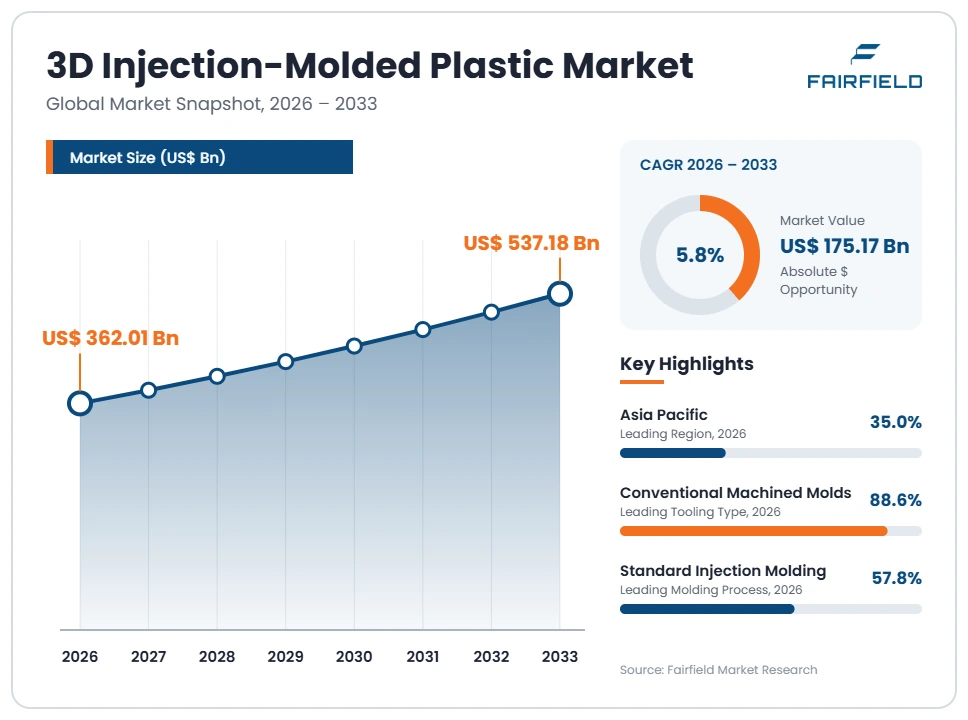
The global 3D injection-molded plastic market size is expected to be valued at US$ 362.01 billion in 2026 and projected to reach US$ 537.18 billion by 2033, growing at a CAGR of 5.8% between 2026 and 2033.
Between 2020 and 2025, the market grew at a CAGR of about 4.3%, as packaging and medical demand offset pandemic supply chain disruptions and volatile resin prices. Three main factors now support growth: rising demand for lightweight, complex three-dimensional parts in electric vehicles, steady expansion of packaging and consumer goods in emerging economies, and faster tool production through 3D-printed mold inserts. The market is steadily shifting toward precision, multi-material, and recycled-content molding, while additive manufacturing shortens tooling lead times and improves cycle times through conformal cooling.
Key Report Takeaways
- By Raw Material: Polypropylene held 24.0% share in 2026, while ABS is projected to expand at a 6.7% CAGR through 2033, driven by vehicle interiors, appliances, and electronics housings needing strength and surface finish.
- By Tooling Type: Conventional Machined Molds held 88.6% share in 2026, while 3D-Printed & Hybrid Mold Inserts are projected to expand at a 17.4% CAGR through 2033, driven by conformal cooling that shortens cycle times.
- By Molding Process: Standard Injection Molding held 57.8% share in 2026, while Multi-shot & Overmolding is projected to expand at a 7.3% CAGR through 2033, driven by soft-touch, sealed, and integrated parts.
- By Application: Packaging held 34.0% share in 2026, while Automotive is projected to expand at a 7.4% CAGR through 2033, driven by lightweight interior, battery, and exterior components for electric vehicles.
- By Region: Asia Pacific held 35.0% share in 2026, while North America is projected to expand at a 6.6% CAGR through 2033, driven by reshoring of medical, automotive, and consumer goods production.
Global 3D Injection-Molded Plastic Market Trends and Insights
Drivers Impact Analysis
Two drivers carry the strongest influence on 3D injection-molded plastic demand during the forecast period.
| Driver | Impact on CAGR Forecast | Geographic Relevance | Impact Timeline |
| Vehicle lightweighting and electric vehicle components | High | Asia Pacific, North America, Europe | Long term (≥4 years) |
| Packaging and consumer goods demand in emerging economies | High | Asia Pacific, Latin America, Middle East & Africa | Medium term (2–4 years) |
Electric Vehicle Lightweighting Is Driving Demand for 3D Injection-Molded Plastic Parts
Vehicle lightweighting and electric vehicle production are major drivers of 3D injection-molded plastic demand. Automakers replace metal parts with molded plastics to cut weight, extend driving range, reduce noise, and lower cost.
The mechanism is part consolidation and design freedom. Injection molding produces complex three-dimensional shapes in one step, combining brackets, clips, and housings that once needed several metal parts. Electric vehicles use molded plastics in battery housings, cell holders, connectors, charging components, and interior trim. Engineering plastics such as polyamide, polycarbonate, and ABS provide strength, heat resistance, and electrical insulation. In January 2026, BASF introduced Ultramid TG3, a polyamide grade for automotive use. Every kilogram saved improves range, which encourages automakers and suppliers such as Magna International to expand plastic content in each vehicle.
Packaging and Consumer Goods Growth Keeps 3D Injection-Molded Plastic Volumes Rising
Packaging and consumer goods demand keeps 3D injection-molded plastic volumes rising, especially in emerging economies. Caps, closures, containers, preforms, and household products are produced in billions of units each year.
The cause is population growth, urbanization, and rising incomes. Consumers in Asia Pacific, Latin America, and Africa are buying more packaged food, beverages, personal care products, and household goods. Injection molding delivers high-speed, low-cost production of precise, lightweight parts. Packaging accounted for about 34% of demand in 2025. Preform molding for bottles benefits from new systems such as Husky Technologies’ HyPET 6e, launched in May 2024, which can process preforms containing up to 100% recycled PET. Large packaging companies such as Berry Global, Amcor, ALPLA, and AptarGroup continue to invest in injection molding capacity worldwide.
Restraints Impact Analysis
Two restraints limit how smoothly the 3D injection-molded plastic market can grow.
| Restraint | Impact on CAGR Forecast | Geographic Relevance | Impact Timeline |
| Plastic regulations and sustainability pressure | Medium | Europe, North America, Asia Pacific | Long term (≥4 years) |
| Resin price volatility and tariff costs | Medium | Global | Short term (≤2 years) |
Plastic Regulations and Sustainability Pressure Limit 3D Injection-Molded Plastic Demand
Tighter plastic regulations and sustainability pressure limit growth in some 3D injection-molded plastic applications, especially single-use packaging. Governments and brand owners want less virgin plastic and more recycling.
The underlying cause is policy aimed at reducing plastic waste. The European Union’s Packaging and Packaging Waste Regulation, which entered into force in 2025, sets requirements for recyclability, recycled content, and reuse. Many countries, including India, have banned selected single-use plastic items such as cutlery. Extended producer responsibility schemes make producers pay for collection, sorting, and recycling. Many large brand owners have set public targets to reduce virgin plastic use. These rules force molders to redesign parts, switch materials, and invest in recycled resin processing and testing, which adds cost and can reduce demand for some disposable products.
Resin Price Volatility and Tariffs Squeeze 3D Injection-Molded Plastic Margins
Volatile resin prices and tariff costs squeeze margins for 3D injection-molded plastic producers. Resins such as polypropylene, polyethylene, and ABS make up a large share of part costs, and their prices follow crude oil, natural gas, and petrochemical capacity.
The specific cost sources are feedstocks, energy, molds, and trade policy. When oil prices rise, resin prices usually follow, but molders cannot always pass increases to customers quickly. Energy is needed to heat barrels and run large machines. Tariffs have raised the cost of imported resins, steel molds, and machinery in several markets. Mold making requires skilled toolmakers, who are in short supply in North America and Europe. Small and medium-sized molders, which make up much of the industry, have limited ability to absorb these cost swings.
Market Opportunities
3D-Printed Mold Inserts Open a Productivity-Driven Revenue Pool in Injection Molding
3D-printed mold inserts create a fast-growing, productivity-driven revenue pool in the 3D injection-molded plastic market. Additive manufacturing allows cooling channels to follow the exact shape of a part, which removes hot spots and cuts cycle times.
Additive manufacturing firms, mold makers, and molders can capture this opportunity. 3D Systems reports that printed inserts can take one to three days to print, plus one to two days of post-processing, which is faster than traditional machining for complex designs. Users have reported strong results; B&J Specialty cut cooling time from one minute to 40 seconds, and Bastech reported a 22% cycle time reduction. Start-ups such as Mantle combine metal printing with machining to produce high-precision tooling. Automotive, medical, and consumer goods molders are the main customers.
Recycled and Bio-Based Resins Create a Sustainable Revenue Pool for Injection Molding
Recycled and bio-based resins create a fast-growing, sustainable revenue pool for injection molding. Brand owners need molded parts with recycled content to meet regulations, retailer requirements, and public commitments.
Resin producers, compounders, and molders with recycling expertise can capture this demand. Machine makers are designing equipment that handles recycled materials consistently, such as Husky’s HyPET 6e for recycled PET preforms. Chemical companies such as BASF, SABIC, and LyondellBasell offer certified circular and bio-attributed polymers for molders. Packaging, consumer goods, and automotive companies are the main customers for these materials, often paying premiums for recycled-content parts that meet quality standards. Molders that can process recycled resin reliably, with consistent color and strength, can win long-term contracts with major brands seeking to meet sustainability targets.
Segment Analysis
- By Raw Material: Polypropylene Leads While ABS Grows Fastest
Polypropylene held 24.0% share in 2026. Polypropylene is lightweight, low-cost, chemically resistant, and easy to mold, which makes it the leading resin for packaging, caps, containers, household goods, and many automotive parts. It is also widely recycled and accepted in many curbside collection systems.
ABS is the fastest-growing raw material, expanding at a 6.7% CAGR through 2033. ABS offers strength, impact resistance, and a high-quality surface finish, which suits vehicle interiors, electronics housings, appliances, and toys. Electric vehicle interiors, smart home devices, and consumer electronics drive growth. Polystyrene, polyethylene, polycarbonate, polyamide, and other engineering plastics also play important roles. For the broader market, ABS growth reflects rising demand for durable, attractive parts in higher-value applications with better margins.
- By Tooling Type: Conventional Machined Molds Lead While 3D-Printed & Hybrid Mold Inserts Grow Fastest
Conventional Machined Molds held 88.6% share in 2026. Most injection molds are still machined from tool steel or aluminum using CNC milling and electrical discharge machining. They are durable, proven, and suited to high-volume production lasting millions of cycles with stable quality.
3D-Printed & Hybrid Mold Inserts are the fastest-growing tooling type, expanding at a 17.4% CAGR through 2033. Metal additive manufacturing creates inserts with conformal cooling channels that follow part shapes, reducing cycle times and warpage. Polymer-printed molds also support fast prototyping and short runs. Companies such as 3D Systems and Mantle offer printed tooling solutions. For the market, printed tooling growth improves productivity, shortens lead times, and helps molders compete on speed and quality.
- By Molding Process: Standard Injection Molding Leads While Multi-shot & Overmolding Grows Fastest
Standard Injection Molding held 57.8% share in 2026. Single-material molding produces most packaging, household goods, and simple technical parts. It is fast, efficient, highly automated, and suited to very high volumes.
Multi-shot & Overmolding is the fastest-growing process, expanding at a 7.3% CAGR through 2033. These processes combine different materials or colors in one part, such as rigid plastics with soft-touch rubber or integrated seals. They reduce assembly steps and improve product design in automotive, medical, consumer electronics, and tools. Micro molding, insert molding, and gas-assisted molding also grow in specialized medical, electronics, and automotive uses. For the market, advanced processes raise part value and favor molders with sophisticated machines and engineering skills.
- By Application: Packaging Leads While Automotive Grows Fastest
Packaging held 34.0% share in 2026. Caps, closures, preforms, containers, and thin-wall packaging are produced in very high volumes for food, beverages, personal care, and household products. Growing consumption of packaged goods in emerging markets supports steady demand.
Automotive is the fastest-growing application, expanding at a 7.4% CAGR through 2033. Electric vehicles use injection-molded plastics in battery systems, charging parts, lighting, interiors, and exterior trim to reduce weight. Automakers also consolidate several metal and plastic parts into single molded components to cut assembly time. Medical devices, consumer goods, electronics, and home appliances remain important applications. For the market, automotive growth increases demand for engineering plastics and precision molding with tight tolerances and strong quality systems.
Geography Analysis
- Which Region Is Growing Fastest in the 3D Injection-Molded Plastic Market?
North America is growing fastest in the 3D injection-molded plastic market at a 6.6% CAGR through 2033. The United States is steadily reshoring medical device, automotive, and consumer goods production, increasing demand for domestic molding capacity. Electric vehicle and battery plants in the Midwest and South need molded components. Mexico’s automotive and electronics factories serve United States customers under trade agreements. Proto Labs and other digital manufacturers offer fast online quoting and quick-turn molding services. Skilled toolmaker shortages and high labor costs remain barriers. One opportunity is 3D-printed tooling to reduce mold lead times for reshored programs.
- Europe Advances Sustainable and Precision Molding in the 3D Injection-Molded Plastic Market
Europe is a mature regional market focused on precision, automotive, and sustainable molding. Germany, Italy, France, and Austria host world-leading machine makers such as ENGEL, Arburg, and KraussMaffei, along with automotive and medical molders. The Packaging and Packaging Waste Regulation pushes the use of recycled content and reusable designs. High energy costs pressure margins, especially for smaller family-owned molders. Automotive suppliers are shifting production toward electric vehicle components. In March 2025, Sapa Group acquired Megatech Industries, including German facilities. One opportunity is recycled-content molding for packaging, appliances, and automotive parts.
- Which Region Is Leading the 3D Injection-Molded Plastic Market?
Asia Pacific is leading the 3D injection-molded plastic market with a 35.0% share in 2026. China is the largest producer and consumer, with huge packaging, electronics, appliance, and automotive industries. India is expanding manufacturing and packaging, and machine makers showcased new equipment at Plastindia 2026, where ENGEL unveiled a 1,000 kN fully electric machine in January 2026. Japan and South Korea have advanced automotive and electronics molding industries. Vietnam, Thailand, and Indonesia attract relocated manufacturing. Low production costs and large domestic demand support the region. One opportunity is electric vehicle components for regional automakers.
- Latin America Expands Packaging and Automotive Molding in the 3D Injection-Molded Plastic Market
Latin America is a growing region in this market, where packaging and automotive demand drive molding. Mexico has large automotive and appliance industries that use many injection molded components. Brazil has strong packaging, consumer goods, agriculture, and automotive sectors. Argentina, Colombia, and Chile add packaging and consumer goods demand. Key barriers include currency volatility, high resin import costs, high interest rates, and older equipment at smaller molders. Recycling infrastructure is improving but remains uneven across the region. One opportunity is nearshoring to Mexico, where molders can supply North American automotive and electronics customers with shorter lead times.
- Middle East & Africa Builds Petrochemical-Linked Molding in the 3D Injection-Molded Plastic Market
Middle East & Africa is a developing region with strong resin supply and growing consumption. Saudi Arabia, through SABIC, and other Gulf producers supply large volumes of polypropylene and polyethylene, giving local molders access to feedstock. Gulf governments are encouraging downstream plastics processing to diversify economies and create jobs. In Africa, South Africa, Nigeria, Egypt, and Kenya have growing packaging and consumer goods sectors. Key barriers include limited skilled labor, power reliability, high import costs for molds, and weak recycling systems. One opportunity is downstream molding plants near Gulf petrochemical complexes that serve regional markets.
Competitive Landscape
The 3D injection-molded plastic market is highly fragmented. Thousands of custom and captive molders operate worldwide, from small family businesses to global companies such as Berry Global, Amcor, ALPLA, AptarGroup, and Magna International. Resin producers BASF, SABIC, LyondellBasell, Dow, ExxonMobil, and INEOS supply commodity and engineering materials, often with technical support for part design and processing. Machine makers ENGEL, Arburg, Husky Technologies, KraussMaffei, Haitian, and Sumitomo Demag provide equipment and automation.
Molders compete mainly on price, quality, delivery speed, design and engineering support, and certifications such as ISO 13485 for medical devices and IATF 16949 for automotive parts. Material innovation, automation, and sustainability credentials increasingly influence customer choice, especially among global brand owners that audit their suppliers.
Recent strategic moves show clearly how competition is changing. Husky Technologies launched HyPET 6e in May 2024 for recycled PET preforms. ALPLA created its ALPLAinject division in May 2024. Sapa Group acquired Megatech Industries in March 2025. BASF introduced Ultramid TG3 for automotive in January 2026, and ENGEL unveiled new all-electric machines at Plastindia 2026. Together, these moves show companies investing in sustainability, automotive materials, and energy-efficient machines.
Three themes shape vendor strategy. First, companies are steadily expanding recycled and bio-based materials. Second, they are adopting all-electric machines and 3D-printed tooling to raise efficiency. Third, they are consolidating through acquisitions to gain scale, new customers, and new capabilities.
Recent Industry Developments
- January 2026: BASF introduced Ultramid TG3 polyamide for automotive parts – supports lightweight electric vehicle components.
- January 2026: ENGEL unveiled a 1,000 kN fully electric injection molding machine at Plastindia 2026 – targets energy-efficient molding in India.
- March 2025: Sapa Group acquired Megatech Industries – expands automotive molding capacity in Europe.
- May 2024: Husky Technologies launched HyPET 6e for up to 100% recycled PET preforms – supports circular packaging.
Companies Covered in the Report
- BASF
- SABIC
- LyondellBasell
- Dow
- ExxonMobil
- INEOS
- Berry Global
- Amcor
- ALPLA
- AptarGroup
- Magna International
- Husky Technologies
3D Injection-Molded Plastic Market Report Scope
| Metric | Value |
| Study Period | 2020–2033 |
| Market Size 2026 | US$ 362.01 Billion |
| Market Size 2033 | US$ 537.18 Billion |
| CAGR 2026–2033 | 5.8% |
| Absolute Dollar Opportunity | US$ 175.17 Billion |
| Largest Market | Asia Pacific |
| Fastest-Growing Market | North America |
| Market Concentration | Low |
| Major Players | BASF, SABIC, LyondellBasell, Berry Global, Magna International |
3D Injection-Molded Plastic Market Segmentation
Raw Material
- Polypropylene
- ABS
- Polyethylene
- Polystyrene
- Polycarbonate & Engineering Plastics
Tooling Type
- Conventional Machined Molds
- 3D-Printed & Hybrid Mold Inserts
Molding Process
- Standard Injection Molding
- Multi-shot & Overmolding
- Insert Molding
- Micro Molding
- Gas-assisted Molding
Application
- Packaging
- Automotive
- Medical
- Consumer Goods
- Electronics & Telecom
- Home Appliances
Regions
- North America
- Europe
- Asia Pacific
- Latin America
- Middle East & Africa
- Executive Summary
- Global 3D Injection-Molded Plastic Market Snapshot
- Future Projections
- Key Report Takeaways
- Regional Snapshot
- Market Overview
- Market Definition and Report Scope
- Historical Trends 2020–2025
- Market Dynamics
- Drivers
- Electric Vehicle Lightweighting Is Driving Demand for 3D Injection-Molded Plastic Parts
- Packaging and Consumer Goods Growth Keeps 3D Injection-Molded Plastic Volumes Rising
- Restraints
- Plastic Regulations and Sustainability Pressure Limit 3D Injection-Molded Plastic Demand
- Resin Price Volatility and Tariffs Squeeze 3D Injection-Molded Plastic Margins
- Market Opportunities
- 3D-Printed Mold Inserts Open a Productivity-Driven Revenue Pool in Injection Molding
- Recycled and Bio-Based Resins Create a Sustainable Revenue Pool for Injection Molding
- Drivers
- Global 3D Injection-Molded Plastic Market Outlook, 2020–2033
- Global 3D Injection-Molded Plastic Market Outlook, by Raw Material, Value (US$ Billion), 2020–2033
- Polypropylene
- ABS
- Polyethylene
- Polystyrene
- Polycarbonate & Engineering Plastics
- Global 3D Injection-Molded Plastic Market Outlook, by Tooling Type, Value (US$ Billion), 2020–2033
- Conventional Machined Molds
- 3D-Printed & Hybrid Mold Inserts
- Global 3D Injection-Molded Plastic Market Outlook, by Molding Process, Value (US$ Billion), 2020–2033
- Standard Injection Molding
- Multi-shot & Overmolding
- Insert Molding
- Micro Molding
- Gas-assisted Molding
- Global 3D Injection-Molded Plastic Market Outlook, by Application, Value (US$ Billion), 2020–2033
- Packaging
- Automotive
- Medical
- Consumer Goods
- Electronics & Telecom
- Home Appliances
- Global 3D Injection-Molded Plastic Market Outlook, by Region, Value (US$ Billion), 2020–2033
- North America
- Europe
- Asia Pacific
- Latin America
- Middle East & Africa
- Global 3D Injection-Molded Plastic Market Outlook, by Raw Material, Value (US$ Billion), 2020–2033
- North America 3D Injection-Molded Plastic Market Outlook, 2020–2033
- North America 3D Injection-Molded Plastic Market Outlook, by Raw Material, Value (US$ Billion), 2020–2033
- Polypropylene
- ABS
- Polyethylene
- Polystyrene
- Polycarbonate & Engineering Plastics
- North America 3D Injection-Molded Plastic Market Outlook, by Tooling Type, Value (US$ Billion), 2020–2033
- Conventional Machined Molds
- 3D-Printed & Hybrid Mold Inserts
- North America 3D Injection-Molded Plastic Market Outlook, by Molding Process, Value (US$ Billion), 2020–2033
- Standard Injection Molding
- Multi-shot & Overmolding
- Insert Molding
- Micro Molding
- Gas-assisted Molding
- North America 3D Injection-Molded Plastic Market Outlook, by Application, Value (US$ Billion), 2020–2033
- Packaging
- Automotive
- Medical
- Consumer Goods
- Electronics & Telecom
- Home Appliances
- North America 3D Injection-Molded Plastic Market Outlook, by Country, Value (US$ Billion), 2020–2033
- United States 3D Injection-Molded Plastic Market Outlook, by Raw Material, 2020–2033
- United States 3D Injection-Molded Plastic Market Outlook, by Tooling Type, 2020–2033
- United States 3D Injection-Molded Plastic Market Outlook, by Molding Process, 2020–2033
- United States 3D Injection-Molded Plastic Market Outlook, by Application, 2020–2033
- Mexico 3D Injection-Molded Plastic Market Outlook, by Raw Material, 2020–2033
- Mexico 3D Injection-Molded Plastic Market Outlook, by Tooling Type, 2020–2033
- Mexico 3D Injection-Molded Plastic Market Outlook, by Molding Process, 2020–2033
- Mexico 3D Injection-Molded Plastic Market Outlook, by Application, 2020–2033
- North America 3D Injection-Molded Plastic Market Outlook, by Raw Material, Value (US$ Billion), 2020–2033
- Europe 3D Injection-Molded Plastic Market Outlook, 2020–2033
- Europe 3D Injection-Molded Plastic Market Outlook, by Raw Material, Value (US$ Billion), 2020–2033
- Polypropylene
- ABS
- Polyethylene
- Polystyrene
- Polycarbonate & Engineering Plastics
- Europe 3D Injection-Molded Plastic Market Outlook, by Tooling Type, Value (US$ Billion), 2020–2033
- Conventional Machined Molds
- 3D-Printed & Hybrid Mold Inserts
- Europe 3D Injection-Molded Plastic Market Outlook, by Molding Process, Value (US$ Billion), 2020–2033
- Standard Injection Molding
- Multi-shot & Overmolding
- Insert Molding
- Micro Molding
- Gas-assisted Molding
- Europe 3D Injection-Molded Plastic Market Outlook, by Application, Value (US$ Billion), 2020–2033
- Packaging
- Automotive
- Medical
- Consumer Goods
- Electronics & Telecom
- Home Appliances
- Europe 3D Injection-Molded Plastic Market Outlook, by Country, Value (US$ Billion), 2020–2033
- Germany 3D Injection-Molded Plastic Market Outlook, by Raw Material, 2020–2033
- Germany 3D Injection-Molded Plastic Market Outlook, by Tooling Type, 2020–2033
- Germany 3D Injection-Molded Plastic Market Outlook, by Molding Process, 2020–2033
- Germany 3D Injection-Molded Plastic Market Outlook, by Application, 2020–2033
- Italy 3D Injection-Molded Plastic Market Outlook, by Raw Material, 2020–2033
- Italy 3D Injection-Molded Plastic Market Outlook, by Tooling Type, 2020–2033
- Italy 3D Injection-Molded Plastic Market Outlook, by Molding Process, 2020–2033
- Italy 3D Injection-Molded Plastic Market Outlook, by Application, 2020–2033
- France 3D Injection-Molded Plastic Market Outlook, by Raw Material, 2020–2033
- France 3D Injection-Molded Plastic Market Outlook, by Tooling Type, 2020–2033
- France 3D Injection-Molded Plastic Market Outlook, by Molding Process, 2020–2033
- France 3D Injection-Molded Plastic Market Outlook, by Application, 2020–2033
- Austria 3D Injection-Molded Plastic Market Outlook, by Raw Material, 2020–2033
- Austria 3D Injection-Molded Plastic Market Outlook, by Tooling Type, 2020–2033
- Austria 3D Injection-Molded Plastic Market Outlook, by Molding Process, 2020–2033
- Austria 3D Injection-Molded Plastic Market Outlook, by Application, 2020–2033
- Europe 3D Injection-Molded Plastic Market Outlook, by Raw Material, Value (US$ Billion), 2020–2033
- Asia Pacific 3D Injection-Molded Plastic Market Outlook, 2020–2033
- Asia Pacific 3D Injection-Molded Plastic Market Outlook, by Raw Material, Value (US$ Billion), 2020–2033
- Polypropylene
- ABS
- Polyethylene
- Polystyrene
- Polycarbonate & Engineering Plastics
- Asia Pacific 3D Injection-Molded Plastic Market Outlook, by Tooling Type, Value (US$ Billion), 2020–2033
- Conventional Machined Molds
- 3D-Printed & Hybrid Mold Inserts
- Asia Pacific 3D Injection-Molded Plastic Market Outlook, by Molding Process, Value (US$ Billion), 2020–2033
- Standard Injection Molding
- Multi-shot & Overmolding
- Insert Molding
- Micro Molding
- Gas-assisted Molding
- Asia Pacific 3D Injection-Molded Plastic Market Outlook, by Application, Value (US$ Billion), 2020–2033
- Packaging
- Automotive
- Medical
- Consumer Goods
- Electronics & Telecom
- Home Appliances
- Asia Pacific 3D Injection-Molded Plastic Market Outlook, by Country, Value (US$ Billion), 2020–2033
- China 3D Injection-Molded Plastic Market Outlook, by Raw Material, 2020–2033
- China 3D Injection-Molded Plastic Market Outlook, by Tooling Type, 2020–2033
- China 3D Injection-Molded Plastic Market Outlook, by Molding Process, 2020–2033
- China 3D Injection-Molded Plastic Market Outlook, by Application, 2020–2033
- India 3D Injection-Molded Plastic Market Outlook, by Raw Material, 2020–2033
- India 3D Injection-Molded Plastic Market Outlook, by Tooling Type, 2020–2033
- India 3D Injection-Molded Plastic Market Outlook, by Molding Process, 2020–2033
- India 3D Injection-Molded Plastic Market Outlook, by Application, 2020–2033
- Japan 3D Injection-Molded Plastic Market Outlook, by Raw Material, 2020–2033
- Japan 3D Injection-Molded Plastic Market Outlook, by Tooling Type, 2020–2033
- Japan 3D Injection-Molded Plastic Market Outlook, by Molding Process, 2020–2033
- Japan 3D Injection-Molded Plastic Market Outlook, by Application, 2020–2033
- South Korea 3D Injection-Molded Plastic Market Outlook, by Raw Material, 2020–2033
- South Korea 3D Injection-Molded Plastic Market Outlook, by Tooling Type, 2020–2033
- South Korea 3D Injection-Molded Plastic Market Outlook, by Molding Process, 2020–2033
- South Korea 3D Injection-Molded Plastic Market Outlook, by Application, 2020–2033
- Vietnam 3D Injection-Molded Plastic Market Outlook, by Raw Material, 2020–2033
- Vietnam 3D Injection-Molded Plastic Market Outlook, by Tooling Type, 2020–2033
- Vietnam 3D Injection-Molded Plastic Market Outlook, by Molding Process, 2020–2033
- Vietnam 3D Injection-Molded Plastic Market Outlook, by Application, 2020–2033
- Thailand 3D Injection-Molded Plastic Market Outlook, by Raw Material, 2020–2033
- Thailand 3D Injection-Molded Plastic Market Outlook, by Tooling Type, 2020–2033
- Thailand 3D Injection-Molded Plastic Market Outlook, by Molding Process, 2020–2033
- Thailand 3D Injection-Molded Plastic Market Outlook, by Application, 2020–2033
- Indonesia 3D Injection-Molded Plastic Market Outlook, by Raw Material, 2020–2033
- Indonesia 3D Injection-Molded Plastic Market Outlook, by Tooling Type, 2020–2033
- Indonesia 3D Injection-Molded Plastic Market Outlook, by Molding Process, 2020–2033
- Indonesia 3D Injection-Molded Plastic Market Outlook, by Application, 2020–2033
- Asia Pacific 3D Injection-Molded Plastic Market Outlook, by Raw Material, Value (US$ Billion), 2020–2033
- Latin America 3D Injection-Molded Plastic Market Outlook, 2020–2033
- Latin America 3D Injection-Molded Plastic Market Outlook, by Raw Material, Value (US$ Billion), 2020–2033
- Polypropylene
- ABS
- Polyethylene
- Polystyrene
- Polycarbonate & Engineering Plastics
- Latin America 3D Injection-Molded Plastic Market Outlook, by Tooling Type, Value (US$ Billion), 2020–2033
- Conventional Machined Molds
- 3D-Printed & Hybrid Mold Inserts
- Latin America 3D Injection-Molded Plastic Market Outlook, by Molding Process, Value (US$ Billion), 2020–2033
- Standard Injection Molding
- Multi-shot & Overmolding
- Insert Molding
- Micro Molding
- Gas-assisted Molding
- Latin America 3D Injection-Molded Plastic Market Outlook, by Application, Value (US$ Billion), 2020–2033
- Packaging
- Automotive
- Medical
- Consumer Goods
- Electronics & Telecom
- Home Appliances
- Latin America 3D Injection-Molded Plastic Market Outlook, by Country, Value (US$ Billion), 2020–2033
- Mexico 3D Injection-Molded Plastic Market Outlook, by Raw Material, 2020–2033
- Mexico 3D Injection-Molded Plastic Market Outlook, by Tooling Type, 2020–2033
- Mexico 3D Injection-Molded Plastic Market Outlook, by Molding Process, 2020–2033
- Mexico 3D Injection-Molded Plastic Market Outlook, by Application, 2020–2033
- Brazil 3D Injection-Molded Plastic Market Outlook, by Raw Material, 2020–2033
- Brazil 3D Injection-Molded Plastic Market Outlook, by Tooling Type, 2020–2033
- Brazil 3D Injection-Molded Plastic Market Outlook, by Molding Process, 2020–2033
- Brazil 3D Injection-Molded Plastic Market Outlook, by Application, 2020–2033
- Argentina 3D Injection-Molded Plastic Market Outlook, by Raw Material, 2020–2033
- Argentina 3D Injection-Molded Plastic Market Outlook, by Tooling Type, 2020–2033
- Argentina 3D Injection-Molded Plastic Market Outlook, by Molding Process, 2020–2033
- Argentina 3D Injection-Molded Plastic Market Outlook, by Application, 2020–2033
- Colombia 3D Injection-Molded Plastic Market Outlook, by Raw Material, 2020–2033
- Colombia 3D Injection-Molded Plastic Market Outlook, by Tooling Type, 2020–2033
- Colombia 3D Injection-Molded Plastic Market Outlook, by Molding Process, 2020–2033
- Colombia 3D Injection-Molded Plastic Market Outlook, by Application, 2020–2033
- Chile 3D Injection-Molded Plastic Market Outlook, by Raw Material, 2020–2033
- Chile 3D Injection-Molded Plastic Market Outlook, by Tooling Type, 2020–2033
- Chile 3D Injection-Molded Plastic Market Outlook, by Molding Process, 2020–2033
- Chile 3D Injection-Molded Plastic Market Outlook, by Application, 2020–2033
- Latin America 3D Injection-Molded Plastic Market Outlook, by Raw Material, Value (US$ Billion), 2020–2033
- Middle East & Africa 3D Injection-Molded Plastic Market Outlook, 2020–2033
- Middle East & Africa 3D Injection-Molded Plastic Market Outlook, by Raw Material, Value (US$ Billion), 2020–2033
- Polypropylene
- ABS
- Polyethylene
- Polystyrene
- Polycarbonate & Engineering Plastics
- Middle East & Africa 3D Injection-Molded Plastic Market Outlook, by Tooling Type, Value (US$ Billion), 2020–2033
- Conventional Machined Molds
- 3D-Printed & Hybrid Mold Inserts
- Middle East & Africa 3D Injection-Molded Plastic Market Outlook, by Molding Process, Value (US$ Billion), 2020–2033
- Standard Injection Molding
- Multi-shot & Overmolding
- Insert Molding
- Micro Molding
- Gas-assisted Molding
- Middle East & Africa 3D Injection-Molded Plastic Market Outlook, by Application, Value (US$ Billion), 2020–2033
- Packaging
- Automotive
- Medical
- Consumer Goods
- Electronics & Telecom
- Home Appliances
- Middle East & Africa 3D Injection-Molded Plastic Market Outlook, by Country, Value (US$ Billion), 2020–2033
- Saudi Arabia 3D Injection-Molded Plastic Market Outlook, by Raw Material, 2020–2033
- Saudi Arabia 3D Injection-Molded Plastic Market Outlook, by Tooling Type, 2020–2033
- Saudi Arabia 3D Injection-Molded Plastic Market Outlook, by Molding Process, 2020–2033
- Saudi Arabia 3D Injection-Molded Plastic Market Outlook, by Application, 2020–2033
- South Africa 3D Injection-Molded Plastic Market Outlook, by Raw Material, 2020–2033
- South Africa 3D Injection-Molded Plastic Market Outlook, by Tooling Type, 2020–2033
- South Africa 3D Injection-Molded Plastic Market Outlook, by Molding Process, 2020–2033
- South Africa 3D Injection-Molded Plastic Market Outlook, by Application, 2020–2033
- Nigeria 3D Injection-Molded Plastic Market Outlook, by Raw Material, 2020–2033
- Nigeria 3D Injection-Molded Plastic Market Outlook, by Tooling Type, 2020–2033
- Nigeria 3D Injection-Molded Plastic Market Outlook, by Molding Process, 2020–2033
- Nigeria 3D Injection-Molded Plastic Market Outlook, by Application, 2020–2033
- Egypt 3D Injection-Molded Plastic Market Outlook, by Raw Material, 2020–2033
- Egypt 3D Injection-Molded Plastic Market Outlook, by Tooling Type, 2020–2033
- Egypt 3D Injection-Molded Plastic Market Outlook, by Molding Process, 2020–2033
- Egypt 3D Injection-Molded Plastic Market Outlook, by Application, 2020–2033
- Kenya 3D Injection-Molded Plastic Market Outlook, by Raw Material, 2020–2033
- Kenya 3D Injection-Molded Plastic Market Outlook, by Tooling Type, 2020–2033
- Kenya 3D Injection-Molded Plastic Market Outlook, by Molding Process, 2020–2033
- Kenya 3D Injection-Molded Plastic Market Outlook, by Application, 2020–2033
- Middle East & Africa 3D Injection-Molded Plastic Market Outlook, by Raw Material, Value (US$ Billion), 2020–2033
- Competitive Landscape
- Market Concentration and Industry Leaders
- Competitive Differentiation
- Strategic Moves and Market Direction
- Recent Industry Developments
- Company Profiles
- BASF
- SABIC
- LyondellBasell
- Dow
- ExxonMobil
- INEOS
- Berry Global
- Amcor
- ALPLA
- AptarGroup
- Magna International
- Husky Technologies
- Appendix
- Research Methodology
- Report Assumptions
- Acronyms and Abbreviations
Raw Material
- Polypropylene
- ABS
- Polyethylene
- Polystyrene
- Polycarbonate & Engineering Plastics
Tooling Type
- Conventional Machined Molds
- 3D-Printed & Hybrid Mold Inserts
Molding Process
- Standard Injection Molding
- Multi-shot & Overmolding
- Insert Molding
- Micro Molding
- Gas-assisted Molding
Application
- Packaging
- Automotive
- Medical
- Consumer Goods
- Electronics & Telecom
- Home Appliances
Regions
- North America
- Europe
- Asia Pacific
- Latin America
- Middle East & Africa
Our Research Methodology
Considering the volatility of business today, traditional approaches to strategizing a game plan can be unfruitful if not detrimental. True ambiguity is no way to determine a forecast. A myriad of predetermined factors must be accounted for such as the degree of risk involved, the magnitude of circumstances, as well as conditions or consequences that are not known or unpredictable. To circumvent binary views that cast uncertainty, the application of market research intelligence to strategically posture, move, and enable actionable outcomes is necessary.
View Methodology
Quality Assured
Rigorous Validation Process

Confidentiality Assured
End-to-end Data Security

Custom Research Services
Tailored To Your Objectives
FAQs
The 3D injection-molded plastic market is valued at US$ 362.01 billion in 2026, led by polypropylene parts for packaging.
The market is projected to reach US$ 537.18 billion by 2033, growing at a 5.8% CAGR and adding US$ 175.17 billion.
3D-Printed & Hybrid Mold Inserts are growing fastest at a 17.4% CAGR through 2033, driven by conformal cooling.
North America is growing fastest at a 6.6% CAGR through 2033, driven by reshoring of medical, automotive, and consumer goods production.
Asia Pacific holds the largest share at 35.0% in 2026, supported by China’s large packaging, electronics, and automotive industries.
Related Reports
Electric Vehicle Fluids Market Size, Share, Insights, Competitive Landscape, and Forecast 2026 to 2033
The global electric vehicle fluids market is valued at US$2.8 billion in 2026, reaching US$7.6 billion by 2033, growing at a 15.3% CAGR
Foamed Plastic Insulation Products Market Size, Share, Insights, Competitive Landscape, and Forecast 2026 to 2033
The global foamed plastic insulation products market is valued at US$42.0 billion in 2026, reaching US$62.0 billion by 2033, growing at a 5.7% CAGR
Expandable Microspheres Market Size, Share, Insights, Competitive Landscape, and Forecast 2026 to 2033
The global expandable microspheres market is valued at US$0.9 billion in 2026, reaching US$1.5 billion by 2033, growing at a 7.6% CAGR
Exosuit Materials Market Size, Share, Insights, Competitive Landscape, and Forecast 2026 to 2033
The global exosuit materials market is valued at US$0.3 billion in 2026, reaching US$0.8 billion by 2033, growing at a 15.0% CAGR
Zinc-Nickel Plating Market Size, Share, Insights, Competitive Landscape, and Forecast 2026 to 2033
The global zinc-nickel plating market is valued at US$1.9 billion in 2026, reaching US$2.9 billion by 2033, growing at a 6.2% CAGR
Zinc Citrate Market Size, Share, Insights, Competitive Landscape, and Forecast 2026 to 2033
The global zinc citrate market is valued at US$0.3 billion in 2026, reaching US$0.5 billion by 2033, growing at a 7.6% CAGR